INTRODUCTION
Urbanisation is proceeding more rapidly in sub-Saharan Africa than anywhere else in the world, resulting in a range of socioeconomic inequalities and generating various policy challenges that city governments must increasingly confront (Bearak et al. Reference Bearak, Moriarty and Ledur2021). Decentralisation in the region also has given city governments greater autonomy to address service delivery needs, while generating higher expectations among citizens about what they can provide. Political trust – or the extent to which political authorities and institutions perform in accordance with citizen expectations (Hetherington Reference Hetherington2004) – is as essential to the functioning of local governments as it is to the national one. For instance, it determines whether citizens comply with key public policies, respect the rule of law, and participate in political life through elections and party engagement (Levi & Stoker Reference Levi and Stoker2000; Marien and Hooghe Reference Marien and Hooghe2011; Hooghe & Marien Reference Hooghe and Marien2013; OECD 2017).
Yet, how do city governments in Africa foster political trust with their diverse socioeconomic constituencies, especially those in the informal economy? Globally, more than 40% of the urban labour force and two-thirds of women work in the non-agricultural informal economy (ILO 2018; Bonnet et al. Reference Bonnet, Vanek and Chen2019). Such employees typically operate in enterprises that are not registered, do not pay social security or tax wages, have five or fewer employees, lack a social safety net and paid annual or sick leave (see ILO 2018). In Africa, the share is as high as 80%, with more than three-fourths of informal workers concentrated in the services sector, which encompasses trading activities (ILO 2018).
Despite the many benefits of informal trade for the livelihoods of the urban poor and their food security (Battersby & Crush Reference Battersby and Crush2015; Crush & Young Reference Crush and Young2019), they often face a contentious relationship with local governments, including forced removals, arrests and confiscation of goods. The problem is most pronounced among informal food traders due to the implications of their activities for consumer food safety and occupation of public space. Indeed, erratic crackdowns and campaigns against informal food traders in African cities are well-documented, often justified as a way to uphold law and order and enforce hygiene standards for other city residents (Resnick Reference Resnick2019; Skinner Reference Skinner, Battersby and Watson2019). Since women constitute most of Africa's informal food traders (Brenton et al. Reference Brenton, Gamberoni and Sear2013), these dynamics can also be highly gendered.
This paper focuses on drivers of local political trust among informal food traders in Ghana's three largest cities, Accra, Kumasi and Tamale. As a long-standing democracy where local governments are empowered to make regulations over informal trade, Ghana offers an ideal setting to examine political trust at the local level among informal food traders.Footnote 1 At the same time, because all mayors are appointed by the president, there is institutional consistency across the country. Semi-structured interviews were conducted in March–April 2018 with more than a dozen policymakers involved in overseeing informal trade within each city. These interviews were complemented with a survey of over 1000 traders in May 2018.
We find that perceptions of reciprocity and procedural justice – but not associational membership – play a strong role in driving informal traders’ trust in Ghana's local government bodies, known as Metropolitan, Municipal and District Assemblies (MMDAs). Specifically, traders are more likely to trust their MMDA if they have paid their requisite fees to authorities and can identify a concrete benefit in return. Such payments are highest in Accra and lowest in Tamale. In addition, a trader's personal experience with forced removal, confiscation of goods or arrest by authorities undermines local political trust. This dynamic is particularly pronounced in Kumasi, where successive mayors historically have implemented particularly draconian policies towards traders.
The paper makes several contributions. First, with the exception of LeBas’ (Reference LeBas2020) research in Nigeria, this is one of the few studies to examine political trust in African local governments. In doing so, it builds on a burgeoning field of research in Asia, Europe and the USA on drivers of political trust at the subnational level (Rahn & Rudolph Reference Rahn and Rudolph2005; Wolak & Palus Reference Wolak and Palus2010; Fitzgerald & Wolak Reference Fitzgerald and Wolak2016; Tang & Huhe Reference Tang and Huhe2016; Wu & Wilkes Reference Wu and Wilkes2018). These studies recognise that cities represent important sites of alternative forms of political authority. Indeed, since citizens most directly engage with their local rather than national government on a regular basis, it is at the sub-national level where they form their views on their rights and responsibilities vis-à-vis the state (Levi & Stoker Reference Levi and Stoker2000; Corbridge Reference Corbridge2005).
Secondly, political analyses of informal traders in urban Africa rarely consider dynamics across multiple cities in the same country. Instead, they tend to focus on either the capital city (Resnick Reference Resnick2019) or economically primate city (Grossman Reference Grossman2020). By contrast, this study includes the national capital (Accra), a regional trading hub (Kumasi) and a regional capital (Tamale). As shown elsewhere (van Assche & Dierickx Reference van Assche and Dierickx2007; Lewis Reference Lewis2011), citizens’ evaluations of their local officials can be conditioned by jurisdictional scale; in other words, citizens living in major metropolises may hold different expectations of their officials than those residing in smaller ones.
Third, several scholars argue that trust is contingent on the content of a relationship, and that citizens evaluate government trustworthiness according to the criteria and performance metrics that are most salient to them but not necessarily to others (Levi & Stoker Reference Levi and Stoker2000; Hetherington & Husser Reference Hetherington and Husser2012). By focusing on a specific constituency – informal traders – and analysing their interactions with local governments on issues directly related to their economic livelihoods, we provide this more nuanced perspective.
WHAT DRIVES TRUST IN LOCAL GOVERNMENT?
Although trust comes in at least three variants – particularised, generalised and political trust – the one employed here is political trust, which conveys that political authorities and institutions perform in accordance with citizen expectations (Hetherington Reference Hetherington2004). As noted by Levi et al. (Reference Levi, Sacks and Tyler2009: 356), ‘The belief that government is trustworthy reflects the judgment that the authorities are motivated to deliver on their promises and do what is right for the people they service, seeking policies that truly benefit their societies.’ Political trust at the local level is especially important since most people's everyday lives are more likely to be affected by housing, public safety and waste management – typically locally-controlled issues – than national issues such as defence or trade (Fitzgerald & Wolak Reference Fitzgerald and Wolak2016).
Several potential factors that are relevant to trust in local governments are discussed in the literature. One is that political trust is tied to assessments of government performance. Such assessments may be based on either objective outcomes (Seyd Reference Seyd2015; Ziller & Andreß Reference Ziller and Andreß2021) or subjective impressions of what citizens expect and the degree to which they believe a government entity is responsible for meeting those expectations (Hardin Reference Hardin2002; Yang & Holzer Reference Yang and Holzer2006; Sacks Reference Sacks2011; McLoughlin Reference McLoughlin2015; Proszowska et al. Reference Proszowska, Jansen and Denters2021). For example, Brinkerhoff et al. (Reference Brinkerhoff, Wetterberg and Wibbels2016) find that rural Africans tend to have greater trust in government than their urban counterparts even though they have worse access to services. They believe this is because urbanites have higher expectations from government. Such expectations can be further predicated on how effectively citizens can attribute service provision to a particular state entity (McLoughlin Reference McLoughlin2015).
Taxation can be an important metric in both regards. Specifically, revenue-raising capacity reflects the ability of a government entity not only to extract revenue from citizens but also to pay for goods and services. For instance, Wolak & Palus (Reference Wolak and Palus2010) examine the fiscal capacity of US subnational governments, measured by total revenues and expenditures, finding that when subnational governments have more resources to accomplish their policy goals, the public exhibits greater trust. Yet, perceptions of reciprocity – the idea that one receives an expected benefit in exchange for agreeing to pay taxes – is also central to one's confidence in government. Although informal traders may not pay income taxes, they do pay a range of other fees (see Olken & Singhal Reference Olken and Singhal2011; Meagher Reference Meagher2018; Resnick Reference Resnick2021), and these constitute an important source of revenue for financing waste collection, drainage, clean water, toilets, electricity and security in markets. Attribution is usually high because vendors directly engage with city revenue collectors and can closely observe whether the services they pay for actually materialise. In their work in Sierra Leone, Van den Boogaard et al. (Reference van den Boogaard, Prichard and Jibao2019) find that despite being more regressive, citizens were more positive about locally levied taxes than national ones because revenues were used immediately and visibly to deliver goods and services. Consequently, one hypothesis we examine in this paper is whether informal traders demonstrate greater trust in local government when they perceive a benefit from paying their taxes and fees to their local government.
A second driver of local political trust focuses on assessments of procedural justice. Procedural justice refers to the process through which decisions are reached (Grimes Reference Grimes, Zmerli and van der Meer2017), and assessments are shaped by perceptions that decisions are implemented fairly, evenly, predictably and transparently (Levi Reference Levi1997; van der Meer Reference van der Meer2017; Newton et al. Reference Newton, Stolle, Zmerli and Uslaner2018). Especially in poorer countries, where service provision and law enforcement is uneven, assessments of procedural justice in government policies, even if they do not lead to ideal objective outcomes, are critical to generating political trust (Sunshine & Tyler Reference Sunshine and Tyler2003). By implication, political trust diminishes when citizens perceive a lack of fairness in procedural or distributive decisions, which can lead to questions about the state's impartiality (Tyler et al. Reference Tyler, Rasinski and McGraw1985). Such sentiments are likely to be especially pronounced when citizens feel they do not have a voice or an opportunity to influence the policy process (Levi et al. Reference Levi, Sacks and Tyler2009). Repeated interactions with government institutions can shape these assessments and affect whether citizens are willing to accept decisions by authorities (Hardin Reference Hardin1993; Rothstein & Stolle Reference Rothstein and Stolle2008; Grimes Reference Grimes, Zmerli and van der Meer2017).
Perceptions of procedural justice are often lower in more unequal settings, such as cities (Uslaner Reference Uslaner, Zmerli and Hooghe2011). Moreover, such perceptions can be specifically pronounced for economically or ethnically marginalised communities. For example, several studies show that black Americans and Hispanics express lower levels of trust in their city governments, driven in part by perceptions of procedural injustice in policing in minority and poorer neighbourhoods (Van Ryzin et al. Reference Van Ryzin, Muzzio and Immerwahr2004; Rahn & Rudolph Reference Rahn and Rudolph2005; Marschall & Shah Reference Marschall and Shah2007). The impacts of inequality on political trust have been rarely examined in the African region, though LeBas (Reference LeBas2020) finds that those in informal employment within Nigerian cities are significantly less likely to trust their local officials than others.
In many low-income countries, those in the informal economy have many reasons to perceive procedural injustice from local authorities. They typically have unequal bargaining power with the state and are expected to adhere to regulations without receiving much in return (Agarwala Reference Agarwala2013; World Bank 2019). In Africa, informal traders are often subject to multiple urban laws which, on paper, appear fair and equitable but in reality, disproportionately penalise the poor who cannot afford to comply (Glasser & Berrisford Reference Glasser, Berrisford, Wouters, Ninio, Doherty and Hassane2015). These include laws enforcing public space, traffic safety, food safety and land tenure laws that are erratically applied across time and neighbourhoods. Since 2012, countries such as Malawi, Nigeria and Zambia not only banned street vending but also criminalised consumer purchases from such vendors (Roever & Skinner Reference Roever and Skinner2016). In addition, attempts to make cities clean and attractive for investors and the middle-class can result in large-scale eviction campaigns and everyday, indiscriminate violence against street hawkers and marketeers (Resnick Reference Resnick2019; Skinner Reference Skinner, Battersby and Watson2019). Sometimes such evictions are an extension of electoral politics – epitomised by Operation Murambatsvina in Zimbabwe in 2005 – whereby urban traders are believed to support opposition parties (Potts Reference Potts2006). At other times, such evictions are the by-product of legitimate health and safety concerns, such as market overcrowding, but they result in improperly communicated and planned relocations that undermine traders’ livelihoods by distancing them from their customers. During the Covid-19 pandemic, the closure of urban markets and removal of vendors was a common technique used across African cities (Onyishi et al. Reference Onyishi, Ejike-Alieji, Ajaero, Mbaegbu, Ezeibe, Onyebueke, Mbah and Nzeadibe2020), including in Ghana (Akuoko et al. Reference Akuoko, Aggrey and Amoako-Arhen2021). Thus, a second hypothesis explored in this paper is how perceptions of procedural (in)justice due to exposure to such laws, evictions, and removals affect informal traders’ trust in city authorities.
A third approach argues that political trust is a by-product of civic engagement (Brehm & Rahn Reference Brehm and Rahn1997; Jennings & Stoker Reference Jennings and Stoker2004). Voluntary associations and networks can play a role in shaping individuals’ levels of political trust (Putnam Reference Putnam2000: Freitag & Traunmüller Reference Freitag and Traunmüller2009). On the one hand, those who participate in civic organisations engage in repeated interaction with colleagues and neighbours, learn the principles of cooperation, and develop a concept of the common good, which may improve their likelihood to be more trusting of state institutions (see Delhey & Newton Reference Delhey and Newton2003; Paxton & Ressler Reference Paxton, Ressler and Uslaner2017). If political trust is derived from social connections, then one's engagement in community life may influence his/her willingness to place trust in political authorities (Fitzgerald & Wolak Reference Fitzgerald and Wolak2016).
On the other hand, participation in civic associations may correlate with more distrust (Brehm & Rahn Reference Brehm and Rahn1997) or show no relationship at all with local political trust (Rahn & Rudolph Reference Rahn and Rudolph2005). One reason can be that such associations were in fact established as a way to disengage with the state, or lobby against it (Gamson Reference Gamson, Abcarian and Soule1971; Kaase Reference Kaase1999; Uslaner Reference Uslaner2002). Another is that political trust is really, at its root, a proxy for satisfaction with government performance that varies over time and should have minimal ties to broader social participation (Kim Reference Kim2005).
Informal workers’ organisations can provide a consultative arena that fosters democratic engagement and inculcate a feeling of belonging and shared concerns (Chowdhury Reference Chowdhury2003; Heller Reference Heller2000). Marketplaces in Africa often have associations that resolve disputes among traders, manage credit relations, provide assistance during crisis events, such as a family death, acquire market information and engage with local governments over services and infrastructure (Lyons & Snoxell Reference Lyons and Snoxell2005; Clark Reference Clark2018). For instance, in Kumasi, King (Reference King and Brown2006) found that the Market Traders Association successfully reversed plans by the MMDA to increase fees by 300%. However, clashes between such associations and MMDAs over governance in the markets are not uncommon (Beek & Thiel Reference Beek and Thiel2017). We therefore also explore the alternative hypothesis that participation in an informal workers’ association drives trust in local government.
The literature reviewed here is certainly not exhaustive, and there are other views on drivers of local political trust related to institutional governance, including whether mayors are elected or appointed, and whether local elections allow or prohibit competition along party lines (Rahn & Rudolph Reference Rahn and Rudolph2005; Copus et al. Reference Copus, Wingfield, Steyvers, John, Mossberger and Clarke2012). Yet, we do not explore these variations in the current study since there is no variation on these factors across Ghanaian cities. Specifically, all are run by mayors – known as Municipal Chief Executives – who are appointed by the president, and local councillors are legally obliged to campaign as independents rather than along partisan lines.Footnote 2
INFORMAL FOOD TRADE IN GHANAIAN CITIES
We examine the three hypotheses of drivers of local trust elaborated above – reciprocity, procedural justice and associational activity – in the context of informal traders in Ghana for at least two reasons. First, informal traders constitute the main residents in the country's cities. Ghana adopts the Informal Labour Organization (ILO) definition of informal, which refers to self-employment in informal enterprises as well as wage workers without legal or social protection who work for formal or informal firms, for households or for no fixed employer (Ghana Statistical Service 2014). The importance of the informal economy has become more pronounced as the country has urbanised, with now more than half of the country's population living in urban areas (Ghana Statistical Service 2014). Almost 62% of Ghana's urban labour force is employed in the informal sector (Ghana Statistical Service 2014), and women in particular constitute 73% of informal traders and almost 90% of informal food service providers (Ghana Statistical Service 2016). Secondly, since 1993, Ghana's Local Government Act allows the MMDAs to make their own by-laws for the functions that were delegated to them under the Act. Due to their relatively high autonomy over regulating taxes, public space and food safety, the MMDAs play a visible and recurrent role in the everyday lives of vendors.
The MMDA departments of finance oversee the collection of fees from traders for business operation permits, which are required for anyone intending to process or sell food (Food and Agriculture Organization 2016). Each MMDA has a fee fixing schedule that determines the amounts of such permits based on the market and business type and varies across cities. For example, in Tamale Central Market, these range from 36–72 GHS per year for established stores while in Accra's 31 December market, they range from 15–31 GHS per month.Footnote 3 Fees for those in open stalls will be lower while across all three cities, hawkers on the streets and pavements or from a table may pay anywhere from 0.50–1 GHS per day. Depending on the city, they will also issue temporary permits if an individual is trading from a structure that could be easily moved; such permits need to be renewed every 3–6 months (Accra Director of Physical Planning, Tamale Director of Metro Planning 2018 Int.). The revenue garnered from licence and public space fees for markets and street hawking is classified as ‘taxes on goods and services’ in the Assembly budgets (Adamtey Reference Adamtey2015). Table I highlights the overall projected amounts of money obtained for this budget line by city in an average year. Despite similar population levels, Kumasi is more dependent on such taxes for its internally generated funds (IGF) than Accra, which has a more varied economic base.Footnote 4
Overview of Staff, Financing, and Population for Ghanaian Cities, 2017–2018

Source: Fieldwork interviews, March 2018; Population projections based on the 2010 Census and available at: http://www.citypopulation.de/Ghana-Cities.html. Data on Tamale's Task force from https://starrfm.com.gh/2017/05/tamale-chief-assaulted-over-decongestion-exercise (accessed October 2019). Fiscal and staffing data are available from the composite budgets for all three cities, for most recent year where data are available and can be accessed from the Ministry of Finances’ Fiscal Decentralisation Unit at: https://www.mofep.gov.gh/publications/composite-budget. Data on vendors are from the Ghana Statistical Services.
For the cities analysed here, there are also Task Forces under the metropolitan department of security that enforce street hawking and ‘decongestion’ by-laws, which are ostensibly aimed at ensuring traders are not impeding vehicle and pedestrian traffic. Decongestion enforcement is financed out of the MMDAs' IGF, which means that there can be substantially different levels of enforcement depending on their socioeconomic resources. In all three cities, the central business districts tend to be more targeted for decongestion campaigns due to the higher density of foot traffic.
Table I illustrates variations in the level of revenue across the three cities and the levels of IGF that constitute that revenue. As discussed earlier, if taxation is a metric for objective performance by demonstrating extractive capacity and resources for goods and services, inclusive of hiring sufficient staff, Tamale clearly performs less well than the other two cities. As a result, its Task Force is smaller than Accra's and Kumasi's (see Table I) and only conducts decongestion campaigns occasionally if a complaint is received (Tamale Metro Planning Director 2018 Int.). In Accra, which updated its Street Hawkers by-laws in 2011, a redline policy was implemented in 2016 whereby pavements were painted with red lines to demarcate that traders could not sell past the line (Accra Public Relations Officer 2018 Int.). In general, Accra has had several large-scale decongestion campaigns (Bob-Milliar & Obeng-Odoom Reference Bob-Milliar and Obeng-Odoom2011; Gillespie Reference Gillespie2016), with more than 16 between 2000 and 2016 (Resnick Reference Resnick2019). The MMDA also has a special court established to deal with offenders of its by-laws, who have to pay a fine or spend up to three months in prison, which can be commuted to communal labour (GTUC 2012). In Kumasi, the Task Force is very institutionalised, patrols daily from 6:30 am to 6 pm, and retains a warehouse with seized goods that can be retrieved by traders if they pay a fine and sign a pledge not to return to where their goods were confiscated (Kumasi Head of Metro Guards 2018 Int.).
SURVEY APPROACH AND DESCRIPTIVE STATISTICS
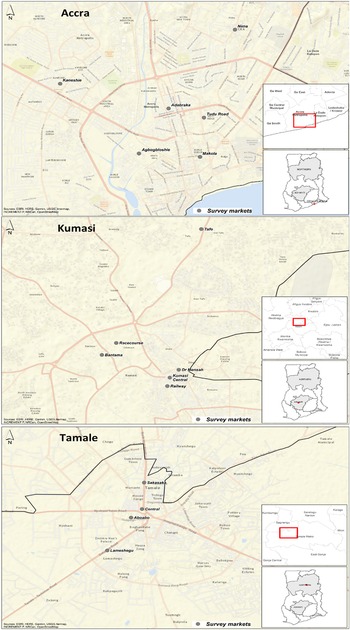
To examine levels and determinants of trust in Ghana's local governments, a survey was conducted with over 1000 food traders across 16 markets in the three cities. As seen in Figure 1, the markets were chosen to be distributed across different locations in the city to capture the experiences of those in central business districts versus informal settlements. To be proportional to size of population and numbers of markets, fewer markets were sampled in Tamale (4) than in Accra and Kumasi (6 each).
Map of Survey Locations in Accra, Kumasi, and Tamale.

Surveying informal traders can be much more complex than a typical household survey due to the density of respondents and the lack of census information about the full set of shops, stalls and street hawkers.Footnote 5 The sampling approach aimed to ensure an equal mixture of respondents located properly within a market and those selling outside a market on the pavement or streets. This was because those outside of markets are potentially more vulnerable to harassment by government authorities since they operate on public sidewalks and streets. They also pay fewer taxes to the MMDAs but have less access to the services within the markets.
Every third food vendor was selected based on a random walk approach that ensured that even in market settings where there were multiple rows of vendors along the path or street, each one had a relatively equal chance of being selected rather than just those who were most accessible in the front row. To be eligible to be surveyed, the respondent had to have been at least 18 years old. There was no attempt at gender parity since that is not reflective of the broader population of food vendors in Ghana; except for meat, women disproportionately control food trade (Awo Reference Awo2012; Baah-Ennumh & Adom-Asamoah Reference Baah-Ennumh and Adom-Asamoah2012; FAO 2016). The full questionnaire and data are publicly available from IFPRI (2020).
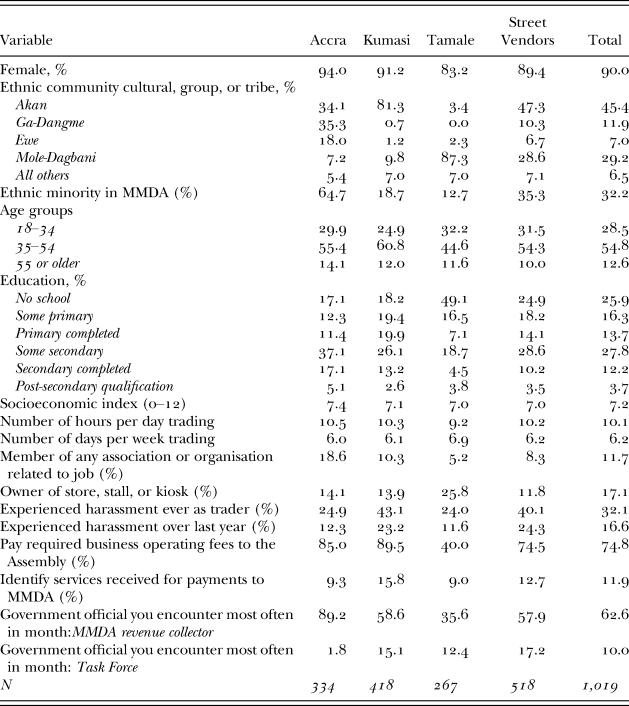
Table II provides profiles of the traders in the sample. Reflecting the lack of gender parity in the survey sampling, women comprise high shares of the sample and are equivalent to those found in other studies of informal food trade in Ghanaian cities (Baah-Ennumh & Adom-Asamoah Reference Baah-Ennumh and Adom-Asamoah2012; FAO 2016). The distribution of traders by ethnicity is equivalent to the ethno-linguistic profile in their respective cities. For example, the Akan and Mole-Dagbani are the dominant communities in Kumasi and Tamale, respectively. Accra is a more diverse city, with a higher share of ethnic minorities, but the indigenous Ga still comprise a plurality of the vendors. A socioeconomic index captures whether a respondent's household has access to up to 12 different services and assets: radio, television, bicycle, vehicle (car or motorbike), refrigerator, mobile phone, computer, electric fan, electric/gas stove, piped water, flush toilet and rubbish collection. On average, most people have access to seven of these services and assets, and there is relatively little difference in socioeconomic status among vendors across cities. In Accra and Kumasi, a large proportion of vendors have at least some secondary education, while almost 47% of respondents in Tamale have not had any schooling. Associational membership is objectively low across all three cities but relatively higher in Accra.
Descriptive Statistics, Means

Source: IFPRI (2020), Informal Food Retail Trade in Ghanaian Cities survey.
Table II further highlights whether they have experienced what we classify as ‘harassment’ by authorities from their MMDA during both their entire time as a trader and also during the 12 months previous to the time of the survey. Such harassment encompasses three forms of behaviours. The first is confiscation of merchandise by authorities that can occur when traders sell unsafe or expired foodstuffs, or if they are selling without a permit and have not paid their required fees to the MMDA. The second is forcible re-location, which can occur when traders are selling in a market targeted for upgrading, hawking in public spaces that are proscribed by the by-laws, or vending in an unsafe location, such as near railroad tracks or under electricity pylons. The third, which was the least common for the sample, was being arrested for refusing to pay a fine levied for contravening by-laws or being a repeat offender. There are other forms of harassment that traders encounter, including requests for bribes from authorities to avoid confiscation of goods and sexual exploitation to avoid paying fees (Osei-Boateng Reference Osei-Boateng2019). However, due to the difficulty of measuring these types of exchanges through a survey instrument, they were not included. This implies that the levels of harassment reported here are most likely understated.
Experience with these collective forms of harassment is highest among the street vending sample, which is not surprising given that they are more likely to attract authorities’ attention due to operating on public space. They have a higher share of respondents whose most frequent engagement with a local government official in a typical month is the Task Force. Moreover, 41% of the traders in Kumasi had experienced harassment over their lifetime, and 23% had so just in the previous 12 months. This resonates with secondary literature that emphasises the particularly draconian approach that successive mayors of Kumasi have pursued. As Clark (Reference Clark, Hansen, Little and Clark2013: 29) observes, ‘Government crackdowns on street vendors in Kumasi, Ghana, have been repeated so often that their occurrence requires less explanation than their absence’ (see also Obeng-Odoom Reference Obeng-Odoom2011).
Importantly, harassment may be the consequence of the MMDA's legal enforcement of regulations or an abuse of office by such authorities; in other words, it may or may not be warranted by MMDA by-laws. The important factor here is that such actions typically are perceived as being unjust, as noted by the following quotes:
I was just there, and a police officer came to arrest me for no reason.Footnote 6
I left this present trading place to my daughter while I travelled and when I came back, they [the Task Force] had come to destroy my table and destroy the pot the koko was in.Footnote 7
My things were thrown away like some rubbish by the Task Force.Footnote 8
KMA [Kumasi Metropolitan Assembly] should stop seizing our goods because that is what we are using to take care of our kids.Footnote 9
Task Force are always on our neck, seizing our goods and giving them out to prisoners. Sometimes too they throw them [the goods] into the gutters.Footnote 10
Another difference among the three cities is that traders are more likely to pay the required fees to the MMDA in Accra and Kumasi than in Tamale. Following Resnick (Reference Resnick2021), payments were assessed based on a multi-tiered set of questions that included whether the MMDA regularly requests payments from the respondent due to their trading activities, how much the payments are, and whether they can make the payments and if not, why not. Only those who affirmed they were always able to do so are coded as paying their fees. The reported survey trends largely support the pattern in Table I that internally generated revenue garnered from traders through taxes on goods and services is much lower in Tamale. Those who do pay their fees to the Assembly were subsequently asked if they could attribute a benefit they receive in return for those payments. The services identified by traders ranged from maintaining market cleanliness to security services to access to a consistent trading spot.
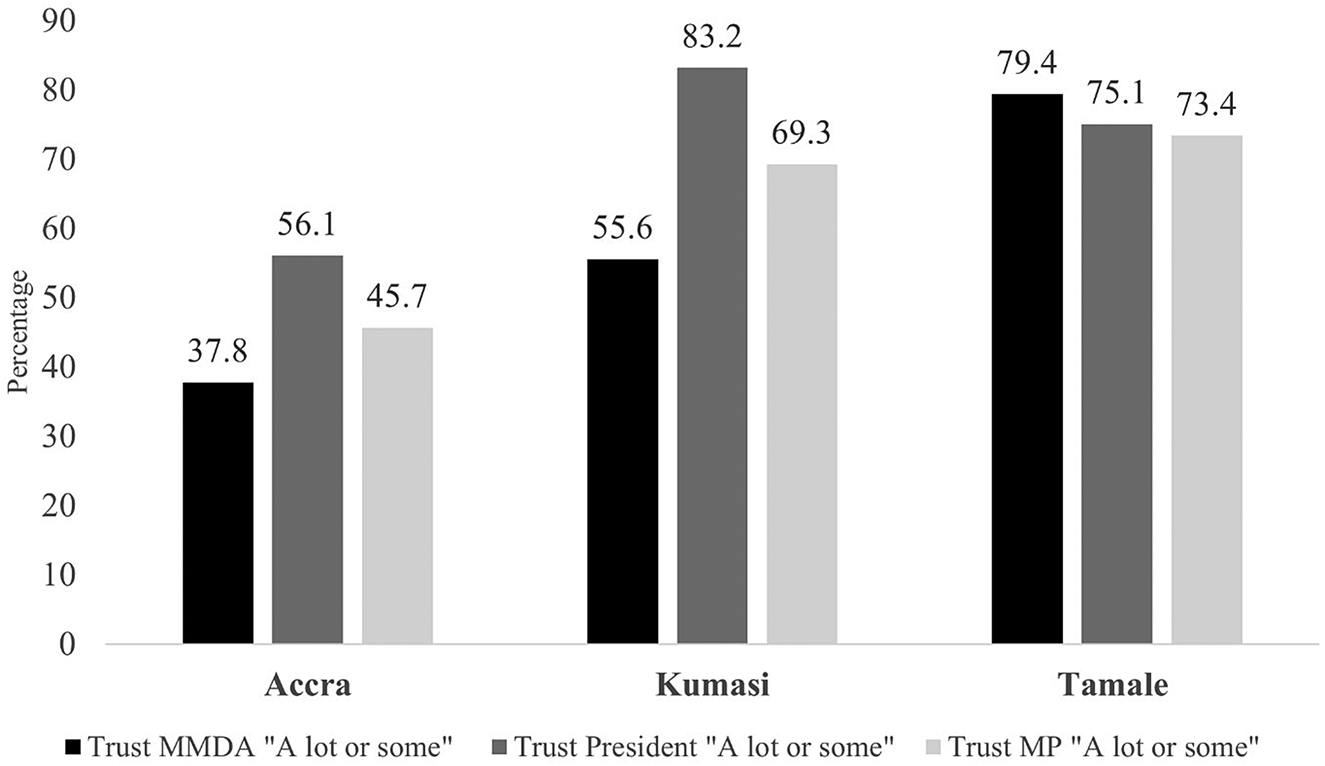
Figure 2 examines the levels of trust that respondents have in their MMDAs. Importantly, the survey questionnaire avoided any attempts at priming respondents by including all questions about trust in different political authorities at the end of the survey and after several modules on topics, such as dietary diversity and food safety, that are unrelated to the hypotheses examined in this paper. Specifically, respondents were asked: ‘How much do you trust your MMDA?’ They could give a response along a Likert scale of ‘not at all, a little, and a lot’. Figure 2 aggregates the latter two categories into a dichotomous variable to capture those who trust their MMDA at all. This is the most common way that trust is measured in much of the literature, which draws on either World Values Surveys or the Afrobarometer, Latinobarometer and Arabarometer surveys (Inglehart Reference Inglehart2003; Sacks Reference Sacks2011; Brinkerhoff et al. Reference Brinkerhoff, Wetterberg and Wibbels2016; Mattes & Moreno Reference Mattes, Moreno and Uslaner2018).
Variations in Trust across Ghanaian Cities, Per cent who Agree (N = 1,019).

Figure 2 demonstrates two key trends. First, trust in one's MMDA varies considerably across the three cities. Second, local trust is not simply derivative from national trust. As argued by Cook et al. (Reference Cook, Hardin and Levi2005), trust is domain-specific and varies by tasks that can be under mandates of different levels of government. National and local trust may operate independently, especially in settings where local governments have substantial autonomy to make and implement policies in specific domains (see Jennings Reference Jennings1998). Furthermore, citizens may distinguish between politicians, who are responsible for developing public policies, and civil servants or public administrations in charge with policy implementation (Denters et al. Reference Denters, Gabriel, Torcal, van Deth, Montero and Westholm2007; Schnaudt Reference Schnaudt2019).
In Ghana, where market trade and street vending are decentralised to local governments, it seems plausible that MMDA activities that affect traders – who devote on average six days of the week and more than 10 hours each day to their jobs (see Table II) – would strongly condition their assessments. Moreover, the other functional mandates that MMDAs have, such as over agricultural extension, would not be as relevant or visible to informal traders. Indeed, Figure 2 emphasises that, especially in Accra and Kumasi, respondents drew a clear distinction between nationally elected leaders, such as the president and a member of parliament, and the institution of the local MMDA.
EMPIRICAL STRATEGY
Dependent variable
To explain the above variation in political trust among informal traders across these three cities with varying objective capacity levels, a logit analysis was conducted to determine the likelihood that respondents claim they trust their MMDA ‘a lot or a little’ instead of ‘not at all’. Recognizing that a great deal of scholarship focuses solely on the measurement of trust (see Bauer & Freitag Reference Bauer, Freitag and Uslaner2018), the operationalisation of the dependent variable in this way is not trivial. It suggests a strict differentiation between those who trust and those who do not, but it does not capture the intensity of that trust. Uslaner (Reference Uslaner, Lyon, Mollering and Saunders2012) argues that a dichotomous approach is preferable because survey respondents often disproportionately choose interim categories as a way of avoiding a clear articulation of their beliefs and therefore that movement from one interim category of the scale to another is not substantively meaningful.Footnote 11
Independent variables
To examine our three main hypotheses – reciprocity, procedural justice and civic engagement – we include several measures. First, we include whether respondents report paying required fees to their respective MMDA. This fee payment refers to the business operating permits discussed earlier, which vary by stall type, market and city and are intended to improve water, sewage, electricity, sanitation and security services in the markets. Those who have paid presumably are more likely to have stronger expectations than those who do not pay about their MMDA's ability to deliver services. Based on the reciprocity hypothesis, we assume that those who can identify a benefit they receive for their fee payments would likely be more trusting of their MMDA. As a result, we incorporate an interaction term for those who claim to have paid their requisite fees and can identify what exactly they believe they receive in return for such payments.
To examine the effects of procedural justice, we focus on two measures. The first encompasses whether respondents experienced any type of harassment by their MMDA in the 12 months prior to the survey. This dummy variable reflects whether a trader experienced any of the following three types of targeting by authorities: seizure of merchandise, forcible relocation and arrest for violating trading laws. Respondents were also able to answer an open-ended question about whether there were other types of harassment they had experienced over the last year by authorities. All the responses to this open-ended question corresponded to the three types of targeting listed above, but the responses often provided more context, as shown in the quotes provided in the previous section. Since a one-time negative experience with harassment may not sufficiently affect perceptions of procedural injustice, we also examine whether and which types of government officials a respondent engages with the most during a typical month. We code into a dummy variable those who identify an Assembly bureaucrat, including a revenue collector, health inspector or Task Force member, versus no interaction with the MMDA at all. By looking specifically at engagement with MMDA officials, we have greater confidence that we are controlling for local level experiences. To determine the role that civic engagement plays in shaping trust of traders, a dummy variable is included to account for whether a respondent is a member of a trader's association.
Controls
Traditional demographic controls were also included. Following LeBas (Reference LeBas2020), we include whether a respondent is an ethnic minority within the city, which she argues can reduce trust if minorities are excluded from patronage or experience weaker affective ties with local elected officials. Furthermore, we include a dummy variable for whether a respondent has completed secondary education or beyond. In industrialised countries, some research shows that distrust is higher among those who are less educated (Putnam Reference Putnam2000). Others, however, find that the more educated tend to be more critical of state institutions because they may have higher expectations of how the state should perform (Inglehart Reference Inglehart2003; Sanchez & Senderowitsch Reference Sanchez and Senderowitsch2012). Other controls include gender, youth age group (ages 18–34), and whether a respondent owns her/his store, stall or kiosk. The latter stands as a proxy for socioeconomic status since poorer traders typically rent rather than own their trading unit.
FINDINGS
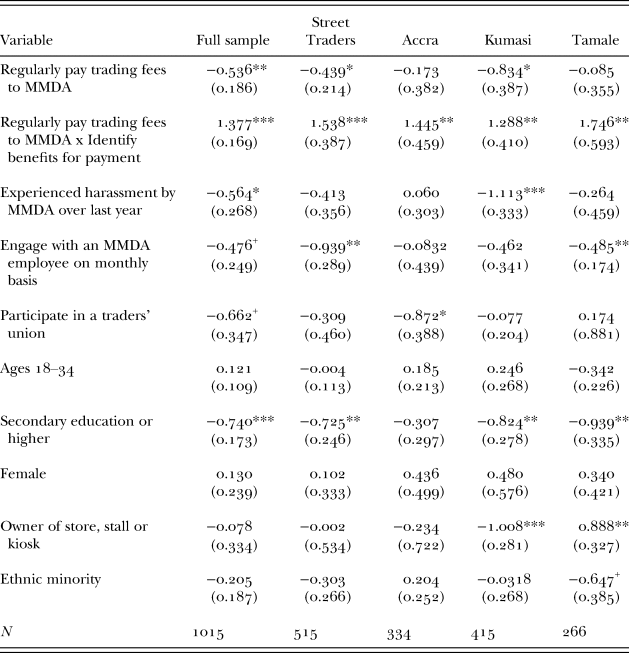
Table III presents the findings for five samples. The first model includes all traders aggregated together while the subsequent one targets traders who are located outside on the streets and pavement. The last three models isolate the samples for each city. Typically, subnational administrative units are relegated to dummy variables or fixed effects in statistical analyses due to underlying heterogeneity. However, since we are precisely interested in how differences in local governance affect trust, our analytical approach allows us to examine how local authorities’ actions are interactive with citizens’ experiences and expectations.Footnote 12 To address other potential heteroscedasticity issues, standard errors are clustered at the market level using bootstrapping to account for the relatively low number of markets per city (see Huang Reference Huang2018).
Logit Analysis of Drivers of Trust in Local Government

Notes: Cluster bootstrapped standard errors in parentheses. Four respondents could not identify their education levels, accounting for the small change in sample size for the full sample.
+p < 0.10, * p < 0.05, ** p < 0.01, *** p < 0.001.
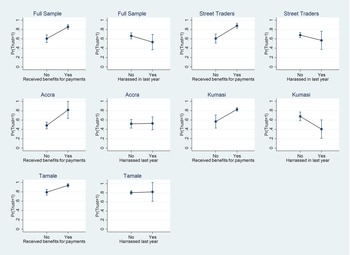
Table III indicates that just paying the requisite fees to the MMDA is significantly and negatively associated with trust for the full sample, street traders and in Kumasi. Yet, paying the fees and being able to identify a benefit in return is correlated with a higher likelihood of trust in local government across all samples, affirming the reciprocity hypothesis. Figure 3 presents the predicted probabilities for attributing a benefit to fee payments, keeping all other variables at their means. A predicted probability captures the magnitude of the impact of a particular independent variable on the dependent variable. Specifically, for the entire sample, the predicted probability of trusting one's MMDA increases from 60% to 86% if the trader can attribute a benefit to their fee payments compared with someone who does not. The difference is particularly pronounced for those in Accra, going from 48% to 80% if the respondent can identify a benefit. This corresponds with the trends in Table II, which show that traders in Accra exhibit a high degree of compliance with fees, but only 9% claim they can identify services for their payments. Since 89% claim they come into contact the most with revenue officers every month, attribution to the MMDA for benefits received or not for payments is presumably quite high.
Trust in MMDA, Predictive Probabilities.

Perceptions of procedural justice demonstrate disparate impacts. While harassment is associated with a decline in trust for the full sample, this pattern is most pronounced in Kumasi. In fact, a trader in Kumasi who has been harassed in the last year has a 42% probability of trusting their MMDA compared with 69% for someone who has not, holding all other variables at their means. This is not surprising given the city's history and the fact that a quarter of its traders reported harassment just in the year prior to the survey. Street traders are the most likely to distrust the MMDA if they engage with an MMDA employee more frequently, suggesting that such interactions may be confrontational; indeed, as highlighted in Table II, 17% of street traders reported that their main form of interaction with the MMDA was through the Task Force. In other words, even if they did not have merchandise confiscated or experience relocation or arrest, the exchanges with the MMDA have not been a positive experience for these traders. Interestingly, the same pattern upholds for those few Tamale traders who do engage with an MMDA employee on a monthly basis (less than 50%).
Participation in a traders’ union generates some surprising results. Membership in a traders’ association translates into lower political trust, particularly in Accra and among inside traders. This suggests that the way in which the union mediates relationships with the local government is deserving of more attention. We are disinclined to believe that this relationship is due to reverse causality, i.e. that respondents join an association because they distrust the government. Participation in such associations is largely commodity based (see Awo Reference Awo2012), with 80% of those in our sample who do belong to an association selling fresh food, especially fruits and vegetables. Instead, the strong negative relationship is likely due to the long history of acrimony between such associations and the Accra MMDA (Bob-Milliar & Obeng-Odoom Reference Bob-Milliar and Obeng-Odoom2011; Beek & Thiel Reference Beek and Thiel2017). As noted by Uslaner (Reference Uslaner2002), associations may improve particularised trust in those who are ‘like us’ but may not necessarily improve political trust. The most consistently important demographic control is education. More educated respondents are less trusting of their MMDAs in all five models, giving support to the view that they may expect more from their local governments than their less educated counterparts.
DISCUSSION AND CONCLUSIONS
The trust of informal traders in their MMDAs is strongly associated with their past experiences of reciprocity and procedural justice. Paying requisite taxes, fees and licences can be associated with trust if respondents can identify benefits from government authorities in exchange for such payments. Such exchanges have been at the cornerstone of the social contract between national governments and citizens, and they appear to be just as salient at the subnational level as well. This mechanism affected trust in all three cities examined here, but it was most pronounced in Accra where a high share of traders reported paying their requisite fees to revenue authorities and where the capacity for revenue collection is comparatively higher.
Furthermore, political trust is undermined by perceptions of discrimination by political authorities who are perceived to not enforce laws relevant to informal food trade in an impartial manner. Experience with harassment can affect whether one views political authorities as legitimate representatives of the needs of the urban poor. This dynamic was especially significant among street traders and in Kumasi where a higher share of traders reported interacting with the Task Force than in the other cities.
Notably, these trust assessments were not clearly correlated with capacity. Trust was highest in Tamale, which has the lowest rates of revenue collection from traders and the lowest ratio of Task Force officials to vendors. This supports other studies focused at the national level that argue that trust is not purely a metric of objective service provision that would reflect a state's level of human and financial resources (McLoughlin Reference McLoughlin2015; Brinkerhoff et al. Reference Brinkerhoff, Wetterberg and Wibbels2016).
As decentralisation and urbanisation enhance the political, administrative and fiscal autonomy of subnational governments (Stren Reference Stren, John, Mossberger and Clarke2012), cities increasingly represent important sites of alternative forms of political authority. As noted by Levi & Stoker (Reference Levi and Stoker2000: 495), ‘All citizens enter into a relationship with their national government in that they are bound by its laws. Still, the ordinary relationships that citizens have with political authorities are most likely to be local in focus. They involve local problems, if not local authorities, though perhaps usually both.’
As many countries in Africa and elsewhere continue to deepen their decentralisation processes (OECD/UCLG 2016), trust can be a critical factor in determining whether the goals of enhanced political participation and engagement integral to decentralisation actually materialise. Particularly for the urban poor, perceiving local governments as fair and responsive to their needs, and not just to those of the affluent, will be key for forging inclusive cities. While the current study focused on this for traders, it is equally relevant for the region's slum dwellers, informal transport providers, and others with vulnerable livelihoods whose contributions are nonetheless central to urban economies.
More broadly, the study suggests that important nuances are lost by failing to examine subnational variations in outcomes of interest, especially in countries where local governments have substantial autonomy to make policy decisions. Currently, there are few cross-city comparisons of urban governance in developing country settings. Yet, as global development initiatives continue to endow city governments with agenda-setting authority over major policy goals (Barber Reference Barber2014; Schragger Reference Schragger2016), it is increasingly necessary to understand whether local governments are viewed as legitimate and responsive entities by their heterogeneous constituencies to deliver on these goals.
Competing interests
The authors declare none.