Young Canadians emerged as an active and powerful voting group that helped propel the Liberal party to victory in the 2015 federal election (Coletto, Reference Coletto2016). Turnout among 18- to 24-year-olds rose from 38.8 per cent in 2011 to 57.1 per cent in 2015—the largest increase of any age group. Despite these encouraging signs, the youngest members of “Generation Y”Footnote 1 voted at rates more than 21 points lower than Canadians aged 65 to 74 years (Elections Canada, 2016a).
Cultural displacement theorists have argued that conventional, duty-based political actions such as voting have become less appealing to younger generations, who prefer informal political acts that privilege self-expression and eschew long-term commitments to hierarchical organizations and ideologies (Loader, Reference Loader and Loader2007; Bennett et al., Reference Bennett, Wells and Rank2009). Indeed, acts of political consumerism such as boycotts and buycotts have grown in Western democracies and are often important for young people (Micheletti and Stolle, Reference Micheletti and Stolle2008). In Canada, 18- to 34-year-olds are more likely than older individuals to take part in a protest or demonstration, to circulate or report political information on social networking sites, to use email or instant messaging to discuss societal and political issues, to blog about a political issue and to participate in online groups that discuss public affairs (Samara Canada, 2013).
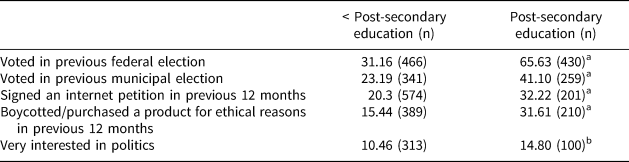
Scholars have closely monitored youth disengagement from voting and the diversification of their political behavior. Studies that are sensitive to the internal heterogeneity of the youth population are less common and have overlooked the deep democratic divide between youths with different levels of educational attainment. About 65 per cent of 18- to 24-year-olds with a post-secondary degree or diploma voted in the 2011 federal election, compared to just 31 per cent of their age peers who had not completed their tertiary education. A similar pattern was observed in the 2010 United Kingdom election, where 18- to 34-year-olds with a degree reported voting at rates 31 points higher than their peers with secondary school or lower qualifications (Berry and Mcdonnell, Reference Berry and Mcdonnell2014). At the municipal level, Canadian youths who had completed their tertiary education voted at almost twice the rate of those who had not. Informal political activism was marked by the same inequalities; 15- to 24-year-olds with a completed post-secondary education signed internet petitions and participated in boycotts and buycotts at twice the rate of their peers with less formal education (Tossutti, Reference Tossutti2016).
The link between education and political engagement is well established (Nie et al., Reference Nie, Junn and Stehlik-Barry1996; OECD, 2011). Schools have a critical role to play in enhancing youth civic literacy, including knowledge about decision-making institutions and the positions of political actors on relevant issues (Milner, Reference Milner2002). Yet formal education is not the sole agent of political socialization. Internationally, there is a robust debate about the political significance of social capital. In his widely cited book Bowling Alone, Putnam argued that social capital, or the “social networks and norms of reciprocity and trustworthiness that arise from them” (Reference Putnam2000: 18) can lead to positive outcomes for society, including higher rates of political and civic engagement. Researchers have found evidence of this positive relationship in several democracies, while others have contended that the political significance of social connections is modest, uneven or non-existent, depending on the country or group examined.
This article draws on the results of the 2013 General Social Survey to investigate whether offline and online forms of social capital are positively associated with the participation of 15- to 24-year-old Canadians in formal and informal political activities, and with their political engagement. In doing so, it will contribute to the sparse literature on the political relevancy of social capital for young Canadians and reveal whether social ties can help address the democratic divide between youths with different educational qualifications.
The Political Significance of Social Capital
In various works, Putnam has conceptualized social networks as consisting of formal involvements in voluntary organizations (Reference Putnam, Leonardi and Nanetti.1993), as well as more informal, everyday types of sociability (Reference Putnam2000). Social capital researchers have argued that participation in civic organizations develops the capacities, motives and relationships necessary for political involvement (Verba et al., Reference Verba, Schlozman and Brady1995), creates a common vision of society among members, broadens those members’ sphere of concerns to include social and political issues, and connects them to more possibilities for political recruitment (Hart et al., Reference Hart, Donnelly, Youniss and Atkins2007; Quintelier, Reference Quintelier2008).
Adult participation in voluntary associations has been positively associated with voting in local and national elections, joining a party, discussing and taking an interest in politics, attending meetings, and contacting political officials (Verba and Nie, Reference Verba and Nie1972; Olsen, Reference Olsen1972; Rogers et al., Reference Rogers, Bultena and Barb1975; Verba et al., Reference Verba, Schlozman and Brady1995). In Canada, members of voluntary organizations were more likely to vote in federal elections and join parties (Pammett and LeDuc, Reference Pammett and LeDuc2003; Gidengil et al., Reference Gidengil, Blais, Nevitte and Nadeau2004). Associational involvements and social networks were the best predictors of political participation for the Canadian-born, early immigrants and immigrants who arrived between 1970 and 1989 (Nakhaie, Reference Nakhaie2008). For immigrants and ethnic minorities, high levels of formal interaction (that is, membership in a recreational group, voluntarism, attendance at religious services) have been associated with higher odds of voting in federal and provincial elections (Bevelander and Pendakur, Reference Bevelander and Pendakur2009). In Sweden, Germany and the United States, members of voluntary associations were more likely than nonmembers to engage in political contacting (Stolle and Rochon, Reference Stolle and Rochon1998). In Sweden, they were more likely to make their political preferences known to the public through informal acts such as signing a petition, boycotts and demonstrations (Teorrell, Reference Teorrell2003).
Other studies have cautioned that the political significance of associational involvements is modest, negative or varies across organizational types. In western Europe, membership in social movement and political organizations was only weakly related to political interest, while membership in church-related groups and welfare organizations was associated with a decline in the perceived saliency of politics (Van Deth, Reference Van Deth2000). Membership in groups focused on external objectives (for example, interest groups, social movements, cultural and religious groups) has been more strongly linked to political participation than has membership in groups with entertainment or expressive goals, such as sports organizations and hobby clubs (Stoll, Reference Stoll2001). In Germany, Sweden and the United States, members of political, economic and community groups were most likely to be heavily involved in political and community participation (Stolle and Rochon, Reference Stolle and Rochon1998). Participation in community development groups was the only form of voluntary involvement consistently associated with contacting government officials in six Central American countries (Seligsen, Reference Seligsen1999).
For youth populations, associational life can contribute to the development of politically relevant attitudes and skills at a young age (Hanks and Eckland, Reference Hanks and Eckland1978; Verba et al., Reference Verba, Schlozman and Brady1995; Torney-Purta et al., Reference Torney-Purta, Barber and Richardson2004; Stolle and Hooghe, Reference Stolle and Hooghe2004). High school community service and extracurricular activities have predicted adult voting in local and presidential elections and volunteering later in life (Hart et al., Reference Hart, Donnelly, Youniss and Atkins2007). Echoing research on the general population, research on the political significance of youth associational involvement has found that it is contingent on the group type and its activities. In the United States, organizations that emphasized service, public speaking and identity representation (for example, community service, student council, drama clubs, musical groups and religious organizations) had a positive influence on political participation later in life (McFarland and Thomas, Reference McFarland and Thomas2006). A study of 16-year-old Belgian pupils found that political participation was most influenced by membership in cultural, deliberative and helping organizations aimed at assisting society, while civic participation was highly related to membership in helping and religious-ethnic organizations (Quintelier, Reference Quintelier2008).
In Canada, associational memberships were more closely related to the informal political activism and interest of 20- to 29-year-olds than to their electoral participation. No form of associational involvement was positively associated with youth turnout in the 2000 federal election, and young members of artistic, musical and cultural groups were actually less likely to vote, with all else held constant (Tossutti, Reference Tossutti2007). However, an index of informal activities (signed a petition, participated in a boycott, attended a demonstration, attended a meeting or rally, wrote a letter to a newspaper, or called a talk show) was associated with membership in organizations focused on external societal objectives, as well as entertainment and expressive goals. Youths involved in artistic, musical and cultural groups also expressed more political interest than nonmembers.
The political consequences of informal social networks outside voluntary organizations have attracted growing interest from scholars. The internet, for example, offers a public space for individuals to discuss politics and lowers the cost of political participation in terms of time and effort (Dmitrova et al., Reference Dmitrova, Shehata, Strömbäck and Nord2014). Online applications also provide users with access to large and often heterogeneous networks of people who can provide support, information and other resources relevant to politics (Quinn, Reference Quinn2016). Skeptics have observed that the internet does not seem to encourage political interest, so much as provide a route for those who are already engaged to pursue pre-existing interests (Bimber, Reference Bimber2003). Putnam has argued that time spent on electronic media, including the internet, leads to social isolation and reduces the available time to engage in civic and political activities (Reference Putnam2000).
A meta-analysis of current research found a positive relationship between social media use and political participation and knowledge, with panel studies less likely than cross-sectional surveys to report positive and statistically significant coefficients (Boulianne, Reference Boulianne2015). The web and other online applications are heavily used by young people and have transformed how they interact with each other and politics. Yet there is mixed evidence about the relationship between digital communities and youth political activism. A panel study of 15- to 27-year-old American youths found that online social interactions led to greater offline and online political activities (Kahne and Bowyer, Reference Kahne and Bowyer2018). In the Netherlands, online communication (primarily email and forum use) was positively, but modestly, related to the online and offline political participation of 16- to 24-year-olds, while social networking (chat and online communities) was not (Bakker and de Vreese, Reference Bakker and de Vrees2011). In Greece, maintaining a Facebook account had a negative effect on the offline and online political and civic participation of 18- to 35-year-olds (Theocharis and Lowe, Reference Theocharis and Lowe2016).
Trust is another important feature of social capital (Granovetter, Reference Granovetter1973). Associational memberships and social networks are said to increase generalized trust in strangers, which leads to political trust and higher levels of political participation (Putnam, Reference Putnam, Leonardi and Nanetti.1993). Scholars have explored the effects of generalized social trust and particularized trust in people of one's own kind, kin and close associates. An index measuring trust in others, family members and neighbours was a significant predictor of political participation for the Canadian-born and immigrants who arrived between 1970 and 1989, but not for earlier and later arrival cohorts (Nakhaie, Reference Nakhaie2008). In the United States, generalized trust in strangers predicted volunteering and charitable giving but was unrelated to turnout and only marginally and positively related to signing petitions (Uslaner and Brown, Reference Uslaner and Brown2005). The consequences of particularized trust have varied across geographic and historical contexts. It has arguably exerted a negative impact on civic life in southern Italy (Banfield, Reference Banfield1958; Putnam, Reference Putnam, Leonardi and Nanetti.1993), but family ties were positively linked to civic engagement in some northern Italian towns (Cento Bull, Reference Cento Bull2000). In Canada, immigrants who expressed more trust in family members were significantly less likely to have voted in federal, provincial and municipal elections (Tossutti et al., Reference Tossutti, Wang and Kaas-Mason2008).
International scholarship on the political relevancy of social capital has produced conflicting results that vary across geographic and historical contexts and subpopulations, as well as across the forms of social capital and political activities examined. With some exceptions, literature on its significance for young Canadians is thin. In light of these challenges, the following hypotheses have been derived on the basis of the most relevant or dominant research findings:
Previous research on 20- to 29-year-old Canadians found no relationship between turnout in the most recent federal election and most types of organizational involvements.
Hypothesis 1:
Youth involvement in all forms of voluntary organizations will be unrelated to turnout, with all else held constant.
Youth-based research in Belgium and Canada has found that membership in different types of voluntary organizations, including those with external objectives aimed at helping society and those with in-group goals focused on entertainment or the expression of identities, is associated with informal political activism or political interest.
Hypothesis 2:
Youth involvement in different types of voluntary organizations will be related to informal political activism, with all else held constant.
Hypothesis 3:
Youth involvement in different types of voluntary organizations will be related to higher levels of interest in politics, with all else held constant.
Most research has suggested a generally positive relationship between social media use and political participation and knowledge.
Hypothesis 4a:
Youths who communicate frequently through internet-based media will be more likely to vote, with all else held constant;
Hypothesis 4b:
Youths who communicate frequently through internet-based media will be more likely to engage in informal political activism, with all else held constant;
Hypothesis 4c:
Youths who communicate frequently through internet-based media will express more interest in politics, with all else held constant.
Studies of the relationship between generalized and particularized forms of trust and political participation provide no clear guidance for a directional hypothesis regarding young Canadians.
Hypothesis 5a:
Social trust will be unrelated to youth voting, with all else held constant;
Hypothesis 5b:
Social trust will be unrelated to informal political activism, with all else held constant;
Hypothesis 5c:
Social trust will be unrelated to political interest, with all else held constant.
Data, Measures and Analytical Methods
Statistics Canada's 2013 General Social Survey (Social Identity) featured an oversample of youths and items measuring social capital and political engagement, making it uniquely suited for testing these hypotheses. The random survey was administered by telephone and internet between June 2013 and March 2014 to 27,534 people aged 15 years and over living in private households in 10 provinces. Of those respondents, 3,486 were aged 15 to 24 years. The proportion of young people in the survey sample (12.6 per cent) is similar to census estimates of the proportionate size (12.1 per cent) of Canada's 15- to 24-year-old population (Statistics Canada, 2016). Coding information for the dependent, independent and control variables is available in the appendix.
Early typologies of political participation emphasized formal activities, including voting, participating in campaigns, contacting public officials and participating in communal activities (Verba and Nie, Reference Verba and Nie1972) but have broadened to include informal acts such as signing petitions, participating in demonstrations, political consumerism and online activism (Vissers and Stolle, Reference Vissers and Stolle2014). In light of evolving conceptions of political participation, questionnaire items were chosen to measure formal and informal political action. Voting is the most fundamental act of democratic participation and was measured with two dichotomous items administered to eligible citizens aged 18 years and over: reported turnout in the most recent federal and municipal elections. Informal political activism was measured with two dichotomous items administered to respondents aged 15 years and over: whether they had signed an internet petition in the previous 12 months, and whether they had participated in a boycott or had purchased a product for ethical reasons (buycott) in the previous year.
The dependent construct of political engagement is distinct from, but connected to, political participation. Cognitive political engagement refers to attachments to the political system, including whether an individual is interested in politics and seeks political information (Carreras, Reference Carreras2016). Having an interest in politics is important because it underpins how much people know about politics, which then provides the basis for opinions that may influence political participation (Emler, Reference Emler, Barrett, Flood and Eade2011). For these reasons, a four-category ordinal item tapping into levels of interest in politics, with values ranging from “very interested” to “not interested at all”, was selected to measure political engagement.
Putnam's notion of the independent construct of social capital consists of structural components (institutions and networks) and cultural components (social norms—particularly trust). The political consequences of associational involvements have received the most attention, with scholars distinguishing between externally oriented voluntary organizations and those serving primarily inward-looking interests or identities. This study operationalizes associational involvements with items measuring whether the respondent was a member or participant in three types of external associations (political parties, school group/neighbourhood/civic or community associations, and service clubs) and three types of organizations focused primarily on recreational or expressive objectives (cultural/educational/hobby groups, religious groups, and immigrant/ethnic associations).
Social ties may also form outside the domain of voluntary organizations, through everyday communications. Since younger Canadians are more likely than older Canadians to use online media to learn about politics and to discuss and share content related to political issues (Samara, 2015), this study measured informal ties with two items: the frequency of internet-based communication (including email, social media, instant messaging and Skype) with relatives in the past month and the frequency of internet-based contacts with friends over the same time period. Contacts with family were considered separately from friendship networks for two reasons: the first pertains to the centrality of family as an agent of political socialization (Verba, Schlozman and Brady, Reference Verba, Schlozman and Brady1995); the second stems from intellectual disagreement about the civic impact of family attachments, as discussed in the literature review.
The cultural component of social capital has been operationalized with measures of trust that have been used in Canadian research (Nakhaie, Reference Nakhaie2008). This approach has been replicated by selecting questions measuring how much respondents trusted people in general, how much they trusted their families, how much they trusted their neighbours, and whether they lived in a neighbourhood where neighbors helped each other.
In order to establish the context for the research question, statistics are presented first that compare the political participation and engagement rates of Canadians aged 24 years and under relative to older Canadians, and of youths with and without a tertiary diploma or degree. Multiple regression analysis was then employed for hypothesis testing. The binary logistic regression model was used to analyze the dichotomous outcome variables of electoral turnout, signing an internet petition and political consumerism. With binary outcomes, estimates derived from conventional logistic regression are preferable to linear probability models, which tend to produce inefficient parameters and biased standard errors. Ordered logit was used to analyze the ranked categories of political interest (Long, Reference Long1997). Probabilities were modelled over the lower values of political interest, which in this survey corresponded with the “very interested” responses.
The independent variables were grouped into four blocks that were consecutively entered into the regression (Miller and Shanks, Reference Miller and Shanks1996). The variables entered in the first block were control variables known to influence political engagement: education, gender, income, immigrant status and political interest. Other variables that are known to affect youth turnout, such as a sense of civic duty and administrative barriers, were not available in the General Social Survey. The second block was formed by measures of associational involvements, the third by the online social network measures and the fourth by measures of generalized and particularized trust. Diagnostics were conducted to eliminate possible issues related to multicollinearity. Since the General Social Survey uses a multistage survey design and calibration, the bootstrap method was used to calculate variance estimates (Statistics Canada, 2015). The SAS program was used to compute variances with the help of 500 bootstrap weights provided with the microdata file. Only quality estimates with a coefficient of variation between 0 and 16.5 per cent are reported.
This article acknowledges the limitations of using cross-sectional survey data to draw conclusions about causal relationships, although some studies have shown that involvement in voluntary associations precedes political participation (Teorrell, Reference Teorrell2003; Olsen, Reference Olsen1972). A correct specification of a causal relationship would require longitudinal panel data, where the same subjects are repeatedly asked about their social capital resources and political behavior. A second limitation is that it is impossible to untangle whether differences in outcomes can be attributed to social capital or to self-selection effects. In other words, people who engage in political affairs may also be more inclined to join voluntary organizations, to socialize and to trust. To the best of the author's knowledge, there are no Canadian survey datasets with a youth oversample that would allow for a definitive testing of causal relationships. For these reasons, this article interprets relationships and coefficients, rather than effects.
Social Capital and Youth Political Participation and Engagement: Promise Realized?
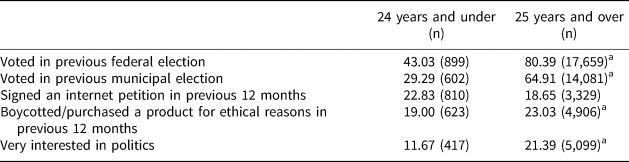
A bivariate analysis confirmed the long-established pattern of lower rates of youth participation in federal elections and political interest (Gidengil et al., Reference Gidengil, Blais, Nevitte and Nadeau2004). In 2013, Canadians aged 24 years and under were significantly less likely than older Canadians to have voted in the previous federal and local elections and to express a lot of interest in politics (Table 1). They were also less likely to have engaged in acts of political consumerism, contrary to the expectations of cultural displacement theorists (Table 1). Although 15- to 24-year-olds were more inclined to sign an internet petition, only 22.8 per cent did so in the previous year, and the gap with their older cohorts was not large. While the nature of youth political participation is diversifying, an age gap on four of these five measures remains. Table 2 shows that young Canadians who had completed a post-secondary diploma or degree were significantly more likely to participate in all types of political activities and to express more interest in politics than were their peers with less education. The patterns displayed in these tables raise the question of whether social capital can serve as a politically relevant resource for young people, in general, and for youths who have not completed tertiary education, in particular.
Political Participation and Interest by Age (column percent)

ap ≤ .0001.
Youth Political Participation and Interest, by Level of Education (column percent)

ap ≤ .0001; bp ≤ .01.
Local and federal turnout
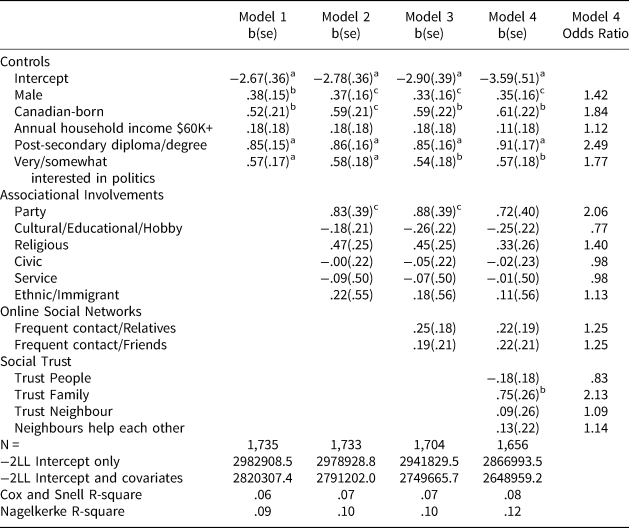
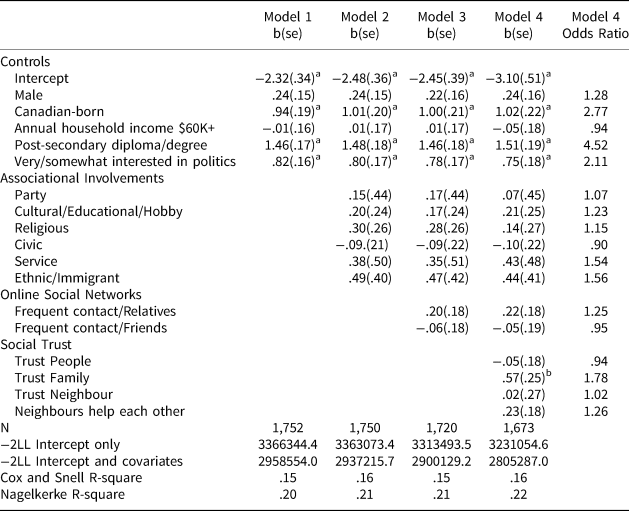
Social capital resources were generally unrelated to formal political participation, with all else held constant. No form of associational involvement was significantly related to a higher likelihood of voting in the previous federal and municipal elections, confirming Hypothesis 1 (Table 3 and 4). Despite research showing that online communications are positively associated with offline political participation, they were irrelevant for youth voting in Canada. Thus, contrary to the expectations of Hypothesis 4a, youths who used the internet to contact their friends and relatives at least once a week or more were no more likely to vote at any level than less frequent contacters. Trust proved to be more critical than any other form of social capital. Youths who expressed above-median levels of trust in their relatives were more likely to vote locally and federally than were their peers who expressed less trust. Intriguingly, no other form of trust outside the family circle was positively related to voting at any level. Together the findings regarding the political significance of trust provide partial support for the null hypothesis (Hypothesis 5a).
Binary Logistic Regression Analysis of Turnout in Previous Municipal Election (18- to 24-year-olds)

ap ≤ .001; bp ≤ .01; cp ≤ .05.
Binary Logistic Regression Analysis of Turnout in 2011 Federal Election (18- to 24-year-olds)

ap ≤ .001; bp ≤ .01; cp ≤ .05.
Informal political activism
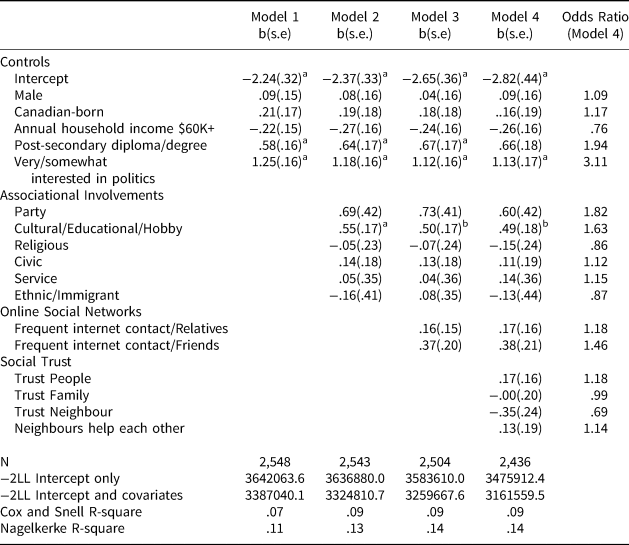
Social capital was more closely related to informal political participation. While involvements in externally focussed organizations were unrelated to signing internet petitions, members of a cultural, educational or hobby group—an in-group focussed on entertainment and expressive goals—were more likely to have signed such a petition in the previous year (Table 5). Together the findings provide partial support for Hypothesis 2. As with voting, frequent internet-based contacts with friends and relatives were unrelated to signing an internet petition, leading to a rejection of Hypothesis 4b. No measure of generalized or particularized trust was related to signing an internet petition, supporting Hypothesis 5b.
Binary Logistic Regression Analysis of Signed an Internet Petition in Previous Year (15- to 24-year-olds)

ap ≤ .001; bp ≤ .01; cp ≤ .05.
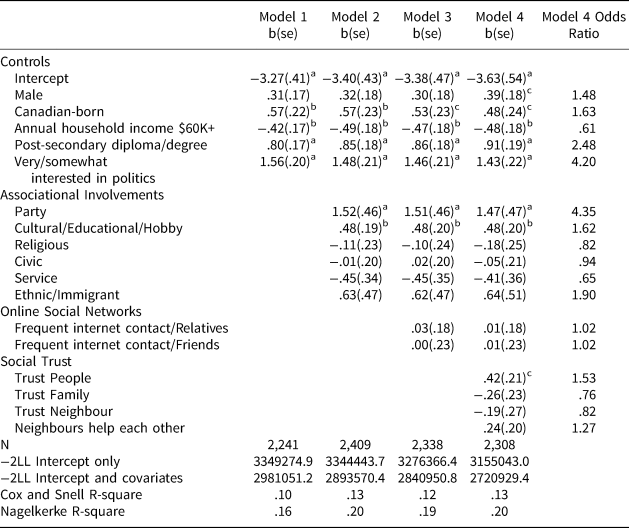
Social ties were most often associated with political consumerism (Table 6). Youths who were involved with political parties and with cultural, educational and hobby groups were more likely to have participated in a boycott or buycott. This supports the expectations of Hypothesis 2 concerning the positive relationship of voluntary organizations that serve both external and in-group goals with informal political activism. Contrary to Hypothesis 4b, frequent internet-based communications with relatives and friends was unrelated to political consumerism. Those who agreed that most people in general can be trusted were more likely to have participated in a boycott or buycott, while trust in family or neighbours was irrelevant. When considered together, these findings provide partial support for Hypothesis 5b.
Binary Logistic Regression Analysis of Participated in a Boycott/Purchased a Product for Ethical Reasons in Previous Year (15- to 24-year-olds)

ap ≤ .001; bp ≤ .01; cp ≤ .05.
Political engagement
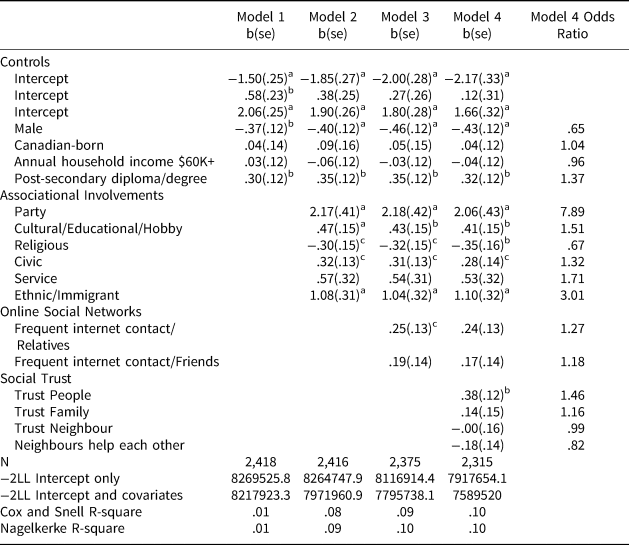
Associational involvements demonstrated their greatest potential with respect to political interest (Table 7). Youths who were members of external organizations (political parties and civic groups) or expressive in-groups (cultural/educational/hobby and ethnic/immigrant associations), expressed more interest in politics than did nonmembers. Although youths who were involved with religious groups were significantly less likely to find politics interesting, the results generally support Hypothesis 3. Once again, frequent internet-based communications with relatives and friends were unrelated to political interest, leading to a rejection of Hypothesis 4c. Youths who felt that most people can be trusted were more likely to say they were very interested in politics compared to those who said “you cannot be too careful”, while other forms of trust were insignificant, providing partial support for Hypothesis 5c.
Ordered Logit Analysis of Interest in Politics (15- to 24-year-olds)

ap ≤ .001; bp ≤ .01; cp ≤ .05.
Social capital and tertiary education
In no instance does any form of social capital wash away the positive and significant relationships between tertiary education and all measures of political participation and engagement. Youths with a post-secondary diploma or degree were more likely to vote in local and federal elections, sign internet petitions, participate in a boycott or boycott, and express more interest in politics than their peers were who had not completed tertiary education, other things being equal (Tables 3–7). Furthermore, higher education was associated with higher odds of voting and of signing an internet petition, compared to any other single indicator of social capital (Tables 3–5).
While social capital resources cannot substitute for formal education, certain types of social ties were more strongly related to political consumerism and political engagement than higher education. Youths who were involved with political parties had higher odds of participating in a boycott or buycott than did diploma or degree holders (Table 6). Those who were involved with parties, cultural/educational/hobby and ethnic/immigrant associations had higher odds of expressing more political interest than did degree or diploma holders (Table 7).
Discussion
Two main findings can be derived from this study. Youth social connections are generally more relevant for informal political activism and engagement than for electoral participation. Although associational involvements and trust can help narrow the participation and engagement gap between youths with different levels of educational attainment, they are not a substitute for the political socialization processes that unfold on university and college campuses.
If the focus is on the structural component of social capital, voluntary organizations are intrinsically valuable for communities. They provide a “remedy against atomization and social disintegration” (Van Deth, Reference Van Deth and Van Deth1997) and offer opportunities for youths to meet each other and to cooperate. However, they are unrelated to youth voting at any level, confirming previous research on younger adults (Tossutti, Reference Tossutti2007). While the findings are not inherently troubling for apolitical organizations, they should be of concern to externally focussed groups. Social capital theories have contended that organizational involvements lower the cost of voting and provide incentives to cast a ballot, as awareness of areas of common interest is raised. However, those involvements may also reduce the amount of available time for political participation (Verba et al., Reference Verba, Schlozman and Brady1995), expose people to conflicting opinions (Mutz, Reference Mutz2002) or give people the sense that they have already contributed to the community (Atkinson and Fowler, Reference Atkinson and Fowler2014). More research is needed to better understand why youth social capital is less relevant in the domain of elections.
Various associational involvements in external and expressive organizations were significantly and positively related to signing an internet petition, political consumerism and political engagement. The results confirm that activities in voluntary organizations—even ones that are not explicitly concerned with politics—can help individuals develop skills and interests they can eventually apply to political causes (Erickson and Nosanchuk, Reference Erickson and Nosanchuk1990; Tossutti, Reference Tossutti2007; Quintelier, Reference Quintelier2008). Panel and qualitative research is best suited to determining whether these organizations attract people who are already politically engaged and reinforce those predispositions or whether they are venues that promote political awareness and action. The negative relationship between religious groups and political interest was noteworthy, as similar findings were observed for the general population in western Europe (Van Deth, Reference Van Deth2000).
Young people in Canada and around the world are heavy internet users and have been at the forefront of social justice, environmental, Indigenous and democratization movements that have relied on internet-based media to raise issue awareness and encourage supporters to take offline and online action. Online social networks expose youths to political discussions that stimulate engagement with political issues and that make political mobilization more likely (Kahne and Bowyer, Reference Kahne and Bowyer2018). Yet contrary to the study's hypotheses, digital social capital was unrelated to all modes of political participation and engagement.
The results echo the findings of one study on the adult population in the United States (Gil de Zúñiga et al., Reference Gil de Zúñiga, Barnidge and Scherman2017), which found no relationship between social interactions fostered through social media and voting in subnational, federal or presidential elections and other forms of offline and online political participation. Yet the same study found that when people use social media for a specific purpose—to discuss community problems, solve community problems, foster community values, and so on—they were more likely to engage in offline and online political activities. This suggests that understanding how the medium is used may be more important than measuring the frequency of internet-based communications. The 2013 General Social Survey asked respondents whether they used the internet for banking and consumer purposes and whether group members conducted their activities through the internet. It did not ask all respondents whether they specifically used the internet to discuss or share information about political or civic matters. Given the links between certain usage patterns and political activism that have been observed elsewhere, it is possible that this study has underestimated the political significance of digital social networks.
However, the absence of positive coefficients raises the equally plausible argument that the online communications of Canadian youths are primarily focussed on social or instrumental objectives and not on civic or political matters. An early Australian study found that youths mainly used the internet for work and study or for communicating with friends and family, and not as a forum for community and political discussion and sharing information about these issues (Vromen, Reference Vromen and Loader2007). A recent study reported that a substantial minority of younger Canadians use the internet to discuss and share information about political issues, although it did not specify with whom (Samara, 2015). Questionnaires that measure the substance of internet-based communications would enhance our understanding of the relationship between digital forms of social capital and youth activism and engagement. Not all digital social networks may be politically relevant, as has been the case for in-person forms of social capital.
This study also found that generalized social trust was unrelated to voting at the national and subnational level, an observation that has been made in the United States (Uslaner, Reference Uslaner and Warren1999). Generalized trust was more salient for informal political activism, recalling the positive relationship between political consumerism and social trust for young Belgians (Quintelier, Reference Quintelier2008). Most intriguing is the fact that particularized trust in kin did not discourage electoral participation, as has been argued in other national and historical contexts. This may be because families bring individuals into politics indirectly, by shaping opportunities to acquire education, jobs and income, and directly, by stimulating political interest, information and overall political activity (Verba et al., Reference Verba, Schlozman and Brady1995). Considering that 67 per cent of 18- to 22-year-olds reported being encouraged by their family to vote in the 2015 federal election (Elections Canada, 2016b), the role of Canadian families as powerful agents of political socialization merits more scholarly attention.
This study found that higher education was more strongly related to voting than any other social capital or control variable. In the 2015 election, more than 80 per cent of university degree holders in the 18- to 24-year-old age group reported voting, compared to 66 per cent with a high school diploma or some postsecondary education (Uppal and LaRochelle-Côté, Reference Uppal and LaRochelle-Côté2016). Emler (Reference Emler, Barrett, Flood and Eade2011) has argued that education effects are mediated through the psychological components that are necessary for participation in democracies: holding opinions, agreeing to procedural norms for negotiating differences, and having the resources and skills to participate in political processes. Knowledge is a necessary resource for electoral participation, but younger people are at a disadvantage in that regard. In the 2015 election, 50 per cent of 18- to 22-year-olds reported that politics and government were too complicated for them to understand, compared to 39 per cent of people aged 35 years and over (Elections Canada, 2016b). Higher education may be playing a role in closing that information gap.
The school or campus environment also facilitates youth political mobilization. Forty-one per cent of 18- to 22-year-olds said they had been encouraged to vote in the 2015 election by a teacher or professor. Members of student organizations were also more likely to have been encouraged to vote than were youths who belonged to different types of organizations (Elections Canada, 2016b). Since the context of higher education is conducive to voting, the objective of further boosting overall youth turnout can be aided by developing policies that help more young people access and complete tertiary education.
Acknowledgments
The author is grateful to the anonymous reviewers for their helpful comments. I would also like to thank Mirka Ondrak at the Institute for Social Research, York University, for her advice on SAS.
APPENDIX
Dependent Variables
VBR_Q10: Did you vote in the last federal election? (1 = yes; 0 = no)
VBR_Q40: Did you vote in the last municipal or local election? (1 = yes; 0 = no)
REP_Q45: In the past 12 months, have you signed an internet petition? (1 = yes; 0 = no)
REP_Q50: Boycotted or chosen a product for ethical reasons? (1 = yes; 0 = no)
REP_Q05: Generally speaking, how interested are you in politics (e.g. international, national, provincial or municipal)? 1 = Very interested; 2 = Somewhat interested; 3 = Not very interested; 4 = Not at all interested
Independent Variables
Associational Involvements (coded 1 = yes; 0 = no):
In the past 12 months, were you a member or participant in:
CER_Q120:…a political party or group?
CER_Q150:… a cultural, educational or hobby organization?
CER_Q160:…a religious-affiliated group?
CER_Q170:…a school group, neighbourhood, civic or community association?
CER_Q180:…a service club?
CER_Q210:…an immigrant or ethnic association or club?
Social Networks
CWR_Q30: (In the past month), how often did you communicate with any of your relatives (living outside the home) by email or Internet? (1 = once a week or more often; 0 = less than once a week)
CWF_Q50: (In the past month), how often did you communicate with any of your friends/your friend by email or by internet (1 = once a week or more often; 0 = less than once a week)
Social Trust
PCT_R10: Generally speaking, would you say that most people can be trusted or that you cannot be too careful in dealing with people? (1 = Most people can be trusted; 0 = You cannot be too careful in dealing with people)
TIP_Q10: Using a scale of 1 to 5 where 1 means “Cannot be trusted at all and 5 means “Can be trusted a lot” how much do you trust people in your family? (1 = above median reponse; 0 = below median)
TIP_Q15: Using a scale of 1 to 5 where 1 means “Cannot be trusted at all and 5 means “Can be trusted a lot” how much do you trust people in your neighbourhood? (1 = above median reponse; 0 = below median)
QIN_Q20: Would you say this neighbourhood is a place where neighbours help each other? (1 = yes; 0 = no)
Control Variables
Sex of Respondent: Male = 1; Female = 0
DH1GED Education (Highest Degree): 1 = Post-secondary diploma or university degree; 0 = Graduated from High School and Less Than High School
INCMHSD Total Household Income: 1=$60,000 and above; 0 = Less than $60,000
BRTHCAN Place of Birth of Respondent: 1 = Born in Canada; 0 = Born outside Canada
REP_Q05: Generally speaking, how interested are you in politics (e.g. international national, provincial or municipal)? 1 = Very/Somewhat interested; 0 = Not very interested/Not at all interested