Introduction
In 2015 there were approximately 36.7 million people worldwide living with HIV (Joint United Nations Programme on HIV/AIDS (UNAIDS) 2016). Thirteen per cent (over four million) of the adult HIV-population is aged 50 years and over, whilst in developed nations this percentage climbs to approximately 30 per cent (UNAIDS 2014). The higher rate in developed nations has been attributed to the greater access and usage of anti-retroviral therapy (ART), and significant increases in new diagnoses amongst those 50 years and over (Wallach and Brotman Reference Wallach and Brotman2013). Whilst a person who achieves and maintains viral suppression on ART can expect a similar life expectancy to an HIV-negative person (Nakagawa, May and Phillips Reference Nakagawa, May and Phillips2013), there is evidence that the combination of ageing, HIV and HIV medications may act on the body in cumulative ways that present unknown future challenges (Beuthin, Bruce and Sheilds Reference Beuthin, Bruce and Sheilds2015; Masten Reference Masten2015; Murray, McDonald and Law Reference Murray, McDonald and Law2009). As the number of people living and ageing with HIV increases, further research is needed in order to understand and respond to their varied needs.
Whilst growing older per se can be associated with a complex combination of physical, emotional, and social changes and adaptations, it is not always a uniform process (Jeste, Wolkowitz and Palmer Reference Jeste, Wolkowitz and Palmer2011; Kunzmann, Little and Smith Reference Kunzmann, Little and Smith2000). For example, in developed nations, age-related declines in objective markers such as physical health and some cognitive functions have not been matched by similar declines in subjective wellbeing and psycho-social functioning (Jeste, Wolkowitz and Palmer Reference Jeste, Wolkowitz and Palmer2011). This suggests that examining a person's subjective experience of wellbeing may be one way to gain a greater understanding of living and ageing with HIV.
Subjective wellbeing refers to how people experience and evaluate life satisfaction as a whole, as well as across specific life domains and activities (Krueger and Stone Reference Krueger and Stone2014). Research suggests that subjective wellbeing remains relatively stable in an individual, despite short-term fluctuations in one or more life domains, through a set of psychological devices that defend general life satisfaction and subjective wellbeing homeostasis (Cummins Reference Cummins2010). According to Cummins (Reference Cummins2010), the average set-point of subjective wellbeing homeostasis among Western populations remains within the narrow range of 70–80 points on a 100-point scale. Amongst older adults, there is evidence that subjective wellbeing may even increase after the age of 50 years in most developed nations (Jeste, Wolkowitz and Palmer Reference Jeste, Wolkowitz and Palmer2011; Mead and Tooley Reference Mead and Tooley2015; Shankar, Rafnsson and Steptoe Reference Shankar, Rafnsson and Steptoe2015), suggesting that subjective wellbeing is affected by variables other than health alone (Steptoe, Deaton and Stone Reference Steptoe, Deaton and Stone2015). However, irrespective of age, if challenges to subjective wellbeing become too great, homeostasis may fail and subjective wellbeing may drop below the set-point range, resulting in a loss of positive affect (Cummins Reference Cummins2010). Amongst older adults, reduced subjective wellbeing has been associated with some medical conditions such as stroke, chronic lung disease and rheumatoid arthritis (Steptoe, Deaton and Stone Reference Steptoe, Deaton and Stone2015), but other groups, such as people living with schizophrenia, still report improvement in psycho-social functioning with age (Jeste, Wolkowitz and Palmer Reference Jeste, Wolkowitz and Palmer2011). Research amongst general populations indicates that subjective feelings of life satisfaction may be important health predictors, with life dissatisfaction linked to increased mortality, adverse health behaviours (such as smoking, heavy drinking, inactivity), obesity, somatic complaints, and depressive and anxiety symptoms (Koivumaa-Honkanen et al. Reference Koivumaa-Honkanen, Honkanen, Vinamaki, Heikkila, Kaprio and Koskenvuo2000; Strine et al. Reference Strine, Chapman, Balluz, Moriarty and Mokdad2008).
With HIV increasingly being recognised as a disease affecting older adults in developed nations (Emlet, Fredriksen-Goldsen and Kim Reference Emlet, Fredriksen-Goldsen and Kim2013), it is widely accepted that HIV may complicate the ageing process and a person will need long-term access to HIV and other health services. Whilst the exact relationship between HIV, long-term ART usage and the ageing process remains unclear (Owen and Catalan Reference Owen and Catalan2012; Pratt, Gascoyne and Cunningham Reference Pratt, Gascoyne and Cunningham2010), there are indications that those living longer with HIV may face an increased risk of conditions not traditionally defined as ‘AIDS-related’, including malignancies, kidney disease, liver disease, cardiovascular disease, diabetes and osteoporosis (Chambers et al. Reference Chambers, Wilson, Rueda, Gogolishvili, Qiyun Shi and Rourke2014; Kohli et al. Reference Kohli, Klein, Schoenbaum, Anastos, Minkoff and Sacks2006; Murray, McDonald and Law Reference Murray, McDonald and Law2009); as well as neuro-cognitive impairment and co-morbid psychiatric problems (Heckman et al. Reference Heckman, Heckman, Kochman, Sikkema, Suhr and Goodkin2002; Webel et al. Reference Webel, Longenecker, Gripshover, Hanson, Schmotzer and Salata2014). Other non-medical negative aspects of ageing reported in both the HIV literature and the ageing literature include social isolation, age-related stigma and HIV-related stigma (Vance et al. Reference Vance, Brennan, Enah, Smith and Kaur2011a ).
Stigma can take the form of actual discrimination, resulting in the stigmatised person existing on the margins of society; or a person's ‘felt’ stigma, whereby they live in fear or anticipation of discrimination and rejection, often resulting in a sense of internal shame and reluctance to disclose the stigmatising condition (Goffman Reference Goffman1963; Green Reference Green2009; Scambler Reference Scambler1998). Although no clear relationship between age and HIV-stigma has been established (Sankar et al. Reference Sankar, Nevedal, Neufeld, Berry and Luborsky2011), some studies have identified an overlap of ageism and HIV-stigma that may reduce social involvement, and increase loneliness and social isolation (Emlet Reference Emlet2006; Masten Reference Masten2015).
Social isolation, defined as living without companionship or social connectedness, has been associated with decreased quality of life and increased health-care utilisation, and can be a risk factor in both older adults and people living with HIV (Webel et al. Reference Webel, Longenecker, Gripshover, Hanson, Schmotzer and Salata2014). Shippy and Karpiak (Reference Shippy and Karpiak2005: 246) described the ‘fragile social networks’ of older adults that could arise from the loss of friends and partners to AIDS in the 1980s and 1990s when treatments were less effective. This was often compounded by the risk of encountering negative social responses from remaining family and friends, typically older themselves, who held irrational, out-dated fears and negative stereotypes about HIV-positive adults. A similar theme emerged in Wallach and Brotman's (Reference Wallach and Brotman2013: 1226) scoping study on ageing with HIV, where a ‘shrinking of the social network’ was identified as a significant difficulty by some of the nine participants.
In contrast, the study of Webel et al. (Reference Webel, Longenecker, Gripshover, Hanson, Schmotzer and Salata2014), amongst 102 people living with HIV, found that younger participants were significantly more isolated than older participants. The authors speculated that younger adults may have social networks less suitable to their health needs. Further supporting the complex and heterogeneous experiences of living with HIV, Logie and Gadalla's (Reference Logie and Gadalla2009) meta-analysis of stigma towards people living with HIV found that, despite variability in the way that researchers assessed participants’ HIV-related stigma, and physical, emotional and mental health, high stigma levels were consistently and significantly associated with younger age. ‘Stigma competence’, the development of skills necessary to overcome actual and perceived stigma experience, may offer some explanation for age-related differences (Slater et al. Reference Slater, Moneyham, Vance, Raper, Mugavero and Childs2015: 31).
The present study
Given the contradictions in existing research literature and the need to learn more about the needs of a growing section of the adult HIV-population, the aim of this study was to explore the relationship between ageing, subjective wellbeing and stigma amongst people living with HIV in two English-speaking developed nations – the United States of America (USA) and Australia. It was hypothesised that (a) participants of all ages would report lower subjective wellbeing than the Western population normative range of 70–80 points; (b) participants aged 50 years and over would report greater subjective wellbeing than younger participants; and (c) experiences of stigma, operationalised as unsupportive behavioural responses perceived in others, would negatively affect subjective wellbeing at all ages. The project was approved by the Monash University Human Research Ethics Committee in Australia.
Materials and methods
Study population and recruitment
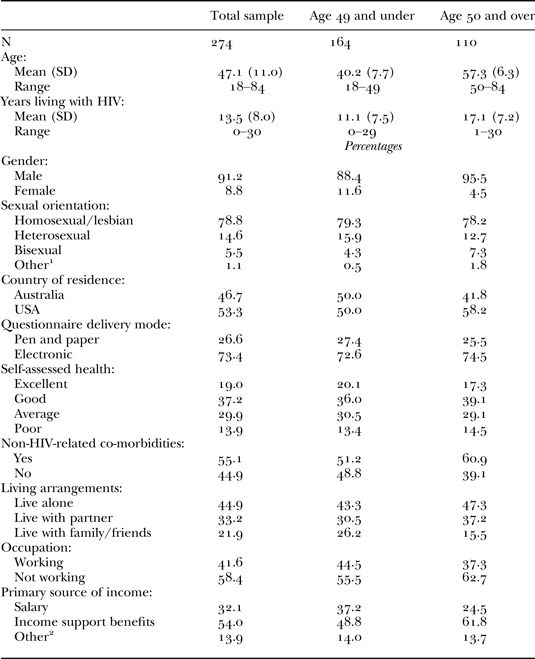
A cross-sectional study was completed amongst 274 people living with HIV in Australia (N = 128) and the USA (N = 146). This comprised a convenience sample recruited through Australian capital city HIV/AIDS Councils as well as Australia-based and USA-based HIV-specific online support groups accessed through the social networking services of Facebook and Yahoo Groups. Individuals over the age of 18 years who were diagnosed and living with HIV were invited via recruitment flyers distributed at HIV/AIDS Councils to complete the anonymous questionnaire in pen and paper format. In addition, individuals over the age of 18 years who were diagnosed and living with HIV were invited via online message boards to complete the anonymous questionnaire through the Web-based service tool, SurveyMonkey (SurveyMonkey 2012). There were 73 (26.6%) pen and paper responders and 201 (73.4%) online responders. Independent-samples t-tests on demographics and the variables of interest revealed no significant differences based on the questionnaire delivery mode. The final sample comprised 274 participants, aged between 18 and 84 years (mean = 47.1, standard deviation (SD) = 11.0), and living with HIV for less than a year, up to 30 years (mean = 13.5, SD = 8.0). Forty per cent of the participants (110) were aged 50 years and over. The majority of participants were male (91.2%) and described themselves as homosexual (78.8%), reflecting the over-representation of HIV-diagnoses amongst men who have sex with men and the gay communities in many developed nations (UNAIDS 2013). Almost 45 per cent of participants lived alone, and 54 per cent relied on some form of government income-support benefits, especially disability support payments. Non-HIV-related co-morbidities were reported in 55.1 per cent of participants. Table 1 shows the characteristics of all participants.
Demographic characteristics of the total sample, the 49 years and under age group and the 50 years and over age group

Notes: SD: standard deviation. USA: United States of America. 1 Including participants who described themselves as ‘not interested’. 2. Including income derived from savings, superannuation, spouse/partner or family.
Measures
The measures examined here are the Personal Wellbeing Index-Adult (PWI-A; International Wellbeing Group 2006), the HIV version of the Unsupportive Social Interactions Inventory (USII; Ingram et al. Reference Ingram, Jones, Fass, Neidig and Song1999), participants’ self-assessed health status, years living with HIV, demographics and responses to the final optional open-ended question about the experience of living with HIV.
The PWI-A (International Wellbeing Group 2006) is a nine-item measure of participants’ abstract feeling of satisfaction with ‘life as a whole’ and eight broad life domains: standard of living; personal health; achieving in life; personal relationships; feeling safe; community-connectedness; future security; and spirituality–religion. These eight domains comprise the minimum set of domains that represent the first level of deconstruction of ‘life as a whole’. Participants indicated their satisfaction with each item on a 0–10 Likert response scale, ranging from ‘completely dissatisfied’ (0) to ‘completely satisfied’ (10). Data can be used at either the level of individual items, or the eight life domains can be aggregated and averaged to form a Personal Wellbeing Index. When expressed on a scale of 0–100, the normative range for Western subjective wellbeing lies in the very narrow range of 70–80 points (International Wellbeing Group 2006). In this study, the Cronbach's alpha coefficient for the aggregated PWI-A was 0.91.
HIV-related unsupportive social interactions were assessed using the 24-item HIV-specific version of the USII (Ingram et al. Reference Ingram, Jones, Fass, Neidig and Song1999). Unsupportive social interactions are conceptualised as unhelpful or upsetting responses from other people that a person receives about their HIV status. Participants were asked to rate the occurrence of events such as ‘After becoming aware of my having HIV, someone avoided me or had less contact than usual’, on a five-point Likert scale ranging from ‘never’ (0) to ‘a lot’ (4). In this study, the Cronbach's alpha coefficient for the total scale was 0.95.
Self-asssessed health was measured by asking participants to describe their present state of health on a four-point scale ranging from ‘excellent’ (1) to ‘good’ (2) to ‘average’ (3) to ‘poor’ (4). The intention of this single item assessment was to ascertain the participants’ subjective appraisal of their overall health status, irrespective of the CD4 count and viral load. There is evidence that a global question of self-reported health status like this can be a good indicator of public health and mortality in a population even across different cultures (Nyirenda et al. Reference Nyirenda, Evandrou, Mutevedzi, Hosegood, Falkingham and Newell2015).
Analyses
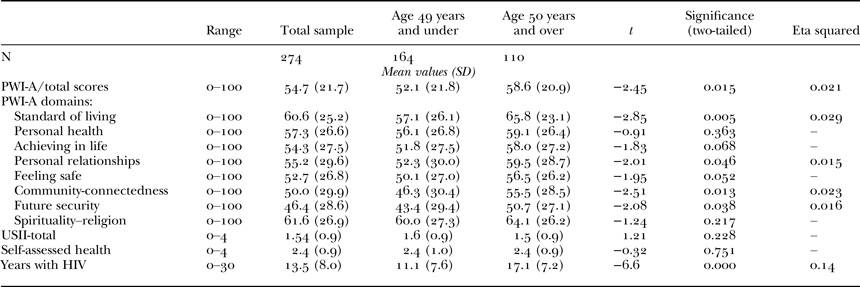
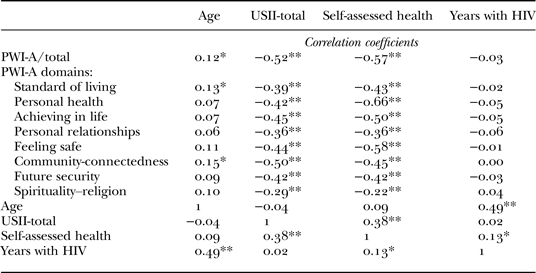
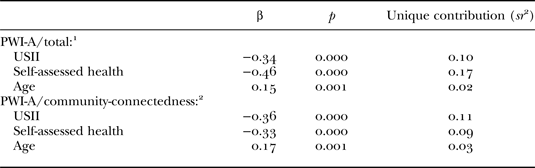
Descriptive statistics for, and comparisons between, participants aged 50 years and over, and 49 years and under, on variables of interest (i.e. PWI-A, USII, self-assessed health, years living with HIV) are reported first (Table 2). The relationship between age, subjective wellbeing, unsupportive social interactions, self-assessed health and years living with HIV was investigated using the Pearson product-moment correlation coefficient (Table 3). Standard multiple regressions were conducted to examine the unique contribution of age, USII and self-assessed health to overall subjective wellbeing and each life domain (Table 4). All statistical analyses were performed using IBM SPSS Statistics 22 (IBM Corp. 2013).
Range, group means and standard deviations (SD) for the total sample, the 49 years and under group and the 50 years and over group, as well as results from independent-samples t-tests comparing the two age groups

Notes: PWI-A: Personal Wellbeing Index-Adult. USII: HIV-Unsupportive Social Interactions Inventory.
Correlations for scores for the Personal Wellbeing Index-Adult (PWI-A), HIV-Unsupportive Social Interactions Inventory (USII), self-assessed health, years living with HIV and age for the total sample

Note: N = 274.
Significance levels: * p < 0.05, ** p < 0.001 (two-tailed).
Standard multiple regressions

Notes: N = 274. PWI-A: Personal Wellbeing Index-Adult. USII: HIV-Unsupportive Social Interactions Inventory. 1. PWI-A/total (i.e. aggregate of eight domains) with USII, self-assessed health and age as predictors for total sample: R 2 = 0.46, adjusted R 2 = 0.45, R = 0.68 (p < 0.001). 2. PWI-A/community-connectedness domain with USII, self-assessed health and age as predictors for total sample: R 2 = 0.35, adjusted R 2 = 0.35, R = 0.59 (p < 0.001).
In addition, thematic analysis was used to code comments from participants aged 50 years and over about their experiences of living with HIV. The coding of these responses was based on Braun and Clarke's (Reference Braun and Clarke2006) six phases of analysis in order to methodically and transparently make sense of the data (i.e. familiarisation with the data, generation of initial codes, sorting of themes, review and refining of themes, defining and naming themes, data analysis). In this study, a ‘theme’ was defined as being able to capture something important about the data in relation to the research question, and representing a patterned response or meaning within the data-set (Braun and Clarke Reference Braun and Clarke2006). Patton's (Reference Patton1990) dual criteria for judging the final themes were adopted; that is, internal homogeneity and external heterogeneity. This ensured that the themes demonstrated meaningful coherence, and there were clear and identifiable distinctions between themes.
Results
The range, group means and SD for the total sample, and for the 49 years and under, and 50 years and over age groups separately, are presented in Table 2 for the PWI-A/total and eight domains, as well as the USII, self-assessed health item and years with HIV item. The results from the independent-samples t-tests conducted to examine differences between the 49 years and under and 50 years and over age groups are also included in Table 2. Of particular note is the mean score of 54.7 points (SD = 21.7) for PWI-A/total (i.e. aggregate of eight domains) for the total sample, as well as the substantially reduced scores in the domains of future security (mean = 46.4, SD = 28.6) and community-connectedness (mean = 50.0, SD = 29.9).
The results from the independent-samples t-tests showed that participants aged 50 years and over reported greater subjective wellbeing (mean = 58.6, SD = 20.9) compared to those aged 49 years and under (mean = 52.1, SD = 21.8). This difference was significant t(272) = −2.45, p = 0.015, two-tailed); and represented a small effect size (eta squared = 0.021). Significant differences, with small effect sizes, were also reported in the domains of standard of living, personal relationships, community-connectedness and future security. There were no significant differences between the age groups for USII and health but, as expected, there was a significant difference in terms of the years living with HIV.
To examine the linear relationship between age and all domains of the PWI-A, USII, self-assessed health and years living with HIV, a Pearson product-moment correlation coefficient was conducted. The results are presented in Table 3. There was a small positive correlation between the two variables PWI-A/total and age, r = 0.12, p < 0.05, with greater subjective wellbeing associated with older participants. There were also small positive correlations between age and the domains of standard of living and community-connectedness. There was no significant correlation between age and USII, nor between age and self-assessed health. Greater reports of unsupportive social interactions were significantly associated with reduced PWI-A/total, r = −0.52, p < 0.001. Whilst all domains of the PWI-A were also significantly associated with USII, the strongest correlation was recorded with community-connectedness, r = −0.50, p < 0.001.
To examine the relationship between PWI-A/total and age, USII and self-assessed health further, a series of multiple regression analyses were conducted. Firstly, a standard multiple regression on the PWI-A/total was conducted with age, self-assessed health and USII as predictors. The amount of variance in PWI-A/total explained was 46 per cent, F(3, 270) = 76.55, p < 0.001. In this model, all variables were significant predictors of the PWI-A/total, contributing unique variances ranging from 17.5 per cent for self-assessed health, 10 per cent for USII and 2.2 per cent for age. A series of eight multiple regression analyses were also conducted for each of the PWI-A domains with age, USII and self-assessed health as predictors. Age remained a significant predictor at p < 0.001 in the domain of community-connectedness, contributing a unique variance of 3 per cent (see Table 4). Age was also a significant predictor at p < 0.01 in the domains of standard of living and feeling safe.
Thematic analysis of comments from participants aged 50 years and over
Forty-seven of the 110 participants aged 50 years and over provided a response to the open-ended question: ‘Are there any other comments you would like to make about the experience of living with HIV?’ They ranged in age from 50 to 73 years. An examination of responses showed that 19 participants had commented on beneficial aspects of living and ageing with HIV, and 28 on negative aspects. Patterned responses within these two primary codes that were relevant to the research aims and hypotheses were then identified and coded as follows: (a) beneficial aspects of living with HIV were coded as ‘gratitude for being alive’ (ten responses), ‘motivation to change their life’ (six responses) and ‘opportunity to help others’ (three responses); and (b) negative aspects of living with HIV were coded as ‘deteriorating physical and/or mental health’ (11 responses), ‘need for secrecy’ (ten responses) and ‘experiences of stigma’ (seven responses). These themes are discussed next, with verbatim quotes.
Beneficial aspects of living with HIV (19 responses)
Gratitude for being alive
Living rather than dying with HIV provided ten participants with a heightened sense of gratitude and relief, as the following comments demonstrate:
I should have died five years ago but didn't and am now blessed with every day. (Female, aged 51)
I'm grateful to have lived to experience the benefits of effective antiretroviral meds [medications]. (Male, aged 60)
When first diagnosed with HIV, some people describe feeling fear and a lack of control over their life trajectory (Vance et al. Reference Vance, McGuinness, Musgrove, Orel and Fazeli2011b ). For older adults, many of whom lived through the early untreatable years of the epidemic, surviving may represent personal gains and a sense of control in coping with a chronic, incurable disease (Littlewood et al. Reference Littlewood, Vanable, Carey and Blair2008), thus facilitating an accompanying shift of perspective towards self-acceptance (Emlet, Tozay and Raveis Reference Emlet, Tozay and Raveis2011). Importantly, this gratitude may prompt a change in priorities.
Motivation to change their life
Six participants viewed the experience of living with HIV as an opportunity to learn what was really important in life; for example:
HIV is perhaps the best thing to ever happen in my life … I have been able to achieve many things that I otherwise would never have dreamt of. (Male, aged 51) It was a shock at first to be diagnosed, but in the long run, it turned my life around. I may have been dead from bad lifestyle choices had I not been faced with death from AIDS. (Female, aged 60)
Previous research shows that some of the positive aspects of ageing with HIV can be cessation of drugs and alcohol (Masten Reference Masten2015), as well as seizing the opportunity to re-prioritise life and focus on the things that truly matter (Vance et al. Reference Vance, McGuinness, Musgrove, Orel and Fazeli2011b ). To restructure attitudes and priorities in this way requires an ability to develop, maintain and integrate positive attitudes towards oneself and ageing, irrespective of physical, social or economic losses that can accompany both ageing and living with HIV (Moore et al. Reference Moore, Moore, Thompson, Vahia, Grant and Jeste2013). This process is reminiscent of the cognitive devices described in the subjective wellbeing literature whereby older adults ‘restructure reality’ to maintain a sense of worth in the face of declines with age and chronic medical conditions (Cummins and Nistico Reference Cummins and Nistico2002; Cummins and Schäfer Reference Cummins and Schäfer2011). The following comment exemplifies this point:
I used to believe attitude was 30 per cent of health, now I believe attitude is 70 per cent of health. (Male, aged 70)
Opportunity to help others
There is a body of research suggesting that sharing one's experience can benefit physical and mental health, foster resilience and meet a basic human need of feeling acknowledged (Beuthin, Bruce and Sheilds Reference Beuthin, Bruce and Sheilds2015; Holloway and Freshwater Reference Holloway and Freshwater2007). Three participants demonstrated this when describing the benefits of using their experiences to help others with HIV; for example:
I feel that staying active and giving back to the community has kept me sane and strong. (Male, aged 54)
I got very active in the HIV community … to help others in the same situation when I can. (Female, aged 51)
It is also well-documented that community involvement has played a pivotal role in areas such as safer sex practices, social acceptance and self-identify since the beginning of the HIV epidemic (Ramirez-Valles Reference Ramirez-Valles2002). Older adults with HIV may therefore be uniquely positioned to benefit both themselves and younger HIV-positive adults in the community.
Negative aspects of living with HIV (28 responses)
Deteriorating physical and/or mental health
In developed nations, life expectancy for many HIV-positive people with access to ART has increased dramatically (Nakagawa, May and Phillips Reference Nakagawa, May and Phillips2013). However, poor physical and/or mental health was problematic for 11 participants in the current study, with many specifically citing the difficult mix of ageing and HIV; for example:
Not enough is being done to support people living longer with HIV, about growing old with HIV, age and mental health. (Male, aged 56)
…insecurity about future health, fear of the next new unaccountable/unexplainable/untreatable ‘mysterious’ symptom to appear. (Female, aged 63)
Living with HIV requires lifelong reliance on antiretroviral medications, which has been linked to uncertainty and worry about expected or actual side-effects, and the potential for drug resistance (Harding and Molloy Reference Harding and Molloy2008; Viala-Danten et al. Reference Viala-Danten, Dubois, Gilet, Martin, Peeters and Cella2010). The concept of ‘uncertainty in illness’ (Neville Reference Neville2003), whereby people with chronic illness express uncertainty about the future, has been previously reported as a source of stress and anxiety amongst people with HIV (Brashers et al. Reference Brashers, Neidig, Russell, Cardillo, Haas, Dobbs, Garland, McCartney and Nemeth2003). These feelings can be exacerbated by the loneliness also described by some participants.
Need for secrecy
Seven participants believed it preferable to limit the number of people who knew about their condition; for example:
When I was diagnosed in 1992 I chose to tell no one. Only my doctor knows. (Male, aged 65)
I choose not to tell most about my HIV status because it is none of their business and I would rather they know and remember me as the warm loving vibrant intelligent man that I am. (Male, aged 58)
This in turn affected the ability to form friendships:
Don't feel able to establish any close friendships with the attendant risk of disclosing my illness. (Male, aged 60)
Early in the epidemic it was identified that an HIV diagnosis could result in the destruction of traditional familial-based networks (Arnold et al. Reference Arnold, Rice, Flannery and Rotheram-Borus2008; Schrimshaw and Siegel Reference Schrimshaw and Siegel2003). Emlet's qualitative study found that some HIV-positive adults aged 50 years and over preferred to adopt ‘protective silence’ to avoid rejection (Emlet Reference Emlet2006: 787), while secretiveness emerged as a dominant storyline in Beuthin, Bruce and Sheilds’ (Reference Beuthin, Bruce and Sheilds2015) storylines of five older adults living with HIV. In the current study, the need for self-protection by keeping their HIV status secret conflicted with the need to seek belonging and connection with others, as expressed by one participant who chose to ‘lie’ about her condition:
I told my family and people in my job I had cancer. (Female, aged 57)
Experiences of stigma
Ten participants who had not kept their condition a secret described the impact of stigma in their lives; for example:
Living with HIV is the pits basically. It's all too easy to internalise shame and stigma. (Male, aged 57)
One participant described HIV today as:
Somewhat akin to being gay in the 50s or 60s … i.e. stigma, fear, vilification. (Male, aged 70)
This positioned HIV-stigma as a re-traumatising experience for older adults who had also experienced homophobia (Masten Reference Masten2015). Some comments reflected the division reported within the gay community, where some HIV-negative men held stigmatising views towards those who were positive (Smit et al. Reference Smit, Brady, Carter, Fernandes, Lamore, Meulbroek, Ohayon, Platteau, Rehberg, Rockstroh and Thompson2012); for example:
I have been living with HIV for 25 years, and although I have some physical problems, I have been socially more affected than in any other realm. There are few negative men willing to chance a relationship with a positive man, there even feels like there is apartheid when it comes to this social experience. (Male, aged 62)
Discussion
Results from this study supported the three hypotheses; that is, all participants reported lower subjective wellbeing than the Western population normative range of 70–80 points; subjective wellbeing was greater amongst adults aged 50 years and over, but still below the normative range; and experiences of stigma, operationalised as unsupportive behavioural responses perceived in others, were negatively associated with reduced subjective wellbeing amongst all participants. Results from the qualitative analysis provided some insight into the protective factors that allowed some older adults to report greater wellbeing as they aged with HIV. These factors included gratefulness for being alive; changes in attitude and motivation directly attributable to their HIV diagnosis; and the ability to use this experience to help others. These results are elaborated below.
The mean score of 54.7 points recorded on the Personal Wellbeing Index indicated that participants in this study experienced homeostatic challenges strong enough to reduce subjective wellbeing below the normative range. Not unexpectedly, self-assessed health was identified as a unique predictor of subjective wellbeing amongst all participants, as were experiences of unsupportive social interactions. Of note is the life domain ‘satisfaction with community-connectedness’ which attracted low scores in the PWI-A (i.e. 50 points for the total sample, as well as 55.5 points for older adults and 46.3 points for younger adults), and was the domain most strongly affected by experiences of unsupportive social interactions in the multiple regressions (i.e. unsupportive social interactions contributed 11 per cent unique variance, compared to self-assessed health which contributed 9 per cent unique variance). These results support consistent findings that some people with HIV report feelings of rejection and an internal sense of shame, resulting in the development of strategies, including non-disclosure of the HIV diagnosis and social isolation that can reduce both feelings of community-connectedness and overall subjective wellbeing (Emlet, Fredriksen-Goldsen and Kim Reference Emlet, Fredriksen-Goldsen and Kim2013; Grov et al. Reference Grov, Golub, Parsons, Brennan and Karpiak2010; Schrimshaw and Siegel Reference Schrimshaw and Siegel2003). The implications of this finding will be discussed later in this section within the context of the third hypothesis.
The finding that subjective wellbeing was significantly greater amongst older participants draws attention to subjective markers such as adaptation, meaningfulness and connection rather than objective markers of freedom from disease and disability (Jeste, Depp and Vahia Reference Jeste, Depp and Vahia2010). Cummins (Reference Cummins2010) described two internal buffers for the maintenance of subjective wellbeing homeostasis that may be particularly relevant to the ageing process; namely ‘adaptation’ whereby older people display greater acceptance of their psycho-social circumstances (Lyons et al. Reference Lyons, Pitts, Grierson, Thorpe and Power2010) and adapt behaviour and expectations to the reality of loss of functioning with advancing age (Cummins Reference Cummins2010; Windle and Woods Reference Windle and Woods2004); and cognitive devices which allow a person to make sense of negative experiences and maintain a sense of worth and positive state of mind (Cummins Reference Cummins2010; Cummins and Nistico Reference Cummins and Nistico2002). Where participants in the current study expressed gratitude to be living rather than dying with HIV, the process of adaptation may have further enhanced their gratitude and acceptance of HIV as a chronic disease they could now successfully live with as part of the ageing process. In contrast, younger adults may struggle to adapt to living with a chronic illness which they perceive as incompatible with their life stage. The qualitative comments also suggested that cognitive devices had been adopted by some participants to re-structure and re-prioritise their attitudes, as well as share their experiences with the next generation of those living with HIV. Both adaptation and these cognitive devices are reminiscent of the ‘survivorship effect’ described by Moore et al. (Reference Moore, Moore, Thompson, Vahia, Grant and Jeste2013: e421), whereby older adults with HIV may see themselves as more resilient because they have lived longer with HIV, often surviving well beyond their expectations.
As indicated earlier in this section, the third hypothesis, that reported experiences of unsupportive social interactions would impact subjective wellbeing irrespective of one's age, was also supported in the current study. It is noteworthy that although all participants reported similar experiences of unsupportive social interactions, older adults still recorded greater subjective wellbeing compared to younger adults. These results align with research suggesting that some older people may be better able to handle experiences of stigma (Logie and Gadalla Reference Logie and Gadalla2009; Webel et al. Reference Webel, Longenecker, Gripshover, Hanson, Schmotzer and Salata2014), possibly through the process of ‘stigma competence’, and the development of skills to overcome actual and perceived stigma experiences (Slater et al. Reference Slater, Moneyham, Vance, Raper, Mugavero and Childs2015: 31). A greater understanding of these potential skills could provide valuable insight for both older and younger adults living with HIV.
However, it may also be that older adults have learned to keep their HIV status secret, as identified in Beuthin, Bruce and Sheilds’ (Reference Beuthin, Bruce and Sheilds2015) qualitative study of storylines of ageing with HIV, and supported by the qualitative comments from the current study. Over one-third of comments from participants aged 50 years and over described experiencing an HIV-related stigma, while one-quarter described the decision to opt for secrecy to avoid exclusion and stigma. Amongst older adults with HIV, the adoption of secrecy as a strategy may have implications as individuals move into the ‘older-old’ age group of 80 years plus (Litwin and Stoeckel Reference Litwin and Stoeckel2013) and require ongoing care in facilities where secrecy may no longer be an option and stigma exist amongst care workers (Wallach and Brotman Reference Wallach and Brotman2013). In the current study, the oldest participant was aged 84 years, and no participant lived in a care facility. It is anticipated that geriatric and gerontological settings and services will increasingly have to face this somewhat neglected area (Wallach and Brotman Reference Wallach and Brotman2013) as more people living with HIV enter the 80 years plus age group.
Limitations
A limitation of the current study was the use of a convenience sample, which reflects the difficulty of recruiting amongst a private population group. HIV-positive participants self-selected via recruitment flyers and online message boards and whilst the researcher attempted to obtain a representative sample, the stigmatising nature of HIV, and the potential social isolation resulting from that stigma, means some potential participants may not have been accessed. In addition, whilst the predominance of gay males reflects the HIV epidemological patterns in developed nations (UNAIDS 2013), it prevents generalisations of these findings to other sectors of the HIV-community.
A further limitation is the cross-sectional design of this study which precludes any causal interpretations, and the self-report nature of the measures which introduce the possibility that some participants may give socially desirable responses. Future longitudinal studies are recommended with larger sample sizes and more diversity (especially women and heterosexual people) to obtain information about changes in subjective wellbeing and experiences of unsupportive social interactions as adults grow older with HIV. This is particularly important as more people enter the 80 years plus age group and may require formal care arrangements.
Conclusion
In conclusion, HIV is increasingly being recognised as a disease affecting older adults in developed nations (Emlet, Fredriksen-Goldsen and Kim Reference Emlet, Fredriksen-Goldsen and Kim2013). There is a growing need to make sense of the reality of ageing with HIV and the gaps in our knowledge, and this study offers some insights. The results have some important clinical and social implications. Firstly, by using the Personal Wellbeing Index (International Wellbeing Group 2006), a sensitive and non-confrontational instrument underpinned by theory and research, early identification of at-risk individuals of any age, and the life domains most impacted, could facilitate targeted health promotion initiatives to strengthen and maintain a person's life satisfaction and coping abilities. Secondly, the knowledge that subjective wellbeing amongst adults aged 50 years and over remained significantly greater than those aged 49 years and under and the means by which this may be achieved (i.e. attitudes, motivation and helping others) could provide valuable strategies for service providers and clinicians to develop amongst all age groups. Thirdly, in contrast to previous literature suggesting older adults may be at greater risk of both HIV-stigma and ageism, results from the current study indicate that stigma remains a problem for all age groups, but some older adults may have developed strategies to mitigate its impact and maintain subjective wellbeing. Rather than perceiving the ageing HIV-population as a ‘burden’, it is proposed that a greater understanding of the coping skills displayed by some members of this group could prove beneficial to the HIV-population as a whole.
Acknowledgements
This study has been approved by the Monash University Standing Committee on Ethics in Research Involving Humans (approval number CF09/1014-2009000505).