US children have been disproportionately impacted by emerging infectious disease outbreaks such as H1N1 pandemic influenza and enterovirus D68, as well as by the long-term effects of congenital Zika virus infection.Reference Chung, Fagbuyi and Lozon 1 - Reference Cuevas, Tong and Rozo 3 The public health community has needed to rapidly communicate with health care providers to develop appropriate pediatric screening and treatment protocols to ensure proper management. Pediatric expertise is essential in developing such protocols and communicating with families. The ongoing lessons learned from each outbreak continue to reinforce the importance and urgency of connecting pediatric and public health leaders and improving pediatric public health emergency preparedness and response.
Preparing for the unique needs of children during disasters and public health emergencies continues to pose challenges. Traditional approaches for “all-hazard and all-populations” preparedness may fail to fully address the needs of more vulnerable populations at increased risk for poor outcomes. 4 Although it is widely accepted that children have unique care requirements due to their anatomic, physiologic, and developmental/behavioral characteristics, planning at federal, state, and local levels is insufficient to fully protect children throughout the disaster life cycle. 5
Tabletop exercises have been widely adopted as proven and effective tools in promoting awareness and planning for disasters.Reference Biddinger, Savoia and Massin-Short 6 However, representation of the pediatric population in national and regional planning and exercises has been limited.Reference Hinton, Griese and Anderson 7 This article describes the process of developing and convening a pilot regional tabletop exercise for an infectious disease outbreak scenario disproportionately affecting children and reports collaborative strategies between pediatricians and public health providers that enhance pediatric planning for and response to public health emergencies.
Methods
Development of Tabletop Exercise
The initial proposal for this exercise came during the 2014 Leadership Management Institute (LMI) training program on pediatric preparedness at the Centers for Disease Control and Prevention (CDC) in which LMI team members designed a hypothetical project to address lack of coordination around the needs of children during disaster response. Subsequently, a planning team from the American Academy of Pediatrics (AAP) and CDC convened to create a scenario for a pediatric-centered infectious disease outbreak in a multistate region. The planning team included pediatric primary care, infectious disease, emergency medicine, critical care, developmental-behavioral pediatrics, and public health perspectives. The logistics and implementation of the exercise were refined over a 6-month period. The AAP Institutional Review Board (IRB) determined that these efforts were not subject to IRB review.
Participants
State teams from Federal Region VI (Arkansas, Louisiana, New Mexico, Oklahoma, Texas) were invited to participate. Each state team included 2 pediatricians chosen by the AAP state chapter and 2 state or local public health officials chosen by CDC-funded Public Health Emergency Preparedness grantees. Representatives from the CDC, Office of the Assistant Secretary for Preparedness and Response, and the Federal Emergency Management Agency observed the exercise. Participants were informed ahead of time that the exercise would involve a case of smallpox and were given background information on the virus.Footnote a Participants received an orientation call to review participant expectations.
Tabletop Exercise
The tabletop exercise was held at CDC offices in Atlanta, GA. The exercise was designed as an 8-hour event with opportunity for participant interactions and short presentations by CDC experts on smallpox and the federal strategic national stockpile. AAP facilitators introduced the scenario and led the exercise. State teams worked through pieces of the progressing scenario: a smallpox outbreak spread through accidental exposure to stored samples by high school students at a laboratory, which leads to possible exposures in multiple states. Facilitators encouraged the sharing of team experiences across states to discuss best practices. During the scenario, a call was made to AAP headquarters leadership, allowing exercise facilitators to summarize the situation and AAP leadership to describe how the organization would respond if confronted with this evolving emergency. At the conclusion, participants were led through a debriefing session to elicit feedback about the exercise and to discuss processes to further enhance pediatric preparedness. The meeting proceedings for the exercise are available (www.aap.org/disasters/tabletop).
Evaluation of the Tabletop Exercise
The primary objectives for the exercise were 3-fold: first, to have state teams identify at least 10 collaborative strategies that AAP chapters, pediatric clinicians, and public health leaders could implement to advance pediatric preparedness at state and local levels; second, for states to determine at least 5 steps that teams could take to improve communications, specific to children’s issues, between public health and pediatric leaders; and third, for participants to discuss and evaluate strategies to optimize plans for the distribution and dispensing of medical countermeasures for children.
Secondary objectives included assessment of the impact on state team exercise participants. Participants were given an electronic survey 24 hours after the exercise. Participants were asked at that time to rate their knowledge and confidence before and after the exercise, on a Likert scale from 1 (totally unaware/unprepared) to 10 (completely aware/prepared), regarding: preparedness for a pediatric infectious outbreak, personal role during a public health emergency, communication strategies, partnerships, and resources. Wilcoxon’s rank score tests were performed to compare pre- and post-exercise results. Statistical significance was determined a priori using α=0.05. All statistical analysis was performed using STATA statistical software, version 13.1 (StataCorp College Station, TX, USA). Participating state teams were asked to report on improvements in pediatric planning in their respective states during the 6 months post-exercise.
Results
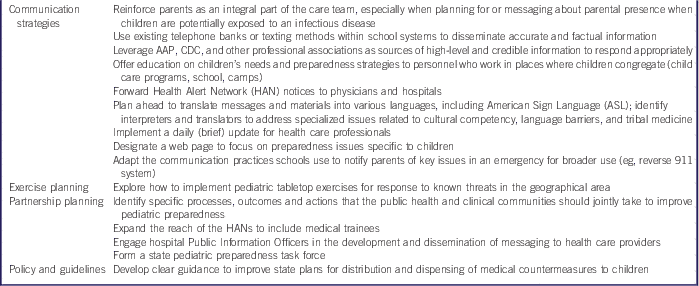
In total, 22 people participated in the exercise: 12 pediatricians and 10 public health officials from the 5 states. Participants identified 113 collaborative strategies and 25 communication strategies to promote pediatric preparedness. General recommendations for state public health agencies included reviewing emergency preparedness and response plans and initiatives to see if children are addressed, and connecting with or forming a state pediatric preparedness council. Communication strategies included developing pre-scripted communication materials and monitoring social media to address concerns. See Table 1 for examples of collaborative and communication strategies. State teams also identified vaccination strategies (including rationing), if a limited supply was available.
Examples of Communication and Collaboration Strategies Identified During the Exercise

Abbreviation: AAP, American Academy of Pediatrics; CDC, Centers for Disease Control and Prevention.
Survey Results
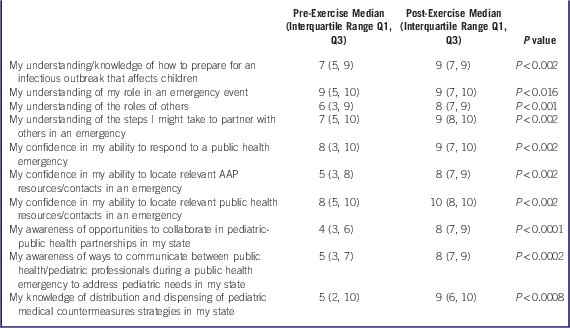
Out of 22 (86%) participants, 19 completed the survey (10 pediatricians and 9 public health officials). All respondents strongly agreed or agreed that the exercise generated productive discussion. All but 1 respondent strongly agreed or agreed that the exercise helped identify individual or agency strengths and weaknesses, as well as gaps in planning in their state and/or community. All but 1 respondent stated the exercise helped build relationships with participants outside of their agency and their area of expertise. Participants also described improvement in disaster readiness knowledge, their understanding of personal roles during a public health emergency, confidence, and awareness around a public health emergency (Table 2). A theme that consistently emerged when participants were asked to name the most beneficial exercise component was the potential collaboration and partnership between pediatricians and public health officials. All participants recommended that this exercise be replicated with other states and regions.
Participant (n=19) Rating Pre- and Post-Exercise (Scale 1 [Least Confidence] to 10 [Most Confidence])

Abbreviation: AAP, American Academy of Pediatrics.
As a result of the exercise, participants were asked to indicate the extent to which they were likely to follow up and take actions in the future. Eighty-four percent of respondents indicated they were very likely to initiate new partnerships. When asked how likely they were to make changes to disaster preparedness and response planning, 100% reported they were likely to do so.
6-Month Follow-Up
Participants were contacted through e-mail for 6 months following the exercise to assess for further pediatric preparedness planning. Participants from 4 of the 5 states replied to the 6-month e-mail. Pediatricians and public health officials who replied stated that they continued to work together on pediatric preparedness topics after the exercise. One state received additional funding to implement a state pediatric preparedness and response plan that identified a pediatric contact in each of the regions within the state and brought these individuals to an exercise and workshop similar to the tabletop exercise described. Another state AAP chapter partnered with its state public health colleagues to collaborate in a hospital pediatric emergency readiness project. A third state AAP chapter and public health department developed a task force and plan to protect immunization supplies in clinic sites that may be at risk. Notably, states were only asked to report on changes that have been implemented as a direct result of having participated in the tabletop exercise, suggesting that these pediatric-public health partnerships and preparedness activities would not have occurred otherwise.
Discussion
This article describes the development and pilot testing of a tabletop exercise designed to improve pediatric public health emergency preparedness and response by building partnerships between public health officials and pediatricians at the state and local level. This tabletop exercise is the first of its kind, as it was based on AAP and CDC collaboration and aimed to bring state public health officials and pediatricians in a region together as state teams for collaboration. A majority of participants agreed that the tabletop exercise was valuable towards building pediatric collaborations, with evidence of sustained partnerships in the 6 months after the exercise.
Ongoing collaboration between pediatricians and public health officials is essential for long-term partnerships to be maintained. 5 At the state and local level, pediatricians can assist public health departments with vetting and development of materials addressing the unique characteristics of infectious disease outbreaks that impact children, as well as collaborate on communication strategies to reach families. Those with pediatric expertise can also participate in health care coalitions to promote child- and family-appropriate response and recovery plans. Recent legislation now requires a representative to address children’s needs at the state and local level for all major US Homeland Security emergency grants recipients. 8
Tabletop exercises have been used to discover gaps and advance planning, including as they relate to health care. Savoia et al showed that participants from a variety of disciplines including public health and health care who engaged in tabletop exercises were more confident about the availability and sufficiency of legal authorities for infectious disease emergencies.Reference Savoia, Biddinger and Fox 9 Behar et al demonstrated that a tabletop exercise increased hospital physicians’ and nurses’ sense of knowledge and comfort with pediatric disaster medical topics.Reference Behar, Upperman, Ramirez, Dorey and Nager 10 This tabletop exercise differs from those in the literature in that pediatricians and public health officials in each state actively worked together during the tabletop exercise to identify gaps and strategies in operational planning for a pediatric-specific event. There was also a transmission of knowledge, as states that developed certain pediatric strategies shared those with other states.
There are limitations to this pilot tabletop exercise. Given the small number of participants, it is possible that the participants do not represent the perspectives of all pediatricians and public health officials, and these results may not be generalizable to other regions or states. Participant pre- and post-ratings of knowledge and confidence were assessed at the same timepoint post-exercise. The 6-month follow-up elicited self-reported impacts of the exercise. Positive impacts may have been inflated by social desirability bias and were not validated by other means. Preparedness plans are presumed to translate into increased effectiveness in meeting children’s needs in the event of a disaster or crisis, but this hypothesis has yet to be tested. Continuity can be challenged by turnover of individuals, particularly in government; however, the institutionalization of collaborative face-to-face relationships between public health and pediatric health care holds promise for improved sustainability. There was a cost to assemble all participants in one area to participate, limiting options for replication. However, AAP and CDC are adapting this tabletop into a virtual exercise, allowing cost-effective widespread participation and applicability to all states. Further evaluation is needed to identify what aspects of the tabletop exercise produce positive strategies for pediatric preparedness and determine whether preparedness plans and the use of such exercises actually improve pediatric response during an incident.
Conclusions
The AAP/CDC pediatric and public health tabletop exercise was effective in determining strategies to enhance pediatric public health preparedness, including synergy from collaboration between pediatricians and public health officials at the state level. Participants’ knowledge and level of confidence regarding a pediatric public health emergency increased following the exercise. A 6-month follow-up evaluation indicated continuing collaboration between pediatricians and public health officials.
Acknowledgments
The authors thank Steven E. Krug, MD, FAAP; Scott Needle, MD, FAAP; Margaret Fisher, MD, FAAP; Laura Aird, MS; Sean Diederich; Kate Klein, MA, MPH; and Breanna Smith for their participation and thoughtful review of the manuscript; Michael Monuteaux, ScD, for his assistance with the analysis; and Daniel Sosin MD, MPH, FACP, and the CDC Leadership Management Institute (LMI) planning team for their contributions to the exercise planning process.
Funding
This publication was supported by Cooperative Agreement Number 5U38OT000167-04, funded by the Centers for Disease Control and Prevention. Its contents are solely the responsibility of the authors and do not necessarily represent the official views of the Centers for Disease Control and Prevention or the U.S. Department of Health and Human Services.
Conflicts of Interest
None.