Implications
European Union regulations prohibit the use of additives to extend the shelf life of raw meat fillets (Regulation (EC) No 1333, 2008). Red meat cuts, such as lamb, are often packed in high-O2 protective atmospheres to maintain their redness for longer without considering the consequent enhancement of lipid oxidation. If rancidity is not controlled in the raw meat, then oxidized lipids may alter the flavour of the cooked meat. The supplementation of livestock diets with aromatic plant by-products containing bioavailable antioxidants may help to reduce the formation of the volatiles responsible for rancidity in meat, delaying odour deterioration during storage.
Introduction
The determination of volatile organic compounds (VOCs) has become a popular indicator of lipid oxidation in meat due to the limitations involved in using thiobarbituric acid reactive substances and measurements of primary oxidation products (Ross and Smith, Reference Ross and Smith2006). VOC profiling provides direct information on the potentially odour-active contributors to meat rancidity. Lipid-derived VOCs responsible for rancid off-flavours can develop when the oxidation level of meat is very high or when the oxidation reactions are produced before or after cooking (Mottram, Reference Mottram1998). High-O2 protective atmospheres frequently used to prolong the shelf life of red meat cuts, such as lamb, enhance lipid oxidation and provide excellent conditions for the formation of VOCs in meat. The levels of these VOCs strongly increase in the raw meat packed under pro-oxidizing atmosphere (Olivares et al., Reference Olivares, Dryahina, Spanel and Flores2012). Different VOCs, such as aliphatic saturated aldehydes and, to a lesser extent, alcohols, are frequently used as indicators of meat rancidity because of their relatively high concentrations and low odour thresholds (Shahidi, Reference Shahidi1994).
Few studies have focussed on the formation of VOCs in raw lamb meat. Raw lamb would generate a lesser number of VOCs (Lee et al., Reference Lee, Waller, Melton, Saxton and Pordesimo2004; Nieto, Reference Nieto2009; Vasta et al., Reference Vasta, Aouadi, Brogna, Scerra, Luciano, Priolo and Ben-Salem2013; Gravador et al., Reference Gravador, Serra, Luciano, Pennisi, Vasta, Mele, Pauselli and Priolo2015) than cooked lamb (Almela et al., Reference Almela, Jordán, Martínez, Sotomayor, Bedia and Bañón2010; Bueno et al., Reference Bueno, Campo, Cacho, Ferreira and Escudero2011; Nieto et al., Reference Nieto, Bañón and Garrido2011; Resconi et al., Reference Resconi, Escudero and Campo2013; Bueno et al., Reference Bueno, Resconi, Campo, Cacho, Ferreira and Escudero2014; Gravador et al., Reference Gravador, Serra, Luciano, Pennisi, Vasta, Mele, Pauselli and Priolo2015) due to the greater chemical transformations that occur in meat during heating, although many VOCs are common to both, in particular, carbonyl compounds from the oxidation of polyunsaturated fatty acids. In general, the above studies point to the difficulty of establishing the role of the different VOCs that simultaneously contribute to flavour, suggesting that volatile profiling should be accompanied by sensory studies. In this respect, quantitative sensory tests performed with trained panels have been demonstrated to be a good tool for interpreting VOC profiles because of the good correlation existing between the levels of VOCs in the headspace and the intensity of rancid odour in the lamb meat (Nieto, Reference Nieto2009; Nieto et al., Reference Nieto, Bañón and Garrido2011).
Fresh lamb presents a weak serum odour that, under pro-oxidizing conditions, can be easily altered by rancid VOCs (Nieto et al., Reference Nieto, Bañón and Garrido2011; Bañón et al., Reference Bañón, Méndez and Almela2012; Serrano et al., Reference Serrano, Jordán and Bañón2014), so that their formation should be controlled. The use of dietary antioxidants from rosemary (Rosmarinus officinalis L.) has proven to be effective for improving the oxidative stability of chilled-packed lamb meat. Rosemary products are considered a source of phenolic antioxidants and the essential oils contain eucalyptol, camphor, α-pinene and other minor compounds while oil-free leaves, a by-product of rosemary distillation, contain polyphenols such as carnosic acid, carnosol, rosmarinic and caffeic acid, among others (Jordán et al., Reference Jordán, Lax, Rota, Lorán and Sotomayor2013). Preliminary studies have revealed the good properties of the dietary rosemary extracts (DRE) used in sheep feeding to extend the shelf life of lamb meat. DRE containing carnosic acid and carnosol presents a suitable degree of bioavailability to exert its antioxidant action in muscle (Ortuño et al., 2016) and to inhibit lipid oxidation and VOC formation in raw lamb meat packed in a high-O2 protective atmosphere (Ortuño et al., Reference Ortuño, Serrano, Jordán and Bañón2014). In the above study and other studies (Nieto et al., Reference Nieto, Bañón and Garrido2011; Vasta et al., Reference Vasta, Aouadi, Brogna, Scerra, Luciano, Priolo and Ben-Salem2013), hexanal was seen to be by far the most abundant VOC in the headspace of rancid lamb meat. However, Ortuño et al. (Reference Ortuño, Serrano, Jordán and Bañón2014) concluded that a reduction in the level of hexanal did not always discriminate meat samples when rancidity was inhibited through DRE, especially in strongly oxidized samples. This underlines the interest of extending the study to all the VOCs present in the headspace to establish their potential as rancidity markers in raw lamb meat.
The aim of the present study was to determine the inhibitory effect of a DRE containing carnosic acid and carnosol on the formation of rancid VOCs in raw lamb meat packed in high-O2 atmosphere and kept in retailing conditions. The differences in the VOC formation rate were used to establish the best rancidity markers as well as to identify whether the meats were reinforced or not with dietary antioxidants.
Material and methods
Animals and diets
A DRE containing carnosic acid and carnosol at 1 : 1 (w/w) (Nutrafur-Furfural Español S.A., Murcia, Spain) was incorporated in the feed for fattening lambs during the pelleting process. Three groups of nine lambs from the Segureña breed were randomly assigned to the three experimental diets: (i) C: Control (basal diet); (ii) R200: basal diet plus 200 mg DRE/kg feed; and (iii) R400: basal diet plus 400 mg DRE/kg feed. The basal diet for fattening lambs was a commercial concentrate feed (Nantacor Cebo Intensivo®) provided by Nanta Animal Nutrition (Torre-Pacheco, Murcia, Spain). The ingredients (expressed as g/kg feed) of feed were as follows: wheat bran (377), sunflower flour from oil extraction (219), soya bean (176), carob (50), molasses-cane (39.9), and rice (43.5) and mine salt (10). Feed formulation was completed with vitamin D3 (2000 IU/kg feed), vitamin A (10 000 IU/kg feed) and vitamin E (30 mg/kg feed). The level of rosemary diterpenes in the feed were checked by HPLC-MS (Ortuño et al., 2015). All the lambs were weaned when they reached the weight of 13±1 kg and were then fed ad libitum for around 80±5 days, coinciding with their fattening stage, until reaching a live weight of 25±2 kg (at 108±14 days of age). The mean feed intake of fattening lambs was 0.89±0.05 kg/day. The lambs were fattened in individual pens located in the same farm during two different time periods (between November and March). All handling practices followed the recommendations of the European Council Directive 2010/63/EU for the protection of animals used for experimental and other scientific purposes, and all of the animals were able to see and hear other lambs. The experiment was authorized by the Ethical Committee on Animal Research of the University of Murcia.
Meat sampling
After slaughtering, the loins were processed to obtain meat samples. After chilling, a professional butcher removed the longissimus thoracis et lumborum muscle from both sides of the carcasses. Two batches composed of six loins (two loins from the same lamb carcass per diet) were processed weekly until all 30 lamb carcasses had been analysed. First, rosemary metabolites were analysed in the meat by HPLC-electrospray ionization (ESI)-MS/time-of-flight (TOF)MS. 5,6-Dihydroxy-7-isopropyl-1,1-dimethyl-2,3-dihydrophenanthren-9(1H)-one (C19H22O3) was the only diterpenic metabolite derived from carnosic acid found in fresh lamb at concentrations (mean±SD) of 0.39±0.10 (R200) and 0.70±0.12 (R400) mg/kg meat (Ortuño et al., Reference Ortuño, Serrano, Jordán and Bañón2016). For the retailing case study, the loin fillets (longissimus thoracis et lumborum muscles) were filleted (1.5 cm thick) and packaged in polystyrene trays B5-37 Aerpack (Coopbox Hispania, Lorca, Murcia, Spain) in BB4L bags (Cryovac Packaging, Barcelona, Spain) of low gas permeability (8 to 12 cm3/ml2 per 24 h). The air in the packs was replaced by a modified atmosphere composed of 70% O2 and 30% CO2 (v/v) (EAP20; Carburos Metálicos, Barcelona, Spain) using a discontinuous INELVI VISC 500 packer (Industrial Eléctrica Vilar, Barcelona, Spain). The meat:gas ratio was ~0.03 kg meat/l O2/CO2. The packed fillets from each lamb were stored at 2±1°C for 0, 7, 11 or 14 days, respectively, continuously illuminated with white fluorescent light (800 lx), in a Climacell 707 display cabinet (MMM Medcenter Einrichtungen, München, Germany).
Determination of volatile organic compounds by headspace solid-phase microextraction
VOCs were determined by headspace solid-phase microextraction (HS-SPME), using an SPME device (Supelco Co., Bellefonte, PA, USA) containing a fibre coated with carboxen-poly(dimethylsiloxane)-divinylbenzene (50/30 lm thickness). Before analysis, the SPME fibre was preconditioned at 300°C for 60 min in the gas chromatographic (GC) injection port. Semi-frozen muscle samples were ground with a commercial grinder for 20 s. A portion of 5 g was weighed into a 20 ml screw-capped amber vial. Sample vials were flushed with He (99.9%) for 5 s at 275 kPa to minimize lipid oxidation and volatile production by residual O2. In order to achieve equilibrium between each sample and its headspace before HS-SPME, vials were kept in a water bath for 10 min at 40°C. The extractions were performed in an autosampler with a thermostated water bath at 40°C for 45 min and under stirring (250 r.p.m.) (Gerstel MPS 2XL; Gerstel, Mülheim an der Ruhr, Germany).
Analyses were performed using an Agilent 7890A series GC (Agilent, Avondale, AZ, USA) coupled to an IonTrap GC-MS (Agilent). Analytes were separated using a VF-WAXMS (30 m×0.5 µm (0.25 mm)) column (Agilent) operating at 45 kPa of column head pressure, resulting in a flow of 1 ml/min at 40°C. For analyte separation and identification, the SPME fibre was desorbed in the injection port at 250°C for 5 min. To improve the recovery of the highly volatile components, the injection port was operated in splitless mode for the initial 0.6 min, after which a 50 : 1 division rate was established. The initial oven temperature programme was 40°C, which was raised to 130°C at a rate of 2.5°C/min and then raised to 200°C at a rate of 15°C/min, and maintained at this temperature for 5 min. The transfer line to the MS was held at 280°C. The MS were obtained by electronic impact at 70 eV and a multiplier voltage of 1756 V, collecting data at a rate of 3 scans/s over the m/z range 30 to 300. For identification of the volatile components, n-alkanes (Sigma R-8769) (C5-C20) (Sigma-Aldrich, Tres Cantos, Madrid, Spain) were analysed under the same conditions to calculate the retention indices (RI). Individual peaks were identified by comparison of their RI and MS with those obtained from commercial reference compounds. At the same time, MS, described on the web at http:// webbook.nist.gov (NIST 11), were used to verify identification (see Supplementary Material S1). Pure reference standards were supplied by Acrōs Organics (Geel, Belgium) and Sigma-Aldrich (Steinhein, Germany).
Odour assessment by quantitative descriptive analysis
A quantitative descriptive analysis (ISO 4121, 2003) was performed to assess lamb odour. In all, eight experienced panellists from the university personnel were specifically trained in four training sessions in accordance with ISO 8586 (2012). In the first two sessions, the possible odour descriptors (serum, rancid, putrid, acid and mouldy) of raw lamb meat were studied in fresh and strongly spoiled samples packed under vacuum (acid), air (putrid and mouldy) and protective atmosphere (rancid); once the presence of microbial off-odours in the meat was discarded, the next two sessions were concerned with quantifying serum and rancid odours by using an intensity scale graduated in 1-point intervals (1: absent; 10: very intense). Fresh and strongly spoiled (stored at 4°C under protective atmosphere for 21 days) lamb samples were used as extreme references for the scales of odour. Fresh lamb was characterized by a weak serum odour and by the absence of rancid off-odour. Strongly spoiled lamb was characterized by an intense rancid off-odour. The panellists analysed all the samples in triplicate.
Statistics
A full repeated-measures ANOVA was conducted to investigate the effect of dietary treatment (C, R200, R400), time and the interaction between dietary treatment and time. Dietary treatment represented the ‘between subjects’ where subjects are the lambs in this case. The effect of day was measured ‘within subjects’ and multiple measurements were made for the same animal (days 0, 7, 11 and 14). For the repeated-measures analysis, where needed, the degrees of freedom were adjusted for the correlation among the repeated measures using the correction by Greenhouse and Geisser. An LSD means test was used to compare the least squares means, which were considered to be statistically different when P⩽0.05. A preliminary ANOVA was made to verify that the rearing period did not affect (P>0.05) the concentration of C19H22O3 diterpenic metabolite in meat (Ortuño et al., Reference Ortuño, Serrano, Jordán and Bañón2016). The relationship between the dependent variables was determined in the total sample (loins from 27 lambs at four storage times) by using Pearson’s coefficients and principal component analysis (PCA). The data were analysed using the IBM SPSS Statistics 19 software (IBM, Software Group, Chicago, IL, USA).
Results and discussion
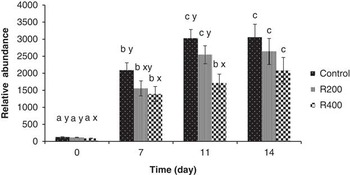
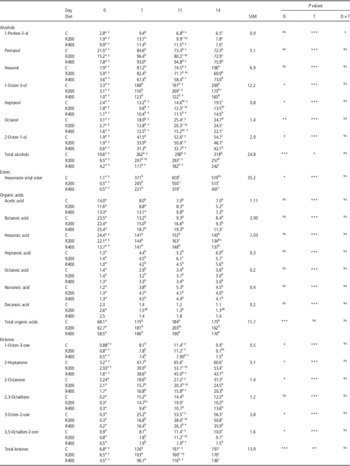
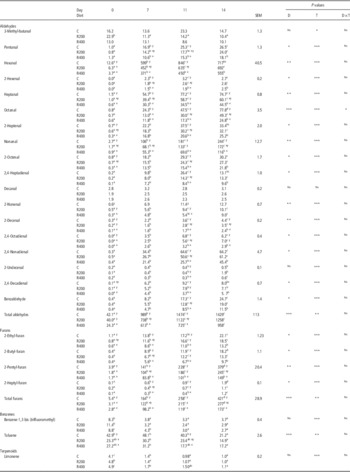
A total of 46 volatile compounds were determined in the lamb headspace by HS-SPME (Tables 1 and 2). The identified volatiles including seven alcohols, seven organic acids, one ester, six ketones, 18 aldehydes, four furan compounds, two benzene compounds and one terpenoid. In general, volatiles began to be detected on day 0 as a probable consequence of meat oxidation during handling. The level of total VOCs clearly increased from day 0 to day 11 and then tended to stabilize (see Figure 1). As expected, the strong pro-oxidizing conditions existing in the meat under high-O2/CO2 protective atmosphere and fluorescent lighting led to the gradual formation of aldehydes, ketones, alcohols, furan compounds, hexanoate vinyl ester and some organic acids as a result of lipid oxidation. In contrast, C3-C5 organic acids, benzene compounds and limonene decreased as storage time progressed. The type of volatiles found in our study showed a high degree of coincidence with others obtained in fresh lamb using HS-SPME at higher extraction temperatures, where aldehydes predominated (Lee et al., Reference Lee, Waller, Melton, Saxton and Pordesimo2004; Vasta et al., 2013; Gravador et al., Reference Gravador, Serra, Luciano, Pennisi, Vasta, Mele, Pauselli and Priolo2015). In our case, volatiles were recovered at 40°C to obtain a more representative profile of the compounds generated in the chilled raw meat. Our results agree with other shelf-life studies made on raw lamb (Nieto, Reference Nieto2009) and raw beef (Olivares et al., Reference Olivares, Dryahina, Spanel and Flores2012) packed under high-O2 protective atmospheres where the levels of aldehydes, alcohols, ketones, acids and other VOCs resulting from lipid oxidation increased throughout storage.
Projection of the dependent variables (odour attributes and volatile organic compounds) and individual groups (diet×storage time) in the two principal components calculated from correlation matrix. All results are expressed as mean abundance values of total volatile oxidation compounds (alcohols, organic acids, aldehydes, ketones, esters and furans) multiplied by 10−4; C, R200 and R400 diets were supplemented with 0, 200 or 400 mg dietary rosemary extract/kg feed. a,b,cStorage time effects (P⩽0.05); x,ydiet effects (P⩽0.05). Bars: standard error of the mean.

Effects of diet (D) and storage time (T) on the volatile profile (alcohols, organic acids, esters and ketones) of lamb loin fillets kept in retailing conditions for up to 14 days

All results are expressed as mean abundance values multiplied by 10−4. C, R200 and R400 diets were supplemented with 0, 200 or 400 mg dietary rosemary extract/kg feed.
a,b,c,dStorage time effects (P⩽0.05); x,y,zdiet effects (P⩽0.05).
Levels of significance: ***P⩽0.001, **P⩽0.01, *P⩽0.05, Ns⩽P>0.05.
Effects of diet (D) and storage time (T) on the volatile profile (aldehydes, furans, benzenes and terpenoids) of lamb loin fillets kept in retailing conditions for up to 14 days

All results are expressed as mean abundance values multiplied by 10−4. C, R200 and R400 diets were supplemented with 0, 200 or 400 mg dietary rosemary extract/kg feed.
a,b,c,dStorage time effects (P⩽0.05); x,ydiet effects (P⩽0.05).
Levels of significance: ***P⩽0.001, **P⩽0.01, *P⩽0.05, Ns⩽P>0.05.
Resconi et al. (Reference Resconi, Escudero and Campo2013) reviewed the VOCs formation pathways responsible for the development of aromas in the ruminant meat, finding that the free radicals formed from unsaturated lipids through oxidation reactions catalyzed by Fe+2, light or lipoxygenases are able to react with each other in the propagation chain to form lipid hydroperoxides. These are unstable molecules, so they can react again, resulting in lower molecular weight compounds such as aldehydes, alcohols, ketones, furans or organic acids. Phospholipids containing polyunsaturated fatty acids such as linoleic acid are particularly susceptible to oxidation, and are the largest source of free radicals in lamb meat, which explains the predominance of saturated aldehydes with six to nine carbons (e.g. hexanal) and their oxidized derivatives (e.g. hexanoic acid, hexanoate vinyl ester or 2-pentyl-furan). Moreover, the lamb meat may also contain aromatic residues from phytochemicals, such as toluene, which would follow a similar oxidation pattern to that followed by aliphatic VOCs.
The effects of diet on the volatile profile can be summarized as follows: the VOC formation ratio during storage was clearly higher in the C lamb than in the R400 lamb, whereas the R200 lamb presented intermediate values, depending on the compound analysed. The effect of diet on VOC levels was more evident at days 7 and 11 of chilled storage, before the probable depletion of meat antioxidants. Compared with the C diet, the R400 diet inhibited the formation of all the alcohols, ketones, aldehydes (except 3-methyl-butanal and decanal) furans and hexanoate vinyl ester. By contrast, organic acids and limonene were not affected by the diet. Thus, inhibition of VOCs by DRE was not seen to be particularly selective, corresponding, rather, to a general inhibition of lipid oxidation by phenolic antioxidants. However, heptanal, octanal, nonanal and 2-pentyl-furan were the only VOCs affected (P<0.05) by the diet at any storage time, which suggests that variations in the levels of these VOCs allow to accurately assess the inhibitory effect of rosemary diterpenes on rancid VOCs. Antioxidant action of rosemary diterpenes is well documented. Rosemary diterpenes are metal-chelating agents and also act on free radicals, as their benzene rings are able to act as electron donors, inhibiting chain reactions during lipid oxidation (Marco et al., Reference Marco, Navarro and Flores2007). The C19H22O3 diterpene metabolite, a lipophilic molecule derived from carnosol, may be integrated in phospholipidic membranes, as in the case of vitamin E, the most powerful natural antioxidant present in animal tissues. The deposition of this metabolite in muscle delayed the depletion of vitamin E in the fresh lamb meat (Ortuño et al., 2015), which represents an indirect evidence of this antioxidant activity. Our results confirmed that the formation rate of VOCs in the meat kept under strong pro-oxidizing conditions can be delayed through bioavailable diterpenes from rosemary in the lamb diet.
VOCs generated from lipids play an important role in meat odour due to their low perception thresholds. Aliphatic saturated aldehydes are indicators of raw or cooked rancid meat because of their relatively high concentrations (Shahidi, Reference Shahidi1994). Hexanal (green grass and rancid), octanal (geranium herbal and floral) and nonanal (plastic and soap) (Marco et al., Reference Marco, Navarro and Flores2007) are considered as markers of lipid oxidation because they are derived from hydroperoxide degradation (Frankel et al., 1998). Octanal, nonanal and 2-decenal are formed from the oxidation of oleic acid, pentanal, hexanal, heptanal, 2-heptenal, 2-octenal and 2-nonenal are derived from the oxidation of linoleic acid, whereas 2-pentenal, 2-hexenal, 2-n-pentyl-furan and benzaldehyde are flavour compounds derived from the oxidation of linolenic acid (deMan, Reference deMan1990). Alkenals formed by the autoxidation of polyunsaturated triacylglycerols containing linoleate are present at low levels compared with hexanal and other alkanals, and are associated with rancid and dirty off-odours (Marco et al., Reference Marco, Navarro and Flores2007). It has been reported that top odour-active alkenals and alkadienals, such as (E,E)-2,4-decadienal and (E)-2-nonenal, have a negative influence on lamb flavour (Bueno et al., Reference Bueno, Resconi, Campo, Cacho, Ferreira and Escudero2014). On the other hand, carboxylic acids resulting from the oxidation of aldehydes and ketones may provide rancid and pungent off-odours (Marco et al., Reference Marco, Navarro and Flores2007).
The antioxidant action of the diterpenic metabolite deposited in lamb muscle has been demonstrated in both studies on the antioxidant status of muscle (Ortuño et al., Reference Ortuño, Serrano, Jordán and Bañón2016) as shelf-life studies on chilled-packed meat fillets (Ortuño et al., Reference Ortuño, Serrano, Jordán and Bañón2014). The formation of VOCs was also inhibited in the chilled-MAP (Modified Atmosphere Packaging) raw lamb meat by using dietary antioxidants from other aromatic plants. Nieto (Reference Nieto2009) reported that rosemary-based and thymus-based diets decreased the levels of hexanal, heptanal, octanal, nonanal, 1-penten-3-ol, pentanol, 1-octen-3-ol and heptanol, inhibiting lamb rancidity during the storage in similar conditions to those used in our study. In this study, ewes were given high quantities (10% to 20%) of distilled rosemary leaf, a source of carnosic acid and carnosol (Moñino et al., Reference Moñino, Martínez, Sotomayor, Lafuente and Jordán2008), which resulted in a reduction in the level of hexanal and of other quantitatively minor VOCs in lamb meat from day 7 onwards. These results were explained in a further study by the lesser degradation of linoleic and linolenic acids protected by phenolic antioxidants (Nieto et al., Reference Nieto, Bañón and Garrido2012). Other dietary studies have studied the VOC profile of the fresh lamb meat. The dietary supplementation of heavy lambs with essential oils from rosemary or artemisia (at 400 mg/kg) did not affect the VOC profile (extracted at 80°C) of lamb meat (Vasta et al., 2012), as succeeded in our study at day 0. Similarly, Gravador et al. (Reference Gravador, Serra, Luciano, Pennisi, Vasta, Mele, Pauselli and Priolo2015) reported that the replacement of cereal concentrates with linseed and/or olive cake did not cause appreciable changes in the volatile profile of raw lamb meat (extracted at 72°C), as diet effects were limited to some minor volatiles, such as 3-methylpentanoic acid, nonanoic acid and 2-phenoxyethanol.
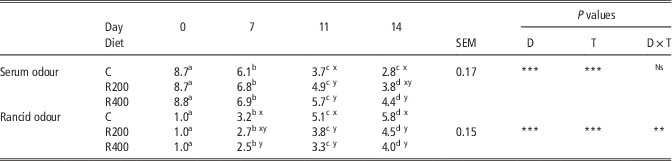
Odour assessment is shown in Table 3. The odour of lamb meat followed an oxidative deterioration pattern during storage. Fresh lamb gradually lost its serum odour by the development of an incipient rancidity. Similar finding were reported in previous studies (Bañón et al., Reference Bañón, Méndez and Almela2012; Serrano et al., Reference Serrano, Jordán and Bañón2014) and may be explained by the type of protective atmosphere used in the present study. The use of levels of 30% CO2 in packaging atmosphere is highly effective at inhibiting the growth of spoiling microbes in the meat, including lactic acid and other bacteria able to proliferate in these conditions; hence, any rancid odour would be more easily perceived by panellists without interference from microbial off-odours (acid, cheesy or putrid). Moreover, O2 enhances meat oxidation, in particular, lipid oxidation, and rancid odour is developed early. This may explain why a rancid odour began to be detected in lamb meat after 7 days of storage, as also occurred in other shelf-life studies on raw lamb packed in protective atmosphere (Nieto, Reference Nieto2009; Bañón et al., Reference Bañón, Méndez and Almela2012, Serrano et al., Reference Serrano, Jordán and Bañón2014). The effects of diet on odour scoring were coherent with the differences in VOC concentration observed among the diets. The R200 lamb and R400 lamb had lower scores for rancid odour and higher scores for serum odour from day 7 onwards and from 11 onwards, respectively, than the C lamb. Thus, odour stabilization by DRE showed a certain degree of dosage dependence, and was more effective at the dose of 400 mg DRE/kg feed.
Effects of diet (D) and storage time (T) on the odour scores of lamb loin fillets kept in retailing conditions for up to 14 days

All results are expressed as mean values (intensity arbitrary scale from 1 to 10). C, R200 and R400 diets were supplemented with 0, 200 or 400 mg dietary rosemary extract/kg feed.
a,b,c,dStorage time effects (P⩽0.05); x,ydiet effects (P⩽0.05).
Levels of significance: ***P⩽0.001, **P⩽0.01, Ns⩽P>0.05.
Rancidity inhibition observed in the meat reinforced with rosemary dietary antioxidants was clearly associated with the lesser development of a large number of VOCs responsible for rancid and pungent odours in ruminant meat (Resconi et al., Reference Resconi, Escudero and Campo2013). The dietary use of rosemary antioxidants clearly resulted in a meat with lower rancid odours. The individual contribution of each VOC to rancid odour is very difficult to establish, as it depends on the quantity and the detectable odour thresholds of each molecule as well as their interactions. In quantitative terms, the aldehyde group, led by hexanal, is considered the main contributor to rancid odour in raw meat (Ross and Smith, Reference Ross and Smith2006). The detectable odour threshold of hexanal in meat is relatively high (5.9 mg/kg) compared with those for other aldehydes, such as pentanal (2.7), 2-hexenal (7.9), heptanal (0.2), 2-octenal (4.2) or 2,4-decadienal (0.5), which are associated with rancid, painty and herbal odours (Brewer and Vega, Reference Brewer and Vega1995). Rancidity inhibition through a rosemary-based diet has been reported by Nieto (Reference Nieto2009) in lamb meat. In this study, the inhibitory effect of diet on hexanal and other VOCs was detected before the rancid odour could be detected by the sensory panel, which agrees with our results.
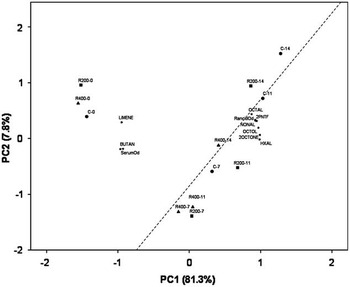
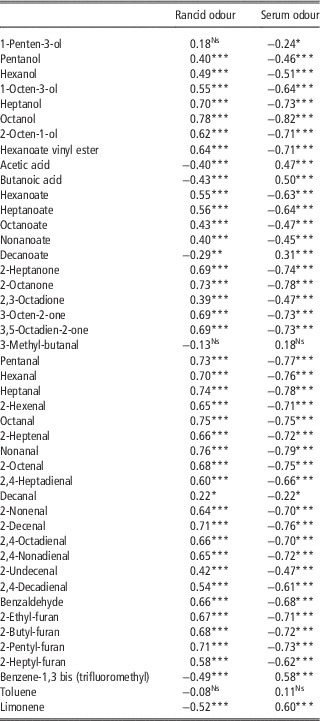
Table 4 shows the Pearson’s correlation coefficients between the relative areas of the VOCs and odour scores. As was expected, serum and rancid odour strongly correlated between themselves (R=−0.95; P<0.001). The values of 43 out of the 46 volatiles detected in the lamb headspace significantly (P<0.05) correlated with odour scores, confirming the strong dependency existing between VOC formation and odour deterioration. None of the correlation coefficients was noticeably higher than the rest, although C5-C9 VOCs, in particular, C8 VOCs, had the highest correlation coefficients with rancid odour. In general, aldehydes and ketones had higher correlation coefficients than alcohols and organic acids with the same number of carbons. Thus, practically all the VOCs present in lamb headspace can be considered as rancidity markers. Nieto (Reference Nieto2009) also found strong correlations between rancid odour and different VOCs in raw lamb fillets processed in similar conditions and stored for up to 21 days. Finally, a PCA was made to summarize the relationship existing between the VOC profile and meat odour. Figure 2 shows the projection of the dependent variables and individual groups in the plane defined by the two first principal components (PCs). The high percentage of variation accumulated by the PC1 indicated the strong correlation existing between many VOC markers of rancidity. The PC2 was positively correlated with serum odour indicative of meat freshness and limonene, a probable residue from feed. The average values for each combined treatment, diet×storage time, were also represented in the two principal PCs. A charted line allowed the lamb groups to be classified from lower to higher levels of VOCs and/or rancid odour: (i) R200-day 7; R400-day 7 and R400-day 11; (ii) C-day 7, R200-day 11 and C-day 7; and (iii) C-day 11, R200-day 14 and C-day 14. On the other hand, the three groups of fresh lamb (day 0) were represented in another quadrant. Thus, chilled-MAP lamb meat could be assigned to different dietary treatments according to its VOC levels.
Effects of diet and storage time on the relative abundance of volatile oxidation compounds of lamb loin fillets kept in retailing conditions for up to 14 days. Combined treatments: diet (○: Control (C, basal diet); Δ: basal diet plus 200 mg dietary rosemary extract (DRE)/kg feed (R200); □: basal diet plus 400 mg DRE/kg feed (R400))×storage day (0, 7 and 11). PC1=principal component 1; PC2=principal component 2; SerumOd=serum odour; RancidOd=rancid odour; LIMENE=limonene; BUTAN=butanoate; HXAL=hexanal; OCTAL=octanal; NONAL=nonanal; OCTOL=octanol; 2OCTONE=2-octanone; 2PNTF=2-pentyl-furan.

Pearson’s correlation coefficients (R) between the odour scores and the relative areas of volatile organic compounds

All results are expressed as Pearson’s correlation coefficients (R).
Levels of significance: ***P<0.001, **P<0.01, *P<0.05, Ns P>0.05.
Conclusions
The odour of raw meat quickly deteriorates under strong pro-oxidizing conditions due to the formation of volatile oxidized lipids, including aldehydes, alcohols, ketones, short-chain organic acids and furans, among others, which are potential contributors to meat rancidity. The correlation study indicated that the intensity of rancid odour is strongly associated with an increase in the levels of lipid-derived VOCs in the meat. A large number of carbonyl, alcohols and furan compounds, among other volatiles, can be considered molecular markers of rancidity in raw lamb meat. The use of DRE containing carnosic acid and carnosol contributes to inhibit VOCs formation and the subsequent rancid odour during meat storage. PCA confirmed that the differences in the VOC profile make it possible to identify whether or not samples have been reinforced with dietary rosemary diterpenes. Thus, VOC profiling can be regarded as a useful tool for assessing the dietary treatments used in sheep to improve the oxidative stability of lamb meat.
Acknowledgments
We thank the INIA (Instituto Nacional de Investigación y Tecnología Agraria y Alimentaria) for project RTA2008-00077-C02-01, under which this work was carried out.
Supplementary Material
For supplementary material/s referred to in this article, please visit http://dx.doi.org/10.1017/S1751731116000392