Introduction
An increasing proportion of the world's population lives in urban environments. One of the consequences of this increase in urban population is the growing population of dogs in cities (Otranto et al., Reference Otranto, Dantas-Torres, Mihalca, Traub, Lappin and Baneth2017). In most urban environments, it is common to see that people go to public green spaces for their dogs to defecate there. Since the dog owners do not usually pick up the faeces of their dogs or deworm their dogs periodically, green spaces have become an important source of infective stages for the transmission of canine parasites, some of which have zoonotic potential (Rubel & Wisnivesky, Reference Rubel and Wisnivesky2010; Wang et al., Reference Wang, Ruch-Gallie, Scorza, Lin and Lappin2012; Smith et al., Reference Smith, Semeniuk, Kutz and Massolo2014; Ferreira et al., Reference Ferreira, Alho, Otero, Gomes, Nijsse, Overgaauw and Madeira De Carvalho2017; Rubel et al., Reference Rubel, Nemirovsky, Gorosito, Servián and Garbossa2019). In Argentina, 92% of the population lives in cities (Clarín Newspaper, 2011). The city of Buenos Aires has 2.89 million inhabitants and 430,000 dogs (GCBA, 2010a, 2016). In the last decade, the number of dogs visiting the green spaces of Buenos Aires city has shown an increase (De Francesco et al., Reference De Francesco, Zunino, Kuruc and Schweigmann1997; Pinto et al., Reference Pinto, Pairo, Vaccaro, Turuelo, Sotelo, O'Donohoe, Banús and Rubel2012). Pinto et al. (Reference Pinto, Pairo, Vaccaro, Turuelo, Sotelo, O'Donohoe, Banús and Rubel2012) showed that squares (i.e. the most numerous type of public green spaces in Buenos Aires, which are about one hectare of surface) were visited by 150 to 312 dogs every day, which suggests an input of 13.8 to 28.7 kg of canine faeces daily in one hectare (considering an average of 92 g of faeces per day per dog; Morgan et al., Reference Morgan, Azam and Pegler2013).
The canine faecal contamination and the prevalence of parasites in the faeces in public spaces such as sidewalks and green spaces have been found to be related to the human density (HD) (Rubel & Wisnivesky, Reference Rubel and Wisnivesky2005, Reference Rubel and Wisnivesky2010; Rinaldi et al., Reference Rinaldi, Biggeri, Carbone, Musella, Catelan, Veneziano and Cringoli2006; Veneziano et al., Reference Veneziano, Rinaldi, Carbone, Biggeri and Cringoli2006; Rubel et al., Reference Rubel, Nemirovsky, Gorosito, Servián and Garbossa2019). It seems clear that the risk of parasitic transmission both between dogs and between dogs and humans increases as canine faecal contamination in public spaces increases (Uga, Reference Uga1993; Mizgajska-Wiktor & Uga, Reference Mizgajska-Wiktor, Uga, Holland and Smith2006; Poglayen & Marchesi, Reference Poglayen and Marchesi2006; Morgan et al., Reference Morgan, Azam and Pegler2013; Otero et al., Reference Otero, Alho, Nijsse, Roelfsema, Overgaauw and Madeira de Carvalho2018).
With respect to the economic level (EL), several review articles have mentioned the relationship between poverty and increased circulation of canine parasites (Traub et al., Reference Traub, Robertson, Irwin, Mencke and Thompson2005; Lee et al., Reference Lee, Schantz, Kazacos, Montgomery and Bowman2010; Dantas-Torres & Otranto, Reference Dantas-Torres and Otranto2014; Otranto et al., Reference Otranto, Dantas-Torres, Mihalca, Traub, Lappin and Baneth2017; Rivero et al., Reference Rivero, De Angelo, Nuñez, Salas, Motta, Chiaretta, Salomon and Liang2017). In agreement with this, in Argentina, previous studies in the suburbs of Buenos Aires and other cities have shown a higher frequency of parasite-containing canine faecal samples in areas with lower EL (Rubel et al., Reference Rubel, Zunino, Santillán and Wisnivesky2003; Martin & Demonte, Reference Martin and Demonte2008; La Sala et al., Reference La Sala, Leiboff, Burgos and Costamagna2015; Rivero et al., Reference Rivero, De Angelo, Nuñez, Salas, Motta, Chiaretta, Salomon and Liang2017). However, the possible influence of the HD and the EL on the frequency of parasites in faecal samples from urban public green spaces has not been studied simultaneously. Thus, the aim of this study was to explore the variations in the prevalence of parasitic helminths in canine faeces of green spaces according to HD and EL in the surroundings of these green spaces.
Materials and methods
Study area
Buenos Aires (34°35′S, 58°29′W) is the capital city of Argentina. It has got a diameter of around 17 km, covering an area of 200 km2 and includes 2.89 million inhabitants. Densities vary between 8200 and 33,100 inhabitants per sq km. The climate of the study area is temperate humid, with a mean annual relative humidity of 76% and a mean annual temperature of 15.8°C (Fuerza Aérea Argentina, 1992). Annual cumulative rainfall is 1200 mm on average, and rainfall events are recorded throughout the year (between seven and ten rainy days per month, average data for the period 1981–2010; National Meteorological Service, 2014).
The city is organized into 15 administrative divisions or communes (‘comunas’), which, in turn, include 48 neighbourhoods (GCBA, 2010b). The communes with highest EL and HD are located in the north of the city, while the communes with lowest EL and HD (as well as most of the contaminating industries and larger areas without houses or buildings) are located in the south of the city. The so-called slums or ‘villas miserias’ are also located there. Here, inhabitants live in precarious housing conditions and have deficient services – that is, without a supply of clean water inside houses, without sewage services and with a low frequency of paved streets with sidewalks (GCBA, 2006).
Sampling design
First, each square was classified according to the HD and EL in the surroundings. These two variables were considered as ordinal variables in three levels: low, high and very high HD and high, low and very low EL. Regarding the HD, the ‘low’ level was considered that in which the HD in the neighbourhood was lower than 13,000 inhabitants per km2 (GCBA, 2010a) and buildings taller than two storeys were absent in the surroundings of the square; the ‘high’ level was considered that in which the HD in the neighbourhood was higher than13,000 inhabitants per km2 (GCBA, 2010a) and buildings taller than three storeys were present as a continuum in the surroundings of the square; and the ‘very high’ level (slum areas or ‘villas’) was considered that in which the HD was 64,000 inhabitants per km2 on average (GCBA, 2015). No green spaces were found in the city that did not correspond to these categories (i.e. squares with less than 13,000 inhabitants and buildings taller than two storeys).
The EL was classified taking into account government data that group the population of the city into five economic categories (indigent, poor, vulnerable, middle-income and well-off citizens) by comparing their income with the cost of the ‘basic food basket'. Green spaces located in neighbourhoods with less than 7% of indigent citizens and more than 6% of well-off citizens were classified as being located in areas with ‘high’ EL. Green spaces located in neighbourhoods with 13% to 15% of indigent citizens and less than 6% of well-off citizens were classified as being located in areas with ‘low’ EL (GCBA, 2013). Green spaces located in slum areas or ‘villas’ were classified as being located in areas with ‘very low’ EL. We also took into account that, in these areas, 21.8% of the inhabitants live in an indigent household and 58.2% in a poor household, and that 49.2% of the households receive government assistance and 27.2% have unsatisfied basic needs compared to 6% of the households in the rest of the city (GCBA, 2015). In slum areas, a large number of dogs are unleashed, roaming the streets without their owners (more than 40% of the dogs that have been sighted at random corners roam alone; Rubel & Carbajo, Reference Rubel and Carbajo2019), while, in the other two areas, most of the dogs walk the streets with their owners or dog walkers. Only five out of the nine possible combinations of levels of the variables were present in the city.
In a second step, the green spaces with each of the existing combinations of the selected variables were numbered and a minimum of three green spaces was randomly selected (n = 20). The selected green spaces included: three squares from neighbourhoods with low HD and low EL (13% of the total squares in that category), five squares from neighbourhoods with high HD and high EL (17% of the total squares in that category), three squares from neighbourhoods with high HD and low EL (60% of the total squares in that category), five squares from neighbourhoods with low HD and high EL (14% of the total squares in that category) and four squares from slum areas or ‘villas’ with very high HD and very low EL (total of 20 sampled squares). In each green space selected, ten samples of fresh dog faeces were randomly selected. The faeces were randomly selected using a 5 m side grid on the map of each green space, randomly selecting ten coordinates and choosing fresh faeces closest to the ten selected sites. The selected faeces were collected (approximately 5 g of the middle portion of each) during a spring morning of 2014 (total samples = 200). Samples were collected in the field by the authors, who used the appropriate biosecurity protection (gloves, surgical masks, acrylic goggles and clothing protection). Each faecal sample was collected and placed in a collector vial with sodium acetate–acetic acid–formaldehyde solution in a 1:2 ratio. Each vial was sealed with ParafilmVR and vigorously shaken to crush the solid and fix the biological material and to be transported to the laboratory for parasitological analysis. Each batch of vials was transported in watertight containers under biosecurity conditions to the laboratory of the Department of Biological Chemistry, which were authorized and classified with biosecurity level 2 by the Health and Safety Department.
Diagnostic methods
Two aliquots of 55 ml of the well-homogenized faecal suspension were centrifuged (5 min, 10005 rpm, 167.705 ×g). One of the pellets was concentrated by centrifugation (modified Telemann sedimentation technique; Betti et al., Reference Betti, Cardillo, Diez, Cornero and Braida2007), whereas the other was floated in a saturated sodium chloride solution (specific gravity 1.20; Zajac & Conboy, Reference Zajac and Conboy2012). Two preparations from each tube were examined by light microscopy (400× magnification) by the two authors so that the diagnosis of each sample required the whole observation of four independent slides. Morphometric data were obtained with the aid of a calibrated micrometre eye-piece to identify helminth species.
Statistical methods
The Extended Mantel–Haenszel Chi Square for linear trend test was used to explore the linear increase in the frequencies of positive faecal samples at the different levels of the independent variables (Schlesselman, Reference Schlesselman1982). The prevalence for each of the helminth species found was analysed using generalized linear models (GLM) in R (R Core Team, 2019). Each prevalence was modelled with a binomial error distribution and a logit link function. The variables ‘economic level’ and ‘human density’ were analysed separately because the green spaces present in slum areas showed very low EL and very high HD simultaneously. When applicable, multiple testing was corrected using a Bonferroni correction with alpha = 0.05.
Results
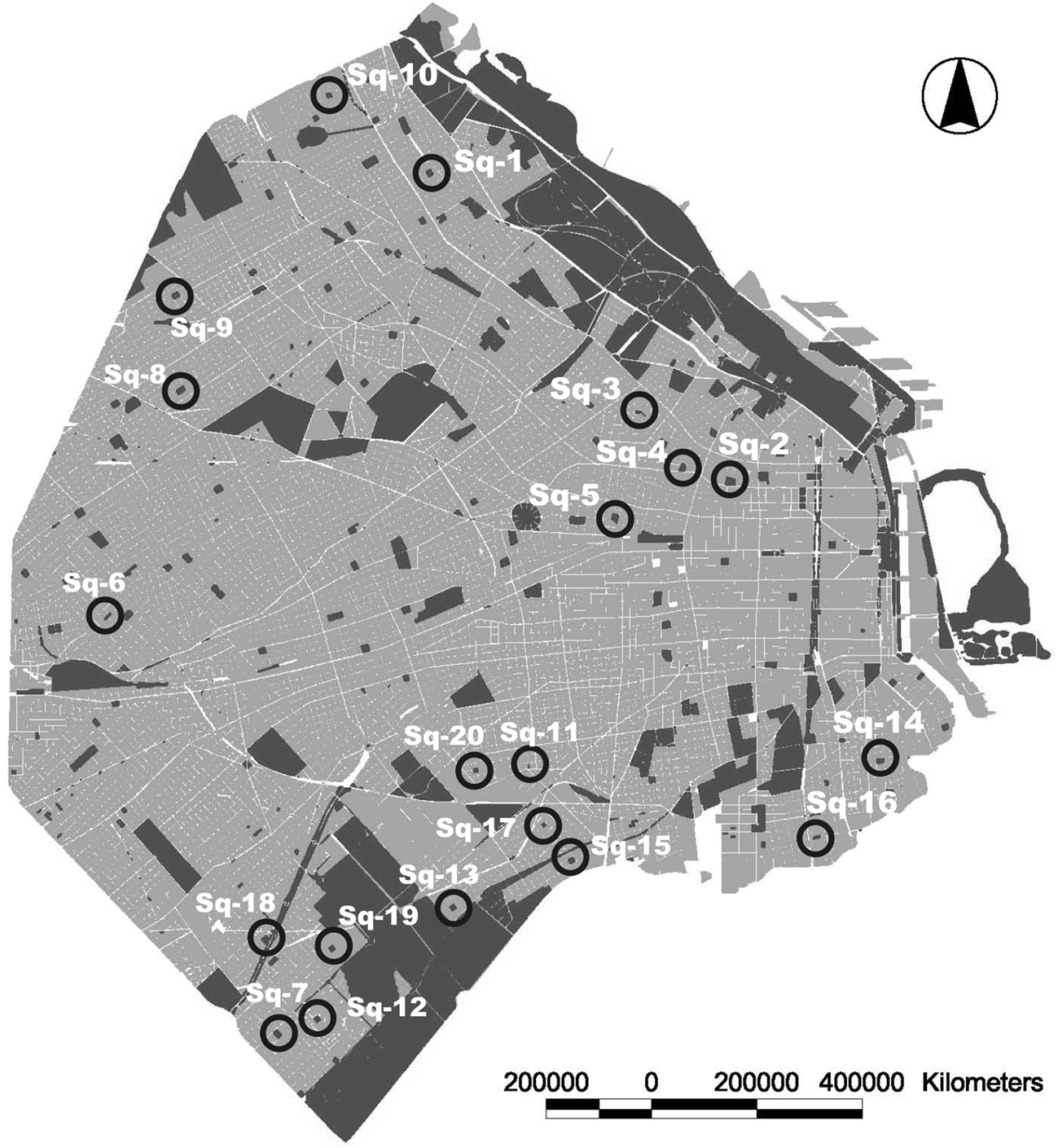
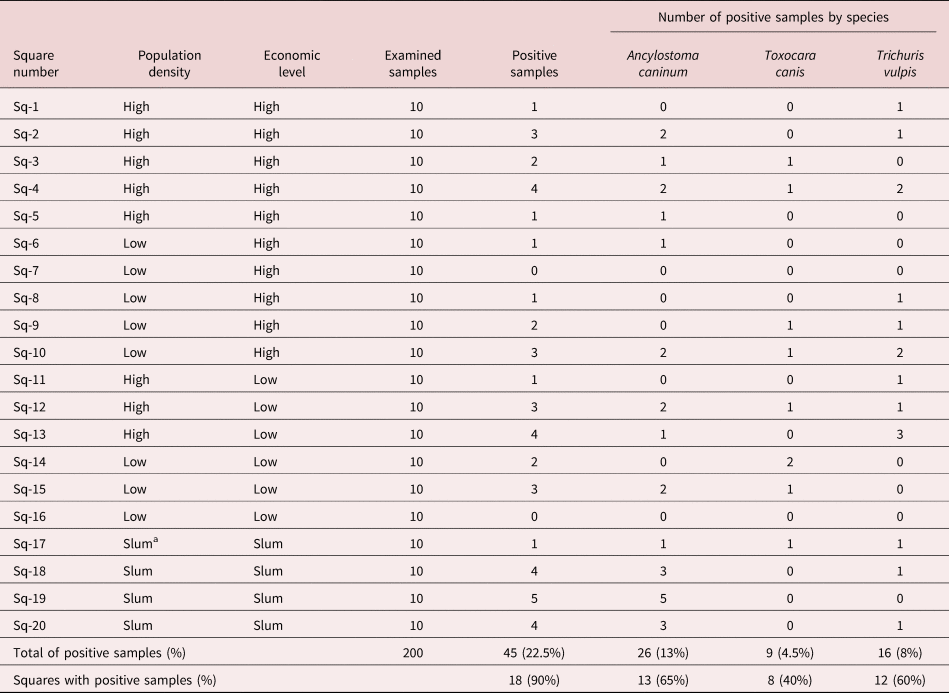
The location of the green spaces studied is shown in fig. 1. The results for each square and parasites found are shown in table 1. Helminth eggs were detected in 45 out of the 200 (22.5%) faecal samples collected and in 18 of the 20 green spaces sampled. The only two squares where no parasites were detected in the canine faeces corresponded to areas with low HD. The species observed were Ancylostoma caninum (13% of the samples examined), Trichuris vulpis (8% of the samples examined) and Toxocara canis (4.5% of the samples examined). The minimum and maximum prevalences for helminths per square were 0% and 50%, respectively (positive samples × 100/10 samples examined). The minimum and maximum prevalences per square for each species were as follows: 0% and 50% for A. caninum; 0% and 30% for T. vulpis; and 0% and 20% for T. canis. In 40 out of these 45 positive samples, only one species was detected, while the remaining samples harboured two or three different species (four samples harboured two species and one sample harboured all three species).
Location of the sampled green spaces in Buenos Aires city, 2014.

Sampled squares, level of independent variables and parasitological results for the canine fecal samples examined, Buenos Aires city, 2014.

a Areas whose inhabitants have precarious housing and deficient services, i.e. without a supply of clean water inside the houses, sewer or sewage pit services and low frequency of paved streets with sidewalks.
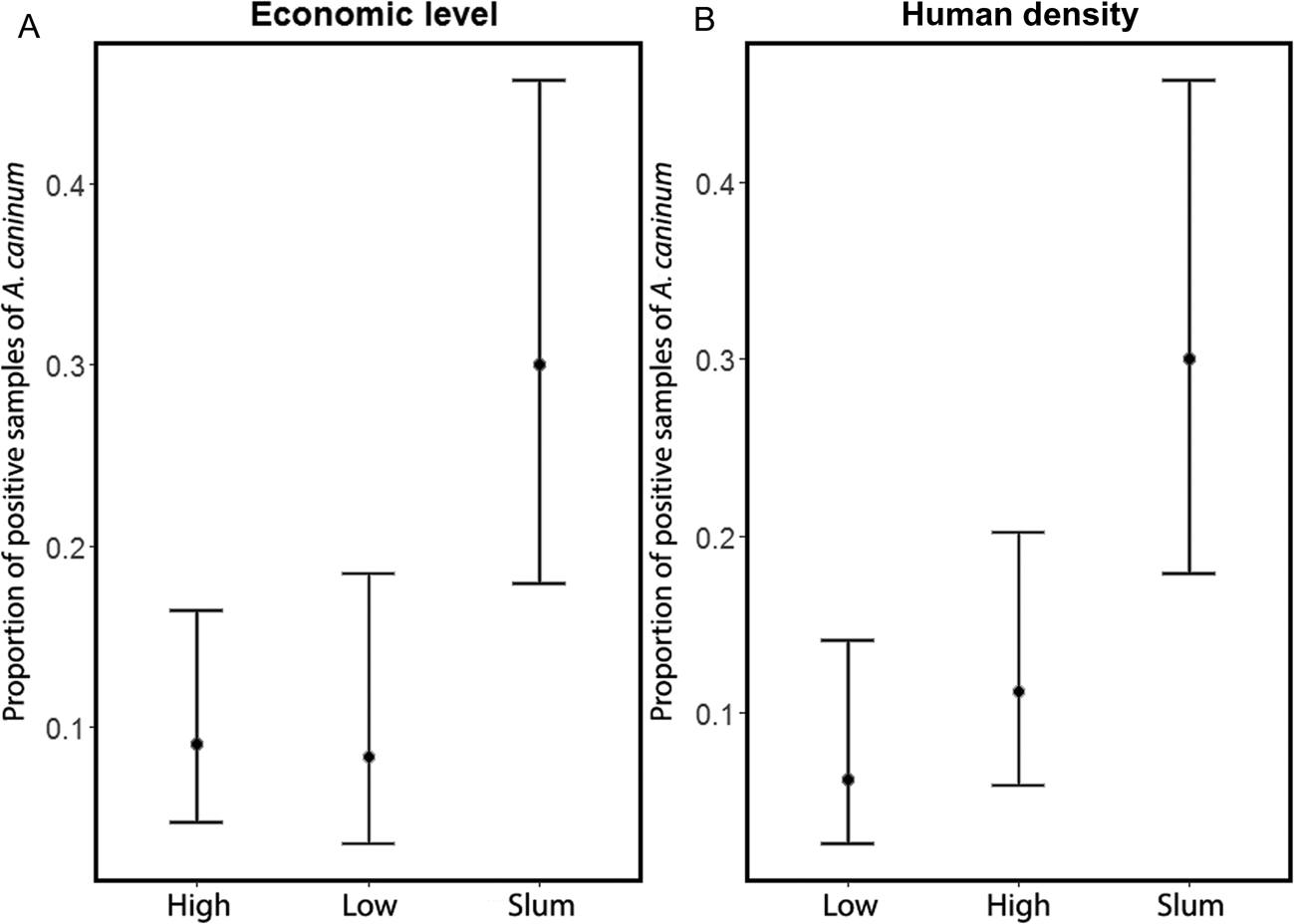
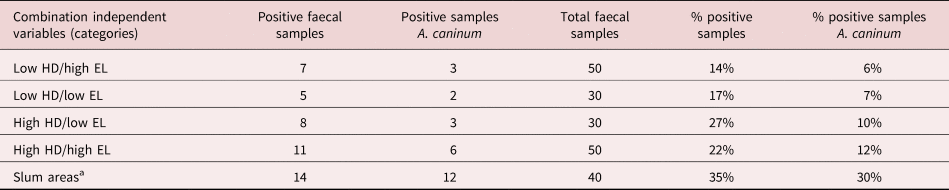
The GLM indicated that the prevalence of A. caninum in the samples from the slum areas was higher than that in samples from the areas with high and low HD as than that in samples from the areas with high and low EL (see fig. 2). The GLM showed no differences in the prevalences of the other parasite species for the different levels of the independent variables. Table 2 shows the percentage of parasite samples according to each combination of independent variables. The frequency of positive samples for Ancylostoma spp. showed a linear increase for both increasing HD and decreasing EL ($\chi _{{\rm Mantel\ndash Haenszel}\;{\rm Chi}\;{\rm Square}\;{\rm linear}\;{\rm trend}}^2$ = 6.165, P = 0.01303, odds ratio = 1 −1.77–3.05 for low, high and very high HD levels and $\chi _{{\rm Mantel\ndash Haenszel}\;{\rm Chi}\;{\rm Square}\;{\rm linear}\;{\rm trend}}^2$
 = 4.472, P = 0.03446, odds ratio 1 −1.35–2.63 for high, low and very low EL).
Proportion of positive samples for A. caninum with confidence intervals estimated from the generalized linear models, Buenos Aires city, 2014. Different letters denote significant differences between the categories for each variable considering the corrections by multiple tests. (A) Slum-Low, P = 0.020; Slum-High, P = 0.008. (B) Slum-Low, P = 0.036; Slum-High, P = 0.008.

Percentage of canine faeces with A. caninum eggs according to each combination of human density (HD) and economic level (EL) in squares of Buenos Aires city, 2014.

a Slum areas have very high HD and very low EL.
Discussion
In the present study, we detected only three species: A. caninum, T. vulpis and T. canis. In contrast, in one of our previous studies in green spaces of Buenos Aires, we detected greater diversity of parasitic helminths, including Toxascaris leonina, Strongyloides sp., Dipylidium caninum and Taenia sp. (Rubel & Wisnivesky, Reference Rubel and Wisnivesky2010).
These species were probably not detected due to their low prevalence, which varied from 0.2% to 0.6% of the positive samples in 1409 examined faecal samples (Rubel & Wisnivesky, Reference Rubel and Wisnivesky2010).
However, the total percentage of stool samples with helminth eggs (22.5%) found in the present study was similar to that observed in the same previous study (25%), suggesting that these parasitoses are endemic in the dog population of Buenos Aires city (Rubel & Wisnivesky, Reference Rubel and Wisnivesky2010). The percentage of parasitized stool samples confirms that green spaces are potential sources of infection for the dog population and zoonotic transmission. These urban spaces simultaneously present a high number of dogs daily walking around, high levels of faecal contamination and presence of parasites in the dog faeces (Wang et al., Reference Wang, Ruch-Gallie, Scorza, Lin and Lappin2012; Smith et al., Reference Smith, Semeniuk, Kutz and Massolo2014; Ferreira et al., Reference Ferreira, Alho, Otero, Gomes, Nijsse, Overgaauw and Madeira De Carvalho2017; Cortez-Aguirre et al., Reference Cortez-Aguirre, Jiménez-Coello, Gutiérrez-Blanco and Ortega-Pacheco2018; Rubel et al., Reference Rubel, Nemirovsky, Gorosito, Servián and Garbossa2019). In agreement with that already recorded in previous studies in the area (Fontanarrosa et al., Reference Fontanarrosa, Vezzani, Basabe and Eiras2006; Rubel & Wisnivesky, Reference Rubel and Wisnivesky2010), A. caninum was the most frequently detected parasite. Also, A. caninum was the species most detected in other studies carried out in different countries and continents, with a prevalence in the canine stool samples ranging from 12.2% to 88.1% (Katagiri & Oliveira-Sequeira, Reference Katagiri and Oliveira-Sequeira2008; Bwalya et al., Reference Bwalya, Nalubamba, Hankanga and Namangala2011; Savilla et al., Reference Savilla, Joy, May and Somerville2011; Chen et al., Reference Chen, Xu, Zhou, Song, Wang and Zhu2012; Alvarado-Esquivel et al., Reference Alvarado-Esquivel, Romero-Salas, Aguilar-Domínguez, Cruz-Romero, Ibarra-Priego and Pérez-de-León2015; Oliveira-Arbex et al., Reference Oliveira-Arbex, David, Oliveira-Sequeira, Katagiri, Coradi and Guimarães2016; Ferreira et al., Reference Ferreira, Alho, Otero, Gomes, Nijsse, Overgaauw and Madeira De Carvalho2017; Gillespie & Bradbury, Reference Gillespie and Bradbury2017; Idika et al., Reference Idika, Onuorah, Obi, Umeakuana, Nwosu, Onah and Chiejina2017; Mircean et al., Reference Mircean, Dumitrache, Mircean, Colosi and Györke2017; Traversa et al., Reference Traversa, Di Cesare, Simonato, Cassini, Merola, Diakou, Lénaïg, Beugnetd and Frangipane di Regalbono2017; Cortez-Aguirre et al., Reference Cortez-Aguirre, Jiménez-Coello, Gutiérrez-Blanco and Ortega-Pacheco2018). Unlike other canine intestinal parasites, A. caninum can also infect new hosts through skin contact, a fact that could contribute to its high prevalence. Comparisons between the different prevalences found in different studies are difficult due to the heterogeneity among sampling sites, number of samples, sampling selection method, diagnostic methods, etc. Despite these difficulties, many studies agree that A. caninum has cosmopolitan distribution and is potentially zoonotic (McCarthy & Moore, Reference McCarthy and Moore2000; Traversa, Reference Traversa2012; Dantas-Torres & Otranto, Reference Dantas-Torres and Otranto2014). Our results showed that A. caninum was the only parasite for which the frequency in the canine faeces was higher in green spaces located in areas with very low EL and very high HD (slum areas). Trichuris vulpis and T. canis showed similar frequency at the different levels of the variables analysed. However, it must also be mentioned that the low number of obtained positive samples of T. canis and T. vulpis (parasites of low prevalence in this population) makes it difficult to obtain statistically significant differences with the sample size used.
Despite this limitation, our results coincide with those found by Andresiuk et al. (Reference Andresiuk, Denegri, Esardella and Hollmann2003) in Mar del Plata city (Buenos Aires Province) and La Sala et al. (Reference La Sala, Leiboff, Burgos and Costamagna2015) in Bahía Blanca city (Buenos Aires Province). In both studies, the prevalence of A. caninum in canine faeces was higher in green spaces/areas with lower EL, whereas the prevalence of other parasites showed lower or null differences between green spaces/areas with different EL.
The contrast between areas can be more evident due to the combination of factors present in areas of lower EL such as higher densities of stray dogs and low coverage with anthelmintic drugs, added to the fact that the transmission of A. caninum through the skin could amplify the probability of reinfection with this species (Rubel et al., Reference Rubel, Zunino, Santillán and Wisnivesky2003; Brusoni et al., Reference Brusoni, Dezzotti, Fernández Canigia and Lara2007; Katagiri & Oliveira-Sequeira, Reference Katagiri and Oliveira-Sequeira2008; La Sala et al., Reference La Sala, Leiboff, Burgos and Costamagna2015; Otranto et al., Reference Otranto, Dantas-Torres, Mihalca, Traub, Lappin and Baneth2017; Rubel & Carbajo, Reference Rubel and Carbajo2019).
The effects of HD and EL cannot be discriminated because the sampled areas with very low EL are also the areas with the highest HD (slum areas). However, our results seem to indicate that the HD in the surroundings of the green spaces plays a more important role in the increase in infection than the EL (fig. 2 and table 3). This result can be related to the direct relationship between HD and canine density (Butler & Bingham, Reference Butler and Bingham2000; Kitala et al., Reference Kitala, McDermott, Kyule, Gathuma, Perry and Wandeler2001). Future studies should be carried out in this direction for more conclusive results.
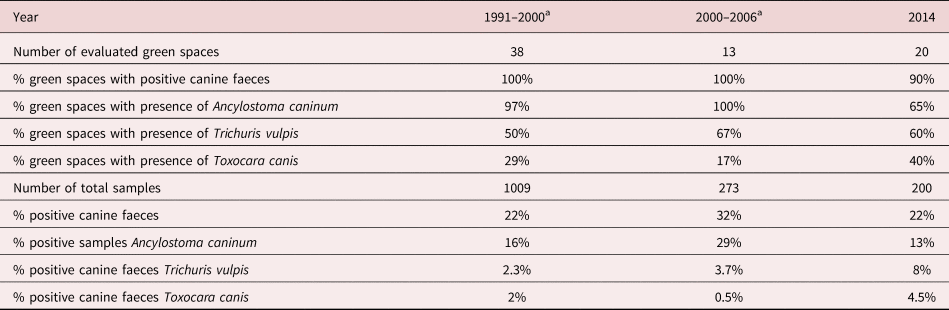
Comparison between the present results and results of a previous study (Rubel & Wisnivesky, Reference Rubel and Wisnivesky2010).

The data were grouped into three periods, Buenos Aires city, Argentina. Both studies analysed the presence of helminths in canine faeces of green spaces.
a Source: Rubel & Wisnivesky, Reference Rubel and Wisnivesky2010 (the sampled green spaces in this study were not located in slum or low-economic-level areas).
Regarding T. canis in canine stool samples, Andresiuk et al. (Reference Andresiuk, Denegri, Esardella and Hollmann2003) and La Sala et al. (Reference La Sala, Leiboff, Burgos and Costamagna2015) also obtained low prevalence (9.25% and 2.3% in Mar del Plata and Bahía Blanca, respectively) and neither of them found differences between the prevalence in green spaces/areas with different EL. Also regarding T. canis, in a study performed in different cities of the central region of Argentina, Martin & Demonte (Reference Martin and Demonte2008) obtained contradictory results; whereas, in a study of our group performed in Buenos Aires suburbs, we found higher levels of transmission in the dog population of an area with low EL than in the dog population of a nearby area with medium EL (Rubel et al., Reference Rubel, Zunino, Santillán and Wisnivesky2003). In agreement, several authors have shown higher seroprevalences of T. canis in children of lower EL inhabiting places with poor sanitation (Campos Júnior et al., Reference Campos Júnior, Elefant, Silva, Gandolfi, Jacob, Tofeti and Pratesi2003; López et al., Reference López, Martin, Chamorro and Alonso2005). However, the results about the prevalence of T. canis in dogs should be carefully analysed because it has been shown to be dependent of the age of pets, a variable considered in some previous studies (Overgaauw & Nederland, Reference Overgaauw and Nederland1997; Rubel et al., Reference Rubel, Zunino, Santillán and Wisnivesky2003; Nijsse et al., Reference Nijsse, Ploeger, Wagenaar and Mughini-Gras2015) but not in that by Martin & Demonte (Reference Martin and Demonte2008). Puppies less than one year old are more infected and, at the same time, they remain most of the time in the interior of homes and are usually underrepresented in studies that analyse faeces from public spaces (Hinney et al., Reference Hinney, Gottwald, Moser, Reicher, Schäfer, Schaper, Joachim and Künzel2017). This is a possible reason why the presence of T. canis eggs in canine faeces from green spaces was low in our results.
Ancylostoma caninum can be transmitted by transmammary passaging, through the skin or ingestion of infective third-stage larvae (Stone & Girardeau, Reference Stone and Girardeau1968; Burke & Roberson, Reference Burke and Roberson1985; Arasu & Kwak, Reference Arasu and Kwak1999), whereas T. canis – although it can also be transmitted by ingestion of embryonated eggs or lactogenically – is mostly transmitted to unborn puppies transplacentally in the uterus of the bitches (Burke & Roberson, Reference Burke and Roberson1985; Epe, Reference Epe, Holland and Smith2006; Katagiri & Oliveira-Sequeira, Reference Katagiri and Oliveira-Sequeira2008). These differences could explain the variations in the prevalence of these parasites according to the age of dogs: T. canis reaches its highest frequency in newborn puppies, while the infection by A. caninum can increase with the age of dogs or not be clearly associated with the age of dogs (Rubel et al., Reference Rubel, Zunino, Santillán and Wisnivesky2003; Fontanarrosa et al., Reference Fontanarrosa, Vezzani, Basabe and Eiras2006; Katagiri & Oliveira-Sequeira, Reference Katagiri and Oliveira-Sequeira2008; Núez et al., Reference Núez, Martínez, Bustamante, Galván and Durán2011; Morgan et al., Reference Morgan, Azam and Pegler2013; Nijsse et al., Reference Nijsse, Ploeger, Wagenaar and Mughini-Gras2015; Mircean et al., Reference Mircean, Dumitrache, Mircean, Colosi and Györke2017; Tadesse et al., Reference Tadesse, Ayana, Kumsa and Fromsa2020).
With respect to T. canis, it should also be considered that the eggs persist for long periods in the soil, which may increase the risk, even with low prevalences in faeces.
On the other hand, the prevalences of T. canis and T. vulpis obtained here were higher than those detected in a previous study in green spaces of Buenos Aires (see table 3). This result could be because this study included green spaces located in slum areas, while the previous study did not include green spaces of these areas. Future studies about canine parasites in green spaces should keep in mind the heterogeneity of EL, which could be reflected in differences in the prevalence of some parasites.
Buenos Aires city requires sustainable strategies to keep the public spaces clean of dog faeces and dogs free of parasites. The study of variables related to the transmission of canine parasites in different types of urban environments is necessary for the design of control programs and monitoring systems for canine helminths, some of which are potentially zoonotic.
Acknowledgement
We thank David Correa for his help during sample collection.
Financial support
This study was supported by the Environmental Protection Agency (APRA, OAT32/13) of the Government of the city of Buenos Aires and the University of Buenos Aires (researchers’ salaries and laboratories), Argentina.
Conflicts of interest
None.
Ethical standards
This study did not require ethical approval, as it did not involve animal experimentation and its risk was low.