Psychiatric comorbidity is the presence, simultaneously or in sequence, of two or more distinct mental disorders in an individual and is widely recognised as the norm rather than the exception among people with mental disorders (Cerda et al. Reference Cerda, Sagdeo and Galea2008). Community studies indicate that around one-half to two-thirds of people with a mental disorder experience comorbidity over their lifetime (Merikangas & Kalaydjian, Reference Merikangas and Kalaydjian2007; Kessler & Wang, Reference Kessler and Wang2008; Teesson et al. Reference Teesson, Slade and Mills2009). People with comorbid mental disorders suffer significant disability, experience a more complex and chronic course of illness and often remain untreated in the community (de Graaf et al. Reference de Graaf, Bijl, Ten Have, Beekman and Vollebergh2004; Coryell et al. Reference Coryell, Fiedorowicz, Solomon, Leon, Rice and Keller2012).
Comorbidity between anxiety and mood disorders (MDs) is typically investigated from the perspective of shared aetiology v. direct causation, with some researchers proposing that anxiety and affective disorders exist along a continuum and share vulnerability and risk factors, and others suggesting that they are separable disorders with distinct vulnerability, natural history and symptom profiles (Wittchen et al. Reference Wittchen, Kessler, Pfister and Lieb2000; Matthew et al. Reference Mathew, Pettit, Lewinsohn, Seeley and Roberts2011). The relationships between internalising disorders [i.e., mood and anxiety disorders (ADs)] and substance use disorders (SUDs) have been explained by the self-medication hypothesis, where a SUD is thought to develop to cope with the symptoms of a primary mood or AD (Martins et al. Reference Martins, Keyes, Storr, Zhu and Chilcoat2009; Leeies et al. Reference Leeies, Pagura, Sareen and Bolton2010; Robinson et al. Reference Robinson, Sareen, Cox and Bolton2011). It has also been proposed that substance use may exert physiologic efforts that increase vulnerability to mood and ADs (Falk et al. Reference Falk, Yi and Hilton2008), that both disorders are initially unrelated but exacerbate each other, or that an unknown antecedent factor gives rise to both (Compton et al. Reference Compton, Thomas, Stinson and Grant2007; Hasin et al. Reference Hasin, Stinson, Ogburn and Grant2007; Liang & Chikritzhs, Reference Liang and Chikritzhs2011).
Examining patterns of comorbidity over lifetime as well as temporal relationships between disorders has the potential to guide the timing and targeting of prevention and treatment (Glantz et al. Reference Glantz, Anthony, Berglund, Degenhardt, Dierker, Kalaydjian, Merikangas, Ruscio, Swendsen and Kessler2009) as well as inform nosologic debates about the underlying structure of psychopathology (Forbush and Watson, Reference Forbush and Watson2012). To date, very few studies have examined the bi-directional temporal sequencing of MDs, ADs and SUDs simultaneously and none have comprehensively examined the relationship between sex and the development of these disorders over lifetime in a large representative population sample. The present study therefore aimed to: (1) determine the rates and patterns of comorbidity of the common MDs, ADs and SUDs across lifetime and (2) describe the onset and temporal sequencing of these classes of mental disorder, by sex, in a representative general population sample in Australia.
Methods
Sample
Data came from the 2007 Australian National Survey of Mental Health and Wellbeing (NSMHWB), a nationally representative population survey with a sample size of 8841 (Slade et al. Reference Slade, Johnston, Oakley Browne, Andrews and Whiteford2009). Respondents were selected at random from a stratified, multistage area probability sample of persons aged 16–85 years living in private dwellings and data were weighted according to the inverse probability of being selected. Interviews were carried out by trained lay-interviewers from the Australian Bureau of Statistics (ABS) and were conducted in the respondent's own household using a Computer-Assisted Personal Interview (CAPI) questionnaire that took, on average, 90 min to complete. The ABS operates under Australian National Legislation that mandates strict provisions for the ethical conduct of the agency's research. Survey participation was voluntary and not remunerated. The survey achieved a response rate of 60%, with an intensive non-response follow-up study demonstrating that mis-estimation at the aggregate level is likely to be small (Slade et al. Reference Slade, Johnston, Oakley Browne, Andrews and Whiteford2009).
Measures
Experience of DSM-IV disorders over lifetime was assessed using a modified version of the World Health Organization's Composite International Diagnostic Interview (WMH-CIDI; (Kessler & Ustun, Reference Kessler and Ustun2004), a structured interview with questions designed to operationalise the diagnostic criteria for each mental disorder. The survey assessed the prevalence of 13 individual mental disorders across the three classes of mental disorder; MDs (major depressive disorder, bipolar disorder and dysthymia), ADs (panic disorder, agoraphobia, social phobia, generalised AD, post-traumatic stress disorder and obsessive–compulsive disorder) and SUDs (alcohol abuse, alcohol dependence, drug abuse and drug dependence). Note that abuse and dependence were assessed with reference to four separate classes of illicit drugs – cannabis, sedatives, stimulants and opioids). Comorbidity was examined between each of these three classes of disorder, rather than at the individual disorder level. The rationale for this was twofold: first, cell sizes at the individual disorder level were not adequate across all disorder combinations to allow comparisons of temporal sequencing. Second, there are reasonable theoretical grounds to argue that comorbidity across different disorder class combinations (e.g., MDs and ADs v. MDs and SUDs) may reflect different causal mechanisms and may have different implications for research and treatment (Cerda et al. Reference Cerda, Sagdeo and Galea2008).
Age of onset and temporal sequencing of disorders
Respondents were asked about the age at which they first experienced symptoms of each mental disorder and this was defined as the age of onset for that disorder. A series of prompts similar to those used in the World Mental Health Survey Initiative were used to increase the accuracy of retrospective recall of onset (Kessler et al. Reference Kessler, Amminger, Aguilar-Gaxiola, Alonso, Lee and Ustun2007). Because this analysis was limited to disorder groups or classes, the earliest disorder onset for each class was used. For example, if a respondent met criteria for panic disorder and social phobia, the earlier of these two onsets was used to define the age at onset of ADs. When considering temporal sequencing of MDs and ADs, respondents were classed as having a temporally primary AD if their earliest onset AD preceded the onset of all MDs.
Statistical analysis
Survey procedures in STATA Release 12 were used for all analyses. Prevalence estimates were weighted to conform to independent population estimates and 95% confidence intervals were based on, and standard errors obtained through, the delete-a-group jack-knife variance technique. Comparisons across comorbidity classes were made using adjusted Wald chi-squared tests and odds ratios (ORs) for gender comparisons were obtained using binary logistic regression analyses. Median ages of onset were obtained using Kaplan–Meier survival estimates stratified by sex (Hosmer & Lemeshow, Reference Hosmer and Lemeshow1989). This method of analysis allows for data to be modelled over time to retain all respondents including those who had not developed the disorder at the time of interview, often referred to as ‘censored’ cases. Survival time was defined as the number of years from birth to onset of disorder or to age at interview, whichever came first. The relationship between temporal sequencing of disorder classes and sex was examined using discrete-time survival analysis where sex and pre-existing disorders were treated as covariates and examined in interaction in models that predicted subsequent onset of either MDs, ADs or SUDs. Hierarchy rules were not applied.
For each of the six disorder class combinations (ADs prior to MDs, SUDs prior to MDs, MDs prior to ADs, SUDs prior to ADs, MDs prior to SUDs and ADs prior to SUDs) six separate discrete-time survival analyses (labelled Model 1 to Model 6) were carried out. Each analysis modelled the conditional probability of transitioning from not having the target disorder to having the target disorder in any given year. Model 1 included sex as a single predictor variable to examine the odds of developing the target disorder class for females compared with males. Model 2 included pre-existing disorder class as a single predictor variable to examine the odds of developing the target disorder class for those with compared with those without the pre-existing disorder class. Model 3 included both sex and pre-existing disorder class in a model together to determine whether pre-existing disorder class was associated with increased odds of developing the target disorder class controlling for sex and vice versa. In addition to the main effects, Model 4 included the interaction between sex and pre-existing disorder class to determine whether the association between the pre-existing disorder class and the odds of developing the target disorder class differed for males and females. To further understand the interaction terms, Models 5 and 6 examined the sex-specific odds (males in Model 5 and females in Model 6) of the target disorder class for those with compared with those without the pre-existing disorder class. The effect of time in all discrete-time survival models was approximated by a model including linear, quadratic and cubic terms. Preliminary modelling ensured that models met the assumption of proportionality of hazards and where this assumption was not met models included interaction terms between covariates and time. All models controlled for age at interview, divided into three categories (16–29, 30–49, 50+).
Results
Comorbidity of mental disorders over lifetime
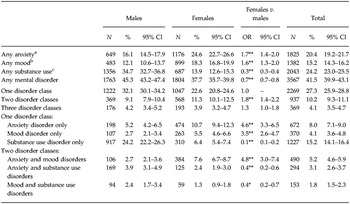
The lifetime prevalence of DSM-IV mental disorders and mental disorder comorbidity in the Australian population is presented in Table 1. Of the total population, 41.5% (95% CI = 39.9–43.1) met criteria for a mental disorder, most commonly SUDs (24.2%, 95% CI = 23.0–25.5) or ADs (20.4%, 95% CI = 19.2–21.7). Compared with males, females were less likely to meet criteria for SUDs (OR 0.3, 95% CI= 0.3–0.4) but more likely to meet criteria for ADs (OR 1.7, 95% CI = 1.4–2.0) or MDs (OR 1.6, 95% CI = 1.3–2.0).
Lifetime prevalence of mental disorder classes and mental disorder class comorbidity for males and females in the Australian population

aIncludes panic disorder, agoraphobia, social phobia, generalised anxiety disorder, post-traumatic stress disorder and obsessive–compulsive disorder.
bIncludes major depressive disorder, dysthymia and bipolar disorder.
cIncludes alcohol abuse, alcohol dependence, other drug (e.g., cannabis, ecstasy, methamphetamine, etc.) abuse and other drug dependence.
*p < 0.05; **p < 0.001.
Of the total population 10.2% (95% CI= 9.3–11.1), or a quarter of those with a mental disorder met criteria for two disorder classes and 4.1% (95% CI = 3.5–4.7) met criteria for all three disorder classes. Comorbidity differed by sex with females more likely to meet criteria for two disorder classes compared with males (OR 1.8 95% CI = 1.4–2.2).
Among those with only one disorder class females were more likely than males to meet criteria for ADs (OR 4.6, 95% CI = 3.3–6.5) or MDs (OR 3.5, 95% CI = 2.6–4.7) but less likely than males to meet criteria for SUDs (OR 0.1, 95% CI = 0.1–0.2). Among those with two disorder classes, females were more likely than males to meet criteria for anxiety and MDs (OR 4.8, 95% CI = 3.0–7.4) but less likely to meet criteria for anxiety and SUDs (OR 0.4, 95% CI = 0.2–0.6) or mood and SUDs (OR 0.4, 95% CI = 0.2–0.7).
Age of onset of mental disorder classes over lifetime
Median age at onset of ADs was 20 (Interquartile range (IQR) 12–40) for males and 19 (IQR 12–36) for females. Median age at onset of MDs was 38 (IQR 22–49) for males and 32 (IQR 20–52) for females and median age at onset of SUDs was 20 for both males and females (IQR 18–26 and 18–28, respectively).
Temporal sequencing of mental disorders over lifetime
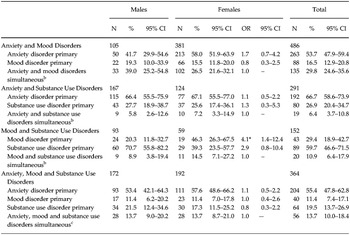
Data on the temporal sequencing of mental disorders for people with different disorder class combinations are shown in Table 2. ADs were reported as temporally primary for 53.7% (95% CI = 47.9–59.4) of people with comorbid ADs and MDs, and for 66.7% (95% CI = 58.6–73.9) of people with comorbid ADs and SUDs. When SUDs were comorbid with MDs over lifetime SUDs were reported as temporally primary for 59.7% (95% CI = 46.6–71.5) of people. When all three classes of disorder were comorbid over lifetime, ADs were most commonly the primary disorder (55.5%, 95% CI = 47.8–62.8), followed by SUDs (19.5%, 95% CI = 13.7–26.9). ADs and MDs were the most common combination to have their onset in the same year (29.8%, 95% CI = 24.6–35.6). There were no differences in temporal ordering of disorder classes for males and females among those with comorbid ADs and MDs, ADs and SUDs, or all three disorder classes. However, when MDs and SUDs were comorbid females were more likely than males to report their MDs as temporally primary (OR 4.1, 95% CI = 1.4–12.4).
Temporal ordering of mental disorder classes over lifetime for males and females with two or three classes of mental disorders a
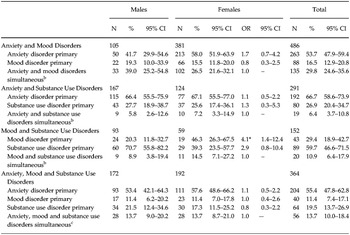
a A small number of respondents (N = 13) were missing age of onset for at least one of their lifetime disorders. They are not included in this table.
bOnset of both disorder classes occurred within the same 12-month period.
cOnset of at least two disorders occurred within the same 12-month period, and before the onset of the third class of disorder, or all three classes of disorder had their onset within the same 12-month period. For the majority of this group (63%) onset of anxiety and mood disorders occurred within the same 12-month period, but before the onset of substance use disorders. Onset of all three classes of disorder within the same 12-month period was uncommon.
*p < 0.05; **p < 0.001.
Development of lifetime mental disorders by sex and pre-existing disorder
The above analyses are restricted to the 14.3% of people meeting criteria for more than one class of mental disorder thus excluding the majority (85.7%) of the total sample. To understand the relationship between sex, pre-existing mental disorders and the development of comorbidity across the lifetime of all respondents (including those who do not go on to develop comorbid disorders), discrete-time survival analyses were carried out.
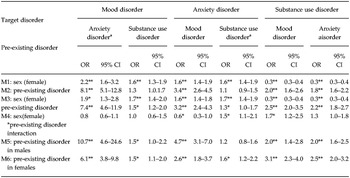
The results of the discrete-time survival analyses are found in Table 3. The results of Model 1 analyses showed that for all six pre-existing and target disorder combinations sex was associated with the target disorder class in predictable ways (i.e., females had a higher odds of developing MDs and ADs and a lower odds of developing SUDs compared with males). The results of Model 2 analyses showed MDs were predicted by pre-existing ADs (OR = 8.1, 95%CI = 5.1–12.8) but not SUDs. Similarly, ADs were predicted by pre-existing MDs (OR = 3.4, 95%CI = 2.6–4.5) but not SUDs. Last, SUDs were predicted by both a pre-existing MDs (OR = 4.9, 95%CI = 2.2–11.0) and pre-existing ADs (OR = 1.8, 95%CI = 1.6–2.2). Results of Model 3 analyses confirmed that, when entered into a model together, both sex and the presence of a pre-existing disorder remained as significant predictors of the development of the target disorder with minimal attenuation of ORs. With sex in the model, pre-existing SUDs became significantly associated with an increased odds of developing both MDs (OR = 1.5, 95%CI = 1.2–2.0) and ADs (OR = 1.3, 95%CI = 1.0–1.7).
Results of discrete-time survival analyses examining the risk of developing a target mental disorder class given the presence of a pre-existing mental disorder class
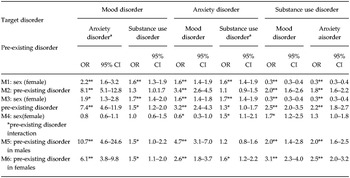
*p < 0.05; **p < 0.001.
aEvidence of non-proportionality of hazards was found in some or all models within a given disorder pair, where appropriate, models include sex by time and pre-existing disorder by time interaction terms to account for non-proportionality.
Model 4 results showed that statistically significant interactions were present for three out of the six disorder class combinations. The results suggest that the nature and/or extent of the association between a pre-existing disorder and the development of the target disorder differed for males and females. When looking at the development of ADs the significant interaction between sex and pre-existing MDs indicated that the association between pre-existing MDs and the development of ADs was nearly half as strong in females as it was in males. Sex-specific models (Models 5 and 6) showed that males with pre-existing MDs were around five times more likely to develop subsequent ADs, while the odds of developing ADs in females given pre-existing MDs were increased by around two and a half. The association between pre-existing MDs and the development of SUDs also differed significantly in males and females. However, in this case the direction of the effect was opposite to that seen among pre-existing MDs and the subsequent development of ADs. Sex-specific models showed that females with pre-existing MDs were around three times more likely to develop subsequent SUDs, while males with pre-existing MDs were twice as likely to develop SUDs compared with those without pre-existing MDs. Last, the relationship between pre-existing SUDs and subsequent ADs again differed for males and females. While there was no significant relationship for males, females with pre-existing SUDs were at significantly increased odds of developing ADs compared with females without pre-existing SUDs.
Discussion
The current study used data from a large epidemiological survey of mental disorders in the Australian general population to examine the patterns and temporal sequencing of comorbidity both in the total sample and separately for males and females. In general, females were more likely than males to report comorbidity over lifetime. MDs were commonly temporally secondary when comorbid with other disorders. The exception to this pattern was for comorbid MDs and SUDs where females were more likely to report their MDs as primary. While contemporaneous onset was evident to a greater or lesser extent for all disorder combinations ADs and MDs were the most common of the comorbid disorder combinations to have their onset in the same year. Two findings were of note in the discrete-time survival analyses. First, all disorder classes were significantly related to each other regardless of the temporal direction. Second, the strength and direction of the association between pre-existing and target disorder classes in some cases differed between males and females.
The finding that females are more likely than males to report comorbidity is undoubtedly a result of the higher prevalence of MDs and ADs in females compared with males coupled with the higher prevalence of comorbidity among the MDs and ADs compared with any other disorder combinations. Given the common finding that comorbidity per se is associated with more disability, higher rates of service utilisation, longer illness duration and other indicators of poor functional outcome (Merikangas & Kalaydjian, Reference Merikangas and Kalaydjian2007), these findings point to the continued need to prevent and treat comorbidity in order to reduce the burden of mental disorders, particularly in females. Sex differences in the proportion reporting temporal primacy of MDs when MDs and SUDs are comorbid are consistent with previous epidemiological studies (Helzer & Pryzbeck, Reference Helzer and Pryzbeck1988; Kessler et al. Reference Kessler, Crum, Warner, Nelson, Schulenberg and Anthony1997). Moreover, there is some evidence that the reasons for excessive/harmful drinking or drug use, the natural pre-cursors to SUDs, are different in males and females across early adulthood. Studies have shown that young adult males drink and use drugs more for social reasons, while females' use of alcohol and drugs is more closely related to emotional feelings such as stress, anxiety and loneliness (Lee et al. Reference Lee, Kosterman, McCarty, Hill and Hawkins2012).
One of the innovative aspects of the current study is the simultaneous examination of the bi-directional temporal sequences of mental disorder comorbidity. Past studies have tended to focus on pairs of individual disorders, sometimes examining associations that run in only one direction (Cerda et al. Reference Cerda, Sagdeo and Galea2008). The few studies that have examined all three disorder classes have tended to focus on temporal ordering with respect to one disorder class (de Graaf et al. Reference de Graaf, Bijl, Spijker, Beekman and Vollebergh2003; Falk et al. Reference Falk, Yi and Hilton2008). A strong finding that emerges from the current study is that the presence of any class of pre-existing mental disorder increases the risk of development of any other class of mental disorder. This pervasive finding suggests the existence of common mechanisms central to the development of comorbidity, regardless of the specific type of comorbidity. The findings underscore the need to further refine etiological models to account for the general increase in risk of any mental disorder given the prior existence of any other mental disorder. In fact, recent research by Lahey et al. (Reference Lahey, Applegate, Hakes, Zald, Hariri and Rathouz2012) proposes that a ‘general factor of prevalent psychopathology’ accounts for a significant degree of comorbidity in the general population. Understanding the psychological and neurobiological processes that underlie this general factor warrants further study.
When the target disorder class was MDs males and females were equally at risk given the pre-existence of either ADs or SUDs. However, males with pre-existing MDs were more likely to develop subsequent ADs than were females with pre-existing MDs, whereas females with pre-existing SUDs were more likely to develop subsequent ADs than were males with pre-existing SUDs. Both these findings are consistent with the so-called ‘gender paradox’ where in disorders with an unequal sex prevalence ratio the sex with the lower prevalence is often more seriously affected in terms of comorbidity (Taylor & Ounsted, Reference Taylor, Ounsted, Ounsted and Taylor1972). Males may require a larger genetic load than females to manifest MDs but once they do, this strong genetic load coupled with the robust genetic link between MDs and ADs substantially increases the risk of developing ADs in males. Similarly, females who engage in risky substance use, the natural pre-cursor to SUDs, are often more psychologically unhealthy than their male substance using counterparts (Pettinati & Plebani, Reference Pettinati, Plebani, Brady, Back and Greenfield2009). These findings are important given recent evidence of a narrowing in the gap between males and females traditionally seen in the rates of risky substance use and SUDs (Keyes et al. Reference Keyes, Li and Hasin2011). With females in more recent birth cohorts appearing to drink at more risky levels the potential for increased rates of ADs may become realised in the near future.
While pre-existing MDs increased the risk of developing subsequent SUDs in both males and females the effect was stronger in females. These results are consistent with prospective studies, e.g. (Moscato et al. Reference Moscato, Russell, Zielezny, Bromet, Egri, Mudar and Marshall1997), which demonstrate that depressive symptoms predict subsequent alcohol problems among females but not amongst males. Similarly, using data from the Epidemiologic Catchment Area study Gilman & Abraham (Reference Gilman and Abraham2001) demonstrated that the odds of developing alcohol dependence during a 1-year follow-up period increased according to the severity of baseline depressive symptoms and, critically, that this increase was much more pronounced among females. These findings highlight the need to screen for depressive symptoms not only as potential indicators of future MDs but also as possible markers for an increased risk of the development of SUDs in females.
Knowledge of the specific pre-existing/target disorder relationships that are most likely to occur in the general population can be used as markers for at-risk sub-groups. From this it may be possible to develop prevention programmes that target those with specific disorders early on in their developmental lifespan before they lead to the development of subsequent comorbid disorders. Within this context, the present study suggests that the exploration of sex-specific risk factors for the development of mental disorders may be of benefit. Gender-based violence represents one such sex-specific risk factor that is strongly associated with the development of individual and comorbid forms of mental disorder (Rees et al. Reference Rees, Silove, Chey, Ivancic, Steel, Creamer, Teesson, Bryant, McFarlane, Mills, Slade, Carragher, O'Donnell and Forbes2011). While there is some doubt as to how much the treatment or prevention of a given mental disorder will prevent the subsequent onset of another mental disorder (Glantz et al. Reference Glantz, Anthony, Berglund, Degenhardt, Dierker, Kalaydjian, Merikangas, Ruscio, Swendsen and Kessler2009) identification and characterisation of these vulnerable sub-groups still remains a public health priority.
Analyses like these provide evidence of the most common combinations of mental disorders, both how they exist at a given point in time and also, using self-reported age of onset, how they develop over time. Common combinations of disorders provide insight into novel and parsimonious ways of structuring mental disorder classification systems. A growing body of research is emerging that has identified a reduced number of core liabilities, often described as internalising, externalising and psychosis, that are thought to explain the high levels of comorbidity among a range of common and uncommon mental disorders (Kotov et al. Reference Kotov, Ruggero, Krueger, Watson, Yuan and Zimmerman2011; Simms et al. Reference Simms, Prisciandaro, Krueger and Goldberg2012). The present study lends support to this line of investigation.
The above findings should be interpreted in the light of some limitations. The data come from a cross-sectional survey and hence are subject to biases typically associated with retrospective recall, including the general limitations of memory and the cognitive schemas people might have regarding the typical v. actual age of onset of mental disorders (Simon & VonKorff, Reference Simon and VonKorff1995). It is most likely that males and females will have these biases to the same extent yet despite this we are still finding sex differences in temporal sequencing. We note that our findings are consistent with prospective studies that have assessed the development of comorbidity amongst specific mood and ADs (e.g., Moffitt et al. Reference Moffitt, Harrington, Caspi, Kim-Cohen, Goldberg, Gregory and Poulton2007). Our approach to identifying comorbidity meant that it was not possible to examine the comorbid patterns amongst the individual anxiety, mood and SUDs. Given the finding that individual disorders within a specific class differ greatly in their median age of onsets (particularly the ADs, (McEvoy et al. Reference McEvoy, Grove and Slade2011)) future research should investigate disorder by disorder combinations to identify specific patterns that fall outside the patterns observed at the disorder class level. All data used in the current study come from a cross-sectional survey and hence limit the ability to draw causal conclusions. However, the data provide informative evidence of ‘hot-spots’ in the comorbidity matrix and are the first step in understanding risk pathways between one mental disorder and another.
The current study examined the onset and temporal sequencing of the common mental and SUDs across lifetime for males and females in a representative general population sample. It is one of the first studies to examine the sex-specific differences in development of comorbid disorders and one of the few to simultaneously consider bi-directional relationships across all three classes of disorders. It found that the presence of any class of pre-existing mental disorder increases the risk of development of any other class of mental disorder lending support to the notion of a general factor of psychopathology that accounts for the pervasive prevalence of comorbidity in the general population. Second, it found evidence for several sex-specific differences in the temporal sequencing of comorbid disorders highlighting the potential benefit of sex-specific prevention and treatment programmes and underscoring the need for future longitudinal studies to examine development of comorbidity separately for males and females.
Acknowledgements
We would like to acknowledge the Australian Bureau of Statistics for carrying out the 2007 National Survey of Mental Health and Wellbeing and the respondents for participating in the survey.
Financial Support
This work was supported in part by and Australian National Health and Medical Research Council project grant (no. 630414).
Conflict of Interest
None.
Ethical Standard
The authors assert that all procedures contributing to this work comply with the ethical standards of the relevant national and institutional committees on human experimentation and with the Helsinki Declaration of 1975, as revised in 2008.