Introduction
Emotional information is generally better remembered than neutral information (LaBar & Cabeza, Reference LaBar and Cabeza2006). In addition to this general emotional enhancement effect, which is induced by negative, aversive or positive arousing items (Cahill et al. Reference Cahill, Gorski and Le2003), a negative emotional memory effect is specifically linked to states of reduced mood. Individuals with low mood states tend to remember sad or pessimistic information better than positive or optimistic information. This so-called negative memory bias is thought to be one of the main cognitive risk and maintenance factors for major depression, which even persists after remission (Beck et al. Reference Beck, Rush, Shaw and Emery1979; Watkins et al. Reference Watkins, Vache, Verney, Muller and Mathews1996; Gordon et al. Reference Gordon, Barnett, Cooper, Tran and Williams2008; Haas & Canli, Reference Haas and Canli2008). Also, individuals with high scores of neuroticism, and thus vulnerable to develop depression (Kendler et al. Reference Kendler, Fiske, Gardner and Gatz2009), have a pronounced negative memory bias (Martin et al. Reference Martin, Ward and Clark1983; Bradley et al. Reference Bradley, Mogg, Galbraith and Perrett1993). This evidence highlights the potential role of memory bias as a cognitive mechanism contributing to vulnerability and/or pathophysiology of depression (Hasler et al. Reference Hasler, Drevets, Manji and Charney2004).
The neural basis of this negative memory bias is not, however, well understood. One theory states that emotional memory enhancement is mediated by an amygdala–hippocampal interaction, whereby the amygdala seems to modulate hippocampal activity (Dolcos et al. Reference Dolcos, LaBar and Cabeza2005). Evidence for a role of the amygdala in mediating negative memory bias comes from functional imaging studies among depressed patients, which show increased amygdala activity associated with enhanced memory for negative information (Ramel et al. Reference Ramel, Goldin, Eyler, Brown, Gotlib and McQuaid2007; Williams et al. Reference Williams, Gatt, Grieve, Dobson-Stone, Paul, Gordon and Schofield2010). More importantly for the topic at issue, Hamilton and colleagues found an increased hippocampal–amygdala connectivity related to increased negative memory bias (Hamilton & Gotlib, Reference Hamilton and Gotlib2008). Thus, a dysfunction of amygdala–hippocampal interaction might be related to negative memory bias.
In addition to the functional abnormalities in amygdala–hippocampal interaction, accounting for negative memory bias in depression, structural imaging studies of depression quite consistently showed smaller hippocampal volumes (MacQueen & Frodl, Reference MacQueen and Frodl2010). The causal and even the temporal relationship between depression and hippocampal volume is, however, unresolved as several studies have shown that depression may lead to hippocampal atrophy (Sheline et al. Reference Sheline, Gado and Kraemer2003; Frodl et al. Reference Frodl, Meisenzahl, Zetzsche, Hohne, Banac, Schorr, Jager, Leinsinger, Bottlender, Reiser and Moller2004), whereas others have shown that smaller hippocampi may pre-date the onset of depression; suggesting that a smaller hippocampal volume may be a risk factor for depression (Chen et al. Reference Chen, Hamilton and Gotlib2010; Amico et al. Reference Amico, Meisenzahl, Koutsouleris, Reiser, Moller and Frodl2011). Additionally, both larger and smaller amygdala volumes have been reported (Anand & Shekhar, Reference Anand and Shekhar2003). In particular, during the early course of depression, larger amygdala were found in patients who were currently depressed (Frodl et al. Reference Frodl, Meisenzahl, Zetzsche, Born, Jager, Groll, Bottlender, Leinsinger and Moller2003; van Eijndhoven et al. Reference van Eijndhoven, van Wingen, van Oijen, Rijpkema, Goraj, Jan, Oude, Fernandez, Buitelaar and Tendolkar2009). Therefore, morphological changes may also be relevant to amygdala–hippocampal disturbances and negative memory bias.
All data published so far on the relationship between negative memory bias and brain structure were based on studies conducted among psychiatric patients and are thus potentially affected by (chronic) consequences of disease or therapy. Numerous studies have shown that differences in brain volumes can explain the variation in behaviour and psychiatric susceptibility.
Recent studies have suggested that structural brain abnormalities may be a risk factor for depression (Chen et al. Reference Chen, Hamilton and Gotlib2010; Amico et al. Reference Amico, Meisenzahl, Koutsouleris, Reiser, Moller and Frodl2011). Therefore, we investigated whether a cognitive risk factor for depression was already associated with structural brain abnormalities in healthy subjects as previously found among depressed subjects. The hippocampus and the amygdala are critical for memory in general and emotion memory enhancement in particular (Scoville & Milner, Reference Scoville and Milner1957; Cahill et al. Reference Cahill, Babinsky, Markowitsch and McGaugh1995). There is ample evidence that has linked the mediation of negative memory bias with the amygdala/hippocampus complex in depression (Ramel et al. Reference Ramel, Goldin, Eyler, Brown, Gotlib and McQuaid2007; Hamilton & Gotlib, Reference Hamilton and Gotlib2008; van Eijndhoven et al. Reference van Eijndhoven, van Wingen, van Oijen, Rijpkema, Goraj, Jan, Oude, Fernandez, Buitelaar and Tendolkar2009) and investigating the relationship in healthy controls is the next step to draw more conclusions about the cause and consequence of depression. However, no structural imaging study has been done, which explores the relationship between negative memory bias and measures of amygdala and hippocampal volume.
Therefore, we investigated in the current study whether negative memory bias was related to measures of amygdala and hippocampal volume as assessed by magnetic resonance imaging (MRI) in a sample of 272 healthy volunteers. We aimed at elucidating the following hypothesis: If, in healthy subjects, negative memory bias is associated with enlarged and decreased hippocampal volume, as previously found among depressed subjects, this would support the idea that an altered structural integrity of the amygdale and hippocampus in healthy subjects would make them more vulnerable to exhibit a negative memory bias, thereby increasing the cognitive vulnerability for depression.
Memory bias was assessed by the Self-Referent Encoding/Evaluation Task (SRET) (Hammen & Zupan, Reference Hammen and Zupan1984). This is a widely used information processing task designed to tap into memory for affectively charged words, which has previously been applied in mood-induction studies (Bradley & Mogg, Reference Bradley and Mogg1994) and studies on pharmacological modulation (Robinson et al. Reference Robinson, Cools, Crockett and Sahakian2010). We hypothesized that negative memory bias is associated with increased amygdala and decreased hippocampal volume, as previously found among depressed subjects (Ramel et al. Reference Ramel, Goldin, Eyler, Brown, Gotlib and McQuaid2007).
Materials and method
Participants
This study was part of the Brain Imaging Genetics (BIG) study at the Donders Institute for Brain, Cognition and Behavior of the Radboud University Nijmegen (Medical Centre) (Gerritsen et al. Reference Gerritsen, Tendolkar, Franke, Vasquez, Kooijman, Buitelaar, Fernandez and Rijpkema2011). Altogether, 272 individuals from BIG participated in the current study. They were screened using a self-report questionnaire for the following exclusion criteria: a history of somatic disease potentially affecting the brain; current or past psychiatric or neurological disorder; medication (except hormonal contraceptives) or illicit drug use during the past 6 months; history of substance abuse; current or past alcohol dependence; pregnancy; lactation; menopause; MRI contraindications. Using a web-based psychological test battery we assessed memory bias and current mood state. The test battery was programmed in Flash.
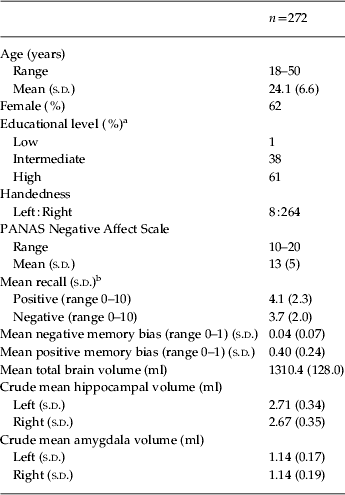
Table 1 gives an overview of the mean characteristics of our sample and the mean SRET scores and regional brain volumes. As can be seen, the participants were aged 18–50 years old, with a mean age of 24.1 (s.d.=6.6) years. The majority was female (62%) and had a university or equivalent degree (61%).
Description of study sample

PANAS, Positive Affect and Negative Affect Schedule.
a Low, elementary education or less ±6 years of education; Intermediate, general education, intermediate vocational education, lower vocational education; High, university education, college education and higher vocational education.
b As measured by the Self-Referent Encoding/Evaluation Task.
Self-Referent Encoding/Evaluation Task
The SRET (Hammen & Zupan, Reference Hammen and Zupan1984) was used to assess affective memory bias. During encoding, 12 negative and 12 positive trait adjectives (e.g. friendly and pessimistic) were presented on a computer screen, one by one for 2 s each. Participants were instructed to remember these words for a subsequent memory test and asked to press a button indicating whether a word was self-referent or not. After a distraction task, participants were requested to type as many of the studied adjectives as possible for 3 min. The two adjectives at the beginning and at the end of the encoding list were used as filler items and were excluded from analyses to avoid primacy and recency effects. Spelling errors were permitted since all responses that did not match exactly with study words were checked by the experimenter. Three outcome variables were calculated: the total number of words recalled; the proportion of self-referent negative recall; the proportion of self-referent positive recall. These latter two variables were calculated by dividing the number of adjectives that were endorsed as self-referent and recalled in a given valence category by the total number of adjectives endorsed as self-referent. For example, the proportion of self-referent negative recall was calculated by dividing all endorsed and recalled negative adjectives by the total number of endorsed adjectives. The advantage of using this variable is that it controls for group differences in overall rates of endorsement (Symons & Johnson, Reference Symons and Johnson1997). The general memory measure consisted of the composite of positive and negative words.
Image acquisition and data processing
For the current study, we used two scanners (Avanto and Sonata, both 1.5 T; Siemens, Germany) with six slightly different scanner protocols on Avanto and four on Sonata. We used a standard T1-weighted 3D MPRAGE sequence (TR 2300 ms, TI 1100 ms, TE 3.03 ms, 192 sagittal slices, field of view 256 mm). Previously, Jovicich et al. (Reference Jovicich, Czanner, Han, Salat, van der, Quinn, Pacheco, Albert, Killiany, Blacker, Maguire, Rosas, Makris, Gollub, Dale, Dickerson and Fischl2009) showed that differences in scanner protocols as used here do not affect the reliability of regional volume segmentation.
Structural MRI data were used to calculate both total brain volume and the volumes of hippocampus and amygdala. For total brain volume, raw DICOM MR imaging data were converted to NIFTI format using the conversion as implemented in SPM5 (www.fil.ion.ucl.ac.uk/spm). Normalizing, bias-correcting and segmenting into grey matter, white matter and cerebrospinal fluid was performed using the VBM toolbox in SPM (VBM5.1 Toolbox version 1.19, dbm.neuro.uni-jena.de/vbm/) using priors (default settings) (Ashburner & Friston, Reference Ashburner and Friston2000). This method uses an optimized VBM protocol as well as a model based on Hidden Markov Random Fields developed to increase signal:noise ratio. The total volume of grey matter, white matter and cerebrospinal fluid was calculated by adding the resulting tissue probabilities. Brain volume was defined as the sum of white matter and grey matter volume.
Automatic segmentation of hippocampus and amygdala was performed using the FIRST module of FSL [First version 1.2 (www.fmrib.ox.ac.uk/fsl/first/index.html) (Patenaude et al. Reference Patenaude, Smith, Kennedy and Jenkinson2011) in FSL version 4.1.4 (www.fmrib.ox.ac.uk/fsl), developed by the Analysis Group, FMRIB, UK]. This method is based on Bayesian statistical models of shape and appearance for bilateral amygdala and hippocampus from 317 manually labelled T1-weighted magnetic resonance images. To fit the models, the probability of the shape given the observed intensities is used. In addition, to model intensity at the structural boundary, automatic boundary correction was used (Smith et al. Reference Smith, Jenkinson, Woolrich, Beckmann, Behrens, Johansen-Berg, Bannister, DeLuca, Drobjnak, Flitney, Niazy, Saunders, Vickers, Zhang, De Stefano, Brady and Matthews2004). After automatic segmentation, volume determination of the subcortical structures was calculated using a script in Matlab7.2 (MathWorks, USA). In this script the volumes of the regional structures of interest were calculated by multiplying the number of voxels with the voxel volume (1 mm3). Visual inspection of the segmented subcortical structures projected onto the T1-weighted MRI scans was done using the software MRIcroN Version Beta 7 (www.mricro.com/mricron).
Test–retest reliability
In our dataset, using optimized values for the modes of variation (300 for both hippocampus and amygdala), the test–retest reliability expressed as Pearson's correlation increased from r=0.7 to r>0.9 (p<0.01) for amygdala and hippocampus.
Mood state
To avoid confounding by current mood state we adjusted the analyses for the negative affect scale of the Positive Affect and Negative Affect Schedule (PANAS; Watson, Reference Watson1988) which was assessed in all participants prior to performing the SRET.
Statistical analysis
In separate general linear models, the relationships between hippocampal and amygdala volume and SRET outcomes (total recall; negative and positive memory bias) were estimated. Because negative memory bias had a skewed distribution, the scores were normalized by converting them into a log-linear scale. First, we analysed the linear relation between memory bias scores and brain volumes and, second, we compared two groups of subjects by dichotomizing on negative memory bias scores (a group with and a group without negative memory bias). The full statistical model encompassed the following covariates: age; gender; total brain volume; MRI protocol; negative mood state.
All analyses were carried out in SPSS version 16.0 (SPSS Inc., USA).
Results
The mean number of words recalled was 4.1 (s.d.=2.3) for positive words and 3.7 (s.d.=2.0) for negative words. Overall, mean negative and positive memory bias were 0.04 (s.d.=0.07) and 0.4 (s.d.=0.24), respectively.
Within our sample, 108 individuals (39%) indicated one or more negative words to be self-descriptive (with a maximum of 10) and, within this subgroup, all but one person endorsed these negative self-descriptive words. Out of the participants endorsing negative self-descriptive words, 72 (67%) also recalled previously endorsed negative words such that a negative memory bias could be calculated.
Memory bias and hippocampus and amygdala volume
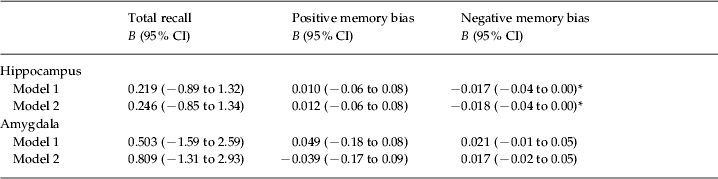
In Table 2, an overview of results of general linear models is shown for the SRET outcome total recall, positive and negative memory bias. A smaller total hippocampal volume was associated with more negative memory bias (B=−0.91, 95% CI −1.72 to −0.10, p=0.023), whereas a larger total amygdala volume was not (B=0.22, 95% CI −0.20 to 0.64, p=0.30). However, when looking into volumes per hemisphere, we found that the left amygdala volume was significantly related to more negative memory bias (B=0.29, 95% CI=0.002–0.590, p=0.048), but the right amygdale volume was not (data not shown). No associations were found for total recall and positive memory bias.
Overview of relations between hippocampal and amygdala volume and Self-referent Encoding/Evaluation Task

Model 1, adjustment for age, gender, total brain volume and magnetic resonance imaging protocol; Model 2, model 1 and additional adjustment for negative mood (Positive Affect and Negative Affect Schedule).
* p<0.05.
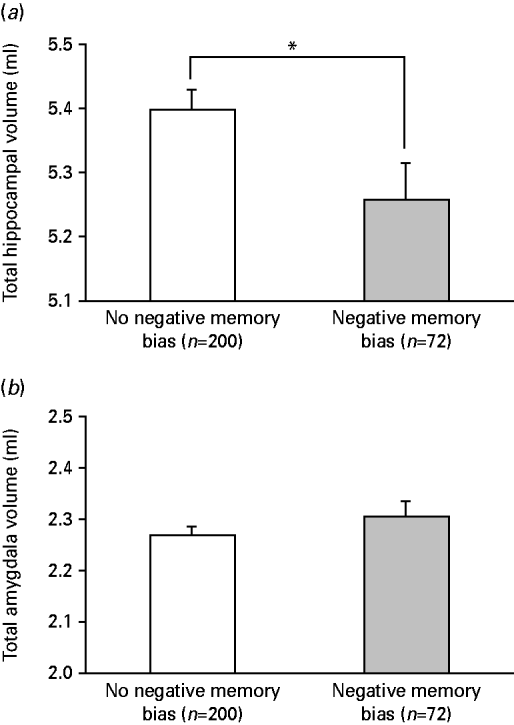
Fig. 1 shows the results for dichotomized negative memory bias and amygdala and hippocampal volume. Smaller total hippocampal volume (F 267,1=4.75, p=0.03) and larger left amygdala volume (F 267,1=4.16, p=0.042) were related to negative memory bias, whereas right amygdala volume was not (F 286,11=0.16, p=0.901). These associations corresponded to the following percentage in volume differences; compared with persons without negative memory bias, persons with negative memory bias had 2.2% larger amygdala volume and 3.7% smaller hippocampal volume.
Adjusted hippocampal (a) and amygdala (b) volume in relation to negative memory bias. * p<0.05. Error bars represent standard error. Adjusted for age, gender, total brain volume, scanning protocol and Positive Affect and Negative Affect Schedule negative scale.

Memory bias and amygdala to hippocampus volume ratio
Furthermore, we conducted additional linear regression analysis with both hippocampal and amygdala volume added into one model as independent variables. These analyses showed that amygdala and hippocampal volume are independent predictors of negative memory bias (B=0.67, p=0.03 for amygdala and B=−0.03, p=0.04 for hippocampus). Also, there was a trend for the interaction between amygdala and hippocampal volume (p=0.10), suggesting that both structures have a different relationship with negative memory bias (e.g. larger amygdala volume and smaller hippocampal volume). To further investigate whether the combination of enlarged amygdala and decreased hippocampal volume could underlie negative memory bias, we calculated the volume ratio between amygdala and hippocampus and repeated all analyses with the volume ratio as dependent variable. The analyses of covariance showed that persons with negative memory bias had a higher volume ratio (thus smaller hippocampal and larger amygdala volume) bilaterally (F 286,11=5.31, p=0.021). The difference in amygdala:hippocampus volume ratio between persons with and without negative memory bias corresponded to a difference of 6.3%.
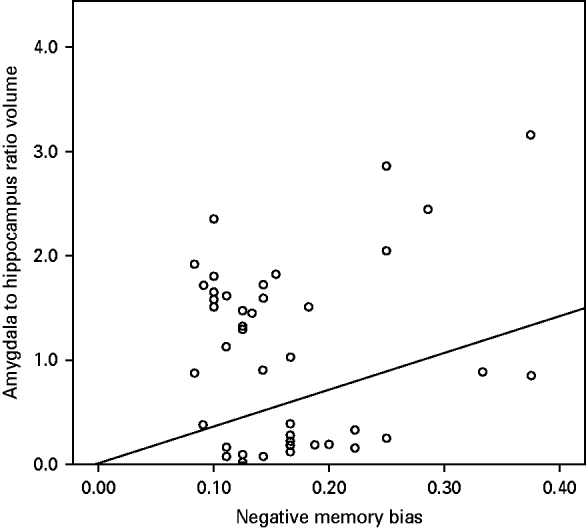
Along these lines we found within the subgroup with negative memory bias (n=72), that with increasing negative memory bias amygdala volume increases, whereas hippocampal volume decreases (Spearman's correlation coefficient: 0.35, p=0.01) (Fig. 2).
Adjusted ratio of amygdala and hippocampus volume in relation to the negative memory bias Spearman correlations, within sample with negative memory bias (n=72). Ratio volumes adjusted for age, gender, total brain volume, scanning protocol and Positive Affect and Negative Affect Schedule negative scale (r=0.34).

Discussion
In the present study we investigated the relationship between amygdala and hippocampal volume and emotional memory performance as measured by the SRET. We were particularly interested in negative memory bias, because this construct is thought to be one of the main cognitive risk and maintenance factors for depression. Indeed, we found that negative memory bias was associated with a smaller hippocampal volume and a larger amygdala volume. More importantly, our results suggest that negative memory bias is not simply associated with smaller hippocampal volume and larger amygdala volume separately, but that, particularly, the balance between the sizes of these two structures is of importance, as the strongest association was observed in individuals who had both large amygdala and small hippocampus.
These findings are in line with a study performed among paediatric patients with depression, which also found that the difference in amygdala:hippocampal volume ratio between controls and depressed patients was much larger than the difference in the separate volumes measured (MacMillan et al. Reference MacMillan, Szeszko, Moore, Madden, Lorch, Ivey, Banerjee and Rosenberg2003). Furthermore, when our analyses were adjusted for negative mood, the associations became more significant, suggesting that our measure of negative memory bias is a stable trait and thus independent of current mood state, as has previously been hypothesized (Teasdale & Dent, Reference Teasdale and Dent1987).
General memory and hippocampal volume
In our population we did not find a relationship between general memory performance and hippocampal volume, which seems prima vista to be counterintuitive, as the hippocampus is critically involved in memory processing. However, in our healthy population we did not expect a relationship between memory performance and hippocampal volume, as the overall memory performance was in the normal range, resulting in too low a variation to detect any association with brain volumes (van Petten, Reference van Petten2004).
Negative memory bias and hippocampal and amygdala volumes
Memory bias was assessed using the self-referent encoding/evaluation test. Within our sample a relatively small number of participants showed negativity bias (n=72) and therefore the overall mean of negative memory bias was quite low. However, the mean levels within the sample, which endorsed negative words (mean=0.08), was highly comparable to the levels of negative memory bias reported in previous studies among young depressed persons (Hayden et al. Reference Hayden, Dougherty, Maloney, Olino, Sheikh, Durbin, Nurnberger, Lahiri and Klein2008; Timbremont et al. Reference Timbremont, Braet, Bosmans and van Vlierberghe2008).
Larger amygdala and smaller hippocampal volumes have been frequently found in relation to depression (Drevets, Reference Drevets2003; MacQueen & Frodl, Reference MacQueen and Frodl2010), but as far as we know only one previous study also focused on the volume ratio of these two structures (MacMillan et al. Reference MacMillan, Szeszko, Moore, Madden, Lorch, Ivey, Banerjee and Rosenberg2003). However, the functional interaction between amygdala and hippocampus suggests that this is crucial since both structures are involved in emotional memory (Phelps, Reference Phelps2004; LaBar & Cabeza, Reference LaBar and Cabeza2006; Haas & Canli, Reference Haas and Canli2008). The hippocampus is thought to be the primary structure forming and retrieving declarative memories, whereas the amygdala plays an essential role in modulating hippocampal processing and plasticity when emotion and arousal come into play (Richardson et al. Reference Richardson, Strange and Dolan2004).
Accordingly, subjects with more negative memory bias may be more susceptible to stress, which, in turn, results in an increase in amygdala volume. Indeed, patient studies suggest that amygdala volume can change rapidly as a function of stress (Holzel et al. Reference Holzel, Carmody, Evans, Hoge, Dusek, Morgan, Pitman and Lazar2010).
It is somewhat more unclear if a higher susceptibility to stress is sufficient to cause the decrease in hippocampal volume. Animal studies have demonstrated that chronic repeated stress evokes excitotoxic changes in the hippocampus, resulting in degeneration (McEwen, Reference McEwen2001; Czeh & Lucassen, Reference Czeh and Lucassen2007). In humans, it remains a matter of debate whether hippocampal volume decreases as a result of chronic stress exposure or whether smaller hippocampal volume constitutes a risk factor for the development of psychiatric disorders in case of stress exposure. There are some studies suggesting that chronic depression can lead to hippocampal volume loss over time (Frodl et al. Reference Frodl, Koutsouleris, Bottlender, Born, Jager, Scupin, Reiser, Moller and Meisenzahl2008; Kronmuller et al. Reference Kronmuller, Pantel, Kohler, Victor, Giesel, Magnotta, Mundt, Essig and Schroder2008; MacQueen & Frodl, Reference MacQueen and Frodl2010), whereas other studies suggest that hippocampal volume reduction is already present before depression occurs (de Geus et al. Reference de Geus, van't Ent, Wolfensberger, Heutink, Hoogendijk, Boomsma and Veltman2007; Chen et al. Reference Chen, Hamilton and Gotlib2010; Rao et al. Reference Rao, Chen, Bidesi, Shad, Thomas and Hammen2010). Our results are more in favour of the latter hypothesis, because our sample consisted of non-depressed adults without a history of psychiatric disorders.
Given that non-depressed individuals with negative memory bias are at increased risk for depression (Beck et al. Reference Beck, Rush, Shaw and Emery1979; Watkins et al. Reference Watkins, Vache, Verney, Muller and Mathews1996; Gilboa et al. Reference Gilboa, Roberts and Gotlib1997; Gordon et al. Reference Gordon, Barnett, Cooper, Tran and Williams2008), our results may indicate that a large amygdala in the presence of a small hippocampus accounts for the negative memory bias and that this pattern of results is also related to depression itself. However, because of the cross-sectional design and the study population, our data appear to be unrelated to any consequence of depression. Nonetheless, our findings may point towards a potential role of negative memory bias and its underlying neural correlate in increasing the risk for depression. In turn, Beck's original formulation of the cognitive theory of depression stated that negative memory bias is a maintenance factor for the disease. Thus, it is most likely that memory bias can be related to both maintenance and risk of depression (Teasdale & Dent, Reference Teasdale and Dent1987).
Strengths and limitations
A major strength of the current study is the large number of subjects involved. Moreover, most preceding studies on negative memory bias used psychiatric patient populations, whereas the advantage of the current study among healthy participants is that the relationship found in this study cannot be explained by underlying pathophysiology or consequences of disease and therapy. Our results may thus suggest that certain structural brain differences are already apparent before possible onset of a mood or anxiety disorder. Despite the fact that our participants denied having (had) any psychiatric disorder and the fact that mood scores were normal as assessed with the PANAS, we cannot rule out that a few participants may have had a history of depression. However, the prevalence of depression is likely very small in our large cohort and we adjusted all analyses for negative mood scores. In sum, the potential effect of a depressive history on our results can be regarded as very small, most likely negligible. Brain volumes were measured by a fully automated segmentation tool, FSL-FIRST. Preceding studies showed that, compared to manual segmentation, the FSL-FIRST toolbox has a good reliability for small brain structures, such as the hippocampus and amygdale (Barnes et al. Reference Barnes, Foster, Boyes, Pepple, Moore, Schott, Frost, Scahill and Fox2008; Patenaude et al. Reference Patenaude, Smith, Kennedy and Jenkinson2011). Although manual segmentation is still considered to be the gold standard, a great advantage of automated segmentation is the high intra-rater reliability.
Memory bias was presented to the subjects by means of a web-based psychological test battery. There are many benefits of using the Internet for psychological testing, such as the absence of time and organizational constraints (Reips, Reference Reips2002). At the same time there are some problems with psychological research via the Internet. For instance, the experimental situation cannot be controlled; hence, it is unclear whether the participant did the test by him/herself and whether he/she got distracted.
Conclusions
To conclude, in the current study we found that larger amygdala and smaller hippocampal volumes were associated with more negative memory bias in non-depressed, apparently healthy subjects. Furthermore, we showed that the association found here might be based on a balance between the sizes of the amygdala and hippocampus. Possibly, the amygdala:hippocampus volume ratio may serve as an intermediate phenotype of depression (Hasler et al. Reference Hasler, Drevets, Manji and Charney2004). Future, longitudinal studies will be needed to confirm our hypothesis that an increased amygdala:hippocampus volume ratio accounts for the cognitive vulnerability often seen in persons with high risk for depression and also pre-dates the onset of depression.
Acknowledgements
We thank Sabine Kooijman for her assistance during the data collection.
Declaration of Interest
None.