1. Introduction
Similar to other varieties of German, High Prussian (East Central German) has final devoicing; yet its application is more restricted. Coda obstruents in word-medial syllables always surface as voiceless, similar to what is found in, for instance, Standard German. Unlike Standard German, however, High Prussian has final devoicing in word-final position only in some words. Voiced and voiceless word-final obstruents contrast in lexical items—as in the near-minimal pair [taov] ‘pigeon’ versus [touf] ‘baptism’—as well as in morphological paradigms. Two examples of synchronic alternations between voiced and voiceless obstruents in singular versus plural forms are provided in 1: The singular forms of the words for ‘day’ and ‘bread’ end in a voiceless obstruent, whereas the corresponding plurals end in a voiced obstruent (comparable patterns are found in adjectival and verbal paradigms; see section 2 for references and further discussion).
(1)


As discussed in more detail throughout the paper, there are good reasons to assume that the words for ‘day’ and ‘bread’ end in a voiced plosive underlyingly. Along these lines, final devoicing in 1 only applies in the singular forms, but not in the corresponding plurals. This, in turn, suggests that these plurals must have some property that blocks word-final devoicing. The main theoretical goal of this paper is to suggest that this property might be representational. In a nutshell, my approach builds on the idea that word-final consonants can be syllabified either as word-final codas or as onsets of empty-headed syllables, that is, syllables with an unpronounced nucleus (a recent overview of the use of empty-headed syllables in phonological theory can be found in Côté Reference Côté2011). In items where a word-final obstruent is syllabified as a coda, it is devoiced. Conversely, in items where a word-final obstruent is syllabified as the onset of an empty-headed syllable, final devoicing does not apply. My analysis derives empty-headed syllables from disyllabic trochaic foot templates in lexical representations (there are other ways to derive empty-headed syllables, see section 4.2). These templates enforce a disyllabic final window in words that would otherwise end in a stressed final syllable. For instance, the plural forms of the words for ‘day’ and ‘bread’ have word-final onsets: [broːd] ‘breads’ is syllabified as [broː.d], and [taːg] ‘days’ as [taː.g] (dots indicate syllable boundaries).
This metrical approach to final devoicing in High Prussian is part of a larger research program that investigates the role of metrical representations in the analysis of phonological alternations, which is sometimes referred to as contrastive metrical structure (Iosad Reference Iosad2016, Köhnlein Reference Köhnlein2016, among others). The representational tools employed in this paper are in line with previous metrical analyses of variation in the application of final devoicing (van Oostendorp Reference Oostendorp2006 on morphologically conditioned exceptions to final devoicing in Dutch dialects; van Oostendorp Reference Oostendorp, Riemsdijk and Oostendorp2015 on final devoicing in French), tonal accent (Köhnlein 2011, Reference Köhnlein2016, Reference Köhnlein2017, Hermans Reference Hermans2012, Kehrein Reference Kehrein2017 for Franconian; Iosad 2015 for Scottish Gaelic; Iosad Reference Iosad2016 for Danish; Morén-Duolljá Reference Morén-Duolljá2013 for Swedish), and interactions of syllable structure and vowel quality (Botma & van Oostendorp Reference Botma and van Oostendorp2012 for Dutch).
To model the interface between phonology and morphology, I adopt a morpheme-based approach where certain patterns of nonconcatenative morphology are attributed to the affixation of metrical units (generalized nonlinear affixation; see, for example, Trommer Reference Trommer2011, Bermúdez-Otero Reference Bermúdez-Otero and Trommer2012, Trommer & Zimmermann Reference Trommer and Zimmermann2014). In the case at hand, the quality of word-final obstruents interacts with the affixation of a metrical template. That is, while the morphological operation in question is additive—a metrical template is added—the presence of this template is not reflected on the surface as additional segmental material, but rather as a change in the pronunciation of the word-final obstruent. My analysis is formalized in Optimality Theory (OT; Prince & Smolensky Reference Prince and Smolensky1993, McCarthy & Prince Reference McCarthy1995), but this choice is not essential. The interactions could also be expressed in a rule-based framework.
The paper is organized as follows. Section 2 introduces the basic devoicing data from High Prussian. These data are analyzed in section 3; the section also discusses spirantization as well as predictable interactions of vowel length in high vowels and obstruent voicing. Section 4 provides some remarks on possible alternative analyses of the facts. Section 5 concludes the paper.
2. Background and Main Facts
This section first provides some background on High Prussian and the history of final devoicing in the language (section 2.1), and then discusses synchronic morphological alternations between simplex forms with word-final voiceless obstruents and complex forms with word-final voiced obstruents (section 2.2). Such alternations are found in pluralization, as well as in verbal and adjectival inflection.
2.1. Background and Historical Development of Final Devoicing
High Prussian is a presumably extinct variety of East Central German, located in present-day Poland and subdivided into Breslau Prussian (Breslausch) and Oberland Prussian (Oberländisch). The variety has been described in Stuhrmann 1895–1898, Kuck Reference Kuck1925, Kuck & Wiesinger Reference Kuck and Wiesinger1965, Teßmann Reference Teßmann1969, and Wiesinger Reference Wiesinger, Besch, Knoop, Putschke and Wiegand1983; some synchronic alternations are also recorded in individual entries in Riemann et al. 1974–2005, a six-volume dictionary of the Prussian varieties of German.Footnote 1 The data in these publications reflect how the language was spoken in a period around the end of the 19th and the beginning of the 20th century, a time when the dialect was still vital and used by speakers on a daily basis.
Similar to other varieties of German, High Prussian has final devoicing, although some items do not show final devoicing. The majority of exceptions have their origin in the historical development of the language, as shown in 2.Footnote 2 Items deriving from Middle High German (MHG) forms with originally word-final phonologically voiced obstruents usually show devoicing, as in 2a–c. Words that lost word-final schwas through apocope, however, retain the voicing quality of (now) word-final voiced obstruents, as in 2d–f.Footnote 3 Judging from the available sources, both types of items—with and without word-final devoicing—seem well represented in the language. Since the sources only provide examples of general patterns rather than comprehensive word lists, I am not able to provide distributional statistics. Exceptions to final devoicing are restricted to word-final position (for example, Kuck & Wiesinger Reference Kuck and Wiesinger1965:134); in other words, word-medial coda obstruents surface as voiceless (*VD.CV, where D=voiced obstruent).
(2)

Given the available, exclusively written sources, it is not possible to decide conclusively whether final devoicing in High Prussian should be treated as an instance of “true” devoicing or rather as final fortition, that is, the addition of aspiration to plain obstruents (Iverson & Salmons Reference Iverson and Salmons2011, among others). Kuck & Wiesinger (Reference Kuck and Wiesinger1965:140) refer to final voiced obstruents as stimmhaft ‘voiced’ and as being realized with Stimmton ‘voicing’. Therefore, I tentatively assume that High Prussian had final devoicing, rather than final fortition. Note, however, that this choice is not crucial for the analysis provided in section 3; devoicing could also be formalized as final fortition.
2.2. Synchronic Alternations: Pluralization, Verbal and Adjectival Forms
In some plural forms, word-final voiced obstruents correspond to singulars with voiceless obstruents. Examples of synchronic alternations between singular and plural forms are provided in 3.Footnote 4 In 3a,b, only the voicing quality of the obstruent changes. There are also alternations where additional changes occur. In 3c,d, the alternations are accompanied by spirantization in the plural forms. That is, instead of voiced plosives, the items in question have voiced fricatives (this issue is treated in more detail in section 3.2). In 3d–f, umlaut accompanies the alternation in obstruent quality. Lastly, 3f,g also display additional alternations in vowel length: short, lax high vowels before voiceless obstruents versus long, tense high vowels before voiced obstruents (the length alternations are discussed further in section 3.3).Footnote 5
(3)

In verbal paradigms, obstruent-final forms (1st person singular present tense, imperative singular) always retain the voicing quality of the stem-final obstruent. As shown in 4, this is independent of whether the obstruent is underlyingly voiced, as shown in 4a,b, or voiceless, as in 4c,d. Barring a few examples of suppletion, these patterns are entirely systematic.Footnote 7
(4)

As far as obstruent-final adjectival forms are concerned, there is no devoicing in attributive position. According to Stuhrmann 1895–1898 and Kuck & Wiesinger Reference Kuck and Wiesinger1965:134, this lack of devoicing is entirely systematic; unfortunately, concrete examples are scarce. The only example provided in Kuck & Wiesinger Reference Kuck and Wiesinger1965 is [das liːv kɪɲt] ‘the nice child’ (p. 134), where the word-final voiced obstruent in attributive [liːv] does not undergo final devoicing. Stuhrmann’s (1895–1898) description of the High Prussian sound system contains a few relevant paradigms, two of which are given in 5, from Stuhrmann’s description of Breslau Prussian (1895-1898:28). With regard to these examples, Stuhrmann states that the two forms following the base form are inflected (which means that they are attributive forms), but he does not provide the respective morphosyntactic environment.Footnote 8
(5)

Stuhrmann does not discuss any Breslau Prussian examples of adjectival paradigms ending in a phonologically voiceless obstruent. In Stuhrmann 1895-1898:16, however, he mentions that the word for ‘red’ is always realized with [t] in Oberland Prussian ([roːt], [roːtɐ], [roːt]), which can presumably be regarded as a prototypical voiceless paradigm.
To summarize the discussion in this section, exceptions to final devoicing can be found in monomorphemic words (as in [glaiz] ‘rail’) as well as in three types of morphologically complex words: i) plural forms, as in [broːt] ‘bread’ versus [broːd] ‘breads’; ii) verb forms, as in [raiv] ‘rub.imp.sg, 1sg’; and iii) adjectival paradigms, as in [roːt] ‘red (predicative)’ versus [roːd] ‘red (attributive)’. Notably, in cases where voiceless and voiced word-final obstruents alternate in morphological paradigms, the voiced pronunciation always corresponds to the morpho-logically complex form.
3. Analysis
This section presents a formal analysis of the voicing alternations in question, including interactions with metrical structure. I assume that in High Prussian, some lexical representations contain a disyllabic trochaic foot template, where the first syllable is the head and the second syllable the dependent. Example 6 shows the structure of the underlying disyllabic trochee. In running text, I represent this template as /(σ+σ−)/, indicating foot boundaries with brackets, the head syllable with a superscript plus, and the dependent syllable with a superscript minus.
(6)

As discussed in more detail in the following subsections, this template affects the syllabification of word-final obstruents. If no disyllabic foot template is present in the input, word-final obstruents are syllabified as codas, which means that they are subject to final devoicing. If the input contains a foot template, obstruents are syllabified as the onset of an empty-headed syllable and are not subject to final devoicing. In section 3.1, the analysis is implemented in terms of OT. Interactions with spirantization and vowel length are addressed in sections 3.2 and 3.3, respectively.Footnote 9 Section 3.4 summarizes the analysis.
3.1. Voicing Alternations in Word-Final Position
As described in section 2, morphologically alternating forms can differ in the voicing quality of word-final obstruents. In such word pairs, simplex forms always end in a voiceless obstruent and complex forms in a voiced obstruent. Consider pluralization as an example. I have argued that in relevant alternations, the plural morpheme consists of a disyllabic foot /(σ+σ−)/. The foot template then combines with the segmental material of the stem. This leads to a contrast in syllabification, which in turn determines obstruent voicing. Representations for the alternation between [broːt] ‘bread’ and [broːd] ‘breads’ are provided in 7. The underlying representation for ‘bread’ is given as /broːd/. The singular is footed as a default monosyllabic, bimoraic trochee (left side). In this form, /d/ is syllabified as a coda; accordingly, /d/ devoices on the surface, yielding [t]. In combination with the templatic plural morpheme /(σ+σ−)/, however, stem-final /d/ is syllabified in the onset of an empty-headed syllable, and voicing is retained (right side). Formally, I represent voicing with a privative laryngeal feature [Voice] that is lost when an obstruent is not linked to an onset position; the absence of [Voice] leads to a voiceless pronunciation.Footnote 10
(7)

Now consider the proposed interactions in terms of OT. I begin with the evaluation of the devoiced singular form. A constraint enforcing final devoicing is central for the analysis (van Oostendorp Reference Oostendorp, Riemsdijk and Oostendorp2015, among many others):
(8)

Given that High Prussian shows final devoicing in some forms, FinDev must outrank a faithfulness constraint against the deletion of the feature [Voice] (McCarthy & Prince Reference McCarthy, Prince, Beckman, Urbanczyk and Dickey1995):
(9)

Furthermore, Max[Voice] must be lower-ranked than a constraint prohibiting empty-headed syllables, which I refer to as *Empty (Harris & Gussmann Reference Harris and Gussmann2002, Barlow Reference Barlow and Eddington2005, van Oostendorp Reference Oostendorp2017):
(10)

For underlying forms of the type /broːd/, the ranking *Empty, FinDev >> Max[Voice] results in the syllabification of /d/ as a coda. Accordingly, the obstruent devoices, as shown in the OT tableau in 11.
(11)

Candidate 11a is optimal since it violates only the low-ranked faithfulness constraint Max[Voice] but satisfies high-ranked FinDev and *Empty: The obstruent in coda position is devoiced (satisfying FinDev), and the word does not end in an empty-headed syllable (satisfying *Empty). Each of the two losing candidates violates one of these undominated constraints: Candidate 11b fails to devoice (violating FinDev), and candidate 11c creates an empty-headed syllable (violating *Empty).
Consider now the plural form [broːd] ‘breads’, where word-final obstruent voicing is retained. As argued in 7, the retention of obstruent voicing in [broːd] results from the combination of the stem /broːd/ with a templatic plural morpheme, a disyllabic foot, which creates an empty-headed syllable. Since empty-headed syllables are generally disfavored (*Empty), retention of the templatic foot in the plural form has to be attributed to a highly-ranked faithfulness constraint. This interaction can be modeled with Head-Match (McCarthy Reference McCarthy1995, Reference McCarthy2000; Köhnlein Reference Köhnlein2016), a constraint preserving metrical heads (here the initial syllable of the trochaic foot):
(12)

The relevant interactions can be observed in 13. Since Head-Match outranks *Empty, the winning candidate 13b preserves the disyllabic foot template, and /d/ occupies the onset position of the empty-headed second syllable. As a consequence, /d/ is not subject to FinDev and realized as [d]. The losing candidate 13a, which is identical to the winning singular form, does not realize the metrical template, which causes a fatal violation of Head-Match. Candidate 13c realizes the metrical template but devoices, although the conditions for FinDev are not met, which causes a fatal violation of Max[Voice]. The rankings given at the head of (13) and in subsequent tableaux are the rankings that have been established in the analysis up to that point.
(13)

The analysis works in exactly the same way for alternations in verbal and adjectival paradigms. All that needs to be assumed is that the morphologically complex forms in question contain a templatic morpheme /(σ+σ−)/, similar to the plural morphemes introduced above. This solution also works for monomorphemic forms that do not undergo final devoicing, such as [glaiz] ‘rail’. Here, I assume that the lexical representation of [glaiz] contains the segmental string /glaiz/ and a metrical template /(σ+σ−)/. To avoid repetition, I do not discuss the evaluation of these forms here, but the appendix provides tableaux for the forms [laid] ‘suffer!’ (verbal paradigms), [roːt] ‘red (predicative)’, [roːd] ‘red (attributive)’ (adjectival paradigms), and [glaiz] ‘rail’ (monomorphemic word).
3.2. Spirantization
Some voiced stops undergo spirantization in High Prussian in post-tonic position. These facts are relevant for the purposes of this paper since, as I argue, they provide additional evidence for my analysis. That is, the locus of spirantization can be straightforwardly identified under the assumption that word-final voiced obstruents are syllabified as onsets of empty-headed syllables, rather than as codas.
The distributionally most complex type of spirantization can be found in Breslau Prussian, where /b/ changes to [v] in certain contexts, as shown in 14. The obstruent /b/ surfaces as [b] in word-initial position, independent of whether the syllable is stressed, as in 14a, or unstressed, as in 14b, as well as in the onset of stressed word-medial syllables, as in 14c. In word-final position, /b/ either devoices to [p] or spirantizes to [v] when it follows a long vowel/diphthong or a short vowel plus consonant, as in 14d,e. Spirantization also occurs after a long vowel/diphthong or a short vowel plus consonant when /b/ is followed by a vowel, as in 14e,f. Lastly, as shown in 14g,h, /b/ does not spirantize when realized as voiced after short vowels, but surfaces as [b] instead.Footnote 11
(14)

For my analysis of these patterns, I assume that stressed syllables are minimally and maximally bimoraic, a choice that is motivated below. For now, note that with regard to consonant moraicity, this assumption implies that consonants after short stressed vowels have to be moraic to fulfill the bimoraic requirement. It furthermore implies that consonants after bimoraic sequences of long vowels, diphthongs, or short vowels plus consonants are not moraic because this would create trimoraic syllables.
Given these assumptions, and building on the analysis of final devoicing developed in section 3.1, the spirantization facts in 14 can be formalized straightforwardly. In a nutshell, I argue that spirantization affects onset consonants in foot-medial position. This proposal is in line with the observation that spirantization in Germanic languages often occurs foot-medially, that is, in the onset of the weak second syllables of a trochaic foot (see Holsinger Reference Holsinger2008 for discussion, among others); yet there are also language-internal arguments to motivate this particular analysis.Footnote 12
The argument is as follows: Spirantization occurs after stressed long vowels, diphthongs, and sequences of a short vowel plus a sonorant. In moraic theory, these three contexts can be captured as a natural class by regarding them as bimoraic sequences: Long vowels and diphthongs are VµVµ, short vowels plus coda consonants are VµCµ. Given that the language indeed employs a bimoraic maximum, a /b/ following any bimoraic unit will have to be nonmoraic, since moraicity would create a trimoraic syllable. That is, in items such as /kɔrb/ [kɔrp] ‘basket’, the moraic structure will be [kɔµrµp], and /b/ will surface as a voiceless, nonmoraic coda plosive due to final devoicing.Footnote 13 When nonmoraic /b/ is parsed as the onset of a following syllable, however, it occurs in foot-medial onset position and thus spirantizes to [v], independent of whether that syllable is empty-headed (as in [kɛr.v] ‘baskets’) or contains a vowel (as in [kɛl.vɐ] ‘calves’).
Identifying the spirantization context as the foot-medial onset position correctly excludes all other contexts. First of all, as shown in 14a,c, onsets of stressed syllables never show spirantization, even if /b/ occurs between two sonorant sounds, as in [ʝəˈbɛːrə]. Furthermore, word-initial unstressed syllables surface with [b] in the onset, as shown in 14b. This implies that the trigger for spirantization can be neither in intersonorant position nor in the onset of any unstressed syllable in general. This observation is in line with my claim that spirantization occurs in foot-medial onset position.Footnote 14
It still needs to be explained, however, why spirantization is blocked after short stressed vowels in items such as [rɛb] ‘rib’ and [grabələ] ‘to grab’. In my analysis, the absence of final devoicing in [rɛb] implies that the item surfaces with a disyllabic foot template; therefore, /b/ does, in fact, occur in a foot-medial onset position in this context, which should trigger spirantization (the same holds for [grabələ]). Since stressed syllables have to be bimoraic, however, it is possible to explain the nonoccurrence of spirantization as an effect of consonant moraicity. After short, monomoraic vowels, /b/ has to contribute a mora to syllable weight. In other words, /b/ must be parsed as an ambisyllabic consonant, which I represent in written text as [rɛb.b] ‘rib’ (empty-headed second syllable) and [grab.bə.lə] ‘to grab’ (vocalic second syllable).Footnote 15 By virtue of being ambisyllabic, /b/ is therefore also linked to a stressed syllable, which blocks spirantization.
In sum, all the contexts described in 14 can be captured by claiming that /b/ spirantizes to [v] in nonmoraic onset consonants in foot-medial position; devoices if it occurs exclusively in coda position; and surfaces faithfully when moraic or when it occurs in onset positions that are not foot-medial. Crucially, my analysis, which regards word-final voiced obstruents as onsets of empty-headed syllables, correctly predicts that items such as [kɛr.v], [liː.v], [krɛb.b] should behave in the same way as onsets of vocalic syllables, [kɛl.vɐ], [liː.vɐ], [grab.bə.lə]. Lastly, note that, if syllables could be trimoraic, one might expect ambisyllabic [b] to show up after bimoraic vowels or sequences of a short vowel plus a moraic consonant; yet words of the type *[kɛrb], *[kɛlbɐ], *[liːb], and *[liː.bɐ] are unattested.
Now I turn to the OT analysis of the facts. I begin with the bimoraicity requirement, which can be modeled straightforwardly by making reference to the StressToWeight Principle (SWP, Prince Reference Prince, Deaton, Noske and Ziolkowski1990):
(15)

SWP is never violated in High Prussian. To keep the evaluations as clear as possible, and the number of output candidates to the necessary minimum, I omit SWP in the tableaux, and also disregard candidates with only one mora in the stressed syllable. The absence of trimoraic syllables in High Prussian can be attributed to an undominated constraint against trimoraic syllables. It has also been argued that trimoraic syllables are absent altogether in phonological representations.
I capture spirantization with the constraint Spirantization in 16. Spirantization can best be understood as a cover constraint in an approach that works along the lines of Smith Reference Smith2008 or Vaysman Reference Vaysman2009.Footnote 16
(16)

Spirantization requires voiced /b/ to be realized as [v] when it occurs in the onset of the weak syllable of a foot. This requirement violates a constraint preserving the identity of the manner feature, Ident[Cont] (McCarthy & Prince Reference McCarthy, Prince, Beckman, Urbanczyk and Dickey1995):
(17)

In 18, I provide a tableau for the form [liːv] ‘nice (attributive)’, which consists of /lib/ plus the metrical template (σ+σ−) as an attributive morpheme, leading to the syllabification of word-final /b/ as the onset of an empty-headed syllable. I ignore the predictable vowel-length alternations in this tableau; these facts are treated in section 3.3. Furthermore, I omit constraints on the realization of the metrical template, which works in the same way as shown in 13 for [broːd] ‘breads’. Candidate 18a is the winner since it satisfies high-ranked Spirantization and violates only lower-ranked Ident[Cont]. Candidate 18b loses since it fatally violates Spirantization.
(18)

The analysis also has to account for the fact that spirantization does not occur after short vowels, as evidenced by forms such as [rɛb] ‘rib’ and [grabələ] ‘grab’. Recall that in these cases, I assume that /b/ does not spirantize because it is ambisyllabic. That is, while /b/ forms the onset of the weak syllable of the foot, it is also linked to the strong first syllable as a moraic coda consonant. The association with the stressed syllable protects the identity of the continuity feature, which I attribute to positional faithfulness (Beckman Reference Beckman1999). The relevant constraint is given in 19.
(19)

Ident[Cont] (Stress) outranks Spirantization, which ensures that /b/ in foot-medial position surfaces faithfully in cases where [b] is ambisyllabic. A tableau for [rɛb] ‘rib’ is given in 20. In standard moraic theory, the ambisyllabic status of /b/ suggests that the consonant has a mora. I assume that this mora is present in the underlying representation of /b/, that is, the lexical representation of /b/ contains a link between the root node and a mora. I represent this association with a mora subscript following /b/ in the input, /rɛbµ/.Footnote 17 Furthermore, since [rɛb] surfaces with a voiced word-final obstruent, the item also must have a disyllabic trochee in its underlying representation.
(20)

To conclude the section on spirantization, note that there is a second type of spirantization in High Prussian where the voiced plosive [c] corresponds to the voiced palatal fricative [ʝ] (and not to the voiced plosive [ɟ]) after liquids. An example is the alternation between [baːrc] ‘mountain’ and [baːrʝ] ‘mountains’. Kuck & Wiesinger (Reference Kuck and Wiesinger1965:143) report that younger speakers at the time also showed tendencies to spirantize /g/ to [ɣ] after liquids, but state that this occurred less frequently than spirantization of /ɟ/ to [ʝ]. The general environment for spirantization can again be identified as a nonmoraic foot-medial onset position, and the analysis could be formalized in the same way as /b/-spirantization.
3.3. Obstruent Voicing and Vowel Length in High Vowels
In addition to alternations in obstruent voicing (and sometimes quality), High Prussian also displays predictable interactions between vowel length/laxness and the voicing of the following obstruent, as discussed in Kuck & Wiesinger Reference Kuck and Wiesinger1965:129–131. These facts are important for the overall analysis for two reasons. First, this interaction is directly related to word-final voicing alternations in morphological paradigms; it therefore touches on the main topic of this paper, the analysis of apparent exceptions to final devoicing. Second, I argue that these vowel-obstruent interactions lend further support to some basic analytical decisions that were made to account for spirantization (see section 3.2). That is, I aim to show that a principled analysis of the vowel-obstruent interactions in question is possible if one regards i) stressed syllables as obligatorily and maximally bimoraic, and ii) obstruents following stressed short vowels as moraic, both of which I proposed in section 3.2.
In 3d,e, I provided two examples of the alternations under discussion, [flʊk] ‘plow’ versus [fliːg] ‘plows’ (umlaut can be ignored) and [brɪf] ‘letter’ versus [briːv] ‘letters’. Some additional examples are given in 21. The examples show differences in vowel length in high vowels followed by obstruents: High vowels are short/lax when they occur before a voiceless obstruent, as in 21a–d, and long/tense when they occur before a voiced obstruent, as in 21e–h. This pattern is independent of whether an item ends in an obstruent, as in 21c,d,g,h, or whether the obstruent is followed by a vowel, as in 21a,b,e,f.Footnote 18
(21)

From a functional perspective, such interactions are not unusual. The general interaction of vowel length and obstruent voicing can be regarded as a phonological instantiation of pre-fortis clipping (see, for example, Wells Reference Wells and Ramsaran1990 for English): Vowels followed by a voiceless (=fortis) obstruent tend to be phonetically shorter than vowels followed by a voiced (=lenis) obstruent. That the process is limited to high vowels is in line with the crosslinguistic observation that long high vowels are more marked than long nonhigh vowels, presumably due to their shorter intrinsic duration (for example, Jespersen Reference Jespersen1913; Laver Reference Laver1994; Miglio Reference Miglio1999, Reference Miglio2005; Gussenhoven Reference Gussenhoven, Hanson and Inkelas2009; Köhnlein Reference Köhnlein2015).Footnote 19
In High Prussian, the interaction between voicing and vowel length poses two analytical challenges: It must be explained why vowel length correlates with obstruent voicing and why the effect is limited to high vowels. Recall that mid and low vowels do not show such alternations, as can be observed in, for example, [taːk] ‘day’ versus [taːg] ‘days’, or [broːt] ‘bread’ versus [broːd] ‘breads’. Arguably, the most straight-forward way to analyze these patterns in OT would be to formulate two constraints on coarticulation, one against long high vowels plus voiceless obstruents (such as *LongHighV+T), another one against short high vowels plus voiced obstruents (such as *ShortHighV+D). However, I would like to pursue an alternative analysis that makes reference to more general phonological principles, and is, furthermore, in line with my approach to the spirantization facts in section 3.2.
Essentially, I claim that the interactions can be modeled by making reference to preferences in moraic association, along the lines of, for example, Zec Reference Zec1988, Reference Zec1995 and Morén Reference Morén1999, Reference Morén2001. The mechanism generally prefers vocalic moras to obstruent moras; yet in High Prussian, this preference is overridden in bimoraic syllables with high vowels plus voiceless obstruents, where both vowel and obstruent each receive one mora. Recall that, adopting the tenets of my spirantization analysis, I regard stressed syllables as obligatorily bimoraic, and obstruents following stressed short/lax vowels as moraic. Furthermore, I attribute the phonological distinction between the two types of high vowels to length: Short lax vowels are monomoraic, long tense vowels are bimoraic.Footnote 20
Along these lines, all postvocalic voiceless obstruents in 21 must be moraic since the preceding vowels are short; this approach also implies that the obstruents in 21c,d are ambisyllabic. For instance, the word-final [t] in [hʊt] ‘hat’ is moraic, and [ʃlɪsə] ‘to close’ has a moraic [s], which means that [s] is ambisyllabic, leading to a syllabification [ʃlɪs.sə]. Furthermore, the bimoraic maximum predicts that the voiced obstruents in 21 are nonmoraic since the preceding vowels are long. A reviewer points out that my assumptions about mora association might suffer from the potential problem that, across languages, consonantal moras are more marked than vocalic moras (for instance, Zec Reference Zec1988, Reference Zec1995; Morén Reference Morén1999, Reference Morén2001). This issue is addressed below, when I discuss the formal implementation of the interactions.
Generally, association of moras to segments can be modeled in OT with constraints that penalize the addition of moras to segments (along the lines of Morén Reference Morén1999, Reference Morén2001); 22 provides a general constraint against adding moras to vowels.
(22)

In line with universal markedness principles, *Mora[V] is outranked by a constraint prohibiting moraic obstruents, *Mora[Obs]:
(23)

The ranking *Mora[Obs] >> *Mora[V] predicts that bimoraic vowels should always be preferred to monomoraic vowels plus moraic consonants. Note, however, that violations of markedness principles in moraic association have been observed for various languages. For instance, a situation somewhat comparable to High Prussian has been described for southern dialects of Welsh: Vowels in stressed syllables are always short when followed by /p, t, k, m, ŋ/ (Williams Reference Williams1983, Hannahs Reference Hannahs2013). Hannahs (Reference Hannahs2013:30) “infer[s] from this that /p, t, k, m, ŋ/ are moraic in coda position.” Other relevant examples are summarized in Morén Reference Morén1999:24–27.
Such cases demonstrate that languages can violate the vocalic default in mora association. To account for patterns that disobey the fixed ranking *Mora[Obs] >> *Mora[V], Morén (Reference Morén1999) argues that other types of constraints can affect the markedness hierarchy. Two such constraints are DepLink-Mora[Seg] and MaxLink-Mora[Seg], militating against insertion and deletion of associations between moras and certain segments, respectively. Crucially, these constraints can be restricted to specific segment classes. For the High Prussian case, where high vowels surface as short before voiceless obstruents, I employ a high-ranked constraint that disfavors adding a mora to a high vowel (taken from Morén Reference Morén1999:252):
(24)

I assume that vowels always have at least one mora. This can either be attributed to an undominated constraint enforcing moraicity of syllable nuclei, or to a restriction on GEN; either solution would be in line with my proposal. For the analysis this assumption implies that one violation of DepLink-Mora[HighV] per high vowel is inevitable. Therefore, the constraint essentially militates against bimoraic vowels, which incur two violations.
The analysis also has to capture the fact that the preference for short vowels plus moraic obstruents applies only when the obstruent is voiceless (recall that in sequences of high vowels and voiced obstruents, the vowels surface as long). To account for this, I assume that a constraint against moraic voiced obstruents, such as in 25, is high-ranked. Again, this constraint is not only motivated on the basis of the High Prussian facts, but it also reflects typological tendencies. For instance, as noted in Morén Reference Morén1999:25 (and references therein), Lak, Nez Perce, Ocaina, Ojibwa, Totonac, and Yakut allow voiceless ambisyllabic consonants, but not voiced ones.
(25)

As is explicated subsequently, interactions of vowel length and obstruent voicing for High Prussian can be analyzed with the ranking DepLink-Mora[VoicedObs] >> DepLink-Mora[HighV] >> *Mora[Obs] >> *Mora[V].
The OT tableau in 26 shows how the surface form [brɪf] ‘letter’ is derived from the underlying representation /briv/. Note that the constraint DepLink-Mora[VoicedObs] is not included in this tableau; since high-ranked FinDev takes care of all candidates with voiced word-final obstruents, its ranking cannot yet be determined.
(26)

The winning candidate 26a has a short vowel and a moraic (voiceless) obstruent, which only leads to violations of low-ranked constraints. Candidate 26b does not win because it violates undominated FinDev. Candidate 26c loses because it violates high-ranked DepLink-Mora[HighV] twice, once more than the winning candidate 26a. Candidate 26d, then, fatally violates *Empty by adding an empty-headed syllable that is not licensed by faithfulness to an underlying metrical template.
The tableau in 27 demonstrates on the basis of the plural form [briːv] ‘letters’ why high vowels are long before voiced obstruents.
(27)

The input differs from the corresponding singular form because it contains the underlying metrical template /(σ+σ−)/ as a plural morpheme, similar to [broːd] ‘breads’ in section 3.1. Recall that word-final obstruent voicing is preserved because the obstruent is syllabified in the onset of the empty-headed second syllable of the winning candidate 27b.
With regard to the vowel length alternations in question, the newly established ranking DepLink-Mora[VoicedObs] >> DepLink-Mora[HighV] is of particular importance. The winner, candidate 27b, has a bimoraic vowel and accordingly does not violate high-ranked DepLink-Mora[VoicedObs]; yet the losing candidate 27c, which contains a moraic voiced obstruent, violates DepLink-Mora [VoicedObs]. Furthermore, the tableau indicates that Max[Voice] must outrank DepLink-Mora[HighV]. This ranking prefers the winning candidate 27b, which retains voicing but violates DepLink-Mora [HighV] twice, to the losing candidate 27d, which has a monomoraic vowel and a devoiced moraic voiceless obstruent. Candidate 27a loses because it fails to realize the foot template and thus violates Head-Match.
Since word-final voiced obstruents constitute onsets of empty-headed syllables, my analysis predicts that the computation of vowel length before voiced obstruents should work in exactly the same way for words ending in an unstressed vowel. This is indeed the case, as evidenced by forms such as [liːdɐ] ‘songs’. The only difference is that in such words, the second syllable is not empty-headed but contains a vowel. I therefore do not provide an additional tableau.
Given that [brɪf] ‘letter’ is monosyllabic, however, it might be useful to show that the analysis of monosyllabic forms with short vowels plus voiceless obstruents extends to corresponding disyllabic words without any further adjustments. As an example, consider the computation of the disyllabic item [ʃɪsə] ‘to shoot’ in 28. Candidate 28b with a short vowel and an ambisyllabic consonant wins because it violates DepLink-Mora [HighV] only once; the losing candidate 28a with a long vowel violates the constraint twice. Note that the additional violations of *Mora[V] are caused by the moraic schwa; they are irrelevant for my purposes.
(28)

For the sake of completeness, I now discuss nonhigh vowels, which do not show predictable alternations between long and short vowels based on the voicing quality of the following obstruent. Examples are [taːk] ‘day’ versus [taːg] ‘days’, or [broːt] ‘bread’ versus [broːd] ‘breads’. The absence of such alternations is already explained in the established constraint ranking, which generally favors moraic vowels over moraic obstruents. As an example, consider the evaluation of [broːt] ‘bread’ once again. Note that, in section 3.1 I had given the input for [broːt] ‘bread’ as /broːd/, with a long, bimoraic vowel. This was done since the focus was on the analysis of final devoicing. To understand why the grammar does not generate length alternations in nonhigh vowels, I assume that the input is, in fact, /brod/, without indication of vowel length in the underlying form.Footnote 21 The voicing alternation between the singular and the plural form has been discussed in section 3.1; therefore, the tableau in 29 focuses solely on demonstrating that default mora association results in a long vowel before a voiceless obstruent, rather than in a short vowel plus a moraic voiceless obstruent.
(29)

Candidate 29a is the winner because it satisfies *Mora[Obs], unlike the losing candidate 29b. Undominated DepLink-Mora[HighV] does not affect the outcome since [broːt] does not contain a high vowel. I omit a tableau for the plural form [broːd], since voiced moraic obstruents are dispreferred anyway. The evaluation would be similar to the one for [briːv] ‘letters’ in 27.
3.4. Summary of the Analysis
Throughout this section, I have argued that some grammatical and lexical morphemes contain a disyllabic trochaic foot template, which blocks word-final devoicing and sometimes triggers spirantization. The analysis is supported by the fact that distributionally, voiced word-final obstruents behave in the exact same way as voiced obstruents in overtly disyllabic words in morphological alternations, which has been observed as early as Stuhrmann 1895–1898.Footnote 22 That is, High Prussian has numerous alternations that involve monosyllabic words with final devoicing versus overtly disyllabic words where voicing is retained in intervocalic position. For instance, nominal paradigms display various alternations where singular forms are combined with vowel-initial plural morphemes, such as [haus] ‘house’ versus [haizɐ] ‘houses’, [kleːt] ‘dress’ versus [kleːdɐ] ‘dresses’, or [lɪt] ‘song’ versus [liːdɐ] ‘songs’. In adjectival paradigms, many items show final devoicing in their base form but not in attributive forms. Recall the form /roːd/ ‘red’ in section 2.2, which is realized with a voiceless obstruent in predicative position, [roːt], but with a voiced obstruent when inflected, either as [roːd] or as [roːdɐ]. In such alternations, the structural similarities between word-final and prevocalic realizations of voiced obstruents can be observed within the paradigm. Furthermore, it has been shown that spirantization applies in the same way to all (nonmoraic) foot-medial onset obstruents, independent of whether these obstruents are followed by a vowel (as in [kalp] ‘calf’ [kɛl.vɐ] ‘calves’) or syllabified as the onset of an empty-headed syllable (as in [kɔrp] ‘basket’ versus [kɛr.v] ‘baskets’).
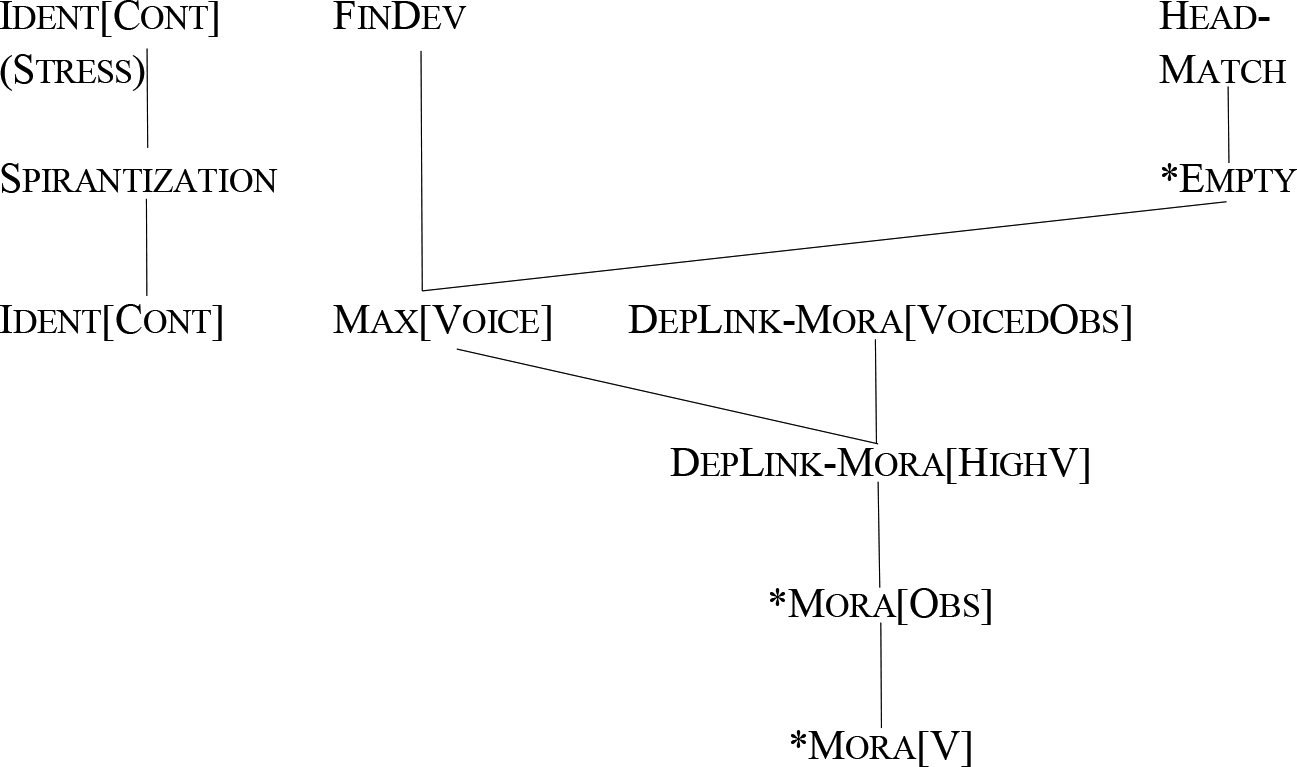
In addition to discussing the voicing alternations and the spirantization facts, I have furthermore presented an analysis that captures the interaction of vowel length and obstruent voicing in high vowels as an effect of mora assignment preferences in heavy syllables. The constraint interactions established in my analysis are summarized in the Hasse diagram in figure 1.
Hasse diagram for High Prussian alternations in obstruent voicing / quality and vowel length.

Notably, what all relevant morphological alternations have in common is that a voiceless obstruent in a simplex form corresponds to a voiced obstruent in a more complex form. Conversely, there are no alternations where a voiced obstruent in a simplex form corresponds to a voiceless obstruent in a more complex form. This distribution, which is schematized in 30, directly follows from my assumption that voicing alternations in High Prussian correlate with more complex metrical representations in morphologically complex forms (at least under the assumption that morphology is generally additive; X=any segment; D=voiced; T=voiceless).
(30)

Thus, my approach predicts attested alternations of the type voiceless to voiced in 30a, where a disyllabic foot template is added in a morphologically complex form. At the same time, the analysis excludes unattested alternations of the type voiced to voiceless, as shown in 30b.
4. Some Remarks on Possible Alternative Approaches
Since, to the best of my knowledge, this is the first time the High Prussian facts are being discussed in detail in the theoretical literature, there are no previous approaches that I could review here. In what follows, I aim to provide a few remarks on what I consider the most obvious alternative approaches to the final devoicing facts, without claiming to be exhaustive. The goal of these remarks is not to provide full-fledged analyses, but rather to indicate why I chose my particular analysis. I divide the discussion into alternative computational solutions (section 4.1) and alternative representational solutions (section 4.2).
4.1. Alternative Computational Solutions
A computational alternative to the representational analysis of final devoicing provided in this paper might be found in an approach that makes reference to cophonologies (based on, for instance, Orgun Reference Orgun1996, Inkelas Reference Inkelas1998, and subsequent work). A basic assumption in cophonological approaches is that different groups of items may have different grammars, which is usually expressed in diverse constraint rankings in OT. That is, specific morphemes, different parts of speech, lexical classes (such as different noun classes; Inkelas Reference Inkelas2014:19), or even individual items can have their own cophonology. Under such an approach, one would need to employ two cophonologies to account for the facts—one with a ranking that leads to final devoicing (for example, FinDev >> Max[Voice]), and one with a ranking that does not lead to final devoicing (for example, Max[Voice] >> FinDev).
The analysis itself is straightforward. It would seem less trivial, however, to reproduce the distributional generalizations that emerge from my metrical analysis in a cophonological approach. That is, it seems to me that a cophonology approach could in principle derive unattested alternations that are excluded in my analysis, such as simplex forms without devoicing corresponding to complex forms with devoicing. In general, as soon as an analysis allows different types of lexical words to be subject to different cophonologies, there seems to be no way to limit the number of possible cophonologies. Therefore, I believe that my representational approach is considerably more restrictive. From a broader perspective, the present analysis therefore suggests that at least some apparently opaque phonological processes can be successfully analyzed with a more refined set of representations, as opposed to giving up the idea of one (possibly stratified) grammar at the expense of introducing a potentially infinite set of different constraint rankings across word classes/morphological constructions (see Bermúdez-Otero Reference Bermúdez-Otero and Trommer2012 for a more detailed discussion of the general issue).
A reviewer asks whether the alternations discussed in this paper could be modeled with constraints that require morphologically related forms to differ from each other to avoid homophony (see Anttila Reference Anttila1989 for discussion). Indeed, antihomophony constraints could account for at least some alternations, such as [broːt] ‘bread’ versus [broːd] ‘breads’. There are, however, also certain challenges for this type of approach, which lead me to reject it.
First, recall that there are also simplex forms without final devoicing, such as [tauv] ‘pigeon’ or [blaid] ‘stupid’. Such exceptions to final devoicing in morphologically complex forms cannot be captured with antihomophony constraints. Second, there are also items where the voicing alternation in word-final position is accompanied by other differences, such as umlaut in [gans] ‘goose’ versus [gɛnz] ‘geese’. Given that there is already a difference in vowel quality between singular and plural, there should be no need to add a voicing difference to avoid homophony. Third, in verbal paradigms, in forms with stem-final voiced obstruents, these obstruents are always realized as voiced when they occur in word-final position. If the purpose of exceptions to final devoicing were to keep paradigmatically related forms apart, it might be expected that only some obstruent-final forms in verbal paradigms should escape word-final devoicing, but not all of them.
4.2. Alternative Representational Solutions
There are certainly alternative ways to derive empty-headed syllables representationally. For instance, one could introduce featureless “ghost” vowels that create their own syllable but are inaudible on the surface. One potential challenge for this approach emerges in a theory that works with underspecification: At least for Germanic languages, some have argued that schwa is a featureless vowel (van Oostendorp Reference Oostendorp1995, among others). Therefore, one would have to find a sensible way to distinguish featureless vowels from ghost vowels representationally.
Another possibility would be to derive morphological alternations via mora affixation along the lines of Colored Containment Theory, as proposed in, for example, van Oostendorp Reference Oostendorp2006 or Trommer & Zimmermann Reference Trommer and Zimmermann2014. For morphological alternations, one could argue that an affixal mora would not be allowed to associate with stem segments, and would therefore be forced to create an empty nucleus at the right edge of the word. It would be less trivial, however, to apply the same principle to simplex words that do not show final devoicing, such as [glaiz] ‘rail’. For such words, one would presumably have to assume that there is always one mora too many in the lexical representation, and preserving that mora would lead to the creation of an empty-headed syllable. For instance, the form [glaiz] should have three moras, two of which would go to the diphthong, whereas the remaining one would lead to the creation of an empty-headed syllable. In general, I do not object to alternative representational solutions to derive empty-headed syllables; yet with regard to the phenomenon at hand, I do not think that these alternatives would be conceptually simpler than my foot-based approach.
Some may wish to analyze these patterns representationally without assuming empty-headed syllables. The general challenge for an alternative approach would be to provide a competing analysis that captures the patterns as adequately as the approach proposed in this paper. As pointed out by a reviewer, one such alternative might be found in an analysis along the lines of what has been claimed for syllable-final devoicing in Turkish. The main facts of Turkish are illustrated in 31: In some paradigms, syllable-final plosives are always realized as voiceless, as shown in 31a; in other cases, they alternate between voiceless (coda) and voiced (voiced) onset, as shown in 31c in a third type, all realizations are voiced, as shown in 31b
(31)

One possible analysis of the Turkish facts assumes binary specifications for [voice], with a third possibility to leave some items underspecified (for instance, Inkelas Reference Inkelas1994). Plosives specified as [-voice] are always realized as voiceless, as in 31a; plosives with [+voice] are always realized as voiced, as in 31b Underspecified plosives in 31c are realized as voiceless in coda position (that is, they receive a default feature [-voice]), and as voiced in onsets (that is, they receive a default feature [+voice]).
There are certainly distributional parallels between the Turkish and the High Prussian data. In both languages, paradigms with coda obstruents can be divided into three sets (voiced, voiceless, alternating). Therefore, it would generally be possible to analyze the High Prussian data along the lines of the underspecification analysis. For alternating word-final realizations, as in [broːt] ‘bread’ versus [broːd] ‘breads’, one could assume that the plural morpheme consists of a floating feature [+voice], and that the respective final obstruents are underspecified (D=underspecified). That way, /broD/ would be realized as [broːt] in the singular, and as [broːd] in the plural (the feature [+voice] would have to be incorporated to realize the plural morpheme).
That said, note that there are also nontrivial differences between the Turkish and the High Prussian data. Most importantly, exceptions to final devoicing in Turkish can occur word-medially, while they are restricted to word-final position in High Prussian. Therefore, an underspecification analysis of the High Prussian facts would have to introduce an additional mechanism that restricts exceptions to final devoicing to word-final syllables. Of course, it is possible to postulate such a constraint; yet this restriction follows from my metrical approach, while it would have to be stipulated for the underspecification approach.
Furthermore, in verbal paradigms, where word-final obstruent realizations are always either voiceless or voiced throughout the paradigm, a feature-based analysis would have to invoke a ban on stems with underspecified final obstruents, which should show alternating realizations. I cannot think of a principled reason to prohibit underspeci-fication in verb stems. Again, in my metrical approach, which predicts only two underlying specifications (either with the feature [Voice] or featureless), the distribution follows from the structure of the inflectional morphemes.
In addition, it would be difficult to provide an insightful analysis of spirantization without making reference to metrical structure. In the underspecification approach, one would have to say that spirantization occurs in word-medial, post-tonic onset position and word-final coda position, but for some reason would be blocked after short vowels. Given these complications, I would argue that, although a featural analysis of the facts is possible, my metrical analysis is more restrictive than this alternative approach.
Lastly, another possible solution would be to essentially have no analysis of the facts, that is, to regard all patterns as lexicalized. For instance, it could be assumed that some words are (diacritically) marked as lexical exceptions to final devoicing. If the phenomenon were restricted to a few isolated cases, this might have been a viable solution. Yet, as I have tried to show, there are certainly broader generalizations emerging from the data, be it with regard to the observation that morphological alternations always proceed from simplex=voiceless to complex=voiced, the fact that there are no word-final voicing alternations in verbs, predictable alternations in adjectival paradigms, or the spirantization facts. I believe that these patterns justify the assumption that one is not simply dealing with a limited set of lexical exceptions.
5. Conclusion
On the basis of a segmentally opaque final devoicing process in High Prussian, this paper has argued that metrical structure can be a useful tool for the representational analysis of certain types of nonconcatenative morphology. I have shown that apparent exceptions to final devoicing in High Prussian can be successfully analyzed under the assumption that nondevoicing word-final obstruents are syllabified as onsets of empty-headed syllables, rather than as codas. The analysis derives empty-headed syllables from the presence of metrical templates, that is, disyllabic trochaic feet at the right edge of a word. As I have claimed, this representational tool makes it possible to provide a maximally restrictive analysis of morphological alternations, and furthermore captures an additional phonological process with the same machinery, that is, the spirantization of voiced plosives. The spirantization analysis itself was partially based on the additional claim that stressed syllables in High Prussian are always bimoraic. This analytical decision was further substantiated by showing that the obligatory bimoraicity of stressed syllables helps provide a principled explanation of the interaction of high vowel quantity and following obstruents, where vowels are long before voiced obstruents and short before voiceless obstruents.
As indicated in the introduction, the analysis proposed in this paper contributes to an ongoing research program that aims to emphasize the role of contrastive metrical structure in the analysis of phonological phenomena. It also demonstrates how evidence from West Germanic dialects can contribute to our understanding of the phonology of laryngeal features and of the role that metrical structure can play in shaping phonological alternations. Future research on the segment-prosody interface will have to investigate what other phenomena can be accounted for by assuming a more sophisticated set of metrical representations, and how such representational approaches fare in comparison to analytical alternatives, such as cophonologies.
APPENDIX
Some Additional Tableaux
(i)
(ii)
(iii)
(iv)