INTRODUCTION
For years scholars have argued that white Americans “hate welfare” because they believe that most social welfare spending disproportionately benefits the “wrong people”: people who are “lazy,” who “abuse” the system, who are “undeserving,” and, perhaps most importantly, who are black. The roots of this popular conflation of welfare and race date back to the mid- to late 1960s, in the wake of the War on Poverty.Footnote 1 By that time, the white backlash to the black freedom struggle was gaining strength. Among other concerns, many white Americans believed that liberal Democrats were spending their tax dollars to support programs that benefited “undeserving” black Americans.Footnote 2 This backlash was nurtured by conservative politicians, eager to exploit white resentment for electoral gain, and it helped deliver 13.5 percent of the vote in the 1968 presidential election to segregationist George Wallace and another 43 percent to Republican Richard Nixon, propelling him into office.Footnote 3 As the New Deal coalition fractured over race, rights, and taxes, government officials began to pull back on antipoverty efforts. By 1971, at least nineteen states had “made sharp reductions in welfare benefits, and almost all of the others” were considering or had already “made changes in welfare programs.”Footnote 4
Just as whites’ concerns over race and social spending helped spur a racial realignment in politics during the mid- to late 1960s, some scholars suggest that whites’ concerns over immigration and changing demographics have also helped to pull the Republican Party in a nationalist, far-right direction in recent years.Footnote 5 Indeed, significant concerns of both Tea Party and Donald Trump supporters are immigration and immigrants’ alleged abuse of social welfare benefits.Footnote 6 Most scholars argue that efforts to limit immigrant social rights began in 1994 when California voters passed Proposition 187, which barred unauthorized immigrants from most nonemergency services and mandated cooperation between service providers and immigration officials. Proposition 187 was invalidated by the courts before it was implemented. Nevertheless, scholars have argued that it denoted the emergence of a “new nativism,” distinct from the “old” for its emphasis on immigrants’ reliance on public benefits, and that it helped spawn similar restrictive measures at both the state and federal levels.Footnote 7
While nativism can spur support for greater welfare chauvinism—that is, reserving benefits for citizens—some scholars have argued that nativism or changing racial and ethnic demographics can also undermine support for the welfare state more broadly. According to one line of thinking, immigrant-generated diversity decreases social solidarity, generosity, class consciousness, and social trust, all factors that are presumed necessary for the development and maintenance of a generous welfare state. Another line of thought focuses on attitudes over demographic change. These scholars argue that Americans’ belief that immigrants overuse the welfare system decreases their support for welfare.Footnote 8 Indeed, some now contend that whites’ attitudes toward immigrants may better predict attitudes toward welfare spending than do white attitudes toward black Americans.Footnote 9
I argue, however, that the seeds of contemporary concerns about immigrants and welfare were sown not during the 1990s, as most scholars suggest, but rather during the 1970s, amid those broader state-level efforts designed to rein in welfare spending.Footnote 10 In 1971, Governor Ronald Reagan declared that unauthorized immigrants in “uncounted numbers” were making use of California's public assistance programs, representing “an abuse of the welfare system.”Footnote 11 Thus, he called on the legislature to ban unauthorized immigrants from public welfare programs. In New York, too, a similar controversy was brewing. Officials there claimed that 25,000—or even as many as 100,000—unauthorized immigrants were making use of public assistance, contributing to budget shortfalls and the overall “welfare mess.” Officials called for greater cooperation between welfare and immigration authorities in order to deport those who dared to apply. Legal status restrictions spread quickly thereafter. Within a few years, the federal government had, for the very first time, barred unauthorized immigrants from nearly all federal welfare programs, including Supplemental Security Income and access to Social Security numbers (1972), Aid to Families with Dependent Children (AFDC) and Medicaid (1973), Food Stamps (1974), and unemployment insurance (1976). And state welfare officials were now allowed—sometimes required—to cooperate with immigration officials for enforcement purposes. Unauthorized immigrants who tried to apply for benefits for themselves or their American-born children now risked being deported.Footnote 12
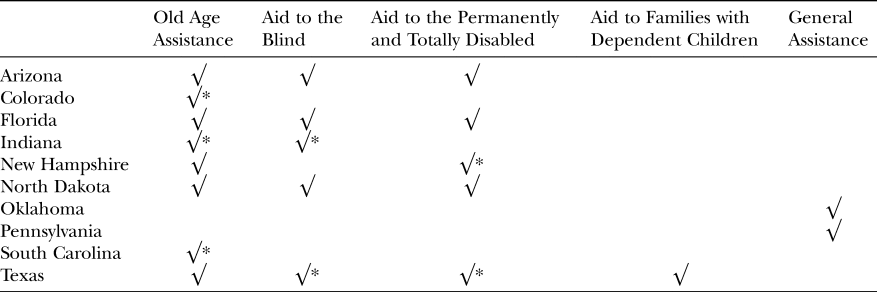
Efforts to deter unauthorized immigrants’ use of welfare in the 1970s represented an important shift in the boundaries of social citizenship—that line separating those with a right to social assistance from those without. Between the Great Depression and the 1970s, most welfare officials did not ask whether applicants for public aid were legal residents or not. While many states barred noncitizens from Old Age Assistance during the 1930s, by the 1960s, most states had dropped those alienage restrictions. In the few states where citizenship was a precondition for some forms of aid, as in Arizona and Texas (see Table 1), unauthorized immigrants were excluded alongside legal immigrants. Where citizenship was not a precondition for assistance, as in California, New York, and thirty-eight other states, no questions were usually asked about citizenship or legal status. Indeed, a New York City welfare official testified in 1972 that a welfare applicant in his city was “not questioned as to whether he is an illegal alien. The question is, ‘Are you a resident of the city of New York?’”Footnote 13 All of that began to change in the 1970s when unauthorized immigrants were first barred from state and federal welfare programs.
Alienage Restrictions in State Welfare Programs, January 1970

Notes: *Rigid citizenship requirements that did not allow long-term U.S. residency in lieu of citizenship.
Sources: Fred P. Graham, “Court Says Cities May Close Pools to Bar Racial Mix,” New York Times, June 15, 1971; Social and Rehabilitation Service administrator to HEW Secretary, n.d., folder EA3, box 1, Administrative Subject Files, Medical Services Administration, Records of the Social and Rehabilitation Service, RG 363, National Archives.
Welfare and immigration scholars have overlooked this restrictive turn in social welfare policy.Footnote 14 The welfare scholarship has focused on the legacies of the War on Poverty, the failure of Nixon's Family Assistance Plan, and the politics of retrenchment that ensued. Immigrants are absent from this narrative.Footnote 15 Immigration scholars, meanwhile, portray this era as a time of growing popular nativism but political stalemate on the regulation of illegal immigration.Footnote 16 Some scholars even present the 1970s as the moment when the rights of noncitizens were finally secured; in 1971, the Supreme Court declared in Graham v. Richardson that state-level alienage-based restrictions in public assistance were unconstitutional.Footnote 17 Yet at the same moment that noncitizens were poised for this important legal victory, a new form of alienage-based restriction was starting to emerge—one based not on formal citizenship but on legal status.
In this article, I examine why unauthorized immigrants’ use of welfare suddenly became a subject of concern to state and local officials in California and New York in the early 1970s, and why these two states tried to curb unauthorized immigrants’ use of assistance before the federal government intervened and barred their access altogether.Footnote 18 I focus on these two states because it was in them that the issue first took hold and became a subject of debate in the media, among local and state officials, and in each of the state legislatures. In 1971, Governor Reagan, for example, signed into law a measure that barred unauthorized immigrants from public assistance. The following year, New York State legislators passed a bill to do the same, although that bill was vetoed by Governor Nelson Rockefeller.
To be clear, California and New York were not the only states to try to prohibit unauthorized immigrants from accessing welfare prior to federal restriction; Arizona and Texas did the same. Unlike in California and New York, however, Arizona and Texas had already barred most noncitizens from various welfare programs. When the courts invalidated those state-level alienage restrictions, each state was forced to revise their regulations. With little fanfare or media attention, state welfare administrators in Arizona and Texas quietly complied with the court orders by issuing new regulations extending public assistance to all lawful immigrants, but not to unauthorized immigrants.Footnote 19
This article therefore tackles two questions. Why did state and local officials in California and New York try to restrict unauthorized immigrants’ access to welfare in the early 1970s? And why was the bill to bar access signed into law in California but vetoed in New York? To answer these questions, I make extensive use of newspapers; government reports and hearings; and federal, state, and local archives. Common explanations for the curtailment of immigrant social rights often center on partisan politics, popular nativism, demographic context, or issue entrepreneurs. While demographic context and issue entrepreneurs offer partial explanations to this question, I highlight the importance of two additional factors: the politics of welfare retrenchment and the influence of the federal judiciary.
Efforts to restrict unauthorized immigrants’ access to welfare in the 1970s must be understood in large part as a product of the chain reaction of race, rights, and taxes. During this period, state and local officials were eager to show the public that they could cut welfare costs and curb welfare fraud. However, Supreme Court decisions traditionally seen as victories for welfare and immigrant rights constrained state options for withholding aid from internal migrants—primarily understood to be poor blacks from the South—the population of greatest concern to state and local officials. These officials, therefore, looked for other ways to restrict access to aid that would survive court scrutiny. With the help of immigration officials—eager to build public support for greater immigration enforcement—they found a new target: international migrants, especially those without legal authorization to remain in the United States. Differing interpretations of the scope and reach of these court decisions, in turn, help to explain the initial variation in policy outcomes in each state. In short, where scholars often argue that immigration or nativism undermines support for or spending on social welfare, I show instead how the turn against welfare helped to undermine immigrant social rights.
In the next section, I examine conventional explanations for welfare chauvinism and explain why these alternative arguments, by themselves, fail to explain the cases considered in this article. I then provide a detailed preview of my argument, followed by case studies of California and New York. In the conclusion, I return to the main themes that animate this article.
CONVENTIONAL EXPLANATIONS FOR WELFARE CHAUVINISM
Scholars of contemporary politics often highlight the important role of conservatives and Republicans in restrictive immigrant policies.Footnote 20 Gulasekaram and Ramakrishnan argue that the single best predictor of the adoption of anti-immigrant policies at the city or state level after 2004 is Republican control of government.Footnote 21 Other scholars, however, argue that Democrats and liberals have also played an important role in the rise of legal status restrictions. Daniel HoSang, for example, charges that California Democrats during the 1990s helped to spur the passage of Proposition 187 because they were too quick to concede that unauthorized immigrants were a “problem” in need of a tough solution.Footnote 22
Partisanship, I argue, is not a particularly potent explanation for the rise of restrictive policies in the early 1970s. As Timothy Thurber explains, Republicans had long resisted government efforts to redistribute income, and they were deeply ambivalent over government efforts to promote racial equality, especially outside of the South. By the mid-1960s, the party was committed to limiting public spending on programs seen to benefit racial minorities (and they highlighted this commitment to solicit votes from working class, suburban, and Southern whites).Footnote 23 In line with those ideological commitments, I found that Republicans were more likely than (Northern) Democrats to support legal status restrictions in welfare. However, Democrats in California—who, like labor, were no friends of unauthorized immigrants—did little to oppose restrictions on their use of welfare, though they did fight to preserve the rights of legal immigrants. And in New York, some Democrats—especially those who supported welfare reform—even helped lead the charge for more restrictive policies.
Scholars have also highlighted the importance of popular nativism for restrictive welfare or immigrant policies. Robin Dale Jacobson, for example, argues that popular nativism, not elite manipulation, explains the mobilization and passage of Proposition 187.Footnote 24 I found little evidence in the archives to suggest that popular nativism drove officials to act, however. No public opinion polls in the early 1970s asked respondents whether unauthorized immigrants should have access to public assistance.Footnote 25 But scholars largely agree that unauthorized immigration was not a salient public issue until after 1973, when media coverage of unauthorized immigration increased precipitously.Footnote 26 Indeed, popular nativism appears to have followed rather than preceded state action.
Scholars have long noted that certain demographic contexts are associated with more restrictive welfare policies. Several studies have found that states with more blacks, for example, tend to spend less on welfare and are more punitively oriented.Footnote 27 Given such findings, many scholars started to wonder whether diversity, broadly defined, undermined support for welfare.Footnote 28 Subsequent studies showed mixed support for this hypothesis in the United States, as the association between welfare policy and Latino, Asian, or immigrant context is not particularly robust.Footnote 29 The same is true for policies targeting immigrants specifically. Hopkins found that communities that experienced a sharp increase in immigration were more likely to adopt anti-immigrant policies, but only when national rhetoric politicized immigration.Footnote 30 Other studies found no significant effects.Footnote 31 And a number of studies showed that states with more Latinos pass more pro-immigrant policies, since greater numbers often produce greater political power.Footnote 32
Changes in demographic context are certainly consistent with the timing of the rise of legal status restrictions in the 1970s. Following the passage of the Hart Celler Act of 1965, both authorized and unauthorized immigration were on the rise. While the total number of unauthorized immigrants in the country in 1970 was unknown, expulsions of unauthorized immigrants had increased significantly, from just over 60,500 in 1961 to more than 320,800 by 1970.Footnote 33 Furthermore, most unauthorized immigrants were concentrated in California and New York, which certainly helped to increase the salience of the issue there.Footnote 34 But demographic shifts by themselves do not explain why unauthorized immigrants became a topic of such concern in California and New York in this period. After all, expulsions of unauthorized immigrants were at least as high in the early to mid-1950s when border officials expelled hundreds of thousands of immigrants each year.Footnote 35 And yet that period produced no significant efforts to exclude unauthorized immigrants from welfare.
Last, some scholars highlight the importance of issue entrepreneurs for restrictive immigrant policies. Gulasekaram and Ramakrishnan, for example, argue that a few key individuals (former Colorado Congressman Tom Tancredo, Kansas Secretary of State Kris Kobach, and television news anchor Lou Dobbs) and nativist organizations (Numbers USA and the Federation for American Immigration Reform) have taken advantage of rising ethnic nationalism and political polarization to push for restrictive policies at the state and local levels.Footnote 36 Similarly, scholars have noted that immigration officials (both current and former) have at times successfully mobilized anti-immigrant sentiment and lobbied for more restrictive policies.Footnote 37 In the mid-1970s, for example, Immigration and Naturalization Service (INS) Commissioner Leonard Chapman made “effective use of the media” and “greatly contributed to the perception of a crisis through his outspokenness about unauthorized immigration and the problems allegedly associated with it.”Footnote 38 While immigration officials helped to politicize unauthorized immigrants’ use of public assistance in the early 1970s, it was immigration officials in the field—not Chapman, who was only first appointed to head the INS in 1973—who played the most important role.
FIXING THE “welfare mess”
Previous studies have done much to explain when and where states are more likely to withhold aid from immigrants. But because these studies tend to focus on restrictive measures passed since 1994, they have missed how efforts to exclude unauthorized immigrants from welfare first emerged in the 1970s as well as how these efforts were initially closely bound up in broader debates over race and welfare that followed in the wake of the War on Poverty and the civil rights movement. The key actors in this story are state and local government elected and appointed officials who were determined to do something about the so-called welfare mess but felt increasingly constrained in their ability to do so. Secondary players in this story were federal immigration officials stationed in New York and California who provided state and local government officials with an easy target for exclusion.
State and local officials understood the “welfare mess” to be the product of at least three factors. The first was the dramatic increase in the number of people on welfare nationally (and mirrored locally), from just over 3 million in 1960 to almost 10 million by 1970.Footnote 39 The rising welfare rolls, they argued, placed a significant strain on state and local budgets. Second, internal audits and media reports suggested widespread welfare fraud, abuse, and mismanagement.Footnote 40 Last, state and local officials understood the “welfare mess” to be the product of militant welfare rights activists, intrusive federal administrators, and a coercive federal judiciary, all of which spurred the growth of the welfare rolls and inhibited state efforts to address what they saw as the problems with the welfare system.Footnote 41 Especially important in this regard were a string of Supreme Court decisions that helped to expand access to welfare by, among other things, eliminating “man in the house” or “substitute father” rules (King v. Smith 1968), requiring a hearing prior to the termination of assistance (Goldberg v. Kelly 1970), and eliminating durational residency requirements (Shapiro v. Thompson 1969) and alienage-based restrictions (Graham v. Richardson 1971) in state welfare programs.Footnote 42 To deal with the “welfare mess,” some state and local officials, including Governor Rockefeller, supported a complete federal takeover of welfare. Others, including Governor Reagan, wanted greater state control instead. But whether to spur (or undermine) federal action or to address rising costs and fraud themselves, many state and local officials by 1971 had begun a push to fix the “welfare mess” at the state level.Footnote 43
Welfare rights activists, of course, had a competing interpretation about the nature of the welfare crisis. Where state and local officials saw the problem as too much welfare, activists argued that the real problem was not enough: Access was limited, welfare administrators had too much power over the lives of recipients, and benefit levels were too low.Footnote 44 Indeed, most of the fraud detected involved unreported income, a predictable outcome given that meager benefit levels made it impossible to subsist on welfare grants alone.Footnote 45 From this perspective, activism from below and oversight from above were necessary to reduce discrimination, guarantee access to eligible individuals, and ensure that benefit levels allowed poor mothers to care for their children and make ends meet. While some activists agreed with state and local officials that a federal takeover of welfare was necessary, they vehemently opposed the restrictive and punitive reforms that state and local officials ultimately pursued. By the early 1970s, however, the power of the welfare rights movement and their framing of the issues waned as membership declined, internal divisions proliferated, and the movement faced growing resistance and hostility to their demands.Footnote 46
State and local officials’ diagnosis of the situation as a “welfare mess” and their determination to act upon that diagnosis both fueled and were fueled by the growing popular backlash against welfare. Antiwelfare sentiment was certainly not a new phenomenon during this period, but it did become more widespread and salient.Footnote 47 This occurred in part because welfare rolls were rising as barriers to access began to fall. But it also increased because elite and nonelite white Americans increasingly linked welfare with black Americans and the struggle for racial equality. As historian Julilly Kohler-Hausmann explained, “When black freedom movements disrupted the legal and institutional machinery of white supremacy, they challenged the subordinate civic status of African Americans in the North and the South. AFDC became a lightning rod for frustration with this broader renegotiation of rights and services.”Footnote 48 Indeed, political elites, such as Ronald Reagan, who were eager to take advantage of white resentment for electoral gain, stoked these frustrations by vilifying the AFDC program and its imagined beneficiaries.Footnote 49
The link between race and welfare was also reinforced by the media. Media portrayals of the poor in national newsmagazines shifted dramatically during the late 1960s, both reflecting and fueling popular antiwelfare sentiment. Where rural white Americans once represented the dominant face of poverty in media representations, after 1968, urban black Americans filled that role. Coverage of welfare soon became more negative, too, as the media increasingly portrayed the welfare system as “wasteful” and “inefficient,” and welfare recipients—especially those who were black—as “lazy” and “chiselers.”Footnote 50 As whites increasingly associated welfare with blacks, and as the white backlash toward the broader civil rights struggle set in, resentment toward those on assistance increased, and elite and popular support for welfare declined.Footnote 51
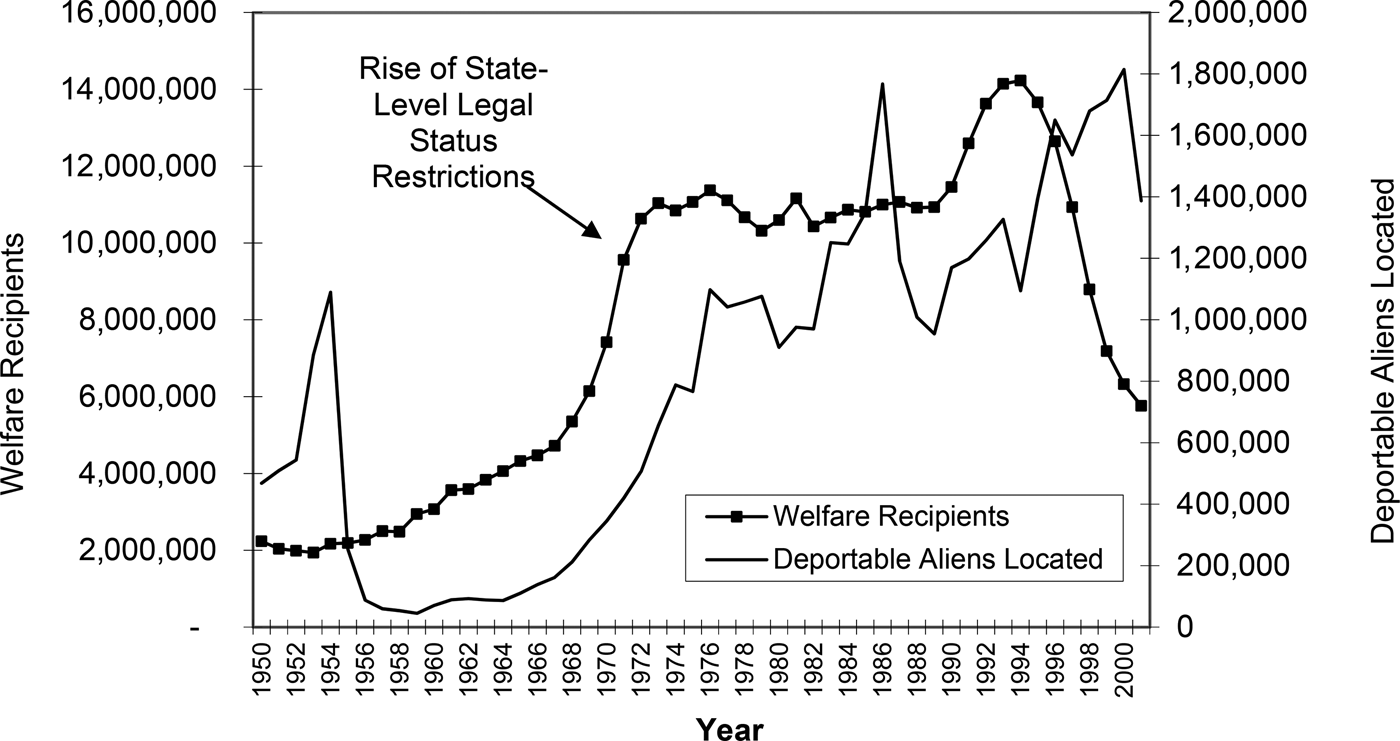
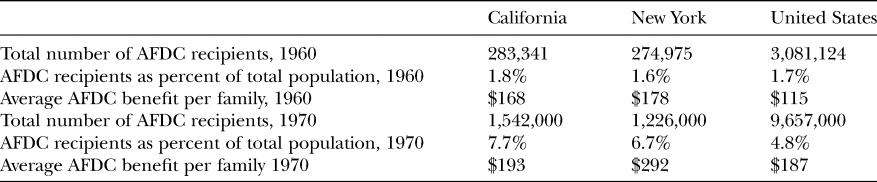
Initially, little of that elite or grassroots resentment focused on unauthorized immigrants, even though unauthorized immigration appeared to be rising in tandem with the rising welfare rolls (see Fig. 1). While the vast majority of unauthorized immigrants were thought to live in California and New York, neither Governor Reagan nor Governor Rockefeller evinced much concern about unauthorized immigrants at first; both were far more concerned with internal migrants. Both governors believed that poor Southern blacks (and in New York, Puerto Ricans, too) were migrating in order to take advantage of their states’ relatively generous welfare systems (see Table 2), a charge that had little evidentiary support.Footnote 52 However, there was little that state officials could do to limit internal migrants’ use of welfare. In 1969, the Supreme Court ruled in Shapiro v. Thompson that state-level durational residence requirements for public assistance were unconstitutional. Prevented from limiting access to internal migrants, state and local officials in California and New York looked for other ways to curb the growth of the welfare rolls and show the public that they were tough on welfare fraud.
Welfare Recipients and Deportable Aliens Located by INS, 1950–2001.

AFDC Recipients and Benefit Levels, 1960 and 1970

Sources: U.S. Census Bureau, Statistical Abstract of the United States, 1961 (Washington, DC: U.S. Government Printing Office, 1961); U.S. Census Bureau, Statistical Abstract of the United States, 1971 (Washington, DC: U.S. Government Printing Office, 1971).
Concerns about internal migration expanded over time to include concerns over international migration. The issues became linked symbolically in both states because state and local officials saw both groups as outsiders and illegitimate claimants on the public purse who fraudulently abused the welfare system. The issues were also linked in a practical sense, especially in California. Prior to Shapiro, recent immigrants (like recent state residents) had to wait one to five years in California (as in most states) to apply for public aid.Footnote 53 The end of durational residence requirements meant that noncitizens became eligible for aid as soon as they declared their intent to reside in the state. Shapiro, therefore, increased the salience of international migration for California officials.Footnote 54
In both states, moreover, unauthorized immigrants’ use of assistance became a subject of debate and a target for state action in part because rank-and-file immigration officials helped to politicize the issue, calling for restrictive welfare policies and greater cooperation between welfare and immigration officials. The union representing INS employees was “battling against reductions in immigration worker personnel,”Footnote 55 claiming that while the workload had tripled since 1965, their ranks had been cut by 1,000 employees.Footnote 56 They saw INS Commissioner Raymond Farrell and Associate Commissioner E. A. Loughran as unwilling to fight for their interests. INS leaders had been reluctant to ask Congress or the executive branch for more funding for the agency. These leaders were known to be close to Senator James Eastland, who, as chairman of the judiciary committee, repeatedly blocked the passage of sanctions for employers who knowingly hired unauthorized immigrants.Footnote 57 INS leadership recognized rank-and-file members’ frustrations. Commissioner Farrell testified in 1971 that INS union members had “been greatly concerned about the number of illegals and the lack of manpower, and they embarked on a campaign a couple of years ago to try to bring this to the public and thought they could get more manpower for us.”Footnote 58 A reporter for the Los Angeles Times confirmed that “much of the information about the illegal alien problem comes from officials of the AFL-CIO American Federation of Government Employes [sic] as part of a campaign to dramatize what the union officials charge is a ‘shameful cutback’ in government efforts to halt the flow” of unauthorized immigrants.Footnote 59
As part of those efforts, immigration officials in California and New York tried to link unauthorized immigrants and welfare in the public mind, and to convince government officials to restrict access to benefits. To do so, they tried to convince others that unauthorized immigration was contributing to the so-called welfare mess. Since unauthorized immigrants were not barred from public assistance, welfare agencies did not collect data on their use of these programs. Immigration officials in both states, therefore, constructed their own “guesstimates,” which they shared with public officials, welfare oversight agencies, and the press, in the hopes that the data (combined with a few salacious anecdotes) would spur officials to act. A representative for the National Council of Immigration and Naturalization Service Employees, AFL-CIO, for example, sent letters to the president and testified before Congress to ask for greater funding, claiming that unauthorized immigrants “cost our Federal, state and local public assistance and social services some $200 million through hospitalization and welfare costs,” estimates that his agency helped to produce.Footnote 60 State officials in California and New York seized on the new “evidence” and the appeals for greater enforcement to call for a state ban on unauthorized immigrants’ use of social assistance and greater cooperation between welfare and immigration authorities. State and local officials framed unauthorized immigrants as costly burdens, who were undeserving of assistance and fraudulently abusing the social welfare system. Unauthorized immigrants were convenient targets for exclusion, too. They could not vote, and at least initially, they had few strong allies.
Though unauthorized immigrants’ use of aid became politicized in both states, and both state legislatures passed bills to restrict unauthorized immigrants’ access to assistance, only the California measure became law prior to federal intervention in 1973. Unlike in California, state and local officials in New York worried that the Graham v. Richardson (1971) decision, which declared alienage-based restrictions in state welfare programs unconstitutional, applied to both authorized and unauthorized immigrants. Concerned about the legality of restriction, Rockefeller vetoed the bill, preferring to wait for federal guidance to formally exclude them from assistance. In the meantime, some caseworkers began to turn over those who applied for assistance to INS—a practice that various state officials and welfare rights lawyers alike claimed was consistent with Graham. Within a few months of federal restriction, New York followed suit and barred unauthorized immigrants from state and local programs. Rockefeller's veto therefore represented only a delay in—not a rejection of—the ban on assistance.
In the next section, I discuss the California and New York cases in greater depth, showing how state and local officials’ efforts to deal with the “welfare mess” and internal migration led officials to target unauthorized immigrants for exclusion. In the process, I show how government officials’ interpretation of the scope and consequences of federal court decisions shaped the policy process in each state. I end with a brief discussion of the rise of federal legal status restrictions that followed in the wake of these state-level debates.
CALIFORNIA
Reagan won the 1966 gubernatorial election in a landslide, swept into office on a tide of concerns over taxes, welfare, campus militancy, the Watts riots, and the speed of changes associated with civil rights movement.Footnote 61 When he announced his candidacy, Reagan “attacked rising welfare costs” and said “that taxpayers should not be forced to support ‘a segment of society which prefers making welfare a way of life, free-loading at the expense of conscientious citizens.’” If elected, he promised to reform the state's welfare system.Footnote 62
The Problem of Internal Migrants
Limiting immigrants’ access to welfare was not initially part of Reagan's welfare reform agenda.Footnote 63 Reagan officials were more concerned about internal migration, especially the migration of blacks from the South.Footnote 64 In an address to the state legislature in March 1970, Reagan noted that “over the past decade, the number of welfare and Medi-Cal recipients” had “more than tripled,” and he blamed this increase in large part on “a variety of judicial decisions handed down during the past several years.” Chief among these was Shapiro v. Thompson (1969). Reagan told the state legislature that “as a result of the Supreme Court's abolition of our residency requirements last year, most of those persons who flock to California from other states are receiving significantly larger welfare grants than they could at home. One-way migration of applicants to California from other states continues to more than offset all our efforts to reduce caseloads.”Footnote 65 Reagan did not specify exactly where these individuals were coming from, but a Los Angeles Times article suggested that most interstate migrants came from Louisiana and Texas, as well as Arkansas, Mississippi, Alabama, and Oklahoma.Footnote 66 Reagan proposed legislation that would limit the amount of aid these individuals could receive to the amount they would have received at home. Though he was clearly concerned about the potential effects of welfare payments on decisions to migrate across states, he did not apply the welfare magnet theory to international migration, making no mention of immigrants in this message to the legislature.Footnote 67
Constructing Unauthorized Immigrants as a Problem
The first state body to seriously question whether immigrants should have access to assistance was the California State Social Welfare Board. The Social Welfare Board functioned in a purely advisory capacity to both the governor and the director of the State Department of Social Welfare, the agency responsible for administering the state's welfare programs. Board members were appointed by the governor, and they held regular monthly meetings throughout the state to gain “firsthand exposure to problems and trends encountered by various segments” of society. Board members included members of the legislature as well as citizens, including lawyers, businessmen, service providers, and housewives.Footnote 68 Robert E. Mitchell, an attorney from Norwalk, was chairman of the board.Footnote 69
At one of these meetings in May 1970, Mitchell reported that “several most interesting areas of controversy came to light.” “Of first importance,” he said, “was a report concerning welfare benefits available to immigrants or aliens.” Some counties, he claimed, were confused about the state policy and simply adopting their own instead. “Although sponsors of aliens have certain responsibilities” to support sponsored immigrants in time of need, Mitchell said it was “questionable whether the sponsors are living up to their moral or legal commitment.” Last, he noted that confidentiality provisions were “a hindrance” to “full cooperation with the Immigration Department.” Mitchell promised to gather more “evidence on this subject,” explaining that an INS representative would give a statement at the next board meeting.Footnote 70
Immigration officials in California had a lot to say on the subject, suggesting that nonresident immigrants were “abusing” the social welfare system. They told the board of “instances … in which apprehended illegal and temporary aliens had in their possession food stamps or documents which indicated the individual had some contact with the local welfare department. In other instances, Border Patrol officers became aware of entire families who entered the country illegally and had been admitted to the public assistance rolls or cases in which the apprehended alien had been living with a welfare family.”Footnote 71
Immigration officials also expressed their concerns to the press, part of a campaign by their union to “dramatize” the cutback in government efforts to halt unauthorized immigration.Footnote 72 A Border Patrol agent in charge of the Sacramento office told a reporter in 1970 that he thought “the number of persons being lured here by welfare is becoming a very serious problem.” “They've found their El Dorado. They can live so much better here on welfare than they could in Mexico working for a living.” He went on to say that “the first thing an alien does once he's across the border is pick up a Social Security card, and, if a young man, register for the draft for a good identification card, then head for the welfare office to get food stamps. No one is sure,” the reporter continued, “how much this costs the taxpayer.”Footnote 73
No one was sure how much it cost because welfare agencies were not keeping records of such cases. However, immigration officials in California were keeping track on their own. The Deputy Director of Immigration in Los Angeles, Donald Williams, said that “a check of 1500 illegal aliens picked up recently revealed that 35 of them admitted they were receiving some type of public assistance.” County welfare officials conceded that “some illegal aliens may be receiving aid,” but they also doubted that it was “a large number.” The INS estimate suggests that 2 percent of unauthorized immigrants relied, at some point, on some form of public assistance.Footnote 74 Even if accurate, this was far lower than the rate of public assistance use in the general population (the AFDC take-up rate alone was nearly 8 percent statewide).Footnote 75 Nevertheless, immigration officials framed the issue as a “very serious problem” requiring action.Footnote 76 “What is needed,” according to Border Patrol men, “is congressional action that would exclude aliens from Social Security cards—the ticket to jobs—and from welfare cards—the ticket to free food, money and housing.”Footnote 77 Immigration officials in California then lobbied local and state officials, encouraging them to tighten welfare eligibility requirements to exclude unauthorized immigrants. According to one state welfare official, an immigration inspector told him that “large numbers of illegal aliens are receiving welfare” and that the immigration inspector was “anxious to cooperate in doing something about it,” suggesting that they ask questions about legal status when immigrants apply for aid.Footnote 78
Immigration officials also complained to the press about the “secrecy surrounding the welfare rolls,” noting that “the county welfare files” were “not open to” their “office.” “We have made requests for information but have always been turned down,” they explained.Footnote 79 From their conversations with immigration and welfare officials throughout the state, Social Welfare Board members concluded that indeed “Little, if any, communication existed between county welfare departments and immigration authorities” because “federal and state statutory and regulatory provisions relating to the confidentiality of welfare records were interpreted as preventing this kind of communication.” What is more, “Federal and state welfare eligibility requirements made no distinction between citizens and noncitizens…. Consequently, valid statistical information as to the program impact of aliens was not maintained at any level of welfare administration.”Footnote 80
Despite the lack of firm data, in the course of its public meetings and conversations with immigration officials, the board came to understand that the “problems with illegal and temporary aliens were not limited to the border counties,” but rather “the problem was widespread.”Footnote 81 Mexicans were singled out as the principal source of the “problem.” Reflecting popular stereotypes of Mexicans as overly fertile, the INS District Director asserted that “the majority of the cases called to his attention” had been “large families coming in from Mexico.”Footnote 82 The board was especially concerned about “male aliens, who fathered children in this country, either in or out-of-wedlock, the child of that relationship becoming a United States citizen.”Footnote 83
Finding Solutions to the “Welfare Problem”
While the State Social Welfare Board was busy gathering information, the governor told his cabinet and senior staff that “the solution to the welfare problem” was his “NUMBER ONE priority,” declaring an “all-out war on the tax-taker.”Footnote 84 Toward that end, he created a secret “task force to study California's public assistance programs.” The task force included “key members of the State Administration, assisted by attorneys and fiscal experts from the state and private sector.”Footnote 85 These were individuals, according to Reagan, “who had proven themselves in other state administrative posts.”Footnote 86 They were also individuals “purposely chosen for their lack of familiarity with welfare in order to help promote the development of new ideas.”Footnote 87 The task force was headed by Ned Hutchinson, a former businessman and the governor's appointment secretary. It also included Robert Carleson, who would later be named head of the State Department of Social Welfare. To determine how best to reform the state welfare system, the task force consulted federal officials; reviewed state and federal statutes and regulations; undertook “extensive organizational, fiscal, and legal analyses”; and conducted “over 700 in-depth interviews … with persons involved in the welfare system.”Footnote 88 They also sent a letter to each county to see if they had suggestions to share.
County officials, task force members learned, were concerned about immigrants’ use of assistance, and part of that concern stemmed from the fallout from Shapiro v. Thompson.Footnote 89 The L.A. County Board of Supervisors complained that ever since that Supreme Court decision, their welfare rolls had soared. According to Supervisor Warren Dorn, “It is a shocking fact that there are now 850,000 persons on welfare in the county and this is growing between 8,000 to 10,000 a month because residency requirements were eliminated.” He went on to state that 5,000 individuals from forty-three countries had been approved for welfare over the last two years who would not have previously been eligible because they had recently moved to the state. “Even though some of the aliens have entered the United States illegally,” Dorn noted, the “State Social Welfare Department gave them access to public assistance.” The addition of 5,000 noncitizens over two years—only some of whom may have been undocumented—was relatively trivial given the rate at which the welfare rolls were growing, representing 2 to 3 percent of the growth at most. But lacking any legal mechanism to reinstate durational residence restrictions in the wake of the Shapiro ruling, officials looked for other ways to limit the growth of the welfare rolls. Dorn told a reporter that “while the states cannot set up durational residence standards, they can—by state law—limit welfare to persons who are citizens.”Footnote 90 The L.A. County Board of Supervisors then called on the state to “restore its citizenship requirements in all aid programs.”Footnote 91
Los Angeles was not alone in its desire to exclude noncitizens from aid.Footnote 92 There was some debate among counties, however, about exactly what should be done or who should be barred. Some counties encouraged the enforcement of sponsor's obligations or the adoption of a state law barring all noncitizens from assistance.Footnote 93 While some of these counties noted that unauthorized immigrants or temporary aliens may require particular attention or, at the very least, specific guidelines about which noncitizens were eligible, most framed the issue more broadly, suggesting limits for all noncitizens.Footnote 94 Indeed, the California Counties Welfare Modernization Task Force, made up of directors of various county welfare departments, recommended a list of welfare changes, “which could be immediately acted upon with great benefit to the State and Counties of California.” “The elimination of residence as a requirement for eligibility” with the Shapiro decision, they explained, “has resulted in the movement of people to the higher paying states, and increasing their fiscal burdens. In combination with the lack of citizenship requirements it has resulted in persons coming directly from foreign countries and qualifying immediately for aid.” They recommended that “State regulation … be reviewed to clearly delineate eligibility of aliens, especially those who are illegally in the U.S.” In addition, “State law should be amended to reinstate the citizenship requirement as a protection to California.”Footnote 95
By December, state officials were also linking the Shapiro ruling not only to internal migration and the growing welfare rolls but also to noncitizens’ access to benefits. Speaking at a Sacramento Republican Women's Club event, the head of the state Human Relations Agency, which oversaw the State Department of Social Welfare, said that “welfare has grown monstrously” and that the courts had created “‘instant welfare’ by striking down state residency requirements so that ‘our taxpayers pay for programs not only for persons from other states but even for aliens—and illegal aliens at that.’”Footnote 96
State officials weighed their options. They considered banning all noncitizens from welfare assistance. But lawyers for the Department of Social Welfare warned that it was “doubtful” whether citizenship or durational residence requirements for noncitizens only “would survive a challenge on constitutional grounds.”Footnote 97 A U.S. District Court in Arizona had recently struck down their state's durational residence requirement for noncitizens applying to Aid to the Permanently and Totally Disabled. The case, later known as Graham v Richardson, was being appealed to the Supreme Court. While the Supreme Court had not yet decided whether it would hear the case, lawyers for the Department of Social Welfare noted, “This, not only is precedent in the making[,] but any statutory or regulatory enactment” banning aid to noncitizens in California “would undoubtedly be challenged at once.”Footnote 98
The Department of Social Welfare considered whether certain noncitizens might be barred via the state's residence restrictions. While Shapiro v. Thompson barred durational residence requirements, states were still permitted to require applicants for welfare to be residents of their state. Residence could be established “by physical presence for a purpose not temporary in nature…. A person resides ‘at the place where he is living if he has no intention of presently leaving.’” The question, then, was “whether a person may form the necessary intent to be a resident when his continued presence in the United States is in violation of the immigration laws and he is subject to deportation.” If not, then the state might issue a regulation arguing that existing law allowed them to bar unauthorized immigrants from welfare because these immigrants could not “form the requisite intent to reside in California.” The legal team for the Department of Social Welfare ultimately concluded that “A statute based on the illegal nature of the presence of the applicant or recipient would probably have a better chance of surviving a challenge in the courts than any effort either to exclude all aliens or to impose a durational residence requirement upon noncitizens.”Footnote 99
Not all state officials were of the same mind about the scope or desirability of alienage-based restrictions. The director of the Department of Social Welfare, Robert Martin, worried about the effect on immigrants and their families. “What do you do about aliens on welfare?” he asked. “Do you let the kids of legal or even illegal entrants go hungry? County general relief ends up having to care for immediate needs.”Footnote 100 Another administration official suggested that instead of barring immigrants from assistance, “the federal government be asked to make up the funds needed to cover the benefits given to aliens.”Footnote 101 Task force head Ned Hutchinson was unmoved by this suggestion. “Our recommendation regarding aliens on public assistance is aimed at reducing and finally eliminating the eligibility of aliens. I don't feel that any political subdivision (local, state or federal) of the U.S. should pay for public assistance to aliens. In my judgment, the American public dollar is stretched beyond all reason already with too many benefits for citizens, let alone non-citizens. The line must be drawn somewhere, sometime, by someone.”Footnote 102
Reagan officials, in fact, considered the feasibility of getting an initiative on the California ballot to amend the state constitution to bar all noncitizens from public assistance. But they were concerned that the Supreme Court might soon rule that such state-level restrictions were unconstitutional. In December 1970, the Supreme Court had decided to hear the Graham v. Richardson case. Reagan officials worried that if the court ruled that restrictions on noncitizens’ access to assistance were “invalid under the U.S. Constitution, then there would be no real basis for proposing similar language” in a statewide ballot. However, “If the Court finds no cause to impair such provisions, there would still be … time to propose a similar provision for the California Constitution” in 1972.Footnote 103 They were not concerned, however, that Graham would prevent them from barring unauthorized immigrants from welfare.
In the middle of the task force deliberations, the State Social Welfare Board issued a press release urging the governor to reserve welfare for citizens and legal immigrants, and barring “aliens with temporary permits and those present without authorization.” “As a matter of public policy and legislative intent,” they said, “we believe that public assistance is intended for citizens or immigrants who have declared their intent to reside in this state. We believe that aliens who hold temporary immigration permits or those who are here without authorization do not meet this test. Therefore, we strongly recommend that action be taken to recognize the ineligibility for public assistance of those applicants who are in this country on temporary permits or without official authorization.”Footnote 104
No public opinion polls asked California residents their thoughts on the subject, but there is not much evidence that public opinion drove state officials to restriction. I found few letters on the subject in the governors’ files, and no mention that the public demanded any ban on immigrants’ use of assistance. The few letters I did find tended to be from welfare workers. Theresa Barajas, a new employee in the Department of Human Resource Development, wrote to Governor Reagan “to pass information to you regarding some of the problems I see in the welfare program.” Barajas said she was “very disturbed to find that … the Department of Social Services provides aid for alien citizens from Mexico. And by that I mean the individual without legal status to reside in this country.” She did not believe that California “should aid the illegal citizens out of our hard earned tax dollars. I don't care where they come from,” she said. Like L.A. County officials, she blamed the Shapiro residency ruling for this state of affairs, saying that it “left the door wide open for what I see happening today.”Footnote 105
As the debate continued, the media began to pay greater attention to the issue. An article in the Oxnard Press Courier averred that “California has long been known as a land of milk and honey. Its reputation is well known in Mexico, where to wetbacks … the word is out: ‘Go to California, where welfare workers hand out free food, free money and free medical-dental care just for the asking.’”Footnote 106 The Van Nuys Valley News published an editorial cartoon of two men in the Mexican desert, with one—sporting a sombrero and a serape—whispering to the other: “You can collect welfare money in Los Angeles and not even be a citizen—Pass it on!”Footnote 107 The Los Angeles Times also endorsed restriction, opining that “Obviously something is wrong when … Aliens in the country illegally must be paid welfare relief.”Footnote 108 Only La Opinion, a Spanish language newspaper, seemed less supportive, publishing an editorial cartoon of a needy individual looking up at a sign on the door of the Welfare Department, which read, “No hay ayuda para extranjeros,” translating roughly to “There is no help for aliens.” The caption read, “¿Se Aprobara Esta Propuesta?” Or in English: “Will this proposal be approved?”Footnote 109
Restricting “Illegal” and “Temporary” Immigrants
In December 1970, Reagan answered the question by issuing an emergency regulation barring “illegal” and “temporary” immigrants from receiving public assistance in California. Administration officials did not know whether the measure would save any money. They had no idea how many unauthorized immigrants lived in California or how many were using social welfare assistance. Nevertheless, the administration made what they acknowledged was “a wild guess” and estimated that the new regulation would save the state $290,000 in 1970–1971.Footnote 110 Privately, officials acknowledged that “ending aid to aliens … among other measures” might not be “revenue savers (in terms of immediate return),” but it could constitute “some visible welfare reforms” that could be implemented without first passing legislation.Footnote 111 In other words, the emergency regulation was largely a symbolic move intended to demonstrate Reagan's commitment to reforming welfare and addressing welfare fraud.
Thereafter, people in need of assistance had to provide proof of citizenship or legal status. Noncitizens in the country legally had to present a green card “or other written evidence” from the INS, while U.S. citizens also had to provide proof of citizenship.Footnote 112 At a public hearing on the emergency regulations, “A parade of angry witnesses faced” the two representatives from the State Department of Social Welfare and “demanded that California officials rescind emergency welfare regulations” targeting unauthorized immigrants. “The administration said the regulations were designed to eliminate welfare abuse.” But the “more than 30 witnesses, representing various ethnic minorities and welfare rights organizations” “said the regulations intimidated, harassed and oppressed ethnic minorities.”Footnote 113 “Speakers from American Chinese, Japanese, Filipino, and Mexican communities protested … that the State Department of Social Welfare regulation” was “imposing great hardship—especially among older aliens who find it difficult to produce proof of their right to live in the United States.” Some advocates worried that noncitizens who lost their documents would be denied assistance under the new regulation. Others worried about those immigrants who could have applied for legal status but had failed to. They noted that “older aliens” had “been frightened” by the notices in the mail that demanded they produce documents to prove their legal status. Many did not have green cards because they did not know how to get them or felt that they did not need one.Footnote 114
The emergency regulation survived the protests of activists. But to strengthen their position,Footnote 115 the Reagan administration decided to pursue legislation to formally bar these immigrants from public assistance. That legislation would come as part of Reagan's larger effort to reform welfare in California.
On March 3, 1971, Reagan unveiled his sweeping seventy-point plan to reform welfare.Footnote 116 Reagan had six objectives for reform.Footnote 117 He wanted to “cap the uncontrolled growth in the cost of welfare,” “reduce the welfare rolls to those strictly entitled to be there,” “require those able to work to do so or to seek work,” and “strengthen family responsibility.” In return, Reagan said he would “increase assistance to the truly needy.” Reagan made the concession about benefit levels grudgingly, only after he was forced to do so by the threat of lawsuits and a federal threat to withdraw financial support.Footnote 118 “California's reform planners chose to ‘purify’ the system,” noted one reform cheerleader. “The goal was to preclude or uproot those from the system who legally ‘didn't belong there,’ while making grants more equitable—even increasing them as warranted—to eligibles who did belong.”Footnote 119 Reagan did not mince words when he spoke about the need for reform. He called welfare a “monster,” “a national moral and administrative disaster,” and “a cancer that is destroying those it should succor and threatening society itself.” It was not until 1976, while campaigning for the presidency, that Reagan first deployed the infamous “welfare queen” trope in his stump speech. But his obsession with welfare fraud was already well developed by 1971. Welfare, he wrote in an op-ed to the New York Times, “threatens the security of those whose labor and generosity subsidizes the cheats and the frauds.”Footnote 120
Reagan then linked unauthorized immigrants’ use of welfare not to budgetary woes (after all, he had no idea how many used welfare) but rather to his larger concern about welfare fraud. He complained that “Foreign Nationals in uncounted numbers are on California welfare,” saying that “aliens receiving welfare” represented an “abuse of the welfare system.” “Many persons not legally within the United States have applied for and have become eligible for welfare grant assistance. To correct this abuse, regulations will be revised to require all individuals to prove that they are legally entitled to remain” in the country, he explained.Footnote 121
Shortly thereafter, the Supreme Court finally issued its decision in Graham v. Richardson (1971), ruling that state laws conditioning welfare assistance upon citizenship were unconstitutional. In the wake of the ruling, state officials had to abandon efforts to bar (all) noncitizens from public assistance. However, officials did not believe the court ruling had any impact on the state's emergency regulation baring unauthorized immigrants from assistance or its efforts to seek a legal status restriction by legislative statute. The two plaintiffs in the Graham case were legal immigrants, and the court decision, in several places, referred to “resident aliens” or aliens lawfully admitted. The State Department of Social Welfare told the Los Angeles Times that the Graham ruling had “no direct effect on California, which pays welfare benefits to aliens as long as they are in the state legally.”Footnote 122
Opposition to the proposal to ban unauthorized immigrants’ use of assistance came from immigrant rights and Mexican American groups. Some of these groups believed that aid should continue to be provided without any restriction. At the Immigracion y La Raza conference held in Los Angeles in 1971, attendees expressed “strong opposition” to the “Departments of Public Welfare … playing the role of immigration agents by denying services or benefits to those they deem to be here without papers.” They went on, asserting that “all people, whether with or without documents, have the right to jobs, unemployment and disability insurance, and to public welfare, if necessary, on the basis of qualifications and needs. If all people are taxed alike, all people deserve equal service.” In addition, soon after the emergency regulation was announced, “a small band of Mexican Americans” protested at a meeting of the state Democrats. “One of the leaders of the protest demonstration was Abe Tapia, president of the Mexican-American Political Association.” Tapia “berated the party and shouted about a ‘blood bath’ if the Democrats didn't immediately pledge their opposition to a legislative bill banning welfare benefits to aliens illegally in this country.”Footnote 123
Banning unauthorized immigrants from welfare was not a particularly partisan issue. Democrats, who controlled the state legislature, generally supported the legislative ban.Footnote 124 This is perhaps not surprising since the labor movement was also hostile toward unauthorized immigration during this period.Footnote 125 Democrats were concerned, however, that Reagan's reforms would hurt legal immigrants. Anthony Beilenson, a liberal Democrat who represented Beverly Hills, chaired the Senate Health and Welfare Committee.Footnote 126 He explained that “in the Los Angeles area, a good deal of publicity was given to the possibility of illegal aliens receiving welfare.” But he said that testimony before his committee revealed that “the problem was not so much one of keeping illegal aliens off the rolls—they rarely seek aid for fear of being discovered—but rather of allowing legal aliens to secure welfare as long as they are otherwise qualified.” Under the emergency regulations, individuals with questionable legal status were denied aid until their legal status was resolved. According to Beilenson, “In many instances, legal aliens and even Chicano and Oriental American citizens were required to prove their legal status. If unable to do so, they were denied welfare benefits.” It could take months to locate a birth certificate or determine one's legal status, during which time desperate individuals would have to go without assistance.Footnote 127 Mexican Americans, who made up roughly 12 percent of the state population, were important sources of support for Democrats in the state.Footnote 128 The Senate and Assembly, therefore, each crafted their own alienage restriction, designed to avoid these problems.Footnote 129 However, the new director of the State Department of Social Welfare, Robert Carleson, objected to these proposals, because each version granted aid to noncitizens pending verification of legal status.Footnote 130
At odds over most features of welfare reform, the governor and the legislature battled over the final form of the legislation, including the language barring unauthorized immigrants. The Reagan administration wanted to limit aid to “only to those persons who have legally established residence in this state,” while the legislature preferred a more expansive interpretation of eligibility. After two weeks of closed-door negotiations, “the Administration abandoned their approach and agreed to” the language that was ultimately adopted.Footnote 131 Among other compromises, Section 24 of the Welfare & Institutions Code would now permit “an alien to receive welfare if he certifies under penalty of perjury that he is in the country legally and entitled to remain indefinitely, or that he is not under order for deportation, or that his spouse is not under order for deportation. Upon such certification aid shall be paid pending verification by the U.S. Immigration Service.”Footnote 132 Section 24 changed the burden of proof and placed it squarely on the state. Otherwise eligible individuals did not need to prove their legal status to receive assistance. The state would provide assistance pending state verification of available documents. Beilenson conceded that “while this may result in payment of aid on a temporary basis to some illegal aliens,” he also maintained that “there is no indication of any intent on the part of the Legislature to thus grant eligibility to illegals.”Footnote 133 State legislators did not believe many unauthorized immigrants would make use of assistance—even on a temporary basis—because all immigrants who applied for welfare were required to fill out a form, which was forwarded to INS for verification. Unauthorized immigrants who applied for assistance, therefore, now risked being deported. Section 24 was incorporated into the California Welfare Reform Act and signed into law by Governor Reagan on August 13, 1971.Footnote 134
NEW YORK
New York's Governor Nelson Rockefeller was a Republican who mixed “fiscal prudence with social conscience.”Footnote 135 Unlike Reagan, he had a reputation for taking “a liberal position on welfare questions.” Just a year into his governorship in 1960, the New York State legislature passed a bill to “deny welfare benefits to anyone residing in the state less than a year.”Footnote 136 Opponents charged that the bill was designed to “curb the migration of Southern Negroes and Puerto Ricans to New York.”Footnote 137 Bucking the wishes of his own party, however, Rockefeller vetoed the bill, citing “our state's heritage with its respect for the dignity and worth of each individual.”Footnote 138 In his veto message, he likened migrants from the South and Puerto Rico to previous waves of immigrants from Poland, Ireland, Germany, and Italy, “bringing with them their problems and cares, but far more importantly bringing with them their enterprise and energy and the continuing promise of ever greater and ever broader achievement by the people of our state.” He reminded New Yorkers that “less than 2 per cent” of those on public assistance went to those “who have been in New York for less than one year,” and said that “the same basic principles dictate aid for the new arrival as for the established resident. The time a person has lived among us is no measure of his needs.”Footnote 139
The Problem of Internal Migrants
During his tenure as governor, however, the size of the welfare rolls increased dramatically, straining the state (and New York City) budget.Footnote 140 In 1960, there were just under 275,000 ADC recipients in the state, but by 1970, that number had ballooned to more than 1,226,000, representing nearly 7 percent of the state population.Footnote 141 Many white New Yorkers deeply resented the demands of both welfare rights activists and other civil rights activists more focused on police reform, schools, housing, and jobs.Footnote 142 To their mind, elected officials were both failing to address urgent city concerns—including rising crime and crippling teacher and transit strikes—and they were focused on the wrong people: blacks and Puerto Ricans. Further weakening the “public's confidence in city government” were “a series of investigations” that reportedly “uncovered widespread corruption and mismanagement” at the Human Resources Administration (the city agency responsible for administering welfare), including high rates of ineligible individuals on the city welfare rolls.Footnote 143
Rockefeller was acutely aware of the shifting local and national mood on taxes, government spending, and government attention to minority concerns.Footnote 144 With his eye on national office, he shifted to the right, trying to shake the image that he was soft on welfare.Footnote 145 “I have learned from bitter experience,” he explained, “that liberalism ceases to work at some point if it is not controlled by realism. We have come face to face with the fact that state and local governments are running out of money, abuses have occurred, and an inevitable taxpayer reaction has set in. I am simply trying to get things back into balance.”Footnote 146 Toward that end, he proposed a sweeping overhaul of the state welfare system, “adopted almost in toto” by the legislature in 1971, to restrain costs, eliminate fraud, and incentivize work.Footnote 147
The primary targets of welfare reform in New York were American “migrants” (from the South and Puerto Rico), not international ones.Footnote 148 The centerpiece of Rockefeller's welfare reform was a one-year residency requirement for recent state residents, the same measure the governor had vetoed a decade earlier. When Rockefeller had first vetoed the state residency bill, his biographer explained, he “had believed the Empire State capable of absorbing an influx of Southern blacks and Puerto Rican immigrants attracted by its historic liberality.” “Regrettably,” Rockefeller concluded, “I was simply wrong. The immigration of minorities from the South was overwhelming.” Part of the problem, according to the governor, was that Southern blacks and Puerto Ricans lacked the strong work ethic of foreign migrants. “Most of those entering the United States from abroad” in the past, Rockefeller reportedly told his deputy secretary, “had arrived with ‘formidable cultures, or traditional work ethics’ that helped speed their integration. Not so domestic immigrants, ‘people who had not the remotest background of culture,’ many of them refugees from a racist South, said Rockefeller, with little or no legacy of self-support.”Footnote 149 Rockefeller's analysis, of course, downplayed the virulent racism that blacks and Puerto Ricans faced in the North as well as the structural changes in the economy that had taken place in the years since the end of mass European migration. Those factory jobs, which helped so many white ethnics move into the middle class, had all but disappeared.Footnote 150 What is more, New York City Mayor John Lindsay refuted the governor's claims that individuals were migrating across states for welfare. “Long experience has shown that less than two percent of new welfare recipients are migrants who have spent less than one year in the City.” As a result, Lindsay believed that the “passage of a one-year residency requirement would not have a significant impact on the welfare rolls.”Footnote 151 But Rockefeller's diagnosis of the problem (the rapid in-migration of welfare-seeking blacks and Puerto Ricans) and its solution (residency tests) were widely shared among white New Yorkers.Footnote 152 Rockefeller was confident that the residency test would not violate the Supreme Court ruling in Shapiro v. Thompson (1969) because the state could demonstrate “‘a compelling state interest’ for such a requirement,” including the fact that his state faced “the highest tax burden in the country and an acute housing shortage.” The courts, however, disagreed, and quickly overturned the law.Footnote 153
Other state legislative reforms passed in 1971 included “job training and public works programs, a work incentive program and the requirement that employable recipients report to State Employment Service offices regularly.”Footnote 154 As in California, concerns about welfare fraud were paramount. The state created an office of the Welfare Inspector General, “with broad powers to investigate state and local welfare operations.”Footnote 155 Among other duties, the new office was authorized to “receive and investigate complaints concerning alleged abuses of, suspected frauds against, and administrative failures in, the welfare system, and to insure proper expenditure of welfare funds.”Footnote 156 Rockefeller appointed George Berlinger to the post. A Republican “businessman and philanthropist,” who had served on the State Board of Social Welfare since 1964, Berlinger understood his task as restoring “confidence in the welfare system.” “Confidence is lacking through the state,” he averred. “The taxpayers, middle income people, working men are annoyed as hell at the amount being spent on welfare.” Berlinger said his job would be to “either root out such abuses or to prove that they do not exist to any significant degree.”Footnote 157
Unlike in California, none of the welfare reforms adopted that year focused specifically on unauthorized immigrants. This is not because unauthorized immigrants were seen to be a trivial proportion of the population. Indeed, by all accounts, New York had the second largest unauthorized population in the country. There were no reliable estimates of the size of the population, but city officials believed the number to be as high as 500,000. Unlike California, where authorities presumed that unauthorized immigrants hailed almost exclusively from Mexico, in New York the unauthorized population was presumed to be far more diverse. Most unauthorized immigrants, an aide to Mayor Lindsay claimed, were “Latin Americans, Haitians, Dominicans, Columbians, Ecuadorians, Chilians [sic], etc.” But there were also thought to be “large numbers of Chinese, Italians, and Greeks,” too.Footnote 158
Constructing Unauthorized Immigrants as a Problem
Concerns about unauthorized immigrants’ use of assistance in New York did not emerge until just after the state legislature had already passed its welfare reform package. In late September 1971, the Daily News, a tabloid newspaper, ran a sensationalized three-part series on unauthorized immigration. The series touched on many of the “problems” associated with unauthorized immigration, and a significant theme was their alleged abuse of social services. The first article in the series claimed that “illegal aliens” were “taking advantage of such overburdened urban facilities as housing, hospitals and public schools.” Berating the government for its ignorance and laxity, the Daily News said that “Uncle Sam,” had turned into “Uncle Gullible, the unwitting host.”Footnote 159
The Daily News articles linked concerns about unauthorized immigrants to broader concerns about welfare fraud. One “illegal alien from Latin America,” the Daily News reported, “had social security cards under three names. This allowed him to apply for unemployment insurance under two of them while actually working under the third name.” In another case, a man had “worked six months until his firm moved to North Carolina. He then began collecting $101 weekly in unemployment insurance from the state—for a $2,600 total—although he had managed to get another job that paid $2.60 an hour.” “These are examples,” the paper claimed, “of abuses by illegal aliens who are chiseling on government benefits and often holding down jobs.”Footnote 160 The paper also associated unauthorized immigrants with violent crime. Citing an unnamed “spokesman for the Welfare Department,” the paper reported that the “height of gall was uncovered in the case of an illegal alien from the West Indies, who later brought his mother here illegally. Then he got her on welfare—and proceeded to steal her checks. When she objected, he apparently struck her, the spokesman said, and the case came to light when she complained to the department.”Footnote 161
The “problem,” the Daily News claimed, was widespread. The News reported that it had discovered “that an estimated 25,000 illegal aliens in the state are on welfare rolls.”Footnote 162 The paper claimed that it had learned through “public and private sources that the cheating is made possible largely by slipshod government controls.” This included a welfare spokesman, again unnamed, who “confirmed that many illegal aliens are on the relief rolls. There is no question on the welfare application blank as to citizen or immigrant status. A large number of the illegal recipients who have been exposed have either left the city or the country, and the department has no way to recoup the illegal benefits.”Footnote 163 Despite the Daily News’ characterization of “illegal recipients” receiving “illegal benefits,” there was actually nothing illegal about it. No law barred unauthorized immigrants from federal, state, or local benefits in New York.Footnote 164
If there was no question on the welfare application about immigration status, exactly where did the Daily News get its estimate that 25,000 unauthorized immigrants were on welfare? Some welfare officials wondered that as well. And one state welfare official contacted the paper to find out. They told him that “they got that information from Immigration authorities.”Footnote 165
Indeed, even more than in California, immigration officials in New York played a crucial role in the construction of unauthorized immigrants as costly burdens. Much of the credit for this went to Ed Kavazanjian, a criminal investigator with the INS office in New York City and the former president of and current national liaison officer for the National Council of Immigration and Naturalization Service Locals. One of the Daily News’ on-the-record sources, he “insisted” that he had “access to records, files, and men in the field to prove the figures on illegal aliens are ‘overwhelming.’” He told the paper that he suspected that “thousands of the aliens are on the welfare rolls throughout New York State,” asserting: “We know the illegal alien is overstaying his visa, working, sending money to the homeland, taxing our schools and social services and costing the United States billions of dollars during this economic crisis.” This INS office was reported to have files that “contain 43,000 complaints from citizens who have reported illegal aliens working here, collecting public benefits for which they are ineligible, beating hospital bills, and otherwise biting the big fat hand that feeds them.”Footnote 166
As in California, immigration officials in New York collected their own data to determine whether unauthorized immigrants were using public assistance. Kavazanjian had the “criminal investigators in the New York office ask each apprehended alien … whether or not they received” any public aid. Using these data, they determined that somewhere between 3 and 5 percent had made use of welfare at some point.Footnote 167 Applying a 5 percent take-up rate to the estimated 500,000 unauthorized immigrants presumed to live in the state yields the Daily News estimate that 25,000 unauthorized immigrants had made use of welfare, confirming Kavazanjian as the most likely source of the Daily News estimate.Footnote 168 Interestingly, Kavazanjian received little support for his efforts from higher-ups at INS. “For all of his insistence and fury,” one journalist wrote, “Kavazanjian has not to this point been given any official backing for his gripe. In fact, spokesmen for immigration headquarters in Washington deny the man's statistics and question his motives.” Federal officials in Washington, DC, pointed out that Kavazanjian was a leader of the national immigration workers union and was “battling against reductions in immigration worker personnel.”Footnote 169 Bypassing his superiors, Kavazanjian sent letters to the president and Congress to ask for greater funding, claiming that unauthorized immigrants “tap our welfare monies, our public hospitals, and welfare agencies, and fail to pay their fair share of income taxes.” “The cure is simple and immediate,” he continued. “A fully manned, effective, hard-hitting and efficient INS with the funds properly allocated and administered to exclude, detain, arrest, deport, and insure departure of all aliens on time.”Footnote 170 Kavazanjian was proud of his efforts, boasting in 1972 that he had been “working on this problem for the last 5 years” and had “contributed to every single newspaper, magazine article on illegal aliens.”Footnote 171
Critics charged that the media campaign was “blatantly racist,” and that both the INS union and “certain members of the press” were characterizing “this entire class of people as being dope pushers, welfare racketeers, Communists, carriers of disease, criminals and the cause of our high rate of unemployment.” Advocates singled out the Daily News for the slew of articles that appeared in the days and weeks that followed the original three-part series. “The Daily News, in a hysterical manner, has published for weeks one sided stories, half-truths and whole lies against these aliens,” argued one advocate. Yet it offered “no statistics, no proofs, no responsible documents in the campaign to darken the conduct of these foreigners.”Footnote 172 This negative coverage was so relentless that “various Hispanic groups demonstrated in front of the Daily News Building” in 1974 protesting what they saw as “the racist discrimination against our community expressed by the Daily News in both its editorial and its news items.” In particular, they protested the treatment of “the so called ‘illegal aliens’” whom the Daily News treated “as ‘things’ and not as human beings.”Footnote 173
Despite its reliance on questionable sources and unverified statistics, the Daily News coverage had a significant impact on the conversation in New York. In a “terse announcement” delivered just after the Daily News stories first broke, city welfare officials announced that Mayor Lindsay had directed the Human Resources Administration “to investigate revelations by The News that illegal aliens are on the welfare rolls.”Footnote 174 But it was the new State Welfare Inspector General, George Berlinger, who was especially eager to restrict assistance, pledging that he would “tighten relief requirements.” He “was concerned to find the application … for welfare omits any question concerning citizenship.” He “promised to explore the problem and said: ‘I think that the governor and the Legislature should be informed of the need for a change in the application form, which would include proof of status of the applicant.’” Berlinger also recommended “‘some sort of liaison with the immigration people.’ Under such a set up, he said, welfare authorities might be able to check the people who are overstaying their visitor visas and see if they are on our welfare rolls. ‘Then we could go after them.’” If, as the Daily News claimed, there were “25,000 illegal aliens on the welfare rolls,” then “the impact ‘would be terrific if we could top them off,’ Berlinger said.” City welfare officials—who had a testy relationship with Berlinger—resisted Berlinger's measures, insisting “that neither federal nor state law” required citizenship, and that “the only basis for welfare is need.”Footnote 175
The Daily News series also caught the attention of the New York City Council. Just days after the story broke, City Council President Sanford D. Garelik, a former police officer and Democrat who “cast himself as a voice of fiscal reason,”Footnote 176 “also moved into the alien scandal. Garelik scored the ‘permissive attitude’ of local welfare officials in tolerating the illegal aliens on the relief rolls.” “Once again, we see our welfare rolls being swelled with people who just do not belong there,” Garelik said, implicitly linking unauthorized immigration to the migration of Southern blacks and Puerto Ricans. “When the local welfare officials say there is no citizenship law which prohibits them from granting relief to noncitizens they are evading the responsibility of administrative decision. Such a permissive attitude will merely encourage further migration into New York of illegal aliens.”Footnote 177 Garelik also praised the Daily News for bringing the issue to the city's attention. “The [Daily] News should be congratulated by all New Yorkers for its powerful and revealing series on illegal aliens.”Footnote 178
Other members of the city council seemed to agree.Footnote 179 Councilman Thomas Cuite (D-Brooklyn) charged that “The shocking revelations in the Daily News series of increasing official tolerance of the activities of illegal aliens in New York City show gross laxity in many agencies.” “We in city government can do our share by tightening the regulations to make sure none of these illegal aliens are able to obtain relief, Medicaid assistance or jobs under city contracts.”Footnote 180 Cuite and Councilwoman Aileen Ryan, also a Democrat, sponsored a resolution calling for federal and state agencies to “establish stringent regulations and tighten procedures with regard to illegal aliens.”Footnote 181 Garelik and Cuite also called on Congressman Peter Rodino (D-NJ)—who, as chair of the Judiciary Committee, was in the process of conducting congressional hearings in cities across the country to assess the effects of unauthorized immigration on the American economy—to “extend” his “current series” of immigration “hearings into New York ‘as quickly as possible.’ ‘Certainly the recent revelations of widespread abuses by THE DAILY NEWS justify such action,’” Garelik proclaimed.Footnote 182
Congressman Mario Biaggi, a conservative Democrat from the Bronx, also waded into the issue, claiming that unauthorized immigrants “cost the public a great deal of money for the nonpayment of hospital bills as well as the receipt of unemployment compensation, welfare and other public services.” Biaggi portrayed their use of welfare as illegitimate, equating it to welfare fraud. “The taxpayer in New York is not unwilling to provide welfare service for those for whom it is necessary,” he claimed, “but he becomes outraged when he finds that those who are otherwise not qualified are draining the coffers that he is required to pay.”Footnote 183
No public opinion polls registered public sentiment on the issue, but the Daily News suggested that their coverage exposed latent concerns. “The pent-up anger of citizens with personal knowledge of illegal aliens living, working and collecting benefits in the metropolitan area exploded with a torrent of mail and phone calls to The News after revelations of the problem.” Readers, who described “themselves as law-abiding, hard-working and tax-burdened,” were fed up with aliens in their midst. One man said he had been living in Brooklyn for “more than 24 years and lately I've seen the influx of illegal aliens…. These people are raping our economy, taking our jobs or going on welfare, and occupying needed housing units.’”Footnote 184
Concerns about unauthorized immigrants’ use of welfare did not quickly dissipate. If anything, some elected officials escalated the rhetoric. In February 1972, New York Assemblyman Andrew Stein, a Democrat representing the East Side of Manhattan who would later go on to become Manhattan borough president and city council president, issued a press release in which he claimed that as many as “100,000 illegal aliens,” most of whom were from the Caribbean and South America, might be receiving public assistance, a figure four times the Daily News estimate. As a result, he claimed “that the Department of Social Services could save up to 100 million dollars a year by tightening its eligibility procedures.”Footnote 185 The estimate came neither from welfare nor immigration officials; rather, it came from one of his staff aides, who applied a welfare take-up rate of 20 percent to the estimated 500,000 unauthorized immigrants living in New York.Footnote 186 Stein justified the 20 percent take-up rate by noting that economists and labor officials believed that the incomes of unauthorized immigrants fell below those of Puerto Ricans. “With nearly half of the City's Puerto Ricans receiving some form of assistance, Stein believed it was reasonable to speculate that as many as 20 percent of the illegal aliens might be forced by economic circumstance onto the welfare rolls.” He acknowledged, however, that “a paucity of data made his 20 percent estimate a general approximation.”Footnote 187 But this did not stop others from repeating and reprinting his estimates.Footnote 188
Stein's concerns about unauthorized immigrants were part of his larger crusade focused on reforming the welfare system. The 27-year-old Stein commissioned a series of studies in 1972 about welfare and proposed various policy solutions.Footnote 189 For example, he argued that drug addiction and disintegrating families—not unemployment—were the primary cause of the city's rising welfare caseloads, and he promised to introduce legislation to make abandonment of a spouse and children a misdemeanor, punishable by up to three months in prison.Footnote 190 Critically, he laid the blame for the whole mess on outsiders, whether unauthorized immigrants or, more importantly, internal migrants. “‘New York City's horrendous welfare mess is not indigenous but an importation,’” he told a reporter, “attributable to Federal failure to provide job opportunities ‘for the disposed poor of the Southern states and Puerto Rico’ and failure of those areas to provide ‘even minimally decent welfare benefits.’”Footnote 191 He therefore supported “Federal assumption of welfare costs for mothers born elsewhere,” just as the federal government was already doing for Cuban refugees.Footnote 192 For unauthorized immigrants, Stein had a different solution.
As in California, court decisions shaped how New York would respond to the issue. Stein wanted “the State Department of Social Services to require that any new applicant for assistance present either a birth certificate or a ‘green card.’” Stein was not suggesting that unauthorized immigrants be formally barred from assistance. Unlike officials in California, many officials in New York worried that Graham applied not simply to legal immigrants but to unauthorized immigrants as well. While the case involved legal immigrants, and the decision referred in several places to aliens lawfully admitted, the justices did not specify whether their reasoning applied only to authorized immigrants or whether it applied to all immigrants regardless of legal status. Believing the decision applied to all immigrants, Stein wanted to force applicants for assistance to “supply information which might subject them to deportation” to discourage them from applying for public assistance in the first place. “While it would be impermissible to deny public assistance to an individual because of his status as an illegal alien,” he explained, “there is no prohibition against the Department of Social Services gathering information regarding citizenship status which would enable the Immigration and Naturalization Service to initiate proceedings against illegal alien residents.”Footnote 193
The State Welfare Inspector agreed with Stein's plan, noting that while unauthorized immigrants’ use of welfare had recently become “one of our top priorities,” his office was unable to deal with the issue “at this time” since they had “so many areas of fraud” to deal with. Instead, he said that “some action is needed to properly place the welfare burden for aliens totally on the Federal Government which alone can regulate them. Short of this,” welfare agencies should be “encouraged to obtain alien data at the time of application which can be turned over to Immigration authorities for their action.”Footnote 194 Since New York City prepared its own application forms, Stein asked the City Department of Social Services to include questions about citizenship and legal status. They informed Stein, however, that no changes would “be made without a request from the State.” Stein “described the attitude of the Social Services Department as one of ‘bureaucratic blindness and obstinance. Because citizenship matters lie outside their jurisdiction, they make no inquiries as to who is here legally and who is not. If they made such inquiries, and if they forwarded the names of illegal aliens to the Immigration officials, they might find the half-million illegal aliens in the City more hesitant about applying for assistance.’”Footnote 195
Like Berlinger, the New York State Department of Social Services supported Stein's suggestions. Bernard Shapiro, a state welfare official, explained that Stein's published “wild guesstimates” forced state welfare officials to look into the issue.Footnote 196 They pledged that they were “trying to develop a form acceptable under Federal rules that might identify citizenship status.”Footnote 197 They then sent a letter to the U.S. Department of Health, Education, and Welfare (HEW) asking it “to issue regulations clarifying (1) whether aliens could be prohibited from receiving welfare and (2) the information which may be obtained from applicants regarding their alien status.”Footnote 198 Like Stein, the State Department of Social Services’ legal counsel believed that with the Graham ruling, there could be “no distinction” between “illegal” and legal aliens. In other words, “Anyone who is in need, whether he is a citizen, whether he is an alien, whether he is an illegal alien, as long as the need exists, that need must be met.” By asking questions about immigration status, state officials hoped to determine “the exact magnitude of the problem” and refer unauthorized immigrants to INS “for whatever action they would take.”Footnote 199
Stein's estimates did not go unchallenged. An official in the New York Archdiocese testified at the Rodino immigration hearings that “too many people are dramatically asserting statistics for which they can provide no documentation. Some, like Assemblyman Andrew Stein of New York have unfortunately yielded to the temptation of irresponsibility by urging that illegal aliens seriously increase the costs of public assistance to the New York taxpayer.”Footnote 200 At the same hearing, Farrell Jones, a city welfare official in the Human Resources Administration, explained to the congressmen that there had “never been a procedure in the Department of Social Services to determine who is an illegal immigrant. The application forms for public assistance carry no query with reference to citizenship per se because there are no statutes or regulations making it incumbent upon the Department to notify immigration if an alien, legal or illegal has applied.”Footnote 201 Nevertheless, his office had looked into the issue since the controversy broke in the news. Based on small “samplings” of welfare recipients in the city, it appeared that few unauthorized immigrants were requesting assistance. “Apparently we don't find that many,” he maintained. But when Jones was asked whether the federal government should bar such aliens from public assistance, he said he thought it was “definitely something the committee should consider.” But, if the state or the nation did “move in that direction, some procedure for moving the alien to his country of origin would have to be appended,” he argued. “We cannot just have persons walking around the streets with no support whatsoever.”Footnote 202
Mayor Lindsay resisted efforts to portray unauthorized immigrants as welfare dependent. Lindsay was first elected Mayor of New York in 1965 as a liberal Republican who championed the poor and racial minorities. Despairing of the growing conservatism in his party, in 1971 he became a Democrat. In explaining the shift, he said that Republicans “have finally abandoned the fight for a government that will respond to the needs of most of our people and of those most in need.”Footnote 203 A few days before Christmas, Lindsay announced that he was running for president.Footnote 204 For that reason, his aides tried to keep the mayor “out of the illegal alien situation,” as much as possible. They reasoned that “as mayor, he had no power to alter a situation which effectively demanded legislative change.”Footnote 205 Though he made no public statements about unauthorized immigrants’ use of welfare (that I could find), in a letter to Congressman Rodino, Lindsay rejected the estimates put forward by Stein or even the Daily News. Backing city welfare officials, he said that “it is simply not possible at present to estimate how many illegal aliens reside in our City, or how many take advantage of services provided by the City. We have been assured, however, by persons close to the problem, that only a very small number, and only those in greatest need, would venture to seek public assistance. They simply fear that they may be discovered to be here illegally.”Footnote 206
The issue soon came to a head in the Republican-led state legislature, when on March 22, 1972, State Assemblyman James L. Emery introduced a bill to prohibit the payment of “public assistance and care of any kind … to any person applying therefore who has illegally entered and remained in the United States.”Footnote 207 Emery, a Republican from upstate, where there were presumably few unauthorized immigrants, had long been concerned about excessive welfare spending and fraud.Footnote 208 The bill passed the senate (33 to 24) and the assembly (118 to 27) in April. The vote in the senate was along party lines, with all Republicans voting for and all Democrats voting against. The vote in the assembly was less partisan: While all but one Republican voted for the measure, a majority (62 percent) of Democrats did, too.Footnote 209 The bill also earned the support of Berlinger as well as officials in New York's Division of the Budget, the New York Public Welfare Association, and the State Department of Social Services.Footnote 210
Governor Rockefeller, however, vetoed the measure. Among those who supported Rockefeller's veto were his attorney general, Mayor Lindsay, the County Officers Association for New York, and the Center for Social Welfare Policy and Law. Opponents of the bill had a number of objections. A few were concerned about the effects on unauthorized immigrants and their “citizen children.”Footnote 211 Others argued that the bill was so poorly written that it would fail to reduce state and local expenditures. According to the attorney general, the bill would apply “only to aliens who both entered and remained in the United States illegally.” Most unauthorized immigrants in New York had not entered illegally; rather, they had overstayed a tourist or student visa. Yet “they would not be included in the dual requirement of this bill.”Footnote 212
Crucially, some opponents believed that Graham v. Richardson prevented the state from acting on its own.Footnote 213 Attorneys for the Center for Social Welfare Policy and Law made this point most forcefully. Known as the legal arm of the welfare rights movement, the center tried to coordinate and support strategic welfare litigation nationwide to increase access to welfare, raise benefit levels, create more uniform state policies, and ultimately establish a “right to live.”Footnote 214 They argued that “the import of” the Graham decision “is clear, namely that … public assistance benefits may not be denied to noncitizens, regardless of whether they entered the country or are remaining in the country illegally.’” However, they also maintained that welfare agencies were not prohibited from reporting unauthorized immigrants to immigration officials. Should the Social Services Department “suspect or discover that a recipient of public assistance is an unlawfully admitted alien,” it was not “powerless” to act. Indeed, it had “an obligation to report suspected criminal behavior,” including “unlawful entry or stay in this country,” “to the appropriate officials.”Footnote 215 In effect, the legal arm of the welfare rights movement was claiming that while welfare agencies could not deny assistance to unauthorized immigrants, they could (and should) facilitate their deportation.
Rockefeller made no mention of the possibility of greater cooperation between welfare and immigration agencies in his veto message, but he did cite concerns about constitutionality, noting that “the Supreme Court of the United States has held that citizenship may not be a prerequisite for public assistance, but the precise question of whether illegal aliens may be denied welfare by the states remains unsettled.”Footnote 216 At the time, New York had yet to hear back from HEW about whether the state could prohibit unauthorized immigrants from receiving welfare.Footnote 217 Without federal guidance, it was safer not to act.
Rockefeller's veto meant that—at least in the short term—unauthorized immigrants in New York continued to be eligible for public assistance. However, according to a “New York State spokesman,” starting on February 1, 1973, welfare applicants across the state were required to provide proof of legal status if they were born abroad.Footnote 218 The commissioner for the State Department of Social Services also acknowledged that caseworkers then reported this information to “the appropriate consulate … or to the U.S. Immigration and Naturalization Service for appropriate action.” It is unclear whether state officials ordered caseworkers to do so. Nevertheless, INS officials said that “when they receive[d] information about an illegal alien either receiving or applying for welfare, they call[ed] him into the district office for questioning.”Footnote 219 There is no evidence that this sort of cooperation produced widespread deportation, but it likely deterred eligible immigrants from applying for aid.
Federal Response
Federal officials were slow to give New York guidance on the issue, vacillating on the best course of action. In the wake of the Graham decision, HEW officials met to clarify regulation of noncitizen access to welfare and Medicaid.Footnote 220 Initially, federal officials shared New York's concern that Graham applied to both authorized and unauthorized immigrants. As a result, in June 1972, about a week after Rockefeller's veto, they published proposed regulations that would effectively prohibit states from denying AFDC and Medicaid even if the noncitizen was “in the country illegally.”Footnote 221 Mandatory inclusion did not sit well with members of Congress, however, who were in the middle of debates about how best to reduce unauthorized immigration. As one Texas representative put it: “We are trying to develop a system of getting the Wetbacks under control and HEW has an incentive program of encouraging them to enter our country.” In September, bills were introduced in both the House and the Senate to prohibit states from granting unauthorized immigrants’ access to public assistance, but the bills died. What passed instead was a federal restriction on unauthorized immigrants’ access to Supplemental Security Income (SSI), the federally funded program then under consideration.Footnote 222
Mandatory inclusion did not sit well with most state and local officials, either, many of whom rejected the notion that Graham v. Richardson required inclusion of unauthorized immigrants.Footnote 223 And yet few states called for federal restriction. Some state and local officials preferred that the federal government leave coverage optional. With optional restriction, states could cover unauthorized immigrants in some programs, such as Medicaid, and share those costs with the federal government. Others—many of whom were champions of state-level restriction—wanted the federal government to cover all social welfare costs associated with unauthorized immigrants or even all noncitizens.Footnote 224 Reagan officials, for example, argued that because the “federal government controls entry” and the “states have no effective means of regulating the number of aliens who either legally or illegally gain entry,” the federal government, therefore, should “fully finance welfare benefits for any alien who becomes dependent upon public assistance.”Footnote 225 New York officials agreed, adding that federal officials could certainly tighten cooperation between welfare and immigration officials and “deport those who either cannot maintain themselves or overstay their visas.” Otherwise, HEW should “pay for welfare and Medicaid services incurred by any permitted to remain for whatever reason.”Footnote 226 HEW authorities, however, claimed that they had no authority to reimburse states for the full cost of unauthorized immigrants’ use of welfare and Medicaid. They argued that “legislation would be required of Federal assumption of responsibility for support of aliens unlawfully in the country.” And such legislation was not forthcoming from Congress.Footnote 227
Instead, within a year, HEW reversed course and adopted a new policy that, for the first time, prohibited states from providing welfare and Medicaid to unauthorized immigrants.Footnote 228 The change of heart came after Nixon's re-election, when the president ordered a complete top-to-bottom reorganization at HEW. Stung by legislators’ failure to pass the Family Assistance Plan and frustrated with spiraling welfare costs, in the run-up to his second term, Nixon advocated a decisive shift to the right on welfare issues, including a new emphasis on cutting costs and curbing fraud. The new leaders at HEW—including Caspar Weinberger, secretary of HEW; James S. Dwight, head of HEW's Social and Rehabilitation Service; and Robert Carleson, then U.S. commissioner of welfare and special assistant to Weinberger—had cut their teeth in Governor Reagan's administration where they had “vigorously implemented” the governor's “cutbacks in welfare,” including the state ban on assistance to unauthorized immigrants.Footnote 229 Weinberger justified the reversal, citing the negative comments HEW received about its original mandate to provide coverage, the congressional decision to bar unauthorized immigrants from SSI, and a desire for consistency across programs. In the years that followed, HEW administrators explained that mandated exclusion was necessary, even desirable, because it would save money and serve the larger aim of reducing incentives for unauthorized migration.Footnote 230
Within a few months of federal restriction, New York State followed suit, passing a law to bar unauthorized immigrants from all forms of state public assistance and formally authorizing cooperation between welfare and immigration officials.Footnote 231 Rockefeller's veto, therefore, ultimately represented only a delay in the state ban on assistance for unauthorized immigrants.
CONCLUSION
A growing body of literature portrays the 1970s as a “pivotal decade” for understanding the culture, politics, and economics of “our own time.” It was in the 1970s, this scholarship tells us, that American society began “to move in a new direction,” trading “factories for finance,” union power for business power, New Deal liberalism for conservativism, Keynesian-style economic policy for free-market economics, and working- and middle-class prosperity for soaring inequality.Footnote 232 The 1970s was also a pivotal decade for understanding contemporary welfare politics. It was in the “long 1970s” that white Americans’ aversion to welfare began to crystalize and when the seeds of welfare retrenchment were first sown.Footnote 233 Indeed, many conservatives understand the passage of the “historic welfare reform of 1996,” which abolished AFDC, “to be the culmination of the project” that started in California in the early 1970s.Footnote 234 It was also the moment when unauthorized immigrants’ use of public benefits first became politicized and when state and local officials began to look for ways to curb these immigrants’ use of public benefits.
The turn against welfare in the early 1970s helped to undermine the social rights of unauthorized immigrants. Specifically, state and local officials’ concerns about welfare spending and welfare fraud played a key role in efforts to restrict unauthorized immigrants’ access to public assistance. Initially, most of the concern in both states was directed primarily at internal migrants, especially Southern blacks and Puerto Ricans. However, the Supreme Court's ruling in Shapiro v. Thompson inhibited efforts to tackle that issue directly. Indeed, in both states, Shapiro v. Thompson and Graham v. Richardson (among other recent court decisions) contributed to a sense among government officials that their welfare systems were spiraling out of control, and that the means at their disposal to limit that growth were quickly disappearing.Footnote 235 There was little evidence to suggest that unauthorized immigrants contributed much to the growth of the welfare rolls, just as there was little evidence that Southern blacks and Puerto Ricans were moving from state to state in search of bigger welfare checks. Nevertheless, in a context where options for curbing welfare growth appeared increasingly limited as elite and popular antiwelfare sentiment was rising, state and local officials looked for other ways to convince themselves and others that they were doing something about the “welfare mess.”
Given the highly partisan nature of contemporary debates about immigration and immigrant integration policy, it is notable that debates over unauthorized immigrants’ access to welfare during the 1970s were not particularly partisan. While Republicans were more likely to support legal status restrictions for welfare (in line with their broader opposition to welfare spending), Democrats did little to oppose these restrictive measures, and in some cases, they even helped lead the charge for more restrictive policies. It was only in the aftermath of contentious debates over the Sensenbrenner immigration bill (H.R. 4437) in 2005—a highly restrictive measure that spawned a massive wave of immigrant rights protests—that partisan divides over immigration became entrenched. Republican opposition to immigrants and immigration has hardened significantly, while Democrats have grown more inclusive, even advocating for the extension of various state benefits to unauthorized immigrants.Footnote 236
Though the primary targets of antiwelfare ire in the United States in the early 1970s were black Americans (and to a lesser extent Puerto Ricans), stereotypes popularly deployed to demonize these groups as so-called welfare queens were rearticulated and reapplied to unauthorized immigrants. Like black Americans, unauthorized immigrants were portrayed as overburdening and fraudulently abusing the social welfare system. And both internal and international migrants were treated as outsiders who were underserving of state and local assistance. In California, the two issues were also linked in a more practical sense. The same residency requirements that limited internal migrants’ use of assistance limited access to international migrants, too. When durational residency restrictions were declared unconstitutional, both recent state residents and recent immigrants became immediately eligible for aid.
Unauthorized immigrants became targets of state officials in part because immigration officials in both states took pains to politicize the issue, mobilizing antiwelfare sentiment for their own purposes. They constructed estimates of the proportion of unauthorized immigrants who made use of public assistance, shared those data with welfare oversight agencies and the press, and lobbied for more restrictive welfare policies and greater cooperation with immigration agencies. These findings underscore the important role that INS officials “on the line” or in the field have played in the development of immigration and alienage policy.Footnote 237 The press also played a particularly important role in the rise of legal status restriction in New York, where the Daily News waged an aggressive campaign to demonize unauthorized immigrants, framing their presence and presumed overuse of assistance as a serious policy concern.
State officials’ interpretations of the scope of the Supreme Court's ruling in Graham v. Richardson also played a role in the policymaking process in each state. Some state and local officials in California wanted to bar all noncitizens from public assistance, not simply those in the country illegally. The Graham case, however, led California officials to narrow the scope of the state ban to target unauthorized immigrants and temporary visitors. While Graham might protect the rights of legal immigrants, state officials did not believe it would apply to those in the country illegally or those who were only visiting. Unlike their peers in California, however, many state and local officials in New York worried that the Graham ruling applied to both authorized and unauthorized immigrants. Concerned about the legality of restriction, New York officials waited for federal guidance to formally exclude them from assistance. In the meantime, the state allowed caseworkers to report unauthorized immigrants to the INS, a practice that many state and local officials believed was consistent with the Graham decision.
While scholars often claim that immigration undermines support for welfare, my analysis suggests that immigrant social rights can be especially vulnerable during periods of welfare retrenchment. This is true for a number of reasons. First, noncitizens cannot vote, decreasing their political power. Second, absent a strong immigrant rights movement, unauthorized immigrants in particular may have few strong allies willing to fight for their inclusion. Third, the courts have refused to guarantee their access to assistance. The Graham case itself was ambiguous about the scope of its protection. But later Supreme Court decisions were less ambiguous in their implications. In Mathews v. Diaz (1976), the Supreme Court upheld the federal government's ability to make distinctions between citizens and noncitizens for access to social welfare benefits.Footnote 238 And while Plyler v. Doe (1982) established that undocumented children were entitled to a K–12 public education, it did not secure their right to social welfare benefits.Footnote 239 Last, barring immigrants from welfare may result in significant budget savings, as it did during the 1996 welfare reforms.Footnote 240 Yet even when it does not—as was the case here—restriction can still serve an important symbolic function, allowing state and local officials to demonstrate their commitment to cutting welfare spending and curbing fraud, especially when other options to restrict access to aid are blocked.
My research also illustrates how states can serve as laboratories of conservative policy innovation.Footnote 241 States have played a significant role as drivers of restrictive federal immigration and alienage policy.Footnote 242 Scholars have also documented how states have functioned as drags on activist government, playing a critical (if at times underappreciated) role in the “decline of New Deal liberalism,” as Margaret Weir explains.Footnote 243 Consistent with this literature, I showed that the impetus for the curtailment of immigrant social rights was incubated at the state level. Moreover, federal legal status restriction came about only after Nixon reorganized HEW, installing new administrators who were fresh from their service in California state government, where they had helped to design and implement Governor Reagan's restrictive welfare policies, including those targeting unauthorized immigrants.
Ironically, some state and local communities that pushed for state-level legal status restrictions ultimately rued the adoption of similar restrictions at the federal level. After the federal government barred unauthorized immigrants from welfare and Medicaid in the fall of 1973, no state was permitted to use federal funds to provide cash or medical assistance to unauthorized immigrants. Over time, state and local communities discovered that they had to continue providing limited services to unauthorized immigrants but now without any federal reimbursement. California and New York, for example, had laws mandating emergency medical treatment to all regardless of legal status. In addition, some state and local officials found it hard to deny aid to those seen as especially deserving of assistance, including the elderly and pregnant women. Officials also discovered that requiring welfare workers to cooperate with immigration officials violated the rights of U.S. citizen children in mixed-status families, whose parents were threatened with deportation when they applied for benefits for their children. Cooperation between health and immigration officials, meanwhile, led unauthorized immigrants to defer health care, causing suffering and endangering public health.Footnote 244
Because state and local officials found it hard to restrict in practice, some communities and hospitals were left with large uncompensated costs, at the same time that the size of the unauthorized population continued to rise and local budgets were contracting. Very quickly, therefore, state and local officials (including many in California and New York) called on the federal government to reimburse states for the social welfare costs of unauthorized immigration. To make their case, they conducted countless studies documenting—oftentimes exaggerating—the burden of unauthorized immigration at the state and local level. As a result, federal restriction heightened nativist sentiment and the perception of immigration as an “illegitimate burden” at the state and local level, reinforcing the logic of restriction. It also fueled some of the anti-immigrant politics that we have seen in the past two and a half decades. California's Proposition 187 was a case in point. Among other things, the 1994 initiative would have barred unauthorized immigrants from nonemergency services. In addition to encouraging immigrants to “self-deport,” Proposition 187 was designed to send a message to Washington: that the federal government should increase enforcement efforts and reimburse state and local governments for the social welfare costs of unauthorized immigration. Getting federal aid—“that's what it's all about,” explained Governor Wilson. Ironically, the federal government responded by barring more categories of noncitizens in 1996—thereby increasing the state and local burden further.Footnote 245 To be sure, Proposition 187 and other recent state initiatives restricting immigrants’ access to social welfare benefits were not simply about the desperate search for federal aid. Yet narratives that focus simply on racism, rising nativism, or a late twentieth-century emphasis on balanced-budget conservatism—important as all of these factors are—miss an important part of the story that began in the early 1970s. Not only was the genesis of these political dynamics earlier, but they were also, to a large extent, the product of the backlash against welfare that followed in the wake of the War on Poverty and civil rights movement.Footnote 246