INTRODUCTION
Ranging from small-scale subsistence to heavily mechanized commercial efforts, fisheries differ greatly in exploitation levels, economics, harvested species and ecological impacts. Extraction rates may be influenced by both local and global market forces, and teasing apart the drivers that influence fisheries development, expansion, transitions in scale, practices and targeted species can improve management and resilience planning (Crona et al. Reference Crona, Van Holt, Petersson, Daw and Buchary2015; Hicks et al. Reference Hicks, Levine, Agrawal, Basurto, Breslow, Carothers, Charnley, Coulthard, Dolsak, Donatuto, Garcia-Quijano, Mascia, Norman, Poe, Satterfield and Levin2016; Watson et al. Reference Watson, Green, Tracey, Farmery and Pitcher2016).
The development trajectories of fisheries and their connections to export markets may be buffered by social drivers, particularly local history, current well-being, traditional management and value systems (Berkes et al. Reference Berkes, Hughes, Steneck, Wilson, Bellwood, Crona, Folke, Gunderson, Leslie, Norberg, Nystrom, Olsson, Osterblom, Scheffer and Worm2006; Coulthard et al. Reference Coulthard, Johnson and McGregor2011; Foale et al. Reference Foale, Cohen, Januchowski-Hartley, Wenger and Macintyre2011; McClenachan & Kittinger Reference McClenachan and Kittinger2013; Stevens et al. Reference Stevens, Irwin, Kramer and Urquhart2014; Hicks et al. Reference Hicks, Crowder, Graham, Kittinger and Cornu2015). Improved connectivity to export market centres often leads to the extraction of previously untargeted marine resources (Berkes et al. Reference Berkes, Hughes, Steneck, Wilson, Bellwood, Crona, Folke, Gunderson, Leslie, Norberg, Nystrom, Olsson, Osterblom, Scheffer and Worm2006; Scales et al. Reference Scales, Balmford, Liu, Sadovy and Manica2006; Eriksson et al. Reference Eriksson, Österblom, Crona, Troell, Andrew, Wilen and Folke2015), with impacts spanning multiple scales, demonstrating a constantly shifting and growing ecological footprint (Crona et al. Reference Crona, Van Holt, Petersson, Daw and Buchary2015; Watson et al. Reference Watson, Green, Tracey, Farmery and Pitcher2016). Increasing globalization can disrupt locally evolved adaptive management and traditional knowledge systems, and can impose a variety of influences that may not be sustainable in the long term (McClenachan & Kittinger Reference McClenachan and Kittinger2013; Sadovy de Mitcheson et al. Reference Sadovy de Mitcheson, Craig, Bertoncini, Carpenter, Cheung, Choat, Cornish, Fennessy, Ferreira, Heemstra, Liu, Myers, Pollard, Rhodes, Rocha, Russell, Samoilys and Sanciangco2013; Stevens et al. Reference Stevens, Irwin, Kramer and Urquhart2014).
Seafood export, however, has received limited attention in global analyses of relationships between fisheries and fish biomass, which tend to focus on local markets and local populations (Brewer et al. Reference Brewer, Cinner, Green and Pressey2013; Cinner et al. Reference Cinner, Graham, Huchery and MacNeil2013; Maire et al. Reference Maire, Cinner, Velez, Huchery, Mora, D'agata, Laurent Vigliola, Wantiez, Kulbicki and Mouillot2016). Recent studies have attempted to associate the impacts of fishing with seafood trade (Watson et al. Reference Watson, Green, Tracey, Farmery and Pitcher2016) and, in the case of coral reefs, have identified areas where socioeconomic drivers and environmental conditions have led to higher levels of reef conservation or degradation (Cinner et al. Reference Cinner, Huchery, MacNeil, Graham, McClanahan, Maina, Maire, Kittinger, Hicks, Mora, Allison, D'agata, Hoey, Feary, Crowder, Williams, Kulbicki, Vigliola, Wantiez, Edgar, Stuart-Smith, Sandin, Green, Hardt, Beger, Friedlander, Campbell, Holmes, Wilson, Brokovich, Brooks, Cruz-Motta, Booth, Chabanet, Gough, Tupper, Ferse, Sumaila and Mouillot2016). Amongst the suite of variables used, factors such as infrastructure (motorization and freezing facilities), local governance (traditional management structures and community engagement) and environmental metrics (deepwater refuges, disturbances, etc.) were found to be significant (Cinner et al. Reference Cinner, Huchery, MacNeil, Graham, McClanahan, Maina, Maire, Kittinger, Hicks, Mora, Allison, D'agata, Hoey, Feary, Crowder, Williams, Kulbicki, Vigliola, Wantiez, Edgar, Stuart-Smith, Sandin, Green, Hardt, Beger, Friedlander, Campbell, Holmes, Wilson, Brokovich, Brooks, Cruz-Motta, Booth, Chabanet, Gough, Tupper, Ferse, Sumaila and Mouillot2016). Improved freezing abilities through the development of ice plants and freezing units both on land and on vessels can enhance the potential to transport fish catches over larger distances, reaching higher-demand export markets. Transportation networks (marine, road and air) arising from human welfare and development imperatives typically drive fish exports without always intending to do so (Berkes et al. Reference Berkes, Hughes, Steneck, Wilson, Bellwood, Crona, Folke, Gunderson, Leslie, Norberg, Nystrom, Olsson, Osterblom, Scheffer and Worm2006; Stevens et al. Reference Stevens, Irwin, Kramer and Urquhart2014).
Being relatively isolated, islands offer ideal model systems for studying market connectivity and fisheries development. The complexities in scale and function of the domain, system structure, agencies of change, assessment and management can only be unravelled with locality-specific research (Wilbanks & Kates Reference Wilbanks and Kates1999; Cash & Moser Reference Cash and Moser2000; Cash et al. Reference Cash, Adger, Berkes, Garden, Lebel, Olsson, Pritchard and Young2006). Here, we compare and contrast India's oceanic island groups (the Andaman and Nicobar Islands to the east in the Bay of Bengal and the Lakshadweep Islands to the west in the Arabian Sea) and profile their main export-driven fisheries and development trajectories in order to tease apart the socioeconomic drivers that enable the establishment of local and global market forces. As union territories of India, these fall under the direct control of the central government, but display stark differences in geology, ecology, settlement history and growth. Using a combination of government records, catch statistics, literature and key informant interviews, we review these fisheries in order to provide insights into the influence of history (McClenachan & Kittinger Reference McClenachan and Kittinger2013), culture, infrastructure (Cinner et al. Reference Cinner, McClanahan, Daw, Graham, Maina, Wilson and Hughes2009; Cinner et al. Reference Cinner, Huchery, MacNeil, Graham, McClanahan, Maina, Maire, Kittinger, Hicks, Mora, Allison, D'agata, Hoey, Feary, Crowder, Williams, Kulbicki, Vigliola, Wantiez, Edgar, Stuart-Smith, Sandin, Green, Hardt, Beger, Friedlander, Campbell, Holmes, Wilson, Brokovich, Brooks, Cruz-Motta, Booth, Chabanet, Gough, Tupper, Ferse, Sumaila and Mouillot2016) and access to export markets (Berkes et al. Reference Berkes, Hughes, Steneck, Wilson, Bellwood, Crona, Folke, Gunderson, Leslie, Norberg, Nystrom, Olsson, Osterblom, Scheffer and Worm2006; Stevens et al. Reference Stevens, Irwin, Kramer and Urquhart2014; Crona et al. Reference Crona, Van Holt, Petersson, Daw and Buchary2015; Watson et al. Reference Watson, Green, Tracey, Farmery and Pitcher2016). Based on the localized understanding of these dominant fisheries and their commodity chains that link them to export market centres, we also improve existing estimates of reef accessibility for India's oceanic islands (Maire et al. Reference Maire, Cinner, Velez, Huchery, Mora, D'agata, Laurent Vigliola, Wantiez, Kulbicki and Mouillot2016).
METHODS
Study area
The Lakshadweep Islands lie approximately 200 km off India's west coast, between 8°N–12°N and 71°E–74°E. With a total land area of 30 km2, the island group comprises 36 islands, of which only 11 are inhabited (Fig. S1 and Table S1, available online). The Lakshadweep archipelago contains atolls with ringed reefs and shallow inner lagoons, submerged reefs and coral and sand islands.
The much larger Andaman and Nicobar Islands are located approximately 1000 km east of mainland India (6°N–14°N and 92°E–94°E). The Andaman group comprises 325 islands with a total land area of 6408 km2, and only 38 islands are inhabited. The Nicobar Islands, comprising 24 islands (with a total land area of 1841 km2) are separated from the Andaman group by the Ten Degree Channel (Fig. S1 and Table S1). These islands are tectonically active and surrounded by fringing reefs, mangrove ecosystems and seagrass beds.
Island fisheries and their socioeconomic drivers
Government statistics, research publications, grey literature, direct observations and key informant interviews were compiled in order to present a holistic understanding of island fisheries and their development. In the Lakshadweep Islands, we interviewed key members of the fishing community, including fishery union leaders (n = 3, in Agatti, Kavaratti and Minicoy islands), fish traders (n = 5), a fisheries manager (n = 1) and community elders (n = 3). In the Andaman Islands, fish traders (n = 9) and a fisheries manager (n = 1) were interviewed in order to better understand the export-driven fisheries. The interviews were conducted between 2013 and 2015 as part of ongoing projects by different researchers (M. Jaini, S. Nair and S. Advani), with interview scripts locally modified to understand the current and historical nature of fisheries and trade in each island system. Information gathered from these sources helped validate government records and grey literature, facilitating a comprehensive understanding of the system.
Reanalysis of travel time to major markets
Based on the major commercial fisheries of these islands and their commodity chains, we re-evaluated published estimates from Maire et al. (Reference Maire, Cinner, Velez, Huchery, Mora, D'agata, Laurent Vigliola, Wantiez, Kulbicki and Mouillot2016) of reef accessibility to major markets by revising the definition of the nearest major market to be the export market centre and by using the appropriate mode for transporting seafood (i.e. ship- and flight-based). We assumed that the modes of transport and the specific export centres utilized by the major commercial fisheries of these islands would be the primary and most efficient modes available to any other fishery for export. This was corroborated by our review of the available infrastructure.
Since Maire et al. (Reference Maire, Cinner, Velez, Huchery, Mora, D'agata, Laurent Vigliola, Wantiez, Kulbicki and Mouillot2016) account for topography and road networks in their analysis, we only had to re-estimate linear distances via sea and air. We performed a nearest neighbour analysis using QGIS v 2.14 (QGIS Development Team 2016) and the mmQGIS plugin (Minn Reference Minn2016) in order to calculate the distances between reefs and local markets on the islands and major export centres on mainland India (see Supplementary Materials for additional methodological details).
RESULTS
Island fisheries and their socioeconomic drivers
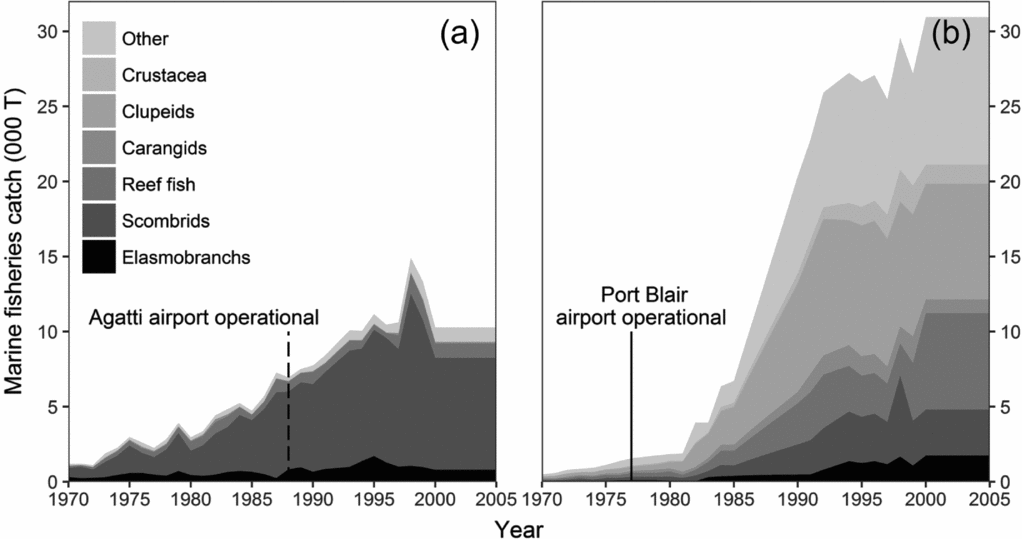
Fishery landings from the two island systems differ in volume, catch composition and disposition. Composition data from catch reconstructions demonstrate the dominance of tuna in the Lakshadweep landings and a highly mixed species catch in the Andaman and Nicobar Islands (Fig. 1) (Bhathal Reference Bhathal2014). While fish landings in both systems continue to grow every year, the increase in the Andaman and Nicobar Islands was 61-fold from 1970 to 2005, while in Lakshadweep, it was only nine-fold during the same period (Fig. 1) (Bhathal Reference Bhathal2014). Using the more recent Ministry of Agriculture (MOA 2014) fisheries landings data from 2007 to 2012, we found that scombrids (tuna and mackerel) comprise 82% of Lakshadweep landings, but only 9% of the Andaman and Nicobar landings. On the other hand, reef fish (suborder: Percoidei, including snappers, groupers and emperors) comprise the highest proportion of landings of the Andaman and Nicobar Islands at 15%, but are as low as 2% for Lakshadweep (MOA 2014). Similarly, elasmobranchs comprise 9% of the Andaman and Nicobar landings, but only 2% for Lakshadweep (MOA 2014). While the majority of the Lakshadweep catch (62%) is cured, 65% of the Andaman and Nicobar catch is marketed fresh and 15% is frozen (MOA 2014).
Marine fish catch composition (in thousand tonnes) for (a) the Lakshadweep Islands and (b) the Andaman and Nicobar Islands from 1970 to 2005 (Bhathal Reference Bhathal2014). Reef fish (suborder: Percoidei) include snappers, groupers and emperors.

Available fisheries department statistics for Lakshadweep from 2003 to 2012 show an average catch of 11 724 t. Separate records of the Andaman and Nicobar groups were only available for a limited 10-year period from the fisheries department; catches from 2006 to 2015 averaged 33 297 t for the Andaman Islands and 591 t for the Nicobar Islands. Commercial fish landings of the Nicobar Islands are close to nil when compared to the other island systems; fish in the Nicobar Islands are caught primarily for subsistence and local sale.
History and culture
Communities in Lakshadweep are homogeneous, entirely Islamic, have deep-rooted island traditions and have matrilineal societies akin to certain caste groups of Kerala and the Maldives (Table S2) (Saigal Reference Saigal1990). The southernmost island of Minicoy remained a part of the Maldives until 1500 CE (Hoon Reference Hoon2003), while the rest of the Lakshadweep Islands were settled by rulers from Kerala by as early as the 11th century. In the early 1900s, all of the islands in the Lakshadweep group came to be included within British India (Hoon Reference Hoon2003). To date, Minicoy maintains a separate cultural identity, speaking Maldivian Dhivehi, while the rest of Lakshadweep speaks Malayalam from mainland India.
The Andaman and Nicobar Islands are home to multiple distinct indigenous communities. These include the Great Andamanese, Onge, Jarawa and the Sentinelese in the Andaman Islands, and the Nicobarese and Shompen of the Nicobar group. Today, indigenous communities constitute only 8.3% of the total island population (Planning Commission 2008). The Andaman Islands were colonized by the British in the late 19th century to serve as a penal settlement. The high costs associated with transporting supplies to the islands led to the settlement of various communities for the harvest of locally available resources (Vaidik Reference Vaidik2010). In 1955, the newly independent Indian government began relocating fishing communities to these islands from mainland India in order to develop commercial fisheries via fishermen settlement schemes (Table S2) (Dorairaj & Soundararajan Reference Dorairaj and Soundararajan1985; Whittingham et al. Reference Whittingham, Campbell and Townsley2003). Presently, fisheries in the Andaman and Nicobar Islands constitute a mix of settler groups from several parts of the Indian subcontinent, some of which have no prior experience of fishing or island life. Advani et al. (Reference Advani, Sridhar, Namboothri, Chandi and Oommen2013) provide a detailed review of fisher origins in the major villages of the Andaman Islands.
Infrastructure and development
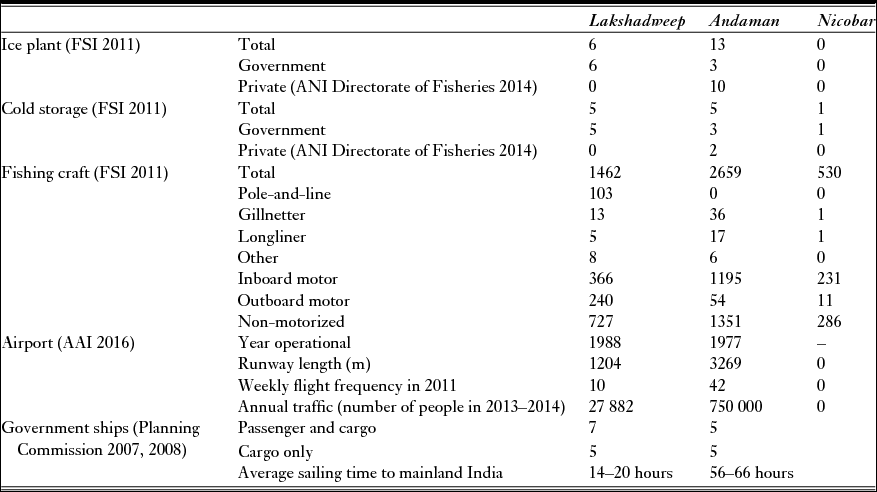
The Andaman Islands have the largest fishing fleet of the three groups, including a greater number of boats with inboard motors and mechanized vessels like gillnetters and longliners (Table 1). Additional investment from the private sector in the Andaman group has resulted in more cold storage facilities and ice plants than in the Lakshadweep or Nicobar Islands (Table 1). Lakshadweep does, however, have a government-sponsored canning factory and curing yard to support its tuna fishery (MOA 2014). Limited land area inhibits the construction of large runways, and thus flight connectivity in Lakshadweep is restricted to a small, 40-seater passenger plane without any cargo capacity (Table 1). Given the shorter sailing times and ship connectivity, goods are exported from the Lakshadweep Islands via government and private ships (Table 1). As sailing to the Andaman and Nicobar Islands can take almost 3 days, Port Blair in the Andaman Islands is better connected to Chennai and Calcutta, with frequent flights and ample cargo capacities (Table 1). The Port Blair airport connecting the Andaman and Nicobar Islands by flights to mainland India became operational in 1977, over a decade before the airport at Agatti, Lakshadweep (Table 1).
Fisheries infrastructure in terms of numbers of ice plants, cold storage facilities and fishing craft, along with descriptions of government-supported air- and ship-based transport facilities for the Lakshadweep, Andaman and Nicobar Islands.

Major commercial fisheries and their commodity chains
The primary commercial fishery operating in the Lakshadweep Islands is the traditional live-bait pole-and-line tuna fishery, which utilizes small planktivorous fish from island reefs and lagoons in order to target oceanic skipjack tuna (Katsuwonus pelamis). This fishery evolved over 1000 years ago in the Maldives and in Minicoy, the southernmost Lakshadweep Island (Hornell Reference Hornell1910; Anderson et al. Reference Anderson, Huntington, Macfayden, Powers, Scott and Stocker2012). This practice was successfully introduced to the rest of the Lakshadweep Islands in the 1960s by the local fisheries department as part of a fisheries training and development programme (Pillai et al. Reference Pillai, Vivekanandan and Said Koya2006; Zacharia Reference Zacharia2007). Over 60% of the Lakshadweep fish catch is cured to form a smoked and dried tuna product called masmin (MOA 2014). Masmin is transported via government and private ships from Lakshadweep to ports on the mainland for export to end markets in Sri Lanka, Southeast Asia and Japan (Bhatta Reference Bhatta2006; Zacharia Reference Zacharia2007). Interviews with the community elders of these islands indicate that the successful introduction was a result of the lucrative markets that existed for cured tuna and the high local availability of tuna resources, with no evidence of historical depletion of reef resources.
Today, reef fish, like groupers and snappers, constitute the highest landings of the Andaman and Nicobar Islands (Mustafa Reference Mustafa2011; MOA 2014). A targeted grouper fishery began in 1998, while fisheries for sharks, crustaceans and chilled and frozen reef fish arose in the 1990s (Fig. 1; see supplementary text for additional notes on export fisheries development in the Andaman Islands) (Advani et al. Reference Advani, Sridhar, Namboothri, Chandi and Oommen2013). Driven by the demand for chilled, fresh, high-value reef fish in Southeast Asia and China (Sadovy de Mitcheson et al. Reference Sadovy de Mitcheson, Craig, Bertoncini, Carpenter, Cheung, Choat, Cornish, Fennessy, Ferreira, Heemstra, Liu, Myers, Pollard, Rhodes, Rocha, Russell, Samoilys and Sanciangco2013; Fabinyi Reference Fabinyi2015), groupers and snappers are directly flown from Port Blair to export centres in Chennai (Mustafa Reference Mustafa2011). In particular, exports of the highly valued leopard coral trout (Plectropomus leopardus) display a peak in earnings around the time of the lunar new year (Advani Reference Advani2013), and fetch anywhere from US$90–100 kg–1 in international markets (Muldoon et al. Reference Muldoon, Sadovy, Shea, Tam, Welford and Whitford2015).
Travel time to major markets
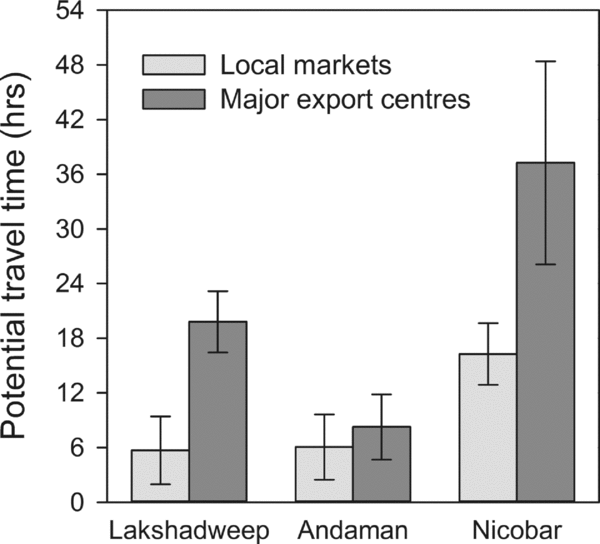
The accessibility of India's oceanic islands to mainland export centres is counterintuitive in terms of their geographic proximity. Our estimates of travel time between island reefs to the nearest major export centre differed significantly from those calculated by Maire et al. (Reference Maire, Cinner, Velez, Huchery, Mora, D'agata, Laurent Vigliola, Wantiez, Kulbicki and Mouillot2016) (Wilcoxon rank sum test, χ 2 = 85.443, p = 0.0001; Fig. S1 and Fig. 2). For the Lakshadweep Islands, 87% of the reefs were 12–24 hours away, while 10% were more than 24 hours away from major export centres (Fig. S1 and Fig. 2). All of the reefs in the Andaman group are accessible by export markets within half a day, while it takes more than 24 hours to link major export centres to 70% of the reefs in the Nicobar Islands. Overall, the accessibility estimates provided by Maire et al. (Reference Maire, Cinner, Velez, Huchery, Mora, D'agata, Laurent Vigliola, Wantiez, Kulbicki and Mouillot2016) for coral reefs in the Lakshadweep and the Andaman and Nicobar Islands did not determine any reefs being further than 24 hours from the nearest major local market. However, in our analysis, approximately 18% of the studied reefs are over 24 hours away from export market centres, with significant differences between groups (Fig. S1 and Fig. 2).
Average potential travel time estimates between reefs and local island markets (Maire et al. Reference Maire, Cinner, Velez, Huchery, Mora, D'agata, Laurent Vigliola, Wantiez, Kulbicki and Mouillot2016) and major export markets in mainland India (this analysis). Error bars represent standard deviations.

DISCUSSION
Our study highlights the stark contrasts in development trajectories of fisheries in India's oceanic islands. Today, Lakshadweep primarily engages in an export fishery for dried skipjack tuna. The most lucrative seafood export industry in the Andaman Islands is for chilled groupers, whereas subsistence fisheries predominate in the Nicobar Islands. While our revised reef accessibility estimates show that the development trajectories of these fisheries are governed by transport connectivity and preservation infrastructure, we also find that the propensity of these island communities to engage with available export markets is rooted in their history, culture and socio-economic status.
The broader settlement histories and cultures of communities in the Lakshadweep and Nicobar Islands have influenced access to marine resources and export markets. Customary marine resource tenure and traditional resource management systems exist in the southernmost Lakshadweep island of Minicoy and parts of the Nicobar Islands (Sivadas & Wesley Reference Sivadas and Wesley2006; Chandi et al. Reference Chandi, Mishra and Arthur2015; Patankar et al. Reference Patankar, D'Souza, Alcoverro and Arthur2015). Despite the accessibility to reef fish, tuna remains a desired seafood item across all Lakshadweep households (Karkarey et al. Reference Karkarey, Kelkar, Lobo, Alcoverro and Arthur2014; M. Jaini, personal observation 2016). Fisheries in the Nicobar Islands are predominantly subsistence, and reef fish caught for commercial purposes are sold only locally (Patankar et al. Reference Patankar, D'Souza, Alcoverro and Arthur2015). This is most likely the result of a combination of traditional value systems and limited connectivity.
On the other hand, the more recently settled Andaman Islands have greater cold storage infrastructure and preservation facilities, driven largely by private investment. This investment originates from individuals and agencies that are recent migrants, with external capital and pre-established links to the export industry in mainland India, who migrated to these islands as a result of the perceived fisheries potential (S. Advani, unpublished data 2017). Communities in the Lakshadweep and Nicobar island groups have been designated as Scheduled Castes and Tribes, restricting entry and land ownership by outsiders and thus potentially inhibiting private investment in fisheries and export-related infrastructure (Planning Commission 2007, 2008).
While both Lakshadweep's tuna and Andaman's grouper fisheries supply export markets, it is important to note that they differ significantly in sustainability criteria, including target species biology, trophic role and harvest methods. Skipjack tuna is a fast-growing, early maturing species in comparison to the lucrative leopard coral grouper (Froese & Pauly Reference Froese and Pauly2017). Furthermore, being a mid-level oceanic consumer, removal of skipjack tuna is more likely to be less detrimental than the removal of reef top predators like the leopard coral grouper. Techniques employed by the pole-and-line fishery are highly selective and present little to no bycatch in comparison to the handline and bottom set longline fishing method that is used to catch groupers in the Andaman Islands (Advani et al. Reference Advani, Sridhar, Namboothri, Chandi and Oommen2013; Jaini & Hisham Reference Jaini and Hisham2013). The voluntary adoption of sustainable or unsustainable practices in these island systems seems to be rooted in human settlement history and inherent value systems.
The future of export-driven fisheries in India's oceanic islands depends upon development policies, infrastructure investment, resource availability, market links and local preferences. In the Lakshadweep Islands, with the declining profitability of Indian Ocean tuna fisheries (Pillai & Satheeshkumar Reference Pillai and Satheeshkumar2012) and growing ice production infrastructure, reef fisheries that supply to mainland market centres are beginning to be established (Arthur Reference Arthur2013). In the Nicobar Islands, kin group resource-sharing mechanisms and complex reef tenure and taboo systems were prevalent before the 2004 tsunami (Chandi et al. Reference Chandi, Mishra and Arthur2015). However, kin group resource-sharing arrangements and compliance with resource extraction have broken down with the receipt of tsunami aid (Chandi et al. Reference Chandi, Mishra and Arthur2015; Patankar et al. Reference Patankar, D'Souza, Alcoverro and Arthur2015). Poor connectivity and limited infrastructure may temporarily inhibit the evolving social systems of the Nicobar Islands from accessing fresh and frozen seafood export markets, but may be adequate for processed seafood and the currently developing live-crab trade (Fig. 2 and Table 1) (M. Chandi, personal communication 2017). Understanding the drivers of such transitions in fisheries is critical for management, and our revised accessibility estimates can help identify gradients in reef vulnerability as a function of access to export centres on the Indian mainland.
To the best of our knowledge, this is the first study to demonstrate reef accessibility in terms of export markets and to highlight the significant differences between export and local market accessibility for India's oceanic islands. Further scaling up of assessments of reef accessibility could potentially be attempted for specific high-value, ecologically sensitive global seafood industries (Berkes et al. Reference Berkes, Hughes, Steneck, Wilson, Bellwood, Crona, Folke, Gunderson, Leslie, Norberg, Nystrom, Olsson, Osterblom, Scheffer and Worm2006; Watson et al. Reference Watson, Green, Tracey, Farmery and Pitcher2016) by combining the metrics used by Maire et al. (Reference Maire, Cinner, Velez, Huchery, Mora, D'agata, Laurent Vigliola, Wantiez, Kulbicki and Mouillot2016) with flight cargo capacities, international transportation hubs, cold storage infrastructure and shelf-life estimates. We argue that an understanding of fisher preferences as influenced by social, cultural, ecological, economic and political factors (Coulthard et al. Reference Coulthard, Johnson and McGregor2011; Kittinger Reference Kittinger2013; Hicks et al. Reference Hicks, Levine, Agrawal, Basurto, Breslow, Carothers, Charnley, Coulthard, Dolsak, Donatuto, Garcia-Quijano, Mascia, Norman, Poe, Satterfield and Levin2016) may be necessary in order to predict community engagement with available export markets. While we provide insights into local factors that can significantly influence fisheries development and export market accessibility, an understanding of how this accessibility impacts reef fish biomass and reef health is lacking and may be confounded by other environmental factors.
ACKNOWLEDGEMENTS
Funding for this work comes in part from Rohini Nilekani, The Rufford Foundation and the Ravi Sankaran Inlaks Fellowship. This work would not have been possible without the help of Shwetha Nair, island fishing communities, Lakshadweep, Andaman and Nicobar Fisheries Departments, the Department of Science and Technology and the Department of Environment and Forests. Partners like the Andaman and Nicobar Environment Team (ANET) and the Nature Conservation Foundation (NCF) provided valuable support and collaboration. We also thank three anonymous reviewers for their constructive feedback that helped improve this manuscript.
FINANCIAL SUPPORT
This research received no specific grant from any funding agency, commercial or not-for-profit sectors.
CONFLICT OF INTEREST
None.
ETHICAL STANDARDS
Our key informant interviews conform to Dakshin Foundation's ethical standards on research involving human subjects, including full disclosure of risks and benefits and maintenance of confidentiality.
Supplementary Material
For supplementary material accompanying this paper, visit https://doi.org/10.1017/S037689291700042X