Introduction
Studies indicate that various diagnostic systems for delirium (DSM-5, DSM-IV, DSM III-R, and DSM III) have significant agreement in the identification of patients with delirium, with DSM-IV the most inclusive and DSM-5 the most restrictive diagnostic method (Meagher et al., Reference Meagher2014; Adamis et al., Reference Adamis, Rooney, Meagher, Mulligan and McCarthy2015; Sepulveda et al., Reference Sepulveda2015). However, further evaluation of these criteria is needed in terms of their association with outcomes of delirium (Neufeld, Reference Neufeld2015). In the present study, we examined four outcomes that are particularly relevant to delirium: (a) mortality, (b) length of hospital stay, (c) destination after discharge, and (d) cognitive improvement – all in relation to any delirium (incident or prevalent) defined with the different classification systems. We tested the null hypotheses that there will not be differences in the different classification systems (DSM-5, DSM-IV, DSM III-R, and DSM III) between those with and without delirium in terms of (a) mortality rates, (b) length of stay, (c) discharge back to previous address or to an institution, and (d) cognitive improvement.
Methods
This is a post-hoc analysis of data collected from a prospective, observational, longitudinal study conducted on the elderly medical wards of Sligo University Hospital. All acute medical admissions of patients 70 years old and above were approached for permission to enter the study within 72 hours of admission. Each participant was scheduled to be assessed twice per week up to a maximum of four times during their hospitalization. Exclusion criteria used were the following: terminal phase of illness (patients who were deemed as likely to die next few days by their treating medical team), severe aphasia, intubation, severe sensory problems, and non-English speakers.
Delirium diagnosis
Delirium presence in each assessment was assessed with the criteria described in DSM-5, DSM-IV, the Confusion Assessment Method (CAM), and the Delirium Rating Scale Revised-98 (DRS-R98). A cut-off score >15 of DRS-R98 severity scale is consistent with a diagnosis of delirium (Trzepacz et al., Reference Trzepacz, Meagher and Franco2016). The DRS-R98 is a revision of the DRS which was developed as a complement to the DSM-III criteria to measure the severity of delirium. Similarly, the CAM is based in DSM-IIIR criteria to detect delirium. We applied these two scales as proxies of DSM-III and DSM-IIIR criteria respectively. In this analysis we have included any delirium during hospitalization (either prevalent or incident).
Cognitive assessment
In addition, cognitive status was assessed by using the MoCA (Montreal Cognitive Assessment; Nasreddine et al., Reference Nasreddine2005) in each assessment.
Outcomes
One year mortality (in hospital and after discharge) was ascertained from various sources: (a) the hospital computerized database, (b) by telephone contact with the General Practitioner, and (c) by the local and/or National (if patients have moved out of the area) database of recorded deaths.
Length of stay (in days) was estimated from the hospital computerized database. Destination after discharge (excluding in-hospital deaths) was classified as discharged to same address (even if this was a care home), or newly discharged to a residential or care home.
Cognitive improvement was defined as 20% increase from the initial total MoCA score and the subsequent best score (Adamis et al., Reference Adamis2014). A score of 25 or less in MoCA is necessary to allow for a subsequent 20% improvement.
Ethics
The study was approved by Sligo University Hospital Research ethics committee.
Statistical analysis
For the categorical outcomes namely mortality and destination, χ2 tests were used to compare the different classification systems in terms of each outcome. For the continuous outcome length of stay, Mann–Whitney tests was used to investigate the differences between delirium and not delirium in terms of length of stay in each classification system, and an overall Generalized Linear Model (GLM) investigated the effects of the classification systems on the length of stay. Similarly, for the categorical outcomes to explore the overall effects of each classification system on each outcome, we used two approaches: (a) Binary logistic regression analysis with as dependent variable the outcome and as independent variables each of the classification systems, and (b) calculation of the odds rations for each classification in relation to each outcome and testing of their homogeneity across the classification systems via the Breslow–Day test. (Agresti, Reference Agresti2013). Homogeneous association implies that the conditional relationship between any pair of variables given the third one is the same at each level of the third variable (e.g. delirium/no delirium vs. death/alive conditioning in the third variable classification systems: DSM-5, DSM-IV, DRS-R98, and CAM). Data were analyzed using the IBM SPSS v24 software and R (vcdExtra and vcd packages described by Friendly and Meyer (Reference Friendly and Meyer2015)). The Venn diagram was drawn with the R package venn Version: 1.2.
Results
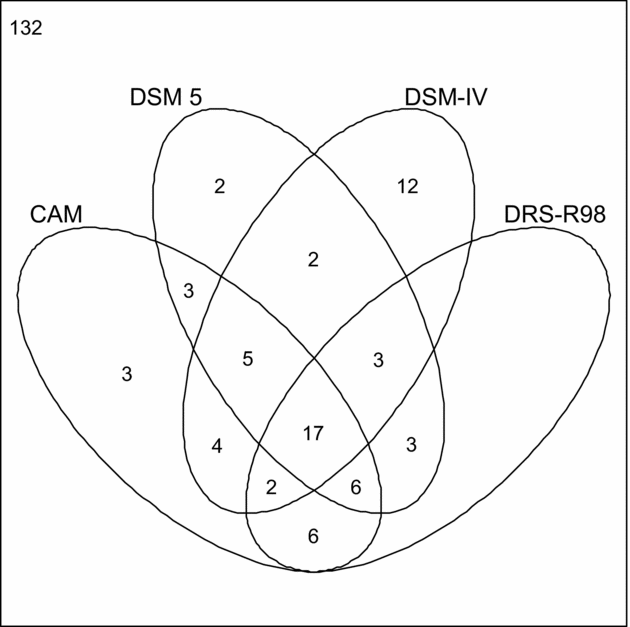
The mean age of the studied sample (n = 200) was 81.1 (SD = 6.5; range 70–100), of whom 100 (50%) of participants were female. Overall, during hospitalization 41 (20.5%) participants were identified with delirium according to DSM-5, 45 (22.5%) according to DSM-IV, 46 (23%) with CAM, and 37 (18.5%) with DRS-R98. One hundred and thirty two (66%) were identified as without delirium by any of the classification systems and 17 (8.5%) with delirium with the all four of the classifications. Figure 1 shows the numbers and their overlap (Venn diagram) of the cases identified as delirium with the different classification criteria across the hospitalization.
Venn diagram that shows the numbers of the cases identified as delirium among the different classification criteria across the hospitalization.

Mortality
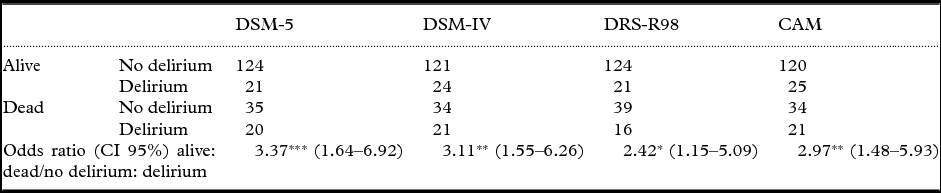
Mortality rates between delirious and non-delirious participants across the four classification systems and their odds ratios are presented in Table 1. The Breslow–Day test of Homogeneity of these Odds Ratios indicated no significant differences (χ2 = 0.428, df = 3, p = 0.677). For the outcome “alive at one year,” there were no difference between the four classification systems (χ2 = 0.665; df = 3, p = 0.881). Similarly for the outcome dead (χ2 = 1.351; df =3, p = 0.717).
Mortality rates between delirious and not delirious participants across the four classification systems and their odds ratio

***p < 0.001, **p < 0.01, *p < 0.05.
In addition, the regression model showed no significant effect of delirium with any of the four classification system in the outcome mortality.
An analysis of only the prevalent cases indicated similar results.
Length of hospital stay
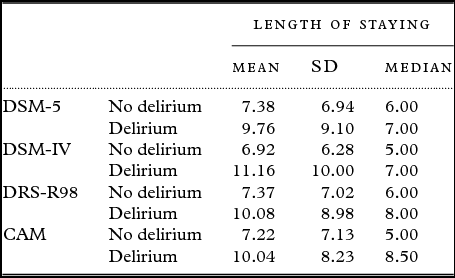
Table 2 shows the length of stay of those classified as delirious or not according to each of the classification systems. There were significantly longer hospital stays for those classified as delirious with DSM-IV (Mann–Whitney U = 2441.5, p = 0.002), CAM (Mann–Whitney U = 2445.5, p = 0.001), and DRS-R98 (Mann–Whitney U = 2238.0, p = 0.014) but not for those classified as delirious with DSM-5 (Mann–Whitney U = 2673.0, p = 0.075). Overall, the GLM found that three classification systems (DSM-5, CAM, and DRS) had similar effects upon the length of stay but not the DSM-IV (Wald χ2 = 6.946, df = 1, p = 0.008). Again, similar results were found when analyses were limited to prevalent cases.
Length of staying in the hospital between those with and without delirium across each classification system

Destination after discharge
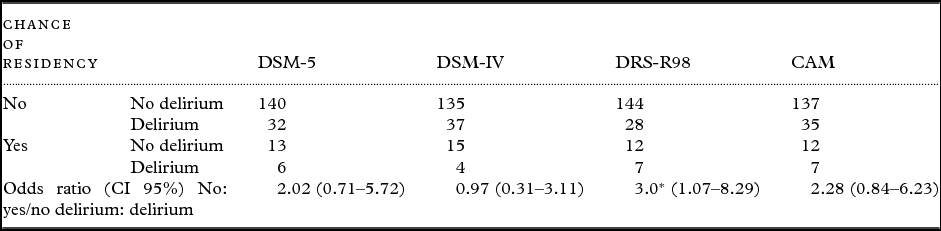
After excluding in-hospital deaths (n = 8) and one missing destination, the post-hospital residency of the remaining 191 participant is presented in Table 3. For the outcome “change of residency,” there were no differences among the four classification systems (χ2 = 1.462; df = 3, p = 0.691). Similarly, for the outcome discharge destination at the same place no differences among the four classification systems were found (χ2 = 1.725; df = 3, p = 0.631). The overall logistic regression model showed no significant effect of delirium identified by any of the classification systems. Similarly, the Breslow–Day test on Homogeneity of Odds Ratios showed no significant differences (χ2 = 2.22, df = 3, p = 0.528), indicating no significant difference between the four classification systems. However, those identified with delirium according to DRS-R98 were more likely to be discharged to a care home (χ2 = 4.834, df =1, p = 0.028).
Destination according to delirium/no delirium status across the classification systems and their odds ratio

*p < 0.05.
Cognition
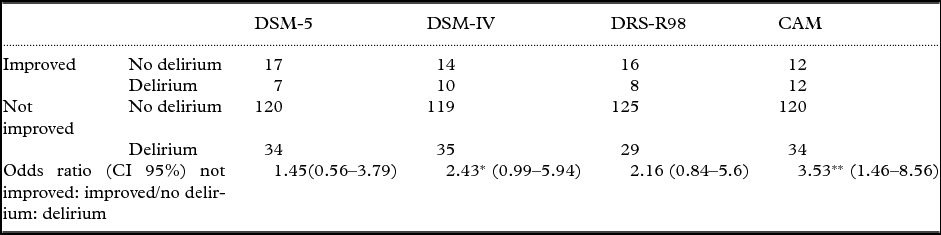
To allow for an improvement of 20% only those with a MoCA score of 25 or less were included in this analysis (n = 178). The rates of those who improved or not with or without delirium according to each classification system as well as their odds ratios are presented in the Table 4. The Breslow–Day test indicated no significant heterogeneity between the four classification systems(χ2 = 1.83, df = 3, p = 0.609). Analysis with χ2 tests between those with and without delirium who improved or not cognitively in each classification system separately, showed that only those who diagnosed with CAM delirium or DSM-IV have significantly cognitive improvement compared to those without delirium (χ2 = 8.447, df = 1, p = 0.004 for CAM, χ2 = 3.943, df = 1, p = 0.047 for DSM-IV).
Cognitive improvement by 20% of MoCA on delirious and not delirious participants across the four classification systems and their odds ratio

**p < 0.01, *p < 0.05.
Discussion
This work indicates a significant association between mortality and delirium identified by any of the standard DSM systems. However, the magnitude of this association varied across systems with those diagnosed with DSM-5 delirium at greatest risk for death but not significantly different compared to the other systems. It has been argued that DSM-5 criteria are relatively restrictive (Meagher et al., Reference Meagher2014; Adamis et al., Reference Adamis, Rooney, Meagher, Mulligan and McCarthy2015) such that cases diagnosed with DSM-5 criteria may be more severe with greater risk of mortality during hospitalization. Regarding mortality, our results echo those of Laurila et al. (Reference Laurila, Pitkala, Strandberg and Tilvis2004) in their evaluation of DSM-III, DSM-III-R, DSM-IV, and ICD-10 clinical criteria. They found a significant association between mortality and delirium without significant differences between the classification systems, although they had different proportions of mortality rates.
In contrast, regarding the length of hospital stay differences were found between the classification systems. Those classified as delirious with DSM-5 were not significantly different in the length of stay to those without delirium, and comparing classification systems, only those classified as delirious with DSM-IV had longer lengths of hospital stay. In addition regarding destination after discharge, only those diagnosed as delirious with DRS-R98 had significantly elevated rates of discharge to care homes. However, there were no differences between the other classification systems in terms of discharge destination.
Finally regarding cognitive improvement, only those who classified as delirious with CAM or DSM-IV were more likely to improve cognitively compared to those without. For the other two classification systems, cognitive improvement was independent of the presence or not of delirium. Substantial changes to cognitive performance occurred mostly in delirious patients, who identified with those two classification systems while many subjects without delirium also experienced clinically relevant changes to cognition.
Although some of the core symptoms of delirium exist in all the definitions even the small changes (especially from disorder of consciousness to disorder of attention in DSM-5) reveals how they identify somewhat different populations who, in turn, experience different outcomes. In addition, only 17 out of the 68 participants have been classified as delirious with the four systems, while the rest 51 with one or more systems. This indicates not necessarily only a poor agreement between the classification systems but perhaps that the different systems may detect delirium in different time points when the full symptoms of each classification system are evident. Also, given the overlap of symptoms of delirium with pre-existing cognitive impairment or dementia this may influence the accuracy of the diagnostic systems for the detection of delirium. However, we were not able to investigate the detection rates separately within the two groups (those with previous cognitive impairment and those with not) because of the small sample size, although still this distinction is difficult to be done especially during acute medical illness (Macdonald, Reference Macdonald1999).
In addition to the above limitation this study has two more. First, we assumed a direct association between the main outcomes (mortality, length of staying destination, and cognition) with delirium ignoring other confounding factors that also can contribute to outcomes. However, these confounding factors are the same for all those classified as delirious with any diagnostic system (as the sample remains the same). Therefore any differences in the outcomes can be better attributed to the selection bias that each definition introduces. Second, the study focused upon a relatively small sample size but perhaps a larger sample is more likely to strengthen the present results.
As in the previous study where we investigated the agreement of the four classification systems, we cannot conclude which is the best definition as we compared “gold standards” in relation to outcomes. Identifying the system with the best predictive ability requires some external criteria. Unfortunately, biological markers investigated for delirium (e.g. genetic, cytokines, S100B, BDNF, IGF-I, melatonin, cortisol, amino acids, and others) are not yet conclusive and have not been identified as reliable biomarkers for delirium. Alternatively, perhaps a different epistemological approach is needed (Stoyanov and Aragona, Reference Stoyanov, Aragona, Zachar, Stoyanov, Aragona and Jablensky2014) to define delirium in phenomenological terms. New research criteria have been proposed by Trzepacz et al. (Reference Trzepacz, Meagher and Franco2016) that are based on core symptom domains of delirium attentional/cognitive, circadian, and higher level thinking. Similarly, different definitions of delirium have been suggested by Macdonald (Reference Macdonald1999) and Adamis et al. (Reference Adamis, Rooney, Meagher, Mulligan and McCarthy2015) based on the cognitive outcomes and mainly cognitive reversibility/recovery. Although it needs to be emphasized here that all acute and reversible cognitive disorders are not necessarily delirium according to the present definitions. These new criteria are still in their infancy and they are not widely accepted and they need to be tested in phenomenological studies as well as in conjunction with biological markers.
Conflict of interest
None.
Description of authors’ roles
All the authors participated in the study design, interpretation of results, the drafting of manuscript and all approved the final version. Dr Adamis has the responsibility for the statistical analysis of the data.
Acknowledgments
We would like to thank the two anonymous reviewers who with their helpful comments have improved the manuscript.