Introduction
Alzheimer's disease (AD) involves a considerable challenge for the patient and his family. Caregiving for people with AD is highly stressful and has significant negative consequences, including physical and psychiatric morbidity; in fact, many studies have shown that rates of anxiety and depression in caregivers, as opposed to noncaregivers, are substantially higher (Pinquart and Soerensen, Reference Pinquart and Soerensen2003; Mahoney et al., Reference Mahoney, Regan, Katona and Livingston2005).
Several studies have investigated predictors of caregiver anxiety and depression. Some of these have focused on patient characteristics, such as cognitive impairment, decline or loss of functional activities of daily living, and behavioral disturbances (Covinsky et al., Reference Covinsky2003). On the other hand, some caregiver characteristics, such as gender, education level, low economic status, poor physical health, scarce social support or poor prior relationship with the patient have also been assessed (Mahoney et al., Reference Mahoney, Regan, Katona and Livingston2005; Cooper et al., Reference Cooper, Katona, Orrell and Livingston2006; Takai et al., Reference Takai2009). Recently, some studies have also analyzed which psychological variables may act on caregiver distress, focusing on the possible role of coping strategies adopted by caregivers (Cooper et al., Reference Cooper, Katona, Orrell and Livingston2006; 2008; Di Mattei et al., Reference Di Mattei, Prunas, Novella, Marcone, Cappa and Sarno2008).
Coping refers to constant cognitive and behavioral responses which individuals use to manage or tolerate a stressful situation and it therefore includes all the cognitive and behavioral measures adopted by an individual in response to specific internal and/or external demands that are deemed to exceed his or her normal resources (Lazarus and Folkman Reference Lazarus and Folkman1984; Lazarus, Reference Lazarus1999). The construct of coping has become central to stress theory and it has been recognized that health consequences of stress are influenced by coping as well as the amount of stress to which an individual is exposed. The experience of caring for an elderly family member has been conceptualized within the context of transactional models of stress, and within this framework stress is defined as a relationship between the person and the environment that is appraised by the person as taxing or exceeding his or her resources and as endangering well-being (Lazarus and Folkman Reference Lazarus and Folkman1984; Lazarus, Reference Lazarus1999). This definition emphasizes that coping is a dynamic process, as it consists of a series of reciprocal responses through which the individual and the environment interact and influence each other, and it includes a series of intentional actions, both cognitive and behavioral, meant to control the negative impact of the stressful event or situation (Lazarus and Folkman Reference Lazarus and Folkman1984; Lazarus, Reference Lazarus1999).
There is some empirical support for the existence of several primary dimensions of coping: problem solving, wishful thinking, problem avoidance, social support, cognitive restructuring, self-criticism, emotional expression or social withdrawal (Tobin et al., Reference Tobin, Holroyd, Reynolds and Wigal1989). These primary coping strategies can be organized into different higher-order categories: problem-focused strategies, which are directed at managing or altering the stressor, or emotion-focused strategies, which are directed at regulating emotional responses to the problem (Lazarus and Folkman, Reference Lazarus and Folkman1984), strategies that approach or strategies that avoid a stressor (Maddi, Reference Maddi1980), and strategies organized according to their presumed outcome as adaptive or maladaptive (Zeitlin, Reference Zeitlin1980).
Studies specifically considering associations between coping strategies and caregiver psychological distress have reported conflicting findings as to whether coping strategies are associated with greater caregiver psychological distress or not (Crespo et al., Reference Crespo, Lopez and Zarit2005; Cooper et al., Reference Cooper, Katona, Orrell and Livingston2006; 2008; Di Mattei et al., Reference Di Mattei, Prunas, Novella, Marcone, Cappa and Sarno2008). The different results reported might be due to various factors, e.g. the difference in size of the samples used, patients being at an early stage of AD, significant patient and caregiver confounders not being controlled for, or nonvalidated measurements of anxiety having been used (Vedhara et al., Reference Vedhara, Shanks, Wilcock and Lightman2001; Zucchella et al., Reference Zucchella, Michelangelo, Pasotti, Chiapella and Sinforiani2011). In addition, most of these studies have been limited in their conceptual focus and have mainly considered emotion-focused or problem-focused coping strategies (Morano, Reference Morano2003; Cooper et al., Reference Cooper, Katona, Orrell and Livingston2006; 2008).
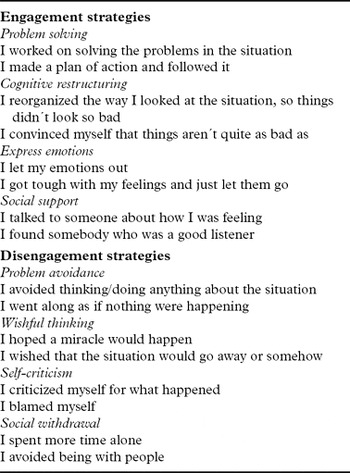
These discrepancies would be minimized if we used another theoretical framework in order to better understand how other higher-order constructs are related to caregiver psychological distress. In effect, Tobin et al. (Reference Tobin, Holroyd, Reynolds and Wigal1989) have attempted to integrate different formulations of coping by specifying how coping strategies could be organized on coping target and directionality of response. Coping efforts are first categorized as to whether they represent an engagement strategy, involving approach-related actions that result in confronting stressors, often viewed as a crucial factor in limiting the long-term psychological and physiological sequelae of environmental stressors, or disengagement strategy seeking to limit exposure to noxious stimuli, often producing desirable short-term effects, but leading to longer-term problems, including depressive symptoms. Within these categories, the target of the coping effort is either problem-focused or emotion-focused. Emotion-focused coping emphasizes the regulation of one's affective response, whereas problem-focused coping emphasizes management of the stress-producing situation (Tobin et al., Reference Tobin, Holroyd, Reynolds and Wigal1989; Jones and Bright, Reference Jones and Bright2001). Engagement coping includes strategies such as problem solving, cognitive restructuring, expression of emotions, and social support, whereas disengagement coping includes strategies such as problem avoidance, wishful thinking, self-criticism, and social withdrawal (Table 1).
Coping strategies inventory, by subgroup

This study therefore aimed to obtain new data regarding the association of coping strategies and psychological distress in AD caregivers. Our primary hypothesis was that caregivers who used disengagement coping strategies were more anxious or depressed than those who used engagement coping strategies.
Methods
Participants and study design
This is part of a larger study of people with AD and their primary caregivers from city, town, and rural areas in Málaga and Middle Spain (the MÁLAGA-AD study). Purposive recruitment was carried out so that, the sample was representative of people living with dementia in terms of dementia severity, gender, and care setting (Domenech, Reference Domenech1999).
Participants were contacted through local health services and the voluntary sector. One hundred-and-fourteen care recipients and their primary caregivers were originally interviewed for the MÁLAGA-AD study, of whom 80 of the family caregivers agreed to take part and were included in our study. Of those not included, 20 did not complete the interview and 14 refused.
All patients satisfied the criteria of the National Institute of Neurological and Communicative Disorders and the Stroke/Alzheimer's Disease and Related Disorders Association for probable AD (McKhann et al., Reference McKhann, Drachman and Folstein1984). A further inclusion criterion was that the responsible caregiver must live with the patient, be directly involved in the patient's care, and be a reliable source of information.
Trained researchers explained the study to the participants and requested their voluntary participation. All participants were required to sign an informed consent form. Where the patient did not have capacity, we asked caregivers whether they thought the patient would have agreed to participate if they could. Once they had agreed, caregivers were assessed and their data were collected by the authors themselves (psychiatrist, neuropsychologist, and neurologist). During the assessment, the interviewer compiled information on the patient's demographics and clinical characteristics.
The study was approved by the ethical committees of both the Instituto Andaluz de Neurociencia y Conducta and the University of Malaga.
Patient data
Information was recorded on age, gender, marital status, years of education, duration of dementia from the initial diagnosis made by the specialist up to the time of evaluation, previous history of psychiatric disorder's, and use of psychoactive medication (antidepressants, antipsychotics, anxiolytics or hypnotics) and antidementia drugs. Cognitive function was tested using the Mini-Mental State Examination (MMSE) (Folstein et al., Reference Folstein, Folstein and McHugh1975) in its validated version in Spanish (Blesa et al., Reference Blesa, Pujol, Aguilar, Santacruz, Bertrán-Serra and Hernández2001). Activities of daily living were assessed by the Bayer Activities of Daily Living Scale (B-ADL) (Hindmarch et al., Reference Hindmarch, Lehfeld, De Jong and Erzigkeit1998) in its validated version in Spanish (Erzigkeit et al., Reference Erzigkeit, Lehfeld, Peña-Casanova, Bieber, Yekrangi-Hartmann and Rupp2001).
The study of behavioral and psychological symptoms was carried out using the Neuropsychiatric Inventory (NPI) (Cummings et al., Reference Cummings, Mega, Gray, Rosenberg-Thompson, Carusi and Gornbein1994) in its validated version in Spanish (Vilalta-Franch et al., Reference Vilalta-Franch, Lozano-Gallego, Hernández-Ferrándiz, Llinás-Reglá, López-Pousa and López1999). The staging of the dementia was carried out with the Global Deterioration Scale (GDS) (Reisberg et al., Reference Reisberg, Ferris, De Leon and Crook1982). The present study included patients in stages 4 (moderate cognitive decline), 5 (moderate to severe cognitive decline), and 6 (severe cognitive decline) of the GDS.
Caregiver data
Information on age, gender, level of education, relationship to the patient, marital status, number of hours per day spent giving care, and whether they were living with the patient was compiled. In addition, caregivers completed:
• The Caregiver Burden Interview (CBI) (Zarit et al., Reference Zarit, Reever and Bach-Peterson1980) in its validated version in Spanish (Martín Carrasco et al., Reference Martín Carrasco, Salvadó, Nadal, Miji, Rico and Lanz1996). Cronbach's α = 0.92 was reported. A 22-item self-report questionnaire, which is the most consistently used measure of caregiver burden. CBI measures caregivers’ subjective burden of caregiving, in terms of health, finance, and social/interpersonal relationships. Participants’ responses were made on a five-point scale (0 = never to 4 = nearly always).
• The Beck Depression Inventory (BDI) (Beck et al., Reference Beck, Steer and Garbin1988). A 21-item self-report questionnaire was used to measure the severity of depressive symptoms. Each item is composed of four statements, representing increasing increments of depression severity for a particular symptom. The score for each item ranges from 0 to 3, with the total score ranging from 0 to 63. The Spanish version of the BDI was used in this study (Conde and Userros, Reference Conde and Useros1975). Cronbach's α = 0.90 was reported. We adopted the cut-off scores proposed by Kendall et al. (Reference Kendall, Hollon, Beck, Hammen and Ingram1987) for nonclinical populations, i.e. scores higher than 15 as detecting dysphoria, and scores over 20 as indicative of depression.
• The State-Trait Anxiety Inventory (STAI) (Spielberger et al., Reference Spielberger, Gorsuch and Lushene1970). For the purpose of this study, we used the STAI State Anxiety subscale (STAI-S) to assess caregiver anxiety. It is composed of 20 statements which the individuals answer stating how they usually feel. Item score ranges from 0 to 3 points, and the total score ranges from 0 to 60 points; the higher the score, the higher the anxiety. State anxiety has been defined as an emotional state characterized by feelings of apprehension and tension with changes in the level of activity of the autonomous nervous system, which can alter over time. The Spanish version (Seisdedos, Reference Seisdedos1982) of the STAI demonstrated good psychometric properties, with Cronbach's α = 0.93 and a cut-off score of 27/28 reported to achieve optimal balance between sensitivity and specificity for clinically significant anxiety in the case of the STAI-S.
• The Coping Strategies Inventory (CSI) (Tobin et al., Reference Tobin, Holroyd, Reynolds and Wigal1989). This is a self-report questionnaire with eight subscales describing different coping strategies, with five items per scale. Caregivers were asked to score each strategy from 0 (not doing it at all) to 4 (doing it a lot) (see Table 1). Satisfactory psychometric properties have been reported. Individual coping strategies are broadly categorized into two basic approaches to managing stressful situations: coping activities that engage the individual with the stressful situation, and coping activities that disengage the individual from it. The Spanish version (Cano-García et al., Reference Cano-García, Rodríguez-Franco and García-Martínez2007) of the CSI demonstrated good psychometric properties, with Cronbach's α ranging from 0.63 for problem avoidance coping strategies to 0.89 for self-criticism coping strategies. The convergent validity was verified using intercorrelations between scales, correlations with personality dispositions, and with coping efficacy.
Statistical analysis
Descriptive statistics were obtained for all variables including demographic and clinical characteristics of both patient and caregiver. Analysis of the distribution type was performed for continuous variables using one sample Kolmogorov–Smirnov test.
In order to compare caregivers who were cases on the STAI-S and BDI scales with those who were not, we first divided the caregiver population into four groups; they were defined as having: STAI-S anxiety, no anxiety, BDI depression, and no depression on the basis of their clinically appropriate cutoffs. Next, we compared caregivers who were cases on the STAI-S and BDI scales with those who were not for mean scores on subscales of the CSI and for sociodemographic and clinical characteristics of both patients and caregivers. We used two-tailed Student t-tests or nonparametric Mann–Whitney test when the supposition of data normality was not observed for univariate analysis. Categorical variables were compared using the χ2 test.
We performed stepwise logistic regression analysis to identify the combined effect of all confounders that might account for the findings regarding coping and anxiety cases. On step 1, we entered all factors that were significant for univariate analysis with the exception of the caregiver's score on the CSI engagement and disengagement subscales entered at step 2. We repeated the above analysis with depression score as the dependent variable. P values under 0.05 were considered statistically significant. Analyses were performed using SPSS version 19.
In order to find a statistically significant difference for mean coping scores when we compared caregivers who were cases on the STAI anxiety scale or the BDI scale with those who were not, a retrospective power calculation revealed that a sample size of 80 caregivers was sufficient to detect a significant difference of mean disengagement score between anxiety cases and nonanxiety cases with an effect size of 1.13, and using a significance level of 0.01 and a power of 99%. Similarly, a sample size of 80 caregivers was sufficient to detect a significant difference of mean disengagement score between depression cases and nondepression cases with an effect size of 1.05 and using a significance level of 0.01 and a power of 98% (Soper, Reference Soper2011).
Results
Caregivers who were interviewed for this study (n = 80) did not differ from those originally recruited to the study (n = 114) in terms of the proportion who were female (77.5% vs. 75.8%), a spouse of the patient (38.8% vs. 40.2%) or had a mean age (62.15 ± 10.37 vs. 63.9 ± 10.02; t = 1.8, p = 0.22).
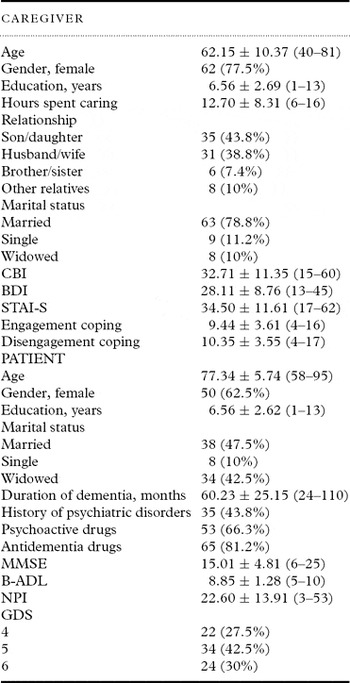
The analysis of the results showed that in most cases the caregiver of an AD patient was female and approximately 60 years of age. They were daughters or wives and were personally involved in caring for patients. Demographic and clinical characteristics, including frequencies, means and standard deviations (SD) of the 80 AD patients and their caregivers on the four groups analyzed are shown in Table 2. Forty-five (56.6%) caregivers were anxiety cases and forty-three (53.7%) were depression cases.
Mean ± SD (range) or number of people (%) for descriptive statistics of variables

SD = standard deviation; MMSE = Mini-Mental State Examination; B-ADL = Bayer Activities of Daily Living; NPI =Neuropsychiatric Inventory; GDS = Global Deterioration Scale; CBI = Caregiver Burden Interview; BDI = Beck Depression Inventory; STAI-S = State Trait Anxiety Inventory-State.
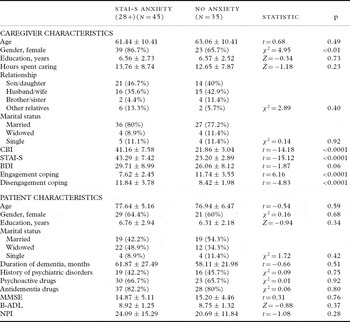
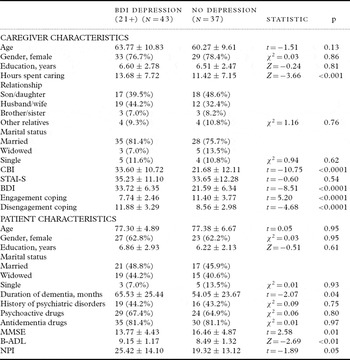
Mean CSI disengagement subscale scores were significantly associated with the STAI-S anxiety cases (11.84 ± 3.78 vs. 8.42 ± 1.98; t = – 4.83, p < 0.0001) and the BDI depression cases (11.88 ± 3.29 vs. 8.56 ± 2.98; t = – 4.68, p < 0.0001). On the other hand, mean CSI engagement subscale scores were significantly associated with caregivers who were not cases on the STAI-S (7.62 ± 2.45 vs. 11.74 ± 3.55; t = 6.16, p < 0.0001) and caregivers who were not cases on the BDI (7.74 ± 2.46 vs. 11.40 ± 3.77; t = 5.20, p < 0.0001). In addition, other factors that were significantly associated with STAI-S anxiety cases on univariate analysis were: female gender and higher burden score (Table 3). In turn, the factors significantly associated with BDI depression cases on univariate analysis (Table 4) were: more hours spent caring, higher burden score, longer duration of dementia, lower MMSE score, higher B-ADL score, and higher NPI score.
Means ± SDs or number of people (%) for relationship of caregiver and patient characteristics to STAI-S cases on univariate analysis

SD = standard deviation. MMSE = Mini-mental State Examination; B-ADL = Bayer Activities of Daily Living; NPI = Neuropsychiatric Inventory; GDS = Global Deterioration Scale; CBI = Caregiver Burden Interview; BDI = Beck Depression Inventory; STAI-S = State Trait Anxiety Inventory-State.
Means ± SDs or number of people (%) for relationship of caregiver and patient characteristics to BDI cases on univariate analysis

SD = standard deviation; MMSE = Mini-Mental State Examination; B-ADL = Bayer Activities of Daily Livingl; NPI = Neuropsychiatric Inventory; GDS = Global Deterioration Scale; CBI = Caregiver Burden Interview; BDI = Beck Depression Inventory; STAI-S = State Trait Anxiety Inventory-State.
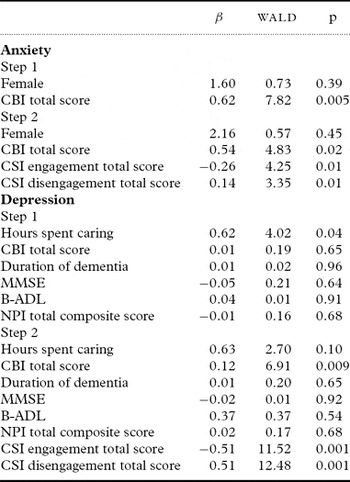
Anxiety was predicted on logistic regression in step 1 by total burden score (OR = 1.76; 95% CI = 1.18–2.86), and on step 2 by total burden score (OR = 1.73; 95% CI = 1.04–2.79) and use of disengagement coping strategies scores (OR = 1.94; 95% CI = 1.24–3.12) (Table 5). In turn, depression was predicted on logistic regression in step 1 by hours spent caring (OR = 1.58; 95% CI = 1.16–3.05), and on step 2 by total burden score (OR = 0.88; 95% CI = 0.66–0.97) and use of disengagement coping strategies scores (OR = 1.91; 95% CI = 0.99–2.01) (Table 5). The goodness-of-fit of the models was tested. The goodness-of-fit values suggested that it is a satisfactory anxiety model (Hosmer-Lemeshow: 0.244; df = 8, p = 0.98) and depression model (Hosmer-Lemeshow: 14.778; df = 8, p = 0.64).
Logistic regression analysis of factors associated with anxiety and depression in AD caregivers

MMSE = Mini-Mental State Examination; B-ADL = Bayer Activities of Daily Living; NPI = Neuropsychiatric Inventory; GDS = Global Deterioration Scale; CBI = Caregiver Burden Interview; BDI = Beck Depression Inventory; STAI-S = State Trait Anxiety Inventory-State.
Discussion
To our knowledge, this is the first study to investigate the relationship between anxiety and depression, and engagement and disengagement coping strategies in caregivers of people with AD in an epidemiological population. Results provided evidence for very high rates of anxiety and depression in primary caregivers of patients with AD, with over 50% of caregivers showing clinically significant anxiety and depression, and with the majority of caregivers being women, mostly daughters or wives.
We found evidence to support our hypothesis that coping strategies are associated with anxiety and depression in caregivers of AD patients. Our findings showed that those who used disengagement coping strategies more frequently showed higher anxiety and depression levels. On the contrary, caregivers who used more engagement coping strategies reported lower anxiety and depression levels. The results presented here suggest that disengagement coping strategies are associated with caregiver anxiety and depression irrespective of demographic and clinical characteristics of either the patient or the caregiver, suggesting that coping is the most important predictor of caregiver psychological distress.
A possible explanation for these findings might be that caregivers with lower anxiety and depression levels, respond to caring demands using engagement coping strategies in an attempt to adapt to the stressful situation. Successful caregiving for people with AD could probably involve problem engagement coping strategies where situations can be changed, and adapting emotionally where they cannot. This could explain why these individuals experience lower levels of psychological distress than caregivers who use coping strategies centered on disengagement from the problem. The use of disengagement coping strategies may revolve around a belief that caregiving strain is unchangeable. This might lead caregivers to believe that they do not have the ability to address or emotionally process the problem through direct cognitive or behavioral action. Thus, the use of disengagement coping strategies could make caregiving more stressful, with caregivers finding it more difficult to face the problems associated with caregiving directly.
Our study, in accordance with the scientific literature (Cooper et al., Reference Cooper, Katona, Orrell and Livingston2006; 2008; Takai et al., Reference Takai2009) clearly confirms that anxiety and depression tend to occur in caregivers who experience a greater burden and that the depressive state of the caregiver depends on the severity of the AD, thus demonstrating that caregiver depression is closely related to the values of the MMSE, B-ADL, and to the several phases of the cognitive and functional deterioration process of the patient (Covinsky et al., Reference Covinsky2003; Schulz et al., Reference Schulz, Boerner, Shear, Zhang and Gitlin2006; García-Alberca et al., Reference García-Alberca, Lara and Berthier2011). In addition, female caregivers show higher anxiety than nonanxious caregivers in accordance with previous studies which have found that female caregivers tend to report more anxious and depressive symptoms than male caregivers (Almberg et al, Reference Almberg, Jansson, Grafstrom and Winblad1998; Gallicchio et al, Reference Gallicchio, Siddiqi, Langenberg and Baumgarten2002).
There are several reasons why it is important to develop a better understanding of the relationship of coping strategies with caregiver anxiety and depression. First, it would be useful for clinicians to identify caregivers for whom more detailed screening may be indicated. Second, it may help to increase our knowledge of the etiology of caregiver anxiety and depression. Third, a better understanding of coping strategies associated with caregiver anxiety and depression will inform the development and targeting of interventions to help caregivers with anxiety and depression disorders. Future interventions to reduce AD caregiver anxiety and depression should focus on coping strategies used by them. In accordance with Cooper et al. (Reference Cooper, Katona, Orrell and Livingston2008), this seems to be more important than all other factors including the care recipient's psychiatric symptoms and hours of care provided. In this sense, Kuzu et al. (Reference Kuzu2005), and more recently Gelmini et al. (Reference Gelmini, Morabito and Braidi2009), provided an individualized comprehensive education program for caregivers of patients with dementia, and successfully improved their symptoms of depression and anxiety. However, our results indicate that adequately powered studies of interventions to reduce caregiver anxiety and depression that place more emphasis on engagement coping strategies, and on reducing disengagement coping, are needed.
This study has some limitations. This was a cross-sectional study and so the direction of causality would be strengthened by a longitudinal study. The relationship between anxiety and depression and coping strategies may be two-directional, with unhelpful coping strategies making caregiving even more stressful, and anxious and depressive caregivers finding it more difficult to face the problems associated with caregiving directly and so using more disengagement strategies. Caregivers were asked about coping strategies using a general measure of coping, and not about specific situations. Also, almost all measures in this study were self-reported. The extent to which participants’ answers on coping strategy measures relate to actual behavior is debatable (Kneebone and Martin, Reference Kneebone and Martin2003); anxious and depressive caregivers may be more likely to report their coping strategies negatively.
In summary, most caregivers reported higher anxiety and depression levels, and this was associated with disengagement coping strategies. These results may be useful for designing treatment interventions that aim to modify the use of coping strategies and thus reduce caregiver anxiety and depression. Interventions to reduce caregiver anxiety and depression should focus on the psychological coping strategies which the caregivers use. Our results indicate that interventions to reduce caregiver anxiety and depression that place more emphasis on engagement coping strategies, and on reducing those disengagement coping strategies associated with greater anxiety and depression, are needed. A randomized, controlled trial of a psychological intervention package, which places particular emphasis on engagement coping strategies, is therefore indicated to test this rational approach to reducing caregiver anxiety and depression.
Conflict of interest
None.
Description of authors' roles
JM García-Alberca designed the overall study; JM García-Alberca, B Cruz, JP Lara, A Lara, V Garrido, and E Gris supervised the data collection; JM García-Alberca, JP Lara, and B Cruz were responsible for the statistical design of the study and for carrying out the statistical analysis. All authors contributed to, and have approved, the final paper.