Approximately 282,000 persons live with traumatic spinal cord injury or disorder (SCI/D) in the United States. 1 High healthcare utilization is expected during their lifetimes because of morbidity from secondary complications.Reference St. Andre, Smith and Stroupe 2 Individuals with SCI/D are at high risk for infections due to frequent healthcare contact, antibiotics, and use of invasive medical devices.Reference Montgomerie 3 – Reference Rabadi, Mayanna and Vincent 6 Although many of these infections are caused by antibiotic-resistant organisms, such as multidrug-resistant gram-negative organisms (MDRGNOs), few data exist on the burden of MDRGNOs in persons with SCI/D.Reference Evans, Hershow, Chin, Foulis, Burns and Weaver 7 , Reference Waites, Chen, DeVivo, Canupp and Moser 8
MDRGNOs account for an increasing rate of infections annually.Reference Kallen, Hidron, Patel and Srinivasan 9 The Centers for Disease Control and Prevention (CDC) have made controlling MDRGNOs a high priority because of their increasing burden on morbidity and mortality.Reference Kallen and Srinivasan 10 The CDC National Healthcare Safety Network (NHSN) data from 2009–2010 showed significant increases in resistance in all gram-negative organisms across various infections.Reference Kallen, Hidron, Patel and Srinivasan 9 , Reference Sievert and Edwards 11 In addition, MDRGNOs have been associated with increased morbidity and mortality, longer length of stay in healthcare institutions, and increased healthcare costs. 12 , Reference Giske, Monnet, Cars and Carmeli 13
Most studies of MDRGNOs have focused on the incidence and spread of these organisms in acute care; however, data show a considerable burden in long-term-care facilities and in specialty outpatient settings such as dialysis clinics.Reference Kallen and Srinivasan 10 We speculate that due to multiple risk factors, such as antibiotic exposure, patients with SCI/D may have a higher burden of MDRGNOs.Reference Evans, LaVela and Weaver 4 Most of the studies of SCI/D or acute rehabilitation units is from 20–30 years ago and were single-site studies showing a range of 22%–34% of gram negatives being MDR (using older MDR definitions of resistance to ≥2 classes).Reference Waites, Chen, DeVivo, Canupp and Moser 8 , Reference Mylotte, Kahler, Graham, Young and Goodnough 14 , Reference Evans, Burns, Chin, Weaver and Hershow 15 More recent data have demonstrated that 60% of gram-negative bacteria are MDR, defined as intermediate or resistant to ≥3 antimicrobial classes.Reference Suda, Patel and Sabzwari 16 Thus, current literature in persons with SCI/D does not reflect the changing and increasing prevalence of resistance in these organisms, nor does it define the burden across a national sample of patients with chronic SCI/D. The Department of Veterans Affairs (VA) is the largest provider of SCI/D care in the United States, making this system an excellent resource for assessing the burden of MDRGNOs in SCI/D. Therefore, the goal of this study was to describe the epidemiology of MDRGNOs, including burden, geographic variability, and factors associated with resistance in a cohort of veterans with SCI/D.
METHODS
Study Design, Setting, and Patients
This investigation was a retrospective cohort study of national VA medical encounter, pharmacy, and microbiology data from adult patients with SCI/D treated at 142 VA facilities. Microbiology culture data and antibiotic sensitivities were evaluated for the study period January 1, 2012, through December 31, 2013, while data from January 1, 2011, to December 31, 2011, were utilized to determine exposures.
Data Collection
Several national VA data sources were used for this study. The VA Spinal Cord Dysfunction (SCD) Registry and Spinal Cord Injury and Disorders Outcomes (SCIDO) databases are derived from clinical patient registries maintained at individual VA facilities. These data sources were used to obtain spinal cord characteristics including injury date (for duration of injury), level (paraplegia vs tetraplegia), and completeness (complete vs incomplete) of injury.
The VA Corporate Data Warehouse (CDW) is a national repository including clinical and administrative data; this database was used to obtain demographics (age, gender, and race/ethnicity); clinical setting at the time of culture (outpatient clinic/emergency, inpatient, long-term care (LTC), or home care), comorbidity diagnoses in the past year (to develop Charlson comorbidity score), previous healthcare exposure (ie, intensive care unit [ICU] stay, LTC), facility characteristics (ie, SCI center, geographic region based on US Census Bureau regions 17 ), microbiology data (ie, date/time of culture, specimen type, organisms, and susceptibilities), and antibiotic exposures. For clinical setting, if a patient culture was obtained during an outpatient visit but the patient was subsequently admitted, the culture was categorized as an outpatient culture. Facility characteristics were evaluated based on whether care was provided at a VA with a specialty SCI center (24 facilities) or at a non-SCI center (118 facilities). All relevant exposures or independent variables (ie, antibiotic exposure) were evaluated 90 days prior to culture date unless otherwise noted.
Outcomes
The primary outcome was prevalence of MDRGNOs, where MDR was defined as any gram-negative organism (GNO) that was resistant or had intermediate susceptibility to 1 or more antibiotics in 3 or more antimicrobial classes. These definitions varied by organism but were defined by criteria established by a panel of experts from the European and US CDC and other partners.Reference Magiorakos, Srinivasan and Carey 18 All gram-negative (GN) isolates were defined as MDR or non-MDR based on these definitions which accounted for intrinsic resistance. Any GN culture that had at least 1 MDR isolate was defined as an MDRGNO culture. The sample was limited to those cultures with antibiotic sensitivities; we removed multiple cultures from the same patient within 30 days and cultures that did not grow at least 1 GNO.
Statistical Analyses
The prevalence of MDRGNOs at the culture level was described by patient demographic, medical characteristics, and facility-level characteristics using univariate and bivariate statistics. For the bivariate analyses, continuous variables were compared using the Student t test or Wilcoxon 2-sample test dependent on the distribution of the variables. Categorical variables were compared using χ2 tests and unadjusted odds ratios (ORs) and 95% confidence intervals (CIs). A multivariable random effect logistic regression model, accounting for multiple cultures within the same patient during the study period, was used to identify independent factors associated with having a MDRGNO versus non-MDRNGO culture. A multilevel random-effects model was also fit, nesting cultures within patients and within facilities. However, this model was not significantly different from the model clustering on patients; thus, the final model reported adjusts for multiple cultures per patient. The most parsimonious model was used, including only covariates that were significant at the 0.01 level due to multiple comparisons and that had adjusted ORs and 95% CIs. Descriptive and bivariate analyses were conducted using SAS software version 9.3 (SAS Institute, Cary, NC) and regression models were fit using STATA software version14.1 (StataCorp, College Station, TX).
RESULTS
Between January 1, 2012, and December 31, 2013, a total of 19,657 patients with SCI/D received care in VA facilities. Of these, 13,940 patients had 125,394 microbiology cultures. After exclusions, the final sample included 8,681 patients with 34,760 GN isolates in 27,904 GN cultures (mean, 3.1 gram-negative cultures per patient).
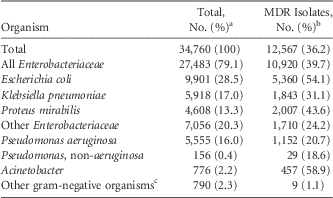
Of all the cultures with a GN isolate, 11,527 (41.3%) had an MDRGNO. Among GN isolates, 12,567 (36.2%) were MDR. The most frequent GN isolates were Escherichia coli (28.5%), Klebsiella pneumoniae (17.0%), and Pseudomonas aeruginosa (16.0%). Multidrug resistance among these isolates was 54.1%, 31.1%, and 20.7% respectively (Table 1).
Frequency of Gram-Negative Isolates and Prevalence of Multidrug Resistance in Clinical Cultures (N=34,760)

a %=(organism isolates/total gram-negative isolates)×100.
b %=(MDR organism isolates/total organism isolates)×100.
c Other gram-negative organisms include Achromobacter, Aeromonas, Agrobacterium, Alcaligenes, anaerobes, Bacteroides, Bordetella bronchiseptica, Burkholderia cepacia, Chryseobacterium, Comamomas testosteroni, Cupriavidus, Delftia acidovorans, Elizabethkingia, Fusobacterium, gram-negatives, Haemophilus, Moraxella, Myroides, Pantoea, Pasteurella, Porphyromonas, Prevotella, Rahnella, Ralstonia, Raoultella, Sphingomonas, and Stenotrophomonas maltophilia.
Overall, the 8,681 patients included had a mean age of 62.1±13.2 years, duration of injury of 19.4±15.5 years, and a mean Charlson comorbidity score of 2.3±2.0. Most cultures were from the outpatient setting (62.8%), followed by the inpatient setting (30.6%), LTC (4.3%), and home care (2.3%). Most specimens were from urine (86.6%). More than one-fourth of cultures (27.7%) were obtained from patients who had a healthcare exposure in the previous 90 days, and 67.3% were obtained from patients with an antibiotic exposure in the previous 90 days.
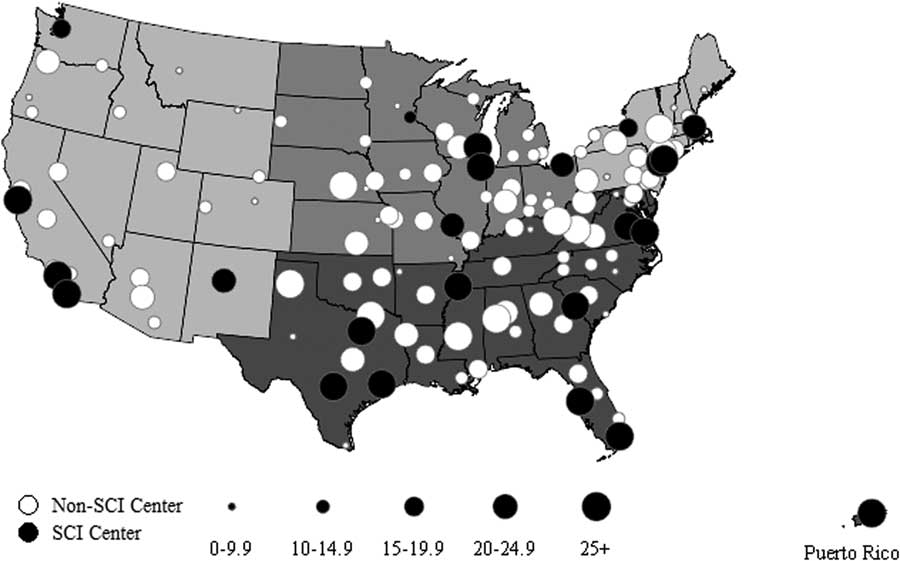
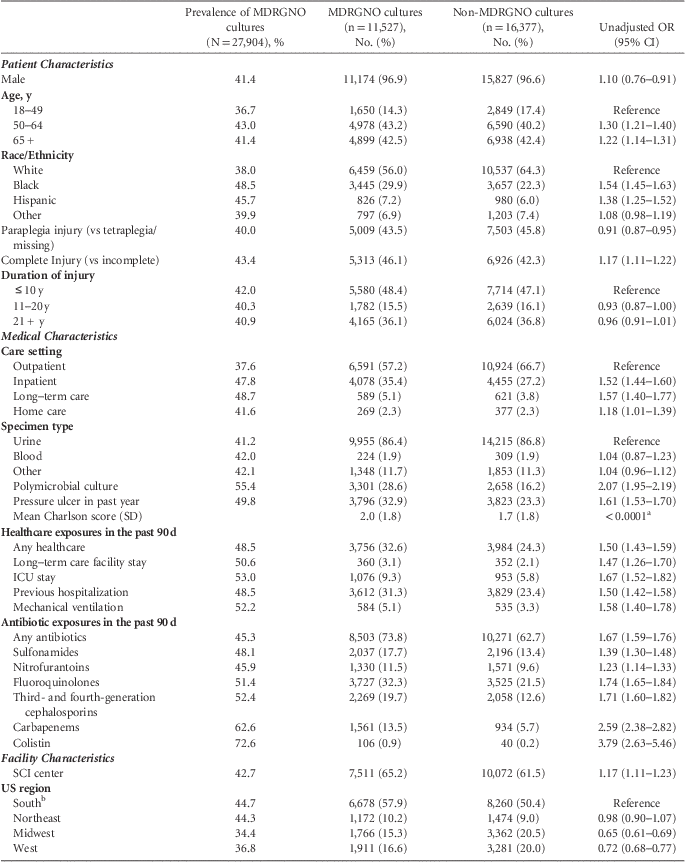
Unadjusted associations between demographic, medical, and facility characteristics and having an MDRGNO culture were identified (Table 2). Older age, black or Hispanic race/ethnicity, and complete injury had higher odds of a MDRGNO, while paraplegia (vs tetraplegia) had lower odds. MDRGNO cultures were also associated with culture location where higher odds was found in the inpatient, LTC, and home care settings compared to the outpatient setting. Having a polymicrobial culture, pressure ulcer, higher Charlson comorbidity score, and other healthcare exposures in the previous 90 days were associated with having an MDRGNO. Antibiotic exposure in the previous 90 days was also associated with an MDRGNO culture; carbapenems and colistin exposure had the highest odds. Facilities with a SCI Center had a higher prevalence of MDRGNO cultures (compared to non-SCI centers). Also, we observed significant regional variation (Table 2). Figure 1 shows the geographic distribution of MDRGNO cultures and patients in VA facilities across the United States, where 3.1% to 53.1% of SCI/D patients cared for in a particular facility had at least 1 MDRGNO (interquartile range (IQR) 9.6%, median 15.9%). For SCI centers, SCI/D patients with MDRGNOs comprised 13.4%–53.1% of the population, (IQR, 13.6%; median, 30.2%), while those facilities without SCI centers showed that 3.1%–44.8% of SCI/D patients had MDRGNOs (IQR, 8.2%; median, 13.9%).
Percentage of patients with spinal cord injury/disorder (SCI/D) with at least 1 multidrug-resistant gram-negative organism (MDRGNO) at VA facilities, 2012–2013. *Alaska (11.3%) not shown.

Prevalence of Multidrug-Resistant Gram-Negative Organism (MDRGNO) Cultures and Unadjusted Association Between Patient, Medical and Facility Characteristics (N=27,904)

NOTE. OR, odds ratio; CI, confidence interval, SD, standard deviation;l SCI, spinal cord injury.
a T test P value.
b South includes Puerto Rico due to small sample size.
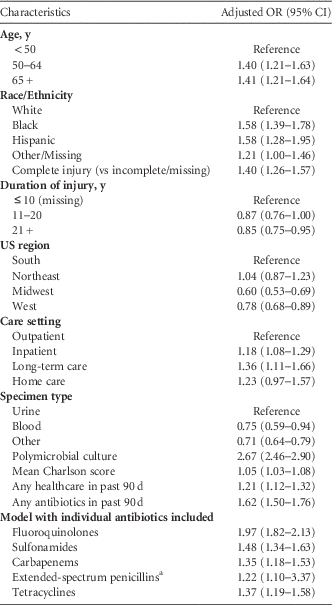
Overall, in the final model, older age, black and Hispanic race, and having a complete injury were still associated with higher odds of MDRGNO cultures (Table 3). However, unlike the unadjusted analyses, the multilevel random-effects model found that duration of injury for 21 or more years demonstrated lower odds of MDRGNO culture compared to those injured for 10 or less years. Being at an SCI center was no longer significant, but significant regional variation was still apparent. The South and Northeast regions had similar odds of having an MDRGNO culture, but the Midwest and West regions had lower odds. Cultures collected from inpatient and LTC settings remained associated with higher odds of MDRGNO cultures. Cultures obtained from blood and other specimen types (vs urine cultures) were less likely to have MDRGNOs. Higher Charlson comorbidity score, polymicrobial culture, and healthcare and antibiotic exposure in the previous 90 days were also associated with a MDRGNO culture. When individual antibiotic classes were included in the model, fluoroquinolones had the highest odds of being associated with MDRGNO cultures, followed by sulfonamides. Carbapenems, extended-spectrum penicillins (piperacillin, piperacillin/tazobactam and ticarcillin/clavulanate), and tetracyclines were also associated with MDRGNO cultures. No other antibiotic classes were associated with MDR.
Multivariable Random Effect Logistic Regression Analysis Assessing the Association Between Patient, Medical and Facility Characteristics and Having a Multidrug-Resistant Gram-Negative Organism in Culture (N=27,904)

NOTE. OR, odds ratio; CI, confidence interval.
a Includes piperacillin, piperacillin/tazobactam, and ticarcillin/clavulanate.
DISCUSSION
In this study, more than one-third of GN isolates and 2 of 5 GN cultures had an MDRGNO. Earlier studies in SCI/D demonstrated the prevalence of MDRGNO to be between 22% and 33%.Reference Waites, Chen, DeVivo, Canupp and Moser 8 , Reference Mylotte, Kahler, Graham, Young and Goodnough 14 Our results suggest that MDRGNOs are common in this population and that the burden is higher than previously reported. This finding is particularly concerning because these older studies used a definition that was less conservative for defining multidrug resistance (resistant to ≥2 classes), while our definition required being resistant to ≥3 antibiotic classes and accounted for intrinsic resistance. In our study, the percentage of patients with MDRGNOs across facilities ranged from 3.1% to 53.1%. Significant variability across facilities was even more apparent when stratified by presence of an SCI center (median, 30.2%) compared to non-SCI centers (median, 13.9%).
The most frequent gram negatives identified in this study were E. coli and K. pneumoniae, with E. coli and P. mirabilis having the highest prevalence of MDR (54.1% and 43.6%, respectively). The prevalence of MDR E. coli and K. pneumoniae in this study were both significantly higher than that observed in HAIs in general acute care, long-term acute care, and inpatient rehabilitation reported to the NHSN (54.1% vs 11.1% for E.coli and 31.1% vs 20.9% for K. pneumoniae).Reference Weiner, Webb and Limbago 19 In fact, the prevalence of MDRGNOs from the outpatient setting in this study was higher (37.6%) than that reported to NHSN in acute care, demonstrating the high risk of SCI outpatients for having MDRGNOs.Reference Weiner, Webb and Limbago 19 MDR Enterobacteriaceae and P. aeruginosa are highlighted as urgent or serious threats by the CDC. 12 Therefore, this increased prevalence highlights the need for increased surveillance and prevention strategies targeted toward patients with SCI/D.
Factors associated with MDRGNOs in this study included older age, having a complete injury, higher Charlson comorbidity score, and previous healthcare exposure. These factors are not surprising; previous articles demonstrated an association with specific MDRGNOs (eg, carbapenem-resistant Enterobacteriaceae).Reference Bassetti, Peghin and Pecori 20 – Reference Bhargava, Hayakawa and Silverman 23 Rarely reported are the racial/ethnicity differences in risk for MDRGNOs; we found that blacks and Hispanics had a higher prevalence of MDRGNOs. One study found increased fluoroquinolone resistance in GNOs causing healthcare-acquired UTIs in blacks compared to whites.Reference Rattanaumpawan, Tolomeo, Bilker, Fishman and Lautenbach 24 In a study of outpatients with SCI, MDRGNOs were more common in blacks than whites, but this difference was not statistically significant.Reference Rabadi, Mayanna and Vincent 6 Other studies have shown variation in methicillin-resistant Staphylococcus aureus (MRSA) by race/ethnicity.Reference Kuehnert, Kruszon-Moran and Hill 25 – Reference Ray, Suaya and Bazter 27 The differential risk for MDROs by race/ethnicity, may be due to lower socio-economic status and overcrowding in urban areas. These factors have been cited as reasons for the emergence of community-associated MRSA in urban areas.Reference Bratu, Landman, Gupta, Trehan, Panwar and Quale 28 In addition, despite controlling for these factors, differences in healthcare exposures (eg, antibiotics) may vary by race/ethnicity and geographic area. Complete injuries were more common in ESBL- and non–ESBL-producing Enterobacteriaceae than controls in a national case–case-control study of veterans with SCI.Reference Fitzpatrick, Suda and Safdar 29 A study of nursing home residents found that colonized cases of MDR A. baumannii occurred in persons who were more functionally disabled than controls.Reference Mody, Meddings and Edson 30 We also found that those injured for a longer time had a lower prevalence of MDRGNOs, which was surprising, especially since older age was associated with MDRGNOs. This may be secondary to increased immunity over time against bacterial invasion due to repeated infections.Reference Montgomerie 3 , Reference Bhatt, Cid and Maiman 31 , Reference Montgomerie, Chan, Gilmore, Canawati and Sapico 32 This finding warrants further exploration. Polymicrobial cultures were also associated with MDRGNOs, independent of urine cultures, which are often polymicrobial.Reference Waites, Chen, DeVivo, Canupp and Moser 8 , Reference Darouiche, Priebe and Clarridge 33 Polymicrobial cultures have been shown to be a risk factor for inadequate antibiotic treatment,Reference Evans, Burns, Chin, Weaver and Hershow 15 which may provide an opportunity for GNOs to spread drug resistance. These findings highlight the need for continued and focused infection control. The increased association of MDRGNOs with LTC and hospitalization further emphasizes this point. The complex environments involved in caring for SCI/D (ie, physical therapy, shared equipment) could pose additional barriers to optimal infection control. Finally, antibiotic exposure had the second highest odds of association with MDRGNOs. The high prevalence of exposure to antibiotics (67.3%) in this population highlights the need for stewardship. Estimates suggest an opportunity for a 30% reduction in unnecessary antibiotic prescribing in community and acute-care settings.Reference Fleming-Dutra, Hersh and Shapiro 34 , Reference Hecker, Aron, Patel, Lehmann and Donskey 35 In addition, broad-spectrum antibiotics, which can increase resistance, are frequently selected over first-line narrower spectrum agents.Reference Hersh, Fleming-Dutra, Shapiro, Hyun and Hicks 36 – Reference Chakra, Pepin, Sirard and Valiquette 39 Our findings demonstrate sulfonamides and broad-spectrum agents, such as fluoroquinolones, were associated with MDRGNOs. Tetracyclines are commonly used to treat osteomyelitis. These patients have prolonged hospitalizations and prolonged courses of parenteral antibiotics. Thus, a high rate of MDRGNOs would be expected.
Some limitations of this study included the lack of information on prescribing, medical encounters, or cultures that occurred outside the VA system, limited availability of data on medical devices, culture rationale or quality (ie, surface swab vs tissue biopsy), a broad but standardized definition for MDR,Reference Magiorakos, Srinivasan and Carey 18 and the inability of our methodology to distinguish between colonization and infection. Colonization is common in this patient population, with little clinical relevance for treating positive urine cultures in asymptomatic nonpregnant patients. In addition, antibiotic use in asymptomatic bacteriuria has been associated with increased risk for resistance.Reference Cai, Nesi and Mazzoli 40 Clinicians should carefully consider the clinical significance of positive urine cultures in SCI patients where symptoms may not be as apparent. Because this is the largest national study to describe MDRGNOs in a high-risk patient population, using data such as these provides the opportunity to benchmark the current prevalence of MDRGNOs and to direct infection control and stewardship interventions.
Clinicians treating patients with SCI/D should remain cognizant of the frequency of MDRGNOs. The risk for HAIs appears elevated in SCI/D compared to the general population. The rate of MDRGNO in the outpatient setting is substantial, with 37.6% of GNOs demonstrating MDR. Healthcare and antibiotic exposures in the past 90 days are risk factors for MDRGNOs, and the choice of empiric antibiotics in outpatients needs to account for these factors. In addition, it is important to implement stewardship strategies to improve antibiotic susceptibilities in this population.
ACKNOWLEDGMENTS
Financial support: This work was supported by funding from the Veterans Health Administration, Office of Research and Development, Rehabilitation Research and Development Service SPIRE Award (grant no. B-1583-P), finding from the Health Services Research and Development Service Presidential Early Career Award for Scientists and Engineers (grant no. USA 12-564), and a Post-Doctoral Fellowship Award (grant no. TPR 42-005). Dr Nasia Safdar is additionally supported by the VA-funded Patient Safety Center of Inquiry. The views expressed in this article are those of the authors and do not necessarily reflect the position or policy of the Department of Veterans Affairs or the US government.
Potential conflicts of interest: All authors report no conflicts of interest relevant to this article.