I. INTRODUCTION
The direct conversion of heat sources into electrical power through thermoelectric (TE) conversion is well established as a promising electrical energy source for the next decades. TE conversion generators emit no carbon dioxide and work without mechanical moving parts. These two characteristics are the key points for manufacturing environment-friendly and high durability electrical generators. The efficiency of TE conversion for a material increases with the so-called dimensionless figure of merit ZT defined as ZT = S 2T/ρλ, where T is the absolute temperature, S is the Seebeck coefficient, ρ the electrical resistivity, and λ the thermal conductivity. Conventional TE materials currently used in TE conversion systems are mainly intermetallic compounds.Reference Poudel, Hao, Ma, Lan, Minnich, Yu, Yan, Wang, Muto, Vashaee, Chen, Liu, Dresselhaus, Chen and Ren1 However, these materials have low-melting, decomposition, or oxidation temperatures and are composed of harmful or scarce elements. For high temperature TE applications, oxides are suitable due to their natural chemical stability. Moreover, oxides allow the preparation of environmentally friendly devices. Among the different oxides studied since the investigation of NaCo2O4 in 1997,Reference Terasaki, Sasago and Uchinokura2 layered misfits such as Ca3Co4O9+δ or Bi2Ca2Co2Ox are considered as promising materials for TE applications.Reference Funahashi, Matsubara, Ikuta, Takeuchi, Mizutani and Sodeoka3,Reference Maignan, Hébert, Hervieu, Michel, Pelloquin and Khomskii4 In the previous decade, the promising potential of Bi2Sr2Co2Ox materials (named BSC-222 phase in this study) have been highlighting as TE material. Indeed, BSC-222 single crystals exhibit a ZT value of 1.1 at 700 °C in airReference Funahashi and Shikano5 and the BSC-222 phase appears very stable in these conditions. BSC-222 exhibits a layered structure, where CoO2 layers alternate with Bi2Sr2O4 block layers along the c-axis.Reference Leligny, Grebille, Perez, Masset, Hervieu and Raveau6 Moreover, as conducting (CoO2) and insulating (Bi2Sr2O4) layers are alternately stacked, a decrease in the thermal conductivity (λ) through phonon scattering at the interface between layers would be expected.Reference Funahashi, Matsubara and Sodeoka7 For widespread large-scale use of TE applications, polycrystalline materials are required. However in BSC-222 bulk materials, the ZT value is decreased.Reference Funahashi, Matsubara and Sodeoka7 To the best of our knowledge, the maximal reported ZT value reported so far for BSC-222 polycrystalline samples is about 0.19 in air at 700 °C,Reference Funahashi, Matsubara and Sodeoka7 lower than single crystals. Low electrical resistivity is indispensable to enhance ZT values. Seebeck coefficient and electrical resistivity have a trade-off relation because these are dominated by the carrier concentration. The increase in the carrier mobility is a common method for improving the efficiency of TE polycrystalline materials. This is generally obtained through an enhancement of the bulk density and/or an increase in the average grain size and so on. However, such materials have an important disadvantage concerning thermal transport properties. Accurately tuning the microstructure is a key point to improving the TE properties in bulk materials. In this study, polycrystalline BSC-222 materials have been prepared by a hot pressing and a partial melting method. The relationship between TE properties and microstructure has been investigated.
II. EXPERIMENTAL METHODS
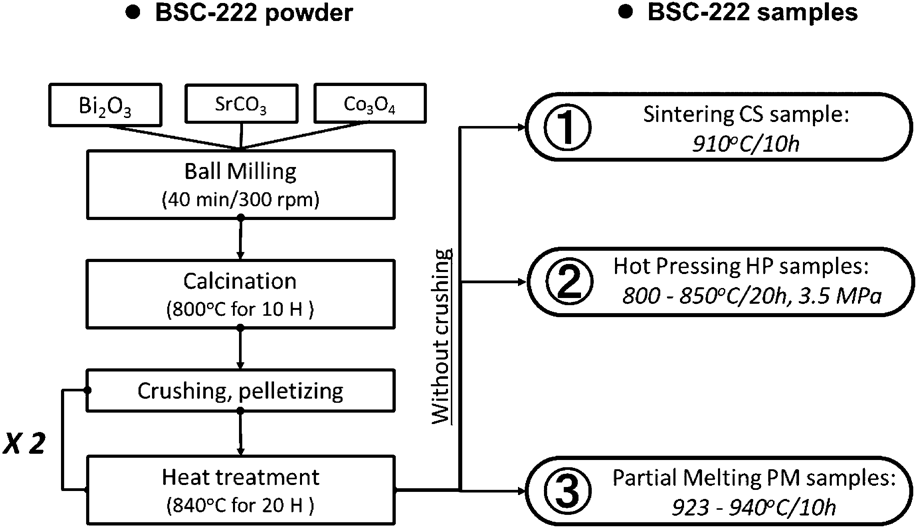
Bi2Sr2Co2Ox green bulk materials were prepared by a conventional solid-state reaction, by using Bi2O3 (High Purity Chemicals, 99.999%), SrCO3 (High Purity Chemicals, 99.9%), and Co3O4 (High Purity Chemicals, 99.999%) as starting powders. Material powders were weighed in stoichiometric amounts and mixed by ball-milling followed by heat treatment at 800 °C for 10 h. Calcined powders were then ground, pelletized, and fired at 840 °C for 20 h. After thermal treatment, the fired pellets were pulverized, pelletized again, and fired at 840 °C for 20 h. Without grinding, final post-treatment, i.e., conventional sintering process, hot pressing, or partial melting, were carried out on the fired BSC-222 pellets, as shown in Fig. 1.
Diagram detailing the different processing methods used for the preparation of Bi2Sr2Co2Ox bulk materials.

Conventional sintering was carried out by a heat treatment of green BSC-222 pellets at 910 °C during 20 h in air under atmospheric pressure. These samples are named CS samples in this study. Hot pressing is nowadays well established as an efficient processing method for preparing anisotropic materials with high bulk density.Reference Shin and Murayama8,Reference Masuda, Nagahama, Itahara, Tani, Seo and Koumoto9 The BSC-222 green pellets were also hot pressed at 800 or 850 °C for 20 h in air under an uniaxial pressure of 3.5 MPa. The hot-pressed samples are abbreviated as HP samples. Concerning the partial melting method, which is similar to single crystal processing, the green BSC-222 pellets were heated at 923 or 940 °C for 10 h in air and slowly cooled to room temperature for 20 h. These samples are called PM samples.
The melting temperatures were measured by thermogravimetry and differential thermal analysis (TG/DTA) from room temperature to 1000 °C in air with a heating rate of 5 °C/min (DTG-50, Shimadzu Corp., Japan). X-ray powder diffraction (XRD) analysis was carried out to investigate the possible presence of secondary phases. The microstructure of BSC-222 bulk materials has been observed by scanning electron microscopy (SEM, Hitachi S-3000H, Japan). For all samples, the average grain size was determined by SEM image analyses. The size of 100 grains was measured to have statistical significance.
Electrical resistivity, Seebeck coefficient, and thermal conductivity were measured in the direction perpendicular to the uniaxial pressing axis at the preparation for the BSC-222 green pellets. The temperature dependence of electrical resistivity (ρ) and Seebeck coefficient (S) were measured from room temperature to 700 °C in air using instruments designed by our laboratory. Electrical resistivity was measured using a conventional four-probe direct-current technique and the temperature dependence of S was investigated by plotting TE voltage against temperature differential. Silver paste was used for the terminal connections. Thermal conductivity, λ, was calculated using heat capacity, and thermal diffusivity measured simultaneously in vacuum using a laser-flash method (Flash TE, Pico Therm, Japan) from 25 to 700 °C.Reference Shinzato and Baba10 The bulk density was measured using the Archimedes method using water. The electronic contribution to the thermal conductivity λe has been calculated by using the Wiedemann–Franz relationship (λe = L 0T/ρ with L 0 the Lorentz number 2.45 × 10⁻⁸ V2 K−2) which is valid for metallic-like behavior. The lattice part of the thermal conductivity λL was obtained by calculating the difference of λe to λ.
III. RESULTS AND DISCUSSION
To investigate the melting temperature of BSC-222 phase with temperature, Fig. 2 shows the TGA/DTA curves in the temperature range from 500 to 1100 °C for prepared BSC-222 powder after the last calcination. In the range 910–930 °C, a significant weight loss is measured on the TGA signal. This weight loss is attributed to oxygen removal from the BSC-222 phase. On the DTA curve, a significant exothermic peak is observed at 923 °C, this corresponding to the melting temperature of the calcined BSC-222 powder.
Thermogravimetry and differential thermal analysis curves of Bi2Sr2Co2Ox green bulk.
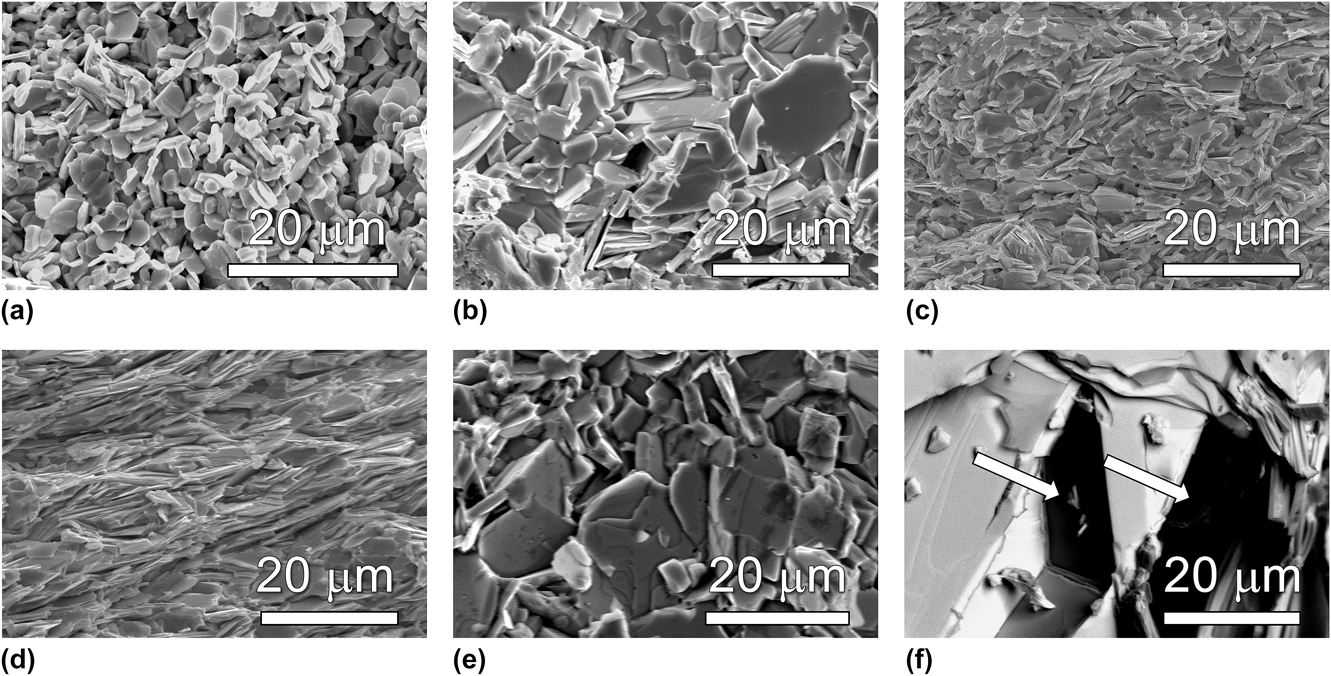
Figure 3 shows the SEM images of all BSC-222 bulk materials. The grain size distribution for the different samples is shown in Fig. 4. Limited grain growth occurs during the hot pressing treatment [Fig. 3(c)], the average grain size increasing from 2.26 μm for the green bulk material to 3.49 μm for the sample hot pressed at 800 °C (Table I). The temperature of hot pressing also has an impact on the average grain size, which increases from 3.49 to 5.58 μm by increasing the hot pressing temperature from 800 to 850 °C. However, the average grain size of HP samples is smaller than the CS sample, which is 7.66 μm. This is due to the low hot pressing temperature by comparison with sintering temperature. Also, collisions among the grains caused by the pressure may prevent grain growth. High bulk density values are obtained in HP samples. Due to the high packing arrangement of the grains, geometrical density is about 6.4 g cm−3, which corresponds to almost 94% of the theoretical density (6.8 g cm−3).Reference Rubešová, Hlásek, Jakeš, Sedmidubský and Hejtmánek11 On another hand, partial melting temperature significantly affects the microstructure of BSC-222 bulk materials. Obvious grain growth occurs in the partially melted BSC-222 bulk materials. The average grain size is as large as 11 μm. The microstructure has been totally changed by increasing the partial melting temperature. As can be clearly seen in Fig. 3(f), partially melted sample at 940 °C possesses large grains of main phase BSC-222 and the presence of secondary phases (Co oxide and Sr–Bi complex oxide) is also observed. The bulk density of the PM samples is lower than the HP and CS samples. In the case of BSC-222 bulk partially melted at 923 °C, the bulk density is as low as 6.1 g cm−3. This corresponds to 90% of the theoretical density. By increasing the partial melting temperature, the bulk density decreases to about 86%.
Electron backscattering images of the different cross-sections of Bi2Sr2Co2Ox bulk materials prepared in this study: green bulk material (a); samples prepared by conventional sintering at 910 °C (b); bulk materials prepared by hot pressing at 800 °C (c) and 850 °C (d) or partial melting at 923 °C (e) or 940 °C (f). Secondary phases observed in sample partially melted at 940 °C are indicated by arrows.
Grain size histogram of the different BSC-222 prepared samples.
Average grain size and standard deviation, bulk density and relative density against theoretical valueReference Rubešová, Hlásek, Jakeš, Sedmidubský and Hejtmánek11 of the different Bi2Sr2Co2Ox bulk materials prepared by conventional sintering, hot pressing at 800 and 850 °C, or partial melting at 923 and 940 °C.
The electrical resistivity exhibits a metallic-like behavior in all measured temperature range for the different prepared samples, and ρ values increase with temperature (dρ/dT > 0) (Fig. 5). However, within the accuracy of the electrical resistivity measurement, the electrical resistivity of PM sample prepared at 940 °C appears almost temperature independent. The differences in microstructures among the different BSC-222 bulk materials, both average grain size and bulk density (Table I) have a significant impact on the ρ values. Both HP samples possess very close ρ values in all temperature range, though their average grain sizes are different (3.49 μm versus 5.58 μm). By comparison with CS sample, the ρ values are decreased by a factor of about 1.8. By increasing the heat treatment temperature from sintering at 910 °C to partial melting at 923 °C, the ρ values are drastically decreased by a factor of about 2.9. However, for the PM sample prepared at 940 °C, the ρ values are more than five times higher than the PM sample prepared at 923 °C.
Temperature dependence of the electrical resistivity ρ of the different BSC-222 prepared samples. Inset: schematic of the sample cutting for the measurement of electrical properties.
The powder x-ray diffraction patterns of both PM samples are shown in Fig. 6. The main peaks in the XRD patterns for both PM samples are due to the BSC-222 phase, though more peaks from secondary phases (Bi3SrOx and CoO) are clearly observed in the PM sample prepared at 940 °C. The shifts in diffraction angles of the main peaks for both PM samples are observed by the different processing temperatures of the partial melting method. Since the BSC-222 phase can accept elemental nonstoichiometry,Reference Funahashi, Matsubara and Sodeoka7 the peak shifts are due to the different cell parameters by the composition between the processing temperature at 923 and 940 °C.
Powder x-ray diffraction patterns of the Bi2Sr2Co2Ox samples prepared by partial melting at 923 °C (a) and 940 °C (b). The diffraction peaks due to secondary phases are indicated by the symbol # for the Bi3SrOx phase and * for the CoO phase.
The ρ values greatly depend on the grain size, bulk density, and the amount of the secondary phases in the samples. By comparison with the conventionally sintered CS sample, in the HP samples, it is relatively clear that the ρ values are decreased by the improvement of bulk densification. However, the lowest ρ values can be observed in the PM sample prepared at 923 °C. PM samples exhibit simultaneously the lowest bulk density, the largest average grain sizes but also secondary phases in the PM sample prepared at 940 °C. This suggests that the grain size and the presence of secondary phases have as significant as or more influence than the bulk density on the ρ values in the case of BSC-222.
All S values are positive and increase with temperature across the whole measured temperature range (Fig. 7). However, the S values of the HP sample prepared at 850 °C seem to be relatively temperature-independent. All the samples prepared in this study possess similar S values. The slight difference in S values and their temperature dependence among the different BSC-222 bulk materials could come from the difference of cationic composition or/and oxygen content. It suggests that the temperature dependence of the ρ values for both hot-pressed samples may be affected mainly by the cationic composition or/and oxygen content. As a result, both HP samples exhibit very close ρ values.
Temperature dependence of the Seebeck coefficient values S of the different BSC-222 prepared bulk materials. Inset: schematic of the sample cutting for the measurement of electrical properties.
The λ values of BSC-222 bulk materials tend to increase with increasing temperature [Fig. 8(a)]. Generally, TE materials have 1/T dependence because acoustic phonon scattering is usually dominant in the high temperature range. The particular temperature dependence of thermal conductivity for BSC-222 samples is however in accordance with previous reported studies concerning BSC-222 phaseReference Funahashi, Matsubara and Sodeoka7,Reference Hsu, Lee, Wu, Kuo, Chen and Chou12,Reference Wang, Bai, Wang, Lü, Wang and Fu13 or other TE material.Reference Muta, Kanemitsu, Kurosaki and Yamanaka14 The highest λ values are measured in HP samples. For both HP samples, despite the temperature applied during hot pressing treatment has an extremely limited impact on the ρ values, an increase of λ values is measured with increasing hot pressing temperature. λ value at 700 °C is increased by a factor of 1.46 for the HP sample prepared at 800 and by a factor of 1.97 for the HP sample prepared at 850 °C, respectively, by comparison with the CS sample. The increase in thermal conductivity between both HP samples is attributed to the simultaneous increase of density and average grain size in the HP sample prepared at 850 °C (Table I). However, the PM samples show lower thermal conductivity than all other BSC-222 samples. The temperature dependence of the two contributions of the thermal conductivity λe and λL is shown in Figs. 8(b) and 8(c), respectively. Concerning PM sample prepared at 923 °C, as it exhibits a large decrease in electrical resistivity, a large increase of the contribution of λe is measured by comparison with CS and HP samples. However, the total thermal conductivity is the lowest in PM samples because of the low λL.
Temperature dependence of the thermal conductivity λ (a), including the electronic λe (b) or lattice contributions λL (c), for the different BSC-222 prepared bulk materials. Inset: schematic of the sample cutting for the measurement of thermal properties.
By investigating the TE properties of all BSC-222 bulk materials at about 700 °C, it appears possible to establish a clear relationship between λL values and bulk density (Fig. 9). The lattice part of thermal conductivity curve decreases by a factor of 2.2 with decreasing bulk density and saturates in the lower density of 6.0 g cm−3. The ρ values depend on the microstructure. Compared with I values, the ρ values are much more spread, over several orders. It means that amount of secondary phases included will affect much more ρ values than λ values. Therefore, in this study, no clear relationship between individual grain size, bulk density, or the amount of secondary phases and the ρ values has been established.
Variation of the lattice part of the thermal conductivity λL versus bulk density in BSC-222 samples at 700 °C in air.
Because the BSC-222 is an incongruent system, it is decomposed into a liquid (Bi-rich) and a solid (Bi-poor) phase by melting, a state known as “partial melting.” The BSC-222 grains are reformed through a peritectic reaction between the solid and liquid phases during cooling. Even after a long cooling time, the solid and liquid phases at the partial melting state remain as the CoO or Bi3SrOx phases, respectively, in the BSC-222 samples prepared by the partial melting method, as shown in Fig. 6. Such remnant secondary phases might act as phonon scattering sites.
Using the ρ, S, and λ values, the temperature dependence of the ZT values of all prepared samples was calculated and is reported in Fig. 10. All curves evolve in a similar way, that is, the ZT values increase with increasing temperature across the entire measured temperature range. The ZT values result from complex relationships between electrical and thermal transport properties. Despite their different electrical or thermal properties, it can be noticed that HP sample prepared at 800 °C and CS sample exhibit very similar ZT values, as well as HP sample prepared at 850 °C and PM sample prepared at 940 °C. Although the HP samples have lower ρ values than the CS sample, the high λ values suppress the ZT values to less than 0.1 in the HP samples at 700 °C in air. Unlike hot pressing, partial melting is an effective processing method for enhancing the TE performances of BSC-222 bulk materials. Indeed, by a partial melting treatment at 923 °C, which is comparable to the melting point of the BSC-222 phase, the ZT value increases to 0.27 at 700 °C. This is 2.7 times higher than the ZT value of the CS sample. This improvement is due to the simultaneous decrease in the ρ and λ values. It is clear in this study that the individual control of the ρ and λ values is possible by simultaneous suppression and enhancement of the scattering of the electrons and phonons, respectively, by the partial melting method. The former can be achieved by grain growth and the latter by lowering bulk density. From an application point of view, the partial melting method is an appropriate technique for mass production, because the process is the same as the conventional sintering method.
Variation of the figure of merit ZT versus temperature for the BSC-222 bulk materials.
IV. CONCLUSION
In this study, Bi2Sr2Co2Ox bulk materials (BSC-222) were prepared through three different processing methods: conventional sintering, hot pressing, and the partial melting solidification process. Although, hot pressing is effective in enhancing the bulk density, the grain growth is suppressed. This leads to a limitation in the decrease in the ρ values. The densification also enhances the λ values. As a result, ZT values are not increased by hot pressing. In the case of BSC-222 bulk materials prepared by partial melting at 923 °C, the decrease in the ρ values is also observed, even by lowering the bulk density, due to significant grain growth promoted by partial melting and slow cooling. A decrease in the thermal conductivity is simultaneously obtained by the partial melting method through lowering the bulk density. The results obtained in this study show that the ρ and λ values can be improved simultaneously by controlling the microstructure. From this, higher ZT values can be expected by optimization of not only bulk density and grain size but also grain alignment, which can be expected to suppress the ρ values.
ACKNOWLEDGMENT
The authors gratefully acknowledge the Japan Society for the Promotion of Science (JSPS) for their financial support.