1. INTRODUCTION
Style is an ordering principle for structuring design artifacts. The concept of style has special relevance in contemporary design domains due to its relationship with identity and image making. Stylistic change refers to the changes in the designs of a set of artifacts over time. For instance, the architectural style in Europe underwent change from Renaissance to Baroque in the 16th century.
It has been a common practice in design fields to develop new styles by modifying previous ones. For instance, mobile phone design and automobile design require frequent changes in style in response to market competition. In order to maintain consistency in product image and brand recognition, it is often a vital design objective that new styles are based on previous ones (Baxter, Reference Baxter1995, pp. 50–55). In this paper, such style change is termed as “strategic” style change, because these are conscious or deliberate changes made by the designer to an existing style. For instance, postmodern architecture is often based on classical or vernacular building traditions.
Such needs of style change are addressed by Knight's grammar transformation model, which allows the adaptive reuse of previous styles encoded in grammar rules (Knight, Reference Knight1994; Colakoglu, Reference Colakoglu2005). Shape grammars have been widely used for the description of styles (Stiny & Mitchell, Reference Stiny and Mitchell1978) and for capturing brand identity in a class of designs (McCormack et al., Reference McCormack, Cagan and Vogel2004; Chen et al., Reference Chen, McKay, De Pennington and Chau2009). Recent studies include the use of shape grammars for adaptation (Al-Kazzaz & Bridges, Reference Al-kazzaz and Bridges2012), the use of generic grammars to create specific ones (Beirão et al., Reference Beirão, Duarte and Stouffs2011), and the use of grammars and space syntax for housing rehabilitation (Eloy & Duarte, Reference Eloy and Duarte2011).
In a previous paper, we raised a number of issues that need to be addressed for the use of grammar transformations for strategic style change (Ahmad & Chase, Reference Ahmad and Chase2012). First, how is style defined in the design language of grammars? How would the designer decide what style(s) of designs are generated by a grammar, and that it has sufficiently changed after grammar transformation? Previous studies have assumed style to be analogous to the design language of a grammar (Stiny & Mitchell, Reference Stiny and Mitchell1978; Knight, Reference Knight1980). The validity of this hypothesis has been questioned by critics who claim that style is a particular perspective of a language, and not the language itself (Emdanat & Vakalo, Reference Emdanat and Vakalo1997; Li, Reference Li2011).
Second, previous studies provide an implicit and partial definition of style. A comprehensive definition of style requires the description of not only aspects of form and composition but also its “content” or “qualities” (Ackerman, Reference Ackerman, Ackerman and Carpenter1963; Knight, Reference Knight1994 pp. 18–35). We use the term aesthetic qualities to signify attributes that pertain to the beauty of design artifacts. For instance, the Hepplewhite furniture style is characterized by “lightness,” “elegance,” and “graceful curves.” Though the Hepplewhite grammar (Knight, Reference Knight1980) describes the design types of oval- or shield-shaped chair backs of the Hepplewhite furniture style, its aesthetic qualities are not detailed by the grammar.
Third, previous studies in using grammar transformations for style change (Knight, Reference Knight1994; Colakoglu, Reference Colakoglu2005) do not give an explicit description of the rationale for transformations (Chase & Liew, Reference Chase and Liew2001). Designers are faced with cumbersome and error-prone tasks such as determining which rules to modify, and how to modify them to generate necessary changes in style. However, the utility of using grammars depends on having a degree of control over the outcome of rules. Hence, there is a need to investigate the relationship between grammar and the style(s) of designs it generates.
In order to address the aforementioned issues, we present a framework that aids designers in transformation of design grammars for strategic style change. The framework relies on a style description scheme constructed for a grammar by describing the aesthetic qualities of grammar elements. The style description scheme facilitated the definition of style in the design language of a grammar and allowed the comparison of the aesthetic qualities of grammar elements. Based on this information, grammars could be transformed by adding, deleting, or modifying rules according to Knight's grammar transformation model (Reference Knight1994).
We tested the framework with an example from mobile phone design (Section 3). A corpus of Nokia mobile phone designs was used to construct a rule base of grammar rules with their descriptions. An original grammar that generated existing Nokia designs was assembled from the rule base (Section 3.3). An experiment was conducted with two designers to transform the original grammar based on given style goals and generate new designs from the transformed grammars (Section 3.4). Transformed grammars and generated designs were analyzed (Section 3.5). Feedback was elicited from the designers regarding the use of the framework (Section 4). Conclusions were drawn from the analysis (Section 5).
2. METHOD
2.1. Key concepts
Shape grammars are production systems used to generate designs. A shape grammar consists of a vocabulary of shapes, an initial shape, and a set of replacement rules of the form A → B, where A and B are shapes. A rule applies to shape C whenever there is a transformation t such that t(A) is part of C. The result is a new shape C – t(A) + t(B). Designs are generated by the recursive application of rewriting rules to the starting shape. Shapes lack any definite parts and can be decomposed in many ways based on how they are interpreted (Stiny, Reference Stiny2006). This is seen to be an advantage of shape grammars, because it makes creative designs possible due to emergent shapes. However, because of the recursive nature of rules and the manner in which they interact, it is difficult to accurately predict the nature of designs generated by a grammar.
Our study employed a set grammar, which is a specialized case of shape grammars. In set-based representations, rule invocations are finite and decidable. A further advantage of a set grammar is that it generates topologically valid designs. Set grammars have been used for the description of consumer products, which have clear form–function decomposition (Agarwal et al., Reference Agarwal, Cagan and Constantine1999). The basic building blocks of a set grammar are primitives and spatial relations (Stiny, Reference Stiny1982). Primitives are atomic in nature and do not support an embedding relation. Markers are nonterminal elements that act as placeholders for substitution by terminal elements. Spatial relations are arrangements of primitives or markers. Together these are referred to as “grammar elements.”
Grammars can be made more comprehensive with the inclusion of a description scheme for the description of nongeometric properties associated with designs. Description schemes comprise symbolic or verbal descriptions associated with grammar rules (Stiny, Reference Stiny1981; Agarwal et al., Reference Agarwal, Cagan and Constantine1999).
The description of aesthetic qualities associated with visual form requires the quantification of attributes that are ambiguous and abstract. We employed the semantic differential technique to describe the aesthetic qualities of grammar elements. The semantic differential technique measures the connotative meaning of abstract concepts using polar adjectival pairs. It employs a set of respondents to rate their perception of abstract concepts on a scale with a range of positions between bipolar extremes, such as “good” and “bad” (Osgood & Suci, Reference Osgood, Suci, Snider and Osgood1969; Chen & Owen, Reference Chen and Owen1997). Because of the focus on grammar transformations, conducting user surveys was considered out of the scope of this study. We instead followed an artifact-oriented approach that employed logical conditions based on the geometric properties of grammar elements.
2.2. A framework for strategic style change using grammar transformations
The objective of the framework for strategic style change was to aid designers in transformation of design grammars to achieve specific style goals. The framework relied on a style description scheme for design grammars that integrated the description of aesthetic qualities with grammar elements. The objective of the style description scheme was twofold. First, it was to provide descriptions of the aesthetic qualities of grammar elements, so that grammars could be purposely assembled, transformed, and compared. Second, it was to aid the computation of the aesthetic qualities of designs generated by grammars. This allowed the definition of style in the designs generated by grammars and facilitated the comparison of style(s) in the design language of original and transformed grammars. An overview of the framework is described here.
Three types of adjectival descriptors were used to describe the aesthetic qualities of grammar elements and generated designs: primitive descriptors, spatial relation descriptors, and design descriptors. These three types of descriptors in a grammar together constituted its style description scheme. Primitive descriptors and spatial relation descriptors described the aesthetic qualities of primitives and spatial relations in the rules of a grammar, respectively. An example of a primitive descriptor pair is “basic–derived,” whereas an example of a spatial relation descriptor pair is “monolithic–fragmentary.” A five-rank scale corresponding to numeric values ranging from –2 to 2 specified each primitive and spatial relation descriptive pair. The third type of descriptors, design descriptors, described designs generated by grammars. Computation of design descriptor ranks was based on rules applied in design derivations, as well as the primitive and spatial relation descriptor ranks present in applied rules. An example of a design descriptor pair is “balanced–unbalanced.” Specific details of how the descriptors were assigned are given in Section 3.
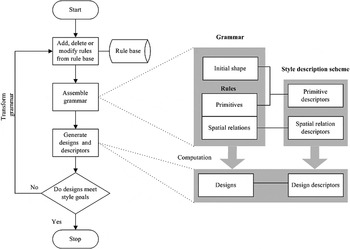
The grammar transformation framework is illustrated in Figure 1. Primitives and spatial relations in rules were augmented with adjectival descriptors that described their aesthetic qualities. Rules with adjectival descriptors were compiled in a rule base. A grammar was assembled by adding initial shapes and rules from the rule base. Designs were generated from the grammar, and their design descriptor ranks were computed. Generated designs were compared to style goals. If designs did not meet style goals, the grammar could be transformed by rule addition, deletion, or modification based on Knight's grammar transformation model. The grammar transformation presented here is “goal driven” because the operations of grammar transformations were carried out on the basis of a rationale, which in this case, was the grammar's style description.
Framework for strategic style change using grammar transformations.

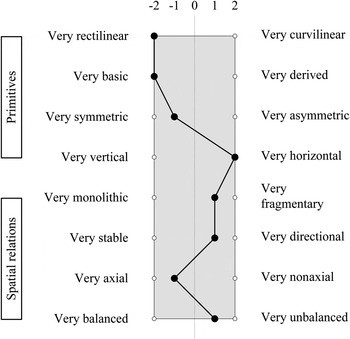
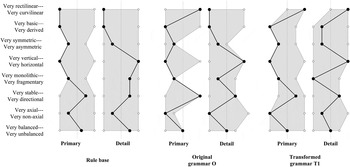
Using the primitive and spatial relation descriptors, we devised two measures to represent the aesthetic qualities of grammar elements: style range and style mode (Fig. 2). Style range describes the range of adjectival descriptor ranks that exist in a grammar. The style range is illustrated in a semantic differential graph that maps the maximum and minimum values (range) of adjectival descriptor ranks that exist in the grammar. This measure was devised to compare the descriptor ranks of different grammars. Style mode shows the most frequently occurring adjectival descriptor ranks in the grammar rules. This measure was devised to compare the adjectival descriptor ranks of grammars and the designs generated by it.
Style range and style mode of a grammar. The shaded region shows the style range. Style mode is shown using dark markers connected with a firm line.

Using design descriptor ranks, we present techniques for the formal definition of style in the design language of a grammar. Our definition is based on the premise that style can be studied at a number of levels and can be classified hierarchically into styles and substyles (Dondis, Reference Dondis1975). Two techniques for defining style in the design language of a grammar are presented here: based on design descriptor ranks and based on rules existing in the grammar.
First, we defined style in the design language of a grammar in terms of the commonalities in adjectival descriptors of a set of designs. This definition was based on the perspective that views style as the common features present in design artifacts (Schapiro, Reference Schapiro, Philipson and Gudel1961). Hence,
 $${S_u} = \{ {D_x}:x \supseteq {\rm \delta} \}\comma $$
where S u is a set of designs D, x is the set of design descriptors in a design, and δ is the set of descriptors common to those designs.
Second, we defined style in the design language of a grammar in terms of the rules used in design derivations. This definition was based on the perspective that views style as similar processes and procedures that result in common features in design artifacts (Simon, Reference Simon and Eastman1975). Hence, we theorized that designs with common features would have commonality in rule applications. Therefore,
 $${S_v} = \{ {D_d}:d \supseteq {\rm\rho} \}\comma $$
where S v is a set of designs D with set of rules d in derivations and ρ is a set of rules common to those designs.
2.3. Outline of the study
The framework for strategic style change was tested using the following steps:
-
1. Construction of rule base: The designs under study were decomposed into distinct design elements. Grammar rules were authored as explicit relations between primitives and spatial relations. Rules modified subdesigns in elementary steps by adding or substituting grammar primitives or markers. Such a format with discrete elements was considered to be conducive to rule transformation using Knight's (Reference Knight1981) method. Rules were arranged hierarchically in function-based rule sets.
-
2. Construction of style description scheme for rules: Adjectival descriptors for primitives and spatial relations were selected and quantified. Rules were augmented with adjectival descriptors.
-
3. Assembling an original grammar: An “original grammar” that generated existing Nokia designs was assembled from the rule base.
-
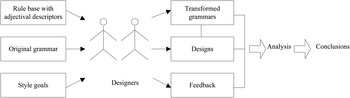
4. Grammar transformation experiment with designers: An experiment with designers was conducted to test the framework for strategic style change (Fig. 3). Designers were provided with the original grammar and the rule base with style description and were asked to transform the original grammars based on given style goals. While transforming grammars, designers could add, delete, or change rules in the rule base. Designers generated designs from the transformed grammars.
-
5. Analysis of transformed grammars and designs: We analyzed the transformed grammars and the generated designs to determine their adjectival descriptor ranks. Using techniques of style definition presented in the last section, we defined style in the designs generated by the transformed grammars. The adjectival ranks of original and transformed grammars were compared, and conclusions were drawn from the analysis.
3. EXAMPLE: MOBILE PHONE DESIGN
3.1. Rule base for mobile phones
The framework presented in the last section was tested with an example of a rule base for mobile phone designs. A set of Nokia phone designs, selected on the basis of stylistic and typological similarities, was used for the creation of rules. The “candy bar” phone with an alphanumeric keypad was considered apt for this study because it has a number of design elements on its face. Current smartphone designs, in contrast, are dominated by a large screen and do not have such an interplay of design elements.
Experiment with designers.

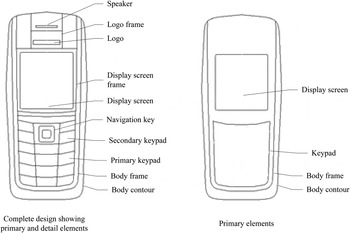
The design of the selected type of mobile phone was decomposed into primary elements and detail elements. The primary elements were the principal design elements that impacted the overall appearance of the design. These were the body contour, body frame, display screen, and keypad. The remaining elements were classified as “detail elements.” Consequently, rules that governed the placement and location of primary design elements were marked as “primary” (rule sets A, B, C, and G), whereas the remaining rule sets were classified as “detail” rule sets (Fig. 4).
Components of mobile phone design.

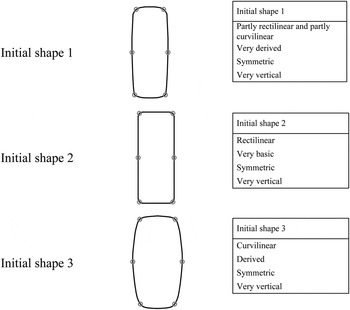
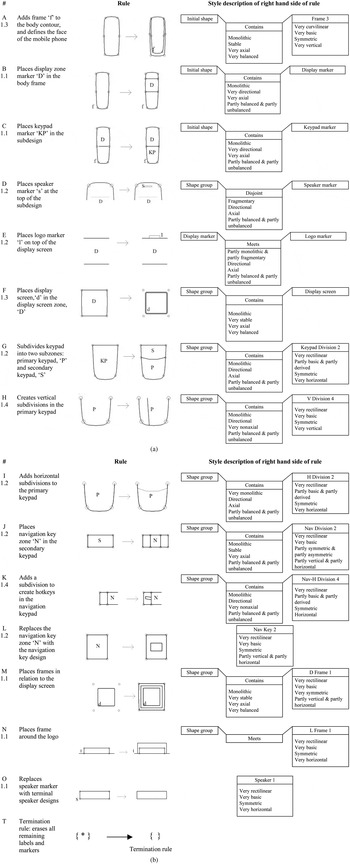
The rule base had 142 rules, organized into 15 function-based rule sets. Three initial shapes defining the body contour of the mobile phone were given in the rule base (Fig. 5). The large number of rules as well as the additional hypothetical rules ensured that there was diversity in the rule base. For instance, rules had descriptors that ranged from “very balanced” to “very unbalanced” and “very basic” to “very derived.” The rule base could therefore be used for assembling grammars that generate extant designs, as well as novel designs. Figure 6 shows examples from each rule set. The complete rule base is detailed in our study (Ahmad, Reference Ahmad2009).
Initial shapes with adjectival descriptors.

Examples of rules with description (a) rule sets A-H and (b) rule sets I-O. Adjectival description of the right-hand side of the rule is detailed.

3.2. Style description scheme
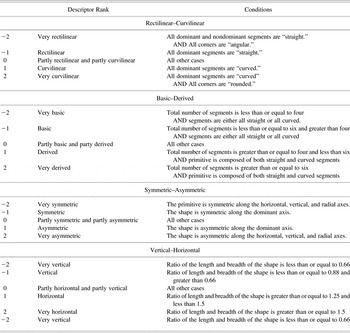
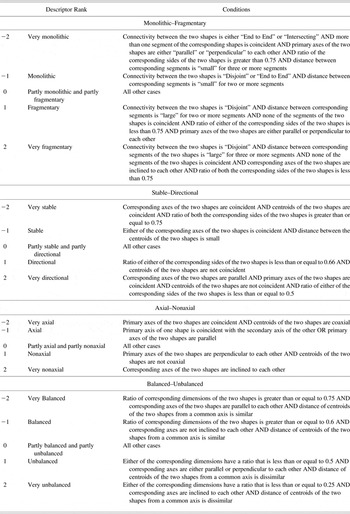
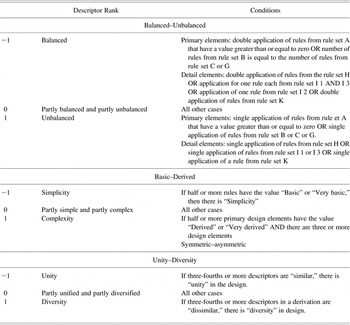
A small study was conducted to select the adjectives appropriate for the descriptions of primitives, spatial relations, and designs. A set of 30 adjectival pairs was identified from the literature (Dondis, Reference Dondis1975; Holgate, Reference Holgate1992; Ching, Reference Ching1996; Chen & Owen, Reference Chen and Owen1997; Ngo et al., Reference Ngo, Samsudin and Abdullah2000). Based on the authors’ perception and judgement, 10 more adjectival pairs were added. These 40 adjectival pairs were narrowed down in an informal study conducted with three domain experts, selected as a convenience sample. The study involved showing the experts samples of primitives, spatial relations, and designs, and asking them to select the most appropriate adjectives for description. Based on their input, a set of 12 descriptors was selected (Appendix A, Tables A.1, A.2, and A.3).
A 5-rank scale corresponding to numeric values ranging from –2 to 2 specified primitives and spatial relations. Logical conditions based on the geometric properties of the primitives and spatial relations were utilized to assign adjectival descriptor ranks (Appendix A, Tables A.1, A.2). For example, properties such as relationships between corresponding segments, axes, and centroids of constituent primitives were used to assign adjectival descriptor ranks to spatial relations. Bounding boxes of constituent primitives were used to determine proportions. For instance, if the primary axes of two primitives were coincident and the centroids of both primitives were coaxial, then the spatial relation was ranked as “very axial.” If the corresponding axes of the two primitives were inclined to each other, the spatial relation was ranked as “very nonaxial.” The middle rank, “partly axial and partly nonaxial,” was used for the description of spatial relations that were ambiguous and had both these opposing qualities present in them.
The computation of design descriptors was based on rules present in design derivations, and their primitive and spatial relation descriptor ranks (Appendix A, Table A.3). Because these descriptors describe designs that were computed from grammars, they were more complex to predict. Hence, only a 3-rank scale corresponding to numeric values ranging from –1 to 1 was used for specifying design descriptor pairs. An additional descriptor “dominance” was introduced to describe the most frequently occurring primitive or spatial relation in the design. Adjectival descriptors were computed for all primitives and spatial relations and were added to the rules in the rule base (Fig. 6a, b).
3.3. Original grammar
We assembled an original grammar “O” from the rule base. The grammar generated existing Nokia designs. It had 8 primary rules and 35 detail rules, making a total of 43 rules. Initial shape 1 was selected for the grammar.
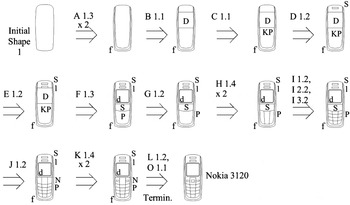
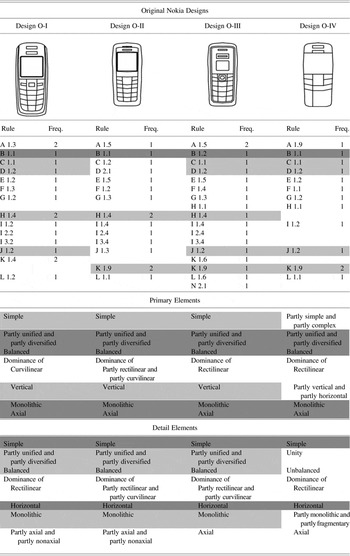
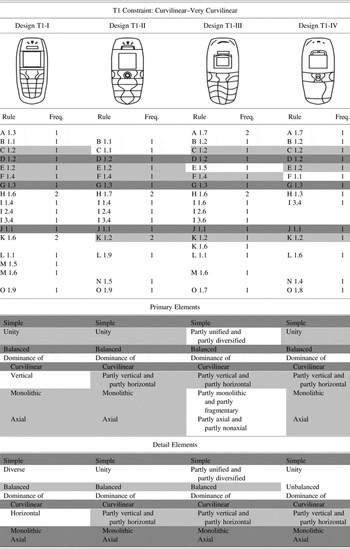
A typical design derivation involved the creation of the layout first with the application of primary rules from the rule sets A, B, and C. The design was then refined by adding details and substituting markers with terminal primitive elements (Fig. 7). Four designs were generated from grammar O, and their design descriptors were computed (Table 1) based on the ranking conditions given in Appendix A, Table A.3. Using the descriptor ranks that are common to designs, a number of styles could be defined in the design language of a grammar. Based on Eq. (1), we defined a style S 1 as
 $${S_1} = \{ {D_{x\comma\,y}}:x \supseteq {{\rm\delta _p}}\comma\, y \supseteq {{\rm\delta _d}}\}\comma $$
where S 1 is the set of designs D with description x, y; x is the set of design descriptors for primary elements, and y is the set of design descriptors for detail elements; δp is the set of design descriptors for primary elements that are common to a set of designs; and δd is the set of design descriptors for detail elements that are common to a set of designs.
Derivation from original grammar O.

Designs generated by the grammar O

Note: Descriptors that are common to all designs have dark shading, and descriptors that are common to three designs have light shading.
Based on the analysis in Table 1, we instantiate common adjectival descriptors as
-
δp = {simple, partly unified and partly diversified, balanced, dominance of vertical primitives, dominance of monolithic relationships, dominance of axial relationships}
-
δd = {simple, partly unified and partly diversified, balanced, dominance of horizontal primitives, dominance of monolithic relationships}
Designs O-I, O-II, and O-III fit into this style description.
A related style S 2 could be defined by instantiating
-
δp = {partly unified and partly diversified, balanced, dominance of monolithic relationships, dominance of axial relationships}
-
δd = {simple, dominance of horizontal primitives}
Hence,
 $${S_2} = {\{} O\hbox{-} I\comma\,O\hbox{-} II\comma \,O\hbox{-} III\comma\,O\hbox{-} IV{\}\comma} $$
where S 1 is a substyle of S 2.
Based on Equation (2), we used the commonalities in rule applications in designs (Table 1), to define a style S 3 as
 $${S_3} = { \{} {D_d}:d \supseteq {\rm\rho} {\}}\comma $$
by instantiating
 $${\rm \rho} = (B\,1.1,\,C\,1.1,\,D\, 1.2).$$
Designs O-I, O-III, and O-IV belong to this set, and S 3 is also a substyle of S 2.
3.4. Experiment with designers
The original grammar assembled was tested for strategic style change in an experiment involving two designers at the University of Strathclyde. Due to the small number of designers who were familiar with grammars, this experiment was carried out with two designers only. Designer A had worked as an architectural assistant for 1 year whereas Designer B had worked as an architect for 3 years. Both designers were familiar with techniques of grammars and grammar transformations, and had used them previously at the university.
The design task was a paper-and-pencil exercise framed in two 1-h sessions. Prior to the first session, the designers were provided with the original grammar, designs that were generated from it, and the rule base, along with its style description scheme, in order to familiarize them with the exercise. In the first session, designers were asked to transform the primitives in the original grammar based on given style goals. Designers could add, delete, or modify the rules in the original grammar with rules from the rule base. In the second session, designers were asked to transform the spatial relations in the original grammar based on given style goals. Designers were asked to generate designs from the transformed grammars. The grammars authored by Designer A were termed T2 and T3, whereas the grammars authored by Designer B were termed T1 and T4. The generation of correct mobile phone designs required the application of rules from each rule set. In addition to correct designs, the designers were asked to generate an incomplete design as well. This was to test whether inconsistency in the application of rules in design derivations produced variation in adjectival descriptor ranks of designs. Finally, the designers were provided with feedback forms to elicit their views on transforming grammars with the help of the style description scheme.
The experiment was designed to accommodate the complexity of the design problem. First, we developed a rule base with wide-ranging adjectival descriptor ranks, so that the designers had choice in rule selection. Second, goals involved the manipulation of only one adjectival descriptor at a time that facilitated the evaluation of grammars and designs. Different goals were given out to each designer in order to generate diversity in grammars and designs.
We used a feedback form to gauge the views of the designers regarding the grammar transformations using the style description scheme. The feedback form was designed using the questionnaire design methods described by Oppenheim (Reference Oppenheim1992). Open-ended questions were prepared, so that designers could freely express themselves. Both designers filled out and returned the feedback forms.
3.5. Analysis: Transformed grammars and designs
Transformed grammar T1 is elaborated here. The goal given to the designer was to constrain the descriptors to the range “partly rectilinear and partly curvilinear” (0) to “very curvilinear” (+2). The designer could search the rule base and based on their judgment decide which rules to include in the grammar. The designer selected a total of 52 rules that included 11 primary rules and 41 detail rules. Initial shape 3 was selected in the grammar.
Design descriptor ranks were computed for the designs generated from the grammar (Table 2) based on the ranking conditions given in Table A.3 in Appendix A. Based on Eq. (1), we defined a style S 4 as
 $${S_4} = \{ D_{x,y}:x \supseteq {\rm \delta}_{p},\,y \supseteq {\rm\delta}_{d}\}.$$
Here,
-
δp = {simple, balanced, dominance of curvilinear primitives}
-
δd = {simple, balanced, dominance of curvilinear primitives, dominance of monolithic relationships, dominance of axial relationships}
-
S 4 = {T1-I, T1-II, T1-III}
Based on Eq. (2), we defined a style S 5 using the following commonalities in rule applications (Table 2):
-
ρ = (C 1.2, D 1.2, G 1.3, J 1.1)
-
S 5 = {T1-I, T1-III, T1-IV}
A commonality in the designs generated by transformed grammar T1 is the dominance of the constrained adjectival descriptor rank “curvilinear” in primary elements as well as details.
Designs generated by transformed grammar T1

Note: Descriptors that are common to all designs have dark shading, and descriptors that are common to three designs have light shading.
We compared the adjectival descriptor ranks present in the rule base, the original grammar O, and the transformed grammar T1 using the measures of style range and style mode (Fig. 8). With the exception of two descriptors in primary rules, the rule base had rules with descriptor ranks that covered the complete range. While the original grammar O also had a complete range of the descriptor “very rectilinear”—“very curvilinear” for both primary and detail rules, grammar T1 was constrained to the range between the median and “very curvilinear.” This also impacted the modal values of T1 for the aforementioned descriptor.
Style ranges and style modes of the rule base, original grammar O and transformed grammar T1.

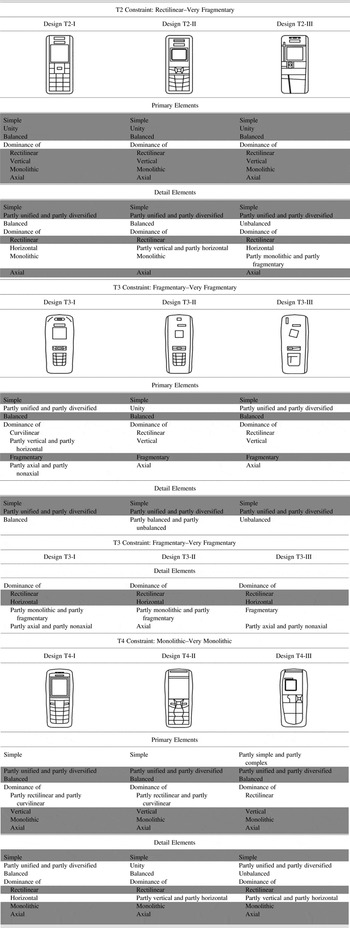
Transformed grammars T2, T3, and T4 involved constraining descriptors from the median position to “very rectilinear,” “very fragmentary, and “very monolithic,” respectively. Designs generated from these grammars were analyzed (Table 3). Designs generated by grammar T2 had a large number of commonalities in descriptor ranks. Hence, definitions of style from grammar T2 were closely related to one another. Using our techniques of style definition, it is also possible to categorize a style with designs from different grammars. For instance, T4-I, T4-II, O-II, and O-III can be categorized as a style.
Examples of designs generated by grammars T2, T3, and T4 with adjectival descriptors

Note: Descriptors that are common to all designs have dark shading.
4. Findings
4.1. Framework for strategic style change
We assessed the use of our framework for strategic style change with the feedback given by the designers on the feedback form. Descriptors aided designers in searching through the large number of rules and selecting appropriate ones. Designer B found the adjectival descriptors useful in assembling the grammar. Designer A, in contrast, found the descriptors easy to use but commented on the task being simple and tedious at times. However, both designers agreed that the generated designs conformed to the style goals. As Designer A commented,
Yes, I believe that my designs conformed to the style characteristics [sic]. The adjectival descriptors acted as a guide for me to ensure that I ended up with a design in the desired style. (Designer A)
Designer A had an ambiguous response regarding the ease of use of the overall framework. A concern voiced by the designer was the issue of subjectivity in defining the descriptors and specifying their limits.
The individual descriptors worked very well and are a “concrete” method of distinguishing styles. However, other people's definition of such descriptors may vary… . I found it difficult to distinguish between “fragmentary” and “very fragmentary” for example. (Designer A)
An unexpected advantage of the framework was pointed out by Designer B, who felt that the rule base and its descriptors helped in the design of a product domain with which the designer was previously unfamiliar.
The adjectival descriptors were very helpful as it was my first attempt to design a mobile phone … even with little knowledge about mobile phone design one can use this method to produce new designs. (Designer B)
4.2. Techniques of definition of style
Our examples illustrated the proposition that the design language of a grammar may host a number of styles or substyles. We found the first technique of defining style, which relied on commonalities in adjectival descriptor ranks of designs, to be more pertinent than the second technique, which relied on the commonalities in rule application in design derivations. This may be attributed to the fact that different rules that added similar subshapes in rule applications yielded the same adjectival descriptor ranks. Hence, there were more commonalities in adjectival descriptor ranks of designs than in their rule applications (Tables 2 and 3). Both techniques allowed incomplete designs, as well as designs from different grammars, to be included in style definitions. Inconsistency in the application of rules in derivations of incomplete designs did not result in a significant variation in adjectival descriptor ranks.
4.3. Relationship between grammar and style(s) of designs
We studied the relationship between the style range of a grammar and the style(s) of designs generated by a grammar. The style range showed how varied the rules were in a grammar. From the examples, we deduced that if a grammar had a large range, then a number of diverse styles could be defined in its design language. For instance, assuming the rule base to be one large grammar, diverse styles such as S 1 and S 5 could be defined in its design language. Grammars with narrow ranges hosted fewer styles that were similar to one another. Representation of the style range of the transformed grammars also made evident the change in adjectival descriptor ranks in these grammars from the original grammar.
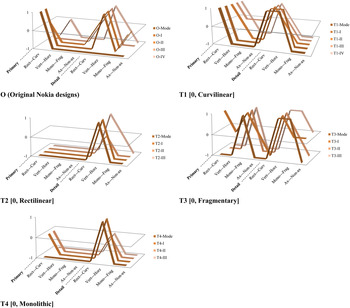
We also investigated the relationship between the normalized modal descriptor ranks of grammars and the dominant descriptor ranks of designs generated by them (Fig. 9). Although the adjectival descriptor ranks of designs mostly conformed to modal ranks of grammars, it was not so in all cases. Hence, we deduced that modal descriptor ranks of a grammar could only be moderately indicative of the adjectival descriptor ranks of designs generated by it. This is in keeping with Knight's (Reference Knight1999) observation that the greater the complexity of a grammar, the more difficult it is to predict with precision the nature of designs generated by it. Our analysis revealed that the descriptors constrained in the grammar were present in all designs as dominant descriptor ranks. This is attributed to the repetition of the constrained style descriptor in design derivations, resulting in the dominance of those adjectival descriptors in designs. Thus, we deduced that constraining rules in grammars was a valid technique for ensuring dominance of adjectival descriptors in designs and thus aiding in strategic style change.
Comparison of dominant descriptor ranks of designs with normalized modal descriptor ranks of grammars.

5. DISCUSSION AND CONCLUSION
This paper presented our framework for strategic style change using goal-driven grammar transformations with an example of mobile phone design. The framework may be seen as furthering the intent of Knight (Reference Knight1994) in the use of grammar transformations for driving style change. While previous studies of grammar transformations rely on intuition for selecting rules that need to be modified to drive style change (Knight, Reference Knight1994; Colakoglu, Reference Colakoglu2005), our framework presented designers with additional aesthetic description in grammar rules that aided in grammar transformation. The framework gave designers a degree of control over the outcome of the transformation process. Although it is impossible to exactly predict the style(s) of designs that a transformed grammar would host, designers could reinforce adjectival descriptor ranks by constraining them in grammars and rule repetition in design derivations. Such control over the grammar transformation process makes our framework amenable for strategic style change.
A style description scheme, based on the semantic differential technique, was constructed for representing the aesthetic qualities of primitives and spatial relations in grammar rules. A design grammar with a style description scheme offers a more comprehensive definition of style because it accounts for both form (encoded in the pictorial grammar rules) and content (encoded in the verbal style description scheme), as envisaged by Ackerman (Reference Ackerman, Ackerman and Carpenter1963) and Knight (Reference Knight1994). Although previous studies have developed description schemes for quantifiable attributes such as manufacturing cost (Agarwal et al., Reference Agarwal, Cagan and Constantine1999), the distinction of this study is that it adds abstract, nonquantifiable attributes to grammar elements.
We presented two techniques for the formal definition of style in the design language of a grammar. A significant advantage of our techniques is that it is flexible and allows the formal definition of multiple styles in the design language of a grammar. This is in keeping with the view that style is only a perspective of language, as argued by Emdanat and Vakalo (Reference Emdanat and Vakalo1997) and Li (Reference Li2011). We also developed measures to represent the aesthetic qualities of grammar elements. These measures allowed the comparison of adjectival descriptors of grammars with designs and aided in comparing change in transformed grammars.
A contention against the framework may be that it is too mechanical in nature, as voiced by Designer A. This issue can be addressed by building a larger rule base with more alternatives so that designers have greater choice in rule selection. Design artifacts can be decomposed in a number of ways, and hence, the rules presented in the study are a hypothetical construct. Transformations are limited by rules that have the same form–function decomposition. We acknowledge that a more developed method would reduce the form–function coupling, and allow manipulation at multiple levels.
The description of aesthetic information has an inherent limitation that aesthetic concepts are ambiguous and open to interpretation. Our study employed hypothetical logical conditions based on geometric properties for assigning adjectival descriptors. Being a bottom-up approach, it had the limitation that it did not always provide accurate descriptions of emergent aesthetic qualities. Adjectival descriptors described aesthetic qualities at a basic level of meaning. Using simple semantics, it risked stating the obvious in some cases. We concede that other valid techniques for description of aesthetic qualities, such as user surveys, could also be used within the overall framework presented here.
Rules in the mobile phone rule base may be considered as a special case of rule parameterization, which was limited to the left-hand side of the rule. The added subshape on the right-hand side was not parameterized, because that would have affected its adjectival descriptors, which were computed from geometric properties of primitives and spatial relations. Complete parameterization would have led to complexities in the computation of adjectival descriptors, and in testing the style description scheme with designers.
Future work includes the development of a technique that allows complex semantics (Ding & Gero, Reference Ding and Gero2001), which have higher levels of meaning, to be mapped to grammar elements. Using the grammar transformation framework, it is possible to transform the designs of the candy bar mobile phone to different types of handheld devices such as remote controllers and smartphones by rule set substitution. We tested our framework using a manual method. However, being a formal framework, its real promise lies in its implementation and automation. Formal definition of style as presented here makes possible automatic creation and transformation of styles. The development of a simultaneous description scheme that gives continuous feedback to the designer, thus assisting a designer in choosing rules for obtaining a particular style description, based on the example of the coffee maker grammar (Agarwal et al., Reference Agarwal, Cagan and Constantine1999), would also be an interesting avenue for further investigation. As with previous works that develop description schemes (Duarte, Reference Duarte2005), this study has also used set grammars that employ atomic primitive elements and limit emergent shapes. This circumvents the need to evolve new sets of descriptions each time a rule is applied in a design computation. We surmise that an ideal system would allow the development of emergent shapes, and would incorporate a method that supports their style description.
This research addresses an issue that is of great significance in computer-aided design: that of a formal framework that facilitates frequent, systematic style change. It offers designers formal techniques for style description and style change, which could prove to be very useful for a number of design domains that require frequent changes in style.
Sumbul Khan is a postdoctoral fellow at Singapore University of Technology and Design. She has a PhD in architecture from the University of Strathclyde, specializing in design computation. She also has a BArch degree from GGS Indraprastha University and an MS in architectural computing studies from the University of Strathclyde. Dr. Khan has worked on numerous design projects as a practicing architect and has taught at the Balwant Sheth School of Architecture, India.
Scott C. Chase is a Teaching Fellow in the Faculty of Engineering Flexible Learning Centre at the University of Strathclyde. Dr. Chase has degrees in architecture from MIT and the University of California at Los Angeles. Previous academic appointments have been in the departments of architecture, design, and manufacturing at the University of Strathclyde, Aalborg University, and the University of Sydney. His industry employment has included Bechtel, IBM, and NIST's Manufacturing Engineering Laboratory. His research interests lie in design computation, including formal generative design systems, building information modeling, virtual worlds, and elearning. He is a member of Sigma Xi and a Fellow of the Higher Education Academy.
APPENDIX A
Ranking conditions for primitive descriptors

Ranking conditions for spatial relation descriptors

Ranking conditions for design descriptors