




No CrossRef data available.
Article contents
Positive emotionality at age 3 predicts cognitive styles in 7-year-old children
Published online by Cambridge University Press: 28 March 2006
Abstract
This study examined associations between temperament at age 3 and depressotypic cognitive styles at age 7 in a community sample of children. Sixty-four preschool aged children were assessed for positive emotionality (PE) and negative emotionality (NE) using a standardized battery of laboratory tasks and naturalistic home observations. At follow-up 4 years later, the children completed laboratory tasks designed to tap helplessness in social and problem-solving situations, positive and negative information-processing biases, and self-reports of attributional style. Lower PE at age 3 predicted greater helplessness in the interpersonal task and decreased positive schematic processing. There was little evidence for a relationship between NE and depressotypic cognitive styles. Our findings are consistent with the hypothesis that some portion of cognitive vulnerability to depression may stem from early-emerging differences in the expression of positive emotions.
This work is based upon a dissertation submitted to the Graduate School of SUNY at Stony Brook by the first author. Portions of this work were supported by NIMH Research Grants RO1 MH45757 and RO1 MH069942. The authors acknowledge the consultation and support of Hill Goldsmith and Everett Waters, and the assistance of Cindy Huang, Grace Lee, Magda Kulesza, Suzanne Rose, and Jayanta Hegde for their help in data collection. Thanks also to the families who participated in this study.
Information
- Type
- REGULAR ARTICLE
- Information
- Copyright
- 2006 Cambridge University Press
Theorists have long posited a relationship between temperament traits and risk for mood disorders. For example, classic descriptive psychopathologists proposed that the predisposition for affective disorders may be rooted in temperamental differences in mood (e.g., Kraepelin, 1921). This notion of affective personality types is remarkably compatible with contemporary models of temperament, which use the term to refer to characteristic patterns of emotion expression and behavior that are relatively stable and partially rooted in biological systems. One trait central to virtually all models of personality and temperament (John & Srivastava, 1999) is positive emotionality (PE), which refers to the propensity to experience positive moods, to be interested in and engaged with the environment, and to seek out social interactions (Depue & Collins, 1999; Lucas, Diener, Grob, Suh, & Shao, 2000; Watson & Clark, 1997). It is at least moderately heritable (Jang, McCrae, Angleitner, Riemann, & Livesley, 1998; Lykken & Tellegen, 1996; Tellegen et al., 1988) and exhibits considerable stability across time (i.e., Lemery, Goldsmith, Klinnert, & Mrazek, 1999; Pedlow, Sanson, Prior, & Oberklaid, 1993; Watson, 2000).
Several authors have suggested that lower levels of trait PE (or related constructs) play a role in the development of depressive disorders (Clark, Watson, & Mineka, 1994; Davidson, 1998; Depue, 1995; Klein, 1987; Meehl, 1975). This hypothesis is consistent with several lines of evidence. Two longitudinal birth cohort studies have found that lower levels of PE-related behaviors in childhood predict the development of depressive disorders in adulthood (Caspi, Moffitt, Newman, & Silva, 1996; Van Os, Jones, Lewis, Wadsworth, & Murray, 1997), and several studies have reported that the infants and toddlers of depressed mothers exhibit diminished positive affect and engagement with the environment (Field, 1992; Neff & Klein, 1992). Studies of adult and child samples show that lower levels of PE are both concurrently and prospectively associated with depression, and that although negative emotionality (NE), may predispose to an array of psychopathologies, including depression, PE shows a relatively specific association with mood disorders (Clark et al., 1994). We previously found that lower scores on a laboratory measure of PE in children were associated with EEG asymmetries reported to characterize depressed adolescents and adults (Shankman et al., 2005), and with a history of depressive disorders in mothers (Durbin, Klein, Hayden, Buckley, & Moerk, 2005). However, we did not find evidence linking child NE to these indices of depression risk.
Precisely how PE might contribute to risk for depression is unclear, but one possibility is through its influence on cognitive processes. Positive affect appears to promote greater cognitive flexibility and creative problem solving (Ashby, Isen, & Turken, 1999) and to expand thought–behavior repertoires (Fredrickson, 2001). Little is known about whether lower levels of PE have a deleterious effect on cognition. However, several authors have proposed the intriguing hypothesis that deficits in the ability to experience positive emotions confer cognitive vulnerability to depression (Collins & Depue, 1992; Davidson et al., 2002).
Meehl (1975) posited that constitutionally low levels of hedonic capacity might be an important etiological factor in chronic forms of depression. Hamburg (1998) framed this hypothesis in developmental terms, describing how deficits in PE would impact mastery behavior and cognition in childhood. Following Meehl, Hamburg notes that because most skills are acquired through intermittent reinforcement schedules, some intrinsic motivation (in the form of PE) is necessary to motivate, initiate, and maintain behavior. This may be particularly important in childhood, when exploration and skill acquisition are critical for successful development. Children with higher levels of PE have what could be described as an adequate internal reinforcement system; even in the absence of overt rewards, these children derive intrinsic satisfaction and positive affect from environmental engagement and skill mastery. In contrast, children with lower levels of PE have a weak internal reinforcement capability. Over time and across multiple domains, repeated experiences that fail to result in subjective feelings of satisfaction and pleasure lead these children to develop negative outcome expectancies and low perceived control over future events: seemingly no matter what actions they take, they derive little enjoyment from daily life. Thus, these children eventually develop cognitive styles characterized by themes of helplessness and hopelessness, or as Collins and Depue (1992) speculated: “Subjectively, the cumulative effect of reduced behavioral facilitation … could be a sense of low self-efficacy in obtaining rewarding goals (a form of learned helplessness or passive avoidance?)” (p. 81).
The two most influential models of cognitive styles in depression are those of Beck (1976) and the various iterations of the learned helplessness theory (Abramson, Metalsky, & Alloy, 1989; Abramson, Seligman, & Teasdale, 1978; Seligman, 1975). These models emphasize the role of characteristic biases in information processing, beliefs about one's ability to influence outcomes, and attributions for why events occur in conferring cognitive vulnerability to depression. Substantial evidence indicates that the cognitive theories of depression accurately characterize thinking during depressive episodes (Haaga, Dyck, & Ernst, 1991), and studies also suggest that cognitive factors generate vulnerability for the onset and recurrence of depression (Alloy et al., 1999; Ingram, Miranda, & Segal, 1998). However, the origins of depressotypic cognitive styles appear complex and have proven difficult to elucidate. Early adversity, including childhood maltreatment and inadequate parenting, and modeling of parental depressotypic cognitions (Alloy et al., 2001; Ingram, 2003) have received the most attention as putative causal factors in the development of depressotypic cognitive styles. Recently, Gibb (2002) concluded that there is a small association between childhood maltreatment and depressotypic cognitions, but that it is limited to certain types of adverse experiences, and varies as a function of the sample studied. Similarly, there is some evidence that modeling of parental, especially maternal, cognitive styles may be associated with children's depressotypic cognitions (Garber & Flynn, 2001), but studies examining this issue have produced mixed results (Alloy et al., 2001; Kaslow, Rehm, Pollack, & Siegel, 1988; Oliver & Berger, 1992; Stark, Schmidt, & Joiner, 1996), and those finding a relationship between maternal and child cognitive style have observed only modest effects. As early adversity and parental modeling do not seem to fully account for the development of depressotypic cognitive styles, it is important to consider the role of other variables. Temperament, particularly PE, may be an additional factor that contributes to the development of depressotypic cognitive styles.
The present study aims to test whether there is a prospective association between PE and depressotypic cognitive styles in early childhood. We use the term “depressotypic” descriptively, to refer to variables that have been associated with depression in the literature, without implying that these variables necessarily play a causal role in the pathogenesis of depressive disorders. We previously assessed temperament in a sample of 3-year-old children using laboratory methods and home observation measures (Durbin et al., 2005). As the developmental literature suggests that cognitions and attributions about environmental events and the self can be validly assessed by early elementary school (e.g., Burhans & Dweck, 1995), we followed the sample up at age 7 using laboratory and questionnaire measures of depressotypic cognitions. Because the prevalence of depressive disorders is still extremely low at this age (Garber & Horowitz, 2002), we did not expect to find a relationship between temperament and depressive symptoms. However, we did expect that lower scores on PE would predict higher levels of helplessness and information processing styles related to depression risk. We were particularly interested in PE because our group has previously found this temperament trait to be associated with various indices of depression risk (Durbin et al., 2005; Shankman et al., 2005). However, because NE has also been linked to internalizing problems (Clark et al., 1994), we also examined whether child NE at age 3 was associated with depressotypic cognitions at age 7. We selected tasks to tap helplessness in instrumental problem-solving and interpersonal contexts that have been developed for, and validated in, child samples (Nolen-Hoeksema, Wolfson, Mumme, & Guskin, 1995; Erdley, Cain, Loomis, Dumas-Hines, & Dweck, 1997). We also assessed negative and positive schematic processing following a negative mood induction and included a measure of depressive attributional style.
Method
Participants
One hundred six families with 3- to 4-year-old children were recruited for the baseline assessment. Eight participants were excluded; two children had significant medical disabilities, and six families did not complete all the assessments. The final baseline sample consisted of 98 children (50 males). Participants were recruited by contacting families living within local zip codes via a commercial mailing list (51%), and through advertisements placed in local newspapers and fliers posted in local preschools (49%). Of the families contacted via mailing list who were eligible, 85% agreed to participate (Durbin et al., 2005).
The children were an average age of 3.6 years (SD = 0.3), mostly White (85%), and of average cognitive ability (M = 104.1, SD = 13.4), as indexed by the Peabody Picture Vocabulary Test (PPVT; Dunn & Dunn, 1997). The mean Hollingshead score of the sample was 35.8 (SD = 9.4), indicating that the families were predominantly working and middle class (Hollingshead, 1975). Both parents were present in most families (97%). The average age of the mothers was 33.8 years (SD = 4.1), and most worked outside the home at least part-time (58%); 12% worked more than 35 hr/week.
One of the 98 children was used to pilot the follow-up tasks. Follow-up assessments were obtained for 64 of the remaining 97 children (66.7%; 32 males). Of the 33 families not available for follow-up, three (3.1%) had moved, 22 (22.7%) declined to participate, and we were unable to reach eight (8.2%) families. Families who declined to participate typically stated that they were too busy. At follow-up, children were an average of 7.0 years old (SD = 0.5). Families who were and were not followed up did not differ on socioeconomic status (SES), t (96) = −1.44, p = .16, and children who were and were not followed up did not differ on PE, t (99) = −0.87, p = .39, or NE, t (99) = −0.06, p = .95. However, PPVT scores were significantly higher for children who were followed up (M = 106.4, SD = 14.3) compared to those who were not (M = 98.8, SD = 12.0), t (89) = −2.49, p = .01.
Baseline assessment: Laboratory tasks
Our laboratory measure consisted of portions of the Laboratory Temperament Assessment Battery (Lab-TAB; Goldsmith, Reilly, Lemery, Longley, & Prescott, 1995). Our use of the Lab-TAB has been described in greater detail elsewhere (Durbin et al., 2005; Hayden, Klein, & Durbin, 2005; Shankman et al., 2005). Child emotionality elicited by the Lab-TAB has been linked to relevant constructs such as emotional tone during mother–child interactions (Kochanska, Coy, Tjebkes, & Husarek, 1998) and emotional regulation (Buss & Goldsmith, 1998). In the present sample, we found that child emotionality displayed during the Lab-TAB was usually correlated with similar constructs observed during home observations (Buckley, Klein, Durbin, Hayden, & Moerk, 2002), and was meaningfully related to teacher reports of child behavior (Hayden et al., 2005). Including a warm-up period, the entire assessment lasted between 1.5 and 2 hr, during which children participated in a standardized set of 12 laboratory episodes videotaped for coding. Episodes are described below in the order in which they were administered along with the traits they were designed to elicit.
Risk Room (behavioral inhibition, activity level)
In this episode, used in studies of behavioral inhibition (Kagan, 1997), the child was allowed to play freely by him/herself with a set of novel and ambiguous stimuli (a cloth tunnel, short staircase, mattress, Halloween mask, balance beam, and a large, black cardboard box) in the main laboratory area. After 5 min, the experimenter returned and asked the child to approach each object.
Tower of Patience (inhibitory control, interest)
The child and experimenter took turns building a tower of cardboard blocks. The experimenter adhered to a schedule of delays of increasing length before placing her block on the tower (5, 10, 15, 20, and 30 s), forcing the child to wait longer each time to take his or her turn.
Arc of Toys (PE, interest, NE)
The child was allowed to play freely by him/herself in a roomful of toys. After 4 min, the experimenter returned to ask the child to clean up the play area by putting the toys in a box.
Stranger Approach (behavioral inhibition)
At the beginning of the episode, the child was left alone in the main experimental area. After a few moments, a friendly male research assistant entered the room and spoke to the child while gradually walking closer.
Make That Car Go (PE, interest)
The experimenter and child raced with two remote-controlled racecars.
Transparent Box (persistence, interest, NE)
The experimenter locked an appealing toy in a transparent box, and left the child with a set of inoperable keys to use to open the box. After 3.5 min, the experimenter returned, explaining that she had accidentally given the child the wrong keys. The child was then allowed to unlock the box and play with the toy.
Pop-Up Snakes (PE)
The experimenter showed the child what appeared to be can of potato chips, actually containing coiled spring snakes. The child was then encouraged to surprise his or her mother with the snakes.
Snack Delay (inhibitory control)
The child was instructed to wait for the experimenter to ring a bell before eating a piece of candy. The experimenter waited a systematic series of delays before ringing the bell (10, 20, and 30 s).
Impossibly Perfect Green Circles (NE, persistence)
The child was asked by the experimenter to draw a circle on a piece of paper. The experimenter responded by mildly criticizing the child's work and asking the child to draw another circle. This process was repeated for 2 min.
Popping Bubbles (PE, interest)
The child and experimenter played together with a bubble-shooting toy.
Painting a Picture (PE)
The child was allowed to play freely with watercolor pencils and crayons.
Box Empty (NE)
The child was given an elaborately wrapped empty box to open, under the pretense that an appealing toy was inside. After a brief interval in which the child was left alone to discover that the box was empty, the experimenter returned with several small toys for the child to keep, explaining that she had forgotten to place the toys inside.
Two graduate students trained in the use of the Lab-TAB by Goldsmith and colleagues were responsible for most of the tape coding and training of other graduate and undergraduate raters. The coding system used in the present study has been described in greater detail elsewhere (Durbin et al., 2005; Hayden et al., 2005; Shankman et al., 2005). Briefly, after viewing each individual episode in its entirety, raters assigned a single score for temperament dimensions based upon all relevant behaviors exhibited within that episode. For the present study, we used laboratory ratings of positive affect, negative affect, sociability, and, as an index of engagement with the environment, interest. These ratings were made on 4- or 5-point scales, depending upon the typical frequency of the temperament trait in question for a given episode (e.g., positive emotions could be more finely coded during episodes designed to tap positive affect). Ratings of facial positive affect for each episode were derived from judgments about the frequency, intensity, and duration of smiling and laughter during each episode. Ratings of physical and verbal positive affect were also made, based on behaviors such as excited jumping and verbalizations of positive content and/or tone. Ratings for NE (sadness, anger, and fear) were similarly derived using facial, physical (e.g., slumping posture, “freezing” during Stranger Approach), and verbal cues (e.g., verbal expressions of anger). Ratings of interest were made by considering factors such as time spent playing with laboratory stimuli and comments reflecting interest, such as questions about stimuli. Sociability ratings were based upon time spent interacting with the experimenter and efforts made to engage the experimenter in play. However, children did not have to meet specific behavioral criteria to receive a specific rating in our coding scheme. For example, multiple instances of mild facial affect exhibited by one participant and a single extreme display by another child, involving multiple facial regions, could potentially result in the same score for an episode. Coding anchors were written such that extreme scores would be given less frequently than scores in the middle of the distribution.
Along with the two lead coders, 10 other undergraduate and graduate coders contributed ratings for reliability analyses. Median interrater reliability, assessed by calculating intraclass correlations (ICCs) on 15 of the 96 cases, was .82 (ranging from .66 for fear to .94 for PE), and median internal consistency for these scales (coefficient alpha) was .71 (ranging from .56 for interest to .90 for PE).
Baseline assessment: Home observation
Home observation ratings were made using the Child Temperament and Behavior Q-Set (CTBQ-Set; Buckley et al., 2002), which consists of 90 items comprising five scales and 11 subscales. Each child was observed during two independent home visits (mean length of each visit = 2 hr, 32 min; SD = 22 min) by trained pairs of graduate and undergraduate students who had no access to laboratory data. A different pair of raters observed the children at the second home visit, without knowledge of the first home visit data. After each observation, the pairs of raters independently sorted the 90 CTBQ-Set items into nine categories ranging from 1 = extremely uncharacteristic of the child to 9 = extremely characteristic of the child, producing a fixed distribution of scores for the child. Two independent sets of ratings were available from each home observation, yielding a total of four sets of ratings of each child's behavior. Ratings were aggregated by averaging across all four ratings. For the present study, the low positive affectivity, low sociability, sadness, anger, and emotion regulation deficits scales were used. Median interrater reliability, based on all four raters, was .77 (ranging from .71 for emotion regulation deficits to .86 for low sociability), and median internal consistency for these scales (coefficient alpha) was .83 (ranging from .70 for emotion regulation deficits to .95 for low positive affectivity). The low positive affectivity and low sociability scales were reverse coded for the present study.
To create aggregate constructs capturing PE and NE expressed across methods and contexts, home observation scores from each of the four raters were z transformed and combined with z-transformed individual episode ratings of laboratory positive affect, negative affect, sociability, and interest. More specifically, the average was taken of the four standardized home observed ratings of low positive affectivity and low sociability and the laboratory episode ratings of facial, physical, and verbal positive affect, sociability, and interest. Similarly, the four home observed ratings of sadness, anger, and emotion regulation deficits were combined with laboratory ratings of facial, physical, and verbal fear, anger, and sadness. Internal consistencies for the composite home and laboratory PE and NE scales were .93 and .88, respectively.
Follow-up assessment: Laboratory tasks
At follow-up, children were administered a battery of laboratory tasks that were videotaped for coding. Tasks are described below in the order in which they were administered.
Helplessness
Like other investigations of helplessness in children (e.g., Burhans & Dweck, 1995; Meyer, Dyck, & Petrinack, 1989; Nolen-Hoeksema et al., 1995), puzzle tasks were used to assess helplessness in problem-solving situations. Following Nolen-Hoeksema and colleagues (1995), children were given a set of blocks and were asked to reproduce various designs on printed cards similar to those found in the Wechsler Intelligence Scale for Children—Revised (Wechsler, 1974) Block Design subtest. The first, third, and fifth puzzles were solvable with the blocks the children had while the second, fourth, and sixth puzzles were unsolvable. Children were given 4 min to work on the solvable puzzles to ensure that they had sufficient time to complete them, thus creating the expectation that all the puzzles were indeed solvable. Children were given only 2 min to work on the unsolvable puzzles to limit frustration and discouragement. After the last puzzle, children were allowed to select one of the puzzles for further play. After playing with the selected puzzle, the experimenter and child reviewed the child's performance, sorting the printed cards into piles based upon whether the child had solved them or not. In the rare instances when children could not solve a solvable puzzle even with extra time, the puzzle in question was counted as an additional unsolved puzzle. Children were then asked (a) Do you think you could finish these [indicating the unsolved cards] puzzles if you had more time? (b) Do you think you could finish these [indicating the unsolved cards] if you tried your hardest? (c) Did the job you did on the puzzles make you feel like a good kid or a bad kid? (Burhans & Dweck, 1995; Heyman, Dweck, & Cain, 1992; Smiley & Dweck, 1994).
To obtain an index of helplessness in the interpersonal domain, children were told that they were going to be interviewed for admission to a club “just for kids” (Erdley et al., 1997). An unfamiliar interviewer asked children a series of questions under the pretence that she needed to determine whether they would get along well with the other children in the club. The interviewer then told the child that she was going to send his/her information to the president of the club by computer, so that the president could immediately decide whether the child would be admitted. After a brief delay, the assistant returned, stating that the president was not sure about whether the child should get to be in the club and that she/he wanted to know more about the child before deciding. Children were then allowed to choose whether they wanted to reapply to the club by providing more information about themselves.
Following the request for more information, children were asked several questions to assess their attributions for the ambiguous rejection (Erdley et al., 1997). These questions were introduced by telling the child that other children had certain thoughts when they heard the president was not sure about letting them into the club. The experimenter told the child that these thoughts were (a) Do other kids not like me? (b) Am I not good at making friends? (c) Am I not a fun kid to be around? (d) Did I not try hard enough to get in to the club? Immediately after stating each “thought” to the child, the experimenter followed with the query “Did you think that?” Ther episode ended when the assistant returned with a certificate of membership, explaining that she had made a mistake and that the child was accepted into the club from the very beginning.
From tapes of the puzzle task, children were rated on behaviors presumed to reflect helplessness: intensity of work on solving puzzles, help-seeking behaviors, and persistence. Ratings were made on either a 3- or 4-point scale, with higher numbers indicating more of the trait in question. Ratings of intensity of work on solving puzzles were relatively objective ratings derived from continuity and rate of motor activity directed toward manipulating the puzzle blocks. Help-seeking ratings were based upon behaviors such as direct requests for feedback/help from the experimenter, statements such as “I can't do this one,” and sustained looking at the experimenter, with unambiguous requests for help receiving higher scores than more ambiguous help seeking. Persistence ratings were based upon time spent working, but also included more subjective behaviors such as vocalized statements reflecting persistence (e.g., “I'm going to keep trying”) and effortful looking at puzzles. Children's puzzle selections (upon being offered a final puzzle to play with) were coded, with choosing an unsolved puzzle being considered indicative of lower levels of helplessness. Children's affirmative responses to queries of whether they thought they could complete the unsolvable puzzles if they had more time and if they tried their hardest were treated similarly. Latencies to first attempt at obtaining help and ceasing to attempt to solve puzzles were also noted for each puzzle trial.
For the interpersonal helplessness episode, whether children elected to reapply after the ambiguous rejection was coded as a dichotomous variable. Pieces of information children provided about themselves both prior to and following the ambiguous rejection were counted, as were number of prompts made by the experimenter. Ratings of desire to join the club were made before and after the ambiguous rejection, as was an overall rating of desire to join the club. Difference scores using ratings derived from before and after the ambiguous rejection were created for the information counts and the desire to join ratings. As an index of the child's effort invested in getting in the club, an overall rating of the complexity of the child's self-description was also made, with concrete descriptors given by children (e.g., “I like riding my bike”) receiving lower scores than more complex descriptions (e.g., “My friends like me because I keep secrets if they ask me to”).
Using data coded from the problem-solving and interpersonal helplessness tasks, scales were constructed using item analysis. For the problem-solving task, ratings of persistence and help seeking, latency to help seeking, average work intensity ratings, and children's reports of which puzzle they would like to try again, and whether they thought they could finish the puzzles with more time and if they tried their hardest, were included in the scale (α = .67). For the interpersonal helplessness task, the difference scores for the desire to join variable, the overall rating of desire to join, child self-description complexity, child self-reports of whether he/she thought he/she had tried hard enough, was fun to be around, and was good at making friends, and whether the child chose to reapply were included in the scale (α = .68). This variable was square-root transformed due to modest positive skewness. Interrater reliability, indexed by ICCs, was assessed for a subset of 29 children from our sample. Respective ICCs for the problem-solving and social helplessness scales were .64 and .70.
Mood induction
A mood induction procedure (MIP) was administered prior to the Self-Referent Encoding Task (SRET) to activate latent cognitive vulnerability (Ingram et al., 1998). Such priming tasks have been successfully used in studies of depressotypic information processing in children (e.g., Kelvin, Goodyer, Teasdale, & Brechin, 1999; Taylor & Ingram, 1999). Children were shown a sad video clip from a children's film to induce negative affect, an approach that successfully induces sad mood in children (Brenner, 2000). Videotapes of the MIP were coded for affect by raters blind to the purpose of the task. For each 30-s epoch, ratings were made on an 11-point scale ranging from −5 (extremely negative facial affect) to 5 (extremely positive facial affect). The MIP proved moderately effective; children displayed significantly greater peak negative affect in the second half of the mood induction (M = −1.40, SD = 0.48) than in the first half (M = −.83, SD = 0.34), t (60) = 8.83, p < .001. Nonsignificant correlations between temperament ratings of PE and NE at age 3 and peak NA during the latter half of the mood induction suggest that temperament did not influence susceptibility to the mood induction (r = .05 and −.06, respectively; both p ≥ .66).
SRET
The SRET procedure was similar to that used by Hammen and Zupan (1984). Immediately after the MIP, children were presented with a series of 18 positive and 18 negative trait descriptions, shown to them printed on flashcards and spoken aloud by the experimenter, followed by a self-referent question (“is this word like you?”). The positive and negative adjectives were matched for frequency and selected for Grade 3 reading level (the lowest for which data were available) using the Carroll, Davies, and Richman (1971) text. An unexpected incidental recall period immediately followed in which children were asked to recall as many of these trait words as possible for a maximum period of 3 min. The first and last three words from the list were not counted to eliminate primacy and recency effects. Positive and negative adjectives rated as self-descriptive were counted, and two additional scores were computed: a positive schematic processing score (the proportion of positive words rated self-descriptive and recalled relative to all words rated self-descriptive), and a negative schematic processing score (derived in the same manner).
Follow-up assessment: Self-reports
As part of a subsequent home visit a mean 3.5 days later (SD = 10.3), children were orally administered the Depression Self-Rating Scale (DSRS; Birleson, 1981) and the Child Attributional Style Questionnaire—Revised (CASQ-R; Thompson, Kaslow, Weiss, & Nolen-Hoeksema, 1998). The DSRS is a self-report measure of the affective, cognitive, behavioral, and somatic symptoms of depression. It has adequate internal consistency and test–retest reliability, and discriminates between children with and without depressive disorders (Asarnow & Carlson, 1985; Kazdin & Petti, 1982). Coefficient alpha for the DSRS in our sample was .75. The mean DSRS score for the present study was low (M = 10.3, SD = 5.4), and comparable to other nonclinical samples. For example, Asarnow and Carlson (1985) reported a mean DSRS score of 11.3 (SD = 4.2) in a nondepressed group of children.
The CASQ-R is a self-report measure of children's attributions for 24 hypothetical positive and negative events. Internal, stable, and global attributions for negative events are combined to form a negative composite score, and a positive composite score is similarly derived. Higher scores on the positive composite reflect a less depressive attributional style, while higher negative composite scores reflect higher levels of depressive attributional style. In our sample, coefficient alphas for the negative and positive composite scales were .50 and .55, respectively. Although lower than desirable, these reliability estimates are consistent with those in the literature (e.g., Thompson et al., 1998). An overall composite can be derived from the difference between the positive and negative composites; however, we did not use it in the present study lest we overlook potentially meaningful linkages between PE and the individual composites. In addition, difference scores on the CASQ-R are difficult to interpret because the same score can reflect very different patterns of attributions for positive and negative events (Curry & Craighead, 1990).
Results
Zero-order correlations between variables
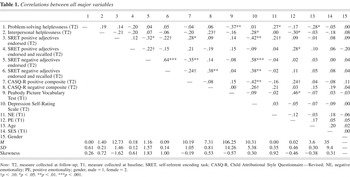
Correlations between all major variables can be seen in Table 1. For all analyses, our child temperament variables were treated as continuous dimensions as our previous research suggests that PE shows a linear relationship to indices of depression risk. Child gender, age, and family SES were unrelated to temperament, depressotypic cognitions, or child self-reports of depression with one exception: older children showed lower levels of helplessness during the problem-solving task. Child cognitive ability (PPVT scores) was significantly associated with PE and problem-solving helplessness, but not with the other cognitive style variables. PE and NE at age 3 were not significantly correlated with one another or with symptoms of child self-reported depression at age 7. Higher NE predicted greater levels of helplessness during the problem-solving task, but was otherwise generally unrelated to cognitive style variables. In contrast, lower PE predicted greater interpersonal helplessness, decreased positive schematic processing, and a more depressive attributional style for positive events at trend level (p = .08). Higher levels of child self-reported depression were associated with greater interpersonal helplessness and, from the SRET, fewer positive adjectives endorsed, more negative adjectives endorsed, and increased negative schematic processing. Higher self-reported depression was also correlated with more depressotypic attributions for positive events, and, at a trend level (p = .07), more depressotypic attributions for negative events on the CASQ-R.
Correlations between all major variables

Similar to Gotlib et al. (2004), who reported low coherence across measures of depressive cognitive styles, intercorrelations between measures of depressotypic cognitions were generally low and nonsignificant. From the SRET, number of positive adjectives endorsed was negatively correlated with number of negative adjectives endorsed. More positive adjectives endorsed and fewer negative adjectives endorsed on the encoding task predicted a less depressive attributional style for positive events. Higher negative schematic processing scores correlated with more depressive attributions for negative events on the CASQ-R negative composite.
Multiple regression analyses
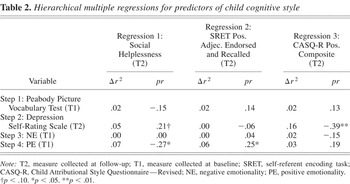
To determine whether lower PE at age 3 continued to predict laboratory interpersonal helplessness, positive schematic processing, and depressive attributional style for positive events at age 7 after controlling for child cognitive ability, age 7 self-reports of depressive symptoms, and age 3 NE, we conducted three hierarchical multiple regression analyses (see Table 2). The first set of regressions examined laboratory interpersonal helplessness. After controlling for child cognitive ability at age 3 and depressive symptoms at age 7 in steps 1 and 2, NE at age 3 entered at step 3 did not provide a significant increment. However, age 3 PE was significant when entered at step 4.
Hierarchical multiple regressions for predictors of child cognitive style

The second model examined positive schematic processing. After controlling for child cognitive ability and concurrent depressive symptoms, NE did not contribute a significant increment. However, PE made a significant contribution to the model when entered on the fourth step.
In the third model, we conducted hierarchical regressions to predict depressive attributional style for positive events on the CASQ-R. After controlling for child cognitive ability and self-reported depression, NE at step 3 did not provide a significant increment to the model. PE also failed to significantly contribute to the model.
When the NE variable was limited to laboratory and home observation measures of sadness, the results were the same. Finally, we used hierarchical multiple regression to examine whether PE and NE interacted in predicting depressotypic cognitive style. When the cross-product term for PE and NE was entered on the fifth step, the interaction was not significant in any of the models.
Discussion
The present study found linkages between PE at age 3 and several measures of depressotypic cognition at follow-up at age 7. To our knowledge, our findings provide the first empirical evidence consistent with the hypothesis that lower levels of PE may contribute to the development of depressotypic cognitive styles (Davidson et al., 2002; Collins & Depue, 1992; Hamburg, 1998). These findings were relatively specific to PE, as NE at age 3 did not predict most indices of depressotypic cognitions at age 7.
PE independently predicted helplessness in the interpersonal task at age 7, even after controlling for cognitive ability and NE at age 3 and depressive symptoms at follow-up. Although the interpersonal helplessness task showed significant associations with child temperament at age 3 and child self-reports of depression at age 7, the instrumental problem-solving helplessness task did not. This suggests that helplessness in interpersonal situations may be a stronger marker of risk for depression than helplessness in instrumental contexts. However, the problem-solving task may have been confounded with child cognitive ability, as it was significantly correlated with child age and PPVT scores at age 3. In future studies, it will be important to develop tasks that take individual differences in children's problem-solving abilities into account in assessing helplessness.
Lower levels of PE at age 3 also predicted decreased recall of positive self-descriptive adjectives, an index of positive schematic processing. In contrast, early temperament did not predict negative schematic processing. These findings are interesting in several respects. Although the literature has emphasized heightened reactivity to negative stimuli in dysphoria and depression, a growing body of research indicates that depression is also characterized by diminished processing of positive stimuli (Deldin, Keller, Gergen, & Miller, 2000; Rottenberg, Kasch, Gross, & Gotlib, 2002; Sloan, Strauss, & Wisner, 2001). Several studies using incidental recall tasks have reported that depressed children recall fewer positive self-descriptive words than controls, but do not differ on negative words (Cole & Jordan, 1995; Hammen & Zupan, 1984), and findings suggest that an association between negative cognitions and depressive symptoms is not consistently observed until late childhood or early adolescence (Cole & Jordan, 1995; Nolen-Hoeksema, Girgus, & Seligman, 1992). Hence, it is possible that a relationship between PE and information processing biases for negative stimuli will emerge as children grow older.
The associations between PE at age 3 and child self-reported attributional style on the CASQ-R at age 7 were weaker than the effects for the laboratory tasks. Univariate analyses revealed only marginally significant associations between PE and depressotypic attributions for positive events. In contrast, self-reported depressive symptoms at age 7 were significantly associated with depressotypic attributions for positive events, and exhibited a trend for an association with depressive attributions for negative events. The latter findings are consistent with other studies examining depressive symptoms and the CASQ-R composites (Joiner & Wagner, 1995), which typically find that depressive symptoms impact attributional style for both positive and negative events. The stronger effects for concurrent depressive symptoms than early childhood temperament may be due to their being administered at the same age and to shared method variance between the two self-report measures. However, it should also be acknowledged that the CASQ-R has lower internal consistency than is desirable (Thompson et al., 1998), and was developed for slightly older children (ages 8 and over). Hence, future studies should consider using newer measures such as the Children's Attributional Style Interview, which may be psychometrically stronger and better suited for younger children (Conley, Haines, Hilt, & Metalsky, 2001). Improved methods for tapping attributional styles may uncover linkages between attributions and temperament that the present study failed to detect.
We found little evidence for an association between NE at age 3 and depressotypic cognitions at age 7. This lack of association may reflect maturational processes in child development, such that NE may be unrelated to vulnerability in early childhood. NE may be more indicative of an underlying vulnerability when seen in older childhood, when most children have developed greater emotion regulation skills. Hence, a relationship between NE and depressotypic cognitions may not emerge until a later age.
It is unclear at what level cognitive style variables become “depressotypic” (i.e., of a magnitude comparable to cognitive styles during a depressive episode). To understand the relative impact of PE on schematic processing in the present sample, we compared children in the highest and lowest quartiles on PE on positive schematic processing from the SRET (data available upon request), finding effect sizes similar to those in studies comparing depressed to nondepressed children (Hammen & Zupan, 1984) and children of depressed mothers to children of nondepressed mothers (Jaenicke et al., 1987). Correlations between depressive symptoms and CASQ positive composite scores vary greatly (Joiner & Wagner, 1995), although most are of a moderate magnitude, as was the correlation we obtained between PE and the CASQ-R positive composite. Thus, the effects of PE on our measures of cognitive styles appear to approximate those of depression, although we cannot definitively say that the cognitive styles children possessed in the present study are equivalent to those seen in clinical depression.
As expected, the level of depressive symptoms at age 7 in the present study was low and well within the range of other community samples (Asarnow & Carlson, 1985). Due to restricted range, we did not anticipate, and did not find, significant associations between the age 3 temperament variables and age 7 depressive symptoms in our nonclinical sample. However, we would expect to find a significant association between PE at age 3 and the emergence of clinically significant depression when the children are further into the risk period for mood disorders. Only longitudinal follow-up into adolescence and young adulthood can clarify the extent to which lower levels of PE predict the onset of clinical depression.
This study had a number of strengths. We examined the relationship between temperamental emotionality and depressotypic cognitions in a community sample of children using a prospective, longitudinal design and multiple measures and methods of assessing temperament and cognition. However, the study also had some weaknesses. We were unable to follow-up about a third of the original sample, and although the dropouts did not differ from the children who were followed up on most variables, the children who were lost to follow-up had lower scores on the PPVT. Our small sample size limited power to detect interactions between PE and NE in predicting child cognitive styles. Consistent with the literature, our measures of attributional style had low internal consistency. In addition, most of the children came from two-parent homes; it is therefore unclear whether the pattern of findings we obtained would apply to nonintact families. Although we have demonstrated that temperamental emotionality at age 3 predicts several indices of depressotypic cognition at age 7, we cannot claim that this is a causal relationship. It is unclear whether it is possible, and if so how, to assess depressotypic cognitions in preschool aged children. However, we cannot rule out the possibility that the children with low scores on PE had already developed depressive cognitive styles at the time of the age 3 temperament assessment. We also note that we cannot disentangle whether lower levels of PE confer cognitive vulnerability from the possibility that higher PE is a protective factor.
Despite these limitations, our findings suggest that PE in early childhood predicts depressotypic cognitive styles in middle childhood. Lower scores on PE in young children predicted helplessness in the face of ambiguous and mild negative feedback in an interpersonal context, and decreased processing of positive self-relevant descriptors 3–4 years later. These findings suggest that children with lower levels of PE may develop a cognitive set that filters out positive self-relevant information and discourages perseverance in the face of challenging situations. Over time, these children may avoid engaging in activities with the perceived potential to result in failure. This passive avoidance may lead to decreased social interactions, limited opportunities for achievement, and fewer opportunities to develop skills necessary for successful future endeavors. The scenario sketched here is but one potential mechanism by which PE may confer risk for depressotypic cognitions, and ultimately for depression. There may be multiple pathways through which temperament influences vulnerability to depressive disorders. It will be necessary to follow these children into adolescence or young adulthood to determine whether lower levels of PE predict the development of depressive disorders, and if so, whether this association is mediated by depressotypic cognitive styles.
References
REFERENCES
Abramson, L. Y.,
Metalsky, G. I., &
Alloy, L. B.
(1989).
Hopelessness depression: A theory-based subtype of
depression.
Psychological Review,
96,
358–372.CrossRefGoogle Scholar
Abramson, L. Y.,
Seligman, M. E. P., &
Teasdale, J. D.
(1978).
Learned helplessness in humans: Critique and reformulation.
Journal of Abnormal Psychology,
87,
49–74.CrossRefGoogle Scholar
Alloy, L. B.,
Abramson, L. Y.,
Tashman, N. A.,
Berrebbi, D. A.,
Hogan, M. E.,
Whitehouse, W. G.,
et al.
(2001).
Developmental origins of cognitive vulnerability to depression:
Parenting, cognitive, and inferential feedback styles of the parents of
individuals at high and low cognitive risk for depression.
Cognitive Therapy and Research,
25,
397–423.CrossRefGoogle Scholar
Alloy, L. B.,
Abramson, L. Y.,
Whitehouse, W. G.,
Hogan, M. E.,
Tashman, N. A.,
Steinberg, D. L.,
et al.
(1999).
Depressogenic cognitive styles: Predictive validity, information
processing and personality characteristics, and developmental
origins.
Behavior Research and Therapy,
37,
503–531.CrossRefGoogle Scholar
Asarnow, J. R., &
Carlson, G. A.
(1985).
Depression Self-Rating Scale: Utility with child psychiatric
inpatients.
Journal of Consulting and Clinical Psychology,
53,
491–499.CrossRefGoogle Scholar
Ashby, F. G.,
Isen, A. M., &
Turken, A. U.
(1999).
A neuropsychological theory of positive affect and its influence on
cognition.
Psychological Review,
106,
529–550.CrossRefGoogle Scholar
Beck, A. T.
(1976).
Cognitive therapy and the emotional disorders.
New York:
International Universities Press.
Birleson, P.
(1981).
The validity of depressive disorders and the development of a
self-rating scale: A research report.
Journal of Child Psychology and Psychiatry,
22,
73–88.CrossRefGoogle Scholar
Brenner, E.
(2000).
Mood induction in children: Methodological issues and clinical
implications.
Review of General Psychology,
4,
264–283.CrossRefGoogle Scholar
Buckley, M. E.,
Klein, D. N.,
Durbin, C. E.,
Hayden, E. P., &
Moerk, K. C.
(2002).
Development and validation of a q-sort procedure to assess
temperament and behavior in preschool-age children.
Journal of Clinical Child and Adolescent Psychology,
31,
525–539.CrossRefGoogle Scholar
Burhans, K. K., &
Dweck, C. S.
(1995).
Helplessness in early childhood: The role of contingent
worth.
Child Development,
66,
1719–1738.CrossRefGoogle Scholar
Buss, K. A., &
Goldsmith, H. H.
(1998).
Fear and anger regulation in infancy: Effects on the temporal
dynamics of affective expression.
Child Development,
69,
359–374.CrossRefGoogle Scholar
Carroll, J. B.,
Davies, P., &
Richman, B.
(1971).
Word Frequency Book.
New York:
American Heritage.
Caspi, A.,
Moffitt, T. E.,
Newman, D. L., &
Silva, P. A.
(1996).
Behavioral observations at age 3 years predict adult psychiatric
disorders.
Archives of General Psychiatry,
53,
1033–1039.CrossRefGoogle Scholar
Clark, L. A.,
Watson, D., &
Mineka, S.
(1994).
Temperament, personality, and the mood and anxiety disorders.
Journal of Abnormal Psychology,
103,
103–116.CrossRefGoogle Scholar
Cole, D. A., &
Jordan, A. E.
(1995).
Competence and memory: Integrating psychosocial and cognitive
correlates of child depression.
Child Development,
66,
459–473.CrossRefGoogle Scholar
Collins, P. F., &
Depue, R. A.
(1992).
A neurobehavioral systems approach to developmental
psychopathology: Implications for disorders of affect. In
D. Cicchetti &
S. L. Toth (Eds.),
Developmental perspectives on depression. Rochester Symposium on
developmental psychopathology
(Vol. 4, pp.
29–101).
Rochester, NY:
University of Rochester Press.
Conley, C. S.,
Haines, B. A.,
Hilt, L. M., &
Metalsky, G. I.
(2001).
The Children's Attibutional Style Interview: Developmental
tests of cognitive diathesis-stress theories of depression.
Journal of Abnormal Child Psychology,
29,
445–463.CrossRefGoogle Scholar
Curry, J. F., &
Craighead, W. E.
(1990).
Attributional style in clinically depressed and conduct disordered
adolescents.
Journal of Consulting and Clinical Psychology,
58,
109–115.CrossRefGoogle Scholar
Davidson, R. J.
(1998).
Affective style and affective disorders: Perspectives from affective
neuroscience.
Cognition and Emotion,
12,
307–330.CrossRefGoogle Scholar
Davidson, R. J.,
Lewis, D. A.,
Alloy, L. B.,
Amaral, D. G.,
Bush, G.,
Cohen, J. D.,
et al.
(2002).
Neural and behavioral substrates of mood and mood regulation.
Biological Psychiatry,
52,
478–502.CrossRefGoogle Scholar
Deldin, P. J.,
Keller, J.,
Gergen, J. A., &
Miller, G. A.
(2000).
Right-posterior face processing anomaly in depression.
Journal of Abnormal Psychology,
109,
116–121.CrossRefGoogle Scholar
Depue, R. A.
(1995).
Neurobiological factors in personality and depression.
European Journal of Personality,
9,
413–439.CrossRefGoogle Scholar
Depue, R. A., &
Collins, P. F.
(1999).
Neurobiology of the structure of personality: Dopamine, facilitation
of incentive motivation, and extraversion.
Behavioral and Brain Sciences,
22,
491–569.CrossRefGoogle Scholar
Dunn, L. M., &
Dunn, L. M.
(1997).
Peabody Picture Vocabulary Test
(3rd ed.).
Circle Pines, MN:
American Guidance Service.
Durbin, C. E.,
Klein, D. N.,
Hayden, E. P.,
Buckley, M. E., &
Moerk, K. C.
(2005).
Temperamental emotionality in preschoolers and parental mood
disorders.
Journal of Abnormal Psychology,
114,
28–37.CrossRefGoogle Scholar
Erdley, C. A.,
Cain, K. M.,
Loomis, C. C.,
Dumas-Hines, F., &
Dweck, C. S.
(1997).
Relations among children's social goals, implicit personality
theories, and responses to social failure.
Developmental Psychology,
33,
263–272.CrossRefGoogle Scholar
Field, T.
(1992).
Infants of depressed mothers.
Development and Psychopathology,
4,
9–66.CrossRefGoogle Scholar
Fredrickson, B. L.
(2001).
The role of positive emotions in positive psychology: The
broaden-and-build theory of positive emotions.
American Psychologist,
56,
218–226.CrossRefGoogle Scholar
Garber, J., &
Flynn, C.
(2001).
Predictors of depressive cognitions in young adolescents.
Cognitive Therapy and Research,
25,
353–376.CrossRefGoogle Scholar
Garber, J., &
Horowitz, J. L.
(2002).
Depression in children. In
I. H. Gotlib &
C. L. Hammen (Eds.),
Handbook of depression (pp.
510–540).
New York:
Guilford Press.
Gibb, B. E.
(2002).
Childhood maltreatment and negative cognitive styles: A quantitative
and qualitative review.
Clinical Psychology Review,
22,
223–246.CrossRefGoogle Scholar
Goldsmith, H. H.,
Reilly, J.,
Lemery, K. S.,
Longley, S., &
Prescott, A.
(1995).
Laboratory Temperament Assessment Battery: Preschool version.
Unpublished manuscript.
Gotlib, I. H.,
Kasch, K. L.,
Traill, S.,
Joormann, J.,
Arnow, B. A., &
Johnson, S. L.
(2004).
Coherence and specificity of information-processing biases in
depression and social phobia.
Journal of Abnormal Psychology,
113,
386–398.CrossRefGoogle Scholar
Haaga, D. A. F.,
Dyck, M. J., &
Ernst, D.
(1991).
Empirical status of cognitive theory of depression.
Psychological Bulletin,
110,
215–236.CrossRefGoogle Scholar
Hamburg, S.
(1998).
Inherited hypohedonia leads to learned helplessness: A conjecture
updated.
Review of General Psychology,
2,
384–403.CrossRefGoogle Scholar
Hammen, C., &
Zupan, B. A.
(1984).
Self-schemas, depression, and the processing of personal information
in children.
Journal of Experimental Child Psychology,
37,
598–608.CrossRefGoogle Scholar
Hayden, E. P.,
Klein, D. N., &
Durbin, C. E.
(2005).
Parent reports and laboratory assessments of child temperament: A
comparison of their associations with risk for depression and
externalizing disorders.
Journal of Psychopathology and Behavioral Assessment,
27,
89–100.CrossRefGoogle Scholar
Heyman, G. D.,
Dweck, C. S., &
Cain, K. M.
(1992).
Young children's vulnerability to self-blame and helplessness:
Relationship to beliefs about goodness.
Child Development,
63,
401–415.CrossRefGoogle Scholar
Hollingshead, A. B.
(1975).
Four Factor Index of Social Status.
Unpublished manuscript.
Ingram, R. E.
(2003).
Origins of cognitive vulnerability to depression.
Cognitive Therapy and Research,
27,
77–78.CrossRefGoogle Scholar
Ingram, R. E.,
Miranda, J., &
Segal, Z. V.
(1998).
Cognitive vulnerability to depression.
New York:
Guilford Press.
Jaenicke, C.,
Hammen, C.,
Zupan, B.,
Hiroto, D.,
Gordon, D.,
Adrian, C.,
et al.
(1987).
Cognitive vulnerability in children at risk for depression.
Journal of Abnormal Child Psychology,
15,
559–572.CrossRefGoogle Scholar
Jang, K. L.,
McCrae, R. R.,
Angleitner, A.,
Riemann, R., &
Livesley, W. J.
(1998).
Heritability of facet-level traits in a cross-cultural twin sample:
Support for a hierarchical model of personality.
Journal of Personality and Social Psychology,
74,
1556–1565.CrossRefGoogle Scholar
John, O. P., &
Srivastava, A.
(1999).
The Big Five trait taxonomy: History, measurement, and theoretical
perspectives. In
L. A. Pervin &
O. P. John (Eds.),
Handbook of child personality
(2nd ed., pp.
102–138).
New York:
Guilford Press.
Joiner, T. E., &
Wagner, K. D.
(1995).
Attributional style and depression in children and adolescents: A
meta-analytic review.
Clinical Psychology Review,
15,
777–798.CrossRefGoogle Scholar
Kagan, J.
(1997).
Temperament and the reactions to unfamiliarity.
Child Development,
68,
139–143.CrossRefGoogle Scholar
Kaslow, N. J.,
Rehm, L. P.,
Pollack, S. L., &
Siegel, A. W.
(1988).
Attributional style and self-control behavior in depressed and
nondepressed children and their parents.
Journal of Abnormal Child Psychology,
16,
163–175.CrossRefGoogle Scholar
Kazdin, A. E., &
Petti, T. A.
(1982).
Self-report and interview measures of childhood and adolescent
depression.
Journal of Child Psychology and Psychiatry and Allied
Disciplines,
23,
437–457.CrossRefGoogle Scholar
Kelvin, R. G.,
Goodyer, I. M.,
Teasdale, J. D., &
Brechin, D.
(1999).
Latent self-schema and high emotionality in well adolescents at risk
for psychopathology.
Journal of Child Psychology and Psychiatry and Allied
Disciplines,
40,
959–968.CrossRefGoogle Scholar
Klein, D. F.
(1987).
Depression and anhedonia. In
D. C. Clark &
J. Fawcett (Eds.),
Anhedonia and affect deficit states (pp.
1–14).
New York:
PMA Publishing.
Kochanska, G.,
Coy, K. C.,
Tjebkes, T. L., &
Husarek, S. J.
(1998).
Individual differences in emotionality in infancy.
Child Development,
64,
375–390.CrossRefGoogle Scholar
Kraepelin, E.
(1921).
Manic depressive insanity and paranoia.
Edinburgh:
E. & S. Livingston.
Lemery, K. S.,
Goldsmith, H. H.,
Klinnert, M. D., &
Mrazek, D. A.
(1999).
Developmental models of infant and childhood temperament.
Developmental Psychology,
35,
189–204.CrossRefGoogle Scholar
Lucas, R. E.,
Diener, E.,
Grob, A.,
Suh, E. M., &
Shao, L.
(2000).
Cross-cultural evidence for the fundamental features of
extroversion.
Journal of Personality and Social Psychology,
79,
452–468.CrossRefGoogle Scholar
Lykken, D., &
Tellegen, A.
(1996).
Happiness is a stochastic phenomenon.
Psychological Science,
7,
186–189.CrossRefGoogle Scholar
Meehl, P. E.
(1975).
Hedonic capacity: Some conjectures.
Bulletin of the Menniger Clinic,
39,
295–307.Google Scholar
Meyer, N. E.,
Dyck, D. G., &
Petrinack, R. J.
(1989).
Cognitive appraisal and attributional correlates of depressive
symptoms in children.
Journal of Abnormal Child Psychology,
17,
325–336.CrossRefGoogle Scholar
Neff, C., &
Klein, D. N.
(1992).
The relationships between maternal behavior and psychopathology and
offspring adjustment in depressed mothers of toddlers.
Presented at the Annual Meeting of the Society for Research in
Psychopathology, Palm Springs, CA.
Nolen-Hoeksema, S.,
Girgus, J. S., &
Seligman, M. E. P.
(1992).
Predictors and consequences of childhood depressive symptoms: A
5-year longitudinal study.
Journal of Abnormal Psychology,
101,
405–422.CrossRefGoogle Scholar
Nolen-Hoeksema, S.,
Wolfson, A.,
Mumme, D., &
Guskin, K.
(1995).
Helplessness in children of depressed and nondepressed
mothers.
Developmental Psychology,
31,
377–387.CrossRefGoogle Scholar
Oliver, J. M., &
Berger, L. S.
(1992).
Depression, parent–offspring relationships, and cognitive
vulnerability.
Journal of Social Behavior and Personality,
7,
415–429.Google Scholar
Pedlow, R.,
Sanson, A.,
Prior, M., &
Oberklaid, X.
(1993).
Stability of maternally reported temperament from infancy to 8
years.
Developmental Psychology,
29,
998–1007.CrossRefGoogle Scholar
Rottenberg, J.,
Kasch, K. L.,
Gross, J. J., &
Gotlib, I. H.
(2002).
Sadness and amusement reactivity differentially predict concurrent
and prospective functioning in major depressive disorder.
Emotion,
2,
135–146.CrossRefGoogle Scholar
Seligman, M. E. P.
(1975).
Helplessness: On depression, development, and death.
San Francisco, CA:
W.H. Freeman.
Shankman, S. A.,
Tenke, C. E.,
Bruder, G. E.,
Durbin, C. E.,
Hayden, E. P., &
Klein, D. N.
(2005).
Low positive emotionality in young children: Association with EEG
asymmetry.
Development and Psychopathology,
17,
85–98.Google Scholar
Sloan, D. M.,
Strauss, M. E., &
Wisner, K. L.
(2001).
Diminished response to pleasant stimuli by depressed women.
Journal of Abnormal Psychology,
110,
488–493.CrossRefGoogle Scholar
Smiley, P., &
Dweck, C. S.
(1994).
Individual differences in achievement goals among young
children.
Child Development,
65,
1723–1743.CrossRefGoogle Scholar
Stark, K. D.,
Schmidt, K. L., &
Joiner, T. E.
(1996).
Cognitive triad: Relationship to depressive symptoms, parents'
cognitive triad, and perceived parental messages.
Journal of Abnormal Child Psychology,
24,
615–632.CrossRefGoogle Scholar
Taylor, L., &
Ingram, R. E.
(1999).
Cognitive reactivity and depressotypic information processing in
children of depressed mothers.
Journal of Abnormal Psychology,
108,
202–210.CrossRefGoogle Scholar
Tellegen, A.,
Lykken, D. T.,
Bouchard, T. J.,
Wilcox, K. J.,
Segal, N. L., &
Rich, S.
(1988).
Personality similarity in twins reared apart and together.
Journal of Personality and Social Psychology,
54,
1031–1039.CrossRefGoogle Scholar
Thompson, M.,
Kaslow, N. J.,
Weiss, B., &
Nolen-Hoeksema, S.
(1998).
Children's Attributional Style Questionnaire—Revised:
Psychometric examination.
Psychological Assessment,
10,
166–170.CrossRefGoogle Scholar
Van Os, J.,
Jones, P.,
Lewis, G.,
Wadsworth, M., &
Murray, R.
(1997).
Developmental precursors of affective illness in a general
population birth cohort.
Archives of General Psychiatry,
49,
625–631.Google Scholar
Watson, D.
(2000).
Mood and temperament.
New York:
Guilford Press.
Watson, D., &
Clark, L. A.
(1997).
Extraversion and its positive emotional core. In
R. Hogan &
J. A. Johnson (Eds.),
Handbook of personality psychology (pp.
767–793).
San Diego, CA:
Academic Press.
Wechsler, D.
(1974).
Manual for the Wechsler Intelligence for Children-Revised.
San Antonio, TX:
Psychological Corporation.
Correlations between all major variables
Hierarchical multiple regressions for predictors of child cognitive style
 You have
Access
- 85
- Cited by