Introduction
Populations of albatrosses and petrels are among the most endangered groups of birds, with 17 of 22 albatross species listed as globally threatened (BirdLife International 2012a). Populations are threatened by a number of factors, including environmental variability, climate change and disease (Weimerskirch Reference Weimerskirch2004, Barbraud et al. Reference Barbraud, Rolland, Jenouvrier, Nevoux, Delord and Weimerskirch2012). One of the main anthropogenic threats to albatrosses is the impact of commercial fishery operations (Baker et al. Reference Baker, Double, Gales, Tuck, Abbott, Ryan, Petersen, Robertson and Alderman2007, Croxall et al. Reference Croxall, Butchart, Lascelles, Stattersfield, Sullivan, Symes and Taylor2012), which causes mortality through drowning birds caught on hooks or snagged on trawl lines (Gales et al. Reference Gales, Brothers and Reid1998, Tuck et al. Reference Tuck, Polacheck, Croxall and Weimerskirch2001) and is driving population declines (e.g. Weimerskirch et al. Reference Weimerskirch, Brothers and Jouventin1997, Arnold et al. Reference Arnold, Brault and Croxall2006, Baker et al. Reference Baker, Double, Gales, Tuck, Abbott, Ryan, Petersen, Robertson and Alderman2007). Because albatrosses are long-lived species and the impact of fisheries may result in gradual declines (Croxall et al. Reference Croxall, Prince, Rothery and Wood1998), assessing the impact of these threats requires long-term data to provide robust information on population trends.
Gough Island, in the central South Atlantic Ocean, holds important breeding populations of three species of albatrosses including almost the entire global population of the Critically Endangered Tristan albatross Diomedea dabbenena L. (Wanless et al. Reference Wanless, Ryan, Altwegg, Angel, Cooper, Cuthbert and Hilton2009), the world's largest population of sooty albatross Phoebetria fusca Hilsenberg (ACAP 2009a), and the world's second largest population of Atlantic yellow-nosed albatross Thalassarche chlororhynchos Gmelin (Cuthbert et al. Reference Cuthbert, Sommer, Ryan, Cooper and Hilton2003). All three species are killed by fishing gear (ACAP 2009a, 2009b), especially by fisheries operating in the South Atlantic (Neves & Olmos Reference Neves and Olmos1998, Ryan et al. Reference Ryan, Keith and Kroese2002, Petersen et al. 2009, Tuck et al. Reference Tuck, Phillips, Thompson, Klaer, Taylor, Wanless and Arrizabalaga2011). The Tristan albatross is also impacted by introduced house mice Mus musculus L. which prey upon chicks of this species and now account for most breeding failures (Cuthbert et al. Reference Cuthbert, Sommer, Ryan, Cooper and Hilton2004, Wanless et al. Reference Wanless, Ryan, Altwegg, Angel, Cooper, Cuthbert and Hilton2009). Although the impact of chick predation appears to be mainly restricted to winter-breeding albatrosses and petrels (Cuthbert & Hilton Reference Cuthbert and Hilton2004, Wanless et al. Reference Wanless, Angel, Cuthbert, Hilton and Ryan2007), recent evidence has shown that mice also prey upon chicks of the summer-breeding Atlantic yellow-nosed and sooty albatrosses (Cuthbert et al. Reference Cuthbert, Louw, Parker, Rexer-Huber and Visser2013a).
Despite the importance of Gough Island as a breeding site for seabirds, long-term studies of its seabirds have been relatively limited until recently and consequently estimates of population trends have either been based on partial count data (Cuthbert & Sommer Reference Cuthbert and Sommer2004a) or have utilized population modelling (Cuthbert et al. Reference Cuthbert, Sommer, Ryan, Cooper and Hilton2003, Cuthbert et al. Reference Cuthbert, Sommer, Ryan, Cooper and Hilton2004, Wanless et al. Reference Wanless, Ryan, Altwegg, Angel, Cooper, Cuthbert and Hilton2009). Methods for the long-term monitoring of birds on Gough Island were established in 2000–01 in order to provide more robust estimates of population trends (Cuthbert & Sommer Reference Cuthbert and Sommer2004b). We present the initial results of this monitoring for Gough Island's three albatross species as well as for the island's small population of southern giant petrels Macronectes giganteus (Gmelin).
Methods
Study site and species
Gough Island is part of the United Kingdom Overseas Territory of St Helena, Ascension and Tristan da Cunha and is located in the central South Atlantic (40°21′S, 9°53′W). It is a volcanic island, c. 65 km2 in area, with steep mountainous terrain. Four main vegetation types are found: coastal tussock (dominated by the grasses Spartina arundinacea (Thouars) Carmich. and Parodiochloa flabellata Lam.), fernbush (dominated by the deciduous fern Histiopteris incise (Thunb.) J. Sm., the Island Tree Phylica arborea Thouars and Bog-ferns Blechnum palmiforme (Thouars) C. Chr.), upland wet heath habitat (comprising a diverse assemblage of species found in all other vegetation types) and peat bogs (Wace Reference Wace1961). Atlantic yellow-nosed albatrosses nest within coastal tussock and fernbush habitats, although small numbers of birds are also found in sheltered gullies in upland wet heath habitat. Tristan albatrosses and southern giant petrels nest in upland wet heath areas, with the former distributed across the island in eight main areas (Ryan et al. Reference Ryan, Cooper and Glass2001), whereas southern giant petrels are found at two main sites (Cuthbert & Sommer Reference Cuthbert and Sommer2004a). Southern giant petrels also nest in small numbers in some years at one other site in the uplands and at Long Beach on the east coast of the island. Sooty albatrosses nest on coastal cliffs and on inland cliffs and steep slopes. The Atlantic yellow-nosed albatross, sooty albatross and southern giant petrel are summer breeders with the two albatrosses laying eggs in September–October and fledging chicks during April, and the southern giant petrel laying eggs in August–September and fledging chicks by January/February. The Tristan albatross is a year-round breeder with eggs laid in January/February and chicks fledging in December.
Field methods
Surveys were undertaken from September–September in seven seasons (2000/01, 2003/04, 2006/07, 2008/09, 2009/10, 2010/11 and 2011/12, hereafter referred to as 2000, 2003 etc.) when year-round teams of fieldworkers were present on the island. Additional counts were made of incubating Tristan albatrosses during summer visits in January–March of 2005, 2007 and 2008. Whole island counts of incubating Tristan albatrosses were made in all seven seasons and island-wide counts of large Tristan albatross chicks were made in September of every year for the period 1999–2011. By this stage, most surviving Tristan albatross chicks go on to fledge successfully (R.J. Cuthbert, unpublished data). Counts of Atlantic yellow-nosed albatrosses were made at 11 sites in the seven survey years. One of the count sites (holding 23–73 pairs) is a long-term study colony that has been monitored continuously since 1982 (Cuthbert et al. Reference Cuthbert, Sommer, Ryan, Cooper and Hilton2003). For this species, breeding success was assessed from the long-term study site which was regularly monitored from laying until fledging (at least bi-weekly checks; Cuthbert et al. Reference Cuthbert, Sommer, Ryan, Cooper and Hilton2003), and from a further three other count sites where visits during early incubation and late chick-rearing provided information on breeding success for 2008, 2009 and 2010. All birds in the long-term study colony were individually banded, and in each year we recorded the number of established breeders (that had made more than one breeding attempt) and all new birds recruiting in to the breeding population. Sooty albatrosses were counted at 16 sites, 11 on coastal cliffs (covering around 6% of Gough Island's coastline) and five inland cliff sites. Information on breeding success for this species was obtained by repeat visits during late chick-rearing, with between 10–16 of the sites recounted in 2008, 2009 and 2010, along with additional breeding success data from 2000 (Cuthbert & Sommer Reference Cuthbert and Sommer2004a). Species were monitored through ground-counts made on foot, with each nest checked to confirm whether an incubating bird was present, or by scan-counts with binoculars. Count methods and the number of sites for each species are summarized in Table I and a full description is given in Cuthbert & Sommer (Reference Cuthbert and Sommer2004b). As far as possible, all sites were counted in all survey years, however, due to the late timing of some field seasons and frequent bad weather not all sites could be counted in every year.
Summary of survey methods indicating the species, count method, number of sites and estimated percentage of the total population covered in survey years.

Analysis
The significance of population trends was determined using log-linear Poisson regression models in TRIM (Trends and Indices for Monitoring Data, Pannekoek & Van Strien Reference Pannekoek and van Strien2001). As well as fitting Poisson models, TRIM imputes data for sites with years of missing count data, which was appropriate for our data. A linear trend was first fitted to the time series to provide the estimated population trend for the whole survey period (e.g. Woehler et al. Reference Woehler, Cooper, Croxall, Fraser, Kooyman, Miller, Nel, Patterson, Peter, Ribic, Salwicka, Trivelpiece and Weimerskirch2001). We then fitted linear trends with all years set as change-points and step-wise removal of change-points, to assess if there were significant non-linear trends in the time-series. Step-wise removal of change points was undertaken for all analyses, except for the long-term Atlantic yellow-nosed albatross study colony, which could not be run within TRIM as it was a single site. Change points for this time series were selected by eye and the fit of the resulting models was determined by comparison of Akaike information criterion (AIC) values, selecting the model with the lowest AIC value. Over-dispersion and serial correlation of counts were incorporated within TRIM for analyses of Atlantic yellow-nosed and sooty albatrosses (which were both samples of the total population), but only serial correlation was included for Tristan albatross and southern giant petrel as these counts were of the total population. The overall multiplicative annual rate of increase (λ) is presented for all models as well as the statistical significance of this trend.
For all species, breeding success was estimated as the proportion of eggs laid producing fledged chicks. Because some of the counts consisted of single checks during the early incubation and late chick-rearing periods, estimates of breeding success overestimate actual breeding success, as they ignore early failures during incubation or any late mortalities of chicks. Although such a bias was unavoidable given the timing and effort available, it is likely to be consistent across years as the incubation and chick counts were made during the same period in each survey and the timing of breeding is consistent across years. For the Tristan albatross and Atlantic yellow-nosed albatross evidence for significant trends in breeding success was determined by linear regression on arcsine-transformed proportions. As well as allowing an assessment of population trends, total counts of incubating Tristan albatrosses and large, nearly fledged chicks allowed breeding success to be calculated for the whole island as well as for each of the eight count areas. In order to assess if low breeding success was capable of driving population declines we examined the decade-long trends in numbers of incubating birds for each count area against the decade average breeding success for each area. Annual rates of increase (λ) were calculated for each of the eight count areas by fitting a linear regression line of ln(incubating pairs) against year and converting the resulting slope (the exponential rate of increase r) to a multiplicative rate of increase.
Estimates of λ and breeding success are presented ± 1 standard error and all significance levels are set at P < 0.05, other than for the significance level for step-wise removal of change-points which was set at 0.20, the default value within TRIM (Pannekoek & Van Strien Reference Pannekoek and van Strien2001). For all species, we attempted to estimate the total island breeding population. We report annual breeding estimates, but these represent different proportions of the adult populations, because most Atlantic yellow-nosed albatrosses and southern giant petrels breed annually (Cuthbert et al. Reference Cuthbert, Sommer, Ryan, Cooper and Hilton2003, ACAP 2009b), whereas most pairs of Tristan and sooty albatrosses are biennial breeders, missing a year after a successful breeding attempt (Cuthbert et al. Reference Cuthbert, Sommer, Ryan, Cooper and Hilton2004, ACAP 2009a). Ranges for the breeding population are either based on 95% confidence limits, the observed range, or an estimated range based on density and crude estimates of the area of habitat.
Results
Tristan albatross
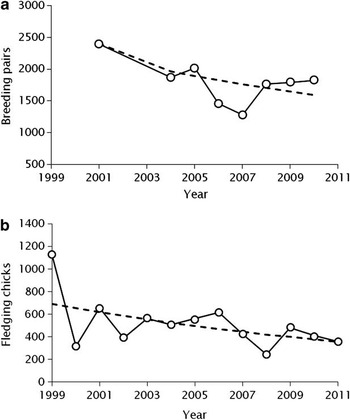
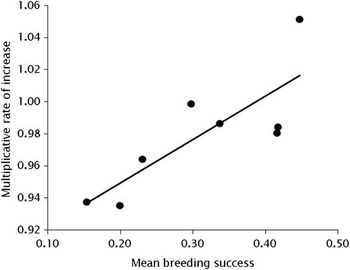
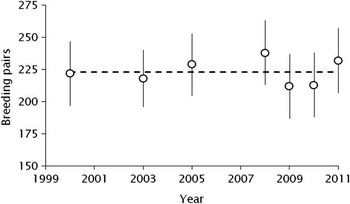
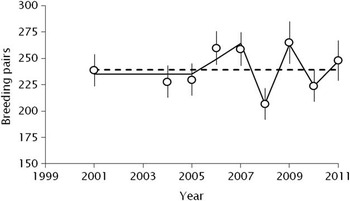
Counts of Tristan albatrosses indicated significant decreases for both the number of incubating pairs (λ = 0.970 ± 0.004, P < 0.01) and number of fledging chicks (λ = 0.953 ± 0.003, P < 0.01). As well as there being a significant decline in numbers, there was significant interannual variation in the number of incubating adults and fledging chicks (Fig. 1). Based on the last three surveys (2008–10), the annual breeding population is around 1800 pairs (observed range 1764–1826 pairs). There was no significant change in breeding success across the whole island from 2001–10 (regression slope = -1.397 ± 1.057, F 1,6 = 1.74, P = 0.244). Island-wide breeding success averaged 23 ± 11% (n = 8 years), ranging from 6.8% in 2008 to 44.1% in 2006. For the eight count areas, average breeding success varied from 15–45% (single-factor ANOVA F 7,52 = 4.61, P < 0.001). The estimated λ for each count area was positively correlated with mean breeding success in that area (r 2 = 0.808, n = 8, P < 0.005; Fig. 2). The rate of increase was positive for only one area, Tarn Moss (unofficial name) (Ryan et al. Reference Ryan, Cooper and Glass2001), which had the highest mean breeding success (λ = 1.052 and breeding success 45%), however, this site only holds 2–3% of the population. The relationship between λ and breeding success remained when this site was excluded from the analysis (r 2 = 0.781, n = 7, P < 0.02).
a. Numbers of breeding pairs of incubating Tristan albatross on Gough Island for the period 2000–10, and b. numbers of near-fledged chicks from 1999–2011. The dashed line is the overall trend for the time series, and the solid line is the fitted trend with significant change-points.

The relationship between mean breeding success and the estimated multiplicative rate of increase for the eight Tristan albatross counts areas on Gough Island. The correlation coefficient is significant (r 2 = 0.808, P < 0.005).

Atlantic yellow-nosed albatross
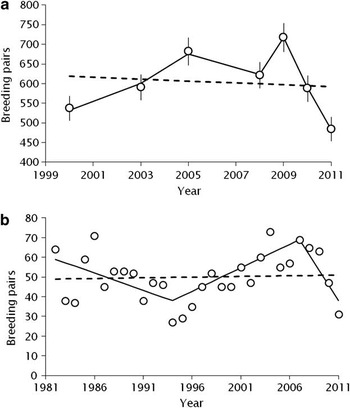
Although numbers of Atlantic yellow-nosed albatross breeding at 11 sites decreased slightly over the 12 years of monitoring, the rate of decrease was not significantly different from 1 (λ = 0.990 ± 0.014). There were significant change-points in the numbers of breeding birds, with the population generally increasing from 2000–09, followed by a sharp decrease from 2009–11 (Fig. 3). There was a significant positive correlation between the number of birds breeding at the study colony and the number breeding at the ten other count sites (r 2 = 0.758, P < 0.02). Trends in the study colony from 2000–11 (λ = 0.989 ± 0.017) were similar to those measured at all 11 sites (reported above). The population at the study colony was stable over the 30-year period 1982–2011 (λ = 1.004 ± 0.004; Fig. 3). Change-points were fitted by eye to the 30-year time series (initially selecting 1994, 1995, 2007 & 2008) and the lowest AIC value was found with change-points at 1994 and 2007 (AIC = 3.63) which indicated a period of decline over the first third of the study (1982–94; λ = 0.963 ± 0.009), followed by a steady increase (1994–2007; λ = 1.049 ± 0.009), and then a sharp decline in the last four years (2007–11; λ = 0.862 ± 0.033) (Fig. 3). These trends in the number of breeding pairs were correlated with the number of adults returning to breed each year (r 2 = 0.929, n = 26 years, P < 0.0001) in comparison to numbers of recruiting birds entering the colony (r 2 = 0.428, n = 26, P < 0.02).
Numbers of breeding pairs of Atlantic yellow-nosed albatrosses in a. 11 count areas in south-eastern Gough Island for the period 2000–11, and b. the long-term study colony from 1982–2011. Error bars are ± 1 standard error and are not included for b. because these data are the observed total count for this site. The dashed line is the overall trend for the time series, and the thin solid line is the fitted trend with significant change-points.

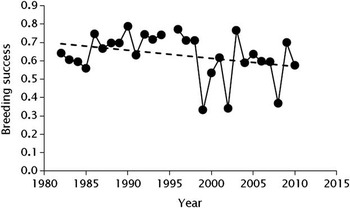
Nesting density within the 11 count areas averaged 5.1 ± 0.3 pairs ha-1 (95% confidence intervals 4.5–5.7 pairs ha-1) and the total area covered by the sites is 118.5 ha: 11% of the fernbush habitat, where most Atlantic yellow-nosed albatross occur. Assuming an equivalent density for the entire breeding are, the annual breeding population is estimated to be around 5300 pairs, with an estimated range of 4600–6000 pairs. Breeding success at the long-term study colony has averaged 63 ± 2% (n = 28 years, 1982–2010), with no significant trend for this period (regression slope = -0.261 ± 0.156, F 1,27 = 2.77, P = 0.108). However, breeding success has become more variable at the study site since 1999 (Fig. 4) following years of low breeding success in 1999, 2002 and 2008 (1982–98 variance = 16.9 (n = 16 years), 1999–2010 variance = 66.5 (n = 12 years); variance test F = 3.92, P < 0.01). Breeding success within the study colony averaged 53 ± 4% for the period 1999–2010, in comparison to breeding success of 69 ± 2% from 1982–99. There was considerable inter-site variation in breeding success in some years, with coefficients of variation of 11% in 2008, 75% in 2009 and 12% in 2010. In 2009 breeding success at the four sites ranged from 5–78% (average 43 ± 16%). The high rate of failure at one site was where observations of mice preying upon chicks were recorded (Cuthbert et al. Reference Cuthbert, Louw, Parker, Rexer-Huber and Visser2013).
Breeding success of Atlantic yellow-nosed albatrosses at the long-term study colony on Gough Island for the period 1982–2010 (n = 27–73 nests per year). The dashed line is the best-fit linear regression. Breeding success was not recorded in 1994.

Sooty albatross
Numbers of sooty albatross breeding within the study areas appeared stable over the 12-year period 2000–11 (λ = 1.000 ± 0.022), although caution should be applied to this trend given the small proportion (∼6%) of the island monitored (Fig. 5). Within these sites breeding numbers averaged 65 ± 3 pairs km-1 (95% confidence intervals 57–74 pairs km-1), giving an estimated coastal population of around 2750 pairs (estimated range 2300–3100). However, all the surveyed areas are in the south-eastern sector of the island, where the sea cliffs are relatively low and sheltered from the prevailing westerly winds. Density estimates from other coastal cliffs are required to increase confidence in this estimate. Estimating numbers at inland sites is difficult, because birds occur at low densities and are patchily distributed, and the area of inland cliffs and steep ground is large (c. 20–30% of the island's area). However, we estimate that a minimum of 500–1500 pairs may occur at inland sites. Combining these totals, the annual breeding population of sooty albatrosses is around 3500 pairs, but confidence in this estimate is poor, and the figure could be from 2500–5000 pairs. Breeding success was estimated in four years (n = 67–213 nests monitored) and averaged 48 ± 5%. Breeding success was constant in three years (54%, 55% from 52% in 2000, 2009 and 2010, respectively), but was only 33% in 2008.
Number of breeding pairs of sooty albatross in 16 monitoring sites in the south-eastern part of Gough Island during 2000–11. Error bars are ± 1 standard error and the dashed line is the overall trend for the time series.

Southern giant petrel
Numbers of breeding southern giant petrels were stable over the 11-year period 2001–11 (λ = 1.000 ± 0.009), although there were significant change-points in trends for the more recent years of monitoring (Fig. 6). For 2000–11 the average count was 240 pairs (95% confidence intervals 225–255 pairs). Breeding success at the largest colony (n = 160–182 nests) was assessed in 2008 (57%), 2010 (72%) and 2011 (72%), giving an overall average of 67 ± 4%.
Number of pairs of southern giant petrel breeding at Gough Island for the period 2001–11. Error bars are ± 1 standard error, the dashed line is the overall trend for the time series, and the thin solid line is the fitted trend with significant change-points.

Discussion
This study provides the first robust analysis of population trends for four species of surface-nesting procellariiforms on Gough Island and reveals contrasting trends. As expected, the population of the most threatened species, the Tristan albatross, is declining, whereas populations of Atlantic yellow-nosed albatross and sooty albatross and southern giant petrels appear to be relatively stable over the last decade. For the Tristan albatross, the measured decline of the breeding population of 3.0% per year closely matches the decline rate estimated from population modelling (2.9%, Wanless et al. Reference Wanless, Ryan, Altwegg, Angel, Cooper, Cuthbert and Hilton2009). The rate of decline in fledging chicks is faster than the decline in breeding numbers. Although this may simply be a result of sampling variation over a relatively small period (for a long-lived species), it could indicate a lag between a worsening impact of mice on chicks and the resulting trend in the breeding population. Population modelling has shown that low breeding success due to chick predation is capable of driving population declines even in the absence of at-sea mortality of adults and immature birds due to fisheries interactions, despite the lower sensitivity of the population to breeding failures in comparison to increased adult and immature mortality (Cuthbert et al. Reference Cuthbert, Sommer, Ryan, Cooper and Hilton2004, Wanless et al. Reference Wanless, Ryan, Altwegg, Angel, Cooper, Cuthbert and Hilton2009). The relationship between breeding success and population growth rate at the eight count areas demonstrates a causal link between rates of chick predation by mice and decrease in incubating adults, because we would expect the impact of any at-sea mortality to be uniform across the island. While fisheries bycatch and other at-sea factors will be important for the population (Wanless et al. Reference Wanless, Ryan, Altwegg, Angel, Cooper, Cuthbert and Hilton2009, Barbraud et al. Reference Barbraud, Rolland, Jenouvrier, Nevoux, Delord and Weimerskirch2012), the pattern found in this study provides the first direct evidence that the impact of low breeding success from mice is driving site-specific trends of the Tristan albatross and an overall decrease in numbers.
Populations of the remaining three species studied on Gough Island appeared to be relatively stable over the period of monitoring, although there was significant interannual variation in numbers of Atlantic yellow-nosed albatrosses and southern giant petrels, which is potentially caused by variability in feeding and foraging conditions at sea. The population of Atlantic yellow-nosed albatross decreased slightly, but the rate was not significantly different from no trend, both for the count areas established in 2000 and the small 30-year study colony. The robustness of any conclusion of “no trend” is dependent on the statistical power of the monitoring methods for detecting population declines, particularly for the Atlantic yellow-nosed and sooty albatross where subsamples of the populations were monitored. Simulation modelling of Atlantic yellow-nosed albatross counts indicates that the power to detect annual declines of 1% is around 80% for a single count area monitored annually for 30 years, and > 90% for an underlying annual decline of 2.5% monitored over the same period (Cuthbert & Sommer Reference Cuthbert and Sommer2004b), suggesting that our conclusions should be robust for the long-term study of this species. Caution should obviously be applied when interpreting trends from just one site, but the correlation between numbers of breeders at the long-term study colony and the ten other sites suggest that population trends for the study colony are representative of the wider population. Up until 2001, the Atlantic yellow-nosed albatross was considered to be declining, based on the reported decrease in numbers at the Gough Island study colony from 1982–2001, population modelling and additional data supporting a declining population at Tristan da Cunha (Cuthbert et al. Reference Cuthbert, Sommer, Ryan, Cooper and Hilton2003). The longer-term data presented in this paper indicate that the Gough population experienced a period of decrease (from 1982–94) followed by a population increase over the following 13 years and recent rapid decline in the last four years. The cause of these long-term fluctuations in the population is unknown, however estimates of adult survival of Atlantic yellow-nosed albatrosses during the period of decline were low (92%) in comparison to other mollymawks Thalassarche spp. with stable populations (93–95%) (Cuthbert et al. Reference Cuthbert, Sommer, Ryan, Cooper and Hilton2003). A reassessment of adult survival is underway for the species on Gough Island to assess variation in this key population parameter. Estimates of productivity of Atlantic yellow-nosed albatrosses at Gough Island confirm that overall rates of breeding success are high (Cuthbert et al. Reference Cuthbert, Sommer, Ryan, Cooper and Hilton2003), but breeding success has become more variable over the last decade. This increasing variation has occurred during the period when mice have been observed preying on this species (Cuthbert et al. Reference Cuthbert, Louw, Parker, Rexer-Huber and Visser2013a), although whether predation or some other factor is the main cause of this variability is not yet established. Studies of the closely related Indian yellow-nosed albatross Thalassarche carteri Rothschild have also found highly variable and often low breeding success, but this pattern has been attributed to mortality from zoonotic diseases (Weimerskirch Reference Weimerskirch2004, Rolland et al. Reference Rolland, Barbraud and Weimerskirch2009). Testing for a range of zoonoses on Gough Island gave no indication that disease was a major issue for the Atlantic yellow-nosed albatross (R.M. Wanless, unpublished data).
Little is known about the demographic parameters of southern giant petrels on Gough Island, and our records provide the first estimates of breeding success for this population. The estimate of 67% is similar to measures of breeding success recorded for other populations of 64 ± 14% (range 43–79% based on data from ten other populations, ACAP 2009b). Regular visits to the largest breeding site of this species on Gough Island in 2010, 2011 and 2012 gave no indication that mice were preying upon chicks. Previous estimates of population trends for Gough Island concluded that southern giant petrels had increased three- to fourfold since 1979 (Cuthbert & Sommer Reference Cuthbert and Sommer2004a), whereas counts from the last decade indicate a stable population. Cuthbert & Sommer (Reference Cuthbert and Sommer2004a) hypothesized that the increase in southern giant petrels from 1979 may have occurred in response to increased feeding opportunities from the recovery of the island's sub-Antarctic fur seal Arctocephalus tropicalis Gray population, which in the south-west of the island increased at a rate of 21% a year from 1975–89 (Bester et al. Reference Bester, Wilson, Burle and Hofmeyr2006). Recent estimates of fur seal populations on Gough Island indicate that the rate of increase has slowed and that the population is reaching an asymptote (Bester et al. Reference Bester, Wilson, Burle and Hofmeyr2006). If, as is likely (Hunter Reference Hunter1983), sub-Antarctic fur seals still provide a significant proportion of the diet of southern giant petrels at Gough, then the slowing of growth in seal numbers may account for the recent stabilization of giant petrel numbers.
Previous analysis of coastal-nesting sooty albatrosses concluded that this species had decreased by around 60% in comparison to the early 1970s, an estimated decline rate of 3% per year (Cuthbert & Sommer Reference Cuthbert and Sommer2004a). Our results from the last decade suggest that the population has not continued to decline at this rate, but we caution against concluding it is stable given the relatively small numbers of birds counted and limited extent of the count areas (∼6% of the coastline and a small inland area). Population trends of sooty albatrosses at other breeding sites indicate the species is declining (Delord et al. Reference Delord, Besson, Barbraud and Weimerskirch2008, ACAP 2009a, Ryan et al. Reference Ryan, Jones, Dyer, Upfold and Crawford2009) due to the inferred impact of longline fisheries (Gales Reference Gales1998, Weimerskirch & Jouventin Reference Weimerskirch and Jouventin1998), and further monitoring is required to assess if the Gough population is still declining or stable. While there is uncertainty over trends of the population, our data indicate that breeding success (48%) is within the range for this species on other islands (19% on Marion Island (Berruti Reference Berruti1979) to 65% on Ile de la Possession (Weimerskirch & Jouventin Reference Weimerskirch and Jouventin1998)). This suggests that, despite isolated cases of mice preying upon chicks (Cuthbert et al. Reference Cuthbert, Louw, Parker, Rexer-Huber and Visser2013a), sooty albatrosses are not as adversely effected by mice as are Tristan albatrosses.
The population trends recorded for the four surface-nesting procellariiform species at Gough Island have important implications for their conservation status. The Tristan albatross is currently classified as Critically Endangered due to the combined impact of chick predation and at-sea mortality (Wanless et al. Reference Wanless, Ryan, Altwegg, Angel, Cooper, Cuthbert and Hilton2009). The population trends recorded in this study confirm this red-listing, as over three generations (70 years; BirdLife International 2012b) the population of adults and chicks is predicted to decrease by 88–97%. Progress towards eradicating house mice from Gough Island include the production of a feasibility assessment and draft operational plan (Parkes Reference Parkes2008, Torr et al. Reference Torr, Golding and Cuthbert2010) and we support this action as a necessity for reversing population trends of the Tristan albatross and other burrowing petrel populations (Cuthbert et al. Reference Cuthbert, Louw, Lurling, Parker, Rexer-Huber, Sommer, Visser and Ryan2013b). The stable numbers of southern giant petrels at Gough Island supports the Least Concern status of the species, although Gough Island supports < 1% of the global population (ACAP 2009b). The Atlantic yellow-nosed albatross is currently classified as Endangered due to previous evidence for population declines on Gough Island and low values of survival for the species at Gough and Tristan da Cunha (Cuthbert et al. Reference Cuthbert, Sommer, Ryan, Cooper and Hilton2003). Although the results of our study should be treated with caution, there is no definitive evidence for a decreasing population at Gough Island (which holds 13–20% of the global population; ACAP 2009c) and also no recent change in numbers at Nightingale Island, Tristan da Cunha (unpublished data), which supports 10–15% of the global population (ACAP 2009c). Further counts from Tristan da Cunha, including an estimate of the largest population breeding on the main island of Tristan, are required to assess whether the conservation status of this species should be altered. The sooty albatross is also classified as Endangered and Gough Island is thought to support the world's largest population (36–40% of the global population; ACAP 2009a). The estimated annual breeding population of 3500 pairs on Gough Island, found in our study, is the best estimate to date of the population, but this figure could range from 2500–5000 pairs. A wider survey and better estimate of the island's population is a priority in order to provide a robust estimate of the global population and of Gough Island's significance for this species. Apart from Gough Island, information on population trends of sooty albatrosses are only available for Marion Island (Prince Edward Islands) and Ile de la Possession (Iles Crozet), where populations have declined at 4–5% a year up until 2005/06 (Delord et al. Reference Delord, Besson, Barbraud and Weimerskirch2008, Ryan et al. Reference Ryan, Jones, Dyer, Upfold and Crawford2009). Given the uncertainty in long-term trends on Gough Island and ongoing declines at other sites, we consider that the species’ current Endangered status remains the most appropriate category for now.
Acknowledgements
We thank Andrea Angel, Karen Bourgeois, Marie-Helene Burle, Ross Cowlin, Sylvain Dromzée, Henk Louw, Jeroen Lurling, Nic le Maitre, Graham Parker, Kalinka Rexer-Huber, Erica Sommer, Paul Visser, Ross Wanless and Johnny Wilson for undertaking monitoring over the year on Gough Island, with volunteer support from numerous members of the South African meteorological teams over the last decade. James Glass, Norman Glass, Trevor Glass, Warren Glass, Patrick Green and Julian Repetto from Tristan da Cunha and Marienne de Villiers, Bruce Dyer, Justin Fiske, Andre Fourie, Richard Halsey, Norman Ratcliffe, Brian Schultz and Richard White assisted with counts during annual visits. Geoff Hilton is thanked for his involvement in establishing this programme. Thanks are due to Anton Wolfaardt and Rob Crawford, and to an anonymous reviewer, for helpful comments that improved this manuscript. Permission to undertake the work was given by the Tristan Conservation Department. Logistical support was provided by the South African Department of Environmental Affairs, through the South African National Antarctic Programme (SANAP), the University of Cape Town and the Royal Society for the Protection of Birds (RSPB). Long-term monitoring on Gough Island was established with a grant from the UK Foreign and Commonwealth Office with further support over the years from the UK Government's Overseas Territories Environment Programme (OTEP), the RSPB, the Agreement on the Conservation of Albatrosses and Petrels and the Royal Naval Birdwatching Society.