INTRODUCTION
In New Zealand, as in many Western countries, women now represent nearly half of the workforce (Statistics New Zealand, 2016). While women continue to be markedly underrepresented at senior management and governance level (Grant Thornton International Ltd, 2016), it is likely that a woman employee will have a woman manager at some stage during her working life, at least at the lower and middle organisational levels. However, very little is known about the nature of these hierarchical relationships and the impact they have on women’s careers, particularly when these relationships become strained.
Our research has explored these hierarchical workplace relationships between women, including career impacts and relational expectations, and identifies strategies that can be developed at both the individual and organisational level to respond to strained relationships. This article focusses on women’s experience as contextually situated and adopts a relational lens to develop an holistic and context-focussed framework. The article begins with a review of the relevant literature on women’s workplace relationships, followed by an outline of our methodology. Our findings canvass the personal and organisational strategies recommended by our participants and we conclude with a discussion of a context-focussed approach to addressing strained hierarchical workplace relationships between women. This is consistent with recent shifts towards more context-specific management and organisational research (Bamberger, Reference Bamberger2008; Egri, Reference Egri2013; Galvin, Reference Galvin2014).
VIEWING WORKPLACE CONFLICT THROUGH A HOLISTIC RELATIONAL LENS
Relationships and the desire to develop connections with other people are at the core of human existence (Fletcher, Reference Fletcher1999; Jordan, Reference Jordan2004b; Jordan & Walker, Reference Jordan and Walker2004; Uhl-Bien & Ospina, Reference Uhl-Bien and Ospina2012). Organisations are structured around relationships, with work, for most people, being an inherently relational act (Blustein, Reference Blustein2011). This relational approach focusses on the interconnection between people within the working environment and places these relationships at the centre of inquiry, in contrast to more traditional perspectives that focus on work as a more individual endeavour and which ‘have articulated a vision of individuals who are fairly autonomous’ (Blustein, Reference Blustein2011: 1). A relational approach emphasises interdependence, collectivity and connection to others (Fletcher, Reference Fletcher1999, Reference Fletcher2012; Hammer, Trepal, & Speedlin, Reference Hammer, Trepal and Speedlin2014), and in adopting a relational lens, it is this connection between people that is the central focus of inquiry.
Workplace relationships exist within a broader societal and cultural context, both representing and reproducing a society’s culture (Jordan, Hartling, & Walker, Reference Jordan, Hartling and Walker2004; Schultheiss, Reference Schultheiss2013). In a gendered society, workplace relationships are understood and experienced in a gendered way. Women are generally expected to act relationally (Catalyst, 2007; Brock, Reference Brock2008; Morrison, Reference Morrison2009; Sias, Reference Sias2009; Litwin, Reference Litwin2011; Mavin, Williams, Bryans, & Patterson, Reference Mavin, Williams, Bryans and Patterson2013; Jogulu & Vijayasingham, Reference Jogulu and Vijayasingham2015) and are more likely to look to their women colleagues for emotional support (Fletcher, Reference Fletcher1999, Reference Fletcher2012; Blustein, Reference Blustein2011). Men, in contrast, tend to be more task focussed and seek instrumental support from colleagues (Brock, Reference Brock2008; Sias, Reference Sias2009). However, little is known of the relational expectations women have of their women managers and/or women employees. Research by Mavin suggests that women managers are expected ‘to be more understanding, more nurturing, more giving and more forgiving than men’ (Reference Mavin2006: 267). Our research has found that women tend to expect their women managers to understand the complexities of their lives, provide flexibility to accommodate those complexities and treat them as an equal person. They also expect a higher level of emotional understanding and support from a woman manager than they would from a man (Author, in press).
Research suggests that relationship expectations in the workplace, including gender-based expectations, often go unspoken (Ladkin, Reference Ladkin2010; Litwin, Reference Litwin2011), leading to the possibility of misunderstanding and conflict. Our research found that a strained and damaged relationship with a woman manager or woman employee can lead to major career decisions, including resignation and sideways or backwards career steps, when considered in terms of organisational position or hierarchy (Author, under review). Research suggests that advancement to senior organisational roles requires a long period of uninterrupted employment and systematic progression through increasingly more senior management positions (O’Neil, Hopkins, & Bilimoria, Reference O’Neil, Hopkins and Bilimoria2008). However, women’s careers tend to be opportunistic, involve career breaks and do not tend to advance in a linear manner, which detrimentally affects a woman’s ability to reach a senior management position (Lalande, Crozier, & Davey, Reference Lalande, Crozier and Davey2000; Mainiero & Sullivan, Reference Mainiero and Sullivan2005, Reference Mainiero and Sullivan2006; Sullivan & Mainiero, Reference Sullivan and Mainiero2008; Sullivan, Forret, Carraher, & Mainiero, Reference Sullivan, Forret, Carraher and Mainiero2009; Doherty & Manfredi, Reference Doherty and Manfredi2010; O’Neil, Hopkins, & Sullivan, Reference O’Neil, Hopkins and Sullivan2011). Any interruption, therefore such as resignation and sideways or backwards career steps in response to negative relationships, can affect the progression of women into more senior management roles, even though they may be gaining valuable experience from these career moves.
Negative relational experiences between women managers and their women employees not only affect the individual, but also have organisational and gender equity implications. Securing a critical mass of women at the senior management level has been demonstrated to improve business performance (Pellegrino, D’Amato, & Weisberg, Reference Pellegrino, D’Amato and Weisberg2011; Wagner, Reference Wagner2011; Dezsö & Ross, Reference Dezsö and Ross2012; Catalyst, 2013; Joecks, Pull, & Vetter, Reference Joecks, Pull and Vetter2013; Grant Thornton International Ltd, 2016), and therefore the loss of women from mid-career levels impacts on an organisation’s senior management pipeline and potentially on business performance. In addition, retaining women in the ranks of senior management is important from a gender equity perspective, with research suggesting a critical mass of women at the senior organisational levels can lead to a reduction in the gender pay gap (Cohen & Huffman, Reference Cohen and Huffman2007) and an increase in the promotion of women at all organisational levels (Kurtulus & Tomaskovic-Devey, Reference Kurtulus and Tomaskovic-Devey2012; Skaggs, Stainback, & Duncan, Reference Skaggs, Stainback and Duncan2012; Cook & Glass, Reference Cook and Glass2014). From a personal, organisational and societal perspective, the quality of hierarchical relationships between women in the workplace is an important but underresearched issue.
In our research, we have sought to harness the lived experiences of our participants to develop personal and organisational strategies that better respond to strained relationships and in doing so, positively enhance women’s careers and strengthen the organisational role of women. Relational cultural theory posits that a positive relationship between women is one that is mutually empowering and empathetic and promotes outcomes of zest, empowered action, an increased sense of worth, new knowledge and desire for more connection (Fletcher, Reference Fletcher2007). While difficult or negative relationships lack those characteristics and can be personally and organisationally damaging, they can also be a source of personal growth if managed well (Miller, Reference Miller1986; Miller & Stiver, Reference Miller and Stiver1997; Jordan, Reference Jordan2004a; Jordan, Reference Jordan2010; Richardson, Reference Richardson2012). Relationship conflict is not inherently bad. We have the potential to ‘undergo our most profound change and grow most deeply when we encounter difference and work on conflict’ within the context of that relational connection (Jordan, Reference Jordan2010: 4). It does require though, the development of relational awareness, which ‘includes personal awareness, awareness of the other, awareness of the impact of oneself on the other, the effect of the other on oneself, and the quality of energy and flow in the relationship itself’ (Jordan, Reference Jordan2004a: 54).
To better understand the hierarchical workplace relationships between women, we grounded our research in narrative inquiry. A narrative approach to understanding experience has, at its central point of focus, the lived experience of a person as narrated by her, and situated within the many contexts of her life (Clandinin & Rosiek, Reference Clandinin and Rosiek2007). Each woman has a different life context and history which influences her understanding of experience, including the way she understands and reacts to workplace relationships with women managers and/or women employees (Smith-Acuna, Reference Smith-Acuna2011; Patton & McMahon, Reference Patton and McMahon2014). Her past experiences will influence how she perceives and reacts to her current situation, as well as her future decision-making and envisioned future. This reflects the temporal and continuous nature of experience, by which ‘experiences grow out of other experiences, and experiences lead to further experiences’ (Clandinin & Connelly, Reference Clandinin and Connelly2000). It also recognises that the way in which a woman understands and narrates her lived experiences will change depending on where it sits within her personal life context, as well as the broader organisational and societal context. This holistic approach to understanding experience, based in the epistemology of narrative inquiry, encourages the examination of multiple contexts when considering relational difficulties (Clandinin & Rosiek, Reference Clandinin and Rosiek2007), recognising that there are likely to be multiple factors involved in a strained relationship, requiring multiple interventions (Smith-Acuna, Reference Smith-Acuna2011). This contextual approach is also consistent with relational cultural theory, which situates relationships within a gendered societal and cultural context (Fletcher & Kaufer, Reference Fletcher and Kaufer2003), as well as the recent calls for a more context-focussed approach to management and organisational research (Bamberger, Reference Bamberger2008; Egri, Reference Egri2013; Galvin, Reference Galvin2014).
METHODOLOGY: DELVING INTO LIVED EXPERIENCE
As discussed above, our research used narrative inquiry to examine the experiences of women managing and/or being managed by women, the influence these relationships have on their career decisions, and to recommend strategies to enhance those relationships and the role of women in business. It is an exploratory study grounded in the lived experiences of New Zealand women and situates those experiences within their particular context, rather than seeking to produce broad generalisations (Creswell, Reference Creswell2013). This is a small-scale qualitative study with an emphasis on depth, rather than breadth of understanding (Guest, Bunce, & Johnson, Reference Guest, Bunce and Johnson2006; Bryman & Bell, Reference Bryman and Bell2011; Saunders, Reference Saunders2012; Creswell, Reference Creswell2013).
Ethical approval for the research was obtained prior to commencement of the fieldwork. Participants were identified using the snowballing technique (Bryman & Bell, Reference Bryman and Bell2011; Creswell, Reference Creswell2013), based initially on the lead author’s professional and personal networks. This method initially identified 49 women who were approached via email and from these, 15 women self-selected into the first phase of the research, based on the criteria that they had experience managing and/or being managed by women. Participants were provided with an information sheet containing details of the research purpose, methods, process and participant rights, including confidentiality arrangements. All participants signed participation consent forms prior to the commencement of fieldwork, covering their involvement in phase one and two of the research.
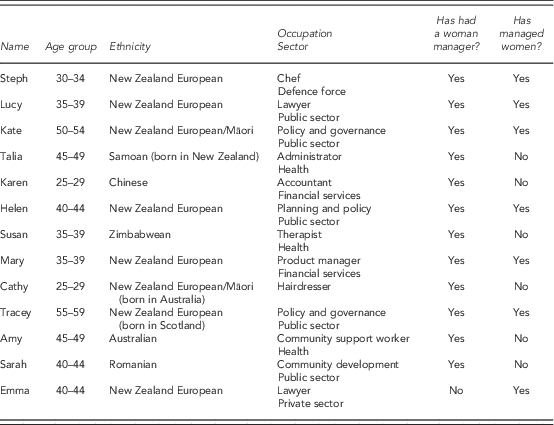
Phase one of the research explored the participant’s hierarchical workplace experiences with women. In all, 13 of the original 15 participants elected to participate in the second phase of the research (which is the subject of this article). This phase focussed on the development of strategies to better support the careers of women. Demographic details of the 13 participants who participated in the second phase of the research are provided in Table 1 (pseudonyms used). One of the 13 participants worked in small owner-operator businesses, and another worked in a small not-for-profit organisation. All other participants worked in larger public and private sector organisations, with workforces ranging from between 200 and 10,000 employees.
Demographic details of participants

Phase one of the research used a mixture of interviews and participant prepared creative materials to explore the lived experiences of the participants. Participants were asked to produce either a piece of written or visual material prior to the interview depicting their experiences with a woman manager or employee, as well as a timeline detailing any life events they felt were significant to their careers. Participants produced line drawings, collages, unsent letters, fictional stories, poems and written summaries of their experiences. This material informed the subsequent interview with the participant.
Phase one of the research identified that over two-thirds of participants had experienced a damaging or negative relationship at some stage during their career and for over half of these participants, this influenced subsequent career decisions. The personal, organisational and societal contexts in which those relationships were situated influenced how the relationship was perceived and subsequent career decision making. Participants also had relational expectations of women managers, such a higher degree of emotional intelligence, empathy and support, an understanding of the complexities of their lives, a willingness to provide flexibility to accommodate those complexities, and an expectation to be treated as an equal.
Phase two, which is the focus of this article, brought the participants together through a series of small workshops (which were supplemented by written and telephone responses where a participant was unable to attend a workshop), to develop strategies to strengthen hierarchical relationships between women in the workplace. Three workshops were held on different days, locations and times to enable participants to attend. In total, 10 participants attended these workshops (two workshops were attended by three participants each and one workshop was attended by four participants). Three participants could not attend the workshops, therefore two sent written responses to the workshop questions and one provided her response by telephone. Participants were reminded at the start of each workshop of their rights relating to participation, including confidentiality and responsibilities. Participants did not, during the workshops, name any person that they had previously worked with or the relevant organisation. Instead, they used generic references such as ‘my boss’ or ‘my manager’.
Participants were asked to reflect on a series of questions, which were provided in advance. These included the following questions which are relevant to this article.
Reflecting on your own difficult relationships with a woman manager or woman employee (or relationships you may have witnessed):
∙ What could have enabled you to cope with that relationship better?
∙ What, if anything, could you or the organisation you worked for have done differently?
The workshops were recorded and transcribed. The lead author also made notes of the key discussion points on large sheets of paper, visible to all participants. The notes were used to create five categories for analysis of the workshop and phone transcripts, and written responses, using the software programme NVivo, namely awareness, communication, support, skills and acceptance. This was supplemented by careful rereading of the source material and a review of the relevant data from phase one. The analysis refined the categories into a number of themes which were further broken down into personal and organisational responses. The following section discusses the findings from phase two against the identified themes (Morrow, Reference Morrow2005; Miles, Reference Miles2014). All relationships discussed in this article refer to those between women.
FINDINGS: PERSONAL AND ORGANISATIONAL STRATEGIES
The participants identified a number of personal and organisational strategies that can be developed in response to strained hierarchical relationships. These have been developed into four themes and are discussed below: developing awareness, enhancing personal and relational skills, building support networks and finding acceptance.
Developing awareness
Strained relationships placed considerable stress on the participants, affecting their physical and psychological well-being, as well their personal relationships, including their families. Personal and organisational awareness of both the existence and consequential impact of a strained or difficult relationship, as well as an ability to articulate that awareness, is essential to the development of appropriate strategies. Personal awareness requires a degree of self-reflection (Taylor, Reference Taylor2012) and recognition of the extent of relationship stress being experienced. This can be hard to see at the time.
I wished I’d been more aware of the stress I was experiencing and got some sort of supervision or counseling to deal with it and empower me and find some tools to better deal with the relationship with my manager. (Lucy)
Personal awareness and self-reflection can be facilitated through various mechanisms such as seeking professional support, gaining the advice of an impartial person, drawing on ‘gut feeling’, trusting instincts and listening to the impact the relationship is having on physical and psychological well-being. This awareness building also extends to understanding the broader personal, relational and family impacts of a strained relationship, as well as the gendered expectations women can have of their women managers and/or employees.
While individual awareness is important, organisations also need to develop ways to increase their awareness of strained relationships. It can be difficult for an organisation to respond if the appropriate staff are not told about a difficult relationship. One participant (Susan) noted that ‘I don’t know how the organisation would’ve responded to me because I didn’t give it a chance to respond because I didn’t do anything’. However, this participant also noted that organisational awareness should have been triggered by the high turnover of staff within her manager’s team, as well as the complaints made against her by other people. This requires an organisational culture that recognises the factors pointing to a problem and proactively responds, rather than waiting until a formal complaint is made.
Organisational practitioners also need to be more aware of the contexts in which those relationships can become strained. For example, our research found that phases of major organisational change can place considerable stress on hierarchical relationships between women, suggesting that organisations need to consciously foster a more supportive environment as part of their change management plans. As well, greater organisational awareness is needed about the gendered expectations women have of their relationships, and the resulting relational impact if these expectations cannot be met.
Enhancing personal and relational skills
At the personal level, participants raised the importance of self-confidence when they reflected on their negative relationships. While it is important to avoid overgeneralisation, research points to a tendency for men to have (or at least display) a greater degree of confidence than women (Kirkwood, Reference Kirkwood2009; Institute of Leadership & Management, 2011; Kay & Shipman, Reference Kay and Shipman2014; Sturm, Taylor, Atwater, & Braddy, Reference Sturm, Taylor, Atwater and Braddy2014). Given the relational expectations women have of other women to have more emotional understanding (as found in our research), it may be assumed that women might feel more confident raising issues with another woman, than with a man. However, our research suggests that this is not necessarily the case. Women can struggle with asking for help, even when their manager is a woman. It can make them ‘feel needy’ and ‘vulnerable’, when they are ‘trying to be the all in control woman’.
It is about not being frightened to ask for help. Being so staunch because you’re juggling all over the place when you have a young family and everything else. You can’t let anything slip but sometimes you need to show you’ve got a bit more vulnerability and that’s not necessarily a bad thing. I guess showing vulnerability to me meant you weren’t coping and you weren’t good enough. (Tracey)
The ability to ask for help and to show vulnerability involves developing the confidence to have an ‘honest conversation’ with a woman manager and be more proactive in raising issues.
Developing good and honest communication and finding ways to bolster confidence are important relational skills. Women need to understand that their managers may also be lacking in confidence, which may be affecting their relationship. One participant (Kate) noted that she had a difficult relationship with a woman manager ‘that probably flip flopped a lot because of her own [lack of] confidence’. Enabling a woman to see an issue or situation from her manager’s perspective provides an opportunity for relationship growth. One participant (Helen), for example, assumed her manager did not like her. However, a woman mentor enabled her to gain a different and invaluable perspective by explaining that the manager ‘was struggling in the male environment she was working in’ and Helen’s actions were exacerbating that difficulty.
Our research suggests a tendency for some women to personalise relationship conflict. For example, one participant discussed how she had believed a strained relationship was all her fault, that she ‘was a bit of a pain’ and ‘more of an inconvenience’, until she received some independent external support that provided her with a much more balanced perspective on the relationship difficulties. This finding is consistent with research pointing to a tendency for some women to be more critical of themselves, have less self-compassion and use more negative self-talk than men (Yarnell, Stafford, Neff, Reilly, Knox, & Mullarkey, Reference Yarnell, Stafford, Neff, Reilly, Knox and Mullarkey2015). It is important therefore, for women to obtain support that enables them to gain a sense of perspective and develop the skills to recognise and respond to negative self-talk, as well as build a sense of self-compassion.
Organisations need to be more aware of the confidence issues some women face and develop mechanisms that encourage women to have honest and open conversations and to seek help and support, within a safe environment. In doing so, organisations must recognise that the relational needs of women may well be different from that of men. Organisational investment in programmes that enhance women’s relational skills, build self-confidence, develop skills to address issues like negative self-talk and provide education on the gender-based expectations women have of their relationships, has the potential to strengthen those relationships.
Organisational practitioners also need to develop their relational skills so that they are better able to recognise and respond to hierarchical relationships between women that have the potential to result in conflict and cause damage. In reflecting on her own experiences, one participant commented that
Human Resources should have played a much bigger role in not pushing people to work together if they are completely incompatible. When the first signs of conflict or misunderstanding and so on do appear, they could have actually worked things out. (Sarah)
This suggests that senior managers and human resources practitioners could benefit from a broader understanding of how to better match people within teams. This could be combined with a wider range of tools to respond to strained relationships, including exploring options to relocate women to other teams, where strengths and personalities may be better matched.
Strained and damaged hierarchical relationships can be healed if approached with honesty about the existence of conflict, emotional maturity and a willingness by both parties to address the issues (Jordan, Reference Jordan2004a; Jordan, Reference Jordan2010). For example, organisational change severely damaged the relationship one participant, Talia, had with a woman manager. A restructuring saw Talia moved to another work area against her wishes. She felt very angry with her woman manager at the time for not fighting to keep her. Another restructuring a couple of years later saw her working for that manager again. They openly discussed their issues and agreed to start afresh. Talia ‘had to get over any anger that I had with my manager at the time and get on with it’. She now describes her manager as having ‘been the real rock of my life’, commenting that ‘we’ve actually had to grow and it’s taken a 20 year relationship of work careers and crossing paths continually’.
Building support networks
Our participants identified the importance of good support mechanisms that provide advice and emotional and practical support when dealing with strained and difficult relationships. This support can come from fellow work colleagues, particularly when they are all experiencing similar difficulties with a woman manager. It can also come from an external person. One participant, for example, described the benefit of having a skilled external consultant to help her understand what was going on in her strained relationship and provide an impartial opinion.
We talked through her experience of a very similar thing and that was when the lights went on and the cloud lifted and I could see clearly. Up until then I had been talking to everybody internally but I think I just needed to talk to that external person because they were impartial. Everybody I talked to internally had their own agenda. They didn’t want me to leave so they had their own motivations for what they were saying to me. Talking to this external person who had the skills helped. (Mary)
The external consultant was able to empathise, due to her own experiences, and provide another perspective. This participant also saw a psychologist who validated her experiences.
I went to see a psychologist. I explained to her what was going on and she went ‘oh my God, you need to leave’. Just having someone say that, those were the two key things together and they were both external impartial people. (Mary)
One participant (Lucy), reflecting on her negative experiences with a previous woman manager thought at the time that ‘I just have to soldier on, I can manage this myself’ but in hindsight realised she ‘should have got support outside the organisation at the time’. She was busy and felt she did not have time to do so, even though her mother was encouraging her to get external support. Another participant (Susan), reflected on how she did not ask for help and did not take action to address relationship difficulties, even though she considers herself to be a ‘strong independent woman’. In hindsight she could have ‘called her up on it and gone and spoken to HR or another manager and said “we need to actually have a mediation here because this isn’t working for me”’.
Organisations need to facilitate avenues for impartial, safe and qualified support from people who have an awareness of the relational dynamics and characteristics that can be present. This can be through external or internal channels. One participant (Karen) reflected on how she should have talked to someone in the organisation about her relationship difficulties. However, she ‘was scared because I was the little person’ and thought ‘that they would not listen to me’. This is a particular issue if the woman manager is very senior within the organisation, as one participant found:
… our human resources people were well aware of a number of issues with my manager and people in the organisation and they were even scared of her … I found that quite disappointing that people I thought I could rely on to intervene and say ‘this is not right’ didn’t do that … Then again, I guess that’s quite hard when the person who is causing the trouble was part of the executive team of the place too. It was quite a position of power. (Lucy)
Another participant reflected on how she was shocked by the ‘culture of silence’ and lack of organisational support when she found herself in conflict with her woman manager. There was an overreliance on formal procedures to address relationship issues.
Nobody talks and you do not talk about her or what happened, don’t discuss with her about it because it’s a case in progress. That made things really hard. We actually wanted to get together and sort things out but no, you have to follow procedure, processes and so on. (Sarah)
Organisational support requires the provision of safe avenues to gain advice and guidance, such as through external employee assistance programmes offered by some organisations. It also requires an empowered human resources department equipped with the skills and tools to address relationship issues, irrespective of the position a woman manager holds within the organisation.
Finding acceptance
A number of participants raised the importance of accepting what can and cannot be changed when dealing with a difficult relationship. For example, one participant (Amy), described how she and her work colleagues tried to talk to their woman manager about their concerns. When the response was ‘I’m the boss, I can do what I want … we just decided to leave it and let the train run away’. Another participant (Lucy), realised organisational intervention would not have helped ‘because it would’ve just made this person more entrenched in her decisions’.
Part of finding acceptance is recognising how bad the relationship has become, the impact it is having, and knowing when to leave the organisation. One participant (Helen), reflected that ‘if I’d recognised sooner how toxic and bad things were, I should’ve just left’ and another felt, in hindsight, she ‘should’ve left sooner’. Another participant (Karen), who had left an organisation because of a damaging relationship reflected that, if in future she was faced with another difficult relationship that was affecting her personally, she would ‘think about the dynamic as a reflection on her (manager) not myself’ and ‘the best option is to quit’.
Reaching a place of acceptance is a process. For some of the participants, this did not occur until well after the relationship with their woman manager or employee had ended. For others, participation in our research provided an important opportunity to reflect on and reach a point of acceptance about their experiences. One participant (Mary), commented that, ‘it was a really good unpack of what I’d been through and then what I’d learnt and being able to grow in confidence’. For another participant (Helen), it showed her ‘how much I needed to be able to get the last few years off my chest’ and a third participant (Talia), commented about attendance at the workshop that, ‘it’s good to meet other women and we’ve actually all been there and done that sort of thing … you’re not alone’. Retelling their stories, in their own way, seems to have provided participants with a powerful medium for gaining acceptance.
TOWARDS A MORE HOLISTIC RELATIONAL APPROACH
The framework
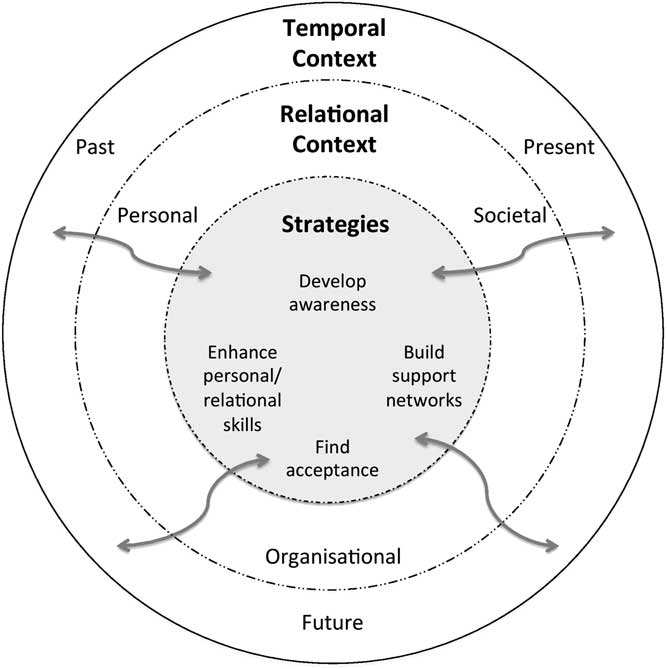
Our participants identified a range of personal and organisational strategies for responding to strained hierarchical workplace relationships, which we have organised into four strategies. This does not represent an exhaustive analysis and identification of all possible responses as there are undoubtedly many more specific interventions that could be developed and implemented. We have though, drawn on the identified strategies to form the basis of a more holistic, context focussed and relational response framework. The key features of this framework are shown in Figure 1 and discussed in more detail in this section.
Holistic relational response framework

Figure 1 shows the four identified strategies at the centre (the inner circle), which are interlinked rather than linear in nature. They are also situated within and influenced by a broader relational context, namely the personal, organisational and societal contexts (the middle circle), which are in turn situated within a continuum of time (the outer circle). It is the combination of each of these elements that provide an holistic, relational framework to identifying and responding to strained workplace hierarchical relationships.
Temporal and contextual factors
Taking a relational approach reflects that work is an inherently relational act and recognises the importance of workplace relationships to women (Miller, Reference Miller1986; Fletcher, Reference Fletcher1999, Reference Fletcher2012; Blustein, Reference Blustein2011). We have taken an holistic approach to the development of relational strategies, recognising that workplace relationships are part of and are understood within a person’s broader lived experience, consistent with the epistemology of narrative inquiry, in which this research is grounded (Clandinin & Connelly, Reference Clandinin and Connelly2000; Clandinin, Murphy, Huber, & Orr, Reference Clandinin, Murphy, Huber and Orr2010; Richardson, Reference Richardson2012). The relationship sits within a continuum of time and experience, with a woman’s perception and reaction to current experience influenced by past experiences, as well as her envisioned future (Clandinin & Connelly, Reference Clandinin and Connelly2000; Clandinin & Rosiek, Reference Clandinin and Rosiek2007; Clandinin, Reference Clandinin2013). It also sits within a much broader personal context. Her personal life, such as her family and financial responsibilities, are all relevant contexts. Understanding and responding to hierarchical relational conflict in the workplace recognises that we all experience events, relationships and situations differently depending on our personal context. Responding in a more holistic and relational way to strained relationships, involves an acknowledgement and degree of understanding of the inherent personal difference between individual women (Smith-Acuna, Reference Smith-Acuna2011). This is not to suggest a need to delve in detail into the complexities of a woman’s life history. Rather, it requires a willingness to listen and to seek to understand each woman’s perspective and develop an awareness that their gendered working relationships will be influenced by many factors from both within and outside the work relational context (Jordan, Reference Jordan2004a; Jordan, Reference Jordan2010; Smith-Acuna, Reference Smith-Acuna2011).
As well as the personal context, a narrative approach situates lived experience within a broader societal/cultural and institutional/organisational context. To explore the relational dynamics requires an exploration of the organisational and societal contexts within which that relationship sits. Organisationally, our participants reflected on how damaging relationships existed within an organisational culture of silence, with a lack of awareness of relationship difficulties or the ‘turning of a blind eye’, with organisational response seeming to favour implementation of formal processes. Organisational change and a lack of organisational support were also relevant contextual factors identified in our previous research. Societally, our research has pointed to gender-based relational expectations women have of their women managers. This societal context will permeate and influence relationships and expectations (Author, in press).
Multiple and interlinked responses to conflict
These temporal, personal, organisational and societal contexts all influence the hierarchical relationships between women in the workplace, and provide the holistic relational framework within which the proposed individual and organisational responses to strained relationships are situated. By being open to the complexity this approach brings, it becomes possible to embrace the concept of multiple causality (Smith-Acuna, Reference Smith-Acuna2011; Patton & McMahon, Reference Patton and McMahon2014). This recognises that a strained hierarchical workplace relationship is likely to be caused or influenced by many different elements, requiring multiple interventions or responses at both the individual and organisational level (Smith-Acuna, Reference Smith-Acuna2011). The four strategies (developing awareness, enhancing personal and relational skills, building support networks and finding acceptance) are interconnected. While it may be tempting to seek to isolate and focus on specific issues, components and interventions, a combination of strategies are likely to be more appropriate. For example, individual and organisational awareness of the existence and severity of a strained relationship is essential to the development of better personal and relational skills, such as enhanced relationship communication. At the individual level, developing awareness may require the assistance of another person, demonstrating the importance of good support networks. Likewise, the enhancement of personal and relational skills is likely to draw on third party expertise and support. However, some degree of individual and organisational awareness is required to identify the need for greater support. A good support network will also facilitate a person’s ability to find acceptance and make difficult decisions, such as a decision to leave the organisation she works for, if this is the best option. However, while acceptance may be viewed as an outcome, it is also part of the response framework. As well as awareness, a woman must also accept that some form of response is needed, such as reaching out for support or seeking to develop better personal and relational skills.
A good understanding of each of the four strategies allows individual women, organisational practitioners and business owners (where an organisation is not of sufficient size to have human resources specialists), to best personalise the responses to the particular relationship and women involved, recognising that a combination of approaches may well be needed to address a strained relationship. Some responses may work better, be easier to implement, or be more appropriate than others. For example, Talia developed a stronger relationship with her manager by accepting that change was needed and through the development of enhanced relational skills, demonstrating that when a difficult relationship is managed well, this can be a source of personal and relational growth. At the other end of the spectrum, a number of our participants resigned from the organisation where they had a damaging relationship with a woman manager or woman employee. Ideally, the personal and organisational response will enable the women involved to develop a stronger relationship and remain working for the organisation. However, even a decision to resign can bring learning and personal and relational growth, particularly if the women involved are supported to gain awareness, enhance personal and relational skills and find acceptance. Change is not therefore, necessarily good nor bad, but provides a platform for growth depending on the response. It is important though, that the responses are cognisant of the characteristics that can be present in a hierarchical relationship between women, including the gender expectations women have of their women managers and/or employees, and are tailored to the specific relationship context.
Many of the strategies suggested by participants involved personal actions that a woman could take, with a greater focus on individual agency than on organisational response. This perhaps suggests a greater willingness by participants to change their own personal situation, rather than to seek organisational change. While there is likely to be some shared responsibility for relationship issues between the individual women involved, as well as the organisation they work for, shared responsibility does not equate to equal responsibility, as each party will hold different levels of relational power (Smith-Acuna, Reference Smith-Acuna2011). Arguably, more power to address interpersonal relational issues is held at the organisational level, suggesting a greater organisational responsibility to recognise and respond to strained hierarchical relationships. This requires an organisational culture that understands the importance of strong relationships between women from a business and gender equity perspective and a sustained commitment at senior executive level to develop and implement a more holistic relational approach to supporting those relationships.
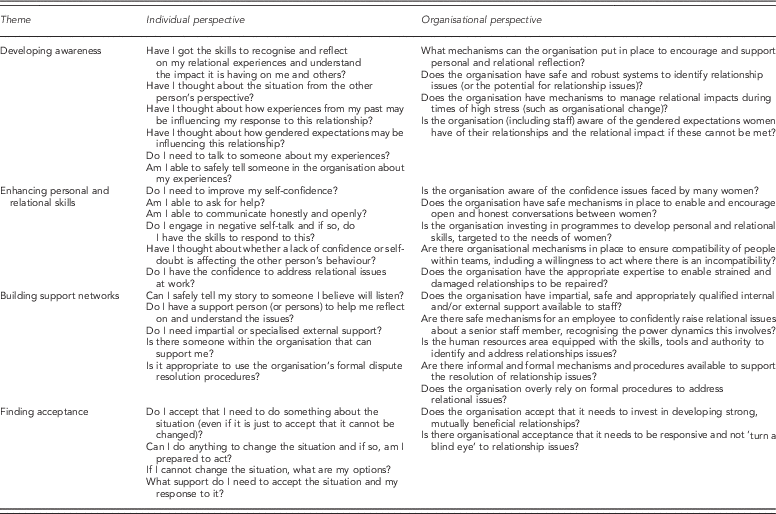
The relational response to a strained relationship must balance personal action and responsibility with organisational action. This requires a degree of sophistication and a recognition that processes must be flexible. To recognise the need for both an organisational and individual response, we have developed a reflective matrix (see Table 2) that can be used by individuals and organisational practitioners (and business owners) when responding to strained relationships. This matrix contains a series of questions to prompt individual and organisational reflection, discussion and action. It provides a reflective starting point when responding to relationship conflict, rather than a comprehensive list of questions. In addition, while the questions have been ordered in a table format, the reflective process is not a linear one.
Reflective matrix

A number of the participants’ suggested strategies only became apparent to the participants with the benefit of hindsight. While ideally an individual or organisation would have the awareness and resources to respond at the time, the types of responses identified can also be employed to good effect after the strained relationship has ended. For example, three of the participants in the study reported their participation in the research as beneficial which, combined with their subsequent experiences, provided them with a greater personal awareness and understanding, improved confidence, support from other participants (through workshop participation) and a sense of acceptance. This suggests that the holistic response framework could inform career coaching more generally to aid understanding, self-reflection, awareness and personal growth both during and after the lived experience of a strained relationship.
CONCLUSION AND FUTURE IMPLICATIONS
Hierarchical relationships between women in the workplace are important from a personal, organisational and gender equity perspective. Our research suggests that many women will, during the course of their working lives, experience a particularly strained or damaging relationship with a woman manager and that this may impact on their careers. A number of women in our research left organisations they worked for and took either sideways or backwards careers steps (in terms of organisational hierarchy or position) as a result. This has implications for the careers of individual women, as well as organisational and gender equity implications. With women underrepresented at the upper echelons of business in New Zealand, like many other Western countries, better individual and organisational responses are needed to address strained hierarchical relationships between women.
Working collaboratively with our participants, we have developed a more holistic response framework, with the relationship situated within its broader context as the focus. This proposed holistic relational response framework is potentially relevant to all strained workplace relationships, irrespective of gender. However, when a conflict involves a hierarchical relationship between women, the application of a gender lens which recognises, for example, the expectations women have of these relationships and the consequences of relationship deterioration, will enable the development and implementation of more appropriate and tailored responses at both the personal and organisational level. We have provided a framework that organisational practitioners (and business owners) can draw on not only when responding to strained relationships, but also in the development of relationship strengthening programmes. The reflective matrix complements this by providing individuals and organisational practitioners with a practical tool aimed at enhancing personal and relational reflection, discussion, understanding and ultimately constructive relationship-building action.
Examining conflict within a more holistic, relational and gendered context shifts the focus of attention away from individual blame and creates a personal and organisational environment more conducive to deeper understanding and positive change. This requires much more than individual commitment to relationship-building responses. Organisations must embrace the potential benefit of strong, healthy relationships between women, and be prepared to invest in the development of those relationships in a more holistic manner. This is not only good for the careers of individual women seeking organisational advancement and for businesses seeking to benefit from gender diversity at the senior management levels. It is also another important step in the quest for gender equity in the workplace.
Acknowledgements
None.
Financial Support
This research received no specific grant from any funding agency, commercial or not-for-profit sectors.
Conflicts of Interest
None.