


1. Introduction
At the opening ceremony of the Hebrew University in Jerusalem in 1925, the eminent Göttingen number theorist Edmund Landau delivered a public lecture in Hebrew to a non-mathematical audience which presented a list of 23 problems from elementary number theory. At first, this presentation by a well-known mathematician strikes one as a slightly awkward attempt to popularize a few number-theoretical tidbits. Looking more carefully, however, and bearing in mind the special occasion, the language, and scattered evidence about Landau's political and cultural views, this list of number-theoretical results and conundrums unexpectedly emerges as an important document. Important, because it combines Landau's personal blend of Zionism, German nationalism, and the proud ethos of pure, rigorous mathematics – all against the backdrop of the situation of Germany after World War I. In spite of the peculiarity of Landau's case, his Jerusalem lecture thus highlights the way the Zionist cause was inextricably linked to, and determined by, European political agendas.
Landau's lecture is thus at the center of our historical investigation, and its English translation stands at the conclusion of the present article (see section 6 below). But this lecture is explicit only in its mathematical assertions. In order to dig out the implications of the lecture that are not purely mathematical, we surround the document with four separate historical contextualizations, each placing Landau's address in the context of independent sources that bring forward certain aspects into relief (see sections 2–5 below).
The first contextualization (section 2) concerns Landau's personal orientation, which is in all respects potentially relevant for understanding his Jerusalem address. His family tradition is mentioned, both his forefathers and his father-in-law. We discuss some proposed analogies between research work in pure mathematics and a life lived within a Jewish religious tradition. Landau's pointedly internal presentation of mathematics oriented only toward facts, with few if any comments – the Landau style, as it was already called during his lifetime – clearly was a result of his conscious effort to objectify or purify his mathematical statements and arguments, leaving little room for extra-mathematical allusions. In the Jerusalem lecture, Landau does interrupt his mathematical exposition for an occasional remark, but most of the extra-mathematical allusions are actually implicit in references to famous number theorists of the past and present.
The final sentence of Landau's Jerusalem talk and his few words at the laying of the cornerstone for the Wattenberg building (see section 6) show that Landau's overriding political issue in the early 1920s was the question of international scientific collaboration (especially with British mathematicians, in particular G.H. Hardy) and his opposition to the French boycott of German science after World War I. We illustrate this point with archival sources quoted here perhaps for the first time. It transpires that Landau's openness to international collaboration was real, but he drew the line where he felt his pride as a German scholar was concerned. And in his scientific specialty, number theory, a German tradition of telling the history of this field since C.F. Gauss's Disquisitiones Arithmeticae (1801) that goes back to the 1830s gave Landau the opportunity to articulate his German scholarly ethos by placing himself in the illustrious pedigree of Göttingen number theorists.
Further, complementary contextualizations of Landau's talk concern the overall history of Jewish scientists in the German Zionist movement (section 3), the history of the founding of the Hebrew University in Jerusalem (section 4), and the creation of a modern Hebrew mathematical language (section 5).
2. Edmund Landau at Jerusalem
Edmund Landau (1877–1938) was born and raised in Berlin in a distinguished Jewish family. His father Leopold Landau (1848–1920) was a professor of medicine and a gynecologist to the Prussian royal family. Together with Louis Lewin (1850–1929) and others he was an active member of the religious Jewish community in Berlin.Footnote 1 Edmund Landau studied mathematics in Berlin and Munich, and taught at Berlin University as a Privatdozent beginning in 1901. He married Marianne Ehrlich (1886–1963) on 22 March 1905. The wealthy couple had two daughters. Both Edmund Landau's father and his father-in-law, the Nobel prize laureate (in 1908) Paul Ehrlich (1854–1915)Footnote 2 were among the founders in 1912 of the Society of Jewish physicians and scientists for medical-biological interests in Palestine (Gesellschaft jüdischer Ärzte und Naturwissenschaftler für medizinisch-biologische Interessen in Palästina). They thus cosigned a public appeal that describes the goals of this association as apolitical, only oriented to the “research in and improvement of the sanitary conditions in Palestine,” in collaboration with “Palestinian medical doctors.” The program included, among other things, building up “a sizeable medical library with a collection of medical-scientific publications on Palestine,” and “holding courses for the skill enhancement of Palestinian doctors.”Footnote 3
In spite of his intimate connection with Berlin – both the city and its mathematicians – Edmund Landau moved to Göttingen in 1909 when he was offered the professorship left vacant there by the sudden death of Hermann Minkowski (1864–1909). Göttingen, under the leadership of David Hilbert (1862–1943) and Felix Klein (1849–1925), had at the time replaced Berlin as the leading mathematical center of Germany. As David Rowe has recently stressed (Rowe Reference Rowe2007, 30), all three candidates shortlisted for Minkowski's succession were Jewish, a highly exceptional event in German academia at the time.Footnote 4 Apart from Landau, the shortlist contained Adolf Hurwitz (1859–1919) and Otto Blumenthal (1876–1944). Legend has it that a main reason why Hilbert and Klein preferred Landau, beyond his undoubted qualifications, was his uncompromising, difficult character.Footnote 5 But it seems only fair to point out that, in comparison with Hurwitz, Landau had the advantage of youth and strong health, and his list of publications in 1909 contained about six times as many items as Otto Blumenthal's.
Apart from short trips, and apart from the Winter semester 1927–28 which he spent at the Hebrew University in Jerusalem, Landau stayed in Göttingen until his retirement under Hitler (we will briefly return to this below), which became effective in 1934. Edmund Landau appears to have been the only non-retired professor of Göttingen University registered after World War I as a member of the Göttingen Synagogengemeinde,Footnote 6 this does of course not imply that he would be regularly seen at the synagogue. As a matter of fact, we have no detailed information about Landau's attitude regarding any Jewish or Zionist organization in Göttingen, in particular after the violent anti-Semitic turn, in 1920, of the major Göttingen newspaper Göttinger Tageblatt.Footnote 7
We do know, however, that Landau was one of the few German professors of Jewish origin who actively went along with Zionist projects already in the 1920s.Footnote 8 Many of his Jewish colleagues, at least in the twenties, were probably closer to the deep skepticism with which the Dresden philologist Victor Klemperer (1881–1960) would react to Theodor Herzl's writings even much later, when he suffered daily Nazi terror during World War II.Footnote 9 Even though Landau's precise attitude towards Zionist ideas and organizations remains difficult to ascertain,Footnote 10 his concrete actions are remarkable enough: He learnt Hebrew, apparently with the help of a Jewish mathematician from PalestineFootnote 11 and delivered two addresses in this language on the second day of the opening ceremonies of the Hebrew University in Jerusalem, April 2, 1925: a lecture on Solved and Unsolved Problems in Elementary Number Theory ( ), which is one of the very first modern mathematical texts in Hebrew, and a toast for the cornerstone laying, on Mount Scopus, of the new Wattenberg building for the Einstein Mathematics-Physics Institute, as it was then still called. Two years later, Landau would obtain a leave of absence from Göttingen UniversityFootnote 12 and move with his family to Jerusalem where he became the first Professor of Mathematics at the budding university. His stay in Jerusalem, however, was rather brief, and he returned to Göttingen in 1928, against a background of both personal and academic reasons.Footnote 13
Landau's Zionist activities did not go unnoticed by German anti-Semitic circles. The entry on Edmund Landau in the violently anti-Semitic German encyclopedia known as Semi-Kürschner (Ekkehard Reference Ekkehard1929, p. 869) mentions, apart from personal and family information including children and address as well as one of Landau's books (Reference Landau1909a), that “in 1927/28, L. worked as exchange professor in Jerusalem.”Footnote 14 And in the Summer of 1933, when Landau's legal situation was analyzed in the Ministry regarding the civil service act of April 7, 1933,Footnote 15 a Göttingen colleague acting as counselor for the minister noted for the record about Landau: “Zionist, absolutely has to disappear,” to which an official (the minister himself?) added in handwriting: “Opinion pleases me, but is contrary to the letter of law.”Footnote 16 In the end it took a student boycott, on 2 November 1933, to precipitate Landau's early retirement and retreat from Göttingen to Berlin.Footnote 17
In our discussion of Edmund Landau's Jerusalem speeches, it should first be pointed out that he was not exactly known for his talent – nor his desire – to address general audiences,Footnote 18 but he was and is remembered as an unusually dedicated academic teacher. More generally, Edmund Landau was known for the relentless formal rigour and precision, down to the tiniest detail, of his lecture courses, books, and papers. In a way, the speech we are translating is also, as we shall see, an example of this proverbial Landau style of mathematical exposition, as it came to be called already during his lifetime; but we have to make more precise what this means. There are four noteworthy places, and one infamous occasion, where Landau's style has been commented on:
• Felix Hausdorff's (1868–1942) review (Reference Hausdorff1911) of Landau's Handbuch von der Lehre der Primzahlen starts by paying homage to Landau's enthusiasm and energy, highlights Landau's organization of his material in four levels according to the nature of the methods of proof employed, and finally extols the almost absolute exactness (nahezu absolute Exaktheit) of the work.
• 18 years later, the young Helmut Hasse's (1898–1979) review (Reference Hasse1929) of Landau's Reference Landau1927Vorlesungen über Zahlentheorie not only uses the expression Landau-Stil explicitly (ibid., 60–61), but also warns that, in spite of the “true mathematical life” which “pulses between the lines” and in spite of the “strong personality” behind the text, the style may lead to a merely “formal understanding” as opposed to the inhaltliches Verstehen (literally: understanding with regard to essential contents, meant in a holistic sense) that Hasse's generation aspired to.
• In 1933/34, Oswald Teichmüller (1913–1943) and Ludwig Bieberbach (1886–1982) saw Landau's presentation of calculus as a symptom of his Jewishness, and used it to justify the boycott of his Göttingen lecture courses in November 1933 as a quasi-biological aversion of his German Aryan students. It was this boycott that quickly led to Landau's resignation from his Göttingen chair, mentioned earlier.
• Godfrey H. Hardy (1877–1947) and Hans Arnold Heilbronn (1908–1975) in their obituary (Reference Hardy and Heilbronn1938) of Edmund Landau, explicitly distinguish between two “Landau styles,” the first, more circumstantial one represented by the Handbuch, and the more mature one that is best exemplified by the Vorlesungen. This mature style is marked by its “power to condense” all details of his argument into a minimum number of words.
• Finally, Konrad Knopp (1882–1957) in his obituary of Landau (Reference Knopp1951) narrows down the Landau style to the way of writing that Landau adopted after World War I, which is marked by the “omission of each superfluous word – more than that: of each word which is not absolutely necessary.” And Knopp insists on the strain that this style puts on the reader to “feel those more general ideas”Footnote 19 which lie behind the austere text.
There is a lesson to be learnt from these examples: not to try and interpret Landau's style as a kind of physiognomy of his mind or nature – let alone, his race. But rather to study the rules which Landau obviously imposed on himself to achieve his ideal standard of mathematical exposition.Footnote 20 He apparently saw his role as author not to comment on, but to unfold mathematical facts in such a way that only these facts themselves seem to be at work. The only other facts that do figure prominently, especially in Landau's research papers, are painstaking accounts of what other authors have contributed, and when, to the mathematical facts at stake. We encounter both characteristics also in Landau's Jerusalem lecture on number-theoretical problems translated in section 5 below; he adheres to explicit mathematical statements as much as is possible in front of a general audience, and he carefully introduces a small selection of relevant mathematicians by name. This personal side does allow for an occasional spontaneous outburst, as at the end of his presentation of the unsolved problem 6 in his Jerusalem lecture, marking the dedication of the researchers. Beyond this – instead of trying to fathom the “general ideas” behind the mathematics, as Knopp would have it – we will try to lay bare the historical underpinnings of Landau's text.
Landau's 1925 presentation of number-theoretical problems that can be formulated in elementary terms bears little resemblance to David Hilbert's (1862–1943) famous list of problems presented at the 1900 International Congress of Mathematicians (ICM) in Paris, in spite of the fact that both listsFootnote 21 run to 23 problems, which is hardly an accident. Landau characteristically hides this allusion to Hilbert's illustrious list in a tongue-in-cheek comment about the handsome number 23 at the end of his lecture.Footnote 22 Whereas Hilbert tried, in front of an international audience of colleagues, to set the stage for a new century of research in all active branches of mathematics, Landau pursued the modest goal of allowing a non-mathematical audience a glimpse of problems which interested him in his own research. In view of the audience, he limited himself to very elementary, relatively accessible statements. His characteristic effort to be mathematically explicit shows in the fact that he avoided just dropping names of major conjectures. For instance, both the Riemann Hypothesis and Fermat's Last Theorem are hinted at via explicit relations between numbers, but not called by their usual names.Footnote 23 We see this as a characteristic expression of Landau's “style” even on this mundane occasion.
When he discussed various problems and the then current state of knowledge about them, Landau mentioned a few mathematicians by name, but only for results which they had proved or contributed towards, not for conjectures. In doing so Landau identified a small number of living or past mathematicians by their nationality – as well as their being Jewish, if such was the case – and he called David Hilbert, Godfrey H. Hardy, and John E. Littlewood (1885–1977) his friends. In this way, a small, distinguished international community emerges around him on the imaginary stage of Landau's exposé, a community which has created and continues to cultivate the objective, transnational, purposefree, and inapplicable domain of number theory.
Looking at Landau's friends, the basic attitude of the Jerusalem lecture may remind one of G.H. Hardy's discourse about “real” mathematics, for instance in the well-known quoteFootnote 24 from his Apology (Hardy Reference Hardy1940, §21):
It is undeniable that a good deal of elementary mathematics . . . has considerable practical utility. These parts of mathematics are, on the whole rather dull; they are just the parts which have least aesthetic value. The ‘real’ mathematics of the ‘real’ mathematicians, the mathematics of Fermat and Euler and Gauss and Abel and Riemann, is almost wholly ‘useless’ (and this is as true of ‘applied’ as of ‘pure’ mathematics). It is not possible to justify the life of any genuine professional mathematician on the ground of the ‘utility’ of his work.
In Hardy's terms then, what Landau was trying to accomplish in Jerusalem was to convey a whiff of ‘real’ number theory, while at the same time keeping the exposition as elementary as possible. As for utility, Landau in the final lines of his lecture flatly dismissed all questions of applicability of number theoretical research as if they were clearly beside the point.
The irony of history is of course that Landau's lecture took place at a time when these epithets of number theory were about to disintegrate. This is not only true in view of the applications that serious Number Theory has found since then, for instance in cryptography. But it is particularly true also in another sense which was of immediate, concrete relevance in 1925, when number theory, and science in general, was caught up in a profound political antagonism about scientific internationalism after World War I.Footnote 25 This antagonism materialized in the boycott of German science. For the German mathematical community, this boycott officially ended only at the 1928 International Congress of Mathematicians (ICM) in Bologna. But even then, many colleagues – among them all the important Berlin mathematicians – would not overcome their mistrust and refused to travel to Bologna.Footnote 26 Landau, however, not only attended the Bologna ICM – acompanied by his wife and one of his daughters – but he actively sought international mathematical contacts on many occasions.
In the year of his Jerusalem address, for instance, Landau applied on 3 June 1925 for a half-week leave of absence from Göttingen during the term, in order to attend the 60-years-jubilee meeting of the London Mathematical Society, “of which I have become an honorary member after the war.” Landau stressed that he wanted to honor this invitation “out of general principles,” documenting his continuing international contacts.Footnote 27
Another example: on 2 October 1923, the Kurator of Göttingen University, Justus Theodor Valentiner (1869–1952) – clearly mindful of the political dimension of the case – had taken the personal initiative to inform the Ministry of Landau's intention to accept an invitation to lecture at Oxford on his specialty in Hardy's stead. Valentiner quoted Landau to the effect that Hardy's attitude towards Germany during the war had been “objective” and that Hardy had attended conferences in Germany since then.Footnote 28 Indeed, Hardy clearly expressed his concerns about mathematical internationalism during World War I in the Latin dedication of his 1915 book with Marcel Riesz (1886–1969), whose final manuscript he had to prepare without his coauthor: “To the mathematicians (how many and wherever they may be): that they may soon again take up, as is to be hoped, the confraternity of their works which is currently disrupted, we, the authors, friends and foes at the same time, present and dedicate” this book.Footnote 29
At the same time Landau was certainly not prepared to give up what he considered his German honor in the name of internationalism. We know for example that during or right after World War I, Landau fell out completely with the wealthy Belgian Jewish mathematician Alfred Errera (1886–1960) “for political reasons on his side.”Footnote 30 The breakup was probably prompted by the German warfare – and war atrocities – in Belgium which triggered very strong anti-German feelings in Errera.Footnote 31
After the death of the French mathematician Camille Jordan (1838–1922), Gösta Mittag-Leffler (1846–1927) from Stockholm asked Landau in March 1922 to write an obituary for the Swedish journal Acta Mathematica, mentioning also the good effect that this could have on reconstructing French-German scientific relations. Landau declined because he felt ill-prepared for the job, but he also addressed the “secondary, highly political purpose” of Mittag-Leffler's proposal: in his opinion, German scientists had already reestablished relations with “almost the whole world” except France, and especially after the “scandalous ‘International’ Congress of Mathematicians” organized by the French in Strasbourg in 1920 (from which German mathematicians were excluded), Landau felt that it was not for the German scientists to make a gesture, but for the French to start cooperating again.Footnote 32
Also in 1922, Landau was approached to participate as a mathematical correspondent in Georg Karo'sFootnote 33 initiative to compile a blacklist of scientists who backed the boycott of German science or had written anti-German political pamphlets. Landau declined, stressing that he shared the concern but had doubts about the means employed, yet he offered to collaborate indirectly on this project:Footnote 34
We all have direct knowledge only of the good things which we would have to say about those more or less singular foreign colleagues who behaved decently during the war or who at least have proved afterwards that they were cured of their war psychosis. . . . Already here part of the material is confidential and cannot be communicated . . .
When it comes to those scholars or “scholars” who have to be judged negatively, i.e., have to be put on the blacklist, and who deserve this stigmatization in view of flawless evidence for our accusations, we will usually have to rely only on rumours or even newspaper articles. . . . This renders such accusations very subjective, and since everyone of us would surely have too much of a sense of justice to circulate mere conjectures and rumours, even if it were just for Karo's register, which after all would have to be copied many times, the whole project, if it is realized as seriously and carefully as it would necessarily be done by German scholars, the final outcome will be very meager.
. . . . . .
But this will not prevent me, if the project is realized, from communicating to you (and you may also discretely pass on extracts to the headquarters) my personal value judgment about any mathematician whom you inquire about, concerning his decent or indecent behaviour towards us.
Landau's participation in the Jerusalem celebration of April 1925 reflects his deep concern about international research cooperation in mathematics. When Landau attended this crucial event for cultural Zionism, he was actually pleading three causes at the same time: scientific internationalism, pride of Germany – for instance on behalf of her most distinguished number theorist and analyst Johann Peter Gustav Lejeune Dirichlet (1805–1859) – and Zionism. He thus concluded his toast at the cornerstone ceremony of the Wattenberg building (reproduced in section 5 below) by saying: “May great benefit emerge from this house dedicated to pure science, which does not know borders between people and people. And may this awareness emerge from Zion and penetrate the hearts of all those who are still far from this view.”
The specific permeability of the supposedly pure and abstract domain of number theory by nationalist discourse was not an invention of the twentieth century.Footnote 35 Dirichlet's case is particularly striking here because, to a historically trained observer, his mathematics appears to be a perfect blend of German and French influences. Indeed, he never traveled without his well-thumbed copy of Gauss's Disquisitiones Arithmeticae, but he learned analysis, and more exactly Fourier analysis, during his formative years in Paris, tapping directly into French mathematical culture. However, the new cultural awakening of Prussia in the 1820s and 1830s, after Alexander von Humboldt's (1769–1859) return to Berlin from Paris, also brought about Dirichlet's subsequent move to Berlin after which he was increasingly portrayed in Germany as an incarnation of the German genius.Footnote 36 Landau still echoed this view in 1925 when he discussed his third problem.
The peculiar twist, however, that Landau gave this German tradition in his Jerusalem addresses concerns Zionism. As the preceding quotation already shows, Landau could associate the ideal of pure number theory with the message from Zion. Shaul Katz quotes from a 1927 New York Yiddish newspaper which explicitly interpreted Landau's (later) activity as a professor of mathematics in Jerusalem as a modern return to the Torah studies of his great-grandfather, the Ga'on Rabbi Yehezkel Landau in Prague, or Noda’ bi-Yehuda (the well-known in Judea), as he is also called after one of his works.Footnote 37 Indeed, Landau actually adopted the name Yehezkel in his Hebrew writings.Footnote 38
A few years earlier, in November 1919, in his letter of condolence to Adolf Hurwitz's widow after the death of this Zurich mathematician, Edmund Landau had expressed the idea that an important scientific œuvre realized by a Jew may be regarded as a – possibly not orthodox, but perfectly valid – contribution to the global Jewish cause. In this letter, after praising Hurwitz for his human and scientific qualities, and praising Mrs. Hurwitz for having helped her husband live so long in spite of his frail health, and after expressing regret that he would not be able to meet him again on his next visit to Zurich, Landau continued: “And that this great man was a Jew, makes me particularly proud. Even though he did not care in the least for rules and customs, he has done infinitely much for the Judentum through his mathematical life's work. This is why I will doubly cherish his memory.”Footnote 39 What strikes us here is not so much Landau's pride that this splendid mathematician was ‘one of us,’ as the way he immediately ties this with the analogy between living for a mathematical work, and living according to orthodox rules. The German word Judentum can mean both jewry and judaism. Even though the context at first suggests jewry here, the double meaning probably resonated with Landau in that he was obviously ready to somehow accept a mathematical œuvre as a valid substitute for the religious cult which traditionally defines judaism.Footnote 40
During the Great War, the assimilated Jews in various European countries opted in the first place for their respective, belligerent nations, thus making it difficult to find a specifically Jewish position.Footnote 41 After the war, Jews in the countries that had lost tended to be accused of not having (or not having effectively) fought in the war. This actually happened to Landau himself in a letter signed “Dr. N.” to the editors of Göttinger Tageblatt published on Christmas eve, 24 December 1918 (page 3). A day later the paper publicly apologized (again on page 3) to Landau who had apparently sent in documents concerning his military status during the war which excluded him from enrollment in fighting troops. This is Edmund Landau's only response to anti-Semitism between the wars that we are aware of.Footnote 42
This and other aspects of the postwar crisis would abet the search for a Jewish identity and may in part account for the popularization of the science of Judaism during the Weimar Republic.Footnote 43 As we mentioned at the beginning of this section, Edmund Landau had certainly been in close contact with Zionist ideas earlier, both through his father and his father-in-law, but we have no sources to trace the evolution of his stand on Zionism. On the basis of his Jerusalem activities, all we can see is how participating in the founding and starting of the Hebrew University enabled Landau to transfer his traditional German scientific ideals to a Zionist setting that he probably hoped would be intrinsically international, and that seemed to offer a safe haven from the cultural and political crisis he was experiencing at home. Thus for Landau, the inauguration of modern mathematics in Hebrew at Mount Scopus, while appealing openly to Jewish tradition, was profoundly marked by the cultural agenda of postwar Germany, or more generally, of postwar Europe.
In this respect Edmund Landau's attitude strikes us as somewhat analogous to what Miriam Rürup, in her analysis of the educational agenda of German Zionist student fraternities, in particular in their support for the foundation of the Hebrew University, has called the function of Palestine as a “projection screen”: helped by an iconography which showed concrete colonization in a sort of biblical scenography, and driven by the desire to overcome lack of recognition at home by building a new, strong and respected Jewish society in Palestine, the student fraternities felt they had a cultural mission.Footnote 44 But as explained above, Landau's cultural and political agendas were not the same, and it was even more immediately directed towards Europe. The attitudes are analogous in that both Landau and those fraternities discussed by Rürup readily availed themselves of the spiritual leverage provided by the geographical outpost, but continued to function according to the priorities dictated by their situation back in Germany.
3. Jewish Scientists and the German Zionist Movement
The Hebrew University project had many supporters among leading Jewish scientists of the time. Albert Einstein's (1879–1955) involvement is well known, but also other prominent mathematicians like Tullio Levi-Civita (1873–1941) and Jacques Solomon Hadamard (1865–1963) were members of the university's Academic Council since its inception. However, none of them, like Landau, took the bold step to actually move to Jerusalem, and at a very early stage in the development of the new university. We have already alluded to Landau's family background as partially explaining his attitude, and we have seen that his support of some Zionist projects did not diminsh his basic German patriotism.
German Zionists were always a minority within the German Jewish community as well as within the World Zionist Organization. Nevertheless their relative weight and influence within both frameworks was fundamental, and certainly well beyond their number. This became especially true after World War I. The movement arose from scattered activities of groups of Jewish university students, who sought their own response to the main questions that occupied German Jewish communities over the last two decades of the nineteenth century: integration, political anti-Semitism, and mass immigration of Eastern European Jews. The generation of their parents, and particularly those belonging to the prosperous upper middle classes, were convinced of the ultimate success of the processes of emancipation and integration of Jews into German society. In contrast, the early Zionists, especially students from the lower middle-class, developed an alternative view about the future of European Jews, both German and East-European. Their post-assimilationist views stressed above all a strengthening of their Jewish national awareness together with a return to their Jewish roots, albeit – in most cases – in a secularized version.Footnote 45
Broadly speaking, in contrast to the Zionist movement in Eastern Europe and in the West, the German Zionist movement was relatively uniform and politically cohesive, and from very early on it adopted a particular version of a Palestine-centered approach. Similarly to other Western Zionists, their ideology was motivated neither by personal hardship nor by deep religious convictions. On the other hand, however, anti-Semitism and the problem of Eastern European Jewish emigration was more of a pressing problem for German Jews than for those from, say, Great Britain or America.
Influenced by national ideologies of late nineteenth-century Central Europe, and strongly concerned with immigration and settlement in Palestine, certain German Zionists were sympathetic to ideologies critical of capitalism, and the evils of industrialism. Social betterment through productive labor, collective farming, and moderate socialist views were widespread ideals. In fact, much of the actual planning of the farm-based economy of the Jewish settlement in Palestine was put forward by German Zionists, and particularly by some of the university professors associated with, or sympathetic to, the movement and its aims. Prominent among these was the physician turned economist Franz Oppenheimer (1864–1943). Also Otto Warburg (see footnote 3 above) dealt with the practical aspects of Jewish settlement in Palestine. The burning issue of national land ownership, for instance, was greatly advanced, from the point of view of the Zionists and for the benefit of Jews coming from Russia, by the efforts of a prominent German Zionist leader, the lawyer Max Bodenheimer (1865–1940), under the influence of a professor of mathematics who is of considerable interest for our story: Hermann Schapira.
Zvi Hermann Schapira (1840–1898) was born in the small Lithuanian town of Erswilken (see Köhler Reference Köhler1900). Although his mathematical talent became evident at an early age, he followed the direction stipulated by his family and received full rabbinical training. Only in 1868 did he start his mathematical studies at the Gewerbeakademie in Berlin, where Siegfried Aronhold (1819–1884) was one of his teachers. In 1871 he fell ill and was forced to move to Odessa, where he worked in a bank, while keeping alive his interest in mathematics. In 1878 he resumed his mathematical studies at Heidelberg. His main mathematical influence came from Lazarus Fuchs (1833–1902), who was his doctoral supervisor, and from Moritz Cantor (1829–1920) who imbued him with a vivid interest in the history of mathematics. He completed his dissertation in 1880 and, although he was invited to take a position in Kazan, he preferred to remain at Heidelberg. Schapira obtained his Habilitation in 1883 and was appointed ausserordentlicher Professor in 1887. His research included works on analytic and algebraic iteration. In 1889 he published an authorized translation into German of Chebyshev's book on number theory (Tschebyscheff Reference Tschebyscheff1889).
While active in mathematical research and teaching, Schapira maintained a lifelong interest in Jewish affairs. In 1880 he translated, edited, and published what is considered to be the oldest mathematical text written in Hebrew: Mishnat Hamiddot (Theory of Measurements).Footnote 46 The manuscript of this medieval text was kept in Munich, and was first transcribed and published in 1864 by the Jewish scholar Moritz Steinschneider (1816–1907). Schapira's translation with commentary embodied an elegant synthesis of his many intellectual interests. His broad Talmudic background was readily put to use in his commentary of the mathematical ideas and vocabulary appearing in the text, while the historiographical influence of Moritz Cantor is also evident throughout. Of no less importance was his intrinsic interest in the Hebrew language and the centrality he attributed to its revival and nurture. For many years he contributed to several Hebrew periodicals published in Germany and the revival of Hebrew culture was a main motive in the concepts that accompanied his eventual involvement with Zionism.
Schapira was the leader of the group established in the 1880s in Heidelberg as part of the Hovevei Zion (Lovers of Zion) associations that were organized in Germany after their Russian counterparts of the same name. A main aim of these proto-Zionist groups was to foster and enable Jewish settlement in Palestine as a way to solve the problem of Russian Jewry. In 1896 at the First Zionist Congress in Basel, Schapira presented a proposal to establish the Jewish National Fund (JNF), with the expressed purpose of drawing active, financial support of Jews around the world to provide the means for purchasing land in Palestine. This idea was eventually implemented, following a decision taken in 1901 at the Fifth Zionist Congress. The Fund, known in Hebrew as Keren Kayemet Le'Israel, soon became central to the realization of the aims of the Zionist movement. It continued to have an enormous practical, political, and symbolic impact for decades.Footnote 47
At the First Zionist Congress, Schapira was also the first to publicly discuss the idea of the creation of a Jewish institution of higher learning in Palestine. He sketched a plan for a religiously oriented institution comprising research and teaching of secular disciplines in the framework of several schools of theology, theoretical sciences, technology, and agriculture. In his vision, this would become the cornerstone of the national revival of the Jewish people. As with his idea of the Jewish National Fund, this one too was elaborated into a more concrete plan at the Fifth Zionist Congress. Chaim Weizmann (1874–1952) then became the main promoter of the idea of a leading, secular research university of European standard.
Schapira and Weizmann represent two successive generations in the development of the Zionist movement. Schapira exemplifies the considerable influence that German Jewish professors could have on the German Zionist movement. Later on, from the early 1890s, some student groups, mainly of Russian origin, became more influential. Some of them became prominent intellectuals as well as Zionist leaders in the decades to come. Among these one can count Weizmann himself, who arrived at Darmstadt in 1892 from Motyli, near Minsk; Shmariyahu Levin (1867–1935), who came from Minsk to Königsberg where he completed his doctorate in philosophy; and Leo Motzkin (1867–1933), who arrived in Berlin from Kiev. After studying in Freiburg, Switzerland, Weizmann became a distinguished chemist at Manchester, and was the first to develop an industrial process of bacterial fermentation to produce acetone. In addition, he was a foremost leader of the World Zionist Organization, and became the first president of the State of Israel in 1949. Levin was directly involved in the creation and later activities of the Technion at Haifa and also with the Hebrew University in Jerusalem. Motzkin started his doctoral studies in mathematics with Leopold Kronecker (1823–1891), but eventually abandoned them in order to devote himself completely to Zionist activities.Footnote 48
A main turning point in the history of German Zionism came in the aftermath of World War I. It gave further impetus to the Palestine-oriented positions of the younger generation and strengthened links with Eastern European Jews. Indeed, at the outbreak of the war, most German Jews fully shared the nationalistic enthusiasm of their fellow Germans in all walks of life. Many felt that the active participation in combat of Jewish soldiers would provide the ultimate proof of loyalty and the last necessary step towards their full integration into German society. Some German Zionist leaders drew a clear connection between German imperialist aspirations and Jewish national interests, and some German officers saw the Zionist movement as fully aligned on the German side (see Zechlin Reference Zechlin1969, 119–120). A main task of the cooperation of Jewish organizations with the German authorities was to help Jews in Eastern European territories occupied by the German army.
An interesting example of Jewish responses to the situation created by the war, which touches upon all the questions mentioned above, appears in the booklet (Simon Reference Simon1916) written by the Strassburg mathematician Max Simon, entitled “The World War and the Jewish Question.” Max Simon (1844–1918) grew up and completed his university studies in Berlin (see Lorey Reference Lorey1918). Simon's analysis of the issue of emigration to Palestine is particularly interesting here.Footnote 49 Such a move is seen as a drastic solution for the plight of East European Jews, but seems to concern German Jews only marginally, if at all. Simon addressed this issue from the point of view of the German alliance with Turkey and the future of the Ottoman Empire. According to him (Simon Reference Simon1916, 69), the Turks had to acknowledge their considerable debt to Jewish colonization in Palestine since the 1880s, both economically and culturally. He thus expressed his concern that as a consequence of the war, one of the entente powers – Russia, France, or England – could take hold of Palestine instead of the Turks. Many Jews, he said, think that it would be in their best interest for England to take hold of Palestine. This liberal country, they think, would allow more intensive Jewish settlement of the land and, may even offer the Jews a national homeland. But Simon was very skeptical about that scenario in 1916. Turkey and the Jews, he said, had a common interest in the Jewish colonization of Palestine, and only from the Turks could the Jews expect cooperation on the Palestinian matter. The Turks, he thought, were no longer antagonistic to the Jewish colonization plans for Palestine. In fact, the panarabic anti-Zionist activities had sought to ally themselves with the British (Simon Reference Simon1916, 71–76).
Simon also feared that a possible victory of the entente would signify the continuation of the unbearable situation of Russian Jews and the destruction of the hopes for the establishment of a new Jewish center with its own Hebrew culture in Palestine. The victory of the central powers on the other hand, would bring new hopes for freeing a large number of Russian Jews, for a free development of the rights of Jewish population in the liberated territories of the Western part of Russia, and for a significant future of Jewish emigration and settlement in Palestine. He thus concluded: “Whoever observes the World War without any sentimentality and prejudices, with the eyes of a sober Jewish politician who examines the situation objectively, can have no doubt that, as Jews, we must only wish for the victory of the central powers.”Footnote 50
Jews living in neutral countries, and especially in the USA, he added, have instinctively felt this way from the beginning of the war, and therefore they have given their support to the central powers. This was not because they had any special sympathy for Germany. But their reaction derived, according to Simon, from the justified evaluation of the best interest of their own people. Simon thus concluded with a call to Jews in the neutral countries to actively support the victory of Germany and the central powers.
The ideas expressed in very different historical circumstances by these two mathematicians, Schapira and Simon, are interesting within the large spectrum of attitudes of German Jews to the political and cultural agenda promoted by the German Zionists. Schapira proposed ideas that would eventually be implemented as core elements of the Zionist program: the Hebrew language as part of the national revival, the Jewish National Fund, and a Jewish institution of higher learning in Palestine. These ideas invited direct support, albeit in varying degrees of commitment, from German Jewry, Zionists as well as non-Zionists. Philanthropy and help to the Jewish brethren from the East, as well as the ideal of universal learning in a context that stressed the primacy of the Jewish contributions to universal heritage, were certainly causes that would elicit broad sympathies. Max Simon, in turn, also expressed concern for the destiny of Eastern Jews, but his wish for a victory of the entente obviously raised a very delicate issue at the peak of the war, especially for Jews outside Germany (if it ever came to their attention). In any event, the Zionist movement faced a new situation at the end of the war, with Palestine under British rule.
The German nationalist enthusiasm of many Jews diminished in the course of the war, as it increasingly became apparent that even the final proof of loyalty, active participation in combat of Jewish soldiers, would not suffice to appease anti-Semitic feelings that were so deeply rooted. Of special significance was the infamous “Jewish count” organized in October 1916 under the initiative of the German Ministry of War in order to determine the actual number of Jews serving in combat lines. Even though this count showed the opposite of what its promoters intended – the proportion between combatant and non-combatant Jews was 80 to 20 – it brought about a deep crisis among Jewish soldiers (see Angress Reference Angress1976). Akiva Ernst Simon (1899–1988), for instance, who in 1939 would become professor of philosophy at the Hebrew University, had gone to war in the nationalistic euphoria shared by so many, and the anger and frustration that the count aroused in him was the direct reason for his conversion to Zionism (see Simon Reference Simon1965, 18).
The establishment of the Weimar Republic, on the one hand, and of the British Mandate in Palestine on the other, changed the outlook of German Zionism after World War I profoundly. Many German Jews felt stronger than ever that total political and social integration was around the corner. On the other hand, the Balfour Declaration of November 2, 1917, granting Jews the right to establish a national homeland in Palestine, rendered the Zionist project much more feasible. The mainstream Zionist conception continued to be based on the combination of two main ideas: (1) the creation of a national homeland in which a renaissance of Jewish culture and Hebrew language would take place, and (2) the return to the soil and productive labor as a basis for a just society based on state-owned capital as the main force behind economic development of this entity.
Yet, some alternative approaches started to develop right after the war. The Binyan Ha'aretz (“Building of the Land”) group, for instance, attracted many bourgeois Jews involved in commerce and liberal professions who opposed the identification of Zionism with social ideologies. They were willing to support the promotion of a Jewish homeland in Palestine, but they stressed the primacy of private enterprise and private capital as the main economic force of this entity. All in all, between 1920 and 1933 about 40,000 German Jews left their country as emigrants; while about 7,000 among them left for the USA, only slightly more than 3,000 headed for Palestine. Edmund Landau lived in Jerusalem in the winter of 1927/28, between two years of the lowest German emigration to Palestine, with only 84, resp. 87 emigrants (see Lavsky Reference Lavsky1998, 104).
4. Founding the Hebrew University
At the Fifth Zionist Congress in 1901, Chaim Weizmann presented for the first time his own program for the creation of a Jewish university in Palestine. Progress reports on this project became a recurring point of interest in the subsequent congresses. At the Tenth Congress, held in Vienna in 1913, the main speaker, Zionist leader Menachem Ussischkin (1863–1941) announced that a considerable sum had been donated for “the crown of our cultural work.” Making the direct connection with the First Temple at Mount Moriah, destroyed 2500 years earlier, he solemnly declared: “let us build a temple of culture and knowledge on Mount Zion.” In his double role of Zionist leader and world-renowned organic chemist, Weizmann became the main moving force behind the Hebrew University project. In many circles it was presented as an undertaking of the Jewish people as a whole, rather than just a Zionist idea (see Berkowitz Reference Berkowitz1993, 110–112).
Over the years, Weizmann made efforts to enlist the support and active participation of as many prominent Jewish scientists as possible for the project. In 1913, Weizmann asked Edmund Landau's father Leopold Landau to help him establish contact with Paul Ehrlich, i.e., Edmund Landau's father-in-law. Ehrlich expressed his willingness to support Weizmann's initiative to create a research institute in Jerusalem modeled after the Institut Pasteur in Paris as part of the larger University project, but the outbreak of World War I disrupted any concrete plans in this direction, and Ehrlich died in 1915 from a stroke. Edmund Landau's later engagement for the cause of the Hebrew University can be seen as a continuation of this family tradition.Footnote 51
Not surprisingly, Weizmann made enormous efforts to gain Albert Einstein's support for the project. Einstein's overall attitude to it, and to Zionism in general, is interesting in itself: First of all it was the new reality created by the influx of East European Jews into Germany during and after World War I which made Einstein, who formerly had been an assimilationist, embrace Zionism as a way to face the evils of anti-Semitism. He was particularly bothered by the way in which assimilated German Jews often attempted to deviate popular anti-Semitic feelings towards the Ostjuden. Yet he took care to preserve a skeptical distance from it, typically presenting himself as a “supporter” of Zionism rather than a “Zionist.” Einstein's “spiritualized” concept of Zionism, as he qualified it, emphasized community bonds and cultural motivations which could seem less intrusive than actions to gain control of land and power. The “very same moral tradition” which for Einstein lay at the heart of Zionism “demanded a just solution of the conflict between Arab and Jew, an end that seemed less and less attainable as the political situation in Palestine continued to deteriorate.”Footnote 52
The Hebrew University project was the kind of project that would allow him to act on his position. At the insistence of Kurt Blumenfeld (1884–1963), a prominent Zionist leader, Einstein in 1921 accepted Weizmann's invitation to accompany him on a fund- raising tour of the United States. Einstein's only visit to Palestine occured in February 1923, on his way back from Japan. On that occasion, he delivered a scientific lecture in what is considered to be the official opening of the university. The event took place in a British Police Academy hall on Mount Scopus. It was a very festive occasion for the Zionist establishment, and Einstein opened the lecture with one sentence in Hebrew and then apologized for being unable to continue in the language of his own people, before switching to French. On the final day of his trip he wrote in his diary: “They absolutely want me in Jerusalem and are assailing me in closed ranks on that question. My heart says yes, but my reason says no!” (Quoted in Fölsing Reference Fölsing1997, 532). Einstein never returned to Jerusalem, not even for a visit. And in 1952, after Weizmann's death, he famously declined Ben Gurion's offer to become the second president of the state of Israel (see ibid., 732–734).
Yet all his life Einstein remained committed to the Hebrew University, and this commitment ultimately materialized in his will that bestowed all his papers to the university. This is not to say that his relationships with the administration were easy. Einstein joined the Board of Governors of the university from its inception in 1925, and also was the founding chairman of its Academic Committee. The first meeting of this committee took place in Tel Aviv in April 1925 in connection with the official Inauguration of the Hebrew University. Einstein was absent. At the next meeting, in September 1925, significant differences over policy with the powerful Chancellor of the university, Judah Leon Magnes (1877–1948), became evident. Einstein resigned from the Board as early as 1928.
The explicitly political opening speeches at the Inauguration of the Hebrew University, on 1 April 1925, were given by personalities such as the British High Commissioner Herbert Samuel (1870–1963), Lord Balfour (1848–1930), and Haim Nachman Bialik (1873–1934), considered the modern Jewish national poet. Also Weizmann gave one of the opening speeches. In his double role of political leader and leading scientist, he combined elements of both worlds and both kinds of emphasis.
Edmund Landau had gladly accepted the invitation to give a more scientific lecture on the second day of the festivities, 2 April 1925. After his father's death in 1920, his involvement in matters related with the Hebrew University and with Jewish academic activities in Palestine seems to have gradually increased. He soon started to study Hebrew, and must have aquired some command of that language by the time he moved to Jerusalem in the Fall of 1927; see section 5 below.
Besides Landau's lecture on problems from number theory, four other scientific lectures were presented on April 2. All five lectures were given in Hebrew, thus emphasizing a specific national side of the whole enterprise. The first academic speaker was the bio-chemist Andor Fodor (1884–1968); his lecture was about “Correlative Processes in the Natural Sciences.” Fodor had opened the institute for chemistry one year earlier, becoming the first professor of the new university. Weizmann had arranged his appointment after hearing from Fodor that a position in Halle, Germany, had been denied to him on anti-Semitic grounds (see Deichmann and Travis Reference Deichmann and Travis2004). Fodor became a major force in establishing a strong Jerusalem tradition of research in chemistry and biochemistry (see Chayut Reference Chayut1994, 251, and Kirsh Reference Kirsh2003). In his lecture, Fodor described how the traditional teleological model for biological explanations had been abandoned in favor of one where, similar to physics, causes and effects are first sought for.
Two of the talks were in the humanities. Joseph Horovitz (1874–1930) from Frankfurt was one of the world's leading orientalists and a foremost Koran researcher. His talk dealt with the history and development of the “Arabian Nights.” Horovitz's personality and ideas embody interesting aspects of the approach of some German Jewish intellectuals to the Zionist movement. Himself not an active Zionist, he was a member of the Board of Governors of the Hebrew University and the promoter of the creation of its Institute for Oriental Studies. Horovitz had visited Palestine as early as 1906, and he was among the first to stress the urgent need to reach a compromise with the local population as a fundamental condition for the viability and sustainability of the Zionist project. He was an inspiring force behind the creation in 1926 of the Brit-Shalom (Peace Alliance) movement that actively sought coexistence and cooperation between Arabs and Jews in Palestine (see Heller Reference Heller2003, 10–11). In fact, following the inauguration ceremony in Jerusalem, Horovitz was invited to meet a group of intellectuals at the Tel Aviv home of Arthur Ruppin (1876–1943), who one year later would establish Brit-Shalom. Horovitz spoke there about “Views on Zionism in the Arab-Islamic world.” He stated his opinion that no negative view had yet been consolidated among Arabs, and that no such negative view would arise if the Jewish people returning to their land would see themselves as part of the oriental world, rather than as an outpost of the West (see Keidar Reference Keidar and Bauer1976, 228–231).
As for Ruppin, he was a German Jew who arrived in Palestine in 1907 and became a leading figure in Zionist settlement activities. He held a degree in law and had published in 1902 a book on Darwinism and the social sciences.Footnote 53 Later on he would become professor of sociology at the Hebrew University. Other figures associated at various times with Brit Shalom included Magnes as well as several German immigrants who became prominent figures in Jerusalem: Gerschom Shalom (or Scholem) (1897–1982), the philosophers Martin Buber (1878–1965) and Shmuel Hugo Bergmann (1883–1675), as well as Akiva Ernst Simon.
A further talk in the humanities was delivered by Talmud Professor Abraham (Adolf) Büchler (1891–1939). Büchler was the rector of the Jews’ College, London, from 1907 until his death. Like Horovitz, he was a member of the university's Board of Governors from its beginning, and he was also among the main forces behind the creation of the Institute for Jewish Studies. In the ceremony, he spoke about land inheritance laws in the Jewish tradition.
Finally, the fifth talk was given by an applied mathematician, Selig Brodetsky (1888–1954), a Cambridge-educated professor at Leeds, and a prominent Zionist leader. In 1949, Brodetsky became the second president of the Hebrew University, albeit for a short period of time. Internal academic politics seem to have been more difficult than he expected and the job affected his health very negatively. In 1951 he returned to England (see Brodetsky Reference Brodetsky1960, 285–307). Brodetsky was an expert in the mathematical theory of airplanes. His speech at the inaugural ceremony was a historical overview, avoiding technicalities, of principles of dynamics from Aristotle to Einstein.
At the cornerstone laying of the Wattenberg building, Brodetsky also spoke, this time in English, and stressed the importance of applied mathematics as the connecting link between the two disciplines jointly represented in the building. He expressed the hope that the Einstein Institute “may rival my alma-mater [i.e., Cambridge University] in brilliance of achievement in mathematics and physics, sciences to which men of Jewish race have made contributions of a higher order.” For reasons of internal academic politics, it was not long before the institute became the Einstein Mathematics Institute, while physics obtained a separate institute.
Around 1926, Landau expressed an interest in coming to Jerusalem in order to become the first professor of mathematics at the new university; we have already mentioned in section 1 above his paid leave of absence from Göttingen which enabled him to go to Jerusalem. Landau also negotiated the transfer of Felix Klein's private library from Göttingen to Jerusalem (Klein had died in June 1925). This served as the basis for the new mathematical library in Jerusalem, and many of those books are still kept in the Einstein Institute of Mathematics at the Giv'at Ram Campus in Jerusalem. The operation was supervised by Binyamin Amira (1896–1968).Footnote 54
5. Creating a modern Hebrew mathematical language
As mentioned above, Edmund Landau had started to learn Hebrew well before he moved to Palestine. He might even have taken (Biblical) Hebrew already at his high school Collège Français where it was a voluntary subject.Footnote 55 But we have no evidence for this. Later on, he was obviously proud of his knowledge and of his connection to his roots and, indeed, as he moved to Jerusalem in 1927, he adopted the name of his famous ancestor, the Noda’ bi-Yehudah, and became Professor Yehezkel Halevy Landau. This is how he signed all his Hebrew documents, including the one we are translating here.
An obituary notice of Landau presumably written by Issai Schur (1875–1941), underlines in particular Landau's passionate love for the Hebrew University, and states that, if he still needed help in 1925 with the final formulation of his Hebrew address, in 1927 he was already able to deliver several months of courses in Hebrew.Footnote 56
Landau's Hebrew text is accomplished, though somewhat pompous, as one may expect from someone who learnt a language with dedication, but without ever having had the opportunity to use it on a daily basis in plain, colloquial contexts. The process of creating a modern mathematical Hebrew language – as part of the overall revival of Hebrew – is intriguing; its detailed history remains to be written. However, Landau's speech being perhaps the first text in modern Hebrew to deal with relatively advanced mathematical topics, we want to indicate here at least the main threads of the complex process in which Hebrew mathematical terminology developed.
One of the most important cultural phenomena before the Zionist revival of the Hebrew language, was the European Jewish Enlightenment, or “Haskalah,” beginning in the late eighteenth century. Inspired by classical enlightenment values and motivated by the wish to achieve a fuller integration of Jews into European society, the Enlightened Jews, or “maskilim,” promoted the study of secular topics among Jews, including a new kind of academic-oriented view of Jewish history (see Feiner Reference Feiner2004a and Feiner Reference Feiner2004b). In striving to distance themselves from the Yiddish-Rabbinical culture then dominant among Ashkenazi Jews, they advocated a revival of the Hebrew language and Hebrew literature. In a first stage, from about 1780 to 1855, they aimed specifically at developing a language that would be as close as possible to the original, Biblical Hebrew. Their lexicon was almost completely taken from the Bible, as were their syntax and style. Later varieties of, or later additions to, this original language, had appeared throughout generations, mainly in the writings of sages ( ), from the time of the Mishnah and the Talmud (from the third century AD, on), which had assimilated a significant input from Aramaic. Such varieties of Hebrew were judged as inadequate for fulfilling the declared aims of the movement. In addition, Biblical Hebrew was perfectly suited for the kind of literary works written by maskilim at the time, which were primarily based on Biblical stories. Sacred Language (
 ) was the term used to refer to the Hebrew language, but in this context the term did not convey a truly religious connotation.
At a later stage of the Haskalah, roughly between 1855 and 1880, the new Hebrew literature in Europe shifted to more mundane topics and, more generally, the very role of language as a vehicle for dealing with reality underwent significant changes. Foreign literature was translated into Hebrew. Hebrew texts dealing with scientific topics started to appear, not only in books but also, more importantly perhaps, in Hebrew journals of a new kind that were published throughout Central and Eastern Europe (see Soffer Reference Soffer2004). Within this process, the Biblical language adopted by the early maskilim proved to be too limited for their broadening needs. As a consequence, words and expressions originating in the Talmud as well as in the Hebrew medieval tradition were increasingly incorporated, foreign terms were also sometimes adopted, some existing words started to be used with new meanings in mind, and also new words were especially invented to cover specific needs that continued to arise.
Among the flurry of Hebrew publications spawned by the Jewish Enlightenment movement there were also scientific texts. The issue of an appropriate Hebrew lexicon for them came up frequently. Schapira and Steinschneider, already mentioned above, were two typical Jewish scholars who worked under the influence of Haskalah ideals, and who devoted their efforts to writing in Hebrew about mathematics. Another, nearly contemporary figure and highly interesting maskil to be mentioned in this context is Chaim Selig Slonimski (1810–1904). A remarkable Talmudist proficient in several European languages as well as in Latin, Slonimski was among the first (if not the very first) to write books on science for a broad Jewish audience, focusing especially on astronomy, physics, and mathematics.Footnote 57 For Alexander von Humboldt's (1769–1859) eightieth birthday, Slonimski published a Hebrew biography, with the explicitly stated goal to interest Jewish readers in science, and to render a well-deserved homage to this “great scholar who, besides being a leading scientist, was also a steadfast defender of the Jews.”Footnote 58 In 1862, Slonimski established in Warsaw one of the prominent Hebrew weekly journals, Ha-Zefirah, in which also Schapira published on a routine basis. This journal was later published in Berlin, where it continued to appear until 1913 (see Soffer Reference Soffer2007).
Slonimski's books illustrate the characteristic issues involved in creating an adequate modern mathematical lexicon in Hebrew. For instance, in the introduction to his 1865 Sefer Yesodei Hachkmat Hashiur (roughly: “A Book of Basic Mathematics.”), which he defined as a book for self-instruction, one reads:
And as for terms and special words that are used in this book, most of them I took from their usage by previous authors, as they appear in the ancient books of our people, or similarly as they appear in the writings of the sages, or as I explain in the relevant places. In places where I needed to add new terms, I copied the terms as they are used, without translating them from the languages of the nations; but only such terms did I leave unchanged as are used by the learned of all nations. And likewise I did, in accordance with previous authors, in writing the algebraic letters in the alphabet of the sacred language. In the books of the nations, algebraic texts use mainly letters from the Latin alphabet, and only very seldom, when in need, letters from the alphabet of the sacred language. In our text this is better done the other way around. Thus I was compelled to change the order of reading algebraic formulae, to be from right to left, contrary to the way they are read in the languages of the nations, because reading them from left to right in a Hebrew book is an obstacle for the reader and is misleading.
Like his fellow maskilim writing other kinds of texts, Slonimski actually took great pains to use Hebrew words wherever possible in his mathematical book – sometimes modifying the accepted sense of terms – rather than transliterating foreign words. But the peculiar case of mathematics presents specific difficulties. As stated in his introduction, only in a few cases did he follow the terminology used by “the learned of all nations,” though he was not strictly consistent in this. Thus, for instance, while “mathematics” itself appeared as hokhmat hashi'ur ( ), i.e. roughly: “the learning of ratios,” and “geometry” as medidah (
 , i.e., “measurement”), “algebra” was simply transliterated. Sometimes, close to one of the newly introduced terms, a German translation appeared, such as in the case of “Differential-Rechnung,” for which he used heshbon pishionot (
 ). Heshbon (
 ) was and remained the accepted term for calculus, while the Talmudic term pishion (
 – meaning “dissemination,” “expansion,” or “dispersion”) is completely out of use nowadays, not only in mathematics.
A complete analysis of the development of Slonimski's mathematical and scientific lexicon falls outside the scope of the present article; but let us indicate at least some of the terms he suggested for elementary mathematical concepts:

But what is of perhaps greater relevance here is to see the kind of difficulties involved in the task, of which Slonimski's was an early, well elaborated attempt. And as he indicated in his introduction, a particularly interesting question concerned the ways of choosing mathematical symbolism for Hebrew texts, as well as deciding on the correct direction for writing formulae. His own choice was not the one that was eventually adopted by Landau and thereafter in modern Hebrew mathematical texts. In Slonimski's proposal, an algebraic expression such as 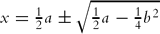 would be written in this way (read from right to left, of course):
The most important figure associated with the revival of the spoken Hebrew language, Eliezer ben-Yehuda (1858–1922), emerged from the same kind of Haskalah background. Born in the town of Luzhky, near Vilna, and strongly influenced in his youth by the Haskalah movement, he moved to Jerusalem in 1881. Very soon after his arrival, he started working towards establishing Hebrew as the language to serve as the everyday means of communication for Jews coming to Palestine from all regions of the world. He regarded this common language as the key ingredient for the national revival of the Jewish people. At the turn of the twentieth century he established the Vaad Halashon Haivry (Committee for the Hebrew Language) which would become the most prominent vehicle for the realization of his plans; in 1953 it became the Academy of the Hebrew Language. The Vaad was actively directed by a group of Hebrew teachers intent on “adapting the Hebrew language for use as a spoken language in all aspects of life: at home, at school, in public life, in commerce, in industry, in art, and in science.” As part of their efforts, they periodically published lists of new terms to be used in various aspects of life. In many cases the lists played a central role in creating the current lexicon of the Hebrew language as spoken nowadays in Israel. In 1913, they published one such list containing mathematical terms, such as the following:
Besides the Vaad, various primary and secondary schoolteachers’ associations took upon themselves the task of turning Hebrew into the main and only teaching language in schools of the Yishuv (the Jewish residents of Palestine). Fierce theoretical discussions, as well as open power struggles, arose occasionally between these teachers’ associations and the Vaad. The teachers were of the clear opinion that the members of the Vaad (mostly inhabitants of Jerusalem) lacked the professional qualifications that they had in the various fields of school learning and, moreover, that their own day-to-day experience in the classroom of all rural and urban areas of the Yishuv, put them in a much better position to develop the necessary lexicons to be used in their work (see Efrati Reference Efrati2004, 49–80).
One person soon distinguished himself as an independent developer of the adequate Hebrew mathematical lexicon: Dr. Avraham Baruch Rosenstein (1881–1950), a renowned mathematics teacher at the emblematic Gymnasia Herzliya in Tel-Aviv (see Razi-Stein Reference Razi-Stein1991). The Gymnasia was established in 1905, as the first high-school to conduct its teaching entirely in the Hebrew language. The city of Tel Aviv – “the first Hebrew city” – was founded 11 April 1909. Hebrew rapidly took over the city in all day-to-day activities. Still, the lack of a proper language in all fields of study was felt to be a problem at the Gymnasia, with some of the founding teachers suggesting that scientific disciplines ought to be taught in French.
Rosenstein joined the staff of the Gymnasia in 1911 shortly after completing a dissertation in mathematics in Vienna. He immediately undertook the task of creating an appropriate lexicon for his teaching, and, more importantly, of writing the necessary textbooks in all fields of high school mathematics and physics. Over the years, he authored or co-authored twenty-five books that continued to be used across the country until the 1950s. As an enthusiastic former student put it, thanks to the efforts of Rosenstein, high-school pupils at Gymnasia Herzliya “spoke algebra, geometry, trigonometry, logarithms and differential calculus as if these disciplines had been created and initially taught in Hebrew” (see Ben Yehuda and Ofek Reference Ben Yehuda and Ofek1971, 83–84).
In his quest for a modern mathematical lexicon, Rosenstein went back to ancient Hebrew sources, including Levi ben Gerson and the medieval sage Avraham Bar Hiyya (1070–1136) who wrote on arithmetic and geometry. He also consulted more recent Hebrew scientific authors such as Slonimski. As early as 1912, he was teaching summer seminars on the Hebrew mathematical lexicon to teachers from all around the Yishuv. The participants of his seminars decided to write to the Vaad demanding that they define their mathematical lexicon based on the suggestions of the teachers’ association (which were actually Rosenstein's) (see Efrati Reference Efrati2004, 71). The list published by the Vaad in 1913 from which we quoted above shows that this demand was not met.
Here are some examples of Rosenstein's lexicon:
It is important to stress that, while rejecting the specific mathematical choices of the Vaad, the neologisms introduced by Rosenstein did often follow some new kinds of general declensions, introduced into Hebrew by the Vaad with the explicit aim of allowing the consistent production of a broad range of neologisms based on existing roots. Thus, for instance, Rosenstein's “chezkah” was an adaptation of the root  (chazak) to one such new type of declension.
Rosenstein's lexicon is still essentially the one used to this day for all aspects of mathematical Hebrew. No less important than the lexicon itself in shaping the new Hebrew mathematical language, however, was Rosenstein's decision to use Latin characters for all mathematical and physical equations and formulae, rather than Hebrew ones as Slonimski had done previously. Rosenstein wrote them from left to right, as in any European text, and this is the way that equations continue to be written in Hebrew scientific texts.
Landau adopted Rosenstein's lexicon for his 1925 speech without exception, and continued to follow it during his mathematical activity in Jerusalem in 1927–28. It may be assumed that he was aware of earlier Hebrew texts such as Slonimski's, and he may have given some independent thought to the question of a Hebrew mathematical lexicon. But the choice may have also been decided by the person – or persons – who taught him Hebrew. Just who this was, seems not entirely certain.
It is said, if not documented,Footnote 59 that Landau learned Hebrew “quickly”Footnote 60 with the help of Jacob Levitzky (1904–1956), and it is implied that the 1925 public lecture was his immediate reason for learning Hebrew. In Landau's letter to Magnes written from Hotel Quellenhof in Bad Wildungen (a spa South of Göttingen) on 22 March 1927,Footnote 61 he mentions, without giving dates, that he “arranged for a Hebrew teacher to move to Göttingen to teach” him the language. But Jacob Levitzky appears to have lived in Germany continuously from 1922 through 1929 (see Hasse and Noether Reference Hasse, Noether, Lemmermeyer and Roquette2006, 92). He would finally earn his doctorate in Göttingen with Emmy Noether in 1929. Emmy Noether subsequently tried to find a position for him somewhere, stressing that there was “nothing unpleasantly Jewish” (nichts von unangenehm jüdisch) about him.Footnote 62 Furthermore, Abraham Fraenkel tells us that Levitzky helped him with Hebrew conversation in Kiel during the Winter term 1928/29 (see Fraenkel Reference Fraenkel1967, 156). Even though Fraenkel's memoirs are not a very reliable source in general, the fact that Fraenkel does not mention Levitzky when he discusses Landau's rapid learning of Hebrew, suggests the possibility that the Hebrew teacher that Landau brought to Göttingen may have been somebody else.
Now, a former student of the Gymnasia Herzliya, Binyamin Amira – who subsequently also taught in the Gymnasia for a while – was Landau's student and assistant at Göttingen during five semesters, between 1922 and 1924 (see Katz Reference Katz2004, 207–208, cf. Fuchs Reference Fuchs1989). If it was indeed with Amira that Landau learnt Hebrew in Göttingen, Rosenstein's mathematical terminology would have naturally been part of it.
Finally, let us mention the so-called Language War in Palestine which broke out in 1913. The dispute was about the place of revived Hebrew as the official instructional language for the schools of the Yishuv. Indeed, Jewish educational institutions had been established at the end of the nineteenth century not only by Zionist initiative, but also as part of the efforts of European Jewish philanthropic organizations such as the French Alliance Israélite Universelle and the German Hilfsverein der Deutschen Juden. The Hilfsverein, for instance, was established in the wake of the great pogroms of the late nineteenth century, with the aim of providing welfare to East-European Jews and helping them immigrate to various places in the world via Germany. They also promoted German culture among non-German Jews in places like the Balkans and the Middle East, and built educational institutions in Eastern Europe and in Palestine (see Moose Reference Mosse1989, 80–92, and Rinot Reference Rinot1972).
From the outset, some of the schools built in Palestine by the Hilfsverein were as committed as any other in the Yishuv to the revival of Hebrew. Hebrew was taught in them, but not always exclusively, and certainly there was no official decision to this effect (see Elboim-Dror Reference Elboim-Dror1986, 242–240). In 1907, the director of the Hilfsverein, Paul Nathan (1857–1927), came up with a new, important initiative of establishing an institution of higher learning for engineering in Haifa, the Technikum – which eventually became the Technion – as well as a Realgymnasium working closely with it – which eventually became the Hebrew Reali High School of Haifa. Against the background of a technological gap increasingly felt at the time in the Ottoman empire, and following an argument that Max Simon would also develop a few years later (Simon Reference Simon1916, 61), Nathan assumed that the Jewish population of Palestine, if properly trained in the German technological tradition, would be a welcome contribution to the development plans then encouraged by the Ottoman government. Moreover, the rise in the level of living that would ensue from a technologically supported economical development in the region would increase its appeal as a target of immigration for Jews all around the world.
Nathan's initiative was greatly welcomed by the Yishuv, but in 1913, as the construction of the new buildings for the Technikum and the Gymnaisum had almost been completed, the Board of Governors of the Hilfsverein in Berlin passed a decision to the effect that all teaching in the Technikum would be in the German language. The reason behind this decision was the assumption that no adequate Hebrew books existed that could be used for advanced technological teaching and it thus seemed obvious to Nathan and his colleagues in Berlin that German books would be used anyway. The decision triggered furious opposition of unprecedented intensity among the local Jewish population. Teachers of the Jerusalem Teacher's Seminar (an institution created and supported by the Hilfsverein) renounced their posts, while students went on strike. The intense emotions that this debate sparked are manifest in an open letter signed by Ben-Yehuda and some representatives of the teachers’ associations:
The Kuratorium of the Technikum in Berlin has decided that all general sciences will be taught in the Reali School and in the Technikum in Haifa not in Hebrew but in a foreign language. This decision is an open attack against the soul of the Hebrew nation and we consider it to be a national disaster.
We do not oppose the detailed study of any foreign language in the Hebrew schools in the Land of Israel, but no foreign language should be allowed to be the official teaching language, as no such right exists in the schools of any other nation.
An entire generation has worked hard for the sake of the revival of our language as a language of schools and of life, and we will not let anyone convert us in matters of language, much as we would not let anyone convert us in matters of religion.
The language is the soul of the nation. The revival of our language is the basis for the renewal of our people.
In order for others to recognize our right to our language, it is first necessary that the people of Israel will defend the language of Israel, and will bring it to absolute rule in all schools in the Land of Israel.
The Hebrew Language, which is the natural bridge among all parts of our people, must by all means be the learning language of all of our schools, be they Orthodox or non-Orthodox.
The Hebrew language is sacred to us and we will fight on behalf of it, much as our ancestors fought for the sanctity of the nation. (Quoted in Efrati 147)
The “war” ended in February 1914 with a full victory for the Hebrew camp. The Hilfsverein agreed that teaching of mathematics and physics at the Technikum would be in Hebrew, and that all teachers not yet fluent in Hebrew will be compelled to learn the language in four years. Nevertheless, budget problems and the outbreak of World War I delayed the opening of the institution for several years. The first course was taught there only in 1924, and the official ceremony of inauguration was held 6 February 1925. By this time, the British Mandate had passed a decision in 1922 that recognized Hebrew as one of its official languages, alongside English and Arabic. Less than two months later Landau gave his speech at the inauguration of the Hebrew University. There was no discussion then that Hebrew would be the official language of this new institution of higher learning.
6. Edmund Landau's 1925 addresses, translations, and notesFootnote 63
Landau's toast at the laying of the foundation stone of the Wattenberg Building, Jerusalem April 1925 (Landau Reference Landau1925a)
I thank you for the honor of having invited me as the representative of the mathematical sciences to deliver some words at this celebration of the cornerstone laying of the Institute for Mathematics and Physics.
Mathematics and physics are sister disciplines. Because of their large size, it would be impossible to house both of them within the same building in any of the great European universities. But here in Jerusalem we are just founding a university today, and we can lay a common cornerstone for a building where the two sciences which have so many points of contact will be cultivated.
As for mathematics itself: it is well known how formidable a role Jews of the European countries played in the development of this science. It is my wish and hope that from among the walls of the building we are founding today, JewryFootnote 64 will continue to impart upon mankind many deserving gifts in the form of discoveries and inventions that will be important for fundamental research and valuable in practice.
May great benefit emerge from this house dedicated to pure science, which does not know borders between people and people. And may this awareness emerge from Zion and penetrate the hearts of all those who are still far from this view.
Landau's mathematical lecture, Jerusalem April 1925 (Landau Reference Landau1925b)
Professor Yehezkel-Edmund Landau Solved and Unsolved Problems in Elementary Number Theory
I have acceded with pleasure to the kind request to lecture on one of my research topics, and I am choosing that part of mathematics whose problemsFootnote 65 are more easily understood by the layman. These problems arise in a natural way whenever we come to calculate with the ordinary, natural numbers 1, 2, 3,. . . . No fractions are encountered in these problems, let alone irrational numbers. The problems can thus be understood even by anyone who is not a professional mathematician and has forgotten school mathematics. But I hasten to add that the solutions to many problems that seem to arise naturally and look like they are very easy to deal with, have not been achieved even with the help of all the tools of modern mathematics and in spite of the efforts of the greatest mathematicians from all peoples of the world. For the purpose of this lecture, it is of course adequate not to give the proofs even for those problems that have been solved.Footnote 66 All I want to present to you are some problems concerning whole numbers, solved ones and unsolved ones, which will be found easy to understand.
The concept of prime number has been known for thousands of years. A prime number is a number a greater than 1 for which there is only one way to decompose it into two integral positive factors (as 1 · a or a · 1). Such a number therefore cannot be divided by any natural number other than 1 and the number a itself. For example, 2, 3, 5, 7, but not 4 = 2 · 2, 6 = 2 · 3. The ancient Greeks already knew that it is possible to make up every number greater than 1 in a unique, fixed way from prime numbers.Footnote 67 Thus for instance 2 · 2 · 3 = 12. And so here is already
Problem 1. Are there as many prime numbers as infinity?Footnote 68 For, by way of logic alone, one might think, for instance, that 1000 prime numbers would suffice to construct all the numbers, since we are allowed to use every building block as many times as we wish. Likewise, from the prime number 2 one can make up, if not all numbers, certainly as many numbers as infinity. Namely, the powers of 2: 2, 4, 8, . . . .
This problem was solved two thousand years ago by Euclid, who showed that there are infinitely many prime numbers.Footnote 69
Problem 2. Are there as many prime numbers as infinity ending in 5 or in 24? Answer: no. In the first case, 5 is the only such prime number, since any number ending in 5 is divisible by 5. In the second case, there is not a single such prime number, since every number ending in 24 is divisible by 4.
Problem 3. Are there as many prime numbers as infinity ending in 21? A positive answer to this question is one of the greatest achievements of one of those mathematicians who preceded me in Göttingen, Dirichlet. He proved the following theorem in general:Footnote 70
In every arithmetic progression whose first term and increment Footnote 71have no common factors there are as many prime numbers as infinity.
That is to say: let us start with a fixed number ℓ (here 21) and let us continually add a second fixed number k (here 100), having no common factor with ℓ. The sequenceFootnote 72 of numbers thus obtained contains as many prime numbers as infinity. Had ℓ and k a common factor, then the answer would be negative, as in the exampleFootnote 73 ℓ = 24; k = 100 of Problem 2. It should not have been difficult to guess this result, since if we tossed an infinite number of objects (the prime numbers) into 100 boxes (corresponding to the one hundred numbers written with two digits), why wouldn't infinitely many objects end up in every one of the boxes? This is not, however, a proof of Dirichlet's theorem. If it were, then there would also be infinitely many prime numbers ending in 24, which is not the case, as was explained above. The proof was, as I said, a great achievement of which German mathematics can be proud.Footnote 74 Dirichlet's proofs succeeded only through the use of deep auxiliary means related to infinite series, and even today one cannot prove the theorem in a very short way.
Problem 4. Can two consecutive prime numbers be found such that the difference between them is as large as we wish? For instance, no other prime number exists between the prime numbers 863 and 877. The difference between these two neighboring prime numbers is thus 14. Can this distance sometimes be >100, >1000, etc.? Answer: yes, and it is not difficult to explain this matter. As an exception, I would like to present the proof here. Let n > 1. Let us look at the numbers:

These are successive numbers of which we can have as many as we wish. They are composite numbers (i.e., they are not prime numbers), since they are divisible, respectively, by 2, 3, . . ., n, and they are different from these factors.
Problem 5. Does the difference 1 appear as many times as infinity? Answer: no. Because starting with 1, all prime numbers are odd.Footnote 75
Problem 6. Does the difference 2 appear as many times as infinity? (It is known that this difference does appear several times; for example,Footnote 76 17, 19; 101, 103.)Footnote 77 The devil knows. What I mean is that besides God Almighty no one knows the answer, not even my friend Hardy in Oxford, who among all those who work with me is the most profound researcher in this field of research.
Problem 7. 4 = 2 + 2, 6 = 3 + 3, 8 = 3 + 5. Perhaps all other even numbers are also sums of two prime numbers? I cannot tell.Footnote 78 There are recent investigations in this direction, but they are still far away from the aim they set themselves, to answer this question.Footnote 79
Problem 8. Are there as many prime numbers as infinity of the form x 2 − 1, i.e., that come right before a square number? (For instance, like the numbers 3, 8, 15, 35.) Answer: no. Because x 2 − 1 = (x + 1) · (x − 1), which is a composite number starting from x > 2.
Problem 9. Are there as many prime numbers as infinity of the form x 2 + 1? I do not know,Footnote 80 and I know that I do not know, and that it is unknown.Footnote 81
Problem 10. Same question for the formFootnote 82x 2 + 111y 2? Yes, this was proved by Dirichlet, again using his method.Footnote 83
Problem 11. Here a deeper question is asked, yet everybody can still understand it. After Dirichlet proved that there are infinitely many primes ending in 3 or in 7, it can be asked, in imprecise language, if the quantities of these numbers are of the same value, i.e., in precise language, if the ratio of these quantities up to a known place gradually approaches unity as much as we wish. Answer: yes. This was proved about 30 years ago by the Jewish mathematician Yaakov Hadamard in Paris, and by the excellent Belgian scholar de la Vallée Poussin.Footnote 84 I did this later in a much simpler way, and I proved for the first time a corresponding theorem in the theory of algebraic number fields,Footnote 85 a theory of which the ordinary theory of numbers is the simplest of its infinitely many particular cases.Footnote 86 Nevertheless, in this lecture I wanted in any case to only speak about the ordinary integers.
Problem 12. Is it possible to estimate the quantity of prime numbers up to x, by means of one of the ordinary elementary expressions depending on x, so that the estimation error will eventually become infinitely small relative to the real value? The greatest of all German mathematicians, Gauss, conjectured, yet only Hadamard and de la Vallée Poussin proved, that the simple expression  fulfills the said requirement.Footnote 87 The estimation of the error remained totally unchanged for 25 years and only a few months ago my friend Littlewood in Cambridge (Trinity College) was able to find a much sharper estimation.Footnote 88
After twelve problems I abandon the prime numbers. It is true that in most cases I confessed my lack of knowledge, and yet I want to add that I am the author of the only textbook on this topic and I did indeed manage to write 961 pages of solved problems of that kind, including in those pages many of my own investigations.Footnote 89
Problem 13. Let us observe the sequence of square numbers 0 · 0 = 0; 1 · 1 = 1; 2 · 2 = 4; 3 · 3 = 9; 4 · 4 = 16; etc. This sequence does not contain all the integers. We ask: can all numbers, perhaps, be decomposed as sums of two squares? No, as the example of number 3 teaches us. Can we perhaps represent every number as a sum of 3 squares? No, the number 7, for instance, cannot be written in this way. Perhaps as a sum of 1000, or of another, fixed number of squares? Yes, because Lagrange proved 150 years ago that every number decomposes into four squares.Footnote 90 For instance: 98 = 81 + 16 + 1 + 0.
Problem 14. Is there such a fixed number also for positive cubes (including 0), for fourth powers, etc.? For k-th powers? It is possible, of course, that this fixed number depends on k. Answer: yes. This is the famous “Waring's conjecture” of 1770, and only after 139 years, in 1909, was it proved by my friend David Hilbert in Göttingen.Footnote 91
Problem 15. Let us stay with the simplest case of cubes. What is the smallest number of summands which suffices to produce any number by adding? The number 23 requires, so it seems, 9 cubes, since there is no shorter decomposition than 8, and another 8, and another 7 units. The best number can therefore not be smaller than nine. And indeed, 9 cubes always suffice, as should be understood from an article by Wieferich.Footnote 92 From a given point on, even 8 cubes suffice, as I myself have proved.Footnote 93
Problem 16. I continue with the cubes. What is the smallest number of cubes that suffices for any large number? From what was said, it is 1 or 2 or . . . or 8. It is proved without difficulty that the desired number cannot be smaller than 4. Whether it is 8, or smaller than 8, it is not known to this day.Footnote 94
Problem 17. Even if we are asked to decompose all numbers into s cubes, except for some of them up to a percentage which is as small as we wish, then the smallest such s will be at least 4, which is easy to prove, and not greater than 8, as already said above. Here Hardy and Littlewood proved recently that the correct number is not greater than 5.Footnote 95 Thus, the number is either 4 or 5.Footnote 96 To summarize: almost all numbers decompose into 5 cubes. The ways of their proof are more beautiful and marvellous than anything else I have seen and studied in my life. They were also able to determine the exact amount corresponding to bi-squares (= fourth powers). That number is 15. I could never imagine that still in our time someone would be able to solve this mathematical problem that seems intractable to the initiated. To present their proof for bi-squares and for all k > 4 took in my class 2 months, at 4 hours a week.
Problem 18. This is actually but an example, in which we will be able to ask the question only after we have given the answer. Let us order according to their size all the reducedFootnote 97 fractions between 0 and 1, with denominator up to n. Thus for instance, for n = 7:

we thus see that for any two neighboring fractions  and
 the number bc − ad (which is always positive, of course, since
 ) always equals 1, and it is also easy to proveFootnote 98 this fact.Footnote 99
Problem 19. A classical theorem in number theory (due to Fermat in the seventeenth century) states: let p be any prime number, then 2p − 2 is divisible by p. For instance, 25 − 2 = 30 is divisible by 5. And in general, ap − a is divisible by p. And now I ask: does it sometimes happen that 2p − 2 is divisible by p 2, and whether this happens infinitely often? The answer to this question has an enormous importance for a well-known application.Footnote 100 Some such numbers p are known. But it is not known if there are infinitely many, or perhaps if there is no such p after a certain p which may be known. The short time will unfortunately not allow me to show you the calculation that 21093 − 2 is divisible by 10932.Footnote 101
Problem 20. The next problem belongs to geometry, but Gauss, with the help of algebra, turned it into a question of number theory. One learns at school that one can draw inside a circle, with the help of ruler and compass, regular polygons of 3, 4, 5, 6, 8, 10, 12, 15, 16, 20 sides, and infinitely many others. (That is, polygons with 2a + 2, 2a + 2 · 3, 2a + 2 · 5, 2a + 2 · 3 · 5 sides, where a is any integer >0). Let n denote the number of sides in the polygon. Then the following question is asked: is that construction possible for any number n? Or: for which n is the construction not possible? Gauss proved: the construction is impossible for the case n = 7. This proof is not extremely difficult. The construction is possible for the case n = 17. This was one of his greatest inventions and the corresponding diagram is part of his memorial monument in the city of Braunschweig. In general, the construction is possible only in cases where n contains each of its odd prime factors only once, and every such prime factor is of the form 22m + 1, the number m being positive or equal to zero. If m = 0, then we obtain n = 3. If m = 1, then we obtain n = 5. If m = 2, then we obtain n = 17. If m = 3, then we obtain n = 257. If m = 4, then we obtain n = 65537. And now the question arises whether these Gaussian prime numbers are infinitely many. The answer: I do not know. And it is unknown how to prove whether there is any such number after 65537. There may perhaps be none, or perhaps some, or perhaps infinitely many.Footnote 102
Problem 21. With the help of number-theoretical methods also the geometrical problem of the quadrature of the circle was solved. Forty years ago, my teacher Lindemann in Munich proved that it is impossible to transform a circle into a square with the help of ruler and compass. The important point in his proof is that he demonstrated that the well known-number π is not a root of an equation with integer coefficients; that this number is, as is usually said, transcendental.
Problem 22. In geometrical language: the curve x 2 − Dy 2 = 1 (where D is a positive integer) is a hyperbola. Are there infinitely many lattice-points on this curve? (Lattice-points are points with integer coordinates.) In arithmetical language: does this equation in the variables x and y have infinitely many solutions which are integers? If D is a square, = E 2, then the answer is negative, because in this case (x + Ey) · (x − Ey) = 1; that is to say (x + Ey) = (x − Ey) = ±1, and therefore there are only two solutions x = ±1, y = 0. For any D which is not a square and is > 0, Lagrange proved that there are infinitely many solutions.Footnote 103
Problem 23. For the problem corresponding to the previous one, where the left-hand side of the equation has an expression in x and y of degreeFootnote 104 >2 which cannot be factorized, and on the right hand side, instead of 1, any integer may appear, the Norwegian mathematician Thue proved the unexpected fact that there is always only a finite number of solutions.Footnote 105
At this number of twenty-three problems I want to stop, because twenty-three is a prime number, i.e., a very handsome number for us.Footnote 106 I am certain that I should not fear to be asked by you, for what purpose does one deal with the theory of numbers and what application it may have. For we deal with science for the sake of it,Footnote 107 and dealing with it was a solace in the days of internal and external war that as Jews and as Germans we fought and still fight today.Footnote 108
Acknowledgments
Hearty thanks go to collegaues who have read earlier versions of this paper and provided precious information and advice: Shaul Katz, Alexandre Métraux, David Rowe, Reinhard Siegmund-Schultze, Shula Volkov.


 ] of the imaginary quadratic field Q(
 (see, for instance, Landau
 = +1 forces p into an arithmetic progression of increment 4n.


 ); there the statement is called Theorem 28 and proved in 3 different ways (all of them correct in the edition quoted).
 . Landau further refined and developed this result in Landau



