INTRODUCTION
Chrysopetalidae is a small polychaete taxon with 12 currently recognized genera and about 50 valid species (Tzetlin et al., Reference Tzetlin, Dahlgren and Purschke2002; Wiklund et al., Reference Wiklund, Glover, Johanessen and Dahlgren2009), although one species does not fit into a currently recognized genus. These taxa are keyed out in Muir & Bamber (Reference Muir and Bamber2008). The monophyly of the group is weakly supported by the presence of golden paleal notochaetae (Fauchald & Rouse, Reference Fauchald and Rouse1997), which were conversely regarded as a primitive feature by Westheide & Watson Russell (Reference Westheide and Watson Russell1992). Synapomorphic characters are clearly needed to clarify the position of the chrysopetalids within the Phyllodocida, since they have been alternatively treated as either a basal (Fauchald & Rouse, Reference Fauchald and Rouse1997) or derived clade (Pleijel & Dahlgren, Reference Pleijel and Dahlgren1998). A cladistic analysis by Dahlgren et al. (Reference Dahlgren, Lundberg, Pleijel and Sundberg2000) indicated a well-delineated chrysopetalid clade but was inconclusive on the identification of the sister-group, which may be either the hesionids or nereidids. Unfortunately none of the recent major phylogenomic analyses of annelids (Zrzavý et al., Reference Zrzavý, Řiha, Pialek and Janouskovec2009; Struck et al., Reference Struck, Paul, Hill, Hartmann, Hösel, Kube, Lieb, Meyer, Tiedemann, Purschke and Bleidorn2011) included chrysopetalids as a terminal taxon.
Most epibenthic shallow-water chrysopetalids share typically flattened notochaetae (Dahlgren et al., Reference Dahlgren, Glover, Baco and Smith2004). These paleae cover the dorsum completely and most probably act as functional scales, similar to those of some other Phyllodocida families sensu Fauchald & Rouse (Reference Fauchald and Rouse1997). By contrast, these paleae are typically missing or are replaced by chaetal spines with D-shaped cross-sections in a group of still poorly-known, smaller (<1 cm long) infaunal forms, usually with 20–80 segments, made up of Acanthopale, Dysponetus and Vigtorniella, as previously suggested by Dahlgren & Pleijel (Reference Dahlgren and Pleijel1995) and Pseudodysponetus Böggemann, Reference Böggemann2009. These roundish rather than flattened notochaetae do not cover the dorsum completely (Tzetlin et al., Reference Tzetlin, Dahlgren and Purschke2002). This species group is present at both shallow and abyssal depths, associated with coarse substrata, whale remains (Wiklund et al., Reference Wiklund, Glover, Johanessen and Dahlgren2009) or muddy deep-sea basins (Böggemann, Reference Böggemann2009). Dysponetus was formally delineated by the presence of circular notochaetae, a mouth appendage, a single pygidial projection and accessory simple neurochaetae (Dahlgren, Reference Dahlgren1996).
Tzetlin et al. (Reference Tzetlin, Dahlgren and Purschke2002) carried out scanning electron microscopy (SEM) studies of Chrysopetalum and Dysponetus but found no circular muscle fibres. To determine whether the transverse muscle elements observed were parapodial muscles or reduced circular muscles, a reconstruction of the entire muscle system was carried out in the small species Dysponetus pygmaeus Levinsen, 1879 by labelling muscle fibres and using confocal laser scanning microscopy. Proof of the absence of circular fibres in the Chrysopetalidae would be of special interest because this taxon is considered to possess several plesiomorphic characters and to be close to the annelid stem species by some authors (Butterfield Reference Butterfield1990, Reference Butterfield1994; Westheide & Watson Russell, Reference Westheide and Watson Russell1992; Butterfield & Nicholas, Reference Butterfield and Nicholas1996; Dahlgren, Reference Dahlgren2000). An assessment of the phylogenetic significance of this feature would provoke a thorough reinvestigation of polychaete muscle systems.
With the exception of recently described or redescribed species (Dahlgren, Reference Dahlgren1996; Böggemann, Reference Böggemann2009), most of the twelve taxa currently referred to Dysponetus remain poorly known (Dahlgren, Reference Dahlgren1996, Reference Dahlgren2000). All the known species are minute and occur in a range of different habitats, such as calcareous algae, ‘Amphioxus sand' or deep-sea muds. They show a wider diversity of chaetal morphology than has been previously suggested (Dahlgren et al., Reference Dahlgren, Glover, Baco and Smith2004). Their small size, fragile bodies and marked contraction during preservation make it difficult to determine homologies of anterior parapodial structures. Given the lack of data on many Dysponetus species and their range of habitats and chaetal forms, it is possible that future work will show the genus, as currently defined, to be polyphyletic.
In this paper we describe a new Dysponetus species from shallow maerl beds located in the English Channel and the Bay of Biscay.
MATERIALS AND METHODS
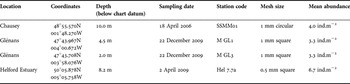
Specimens of Dysponetus joeli sp. nov. were collected from subtidal grab samples taken from the English Channel (Chausey Archipelago, Normandy, France; Helford Estuary, Cornwall, UK) or in the Bay of Biscay (Glénans archipelago, France), North Atlantic Ocean. All the specimens were associated with maerl beds which form very diverse but fragile habitats (Grall & Hall-Spencer, Reference Grall and Hall-Spencer2003). The samples were collected between 2006 and 2010 using Day, Van Veen or Smith–McIntyre grabs (1/10 m2, 15 cm substratum depth) and then sieved through a 0.5 or 1 mm mesh (Table 1), with the retained material fixed in buffered formaldehyde solution. The samples were sorted in laboratory and the specimens preserved in either 4.5% formaldehyde solution or 70% denatured ethanol.
Locations, geographical coordinates (WGS 84), depth, sampling dates, station codes, mesh sizes and mean abundances of the new species.

All observations and measurements were carried out on fixed specimens, without prior relaxation. Specimens were post-fixed for 1 hour in 1% osmium in distilled water. Dehydration was carried out by transferring them to 50%, 70%, 90% and 100% ethanol, each for 15 minutes, and then through at least two changes of 100% ethanol at 30 minutes and 1 hour. Specimens selected for SEM BAL-TEC CPD 030 (SEM) were critical-point dried and subsequently coated with 102 Å of gold with a SCD-030-BALZERS Union FL9496. They were examined with a GOL JSM6360LZ electron microscope, connected to a computer analyser at the Centro de Microscopia Eletronica, Universidade Federal do Paraná.
The phylogenetic position of D. joeli sp. nov. was tested using a dataset of morphological characters modified and expanded from Dahlgren (Reference Dahlgren2000), with additional species described by Böggemann (Reference Böggemann2009) and in this paper. Polarity determinations were carried out by outgroup comparison with Acanthopale perkinsi, Chrysopetalum debile, Paleanotus chrysolepis, Vigtorniella zaikai and Pseudodysponetus fragmentosus. These are accepted taxa which belong to the chrysopetalids, a family still in need of further phylogenetic investigation to assess its internal affinities. All characters were treated as unordered. Under this method, when a character state is scored as absent, all dependent characters are scored as inapplicable, yet parsimony programs treat lack of information (?) and inapplicable characters (–) identically (Pleijel, Reference Pleijel1995). The matrix was analysed using the parsimony method, with the software Mesquite version 2.74 (Maddison & Maddison, Reference Maddison and Maddison2010). All useable characters were included in the matrix. Tree search using a heuristic search was carried out with 100 replicates of random taxa. The unrooted majority rules consensus tree was chosen to trace the history of all characters and to describe the phylogenetic position of the new Dysponetus material among other Dysponetus species. Each character's history was estimated using the reconstructed method with parsimony ancestral state implemented in Mesquite version 2.74 (Maddison & Maddison, Reference Maddison and Maddison2010).
Holotype and paratypes of the new species are deposited in the collections of the Muséum National d'Histoire Naturelle of Paris (France).
SYSTEMATICS
DESCRIPTION
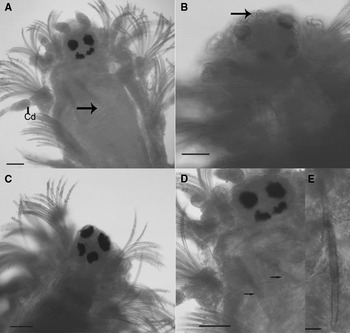
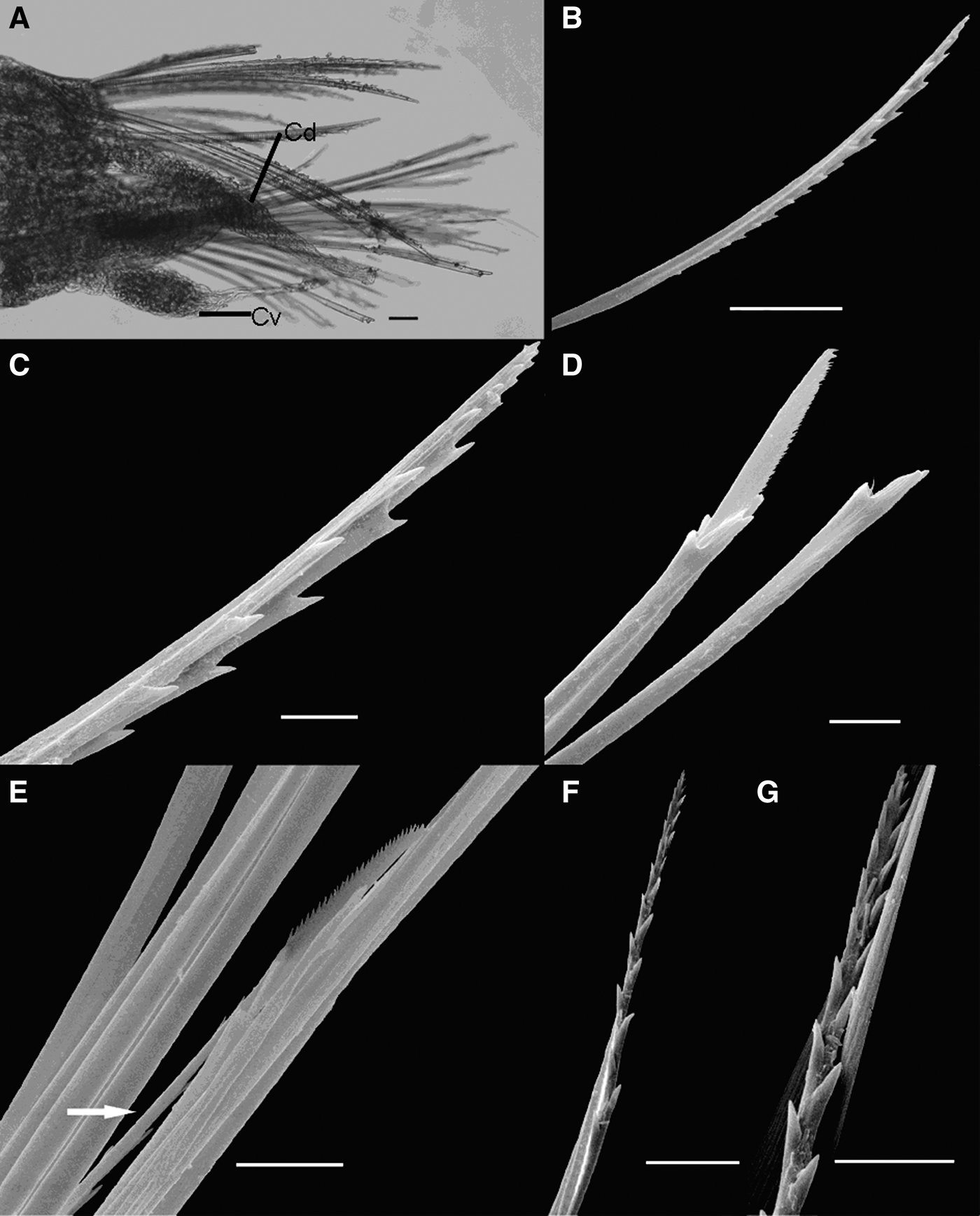
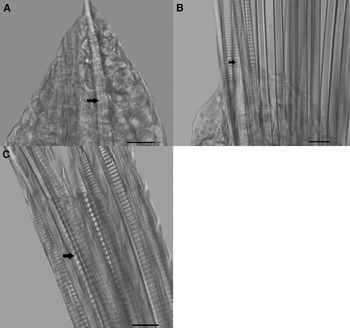
Holotype 3.1 mm (MNHN POLY TYPE 1533, Chausey) for 19 segments, posterior part missing (Figure 1). Paratype, 3 fragments of a posteriorly incomplete individual (MNHN POLY TYPE 1534, Chausey). Holotype width 0.17 mm without parapodia, constant all along the body, with the exception of successively smaller 3–4 posterior segments, which renders the body posteriorly tapered, not wider than 0.13 mm. Fixed specimens whitish, opaque, eyes reddish, with golden chaetae. Four additional paratypes (2 from Glénans, MNHN TYPE 1536 and MNHN TYPE 1537 and 2 from the Helford Estuary, MNHN POLY TYPE 1535) were examined. Two SEM preparations were also deposited as MNHN POLY TYPE ADD. 1533 and ADD. 1536. Body very small (between 3.5 and 4 mm in all examined specimens), cylindrical, truncate and ventrally flat. Prostomium trapezoidal to rounded, longer than wide, surrounded laterally by first two segments. Four large eyes, evident even in fixed specimens. Diameter of anterior pair of eyes two to three times that of posterior ones, which are closer together. Pigments concentrated on posterior half of the first pair of eyes and on anterior half of the latter, in a typically inverted pattern (Figure 1A–D). Median and lateral antennae missing in holotype and paratypes, but prostomial scars visible subdistally. Palps stout, oval, twice as long as wide, not extending ventrally but ventral subdistal scars visible at the sides of the pronounced single buccal appendage, with blunt tip, on lower lip (Figure 1A–B). Pharynx visible through body wall, extending at least to segment 8. Musculature of pharynx resembles that of syllids, with single pair of harpoon-shaped chitinous jaws 0.059 mm long (Figure 1A, D & E), golden as seen through body wall, but not evident in all examined individuals. First two segments with tentacular cirri, one pair per segment (Figure 1A). First segment achaetous, with dorsal cirrus scar. Second segment with notochaetae only. Two anterior segments dorsally displaced and encircling the head. Notochaetae are ventral heterogomph bidentate falcigers (successively longer upwards); ventral cirri globular–elongated, present in all remaining segments. At least 11–12 neurochaetae per fascicle. Parapodia biramous from segment 3; notopodia reduced; broadly rounded dorsal cirri conical with an elongated digitiform distal part, inserted posteriorly on lower side of notopodia and less developed than ventral cirri (Figure 2A). Single protruding noto- and neuroaciculae in each parapodium (Figure 3A–B). Notoaciculae strongly evident in segment 1. Notoaciculae and neuroaciculae clearly chambered (barred), as seen through parapodial lobes or dissected (Figure 3B, C). Notopodial lobes 3 to 5 times less pronounced than neuropodial lobes (Figure 2A). Notochaetae internally chambered (barred), D-shaped in cross-section, with 14–18 alternating denticles in each of two dorsal rows, clearly separated by a sulcus or median fissure. Denticles are truncate but sharply pointed (Figure 2B, C). Barred sections of notochaetae, arranged in two chambers (Figure 3B), extend for about 2/3 of total chaetal length down to the insertion point in body wall, where chaetae display a small torsion. About 20 notochaetae per fascicle. Neuropodia well developed, elongate and tapering. Neurochaetae of two types:
(1) compound heterogomph finely bidentate falcigers (Figure 2D): 20–25 in each anterior and mid-body parapodium. Blades finely dentate for about 1/5 the length of whole chaeta when fully developed but shorter in the ventral part of the bundle. Articulation protected by a hyaline veil, and more robust (small peak) at the insertion point of blade;
(2) 2–4 simple chaetae placed dorsally in each neuropodial fascicle, closely similar to notochaetae, but smaller, more curved and with two rows of spines not separated by a sulcus or median fissure as in the notochaetae (Figure 2 E–G).
(A–D) Variation in the appearance of eyes in Dysponetus joeli sp. nov. fixed animal: (A) paratype Glénans, anterior part, with a pair of stout palps and syllid-like proboscis (arrow) and (B) holotype, scar of median antenna; (D–E) paratype Glénans, harpoon-shaped chitinous jaws. Cd, dorsal cirri. Scale bars: A–D, 50 µm; E 10 µm.

(A) Median parapodium of Dysponetus joeli sp. nov. with dorsal cirrus inserted posteriorly on lower side of notopodium and elongate ventral cirrus; (B) overall view of a notochaetae; (C) details of notochaetae, with two rows of alternating denticles; (D) neurochaetae (compound heterogomph finely bidentate falcigers); (E) fascicle of simple dentate neurochaeta indicated by arrow; (F–G) details of simple neurochaetae, with two rows of alternating denticles. Cd, dorsal cirri; Cv, ventral cirri. Scale bars: A–B, 50 µm; C–F, 10 µm; G, 5 µm.

(A) Notoacicula (indicated by arrow); (B) neuroacicula (arrow) and barred neurochaetae (arrow) of Dysponetus joeli sp. nov.; (C) barred notochaetae. Scale bars: A–C, 10 µm.

Pygidium with a single projection, inserted posteroventrally, macerated in the only complete individual (MNHN TYPE 1536), with no visible cirri or similar structures. Eggs visible in fragmented posterior segments in paratypes from Glénans.
REMARKS
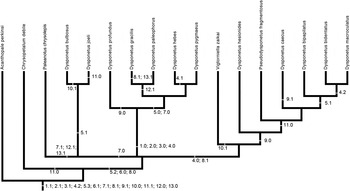
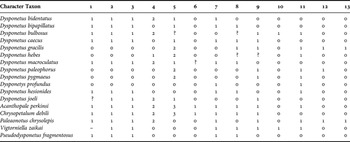
Table 2, modified from Dahlgren (Reference Dahlgren2000), compares Dysponetus joeli sp. nov. to all the other congeneric species and Figure 4 delineates its phylogenetic relationships with other members of the Dysponetus group. Dysponetus joeli differs from congeneric species by a unique combination of characters, including a large syllid-like pharynx, 2–4 simple serrated neurochaetae (closely similar to notochaetae, but much smaller and more delicate), D-shaped chaetal spines and ventral cirri on the third segment. The serration of the simple neurochaetae clearly differs from those previously reported for Dysponetus caecus (Langerhans, 1880) in the redescription provided by Dahlgren & Pleijel (Reference Dahlgren and Pleijel1995). Although a more thorough analysis and additional data, both morphological and molecular, would be necessary for a full resolution of the phylogeny and potential cryptic species, it is important that species are described soon after discovery to allow new records to be made for ecological and conservation studies. For this reason, we have provisionally defined the species using a unique combination of characters and regard it as a hypothesis (Fitzhugh, Reference Fitzhugh2005) available for testing with more complete data at another time.
Delineation of Dysponetus joeli sp. nov. in a phylogenetic analysis of 14 dysponetid taxa with Acanthopale, Chrysopetalum and Paleanotus as outgroups; unrooted majority rules consensus tree computed from three original trees 30 steps (CI = 0.53, RI= 0.73).

Character matrix of Dysponetus species (expanded and modified from Dahlgren, Reference Dahlgren2000). Question marks represent missing values, dashes represent missing characters in examined specimens. Numerals correspond to the characters in the list below, and numerals within parentheses to the character states.

Obs: distinct eyes are absent in D. hesionides, but some specimens have pigmented eye-like spots; antennae of P. fragmentosus are biarticulated.
1. Shape of median antenna: sphaerical (0); elongated (1).
2. Shape of lateral antennae: sphaerical (0); elongated (1).
3. Shape of palps: spherical (0); elongated (1).
4. Eyes: absent (0); one pair (1); two pairs (2).
5. Mouth appendage: absent (0); single papilla (1); double papillae (2); puriform projection (3).
6. Caruncule: absent (0); present (1).
7. Ventral cirri segment 1: absent (0); present (1).
8. Ventral cirri segment 2: absent (0); present (1).
9. Ventral cirri segment 3: absent (0); present (1).
10. Notochaetae on segment 1: absent (0); present (1).
11. Neurochaetae on segment 2: absent (0); present (1).
12. Shape of main fan notochaetae: spines (0); paleae (1).
13. Long spinigerous neurochaetae: absent (0); present (1).
The presence of eyes and reduced notopodia with conical dorsal cirri, inserted posteriorly on the lower side of notopodia, are characters shared by D. caecus, D. joeli and A. perkinsi (see San Martín, Reference San Martín1986; Böggemann, Reference Böggemann2009). According to Dahlgren (Reference Dahlgren1996), eyes are usually visible in live specimens, but may disappear in fixed material, as in Dysponetus bipapillatus. Based on morphological characters, Dahlgren & Pleijel (Reference Dahlgren and Pleijel1995) examined the generic allocation of the closely related Chrysopetalum caecum (Laubier, Reference Laubier1964, Reference Laubier1968) in a parsimony analysis together with the type species of the other chrysopetalid genera. Since their results indicated that C. caecum shares a more recent ancestor with members of Dysponetus than with any other chrysopetalid genus, it was accordingly transferred from Chrysopetalum to Dysponetus. Dysponetus caecus was redescribed from collected specimens from France (Mediterranean), Scotland, and Sweden, and a neotype was designated from Banyuls-sur-Mer, France. The presently known distribution for D. caecus ranges from the western Mediterranean and Madeira to northern Europe (Dahlgren, Reference Dahlgren2000).
Most of the Dysponetus species have an achaetous first segment with the exception of D. bulbosus which is described with notochaetae. The second segment exhibits more variation between taxa, but all known forms have dorsal cirri and chaetae. Some species of Dysponetus lack ventral cirri on the third segment (e.g. D. bidentatus, D. bipapillatus and D. macroculatus). As stated by Perkins (Reference Perkins1985) and Dahlgren (Reference Dahlgren1996), tentacular segments and head structures exhibit marked variation within the chrysopetalids. Due to head contraction during preservation in all D. joeli sp. nov. examined individuals, it is difficult to determine the development of anterior cirri, and dorsal and ventral rami of first two segments, since first segment is reduced and only indistinctly separated dorsally from prostomium.
According to Kisseleva (Reference Kisseleva1992), Dysponetus is characterized by numerous traits, such as biramous parapodia, notopodia with simple toothed chaetae (or a few paleae, as in D. paleophorus), long dorsal cirri, inserted below the chaetae, neuropodia with compound heterogomph chaetae, and the lack of a neuropodial ramus on the first segment. In cases where there is a neuropodial ramus on the first segment (as in D. bulbosus Hartmann-Schröder, 1982), it lacks chaetae and ventral cirri. The buccal apparatus is of the stylet type.
The clearly related Vigtorniella Kisseleva, 1996 is diagnosed by the peculiar structure of the peristomial segment. Besides a notopodial ramus with typical lightly bent, toothed chaetae with transverse striation and long dorsal cirri, there is a well developed neuropodial ramus with a short aciculum, a bundle of special simple chaetae and cirri of the same length or slightly longer than the neuropodial process. It differs from Dysponetus in lacking eyes, only two antennae and small plates (not stylets) in the proboscis. The presence of dorsal chaetae on the first peristomial segments was considered a juvenile trait, since they are absent in worms with more segments. Two pairs of dental plates are present in nectochaetes, but one of them is lost in adults (Kisseleva, Reference Kisseleva1992).
The closely related Pseudodysponetus has notochaetae almost circular in cross-section, rather than the more typically flattened notochaetae of related species. Pseudodysponetus fragmentosus Böggemann, Reference Böggemann2009 is unique among chrysopetalids in having two anterior achaetous segments with dorsal cirri only and acicular notochaetae starting from segment seven or eight (=chaetiger five or six), which should prevent any misidentification. However, anterior fragments of P. fragmentosus with only four chaetigers and, therefore, without notochaetae, could be erroneously referred to other families of polychaetes, e.g. Syllidae (Böggemann, Reference Böggemann2009).
PHYLOGENETIC ANALYSIS
Our parsimony analysis supports the hypothesis that the dysponetid clades are well separated from paleate chrysopetalid taxa (Figure 4), as previously suggested by Dahlgren (Reference Dahlgren2000). Despite their putative morphological differences, both Vigtorniella and Pseudodysponetus are delineated inside the dysponetid clades, which are supported by the presence of chaetal spines instead of paleae. Dorsal spines may have originated in those infaunal forms living in calcareous, coarse sediments as a secondary derivation from paleae, although some species with this character were described from muddy deep-sea basins (Böggemann, Reference Böggemann2009). As such, they should not be considered as plesiomorphic, but as evidence to support the clades made up of Dysponetus, Vigtorniella and Pseudodysponetus, and probably Paleanotus, as delineated by our parsimony analysis (Figure 4). Other probable synapomorphies are the infaunal mode of life and a small size in comparison to ‘golden-paleate' chrysopetalids (Böggemann, Reference Böggemann2009; Wiklund et al., Reference Wiklund, Glover, Johanessen and Dahlgren2009). However, in the absence of a thorough revision of these three ‘dysponetid' taxa, we refrain from proposing formal systematic changes at present.
HABITAT
The species is currently known from shallow maerl (2–10 m) beds with low organic content. The associated benthic assemblages are generally species rich (>100 species at the Chausey Islands) and dominated by interstitial polychaetes (dorvilleids, pisionids, polygordiids and syllids), vagile macrofauna such as amphipods (e.g. Guernea (Guernea) coalita Norman, 1868) and polynoid polychaetes and small molluscs (e.g. Caecum glabrum Montagu, 1803 and Leptochiton cancellatus Sowerby, 1840).
ETYMOLOGY
The species is named in honour of Joël Olivier, father of the first author, who died during the preparation of this paper. He was fascinated by the sea, which explains why all of his children share the same passion for the marine environment.
DISTRIBUTION
Currently known only from type localities off north-west France and south-west England; could be expected in maerl habitats outside this area.
KEY TO WORLDWIDE SPECIES OF DYSPONETUS AND PSEUDODYSPONETUS
1. First segment achaetous, with one or two pairs of cirri; numerous notopodial chaetae on all chaetigers, usually carrying two alternating rows of spines; antennae and palps uni- or biarticulated ……… 2
– First two segments achaetous, each one with one pair of cirri; up to six smooth, acicular notopodial chaetae starting from chaetigers 5–6; both antennae and palps biarticulated ……… Pseudodysponetus fragmentosus Böggemann, Reference Böggemann2009
2. Antennae and palps more or less distinctly biarticulate ……… 3
– Antennae and palps simple and globular or elongated ……… 4
3. Mouth smooth, without conical appendages; dorsal cirri with short cirrophores; notopodial chaetae with two longitudinal rows of alternating spines ……… Dysponetus hesionides Böggemann, 2009
– Single mouth appendage on lower lip; dorsal cirri with elongated cirrophores; notopodial chaetae with two longitudinal rows of large alternating spines which are integrated into one row in distal part of tip ……… Dysponetus caecus (Langerhans, 1880)
4. Ventral cirri lacking on third segment ……… 5
– Ventral cirri present on third segment ……… 7
5. Ventral cirri present on second segment; anterior median antenna ……… 6
– Ventral cirri lacking on second segment; dorsal median antenna ……… Dysponetus bidentatus Day, 1954
6. 4 minute eyes ……… Dysponetus bipapillatus Dahlgren, 1996
– 4 large eyes ……… Dysponetus macroculatus Dahlgren, Reference Dahlgren1996
7. Few or numerous expanded paleae ……… 8
– Few or numerous curved notopodial chaetal spines ……… 9
8. Ventral cirri on second segment ……… Dysponetus gracilis Hartman, 1965
– Ventral cirri lacking on second segment ……… Dysponetus paleophorus Hartmann-Schröder, 1974
9. First segment with one pair of cirri ……… 10
– First segment with two pairs of cirri ……… Dysponetus profundus Böggemann, Reference Böggemann2009
10. Palps globular; eyes absent or minute; unidentate neurochaetae ……… 11
– Palps elongated; 4 large eyes; bidentate neurochaetae ……… 12
11. Anterior median antenna; one pair of minute eyes (not visible in preserved specimens) [after Dahlgren & Pleijel, 1995] ……… Dysponetus hebes (Webster & Benedict, 1887)
– Dorsal median antenna; no eyes. ……… Dysponetus pygmaeus Levinsen, 1879
12. Notochaetae on first segment; neurochaetae on second segment ……… Dysponetus bulbosus Hartmann-Schröder, 1982
– No notochaetae on first segment; no neurochaetae on second segment ……… Dysponetus joeli sp. nov.
ACKNOWLEDGEMENTS
The authors give special thanks to J. Jourde and J. Grall for providing additional material from recent surveys and S. Peaty (Environment Agency and Natural England) for supply of data and permission to use specimens and data from the UK Water Framework Directive programme. Financial support was provided by the MNHN to Paulo Lana to work one month at the Marine Station of Dinard in 2007. Special thanks also to Jerome Fournier who kindly provided accommodation and working facilities for Dr Lana during his stay in France. We also thank Dr Markus Böggemann and two anonymous referees for their valuable comments for the improvement of this paper.