Introduction
Due to their abundance, domesticated ruminants affect life on our planet in many ways. Two of their most important impacts are their relevance for income generation in developing countries, mostly located in the tropics and subtropics, and their involvement in global warming due to methane emissions (e.g. Steinfeld et al., Reference Steinfeld, Gerber, Wassenaar, Castel, Rosales and de Haan2006). Results of studies carried out over the past 30 years indicated the possibility to increase animal productivity and to mitigate methane emission at the same time by the use of shrub legumes. It was shown for many parts of the tropics that shrub legumes, due to their deep root system and their ability to fix nitrogen, associated with a relatively high crude protein (CP) content, might present an alternative for smallholders to improve protein supply in forage-based diets for ruminants (e.g. Kaitho et al., Reference Kaitho, Umunna, Nsahlai, Tamminga, van Bruchem, Hanson and van de Wouw1996). At the same time, the high content of condensed tannins (CT) of many species adapted to acidic soils with low fertility is a major constraint for their use in ruminant diets. On the other hand, some CT-containing plants have been shown to reduce methane formation in the rumen with only limited negative side-effects on animal performance (Woodward et al., Reference Woodward, Waghorn, Ulyatt and Lassey2001; Waghorn et al., Reference Waghorn, Tavendale and Woodfield2002; Tavendale et al., Reference Tavendale, Meagher, Pacheco, Walker, Attwood and Sivakumaran2005). These effects, however, have only been demonstrated for plants from temperate zones. Identifying tropical shrub legumes that perform well in unfavourable growing conditions and contain CT that reduce methane emission at dietary levels not adversely affecting animal productivity would constitute a breakthrough for ruminant livestock systems in the tropics.
The International Centre for Tropical Agriculture (CIAT) in Colombia has identified promising shrub legume species with good agronomic performance under unfavourable conditions. Previous in vitro experiments showed a satisfactory nutritional value of these species for ruminant nutrition when used in mixtures with non-tanniniferous legumes to supplement low-quality tropical grasses (Stürm et al., Reference Stürm, Tiemann, Lascano, Kreuzer and Hess2007). This strategy, particularly suited for feeding in the dry season, would allow small-scale farmers to cultivate only a small plot of care-intensive, high-quality, annual legumes and combine these with perennial tannin-rich shrub legumes, which are easier to grow and more productive. At the same time, such strategies could contribute to methane mitigation. The annual herbaceous Vigna unguiculata (cowpea) chosen as a model for a high-quality annual legume for the present study is cultivated in many parts of the world for human nutrition (grain) and also as animal feed (whole plant or crop residues after harvesting the grains) due to its high protein content. However, the plant requires favourable well-drained soils (Peters et al., 2003). Calliandra calothyrsus and Flemingia macrophylla are shrub or tree legumes of the subhumid or humid tropics, characterised by having high CT contents (>50 g/kg). To our knowledge, the effects on metabolic energy and protein utilisation as well as methane formation of partial replacement of a high-quality legume by CT-rich tropical shrub legumes have not yet been examined in live ruminants.
To define the utility of mixtures of legumes with and without tannins, the following hypotheses were tested in a metabolism experiment with lambs employing the respiration calorimeter technique: (1) supplementation of a tropical grass-hay diet with the tannin-free Vigna increases protein and energy supply; (2) foliage of CT-rich shrub legumes reduces methane emission in ruminants and can partially replace Vigna in a tropical grass-hay based diet without depressing protein and energy utilisation; and (3) the effects of CT-rich plants differ among species due to different CT concentrations and properties.
Material and methods
Experimental forages
Diets consisted of different proportions of dried, leafy biomass of the following tropical forage species: the grass Brachiaria brizantha cv. Toledo (CIAT accession no. 26110), the herbaceous legume V. unguiculata (CIAT accession no. 391) and the foliages of the tannin-rich shrub legumes C. calothyrsus San Ramón (CIAT accession no. 22310) and F. macrophylla (CIAT accession no. 17403). All species were harvested from February to March 2006 from existing pure, non-fertilised stands established on an acidic Ultisol (pH ≈ 5.3) with 76% Al saturation, medium P content (6 mg/kg Bray II) and high (74 g/kg) organic matter content at CIAT’s Research Station in Santander de Quilichao, located in the Cauca valley of Colombia (3°60′ N, 76°31′ W, 990-m elevation, 23°C annual mean temperature, 1772 mm annual rainfall). The grass Brachiaria was cut after 12 weeks of regrowth while Vigna was cut before flowering, and the shrub legume foliages were harvested by hand 9 weeks after a standardisation cut. The grass and cowpea were sun dried, while the shrub legume foliage was air dried in a shaded area. All dried feeds were shipped to Switzerland to be fed to growing lambs about 3 months after harvesting.
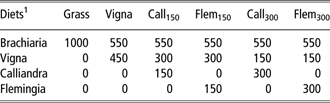
The forages were used to form six diets: one pure Brachiaria diet and five diets consisting of 550 g/kg Brachiaria and 450 g/kg legumes (on dry matter (DM) basis; Table 1). The legume part of the diets consisted of Vigna alone or Vigna combined with either Calliandra or Flemingia in ratios of 2 : 1 or 1 : 2. To facilitate intake and to limit selection, Brachiaria was chopped to particles of about 10 cm length.
Botanical composition (g/kg dry matter) of the experimental diets

1Grass = Brachiaria only; Vigna = in the text referred to as Vigna alone.
Experimental design and procedures
Six castrated, male lambs of the Swiss White Hill breed with an initial body weight (BW) of 21.6 ± 4.2 kg were allocated to the six dietary treatments in a 6 × 6 Latin-square design. Each experimental period lasted for 28 days, consisting of 14 days of adaptation to the respective diet, 7 days of measurement and collection, including 2 days of quantitative measurement of gaseous exchange (two 22.5 h runs) in dual open-circuit respiratory chambers (5.44 m3 each), and 7 days of resting period. During the adaptation and resting periods, animals were kept in individual boxes (150 × 180 cm) allowing visual and partial body contact. During the collection periods, animals were kept in individual metabolic crates (70 × 110 cm) arranged side-by-side. Each animal received the six diets in a different sequence with a daily forage DM allowance of 60 g per kg of metabolic BW (BW0.75). This level was derived from previous experiences on intake of Brachiaria hay (Abreu et al., Reference Abreu, Carulla, Lascano, Dıaz, Kreuzer and Hess2004; Hess et al., Reference Hess, Beuret, Loetscher, Hindrichsen, Machmüller, Carulla, Lascano and Kreuzer2004) and ensured that fluctuations in daily intake and diet selection were limited. Based on estimates using regressions for temperate grasses and legumes (ALP, 2006), as no equations for tropical species were available, the concentrations of net energy for fattening (NEV) of lambs in the different diets were calculated. Accordingly, the daily amount of NEV offered varied between 0.270 (Brachiaria-only) and 0.286 MJ/kg BW0.75 (legume-supplemented diets). This was sufficient to cover maintenance requirements (0.228 MJ/kg BW0.75; ALP, 2006) and provided extra energy for 40 to 50 g of average daily gain. However, considering all uncertainties, these values can only be seen as rough approximation. During the resting period, 80 g/kg BW0.75 of the Brachiaria/Vigna diet were offered to all animals.
Individual forages were offered in separate troughs as one meal per day at 0900 h. Animals had free access to fresh water, and water consumption was measured daily. All experimental animals received 10 g/day of a commercial vitaminised mineral mixture providing 1.4 g Ca, 0.7 g P, 0.8 g Na, 0.3 g Mg, 12 mg Zn, 10 mg Mn, 0.4 mg I, 0.1 mg Co, 0.15 mg Se, and vitamin A, 200 000 IU; vitamin D3, 20 000 IU; vitamin E, 2500 IU; vitamin B1, 300 IU; and biotine, 100 mg.
Animals were weighed directly before feeding in the morning, at the beginning of each experimental period, twice a week during the adaptation periods for adjustment of the daily DM supply, and before (day 14) and after (day 21) the collection periods. During the collection periods no weighing took place and feed allowance was kept constant. The average of days 14 and 21 was used as BW in data evaluation.
From days 13 through 21, feed refusals were recorded daily before the next feed portions were offered. Refusals were collected separately by component and animal, and stored at −20°C. Samples of diet components were taken three times a week. Weight of complete faeces was determined once daily during the collection periods and, after mixing, an aliquot of 0.1 was taken and stored at −20°C. Urine was collected separately in two vessels, one to collect untreated urine, the second containing 1 M sulphuric acid in the amount estimated to be needed to achieve a pH ranging between 2 and 4, to avoid N volatilisation. Both samples were weighed and stored separately at −20°C. At the end of the collection periods, samples of diet components, refusals, faeces and urine were pooled across days within period for each animal. Samples of diet components and refusal were ground in a laboratory mill to pass a 1-mm screen, while faeces were ground in frozen state with a Moulinette kitchen blender. All samples, including urine, were stored at −20°C until being chemically analysed. Sub-samples of faeces were lyophilised.
Before and after the collection periods (days 14 and 21), 4 h after feeding, rumen fluid and blood samples were taken. Approximately 50 ml of rumen fluid was collected through the oesophagus by means of a flexible stomach tube. Special care was taken to avoid contaminations of rumen fluid with saliva. Determinations of pH, ammonia concentration and microbial counts were made immediately after collection, while sub-samples of 1.8 ml were conserved at −80°C for analysis of volatile fatty acids (VFA). Blood samples were drawn from the jugular vein, heparinised (EDTA-Vacutainer), cooled on ice, centrifuged at 2000 × g for 20 min at 4°C, and the plasma obtained was stored at −20°C until being analysed.
The experiment was carried out in accordance with the Swiss guidelines for animal welfare and the experimental protocol was approved by the Veterinary Department of Zurich, Switzerland.
Laboratory analyses
Feeds and refusals as well as fresh and lyophilised faeces were analysed with a TGA-500, Leco gravimetric furnace (Leco Corporation, St Joseph, MI, USA) for DM and total ash in order to calculate organic matter (OM) content. Feeds, refusals and lyophilised faeces were further analysed for NDF and ADF, feeds also for ADL, all by standard methods (AOAC, 1990). NDF was analysed without the addition of sodium sulphite, and values of NDF and ADF were corrected for ash content. Extractable and fibre-bound CT were determined according to the procedure suggested by Terrill et al. (Reference Terrill, Rowan, Douglas and Barry1992) as modified by Barahona et al. (Reference Barahona, Lascano, Narvaez, Owen, Morris and Theodorou2003). Nitrogen (CP = N × 6.25) was determined in feeds, refusals, fresh faeces and acidified urine with an automatic C/N analyser (CN-2000, version 2.2; Leco Instrumente GmbH, Kirchheim Germany). With the same device, the C content of feeds, refusals, fresh faeces and non-acidified urine was analysed. Gross energy (GE) contents of feeds, refusals and lyophilised faeces were assessed through an anisothermic calorimeter (C 700 T System; IKA-Analysentechnik GmbH, Heitersheim, Germany).
Ruminal fluid pH and ammonia concentration were determined by a pH meter (model 632; Metrohm, Herisau, Switzerland) equipped with the respective electrodes. Ciliate protozoa and bacteria were microscopically enumerated using 0.1 and 0.02 mm deep Bürker counting chambers (Blau Brand, Wertheim, Germany), respectively. Determination of VFA was performed by HPLC (HP-5890 series II; Hewlett Packard, Waldbronn, Germany) with sample preparation and HPLC protocols following Doane et al. (Reference Doane, Pell and Schofield1998) and Ehrlich et al. (Reference Ehrlich, Goerlitz, Bourell, Eisen and Godsy1981), respectively. Blood plasma concentration of urea was analysed using a commercial kit (Roche Diagnostics, Basle, Switzerland) and a COBAS INTEGRA automatic analyser (Roche Diagnostics). The data on the two blood and rumen fluid samples taken per animal and period were combined for further data analysis. The respiratory chambers were equipped with an Oxymat 3 detector for quantification of oxygen (Siemens-Albis AG, Dietikon-Fahrweid, Switzerland) and a Binos 1001 for quantification of carbon dioxide and methane (Fisher-Rosemount, Baar-Walterswil, Switzerland).
Calculations and statistical analysis
Urinary energy was calculated from C and N concentrations (Hoffmann and Klein, Reference Hoffmann and Klein1980). Gaseous exchange data were used to calculate methane energy loss and energy expenditure (heat production) by the equations of Brouwer (Reference Brouwer1965), but corrected for the carbon dioxide emitted from fermentation Chwalibog et al. (Reference Chwalibog, Jensen and Thorbek1996). Total body energy retention (RE) was calculated as metabolisable energy (ME) minus energy expenditure. Body fat energy was calculated as the difference between RE and the energy retained in protein.
Data were subjected to analysis of variance using the GLM procedure of SAS (version 9.1.3; 2006; SAS, Cary, NC, USA) with diet, animal and experimental periods as sources of variation. All multiple comparisons among means were performed by the Ryan–Einot–Gabriel–Welsh method (REGWQ; SAS, 1999). Linear and quadratic contrasts were established to identify effects related to the dietary proportion of the CT-rich legumes, while orthogonal contrasts were applied to compare the effects of the CT-rich legumes independent of dietary proportion. The standard errors of the mean (s.e.) are shown for all variables.
Results
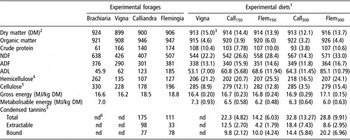
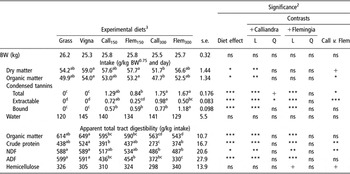
The average BW did not differ (P > 0.1) among diets and there was also no difference in voluntary water intake. In all diets there were some refusals, but the extent differed among diets. As refusals involved mainly the CT-rich legumes, these differences also affected the composition of the diets consumed, but the intended compositional differences were still achieved (Table 2). As expected, the CP (N) content of the diets increased with supplemented legumes by more than 1.5-fold relative to the grass-alone diet, while at the same time, NDF contents declined. Due to the higher ADF and lignin (ADL) contents of the CT-rich legumes (especially of Flemingia) compared with Vigna, the diets supplemented with these legumes were also higher in these two diet constituents. Increasing the dietary proportions of the CT-rich legumes increased tannin contents of the diets consumed by up to some 30 g/kg DM. The ratio of extractable to bound CT was lower in Calliandra than in Flemingia. DM and OM intakes (Table 3) were highest for the diet supplemented with Vigna alone and lowest for the diet with high proportion of Calliandra in the legume supplement. This resulted in a linear decrease of intake with increasing proportion of Calliandra (Table 3; P < 0.01, linear contrast). The effects on intake of adding Flemingia in the legume supplement tended to be less than those with Calliandra (orthogonal contrast).
Composition (g/kg dry matter) of the experimental forages and the consumed diets as analysed (n = 6)

1Chemical composition of diets as actually consumed. Brachiaria was consumed completely. Indices 150 and 300 indicate proportions of the respective legume (Call = Calliandra, Flem = Flemingia) in the diet offered (150 or 300 g/kg DM).
2g/kg original substance.
3Values in brackets are standard deviations of the diet consumed by individual animals, i.e. accounting for occasional refusals.
4Calculated as difference between NDF and ADF.
5Calculated as difference between ADF and ADL.
6nd = not detected.
Intake and apparent digestibility of nutrients in lambs fed grass alone or grass-legume mixtures with varying proportions of tannin-rich plants (diets n = 6)Footnote 1

1 Mean values in the same row without common superscript are significantly different at P < 0.05.
2 *P < 0.05, **P < 0.01, ***P < 0.001; ns = non-significant; L = linear contrast; Q = quadratic contrast; Call v. Flem = contrast between Calliandra and Flemingia independent of dietary level.
3 Indices 150 and 300 indicate proportions of the respective legume (Call = Calliandra, Flem = Flemingia) in the diet offered (150 or 300 g/kg DM).
The apparent total tract digestibility of OM, CP and ADF clearly differed (P < 0.001) among treatments, and the effect was significant (P < 0.05) also for NDF (Table 3). Supplementing only Vigna to the grass had small effects on digestibility (trend for an increase in OM and CP digestibility) while replacing part of Vigna by any of the CT-rich legumes decreased (P < 0.01, linear contrasts) digestibility of OM, CP, NDF and ADF. Differences in OM and CP digestibility between the grass-alone and the legume-supplemented diets were significant only with high Calliandra supplementation and the high level of Flemingia in case of OM digestibility. However, between the two CT-rich legumes, only apparent CP digestibility differed (P < 0.05) at the high level of supplementation where CP digestibility was particularly low with Calliandra (273 g/kg). Both CT-rich legumes resulted in a decreased fibre digestibility (P < 0.01, linear contrast). Hemicellulose digestibility was not affected (P > 0.1) by treatments.
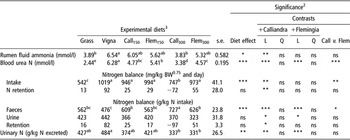
Ruminal fluid pH did not differ (P > 0.1) among treatments and averaged at 7.09 (data not shown in table). Ruminal ammonia concentration was low with Brachiaria alone and was numerically increased by all legume supplements, except by the high proportion of Calliandra in the diet (Table 4). Calliandra addition also resulted in a linear decrease of rumen ammonia concentration (P < 0.01, linear contrast) compared with the Vigna-only-supplemented diet, which was not the case when Flemingia was supplemented. A linear decrease (P < 0.01) in blood urea nitrogen was observed with the inclusion of CT-rich legumes in the supplement, an effect that was more pronounced with Calliandra than with Flemingia. As was expected, supplementing only Vigna resulted in higher blood urea nitrogen than the Brachiaria-only diet. The total concentration of VFA varied between 98 and 110 mmol/l and did not differ (P > 0.1) among diets (data not shown). Also, the molar proportions of individual VFA did not differ between treatments and were high for acetic acid (77% to 79%) and low for propionic acid (11% to 13%) and butyric acid (6% to 7%) (data not shown). Total bacterial counts were not affected by diet, but supplementation of legumes increased (P < 0.05) the number of protozoa from 6 × 10⁶ with the grass-only diet to a level of 16 to 20 × 106 in the legume-supplemented diets (data not shown).
Concentration of ruminal ammonia and blood urea nitrogen as well as nitrogen balance in lambs fed grass alone or grass–legume mixtures with varying proportions of tannin-rich plants (diets n = 6)Footnote 1

1 Mean values in the same row without common superscript are significantly different at P < 0.05.
2 *P < 0.05, **P < 0.01, ***P < 0.001, +P < 0.1; ns = non-significant; L = linear contrast; Q = quadratic contrast; Call v. Flem = contrast between Calliandra and Flemingia independent of dietary level.
3 Indices 150 and 300 indicate proportions of the respective legume (Call = Calliandra, Flem = Flemingia) in the diet offered (150 or 300 g/kg DM).
Daily N intake differed (P < 0.001) among treatments, being higher with any legume supplement. However, with the diet high in Calliandra, N intake was lower (P < 0.05) relative to other legume treatments due to its lower consumption and lower CP content. Faecal N losses increased linearly relative to N intake with increasing proportion of the CT-rich legumes in the diet (P < 0.001, linear contrasts) while the proportionate urinary N losses decreased for both CT-rich species (P < 0.05, linear contrast). The proportion of N in urine relative to total N excretion differed (P < 0.01) among diets and decreased linearly (P < 0.01) with both CT-rich legumes. Body nitrogen retention was positive for all diets, except for the high-Calliandra diet. There was a trend for the highest N retention when Vigna was fed alone as a supplement.
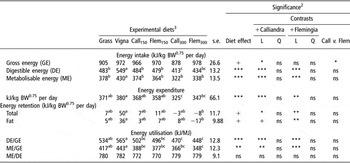
Intake of GE was not clearly affected (P > 0.05) by legume supplementation (Table 5). Intake of digestible energy (DE) increased (P < 0.05) with Vigna addition while the replacement of Vigna with the CT-rich legumes decreased (P < 0.001, linear contrast) the DE intake. ME intake was equally changed by the different diets tested. Energy loss through heat (energy expenditure) was markedly lower (P < 0.05) when high proportions of the CT-rich legumes were fed compared with Vigna alone, and decreased linearly (P < 0.01) with increasing dietary proportion of Calliandra or Flemingia. Total energy losses did not differ among treatments (data not shown). Total body energy retention tended to increase (P < 0.1) with Vigna addition and decreased linearly (P < 0.05) with increasing proportion of CT-rich legumes. The efficiency of utilisation of GE (DE/GE, ME/GE) decreased linearly (P < 0.05) with increasing proportion of Calliandra and Flemingia. ME/DE did not differ (P > 0.05) between treatments.
Balance and utilisation of energy in lambs fed grass alone or grass–legume mixtures with varying proportions of tannin-rich plants (diets n = 6)Footnote 1

1 Mean values in the same row without common superscript are significantly different at P < 0.05.
2 *P < 0.05, **P < 0.01, ***P < 0.001, +P < 0.1; ns = non-significant; L = linear contrast; Q = quadratic contrast; Call v. Flem = contrast between Calliandra and Flemingia independent of dietary level.
3 Indices 150 and 300 indicate proportions of the respective legume (Call = Calliandra, Flem = Flemingia) in the diet offered (150 or 300 g/kg DM).
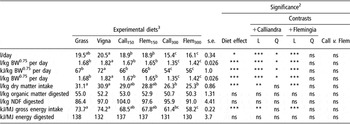
Daily methane release was reduced linearly (P < 0.001) with supplementation of either Calliandra or Flemingia (Table 6). Energy loss through methane was markedly lower (P < 0.05) when CT-rich legumes were fed compared with Vigna alone, and decreased linearly (P < 0.001) with increasing dietary proportion of Calliandra or Flemingia. When adjusted for metabolic BW (BW0.75) it was particularly evident that methane emissions increased with Vigna supplementation and decreased by 9 and 24% with replacement of Vigna by low and high proportions of CT-rich legumes, respectively. There were no differences in methane emissions between the two legumes. Similar shifts occurred when methane energy was related to intake of DM and GE. However, when methane emissions were expressed per unit of digested organic matter, NDF or energy, differences due to diet were no longer evident. The methane conversion rate (energy lost via methane as proportion of GE intake) decreased linearly (P < 0.01) with increasing dietary proportion of the CT-rich legumes and was clearly lower at the high dietary level than with Vigna as the only legume supplement.
Methane release of lambs fed grass alone or grass–legume mixtures with varying proportions of tannin-rich plants (diets n = 6)Footnote 1

1 Mean values in the same row without common superscript are significantly different at P < 0.05.
2 *P < 0.05, **P < 0.01, ***P < 0.001, +P < 0.1; ns = non-significant; L = linear contrast; Q = quadratic contrast; Call v. Flem = contrast between Calliandra and Flemingia independent of dietary level.
3 Indices 150 and 300 indicate proportions of the respective legume (Call = Calliandra, Flem = Flemingia) in the diet offered (150 or 300 g/kg DM).
Discussion
The forages used in the present experiment were typical for tropical livestock systems. The cultivar of B. brizantha was, although low in CP (61 g/kg) compared with standards of temperate climate grasslands, a medium-quality grass compared with Brachiaria dictyoneura cv. Llanero (now called B. humidicola) (37 to 39 g CP/kg), which we previously used for in vivo legume supplementation studies (Abreu et al., Reference Abreu, Carulla, Lascano, Dıaz, Kreuzer and Hess2004; Hess et al., Reference Hess, Beuret, Loetscher, Hindrichsen, Machmüller, Carulla, Lascano and Kreuzer2004). Previous studies with different accessions of C. calothyrsus and F. macrophylla had indicated considerable intra-specific variation in their chemical composition, feeding value and CT content (Lascano et al., Reference Lascano, Avila and Stewart2003; Andersson et al., Reference Andersson, Lascano, Schultze-Kraft and Peters2006). However, both CT-rich species generally have CP values > 150 g/kg DM, which is also the case with the tannin-free V. unguiculata (e.g. Peters et al., 2003; FAO, 2007). The legume accessions used were characterised by being well adapted to drought and acidic soils and were promising when used as supplements of low-quality grasses in previous in vitro trials (e.g. Stürm et al., Reference Stürm, Tiemann, Lascano, Kreuzer and Hess2007).
Effects of the CT-rich shrub legumes on intake
CTs are known to have a wide range of effects on ruminant nutrition, digestion and health. It is known that small amounts of tannins in temperate legumes may improve milk and wool production as well as reproduction in ruminants (Barry and McNabb, Reference Barry and McNabb1999). In the present study, CT content in the diets consumed was increased up to levels of 30 g/kg DM by the supplementation with Calliandra or Flemingia. This intake of CT is similar to the intake reported in other studies (e.g. Carulla et al., Reference Carulla, Kreuzer, Machmüller and Hess2005) and it is considered a moderate intake level, which may have nutritional advantages (e.g. increased bypass protein and bloat suppression in cattle; Min et al., Reference Min, Barry, Attwood and McNabb2003). However, one often-cited negative effect is the reduced palatability associated with tannin-rich plant species (Woodward and Reed, Reference Woodward and Reed1989), particularly when tannin concentrations exceed 60 g/kg DM (Bhatta et al., Reference Bhatta, Shinde, Vaithiyanathan, Sankhyan and Verma2002). Also in the present study, intake of plants with CT concentrations of 175 g/kg (Calliandra) and 111 g/kg (Flemingia) was lower than the daily offer, especially with the high proportion of Calliandra, resulting in a reduced total DM intake. As a consequence, CT intake did not differ between Flemingia and Calliandra at the high level of dietary inclusion. Acceptance of CT-rich species improved in the course of the trial when seen over all experimental periods. This is in line with the observation of Maasdorp et al. (Reference Maasdorp, Muchenje and Titterton1999) that dairy cows feeding on Calliandra may adapt relatively quickly to tannin-rich diets. However, this may also depend on provenance and site of cultivation (i.e. soil fertility). For example, Kaitho et al. (Reference Kaitho, Umunna, Nsahlai, Tamminga, van Bruchem, Hanson and van de Wouw1996) stated that F. macrophylla has a low palatability and feeding value, as compared to Calliandra, which was found to have a medium palatability. In the present study, the intake of Flemingia was slightly higher than that of Calliandra.
Effects of legume supplementation on protein utilisation
Both ruminal ammonia concentration and blood urea nitrogen are indicators of ruminal degradation of dietary protein. In the present study, the inclusion of Vigna in the diet increased the supply of degradable protein, while this effect was partially reversed by the inclusion of CT-rich legumes, particularly with the higher proportion of Calliandra in the diet. The effect of Vigna supplementation on ruminal ammonia concentration was lower than in other studies where hay of B. dictyoneura cv. Llanero with < 40 g CP/kg DM was supplemented with CT-free legumes (Hess et al., Reference Hess, Monsalve, Lascano, Carulla, Díaz and Kreuzer2003 and Reference Hess, Beuret, Loetscher, Hindrichsen, Machmüller, Carulla, Lascano and Kreuzer2004; Abreu et al., Reference Abreu, Carulla, Lascano, Dıaz, Kreuzer and Hess2004), but the ammonia values recorded with legume supplementation were in the same range. This, together with the observation that VFA amount and composition, total bacteria counts and fibre digestibility were not affected by the inclusion of Vigna, suggests that the ruminally available nitrogen was not limiting microbial fermentation in the rumen of lambs fed the Brachiaria-only diet.
Apart from balancing potential limitations in ruminal fermentation due to N deficiency, N-rich legumes could also enhance metabolic protein supply more directly. The changes in ruminal ammonia and blood urea nitrogen, as affected by the CT-rich legumes, were closely reflected in urinary N losses and consistent with the findings of other studies (e.g. Carulla et al., Reference Carulla, Kreuzer, Machmüller and Hess2005). This was expected as it is well documented that CT reduces ruminal protein degradation by complexing proteins and making them less degradable by ruminal microbes (Reed, Reference Reed1995; Mueller-Harvey, Reference Mueller-Harvey2006). The crucial question was whether or not the plant protein protected from ruminal degradation was digested and absorbed in the small intestine. Changes in faecal N losses were compensatory to that in urinary N losses resulting in similar total N excretion in all treatments with legume supplementation. This indicates that most, if not all, CT-protein complexes were irreversible and that the rumen-protected protein was not digested and absorbed in high quantities in the lower gut (Barry and McNabb, Reference Barry and McNabb1999). Based on allantoin measurements, Carulla et al. (Reference Carulla, Kreuzer, Machmüller and Hess2005) concluded that microbial protein synthesis was reduced by a CT extract. However, CT may also increase endogenous N losses (Norton, 2000). Whatever the reason, supplementation of CT-rich legumes seemed to have reduced body N retention compared to Vigna alone. Feeding the diet with the high Calliandra level resulted in an even lower N retention than the grass-only diet. Although not significant, only Vigna without CT-rich legumes appears to have improved metabolic protein supply of the grass-hay fed lambs, as was found earlier for the non-tanniniferous shrub legume Cratylia argentea in terms of duodenal protein flow (Abreu et al., Reference Abreu, Carulla, Lascano, Dıaz, Kreuzer and Hess2004) and body protein retention (Hess et al., Reference Hess, Beuret, Loetscher, Hindrichsen, Machmüller, Carulla, Lascano and Kreuzer2004).
The present findings suggest that CT-rich legumes are useful only when there is a shortage of medium-quality grass or when they have other favourable effects. Among the two CT-rich species used in this study as supplements, Flemingia appeared to be slightly less adverse than Calliandra, in terms of protein supply. Therefore, Calliandra CT seem to be more effective in complexing protein than CT of Flemingia. In Calliandra about 450 g and in Flemingia approximately 700 g/kg of total CT analysed were bound. Assuming that bound tannins are no artefacts as discussed by Makkar (Reference Makkar2003), this would mean that more than twice the amount of free CT was present in Calliandra than in Flemingia. Accordingly, more protein of Vigna and of Brachiaria could have been complexed by CT in diets with Calliandra than with Flemingia.
The shift in the excretion of N from urine to faeces as a result of feeding CT-rich legumes is still of practical relevance because the ratio of urinary N to faecal N determines the level of gaseous ammonia losses (Külling et al., Reference Külling, Menzi, Kröber, Neftel, Sutter, Lischer and Kreuzer2001). The potential of CT to significantly decrease ammonia N emission from the animal’s excreta was demonstrated by Śliwiński et al. (Reference Śliwiński, Kreuzer, Sutter, Machmüller and Wettstein2004).
Effects of legume supplementation on energy utilisation
A first indication on the effects on energy supply is given by protozoal counts. The low number of protozoa in the rumen of animals fed grass-only diets could be related to a lack of easily degradable carbohydrates, which was corrected when legumes were supplemented. Supply with digestible (and metabolisable) energy was increased with Vigna supplementation. Although in this context the lack of effect on total VFA concentrations seems surprising, it is in agreement with observations made by Abreu et al. (Reference Abreu, Carulla, Lascano, Dıaz, Kreuzer and Hess2004), who did not find any effect of legume supplementation on total VFA concentration. Also the proportions of individual VFAs were similar to those reported by Abreu et al. (Reference Abreu, Carulla, Lascano, Dıaz, Kreuzer and Hess2004) for sheep fed diets based on low-quality Brachiaria hay. The lack of effect in VFA levels and the unchanged respiratory quotients indicate that no major shifts in the type of nutrients utilised took place. Any partial replacement by the CT-rich legumes completely reversed the improvement in energy supply caused by supplementing Vigna. It appears that this was mainly the result of a reduced digestibility of the ADF (cellulose and lignin) fraction of the fibre, while hemicellulose digestion was not affected by the inclusion of CT-rich legumes in the diet. This agrees well with the results of a previous study (Fässler and Lascano, Reference Fässler and Lascano1995) where ADF digestion was much more affected by increasing the proportion of CT-rich foliage in the diet of sheep than either DM or NDF digestion. Adverse CT effects on ruminal fibre degradation were described earlier (Reed, Reference Reed1995; Theodorou et al., 2000), most likely without selective suppression of cellulolytic bacteria (McSweeney et al., Reference McSweeney, Palmer, Bunch and Krause2001). However, it was also claimed that fibre digestibility may be affected by analytical problems in fibre determination caused by CT (Makkar et al., Reference Makkar, Borowy, Becker and Degen1995). Since similar shifts were also evident in energy digestibility, this seems to have been a minor issue in the present study. As digestion of the grass-only diet appeared not to have been limited by low levels of ruminal ammonia (see above), the reduction in fibre digestion with addition of the CT-rich legumes seems to have been the result of a low digestibility of the fibre present in these plants rather than a side-effect of the CT on ruminal ammonia concentration. With the high dietary proportions of both CT-rich legumes, energy expenditure was similarly reduced, but this was most likely the result of the reduced supply of ME.
Utility of CT-rich shrub legumes for methane mitigation
Daily methane production averaged 13.0 (s.d. ±2.01) g per animal and was hence only between 0.6–0.5 of the mean reported in the literature for growing lambs (Pelchen and Peters, Reference Pelchen and Peters1998; Hess et al. Reference Hess, Beuret, Loetscher, Hindrichsen, Machmüller, Carulla, Lascano and Kreuzer2004). However, the animals used in the present study had slightly lower BW (18 to 32 kg compared with 25 to 45 kg of BW) and were fed diets with comparably limited digestibility. Methane conversion rate (energy lost via methane as a proportion of GE intake) averaged 67.3 (s.d. ±6.45) kJ/MJ. This value was close to the mean value of 72.2 kJ/MJ reported by Pelchen and Peters (Reference Pelchen and Peters1998), and was very close to the value of 65 kJ/MJ suggested by the IPCC (2006) for cattle fed with less than 90% concentrate.
Some studies (cf. McCrabb and Hunter, Reference McCrabb and Hunter1999) suggested that methane emission per unit of digested DM from the fermentation of C4 plants (most tropical grasses) could be higher than that from C3 plants (most shrubs and trees). This was not confirmed in the present study. When expressed as per kg of metabolic BW, methane emission was higher by 8% with the Vigna-supplemented diet than with the grass-only diet. However, Vigna supplementation increased nutrient digestion, thus providing additional substrate for methanogenesis, and when expressed as per unit of digested OM, methane emission did not differ between the Vigna-supplemented diet and the grass-only diet. The decline of methane emission recorded for diets including Calliandra and Flemingia is consistent with the results of a previous in vitro study with Calliandra, C. argentea and Arachis pintoi (Hess et al., Reference Hess, Monsalve, Lascano, Carulla, Díaz and Kreuzer2003), where supplementation of Calliandra to a grass-based diet suppressed methane production, while the two non-tanniniferous legumes increased methane emissions.
The discovery that CT from intact legumes or from extracts can help mitigate methane in ruminants was a recent one (Woodward et al., Reference Woodward, Waghorn, Ulyatt and Lassey2001; Carulla et al., Reference Carulla, Kreuzer, Machmüller and Hess2005). Carulla et al. (Reference Carulla, Kreuzer, Machmüller and Hess2005) demonstrated that a CT-rich Acacia mearnsii extract may reduce methane per unit of digested OM but not per digested NDF. In the present study, methane produced per unit of digested NDF was not affected by supplementation with CT-rich legumes. This indicates that the methane-suppressing effect of CT might rather result from reduced fibre digestion and not from specific inhibition of methanogens, although the latter has also been observed in pure cultures (Tavendale et al., Reference Tavendale, Meagher, Pacheco, Walker, Attwood and Sivakumaran2005). In addition, the fact that the reduction in methane production caused by CT-rich legumes was not associated with a shift in VFA production or a reduction in the number of rumen protozoa suggests that the methane-suppressing effect of CT was mainly the result of a reduced fermentation activity and not of a specific shift in the nutrients fermented or in microbial populations. As long as overall nutrient and energy utilisation are not simultaneously reduced with methane production (i.e. if the decline in methane is not associated with lower feeding value and therefore productivity of the animal), lower fibre digestion per se would not be a problem. While this was not the case in the study of Carulla et al. (Reference Carulla, Kreuzer, Machmüller and Hess2005), in the present experiment methane suppression was associated with reduced N (Calliandra) and energy (Flemingia) retention. Therefore it is questionable whether the methane-suppressing effect of Calliandra and Flemingia is of any practical value because it would probably be accompanied with a simultaneous reduction in animal performance (i.e. BW gain or milk yield).
Conclusions
Through an in vivo energy and protein balance study it was now demonstrated that V. unguiculata is a valuable supplement to tropical grass diets, since it improves not only protein but also energy supply to growing ruminants. The favourable effects of Vigna might be even higher in cases where only very low-quality grasses or crop residues are available to feed ruminants. On the other hand, F. macrophylla (CIAT 17403) seems to be a suitable alternative for partial replacement of Vigna in terms of protein supply in diets where energy is not limiting. C. calothyrsus (CIAT 22310) seems to be less apt as ruminant feed and cannot be recommended. Although Calliandra and Flemingia were effective in reducing methane production of sheep, the true methane mitigation to be achieved appears to be small due to associated reductions in N and energy retention.
Acknowledgements
The authors would like to thank Patricia Avila and the team of CIAT, Santander de Quilichao, for their valuable support in harvesting, drying and packing the forage used in the present experiment. They further are grateful to Monika Büchel, Rolf Bickel and Dr. Markus Senn for their assistance with the animals at ETH Zurich. This study was funded by the Swiss Centre for International Agriculture (ZIL), ETH Zurich, and the Swiss Agency for Development and Cooperation (SDC).