


Political scientists have made great strides toward greater reproducibility of their findings since the publication of Gary King's influential article Replication, Replication (King Reference King1995). It is now standard practice for good professional journals to insist that authors lodge their data and code in a prominent open access repository. This allows other scholars to replicate and extend published results by reanalyzing the data, rerunning and modifying the code. Replication of an analysis, however, sets a far weaker standard than reproducibility of the data, which is typically seen as a fundamental principle of the scientific method. Here, we propose a step towards a more comprehensive scientific replication standard in which the mandate is to replicate data production, not just data analysis. This shifts attention from specific datasets as the essential scientific objects of interest, to the published and reproducible method by which the data were generated.
We implement this more comprehensive replication standard for the rapidly expanding project of analyzing the content of political texts. Traditionally, a lot of political data are generated by experts applying comprehensive classification schemes to raw sources in a process that, while in principle repeatable, is in practice too costly and time-consuming to reproduce. Widely used examples includeFootnote 1 the Polity dataset, rating countries on a scale “ranging from −10 (hereditary monarchy) to +10 (consolidated democracy)”Footnote 2 ; the Comparative Parliamentary Democracy data with indicators of the “number of inconclusive bargaining rounds” in government formation and “conflictual” government terminationsFootnote 3 ; the Comparative Manifesto Project (CMP), with coded summaries of party manifestos, notably a widely used left-right scoreFootnote 4 ; and the Policy Agendas Project, which codes text from laws, court decisions, political speeches into topics and subtopics (Jones and Baumgartner Reference Jones and Baumgartner2013). In addition to the issue of reproducibility, the fixed nature of these schemes and the considerable infrastructure required to implement them discourages change and makes it harder to adapt them to specific needs, as the data are designed to fit general requirements rather than a particular research question.
Here, we demonstrate a method of crowd-sourced text annotation for generating political data that are both reproducible in the sense of allowing the data generating process to be quickly, inexpensively, and reliably repeated, and agile in the sense of being capable of flexible design according to the needs of a specific research project. The notion of agile research is borrowed from recent approaches to software development, and incorporates not only the flexibility of design, but also the ability to iteratively test, deploy, verify, and, if necessary, redesign data generation through feedback in the production process. In what follows, we apply this method to a common measurement problem in political science: locating political parties on policy dimensions using text as data. Despite the lower expertise of crowd workers compared to experts, we show that properly deployed crowd-sourcing generates results indistinguishable from expert approaches. Given the millions of available workers online, crowd-sourced data collection can also be repeated as often as desired, quickly and with low cost. Furthermore, our approach is easily tailored to specific research needs, for specific contexts and time periods, in sharp contrast to large “canonical” data generation projects aimed at maximizing generality. For this reason, crowd-sourced data generation may represent a paradigm shift for data production and reproducibility in the social sciences. While, as a proof of concept, we apply our particular method for crowd-sourced data production to the analysis of political texts, the core problem of specifying a reproducible data production process extends to all subfields of political science.
In what follows, we first review the theory and practice of crowd-sourcing. We then deploy an experiment in content analysis designed to evaluate crowd-sourcing as a method for reliably and validly extracting meaning from political texts, in this case party manifestos. We compare expert and crowd-sourced analyses of the same texts, and assess external validity by comparing crowd-sourced estimates with those generated by completely independent expert surveys. In order to do this, we design a method for aggregating judgments about text units of varying complexity, by readers of varying quality,Footnote 5 into estimates of latent quantities of interest. To assess the external validity of our results, our core analysis uses crowd workers to estimate party positions on two widely used policy dimensions: “economic” policy (right-left) and “social” policy (liberal-conservative). We then use our method to generate “custom” data on a variable not available in canonical datasets, in this case party policies on immigration. Finally, to illustrate the general applicability of crowd-sourced text annotation in political science, we test the method in a multilingual and technical environment to show that crowd-sourced text analysis is effective for texts other than party manifestos and works well in different languages.
HARVESTING THE WISDOM OF CROWDS
The intuition behind crowd-sourcing can be traced to Aristotle (Lyon and Pacuit Reference Lyon, Pacuit and Michelucci2013) and later Galton (Reference Galton1907), who noticed that the average of a large number of individual judgments by fair-goers of the weight of an ox is close to the true answer and, importantly, closer to this than the typical individual judgment (for a general introduction see Surowiecki Reference Surowiecki2004). Crowd-sourcing is now understood to mean using the Internet to distribute a large package of small tasks to a large number of anonymous workers, located around the world and offered small financial rewards per task. The method is widely used for data-processing tasks such as image classification, video annotation, data entry, optical character recognition, translation, recommendation, and proofreading. Crowd-sourcing has emerged as a paradigm for applying human intelligence to problem-solving on a massive scale, especially for problems involving the nuances of language or other interpretative tasks where humans excel but machines perform poorly.
Increasingly, crowd-sourcing has also become a tool for social scientific research (Bohannon Reference Bohannon2011). In sharp contrast to our own approach, most applications use crowds as a cheap alternative to traditional subjects for experimental studies (e.g., Horton et al. Reference Horton, Rand and Zeckhauser2011; Lawson et al. Reference Lawson, Lenz, Baker and Myers2010; Mason and Suri Reference Mason and Suri2012; Paolacci et al. Reference Paolacci, Chandler and Ipeirotis2010). Using subjects in the crowd to populate experimental or survey panels raises obvious questions about external validity, addressed by studies in political science (Berinsky et al. Reference Berinsky, Huber and Lenz2012), economics (Horton et al. Reference Horton, Rand and Zeckhauser2011) and general decision theory and behavior (Chandler et al. Reference Chandler, Mueller and Paolacci2014; Goodman et al. Reference Goodman, Cryder and Cheema2013; Paolacci et al. Reference Paolacci, Chandler and Ipeirotis2010). Our method for using workers in the crowd to label external stimuli differs fundamentally from such applications. We do not care at all about whether our crowd workers represent any target population, as long as different workers, on average, make the same judgments when faced with the same information. In this sense our method, unlike online experiments and surveys, is a canonical use of crowd-sourcing as described by Galton.Footnote 6
All data production by humans requires expertise, and several empirical studies have found that data created by domain experts can be matched, and sometimes improved at much lower cost, by aggregating judgments of nonexperts (Alonso and Baeza-Yates Reference Alonso, Baeza-Yates, Clough, Foley, Gurrin, Jones, Kraaij, Lee and Mudoch2011; Alonso and Mizzaro Reference Alonso and Mizzaro2009; Carpenter Reference Carpenter2008; Hsueh et al. Reference Hsueh, Melville and Sindhwani2009; Ipeirotis et al. Reference Ipeirotis, Provost, Sheng and Wang2013; Snow et al. Reference Snow, O'Connor, Jurafsky and Ng2008). Provided crowd workers are not systematically biased in relation to the “true” value of the latent quantity of interest, and it is important to check for such bias, the central tendency of even erratic workers will converge on this true value as the number of workers increases. Because experts are axiomatically in short supply while members of the crowd are not, crowd-sourced solutions also offer a straightforward and scalable way to address reliability in a manner that expert solutions cannot. To improve confidence, simply employ more crowd workers. Because data production is broken down into many simple specific tasks, each performed by many different exchangeable workers, it tends to wash out biases that might affect a single worker, while also making it possible to estimate and correct for worker-specific effects using the type of scaling model we employ below.
Crowd-sourced data generation inherently requires a method for aggregating many small pieces of information into valid measures of our quantities of interest.Footnote 7 Complex calibration models have been used to correct for worker errors on particular difficult tasks, but the most important lesson from this work is that increasing the number of workers reduces error (Snow et al. Reference Snow, O'Connor, Jurafsky and Ng2008). Addressing statistical issues of “redundant” coding, Sheng et al. (Reference Sheng, Provost and Ipeirotis2008) and Ipeirotis et al. (Reference Ipeirotis, Provost, Sheng and Wang2014) show that repeated coding can improve the quality of data as a function of the individual qualities and number of workers, particularly when workers are imperfect and labeling categories are “noisy.” Ideally, we would benchmark crowd workers against a “gold standard,” but such benchmarks are not always available, so scholars have turned to Bayesian scaling models borrowed from item-response theory (IRT), to aggregate information while simultaneously assessing worker quality (e.g., Carpenter Reference Carpenter2008; Raykar et al. Reference Raykar, Yu, Zhao, Valadez, Florin, Bo-goni and Moy2010). Welinder and Perona (Reference Welinder and Perona2010) develop a classifier that integrates data difficulty and worker characteristics, while Welinder et al. (Reference Welinder, Branson, Belongie and Perona2010) develop a unifying model of the characteristics of both data and workers, such as competence, expertise, and bias. A similar approach is applied to rater evaluation in Cao et al. (Reference Cao, Stokes and Zhang2010) where, using a Bayesian hierarchical model, raters’ judgments are modeled as a function of a latent item trait, and rater characteristics such as bias, discrimination, and measurement error. We build on this work below, applying both a simple averaging method and a Bayesian scaling model that estimates latent policy positions while generating diagnostics on worker quality and sentence difficulty. We find that estimates generated by our more complex model match simple averaging very closely.
A METHOD FOR REPLICABLE CODING OF POLITICAL TEXT
We apply our crowd-sourcing method to one of the most wide-ranging research programs in political science, the analysis of political text, and in particular text processing by human analysts that is designed to extract meaning systematically from some text corpus, and from this to generate valid and reliable data. This is related to, but quite distinct from, spectacular recent advances in automated text analysis that in theory scale up to unlimited volumes of political text (Grimmer and Stewart Reference Grimmer and Stewart2013). Many automated methods involve supervised machine learning and depend on labeled training data. Our method is directly relevant to this enterprise, offering a quick, effective, and, above all, reproducible way to generate labeled training data. Other, unsupervised, methods intrinsically require a posteriori human interpretation that may be haphazard and is potentially biased.Footnote 8
Our argument here speaks directly to more traditional content analysis within the social sciences, which is concerned with problems that automated text analysis cannot yet address. This involves the “reading” of text by real humans who interpret it for meaning. These interpretations, if systematic, may be classified and summarized using numbers, but the underlying human interpretation is fundamentally qualitative. Crudely, human analysts are employed to engage in natural language processing (NLP) which seeks to extract “meaning” embedded in the syntax of language, treating a text as more than a bag of words. NLP is another remarkable growth area, though it addresses a fundamentally difficult problem and fully automated NLP still has a long way to go. Traditional human experts in the field of inquiry are of course highly sophisticated natural language processors, finely tuned to particular contexts. The core problem is that they are in very short supply. This means that text processing by human experts simply does not scale to the huge volumes of text that are now available. This in turn generates an inherent difficulty in meeting the more comprehensive scientific replication standard to which we aspire. Crowd-sourced text analysis offers a compelling solution to this problem. Human workers in the crowd can be seen, perhaps rudely, as generic and very widely available “biological” natural language processors. Our task in this article is now clear. Design a system for employing generic workers in the crowd to analyze text for meaning in a way that is as reliable and valid as if we had used finely tuned experts to do the same job.
By far the best known research program in political science that relies on expert human readers is the long-running Manifesto Project (MP). This project has analyzed nearly 4,000 manifestos issued since 1945 by nearly 1,000 parties in more than 50 countries, using experts who are country specialists to label sentences in each text in their original languages. A single expert assigns every sentence in every manifesto to a single category in a 56-category scheme devised by the project in the mid-1980s (Budge et al. Reference Budge, Robertson and Hearl1987; Budge et al. Reference Budge, Klingemann, Volkens, Bara, Tannenbaum, Fording, Hearl, Kim, McDonald and Mendes2001; Klingemann et al. Reference Klingemann, Hofferbert and Budge1994; Klingemann et al. Reference Klingemann, Volkens, Bara, Budge and McDonald2006; Laver and Budge Reference Laver and Budge1992).Footnote 9 This has resulted in a widely used “canonical” dataset that, given the monumental coordinated effort of very many experts over 30 years, is unlikely ever to be recollected from scratch and in this sense is unlikely to be replicated. Despite low levels of interexpert reliability found in experiments using the MP's coding scheme (Mikhaylov et al. Reference Mikhaylov, Laver and Benoit2012), a proposal to re-process the entire manifesto corpus many times, using many independent experts, is in practice a nonstarter. Large canonical datasets such as this, therefore, tend not to satisfy the deeper standard of reproducible research that requires the transparent repeatability of data generation. This deeper replication standard can however be satisfied with the crowd-sourced method we now describe.
A simple coding scheme for economic and social policy
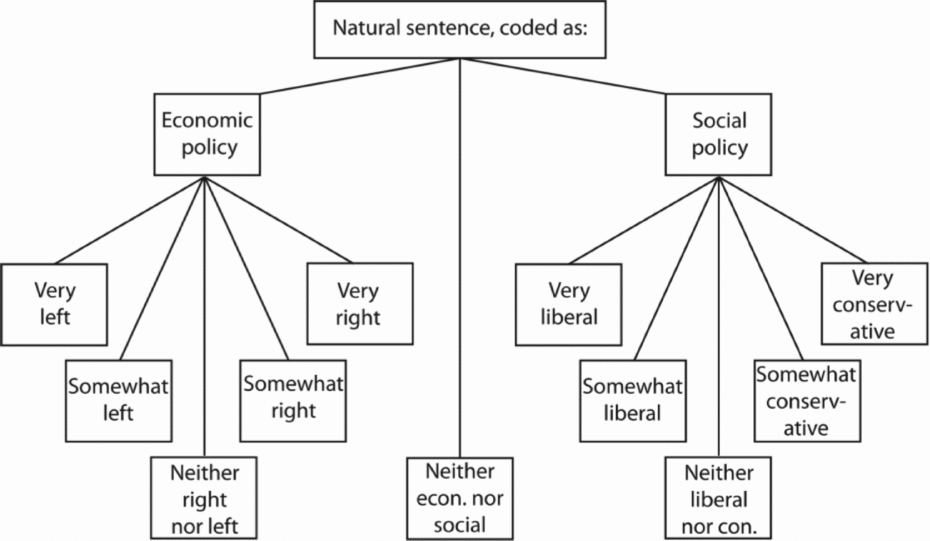
We assess the potential for crowd-sourced text analysis using an experiment in which we serve up an identical set of documents, and an identical set of text processing tasks, to both a small set of experts (political science faculty and graduate students) and a large and heterogeneous set of crowd workers located around the world. To do this, we need a simple scheme for labeling political text that can be used reliably by workers in the crowd. Our scheme first asks readers to classify each sentence in a document as referring to economic policy (left or right), to social policy (liberal or conservative), or to neither. Substantively, these two policy dimensions have been shown to offer an efficient representation of party positions in many countries.Footnote 10 They also correspond to dimensions covered by a series of expert surveys (Benoit and Laver Reference Benoit and Laver2006; Hooghe et al. Reference Hooghe, Bakker, Brigevich, Vries, Edwards, Marks, Rovny, Steenbergen and Vachudova2010; Laver and Hunt Reference Laver and Hunt1992), allowing validation of estimates we derive against widely used independent estimates of the same quantities. If a sentence was classified as economic policy, we then ask readers to rate it on a five-point scale from very left to very right; those classified as social policy were rated on a five-point scale from liberal to conservative. Figure 1 shows this scheme.Footnote 11
Hierarchical Coding Scheme for Two Policy Domains with Ordinal Positioning

We did not use the MP's 56-category classification scheme, for two main reasons. The first is methodological: complexity of the MP scheme and uncertain boundaries between many of its categories were major sources of unreliability when multiple experts applied this scheme to the same documents (Mikhaylov et al. Reference Mikhaylov, Laver and Benoit2012). The second is practical: it is impossible to write clear and precise instructions, to be understood reliably by a diverse, globally distributed, set of workers in the crowd, for using a detailed and complex 56-category scheme quintessentially designed for highly trained experts. This highlights an important trade-off. There may be data production tasks that cannot feasibly be explained in clear and simple terms, sophisticated instructions that can only be understood and implemented by highly trained experts. Sophisticated instructions are designed for a more limited pool of experts who can understand and implement them and, for this reason, imply less scalable and replicable data production. Such tasks may not be suitable for crowd-sourced data generation and may be more suited to traditional methods. The striking alternative now made available by crowd-sourcing is to break down complicated data production tasks into simple small jobs, as happens when complex consumer products are manufactured on factory production lines. Over and above the practical need to have simple instructions for crowd workers, furthermore, the scheme in Figure 1 is motivated by the observation that most scholars using manifesto data actually seek simple solutions, typically estimates of positions on a few general policy dimensions; they do not need estimates of these positions in a 56-dimensional space.
Text corpus
While we extend this in work we discuss below, our baseline text corpus comprises 18,263 natural sentences from British Conservative, Labour and Liberal Democrat manifestos for the six general elections held between 1987 and 2010. These texts were chosen for two main reasons. First, for systematic external validation, there are diverse independent estimates of British party positions for this period, from contemporary expert surveys (Benoit Reference Benoit2005, Reference Benoit2010; Laver Reference Laver1998; Laver and Hunt Reference Laver and Hunt1992) as well as MP expert codings of the same texts. Second, there are well-documented substantive shifts in party positions during this period, notably the sharp shift of Labour towards the center between 1987 and 1997. The ability of crowd workers to pick up this move is a good test of external validity.
In designing the breakdown and presentation of the text processing tasks given to both experts and the crowd, we made a series of detailed operational decisions based on substantial testing and adaptation (reviewed in the Appendix). In summary, we used natural sentences as our fundamental text unit. Recognizing that most crowd workers dip into and out of our jobs and would not stay online to code entire documents, we served target sentences from the corpus in a random sequence, set in a two-sentence context on either side of the target sentence, without identifying the text from which the sentence was drawn. Our coding experiments showed that these decisions resulted in estimates that did not significantly differ from those generated by the classical approach of reading entire documents from beginning to end.
SCALING DOCUMENT POLICY POSITIONS FROM CODED SENTENCES
Our aim is to estimate the policy positions of entire documents: not the code value of any single sentence, but some aggregation of these values into an estimate of each document's position on some meaningful policy scale while allowing for reader, sentence, and domain effects. One option is simple averaging: identify all economic scores assigned to sentences in a document by all readers, average these, and use this as an estimate of the economic policy position of a document. Mathematical and behavioral studies on aggregations of individual judgments imply that simpler methods often perform as well as more complicated ones, and often more robustly (e.g., Ariely et al. Reference Ariely, Au, Bender, Budescu, Dietz, Gu and Zauberman2000; Clemen and Winkler Reference Clemen and Winkler1999). Simple averaging of individual judgments is the benchmark when there is no additional information on the quality of individual coders (Armstrong Reference Armstrong2001; Lyon and Pacuit Reference Lyon, Pacuit and Michelucci2013; Turner et al. Reference Turner, Steyvers, Merkle, Budescu and Wallsten2014). However, this does not permit direct estimation of misclassification tendencies by readers who for example fail to identify economic or social policy “correctly,” or of reader-specific effects in the use of positional scales.
An alternative is to model each sentence as containing information about the document, and then scale these using a measurement model. We propose a model based on item response theory (IRT), which accounts for both individual reader effects and the strong possibility that some sentences are intrinsically harder to interpret. This approach has antecedents in psychometric methods (e.g., Baker and Kim Reference Baker and Kim2004; Fox Reference Fox2010; Hambleton et al. Reference Hambleton, Swaminathan and Jane Rogers1991; Lord Reference Lord1980), and has been used to aggregate crowd ratings (e.g., Ipeirotis et al. Reference Ipeirotis, Provost, Sheng and Wang2014; Welinder et al. Reference Welinder, Branson, Belongie and Perona2010; Welinder and Perona Reference Welinder and Perona2010; Whitehill et al. Reference Whitehill, Ruvolo, Wu, Bergsma and Movellan2009).
We model each sentence, j, as a vector of parameters, θ jd , which corresponds to sentence attributes on each of four latent dimensions, d. In our application, these dimensions are latent domain propensity of a sentence to be labeled economic (1) and social (2) versus none; latent position of the sentence on economic (3) and social (4) dimensions. Individual readers i have potential biases in each of these dimensions, manifested when classifying sentences as “economic” or “social,” and when assigning positions on economic and social policy scales. Finally, readers have four sensitivities, corresponding to their relative responsiveness to changes in the latent sentence attributes in each dimension. Thus, the latent coding of sentence j by reader i on dimension d is
 $$\begin{equation*}
{\mu}_{{ijd}}^{*} = {{\chi}_{{id}}}\left({{{\theta}_{{jd}}} + {{\psi}_{{\,\,id}}}} \right)
\end{equation*}$$
where the χ id indicate relative responsiveness of readers to changes in latent sentence attributes θ jd , and the ψ id indicate relative biases towards labeling sentences as economic or social (d = 1, 2), and rating economic and social sentences as right rather than left (d = 3, 4).
We cannot observe readers’ behavior on these dimensions directly. We therefore model their responses to the choice of label between economic, social and “neither” domains using a multinomial logit given μ* ij1 and μ* ij2. We model their choice of scale position as an ordinal logit depending on μ* ij3 if they label the sentence as economic and on μ* ij4 if they label the sentence as social.Footnote 12 This results in the following model for the 11 possible combinations of labels and scales that a reader can give a sentence:Footnote 13
 $$\begin{equation*}
p\left({none} \right) = \left({\frac{1}{{1 + \ {\rm{exp}}(\mu _{ij1}^*) + \ {\rm{exp}}(\mu _{ij2}^*)}}} \right),
\end{equation*}$$
 $$\begin{eqnarray*}
&&p\left({econ;scale} \right) = \left({\frac{{{\rm{exp}}(\mu _{ij1}^*)}}{{1 + \ {\rm{exp}}(\mu _{ij1}^*) + \ {\rm{exp}}(\mu _{ij2}^*)}}\} \right)\\
&&\quad\times\,\left({logi{t^{- 1}}\left({{\xi _{scale}} - \mu _{ij3}^*} \right) - logi{t^{- 1}}\left({{\xi _{scale - 1}} - \mu _{ij3}^*} \right)} \right),
\end{eqnarray*}$$
 $$\begin{eqnarray*}
&&p\left({soc;scale} \right) = \left({\frac{{{\rm{exp}}(\mu _{ij2}^*)}}{{1 + \ {\rm{exp}}(\mu _{ij1}^*) + \ {\rm{exp}}(\mu _{ij2}^*)}}} \right)\\
&&\quad\times\,\left({logi{t^{- 1}}\left({{\xi _{scale}} - \mu _{ij4}^*} \right) - logi{t^{- 1}}\left({{\xi _{scale - 1}} - \mu _{ij4}^*} \right)} \right).
\end{eqnarray*}$$
The primary quantities of interest are not sentence level attributes, θ
jd
, but rather aggregates of these for entire documents, represented by the
 ${\bar \theta _{k, d}}$
for each document k on each dimension d. Where ε
jd
are distributed normally with mean zero and standard deviation σ
d
, we model these latent sentence level attributes θ
jd
hierarchically in terms of corresponding latent document level attributes:
 $$\begin{equation*}
{\theta _{jd}} = {\bar \theta _{k\left(j \right),d}} + {\epsilon _{jd}}.
\end{equation*}$$
As at the sentence level, two of these (d = 1, 2) correspond to the overall frequency (importance) of economic and social dimensions relative to other topics, and the remaining two (d = 3, 4) correspond to aggregate left-right positions of documents on economic and social dimensions.
This model enables us to generate estimates of not only our quantities of interest for the document-level policy positions, but also a variety of reader- and sentence-level diagnostics concerning reader agreement and the “difficulty” of domain and positional coding for individual sentences. Simulating from the posterior also makes it straightforward to estimate Bayesian credible intervals indicating our uncertainty over document-level policy estimates.Footnote 14
Posterior means of the document level
 ${\bar \theta _{kd}}$
correlate very highly with those produced by the simple averaging methods discussed earlier: 0.95 and above, as we report below. It is therefore possible to use averaging methods to summarize results in a simple and intuitive way that is also invariant to shifts in mean document scores that might be generated by adding new documents to the coded corpus. The value of our scaling model is to estimate reader and sentence fixed effects, and correct for these if necessary. While this model is adapted to our particular classification scheme, it is general in the sense that nearly all attempts to measure policy in specific documents will combine domain classification with positional coding.
BENCHMARKING A CROWD OF EXPERTS
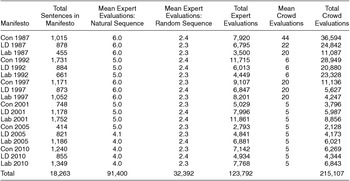
Our core objective is to compare estimates generated by workers in the crowd with analogous estimates generated by experts. Since readers of all types will likely disagree over the meaning of particular sentences, an important benchmark for our comparison of expert and crowd-sourced text coding concerns levels of disagreement between experts. The first stage of our empirical work therefore employed multiple (four to six)Footnote 15 experts to independently code each of the 18,263 sentences in our 18-document text corpus, using the scheme described above. The entire corpus was processed twice by our experts. First, sentences were served in their natural sequence in each manifesto, to mimic classical expert content analysis. Second, about a year later, sentences were processed in random order, to mimic the system we use for serving sentences to crowd workers. Sentences were uploaded to a custom-built, web-based platform that displayed sentences in context and made it easy for experts to process a sentence with a few mouse clicks. In all, we harvested over 123,000 expert evaluations of manifesto sentences, about seven per sentence. Table 1 provides details of the 18 texts, with statistics on the overall and mean numbers of evaluations, for both stages of expert processing as well as the crowd processing we report below.
Texts and Sentences Coded: 18 British Party Manifestos

External validity of expert evaluations
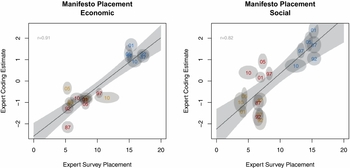
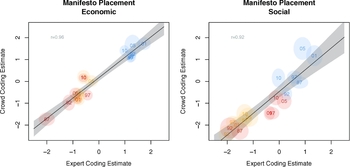
Figure 2 plots two sets of estimates of positions of the 18 manifestos on economic and social policy: one generated by experts processing sentences in natural sequence (x axis); the other generated by completely independent expert surveys (y axis).Footnote 16 Linear regression lines summarizing these plots show that expert text processing predicts independent survey measures very well for economic policy (R = 0.91), somewhat less well for the noisier dimension of social policy (R = 0.81). To test whether coding sentences in their natural sequence affected results, our experts also processed the entire text corpus taking sentences in random order. Comparing estimates from sequential and random-order sentence processing, we found almost identical results, with correlations of 0.98 between scales.Footnote 17 Moving from “classical” expert content analysis to having experts process sentences served at random from anonymized texts makes no substantive difference to point estimates of manifesto positions. This reinforces our decision to use the much more scalable random sentence sequencing in the crowd-sourcing method we specify.
British Party Positions on Economic and Social Policy 1987–2010

Internal reliability of expert coding
Agreement between experts
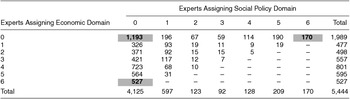
As might be expected, agreement between our experts was far from perfect. Table 2 classifies each of the 5,444 sentences in the 1987 and 1997 manifestos, all of which were processed by the same six experts. It shows how many experts agreed the sentence referred to economic, or social, policy. If experts are in perfect agreement on the policy content of each sentence, either all six label each sentence as dealing with economic (or social) policy, or none do. The first data column of the table shows a total of 4,125 sentences which all experts agree have no social policy content. Of these, there are 1,193 sentences all experts also agree have no economic policy content, and 527 that all experts agree do have economic policy content. The experts disagree about the remaining 2,405 sentences: some but not all experts label these as having economic policy content.
Domain Classification Matrix for 1987 and 1997 Manifestos: Frequency with which Sentences were Assigned by Six Experts to Economic and Policy Domains

Note: Shaded boxes: perfect agreement between experts.
The shaded boxes show sentences for which the six experts were in unanimous agreement—on economic policy, social policy, or neither. There was unanimous expert agreement on about 35 percent of the labeled sentences. For about 65 percent of sentences, there was disagreement, even about the policy area, among trained experts of the type usually used to analyze political texts.
Scale reliability
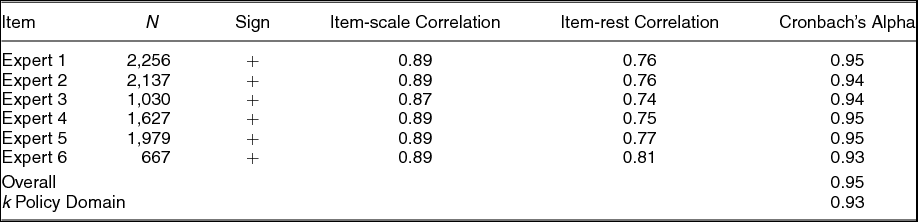
Despite substantial disagreement among experts about individual sentences, we saw above that we can derive externally valid estimates of party policy positions if we aggregate the judgments of all experts on all sentences in a given document. This happens because, while each expert judgment on each sentence is a noisy realization of some underlying signal about policy content, the expert judgments taken as a whole scale nicely—in the sense that in aggregate they are all capturing information about the same underlying quantity. Table 3 shows this, reporting a scale and coding reliability analysis for economic policy positions of the 1987 and 1997 manifestos, derived by treating economic policy scores for each sentence allocated by each of the six expert coders as six sets of independent estimates of economic policy positions.
Interexpert Scale Reliability Analysis for the Economic Policy, Generated by Aggregating All Expert Scores for Sentences Judged to have Economic Policy Content

Despite the variance in expert coding of the policy domains as seen in Table 2, overall agreement as to the policy domain of sentences was 0.93 using Fleiss’ kappa, a very high level of inter-rater agreement (as κ ranges from 0 to 1.0).Footnote 18 A far more important benchmark of reliability, however, focuses on the construction of the scale resulting from combining the coders’ judgments, which is of more direct interest than the codes assigned to any particular fragment of text. Scale reliability, as measured by a Cronbach's alpha of 0.95, is “excellent” by any conventional standard.Footnote 19 We can therefore apply our model to aggregate the noisy information contained in the combined set of expert judgements at the sentence level to produce coherent estimates of policy positions at the document level. This is the essence of crowd-sourcing. It shows that our experts are really a small crowd.
DEPLOYING CROWD-SOURCED TEXT CODING
CrowdFlower: A crowd-sourcing platform with multiple channels
Many online platforms now distribute crowd-sourced microtasks (Human Intelligence Tasks or “HITs”) via the Internet. The best known is Amazon's Mechanical Turk (MT), an online marketplace for serving HITs to workers in the crowd. Workers must often pass a pretask qualification test, and maintain a certain quality score from validated tasks that determines their status and qualification for future jobs. However, MT has for legal reasons become increasingly difficult to use for non-U.S. researchers and workers, with the result that a wide range of alternative crowd-sourcing channels has opened up. Rather than relying on a single crowd-sourcing channel, we used CrowdFlower, a service that consolidates access to dozens of channels.Footnote 20 CrowdFlower not only offers an interface for designing templates and uploading tasks that look the same on any channel but, crucially, also maintains a common training and qualification system for potential workers from any channel before they can qualify for tasks, as well as cross-channel quality control while tasks are being completed.
Quality control
Excellent quality assurance is critical to all reliable and valid data production. Given the natural economic motivation of workers in the crowd to finish as many jobs in as short a time as possible, it is both tempting and easy for workers to submit bad or faked data. Workers who do this are called “spammers.” Given the open nature of the platform, it is vital to prevent them from participating in a job, using careful screening and quality control (e.g., Berinsky et al. Reference Berinsky, Margolis and Sances2014; Eickhoff and de Vries Reference Eickhoff and de Vries2012; Kapelner and Chandler Reference Kapelner and Chandler2010; Nowak and Rger Reference Nowak and Rger2010;). Conway used coding experiments to assess three increasingly strict screening tests for workers in the crowd (Conway Reference Conway2013).Footnote 21 Two findings directly inform our design. First, using a screening or qualification test substantially improves the quality of results; a well-designed test can screen out spammers and bad workers who otherwise tend to exploit the job. Second, once a suitable test is in place, increasing its difficulty does not improve results. It is vital to have a filter on the front end to keep out spammers and bad workers, but a tougher filter does not necessarily lead to better workers.
The primary quality control system used by CrowdFlower relies on completion of “gold” HITs: tasks with unambiguous correct answers specified in advance.Footnote 22 Correctly performing “gold” tasks, which are both used in qualification tests and randomly sprinkled through the job, is used to monitor worker quality and block spammers and bad workers. We specified our own set of gold HITs as sentences for which there was unanimous expert agreement on both policy area (economic, social, or neither), and policy direction (left or right, liberal or conservative), and seeded each job with the recommended proportion of about 10% “gold” sentences. We therefore used “natural” gold sentences occurring in our text corpus, but could also have used “artificial” gold, manufactured to represent archetypical economic or social policy statements. We also used a special type of gold sentences called “screeners,” (Berinsky et al. Reference Berinsky, Margolis and Sances2014). These contained an exact instruction on how to label the sentence,Footnote 23 set in a natural two-sentence context, and are designed to ensure coders pay attention throughout the coding process.
Specifying gold sentences in this way, we implemented a two-stage process of quality control. First, workers were only allowed into the job if they correctly completed 8 out of 10 gold tasks in a qualification test.Footnote 24 Once workers are on the job and have seen at least four more gold sentences, they are given a “trust” score, which is simply the proportion of correctly labeled gold. If workers get too many gold HITs wrong, their trust level goes down. They are ejected from the job if their trust score falls below 0.8. The current trust score of a worker is recorded with each HIT, and can be used to weight the contribution of the relevant piece of information to some aggregate estimate. Our tests showed this weighting made no substantial difference, however, mainly because trust scores all tended to range in a tight interval around a mean of 0.84.Footnote 25 Many more potential HITs than we use here were rejected as “untrusted,” because the workers did not pass the qualification test, or because their trust score subsequently fell below the critical threshold. Workers are not paid for rejected HITs, giving them a strong incentive to perform tasks carefully, as they do not know which of these have been designated as gold for quality assurance. We have no hesitation in concluding that a system of thorough and continuous monitoring of worker quality is necessary for reliable and valid crowd sourced text analysis.
Deployment
We set up an interface on CrowdFlower that was nearly identical to our custom-designed expert web system and deployed this in two stages. First, we oversampled all sentences in the 1987 and 1997 manifestos, because we wanted to determine the number of judgments per sentence needed to derive stable estimates of our quantities of interest. We served up sentences from the 1987 and 1997 manifestos until we obtained a minimum of 20 judgments per sentence. After analyzing the results to determine that our estimates of document scale positions converged on stable values once we had five judgments per sentence—in results we report below—we served the remaining manifestos until we reached five judgments per sentence. In all, we gathered 215,107 judgments by crowd workers of the 18,263 sentences in our 18 manifestos, employing a total of 1,488 different workers from 49 different countries. About 28 percent of these came from the United States, 15 percent from the United Kingdom, 11 percent from India, and 5 percent each from Spain, Estonia, and Germany. The average worker processed about 145 sentences; most processed between 10 and 70 sentences, 44 workers processed over 1,000 sentences, and four processed over 5,000.Footnote 26
CROWD-SOURCED ESTIMATES OF PARTY POLICY POSITIONS
Figure 3 plots crowd-sourced estimates of the economic and social policy positions of British party manifestos against estimates generated from analogous expert text processing.Footnote 27 The very high correlations of aggregate policy measures generated by crowd workers and experts suggest both are measuring the same latent quantities. Substantively, Figure 3 also shows that crowd workers identified the sharp rightwards shift of Labour between 1987 and 1997 on both economic and social policy, a shift identified by expert text processing and independent expert surveys. The standard errors of crowd-sourced estimates are higher for social than for economic policy, reflecting both the smaller number of manifesto sentences devoted to social policy and higher coder disagreement over the application of this policy domain.Footnote 28 Nonetheless Figure 3 summarizes our evidence that the crowd-sourced estimates of party policy positions can be used as substitutes for the expert estimates, which is our main concern in this article.
Expert and Crowd-sourced Estimates of Economic and Social Policy Positions

Our scaling model provides a theoretically well-grounded way to aggregate all the information in our expert or crowd data, relating the underlying position of the political text both to the “difficulty” of a particular sentence and to a reader's propensity to identify the correct policy domain, and position within domain.Footnote 29 Because positions derived from the scaling model depend on parameters estimated using the full set of coders and codings, changes to the text corpus can affect the relative scaling. The simple mean of means method, however, is invariant to rescaling and always produces the same results, even for a single document. Comparing crowd-sourced estimates from the scaling model to those produced by a simple averaging of the mean of mean sentence scores, we find correlations of 0.96 for the economic and 0.97 for the social policy positions of the 18 manifestos. We present both methods as confirmation that our scaling method has not “manufactured” policy estimates. While this model does allow us to take proper account of reader and sentence fixed effects, it is also reassuring that a simple mean of means produced substantively similar estimates.
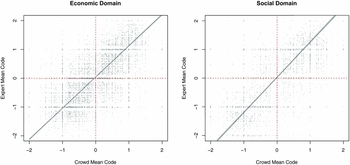
We have already seen that noisy expert judgments about sentences aggregate up to reliable and valid estimates for documents. Similarly, crowd-sourced document estimates reported in Figure 3 are derived from crowd-sourced sentence data that are full of noise. As we already argued, this is the essence of crowd-sourcing. Figure 4 plots mean expert against mean crowd-sourced scores for each sentence. The scores are highly correlated, though crowd workers are substantially less likely to use extremes of the scales than experts. The first principal component and associated confidence intervals show a strong and significant statistical relationship between crowd sourced and expert assessments of individual manifesto sentences, with no evidence of systematic bias in the crowd-coded sentence scores.Footnote 30 Overall, despite the expected noise, our results show that crowd workers systematically tend to make the same judgments about individual sentences as experts.
Expert and Crowd-sourced Estimates of Economic and Social Policy Codes of Individual Sentences, all Manifestos

Calibrating the number of crowd judgments per sentence
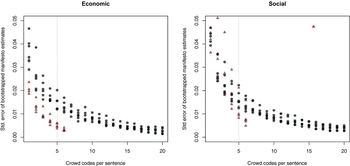
A key question for our method concerns how many noisier crowd-based judgments we need to generate reliable and valid estimates of fairly long documents such as party manifestos. To answer this, we turn to evidence from our oversampling of 1987 and 1997 manifestos. Recall we obtained a minimum of 20 crowd judgments for each sentence in each of these manifestos, allowing us to explore what our estimates of the position of each manifesto would have been, had we collected fewer judgments. Drawing random subsamples from our oversampled data, we can simulate the convergence of estimated document positions as a function of the number of crowd judgments per sentence. We did this by bootstrapping 100 sets of subsamples for each of the subsets of n = 1 to n = 20 workers, computing manifesto positions in each policy domain from aggregated sentence position means, and computing standard deviations of these manifesto positions across the 100 estimates. Figure 5 plots these for each manifesto as a function of the increasing number of crowd workers per sentence, where each point represents the empirical standard error of the estimates for a specific manifesto. For comparison, we plot the same quantities for the expert data in red.
Standard Errors of Manifesto-level Policy Estimates as a Function of the Number of Workers, for the Oversampled 1987 and 1997 Manifestos

The findings show a clear trend: uncertainty over the crowd-based estimates collapses as we increase the number of workers per sentence. Indeed, the only difference between experts and the crowd is that expert variance is smaller, as we would expect. Our findings vary somewhat with policy area, given the noisier character of social policy estimates, but adding additional crowd-sourced sentence judgments led to convergence with our expert panel of five to six coders at around 15 crowd coders. However, the steep decline in the uncertainty of our document estimates leveled out at around five crowd judgments per sentence, at which point the absolute level of error is already low for both policy domains. While increasing the number of unbiased crowd judgments will always give better estimates, we decided on cost-benefit grounds for the second stage of our deployment to continue coding in the crowd until we had obtained five crowd judgments per sentence. This may seem a surprisingly small number, but there are a number of important factors to bear in mind in this context. First, the manifestos comprise about 1000 sentences on average; our estimates of document positions aggregate codes for these. Second, sentences were randomly assigned to workers, so each sentence score can be seen as an independent estimate of the position of the manifesto on each dimension.Footnote 31 With five scores per sentence and about 1000 sentences per manifesto, we have about 5000 “little” estimates of the manifesto position, each a representative sample from the larger set of scores that would result from additional worker judgments about each sentence in each document. This sample is big enough to achieve a reasonable level of precision, given the large number of sentences per manifesto. While the method we use here could be used for much shorter documents, the results we infer here for the appropriate number of judgments per sentence might well not apply, and would likely be higher. But, for large documents with many sentences, we find that the number of crowd judgments per sentence that we need is not high.
CROWD-SOURCING DATA FOR SPECIFIC PROJECTS: IMMIGRATION POLICY
A key problem for scholars using “canonical” datasets, over and above the replication issues we discuss above, is that the data often do not measure what a modern researcher wants to measure. For example the widely used MP data, using a classification scheme designed in the 1980s, do not measure immigration policy, a core concern in the party politics of the 21st century (Ruedin Reference Ruedin2013; Ruedin and Morales Reference Ruedin and Morales2012). Crowd-sourcing data frees researchers from such “legacy” problems and allows them more flexibly to collect information on their precise quantities of interest. To demonstrate this, we designed a project tailored to measure British parties’ immigration policies during the 2010 election. We analyzed the manifestos of eight parties, including smaller parties with more extreme positions on immigration, such as the British National Party (BNP) and the UK Independence Party (UKIP). Workers were asked to label each sentence as referring to immigration policy or not. If a sentence did cover immigration, they were asked to rate it as pro- or anti-immigration, or neutral. We deployed a job with 7,070 manifesto sentences plus 136 “gold” questions and screeners devised specifically for this purpose. For this job, we used an adaptive sentence sampling strategy which set a minimum of five crowd-sourced labels per sentence, unless the first three of these were unanimous in judging a sentence not to concern immigration policy. This is efficient when coding texts with only “sparse” references to the matter of interest; in this case most manifesto sentences (approximately 96%) were clearly not about immigration policy. Within just five hours, the job was completed, with 22,228 codings, for a total cost of $360.Footnote 32
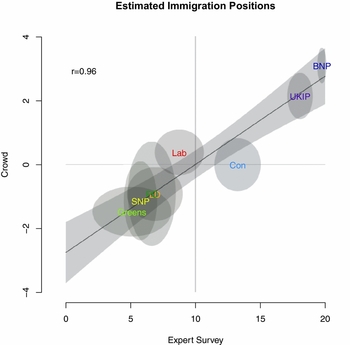
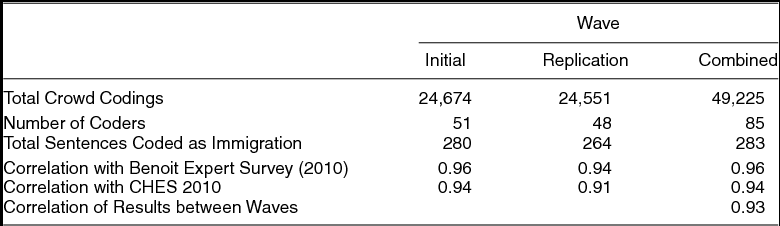
We assess the external validity of our results using independent expert surveys by Benoit (Reference Benoit2010) and the Chapel Hill Expert Survey (Bakker et al. Reference Bakker, de Vries, Edwards, Hooghe, Jolly, Marks, Polk, Rovny, Steenbergen and Vachudova2015). Figure 6 compares the crowd-sourced estimates to those from expert surveys. The correlation with the Benoit (Reference Benoit2010) estimates (shown) was 0.96, and 0.94 with independent expert survey estimates from the Chapel Hill survey.Footnote 33 To assess whether this data production exercise was as reproducible as we claim, we repeated the entire exercise with a second deployment two months after the first, with identical settings. This new job generated another 24,551 pieces of crowd-sourced data and was completed in just over three hours. The replication generated nearly identical estimates, detailed in Table 4, correlating at the same high levels with external expert surveys, and correlating at 0.93 with party position estimates from the original crowd coding.Footnote 34 With just hours from deployment to dataset, and for very little cost, crowd sourcing enabled us to generate externally valid and reproducible data related to our precise research question.
Correlation of Combined Immigration Crowd Codings with Benoit (Reference Benoit2010) Expert Survey Position on Immigration

Comparison Results for Replication of Immigration Policy Crowd Coding

CROWD SOURCED TEXT ANALYSIS IN OTHER CONTEXTS AND LANGUAGES
As carefully designed official statements of a party's policy stances, election manifestos tend to respond well to systematic text analysis. In addition, manifestos are written for popular consumption and tend to be easily understood by nontechnical readers. Much political information, however, can be found in texts generated from hearings, committee debates, or legislative speeches on issues that often refer to technical provisions, amendments, or other rules of procedure that might prove harder to analyze. Furthermore, a majority of the world's political texts are not in English. Other widely studied political contexts, such as the European Union, are multilingual environments where researchers using automated methods designed for a single language must make hard choices. Schwarz et al. (forthcoming) applied unsupervised scaling methods to a multilingual debate in the Swiss parliament, for instance, but had to ignore a substantial number of French and Italian speeches in order to focus on the majority German texts. In this section, we demonstrate that crowd-sourced text analysis, with appropriately translated instructions, offers the means to overcome these limitations by working in any language.
Our corpus comes from a debate in the European Parliament, a multilanguage setting where the EU officially translates every document into 24 languages. To test our method in a context very different from party manifestos, we chose a fairly technical debate concerning a Commission report proposing an extension to a regulation permitting state aid to uncompetitive coal mines. This debate concerned not only the specific proposal, involving a choice of letting the subsidies expire in 2011, permitting a limited continuation until 2014, or extending them until 2018 or even indefinitely.Footnote 35 It also served as debating platform for arguments supporting state aid to uncompetitive industries, versus the traditionally liberal preference for the free market over subsidies. Because a vote was taken at the end of the debate, we also have an objective measure of whether the speakers supported or objected to the continuation of state aid.
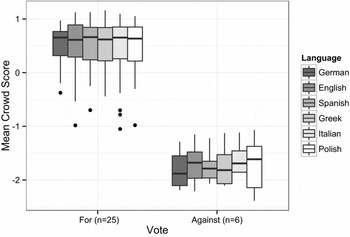
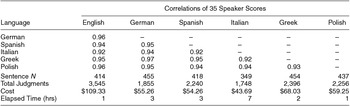
We downloaded all 36 speeches from this debate, originally delivered by speakers from 11 different countries in 10 different languages. Only one of these speakers, an MEP from the Netherlands, spoke in English, but all speeches were officially translated into each target language. After segmenting this debate into sentences, devising instructions and representative test sentences and translating these into each language, we deployed the same text analysis job in English, German, Spanish, Italian, Polish, and Greek, using crowd workers to read and label the same set of texts, but using the translation into their own language. Figure 7 plots the score for each text against the eventual vote of the speaker. It shows that our crowd-sourced scores for each speech perfectly predict the voting behavior of each speaker, regardless of the language. In Table 5, we show correlations between our crowd-sourced estimates of the positions of the six different language versions of the same set of texts. The results are striking, with interlanguage correlations ranging between 0.92 and 0.96.Footnote 36 Our text measures from this technical debate produced reliable measures of the very specific dimension we sought to estimate, and the validity of these measures was demonstrated by their ability to predict the voting behavior of the speakers. Not only are these results straightforwardly reproducible, but this reproducibility is invariant to the language in which the speech was written. Crowd-sourced text analysis does not only work in English.
Scored Speeches from a Debate over State Subsidies by Vote, from Separate Crowd-sourced Text Analysis in Six Languages

Summary of Results from EP Debate Coding in Six Languages

CONCLUSIONS
We have illustrated across a range of applications that crowd-sourced text analysis can produce valid political data of a quality indistinguishable from traditional expert methods. Unlike traditional methods, however, crowd-sourced data generation offers several advantages. Foremost among these is the possibility of meeting a replication standard far stronger than the current practice of facilitating reproducible analysis. By offering a published specification for feasibly replicating the process of data generation, the methods demonstrated here go much farther towards meeting a more stringent standard of reproducibility that is the hallmark of scientific inquiry. All of the data used in this article are of course available in a public archive for any reader to reanalyze at will. Crowd-sourcing our data allows us to do much more than this, however. Any reader can take our publically available crowdsourcing code and deploy this code to reproduce our data collection process and collect a completely new dataset. This can be done many times over, by any researcher, anywhere in the world. This, to our minds, takes us significantly closer to a true scientific replication standard.
Another key advantage of crowd-sourced text analysis is that it can form part of an agile research process, precisely tailored to a specific research question rather than reflecting the grand compromise at the heart of the large canonical datasets so commonly deployed by political scientists. Because the crowd's resources can be tapped in a flexible fashion, text-based data on completely new questions of interest can be processed only for the contexts, questions, and time periods required. Coupled with the rapid completion time of crowd-sourced tasks and their very low marginal cost, this opens the possibility of valid text processing to researchers with limited resources, especially graduate students. For those with more ambition or resources, its inherent scalability means that crowd-sourcing can tackle large projects as well. In our demonstrations, our method worked as well for hundreds of judgments as it did for hundreds of thousands.
Of course, retooling for any new technology involves climbing a learning curve. We spent considerable time pretesting instruction wordings, qualification tests, compensation schemes, gold questions, and a range of other detailed matters. Starting a new crowd-sourcing project is by no means cost-free, though these costs are mainly denominated in learning time and effort spent by the researcher, rather than research dollars. Having paid the inevitable fixed start-up costs that apply to any rigorous new data collection project, whether or not this involves crowd-sourcing, the beauty of crowd-sourcing arises from two key features of the crowd. The pool of crowd workers is to all intents and purposes inexhaustible, giving crowd-sourcing projects a scalability and replicability unique among projects employing human workers. And the low marginal cost of adding more crowd workers to any given project puts ambitious high quality data generation projects in the realistic grasp of a wider range of researchers than ever before. We are still in the early days of crowd-sourced data generation in the social sciences. Other scholars will doubtless find many ways to fortify the robustness and broaden the scope of the method. But, whatever these developments, we now have a new method for collecting political data that allows us to do things we could not do before.
APPENDIX: METHODOLOGICAL DECISIONS ON SERVING POLITICAL TEXT TO WORKERS IN THE CROWD
Text units: Natural sentences
The MP specifies a “quasisentence” as the fundamental text unit, defined as “an argument which is the verbal expression of one political idea or issue” (Volkens Reference Volkens2001). Recoding experiments by Däubler et al. (Reference Däubler, Benoit, Mikhaylov and Laver2012), however, show that using natural sentences makes no statistically significant difference to point estimates, but does eliminate significant sources of both unreliability and unnecessary work. Our dataset therefore consists of all natural sentences in the 18 UK party manifestos under investigation.Footnote 37
Text unit sequence: Random
In “classical” expert text coding, experts process sentences in their natural sequence, starting at the beginning and ending at the end of a document. Most workers in the crowd, however, will never reach the end of a long policy document. Processing sentences in natural sequence, moreover, creates a situation in which one sentence coding may well affect priors for subsequent sentence codings, so that summary scores for particular documents are not aggregations of independent coder assessments.Footnote 38 An alternative is to randomly sample sentences from the text corpus for coding—with a fixed number of replacements per sentence across all coders—so that each coding is an independent estimate of the latent variable of interest. This has the big advantage in a crowdsourcing context of scalability. Jobs for individual coders can range from very small to very large; coders can pick up and put down coding tasks at will; every little piece of coding in the crowd contributes to the overall database of text codings. Accordingly our method for crowd-sourced text coding serves coders sentences randomly selected from the text corpus rather than in naturally occurring sequence. Our decision to do this was informed by coding experiments reported in the Online Appendix (Section 5), and confirmed by results reported above. Despite higher variance in individual sentence codings under random sequence coding, there is no systematic difference between point estimates of party policy positions depending on whether sentences were coded in natural or random sequence.
Text authorship: Anonymous
In classical expert coding, coders typically know the authorship of the document they are coding. Especially in the production of political data, coders likely bring nonzero priors to coding text units. Precisely the same sentence (“we must do all we can to make the public sector more efficient”) may be coded in different ways if the coder knows this comes from a right- rather than a left-wing party. Codings are typically aggregated into document scores as if coders had zero priors, even though we do not know how much of the score given to some sentence is the coder's judgment about the content of the sentence, and how much a judgment about its author. In coding experiments reported in the Online Appendix (Section 5), semiexpert coders coded the same manifesto sentences both knowing and not knowing the name of the author. We found slight systematic coding biases arising from knowing the identity of the document's author. For example, we found coders tended to code precisely the same sentences from Conservative manifestos as more right wing, if they knew these sentences came from a Conservative manifesto. This informed our decision to withhold the name of the author of sentences deployed in crowd-sourcing text coding.
Context units: +/− two sentences
Classical content analysis has always involved coding an individual text unit in light of the text surrounding it. Often, it is this context that gives a sentence substantive meaning, for example because many sentences contain pronoun references to surrounding text. For these reasons, careful instructions for drawing on context have long formed part of coder instructions for content analysis (see Krippendorff Reference Krippendorff2013). For our coding scheme, on the basis of prerelease coding experiments, we situated each “target” sentence within a context of the two sentences on either side in the text. Coders were instructed to code target sentence not context, but to use context to resolve any ambiguity they might feel about the target sentence.
SUPPLEMENTARY MATERIAL
To view supplementary material for this article, please visit http://dx.doi.org/10.1017/S0003055416000058.




Comments
No Comments have been published for this article.