Introduction
Inspired by the Barker hypothesis,Reference Barker and Osmond 1 the Developmental Origins of Health and Disease (DOHaD) theorem has vastly evolved during the last decadeReference Wadhwa, Buss, Entringer and Swanson 2 and along with it the knowledge of short- and long-term sequelae of intrauterine or fetal growth restriction (IUGR/FGR).Reference Cosmi, Fanelli, Visentin, Trevisanuto and Zanardo 3 It became evident that IUGR/FGR is involved in various clinical and public health aspects.Reference Cosmi, Fanelli, Visentin, Trevisanuto and Zanardo 3 – Reference Barker 5 There is growing evidence that the early life environment plays a pivotal role in influencing the risk to develop a wide range of non-communicable diseases (such as type-2 diabetes and cardiovascular disease) in later life.Reference Godfrey, Costello and Lillycrop 6 , Reference Godfrey, Inskip and Hanson 7 Research in the field of IUGR/FGR has increased the awareness for the relevance of these pregnancy outcomes and led to the development of diagnostic screening tools to better recognize fetuses at-risk even among low-risk pregnancies.Reference Cosmi, Fanelli, Visentin, Trevisanuto and Zanardo 3 While the current obstetric management is focused on the right time to deliver in order to prevent adverse perinatal outcomes, neonatologic care is dedicated to treatment of problems related to prematurityReference Mandy, Weisman and Kim 8 – partly due to the lack of awareness regarding the relevance of IUGR/FGR long-term sequelae.Reference Barker 5 Although it is recognized that the postnatal feeding regimen and monitoring of infant growth patterns may be essential for long-term outcome,Reference Cosmi, Fanelli, Visentin, Trevisanuto and Zanardo 3 the establishment of aftercare and treatment guidelines to manage the medical sequelae associated with IUGR/FGR remains a current challenge. 9 This is especially of importance as patients diagnosed with IUGR/FGR gain increasingly more knowledge about the condition and its consequences online.
In order to supplement the information provided by their physician, women nowadays frequently obtain medical information on pregnancy and childbirth from the internetReference Fioretti, Reiter, Betran and Torloni 10 – Reference Sayakhot and Carolan-Olah 13 and from other media.Reference Moyer, Vishnu and Sonnad 14 It is conceived that this exposure might influence their decision making.Reference Fioretti, Reiter, Betran and Torloni 10 , Reference Lagan, Sinclair and Kernohan 15 Unfortunately, pregnant women rarely discuss the information they accessed online with their health providers, who may not be aware of misconceptions based on potentially inaccurate information found on the web.Reference Sayakhot and Carolan-Olah 13 Postnatally, parents intensively utilize the internet as a popular resource for pediatric health-related guidance, which has been shown by numerous studies.Reference Wainstein, Sterling-Levis, Baker, Taitz and Brydon 16 – Reference Tuffrey and Finlay 18 Based on Ofcom’s Adults’ Media Use and Attitudes Report 2015 19 the average adult in the United Kingdom currently spends more than 20 h/week online. The internet usage is currently at an all-time high with an estimated 87.9% of adults in the United Kingdom having used the internet in the last 3 months. 20 Health information-related internet use in the United Kingdom has remained stable at 16% weekly since 2005 19 among adults aged 16+. In the United States, a study from 2010 found that ~74% of English-speaking adults use the internet on a regular basis.Reference Rainey 21 Thus, online health information is available to the majority of the adult population. To analyze changes in the U.S. health information environment, the NIH National Cancer Institute fielded the Health Information National Trends Survey (HINTS) in 2003:Reference Hesse, Nelson and Kreps 22 It showed that 63.7% of the average adult U.S. online population had looked for health-related information (for themselves or others) at least once in the previous 12 months.Reference Hesse, Nelson and Kreps 22 Physicians were the most highly trusted information source to patients, independent of their health literacy level. 23 Nevertheless, 48.6% reported going online first for specific health information, with only 10.9% going to their physicians first.Reference Hesse, Nelson and Kreps 22 Interestingly, parents also use the internet before their contact with a healthcare specialist and in some cases the internet may be the sole source of healthcare advice.Reference Khoo, Bolt, Babl, Jury and Goldman 17 , Reference Tuffrey and Finlay 18 Unfortunately, the quality of information available on health-related websites often varies due to the lack of editorial control.Reference Fioretti, Reiter, Betran and Torloni 10 This can lead to the presentation of inaccurate or incomplete medical information.Reference Fioretti, Reiter, Betran and Torloni 10 , Reference Kaicker, Debono, Dang, Buckley and Thabane 24 – Reference Sacchetti, Zvara and Plante 27 When Scullard et al.Reference Scullard, Peacock and Davies 28 assessed the reliability of medical advice on the web for common pediatric questions, only 39% of sites searched gave the correct information, 11% were incorrect and 49% failed to answer the question. Where an answer was available, only 78% of sites gave the correct information.Reference Scullard, Peacock and Davies 28 Hence we set out to assess the quality of information on postnatal consequences of IUGR/FGR and DOHaD-related consequences on websites directed at laypersons. We based our analysis on Google.com and Yahoo.com search engines to simulate the patient’s perspective.Reference Fioretti, Reiter, Betran and Torloni 10 , Reference Scullard, Peacock and Davies 28
Methods
Selection criteria for the webpages
Websites were considered eligible if they provided any information about IUGR/FGR, such as the etiopathology, outcome and/or maternal or perinatal short- or long-term risks associated with this pregnancy complication. Exclusion criteria were as following:Reference Fioretti, Reiter, Betran and Torloni 10 (1) IUGR-related content was limited (i.e. <100 words); (2) website not written in English; (3) complete access restricted by password; (4) repeated server unavailability for 1 week; (5) scientific libraries, book chapters and journals; (6) information mainly on animal studies; (7) promotional websites advertising healthcare institutions without providing detailed information on IUGR; (8) mere reports of personal experiences (e.g. blogs) of single individuals without any additional scientific information; (9) non-written content (e.g. videos).
Process of identification and selection of webpages
The process of identification, selection and evaluation of the webpages took place from January to April 2016. Two different keywords were chosen for our internet research: ‘IUGR consequences’ and ‘FGR consequences.’ These were entered into internet search engines Google.com and Yahoo.com, with the country of origin set to Germany. In both search engines the following parameters were selected: English was set as preferred language, the browser history was erased before every search and non-institutional internet access was chosen to simulate a non-professional environment. We based our analysis on Google.com and Yahoo.com search engines, as they ranked first and third among the most popular engines available in 2016. 29 Google was the most frequently used search engine among parents of attending pediatric outpatients.Reference Sim, Kitteringham and Spitz 30 Google is also among the most commonly used search engines by medical professionals when accessing academic sites.Reference Giustini 31 We chose to analyze Yahoo.com over the second ranked engine Bing.com, as Yahoo.com uses Bing.com as search engine, yet additionally functions as a webportal offering links to health-related sites. Sacchetti et al.Reference Sacchetti, Zvara and Plante 27 showed that individuals rarely browse through more than 30 sites when looking for online information. Thus, the first three pages of results, representing 30 links, of each internet search engine and each keyword were subjected to further analysis, resulting in a total of 120 links. This approach has also been used by others, previously.Reference Fioretti, Reiter, Betran and Torloni 10 Subsequently, duplicate pages were deleted, and the remaining pages were assessed for possible inclusion by one investigator (1st author, S.P.). Websites passing the above exclusion criteria were electronically saved for later analyses by an independent investigator (last author, F.F.). Relevant information from each unique webpage was extracted using the validated toolsReference Gagliardi and Jadad 32 HONcode (Table 1) 33 and DISCERN Plus score (DPS, Table 2)Reference Fast, Deibert, Hruby and Glassberg 34 , Reference Charnock, Shepperd, Needham and Gann 35 and a checklist for content specifically created for this study (see below). Only the written contents available through screen scrolling of the opening page of each website were assessed, with exception for cases where information on aims and provider of the webpages had to be accessed via a separate link. Written information provided in additional links to websites of other suppliers was not subjected to analysis. From this, categories (sponsored medical news site, medical center/university, interest group, governmental, educational) were chosen to encompass all the types of sites that had arisen. The cited references of each webpage were saved and analyzed for year of publication and overlap with references cited by all other websites examined. The category short-term sequelae of IUGR/FGR relates to the newborn period (first 28 days of life), whereas long-term refers to IUGR/FGR-related sequelae in childhood, adolescence and adulthood.
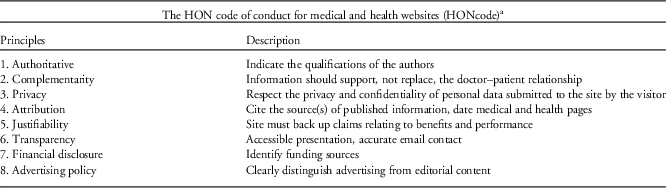
Health on the Net Foundation (HON) code of conduct for medical and health websites: list of the eight principles and the respective description

a Reproduced from the HON foundation. The HON code of conduct for medical and health websites (HONcode) 33
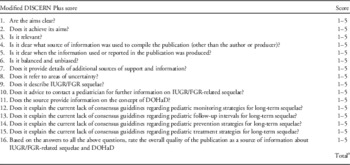
List of the 16 modified questions framing the DISCERN Plus tool

a Maximum of 80.
HONcode
The HONcode agency was founded in 1995 by the Health of the Net Foundation. 33 It is approved by the United Nations and aims to enable patients, web publishers and medical professional to get access to high-value medical information by accrediting websites that publish transparent health-related information. 33 Webpages can apply for accreditation, which involves their examination by a professional committee based on ethical standards. The tool incorporates the assessment of eight principles, which are described in Table 1. HONcode provides a toolbar to internet users that can be added to the browsers toolbar. Whenever a website is accredited by HONcode, the user gets a visual feedback to indicate that quality health information is presented. 33 We utilized the toolbar and recorded whether each website was HONcode accredited, as described by others.Reference Fast, Deibert, Hruby and Glassberg 34 The frequency of accreditation for each website was recorded.
DISCERN Plus
DISCERN was funded by The British Library and National Health Service of the United Kingdom and Development Programme.Reference Charnock, Shepperd, Needham and Gann 35 It was generated to offer patients and information providers the possibility to judge the quality of written content on health-related websites. The DISCERN Plus (DP) instrument is a standardized, validated tool that determines the quality of the medical information on a website based on 16 questions.Reference Charnock, Shepperd, Needham and Gann 35 While it was initially designed to aid in the assessment of the reliability and quality of medical treatment optionsReference Charnock, Shepperd, Needham and Gann 35 including surgical procedures,Reference Fast, Deibert, Hruby and Glassberg 34 , Reference Wasserman, Baxter, Rosen, Burnstein and Halverson 36 it has also been successfully used to analyze health information available on the internet.Reference Fast, Deibert, Hruby and Glassberg 34 , Reference Charnock and Shepperd 37 Hence, we modified the DP questions for our analysis (Table 2). The first eight DP questions address the reliability of the website, while the questions 9 and 10 cover the description of IUGR/FGR-related sequelae and the advice to consult a pediatrician for further information. Questions 11–15 specifically address topics associated with DOHaD, that is concept-related information and patient information about the lack of consensus guidelines for monitoring strategies, follow-up intervals, prevention and treatment strategies (Table 2). The last question is an overall rating of the website. As provided by the DISCERN guidelines,Reference Charnock, Shepperd, Needham and Gann 35 the first 15 questions are given a score from 1 to 5 (1=‘no’, 2–4=‘partially’ and 5=‘yes’). The overall quality of the website is then rated on a scale from 1 (poor quality) to 5 (excellent quality), resulting in a maximum DP-score (DPS) of 80. The modified DP instrument was used by two independent investigators (S.P. and F.F.) to assess the top websites for each search term. DPS discrepancies were discussed and a consensus reached.
Statistical analyses
Spearman correlation and linear regression analysis were performed using GraphPad Prism 7 (GraphPad Software Inc., La Jolla, CA, USA). Group comparisons were performed using an unpaired Student’s t-test. A P-value of <0.05 was considered significant. Results are mainly presented descriptively using means, standard deviations and percentages. Graphical layout was created with Excel 2010 (Microsoft Corporation, Redmond, WA, USA) and Photoshop CS6 (Adobe Systems Inc., San Jose, CA USA).
Results
Our search strategy retrieved a total of 120 webpages (two search engines, two key-phrases, 30 websites each), which were further assessed for eligibility. A total of 80 webpages were excluded because they did not fulfill the inclusion criteria. After exclusion of duplicates, 23 websites were selected as eligible for the final analysis, all of which were freely accessible and written in English. The complete list of the 23 URLs is available in Supplementary Table S1. The categories of the webpages were mostly sponsored medical news sites (n=9), medical centers/universities (n=7) and interest groups (n=4) and a limited number were governmental sites (n=2) (Table 3). None of the 23 websites came from a company or individual.
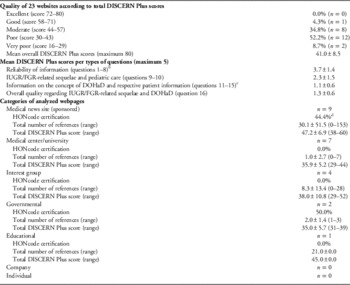
Overview of the quality of information on IUGR/FGR sequelae, DOHaD-related content and respective patient informationFootnote a

a All values expressed as percentage or mean±s.d.
b Questions related to aims, relevance for users, sources of information used, date of information, balance, additional sources and areas of uncertainty.
c Questions related to the concept of DOHaD and provision of information regarding the lack of consensus guidelines for monitoring, follow-up intervals, prevention and treatment strategies.
d Equals 80% of all HONcode certifications.
The overall mean DISCERN Plus score (DPS) for the 23 unique webpages was 41.0±8.5 (range 28–60; Table 3) regarding quality of advice, information on postnatal sequelae of IUGR/FGR and DOHaD-related content. The main focus of the analyzed websites was the provision of pregnancy-associated information. While the reliability of information (questions #1–8; Table 2) on IUGR/FGR-related sequelae was generally good (DPS 3.7±1.4; Table 3 Fig. 1D), the majority (60.9%; Table 3, Fig. 1Ad) of websites showed poor (DPS 30–43) to very poor (DPS 16–29) overall quality, mainly due to the lack of information on the concept of DOHaD and on missing consensus guidelines (questions #10–15; Table 2, Fig. 1D). In fact, only four webpages gave DOHaD-related information by mentioning the buzzwords ‘Barker hypothesis’ (n=2), ‘fetal programming’ (n=1), as well as ‘thrifty phenotype’ and ‘epigenetics’ (n=1). Two webpages indicated that IUGR/FGR sequelae require medical follow-up as an option. However, only a single website was specific with regard to monitoring growth and neurodevelopmental outcome and further stated that the occurrence of these IUGR/FGR-related sequelae is subject to great variability, based on which guidelines outlining long-term care are pending. Only one other website discussed the likelihood of developing IUGR/FGR sequelae.
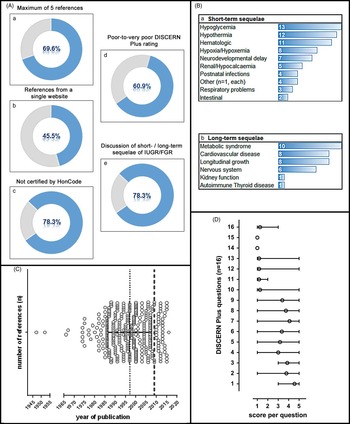
Quality of advice on postnatal sequelae of intrauterine/fetal growth restriction and the implications of developmental origins of health and disease. (A) Descriptive summary of relevant findings given in percent. (B) Short- and long-term sequelae of IUGR/FGR. The numbers represent the sum of the state of declaration of each consequence from all websites analyzed. Results are presented in the order most-to-least discussed. (C) Display of the year of publication for all cited references of the analyzed webpages. Black dotted line indicates the mean±s.d., gray dashed line indicates the year of publication of the first Journal of DOHaD (Issue S1, November 2009). (D) Results of the modified DISCERN Plus tool (see also Tables 2 and 3) presented as score per question (mean±s.d.). Minimal score=1, maximum score=5. Questions #1–8 relate to the general quality of websites, #9–10 to IUGR/FGR sequelae, #11–15 to DOHaD-related content and respective patient information, #16 represents the total score regarding information about IUGR/FGR-related sequelae and DOHaD.

The DISCERN analysis showed that the category ‘sponsored medical news site’ (Table 3) had a significantly higher DPS than both the categories ‘medical center/university’ and ‘governmental’ (P<0.003 and <0.05, respectively).
Looking at the references cited by the 23 websites, 47.8% (n=11) did not mention any sources of information, with 69.6% citing a maximum of five references (n=16; Fig. 1Aa). Overall 336 references were cited. The mean year of reference publication was 1997±10.6 (Fig. 1C, dotted line, range 1947–2016), with only 12.8% (n=43) of cited references after the publication of the first issue of the Journal of DOHaD (Issue S1, November 2009; Fig. 1C dashed line). Interestingly, 45.5% (n=153) of cited references came from a single webpage (Fig. 1 Ab). The majority (n=5, 22.7%) of the remaining webpages cited 1–5 references, 9.1% of websites had a reference list with citation numbers in the range of 6–10, 11–30, 31–70, respectively (n=2, each). There was very little overlap (4.2%) of references (citation of the same sources) in a total of only 13.0% of the 23 webpages (maximum of three references, each). We did not find a significant difference in the number of cited references depending on the category of the webpage (Table 3, data not shown). Interestingly, we found that the number of cited references per webpage significantly correlated with its DPS (linear regression R 2 0.455, P<0.05; Spearman’s r 0.74, P<0.0001).
The majority (n=18, 78.3%; Fig. 1 Ac) of the 23 webpages did not have a HONcode certification. Of the five HONcode-certified sites (n=5, 21.7%), four came out of the category ‘sponsored medical news site’ and one was of ‘governmental’ origin (Table 3). There was no significant difference in DPS (46.6±8.8 v. 39.4±7.9) or the number of cited references (32.8±67.3 v. 9.6±18.0), when comparing HONcode-certified and uncertified webpages, respectively.
Despite short-comings with regard to the concept of DOHaD and its consequences (Fig. 1 Ad), 78.3% of the analyzed websites mentioned IUGR/FGR-related short- and long-term sequelae (Fig. 1 Ae). This is also reflected by the high DPS (3.4±1.2, Fig. 1d) of DISCERN question #9 (Table 2), which addresses this topic. However, only five of the 23 websites gave detailed information on both short- and long-term sequelae. Three websites mentioned neither long- nor short-term sequelae of IUGR/FGR. The categories of short- and long-term consequences as published by the websites are listed in Figure 1Ba and Bb, respectively; 26% (n=6) of the analyzed webpages mentioned the existence of short-term sequelae, including one website that did not give any further related information. In detail, hypoglycemia, hypothermia and hematologic alterations (i.e. polycythemia, hyperviscosity, hyperbilirubinemia, thrombo-/leukopenia) were the top three short-term sequelae of IUGR/FGR (Fig. 1Ba). These ranks were followed by hypoxia/hypoxemia and neurodevelopmental delay (i.e. mostly reduced motor function and cerebral palsy, as well as others, such as behavioral abnormalities, immature sleep patterns, decreased visual fixation, decreased general activity, altered early mother–infant interaction and hyperactivity) (Fig. 1Ba). Furthermore, intestinal (necrotizing enterocolitis, feeding problems), renal immaturity (foremost hypocalcaemia), respiratory problems (i.e. respiratory failure, bronchopulmonary dysplasia), postnatal infections and others (i.e. growth retardation, delay in dental development, retinopathy of prematurity, reduced body fat) were mentioned less frequently.
Of the websites assessed, 22% (n=5) did not mention long-term sequelae of IUGR/FGR. On the remaining 18 websites, metabolic syndrome (i.e. hypercholesterolemia, obesity, impaired glucose tolerance and type-2 diabetes, hyperlipidemia), cardiovascular disease (i.e. hypertension, ischemic heart disease) and problems related to longitudinal growth (i.e. short stature) were the most frequent sequelae discussed (Fig. 1Bb). These were followed by neurologic development [i.e. white/gray matter effects, IQ deficits, accelerated maturation of the hippocampus, mental health morbidity, cognitive problems (executive, concentration), clumsiness, cerebral palsy, abnormal deafness, delay of developmental milestones, hyperactivity, schizophrenia] and others (renal, autoimmune thyroid disease) (Fig. 1Bb).
A total of 52% (n=12) of websites name perinatal risk factors of IUGR/FGR neonates. Interestingly, while meconium aspiration was mentioned by 50.0% (n=6) as the only acute perinatal risk of IUGR/FGR, only 16.7% (n=2) of websites gave information on the risk of prematurity, oligohydramnios, higher incidence of pre-labor cesarean delivery and/or induced labor, birth asphyxia, low Apgar score and apnea. The remaining four webpages mentioned increased perinatal mortality rate (n=3), sepsis (n=1), brain damage (n=1, i.e. intraventricular hemorrhage, periventricular leukomalacia, hypoxic ischemic encephalopathy, seizures) and possible intrauterine demise (n=1).
Discussion
In the recent years, we observe a shift in the ways in which patients consume health-related information, with more patients looking for information online before consulting their physicians.Reference Hesse, Nelson and Kreps 22 Our analysis of current web content regarding the quality of advice on postnatal sequelae of IUGR/FGR showed a significant lack of information on the concept of DOHaD and on related patient information. In cases where respective data is presented, (future) parents are left to decipher a variety of potential IUGR/FGR sequelae due to the lack of further explanation. The majority of the analyzed websites failed to mention the concept of DOHaD and the fact that consensus guidelines addressing aftercare, mitigation of risks or long-term management of children at risk for DOHaD are currently unavailable. This is reflected by the poor ranking of the majority of analyzed websites in our DISCERN Plus rating.
We were surprised to find that the category ‘sponsored medical news site’ had a significantly higher DPS than both the categories ‘medical center/university’ and ‘governmental’ in our DISCERN analysis, while there should be a strong incentive for these traditional institutions of patient education to improve their online services with regard to IUGR/FGR and DOHaD. In line with this finding, the majority of HONcode-certified websites were found in the category ‘sponsored medical news site,’ with only a minority of HONcode-certified websites present in general. The fact that we did not observe HONcode certification of webpages authored by medical centers and universities in combination with their significantly lower DPS compared to HONcode-certified ‘sponsored medical news sites’ might indicate that these institutional webpages did not have the primary goal of patient education, but were rather aimed at informing the public and peers about their services and research interests in general.
Our finding of a significant positive correlation of the number of references cited per webpage and the respective DPS is limited by the fact that the majority of references was published before the beginning of the millennium and 11 of 23 websites did not cite any reference.
In our analysis we excluded scientific articles to mimic a layperson’s access to medical information found online. However, there might be further restrictions present that were not included into our analysis. For example, it has to be noted that the amount of information gained might be limited by the finding that 55% of current internet users spends fewer than 15 seconds on a page, indicating the importance of webpage design to facilitate the access to data.Reference Gurel Koybasi and Cagiltay 39
Furthermore, we did not determine the quality of webpages with regard to the average reader level. It has been shown that only 1–2% were aimed at the recommended reading level,Reference Hargrave, Hargrave and Bouffet 40 taking into account that 16% of adults in the United Kingdom have a reading level equivalent to an 11-year old (equals 6th Grade in the U.S. school system).Reference Scullard, Peacock and Davies 28 Therefore, even if correct information is presented, it might not be understood or might be misinterpreted. In this respect, similar results were obtained from the national assessment of adult literacy in 2003 by the Institute of Education Sciences at the U.S. Department of Education. 23 It was shown that only 12% of the U.S. adults had proficient health literacy. Over 1/3 of the U.S. adults had difficulties completing common health tasks, such as following directions on a prescription drug label or adhering to a childhood immunization schedule. This limitation was prevalent among all racial and ethnical groups, as well as education levels, however, was more pronounced among non-Caucasian minorities and adults without high school education. 23 Noteworthy, the assessment showed that all adults, regardless of their health literacy skills, were more likely to get health information from radio/television, friends/family and health professionals, than from print media. 23 Adults with the most limited health literacy rarely use digital resources and written material to obtain information on health topics in this study. 23 Thus, while our analysis was tailored to encompass the layperson’s view, it can be conceived that the general uptake of information related to IUGR/FGR and DOHaD-related consequences might be limited, especially in adults with reduced health literacy and low socioeconomic status. Unfortunately, it is known that this subpopulation has the highest IUGR/FGR-rate in particular,Reference Kramer 41 , Reference Hendrix and Berghella 42 which argues for physician-based medical education of this group.
Based on our findings, we currently cannot encourage healthcare workers to recommend their patients the use of websites to research the consequences of IUGR/FGR due to the lack of information on DOHaD and the related consequences. This negative assessment is also the consequence of (i) generalization of IUGR/FGR as risk factor of a limited number of subjectively selected sequelae independent of a clear definition of the pregnancy complication, (ii) lack of consensus guidelines for IUGR/FGR aftercare and (iii) the aged data presented online, which also includes websites run by the government or national health services, usually offering valuable medical information in other fields.Reference Scullard, Peacock and Davies 28
It has to be noted, that overall IUGR/FGR-related sequelae were reported by a proportion of the analyzed websites, thereby contributing to the awareness of the relevance of the condition. Hence, it is hoped that the increasing use of the internet in healthcare will offer new opportunities for patient information in the future. Certain limitations might, however, apply regarding online medical education for laypersons with low socioeconomic status and reduced health literacy. As respective consensus guidelines are currently lacking, DOHaD-related patient education and follow-up remains within the physician’s individual responsibility for now.
Acknowledgments
Data acquisition and analysis was performed by Sandra Perzel in fulfillment of the requirements for obtaining the degree ‘Dr. med.’ at the Friedrich-Alexander-University of Erlangen-Nuremberg, Dept. of Pediatrics and Adolescent Medicine, Germany.
Supplementary materials
To view supplementary material for this article, please visit https://doi.org/10.1017/S2040174417000332