Having absorbed the heavy content of Schopenhauer's World as Will and Idea in 1892, the young Alexander Skryabin began to follow in the footsteps of Wagner, who, in Tristan, had attempted to capture the vagaries of the desiring subject in musical form.Footnote 1 Notwithstanding the lingering ghost of the arch-pessimist Schopenhauer, for whom desire was the bane of human existence, Skryabin imagined a world without desire to be one of absolute horror. His nightmarish parody runs:
Nothing remains for me to desire. And in this position I find myself eternally at peace. Is it possible to imagine anything more frightful than the numbness of satisfaction? Are not the most terrible sufferings and all the tortures of the Inquisition better, that is less horrible, than this feeling of infinite satisfaction?Footnote 2
Skryabin saw desire as the insatiable root of all action, a force whose power could not (and should not) be impeded. In his philosophical notebooks the word ‘desire’ becomes something of a mantra: ‘I am all-desiring, ALL URGING, but for me desire is not longing – it is my element – my happiness.’Footnote 3 That Skryabin sought to give musical support to his philosophical ideas is fully recognized: the same composer who called his Third Symphony a ‘short exposition of my doctrine’ discussed his compositions in intricate philosophical terms with his contemporaries.Footnote 4 His close friend Boris de Schloezer, a professor of philosophy, explained that ‘Scriabin associated this philosophy of life with the specific structure of his individual works’.Footnote 5 In working towards a holistic formal analysis of one of his late sonatas, this study focuses on harmonic syntax and attempts to follow the deep current that sets the stream of his often obscure chord progressions in motion. This current I demonstrate to be fully redolent of the flows of desire as they are presented in psychoanalytic theory.
Skryabin's philosophical model of desire – too complex to fully unravel here – is adumbrated in the sketchy ruminations found in his notebooks and poetic texts, but the composer's attempts to embody the structures of desire in his music can be brought to light through a dialogue between two theorists from seemingly disparate fields: Hugo Riemann and Jacques Lacan. Although Lacan's Gaze and Riemann's Tonnetz are both long established in musicological discourse, I follow two underdeveloped alternative strands of their theories – Lacan's semiotic philosophy of desire and Riemann's Funktionstheorie – and allow Skryabin's music to weave them together.Footnote 6 This marriage of Lacan, the philosopher of desire par excellence, with Riemann, whose theories have already been tested on Skryabin's music,Footnote 7 is one that reconnects Skryabin's sophisticated harmonic language with its roots in post-Schopenhauerian desire-philosophy. In turn, an updated model of how Riemannian theory might operate in post-Wagnerian musical discourse is proposed.
While it involves issues of chord substitution and combination, my analysis stems from the commonly held premise that Skryabin's sonorities are fuelled by ‘dominant’ tension, a tension that structures his extended harmonic progressions.Footnote 8 I also pick up a thread from commentators who view dominant seventh progression as an embodiment of his theories of desire. Regarding Skryabin's dominant bias, his earliest analyst, Boleslav Yavorsky, claimed that ‘dominant (V) chords based on the fifth tone of the scale’ produce a ‘tension without relief’ in which the listener ‘thirsts for activity’. But ‘the parch cannot be slaked’: there is ‘no active resolution, no release into stability’.Footnote 9 Roy Guenther, a more recent commentator, consolidates this observation further:
That all Skryabin's late-style should be thought of as ‘dominant’ in origin is logical and consistent, not only with the transitional style trait of prolonging the resolution tendency, but also with Skryabin's philosophy that creativity was for him an unceasing striving for an elusive goal. The tendency of a dominant chord structure to resolve to its tonic is perhaps the strongest tension-releasing characteristic of tonal music.Footnote 10
Skryabin, it seems, is a master of the art of prolonging musical desire, exploiting the tension of the dominant seventh chord and toying with our expectations of its ever-deferred resolution. But to concentrate solely on immediate dominant tensions could severely limit our approach. By oscillating between Riemann's Funktionstheorie and his theory of tonal space I aim to reconstruct the patently Lacanian circuit in which this dominant energy flows.
I
A vital aspect of music theory since the eighteenth century has been the conceptualization of tonal space. The various models yielded by this endeavour explore the relationships between chords (as well as keys and pitches), relationships that largely concern the distance between triads and the operations that transform one into another.Footnote 11 To my mind, a spatial model pliable enough to cope with Skryabin's progressive harmonic structures must bring two elements of his tonal language into dialogue: 1) circles of fifths and 2) transposition schemes based on t3, t6, and t9 operations – transposition by multiples of the minor third. These two branches fuse in various ways throughout his œuvre despite the various stylistic changes he underwent.
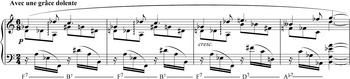
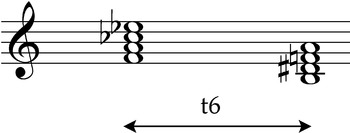
The first trait – long-range circles of fifths – is evident most often towards the end of pieces, for instance that of the Étude, Op. 42, no. 2, above whose sinewy left-hand motion is outlined the chord progression: Bm7→E7→A→D7→G→C♯7 (see Example 1). Note that this sequence closes with a t6 manoeuvre from G to C♯7, illustrating the second stylistic trait: t3, t6, and t9 progression. While Varvara Dernova, George Perle, James Baker, and Cheong Wai-Ling have already scrutinized this tendency, a short excerpt will illustrate it to readers to whom it is unfamiliar.Footnote 12 The following passage of Flammes sombres – the second of two pieces that comprise Op. 73 – unfolds a typically Skryabinesque pattern in which t3-based sequences (including t6) direct the bass motion that outlines F→B(→F→B→F)→D→A♭ seventh chords (see Example 2). The clear t6-connected F and B chords in the left hand (and later D and A♭) can be interpreted as refractions of a single chord complex – a ‘French sixth’ configuration of interlocking tritones, exemplified here by the pitches F, B, A, and D♯ (E♭). Dernova calls this complex the ‘tritone link’, because the seventh chord with a flattened fifth reproduces its pitch-class content under the t6 operation: thus F–A–C♭–E♭ becomes B–D♯–F–A in Example 3. Many instances of this are found in Skryabin's output, and the pliability of tonal implication that it enables in respect of tritone-related keys makes the chord a highly flexible resource, particularly when so much of this music is organized by t3, t6, and t9 sequences.
Skryabin, Étude, Op. 42, no. 2, bars 12–16.

Skryabin, Flammes sombres, Op. 73, no. 2, bars 1–4.

The ‘tritone link’.

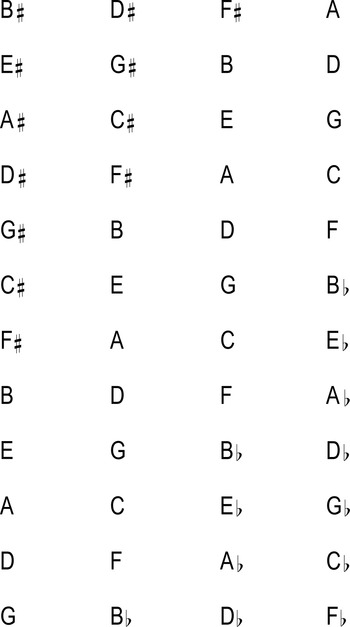
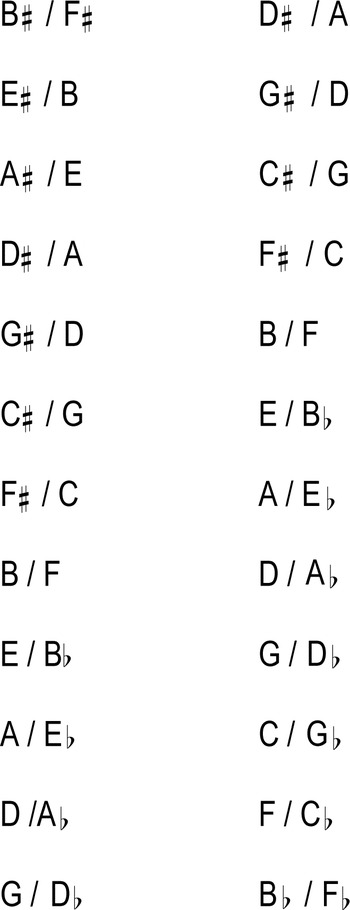
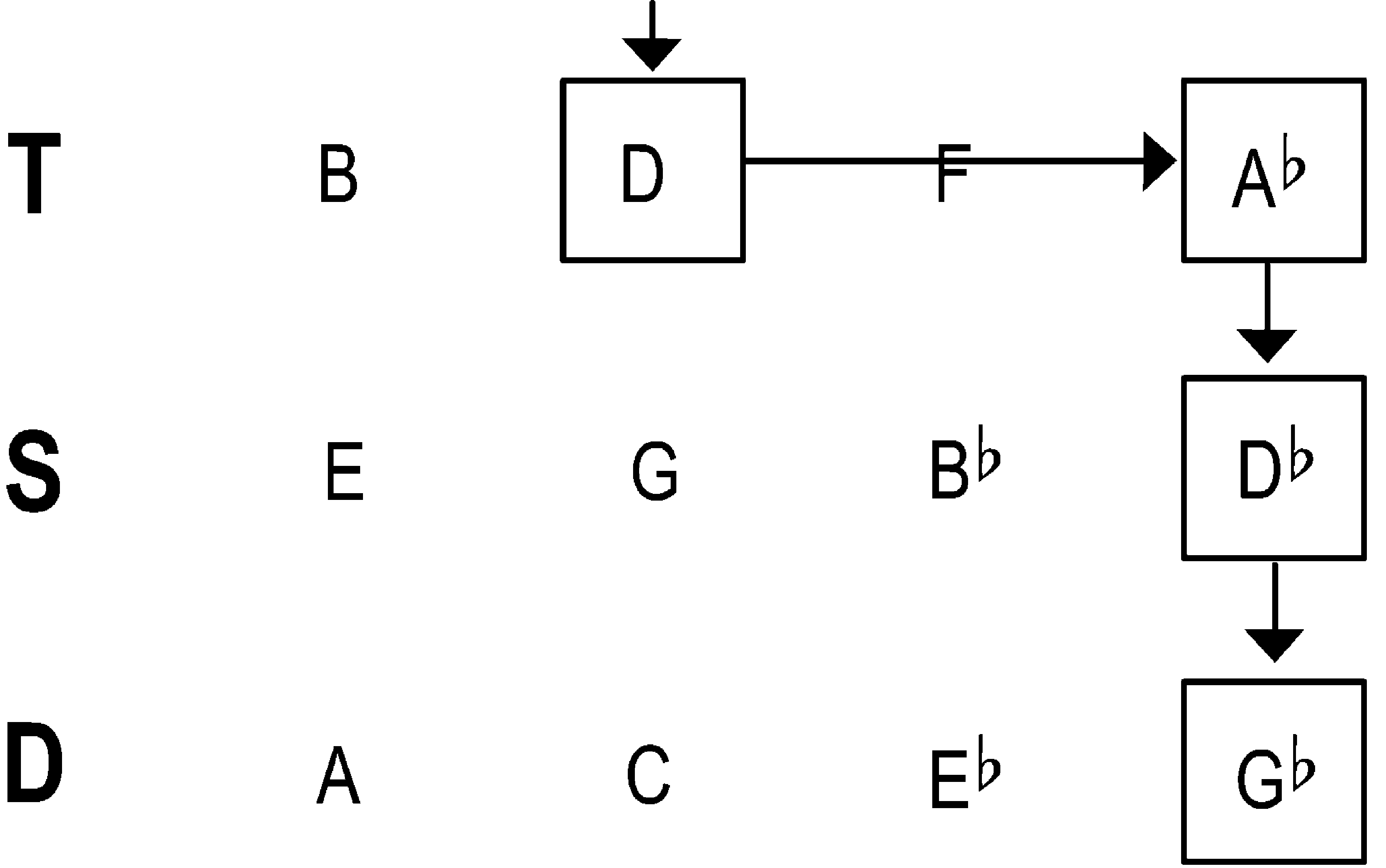
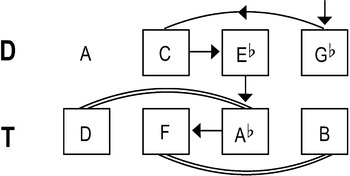
Clearly, if we are to gain access to Skryabin's mysterious harmonic language then these two features must be integrated in a spatial model that permits a dialogue between them. The mainstay of neo-Riemannian spatial configurations is the Tonnetz, which models chord transformation via parsimonious operations (minimal voice motion), and on this foundation networks such as Jack Douthett and Peter Steinbach's ‘dancing cubes’ or Richard Cohn's ‘star clusters’ have been constructed.Footnote 13 In such cases major-third cycles project ‘maximally’ smooth voice leading; nineteenth-century composers have therefore become the locus classicus of neo-Riemannian study.Footnote 14 While Adrian Childs on the one hand and Douthett and Steinbach on the other have attempted to integrate minor-third chord relationships into neo-Riemannian theory (particularly through their ‘OctaCycles’ and ‘Power Towers’, discussion of which extends to an examination of tetrachords pertinent to Skryabin), Skryabin's music, with its constant push around the circle of fifths, relates more to Daniel Harrison's concept of ‘discharge’ than to transformation.Footnote 15 In Harrison's exploration of Riemann's Funktionstheorie a chord can resolve its tensions (hence, can ‘discharge’) into a subsequent chord without undergoing any of the transformational operations represented by more conventional neo-Riemannian systems.Footnote 16 An alternative ‘table of tonal relations’ designed by Gottfried Weber in 1824 encompasses Skryabin's tonal operations more suitably, as it fulfils both criteria listed above. This graph was appropriated most recently by Fred Lerdahl as his model of ‘tonal pitch space’,Footnote 17 and I use it to analyse the paths of individual harmonies as they are organized into chord progressions. I have also slightly revised Weber's model by removing the parallel major/minor relations (e.g., C/c) that are rendered separately on both his and Lerdahl's grids. This contraction reflects Skryabin's avoidance of minor triads, though major triads are themselves decidedly less common than non-modally-specific dominant seventh chords.Footnote 18 My version of Lerdahl's model collapses parallel major/minor chords into a single representative of each key, irrespective of mode; thus Weber's eight-column matrix is reduced to four columns in Figure 1. This is a modular space in which enharmonic equivalence operates: B♯, for example, could equal C, meaning that any three adjacent rows could equally represent the basic space. Strictly speaking, because of the ‘tritone link’ that binds two chords into a single collection of pitches, my version of this model could be collapsed further. Thus Figure 2 includes only two columns, which would be adequate to model passages of music that exploit the ‘tritone link’.
Modified ‘Table of tonal relations’.

Collapsed version of Figure 1 reflecting the tritone link.

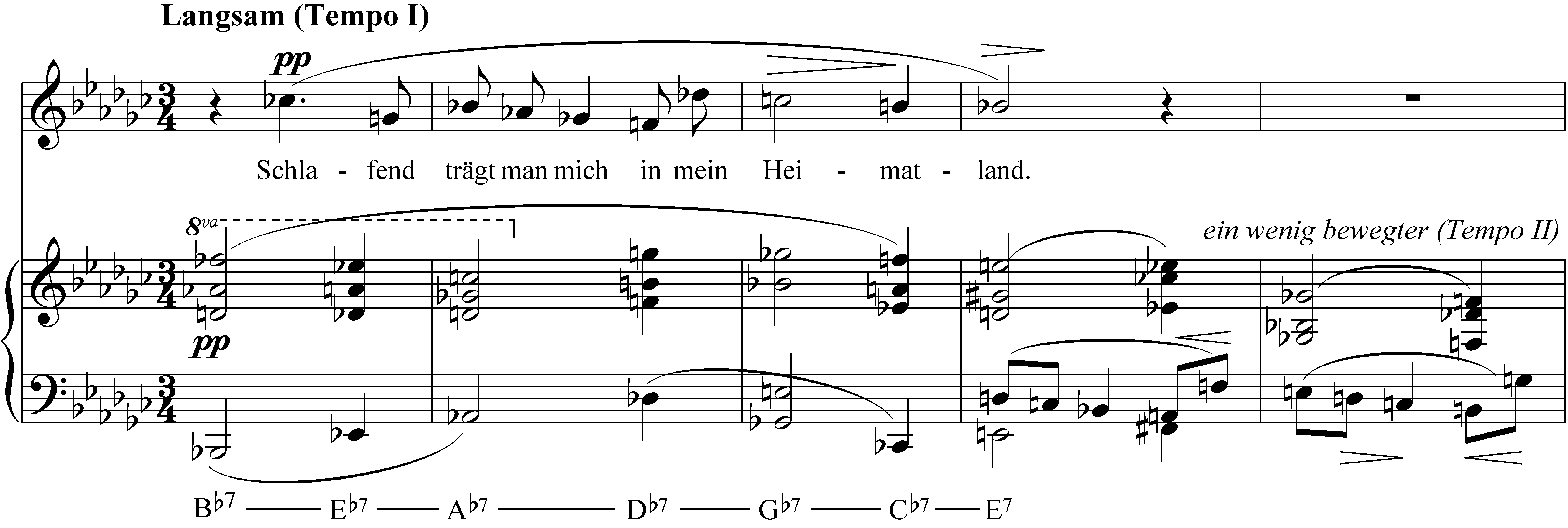
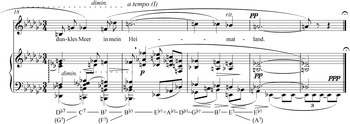
For all that this particular ‘French sixth’ chord is utilized seemingly inexhaustibly by Skryabin, nowhere in his own output is it used as exclusively as in the first of Alban Berg's early settings of Alfred Mombert's Der Glühende (Op. 2, no. 2). The beginning and end of the song are reproduced in Examples 4a and 4b. In Example 4a the bass circle of fifths stretches from B♭ to E (with C♭/B providing an enharmonic bridge). In the final lines, by contrast, the central circle-of-fifths passage (moving again from B♭ to E in Example 4b) is surrounded by chromatic progressions.
Berg Op. 2, no. 2, bars 1–5.
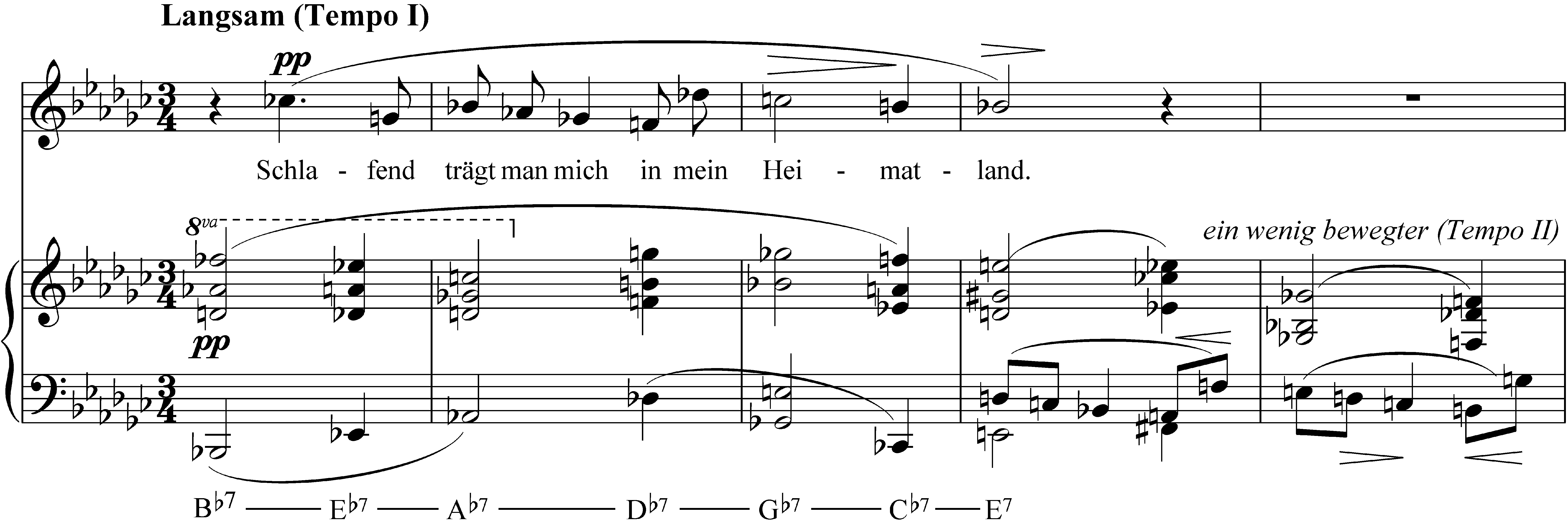
Berg Op. 2, no. 2, bars 14–18.

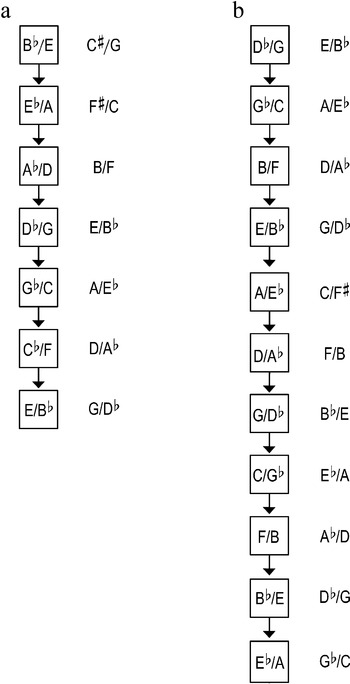
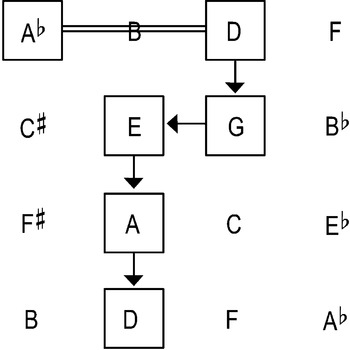
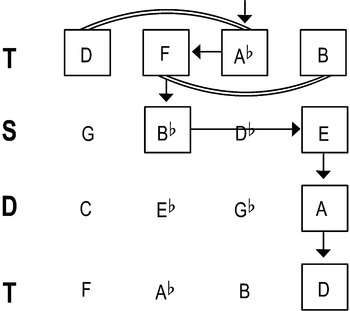
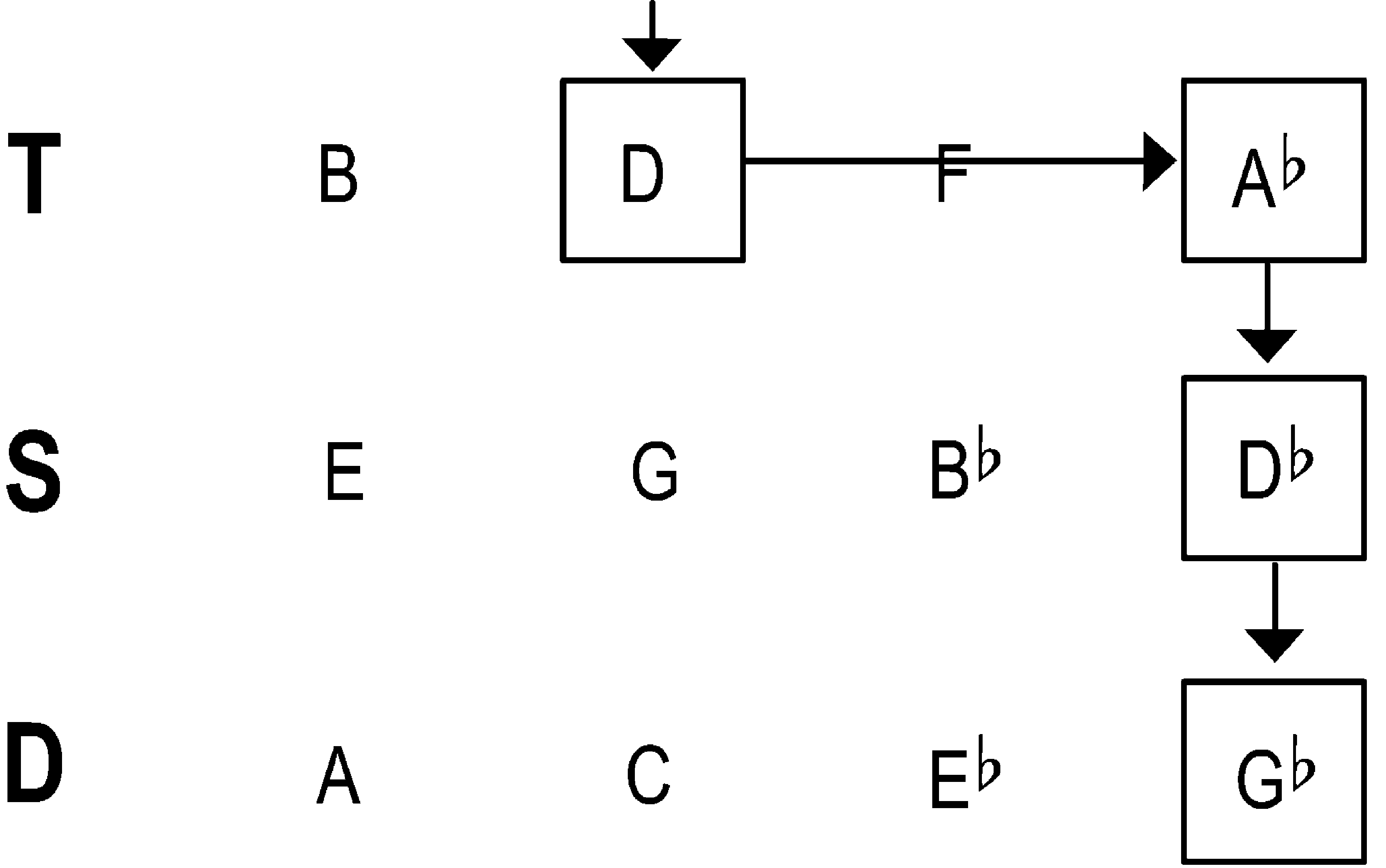
But each sonority expressly comprises ‘tritone link’ chords, meaning that a chromatic chord such as B7♭5 (of the B→B♭ progression) also embodies its tritone relative – an F chord in this instance, which thereby produces F→B♭ motion, commensurate with the circle of fifths. This enharmonic ‘tritone link’ is a more discreet version of the ‘tritone substitution’ common in jazz, and can be mapped successfully onto the collapsed spatial model. Figure 3 (a and b) lays out Berg's paths along the tritone-linked circle of fifths, notwithstanding the apparent chromatic chord progression of Example 4b. Squares here represent the chords heard, while arrows show their progression.
Berg's path through tritone-linked circles of fifths in (a) bars 1–5 (b) bars 14–18.

Unlike Berg in this instance, Skryabin does not always adhere to ‘French sixth’ chords in this type of progression, at least not to the extent that his early analysts Yavorsky and Dernova suggest. There are many occasions when full dominant seventh chords or other variants are deployed despite their tritone-based sequential treatment. Thus to apply this collapsed model would be problematic in practice, and I retain my original four-column model in the following analyses, though it should be understood that tritone-related chord progressions on the graphs are often mutually implicated to a greater degree than their appearance might suggest. That said, I shall return to this two-column model in time.
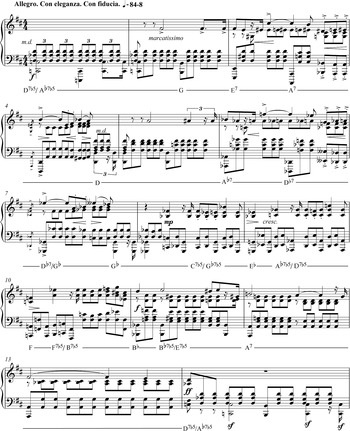
This matrix serves our purposes because of its vertical array of fifths and horizontal axis of minor thirds, though it will show results that are radically different from Lerdahl's analyses of more conventionally diatonic repertoire. It will become apparent that Skryabin cuts a different route through tonal space from the various composers Lerdahl examines, and to exemplify this I look to his Poème, Op. 32, no. 2.Footnote 19 Wholly representative of the composer's burst of creative energy in 1903 this piece belongs to Skryabin's middle period. Of its bombastic opening Dernova claims, ‘It is difficult to see how any tonal orientation other than a motion from D to G♭ could be deduced.’Footnote 20 In response to this calamitous understatement, the analytical method now adopted organizes the fascinating linear chain of seemingly disjointed harmonies into a clear circle of fifths, though this fifth progression is rerouted by minor-third and tritone relationships. Plotting the path Skryabin takes in the opening four bars of his Poème puts this in a nutshell (see Example 5).
Skryabin, Poème, Op. 32, no. 2, bars 1–14.

In spite of its key signature, Skryabin's opening sonority is highly ambiguous. An interpretation of the chord as D is problematized by the seventh (C) in the bass, the diminished fifth (A♭), and the delayed third (F♯). Nevertheless, this reading is retrospectively validated when Skryabin moves to a G major chord (albeit in first inversion with the suspended F♯ above it) at the end of bar 2. This retroactively consolidates the function of the opening chord as a dominant seventh on D that drives towards G, regardless of the fact that the diminished fifth (A♭) creates the potential for the chord to act additionally as ‘tritone link’ on A♭ (hence implying D♭).Footnote 21 The next two bars are slightly more straightforward. An E7 chord is struck in bar 3 which, despite the suspended F♯, the chromatic flirtation with E♯, and the delayed fifth (B) in the melody line, is projected forcefully by the firm bass E and the D–G♯ tritone. Following this, the subsequent protracted harmony is consolidated as a chromatically elaborated A7 chord by its resolution onto a full D major triad. This is now posited as a firm tonic for the piece, or at least for the opening phrase. Using my modified version of the Weber/Lerdahl ‘table of tonal relations’ this procedure could be modelled as in Figure 4. In this four-column grid squares still represent chords (rather generally to include both triads and sevenths) and the double conjoining line (A♭=D) demonstrates the synonymity between the ‘tritone link’ chords. Although this A♭ is only potentially operative at this stage, it plays its part in both the chord's aural ambiguity and the piece's tonal narrative. Notwithstanding the chromatic uncertainty of this opening passage, the progression seems relatively clear once the initial chord is retrospectively understood: D→G→E7→A7→D, or I→IV→II→V→I.
Path traced by Poème, Op. 32, no. 2, bars 1–5.

Skryabin works ‘down’ the circle of fifths (oriented from the perspective of the grid), and this process is interrupted only by the lateral ‘switch’ from G to E. This relatively basic progression becomes the nucleus of the piece and, before we confront the more complex manifestations of it that lie ahead, we need to set it in its theoretical context.
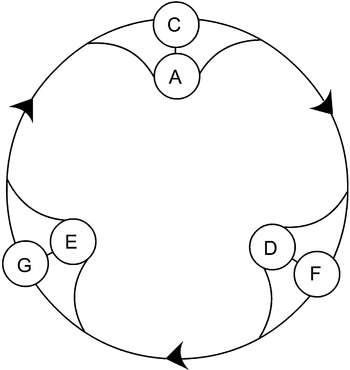
This whole phrase is essentially a self-returning circle of fifths with a ‘substitution’ that is highly reminiscent of Rameau's double emploi. For Rameau, chord IV is often heard as chord ii without root support. In the key of C major this means that a subdominant F chord is actually processed as a D minor seventh.Footnote 22 This substitution facilitates a miniature circle of fifths beneath the archetypical I→IV→V→I progression represented by Figure 5a. In Skryabin's Poème, where chords ii and IV are both articulated, the ‘substitution’ is really a ‘switch’ between two chords that express the same subdominant (S) function. In this regard Rameau foreshadowed Hugo Riemann's Funktionstheorie, according to which the three primary chords (I, IV, and V) govern the secondary chords (vi, ii, and iii), which are heard as substitutes for them.Footnote 23 By Riemann's lights the cardinal tonal functions T, S, and D are optimally heard in the T→S→D→T sequence that he calls the ‘complete cadence’.Footnote 24 This progression can be conceptualized as a potentially endless ‘rotation’ or ‘revolution’ of tonal function structured by a circle of fifths: I→ii/IV→V→I. Whereas Rameau's IV was essentially a substitute for its secondary partner ii, Riemann's secondary chords now stand in for their primary function: thus E minor substitutes for G, D minor for F, and A minor for C, yielding the D, S, and T functions respectively. In this system each diatonic chord can be replaced by its minor-third relation and still bear the same tonal function, hence my conceptual model, displayed as Figure 5b.
A conceptualization of Rameau's double emploi in C major.

An extension to illustrate Riemann's Funktionstheorie.

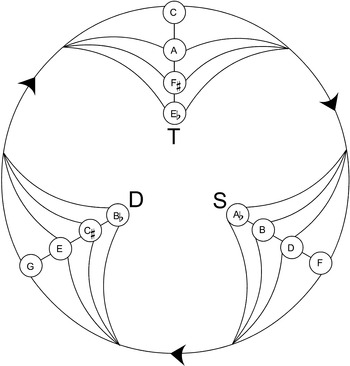
These theoretical qualifications suggest that Skryabin's frequent minor-third (t3) progressions can to some degree be conceptualized as refractions of a single tonal function. But these cycles are often fourfold: not just C–A, but C–A–F♯–E♭. While Riemann's diatonic model is insufficient to cope with such complex harmonic language, Hungarian theorist Ernő Lendvai's more elaborate conception of tonal substitution can potentially bridge the gap. Rather idiosyncratic, Lendvai's Riemannian approach to tonal substitution stands apart from the broader aims of modern neo-Riemannian theory, but it can offer valuable insight into Skryabin's chord progressions where current theory leaves us short-changed. Lendvai's work supports Harrison's more recent investigation of Funktionstheorie by extending Riemann's model to embrace not only the minor-third relation of each primary function but the tritone-related partner of each of the parallel chords. The three families of minor-third cycles are grouped as T, S, and D and highlight an underlying circle-of-fifths progression with revolving tonal functions. Lendvai's ‘axis system’ can thus be added to my model (Figure 5c).
Circle of fifths and full minor-third substitution possibilities.

That Lendvai's system should relate to Skryabin's music has been proposed by Jim Samson, who, in criticizing Lendvai's restrictive concentration on Bartók, claimed that ‘he could have had a field-day with Rimsky-Korsakov and Skryabin’.Footnote 25 Of course, while Lendvai's system is firmly rooted in Riemannian theory, some of his additions are quite startling. For example, the idea that a tritone-related chord can substitute for the true T chord cannot always be applied directly to diatonic harmony. Lendvai rather overconfidently asserts that ‘counterpoles’ (by which he means tritone-related chords) are ‘more directly related to each other than the relative keys of classical harmony’, and thus a ‘pole can be replaced by its counterpole without any change in its function’.Footnote 26 An extreme reading of these words would imply that a simple diatonic tune in C major could end satisfactorily on an F♯ triad and still achieve tonal resolution. And yet in specific ways ‘tritone substitution’ can function perfectly. As any jazz pianist knows, a dominant seventh can be readily replaced with its tritone counterpart (for example a G7 chord replaced by a D♭7 chord in C major) at a cadential juncture. Both chords, when imbued with this dominant-seventh driving quality, contain the same potent tritone that pulls towards the established tonic. But this potential is fully recognized by Dernova's ‘tritone link’, by which dominant-function chords share identical pitch-class content. Thus Lendvai's rather ‘loose’ theory of how tritone-related chords can be substituted is tightened by Skryabin's practice, even more than by Bartók's, which had been Lendvai's principal focus. The idea that four minor-third-related chords can express a single tonal function may even explain the somewhat static quality often attributed to Skryabin's late style of composition, where chord progressions are drawn from such a small family of chords. Taruskin describes this type of harmonic motion as ‘hovering’. He calls it ‘non-progressive’, and claims that ‘[because] ego identification with musical process conventionally depends on functionally directed harmony, we are on the verge of not merely the imitation, or the representation, but the actual experience of ego transcendence.’Footnote 27 Perhaps these minor-third progressions are non-functional precisely because they are confined to a single function which they do not abandon. Taruskin's implication may be that Skryabin denies the circle of fifths in a kind of Schopenhauerian, ascetic attempt to control the tonal motion's libidinal drive. This psychoanalytic dimension will be refined in due course.
Of course Lendvai's additions must be applied to our model with caution. For one thing Riemannian functional labels can only be provisional. The opening progression of the Poème, Op. 32, no. 2, can be functionally categorized only ex post facto; the ‘T→S’ (D→G) would initially be experienced as a ‘D→T’ (D7→G) progression. Only on completion of the overall sequence is it retroactively confirmed as T→S. Thus the model of functional revolution can work only when music maintains a clear orientation towards a specific tonal centre. Berg's Op. 2, for example, would seem to preclude this possibility, because there is no tonic region of stability. Continuing our analysis of the Poème, we find that, through certain explicit cadential progressions, the frequent assertions of D major as T encourage us to process the chords in functional terms. This fixity of T anchors the more fluid substitutional progressions and helps us identify S and D. Thus, as we follow the motion down the grid, we can conceptualize the three minor-third matrices as functionally operative regions that keep revolving through the circle of fifths. Following the establishment of the key of D as T, Skryabin immediately adds the pitch C (bar 5) to transform it back into a dominant seventh chord. But rather than continue down the circle of fifths to a G, he switches to a full A♭7 chord (bar 6). It is as if, through the tritone link, the two chords expressed in the original opening sonority are now refracted into their separate elements. Once established, this A♭ moves down its own axis of fifths and ‘discharges’ to D♭7 and G♭ in turn. Figure 6a shows a substitution involving the tritone chords (D/A♭) that is akin to the earlier substitution involving G and its minor-third-related E.
Skryabin, Poème, Op. 32, no. 2, bars 5–7.
So far Skryabin has only ever availed himself of two successive chords from a given region (initially G→E, then D→A♭). Things now start to become more complicated. After arriving at the G♭ in bar 8, he adds the pitches F♭ (soon to be respelled as E) and C. While the C could readily be interpreted as a respelled ♯ moving chromatically to
 (D♭), its presentation as the bass note on each strong beat allows it to assume a double function as an agent of the tritone link between G♭7♭5 and C7♭5. Furthermore, as this chord occurs after the initial G♭ triad, I draw an arrow on the graph to show an actual progression to C7♭5. From this position Skryabin moves to a clearer E♭ triad (bar 9), which in turn progresses to an A♭ that shares a tritone link with D7♭5. The A♭ then switches to an F chord in bar 10, followed by an F/B tritone link. The entire T space is thus filled out using each of its potential representatives (D–F–A♭–B). Thus Figure 6b exhibits a dense network of chord relationships, despite its clear D→T motion.
Skryabin, Poème, bars 8–10.

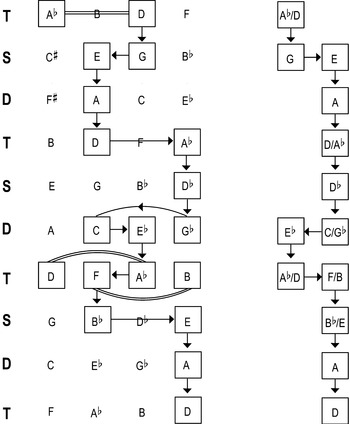
Of course Skryabin now has the problem of establishing the true T chord of D. After all, substitutes are only substitutes and do not carry the same functional weight as the primary triads that they stand in for. In order to achieve this, he first consolidates F as a full seventh chord and resolves it to a B♭ in the following bar. The tritone link is once again exploited as he shifts quite forcefully from the initial B♭ to an E7 chord and activates an A7 in bars 12–14. This chord is drawn out over two bars to confirm itself as the true D function, thus indicating the true T (see Figure 6c). But, after flexing and stretching this A as D in order to fully confirm the D as T, Skryabin denies us the satisfaction of an actual D triad until the end of the piece, offering instead an ambiguous return to the opening D7♭5. The full course of Poème, Op. 32, no. 2, yields two progressions similar to bars 1–14 before the final resolution of the full D major T chord, but the procedures hitherto discussed are charted in Figure 6d.
Skryabin, Poème, bars 10–14.

Skryabin, Poème, bars 1–14, according to both four- and two-column models.

A brief return to the two-column model outlined above (see the right-hand column of Figure 6d) renders the line of fifths more visually striking. Starting from the D on the top left and working towards the D in the bottom right, a single line of fifths is evident, rerouted by three minor-third switches. The first shifts from the left flank to the right via the G to E, while the second and third serve to circumvent the gap between the C and the G♭ by making a detour through E♭ and A♭. This latter manoeuvre allows Skryabin to arrive on the true tonic of D (and A♭) at the passage's mid-point, rather than on the B or F substitute form.
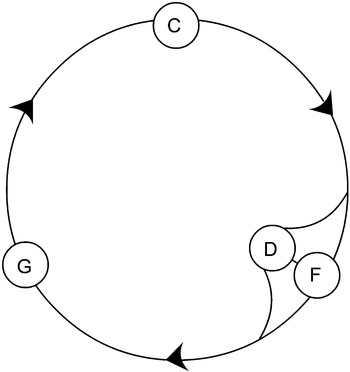
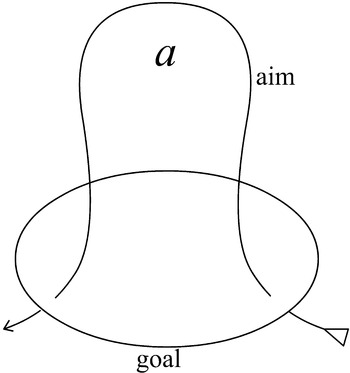
The Poème highlights Skryabin's switches between minor-third-related representatives of individual functional areas, and further shows how these ‘discharge’ around a perpetually mobile circle of fifths. But how can these operations exemplify his theories of human desire? At its most elementary level the continuous chain of dominant sevenths corresponds to his notion that desire is insatiable. On every occasion that a dominant seventh chord is drawn towards the ‘tonic object’ it demands, this object immediately constitutes itself as a further seventh chord that indicates a new tonic. The link with Schopenhauer's perpetually striving Will is plain to see. But given that Schopenhauer's ideas influenced Freud's drive theory, we are justified in having recourse to a more specifically psychoanalytical interpretation. Skryabin, in claiming that desire has ‘no other goal than longing’, foreshadows the insight of Jacques Lacan that desire ‘merely seeks to go on desiring’.Footnote 28 In turn, Lacan's refined model of the human drive circuit offers valuable insights into Skryabin's harmonic practice. The circular path at the base of Lacan's diagram (Figure 7) represents the true goal of the human drive: the simple rotation of an object (designated a – in Lacan's algebraic system). But the drive tirelessly makes demands for its object and aims to achieve it. The drive always misses this object and traces a loop-shaped path around it before returning to the circular path that was its true goal from the outset: Skryabin's ‘no other goal than longing’.
Lacan's model of the drive.

The composer offers a harmonic variant of this paradigm in which the seventh chords, full of driving potential, attempt to ‘discharge’ into a true tonic triad, which, for Rameau, was the object – the focal point ‘towards which is drawn all our desires’.Footnote 29 This rarely achieves satisfaction, however, and the chords, full of what Rimsky-Korsakov called ‘unmitigated tension’, return to their potentially endless revolution of tonal function.Footnote 30 The T function has special privileges as Lacan's objet a, and when this T chord becomes another ‘driving’ seventh chord, we witness the drive's failure and its return to its circular path. Lacan's model corresponds neatly to Skryabin's practice, with a crucial difference. While the tonic chord (in this instance D, or one of its substitutes, F, B, or A♭) is clearly posited as an object of our desire, Skryabin does achieve this object at the close of the piece when he displays a full D major triad, and this appears to be successful. But for Lacan – and seemingly for Skryabin, who says ‘When I have no desire I am nothing’ – this is a hollow gesture, a misrecognition of the drive's true goal.Footnote 31 This is where an examination of Skryabin's late style becomes imperative. Here the tonic chord is at once both implicated and avoided, forcing tonal function to operate quite differently.
II
Like the Poème, Sonata no. 6, Op. 62, emerged from a stylistic crossroads: it marked the beginning of Skryabin's explicit employment of octatonicism. One attribute of octatonic composition is the symmetrical application of minor-third-related seventh chords, and in this regard one could argue that Skryabin's interest in it was integral to his compositional approach as early as Op. 32, because the chords on the horizontal axis of my modified grid of tonal space are essentially an octatonic family. But in the Sixth Sonata he does not, on the surface at least, propel us through a circle of fifths. On the contrary, he allows individual constellations of minor-third-related chords (each derived from a particular octatonic collection) to govern vast stretches of the sonata and thereby generate artificially static phrase structures that preclude fifth-based ‘discharge’. However, a mobile tonal background can be uncovered by analysing the motion between these large-scale minor-third-related constellations. In view of Claude Herndon's proposal that, notwithstanding its octatonicism, the ‘harmonic ballast’ of the sonata is chord V7, this is scarcely surprising.Footnote 32 For surveys of Skryabin's octatonic composition the reader is directed to the work of George Perle, Cheong Wai-Ling, Jay Reise, and Richard Taruskin, as well as Clifton Callender's highly significant neo-Riemannian examination of Skryabin's modal transformations.Footnote 33 These analysts demonstrate how Skryabin writes octatonically, while also highlighting octatonicism's possibilities for dialogue with whole-tone scales, mystic chords, and diatonic sets.
Although its pitch structure precludes cadential progressions, octatonic music proves surprisingly capable of portraying musical desire. While it was traditionally employed to accompany the magical and mystical elements of Russian opera, it also became associated (like the whole-tone scale) with desire's constitutive lack, as depicted by Glinka in Ruslan.Footnote 34 In Sadko (1897), an opera for which Simon Morrison offers a Freudian reading, Rimsky-Korsakov depicts the realm of the underwater kingdom using octatonicism. This is the place where Sadko is free to revel in the aimless flux of his libido – a pleasure denied him in the Novgorod world of symbolic commerce and exchange. Taruskin's analysis of one particular passage shows how the octatonic dominant sevenths discharge to C major (V→I) as Sadko takes control.Footnote 35 While the mysterious, alluring world of libidinal excess is depicted using the octatonic collection, the Lacanian symbolic world is embodied in the assertion of a tonic chord. This Russian trope feeds into Skryabin's late style, in which driving harmonic forces (in the form of dominant seventh chords) are always ready to latch onto tonic objects (triads).
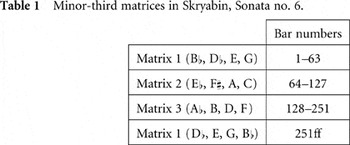
In the Sixth Sonata seventh chords proliferate throughout, but draw exclusively on octatonic collections, creating matrices (derived from the complete modified Weber/Lerdahl matrix) of four chords. As shown in Table 1, these matrices closely resemble the basic space of my model, with their descending fifth progressions of minor-third-related chords. Now dislocated from a particular tonic, the individual chords of any given matrix freely interchange: where three chords from each matrix previously substituted for an authentic T, S, or D, all four chords are now deployed in relatively equal measure. This said, the fifth-based undercurrent of the total matrix that runs through the work's deepest level suggests something analogous to a tonally functional T→S→D→T meta-cycle. Cheong Wai-Ling, one of the foremost analysts of Skryabin's late works, finds that octatonic collections are utilized to build relationships analogous to those of the sonata principle, though she contradicts Dahlhaus, who claims that in octatonic writing ‘it is impossible to contrast subordinate theme with principal theme by means of some characteristic transposition which would be analogous to the tonal contrast found in tonally-based sonata form’.Footnote 36 Insightful though Cheong's analysis is, a generalized sonata principle would polarize the T and D relations, and the unusual T→S→D→T circuit that runs through Skryabin's sonata is very different. Roland Willmann, another of the sonata's analysts, further denies the potential functionality of these cycles by maintaining that, while there are transpositions of the ‘basic [octatonic] scale’, they merely serve to ‘avoid monotony’. Furthermore, Willmann asserts that ‘rather than coinciding with the piece's formal junctures, they are used to produce flowing, barely perceptible transitions.’Footnote 37 This latter claim – the supposed disjunction between formal articulation and tonal operation – must be brought into question. To this end the tonal and the thematic strands of the work must be set into dialogue. This process will also interrogate the nature of the work's tonal ‘functionality’ to bear out Cheong's assertion that a diatonic thread runs through the sonata's rich octatonic tapestry.
Minor-third matrices in Skryabin, Sonata no. 6.

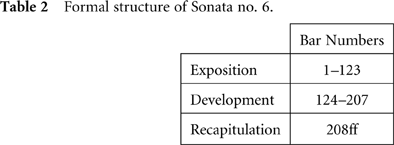
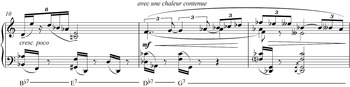
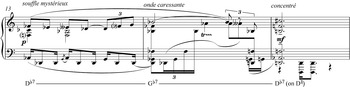
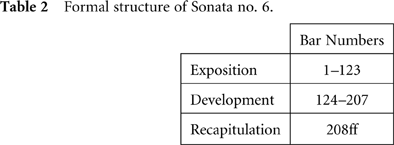
Table 2 takes a formal snapshot of the work, showing it to resemble a standard sonata-form model (a reading agreed upon by both Willmann and Cheong). Skryabin reveals his chosen minor-third matrix in the exposition: bars 9–14 draw exclusively on seventh chords on G, D♭, B♭, and E. In fact bars 10–11 incorporate all four, unfolding B♭ to E to D♭ to G (Example 6). Even the subsequent resolution of D♭7 onto a G♭7 chord (Example 7) is extremely transitory and serves only to reaffirm the original matrix when it moves back to D♭ (C♯ with D♮ bass).
Formal structure of Sonata no. 6.
Skryabin, Sonata no. 6, bars 10–12.

Skryabin, Sonata no. 6, bars 13–15.

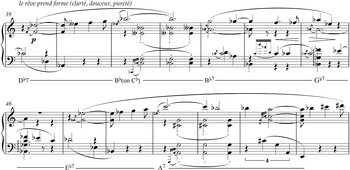
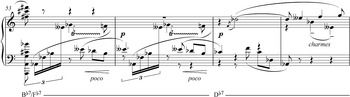
While Willmann locates the sonata's first subject in bars 11–38 and the second in bars 39–124, Cheong's similar structure displays a ‘third theme’ (bars 82–123). But examining the exposition from our tonal purview reveals a process analogous to modulation between the two matrices (which we provisionally designate as T and S) from bar 39. This transitional section overlaps the second subject of both commentators (see Example 8). Chords from the S region now start to break apart the strongly defined T region. While Willmann's second subject begins on a pure seventh chord on D♭ (from the T matrix), a merger with the S is foreshadowed when the seventh chords on B♭ (bar 43) resolve to chords on E♭ (bar 47 – mediated by an S substitute on G♭ in bars 45–6 with the B♭ pedal retained in the bass). This new chord on E♭ undergoes tritone substitution with an A from the same S region. But in this transitional passage the listener is pulled back and forth between two functional areas, for Skryabin retreats to the initial T region in bars 54–60 with seventh chords on B♭, F♭, and D♭ (see Example 9). A reconstruction of bars 43–7 sees a return to G♭, E♭, and A in bar 64 to stabilize the S, and by bar 69 the S region is utterly secure.
Skryabin, Sonata no. 6, bar 39 ff: second subject or transition?

Skryabin, Sonata no. 6, bars 53–6.

The ‘modulatory’ aspect of this passage is analogous to the transitional theme of a classical sonata model, and thus I designate it as a transition to a more distinct second theme at bar 82, with its prompt change of character. This reading finds encouragement in Skryabin's florid performance indications. My transition – Willmann's second subject – is accompanied by ‘le rêve prend forme (clarté, douceur, pureté)’ (the dream takes shape: brightness, gentleness, purity). This crystallization of the poetic ‘dream’ confirms the function of transition; the consequent ‘avec entraînement’ implies the newly shaped, tonally secured idea – the full second subject. And one must not undervalue melodic stability here; despite its many connections with previous motivic content, the five-note ascending cell is now presented in fully developed form, supporting the new S matrix. However, one would expect a tonally functional model to utilize the D region rather than the S in the second subject, and in this regard Skryabin changes the tonal position of the archetypal lyrical second subject. As is so often the case, the tonal and thematic processes in the movement's recapitulation can shed light on the issue.
The recapitulation begins with the D matrix and is presented a whole tone lower than the exposition. This D region spills over from the development, which had reversed yet another classical procedure by setting itself up as the most tonally secure area of the composition, remaining rigidly fixed on a single matrix. Cheong's octatonic analysis uncovers this, though naturally without any appeal to tonal functionality: ‘Scriabin's dedication of about half of the development to mostly one octatonic collection is unusual even by his standard.’Footnote 38 It seems that after an initial, developmental circle of fifths, Skryabin strives to make the development as tonally secure as possible.Footnote 39 The effect of the delayed return to T comes close to the Schubertian practice of commencing recapitulations in the subdominant region, allowing the entire exposition to be transposed as a single unit that mirrors the expositional T→D progression with its S→T. Skryabin's recapitulation faithfully mirrors this exposition's structure, the final return to the T region coinciding with the ‘avec entraînement’. Thus, opposing the classical archetype that converts the T→D exposition into the T→T recapitulation, he transforms the T→S exposition into a D→T recapitulation to fashion a T→S→D→T revolving design. This revolving sonata scheme, in contrast to the traditional oppositional scheme based on dialectical tonal argument, permits Skryabin to preserve the original exposition, transposed but, broadly speaking, without further modification. This said, he naturally provides flashes of elaborate thematic variation in his Byzantine recapitulation.
A more significant departure from the exposition occurs in the reorganized transition section of the recapitulation. Whereas the transition's function in the recapitulation is generally to preserve the tonic key between the first and second theme groups, this example operates as a homecoming that returns us to the tonic. The new transition also carries structural weight, as the climax of the work is articulated here in the space between the two themes as a kind of secondary development. This apex is, however, rather subdued, charged by the cumulative effect of ostinatos.
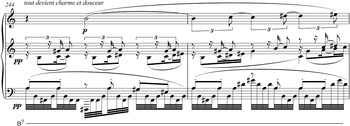
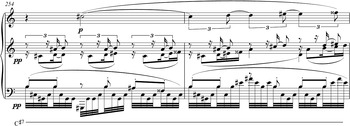
Example 10 illustrates the new setting of the transition theme, with its fuller texture and its sustained presentation of an implied B7 chord in the left hand. Given that the entire development section drew exclusively on the relentless B–F–D–A♭ matrix without any discharges at all, the tension in this recapitulation has become almost intolerable: we need to discharge into a new matrix. Further, the developmental nature of the previous thematic material could, through association with classical norms, force us to hear this claustrophobic tension as dominant-based, and thus lead us to hope for a tonic. In the event, however, Skryabin employs one of his fingerprint techniques for cranking up the level of tension even further – t2 transposition (see Example 11).
Skryabin, Sonata no. 6, bars 244–5.

Skryabin, Sonata no. 6, bars 254–5.

The rise in tension at the moment of transposition is palpable, and this injection of fresh energy reconfirms our need for a real tonic to relieve it. And yet the Lacanian message of the drive is located here: this new matrix is the tonic; this was our true goal all along. Indicating a new C♯7 bedrock (second inversion), this gesture brings us into the T matrix of C♯–G–E–B♭.Footnote 40 The Lacanian drive wants only to continue its exertion of pressure, and thus Skryabin returns to this new T matrix. But in what way can we experience this as tonic if we feel so unsatisfied? This particular event forces us to confront the new minor-third matrix as T in a rather novel way. Although breaking the wave of the D matrix's tension, this intensity subsides to a ppp point of repose when the ostinatos slowly come to rest, ushering in a certain sense of closure. Several of Skryabin's sonatas – notably the Fourth, the Fifth, and the Ninth – are brought to a close immediately after their climactic wave. The piece almost feels over here, and is as tonally secure as we feel it is going to get. In this way, through the illusion of completion, the T matrix is established as the home function. Thus, when Skryabin begins his literal repetition of the second subject's ‘avec entraînement’, the listener feels to some degree tonally refocused.
In summary then, clearly articulated groups of minor-third-related dominant seventh chords modulate at the thematic junctures of the sonata to create a background structure that moves through the three available matrices in a revolving sequence. This may indicate a tonal T→S→D→T progression. Such a progression was the harmonic bedrock of Skryabin's earlier works, and he seems to use it as a touchstone here despite the new octatonic pitch vocabulary. While this is undoubtedly a novel form of functionality, distinct from conventional diatonic practice, it seems to follow the thematic vestiges of classical sonata form but replaces the polarity between tonic and dominant with a structural ‘functional revolution’. In so doing, it shifts the emphasis from a model of dialectical tonal argument to a flow of sequentially discharging tensions. While each section of the sonata demonstrates significant devotion to the t3-related elements of a given matrix, Skryabin's modulatory procedures can also reinforce the sonata's formal divisions. Indeed, the coincidence between the formal and tonal structures consolidates the functionality of this T→S→D cycle at the macro level. And to return to the psychoanalytic premise of this study, these minor-third matrices that orbit a T→S→D→T cycle and coincide with the sonata's thematic structure neatly embody the circular motion of the Lacanian drive. Yet the issue of tonal functionality remains a thorny problem. To what extent can we hear the Sixth Sonata as functional, apropos of classical norms? Before we appeal to Lacanian semiotics to theorize the gap between classical functionality and what is perhaps best described neologistically as the sonata's octatonic ‘neo-functionality’, a few preliminary considerations are in order.
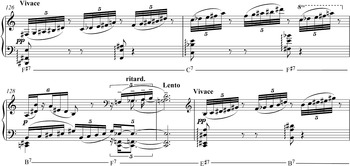
The sonata largely eradicates the possibility of local diatonic progression, directing our full attention to the global progression. The absence of possibilities of discharge within strict minor-third-related harmonies results in clearly demarcated blocks that exploit single matrices and, given the excessive length of these vast stretches involving the claustrophobic alternation of only four chords, an attentive listener could reasonably process the global discharges into a new matrix as a functional shift. Naturally, the literal discharges (i.e., generally V7→I gestures) at local level give the listener the clearest chance of registering the modulations between matrices. The intersection between the exposition's concluding S function and the development's D (shown in Example 12) begins with just such a direct discharge motion from a tritone-linked F♯/C to B/F(E♯), which places the developmental restatement of the opening theme firmly in the ‘dominant key’. Note also how, after the period of transition in the exposition, the final consolidation of the new second subject that occurs at bars 63–4 (a modified repeat of bars 29 ff, shown in Example 8) moves from B♭7 to E♭, and although a G♭7 chord is nestled between the discharging chord and its resolution, the B♭ pedal underlying it strengthens this T→S motion. Through a dialectic between local periods of tonal inertia and concentrated structural discharging motions, Skryabin forces us to switch from an octatonic foreground to a pseudo-diatonic background level, structured by fifth motion that, albeit in drastically reinvented form, mirrors the relationships between micro harmonic progressions and macro key operations in the prototypical sonata dynamic.
Skryabin, Sonata no. 6, bars 126–30.

But Lacanian semiotics refines our perspective on this issue. Given that the T loses its true functional value as the locus of respite from the tension of the D function, one could claim that the T, S, and D labels are arbitrary. Why not interpret the revolving cycles as the Lacanian perpetuation of desire without the additional problem of finding a tonic, given that the music seems to avoid any such clarity? Certainly these labels are somewhat anachronistic here, yet I propose that this apparent arbitrariness embodies something essential to the Lacanian notion of desire, which is closely bound to the process of its signification in linguistic systems. For Lacan, desire is always articulated in the Symbolic Order, where the signified and the signifier share an arbitrary, yet necessary, relationship, bonded by this same desire. We can only hope to satisfy the desire within us if we articulate it symbolically: we want to give it a name and an object.Footnote 41 As listeners we want to process our harmony functionally, not just as after-the-fact analysis but as an integral part of the listening experience. This need is surely doubled when the harmonies are as tense and unstable as these, yearning for the tonic chord that acts as Lacan's objet a and around which the drive revolves. In Lacan's intricate Graph of Desire Footnote 42 the human's libidinal path intersects what he calls the ‘signifying chain’; it becomes symbolic – it is given a name and a position in its autonomous system. On this path it encounters a point de capiton. Loosely translated as ‘anchoring point’, this is the moment when the signified and the signifier become temporarily fixed. Linguistically this moment occurs when a ‘full stop’ retroactively arrests the ‘slippage’ between the signified and the signifier, and a sense of meaning is conferred upon the previous words. Musically this could occur when, after a chain of chords, a cadence point clinches a particular tonic and retroactively confirms the harmonic function of the previous elements in the sequence. Such moments, while ubiquitous in the Poème (the G triad in bar 2 that retroactively confirms the D7 element of the original ambiguous chord, for example), are rare in Sonata no. 6. The indications that the signified (in this case the minor-third matrix) and the signifier (the tonal functional label) can perhaps be welded together are: 1) the coincidence between thematic and harmonic structures; 2) the crystallization of the T function as homecoming in the second subject of the recapitulation, resulting from the climactic ostinatos and their subsequent relaxation; and 3) the single cyclical revolution of function that mimics conventional tonal practice by beginning and ending with the same minor-third matrix. While this is certainly a new form of functionality, we as listeners bring to this octatonic sonata an apparatus of listening that aligns tonal function with our experience of classical thematic structures and their dialectics between harmonic surface and depth. In this way the seemingly static octatonic sonata becomes a revolving paradigm of functionality that both extends and reappraises the classical tonal tradition.
Yet the Lacanian insight is that the point de capiton, while always necessary to any form of signification, is completely illusory. Just as our perception of the tonic is always theoretically provisional and susceptible to subsequent contradiction, so, too, the functions of these minor-third matrices rely on our desire to locate a T centre – a desire to feel tonal security. In the same way, our musical desire for a single tonic chord is essentially a desire to experience the T function as a true T function. Local tonics in a work such as this are meaningless: we need the tonic. Skryabin's vital message is that the motion of sequentially ‘discharging’ dominant sevenths is circular. Despite the various demands that are made for a fixed tonic, and notwithstanding the visceral way in which such a tonic can be experienced, these are always illusionary objects of desire, and what actually structures the human subject is the perpetual cycle of the drive. For Skryabin the tonic is like Lacan's objet a – thoroughly illusionary and unobtainable but ultimately necessary to the functional system as the absent object-cause of desire.