Introduction
One-third of cancer deaths in the United States are caused by cigarette smoking (Jacobs et al., Reference Jacobs, Newton, Carter, Feskanich, Freedman and Prentice2015). Evidence shows that continued smoking after a cancer diagnosis places patients at increased risk for poor treatment outcomes, including complications from treatment, treatment failure, development of secondary cancers, and premature death (Commission on Cancer, 2016; US Department of Health and Human Services, 2014). Unfortunately, evidence demonstrates that 50–83% of patients who smoke at diagnosis continue to smoke (Duffy, Louzon, & Gritz, Reference Duffy, Louzon and Gritz2012). Smoking cessation can reverse many of the adverse effects of smoking, including improving overall and cancer specific mortality in both tobacco-related and non-tobacco-related cancers (Dobson Amato et al., Reference Dobson Amato, Hyland, Reed, Mahoney, Marshall and Giovino2015; Passarelli et al., Reference Passarelli, Newcomb, Hampton, Trentham-Dietz, Titus and Egan2016; Sardari Nia et al., Reference Sardari Nia, Weyler, Colpaert, Vermeulen, Van Marck and Van Schil2005). Additionally, surveys of oncologists consistently demonstrate that while 90% ask about tobacco use and approximately 80% advise patients to quit smoking, only 30–40% assist with quitting (Warren et al. Reference Warren, Marshall, Cummings, Toll, Gritz and Hutson2013a; Warren et al. Reference Warren, Marshall, Cummings, Toll, Gritz and Hutson2013b). Predictive barriers to providing cessation support by oncologists include lack of education, lack of time, and lack of resources (Warren et al., Reference Warren, Dibaj, Hutson, Cummings, Dresler and Marshall2015). Recognizing the need to provide consistent recommendations for cancer care providers, the National Comprehensive Cancer Network issued its Guidelines for Smoking Cessation (NCCN Guidelines®) prescribing the delivery of evidenced-based cessation treatment (counseling and medications) and follow-up support for all identified smokers (Shields et al., Reference Shields, Herbst, Arenberg, Benowitz, Bierut and Luckart2016).
Additional barriers to delivery of comprehensive cessation services for cancer patients include the cost of program development and implementation, providers’ concerns about their ability to deliver effective cessation services, low rates of reimbursement for providing cessation services, time constraints during a brief oncology visit, and the voluntary nature of unmandated treatment guidelines (Hanna, Mulshine, Wollins, Tyne, & Dresler, Reference Hanna, Mulshine, Wollins, Tyne and Dresler2013; Singleterry et al. Reference Singleterry, Jump, DiGiulio, Babb, Sneegas and MacNeil2015; Toll, Brandon, Gritz, Warren, & Herbst, Reference Toll, Brandon, Gritz, Warren and Herbst2013; Warren et al., Reference Warren, Marshall, Cummings, Toll, Gritz and Hutson2013a; Warren & Ward, Reference Warren and Ward2015). The knowledge gap among US providers about state-sponsored and other evidence-based cessation resources is striking (Hanna et al., Reference Hanna, Mulshine, Wollins, Tyne and Dresler2013; Singleterry et al., Reference Singleterry, Jump, DiGiulio, Babb, Sneegas and MacNeil2015). Despite these challenges, implementation of electronic health records (EHR), coupled with policies requiring healthcare systems to routinely assess patients for tobacco use, has made it attractive for healthcare organizations to prioritize delivery of cessation services (US Department of Health and Human Services, 2017). Health insurers, such as the US Centers for Medicare and Medicaid Services (CMS), have established meaningful use incentives to healthcare systems to improve quality while controlling costs (CMS, 2017). Helping patients quit is a proven cost-effective strategy to improve health outcomes (Mohiuddin et al., Reference Mohiuddin, Mooss, Hunter, Grollmes, Cloutier and Hilleman2007; Mullen et al., Reference Mullen, Manuel, Hawken, Pipe, Coyle and Hobler2017; Prochaska, Hall, Delucchi, & Hall, Reference Prochaska, Hall, Delucchi and Hall2014). Technology has also made it possible to deliver cessation support to patients at a lower cost through automated referrals to state quitlines as well as interactive-voice response cessation program platforms (Bernstein et al., Reference Bernstein, Rosner, DeWitt, Tetrault, Hsiao and Dziura2017; Reid et al., Reference Reid, Mullen, Slovinec D'Angelo, Aitken, Papadakis and Haley2010; Reid, Pipe, & Quinlan, Reference Reid, Pipe and Quinlan2006; Reid, Pipe, Quinlan, & Oda, Reference Reid, Pipe, Quinlan and Oda2007). Implementation of institutional opt-out approaches to cessation support for cancer patients using the EHR have demonstrated that patients are highly receptive to receiving cessation support (Warren et al., Reference Warren, Marshall, Cummings, Zevon, Reed and Hysert2014) and that patients who quit smoking using such resources have improved overall survival (Dobson Amato et al., Reference Dobson Amato, Hyland, Reed, Mahoney, Marshall and Giovino2015). However, there are limited data on the feasibility of implementing such approaches in community oncology centers using extant statewide resources. We report on an effort to incentivize community oncology practices through technical assistance and mini-grant funding to use existing EHR systems to assess tobacco use and implement cessation treatment guidelines using referral to existing state quitlines. The current report describes a statewide collaborative approach that was used in South Carolina to expand the reach of tobacco cessation treatment services in state cancer centers, which may be useful for guiding such efforts in other states.
Materials and Methods
Project Implementation
A statewide collaborative partnership was undertaken to facilitate the dissemination and implementation of evidence-based cessation services in South Carolina cancer centers through an innovative program called ‘SC CAN-Quit’. An invitation to join a collaborative learning process facilitating oncology practice changes was extended to all state cancer centers accredited by the Commission on Cancer (CoC), a program of the American College of Surgeons (Commission on Cancer, 2016). Approximately, 85% of cancer centers in SC were CoC-accredited during the pilot period.
An advisory committee comprised of representatives of the South Carolina Department of Health and Environmental Control's (SC DHEC) tobacco control and cancer divisions, the Medical University of South Carolina's Hollings Cancer Center, the South Carolina Tobacco Free Collaborative, and TelASK Technologies, Inc. was formed to guide the development, implementation, and evaluation of the intervention. SC DHEC provided resources for the project. The intervention was carried out in two phases.
Phase 1: Dissemination
The advisory team released a grant announcement requesting proposals from the 17 CoC-affiliated cancer centers in South Carolina, however accepted applications from any cancer center in the state. The mini-grants of US $20,000 aimed to encourage cancer centers to develop evidence-based cessation programs in accordance with the NCCN Guidelines® via participation in four activities: (1) build EHR capability to electronically refer patients to cessation resources, including the South Carolina Tobacco Quitline; (2) supply data necessary for Continuous Quality Improvement (CQI) monitoring; (3) participate in CQI learning sessions and monitoring calls; and (4) enroll smokers in a centralized automated telephone follow-up system that would track patients’ smoking status at 30-, 90-, and 180-day post-enrollment intervals. To apply for funding, cancer centers were required to submit brief applications describing their clinic population, current methods for tobacco use screening and delivering tobacco cessation services to patients. Applicants also submitted a list of clinic staff who would assume responsibility for leading their clinic's CQI program if funded. Although mini-grants were available for five pilot sites, only three centers, two of which were CoC-accredited, submitted applications and were funded in December 2015 to participate in the pilot project.
Phase 2: Implementation
This phase involved provision of training and technical assistance in cessation delivery and quality improvement methods for program development to the funded cancer centers. The project utilized the Institute for Healthcare Improvement (IHI)’s Collaborative Model for Achieving Breakthrough Improvement, an improvement method that relies on the adaptation and spread of existing knowledge to multiple settings to accomplish a common aim. It is designed to use collaborative learning to stimulate improvement in healthcare settings while at the same time reducing costs (IHI, 2003), and focus on CQI through rapid change using Plan, Do, Study, Act (PDSA) cycles. Initial meet and greet sessions were held with each of the funded cancer centers via advisory team site visits. This provided an opportunity for the advisory team and cancer center teams to become acquainted. A CQI expert was hired to facilitate the learning collaborative. Three Learning Sessions (kickoff, mid-term, and end-of-project) were organized during the pilot period. The kickoff was held in February 2016 and the end-of-project Learning Session was held 12 months later. The overall period the project was implemented (from baseline site visits to the final Learning Session) was November 2015 through February 2017.
Learning Sessions were designed to share best practices for cessation program development, identify cancer center needs for program assistance, and use the rapid CQI learning approach. During the first learning session, participating teams were given information about the statewide Quitline as well as evidence-based protocols and tools for cessation. Specific emphasis was placed on providing participants with the brief tobacco intervention steps “Ask-Advise-Refer (2As+R)” recommended by the US Public Health Service's Clinical Practice Guideline for Treating Tobacco Use and Dependence (Fiore et al., Reference Fiore, Jaén, Baker, Bailey, Benowitz and Curry2008), also supported in the NCCN Guidelines®. A variety of clinic staff, including center directors, physician champions, patient navigators, nurses, social workers, and IT personnel, attended. Monthly calls were carried out to review specific CQI measures, troubleshoot, and provide technical assistance where needed. Structured assistance for electronic referral (e-referral) was provided through Optum, the South Carolina Quitline vendor. Interactive voice-response technology from TelASK was used to provide patients with cessation follow-up support and supplement the CQI and evaluation processes.
Specific CQI tools generated during this phase included a Change Package, process maps, and PDSA cycle results. The Change Package (Supplemental Figure 1) outlined salient changes required to transform clinical practice to improve the delivery of evidence-based cessation services (Langley et al., Reference Langley, Moen, Nolan, Nolan, Norman and Provost2009), consistent with the NCCN Guidelines®. This document was designed using the framework of the Chronic Care Model (CCM), a model familiar to clinical providers. It provided a one-page guide using the CCM's core elements of decision support, clinical information system, delivery system design, health system, and community resources to focus areas for cessation program development and improvement. Outcome measures to monitor these changes were included in the packet. A Change Package assessment worksheet was also developed to allow each center to identify and prioritize site-specific changes that were needed (Supplemental Table 1).
Process maps (Supplemental Figure 2) delineating the workflow each cancer center would use to deliver cessation services to all new patients, were developed following midterm site visits with each clinic. During visits, clinic staff provided walk-throughs for the CQI expert and advisory team detailing their processes for delivering cessation services. The CQI expert documented the key steps for implementing cessation services in the clinic workflow using a swimlane diagram. The diagram captures who was responsible for specific cessation activities at different points during a patient's visit.
Once cessation programs were developed via process mapping, each center worked to improve their respective programs using PDSA cycles. Monthly data reviews allowed cancer centers to identify which aspects of their programs needed improvement to optimize cessation service delivery. Targets for improvement were then used as the basis for testing specific process changes to their service delivery protocols via a series of PDSA cycles (Supplemental Table 2).
Project Evaluation
A mixed methods evaluation framework was executed to: (1) assess barriers, facilitating factors of success, as well as best practices for delivery of cessation services within each clinic; and (2) appraise the adoption and implementation of the NCCN Guidelines®. Evaluators were responsible for collecting process and outcome measures and for providing technical support to the participating cancer centers when reporting their respective project data.
Instruments
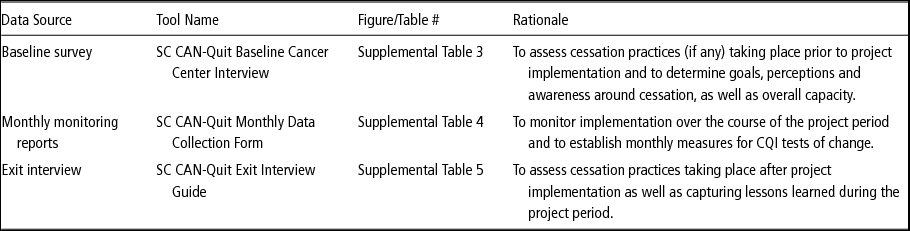
Primary data sources for the project included baseline surveys, monthly monitoring reports, and exit interviews. Each cancer center completed a brief survey (Supplemental Table 3) during the initial site visit to specify the goals of their cessation programs, perceptions about providing cessation services, current smoking documentation and delivery of cessation services, awareness of resources available to help patients quit tobacco use, IT system used, and EHR capacity. Cancer centers also described their experience with CQI and identified responsible team members with respective roles for participation on their CQI project teams.
A monthly reporting template was developed prior to launching the pilot. The template captured a variety of process and outcome measures designed to inform both evaluation and CQI efforts (Supplemental Table 4). Process measures directly reported by centers included the number of patients screened for tobacco use, number of patients advised to quit, and number of patients referred to the Quitline. The Quitline provided additional data to track the number of referrals who were reached/unreached, number of patients who registered for counseling services, and number of patients who declined services. Finally, indicators provided by TelASK included number of patients reached/unreached for follow-up, patients who reported having not smoked in the past seven days (quit proxy), patients who wanted to be re-connected with the Quitline, and patients who reported using quit medications, specifically nicotine replacement therapies (NRT). Reports were provided to the advisory team during monthly calls to monitor the implementation process. CQI utilization of these same data focused on month-to-month comparisons to inform PDSA cycles and the collaborative learning approach.
An ‘Exit Interview Guide’ (Supplemental Table 5) was developed for administration at the end of the project; this took place 12 months after the first learning session. Evaluators with expertise in qualitative research methods and tobacco cessation conducted interviews on site with staff at each cancer center. All interviews were digitally recorded, transcribed, and summarized for emerging themes. An overview of the instruments used in the evaluation is presented in Table 1.
Summary of evaluation instruments

Results
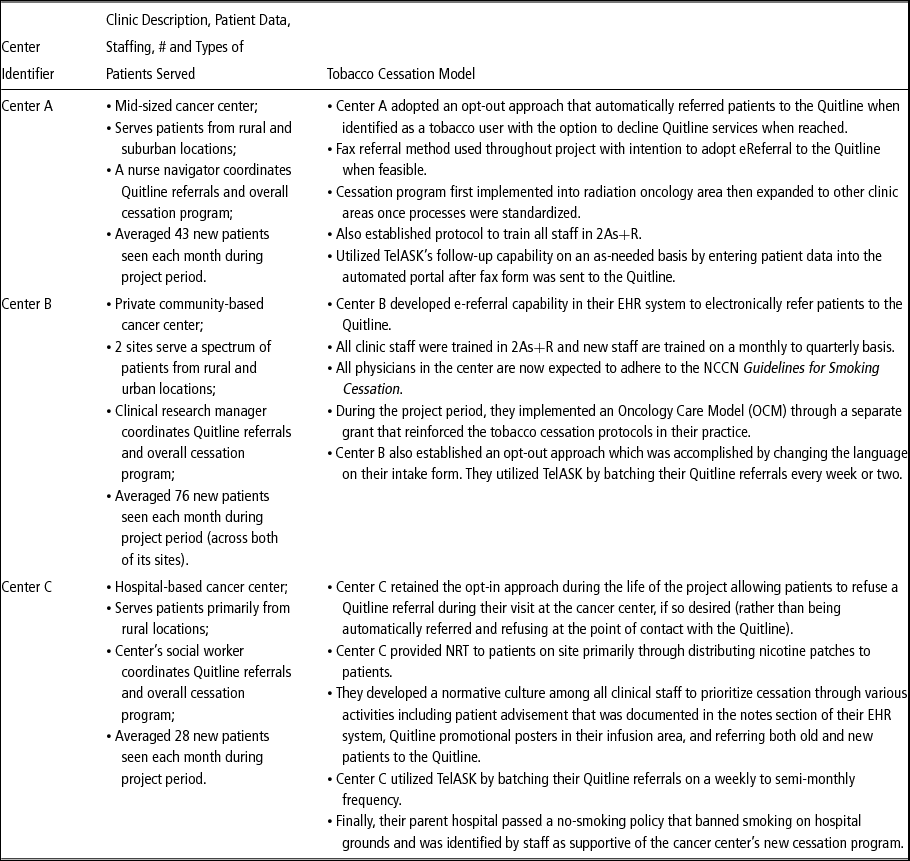
The three participating cancer centers were located in diverse parts of the state with representation of both rural communities and urban centers. They were all small to mid-sized community cancer centers that had a primary focus on clinical care (i.e., not academic or heavily research-focused institutions). Table 2 provides a brief description of each center and the cessation models developed. The average number of new monthly patients seen ranged from 30 to 83 across the three centers. At project baseline, none of the centers were aware of the statewide Quitline. All of the sites reported routinely screening patients for tobacco use, yet none of the centers had a standardized process for delivering cessation treatments to patients as outlined in the NCCN Guidelines®. Similarly, none of the identified smokers had documented evidence showing the delivery of cessation treatments (advisement to quit, referral to counseling, provision of NRT). However, although none of the cancer center's EHR systems included e-referral to the Quitline, they all were equipped with standard questions for documenting key cessation processes, such as identification of smokers, assessment of smoking history, advice to stop smoking, and counseling.
Description of SC CAN-Quit cancer center cessation models

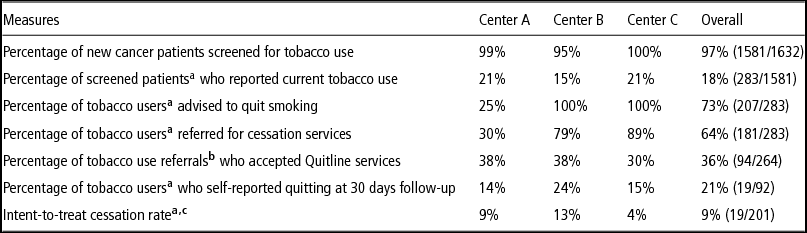
Each cancer center provided monthly reports on their cessation indicators, participated in the three learning sessions, and ultimately established systematic processes for screening patients for tobacco use and delivering cessation services. Table 3 provides an overview of aggregated outcomes overall, and by cancer center. During the pilot period, a total of 1,632 new patients were seen across the three cancer centers, 1,581 (97%) of whom were screened for tobacco use. Among those screened, 283 (18%) were identified tobacco users. Of tobacco users, 207 (73%) were advised to quit and 181 (64%) were referred to the Quitline.
SC CAN-Quit project outcomes overall and by cancer center

a Among new cancer patients.
b Including new and returning patients in Center A and Center C.
c Intent to treat cessation rate: numerator = all respondents who report having quit using tobacco; denominator = all those in the follow-up sample, regardless of whether or not they were reached. Those who were not reached by follow-up were considered to still be using tobacco.
Over the course of the pilot, the Quitline reported 264 referrals from the three centers, including new and returning patients. Of those referrals, 94 (36%) registered for cessation services. In addition, among the 201 patients scheduled for follow-up by TelASK, 92 (46%) were reached. Of those reached, 19 (21%) self-reported having quit smoking at 30 days follow-up. Assuming those not reached were still smoking, the overall intent-to-treat cessation rate was 9%, ranging from 4% to 13% across the three clinics. Last, at the time of project completion, one center (Center B) had implemented changes in their EHR system to electronically refer patients to the Quitline.
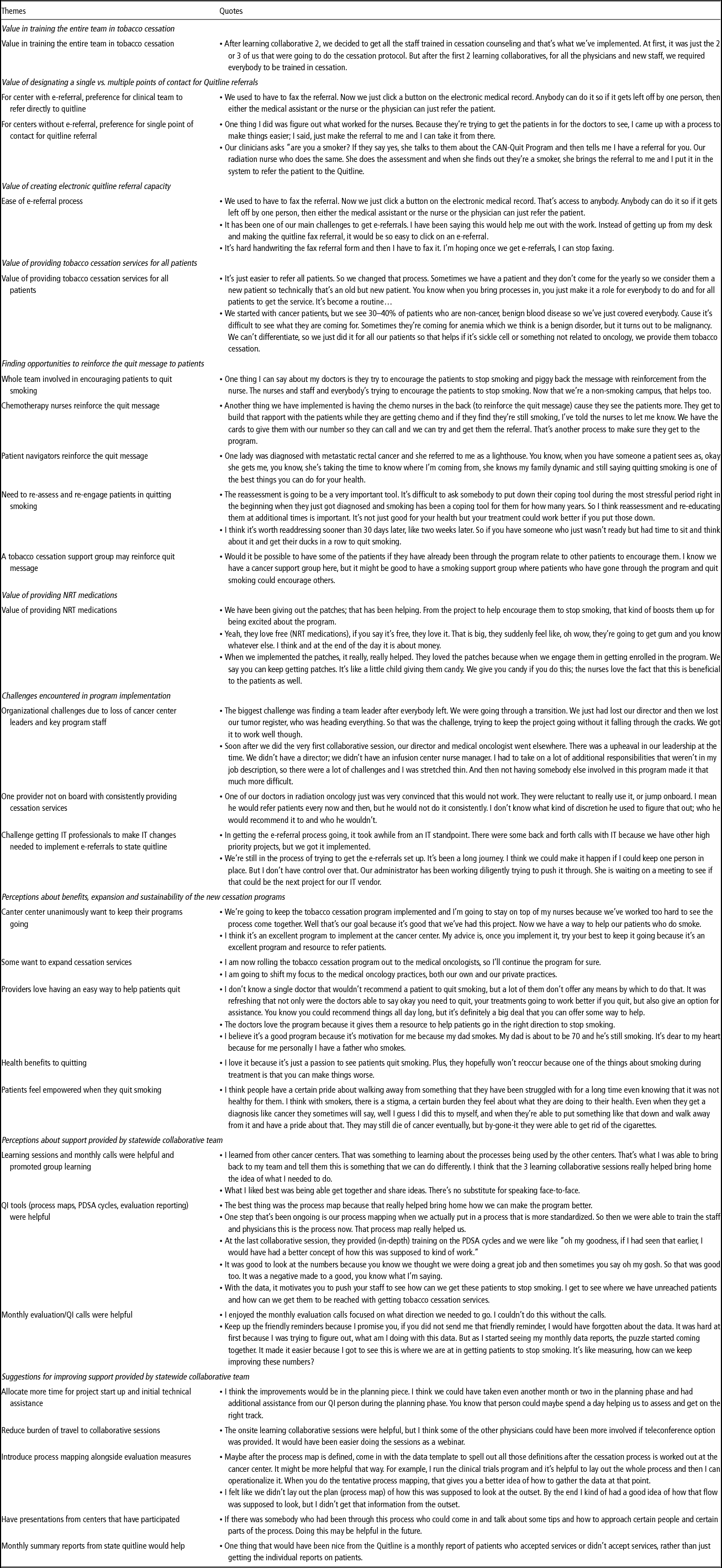
Based on exit interviews with tobacco cessation program staff at the three cancer centers, some themes were identified. Table 4 provides an overview of these themes with supporting quotes. Interview participants provided insight on useful strategies for optimizing delivery of cessation services. Participants consistently emphasized the need for e-referral capability, the value of providing cessation services to all patients (i.e., rather than selecting populations of patients for services, such as new patients or those with a cancer diagnosis), the value of reinforcing quit messages, and the value of providing NRT medications to engage patients in quitting smoking. Several centers described the importance of training the entire clinical team in tobacco cessation. While two centers preferred having a single point of referral to the state quitline, one center preferred having all providers refer directly to the state quitline. Several implementation challenges were also described, including lack of access to IT support for modifying the EHR to support quitline e-referral, changes to cancer center leadership and loss of staffing, and lack of buy-in by one oncologist for cessation services.
Themes identified during qualitative exit interviews

Participants across centers consistently reported that their new tobacco cessation programs were valuable to patients and would be sustained. They also described that implementation support provided by the collaborative coaching team was helpful, including the learning collaborative sessions, process mapping and change packets, and continual evaluation and monitoring of projects. Participants made several suggestions for improving support provided by the collaborative team, which included allocation of more time for program start-up, provision of an option to attend collaborative sessions by teleconference, and integration of QI methods such as process mapping and evaluation more closely.
Discussion
A statewide learning collaborative initiative is an effective and feasible approach for increasing the development of evidence-based tobacco cessation services in state cancer centers, particularly when operationalized via a structured collaborative learning framework and strengthened with the provision of mini-grant incentives. The formal incorporation of CQI, technical assistance, and evaluation from inception to completion, facilitated project success. All three of the funded cancer centers developed systematic approaches to screen and provide cessation services for smokers. As healthcare systems often operate on a narrow financial margin, it is likely that provision of some initial financial support and technical assistance to the cancer centers helped them overcome barriers related to program development costs and the time limitations of busy oncology professionals. Transformational increases in advisement and referrals to the Quitline were observed at each site, particularly as neither formal advisement nor referrals took place in the centers prior to the pilot period.
Several barriers were encountered in the development of evidence-based cessation services in the three pilot sites, but were not insurmountable. Challenges were encountered in getting e-referral processes established between cancer center EHR systems and the state Quitline, primarily due to staff turnover, time constraints, and planned changes in EHR vendors. Only one of the sites (Center B) had e-referral capacity by the end of the grant period. This cancer center reported that transitioning to e-referral made the process of referring patients to the state Quitline much easier, as demonstrated by a three-fold increase in their patient referrals. Since the project formally ended, a second site (Center C) has now developed e-referral capacity to the state Quitline, with the third site (Center A) still planning to develop e-referral after they transition to a new EHR system. For long-term sustainability of cessation programs, e-referral to the state Quitline will likely be crucial, as it can enable cessation services to be delivered more efficiently (Greenwood et al., Reference Greenwood, Parise, MacAller, Hankins, Harms and Pratt2012; Sharifi et al., Reference Sharifi, Adams, Winickoff, Guo, Reid and Boynton-Jarrett2014). Although no sites opted for this, developing an in-house cessation service with trained specialists would serve as a viable alternative or adjunct to quitline referral, as the NCCN guidelines highlight the benefit of face-to-face and group counseling (Shields et al., Reference Shields, Herbst, Arenberg, Benowitz, Bierut and Luckart2016). The cost of hiring/training cessation specialists may have been the main barrier. At one site (Center A), a major turn-over of cancer center leadership and staffing during the grant project slowed cessation program development and contributed to reduced program outcomes overall. Additionally, low rates of advisement were observed at this site specifically. According to anecdotal evidence, this may have been due to one or more providers who were initially skeptical of the initiative and were not early adopters. To mitigate this potential barrier, Center A adopted an opt-out approach where patients were automatically referred when identified as a tobacco user during the intake process, thus avoiding the potential for a missed referral from such providers.
Three key aspects of the statewide intervention facilitated program success in spite of the identified challenges. First, the mini-grant mechanism was successful in encouraging the three cancer centers to put cessation services in place that did not exist prior to their involvement. Originally, the goal was to obtain the participation of five centers. However three centers, representing four brick-and-mortar sites applied and participated. This proved to be a manageable number for this initial effort as it enabled the advisory team to provide personalized attention to each site, while also allowing collaborative learning across sites. Mini-grants have become increasingly utilized as a strategy for increasing dissemination of evidence-based interventions for cancer prevention and control (Kegler et al., Reference Kegler, Carvalho, Ory, Kellstedt, Friedman and McCracken2015). Evidence generated by this pilot denotes that its design is useful for providing incentives and support to cancer centers in our state to develop comprehensive cessation programs.
Second, using IHI's learning collaborative model incorporated CQI methods that included a Change Package, process mapping and PDSA cycles, as well as structured evaluation of process and outcome measures (IHI, 2003). Every cancer center is different, thus using a Change Package provided a menu of evidence-based strategies that can be used to develop a robust cessation program and allows centers the flexibility to build cessation programs that fit their unique context. Process maps developed for each center diagrammed the workflow for their new cessation services. They were found to be essential since the centers did not previously have these processes in place. Without establishing protocols for delivering an intervention, it would not be possible to systematically deliver cessation services to all patients. Use of PDSA cycles enabled the centers to identify and address issues that hampered service delivery. Monthly collection and review of key program measures enabled rapid identification of areas for program improvement. Over the course of the project, the Collaborative Learning model enabled the “expertise” to shift from the advisory team (at learning session one) to the cancer center teams (at learning session three).
Finally, the cancer centers identified a number of practices that helped them build their programs and engage patients in cessation. The cancer center that developed e-referral capacity to the state Quitline described this ability as a transformative change for making program delivery more efficient, in addition to being a tangible policy change for the center. This finding concurs with prior research demonstrating that switching from fax referrals to e-referrals dramatically increases referral of patients to state quitlines (Greenwood et al., Reference Greenwood, Parise, MacAller, Hankins, Harms and Pratt2012; Sharifi et al., Reference Sharifi, Adams, Winickoff, Guo, Reid and Boynton-Jarrett2014). This policy change also supports long-term systems level sustainability. Streamlining the program to train all providers in cessation and provide cessation services for all patients was another best practice identified by the centers. At the start of the study only one of the three sites was interested in the use of free medications, however, all had identified their interest in distributing free NRT to help engage patients in making a quit attempt by the end of the project. This finding is consistent with reports from previous studies that free medications can help to move patients across the trajectory of readiness to change by allowing for free sampling (Carpenter et al., Reference Carpenter, Hughes, Gray, Wahlquist, Saladin and Alberg2011). It is important to note that prescription-based cessation treatments (i.e., verenicline) could be included as a pharmacotherapy utilized by cancer centers, however the scope of this project employed NRT alone due to its feasibility.
Several limitations should be considered in interpreting the findings from this project. First, only three of our state cancer centers participated in the grant-funded project, and so the results described represent what was accomplished by cancer centers that were motivated to apply for a grant and commit to developing cessation services. Furthermore, the centers that participated were smaller community-based cancer treatment centers compared to others in the state. Thus, this project reports on a natural experiment and does not represent a random or representative sample of state cancer centers. In essence, one of the goals of this project was simply to evaluate how many cancer centers would apply for this type of mini-grant when offered the opportunity. Thus, this project represented implementation and evaluation of a practical approach for engaging cancer centers in developing evidence-based tobacco cessation services. To expand or replicate this project, multiple rounds of recruitment may be needed as cancer centers are at different stages of readiness/motivation to participate, granted they have competing priorities with other initiatives such as accreditation. If health insurers such as Medicaid/Medicare were to require evidence of smoking cessation provided to cancer patients as a condition of payment for cancer care, this would likely encourage more clinics to be interested in exploring how to implement NCCN guidelines. Second, monthly evaluation data were collected individually from centers that implemented various cessation models (opt-in, opt-out, and e-referral), explaining the subtle differences in how outcomes were reported. For example, two centers opted to apply the new 2As+R policy to all of their patients, new and returning, explaining the discrepancy between the larger number of referrals reported by the Quitline and the number of new patients referred to the Quitline, as reported by cancer centers.
This study aimed to assess if community oncology clinics could systematically offer cessation treatment support to smokers consistent with the NCCN Guidelines when offered technical assistance and mini-grant funding. In summary, the current project provides robust evidence that a statewide collaborative project implemented in partnership with state cancer centers is a feasible and effective strategy for encouraging cancer centers to develop comprehensive evidence-based tobacco cessation programs. This project represents a novel ‘real-world’ strategy for facilitating rapid dissemination and implementation of cessation services at the state level.
Acknowledgements
The authors wish to thank the three South Carolina cancer centers, who participated in the inaugural CAN-Quit initiative which would not have launched without their dedicated involvement. We also wish to acknowledge the Michigan Oncology Quality Consortium (MOQC) for their foundational efforts instituting tobacco cessation in community cancer centers, which provided a framework for our project in its infancy stage. We also want to acknowledge the contributions of Megan Hicks, MPH, Executive Director of the South Carolina Tobacco Free Collaborative for serving as the fiscal agent for the grant program and as a member of the SC CAN-Quit advisory committee; and Gailya Walters, MPH, Cancer Prevention Consultant (retired), SC DHEC Division of Cancer Prevention and Control, for her coordination and planning that helped launch SC CAN-Quit.
Financial Support
This work was supported by the South Carolina Department of Health and Environmental Control, Division of Tobacco Prevention and Control as well as a grant from CVS Health™.
Conflict of Interest
Dr. Cummings has received grants from Pfizer Inc. to help establish hospital-based cessation services. He has also served as a paid expert witness in litigation against cigarette manufacturers. All other authors have no disclosures to state.
Ethical Standards
The authors assert that all procedures contributing to this work comply with the ethical standards of the relevant national and institutional committees on human experimentation and with the Helsinki Declaration of 1975, as revised in 2008.
Supplementary Material
To view supplementary material for this article, please visit https://doi.org/10.1017/jsc.2018.23