For the past four decades, there has been some consensus on the role of environmental education in achieving the goals of a sustainable society and producing environmentally literate citizens (UNESCO, 1978, 2015; UNESCO-UNEP, 1992). In schools, one key to successful environmental education is the classroom teacher. It can be said that ‘if teachers do not have the knowledge, skills and commitment to environmentalise their curriculum, it is unlikely environmentally literate students will be produced’ (Wilke, Reference Wilke1985, p. 1). Teachers are vital to quality education as they enact and interpret the curriculum through their use of pedagogy and assessment in working with learners. It can be argued then that development of preservice teachers’ environmental literacy in teacher education programs is a prerequisite for their ability to design and implement effective environmental education in schools (Cutter & Smith, Reference Cutter and Smith2001; McKeown-Ice, Reference McKeown-Ice2000). Teacher education programs are, therefore, identified as crucial agents in transforming education and society so that a sustainable future is possible (Ferreira, Ryan, & Tilbury, Reference Ferreira, Ryan and Tilbury2007; McKeown, Hopkins, Rizi, & Chrystalbridge, Reference McKeown, Hopkins, Rizi and Chrystalbridge2002; Tilbury, Reference Tilbury1992).
The inclusion of environmental education in teacher education programs in order to produce effective environmental education teachers has long been recognised as the ‘priority of priorities’ (UNESCO-UNEP, 1990 p. 1). The United Nations Decade of Education for Sustainable Development (UNDESD) also identified the need to reorient teacher education towards sustainability in such a way that teacher education programs supersede transfer of knowledge to instead encompass an active and interactive learning process (UNESCO, 2012). However, despite international recommendations for the inclusion of environmental education in preservice teacher education, the extent to which this integration has been achieved is quite uncertain (Wals, Reference Wals2009). This might partly be due to the marginalised position given to environmental education in the school curriculum, which also often leads to a lack of teacher professional learning and an associated uncertainty of the effectiveness of environmental education in schools. A recent study that examined the integration of environmental education in a Botswana secondary school argues that trying to implement environmental education has been ineffective due to these reasons, in spite of a curricular expectation (Velempini, Reference Velempini2017). Preservice teachers do need education in the subject matter and pedagogies appropriate to environmental education in order to achieve the competencies of an environmentally literate teacher and the professional competencies of an environmental educator (Álvarez-García, Sureda-Negre, & Comas-Forgas, Reference Álvarez-García, Sureda-Negre and Comas-Forgas2015) so that they can play a key role in developing environmental literacy in future generations (Tuncer Teksoz, Boone, Tuzun, & Oztekin, Reference Tuncer Teksoz, Boone, Tuzun and Oztekin2014).
There is some debate in the literature about what environmental literacy is (Erdoğan, Kostova, & Marcinkowski, Reference Erdoğan, Kostova and Marcinkowski2009; Monroe, Andrews, & Biedenweg, Reference Monroe, Andrews and Biedenweg2008; Tuncer Teksoz et al., Reference Tuncer Teksoz, Boone, Tuzun and Oztekin2014). According to Roth (Reference Roth1992), the environmental literacy of an individual is the product of some interplaying components. These components are: (a) knowledge of ecological concepts, human impact on natural systems, environmental issues and environmental action strategies; (b) affective dispositions that relate to an individual's sensitivity, attitudes, personal responsibility, locus-of-control, values, and worldview; and (c) behaviour that could be expressed through specific activities or intentions to act (Buethe & Smallwood, Reference Buethe and Smallwood2010; Goldman, Yavetz, & Pe'er, Reference Goldman, Yavetz and Pe'er2014; Liu, Yeh, Liang, Fang, & Tsai, Reference Liu, Yeh, Liang, Fang and Tsai2015). Knowledge is an important predictor of environmentally responsible behaviour since it is usually regarded as a prerequisite to intentional action (Frick, Kaiser, & Wilson, Reference Frick, Kaiser and Wilson2004; Vicente-Molina, Fernández-Sáinz, & Izagirre-Olaizola, Reference Vicente-Molina, Fernández-Sáinz and Izagirre-Olaizola2013). It is not surprising then that environmental knowledge is a common target of interventions (Onel, Onel, Mukherjee, & Mukherjee, Reference Onel, Onel, Mukherjee and Mukherjee2016). However, knowledge alone is not a sufficient requirement for pro-environmental behaviour by an individual (Bamberg & Möser, Reference Bamberg and Möser2007; Hungerford & Volk, Reference Hungerford and Volk1990; Zsóka, Szerényi, Széchy, & Kocsis, Reference Zsóka, Szerényi, Széchy and Kocsis2013). Likewise, theoretically, there is no linear relationship between knowledge, affective dispositions and behaviour (Hungerford & Volk, Reference Hungerford and Volk1990; Kollmuss & Agyeman, Reference Kollmuss and Agyeman2002). Development of environmental literacy cannot be separated from an exhibition of environmentally responsible behaviour because an individual's level of environmental literacy is reflected in his or her behaviour toward the environment (Hollweg et al., Reference Hollweg Taylor, Bybee, Marcinkowski, McBeth and Zoido2011; Yavetz, Goldman, & Pe'er, Reference Yavetz, Goldman and Pe'er2009).
The components of environmental literacy described are consistent with the Tbilisi framework for environmental education (UNESCO, 1978) and are common to most recent frameworks of environmental literacy (Hollweg et al., Reference Hollweg Taylor, Bybee, Marcinkowski, McBeth and Zoido2011). The key components of environmental literacy, as mentioned by Hollweg et al. (Reference Hollweg Taylor, Bybee, Marcinkowski, McBeth and Zoido2011), are interactive and developmental in nature, implying that individuals develop along a continuum of literacy over time, and a person's environmental literacy, therefore, continues to evolve (Pe'er, Goldman, & Yavetz, Reference Pe'er, Goldman and Yavetz2007; Roth, Reference Roth1992). Adequate preparation of preservice teachers in environmental education could lead to the development of their environmental literacy, as well as equipping them to implement effective environmental education in their future schools (Goldman, Yavetz, & Pe'er, Reference Goldman, Yavetz and Pe'er2006). Hence, it would seem important to understand the relationship between environmental education and the development of environmental literacy and confidence to teach environmental education among preservice teachers.
Environment Education and the Development of Environmental Literacy Among Preservice Teachers
There is evidence from the literature that incorporating environmental education into teacher education programs could lead to the development of environmental literacy among preservice teachers (Ogunyemi & Ifegbesan, Reference Ogunyemi and Ifegbesan2011; Tuncer Teksoz et al., Reference Tuncer Teksoz, Boone, Tuzun and Oztekin2013). Preservice teachers who passed through teacher education programs that included training for teaching environmental education were also found to be more confident and effective in successfully delivering quality environmental education teaching to their students (Darling-Hammond, Chung, & Frelow, Reference Darling-Hammond, Chung and Frelow2002) than their counterparts who had not.
Studies evaluating the development of environmental literacy and relationships between environmental literacy components in response to preservice teachers’ exposure to environmental education have reported varying findings. In some studies, increased levels of environmental knowledge were observed among preservice teachers who took some environmental education-related courses (Tal, Reference Tal2010; Timur, Timur, & Karakas, Reference Timur, Timur and Karakas2014), while in other studies, exposure of preservice teachers to environmental education appeared to make no difference to their environmental literacy. For example, a report on preservice teachers’ environmental literacy in Turkey indicated no significant difference in the level of knowledge acquired even after exposure to environmental education courses (Tugba, Reference Tugba2007). Similarly, Puk and Stibbards (Reference Puk and Stibbards2010) evaluated the environmental literacy levels among a cohort of 15 preservice teachers enrolled in a 9-month Bachelor of Education program. They found that most of these students had very vague understandings of the environment and its related concepts, despite having been previously exposed to environmental education courses at school. The study thus concluded by advocating for the incorporation of specific training on ecological/environmental literacy in teacher education programs.
Some studies have shown that preservice teachers could be knowledgeable on local issues and not on global ones (Ogunyemi & Ifegbesan, Reference Ogunyemi and Ifegbesan2011), or on some environmental issues such as biodiversity, ozone layer, ecology greenhouse effect, and sustainable development, but not on others, like ecological footprint (Esa, Reference Esa2010). When limited environmental knowledge gain has been reported in previous studies, positive environmental attitudes are usually observed. Al-Dajeh (Reference Al-Dajeh2012) assessed the environmental literacy of 124 preservice teachers (prevocational education teachers) using close-ended questionnaires administered in a Jordanian teacher education school, while Saribas, Teksoz, and Ertepinar (Reference Saribas, Teksoz and Ertepinar2014) examined the level of 61 preservice elementary teachers’ environmental literacy and self-efficacy beliefs in Turkey using questionnaires as well. Findings from both studies revealed that although participants demonstrated low knowledge on environmental issues, they had positive attitudes towards the environment. An explanation for the gap between knowledge and attitudes may be attributed to cultural influences such as social norms, and family values, whereby demonstration of positive attitudes towards the environment could occur without a full understanding of the underlying principles of ecological and environmental concepts.
Although an individual's environmental literacy is expressed in exhibiting environmentally responsible behaviour (Yavetz et al., Reference Yavetz, Goldman and Pe'er2009), behaviour is a complex phenomenon (Babcock, Reference Babcock2009). Programs that focus on providing new knowledge may therefore not expect to necessarily influence behavioural outcomes within the short timeframe of the program, even though they may measure them (Stern, Powell, & Hill, Reference Stern, Powell and Hill2014). On this premise, it is not surprising that studies that have reported on preservice teachers’ behaviours have often reported little environmentally responsible behaviour (Boubonari, Markos, & Kevrekidis, Reference Boubonari, Markos and Kevrekidis2013), or just the exhibition of such behaviours that are convenient and would not involve any or much sacrifice (Goldman et al., Reference Goldman, Yavetz and Pe'er2014). For example, a study in Israel on first-year preservice teachers showed that preservice teachers had positive attitudes towards the environment, but limited knowledge and low expression of environmentally responsible behaviour (Pe'er et al., Reference Pe'er, Goldman and Yavetz2007). Furthermore, biology preservice teachers investigated in Malaysia demonstrated high levels of environmental knowledge and positive affective dispositions towards the environment but low levels of pro-environmental behaviour (Esa, Reference Esa2010). These findings may in part be due to the ineffective preparation of preservice teachers in environmental education, and the researchers advocated for more training that transcends the cognitive component, but such that also promotes intention to act in an environmentally responsible manner.
In New Zealand, several waves of national curriculum development have helped to frame the expression of environmental education in schools. For example, The New Zealand Curriculum Framework introduced in the early 1990s signalled opportunities for schools to include environmental education in their science and social studies curricula (Eames, Bolstad, & Robertson, Reference Eames, Bolstad and Robertson2008). The latest iteration, The New Zealand Curriculum, encouraged schools to develop environmental education through a process of school-based curriculum development, highlighting a vision of learners working towards sustainability, but it stopped short of mandating its inclusion (Chapman, Reference Chapman2011) as a visible learning area, leaving schools to work out for themselves how environmental education would fit into and across their curriculum programs. Given this liberal and non-prescriptive approach, it is clear that teachers would need some level of environmental literacy in addition to enthusiasm to be able to confidently teach environmental education in New Zealand schools. This is more important, as environmental education has not been a priority focus for the Ministry of Education in recent years except through linkage to the core learning areas such as science education (Bolstad, Joyce, & Hipkins, Reference Bolstad, Joyce and Hipkins2015), although reviews of the state of environmental education in New Zealand have all signalled a need for greater inclusion of environmental education in teacher education programs (e.g., Parliamentary Commissioner for the Environment, 2007).
To become a primary school teacher in New Zealand, there is the need to receive a qualification from one of the accredited tertiary institutions (Cameron & Baker, Reference Cameron and Baker2004). Some of these institutions offering teacher education programs include some environmental education at primary and/or secondary level. However, this is often limited in scope and optional (Eames et al., Reference Eames, Bolstad and Robertson2008).
To date, there has been a paucity of educational research into the effectiveness of teacher education in environmental education in New Zealand with regard to the development of teachers’ environmental literacy and confidence to teach environmental education in primary schools. Given this research gap, the current study sought to evaluate the impact of completing an environmental education paper on preservice teachers’ environmental literacy and their confidence to incorporate environmental education into their classroom when they begin teaching. This article, therefore, addresses two research questions:
1. What is the immediate impact of completing an environmental education paper on (a) the development of preservice teachers’ environmental literacy and (b) preservice teachers’ confidence to teach environmental education?
2. What relationships exist between components of environmental literacy such as environmental knowledge, affect, concern, and behaviour among preservice teachers?
Methods and Materials
This study was conducted using a mixed-methods approach within an interpretive paradigm to seek the meanings of the experiences of preservice teachers and their learning in an environmental education paper in the first year of an undergraduate teacher education program. Survey instruments included the use of questionnaires (pretest and posttest design), observations, and focus group discussions. Using mixed methods has been suggested to increase the accuracy of data and provide a complete picture of the phenomenon under study (Creswell & Clark, Reference Creswell and Clark2007). The sample for the study comprised 88 preservice teachers enrolled in a compulsory first-year Environmental and Sustainability Education paper during their Bachelor of Teaching program at the University of Waikato. The participants included 52 on-campus and 36 online preservice teachers, of whom 92% were females. The environmental education paper used as a focus in this report covered a 12-week period, which included 1-hour weekly lectures and 2-hour weekly workshops. The first five weeks focused on teaching preservice teachers about environmental and sustainability issues covering concepts such as biodiversity, interdependence, ecosystem services, values, social justice, and inter-generational equity, supply and demand, and globalisation. The last five weeks focused on teaching preservice teachers aspects of pedagogy and practice of environmental education in New Zealand primary schools.
Research Design
A pretest was conducted before the first environmental education lecture on the paper with questionnaires administered to all the preservice teachers (all preservice teachers were present on campus for the first lecture). The posttest by questionnaire was conducted with the same group of on-campus and online preservice teachers upon completing the environmental education paper. The on-campus preservice teachers had their questionnaire administered to them at the last workshop of the same academic year, while the online preservice teachers completed theirs via SurveyMonkey.
Previous research partly informed the development of the questionnaires (Yavetz et al., Reference Yavetz, Goldman and Pe'er2009), but the context and scope of the paper being evaluated was taken into consideration. Some modifications to the draft questionnaires were made based on suggestions from four experts who were staff members from the Faculty of Education, to assist with the content validity. The content-validated questionnaires were thereafter administered to 30 non-participant preservice teachers for a pilot study to ensure that the questionnaire was appropriate and easy to understand. Feedback from the pilot study was factored into the development of the final draft of the questionnaire. The questionnaire had three parts: the first comprised preservice teacher's demographic information and background items, the second part was made up of closed and open-ended questions aimed at assessing the preservice teachers’ environmental literacy, and the third part sought to assess the readiness of preservice teachers to teach environmental education in primary school upon graduation. Following is a brief description of the questionnaire sections addressed in this article.
Environmental knowledge
This study examined preservice teachers’ knowledge on selected environmental and sustainability issues in New Zealand. The environmental knowledge section comprised multiple-choice questions with five possible options. For each question, three options that would be considered not to represent sustainability were coded as incorrect and scored as -1, one option considered to represent sustainability was coded as correct and scored as 1, while a ‘don't know’ option was scored as 0. The scoring was done to capture the overall extent of sustainability thinking of preservice teachers’ choices. Thus, a shift towards more positive values indicates that more questions were answered with sustainable thinking, while a tilt towards negative values shows that more questions were answered with unsustainable thinking. These questions examined knowledge of issues covered in the environmental education paper, except for a question on water pollution, which was not directly covered in the paper. The inclusion of this latter question was perceived to be very relevant to the regional context, given the current prevalence of water pollution issues (Ballantine & Davies-Colley, Reference Ballantine and Davies-Colley2014).
Environmental affect
As influencers of environmental literacy in schools, preservice teachers need to believe in their ability to promote environmental literacy and to nurture that of their future students. Consequently, the environmental affect section of the questionnaire included three parts. The first two parts comprised statements that focused on preservice teachers’ locus of control (two items) and personal responsibility (three items), while the third had statements exploring the preservice teachers’ environmental world views (six items). These statements were adapted from the New Ecological Paradigm (NEP) scale (Dunlap, Van Liere, Mertig, & Jones, Reference Dunlap, Van Liere, Mertig and Jones2000). In all, the environmental affect section of the questionnaire comprised 11 statements to which preservice teachers could state their extent of agreement, based on a 5-point Likert-type scale (1 = strongly disagree, 2 = disagree, 3 = undecided, 4 = agree, 5 = strongly agree). The scores of the negatively worded items were reversed during analysis. The environmental affect section had a Cronbach's alpha reliability coefficient of 0.70, suggesting that the items have high internal consistency (Gliem & Gliem, Reference Gliem and Gliem2003; Tavakol & Dennick, Reference Tavakol and Dennick2011).
Environmental concern
Preservice teachers’ environmental concern on seven environmental and sustainability issues was assessed using a 5-point Likert-type scale (1 = very unconcerned to 5 = very concerned). These environmental and sustainability issues included water pollution, climate change, consumption and waste, endangered species, child poverty, racial discrimination, and bee decline. The environmental concern section had a Cronbach's alpha reliability coefficient of 0.93, suggesting that the items have very high internal consistency.
Environmental behaviour
This section of the questionnaire sought to assess (a) preservice teachers’ intention to act by indicating their level of agreement with five statements assessing their willingness to participate in pro-environmental activities (using a 5-point Likert scale from 1 = strongly disagree to 5 = strongly agree), and (b) preservice teachers’ environmental behaviour through a self-reported data signifying how often they carried out some environmental activities. The environmental activities of preservice teachers assessed in this study align with a theoretically defined scale for measuring environmental behaviour (Hines, Hungerford, & Tomera, Reference Hines, Hungerford and Tomera1987; McBeth & Volk, Reference McBeth and Volk2009; Simmons, Reference Simmons1995). In support of the scale for measuring environmental behaviour, Roth (Reference Roth1992) also claimed that an individual operating at the functional level of environmental literacy must exhibit these behaviours. They encompass consumer action (three items), eco-management (two items), persuasion (two items), nature-related leisure (one item) community giving (one item) and environmental activism (one item). The Cronbach's alpha reliability coefficient for the intention to act scale and overall environmental behaviour scale were 0.83 and 0.77 respectively.
Confidence to teach environmental education in primary schools
This section examining preservice teachers’ confidence to teach environmental education asked them to rate how confident they felt about teaching to achieve environmental education-related objectives in primary schools on a scale ranging from 1 (not confident at all) to 5 (very confident).
Observations and focus groups
Observations of all lectures and workshops attended by preservice teachers were also conducted with field notes guided by the aims of the class and the components of environmental literacy. This assisted with triangulation of the findings (Leech & Onwuegbuzie, Reference Leech and Onwuegbuzie2007). Upon completing the environmental education paper, focus group discussions were conducted by the researcher with a total of 10 randomly selected on-campus students, with a specific focus on elaborating preservice teachers’ responses to some of the questionnaire questions. Further discussions focused on reflections on preservice teachers’ learning in the environmental education paper and the impact it has had on their environmental literacy and confidence to teach environmental education.
Data Analysis
The quantitative and qualitative data collected were analysed statistically using Statistical Package for Social Sciences (SPSS v.22), and thematically using NVivo 11 respectively. For statistical data analysis, both campus and online preservice teachers were treated as one population, as a preliminary one-way ANOVA test indicated that campus preservice teachers did not differ significantly from online preservice teachers in their environmental knowledge, affect, and behaviour. Analysis conducted involved: (a) descriptive statistics such as percentages, means, and standard deviations; and (b) Pearson product-moment correlation to determine the relationships between the environmental literacy components for pretest and posttest scores. For each preservice teacher respondent, an overall total for each environmental literacy component (environmental knowledge, affect, concern, intention to act and behaviour) was calculated. These total scores for each environmental literacy component were correlated with each other to investigate the measure of linear dependence between any two components, at any one time. Using this approach, correlation values generally range between +1 and −1 inclusive, where 1 is total positive linear correlation, 0 is no linear correlation, and −1 is total negative linear correlation (Sedgwick, Reference Sedgwick2012). Content analysis on preservice teachers’ responses to the focus group discussions was conducted using NVivo. A general inductive approach was initially employed to adequately capture the themes emerging from the responses of preservice teachers to the questions asked. After a series of coding and recoding of these responses, themes were developed from the recurring captured categories (Fereday & Muir-Cochrane, Reference Fereday and Muir-Cochrane2006).
Ethical Considerations
Ethical approval was sought and received from the University of Waikato Human Research Ethics Committee. All participants gave informed consent and were advised that any data provided would not be shown to their lecturers or tutor, nor would their academic progress be affected in any way. Neither the researcher who conducted the study nor the co-authors of this article were involved in teaching participants in the paper under study.
Findings
Environmental Knowledge
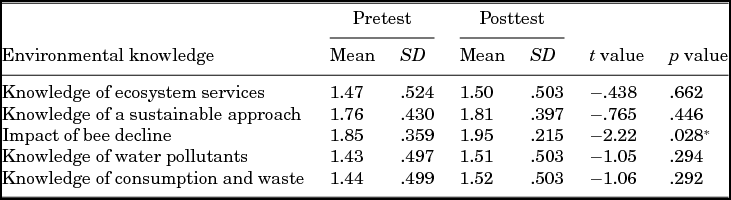
Mean scores of preservice teachers’ answers to environmental knowledge questions prior to and upon completing the environmental education paper are shown in Table 1. Before taking the environmental education paper, the highest mean scores were associated with knowledge on bee decline and sustainable approach, while the lowest score was related to knowledge of water pollutants. Increases in the mean scores for all the environmental knowledge questions were observed upon completing the environmental education paper, except for the question associated with water pollution. However, the only significant change was for the question item associated with bee decline, with the posttest mean significantly higher than the pretest mean (p < .05). Overall, knowledge gain was not significant statistically.
Independent Sample t Test for Preservice Teachers’ Environmental Knowledge

Note: *Statistically significant at p < .05, n = 88 (pretest), n = 87 (posttest).
Classroom observations affirmed that issues around bee decline and the impact on food production were discussed extensively in the environmental education paper taken by the preservice teachers in this study. A number of preservice teachers during the focus group discussion also described their learning about the bees as the most memorable part of the environmental education paper. Some comments were:
For me, it is the bees, learning about them . . . (Preservice teacher 1)
It made me more aware of the things around like the bees. I started noticing the bees around where before I did not really. (Preservice teacher 6)
Environmental Affect
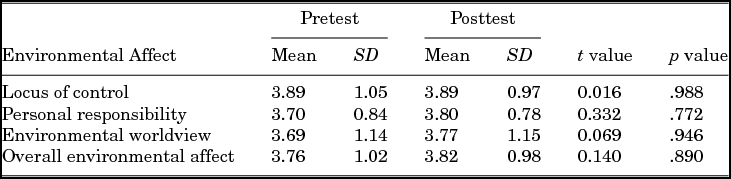
Mean scores of preservice teachers’ response to environmental affect statements prior to and upon completing the environmental education paper are shown in Table 2, where a scale of 1–5 has been used to indicate a low-to-high positive emotional connection to environment and sustainability issues. The mean scores for preservice teachers’ personal responsibility and environmental worldview were observed to increase, while the mean scores for preservice teachers’ locus of control remained the same upon completing the environmental education paper. An overall increase in the mean scores of preservice teachers’ environmental affect was observed upon completing the environmental education paper (see Table 2). Overall, these changes in mean scores were not significant. Preservice teachers generally showed a positive connection, even in the pretest, so significant change may have been unrealistic to hope for.
Independent Sample t Test for Preservice Teachers’ Environmental Affect

Note: n = 88 (pretest), n = 87 (posttest).
Data from the focus group discussion supported the finding regarding preservice teachers’ locus of control; there appeared to be some indecision as to whose role it is to look after the environment. An example of such a comment was:
To me, it is controversial. I know we have spent the whole time learning how we can make a difference individually, but realistically I think it needs to change at the government level, and I think they are going to change when things get really bad. (Preservice teacher 8)
Environmental Concern
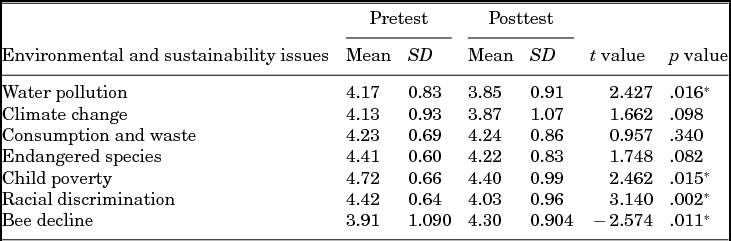
The mean scores of preservice teachers’ level of concern about specified environmental and sustainability issues prior to and upon completing the environmental education paper are presented in Table 3, where a scale of 1–5 has been used to indicate a low-to-high level of concern for the environmental and sustainability issues that were specified in the questions. Prior to taking the environmental education paper, preservice teachers showed the least environmental concern for bee decline (Table 3), despite demonstrating a high level of knowledge on the issue (as in Table 1). However, upon completing the environmental education paper, a significant increase in the level of preservice teachers’ environmental concern towards bee decline was observed (Table 3). An increase in mean scores, albeit small, was also associated with consumption and waste. A high level of concern was already expressed prior to taking the paper, hence much change was unlikely. Based on classroom observations, consumption and waste, as well as bee decline were the major topics stressed in the environmental education paper, and this could explain the shift towards increased concern observed in these areas.
Independent Sample t Test for Preservice Teachers’ Environmental Concern

Note: *Statistically significant at p < .05, n = 88 (pretest), n = 87 (posttest).
Meanwhile, significant decreases in mean scores were observed, particularly for environmental and sustainability issues that were not the main focus of the environmental education paper; for instance, water pollution, child poverty, and racial discrimination. It is uncertain why this might have occurred. Other topics not covered greatly in the paper but which are current in New Zealand, such as climate change and endangered species, also decreased in concern during the paper, but not significantly.
Environmental Behaviour
Intention to act
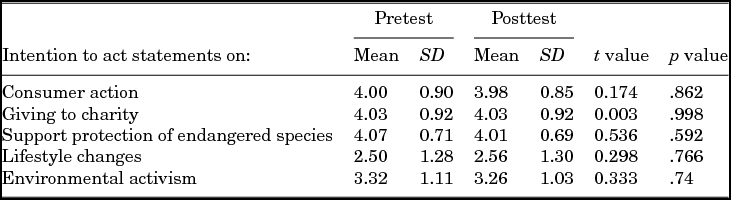
Table 4 presents mean scores of preservice teachers’ responses to statements depicting their intention to act in some environmentally friendly ways prior to and upon completing the environmental education paper, where a scale of 1–5 has been used to indicate a low to high willingness to act in an environmentally friendly manner. Prior to completing the environmental education paper, means scores of intention to act statements associated with consumer action, giving to charity, and protection of endangered species were the highest. A similar trend was observed upon completing the environmental education paper in preservice teachers’ responses to intention to act statements considered in this study (Table 4). Preservice teachers were generally most willing to give to charity and protect endangered species in their communities but were less willing to make sustainable lifestyle changes.
Independent Sample t Test for Preservice Teachers’ Intention To Act

Note: *Statistically significant at p < .05, n = 88 (pretest), n = 87 (posttest).
Self-reported environmental behaviour
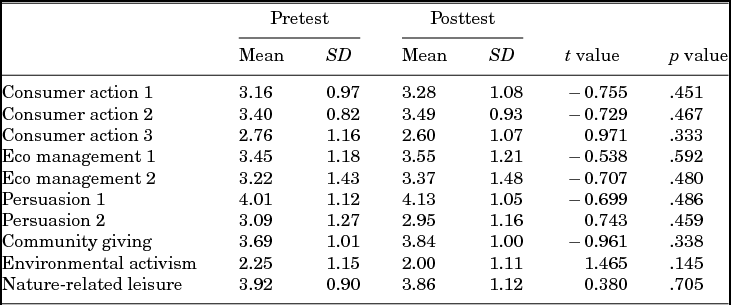
As shown in Table 5, the pro-environmental behaviour reported by most preservice teachers prior to and upon completing the environmental education paper was encouraging people at home to recycle, while the least often performed was associated with environmental activism. Generally, mean scores of preservice teachers’ environmental behaviour did not significantly change upon completing the environmental education paper (p < .05).
Independent Sample t Test for Preservice Teachers’ Environmental Behaviour

Note: *Statistically significant at p < .05, n = 88 (pretest), n = 87 (posttest).
Consumer action 1 = Purchase a product because it was packaged in reusable or recyclable containers; Consumer action 2 = Purchase a product because it claims to be environmentally friendly; Consumer action 3 = Use other types of transport, such as biking or the bus, instead of going in a car; Eco management 1 = Conserve water at home by showering for less than 10 minutes a day; Eco management 2 = Bring your own shopping bags for shopping; Persuasion 1 = Encourage people at home to recycle glass, paper or food scraps; Persuasion 2 = Try to persuade people to stop doing activities that could harm the environment.
Confidence to Teach Environmental Education in Primary Schools
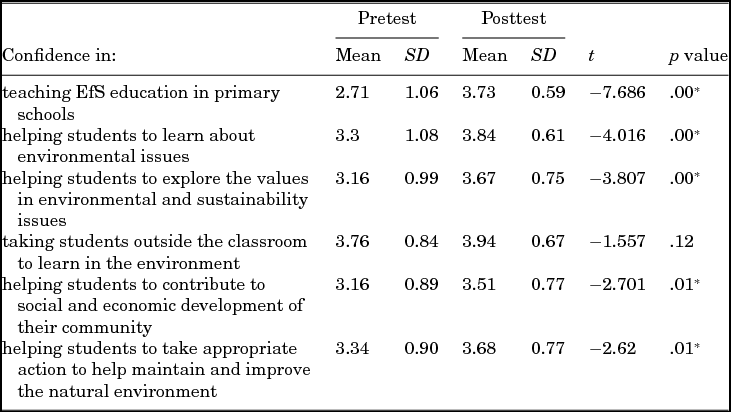
Highlighted in Table 6 are the mean scores of preservice teachers’ responses to statements examining confidence to teach environmental education in primary schools, where a scale of 1–5 has been used to indicate a low-to-high level of confidence to teach. As shown in Table 6, the impact of the environmental education paper on the preservice teachers’ confidence to teach environmental education and help students with their learning in primary schools was profound, as mean scores increased significantly for all but one of the specified learning areas (i.e., confidence in taking students out of the classroom to learn in the environment). Despite this, mean scores associated with confidence in taking students out of the classroom to learn in the environment was the highest prior to and upon completing the environmental education paper, so significant change may have been unrealistic to hope for. There was also a marked lower standard deviation associated with posttest mean scores, indicating reduced variability and improved agreement in preservice teachers’ responses following the completion of the environmental education paper (Table 6).
Independent Sample t Test for Preservice Teachers’ Confidence to Teach Environmental Education in Primary Schools

Note: *Statistically significant at p < .05, n = 88 (pretest), n = 87 (posttest).
Relationships Between Environmental Literacy Components
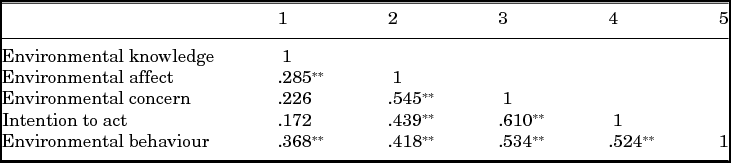
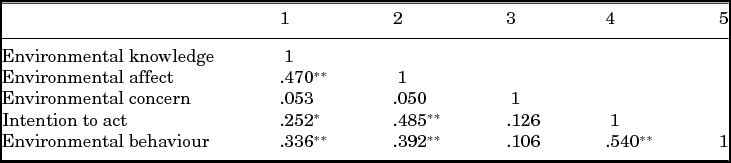
Findings from the exploration of relationships between environmental literacy components of this study are presented in Table 7a and 7b. The strongest correlations observed were correlations between intention to act and environmental concern (r = .610, p < .01), and intention to act and environmental behaviour (r = .540, p < .01; Table 7a and 7b). Prior to taking the environmental education paper, a small but significant correlation was observed between preservice teachers’ environmental knowledge and environmental affect (r = .285, p < .01) and environmental behaviour (r = .368, p < .01). Upon completing the environmental education paper, increases in the strength of correlations between environmental knowledge and affect were observed. This was coupled with an emergence of correlation between environmental knowledge and intention to act upon completing the environmental education paper (r = . 252, p < .05). The correlation between environmental knowledge and behaviour upon completing the environmental education paper remained apparently unchanged.
Correlations Between Environmental Literacy Components (Pretest)

Note: **Correlation is statistically significant at p < .01
Correlations Between Environmental Literacy Components (Posttest)

Note: *Correlation is statistically significant at p < .05, **Correlation is statistically significant at p < .01.
Interrelationships between preservice teachers’ environmental literacy components that further support the observed increase in the strength of correlations between environmental knowledge and affect (see Table 7a and 7b) were also recognised from the focus group discussions upon completing the environmental education paper. Specifically, the knowledge gained through the environmental education paper made them appreciate some values or practices upheld in their homes and also increased their intention to act. Some comments were:
It made me more aware of environmental issues. Before the paper, I knew of them but I didn't know in-depth about them, but it taught me to critically think about this issue and how I can contribute to the solution. (Preservice teacher 2)
I think our lifestyle has been pretty environmentally sustainable, we've got a lot of trees, chickens and we have always recycled. For me, it has made me appreciate that more and willing to put that into my own adult life. (Preservice teacher 8)
I live with my grandparents, and they always plant different plants everywhere. They have a couple of sun plants, and grandpa takes the crystals off the sun plants and hang them from the roof, and so we have rows and rows of crystals hanging from the railings of our house and [I didn't see the need], but after the paper I learnt to appreciate and give a hand. (Preservice teacher 2)
Discussion and Conclusions
Findings from this study have explored the immediate impact of environmental education on preservice teachers’ environmental literacy and confidence to teach environmental education, as well as correlations between their environmental literacy components. Findings from this study could assist curriculum and program developers to have a better understanding of the impact of environmental education on developing teacher environmental literacy through preservice teacher education, including ideas for improvement.
Immediate Impact of Environmental Education on Preservice Teachers’ Environmental Literacy and Confidence to Teach Environmental Education
Preservice teachers demonstrated increased knowledge, notably on the areas focused on in the environmental education paper but limited knowledge on other areas not focused on. It could, however, be implied that preservice teachers’ knowledge was limited to areas that were focused on in the environmental education paper. For example, preservice teachers performed very well on questions related to bee decline but performed poorly on the question related to water quality, a local issue not focused on in the environmental education paper. These findings on the limited knowledge of preservice teachers on areas not focused on in the environmental education paper corroborates with the findings of Tuncer Teksoz et al. (Reference Tuncer Teksoz, Boone, Tuzun and Oztekin2014), where factors such as previous exposure to some environmental issues through environmental education courses made preservice teachers in the study perform well on some knowledge items and poorly on others outside the scope of the previous course taken. Other studies (Esa, Reference Esa2010; Ogunyemi & Ifegbesan, Reference Ogunyemi and Ifegbesan2011) likewise reported limited knowledge on some environmental issues preservice teachers may not have been exposed to.
A similar trend with preservice teachers’ environmental knowledge was observed with preservice teachers’ environmental concern. Increases in preservice teachers’ concern towards the environmental issues emphasised in the environmental education paper were observed, and surprisingly, a significant decrease was found in preservice teachers’ concern towards the other environmental issues not stressed in the environmental education paper. A shift towards more biocentric values would have been expected upon exposure to environment-related studies; research has, however, shown that this is not always the case. Rickinson (Reference Rickinson2001) posited that some environmental issues are rated as more severe than others among young people, and this affects their environmental concern for such ‘low’ rated issues. In some cases, elements of pessimism are reflected in peoples’ environmental concern with regard to the future (Holden & Hicks, Reference Holden and Hicks2007). There is evidence in the literature that sometimes when individuals are knowledgeable about the enormous environmental issues and problems facing our world (locally and globally), they often tend to feel powerless and cynical, or incapacitated to take environmentally responsible actions (Goldman et al., Reference Goldman, Yavetz and Pe'er2014; Jensen, Reference Jensen2002). It is possible that these factors contributed to the reduced concern found in this study, and observational data did highlight how confronting some content of the paper was to some of the preservice teachers. For example, in a workshop where the tutor discussed plastic waste in the ocean, a number of students expressed surprise and feelings of being overwhelmed by the magnitude of the problem and how they could contribute to solving it (Workshop observation, July 29, 2015).
Regarding preservice teachers’ environmental affect, although some acknowledged their individual responsibility in making a difference towards the quality of the environment (locus of control), upon completing the environmental education paper, some preservice teachers still felt that to make a difference there must be the involvement of some ‘powerful others’ such as the government. On the whole, an increase in the mean scores of preservice teachers’ environmental affect was observed upon completing the environmental education paper, as more preservice teachers acknowledged their personal responsibility towards environmental problems and solutions. This observation of generally positive attitudes among preservice teachers is in agreement with previous findings (Al-Dajeh, Reference Al-Dajeh2012; Khalid, Harun, Muda, & Ismail, Reference Khalid, Harun, Muda and Ismail2011).
Findings from preservice teachers’ environmental behaviour revealed that they were more willing to act in areas related to protecting endangered species and environmentally responsible consumerism, but less willing to act on significant lifestyle choices such as not eating meat, despite the statement promoting it as a sustainable way of life. They were not also willing to be involved in environmental activism, such as marching in a rally. A majority of preservice teachers reported that they were already carrying out a number of the specified behaviours, except environmental activism, prior to taking the environmental education paper, and so a significant shift after completing the environmental education paper was unlikely to be seen. The most common activities were connected to preservice teachers encouraging people at home to recycle glass, paper or food scraps and engage in nature-related leisure and community giving, while the least activity preservice teachers engaged in was related to environmental activism, as shown in Table 5.
Overall, although quantitative analysis shows that preservice teachers’ environmental literacy appears not to statistically increase after taking the environmental education paper, preservice teachers had high mean scores on most of the variables prior to taking the environmental education paper, and thus the findings might be attributed to the ceiling effects created. Moreover, the null results reported on the shift between the pre- and posttest scores for most of the components indicates that although the paper did enhance aspects of preservice teachers’ environmental literacy, more needs to be done to achieve the goals of environmental education in teacher education programs. From observation of the environmental education paper, the pedagogical approach employed provided the preservice teachers with the opportunity to ‘learn how to take actions for the environment’, but they were not given the opportunity ‘to take action for the environment’. This poses a challenge for teacher education programs, as attaining the desired level of environmental literacy operational environmental literacy intended for these future environmental educators (Roth, Reference Roth1992) is clearly difficult to achieve in short courses.
Furthermore, findings from this study revealed some of the challenges in attempting to assess the development of environmental literacy using a quantitative approach. An explanation is that participants possibly gave more informed self-assessments when completing the posttest, compared to the pretest. This stance is backed by classroom observations and focus group discussions that showed that the students might have felt that they had good environmental literacy prior to taking the environmental education paper and that their learning through the paper seemed to have compelled them to challenge the limitations of this perception.
Upon completing the environmental education paper, preservice teachers in this study demonstrated significant increased confidence in teaching environmental education and helping their future students learn about environmental and sustainability issues. Findings here are similar to a study in Australia involving 107 final-year preservice teachers (Kennelly, Taylor, & Maxwell, Reference Kennelly, Taylor and Maxwell2008). The study reported increased confidence of these preservice teachers after exposure to a dedicated unit on environmental education. Comparably, another study in Turkey examined 299 preservice teachers’ understanding of science concepts as well as their confidence in its teaching (Tekkaya, Cakiroglu, & Ozkan, Reference Tekkaya, Cakiroglu and Ozkan2004). Their findings indicated that the majority of the preservice teachers generally felt confident about teaching despite holding misconceptions concerning basic science concepts. Confidence is an important teacher attribute (Kennelly et al., Reference Kennelly, Taylor and Maxwell2008) but may be regarded as an unreliable indicator of competence (Appleton, Reference Appleton1995).
Correlation Between Environmental Literacy Components
Findings from the correlations between the environmental literacy components suggest that the environmental education paper completed by preservice teachers seemed to influence some of the relationships between the components of their environmental literacy significantly. For instance, prior to taking the environmental education paper, preservice teachers’ environmental knowledge correlated mildly with environmental affect (r = .285, p < .01), and this correlation increased upon completing the environmental education paper (posttest r = .47, p < .01). This posttest finding concurs with the findings of Teksöz, Şahin, and Ertepınar (Reference Teksöz, Şahin and Ertepınar2010) and Esa (Reference Esa2010), who reported a strong positive correlation between knowledge and affect in their studies. From their questionnaire responses and focus group discussion, preservice teachers indicated that they felt that the environmental education paper they had taken had contributed to their environmental literacy over the duration of the paper.
The strongest correlations observed among the environmental literacy components prior to and upon completing the environmental education paper were between intention to act and environmental concern (p = .610, pretest), and intention to act and environmental behaviour (p = .540, posttest) respectively. Upon completing the environmental education paper, increased correlations were found between environmental knowledge and affect, environmental affect and intention to act, as well as between intention to act and environmental behaviour. Notable also was the emergence of the correlation between environmental knowledge and intention to act upon completing the environmental education paper. Our findings thus corroborate previous studies that have reported strong correlations of intention to act with environmental affect and behaviour (Hsu & Roth, Reference Hsu and Roth1998; Liu et al., Reference Liu, Yeh, Liang, Fang and Tsai2015). The correlation remained apparently unchanged between environmental knowledge and behaviour, despite the emergence of the mild correlation between environmental knowledge and intention to act upon completing the environmental education paper. This confirms previous findings that reported that increased knowledge does not necessarily transform into environmentally responsible behaviour (Esa, Reference Esa2010; Pe'er et al., Reference Pe'er, Goldman and Yavetz2007). The unexpected declines in preservice teachers’ environmental concern towards environmental issues that were not the main focus of the environmental education paper (Table 3) might have led to the drop in correlations between concern and other environmental literacy components upon completing the environmental education paper.
Implications for Preservice Teacher Education
Findings from this study do reveal a shift towards significant increased environmental knowledge on the aspects focused on in the environmental education paper. However, such knowledge cannot be regarded as sufficient, as preservice teachers need to be able to comprehend the diverse environmental and sustainability issues facing our world to be able to address them in schools and provide role models for their students through personal behaviour (Goldman et al., Reference Goldman, Yavetz and Pe'er2014). On the one hand, preservice teachers’ limited knowledge of the topics learnt in the environmental education paper is worrisome, while on the other hand, it questions the existing curriculum in some ways: How much can be covered in a compulsory environmental education paper that would be adequate to prepare preservice teachers to teach their future students? Given the limitations observed in preservice teachers’ knowledge, a case could be made for more in-depth focus on a number of specific environmental and sustainability issues that could widen and strengthen students’ environmental literacy. While this may limit knowledge gain to those issues, the dispositions developed such as inquiry and critical thinking, empathy, and action skills may be transferable to other issues. It is recognised that sustainability issues are contextual in nature, and as such, people's knowledge and level of concern may see their intentions to act differ from issue to issue. Therefore, the decreased environmental concern about the areas not focused on in the environmental education paper, such as water pollution, child poverty, and racial discrimination may require a different pedagogical approach that could stimulate holistic concern for those sustainability issues. This is crucial in achieving the goal of environmental education because, in principle, environmental education has its focus on fostering the transfer of dispositions from issue to issue (International Union for Conservation of Nature, 1970), intended to develop learners’ attitudes and behaviours (Goldman et al., Reference Goldman, Yavetz and Pe'er2014). There is a need to reorient the preservice teacher education curriculum of the paper studied to include environmental value-based education, in addition to content knowledge. Furthermore, fostering the ability of preservice teachers to learn through action taking in their teacher education program would enhance the achievement of the goals of environmental education.
Despite the small shifts associated with preservice teachers’ knowledge, affect, and behaviour upon completing the environmental education paper, they expressed increased confidence to teach environmental education in primary school. It thus appears that some other factors may be responsible for preservice teachers’ reported confidence. Questionnaire responses indicated that the majority of preservice teachers (80%) claimed that upon completing the environmental education paper, they were encouraged to teach environmental education in primary schools. In addition, findings from the focus group discussion indicated that the experiences that enhanced their confidence to teach were the field trip, nature of the assignments, and the interactive nature of the workshop sessions. This finding is in agreement with other studies (Howitt, Reference Howitt2007; Hudson, Reference Hudson2011). As reported by (Howitt, Reference Howitt2007), no single factor can be pinpointed as the major contributor to preservice teachers’ confidence. Instead, a mix of a variety of factors was necessary to improve preservice teachers’ confidence to teach, and this may be the case here. On the flip side, preservice teachers’ confidence to teach environmental education might be based on superficial elements that are not well grounded, as these preservice teachers lack in-depth teaching experience. This shallow environmental literacy could have an impact on their future students with respect to the quality of learning they might receive, as well as them not being role models who might spur their future students to become environmentally literate citizens. This is an area of research that requires more attention.
Finally, although the immediate impact of environmental education on preservice teachers’ environmental literacy reveals a small shift towards more environmentally literate teachers and increased confidence in teaching environmental education, these preservice teachers still had two more years to spend in their Bachelor of Teaching program. This means that confidence to teach environmental education in primary school may wane if preservice teachers get no further exposure to environmental education in their degrees. The question arises as to what these students might therefore retain of their environmental literacy and confidence to teach environmental education when they graduate. The authors of this study are currently evaluating a cohort of preservice teachers at the end of their 3-year program with the intention of assessing preservice teachers’ environmental literacy and confidence to teach environmental education at the time they are ready to graduate and in the first few months of securing a teaching job. Findings from this further study will be reported in a future article.
Acknowledgments
This research was funded by University of Waikato Doctoral Scholarship.
Author Biographies
Deborah Dada is a PhD candidate at the University of Waikato. Her research interest revolves around environmental literacy among higher degree students. She is at the final stages of her dissertation, which employed a cross-sectional cohort study to evaluate the environmental literacy of preservice teachers during their teacher education program, as well as their preparedness to teach environmental education. She also examined the experiences of beginning teachers in teaching environmental education in New Zealand primary schools.
Chris Eames is a lecturer in environmental and sustainability education (EE) at the University of Waikato in Hamilton, New Zealand. He works with preservice and inservice teachers, and with many postgraduate students, with a particular focus on education practice. He also advocates at national level for enviromental and sustainability education as a National Executive member for the New Zealand Association for Environmental Education and works at a local level to promote ESE and to protect and restore the natural environments in his country. He is Associate Editor of the Australian Journal of Environmental Education.
Dr Nigel Calder is Associate Professor at the University of Waikato. His main research interest is the use of digital technologies in mathematics education. His present and recent research projects are: connecting science and mathematics through inquiry; apps in primary-school mathematics teaching and learning; the influence of mobile technologies on the engagement of 16- to 18-year-old reluctant learners; and student-centred inquiry learning in secondary schools. He wrote the book Processing Mathematics Through Digital Technologies and has published numerous resources, book chapters, and journal articles.