

Introduction
The world is undergoing significant transformation. A growing body of scholarship has examined the nature of these changes and how best to conceptualise them.Footnote 1 Broadly, authors have categorised the changes along two dimensions: a material one focusing on shifts in the distribution of material power between states, and an ideational one looking at the evolution of dominant norms and ideas within the international system.Footnote 2 Both these changes have important implications for the liberal international order (LIO). Established in the aftermath of World War II and triumphing at the end of the Cold War, the LIO facilitated deeper economic integration, expanded the role of multilateral institutions, and supported the global spread of liberal democratic norms and values. In recent years, however, scholars have shown the growing contestation – if not retreat – of the LIO.Footnote 3
In this article, we examine one key element linked to the contestation of the LIO: conceptualisations of international security. Whereas security was predominantly defined in state-centric terms during the Cold War, in its aftermath, the heyday of the LIO witnessed a broadening and deepening of the concept to encompass a wider range of actors and issues.Footnote 4 Current debates about the decline or crisis of the LIO raise the important question of how conceptualisations of international security are evolving in this changing global context. To address this question, we define security conceptualisations as ‘a particular set of historical discourses and practices that rest upon institutionally shared understandings’.Footnote 5 Building on this definition, we examine security conceptualisations at the level of both discourse and practice. At the discursive level, we analyse security conceptualisations as expressed in speeches by the five permanent member states (P5) in meetings of the United Nations Security Council (UNSC). Our empirical focus is the United Nations (UN) as it is the principal actor charged with maintaining international peace and security. The P5 speeches provide insights into how individual member states define security.Footnote 6 At the level of practice, we examine UN peace operations, including both peacekeeping operations and political missions.Footnote 7 The mandates of these peace operations reflect the negotiated understandings among UN member states, and in particular the P5, regarding what constitutes security and how it should be promoted.Footnote 8
We theorise security along three interrelated dimensions.Footnote 9 First, the conception of threats, or what is understood to constitute a danger. Second, the referent object of security, defined as those entities ‘seen to be existentially threatened and that have a legitimate claim to survival’.Footnote 10 Third, the subject of security, understood as the entity entitled to provide, maintain, or restore security. Building on these dimensions, we distinguish two ideal-typical approaches. First, a realist state-centric definition, in which threats are seen as primarily military dangers and the state constitutes both the referent object and subject of security. Second, a liberal human-centric definition, in which threats include both military and non-military dangers, the referent object encompasses both the state and individuals, and the subject of security extends beyond the state to include the international community. Against the background of an increasingly contested LIO, we derive two theoretical expectations regarding UN discourse and practice on international security: a decline of liberal human-centric conceptualisations of security, and an increase in realist state-centric conceptualisations of security.
To map the evolution of security conceptualisations, our empirical analysis proceeds in two steps. First to analyse discourses, we provide a content analysis of 384 speeches delivered by the P5 in UNSC meetings on international peace and security held between 2001 and 2020. Second, to analyse practices, we examine the evolution of UN peace operations and their mandates over the same period. Our findings confirm our expectations in that they indicate an overall shift away from human-centric conceptualisations of security and a reassertion of state-centric definitions. At the discursive level, this trend is primarily driven by China and Russia, in contrast to France, the UK, and the United States (the so-called P3). These divergences are reflected in three core areas of disagreement within the P5: whether external interventions constitute a security threat, whether individuals facing harm from their own governments qualify as referent objects of security, and what role the UN should play as a subject providing security. Overall, we observe not a simple return to state-centric security conceptualisations but instead an increasing competition between state- and human-centric visions over how to define international security. At the level of practice, we find that UN peace operation mandates increasingly reflect a reduced emphasis on human-centric security conceptualisations as forwarded by the P3, while increasingly reproducing the state-centric security conceptualisations held by China and Russia.
This article makes key contributions to two bodies of literature. First, it adds to international security studies. By offering a systematic analysis of changing conceptualisations of international security, it engages with ongoing debates on the new world order. While scholars have analysed transformation in the global order and the contestation of the LIO, comparatively less attention has been paid to changes in how security itself is redefined and contested.Footnote 11 This article addresses this gap by showing transformations in how international security is (re-)conceptualised in discourse and practice. Second, the article contributes to peace and conflict studies by adding to the literature on UN peace operations. While scholars have analysed their mandates and their role in a changing world,Footnote 12 the article unpacks the underlying security conceptualisations reflected in these missions. It thereby provides insights into one specific dimension of how the new world order is reflected in UN peace and security engagements.
In the remainder of the article, we first outline our theoretical framework and our methodological approach. We then present the empirical findings on both the discourse and practice of security. This is followed by a discussion situating our results within broader scholarly debates and global trends. We conclude by reflecting on the limitations of our study and identifying avenues for future research.
Conceptual framework
Definitions of security
Security is a central concept in international relations (IR).Footnote 13 Over time, international security studies have expanded from a narrow focus on state survival and military threats towards a wider focus encompassing non-military threats and moving away from state-centrism, giving rise to different subfields, including environment, economic, and health security.Footnote 14 In particular, critical security scholarship has challenged the notion that security can be defined in purely objective terms, emphasising instead that security is socially constructed and intersubjectively negotiated through discourse.Footnote 15
Scholars have studied these discursive processes, including at the level of the UN. Some authors examine how specific issue areas become securitised, such as the environmentFootnote 16 or global health.Footnote 17 Others focus more specifically on how threat conceptions vary within UNSC debates. Paige, for instance, shows that while the notion of a ‘threat to the peace’ under Article 39 of the UN Charter is often treated as a unified category, its interpretation varies across individual P5 members.Footnote 18 Similarly, Sakamoto provides a quantitative analysis of UNSC speeches over three decades, identifying terrorism and weapons of mass destruction as dominant threat framings among the P5.Footnote 19 Finally, Sundström et al. provide a dataset capturing how UNSC members articulate threats and norm violations in explanations of votes and in UNSC resolutions.Footnote 20 More broadly, scholars have demonstrated that major systemic shifts, such as the end of the Cold War and the 9/11 terrorist attacks, constituted critical junctures in how security is conceptualised within the UNSC.Footnote 21
Building on this scholarship, we argue that the new world order – characterised by the contestation of the LIO – represents a further critical juncture in the evolution of security conceptualisations. We therefore examine how security is defined and contested within the UNSC against the background of a declining LIO. To do so, we distinguish between the two ideal-typical approaches introduced above: the state-centric view and the human-centric view. As mentioned, they diverge on the three dimensions of what constitutes a threat, what is considered the referent object of security, and who is considered the main subject of security (see Table 1).
Operationalisation of security.

Table 1 Long description
Columns are Threats, Object, and Subject, with two rows labeled State-centric, realist and Human-centric, liberal. In the State-centric, realist row, Threats are Military threats, Object is State, and Subject is State. In the Human-centric, liberal row, Threats are Military and non-military threats, Object is State and individuals, and Subject is State and international community, UN.
First, the state-centric view is rooted in realist theory that sees the international system as anarchic, with states operating in a ‘self-help’ environment in which no higher authority guarantees their security.Footnote 22 The resulting security dilemma incentivises states to maintain an offensive military capacity.Footnote 23 From this perspective, the main threats consist of military force by other states. The state itself constitutes both the principal referent object and the main subject of security, serving as ‘the primary locus of security, authority, and obligation’.Footnote 24
Second, the human-centric view is grounded in liberal thought, and particularly in the concept of human security. It advocates both a broadening and deepening of the traditional security paradigm.Footnote 25 Broadening entails expanding the range of recognised threats beyond military ones to include economic, environmental, and political risks. Deepening shifts the referent object of security from the state alone to include the protection and empowerment of individuals.Footnote 26 It also extends the views on the subject of security as going beyond the nation-state to encompass the international community, and particularly the UN, if a state is unwilling or unable to protect civilians.
Theoretical expectations
What can we expect regarding the evolution of security conceptualisations in the new global context? To answer this question, it is helpful to look at how conceptualisations of international security have evolved historically.Footnote 27
During the Cold War, security was predominantly understood in state-centric terms, reflecting the dominance of realist thought in the bipolar system characterised by the rivalry between the United States and the Soviet Union. Security was largely defined as the absence of military threats posed by other states,Footnote 28 and the state constituted both the primary referent object whose territorial integrity and sovereignty required protection and the principal subject to providing security through its national security institutions.Footnote 29 Domestic affairs were considered as being within the exclusive authority of a state’s government and firmly outside the realm of international security governance.
In the post–Cold War era, the consolidation of liberal norms within the LIO contributed to a shift towards more human-centric conceptualisations of security.Footnote 30 As Begby and Burgess note, ‘the demise of the Cold War, with its threat of nuclear cataclysm, permitted a shift away from an exclusively state-centered notion of security, toward a notion of human security’.Footnote 31 The concept of human security was first mentioned in the 1994 ‘Human Development Report’ and the Commission on Human Security was established in 2001.Footnote 32 This implied both a broadening of threats to encompass economic, environmental, political, and health risks and a deepening of the referent object to include individuals alongside states. It also expanded the subject of security beyond the state to include the international community, particularly the UN, as reflected in doctrines such as the responsibility to protect (R2P). In this context, the protection of individuals from atrocity crimes came to be viewed as a legitimate concern of international security governance.Footnote 33
In the new world, the LIO is being contested. Newly powerful actors have challenged core liberal principles, such as economic openness, multilateral institutions, security cooperation, and democratic solidarity.Footnote 34 At the same time, liberalism’s traditional guardians have themselves retreated from commitments to multilateralism and international cooperation, as illustrated by ‘America first’ policies and Brexit.Footnote 35 As a result, liberal norms underpinning human-centric approaches to security have become increasingly contested.Footnote 36 Against this backdrop, we expect a decline in human-centric conceptualisations of security in both discourse and practice.
As part of the contestation of the LIO, scholars also point to a resurgence of realist approaches, particularly in the reassertion of sovereignty and the prioritisation of national interests.Footnote 37 Contemporary political dynamics, including the rise of populist nationalism and the growing scepticism towards international organisations, have reinforced state-centric approaches to security.Footnote 38 Empirically, this is reflected in the positions of key UN member states, including China and Russia, that increasingly emphasise sovereignty and state authority in debates on peace and security.Footnote 39 Against this backdrop, we expect a resurgence of state-centric conceptualisations of security in both discourse and practice.
Methodological framework
To analyse conceptualisations of international security, we examine discourses through speeches by the P5 in the UNSC, and practices through the mandates of UN peace operations. We focus on the two decades since the millennium to trace changes over time.
For the analysis of the discourses, we established a dataset of speeches delivered by the P5 in UNSC meetings.Footnote 40 These records were retrieved from the UN Digital Library.Footnote 41 We focused on UNSC debates because they constitute the primary institutional venue in which international security is defined and negotiated.Footnote 42 As such, they provide valuable insights into how states conceptualise security.Footnote 43 Even though P5 security conceptualisations as expressed in their speeches may not fully reflect security definitions by other UN member states or those expressed outside the UN, we see our focus on the P5 as justified by their permanent membership of the UNSC, veto power, and central role in defining what constitutes a threat to international peace and security.Footnote 44 To delimit the dataset, we selected UNSC meetings with the term ‘peace’ in the agenda title.Footnote 45 In total, the dataset comprises 384 speeches, including 130 from 2001–10 and 254 from 2011–20.Footnote 46 We coded these speeches along our three analytical dimensions of threats, object, and subject and assessed whether they align more with state-centric or human-centric security conceptualisations.Footnote 47 Specifically, we coded threats as military or non-military; the referent object as the state alone or including individuals; and the subject of security as the state alone or including the international community and particularly the UN (see Annex 1 for the codebook). In line with our theoretical expectations, we anticipated a decline in references to non-military threats and an increase in references to military threats; a decline in references to individuals and an increase in references to the state as object of security; and a decline in references to the UN and an increase in references to the state as subject of security.
To analyse security conceptualisations in practice, we focused on UN peace operations and drew on the UN peace mission mandates (UNPMM) dataset,Footnote 48 which codes the mandates of 147 UN peace operations between 1948 and 2024. The UNPMM offers two features that were particularly useful for our purposes. First, it classifies peace operations according to their objectives, distinguishing between minimalist and maximalist ones.Footnote 49 Minimalist missions prioritise short-term stabilisation and the prevention of renewed violence, while maximalist missions aim to address the root causes of conflict and achieve positive peace. We interpret this categorisation as a proxy for underlying security conceptualisations: minimalist missions reflect state-centric approaches, while maximalist missions reflect human-centric approaches. Second, the UNPMM codes forty-one different mandate tasks, enabling a fine-grained analysis of how security is conceptualised in practice. Tasks such as ceasefire monitoring and demilitarisation are indicative of state-centric conceptualisations prioritising military threats and the state as referent object and subject of security; whereas activities such as human rights promotion or electoral assistance reflect human-centric approaches prioritising non-military threats, protection of individuals, and an expanded role for the UN as a provider of security. In line with our theoretical expectations, we anticipated a decrease in maximalist peace operations and an increase in minimalist peace operations as well as a decrease in human-centric mandate tasks and an increase in state-centric mandate tasks.
Empirical analysis
In the empirical section, we first present our results on the evolution of security conceptualisations in P5 discourses at the UNSC, and then turn to our findings on the practice of international security as reflected in the evolution of UN peace operation mandates.
Changes in discourse: P5 speeches
The analysis of the P5 speeches confirms both hypotheses: a slight decline in human-centric conceptualisations and a gradual return of state-centric conceptualisations across all three dimensions of threats, object, and subject of security.
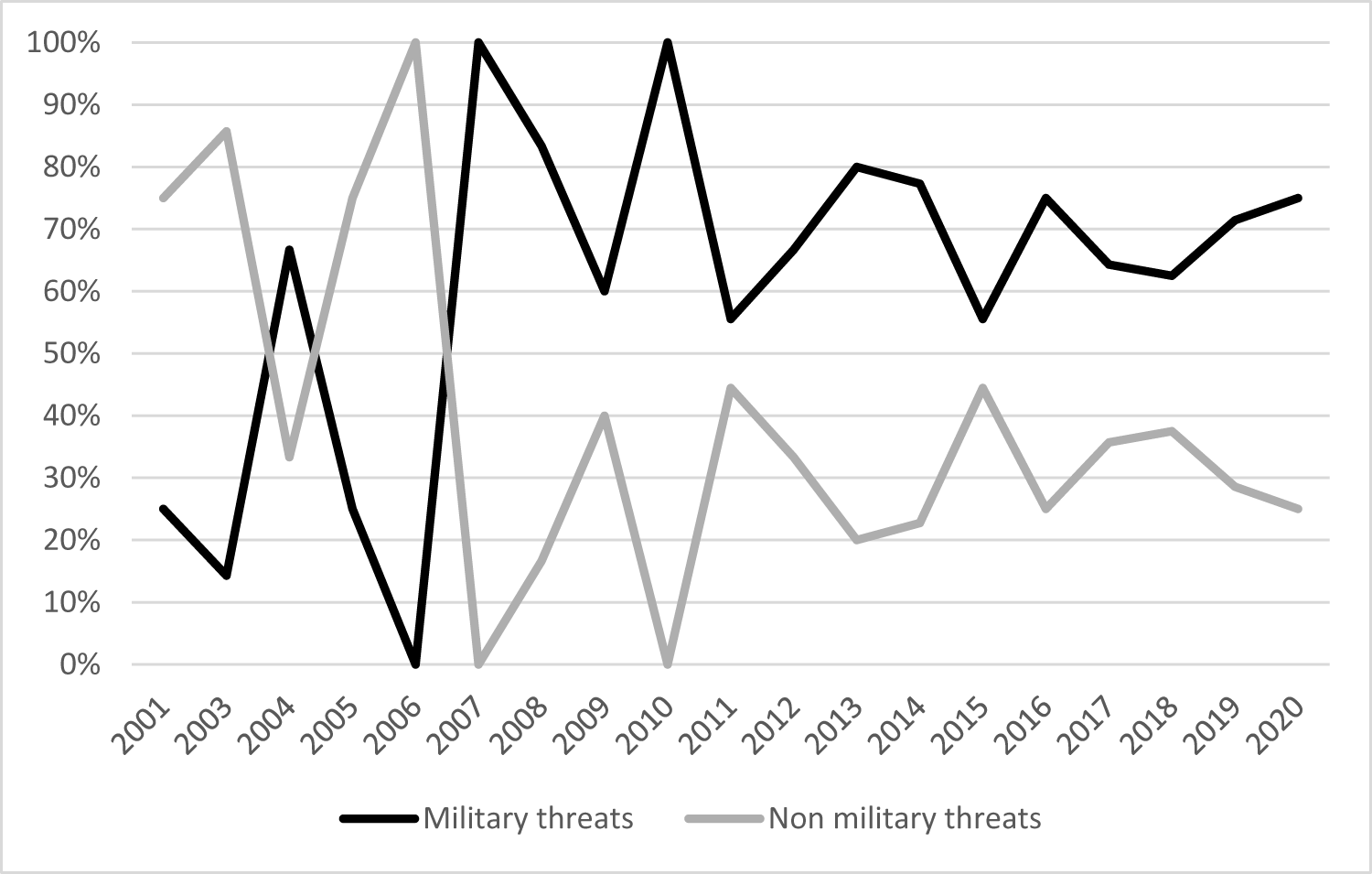
Regarding threats, while both military and non-military threats continue to be mentioned in P5 speeches, we observe that references to military threats have outnumbered references to non-military threats in every year after 2006 (see Figure 1).
Share of military vs. non-military threats mentioned in P5 UNSC speeches.

This pattern is also reflected in the qualitative analysis.Footnote 50 Generally, all P5 acknowledge both military and non-military threats.Footnote 51For instance, Russia and the United States refer to health security,Footnote 52 China to poverty and underdevelopment,Footnote 53 and the UK and France to drug and human trafficking.Footnote 54 However, we observe an evolution over time. A human-centric approach was initially prevalent. This is most vividly exemplified in the health sector, which became securitised with the HIV/AIDS crisis in the 1990s.Footnote 55 Many countries linked the epidemic to international peace and security. The UK, for instance, said that ‘if life expectancy is falling by a generation in a decade […] how can that not be a threat to the security of the State?’Footnote 56 China mentioned that ‘AIDS has […] become one of the most important non-traditional security issues’Footnote 57 and Russia stated that ‘HIV/AIDS is one of the most serious non-military threats to peace and security’.Footnote 58 However, towards the second decade of this millennium, Russia and China began to refer more frequently to military threats. This shift was particularly driven by Russia’s inclusion of external military intervention as a source of insecurity,Footnote 59 which is absent from the other P5 speeches as well as from earlier speeches by Russia.Footnote 60 Russia mentions for instance that ‘there is a dangerous tendency towards [the proliferation of internal armed conflicts] against the backdrop or as the result of the overthrow or destabilisation of legitimate governments through external interference’.Footnote 61 While less explicit, China similarly notes that ‘no […] interference [should] be permitted in the internal affairs or struggles’ of states.Footnote 62 Clearly shaped by the 2011 international intervention in Libya, which both countries heavily contested, this represents an important shift in threat perceptions, indicating a return to more state-centric conceptualisations.
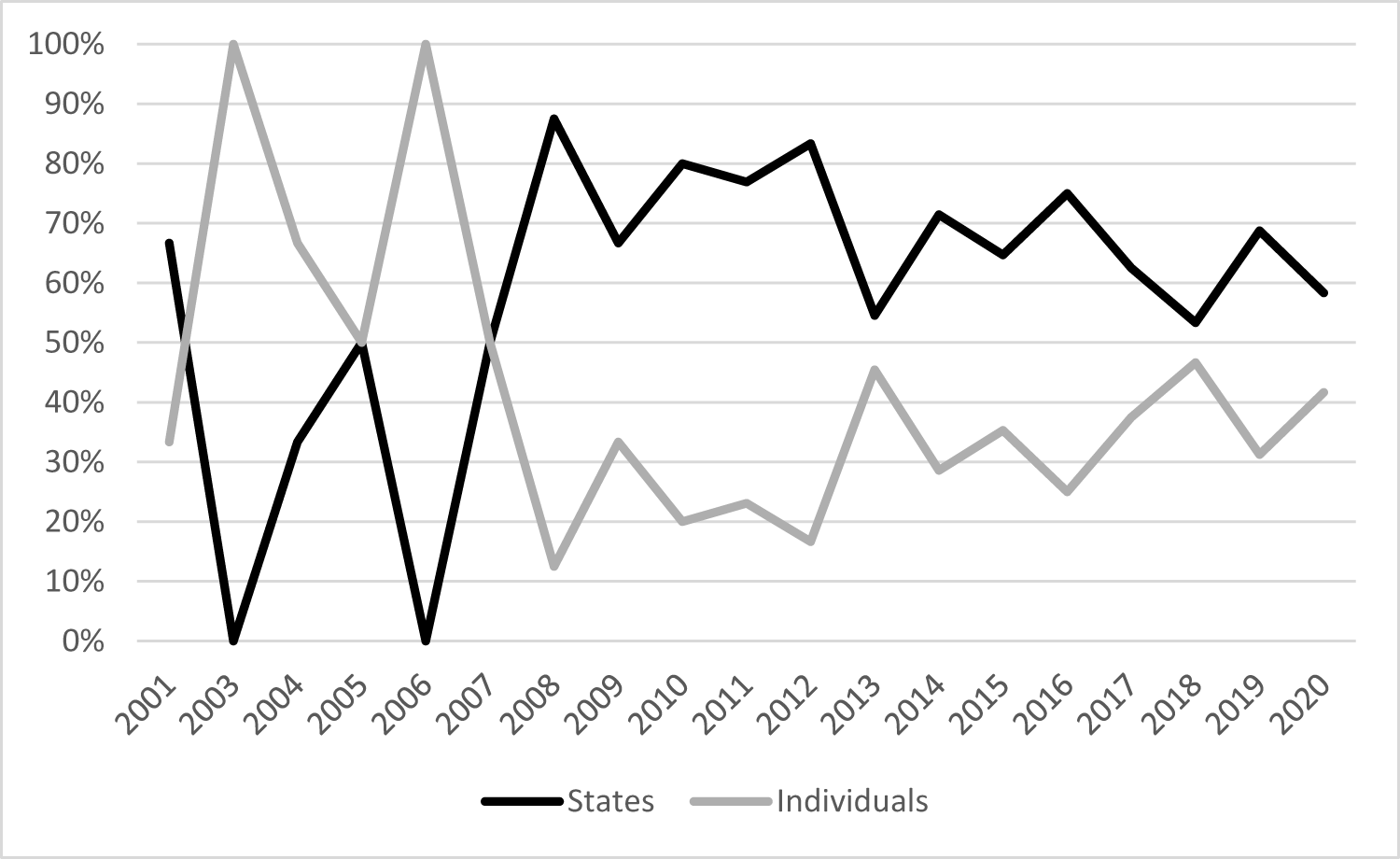
Regarding the referent object of security, references to individuals as in need of protection initially outnumbered references to states in most years (see Figure 2). This trend was reversed after 2006, reflecting a retreat of human-centric understandings and a return of state-centric conceptualisations.
Share of states vs. individuals being mentioned as referent object of security in P5 UNSC speeches.

This is also supported by the qualitative analysis. In the early years under study, states frequently underlined the importance of human rights promotion, the empowerment of individuals, and civil society promotion.Footnote 63 France for instance highlighted the importance of ‘protection of civil populations’,Footnote 64 China said that ‘only political stability, the progress of the population as a whole, sustained economic growth and peaceful development will make it possible to ensure genuine peace and stability’,Footnote 65 and Russia referred to the need of the ‘establishment of a society of political pluralism with strong State and social institutions’.Footnote 66 While in more recent years, the P5 continue to agree that not only states but also individuals need be protected and empowered,Footnote 67 there is growing contestation over whether individuals also need to be protected from threats emanating from their own state institutions.Footnote 68 The P3 frequently refer to situations in which individual insecurity stems from governments.Footnote 69 For instance, the UK notes that individual insecurity often arises from ‘corrupt or venal state institutions that curtail or abuse fundamental rights and freedoms’.Footnote 70 The United States notes that ‘it is no coincidence that some of the most dangerous regimes in the world are also some of the worst abusers of human rights’.Footnote 71 Finally, France argues that ‘corruption is a threat to the stability and security of societies’.Footnote 72 This view is contested by China and Russia.Footnote 73 As China mentions, ‘the international community has long tended to focus on human rights, the rule of law and security sector reform, perhaps without granting sufficient attention to economic and social development’.Footnote 74 Russia even argues that assigning the UN tasks in ‘human rights monitoring’ or ‘sexual and gender issues’ ‘may well prove to be an unreasonable waste of resources’Footnote 75 and expresses ‘serious concerns over the recently observed desire to loosely interpret the standards of international humanitarian law regarding the protection of civilians’.Footnote 76 Thus, while the P3 continue to emphasise human-centric understandings of the object of security, China and Russia increasingly question such conceptualisations.
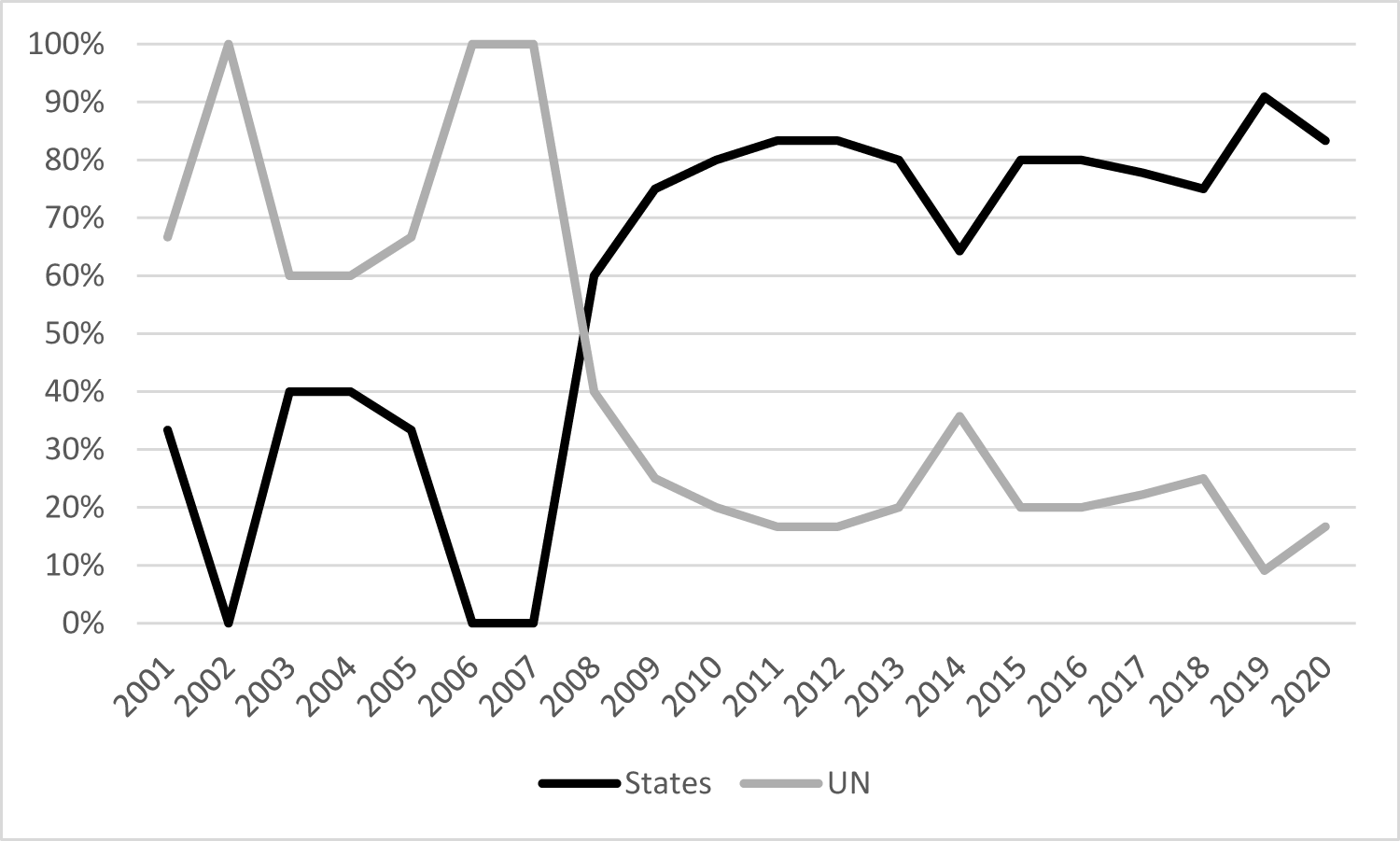
Finally, concerning the subject of security, while references to the UN as a provider of security outnumbered references to the state in every year prior to 2008, this pattern is subsequently reversed, with a higher share of references to the state’s responsibility and a relative decline in references to the UN’s role as a secondary provider of security (see Figure 3).
Share of states vs. the UN being mentioned as subject of security in P5 UNSC speeches.

The qualitative analysis confirms that the P5 initially acknowledged a substantial role for the UN in providing security, even if concurring on the primary responsibility of the host state.Footnote 77 China, for instance, mentioned that while the ‘country concerned bears the primary responsibility’ to provide for its security, ‘the international community has the important mission of assisting the countries concerned’;Footnote 78 France even called for strengthening ‘the international abilities of the United Nations to act during every stage of a crisis, from the threat of conflict through to reconstruction via peacekeeping and stabilization’;Footnote 79 and Russia – while being the most reluctant amongst the P5 – still accepted a secondary role for the UN, referring for instance to the need ‘to establish a clear balance between the responsibilities of governments and international partners’.Footnote 80 Yet, explicit calls for a secondary role of the UN declined over the years. These changes are primarily driven by Russia and China, which increasingly restrict the UN’s role in their speeches. Russia argues that ‘we should not forget that governments bear the main responsibility for ensuring the security of their people, including security against terrorist attacks’Footnote 81 and that they bear the ‘direct responsibility for the protection of their own population’.Footnote 82 Similarly, China states that the ‘national government […] has the primary responsibility to protect civilians’Footnote 83 and the UN’s role should be limited to ‘help[ing] countries in conflict to stabilize the security situation’.Footnote 84 The P3, in contrast, continue to underline that the UN has a secondary responsibility when host states are unwilling or unable to protect their citizens.Footnote 85 The United States, for instance, states that ‘the solution cannot be only to tell the UN to hunker down and wait for someone else to take care of the problem [but] to help civilians in need’.Footnote 86 The UK notes that ‘in the darkest moments of conflict, people all over the world look to the UN […] and we all have a responsibility to deliver’.Footnote 87 Thus, while China and Russia reassert state-centric understandings that restrict the UN’s role as a secondary subject of security, the P3 continue to emphasise a more human-centric understanding of the subject of security.Footnote 88
Table 2 summarises the different security conceptualisations over time. The P5 continue to agree on certain aspects, such as seeing threats in both military and non-military terms, the recognition of both states and individuals as object of security, and the state as the primary subject of security with a secondary role given to the UN. However, there is a relative decline of human-centric conceptualisations and an increase in state-centric conceptualisations driven by three trends: first, the conceptualisation of external interventions as security threat; second, the contestation of framing individuals threatened by their own governments as object of security; and third, the limitation of considering the UN as a secondary subject of security.
P5 security conceptualisations.

Table 2 Long description
Columns are Threats, Object, and Subject, with two rows labeled All P5 and Contested. In the All P5 row, Threats are military and non military threats, Object is state and individuals, and Subject is state and secondary role to international community, UN. In the Contested row, Threats are external interventions, Object is individuals threatened by own governments, and Subject is role of UN.
Changes in practice: UN peace operations
The analysis of UN peace operations, which captures security conceptualisations in practice, also confirms both hypotheses: a decline in human-centric conceptualisations and a gradual return of state-centric conceptualisations regarding all three dimensions of threats, object, and subject of security.
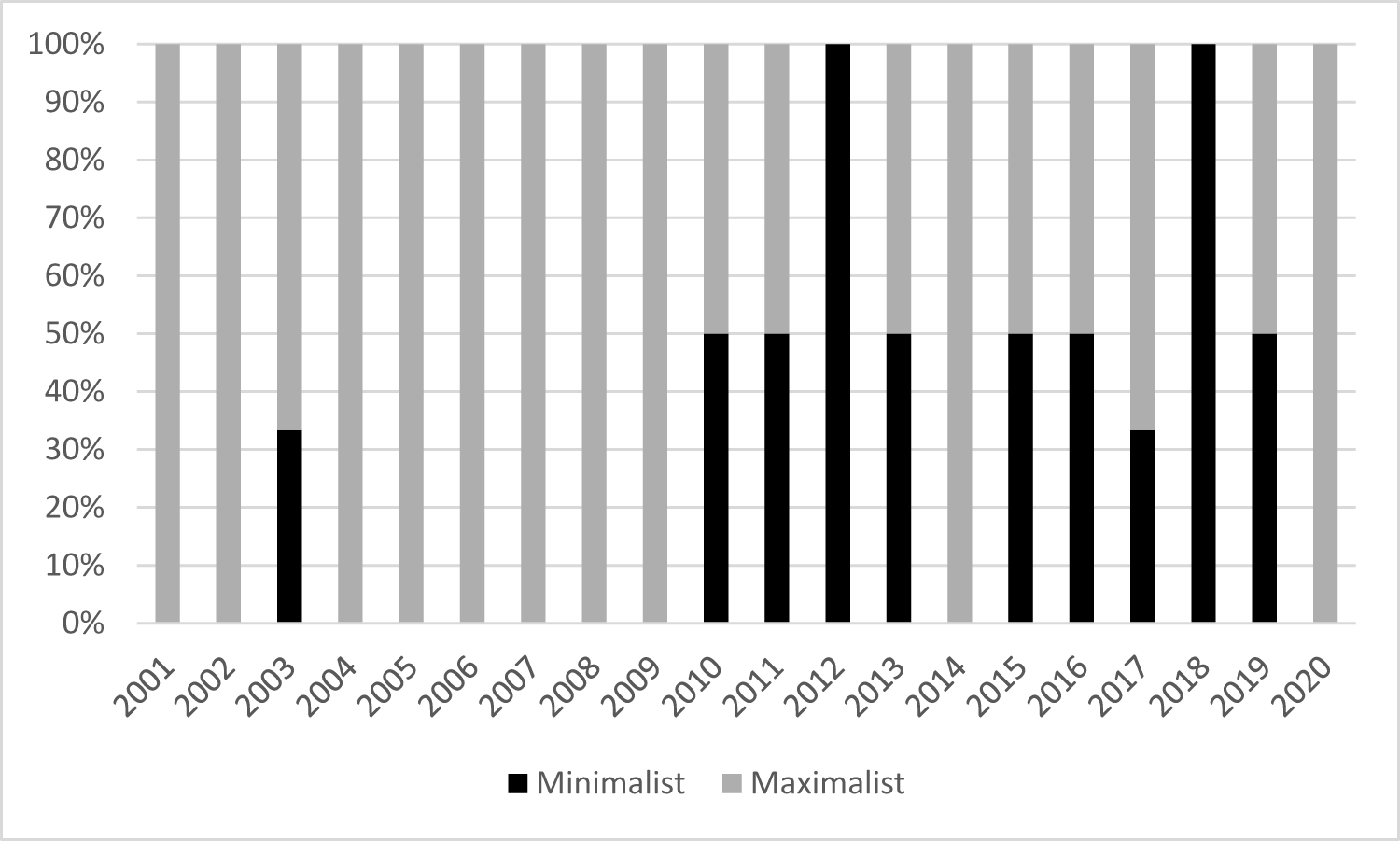
Looking first at peace operations overall, we observe a trend towards more minimalist missions since 2010. Figure 4 shows that the share of newly established maximalist missions has declined, while the share of minimalist missions has increased. This indicates that peace operations have moved away from extensive mandates, suggesting a shift towards more military-oriented threat conceptualisations, a stronger emphasis on the state as the primary object of security requiring stabilisation and protection, and a more state-centric understanding of the subject of security, reflected in the less extensive nature of mandates.
Share of minimalist and maximalist peace operation mandates.

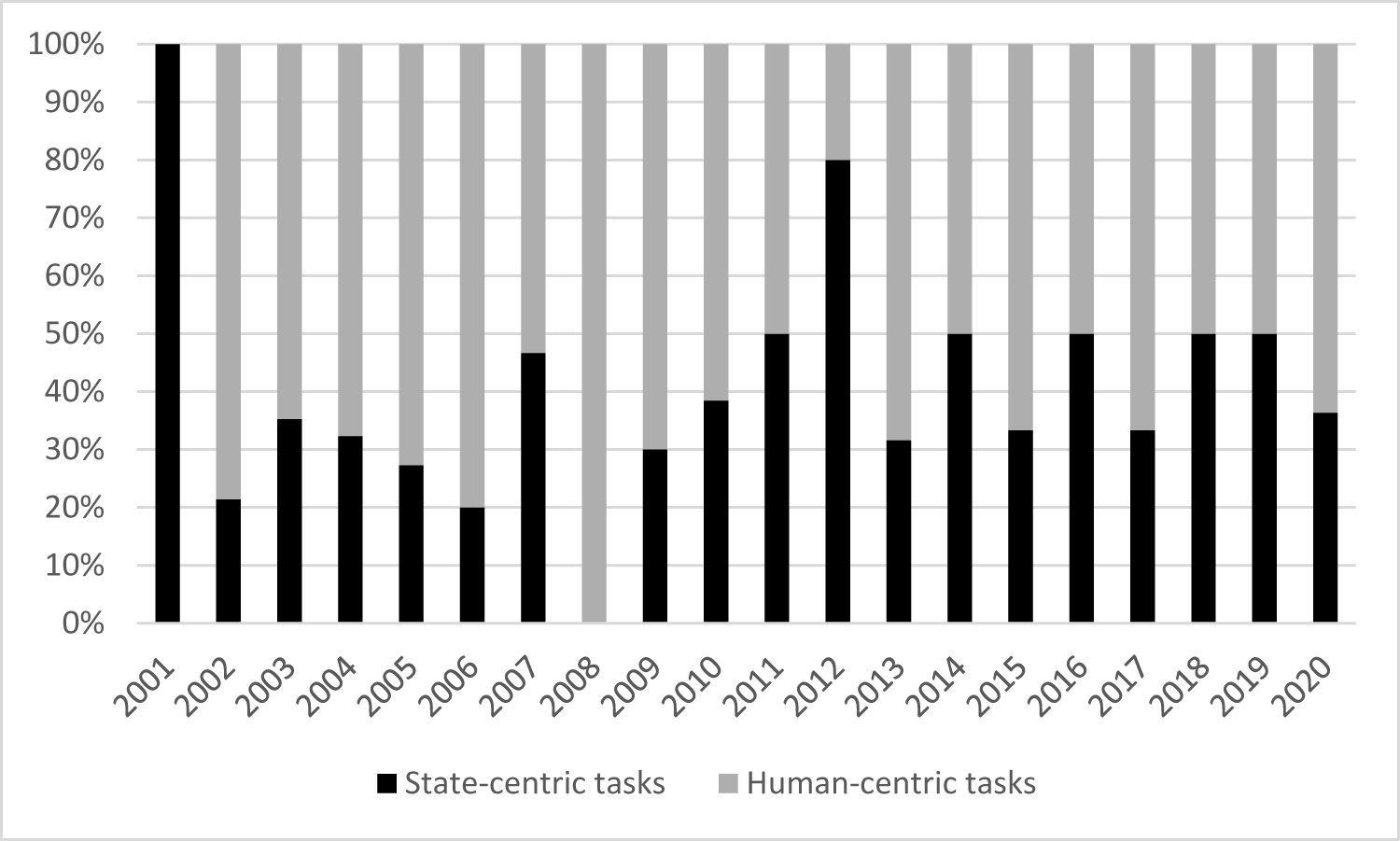
Analysing peace mission mandates more specifically, we selected tasks that reflect state-centric and human-centric conceptualisations and examined their evolution in terms of how frequently they were assigned in any given year in the period under study.Footnote 89 Figure 5 shows that while human-centric tasks constitute a majority of tasks in most years, the relative share of state-centric tasks has increased over time. This change is, however, not pronounced.
Share of state-centric vs. human-centric tasks in UN peace operation mandates.

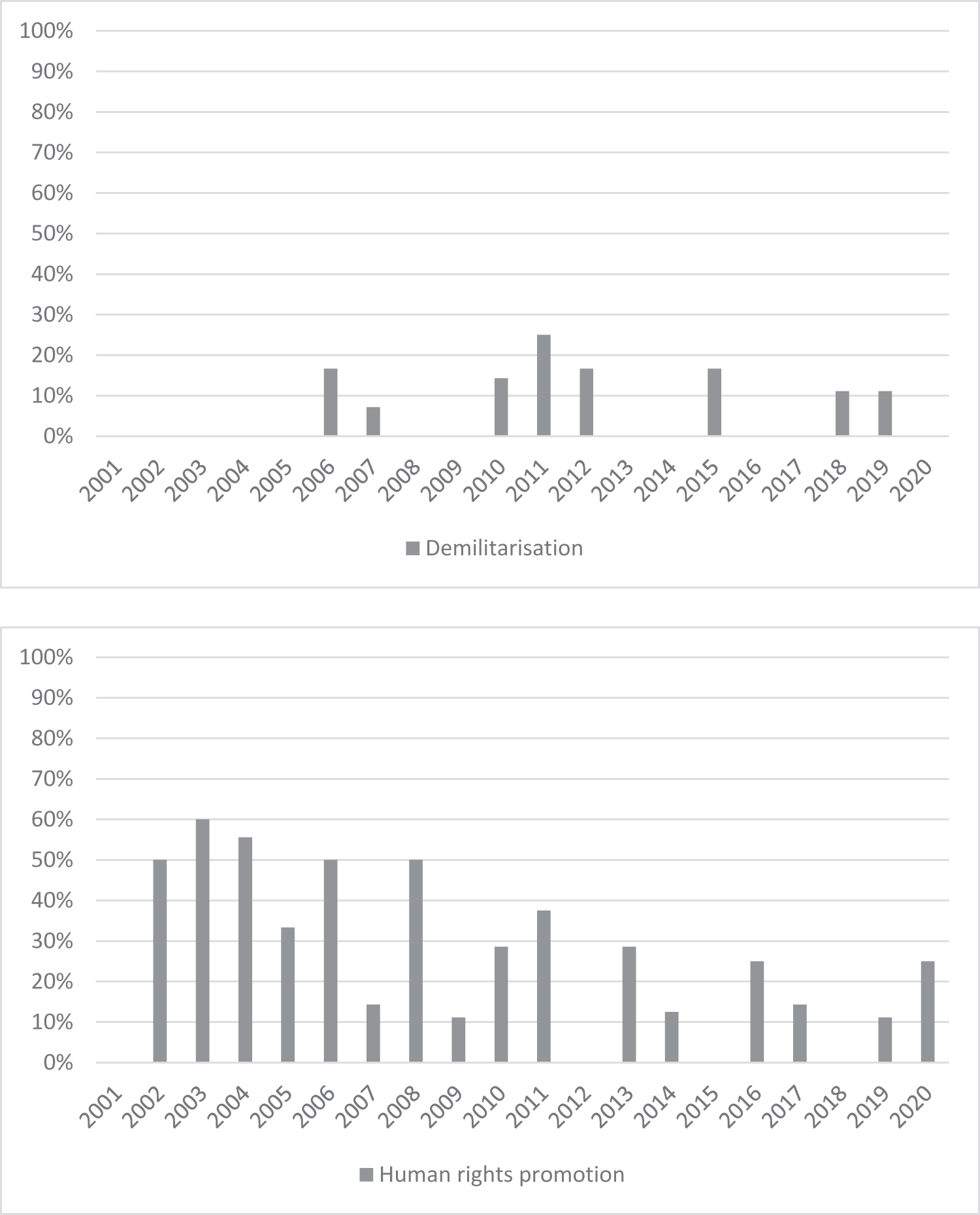
The shift becomes more visible when examining specific mandate tasks individually. For instance, Figure 6 shows demilitarisation as an example of state-centric security conceptualisations and human rights promotion as an illustration of human-centric security conceptualisations. We observe that while demilitarisation tasks have increased in peace operation mandates, human rights promotion tasks have decreased over time.
Share of demilitarisation and human rights promotion tasks in UN peace operation mandates.

Figure 6 Long description
A bar graph with the vertical axis labeled percent, ranging from 0 percent to 100 percent. The horizontal axis shows years from 2001 to 2020. A legend label reads, Demilitarisation. Bars appear at: 2006 about 17 percent; 2007 about 7 percent; 2010 about 14 percent; 2011 about 25 percent; 2012 about 17 percent; 2015 about 17 percent; 2018 about 11 percent; 2019 about 11 percent. The image B showing a bar graph with the vertical axis labeled percent, ranging from 0 percent to 100 percent. The horizontal axis shows years from 2001 to 2020. A legend label reads, Human rights promotion. Bars appear at: 2002 about 50 percent; 2003 about 60 percent; 2004 about 55 percent; 2005 about 33 percent; 2006 about 50 percent; 2007 about 14 percent; 2008 about 50 percent; 2009 about 11 percent; 2010 about 28 percent; 2011 about 37 percent; 2013 about 28 percent; 2014 about 12 percent; 2016 about 25 percent; 2017 about 14 percent; 2019 about 11 percent; 2020 about 25 percent.
Discussion
Our results show that, against the background of a declining LIO, we witness an increasing contestation of what constitutes international security, outlined by a relative decline of human-centric security conceptualisations and a relative increase in state-centric security conceptualisations. This pattern can be observed in both discourse and practice, although it is more pronounced in the former.
At the level of discourse, the P5 initially broadly converged on (or at least did not contest) human-centric conceptualisations of security. This understanding emphasised that threats stem from both military and non-military sources, that both states and individuals require protection, and that while the state is the primary subject of security, the international community assumes an important secondary role. More recently, differences have become more pronounced. While the P3 continue to promote human-centric views, Russia and China have explicitly re-emphasised state-centric elements of security, framing external interventions by other states as a key security threat, questioning the protection needs of individuals from their own governments, and limiting the role of the UN as a secondary subject of security. As a result, state-based security conceptualisations have regained prominence at the expense of human-centric ones. This does not imply a full-fledged return to state-centric security conceptualisations but rather underscores an increasing polarisation between state- and human-centric visions held by the P5.
At the level of practice, our analysis shows that security conceptualisations underlying UN peace operations are also shifting. We find that UN peace operation mandates reflect the relative rise of state-centric approaches to security. This is evident in a shift towards more minimalist missions and a relative increase in state-centric mandate tasks. At the same time, human-centric tasks continue to constitute the majority. This finding is not surprising given that continuation in UN peace operation mandates is more likely than change. Previous research suggests that international organisations are path-dependent,Footnote 90 that macro-level changes may not immediately translate into shifts in peacekeeping practices as missions tend to be ‘resilient’,Footnote 91 and that the P5 may reproduce existing mandates due to group-preserving tactics.Footnote 92 In this context, even modest shifts in mandate composition are analytically significant, as continuity is more likely than change.
Our findings support existing research indicating that peace operations have become more pragmatic and reflect the lowest common denominator among member states.Footnote 93 They are also consistent with scholarship on Russian and Chinese approaches to UN peace operations, which shows that both states tend to oppose liberal elements of peacekeeping, particularly the inclusion of human rights language in mandates.Footnote 94 More broadly, our analysis points to an important implication for the UN and the future of international peace and security: the key challenge may lie not in the overall shift towards state-centric security conceptualisations but rather in the increasing disagreement between major powers over core security principles.
Conclusion
This article examined how conceptualisations of international security have changed in the context of the decline of the LIO. By analysing both the discourses of major powers and the practice of international security through the UN, we identified an increasing contestation over international security, with the gradual return of state-centric definitions of security alongside a relative decline of human-centric approaches. In particular, we show that security conceptualisations among the P5 have become increasingly polarised.
The re-conceptualisation of what constitutes international security and how it is practiced carries wide-ranging implications for the global order, international security architectures, and collective security instruments. Unpacking evolving conceptualisation of international security is particularly important in periods of systemic transitions, such as the one currently underway. This article thus contributes to both academic debates and policy discussions. Academically, it makes two contributions. First, it advances international security studies, providing insights on the re-conceptualisation of international security. Second, it adds to peace and conflict studies by contributing to the discussion on the future of UN peace operations, particularly regarding potential shifts in their mandates. For policy audiences, the findings suggest that UN peace operations are likely to become more minimalist and narrowly defined in their mandates.
At the same time, the article has four main limitations that present opportunities for further research. First, our analysis is limited to the P5, which raises the question to what extent their security conceptualisations are representative of security definitions by other UN member states or those expressed outside the UN. It would therefore be interesting to look at conceptualisations by other states, especially regional powers. Future research could investigate security conceptualisations of elected members of the UNSC and how they relate to the P5 views, for instance by using broader datasets of UNSC speeches.Footnote 95 Second, the UNSC constitutes an arena where states are socialised to express themselves in a certain way. States may voice different security conceptualisations in domestic contexts or other multilateral forums. Further research could uncover how different social contexts shape security discourses.Footnote 96 Third, our analysis shows changes in UN peace operation mandates but did not systematically trace the extent to which they are linked to states’ security discourses. In-depth case-based research, for instance, could help disentangle the various mechanisms that link discourse and practice. Fourth, our analysis focuses on three decades until 2020. Further research can extend the timeframe to test and better understand the trends highlighted by our analysis.
Recent global developments suggest that the identified trends are likely to persist. The Russian full-scale invasion of Ukraine and the US–Israel war against Iran have brought inter-state wars back to the forefront of international politics. These developments have been accompanied by a broader shift, with many states – extending beyond Russia and China – adopting more state-centric security conceptualisations. Indeed, several countries are increasing their defence spending, and there is renewed emphasis on military threats, with the state as primary referent object and subject of security.Footnote 97 This trend reshapes international practices beyond UN peace operations. Development and peacebuilding programmes are likely to further prioritise state-led institutions and mechanisms, while bottom-up approaches and civil society-led initiatives face more restrictions and declining funding and interests. Taken together, these developments suggest that the trend towards more state-centric security conceptualisations in both discourse and practice is unlikely to be reversed in the near future.
Sara Hellmüller is a Research Professor at the International Relations / Political Science Department of the Geneva Graduate Institute. She specializes in UN peace and security engagements, mediation, peacekeeping, peacebuilding, knowledge production on peace, and Switzerland’s peace policy.
Fanny Badache is a Lecturer at the Department of Political Science and International Relations at the University of Geneva. She works on topics related to the staff of international bureaucracies and on UN peacekeeping.
Bilal Salaymeh is a Postdoctoral Researcher at the Geneva Graduate Institute’s Centre on Conflict, Development and Peacebuilding (CCDP). His research focuses on security and conflict dynamics, post-conflict engagements, statebuilding practices, and peace processes
Annex 1. Coding structure




 Open access

