1. Introduction
As medical care has advanced, the survival rate for stroke hemiplegic patients has improved significantly. The number of patients suffering from sequelae has also increased. In Japan, according to the 2017 Ministry of Health, Labour and Welfare report, 1.1 million patients suffered strokes, 60% of whom experienced after-effects[1]. In the entire world, according to the 2016 World Health Organization (WHO) report, 116 million patients suffered from the after-effects of strokes [2]. Due to this serious situation, several neurorehabilitation methods have been developed, especially therapy robots [Reference Maciejasz, Eschweiler, Gerlach-Hahn, Jansen-Troy and Leonhardt3,Reference Hussain, Eschweiler, Jamwal, Vn Vliet and Ghayesh4]. For wrist rehabilitation, several types of rehabilitation robots have been developed: a wearable orthosis with a pneumatic actuator [Reference Sasaki, Noritsugu and Takaiwa5], a manipulandum system equipped with an electromyography-driven motor [Reference Hu, Tong, Song, Zheng, Lui, Leung, Ng and Au-Yeung6], a wearable orthosis with a magnetorheological fluid brake [Reference Loureiro, Belda-Lois, Lima, Pons, Sanchez-Lacuesta and Harwin7], and a stationary rehabilitation system that consists of a desk and a DC servomotor [Reference Song, Tong, Hu and Zheng8], but almost all are still in a research stage. In addition, to use a robot for rehabilitation, it is important to investigate how to evaluate the effect of a robot rehabilitation and what kind of rehabilitation task can be conducted by a robot. For instance, Rose et al. suggested the design guidelines for developing the exoskeleton mechanism robots [Reference Rose, Pezent, Kann, Deshpande and O’Malley9]. Khor et al. investigated whether the end effector-type robots could be applied to the various rehabilitation tasks [Reference Khor, Chin, Yeong, Su, Narayanan, Rahman, Khan and Syst10]. Regarding the movement of rehabilitation, the robot that assists complex movements consisting of multiple joints motion [Reference Pehlivan, Sergi, Erwin, Yozbatiran, Francisco and O’Malley11] and the robot that assists only simple one-degree-of-freedom movements [Reference Martinez and Tavakoli12] have been developed and their effects have been verified. Regarding practical use, most of the devices used in homes and hospitals are exoskeleton mechanism devices. For instance, Motus Hand (Motus Nova, USA) is an Food and Drug Administration (FDA) Class 1 device which means that this medical device has a low to moderate risk to the patient and/or user [Reference Motus13]. The Motus Hand is designed to help stroke survivors recover at home; the user’s wrist is moved like a skilled physical therapist would move it with the hand. CyberGrasp (CyberGrasp systems, USA) is an exoskeleton hand robot and provides a full range of motion for the patients [14]. Furthermore, this device interacts with a virtual environment [Reference Adamovich, Fluet and Mathai15]. Neofect Smart Glove (Neofect, South Korea) is an exoskeleton mechanism hand robot for forearm, wrist, and digit motion [16]. According to this company’s review, this device has been used in 30 countries and 3023 hospitals, since the effectiveness of this rehabilitation device was proven in clinical trials [Reference Shin, Kim, Lee, Jeon, Kim and Lee17]. However, since robot therapies with such an exoskeleton mechanism robot forcibly move the patient’s paralyzed limb, dealing with the symptoms of spasticity and rigidity is difficult. Moreover, since the above rehabilitation robots have many parts, such as actuators, a control system, and many skeleton components, the structure of the device becomes complicated, the size may become large, and its cost becomes much higher in order to realize complex movements driven by motors.
Thus, instead of the above robots, we are investigating new neurorehabilitation robots using the kinesthetic illusion (KI). KI is an illusory phenomenon that causes a person to perceive such proprioception as a joint motion without an articulate movement when a vibrating stimulus is given to the tendon and the muscle through the skin. Since this illusion is created by a simple actuator, such as a voice coil motor, a rehabilitation robot with KI is much simpler and smaller than a robot with an exoskeleton mechanism. The procedure that induces KI has already clarified that a muscle spindle, which is a receptor that detects muscle extension, causes KI. Many researchers have applied KI to medical applications. For instance, KI allows patients to maintain the motor function of their arms in a cast after surgery [Reference Naito, Ehrsson, Geyer, Zilles and Roland18,Reference Imai, Hayashida, Nakano and Morioka19]. KI also reduces postoperative pain for fractures [Reference Imai, Osamu and Morioka20], helps cognitive activity during daily exercise [Reference Honda and Kiguchi21], and provides patients with a proprioceptive sensation as the afferent feedback of a prosthetic hand [Reference Marasco, Hebert, Sensinger, Shell, Schofield, Thumser, Nataraj, Beckler, Dawson, Blustein, Gill, Mensh, Granja-Vazquez, Newcomb, Carey and Orzell22]. Thus, the fact that KI promotes brain plasticity explains why it is expected to become a neurorehabilitation method. Since the above system using KI can be achieved by a vibration motor, it is possible to realize a small and inexpensive therapy system for home use.
Aside from medical applications, research has also been conducted on the stimulation condition that enhances KI’s intensity. The first researchers who investigated the stimulus conditions for precisely inducing KI were Roll et al. [Reference Roll and Vedel23]. Since proprioception is associated with afferent signals from the muscle spindle, they measured the afferent signal pulse from the primary nerve endings of the muscle spindle in the tibialis anterior and extensor digitorum longus muscles with microneurography, while a vibration stimulus was given to these muscles and tendons. They concluded that the frequency of the pulses from the primary nerve ending of the muscle spindle was controlled by external vibrations up to 60 Hz because there was a correlation between them. Next, they achieved complicated proprioception that involved writing or drawing motions by simultaneously controlling the KI of multiple joints [Reference Albert, Bergenheim, Ribot-Ciscar and Roll24–Reference Thyrion and Roll26].
However, the above research did not consider the mechanical structure of the muscle and tendon, both of which affect vibration phenomena. From the viewpoint of vibration engineering, tendon and muscle have their own natural frequencies. If they were vibrated in their natural frequencies, they would vibrate harder, inducing a stronger illusion because the frequency of the muscle spindle firing depends on the magnitude of the muscle’s expansion and contraction. In fact, Honda’s research revealed that KI is strengthened as the amplitude of the sinusoidal vibration stimulation increases [Reference Honda, Karakawa, Akahori, Miyaoka and Ohka27,Reference Kato, Akahori, Yoshida, Honda and Ohka28]. In 2019, we investigated the above relation between the natural frequency of the tendon and the optimal vibration frequency of KI and confirmed a correlation tendency between them (r = 0.498) [Reference Komura, Ikeda, Honda and Ohka29]. However, since this research was only conducted in a laxity state of muscle and tendon, further investigation in a tonus state must be conducted and applied to rehabilitation.
In this paper, we clarified what determines the stimulus condition of KI and established a design theory of a KI rehabilitation robot. We investigated whether the stimulus condition for inducing KI is associated with muscle and tendon tonus. We conducted two experiments: a modal test for measuring the tendon’s natural frequency and a psychophysical experiment for clarifying the optimal condition to induce the strongest KI. Through these experiments, we clarified whether the muscle and tendon tonus affect KI intensity. In the last section, we propose a new wearable rehabilitation robot concept using KI based on this experiment’s results.
1.1. Method
Our goal is to achieve a rehabilitation system that is compact, safe, and inexpensive by exploiting the KI phenomenon. To do so, the parameters must be elucidated that maximize KI. To clarify each participant’s optimal stimulus condition to induce KI, we focused on the mechanical specifications of each participant’s tendons. Our hypothesis argues that a significant relationship exists between a tendon’s natural frequency and the vibrating frequency condition to induce a strong KI. Thus, we measured them in two different tendon tension conditions using weight and confirmed whether the variation of the natural frequency affects the optimal KI frequency. To perform experiments for the above purpose, we chose the flexor carpi radialis (FCR) muscle tendon, which is responsible for wrist flexion as the stimulus part. If KI is induced in the FCR muscle tendon, a sensation occurs that moves the wrist in the extended direction.
1.2. Experimental method
1.2.1. Modal test
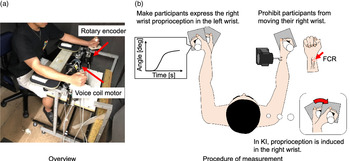
Our laboratory developed a modal test system for tendons. The modal test device consists of an impulse hammer (Model 5800SL, Dytran Instruments Inc., USA) with a force sensor attached to its tip and an acceleration sensor (NP-2110, ONO SOKKI Co., Ltd., Japan). The impulse hammer is adjusted to strike over the FCR muscle tendon and the acceleration sensor is placed on the same tendon 20 mm away from the impulse point (Fig. 1(b)). This impulse hammer is hoisted by a spring to prevent striking the tendon twice. The measured signals of the impulse hammer and the acceleration sensor are sent to an FFT analyzer (WCAmini AD-3661, A&D Company, Ltd., Japan) and scrutinized by software on a personal computer (WCAPRO, A&D Company, Japan).
Apparatus of modal test: (a) Overview shows that it can be conducted in KI experimental posture; (b) acceleration sensor is attached to FCR muscle tendon 20 mm away from impulse point

An overview of this apparatus is shown in Fig. 1(a). Since the modal test and the psychophysical experiment were conducted alternately and continuously, the modal test apparatus must be arranged by the side of the KI device so that the participants can do both experiments in the same posture. Fixing the impulse hammer at a 45
 $^\circ$
angle allows it to hit the participant’s FCR muscle tendon. Since the tendon’s position is different across the participants, we adjusted the stimulus posture and point using a gonio stage (SIGMA KOKI, Japan) and a gas-pressure elevated desk. This apparatus is placed outside on the right hand of the experimental participant sitting in the KI device (Fig. 1(a)).
1.2.2. KI experiment
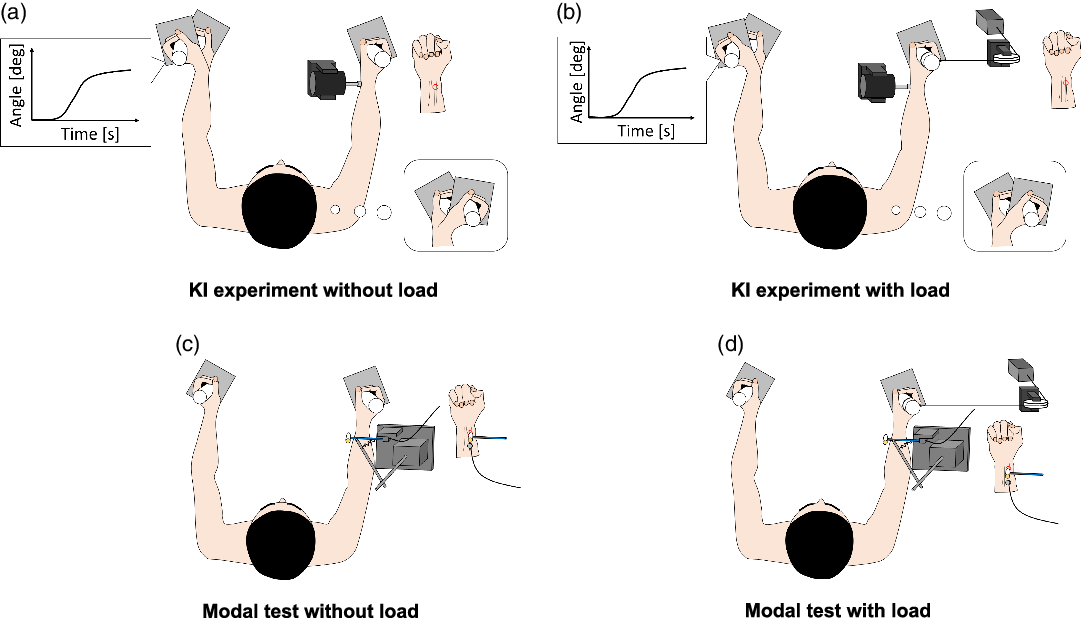
We modified the KI experimental apparatus from Honda’s version [Reference Honda, Karakawa, Akahori, Miyaoka and Ohka27] to a new version (Fig. 2) that can conduct KI experiments with and without load conditions. Participants sat with their left and right arms on armrests to receive the vibration stimulus in a relaxed posture. The KI experimental apparatus consists of two parts: inducing and measuring the KI parts. First, we describe the former part. A compact voice coil motor (511-A, EMIC Corp., Japan) is used as a vibrator. The signal input to the vibrator is generated by a function generator (WF1973, NF Corp., Japan) and boosted by a power amplifier (371-A, EMIC Corp., Japan). The vibrator’s tip is equipped with a disk-shaped, stainless steel contactor (
 $\phi$
10 mm) that is pressed against the skin. A precision stage (SIGMA KOKI, Japan), which adjusts the stimulus position in three axes, is the base of the vibrator. The contact force against the skin is measured with a force sensor (LSM-500G-B, MinebeaMitsumi Inc., Japan) attached to the tip of the contactor and strengthened by a power amplifier (DAS-406C, MinebeaMitsumi Inc., Japan). Next, we describe the latter part, which measures KI. When KI is induced, the participants perceived the proprioception in their right wrists without an actual joint motion. To measure their proprioception, we made the participants express their right wrists proprioception in their left wrists symmetrically. A rotary encoder (HEDS-5540, Maxon Motor, Switzerland), placed at the joint part of the left wrist, measured the left wrist’s expression as a dynamic variation of KI. The rotary encoder’s signal is sent to the FFT analyzer through a D/A converter.
Apparatus for KI experiment: (a) Overview shows participants’ postures and apparatus arrangement; (b) different roles of left and right wrists are described. In right wrist, KI is induced with voice coil motor; in left wrist, KI intensity is measured by making participants express right wrist proprioception caused by KI

2. Experimental Condition
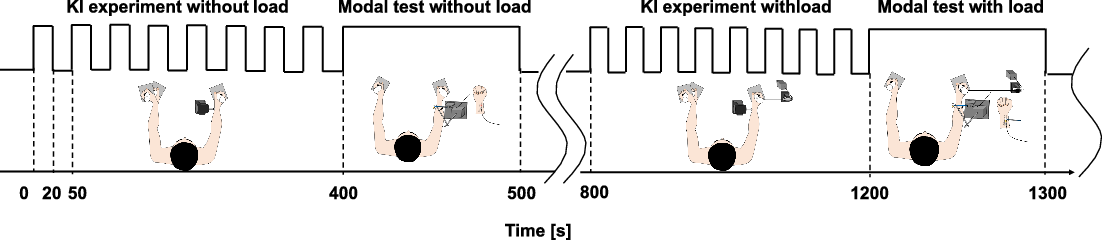
We prepared two conditions to manipulate the tonus of the tendon and the muscle with no load and with a load in which 600-g weight pulls the right wrist in the extended direction. In the loaded condition, the participants maintained a straight wrist joint (Fig. 3). At that time, the load seems to variate the tendon’s tension. If the optimum condition of the KI occurrence were associated with the tonus of the tendon and the muscle, a different stimulus frequency would be revealed between the two conditions. For the experimental process shown in Fig. 4, first, we performed KI experiments in the unloaded condition and measured the tendon’s natural frequency. After giving the participants about a 5-min break, we performed a KI experiment and a modal test under a loaded condition. Each participant did these experiments five times. Next, we describe the condition of the KI experiment, in which we chose a sinusoidal wave as the vibration stimulus. We prepared the following eight stimulus frequency conditions: 40, 50, 60, 70, 80, 90, 100, and 110 Hz. The maximum acceleration of the stimulus was 100
 $\rm m/s^2$
, and the contact force against the skin was set at 0.3 N. This experiment was carried out on a 50-s single trial that consisted of 20 s of stimulus and 30 s of rest. After a 30-s break, a vibrating stimulus was again presented for 20 s. Eight vibration stimuli were randomly given to the participants in this task.
Four kinds of basic experimental tasks

Task design: four kinds of tasks were conducted in this order. One set consists of four tasks and five sets were performed in each participant

2.1. Participants
Twelve healthy male Japanese college students (26
 $\pm$
3 years) were participated in this psychophysical experiment since previous important KI studies were conducted with around 12 participants. [Reference Roll and Vedel23,Reference Thyrion and Roll26,Reference Thyrion and Roll30] All the tests were approved by the Ethics Committee of Nagoya University.
3. Experimental Result
3.1. Modal test
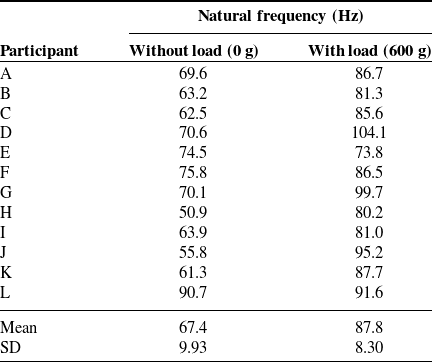
The results of the modal tests are described in Table I. The natural frequency of the 0-g weight condition (M = 67.4 Hz, SD = 9.93 Hz) is much less than that of the 600-g weight condition (M = 87.8 Hz, SD = 8.30 Hz). We found a significant difference between both conditions: t (11) = –5.68, p < 0.001.
Natural frequency of each participant’s FCR muscle tendon in loaded and unloaded conditions

3.2. KI experiment
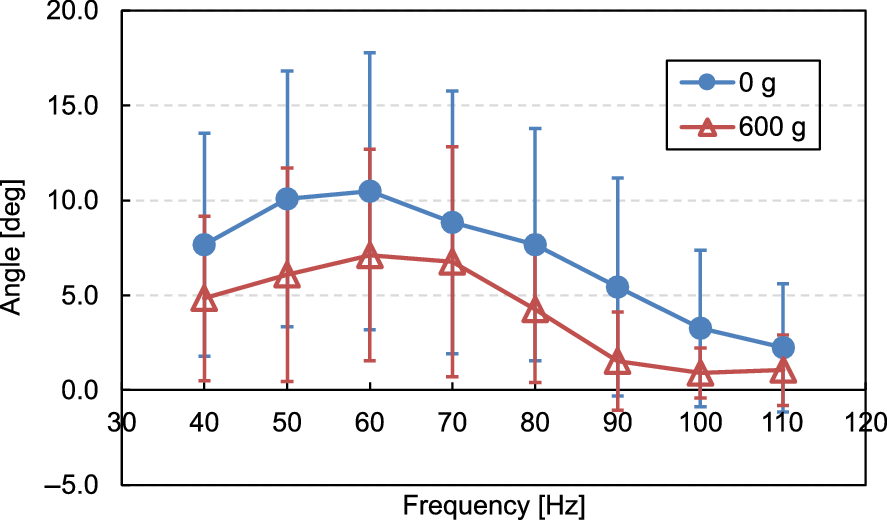
Since participant B could not perceive KI, his data were removed. The optimal frequency of the 0-g weight condition (M = 58.5 Hz, SD = 7.34 Hz) is less than that of the 600-g weight condition (M = 61.8 Hz, SD = 6.53 Hz). However, there is no significant difference between both conditions: t (10) = –1.92, p = 0.08. The KI intensity in all the frequency and load conditions is described in Fig. 5. Comparing the KI intensity under both conditions, the shapes of both graphs share very similar profiles. Regarding the illusionary intensity, a load effect appears and the KI intensity with a load is 3 degrees less than that with no load across the frequency conditions. In both graphs, the illusionary intensity peaks are around 60 Hz of the vibration stimulus, suggesting that the load does not affect the optimal condition for KI, but only the illusion’s intensity. Next, we confirmed whether the stimulus condition of 60 Hz is optimal.
Relationship between frequency of vibrational stimulus and KI intensity in loaded and unloaded conditions

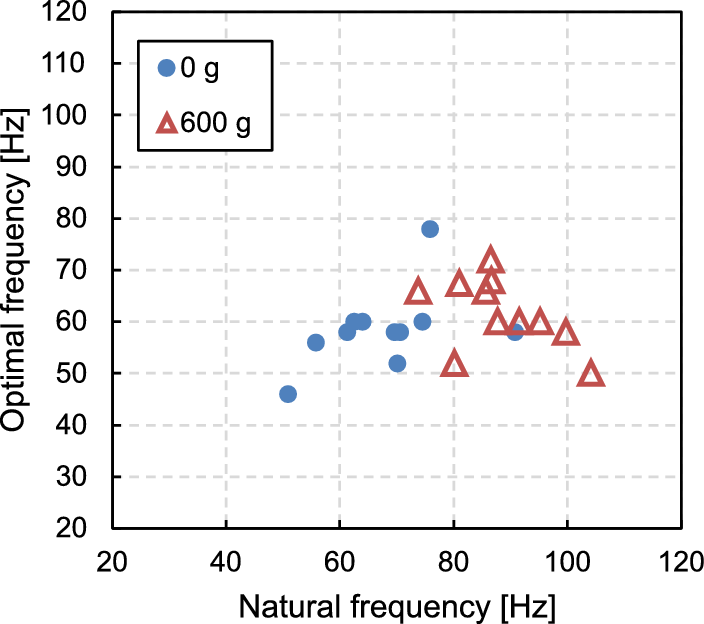
Each participant’s optimal and natural frequencies with or without a load are plotted in Fig. 6. We calculated the Pearson correlation coefficients using the optimal frequency and natural frequency data from Fig. 6 and clarified a positive correlation between the values (r = 0.443, n = 11, p = 0.172) in the unloaded condition. This result agrees with our previous experimental result (r = 0.498) [Reference Komura, Ikeda, Honda and Ohka29]. On the other hand, in the loaded condition, there is a negative correlation (r = $-$0.512, n = 11, p = 0.107), suggesting that the optimal frequency condition is affected by the load.
Relationship between optimal condition for inducing KI and natural frequency of FCR muscle tendon

In psychophysics and psychophysiology,
 $|r| = 0.443$
and
 $0.512$
seems to be treated as a considerable value because variation in human subjects’ mind is observed in these fields. This is different from the engineering field, which usually obtains high correlation
 $r > 0.8-0.9$
. According to the previous studies [Reference Komura, Ikeda, Honda and Ohka29], a correlation coefficient whose magnitudes are between 0.5 and 0.7 is considered moderately correlated, and a correlation coefficient whose magnitudes are between 0.3 and 0.5 is considered a low correlation [Reference Mukaka31]. Therefore, we make
 $|r| \geq 0.3$
a criterion, which treats a target result as considerable phenomenon in the following discussion.
4. Discussion
4.1. Mechanical characteristics for laxity and tonus states
As mentioned in the previous section, when the tendon and muscle are in a laxity state, a positive correlation is confirmed between the natural frequency of the tendon and the optimum frequency for KI. On the other hand, we confirmed a negative correlation between them when the tendon and muscle are in a tonus state. In this section, we address why the opposite relationship is obtained between the laxity and tonus states. KI intensity depends on the firing rate of the muscle spindle, which is associated with the muscle expansion and contraction states for varying the mechanical characteristics of the tendon and muscle. Therefore, we must analyze both states based on simple mechanical models derived from the viewpoint of the essential mechanical vibration by assuming a series connection of a tendon and a muscle. To derive the mechanical models, first we consider Young’s modulus variation caused by muscle expansion and contraction. Young’s modulus of the FCR muscle tendon is about 500 MPa [Reference Loren and Lieber32]. One muscle in a laxity state becomes very low (since no data exist about the FCR muscle, we assume around 0.1 MPa from Young’s modulus of biceps brachii measured in vitro [Reference Yamada and Evan33] and increases with the amount of muscle contraction. Thus, in a laxity state, the muscle is 5000 times softer than the tendon and reduces its natural frequency to a negligible small value. Second, the length of the FCR muscle and tendon is almost the same; the muscle length is 192.8
 $\pm$
4.8 mm, and the tendon length is 230.3
 $\pm$
5.6 mm [Reference Loren and Lieber32]. Thus, the difference in the length between the tendon and the muscle hardly affects their natural frequency differences. Taking the above discussion into account, we intend to qualitatively explain the reason of the difference between laxity and tonus status using Formulas (1) and (2), which are dominant equations expressing for laxity and tonus states. Formula (1) shows the natural frequency of the string vibration emulating the tendon vibration and Formula (2) shows one longitudinal vibration that emulates the muscle vibration. Since the external vibration laterally oscillates the tendon like a cord, the tendon’s vibration mode resembles a string vibration. On the other hand, the muscle’s vibration mode seems to be a longitudinal vibration mode since the muscle is vibrated with stretches and contracts:
 \begin{eqnarray}f_{0} = \frac{n}{2l_{0}} \sqrt{\frac{T_{0}}{\rho_{0}}} \; \; \; (n=1, 2, 3,\cdots)\end{eqnarray}
 \begin{eqnarray}f_{1} = \frac{2n-1}{4l_{1}} \sqrt{\frac{E_{1}}{\rho_{1}}} \; \; \; (n=1, 2, 3,\cdots)\end{eqnarray}
where
 $f_{0}$
,
 $T_{0}$
,
 $l_{0}$
, and
 $\rho_{0}$
are natural frequency, tension, length, and linear density of tendons, respectively, and
 $f_{1}$
,
 $E_{1}$
,
 $l_{1}$
, and
 $\rho_{1}$
are natural frequency, Young’s modulus, length, and density of muscles, respectively.
4.2. Reason for difference between laxity and tonus states
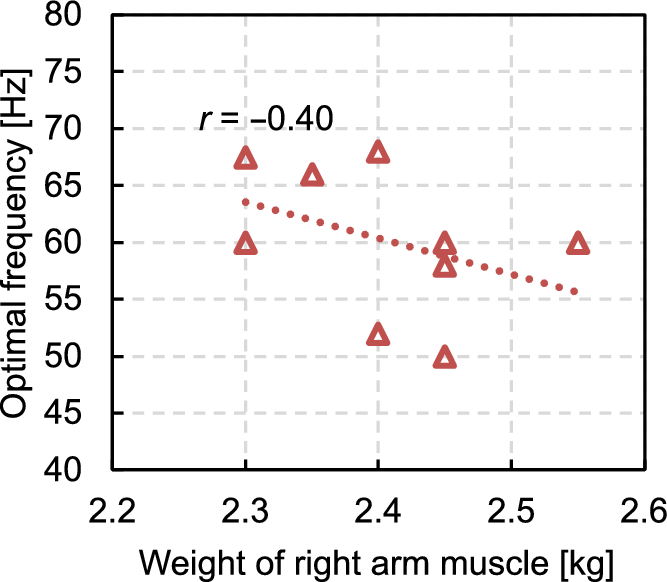
When a muscle is in a laxity state, the system is dominated by the tendon’s vibration mode because its stiffness is around 5000 times higher than that of the muscle. Thus, the tendon’s natural frequency mainly determines the KI occurrence in a laxity state to obtain a positive correlation with the tendon’s natural frequency, as expressed by the model for the laxity state. On the other hand, in the tonus state, since the participants’ tendons are given tension with a force generated with a weight of 600 g, the order of the natural frequencies of the tendon and muscle become similar. In this case, the muscle’s natural frequency seems more dominant than that of the tendon because the muscle spindle embedded in the muscle accepts the vibration. Thus, to the tonus state, we apply Formula (2), the increase of Young’s modulus of the muscle makes the natural frequency of muscle increase. From the above discussion, the mechanical properties of muscles may become important factors for KI induction. Thus, we measured the muscle mass of the right arm of nine participants with a body composition meter (MC-190, TANITA Corp., Japan) to estimate the linear density of the muscle and examined the relationship with the optimum frequency of KI and the right arm muscle’s weight. In the tonus state, the optimum frequency decreases as the muscle mass increases (r = –0.40), as shown in Fig. 7. Based on the above discussion, we address the negative correlation between the natural frequency of the tendon and the optimal frequency for KI in the tonus. The tendon’s natural frequency increases with an increase in the muscle mass because the tendon tension strength increases due to the FCR muscle contraction. This tension strength of the tendon depends on the muscle mass because of the isometric contraction. Since the muscle’s linear density is related to the muscle mass, its natural frequency decreases as the muscle mass increases (Formula (2)). Consequently, the higher the muscle mass and the natural frequency of the tendon, the lower the natural frequency of the muscle should be. Therefore, a negative correlation is seen between the natural frequency of the tendon and the optimal frequency for KI in the tonus (Fig. 6). This finding should be considered in designs for a new therapy robot concept, which will be discussed in the next section.
Relationship between muscle mass of right hand and optimal frequency for KI in a tonus state

4.3. How to apply KI to rehabilitation robots
KI is expected to become a rehabilitation method for stroke patients, as described in Section 1. Our research clarified that the vibration mechanics of tendon and muscle affects the induction of a strong KI because the optimum frequency depends on balancing the laxity and the tonus of tendon and muscle. Based on the above finding, we propose a concept for new rehabilitation robot with KI. Since the efficacy of KI for rehabilitation has been clarified [Reference Naito, Ehrsson, Geyer, Zilles and Roland18–Reference Imai, Osamu and Morioka20,Reference Kodama, Nakano, Ohsugi and Murata34], we focus on the estimation of the optimal stimulus condition and stimulation of the tendon and muscle system as the rehabilitation system. This conceptual system consists of miniature voice coil motors and acceleration sensors. These acceleration sensors detect the mechanical state of the muscle and tendon to vary the external vibration stimulus for maintaining a certain level of acceleration through the feedback of these sensors’ data. The vibration stimulus caused by the miniature voice coil motor is suppressed by the damping caused by the muscle and tendon tissues because of the small mass of the moving coils. Our conceptual system is controlled by a closed loop to control the vibration stimulus according to the stiffness of the tendon and muscle. Since our conceptual rehabilitation system is very compact, it is possible to combine with another conventional rehabilitation device such as an exoskeleton robot, which is very effective for rehabilitation. This is because when muscles and tendons become stiff, the KI may be able to assist the exoskeleton robot with the occurrence of movement feeling. In order to prove the conceptual system, we should develop an actual device and perform a series of experiments with patients.
5. Conclusion
We developed a new neurorehabilitation robot using the KI, which is a proprioceptive illusory phenomenon. Compared to a rehabilitation robot with an exoskeleton mechanism, our proposed robot is more suitable for rehabilitation because proprioception is only caused by a vibration stimulus. The positive effect of medical treatment with KI has also been proven, and these research findings reinforce our rehabilitation theory. However, an important problem remains: a method of determining a vibration stimulus (suitable for each person) has not been clarified yet. We hypothesized that this optimal frequency condition for inducing KI can be derived from the natural frequency of the tendon and conducted two types of experiments to clarify the relationship between the above factors. We chose the FCR muscle tendon, which is associated with wrist flexion, and conducted two experiments: a modal test to measure the natural frequency of the FCR muscle tendon and a psychophysical experiment to determine the optimal frequency for inducing KI. We did two experiments in the condition with and without the tension of the muscle and tendon to compare the variation of both frequency values. We identified a negative correlation between the optimal frequency for KI and the natural frequency of the tendon when it and the muscle are in tonus, although a positive correlation appeared when they are in laxity. This result suggests that the optimal frequency for KI should be changed based on the degree of the tendon and muscle tonus. Therefore, our present findings provide a suitable frequency of vibration that induces KI based on the degree of the tendon and muscle tonus. Therefore, our present findings provide a suitable frequency of vibration that induces KI based on the degree of the tendon and muscle tonus. If it becomes clear that this research result can be applied to stroke patients, it will be possible to realize the stimulus generation based on the patient’s tendon and muscle state, and a strong KI will be induced during robot therapy. To realize this, we will conduct another experiment for stroke patients in the future. In the abovementioned future works, a series of experiments performed with patients is required to prove the efficacy of the proposed device.
Acknowledgments
The authors thank the Toyoaki Scholarship Foundation for its support. Furthermore, we appreciate the support of JSPS Kakenhi Grant Numbers 17K20100 and 19K22869.