The Terminal Classic (dated to a.d. 750/800–1000/1050) was a period of irreversible changes in the Maya lowlands, characterized by depopulation, a halt in construction activity and the collapse of the majority of Maya centers governed by “holy lords” (k'uhul ajaw). Within the past several years, our knowledge of this turbulent period has increased significantly due to new studies carried out in different parts of the Maya lowlands. These studies showed that the Terminal Classic period is not only characterized by the collapse and fragmentation of the majority of Maya sites but also by the transformation and even expansion of other centers which were able to adjust to the new politico-economic conditions (Aimers Reference Aimers2007; Demarest Reference Demarest2004a:240–276; Demarest et al. Reference Demarest, Rice and Rice2004a). The present article adds new and important data to the corpus concerning the Terminal Classic period in the Southern Maya Lowlands and significantly enriches our understanding of this period. It also sheds light on the problem of the Classic Maya collapse. These discussions are based on the results of recent excavations at Nakum, which reached its peak during the Terminal Classic period. In this study we intend to combine the results of archaeological excavations from the core and peripheries of the site, the analysis of the architectural remains and archaeological materials discovered, as well as a broad comparative analysis including archaeological and epigraphic data from other sites in the region.
The archaeological and architectural data from Nakum are based on the results of excavations carried out during the past several years as part of the Triangulo Project of the Instituto de Antropología e Historia de Guatemala (IDAEH) and the recently-initiated Nakum Archaeological Project by the Jagiellonian University, Cracow, Poland.
NAKUM: HISTORY OF RESEARCH AND DESCRIPTION OF THE SITE
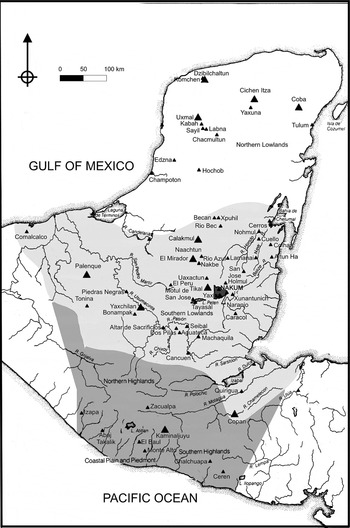
Nakum is situated in the northeastern part of the Department of Peten, Guatemala, 11 km north of Lake Yaxha and 25 km southeast of Tikal (Figure 1). The site is located on the banks of the Holmul River, at an elevation of approximately 200 m asl. The discovery of Nakum is attributed to the French count Maurice de Périgny in 1905, who published the first schematic plan of the site (Périgny Reference Périgny1908). Périgny returned to Nakum in 1910 (Périgny Reference Périgny1910, Reference Périgny1911a, Reference Périgny1911b). Further reconnaissance and limited investigations were carried out by Alfred Tozzer and Raymond Merwin (Tozzer Reference Tozzer1913), as well as by Sylvanus Morley (1937–1938:II:7–21; V:Part 1, Plates 13, 86; V:Part 2, Plate 194). Subsequently, Nakum was forgotten for many decades until the Guatemalan archaeologist Miguel Orrego and the Los Angeles businessman Ovid Kosovsky visited it in 1970 (Hellmuth Reference Hellmuth1975:270). Later, the American archaeologist Nicholas Hellmuth visited the ruins twice for a few days in 1971 and 1973 (Hellmuth Reference Hellmuth1975, Reference Hellmuth1978:93–95, Reference Hellmuth1992). In 1989, the IDAEH initiated efforts to salvage and protect buildings in the core area as part of the Tikal National Project. This was in response to an impending structural collapse brought about in large measure by extensive looting. Formal investigations were initiated in 1994 under the aegis of the Triangulo Project and continued with the consolidation of the most deteriorated monumental structures, the backfilling of looters trenches and extensive excavations (Hermes Reference Hermes2002; Hermes and Calderón Reference Hermes, Calderón, Laporte, Arroyo, Escobedo and Mejía2003; Noriega Reference Noriega, Laporte, Escobedo and de Suasnávar1999; Noriega and Hermes Reference Noriega, Hermes, Laporte, Escobedo and de Suasnávar2000; Noriega et al. Reference Noriega, González, Valiente, Laporte, Arroyo and Mejía2008; Noriega and Quintana Reference Noriega, Quintana, Laporte, Escobedo and Arroyo2002, Reference Noriega, Laporte, Arroyo, Escobedo and Mejía2003; Quintana and Wurster Reference Quintana and Wurster2002). Archaeological work at Nakum was initially supervised by Bernard Hermes and between 2002 and 2008 it has been directed by Zoila Calderón. In 2006 a new project (The Nakum Archaeological Project) was started at the site under the auspices of the Jagiellonian University in Cracow with permission from the IDAEH. This new project is directed by Jarosław Źrałka and Wiesław Koszkul.
Map of the Maya area with location of Nakum and the Triangulo Park area (adapted from Sharer Reference Sharer1994:Figure 1.1)

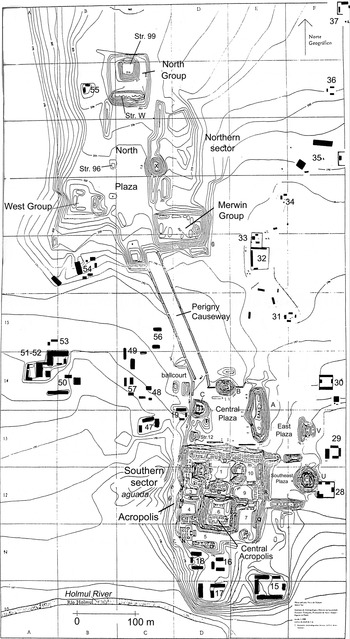
The core of Nakum is divided into two major sectors (North and South) (Figure 2). The Northern Sector is formed by the spacious North Plaza delimited by low platforms (which probably supported perishable constructions) as well as by several large complexes (North Group, Merwin or East Group, and West Group) and a single pyramid-temple structure (Structure X). The most impressive and monumental structures at Nakum are located in the Southern Sector which is connected with the Northern Sector by the raised Périgny Causeway, which is about 250 m long. Close to the southern end of the causeway are the Central and East Plazas; both delimited mainly by large temple-pyramids (Structures A, B, C, and V). Further to the south lies the enormous Acropolis complex and the Southeast Plaza which is delimited from the east by the huge Structure U, similar in form to the famous temple pyramids of Tikal.
Map of Nakum showing the site core and periphery with all patio groups (Numbers 15–19 and 28–58) (after Quintana and Wurster [Reference Quintana and Wurster2002], with corrections made by the authors).

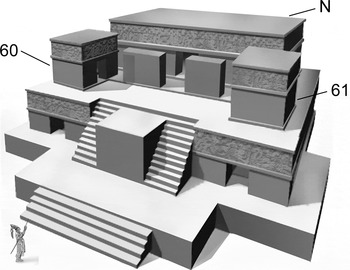
The Acropolis of Nakum consists of a large architectural platform topped by many structures—the majority of which are palace-like constructions—grouped around 12 courtyards or patio groups. Each interior courtyard of the Acropolis has delimiting structures that are unique in their proportions and sizes. Among the largest and the most important constructions of this complex is Structure D (a long palace-type building more than 100 m long), Structure E (a pyramid-like construction topped by residential buildings), Structure N/60/61 (a two-story building) and many others (see Figure 3). This architectural compound is highly compact and has restricted access. The highest point is at the heart of the Acropolis and is called the Interior (or Central) Acropolis. It consists of a massive platform of great height, topped by five structures. An artificial reservoir which fills with water during the rainy season lies to the immediate west of the Acropolis complex.
Map of the Nakum Acropolis, Proyecto Triángulo, Instituto de Antropología e Historia de Guatemala.

The above-described architectural compounds and buildings form a somewhat compact monumental core area. All structures and architectural groups located outside this central core define the site periphery (see Figure 2).
Although ceramic sherds of Pre-Mamom affiliation were found in the deep fill of some of the complexes and plazas in Nakum, the earliest evidence of construction activity dates to the end of the Middle Preclassic period (500/450–300 b.c.). The site saw significant development during the Late Preclassic period when all existing structures were rebuilt and new buildings were added. Many structures visible at Nakum today were constructed in the Late Classic period. However, one of the most interesting and intriguing facts in the occupational history of Nakum is its vigorous development during the Terminal Classic period when the site saw an enormous construction program at both its epicenter and periphery. We define the Terminal Classic period at Nakum ranging from roughly a.d. 800 to 900/950 (see discussion below). In the ensuing text we discuss the background of the methodology applied in dating constructions investigated during our research, with special emphasis on the chronological markers of the Nakum ceramic assemblage. Subsequently, the architectural growth of Terminal Classic Nakum is presented, beginning with the description of the Acropolis complex.
METHODOLOGICAL BACKGROUND
From the commencement of archaeological work at Nakum, it became clear that one of the most fascinating and important findings was the ubiquitous Terminal Classic ceramic material, present not only in the upper layers and middens but also in the construction fill of many excavated structures. In order to establish a clear sequence of the architectural phases of all the investigated constructions at Nakum, especially those located in the large Acropolis complex, a massive research program was carried out within the last 16 years. This included the tunneling and trenching of structures and platforms as well as an extended test-pitting program. The majority of excavated structures were consolidated after investigation. All the construction stages defined for individual structures were dated on the basis of the pottery present in the fill of the structure and/or its particular elements (e.g., stairway blocks, benches, balustrades). Whenever possible, structures were dated by the contents of primary deposits such as burials and offerings that could be stratigraphically linked either to the respective construction stages of the building, or to the entire structure. Within a group of nearly 40 burials that have been discovered at Nakum, more than 20 internments are dated to the Terminal Classic period based on their associated pottery vessels or archaeological context (Matute Reference Matute2005; Źrałka Reference Źrałka2008:92–102). Similarly, half of more than 30 offerings and caches that have been found so far date to the Terminal Classic period. Terminal Classic offerings consisted mostly of vessels and were mainly deposited both on and under floors, in construction cores and in chultuns. Among the vessels found in the offerings, the dominating types are utilitarian Cambio Unslipped and Tinaja Red types. It should also be mentioned that close to many Terminal Classic structures, thick middens dated to the same period were localized and related to the use of these constructions during this time span. Stratigraphic relations between floors of test-pitted plazas or courtyards and their neighboring constructions were also very important in establishing a chronological sequence.
In addition to utilizing the above-mentioned research methods, the dating of some excavated buildings to the Terminal Classic period was also confirmed by the presence of new architectural modes or elements, such as square pillars, tandem plan and circular plan constructions, and flat-roofed buildings which show analogies to contemporaneous Terminal Classic centers from the Southern Maya Lowlands (Seibal and Nohmul) and Northern Yucatan (Chichen Itza and Puuc sites) (see below).
Finally, the Terminal Classic dating of some structures at Nakum was further supported by carved monuments. Almost all carved monuments which bear inscriptions and representations of local rulers or captives (stelae, reliefs, and hieroglyphic steps) can be dated to the Terminal Classic period either on a stylistic basis or by virtue of the dates recorded on them. Thus the dating of pyramid Structure C located on the Central Plaza as well as Structures D, G and H of the Acropolis complex, all of which contained Terminal Classic material in their fill, was further confirmed by the carved monuments found associated with them (Stelae C and D erected in front of Structures C and D, respectively, as well as carved inscriptions embellishing Structures G and H). Moreover, architectural relationships between the above-mentioned constructions and neighboring structures, which are stratigraphically of a later date, confirm the Terminal Classic dating.
Apart from carved monuments bearing dates, the most important time markers are ceramics. However, in many Maya centers there has been a problem of distinguishing and defining a clear and distinct Terminal Classic ceramic component (Chase and Chase Reference Chase, Chase, López Varela and Foias2005:73–74). This situation stems from the fact that in many cases there is a continuity in production and use of ceramic types (especially in monochrome groups) between the Late and Terminal Classic or between the Terminal Classic and Postclassic periods (Aimers Reference Aimers2004, Reference Aimers2007:332; Hammond and Tourtellot Reference Hammond, Tourtellot, Demarest, Rice and Rice2004; Pendergast Reference Pendergast, Sabloff and Andrews1986:229; Rice and Forsyth Reference Rice, Forsyth, Demarest, Rice and Rice2004). Thus, many researchers have to make use of ceramic cross-dating or find imports that, unfortunately, are not present in all Maya sites. One of the most important markers which helps us distinguish and date the latter period are long distance pottery imports such as Plumbate and Nicoya Polychrome, as well as Fine Orange and Fine Gray wares—although Fine Gray ceramics appear already in the eighth century) (Chase and Chase Reference Chase, Chase, López Varela and Foias2005; Foias and Bishop Reference Foias, Bishop, López Varela and Foias2005; Rice and Forsyth Reference Rice, Forsyth, Demarest, Rice and Rice2004:40).
In the case of Nakum—and many neighboring sites—ceramic changes highlight a distinction between the Late and Terminal Classic period. Terminal Classic ceramics at Nakum can be distinguished from those of the Late Classic period on the basis of techno-stylistic changes, including changes in percentage frequencies of certain ceramic groups and the appearance of new shapes and forms. At a technological level, in the main monochrome groups of the Peten Lustroso Class (Tinaja, Maquina, Azote, and Achote), new pastes are used, usually without calcite temper and with a very pale color. Moreover, within the monochrome groups the slip becomes thinner and with a large tendency to erode. This is probably related to changes in the firing process (the use of lower temperature). Technological changes are especially evident in the case of the Azote Group. Ceramics of this group clearly increase during the Terminal Classic period. Moreover, a new form appears—barrel shaped vessels on pedestal supports. These seem to be imitations of similar vessels from the Altar Group (Fine Orange). Another important Terminal Classic monochrome type at Nakum is Camaron Incised. Its frequency of occurrence clearly increased relative to the previous Late Classic period, where it constituted a minor component of the ceramic assemblage.
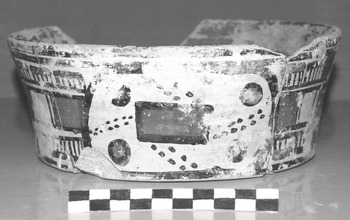
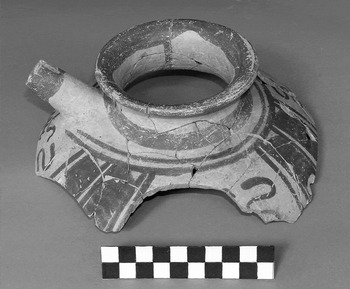
During the Terminal Classic period we observe a decrease of polychromes in the Nakum ceramic assemblage, as has been documented at other Maya sites (Adams Reference Adams and Culbert1973:140; Culbert Reference Culbert and Sabloff2003:62; Foias and Bishop Reference Foias and Bishop1997:282). The most popular group among polychrome ceramics becomes Zacatal (with cream slip for the background), with its principal form represented by flat-bottomed tetrapod dishes with curved, out-flaring walls and characteristic dress shirt designs. This group constitutes between 80 and 90% of all Terminal Classic polychrome ceramics (Figure 4). During the initial part of the Terminal Classic period the Zacatal Group shows the same technological characteristics and quality as during the Late Classic period. It is represented by well-fired vessels with well adhered slip as well as carefully executed designs. Thereafter, Terminal Classic Zacatal Group vessels, as well as ceramics of most important monochrome groups underwent important technological and stylistic changes. A new paste (different from the Late Classic) is used in making the Zacatal Group vessels. This paste is usually similar or the same to the paste used in the production of monochrome ceramics at Nakum during the Terminal Classic period. All these changes point to declining skills in the pottery firing processes. The quality of the designs on the vessels also declines; the most typical being geometric designs (table chess patterns, bands and stripes).
Terminal Classic Zacatal Cream Polychrome bowl excavated in Structure G of Nakum, Proyecto Triángulo, Instituto de Antropología e Historia de Guatemala.

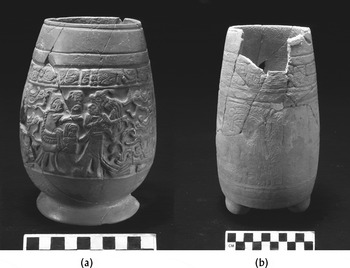
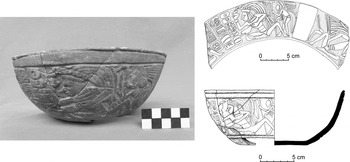
As mentioned earlier, one of the best Terminal Classic markers in the Maya Lowlands is Fine Orange. A significant number of fine paste vessel fragments represented by the Altar Group were found at Nakum. This group is mainly represented by the Pabellon Molded-carved type (Figure 5), though the Trapiche Incised type is also present. Also, a group of ceramics classified by many archaeologists as “local imitations” of the Pabellon Molded-Carved vessels was found at Nakum (Figure 6). In terms of ceramic paste and slip, these “imitations” belong to the Tinaja and Azote Groups (their shapes, forms and decorations are very similar to that from the Pabellon Molded-Carved type;Footnote 1 compare with P. Rice [Reference Rice, Sabloff and Andrews1986:271] and Źrałka [2008:171] for Yaxha).
Two Terminal Classic Pabellon Molded-Carved vessels excavated at Nakum: (a) from Burial 5, Patio 16; (b) from Structure D (courtesy of Ministerio de Cultura y Deportes de Guatemala, Dirección General del Patrimonio Cultural y Natural de Guatemala and Museo Nacional de Arqueología y Etnología de Guatemala).

Terminal Classic molded bowl from Structure 14. Drawing by Katarzyna Radnicka, Nakum Archaeological Project.

Other Terminal Classic markers, such as Fine Gray and Plumbate are less numerous at Nakum. Hitherto, only one fragment of Fine Gray ceramics represented by the Tres Naciones Group has been found at the site; nearly 10 examples of Plumbate (probably representing the San Juan Group) have also been recovered.
As far as Nakum's Terminal Classic unslipped ceramics are concerned, they all belong to the Uaxactun Unslipped Class which is mainly represented by two groups: Cambio and Encanto. The most frequent is the Cambio Group with Cambio Unslipped and Manteca Impressed types. The most common forms of these groups are ollas and jars of large and medium diameter, medium-curved out-flaring necks, and undulating lips.
Among other typical Terminal Classic ceramics which appear at Nakum are “sahumerios” (or ladle censers) with hollow handles. This form becomes extremely typical towards the end of the Classic period in the Maya Lowlands as well as in the Highlands. Moreover, there was a drastic increase of worked sherd artifacts of various shapes as well as molded figurines which usually functioned as whistles. Both groups of artifacts were very rare in the previous Late Classic period at Nakum.
TERMINAL CLASSIC ACTIVITY IN THE SITE CORE AND PERIPHERY
The Acropolis of Nakum
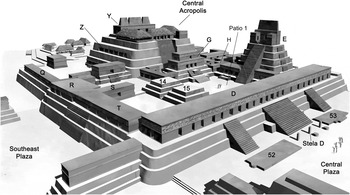
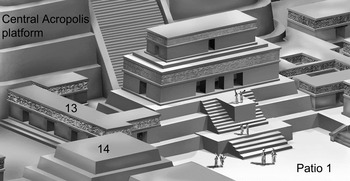
Archaeological investigations undertaken by the Triangulo Project and the Nakum Archaeological Project during recent field seasons in the Acropolis convincingly demonstrate that all structures previously erected here were rebuilt during the Terminal Classic period (Structures D, E, F, I, N/60/61, R, 14, and 15). The rebuilding process focused mainly on extending the living space in the majority of the above-mentioned structures. Moreover, many new constructions were built during this period. As a result of this important architectural program, the Acropolis achieved its final form consisting of 12 courtyards (called patios) (Figures 3 and 7).
View from the northeast of the Nakum Acropolis (Terminal Classic period). Reconstruction by Breitner González and Telma Tobar.

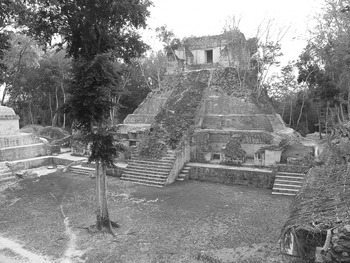
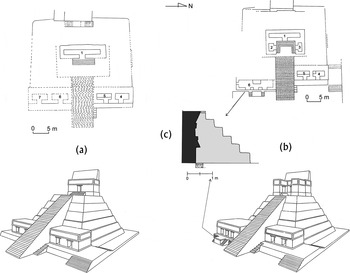
An important building program is observed at that time in Patio 1, the largest and the most important courtyard of the Acropolis complex. In case of Structure D (an elongated palace that encloses Patio 1 from the north), the number of chambers was increased from 19 in the Late Classic to 34 in the Terminal Classic period. Subsequently, several existing chambers were divided into smaller spaces by the construction of transverse walls and the number of rooms was increased to 38. Structure E, located on the western side of Patio 1 (see Figure 8), also underwent important remodeling during the Terminal Classic period. At the end of the Late Classic it had a great quadrangular pyramid platform topped by a superstructure called Chamber 1. During the Terminal Classic period new chambers were added both on the summit of the pyramid platform as well as at its base (Figure 9).
View of Patio 1 with Structure E on its west side.

Structure E. (a) Late Classic; (b) Terminal Classic periods; (c) talud-tablero-reverse talud profile of the western side of Patio 1. Proyecto Triángulo, Instituto de Antropología e Historia de Guatemala.

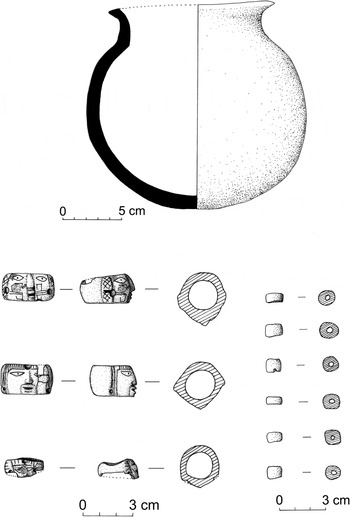
The two low pyramids (Structures 14 and 15) just opposite Structure E, on the eastern side of Patio 1, were recently excavated by the Nakum Archaeological Project. These investigations show that the last architectural stage of both constructions dates to the Terminal Classic period. Structure 15 is located on the same axis as Structure E and it was a four-terraced pyramid in its final architectural stage. In 2006, a single test pit was excavated at the top of the pyramid. This revealed the stone foundations of a Terminal Classic superstructure (which was most probably constructed from perishable materials) and an offering from the same period, consisting of a vessel containing three shell rings and six beads (Figure 10). It is possible that this offering is related to a Late Classic royal tomb discovered in the same test pit at a depth of 1.75 m below the surface (Koszkul et al. Reference Koszkul, Źrałka, Hermes, Martin, García, Laporte, Arroyo and Mejía2007; Źrałka et al. Reference Źrałka, Koszkul, Martin and Hermes2011).
Offering 4 discovered at top of Structure 15 dated to the Terminal Classic period. Drawing by Katarzyna Radnicka, Nakum Archaeological Project.

A neighboring building, Structure 14, was intensively used during the period in discussion. At the base of its last architectural stage stairway we found a Terminal Classic midden which contained a large quantity of chert flakes, ceramics, shell fragments and other artifacts found in an ashy matrix typical of the last phase of occupation at Nakum. On the terraces of Structure 14's platform we found many ceramic fragments as well as whole vessels which included molded-carved types and polychrome pottery.
One of the most important constructions of the Acropolis is Structure G which has been thoroughly excavated by Zoila Calderón and Bernard Hermes. This structure was built during the Terminal Classic period at the southern end of Patio 1 (Figure 11). It consisted of a platform that supported eight vaulted chambers (four on the first floor and four more on the second floor). Structure G underwent several remodeling phases during the Terminal Classic. During one of these phases two walls were constructed in talud style on both sides of the stairway of Structure G. These walls were decorated with stucco representations of two bound captives accompanied by glyphs which are, unfortunately, almost completely destroyed (Calderón Reference Calderón2003:22–33) (Figure 12). They likely recorded the victims' names and their titles and/or provenance. During the 2006 restoration work by the Triangulo Project, a hieroglyphic step and a stairway block were discovered along the primary axis of the main stair of Structure G. The glyphs are not well preserved but, according to Simon Martin (personal communication 2006), their style is very schematic and typical for the Terminal Classic period, showing close analogies to contemporaneous inscriptions from the Northern Maya Lowland centers. This further supports the late dating of Structure G.
Nakum Structure G. Reconstruction by Breitner González and Telma Tobar.

Plan of the first floor of Structure G showing respective Terminal Classic architectural stages and representations of captives (drawing by Katarzyna Radnicka after Calderón Reference Calderón2003:Figures 20 and 21). Proyecto Triángulo, Instituto de Antropología e Historia de Guatemala.

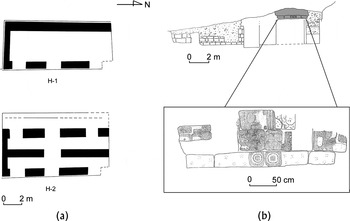
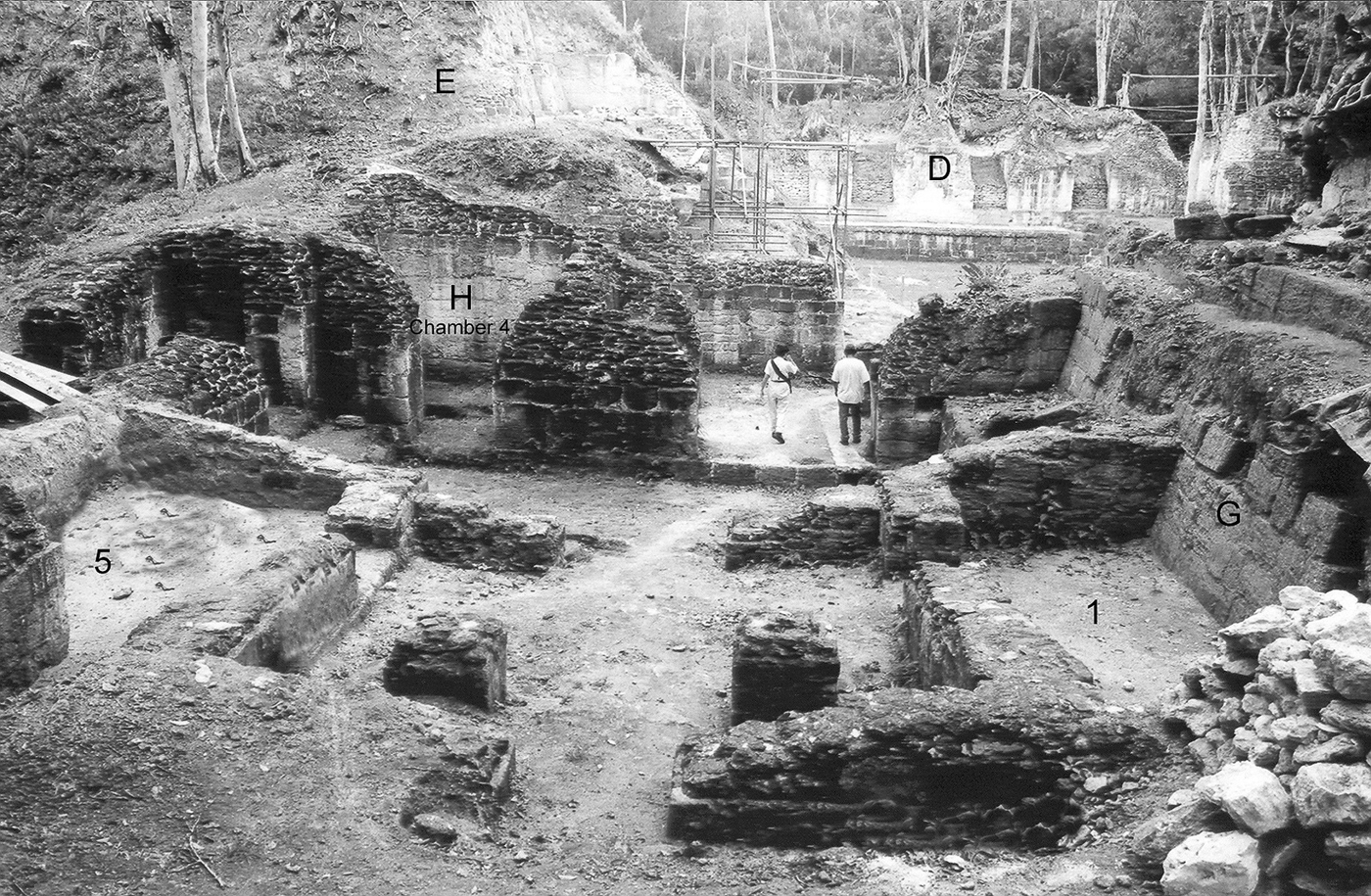
Another interesting late construction which also bore glyphic representations on its façade is Structure H, located west of Structure G. It was constructed in four architectural stages during the Terminal Classic period. In the first stage (H-1), Structure H consisted of one single room which was then separated by a wall into two rooms (stage H-2) (Figure 13a). During the second architectural stage the upper part of the eastern façade of that building was embellished with a frieze containing a few glyphs (Figure 13b). The glyphs were rendered in a very late style typical for the Terminal Classic period and they probably recorded a date (Simon Martin, personal communication 2004). In the third architectural stage, three new rooms were added. An investigation of these new rooms indicates that they probably had a flat roof, very similar to those seen in Postclassic buildings. Further to the south of Structure H, a labyrinth-like complex of rooms (Rooms 1 through 6) was built in the Terminal Classic (see Figure 14). Due to their construction, access from the north to the Central Acropolis and other parts of the Acropolis was very restricted and controlled (Calderón et al. Reference Calderón, Hermes, González, Tobar, Laporte, Arroyo and Mejía2008:354).
Structure H during the first and second Terminal Classic architectural stages; on the right is visible frieze discovered on the façade of this construction. Proyecto Triángulo, Instituto de Antropología e Historia de Guatemala.

Area between Structures H, G, J and the Interior Acropolis showing several interconnected rooms closing this space and constructed during the Terminal Classic period.
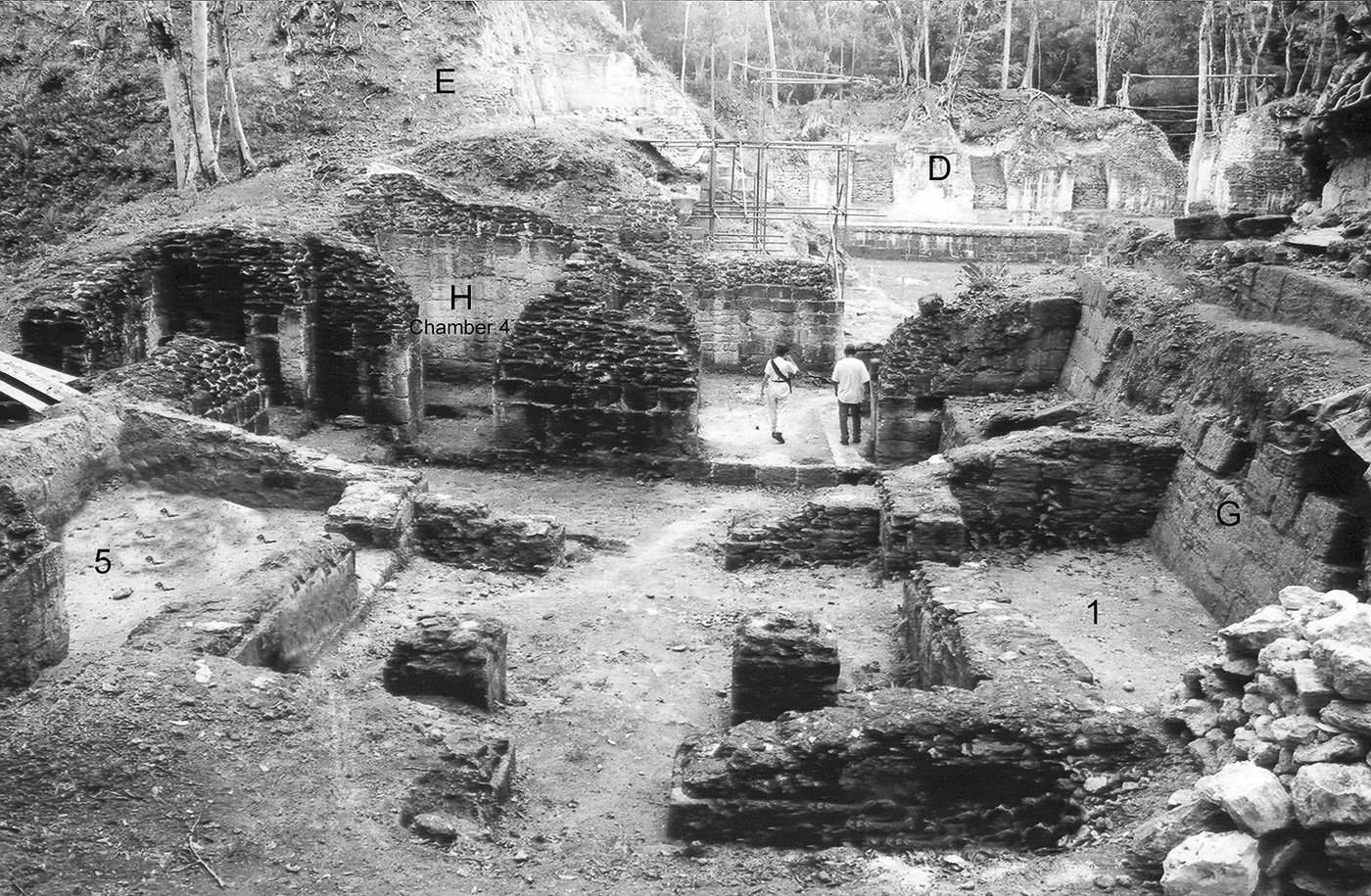
The Central Acropolis underwent an important building program during the Terminal Classic period. At that time, it was the highest and most inaccessible part of the site (see Figure 7). The principal access to this complex was blocked by Structure G. In order to reach a stairway that led to the top of the Central Acropolis, one had to either pass through the labyrinth-like complex of rooms that were erected west of Structure G or encircle this construction from the east (Calderón et al. Reference Calderón, Hermes, González, Tobar, Laporte, Arroyo and Mejía2008:354) (see Figures 3 and 14). We postulate that at this point the Central Acropolis served as the main seat of the royal dynasty of Nakum. During the Terminal Classic period a large two-story palace structure (Building Y) was built at the top of this complex. This palace probably served as a residence for members of the royal family. During the next architectural stage of the Central Acropolis, four new structures (63, 63A, 64, and 65) were constructed north of Building Y forming a small patio group (Patio 6) (Calderón et al. Reference Calderón, Hermes, González, Tobar, Laporte, Arroyo and Mejía2008) (see Figure 3). One of the buildings of this complex (Structure 63A) is of special importance since its layout is reminiscent of the tandem plan structures seen in various Terminal Classic and Postclassic sites (for example, Chichen Itza, Mayapan, and central Peten sites) (Bazy Reference Bazy2004; Freidel Reference Freidel and Ashmore1981:315–323; D. Rice Reference Rice, Sabloff and Andrews1986:309). It should also be mentioned that the same period saw the construction of a two-story palace (Structure Z) which was added to the eastern part of the Central Acropolis platform (Calderón et al. Reference Calderón, Hermes, González, Tobar, Laporte, Arroyo and Mejía2008:353).
During the Terminal Classic period, other parts of the Acropolis were also rebuilt and enlarged by the construction of many new structures. In the southeastern part of the Acropolis several buildings that came to form Patios 7 and 8 were constructed. These are Structure Q (a seven-chambered palace), Structure 62 (with a single room), Structure 24 (a three-room residence), Structure 26 (a sweat bath) and Structure 27 (a small single-room construction) (Calderón and Toraya Reference Calderón and Toraya2002; Hermes Reference Hermes2002; Hermes et al. Reference Hermes, Calderón, Olko and Źrałka2001) (Figure 3). Further to the north, several new structures were also built, Structures S and 13, delimiting two new patio groups (Patios 9 and 10). Structure R enclosing Patio 9 from the east was significantly enlarged by the addition of five new chambers. Important architectural changes were also made during the Terminal Classic period in the western part of the Acropolis where two residential constructions from the Late Classic period were rebuilt (Structures F and I) and one long palace was constructed (Structure L). Terminal Classic remodeling was also documented at two other neighboring constructions, Structures M and N/60/61. Structure N/60/61 is of special importance because it is one of the most thoroughly investigated constructions at Nakum (Noriega and Hermes Reference Noriega, Hermes, Laporte, Escobedo and de Suasnávar2000). It was built over the course of several stages during the Late Classic period and was a two-story palace with ten chambers. Subsequently, during the Terminal Classic it underwent several remodeling programs. Masonry blocks were added to its stairway and on either side of it, one new chamber was constructed and the walls were covered with new masonry (Figure 15). The masonry block constructed in the center of the stairway was originally embellished with a band of glyphs rendered in stucco which was subsequently almost completely destroyed. The extensive use of this building during Tepeu 3 times is confirmed by a midden containing a large amount of Terminal Classic ceramics found on the southern end of the first floor of Structure N/60/61. Numerous Terminal Classic ceramics were also discovered south of Structure N/60/61 at the level of the plaza of the Acropolis platform (Hermes and García Reference Hermes and García1998). It seems that the people who inhabited this building during the Terminal Classic period discarded their refuse on the platform of Structure N/60/61 as well as in the area to the south of it.
View of Structure N/60/61 during the Terminal Classic period. Reconstruction by Breitner González and Telma Tobar.

Finally, during the Terminal Classic period, a long palace was constructed (Structure O) to the east of Structure N/60/61. It consisted of five chambers: three rectangular, located on the northern façade, and two transverse, located on the eastern and western ends of the Structure O (Hermes et al. Reference Hermes, Calderón, Olko and Źrałka2001).
Area of the Central and East Plazas
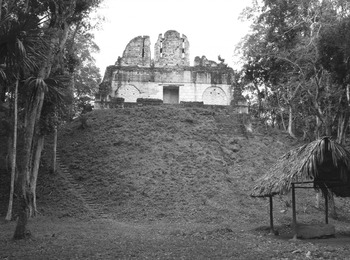
Archaeological data leave no doubt that construction activity at Terminal Classic Nakum focused mainly on the remodeling and construction of elite residential structures. This certainly implies a significant increase in the number of elites. On the other hand, we also observe significant construction efforts in the area of the Central and East Plazas which constituted a sacred precinct of the site. This process included the construction of Temple V which consists of a terraced pyramid platform topped by a single large chamber. Another pyramid-temple—Structure A which was constructed during the Late Classic period on the eastern side of the Central Plaza also underwent important remodeling during the Terminal Classic period (Figures 16 and 18).
General view of Structure A, note the corbelled roof and two doorways in the form of arches constructed during the Terminal Classic (the doorways were sealed by the Triangulo Project to strengthen the stability of the temple).

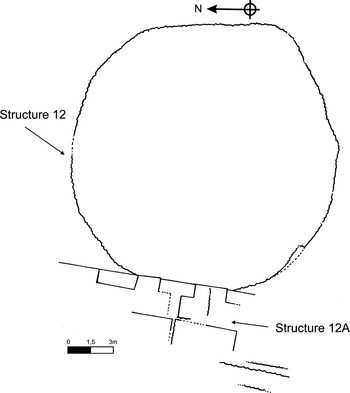
Recent investigations of the Triangulo Project undertaken by Zoila Calderón and Varinia Matute indicate that two small ceremonial platforms (Structures 52 and 53) as well as two other buildings (Structures 12 and 12 A) were constructed during the Terminal Classic at the southern and western side of the Central Plaza, respectively (Calderón et al. Reference Calderón, Matute, Źrałka, Konik and Koszkul2004). Of special importance are Structures 12 and 12A. Investigations showed that Structure 12A consisted of three chambers and that sometime during the Terminal Classic period it was sealed and a new construction built to the east of it (Structure 12) blocked the entrance to Structure 12A. Limited investigations in the area of Structure 12 showed that it consists of a round substructure approximately 16 m in diameter (Figure 17). The upper part of Structure 12 was not fully excavated (only two looters' trenches dug into this construction were documented) and we still do not know what kind of superstructure it supported (Calderón et al. Reference Calderón, Matute, Źrałka, Konik and Koszkul2004). Structure 12 was analogous to other round constructions, especially to those known from Chichen Itza (Structure 3C15) and Nohmul (Structure 9) (Chase and Chase Reference Chase and Chase1982; Hammond et al. Reference Hammond, Kosakowsy, Pyburn, Rose, Staneko, Donaghey, Clark, Horton, Gleason, Muyskens and Addyman1988). Although round structures were present as an architectural form in the Maya area since the Preclassic period, they became very common during the Terminal Classic and Postclassic periods. The size and form of round structures varied through time and can be grouped into several different types based on structural characteristics such as height, number of substructure terraces, the presence or absence of stairways or superstructure, their location, orientation and function (Morales Reference Morales, Laporte, Escobedo and Villagrán de Brady1993; Szymański Reference Szymański, Kozłowski and Źrałka2010). Ringle et al. (Reference Ringle, Negrón and Bey1998:219, 221–222; see also Masson and Mock Reference Masson, Mock, Demarest, Rice and Rice2004:391) argue that during the Terminal Classic period, a pan-Mesoamerican sphere of political and religious interaction was established focusing on the cult of Quetzalcoatl (Taube Reference Taube, Fields and Zamudio-Taylor2001). These scholars associate Terminal Classic round structures with feathered serpent symbolism. On the other hand, in central Mexico circular constructions are associated with Ehecatl-Quetzalcoatl, a wind aspect of Quetzalcoatl. It is worth mentioning that iconography related to Ehecatl is present at Seibal (Stela 19), where a Terminal Classic round structure was also discovered (Structure C-79) (Willey et al. Reference Willey, Smith, Tourtellot, Graham and Willey1975:36). Although this topic needs further investigation, it is possible that Terminal Classic-Postclassic round structures in the Maya area may bear a closer relationship with the wind god (Ik' k'uh in Classic Mayan) than the feathered serpent (Helmke, personal communication 2008; see also Miller and Taube Reference Miller and Taube1993:84–85). Recently, McAnany and Gallareta Negrón (Reference McAnany, Gallareta Negrón, McAnany and Yoffee2010) have proposed that round structures had a religious as well as economic function and were supposed to strengthen the power of rulers during the difficult times of the final part of the Classic era. They also argue that such architectural forms were typical for the sites associated with strategic waterways and coastal locations (along the Caribbean Sea) and were related to the Chichen Itza sphere of influence (McAnany and Gallareta Negrón Reference McAnany, Gallareta Negrón, McAnany and Yoffee2010:162). As we will show (see below), Nakum, situated at a strategic point on the banks of the Holmul River, seems to be an example of such an important mercantile center during the Terminal Classic period that might have also been under the influence of Chichen Itza.
Plan of Nakum Structures 12 and 12A. Proyecto Triángulo, Instituto de Antropología e Historia de Guatemala.

Investigations of Structure C: Dating the Terminal Classic Period at Nakum
Most scholars conducting research in the Triangulo Park area date the Terminal Classic period to approximately a.d. 850–950 (Fialko et al. Reference Fialko, Gámez and Crasborn2002, Reference Fialko, Gámez and Aquino2003; Hermes Reference Hermes2002; Hermes et al. Reference Hermes2002). These dates are based on data from neighboring Tikal, where the Terminal Classic Eznab phase is dated to a.d. 850–950 (Culbert Reference Culbert1993, Reference Culbert and Sabloff2003). However, it should be stressed that the dating of this period at Tikal, as well as at Uaxactun and other neighboring sites is not precise. It was not possible to conclusively associate dated monuments at Tikal to Eznab ceramics. Culbert (Reference Culbert and Culbert1973b, Reference Culbert1993, Reference Culbert and Sabloff2003) places the beginning of this phase to between a.d. 830 and 850, which is to say, during the period between the dedications of the last dated Tikal monuments: Stelae 24 and 11. Stela 24 was erected in front of Temple III and dates to a.d. 810 and is associated with ceramics of the Late Classic Imix complex (Coe Reference Coe1963:54–55; Culbert Reference Culbert1993:Figure 112e). Culbert (Reference Culbert and Culbert1973b) estimates that Tikal's last monument, Stela 11, belongs to the Eznab phase. He also predicts that the use of Eznab complex ceramics might have lasted about 100 years at Tikal (Culbert Reference Culbert and Culbert1973b:89). Thus, the beginning of this phase as well as its duration is still uncertain. The same may be said about the dating of the Terminal Classic Tepeu 3 phase at Uaxactun since the dates proposed for this period are very approximate. According to Smith (Reference Smith1955:106–108), it starts at the beginning of Cycle 10 (10.0.0.0.0 or a.d. 830) and ends after a.d. 889 when the last carved monument at Uaxactun (Stela 12) was dedicated. The dating of Tepeu 3 ceramics is uncertain at other sites as well, and in many cases it is not supported by radiocarbon dates. However, at Xunantunich, situated approximately 30 km southeast from Nakum, radiocarbon dates place the Terminal Classic period from a.d. 780 to 890 (Le Count et al. 2002). Unfortunately, 14C dates relating to Terminal Classic materials or structures from Nakum and other Triangulo Park sites are not available. Nevertheless, we argue that the use of Terminal Classic ceramics in at least some Triangulo Park sites may have begun earlier than the generally accepted date of approximately a.d. 850.
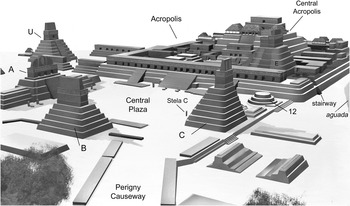
Archaeological work carried out by the Triangulo Project at Structure C, a pyramid-temple located on the western side of the Central Plaza at Nakum (Figure 18) indicates that it was constructed during the Terminal Classic period. A test pit (4 m deep) excavated through the floor of the superstructure of Structure C yielded Terminal Classic ceramics from the construction core. However, no earlier substructures were detected (Calderón et al. Reference Calderón, Matute, Źrałka, Konik and Koszkul2004) although such construction(s) might be still buried below Structure C. Stela C, erected in front of this pyramid was dedicated in a.d. 815 and it is almost certain that this monument is contemporaneous with Structure C. Thus it seems that Terminal Classic ceramics were already in use at Nakum by a.d. 815. From this we conclude that Terminal Classic ceramics at Nakum and possibly at other sites of the Triangulo Park region first appeared at the beginning of the ninth century. New investigations at Yaxha by the Programa de Desarrollo Sostenible de Peten (PDS) indicate that the Terminal Classic period at this site might also have begun at roughly a.d. 800.
Nakum. View from the northwest of the Central Plaza and Acropolis complex during the Terminal Classic period. Reconstruction by Breitner González and Telma Tobar.

We also propose that at Nakum and Yaxha, the Terminal Classic period lasted between 100 and 150 years (to a.d. 900/950) or longer. This conclusion is based on architectural evidence, specifically on the construction stages of excavated structures that are dated to the Terminal Classic period (Źrałka Reference Źrałka2008). As we have seen, many structures at Nakum underwent extensive architectural modifications during the Terminal Classic period. These include Structure G (five construction stages), Structure H and Q (four construction stages each) and Structures E, R, 24, 26, and 27 (three construction stages each). The Central Acropolis and its structures might have been rebuilt three or more times. Thus, if we compare the amount of construction with the earlier chronological horizons (Tepeu 1, Tepeu 2, and Tzakol), it turns out that the Terminal Classic period is characterized by the heaviest construction activity and the greatest number of architectural stages (see Źrałka Reference Źrałka2008:Table 13). Although this remains a hypothesis which needs to be backed up by absolute dates, such a large number of construction stages dated by associated ceramic material suggest that Terminal Classic occupation at Nakum must have lasted for a considerable period of time. At Yaxha, extensive Terminal Classic rebuilding programs were documented in the North Acropolis complex (Structures 134, 135, and 146-147-145). The number of times these structures were remodeled during the Terminal Classic period is much greater than during earlier periods. Multiple Terminal Classic construction stages were also documented for other structures (103, 109, Patio 4 of the South Acropolis, Maler Group, and Ballcourt 1), suggesting that Terminal Classic occupation lasted for a considerable time at Yaxha as well.
The Northern Part of Nakum
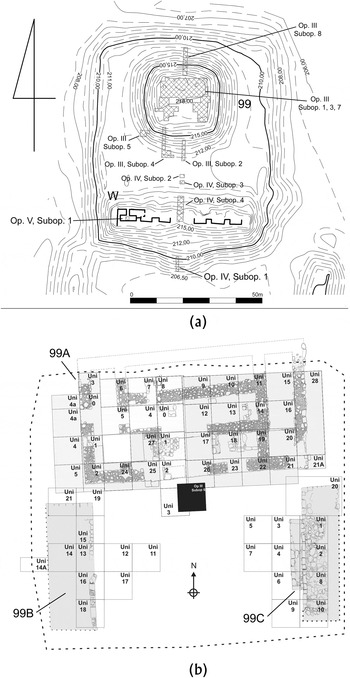
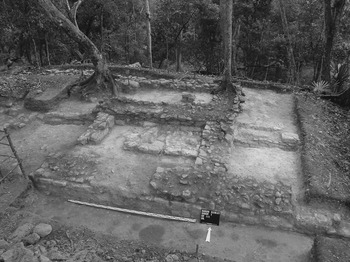
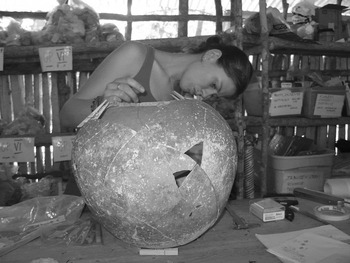
Except for the Merwin Group, prior to 2006 the Northern Sector underwent limited investigation, with only a test-pitting program and excavations of chultuns. This research documented very limited traces of Terminal Classic occupation. Two test-pits excavated at the summit of the North Group—the largest and the most important architectural complex of the Northern Sector—yielded no Terminal Classic materials. Thus, Hermes (Reference Hermes2002) suggested that the North Group and other parts of the northern sector were in large part abandoned by Tepeu 3 times. However, the latest investigations conducted in the North Group by the Nakum Archaeological Project have found copious evidence of Terminal Classic occupation (Figure 19). The largest construction within this complex (Structure 99—a vast quadrangular platform) was subjected to a thorough investigation (Koszkul et al. Reference Koszkul, Źrałka, Hermes, Martin, García, Laporte, Arroyo and Mejía2007; Źrałka et al. Reference Źrałka, Koszkul, Hermes, Martínez, Laporte, Arroyo and Mejía2008). At the top of this platform, a superstructure (Number 99A) dating to the Terminal Classic period and consisting of five interconnected rooms was uncovered (see Figures 19 and 20). The floor in the northern and northwestern part of this superstructure was covered by many fragments of broken ceramic vessels, chert adzes (both fragments and complete artifacts), fragments of manos and figurines. This might reflect a termination ritual that took place during the Terminal Classic period, some time before the abandonment of this structure. Alternatively, it might represent a midden left by the last inhabitants of Nakum. Moreover, in the eastern side of the above-mentioned superstructure, human bones lying on the floor were found. This individual may have been left unburied or only partly covered by soil; similar to examples found at several Maya sites in the Terminal Classic era (Harrison Reference Harrison1999:193, 195, 197; Helmke Reference Helmke2006a:176, 182–183; Valdés and Fahsen Reference Valdés, Fahsen, Demarest, Rice and Rice2004:153; Vidal and Valdés Reference Vidal Lorenzo, Valdés, Lorenzo and Muñoz Cosme2007:18). In 2008, during excavations carried out to the south of the five-roomed superstructure, vestiges of two other constructions (Structures 99B and 99C) forming a triadic complex with Structure 99A were discovered (Figure 19). In the vicinity of one of them many broken ceramic fragments were found (Figure 21), possibly part of the same termination ritual mentioned above.
Nakum. (a) Map of the North Group showing all excavations realized by the Nakum Archaeological Project (map by Michał Sip); and, (b) plan of three Terminal Classic superstructures discovered at the top of Structure 99 platform. Drawing by Aleksander Danecki and Paweł Kurzawa, Nakum Archaeological Project.

Nakum. The eastern part of superstructure discovered at the top of Structure 99 platform (view from the south). Nakum Archaeological Project.

Partly reconstructed Tinaja Red vessel discovered on top of Structure 99 platform, from an apparent Terminal Classic termination ritual. Photo by Hubert Chudzio.

In sum, our investigations indicate that the platform of Structure 99 was initially built during the Late Preclassic period and no evidence of Early or Late Classic construction activity was documented here. It seems that this building was abandoned after the Preclassic epoch and then reoccupied during the Terminal Classic period. This data confirms important demographic growth in Nakum during the Terminal Classic when old constructions (sometimes of religious function) were reused and adapted for new purposes, especially to create new habitation space.
Important remodeling efforts dated to the Terminal Classic period were also documented in other constructions of the Northern Sector, such as Structure X (pyramid-temple), the Merwin Group, and Structure 96 (a small platform located in the center of the North Plaza). Excavations of the Nakum Archaeological Project indicate that these constructions were extensively used and inhabited (as in the case of the Merwin Group) during Tepeu 3 times.
Terminal Classic Activity at the Periphery
Triangulo Project investigations in Nakum not only encompassed the core of the site but also its periphery. Between 2001 and 2003, the area around the Nakum core was surveyed by Justyna Olko and Jarosław Źrałka in order to evaluate the extent of settlement at the site and date the architectural compounds located in the periphery. As a result of this work, 36 complexes or patio groups of various sizes and plans were identified (see Figure 2). After mapping, a test-pitting program was carried out in all of the complexes. The test pits were usually set in front of the largest structure of a particular group (Hermes et al. Reference Hermes, Źrałka and Calderón2005). Archaeological material recovered from the test-pits provided rich and important data on dating the Nakum periphery. These data show extremely dense evidence of Terminal Classic occupation. Late Classic ceramics were discovered at 13 or 14 patio groups (36.1–38.9%), while Terminal Classic material was identified at 28 patio groups. In three other groups (Numbers 37, 39, and 41), pottery from the uppermost cultural level might also date to the Terminal Classic. In 9 complexes (patio Numbers 16–18, 31, 35, 38, 43, 49, and 53), material dating to the Terminal Classic period was discovered in all cultural layers. It is highly probable that these complexes were constructed and utilized during that period. In sum, Terminal Classic material was documented in 77.8 to 86.1% of all 36 investigated complexes on the periphery of Nakum.
Terminal Classic material was also prevalent in the chultuns that were excavated. Among the 35 Nakum chultuns that were documented, a great majority are situated on the periphery. So far, 22 chultuns have been excavated. In 13 chultuns (Numbers 1?, 2, 4, 6, 9, 11, 13, 16, 19, and 22–25) material from almost every layer is dated to the Terminal Classic period. Most excavated chultuns containing Terminal Classic materials have a bell-like cross-section and circular plan. It seems that this form was typical for Nakum during the Terminal Classic period. We find this in the case of chultuns 1, 2, 6, 9, 11, 23, 24, and 25.
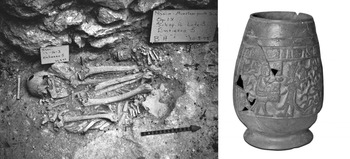
Two Terminal Classic burials (Burials 5 and 24) were encountered during the test-pitting program of the periphery of Nakum. One of these (Burial 5) is of special importance. It was found in Patio 16, only a few meters south of the Acropolis complex and contained the remains of a young man with traces of skull trepanation. The deceased was accompanied by two ceramic vessels, a shell necklace, a worked bone and a few pieces of jade. One vessel is an Azote Incised type, while the other is a Fine Orange Pabellon Molded-Carved type decorated with a beautiful scene modeled in relief (Figure 22). The contents of the burial indicate that the people inhabiting the peripheries of Nakum during the Terminal Classic period had access to exotic trade products such as Fine Orange pottery and jade (Hermes et al. Reference Hermes, Źrałka and Calderón2005:120).
Nakum. Terminal Classic period Burial 5 with one of the two vessels found inside (Pabellon Molded-Carved type).

POSTCLASSIC OCCUPATION AT NAKUM
Archaeological traces dating to the Postclassic period are relatively rare at Nakum. Material from this period is limited to sherds found outside Structures D, L, and O. Postclassic sherds were also found inside Chamber 4 of Structure E as well as in Structure M. Among the other Postclassic remains recovered were ceramic fragments and carbon from the southern part of Chamber 6 of Structure R (Hermes Reference Hermes2002:284–285).
Important evidence of Postclassic occupation was discovered in Structure N/60/61. In Room 2, weights for a fishing net made from Postclassic ceramic sherds were recovered. Also, in Room 3 residues of a hearth associated with Postclassic sherds were documented. Moreover, in Room 6 a concentration of charcoal and Postclassic ceramics was found. Most probably, the doorway between Chambers 2 and 3 of Structure N was sealed during the same period. Several instances of graffiti documented in this construction were possibly also made by Postclassic inhabitants. Two samples from Building N subjected to 14C analysis are associated with these Postclassic vestiges (samples Bln-5137 and Bln-5138). Both of them date to the fourteenth century a.d.
Postclassic material was also discovered in other locations of Nakum (Structures H, D, L, M, 52, 65, the area between Structures 14 and 15, and Chultun 7) where several offerings, one burial and scattered Postclassic fragments were found (Hermes Reference Hermes2002:284–285; Źrałka Reference Źrałka2008). Significantly (except for Platform 52), Early Postclassic materials were found almost exclusively in the Acropolis, the elite residential complex during the Classic period. The archaeological context of these finds indicates that the Postclassic population might have lived in palaces and participated in ceremonial activities. However, many of these buildings were beginning to fall into ruin at that time, if they had not already done so by the end of the Classic era. The best example of this is Structure D, where an offering (consisting of a globular bowl of Pozo Unslipped type) was deposited by Postclassic inhabitants in the rubble derived from a fallen vault of one of the chambers (Chamber 29).
The quantity of Postclassic remains in the Acropolis suggests that the Early Postclassic inhabitants of Nakum were not very numerous. The population might have decreased by more than 90% in comparison with that of the Terminal Classic. Significantly, the presence of materials such as pottery sherds with Red-on-Cream decoration (Chompoxte Group) (see Figure 23) places this late occupation near the end of the Early Postclassic rather than at the beginning of this period. The ceramic material also indicates a temporal gap between the end of the Terminal Classic and the beginning of the Early Postclassic period. This archaeological discontinuity implies that the Postclassic inhabitants of the Acropolis arrived at Nakum sometime after the site had been abandoned by the Classic population. This data is consistent with Postclassic settlement in many other Southern Lowland sites (for example, Tikal, Copan, and Quirigua), where we observe a discontinuity and a settlement gap between the Classic and Postclassic periods. Material from the Postclassic complexes at these sites indicates that they were re-occupied by new groups of people with distinctive ceramics (Culbert Reference Culbert and Sabloff2003; Sharer Reference Sharer, Chase and Rice1985; Sharer and Traxler Reference Sharer and Traxler2006:491, 495). Traces of settlement from the Postclassic era are most likely connected with groups of people coming from the central Peten lakes area. This is the closest area where strong Postclassic occupation as well as settlement continuity from the Classic to Postclassic period can be observed (D. Rice Reference Rice, Sabloff and Andrews1986; P. Rice Reference Rice, Sabloff and Andrews1986; Rice and Rice Reference Rice, Rice, Demarest, Rice and Rice2004, Reference Rice, Lorenzo and Muñoz Cosme2007).
Fragment of Chompoxte Red-on-Cream vessel found in a test-pit excavated between Structures 14 and 15.

Scarce and relatively late Early Postclassic material also indicates that the abandonment of Nakum by its original inhabitants may have already begun in the Terminal Classic, probably in the latter part or at the end of that period. Thus the politico-economic problems that probably led to the collapse of Nakum were being manifested during the Terminal Classic period.
Of major importance is the discovery of ceramics from the Chompoxte group in Structure N. These ceramics were mixed with Tinaja Group fragments in an undisturbed archaeological context. This find indicates that: (1) either the Chompoxte Group ceramics appear earlier than previously thought, or (2) that after the collapse of the major sites of the central Peten, some people continued to produce vessels of Terminal Classic Tinaja Group affiliation for some time. It is also possible that both scenarios could have been involved since they are not mutually exclusive. However, we favor the second option and the existence of the occupational gap between the Classic and Postclassic periods since, as mentioned before, it is obvious that the Postclassic population of Nakum lived in structures that had not been maintained for a long time and were collapsing.
TERMINAL CLASSIC IN THE SOUTHERN MAYA LOWLANDS: COLLAPSE AND TRANSFORMATION
The dating of the Terminal Classic period varies between different regions and even between different centers in the Southern Lowlands. However, in general it encompasses the time between roughly a.d. 800 and 1000 (Demarest et al. Reference Demarest, Rice, Rice, Demarest, Rice and Rice2004b; Hammond and Tourtellot Reference Hammond, Tourtellot, Demarest, Rice and Rice2004:288–289; Rice et al. Reference Rice, Demarest, Rice, Demarest, Rice and Rice2004). In the Northern Maya Lowlands the dates for this period are even broader (a.d. 730/750–1050/1100 or longer) (Bey et al. Reference Bey, Hanson and Ringle1997; Carmean et al. Reference Carmean, Dunning, Kowalski, Demarest, Rice and Rice2004; Suhler et al. Reference Suhler, Ardren, Freidel, Johnstone, Demarest, Rice and Rice2004).
Recently the Terminal Classic period has been the subject of important studies and publications (Aimers Reference Aimers2004, Reference Aimers2007; Demarest et al. Reference Demarest, Rice and Rice2004a; López Varela and Foias Reference López Varela and Foias2005; Webster Reference Webster2002; Źrałka Reference Źrałka2008). These studies convincingly demonstrate that the sociopolitical as well as cultural situation in the Maya Lowlands was very complex at the end of the Classic period. The collapse and depopulation of lowland cities was an extended process that began in the Late Classic period in some areas, like the Petexbatun or Usumacinta regions (Demarest Reference Demarest1997, Reference Demarest2006; Demarest et al. Reference Demarest, O'Mansky, Wolley, Tuerenhout, Inomata, Palka and Escobedo1997; Holley Reference Holley1983; Houston Reference Houston1993; Houston et al. Reference Houston, Escobedo, Child, Golden and Muñoz2000; Martin and Grube Reference Martin and Grube2000), or took place during the Terminal Classic in other areas (Demarest et al. Reference Demarest, Rice and Rice2004a). Yet some Maya cities located in Belize, and the central and southeastern Peten reached their peak during the Terminal Classic and/or continued their growth until the Postclassic period (Aimers Reference Aimers2004; Hammond et al. Reference Hammond, Kosakowsy, Pyburn, Rose, Staneko, Donaghey, Clark, Horton, Gleason, Muyskens and Addyman1988; Laporte Reference Laporte, Demarest, Rice and Rice2004; Laporte and Mejía Reference Laporte, Mejía, Laporte, Escobedo and Arroyo2002; Laporte and Quezada Reference Laporte and Quezada1998; Masson and Mock Reference Masson, Mock, Demarest, Rice and Rice2004; Pendergast Reference Pendergast1981, Reference Pendergast, Chase and Rice1985, Reference Pendergast, Sabloff and Andrews1986; Rice and Rice Reference Rice, Rice, Demarest, Rice and Rice2004, 2007; Willey Reference Willey and Culbert1973).
In most Maya centers the Terminal Classic is characterized by the disappearance of a political system based on the rule of k'uhul ajaw or holy lords and the institution of divine kingship that they represented. Many hallmarks of Classic Maya culture related to the activity of the highest elites ceased during this period, such as the practice of burying kings in elaborate tombs situated within pyramid-temples or the erection of carved dynastic monuments. Moreover, highly skilled artists creating beautifully painted ceramics decorated with mythological or courtly scenes declined and ultimately disappeared. There was also a drastic reduction in architectural activity and most of the Southern Lowland cities were, one by one, depopulated. We know that the decline of Classic Maya civilization was triggered by different factors which in many cases differed from region to region or even from site to site. Thus, nowadays most archaeologists agree on the use of multivariate models to explain the Classic Maya collapse. Researchers still debate the causes of depopulation and abandonment of many Maya cities. However, among the most important and the most frequently cited are: status rivalry and intensification of warfare (Demarest Reference Demarest2004a, Reference Demarest, Demarest, Rice and Rice2004b, Reference Demarest2006), overpopulation and degradation of the natural environment (Culbert Reference Culbert and Hammond1977, Reference Culbert, Yoffee and Cowgill1988), drought (Gill Reference Gill2000; Gill et al. Reference Gill, Mayewski, Nyberg, Haug and Peterson2007; Haug et al. Reference Haug, Günter, Peterson, Sigman, Hughen and Aeschlimann2003; Hodell et al. Reference Hodell, Curtis and Brenner1995, Reference Hodell, Brenner, Curtis and Guilderson2001), and many others (for further information concerning the problem of Maya collapse and its various possible causes see Aimers [2007], Culbert [1973a], Demarest [Reference Demarest, Laporte, de Suasnávar and Arroyo2001, 2004a:240–276], Houston and Inomata [Reference Houston and Inomata2009:288–319], Inomata [Reference Inomata1995:7–22], Lucero [Reference Lucero2002], Sharer and Traxler [2006:499–532], Webster [2002], and Yaeger and Hodell [Reference Yaeger, Hodell, Sandweiss and Quilter2008]).
It is clear that what we call “collapse” was a very long process that unfolded over approximately 300 years (Chase and Chase Reference Chase, Chase, Demarest, Rice and Rice2004:15–16; Demarest et al. Reference Demarest, Rice and Rice2004a). Moreover, some Maya sites and regions survived the crisis adjusting to the new sociopolitical reality and continued their development until the Postclassic or even Colonial periods. The Maya people today are descendants of a civilization which did not collapse completely but underwent a transformation. “Collapse” is thus a term which is more applicable to institutions within Classic Maya society that did not survive the Terminal Classic period (Rice et al. Reference Rice, Demarest, Rice, Demarest, Rice and Rice2004; Sharer and Traxler Reference Sharer and Traxler2006:503–505).
TERMINAL CLASSIC SUCCESS OF NAKUM: TRADE, EXTERNAL CONTACTS AND THE DEMISE OF LOCAL POWERS
Nakum's location on the Holmul River made it an important center for trade during the Preclassic and Classic periods. The Holmul River flows through the central and northeastern part of Peten and it was a very important commercial route and means of communication. It is possible that proximity to the river was a crucial factor regarding the location of Nakum, which was first settled in the Middle Preclassic period. Trade along the Holmul River route was probably controlled for a very long time by two far more powerful Nakum neighbors: Tikal or Naranjo (the latter belonged to the Calakmul political sphere) (see Martin and Grube Reference Martin and Grube2000:69–83). Tikal controlled the upper and possibly middle Holmul drainage (Fialko Reference Fialko, López Varela and Foias2005b:63). Most probably, the collapse and fragmentation of the political system during the Terminal Classic period in the Southern Lowlands and the ensuing downfall of the former superpowers of this area permitted Nakum's ruling elite to actively expand its trade relationships. It seems that Nakum took over the Holmul River trade route and became an important Terminal Classic exchange center (compare with Fialko Reference Fialko, López Varela and Foias2005b:69–70). At the same time it might have established new trade contacts with other, sometimes distant, sites which were still prospering at the end of the Classic period. Recent investigations conducted by Fialko (Reference Fialko, López Varela and Foias2005b, Reference Fialko2005c) confirm the importance of the Holmul River in trade and transportation. It seems that the Holmul River was mainly navigable during the rainy season and connected Nakum to the central Peten area where the river originates (in the hills stretching north of Lake Macanche) (Fialko Reference Fialko, López Varela and Foias2005b:63, Reference Fialko2005c). The 120 km-long Holmul River passes through northeastern Peten and, according to Fialko (Reference Fialko2005c), it flows in the direction of the present day Guatemala-Belize border where it is known as the Río Bravo. The latter river merges with the larger Río Hondo which empties into the Caribbean Sea. The role of rivers in local as well as in long distance canoe-based trade and transport has been emphasized by various scholars (McKillop Reference McKillop1995, Reference McKillop1996, Reference McKillop2005; Pyburn et al. Reference Pyburn, Dixon, Cook and McNair1998) and it seems that rivers flowing from Peten to Belize greatly facilitated the exchange of various products including salt, flint, and marine resources, among others. They also provided a fast means of communication between Peten, Belize, and the Carribean Sea. Some scholars state that certain Belize sites and regions might have even supplied different agricultural and other resources' products for interior and central Peten sites (McKillop Reference McKillop2005; Siemens Reference Siemens, Harrison and Turner1978; Turner and Harrison Reference Turner, Harrison, Turner and Harrison1983:252). Recent discoveries of a dam and dock complex on the Río Hondo—one of the eastern Southern Lowlands rivers—confirms its importance to Maya trade and transport (Barrett and Guderjan Reference Barrett and Guderjan2006). Experimental trips made along the 200 km-long Río Hondo indicate that it could be navigated within three days in traditional dugout canoes (Barrett and Guderjan Reference Barrett and Guderjan2006:228, 238–239). This indicates the significance of rivers in fast transportation as opposed to the more time consuming land-based routes. The above mentioned archaeological data might be further supported by epigraphic studies which indicate the existence of a special title, aj jukuub or “he of the canoe” (Tokovinine and Beliaev Reference Alexandre and Beliaev2010). However, it is not clear if persons bearing this title served trade or military functions (Tokovinine and Beliaev Reference Alexandre and Beliaev2010; Sven Gronemeyer, personal communication 2011). Nevertheless, it is highly possible that aj jukuub might have been in charge of canoe transport and trade.
Most probably, the Holmul River constituted an important part of this far reaching river network connecting Peten centers with Belizean sites and the Caribbean coast while providing a fast means of trade exchange and transportation in this region. At the same time, it might have given an access to the sea routes that encircled the Yucatan Peninsula, which played a key role during the Terminal Classic and Postclassic periods (Sharer and Traxler Reference Sharer and Traxler2006:527–528). Archaeological research at Holmul, another site situated close to the Holmul River, has also yielded considerable evidence of Terminal Classic activity (Estrada-Belli Reference Estrada-Belli2002:110). This is a further indication that the Holmul River was an important fluvial trading route in this region during the Terminal Classic period. However, not all sites located along the Holmul River experienced such prodigious growth during the Terminal Classic. This dichotomy points to the differing responses to the changing sociopolitical conditions of these difficult times. Irrespective of the causes of collapse, Nakum's inhabitants must have adjusted to the new reality and made important choices which made them less vulnerable to the complex problems in the Maya lowlands.
Among the products which were likely imported at that time are ceramics, seashells, obsidian, jade, and alabaster, as well as basalt for grinding implements, all of which have been found in Terminal Classic contexts at Nakum. It also seems very probable that trade contacts (including the important Holmul River route) that Nakum established at this time ensured access to exotic products not only for the elites of Nakum but also for the general population. The richest burial so far discovered on the periphery of Nakum was located in the area of Patio 16 which lies close to the river. It contained greenstone, alabaster, and a beautiful example of an imported Fine Orange vessel (Fialko Reference Fialko, López Varela and Foias2005b:69–70; Hermes et al. Reference Hermes, Źrałka and Calderón2005:120–121). Recent investigations by the Triangulo Project confirmed the importance of the Holmul River trade route. Vestiges of what appears to be a pier or dock were discovered west of the Acropolis complex, in an aguada. This feature as well as the aguada could be easily accessed from the Acropolis by a stairway behind Structures E and F on the western side of this complex (see Figure 18). During the rainy season the aguada connected with the river, enabling easy access to it. Proximity to the river also meant easy access to a water source—a very crucial factor in the development of the site during the Terminal Classic period when climate changes such as prolonged drought or anomalously dry conditions were documented in the northern Yucatan (Gill Reference Gill2000; Gill et al. Reference Gill, Mayewski, Nyberg, Haug and Peterson2007; Hodell et al. Reference Hodell, Curtis and Brenner1995, Reference Hodell, Brenner, Curtis and Guilderson2001) as well as further to the south (Dunning et al. Reference Dunning, Beach, Luzzadder-Beach, Lucero and Fash2006; Estrada-Belli and Wahl Reference Estrada-Belli and Wahl2010; Seefeld Reference Seefeld2008). Just as at Nakum, many important Terminal Classic enclaves like Seibal, Altar de Sacrificios, Punta de Chimino, and sites in Belize and the central Peten were also located close to rivers, lakes, and sea coast; places important for canoe trade and aquatic resources (Aimers Reference Aimers2007:351; Demarest Reference Demarest2004a:257; O'Mansky and Dunning Reference O'Mansky, Dunning, Demarest, Rice and Rice2004; Rice and Rice Reference Rice, Rice, Demarest, Rice and Rice2004, 2007; Tourtellot and González Reference Tourtellot, González, Demarest, Rice and Rice2004).
The presence of new elements in the architecture of Nakum, as well as imported fine paste ceramics of the Altar Group, suggests that new cultural and trade contacts were established with cities and areas that were developing or thriving during the Terminal Classic period in the Maya Lowlands, including Chichen Itza and the Northern Lowlands. A similar tendency can be observed in many other centers in the Southern Lowlands (for example, sites in the southeastern Peten [Laporte Reference Laporte, Demarest, Rice and Rice2004; Laporte and Mejía Reference Laporte, Mejía, Laporte, Escobedo and Arroyo2002; Laporte and Quezada 1998], and Calakmul [Braswell et al. Reference Braswell, Gunn, Rosario, Carrasco, Folan, Fletcher, López, Glascock, Demarest, Rice and Rice2004]), which, during the drastic political and economic transformations of the Terminal Classic period, established new trade contacts with other thriving centers. Close relations with the Northern Lowlands and signs of migration from that area were also documented for the Terminal Classic period in the central Peten lakes area (Rice and Rice Reference Rice, Rice, Demarest, Rice and Rice2004) and in Belize (for example, at Nohmul [Chase and Chase Reference Chase and Chase1982; Hammond et al. 1988]). “New” architectural elements that appeared at that time in Nakum included the use of stone pillars and the construction of round and tandem structures (Structures 12 and 63A respectively). Among other new architectural elements we also see the appearance of flat roofs (typical for Postclassic architecture) as well as the use of the talud-tablero-reverse talud motif in the case of Structure E. This type of motif was especially characteristic of the Epiclassic period centers of Veracruz and central Mexico (e.g., El Tajín and Xochicalco) (compare with Jones Reference Jones and Sabloff2003; Laporte Reference Laporte, Sabloff and Henderson1993:307).
Although during the Late Classic period Nakum was probably subordinate to Tikal or Naranjo, it controlled its own destiny during the Terminal Classic period. Both Tikal and Naranjo suffered from crises during this period. Tikal experienced a very profound (about 80–85%) population decrease during the Terminal Classic Eznab phase, both in the center and at the peripheries (Culbert et al. Reference Culbert, Kosakowsky, Fry, Haviland, Culbert and Rice1990:Tables 5.1 and 5.2; Fry Reference Fry1969:166; Valdés and Fahsen Reference Valdés, Fahsen, Demarest, Rice and Rice2004). This was accompanied by a decline in construction activity and the fragmentation of political authority. The remnant population of Tikal was concentrated in the central part of the city. The inhabitants of Tikal resided in structures that had been built earlier, including palaces and temples that once housed ceremonial and ritual activities. They limited themselves to minor modifications of some of the existing complexes and buildings. Members of the elite must have survived in the city at least up to the year a.d. 869, when the last dated stela was erected in Tikal (Culbert Reference Culbert and Culbert1973b).
Research carried out at Naranjo by Vilma Fialko indicate that this city also suffered a decline in construction activity as well as a demographic decline, although a significant number of people continued to occupy the site well into the Terminal Classic period (Aquino Reference Aquino, Laporte, Arroyo and Mejía2007). This occupation was concentrated mainly in the central and western parts of the site's epicenter. Architectural activity at the epicenter of Naranjo during the Terminal Classic period was limited to minor modifications and construction of small platforms and walls that resulted in restricted access to complexes and buildings (Fialko Reference Fialko, Laporte, Arroyo and Mejía2005a:229). On the other hand, recent investigations in the southwestern periphery of Naranjo documented very important traces of Terminal Classic occupation and architectural activity (Fialko et al. Reference Fialko, Segura, Giorgi, Cambranes, Laporte, Arroyo and Mejía2007). However, in general it is clear that during the ninth century a.d. the city entered a period of political and economic crisis. Of major importance is the absence of Fine Orange and Fine Gray vessels from the ceramic assemblage at Naranjo. This indicates that during the Terminal Classic period Naranjo lost control and access to the most important trade routes (Aquino Reference Aquino, Laporte, Arroyo and Mejía2007).
The political and economic crises that affected these two large centers, Tikal and Naranjo, during the Terminal Classic period probably led to the autonomy of secondary centers such as Nakum, allowing them to take control over commercial routes, including the Holmul River. Other small sites such as Jimbal and Ixlu located close to Tikal also enjoyed independence for a short period of time. Their rulers not only started erecting stone monuments with their portraits but they also titled themselves as k'uhul ajaw (“divine lord”) of Mutal using the Tikal emblem glyph (Schele and Freidel Reference Schele and Freidel1990:391). This indicates that the authority of Tikal's rulers was reduced during the Terminal Classic period by secondary rulers who asserted control of previously dependent centers. Some scholars have suggested a similar situation for Xunantunich, which, during the Late Classic period is thought to have been a part of the Naranjo polity (LeCount et al. Reference LeCount, Yaeger, Leventhal and Ashmore2002:43). However, in the subsequent Terminal Classic Tsak' phase (a.d. 780–890), it seems clear that Xunantunich achieved political independence as indicated by the dedication of carved monuments after a.d. 820 (LeCount Reference LeCount, López Varela and Foias2005; LeCount et al. Reference LeCount, Yaeger, Leventhal and Ashmore2002) and the use of a local emblem glyph (Grube and Martin Reference Grube and Martin2004:82; Helmke et al. Reference Helmke, Awe, Grube, LeCount and Yaeger2010). Two small secondary sites located close to Naranjo—El Aguacate and Chunhuitz—also have carved monuments. Stylistically they can be dated to the Late or Terminal Classic periods (Grube Reference Grube2004:211). The dedication of these carved monuments by local lords indicates that the central authority of Naranjo declined at the end of the Classic period.
A very similar pattern is documented in many other parts of the Southern Maya Lowlands (for example, the Calakmul and Palenque kingdoms). Stelae were dedicated in the secondary centers during the ninth century (for example, at Oxpemul, La Muñeca, and Nadzcaan) situated within the greater Calakmul kingdom (Folan et al. Reference Folan, Marcus, Pincemin, María del Rosario Domínguez Carrasco, Fletcher and López1995:330; Martin and Grube Reference Martin and Grube2000:115). The occurrence of carved monuments dating to such a late period in the secondary centers probably reflects irreversible political changes related to the weakening and fragmentation of the Calakmul polity. In a similar way, the collapse of Palenque was accompanied by the growth of secondary centers such as Comalcalco, Chinkultic, Pomona, Tila, or Tonina, where there was important architectural activity during the Terminal Classic period (Peniche [1973] cited in Rice and Forsyth Reference Rice, Forsyth, Demarest, Rice and Rice2004:43; Romero Rivera Reference Romero Rivera and Pacheco1995:24–25; Stuart and Stuart Reference Stuart and Stuart2008:234–236).
INDEPENDENT RULERS AT NAKUM
Archaeological and epigraphic data from Nakum suggest that it might have gained independence from its powerful neighbors at the end of the Late or the beginning of the Terminal Classic period.
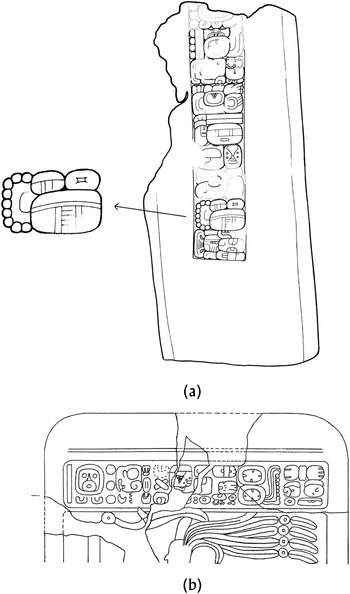
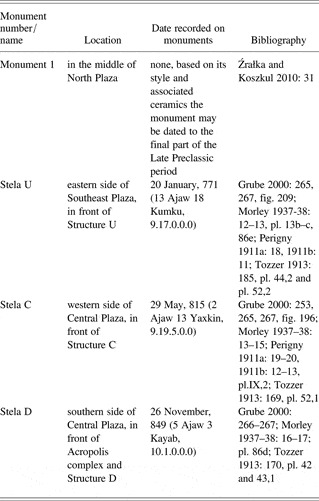
Except for one very early carved monument (Monument 1 dates stylistically to the Terminal Late Preclassic period) recently found at the site (Źrałka and Koszkul Reference Źrałka and Koszkul2010), Nakum has no known carved stelae or altars earlier than the second half of the eighth century (Table 1). The first dated carved monument at Nakum, Stela U, was erected in a.d. 771 in front of a large pyramid-temple (Structure U). Several decades later, in a.d. 815 (2 Ajaw 13 Yaxk'in, 9.19.5.0.0), another monument, Stela C, was erected in front of Structure C. Its text mentions the scattering of “droplets” at a certain place in order to commemorate a hotun ending (Grube and Martin Reference Grube and Martin2004:81). The name of the ruler who dedicated Stela C is eroded but, according to Nikolai Grube (Reference Grube and Wurster2000:253), the glyph which follows the king's name is most likely the Nakum emblem glyph (Figure 24a). It is the first and only epigraphic evidence indicating that Nakum had its own emblem glyph and as such was a seat of k'uhul ajaw. The Nakum emblem glyph is followed by the name of a place called naah ho' chan (“First Five Sky”), which refers to the mythical homeland of several supernatural beings, including the Paddler Deities. It is worth mentioning that the Paddler Deities were widespread in the iconography of Terminal Classic monuments in many Southern Lowland Maya sites (Schele and Grube Reference Schele, Grube and Schele1995:138) and might have played an important role in legitimizing the power of the rulers during that turbulent time. However, the crude execution of this monument (as well as of the hieroglyphic stairway of Structure G) and the fact that it was carved in a tilted position might suggest the existence of a crisis which is reflected in a gradual collapse of the Classic period sculptural tradition. The last carved stela from Nakum (Stela D) was dedicated in a.d. 849 in front of Structure D and was found shattered into many fragments in the early twentieth century (Morley Reference Morley1937–1938:II:16–17; Tozzer Reference Tozzer1913:170, Plates 42 and 43). Some of these fragments show a ruler's headdress, and a short inscription that was documented by Morley (1937–1938:V:Plate 13f) (Figure 24b). Although we have previously argued (Hermes and Źrałka Reference Hermes and Źrałka2008:94; Źrałka Reference Źrałka2008:203) that this text mentions the prestigious title of ochk'in kaloomte', a new interpretation by Simon Martin suggests that the ruler depicted on Stela D likely used the elk'in (?) kaloomte' or the east kaloomte' title (Simon Martin, personal communication 2010) which may reflect the political claims of the local lord and his aspiration to be a high, powerful king of the east. This inscription may also suggest that, at that time, Nakum was an important polity of the eastern part of the Southern Maya Lowlands—at least nominally. The dedications of the three monuments mentioned above, their epigraphic content, as well as the fact that almost all other inscriptions found at the site date to the same time span are strong indications that Nakum gained political independence at the end of the Classic period. This reasoning is further supported by archaeological data which show that Nakum underwent architectural and demographic growth in the same period.
Nakum. (a) Stela C (Nakum Emblem Glyph has been enlarged) (after Grube Reference Grube and Wurster2000:Figure 196); and, (b) Stela D (after Morley 1938:I:Plate 13f). Both monuments were dedicated during the Terminal Classic era.

A list of carved monuments from Nakum1 (it does not include glyphic inscriptions embellishing architecture)

1 One of the altars standing in front of Structure A may have originally born a carving which most probably showed a bound captive. Some vestiges of this carving are still visible. However, the dating of this monument is unknown.
POPULATION GROWTH AT NAKUM
The architectural boom and demographic increase at Nakum during the Terminal Classic period may have been partly caused by a population influx from neighboring Maya cities that were undergoing political and economic collapse. Population influxes during the Terminal Classic period were also documented in the central Peten lakes area centers and in some areas of Belize (Aimers Reference Aimers2004, Reference Aimers2007; Rice and Rice Reference Rice, Rice, Demarest, Rice and Rice2004, 2007; Masson and Mock Reference Masson, Mock, Demarest, Rice and Rice2004; see also Demarest Reference Demarest2004a:266). Archaeological and architectural data from the epicenter and periphery of Nakum suggest that it might have been the place of migration for refugee populations from surrounding sites that were collapsing. The construction of new residential structures, often tightly packed within the Acropolis as well as the building of new chambers or their division into many rooms strongly suggests a considerable increase in the numbers of elite representatives during the Terminal Classic period, on a scale not seen before.Footnote 2 Investigations indicate that during the Terminal Classic period, living space in the Acropolis increased to nearly three times its former capacity (Źrałka Reference Źrałka2008:204–210). The enlargement of the city center is accompanied by a rapid demographic growth and presumably, expansion of the periphery; 36.1 to 41.6% of all patio groups documented in the periphery of Nakum were inhabited during the Late Classic while in the Terminal Classic, inhabitation increased to 77.7–86.1%. Consequently, we observe a 36 to 50% increase in occupation between the Late Classic and the Terminal Classic periods (Hermes et al. Reference Hermes, Źrałka and Calderón2005; Źrałka Reference Źrałka2008).
Similar population influx might have occurred at neighboring Yaxha. Recent archaeological research at the site by the Triangulo and PDS Projects reveals strong evidence of settlement and construction activity during the Terminal Classic period in all the complexes that were investigated. New palaces were constructed and there is evidence of significant architectural remodeling of existing ceremonial and residential structures. Thus the city clearly did not experience severe depopulation at this time. In fact, Hermes et al. (Reference Hermes, Morales, Möllers, Laporte, Escobedo and Monzón de Suasnavar1999) suggest that a Late Classic structure at the end of the Lake Causeway, which served as a southern control point for people coming to Yaxha, was destroyed by local elites during the Terminal Classic period in order to attract refugees fleeing the economic and political collapse of neighboring centers. Studies conducted by the Central Peten Historical Ecology Project in the Yaxha-Sacnab Basin supports this assumption. Although a decrease in population was documented in the Yaxha-Sacnab Basin at the turn of the Late and Terminal Classic periods, the largest concentration of Terminal Classic settlement was documented in two transects on both sides of the Yaxha center (Suboperations 1 and 2) (Rice and Rice Reference Rice and Rice1980). The numerous Terminal Classic settlement remains found in these transects may indicate that a relatively large population remained in the Yaxha peripheries during the Terminal Classic period.
It must be also stressed that several small sites located in close proximity to Nakum show very strong signs of Terminal Classic occupation. Based on ceramic material obtained from test-pits and looters trenches documented at El Tigre and El Carmen (located to the north and west of Nakum, respectively), we know that both sites flourished during the Terminal Classic period (Chan Reference Chan1999; Fialko Reference Fialko2005c; Fialko and Ramírez Reference Fialko and Ramírez2004; Źrałka Reference Źrałka2008:179–181, 211). Existing archaeological data indicate that both centers might have seen an important population influx during the Terminal Classic period and might have been populated by people coming from other abandoned areas. The neighboring site of Laberinto, located west of Nakum, also demonstrates important signs of Terminal Classic occupation (Fialko Reference Fialko2000, Reference Fialko2005c). Moreover, Laberinto, like Nakum, is located close to the Holmul River. Three other, small sites—Fortaleza, Dos Estelas, and Sin Aliento—are also situated west of Nakum and show important Terminal Classic occupation. Five of the above mentioned centers (El Tigre, El Carmen, Fortaleza, Dos Estelas, and Sin Aliento) have defensive locations and are situated in scarped areas close to Nakum (Fialko Reference Fialko2005c). It is possible that during the Terminal Classic period all these sites functioned as outposts of Nakum and were controlled by this center, forming a small Terminal Classic polity in this area.
On the other hand, research by Vilma Fialko (Reference Fialko1996a, Reference Fialko1996b, Reference Fialko1997aReference Fialko1997b, Reference Fialko and Ruz2003) in the inter-site areas between Tikal and Nakum, Nakum and Yaxha, and Yaxha and Naranjo indicate a drop in settlement during the Tepeu 3 phase. It is interesting that in the case of the transect connecting Yaxha and Nakum, Terminal Classic settlement was documented only at the sites located close to Yaxha and Nakum, while sites located further inland did not produce evidence of Terminal Classic occupation. Thus, in this case, we observe a concentration of Terminal Classic settlement in close proximity to centers during this period.
SUMMARY AND CONCLUSIONS
During the Terminal Classic period in the southern Maya Lowlands Nakum became a small enclave, similar to Seibal, Altar de Sacrificios, the Mopan Valley, and some parts of Belize, characterized by cultural continuity and demographic growth. Capitalizing on the decline of Naranjo and the even more powerful state of Tikal, the formerly subordinate elites of Nakum attempted to continue the institution of divine kingship to justify their legitimacy as rulers of this newly independent capital. The Nakum elites might have drawn on the old, traditional symbols seen on the inscribed monuments they erected at the site and new symbols and concepts seen in iconography and architecture to legitimate their rule and high status and to “pull together” local populations, as was documented in the case of Seibal (see Tourtellot and González Reference Tourtellot, González, Demarest, Rice and Rice2004). The short term success of Nakum and possibly also of neighboring Yaxha was dependent on a series of factors, the most important being their proximity to important resources (water sources, trade, and communication routes) and the considerable, if not complete, political and economic independence they gained after the collapse of the former hegemons of this area—Tikal and Naranjo. This combination of different factors enabled the local elites to survive for a century or more into the Terminal Classic period. We conclude, therefore, that Nakum was a vital part of a Terminal Classic period revival in the Maya lowlands and, in fact, reached its peak of population and prosperity during this period before it ultimately declined and was abandoned. As such, we can define the Terminal Classic period as something more than just a time of demise, since it was also a time of very active responses to the changing conditions of this difficult period. In this sense the so-called “collapse” of Classic Maya civilization was rather an extended process that led to the transformation of Maya culture and society.
RESUMEN
Las investigaciones realizadas durante los últimos años en Nakum, ubicado en la parte noreste del Petén, revelaron una ocupación muy fuerte del período clásico terminal. El mayor auge constructivo y aumento poblacional del sitio tuvo lugar en aquella época. Las excavaciones realizadas en el Sector Sur del sitio mostraron que todos los edificios construidos en aquel sector durante los períodos anteriores fueron remodelados sucesivamente de distintas formas durante el clásico terminal. En este mismo período también se llevó a cabo un vasto programa de actividad constructiva durante el cual se erigieron nuevos edificios de diversos tipos (palacios, templos, pirámides y otros). En el Sector Norte y la periferia inmediata al centro del sitio también ha sido documentado el mismo tipo de actividad mencionada. Esto indica que Nakum es uno de los pocos sitios ubicados en las tierras bajas centrales en los que durante el clásico terminal tuvo lugar un auge constructivo de tal magnitud. El desarrollo del sitio en aquel período probablemente estaba relacionado con la ubicación del asentamiento en la margen del río Holmul, que durante el período clásico constituyó una importante ruta comercial y una vía de comunicación dentro de las tierras bajas centrales. Es posible que el desmoronamiento y colapso gradual de Tikal y Naranjo durante aquella época permitiera que Nakum lograra una independencia política y esto permitió que adquiriera al menos una parte importante del control de la ruta comercial asociada al río Holmul. Los datos que se presentan en este artículo demuestran que durante aquel tiempo Nakum estableció nuevos contactos comerciales y/o culturales que contribuyeron a la aparición de productos importados y de nuevos elementos arquitectónicos como edificios circulares, pilares, edificio tipo “tandem” y otros. El grado de poder alcanzado por los gobernantes de Nakum es reflejado en la realización del programa de ampliación a gran escala del sitio y en el uso por primera vez del título de k'uhul ajaw como parte del glifo emblema del cual el ejemplo más claro es la inscripción glífica de la Estela C (dedicada en el año 815 d.C.). Otro gobernante de Nakum, que erigió la Estela D en el año 849 d.C., usaba el prestigioso título de elk'in kaloomte' (kaloomte' de este) lo que indicaba sus deseos y aspiraciones políticas de ser un rey poderoso en este lugar. Los datos presentados proporcionan un mejor entendimiento del período clásico terminal en esta parte de las tierras bajas mayas y contribuyen a nuestro conocimiento del colapso de la civilización maya clásica.
ACKNOWLEDGMENTS
This paper presents results that were mainly obtained during the PRONAT PROSIAPETEN or the Triangulo Project (which the authors participated in from 1990 to 2004) and to a lesser degree, during the newly established Nakum Archaeological Project. The latter Project has been financed by Polish Ministry of Science and Higher Education (grant number N109 022 32/1234 and Iuventus Plus program grant number 9012/H03/2011/70), FAMSI (grant number 06022), the Foundation for Polish Science (Exterius program grant for consolidation of architecture and 3D modelling of architecture), Faculty of History and Institute of Archaeology of the Jagiellonian University. Completion of this article was possible thanks to a scholarship granted to Jarosław Źrałka by the Foundation for Polish Science (Kolumb program).
We would like to thank Robert Sharer, Christophe Helmke, Simon Martin, Wiesław Koszkul, Jan Szymański, and Nicolaus Seefeld for their valuable comments and remarks concerning our paper. Also, we are very grateful for constructive remarks provided by our reviewers, Arthur Demarest and Prudence Rice, which influenced the final version of this article. However, all omissions or errors are our own responsibility. Moreover, we thank Breitner González and Telma Tobar from the Faculty of Architecture of the San Carlos University in Guatemala for their permission to use digital reconstructions of Nakum architecture. Last but not least, we would like to thank Samuel David for editing this text in English.