If you had to choose a moment in human history to live—even if you didn’t know what gender or race, what nationality or sexual orientation you’d be—you’d choose now. There’s power in nostalgia, but the fact is the world is wealthier, healthier, better educated, less violent, more tolerant, more socially conscious and more attentive to the vulnerable than it has ever been. Now there’s also enormous cruelty and tragedy and stupidity and pain. But we tend to forget what the world was like.
—President Barack Obama Footnote 1
My father died in June 2016, aged 98 and a half. His passing was peaceful, and he was lucid and making bad puns almost to the end, so his death was sad rather than a tragedy. But this transition focused my thinking on what “the Greatest Generation” Footnote 2 lived through during the last century—the Great Depression, World War II, and the Holocaust; fascism in Paris, Rome, Berlin, Tokyo, Addis Ababa; mass starvation, the Great Leap Forward, Siberian exile and gulags; lynchings and Jim Crow. Up to eighty million people died in World War II alone, across forty countries.
My father was in military intelligence behind German lines; he was among the first Allied soldiers into Dachau and tracked down the head of Hitler Youth. He would not talk about his war experience and it scarred him irrevocably, but like millions of others, he somehow came home and went on with his life.
My generation and its successors have had our own horrors—the war in Vietnam and Cambodia, 9/11, the 2008 Great Recession, massacres of Kurds and Rwandans, Palestine, Ferguson, MO—but they have not matched the sheer scale and scope of earlier catastrophes. Nonetheless we are arguably more pessimistic than is the Greatest Generation. The 2008 American National Election Study (ANES) asked respondents, “When you think about the future of the United States as a whole, are you generally optimistic, pessimistic, or neither optimistic nor pessimistic?” More people over age 65 than under age 50 chose optimism (58 percent to 54 percent). Respondents over 80 were (marginally) the most optimistic, at 59 percent. The survey results showed a greater disparity among self-identified liberals: 61 percent of those under 50, compared with 71 percent of those over 65 described themselves as optimistic.
My reflections on the passage of the World War II generation merge with Obama’s buoyancy in the epigraph and the ANES results to solidify into this question: Why are contemporary social scientists on the political left relatively pessimistic about the public arena and its trajectory? Answers emerge from two distinct sources: the trajectory of social science research since the 1960s, and the reverberation of world-wide shocks in 1989.
I approach my central question through several more particular questions: What is the evidence of left pessimism among social scientists? Why is left pessimism not the only plausible stance? Why is left pessimism problematic, and surprising? Why does it nonetheless occur? How can social scientists counter left pessimism? I address these questions with illustrative, not definitive, evidence; I believe it to be convincing, but a full research project would need to provide greater breadth and depth. My evidence mainly draws from two arenas of my own research and teaching, but my thinking was invaluably enriched by comments from almost forty colleagues who responded generously to my e-mailed versions of the questions just enumerated. Footnote 3
Reinhard George Hochschild, 1949

Almost every substantive statement could plausibly be festooned with caveats and conditions; I will mostly spare the reader (and myself) those shadings, but I am all too aware of the many nuances I am striding past.
Defining Terms
What do I mean by “relative pessimism among contemporary social scientists on the political left?” First, optimism and pessimism: The optimist “is centered on advancement concerns …. [He or she is driven] by motivations for attaining growth and supports eager strategies of seeking possible gains even at the risk of committing errors or accepting some loss.” Footnote 4 My interlocutors characterized optimistic political actors as those who “believed they were changing history, History was on their side, they have at their full disposal the instruments of the state.” Optimistic scholars engage in “a political science that is founded on an intrinsic idealism and desire for/almost faith in progress.” Such scholars believe that “through careful study, seeking to explain, and leading to understanding, things will somehow be better in some broad sense.” For optimistic social critics, “exposure always carries the connotation, often against likelihood, of pleasing counterfactual states of affairs being attainable ”
A pessimist, in contrast, “is centered on security concerns … [and] supports vigilant strategies of protecting against possible losses even at the risk of missing opportunities of potential gains.” As interlocutors put it, pessimism in this context is an “attack on the very idea that progress is being made.” Or, “programs have reached the limit of their achievement and their proponents have not come up with anything new.” Most broadly, “many relevant aspirations have been butting up against either a) nature or b) democracy—and nature and democracy have been winning.”
I define social scientists on the political left in two ways. The first is self-identification. The broadest and most recent survey of scholars, conducted in 2006, included a stratified sample yielding 1,416 full-time faculty respondents in almost all disciplines and type of institution. Footnote 5 Overall, 58 percent of social scientists, 52 percent of humanists, and 45 percent of biological and physical scientists identified as liberal. Footnote 6 Almost no biologists, but 38 percent of sociologists and 15 percent of political scientists and historians are self-identified radicals or on the far left. Footnote 7
A second way to identify social scientists on the political left is through a set of shared substantive concerns. The Social Science Research Council’s Anxieties of Democracy program nicely encapsulates the institutional face of leftist social science: its investigation “is motivated by a concern about whether the core institutions of established democracies—elections, mass media, political parties, interest groups, social movements, and, especially, legislatures—can capably address large problems in the public interest.” Footnote 8 An interlocutor nicely summarized the distributive face: left social scientists share the commitment “that advances in equality, in the redistribution of power, would occur along class, gender, and racial lines, and international lines—that somehow the whole thing would move together.”
Reinhard George Hochschild, Honor Flight Network, 2010

My time period for “contemporary” is expansive—from 1776 to the present. Although I focus much more on the last half-century than on the two centuries before that, the time scale is such that I have little to say about current political phenomena such as the United States’ presidential election of 2016, Great Britain’s Brexit vote of June 2016, or war in Syria.
Evidence of Left Pessimism among Social Scientists
Racial and Ethnic Politics
Illustrative evidence for my examination of left pessimism and social science comes mainly from the study of racial and ethnic politics in the United States—my chief research arena for the past few decades. An only slightly simplistic summary of that field is that pointing to socioeconomic or political gains made by disadvantaged minority groups, or to policy initiatives that have substantially diminished group-based hierarchy, is perceived by many scholars to be a conservative stance. Conversely, pointing to deep and unchanging racism or white supremacy, the overweening carceral state, the racialization of immigrants, or other failures to erode group-based hierarchy is largely the purview of people who see themselves as being on the left. I discuss why that is a surprising and troubling pattern below—but first some evidence on the point.
Consider the following observations from eminent experts on American racial and ethnic politics:
-
the [fiscal] crisis has made Obama … a ‘hollow prize’ for black America …. [Racial] recognition without a commitment to eradicating racial inequality may actually end up further perpetuating inequality; Footnote 9
-
beyond the increase in explicit racism, … black people have suffered tremendously on Obama’s watch …. Black communities have been devastated …. In 2008 and again in 2012, Obama sold black America the snake oil of hope and change …. Maybe black people believed he represented real change. Maybe we didn’t. Maybe we needed the illusion of hope. It doesn’t matter. The reality, among the thick fog of unmet expectations, is that very little has changed in this country. In fact, things have gotten worse; Footnote 10
-
over roughly the last half-century we have moved from an era of black insurgency in this country to … a period of black nihilism …. For many years now, the capacity of African Americans’ ability to mobilize, influence policy, demand accountability from government officials, and contribute to and influence American political discourse … has been extremely weak, and it remains so; Footnote 11
-
the election of President Obama helped usher in a most-racial political era where racially liberal and racially conservative Americans were more divided over a whole host of political positions than they had been in modern times; Footnote 12
-
U.S. policies are moving Mexican Americans steadily away from their middle position in the economic hierarchy and toward formation as an underclass. Segregation levels are rising, discrimination is increasing, poverty is deepening, educational levels are stagnating, and the social safety net has been deliberately poked full of holes to allow immigrants to fall through; Footnote 13 and
-
[the United States risks subjecting undocumented Mexican immigrants] to the harshest, most exploitive, and cruelest treatment that human beings are capable of inflicting on one another. Footnote 14
These are, of course, selected quotations out of a river of writing on American racial and ethnic dynamics over the past few decades, so I cannot prove that they are representative. They are, nonetheless, exemplary; the authors quoted here are among the most widely read and respected political scientists or sociologists teaching and publishing today. I could have added many other similar depictions of America’s failure to reduce, or even its tendency to expand, racial hierarchy or ethnic exclusion since the civil rights era.
Some survey data support the claim that these quotations are representative of left social scientists’ views on group-based hierarchy in the United States. The General Social Survey (GSS) asked respondents five times from 1994 through 2002: “In the past few years, do you think conditions for black people have improved, gotten worse, or stayed the same?” Given 7,770 respondents, we can do fairly fine-grained tabulations. Combining all of the surveys, among respondents with postgraduate degrees, 55 percent of self-identified liberals, compared with only 32 percent of conservatives, responded “worse” or “stayed the same.” Among liberals, again 55 percent of postgraduates, but only 43 percent of those with a high school degree or less schooling, responded “worse” or “stayed the same.” In short, the best-educated liberals are the most pessimistic category of Americans about our country’s racial dynamics.
Genomics
My other arena for illustrative evidence is the ideology around genomic science; I use it partly because it is another of my own research fields and partly because genomics is crucial to my argument in ways that I will explain below. Here too, a broad summary of social scientists’ positions points to a paradox, or at least a puzzle.
Evidence from public opinion, public officials’ stances, and policy initiators shows liberals to be more likely than conservatives to endorse scientific research and its societal use. Prominent examples are the politics surrounding stem cell research, evolutionary theory, and climate change. Footnote 15 However, social scientists’ views on genomic science show the opposite pattern. Many scholars on the left reject any suggestion of a genetic component to most behaviors, diseases, or physical features—or if they accept the legitimacy of genomic science, they “question the purpose to which that science will be put,” as one of my interlocutors put it. Again I offer a few illustrative quotations, backed by some systematic evidence:
-
Forensic DNA repositories are gathered by the state without consent and are maintained for the purpose of implicating people in crimes. They signal the potential use of genetic technologies to reinforce the racial order not only by incorporating a biological definition of race but also by imposing genetic regulation on the basis of race. … Databanks no longer detect suspects—they create suspects from an ever-growing list of categories. Footnote 16
-
The direct route to eugenics [as in Nazi Germany] is not the issue [with regard to genetic screening for disease] …. It is a more insidious situation about which I would issue a warning and venture a prediction …. With this machinery [genetic sequencing] developing and expanding … it is only a matter of time before elliptical eugenic uses are made of these new technologies …. The hour is late, the technology is closer, and the public debate has not been vigorous. Footnote 17
-
[Biogenetic explanations of disease are misguided, since] we literally biologically embody exposures arising from our societal and ecological context, thereby producing population rates and distributions of health. [Explanations for and treatment of disease should focus on] socially patterned exposure-induced pathogenic pathways … that affect the development, growth, regulation, and death of our body’s biological systems, organs, and cells, culminating in disease, disability, and death. Footnote 18
In order to determine ideological valences of varying views on genomic science, graduate student research assistants hand-coded the relevant highest-impact articles in the highest-impact journals in thirteen disciplines (ten social sciences, law, biology, and biological anthropology) from January 2002 through May 2016. Keywords were “genetic(s),” “genomic(s),” and “DNA,” and the articles were coded for “the author(s)’ overall valence and intensity with regard to the actual or likely effect of genetics or genomics on society, or in medicine, law, racial definition, etc.” The coders were cautious, classifying most articles in most disciplines as lacking a clear valence as I defined it. Setting aside biology, 72 percent of the 1,046 coded social science or law articles were deemed “neutral.” Nonetheless, the remaining three-tenths showed clear differences. Roughly 30 percent of the articles in Ethics and in Law argued that genomics would have a positive societal impact, compared with fewer than 10 percent in Cultural Anthropology and Racial and Ethnic Studies. No article in the field of Cultural Studies offered a positive view of genomic science or its impact; scholars in Cultural Studies and Racial and Ethnic Studies were much more likely to see harmful or, at best, mixed impacts of the new science.
In short, the more leftist or liberal a social science discipline is, the more pessimism or concern its experts express about genomic science. That conclusion holds for both the studies’ initial queries and their conclusions; as one interlocutor put it, “I conjecture that biologists, psychologists and economists are asking questions about how genetic manipulation can advance, while the humanists, including some political scientists, are asking about the (very substantial) ethical and other dilemmas genetic manipulation poses.” Exactly so.
Is Pessimism the Only Sensible or Empirically Warranted Response in these Two Arenas?
It is easy to find evidence to support pessimism about American racial dynamics or the societal deployment of genomic science. The United States is notorious for its racially- and ethnically-inflected poverty and excessive levels of incarceration; undocumented migrants live in legal limbo; new genomics techniques such as CRISPR-Cas9 tempt humankind into hubristic manipulation of nature, and scientists’ promises to cure cancer through genetics knowledge ring hollow to many. The question for this article is whether there are also strong grounds for optimism in my two illustrative realms, such that one could plausibly and persuasively choose to be “centered on advancement concerns” rather than “centered on security concerns.”
The answer is yes. Again I can point only to illustrative, suggestive evidence. First, the gap between blacks’ and whites’ life expectancy declined from seven years in 1990 to 3.4 years in 2014. That is an astonishing, perhaps unprecedented, rate of change given the usual slow pace of demographic transformation. It is important in itself, of course, and also as a summary statement about an array of other social phenomena in which racial disparities are declining. Blacks are living longer mainly because of declining rates of homicides, HIV mortality, infant mortality, cancer and heart disease, and suicide among black men. Footnote 19 A lot of things have to go right for a group’s life expectancy to rise rapidly.
Second, applications for U.S. citizenship rose from the previous year in ten of the fifteen years from 2000 to 2015, while declining in four (and remaining stable in one). That is an important indicator of immigrant incorporation, and especially relevant to political scientists because “Hispanics and Asians who are naturalized citizens tend to have higher voter turnout rates than their U.S.-born counterparts.” Footnote 20
Third, non-white Americans themselves tend to feel pretty good about their lives. Gallup Poll asked in 2016, “Where do you expect your life satisfaction to be in five years?” If whites’ response is standardized at 1, then blacks are at 2.97, and Hispanics at 1.29. Only Asian Americans, at 0.97, were less optimistic than whites. Gallup also asked about one’s level of stress in the previous day. If whites are again standardized at 1, then blacks are at 0.48; Hispanics at 0.53; and Asian Americans at 0.75. Middle-class blacks were half as likely as middle class whites to report stress during the previous day. Footnote 21
In the arena of genomics also, one can point to grounds for optimism rather than pessimism. The Innocence Project, “dedicated to exonerating wrongfully convicted individuals through DNA testing and reforming the criminal justice system to prevent future injustice,” has enabled about 350 people to be released from prison. (Not so parenthetically, seven out of ten are African American or Latino, mostly poor men.) More extensive DNA testing might lead to many more exonerations; one careful analysis of serious crime convictions found that “in five percent of homicide and sexual assault cases DNA testing eliminated the convicted offender as the source of incriminating physical evidence.” Previous estimates had pegged the share of wrongful convictions at no more than one to two percent. Footnote 22 More generally, “DNA profiling [of convicted felons] reduces the probability of future convictions by 17% for serious violent offenders and by 6% for serious property offenders …. These are likely underestimates of the true deterrent effect of DNA profiling.” Footnote 23
Genomic scientists can point to impressive successes with regard to Mendelian (single-gene) diseases, and they focus even more on diagnoses and cures yet to come. Eric Lander, director of the Broad Institute, likens the trajectory of genomic medicine to the development of medicine based on the germ theory of disease, which “took about 75 years. With genomics, we’re maybe halfway through that cycle.” In his view, “the rate of progress is just stunning. As costs continue to come down, we are entering a period where we are going to be able to get the complete catalogue of disease genes.” Cancer is a prime target, almost in sight: “If you understand that this is a game of probability, and there is only a finite number of cancer cells and each has only a certain chance of mutating, and if we can put together two or three independent attacks on the cancer cell, we win. If we invest vigorously in this and we attract the best young people into this field, we get it done in a generation. If we don’t, it takes two generations.” Lander is “not Pollyanna …. [I]t’s not for next year. We play for the long game. I don’t want to overpromise in the short term, but it is incredibly exciting if you take the 25-year view.” Footnote 24
This is a classic statement of optimism, or being centered on advancement concerns. It begins with expertise and perspective, sees dangers and weaknesses, and nonetheless asserts empirical grounds for faith. President Obama’s insistence that “if you had to choose a moment in human history to live … you’d choose now” has the same quality. My point is not that left pessimism is wrong—only that there are grounds, perhaps equally strong, for left optimism. One can choose either, and then find good evidence for that choice.
Why Is Left Pessimism Problematic?
That wily politician, Barney Frank, offers the best answer from the vantage point of the public arena: “When you tell your supporters that nothing has gotten better, and that any concessions you’ve received are mere tokenism, you take away their incentive to stay mobilized. As for those you’re negotiating with, if you denigrate anything they concede as worthless, they will soon realize they can obtain the same response by giving nothing at all.” Footnote 25
One can offer the same type of answer from the vantage point of a teacher. Many of us have had the experience of teaching a course—about civil war, inequality and politics, environmental policy, or the meaning of liberty—only to have our students politely request on the last day of class some idea or piece of information about which they can feel good or which they can use in their public engagement. We need to offer answers. Optimism may also be associated with academic success; one careful study found that “although achievement in mathematics was most strongly related to prior achievement and grade level, optimism and pessimism were significant factors. In particular, students with a more generally pessimistic outlook on life had a lower level of achievement in mathematics over time.” Footnote 26 A study of college students similarly found that “dispositional and academic optimism were associated with less chance of dropping out of college, as well as better motivation and adjustment. Academic optimism was also associated with higher grade point average.” Footnote 27
And for those of us of a certain age, it is heartening to discover that “after adjusting for covariates, the results suggested that greater optimism [among middle-aged, predominantly white Americans] was associated with greater high-density lipoprotein cholesterol and lower triglycerides …. In conclusion, … optimism is associated with a healthy lipid profile; moreover, these associations can be explained, in part, by the presence of healthier behaviors and a lower body mass index.” Footnote 28
Why Should We Be Surprised at Left Pessimism?
For at least the past few hundred years, scholars and activists on the left have been associated with optimism. In fact, the left—understood as progressivism, American-style liberalism, or radicalism—has often been partly defined in terms of optimism. Yuval Levin, in The Great Debate: Edmund Burke, Thomas Paine, and the Birth of Right and Left, Footnote 29 argues that the long decades of disagreement between Edmund Burke and Thomas Paine with regard to the American and French revolutions “still describe two broad and fundamental dispositions toward political life and political change in our … age.” Footnote 30 Levin’s analysis of the two thinkers is dense and complex but perhaps can be encapsulated, once again, in a few illustrative quotations. From Paine:
-
We have it in our power to begin the world over again; Footnote 31
-
From what we now see, nothing of reform in the political world ought to be held improbable; Footnote 32 and
-
Every generation is, and must be, competent to all the purposes which its occasions require. Footnote 33
Burke, in contrast, feared revolution on the grounds that “a spirit of innovation is generally the result of a selfish temper and confined views. People will not look forward to posterity who never look backward to their ancestors.” Footnote 34 He confessed to the British House of Commons that “I advance to it [his proposed financial reforms] with a tremor that shakes me to the inmost fiber of my frame.” Footnote 35
Analytic philosophy concurs with and provides a framework for understanding Levin’s discursive history of political ideas. In fact, Albert Hirschman’s The Rhetoric of Reaction: Perversity, Futility, Jeopardy inspired my thinking on the subject of left pessimism and continues to shape my analysis. Footnote 36 Hirschman argues that conservative thinkers, historically and currently, tend to react to proposals for change in three ways. First, they offer the perversity thesis: “any purposive action to improve some feature of the political, social, or economic order only serves to exacerbate the condition one wishes to remedy.” More pointedly, “the attempt to push society in a certain direction will result in its moving … in the opposite direction.” Footnote 37 Alternatively, conservatives offer the futility thesis: “attempts at social transformation will be unavailing, that they will simply fail to ‘make a dent’.” More expansively, “any alleged change is, was, or will be largely surface, facade, cosmetic, hence illusory, as the ‘deep’ structures of society remain wholly untouched.” Finally, conservatives offer the jeopardy thesis: “the cost of the proposed change or reform is too high as it endangers some previous, precious accomplishment,” or “the proposed change, though perhaps desirable in itself, involves unacceptable costs or consequences.” Footnote 38 These theses may seem to contradict one another, but opponents of political or societal change frequently offer them in combination.
Liberals, in Hirschman’s analysis, offer countervailing rhetorical tropes. Instead of the jeopardy thesis, they promote the synergy illusion: “progressive observers will focus on reasons why a new and an older reform will interact positively …. Progressives are eternally convinced that ‘all good things go together.’” Footnote 39 Instead of the futility thesis, progressives insist that “the world is ‘irrevocably’ moving in some direction they advocate.” Leftists “enjoy and feel empowered by the confidence … that they ‘have history on their side.’” Footnote 40 Finally, instead of the perversity thesis, “the progressive counterpart … is to throw caution to the wind …. Progressives are forever ready to mold and remold society at will and have no doubt about their ability to control events.” Footnote 41
Hirschman may be historically or empirically mistaken—indeed, my argument is that he is mistaken about many contemporary social scientists. But he has captured in a typology what Levin and others have claimed through narrative: part of what it has historically meant be on the right is pessimism about societal reform or scientific innovation, whereas part of what it has historically meant to be on the left is optimism about societal reform or scientific innovation. Footnote 42
How Do I Explain Left Pessimism? The Trajectory of Social science Research
The first of my two proffered explanations for left pessimism among social scientists addresses the social sciences themselves. Again I focus on illustrative themes, four in this case, rather than attempting a complete analysis. The 1960s provided vivid examples of all three Hirschmanian liberal tropes. Theorists of modernization of “underdeveloped countries,” including Talcott Parsons, Edward Shils, Gabriel Almond, Walt Rostow, and Lucian Pye, among others, were one cluster. David Potter provided the vision of historical progress: “the United States is presiding at a general reorganization of the ways of living throughout the world.” Footnote 43 Daniel Lerner provided the synergy: “modernity is felt as a consistent whole among people who live by its rules.” All features of modernization “went together so regularly because, in some historical sense, they had to go together.” Footnote 44 These scholars also exhibited little doubt about their country’s “ability to control events”—hence the involvement of Walt Rostow, for example, at the highest level of the Kennedy administration. “Armed with the tools of social science and confident in their rational, analytic powers, representative thinkers … define[d] the requirements for movement” from “traditional” to “modern” societies. Footnote 45 As Nils Gilman summarizes, “the ideal terminus of development … was an abstract version of what postwar American liberals wished their country to be. … Modernization theory was the fruit of American social scientists’ effort to build a comprehensive theory … for promoting change that would make these regions become more like ‘us’.” Footnote 46
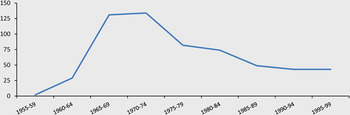
I conducted a JSTOR word search for the term “modernization” in articles, books, or review titles, in English, in political science, from 1950 through 2000. Figure 1 displays the number of appearances of “modernization” that resulted from the search, and shows its rising, then declining, popularity during and after the 1960s. The trajectory is clear and unambiguous: the study of, and commitment to, modernization theory rose through the 1960s, then fell almost as precipitously in the 1970s never to rise again. In its heyday, it provided a rich and intricate theory from which many scholars developed research agendas, deep and powerful empirical results—and a level of optimism that came to be seen as both naïve and imperialistic.
The rise and decline of “modernization” in political science scholarship, in 5-year increments, 1955–2000
Data from JSTOR keyword search; refer to the text for explanation.

A second strand of theory and research enabled similar optimism with regard to western, already “modern” nations. T. H. Marshall’s 1950 classic statement in Citizenship and Social Class, “achieve[d] its full impact in 1963” and thereafter. Footnote 47 Marshall portrayed the progress of rights revolutions in western states, from civil (“rights necessary for personal freedom”), to political (“right to participate in an exercise of political power”), to social (“right to a modicum of economic welfare and security to share to the full in the social heritage and to live the life of a civilized being”). Achievement of these rights roughly corresponded to the eighteenth, nineteenth, and twentieth centuries respectively, in a teleology from which there was no going back.
Marshall and his successors provide, in short, a second example of Hirschman’s synergy illusion and liberal confidence that “history was on their side.” Ralf Dahrendorf captured the essential optimism of this analysis: “In the early centuries of the modern age … legally entrenched differences in entitlements … had to be broken and the principle of citizenship established. Then the struggle for giving this principle civil, political, and social substance began. From the point of view of the 1950s, it was quite successful …. It might indeed have seemed for a while that the battle was almost over.” Footnote 48 This was the path to which modernizing nations could, should, and indeed did aspire.
A third strand of 1960s social science was more methodological, but shared the normative and empirical optimism of the first two. What came to be known as the behavioral revolution, with its claim to “scientific empiricism,” swept through much of American social science, encouraging “a mood of optimism about the possibilities of improving the study of politics.” As Robert Dahl continued, “the evidence of the voting studies tends to pile up in a single direction …. There has been a steady and obvious improvement in quality, range, and depth.” Footnote 49 Even earlier, John Gaus had used his own 1946 APSA presidential address to lay out the “job analysis of political science.” Footnote 50 Confronted as the world is with “the atomic bomb problem,” his listeners have an urgent responsibility. “For those committed to reason, as our very title commits us, we cannot retreat; we must push the application of science further into the analysis of human behavior and institutions.” After all, “a science of materials … is incomplete to man … if he does not complete it with a science of the institutions of the community whereby man may live at peace in that community and realize more nearly what he is capable of being as a man.” Footnote 51 Alongside Dahl and Gaus, eminent scholars such as Philip Converse, Donald Stokes, Sidney Verba, Gabriel Almond, James Coleman, Arthur Miller, and many others embraced behavioral methods; their compelling findings and even more powerful mode of research still form the substrate for a great deal of excellent political science, even as their optimism about behavioral science’s capacity to enable people to live better has lost adherents.
A final strand of social science research in the 1950s and 1960s speaks directly to the issue of American racial and ethnic dynamics. In the era of Brown v. Board of Education and burgeoning civil rights activism, optimistic theories about the promotion of racial justice dominated the academy. Gunnar Myrdal’s canonical An American Dilemma set the tone in 1944. Dozens of chapters and a thousand pages of text developed the theme of the American dilemma, “the ever-raging conflict between … the American Creed … of high national and Christian precepts and … group prejudice against particular persons or types of people.” The dilemma is deep, broad, and devastating. Nonetheless, Americans “are all good people; … America is constantly reaching for … democracy at home and abroad. The main trend in its history is the gradual realization of the American Creed …. America can demonstrate that justice, equality, and cooperation are possible between white and colored people.” Footnote 52
A decade later, social scientists spelled out one crucial mechanism for promoting the American Creed. Gordon Allport’s contact theory was a subtle and conditional argument about the circumstances under which direct connections across racial lines could lead to genuine interaction and more equal relations. Footnote 53 Its argument was careful, but it rested on a strong ideological assumption: “most Americans have a deep inner conviction that discrimination is wrong and unpatriotic …. They may …sigh with relief if the law, in accord with their ‘better natures,’ is passed—and enforced. People want and need their consciences bolstered by law, and this is nowhere more true than in the area of group relations.” Footnote 54 Allport’s argument that well-designed intergroup contact would yield better and fairer relations became the model, at least in principle, for school desegregation and other institutional efforts to overcome Myrdal’s dilemma.
Milton Gordon extended social scientists’ optimism about American racial dynamics to American ethnic dynamics. Footnote 55 His model of the seven stages of assimilation aimed to refute early twentieth-century fears about hordes of indigestible semi-white southern and eastern Europeans who were ruining our democracy and culture. Starting with acculturation to the language and values of the host country, an immigrant (or more likely, several generations of a family of immigrants) became successively incorporated into institutions, marriage, national identity, attitudes, behavior, and finally the full polity. Gordon was acutely aware of “the deeper roots of the problem” Footnote 56 manifested through ethnic discrimination or violence, and he almost despaired of solving the problem of race in the United States. But he remained optimistic about full ethnic incorporation, even to the point of worrying instead about the “intellectual subsociety … who, because of wide-ranging interest in ideas, the arts, and people, find ethnic communality personally uncongenial.” Footnote 57
By the early 1960s, social scientists found evidence that the United States’ new political commitment to racial justice was having the desired impact. Herbert Hyman and Paul Sheatsley’s renowned article in Scientific American demonstrated, at least to the authors’ satisfaction, that behavior change leads to attitude change. Footnote 58 They recognized resistance and hostility, of course, as well as the flaws of survey research. They nonetheless provided evidence to show that “the overall picture is … one of a massive trend …. Official action [to desegregate schools] has preceded public sentiment, and public sentiment has then attempted to accommodate itself to the new situation …. Public acceptance of integration increases because opinions are readjusted to the inevitable reality …. In the hearts and minds of the majority of Americans the principle of integration seems already to have been won.” Footnote 59
These were powerful arguments, powerfully theorized and supported, and they resonated across the social sciences. Linking them with other strands of social science research enabled a vision of robust rights in modern polities, strong forces working to grant rights to those previously excluded, equally strong forces moving nonwestern polities into the modern era, and a new set of methodological tools to document, analyze, and encourage all of these forces. Social scientists had, it seemed, persuasive grounds for Hirschmanian optimism; history was on their side.
Then came the long 1960s. In quick succession, African Americans’ anger erupted into violence and rejection of white liberals; the Vietnam war escalated; the Watergate scandal unspooled; white backlash (or frontlash?) Footnote 60 sponsored racial surveillance and incarceration; former colonial states rejected western liberal modes of governance and understandings of rights. Perhaps inevitably, the research of a new generation of scholars responded to these domestic and international disasters. Footnote 61
I have no room to detail the history of social scientists’ reaction against the optimism of the early 1960s; I will simply point to some of the results. First, theories of modernization came to appear simplistic, imperialistic, or merely wrong. In their place arose an array of analytic frameworks, almost all much more pessimistic: dependency theory, theories of the rise or persistence of religious or ethnic nationalism, post-colonialism, neoliberalism, theories about state failure and stateless warfare, governmental overload, and more.
T.H. Marshall’s progression of rights came similarly to seem simplistic, imperialistic, or merely wrong. Scholars increasingly argued that the language of universal rights is itself profoundly parochial or domineering, that even western polities were built on a gendered social contract or a white supremacist racial contract, that economic inequality is rising to the point that it will overwhelm political rights and societal opportunities. By now, say some scholars, “political systems that had seemed very stable a few short years ago suddenly appear to be under great strain …. [T]he fate of liberal democracy hangs in the balance.” Footnote 62
At the same time, the shiny promise of the behavioral revolution got tarnished, even among empirical researchers. Even while celebrating its promise, Dahl pointed out that behavioralism is poor at systemic analyses: “analysis of individual preferences cannot fully explain collective decisions …, yet one classic concern of students of politics has been the analysis of systems of individuals and groups.” Footnote 63 In response, another array of analytic frameworks, almost all much more pessimistic, arose: Foucauldian genealogies, historical institutionalism, critical race theory, feminist and queer frameworks, rational choice institutionalism, path dependency, motivated reasoning, and more.
Proponents of these frameworks disagree, sometimes vituperatively, with one another. Nonetheless, they share the assumption that individual agency is constrained, distorted, partial, perhaps even impossible. Scholarship abounds on the tragedy of the commons, prisoner’s dilemmas, Arrow’s impossibility theorem, structural constraints. Two of my interlocutors captured this point well: “one of the things that leads to pessimism … is the influence of Foucault—there is no way out of the box; even when you try to implement reforms, you end up supporting the system of oppression …. [Also] at their worst, discussions of neoliberalism can be all-encompassing (like the Foucault approach)—a tight interlocked system that is hard to break through. Focusing on neoliberalism, and especially focusing on it with such an approach, is likely to reinforce pessimism.” Or, “structural and critical approaches tend to assume human domination …. Whereas structuralism and critical theory were once used to identify counterfactuals to hegemony, today many counterfactuals (e.g., instances of progress) are now considered manifestations of oppression. There is no change: only stability.” This is a far cry from Paine’s commitment to remaking the world, or the Hirschmanian conviction that “history is on their side.”
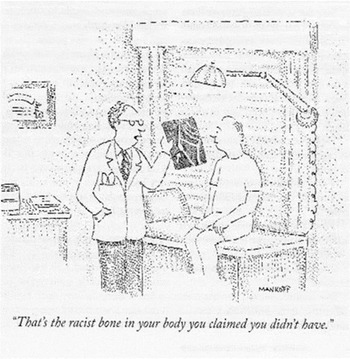
We see the same move toward less volitional and more pessimistic analyses in the arena of racial and ethnic politics. Myrdal, Allport, Gordon, Hyman and Sheatsley, and their ilk came to seem at best naïve, at worst white supremacist. New analyses moved in two distinct though not necessarily incompatible directions. The first probed the psychological, perhaps unconscious, individual impulses that contribute to hierarchy. This line of argument has developed under various labels—implicit racism, the need for covering, social dominance orientation, or dog whistle politics. Figure 2 captures this line of argument.
Implicit racism
New Yorker Cartoon - by Robert Mankoff Published June 20, 2016

Alternatively, post-1960s analyses of racial dynamics focus on structures that created or sustain white supremacy. Scholars point to constitutive features of the United States such as federalism, the two houses of Congress, or whites’ settlement of western territories and laws for the creation of new states. Both in and outside the United States, they identify racial domination in economic structures including taxes and tariffs, financial systems and the international market economy, transportation networks, and the role of undocumented or enslaved workers in creating national wealth. Policies that, intentionally or not, sustain white supremacy include wealth-creating subsidies in the American housing market, social welfare policies tied to employment in the primary labor market, and immigration and naturalization policies.
Most broadly and amorphously, left social scientists felt increasingly betrayed in the twenty-first century by governmental forces that they had perceived as allies in the 1960s. American leftists of my generation imprinted on the positive role of the federal government at same time that political science was maturing and becoming much more empirical. E.E. Schattschneider’s observations about “expand[ing] the scope of the conflict” made a great deal of sense in the era of Sheriff Bull Connor and state’s rights on the one hand, and the 1964 Civil Rights Act, Medicare, Hart-Celler Immigration Act, and the Warren Court on the other. Footnote 64 The emergence of the European Union from a myriad of small polities, with its commitment to internal free trade and open borders, seemed similarly to be an almost miraculous response to the horrors of internecine destruction in World Wars I and II.
But then came the Reagan and Thatcher administrations, the Burger, Rehnquist, and Roberts Courts, bureaucratic sclerosis in Brussels, and the USSR’s repression of religious freedom and nationalist sentiment. Perhaps we should not have been surprised; over the past two centuries, American elected officials and courts more often sustained white supremacy and opposed downwardly redistributive policies than their opposites. Nonetheless, my interlocutors captured the sense of intellectual as well as moral betrayal: “critical race theory and the republican tradition in black political thought … turn to pessimism in moments where the state abrogates its responsibility to enforce the rule of law due to institutional inertia or is captured by conservative forces …. Left pessimism is a cyclical response to real periods of retrenchment.” Or, “the discipline has become considerably more skeptical about what ‘government’ can accomplish. Under the influence of economics, states were more often seen as entities that extracted rents (Bates, Levi, etc.) or at a minimum introduced inefficiencies into a market economy. Development agencies, conscious of corruption now a major issue in the discipline, began to sidestep states to deliver aid via NGOs. So the government/state—the vehicle for collective agency—has been delegitimized.”
One line of research exemplifies social scientists’ decades-long move from excitement about the possibilities of human agency and government reform to the unreachable depths of psychological irrationality and structural rigidity. I teach this trajectory in my course on “Power in American Society” (with “American” stretched to include Virginia Woolf, Foucault, Franz Fanon, and other demonstrably non-Americans). The first face of power is a classic instance of Dahlian behavioralism: a count of explicit actions in which A gets B to do something that B would not otherwise have done. Footnote 65 So the Council on Foreign Relations persuaded Congress and the president that South Vietnam must be defended “at all costs;” Footnote 66 Miss Grava and her neighbors pressured the New Haven city council into rejecting a developer’s plan to build cheap metal houses in their neighborhood. Footnote 67
Scholars responded to this argument by pointing to the second face of power, involving anticipated reactions, hidden agendas, the dog that doesn’t bark. The real power is wielded by those who can keep people from even trying to achieve their interests in the political arena because they know they will lose. Footnote 68 Thus New Haven’s bankers need not take an active role in city governance; Mayor Lee does not bother to propose policies or reforms that they would successfully oppose.
Next came the third face of power: false consciousness, constrained imagination, linguistic and conceptual narrowing. In this view, the exercise of power prevents citizens from even knowing, much less pursuing, their own interests. Footnote 69 Thus the overwhelming presence of coal companies ensures that Appalachian miners oppose unionization or taxation of corporate coal wealth.
Scholars next came to perceive a further face of power: a Foucauldian total disciplinary and surveillance system in which power creates the categories of knowledge that we use to understand power. Footnote 70 This is truly Sartre’s No Exit; the very words in which we think, want, or act are constructed by and reinforce the exercise of state control, down to the capillaries. Perhaps this intellectual trajectory ends in postmodernism, which depicts even Foucauldian structures and disciplines as linguistic inventions, no less ephemeral than a thought or perception. If “there is no text in this class,” then each interpretive community, or perhaps each person, participates in defining or creating power. Any given understanding of power is only as powerful as the interpretive community permits it to be. Footnote 71 There is no there there.
My point is not that the increasingly structural arguments, or even the radically deconstructionist viewpoint, are wrong; any or all may capture some crucial facet of that mysterious core of political science, the study of power. My point instead is that, as political scientists pursue ever-deeper understanding of structural constraints, multiple forms of domination, or manipulated micro-foundations of political thought and action, the role of agency—of individual, group, social movement, or political party—recedes from plausibility or even visibility. Here is where genomic science is reinserted into my analysis: genetic explanations for phenotypes appear to threaten the last hope of claiming intentional action. They must, therefore, be denied, perhaps especially by those who are most persuaded of societal, cultural, political, or group domination.
How Do I Explain Left Pessimism? The Trajectory of Revolutionary Movements
The second of my two proffered explanations for left pessimism among social scientists addresses the external world rather than disciplinary activities. The key term is 1989, the year in which the hope for world-historical revolutionary change ended.
Through the nineteenth and twentieth centuries, leftists had always lived no more than a generation away from a revolutionary movement aimed at radical structural and personal transformation. Even if the movement failed, as many did, leftists could recall or hear from their parents about efforts to make the world anew. The American revolution, the French revolution, the American Civil War, the Bolshevik revolution, and the Chinese revolution provided vivid demonstrations of what might be possible when individuals commit themselves to transformation through faith, action, and solidarity.
There were also a plethora of intermediate movements, not quite on the scale of the Big 5 but exhilarating and inspiring nonetheless. They occurred, among other times and places, in Haiti in 1791, France in 1848; Paris in 1871; India in the 1920s; Spain in 1938; Israel in 1948; Algeria in the 1950s, and Vietnam in 1973. As one of my interlocutors put it, “many of those movements drew on utopian visions whose proper starting point was the Atlantic Revolutions of the late eighteenth century, visions then refueled by the socialist and communist imaginings and revolutions of the twentieth century. All shared a belief in worlds transformed by revolution, and the implementation of regimes of liberty and equality for all.” Another personalized the same vision: “We believed that progress (as we defined it) was possible and would happen (sooner or later). I think that for everyone who was significantly influenced by Marxism (myself included), this type of optimism was somewhat present: Marxism was a scathing indictment of capitalism but promised light at the end of the tunnel.”
The 1989 fall of the Berlin wall and occupation of Tiananmen Square both seemed momentarily to be additional movements drawing on the utopian visions of earlier revolutions. Chinese art students created a 10-meter-tall Goddess of Democracy, who appears in figure 3. Berlin’s protesters wrote “FREEDOM” in huge letters on the Wall, and danced on its top the day it was breached.
The Goddess of Democracy, Tiananmen Square, 1989

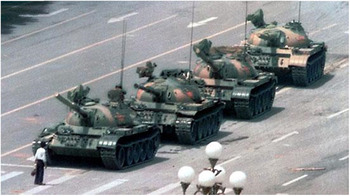
But massacre soon followed in Beijing, with hundreds, or perhaps thousands, of student demonstrators killed by the tanks of the purportedly revolutionary People’s Republic of China. Workers who had demonstrated were tried and executed later. The image seared in our minds of Tiananmen is not the Goddess of Democracy, but “tank man,” shown in figure 4. I do not know his fate. East Germans were not killed in the act of tearing down the Berlin Wall, but their desperate eagerness to do so was another deeply disillusioning moment, showing the destruction of the communist dream of an egalitarian socialist republic.
“Tank man,” Tiananmen Square, 1989

Since 1989, we have witnessed a few additional moments of revolutionary fervor—the end of South African apartheid in 1992, Arab Spring in 2010, perhaps Black Lives Matter. But the first of these moments is mired in difficulties, the second was swamped by ruthless authoritarians, and the third has not yet caught fire with a broad swath of American youth. In short, as an interlocutor put it, after the failure of the communist vision and the winding down of liberalism as a revolutionary liberating force, “the belief in big-H history has declined, [and] hasn’t been accompanied by an increasing faith in human agency, the belief that we make our own world through concerted human action, cunning strategy, etc. So what’s left is a belief that inequality has deep structural sources that we can do little about.” Or, “I don’t think that same belief [in worlds transformed by revolution] has animated liberals and leftists since 1989. Some of that [loss of belief] is good; a lot of revolutions turned out badly. But something has been lost too.” The vacuum left by the collapse of Hirschman’s liberal optimism seems to have been filled by the rhetoric of reaction, now espoused by self-proclaimed progressives. Footnote 72
How Can Social Scientists Counter Left Pessimism?
Let me repeat once more: I do not think pessimism about the state of American politics, or the politics of other nations, is necessarily wrong. I do think it is a choice, as optimism would be, since there are good empirical grounds for both views. Footnote 73 I also think left pessimism is an unfortunate choice, for reasons ranging from Barney Frank’s political calculation to the risk of dreariness in a research and teaching arena that gives up on human agency, never mind revolutionary fervor. So I close with a few (optimistic?) suggestions.
I begin by pointing to exciting work in our discipline that focuses precisely on what I have noted as missing, systematic attention to human action and agency. Examples include David Mayhew’s articles on contingency and the importance of proper nouns in the study of leadership; Nan Keohane’s and Ian Shapiro’s (separate) analyses of leadership; Footnote 74 Nancy Rosenblum’s and Danielle Allen’s (separate) explorations of how small interactions between neighbors cumulate to reinforce or undermine democracy; Steven Teles’ book on conservatives’ new stance with regard to incarceration; Hahrie Han’s analysis of the making of policy activists, and more.
Second, political scientists are ourselves becoming more visible and energizing actors in the public arena, as evidenced by blogs such as the Monkey Cage or Crooked Timber, or public engagement through the Scholars’ Strategy Network, Tobin Project, Project on Middle East Political Science, Latino Decisions, or the Black Youth Project.
Third, political scientists’ teaching increasingly revolves around encouraging students to be politically engaged and efficacious. Examples include the blog, http://activelearningps.com/, re-enactments of the March on Washington at the University of Louisville, the volume on Teaching Civic Education: From Student to Active Citizen, the APSA Taskforce report on Let's Be Heard: How to Better Communicate Political Science's Public Value, and the Consortium for Intercampus Research on the Science of Teaching and Learning. These and other examples manifest the wisdom articulated by one final interlocutor: “Political scientists should look for ways in which critique is not surrender, but the handmaiden of positive changes.”
Supplementary Materials
• Appendix A—Interlocutors' Reflections on Left Pessimism and Political Science.