

1. Introduction
Early modern European credit markets have often been described as being based on personal trust, with those involved in the markets attaching great importance to the word credit itself – both in an economic and a social sense.Footnote 1 Craig Muldrew has argued that people in the early modern period saw ‘trust’ and ‘obligation’ as the principal concepts underpinning activities on the credit markets. Each market operated within a particular community, held together by a network of local social control mechanisms, and individuals from outside that community could find it hard to gain access to or – more importantly – find information about, those involved in the market.Footnote 2 One person can only have a limited number of possible personal relationships and this tended to restrict the flow of capital between people, or groups of people, who were not personally connected.
Research in recent decades has revealed that, in early modern society, institutions – such as the French notaries – played an important role in the credit markets, reducing the need for personal bonds by acting as intermediaries between lenders and borrowers who had no personal ties, and thus easing the flow of capital within society.Footnote 3 One relatively elaborate arrangement was to pool money from people who had a surplus and then lend it to individuals who needed capital; a practice commonly associated with banks.Footnote 4 Such pooling and redistribution of resources placed great demands on the parties involved in terms of trust and risk, particularly if they had the ambition to operate outside the tight-knit groups bound together by personal trust.Footnote 5
In this article we analyse how, at the end of the seventeenth century, the Swedish ‘Bank of the Estates of the Realm’, or the Riksens Ständers Bank (hereafter RSB) handled the uncertainties involved in mortgage lending and examine how, as an institution, it was able to operate within a credit market, which had until then been dominated by private individuals following risk management strategies that were heavily dependent on personal relationships and personal trust. In addition, our study also sheds light on the very early stages in the great shift from private to institutional credit, and from personal to system trust, which took place in north-western and northern Europe over an extended period, but began in the latter half of the seventeenth century.Footnote 6 The shift was far from smooth. Influential groups had strong incentives to retain systems of credit based on personal trust, creating obstacles that could have prevented the bank from succeeding in the credit market. To overcome these difficulties, the bank had to combine formal and informal practices. When the RSB sought to break down the social barriers associated with credit, in order to give mortgage loans to a broad spectrum of people and not just to the political and economic elite, it faced further obstacles because of the lack of a coherent system whereby the ownership of land and property could be registered. By striving to improve the formal practices of the credit market, the bank ensured that system trust became a much greater element of the Swedish credit market.
Both historians and economists have stressed that in order for credit relationships to break free from their dependency on tight-knit social groups, there had to be formalisation not only of the credit relations themselves but also of land ownership. In addition there had to be a well-functioning registration system that recorded the ownership of land or property, and also noted whether there were any encumbrances on the properties in question.Footnote 7 The economist Hernando de Soto has suggested that the registration of mortgages was one of the most important institutional arrangements needed to stimulate economic growth. Because holding a mortgage frees up capital that would otherwise be bound up in property, de Soto argues, registration of that mortgage has the potential to ‘bring dead capital to life’.Footnote 8
In their comparative study of mortgage finance in England and the Low Countries in the medieval and early modern periods, Christiaan van Bochove, Heidi Deneweth and Jaco Zuijderduijn focused on the registration of ownership of, and encumbrances on, property and showed that such arrangements often took a long time to establish and had to overcome obstacles, such as a lack of legal uniformity.Footnote 9 Seiichiro Ito has further shown that, in the case of England, the unwillingness of certain influential groups to put information about property ownership in the public domain was a principal hindrance to the setting up of a mandatory registration system.Footnote 10 For such a system to gain acceptance, those involved had to view the changes it would bring as beneficial, no longer as a threat or an encumbrance. Both Ito and van Bochove et al. focus on the difficulties involved in making credit markets more formal, such as persuading people to trust institutions, like the courts or the banks, with sensitive information. Their studies show that such changes did not come easily.
Peter Temin and Hans-Joachim Voth argue that when, in the early years of the eighteenth century, London's goldsmiths first turned bankers, they had to learn to handle the risks involved in lending the capital deposited with them outside ‘the tight-knit community of merchants or the even smaller community of princely rulers’ as there were no ready-made instructions to follow and the necessary institutional framework was far from fully formed.Footnote 11 In Sweden, the RSB faced a comparable situation, and it too had to learn how a bank should operate when it came to credit rating and risk management.
The sociologist Niklas Luhmann has discussed the theory of trust and the differences between ‘personal trust’ and ‘system trust’.Footnote 12 He describes societies based on personal trust as characterised by weak institutions, limited geographical mobility and stable social relations, all of which create strong interdependence between people. Personal trust is built on personal knowledge of the person one wishes to do business with, which allows an assessment of the risks and guarantees involved in a transaction. In contrast, system trust allows individuals to trust that institutions will provide accurate information and will uphold any contracts they enter into as they know that if the institutions do not do so they will face legal sanction. In order for system trust to emerge, people had to be willing and able to trust each institution and its guarantors, which very often meant they had to have trust in the state. Thus, an essential difference between the two systems of trust is that while system trust is rooted in legislation, in a relationship based on personal trust it is very difficult for one party to explicitly threaten to invoke the law, as to do so would be to seriously offend the other party.Footnote 13 As a consequence, there is a potential tension between the two forms of trust, a tension that tends to emerge particularly when there are changes in the forms of trust on which the markets rely in order to function smoothly.
2. The Riksens Ständers Bank
When the Swedish Estates of the Realm (rikets ständer) founded the Riksens Ständers Bank (The Bank of the Estates of the Realm) at the Diet (riksdag) of 1668, it did so with the aim of easing the flow of capital and increasing the volume of available credit, in order to stimulate the Swedish economy and reduce the need for foreign credit. The RSB was a successor to Stockholm's Banco, a private bank with royal privileges, founded in 1656, which had crashed in 1664, after a run on the bank.Footnote 14 Before the founding of the Banco, a lively credit market had existed. This was dominated by private individuals, but there were also institutions involved in the market, both directly and through fundholders who managed the money belonging to institutions such as parishes or army regiments.Footnote 15
As a public institution (publikt verk) overseen by the Diet, the RSB was neither a profit-oriented institution – the small surplus it generated was reinvested in the bank – nor was it a charitable money-lending institution like the monte de pietas found in Catholic countries.Footnote 16 After the crash of Stockholm's Banco, the Swedish population's trust in banks had to be re-established and so, in an attempt to assure potential depositors that their money would not be confiscated by the state in times of war, the RSB was to be run by the Estates of the Realm, and not by the government (the king and the Council of the Realm).Footnote 17 During the seventeenth century the bank's main functions were as a deposit holder and a lender; it lent to private individuals, businesses, institutions and the Swedish government.
All loans made by the RSB had to be secured against movable goods or against mortgages held on property owned by the borrower.Footnote 18 According to instructions issued by the bank, loans secured against a mortgage had to be further secured by two guarantors, known as cautionister in Swedish.Footnote 19 When dealing with mortgages, however, the bank ran the risk of running into difficulties because there was no coherent system of registration of land and property ownership, and no easy way of knowing whether there were any encumbrances on a particular property. In order to minimise the risk inherent in money lending, banks traditionally only lent to people known to representatives of the bank. This practice, which Naomi Lamoreaux has termed ‘insider lending’,Footnote 20 restricted the range of people to whom money could be lent, curtailing the bank's business. Below we examine the efforts RSB made to expand its lending, changing how early modern credit markets operated in the process.
Loans given by the RSB were financed solely out of money deposited at the bank. In 1680 roughly 2.5 million daler silvermynt (d sm) were deposited, and by 1699 this sum had risen to 4.4 million d sm.Footnote 21 In 1666 the lending rate in Sweden was fixed by the State at 8 per cent per annum, but was then decreased to 6 per cent in 1688. The RSB offered an interest rate of 5 per cent on deposits.Footnote 22 In the 1680s, the bank had between three and four thousand customers and provided 200 to 300 loans of more than 100 d sm each year, and many more for smaller amounts. The smallest recorded loan given by the bank was 3 d sm. By comparison, the daily wage of a male unskilled worker in Stockholm in the same decade was between 0.33 and 0.4 d sm.Footnote 23 Many small loans were secured against silver spoons.Footnote 24
The RSB was governed by a General Council (fullmäktige), whose members were chosen by the three Estates involved in its creation: the nobility, the clergy and the burghers. The fourth estate, the peasantry, had chosen not to participate in the founding of the bank. Six senior officials (bankokommissarier), also elected by the three estates, managed the daily business of the bank. Beneath them, the bank employed a cadre of scribes, bookkeepers, appraisers and porters. In order to oversee the business of the bank, and to act as a link between the bank and the Diet, representatives from the three Estates formed the Bank Committee (bankoutskottet) at the Diet of 1672.Footnote 25
All requests for a mortgage loan of more than two hundred d sm were discussed collectively by the senior officials. Loans of more than 3,000 d sm had to be assessed jointly by the senior officials and the General Council.Footnote 26 The minutes for these collegiate decisions, and the discussions that preceded them, reveal the officials’ assessments of the potential borrowers and the securities they were offering, giving insights into the credit rating and decision-making practices at the bank. During the early 1690s, the RSB's most intensive period of business, the officials assessed more than 200 mortgage applications annually. Below we draw on the minutes of their deliberations to consider how the bank attempted to extend mortgage credit beyond those personally known to its most senior officers.
3. Mortgage lending during the transformation of the credit market
In its first decade in business the RSB's major borrowers were the Swedish government and the nobility. During the war against Denmark in the latter half of the 1670s, the government borrowed heavily, mostly against future tax incomes, and by 1681 it was in debt to the bank to the tune of 1.3 million d sm.Footnote 27 Nobles generally borrowed against the land they possessed and the bank's officials viewed this as the safest form of security; houses, particularly townhouses, were seen as a much riskier option due to the ever-present risk of fire.Footnote 28
The economic and social position of the Swedish nobility was transformed, however, during the last quarter of the seventeenth century due to the ‘Great Repossession’ (reduktionen). From 1680, King Charles XI sought to strengthen the king's position vis-à-vis the upper strata of the nobility by reclaiming estates previously granted to the greatest nobles in recognition of their economic and military services to the state. During this ‘Great Reposession’, any kronojord (land previously owned by the Crown) or skattejord (land previously held by freeholders in return for taxes) that had been bought by the nobles was also repossessed. Such land had often been pledged as security by its noble owners either to the RSB or on the private credit market. The Great Repossession thus seriously reduced the creditworthiness of many noble families, just as they were losing the income from their estates. Many also had to repay substantial sums to the state, forcing them to sell any allodial land that they owned independently. This combination of factors made it much more complicated for the bank's officials to assess the economic resources of noble borrowers.Footnote 29 From the king's point of view the Repossession was a success: in combination with two decades of peace, from 1680 to 1700, it strengthened the economic position of the Swedish state, reducing its need for credit.
The reduced circumstances of the nobles in these two decades forced the RSB to find new markets for its loans, as it still had to pay interest to its depositors. It found two new markets: in Sweden's expanding metal industry, and in mortgage loans to non-noble groups: the burghers and peasants. The bank's officials were of the opinion that both of these markets involved considerable risk: metal prices were highly volatile, and they found it difficult to gain information about the property held by burghers and peasants; the little information there was mostly being held at the local, community level.Footnote 30
Here we will consider all mortgage loans above 200 d sm that were discussed, and awarded, by the officials at the RSB in the period 1685–1699. In the 1670s and early 1680s Sweden had been at war with Denmark, and this greatly affected the country's economy as well as business at the RSB.Footnote 31 In 1700 Sweden once again embarked on a long period of warfare, the Great Northern War, which also severely affected the bank's operations. Lending to private individuals ceased, and deposits fluctuated widely in response to Sweden's military fortunes.Footnote 32 By comparison, the years between 1685 and 1699 were quite stable, but even so the nation's economy had to cope with the Great Repossession and, towards the end of the period, severe crop failures in parts of the country.
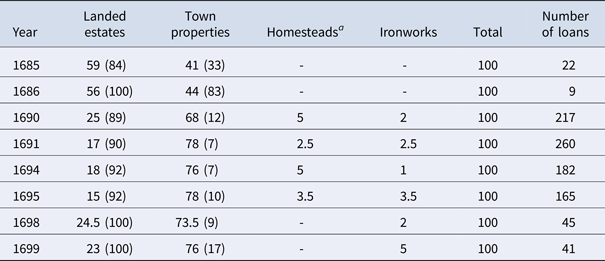
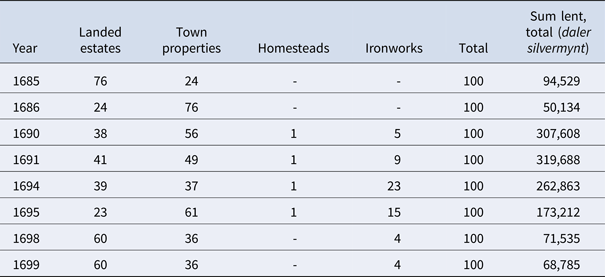
The senior officials at the RSB met every three weeks, and in the minutes of their meetings the passages referring to loan assessments are scattered through a great deal of other material. To make our study more manageable, we present the years 1685–1699 as four two-year periods: 1685–1686, 1690–1691, 1694–1695 and 1698–1699. In the earliest pair of years, the nobility were the biggest group of customers and landed estates were the dominant security for mortgage loans, both numerically and in terms of the total sums borrowed.Footnote 33 On average, more than 90 per cent of the land mortgaged to the bank between 1685 and 1699 was owned by the nobility (Table 1). Table 2 indicates that by 1698–1689 there had been a considerable decrease in the amount the bank was lending on mortgages. During the 1690s, houses and plots of land in urban areas, particularly in Stockholm, became the main form of security for mortgage loans, both numerically and, in some years, in terms of the sums borrowed. During most of the 1690s the great majority of these properties were owned by burghers and civil servants; less than 10 per cent belonged to the nobility (Table 1).
Percentage distribution of types of real estate used as security for mortgage loans assessed by the senior officials (1685–1699). Share of owners belonging to the nobility in brackets

Notes: a Homestead (hemman), a cadastral unit that all land in Sweden was divided into, comparable to the English hide.
Sources: Swedish National Archives (hereafter SNA): 6211.02/A I a/859; 6211.02/A I a/860; 6211.02/A I a/865; 6211.02/A I a/866; 6211.02/A I a/869; 6211.02/A I a/870; 6211.02/A I a/873; 6211.02/A I a/874.
Percentage distribution of sums borrowed against different types of security for mortgage loans assessed by the senior officials (1685–1699)

Sources: SNA: 6211.02/A I a/859; 6211.02/A I a/860; 6211.02/A I a/865; 6211.02/A I a/866; 6211.02/A I a/869; 6211.02/A I a/870; 6211.02/A I a/873; 6211.02/A I a/874.
The expansion in the proportion of the bank's mortgage loans that were secured against town properties is evident in other sources. From the 1660s laws were passed in Stockholm that meant that a probate inventory had to be prepared for anyone non-noble dying in the town with minor heirs.Footnote 34 The property of the minors was managed by the Guardianship Chamber (Förmyndarkammaren), a department of the municipal administration in Stockholm, until the heir had come of age. The gross wealth of the deceased varied from 2 to 100,000 d sm, with an average of 1,574 d sm and a mode of 267 d sm. This meant that the inventories represent people from a fairly broad economic and social spectrum. The inventories state the value of the deceased's property and movable goods, along with any debts owed to, or claims against, the estate. In 1685–1686, 5 per cent of a total of 390 probated persons owed money to the RSB. In both 1695 and 1699 this number had risen to 17 per cent of the probated individuals, who totalled 298 and 235 respectively in these years. The debts owed to the bank varied between 3 and 22,596 d sm, with an average of 632 d sm and a modal value of 318 d sm.Footnote 35
4. The RSB attempts to avoid insider lending
The regulations governing mortgage lending by the RSB made it clear that the loan had to be secured by two guarantors.Footnote 36 The regulations also declared that, when it came to lending, the bank should be open to everyone: ‘in making loans, the officials should not have regard to persons or their circumstances’.Footnote 37 The word ‘circumstances’ (wilkor) presumably refers to an applicant's general social and financial situation. The decision on whether or not to provide a loan was to rest principally on the applicant's ability to meet the bank's requirements for the loan to be secured. The paragraph in the bank's instructions should be seen in the light of the bank's position under the Estates of the Realm. The RSB had to be open to as broad a cross-section of society as possible and try to not to have recourse to insider lending in order to be legitimate in the eyes of the people represented by the Diet.
As well as abiding by its own regulations, the bank had to comply with the laws governing credit in Sweden. The country had had a high degree of legal uniformity since the 1350s, with a two-tier system of national and urban law. The law had little to say about mortgages and other forms of security, however; a residue from its origins in a period when the credit market was more limited. To meet the needs of, and to regulate, the expanding credit market several royal statutes were introduced during the latter half of the seventeenth century.Footnote 38
When the RSB entered the credit market the bank's officials found the existing regulations insufficient for their purposes. The first problem was that they had no way of knowing whether there were any liabilities already attached to a property they were being offered as security. In the fifteenth century Stockholm had taken inspiration from the Hanseatic towns of Germany and instigated the public registration of mortgages.Footnote 39 Such registration systems often, but not always, meant that, in the event of a default on a loan, creditors who had registered their mortgage were given priority over those who had not. During the seventeenth century, royal resolutions were passed to spread such registration outside Stockholm, but this did not become mandatory until 1730.Footnote 40 The underdeveloped system of mortgage registration made it hard for the bank to estimate the value of properties owned by potential borrowers and their guarantors, making it difficult for them to calculate the risk attached to a loan.
Besides the shortcomings in the public registration of mortgages, there were also major flaws in the system of registration of property ownership. One way of confirming ownership in this period was to have title deeds (fastebrev) drawn up in the primary (that is, local, first-instance) court. According to both national and urban law, every purchase or gift of land was to be documented by such a deed. Alternatively, under urban law, the transfer of ownership could be noted in the court record.Footnote 41 A title deed was supposed to contain details about the individuals involved in the transaction and any witnesses, the size and geographical location of the property transferred, and when the transaction took place.Footnote 42 However, a large number of transfers of ownership were not the result of purchases or gifts, but of inheritance, and in such cases no title deed was required.
Studies of the legal practices and debates surrounding property transfer in the second half of the seventeenth century have shown that primary courts seldom checked that the seller of a property was the rightful owner, even though they were legally required to do so. Maria Ågren has suggested that the court officials’ reluctance to formally investigate ownership was offset by a culture in which knowledge of ownership was transmitted orally within a local community.Footnote 43
The formal documentation of property ownership does not appear to have reached a level that would have allowed a fully functioning mortgage market to emerge by the time the RSB entered the credit market. Dealing with problems connected to the ownership of, or encumbrances on, properties became part of the bank's everyday business, and it tried to overcome these hurdles using a variety of techniques.
5. Working in a credit market without property registration
The records of loan application assessments at the RSB show that the bank's officials frequently asked to see title deeds, sometimes retaining them at the bank as material proof of ownership. However, as we have seen, in the case of inherited estates, title deeds often did not exist. On 28 September 1698, a group of burghers from the town of Sala visited the bank to apply for a loan on behalf of a man called Oluff Ersson Tist. They offered Tist's plot of land and his house in the town as security. They could not produce a title deed, saying that Tist had inherited the property in question and neither Tist nor anyone else in Sala had such a deed.Footnote 44 The bank officials approved the application, with the proviso that the guarantors also stood surety for the missing title deed. The bank was thus able to avoid the risk of someone else laying claim to the property by making the guarantors responsible; a solution it often adopted when no title deeds could be produced.Footnote 45
The case of Oluff Ersson Tist shows that being a guarantor in seventeenth-century Sweden had a number of implications. Not only did the guarantor have to guarantee the borrower's obligations towards the bank and take responsibility for the debt in the event of default, he or sheFootnote 46 was also held to have sufficient knowledge of the mortgaged property to be able to guarantee its current and future legal and financial status.Footnote 47 On the basis of this knowledge, guarantors were being asked to stand surety both for the financial terms of the loan and for the information that was provided to the bank, offsetting the inadequacies in the official registration of property ownership and mortgages.
The absence of title deeds often gave rise to discussions, which were recorded in the RSB officials’ minutes.Footnote 48 Swedish legislators had recognised as early as the 1350s that there was a risk of title deeds becoming lost. Copies of a deed were given to each party involved in a property transaction, but there was no requirement for a further copy to be held by an official authority.Footnote 49 In many other parts of Europe, title deeds, or the equivalent documents, were kept by notaries or copies were retained by the courts.Footnote 50
The precarious nature of title deeds was made clear in several records. In some cases deeds were lost in fires; when Arwed Pyhl and his wife applied for a loan from the RSB, for example, they explained that the title deed was missing because their neighbourhood had burned down. However, at the time of the fire, the deed had not been in their hands, but in the possession of ‘a young unmarried servant (dräng) who lived nearby, who had lent [Pyhl] a couple of hundred daler kopparmynt against the title deed’.Footnote 51 In another case, a man tried to mortgage a house and plot in Stockholm. However, the assessment was postponed because the title deed was held by a widow, to whom it ‘was mortgaged’.Footnote 52 These two examples show that private, as well institutional, lenders kept title deeds as security. As the registration of mortgages was only voluntary before 1730, retaining the deed was one way of preventing the owner of a property from mortgaging it several times. The use of title deeds indicates that the provision of credit was becoming more formalised, with private individuals and institutions both making greater use of written documents. This suggests that the credit market, which was traditionally based on personal trust, was beginning to adopt control mechanisms used in markets based on system trust.
In 1685 and 1686, mortgage loans granted by the RSB were not routinely registered with the courts. The bank could not refuse an application simply because the applicant refused to register his or her mortgage. Registration was most likely to occur when a loan was secured on a property in Stockholm, as the RSB took advantage of the mortgage registration practices that had been followed in the city since the late Middle Ages. In the minutes of the RSB senior officials’ deliberations, instructions were often issued that a mortgage loan given to a person from Stockholm was to be registered: ‘for the further security of the bank, [the loan] should be lawfully recorded with the primary court’.Footnote 53
In the 1680s, the RSB was still following older registration practices; a property transaction was only registered if there was a risk of default or because there were concerns over the ownership of a property.Footnote 54 There are many examples in the RSB minutes of officials only deciding to register a mortgage once they had discovered there was a risk of default. Registration can be seen as the first step in the process of debt collection. An official valuation of the mortgaged property would then be made and, finally, the property would be sold at auction, the proceeds hopefully paying off the debt.Footnote 55 Under such conditions registration was a sign of distrust, something of which the senior officials and the board of the RSB were aware when discussing the desirability of mandatory registration as a means of solving the problem of previously encumbered estates being used as collateral for mortgage loans. During these debates, apprehensions were voiced that mandatory registration would scare away potential borrowers, but in the mid-1680s, a majority of the officials agreed that mandatory registration would the best means of avoiding losses in the future.Footnote 56
There were several further reasons why the bank had not always required mortgages to be registered before 1689. Firstly, registration placed the borrower's financial circumstances in the public domain and, out of consideration for a particular person's financial reputation, the bank had sometimes agreed to provide a mortgage without formal registration. Secondly, in most circumstances the bank believed the guarantors had provided sufficient security. The issue of registration revealed a disjuncture between the practices required by law and those followed by borrowers and the bank, which largely relied on informal, personal contacts. A third reason that the RSB did not always insist that a mortgage be registered was because it saw itself as a part of Sweden's public administration and therefore took the view that if a mortgage loan was recorded in the bank's records this would carry the same legal weight as if it had been formally registered with a court. However, several rulings by the Royal Court of Appeal stated that it was not enough to record the mortgage at the bank; formal registration had to be carried out in a primary court. If it were not, then, in cases of default, the bank would be in the same position as other lenders who had not formally registered their claim on a property.Footnote 57
As well as confirming that an individual was the true owner of a piece of property, the officials at the RSB had to ascertain that there were no earlier encumbrances on that property. The minutes from 1685 and 1686 make it clear that the bank was having problems with borrowers mortgaging property that they did not own or were already using as security.Footnote 58 The bank's officials do not appear to have regarded such cases as fraud, choosing instead to trust their other forms of security, primarily the guarantors. For example, when the RSB realised in August 1685 that a house in Stockholm that they had accepted as security for a loan to the tanner Conrad Vultz had been used in the past to secure a loan given to Vultz by another tanner, the bank informed one of the guarantors, that ‘he and his co-guarantor, for both the bank's and their own security’, had to fulfil their obligations to pay off the loan to the bank, using their own resources.Footnote 59 This was not the only case in which guarantors were unaware of, or failed to disclose information concerning a previous mortgage; this appears to have happened several times in the 1670s and 1680s.Footnote 60
Vultz's guarantors had the resources to repay the loan and co-operated with the bank. However, 1685 saw a series of frauds against the bank perpetrated by a factor (befallningsman), Isaac Wulff. Wulff deceived the bank into lending him money on several occasions, both by forging the seal of his employer, a noblewoman, and by mortgaging property he did not own. One of the properties he mortgaged was a house in the Södermalm district of Stockholm, which he claimed he had bought from a woman called Ingegerd Börjesdotter in July 1683. He named Anders Wellamsson as a witness. When the bank started to investigate Wulff's activities, one of its porters was sent to Södermalm to seek information about the property Wulff claimed to own. The porter met Ingegerd Börjesdotter, who admitted that she knew Wulff, but insisted that she had neither sold a house to him nor ever heard that he owned a house in the area. The witness, Wellamsson, was unknown to her.Footnote 61 The bank officials were unable to consult any formal register of title deeds to check whether Wulff had indeed bought the house, and therefore had to trust the oral information given by Ingegerd Börjesdotter. Wulff also mortgaged a house in Stockholm, but Mickell Jacobsson, a barber, and Olof Nilsson, a butcher, claimed that the property was owned by the underage children of a deceased butcher. The bank dismissed the latter claim, arguing that Jacobsson and Nilsson needed to provide more than ‘an oral account’ to support their claim.Footnote 62 When a clerk from the Guardianship Chamber of Stockholm approached the bank about the matter on the children's behalf, he received the same answer: the RSB maintained that it had a right to the property, unless the council could offer written, rather than oral, proof of the children's claim.Footnote 63 A written record of the distribution of the butcher's estate following his death in 1682 was produced, and the bank finally accepted the claim.Footnote 64
When the RSB lent money to Wulff without checking that he or his guarantors actually owned the property they offered as security, it would appear that they had not had sight of the few written, official documents that existed regarding the properties in question: the bank had been unaware of the document recording the distribution of the butcher's estate. Wulff's activities highlight two difficulties the RSB faced in their dealings on the credit market. First, as an institution, the bank had difficulty penetrating the local community in order to access information. Second, Stockholm had just 8,900 inhabitants in 1613 but by 1685 it had 52,700; by the end of the seventeenth century it was not just one community, it encompassed numerous local communities.Footnote 65 Furthermore, the formal documents that existed were not collected into one place; knowledge of several institutions and the records they kept was necessary to find a document, if it actually existed.Footnote 66 The cases discussed above illustrate how written and oral information circulated within a community, and how the RSB had to adopt various techniques to obtain the information it needed to minimise its risks.Footnote 67
The words ‘to know’ (känna) were frequently used by the bank's officials in their discussions of both borrowers and guarantors.Footnote 68 They claimed ‘to know’ that guarantors had ‘sufficient’ (sufficiente) resources to meet any future claims from the bank in the event of a default; but how did, or could, they know this when it was difficult to obtain an accurate overview of the property a person owned? In the 1670s and 1680s, the senior officials at the RSB were finding it very difficult to obtain the information they needed to conduct their business. There were two solutions: the bank either had to try to change the formal institutional framework in which it operated, or it had to work outside that framework and obtain information in other, more informal, ways.
6. Attempts to reform the registration system
In the late 1680s, as discussed above, the senior officials and the General Council of the RSB became increasingly dissatisfied with the uncertainties arising from the incomplete registration of both property ownership and mortgages. At the request of the Bank Committee and the General Council, the king introduced a statute in 1689 that attempted to improve the bank's position on the credit market and its relationship with its borrowers in particular.Footnote 69 The first paragraph of the statute stated that anyone wishing to take out a mortgage loan with the bank had to formally register the loan with the primary court. Until 1689, registration had been undertaken by the creditor in the transaction, but the new legislation passed the responsibility to the debtor, who was expected to have pre-registered the mortgage before he or she applied to the bank for a loan. If this had not been done the guarantors had to provide assurance that the registration would be completed as soon as possible. When a loan was registered with the primary court, a representative of the court was to ‘search very rigorously, in the court records, for any earlier registrations of encumbrances on the property (on which the loan was to be secured)’.Footnote 70 The court would be held responsible if it missed any earlier liabilities. Furthermore, the 1689 statute stated that all Swedish primary courts had to draw up special mortgage registers, in addition to any notes in their general records. Entries in the new registers were to be recorded alphabetically, by order of the address of the mortgaged property, in order to facilitate searches.Footnote 71 Previously, mortgages had been registered consecutively in the general court record, which was probably why the new statute required the head of the court to search ‘rigorously’ for old registrations. The wording of an attestation from the court in Stockholm dated 1690 clearly illustrates the difficulties created by the old records: the town clerk wrote that he had only been able to look through the records from the last couple of years, implying that it was not possible to go any further back in time.Footnote 72 In theory at least, the new mortgage registration system was an effective one, and should, according to economists such as de Soto, have stimulated the market for mortgage loans.Footnote 73
However, while the 1689 statute stipulated that mortgages provided by the RSB were to be registered, it ended with an important proviso that, if the officials were given assurances that both the borrower and the guarantors were responsible and had sufficient resources then, following approval by the General Council, the mortgage could be granted without any ‘public documents’.Footnote 74 It was hoped the inclusion of this proviso would attract borrowers who did not want to make their finances public.
When a captain in the Royal Guards, the nobleman Gabriel Lilliehöök applied for a loan in 1694, he asked for permission not to register it officially because ‘it would harm (touchera) his credit (reputation)’.Footnote 75 His guarantors assured the bank that they would be responsible should he default, and this persuaded the bank officials to approve the application. Such unwillingness to register a mortgage formally was not unique to those borrowing from the RSB. Across Europe there was much debate about registration, and certain influential groups of the nobility who, like Lilliehöök, perceived a risk to their credit in making their financial circumstances public, strongly opposed mandatory registration. As touched on earlier, in earlier times registration of a mortgage was taken to signal a risk of default and previous research has emphasised that the nobles were particularly resistant to this change.Footnote 76 The RSB records show, however, that non-noble applicants were also unwilling to register their mortgages. In 1694, two merchants also asked to be excused from the requirement to register their mortgages in order to maintain their (financial) reputations.Footnote 77 Borrowers who did not want to register their mortgages tended to be seeking comparatively large loans, and to be applying to the private credit market as well as to the bank. In Luhmann's words, these borrowers were dependent on credit based on both personal trust and system trust and lenders in the private credit market, who worked on the basis of personal trust, may have seen the registration of a mortgage as a sign of a lack of confidence in the borrower and warning of an imminent default.
The statute of 1689 also included provisions clarifying the practices that bank officials would be expected to follow when undertaking risk assessments. The RSB's 1668 regulations had stipulated that all loans secured on property had to be further secured by guarantors. The 1689 statute obliged the bank's officials to make certain of the financial circumstances of each borrower and guarantor; to take greater account of these circumstances; and to specify in the records the grounds on which they had approved an application.Footnote 78 The bank had learnt from experience that it could no longer provide loans on the slight grounds it had accepted previously. The greater scrutiny of both borrowers and guarantors changed the practices of the senior officials at the RSB: more loan applications were discussed collegiately, and the minutes of the meetings become more detailed in their descriptions of potential borrowers and their guarantors.
The growing number of mortgage loans that the RSB granted on town properties in the first half of the 1690s shows that the bank did manage to broaden its mortgage clientele. By the end of the decade, however, the number of mortgage loans granted by the bank had diminished (see Tables 1 and 2). This development was intensively discussed at the bank and two main reasons were put forward. The first of these was the general state of the credit market. Stockholm had entered a period of economic stagnation and certain parts of the country were experiencing severe crop failures: the need for credit had diminished. This indicates that, at least according to the senior officials, loans in the bank were not taken to overcome economic crisis. The second reason offered was the problems potential borrowers were having when they tried to find guarantors.Footnote 79 Not only did guarantors in seventeenth-century Sweden have to guarantee to meet the borrower's obligations to the bank as well as taking responsibility for any debt in the event of a default, but they were also held to be mutually responsible for the borrowed sum ‘in solidum’, which meant that each guarantor was fully responsible for the whole of any debt. This was an effective way for the bank to avoid risk, but it put high demands on the guarantors, and caused risk management to revert from system-based trust to personal trust. Within the institutional framework in place in the 1690s, the bank found it increasingly hard to find a balance between its risk avoidance strategies and the risk it ran of discouraging potential borrowers and deterring guarantors.
The 1689 statute indicates that the king was concerned about the RSB, as he not only set out regulations relating to the bank itself, but also passed regulations that affected the whole of society, such as the creation of mortgage registers to be kept by the primary courts, and the shift in the responsibility for registering a mortgage from lenders to borrowers. Thanks to its close ties to the Estates of the Realm and the government, the RSB became a driving force in the institutional development of Sweden, and in the emergence of a more transparent and better-functioning credit market.
Unfortunately, the 1689 statute said nothing about how RSB officials were to gather information about the financial circumstances of guarantors, and missing title deeds, along with the previous system of mortgage registration, continued to cause problems for the bank. Despite the statute, Sweden's wider institutional framework could not provide the bank with the assurances it needed and, even though it worked within the new legislation, the bank was unable to bring about the transformation of the formal and informal rules of the credit market that it needed. It became apparent that the RSB would have to find its own techniques to solve its problems.
7. ‘Knowing’
The verb ‘to know’ may have occupied a prominent place in the bank officials’ minutes, but it was not clear how the officials came by their ‘knowledge’. A person's previous dealings with the bank were one of the few reliable sources officials had on that individual's finances and his or her ‘honour’. A previous relationship with the bank was thus often a critical factor when a loan application was being assessed, usually working in favour of an applicant or guarantor. In 1695, when Christina Leusner was proposed as a guarantor in an application by the officer Gustaf Svinhufvud, the officials emphasised that Leusner ‘had previously had loans from the bank, and always repaid them on time’.Footnote 80 However, past behaviour and outstanding debts could give the bank a reason to reject an application. When the nobleman Per Sparre applied for a loan, he was turned down because his guarantors had already agreed to guarantee large loans made by the bank.Footnote 81 In the discussion about a substantial loan application from Sigrid Ekehielm, who offered her ironworks at Karlskoga as security, Camoen, one of the bank officials, advised against approval, reminding his colleagues that Ekehielm had always treated the bank ‘very discourteously’ and had never repaid her previous loans without pressure being brought to bear.Footnote 82
While ownership of, and encumbrances on property were difficult to check, information on a person's general creditworthiness was almost impossible to access through any formal channel in seventeenth-century Sweden. A comment made by a senior RSB official, Ehrenfelt, during the discussion of a potential guarantor in 1695 was fairly typical. Ehrenfelt stated that all he knew was that the man had a good income, owned a house and was married to a woman of fortune. Nonetheless, ‘he had not counted the man's money’, but trusted ‘the current rumour’.Footnote 83 In the early modern world the ‘current rumour’, that is, a person or household's reputation – in other words their creditworthiness – was important. It was one of the few channels of information available. Previous researchers have viewed ‘reputation’ as fundamental to the successful functioning of early modern credit markets: a person with a bad reputation stood little chance of obtaining a loan.Footnote 84
‘Reputation’ was a vital element considered during the assessment of a loan application, providing information about a person's wealth, or on how they made a living or handled their finances, which no formal documents of the time could provide. When Brita Cruus and Karin Horn, who were both married to a noble, stood surety for Christer Horn, the application was approved on the grounds that ‘these two ladies are regarded as very well-to-do and among the wealthiest in the whole realm’.Footnote 85 When the bank officials discussed the reputations of members of the nobility, their main concerns were the extent of the applicant wealth and how they managed their money. For example, Gabriel Lilliehöök was, by reputation, ‘careful and solicitous’ in the management of his property.Footnote 86 On the other hand, when discussing applications from burghers and peasants, the officials focused on the applicant's reputation for hard work. For example, when evaluating an application from a shoemaker the bank official Molin said that he ‘knew the man to be industrious, making children's shoes that he sells by the dozen’.Footnote 87
According to the records of the assessment process, bad reputations rarely appear to have been discussed. Officials were relatively strict in treating applications from a financial point of view and seem to have followed their instructions not to ‘have regard to persons or their circumstances’. Research into credit markets in France and England has attached great significance to a person's ‘moral reputation’, and their community's ‘knowledge’ of their morals, when it came to the likelihood that that person would be offered a loan.Footnote 88 In the case of decisions made at the RSB, moral reputation seems to have played a more minor role, or interest in moral behaviour was related strictly to financial matters. This may indicate that the bank viewed the credit market as based more on system trust rather than on personal trust.
The six senior officials at the RSB could only know a limited number of people, and if the bank had had to rely on the information they alone could provide, few people would have been able to borrow from the bank. The officials, therefore, turned to the rest of the bank's employees for information. For instance, when an application from Hindrich Larsson, who lived in the municipality of Kopparberg, more than 200 km west of Stockholm, was assessed a clerk at the bank who was ‘familiar with the place’ gave assurances that both the borrower and his guarantors were good people.Footnote 89 A broad spectrum of the bank's employees was asked to supply information: lower servants such as porters (vaktmästare and kammardräng), higher officials such as the master of the mint (myntmästare) and the bank's law officer (iscal) were among those channelling information to the senior officials, allowing them to broaden the range of the bank's borrowers. The lower servants were particularly helpful in this regard as they were recruited from different social groups than the officials. One candidate considered for appointment as a new porter in 1685 was a former gardener,Footnote 90 for example, while the senior officials and the General Council were drawn from the nobility or the ranks just below.Footnote 91 In the years studied, decisions on approximately 200 mortgage loans were based on information passed on by lower-ranking employees at the RSB. Their information allowed the bank to broaden the social and spatial profiles of its borrowers, and also helped to create a more integrated credit market.
8. Making informal information formal
Even with the information it gleaned from its employees, the number of people who could potentially be ‘known’ to the officials at the RSB was limited. The officials therefore took account of information supplied by people from outside the bank whom they trusted. In some cases, these individuals were, like the officials themselves, employees of the government or the Estates of Realm.Footnote 92. Yet other information came from people who were trusted by the officials. Anders Spitz, a merchant and already a customer of the bank, was asked if he knew a housewife called Anna Poppelman, as they both lived in the same district of Stockholm. Spitz said that he had only met her in church, but he knew that she owned a house by one of the squares in the district.Footnote 93 The officials knew Spitz and trusted him, and while he did not know very much about Poppelman, he had sufficient knowledge of her property to satisfy them.
The officials at the RSB recognised that if they based their lending decisions on the knowledge of the bank's employees, this set a limit on who could obtain a loan, and also opened the bank to the charge of insider lending. In 1690 they rejected a guarantor on the grounds that they did not ‘know’ his ‘circumstances and wealth’,Footnote 94 but in other cases they recommended that the applicant seek alternative guarantors who were better known to the bank, in order to increase his chance of obtaining a loan.Footnote 95
One way that allowed borrowers to be ‘introduced’ or ‘made known’ to the bank, was through certificates issued by the applicant's parish priest. Information obtained by this means lay somewhere on the spectrums between ‘formal’ and ‘informal’, and between personal and system trust.Footnote 96 In an application from 1694 a priest's certificate, attesting that the applicant and his guarantors owned their properties and confirming the value of that property, was deemed by the RSB officials to be ‘as trustworthy’ as if the information had been provided by a porter at the bank.Footnote 97 Swedish parish priests were entrusted by the state to keep records of the inhabitants of their parish, but not of their property or economic behaviour. However, a priest would probably know such details through his work in the local community. A priest's certificate thus combined formal, recorded information with more informal details and helped the bank to avoid accusations of insider lending.
After the 1689 statute was introduced, the RSB also started to make its own appraisals of any securities it was offered, rather than trusting the information provided by borrowers and their guarantors. This met the statute's requirement for better documentation of the basis on which a loan was made. The porters of the bank were regularly sent out to examine potential securities. After such an examination in 1690, one porter told the senior officials that a guarantor ‘had a plot with six small houses, a cellar and a well’, and valued it at a couple of thousand kopparmynt.Footnote 98 When examining a property, the porters were not only interested in the size of the plot or the condition of the buildings. After one inspection, one of the porters told the officials that two guarantors had ‘their properties unencumbered’; he knew because ‘he had asked the neighbours’.Footnote 99 The bank thus used these ‘examinations’ to capture the informal, predominantly oral information about a property and the financial reputation of its owner that was circulating in the local community.
The bank only ‘examined’ the property of non-nobles. Porters were never sent to examine the estates belonging to the nobility or, indeed, the properties of prosperous wholesale merchants of Stockholm. Many of these well-to-do individuals based their credit relations with the bank on a system of personal trust, and this trust could have been undermined if they had discovered that they were the subject of an inspection by a lowly bank employee. When a noble or merchant applied for a loan the officials trusted their own information or the applicant's reputation. The financial circumstances and the reputations of many elite individuals appear to have been a matter of common knowledge across large parts of Sweden,Footnote 100 whereas the reputations of burghers and peasants were only known within their much more local communities.
Most of the mortgage loans granted to non-nobles went to individuals with property in Stockholm, which could easily be ‘examined’ by the bank. The RSB did not have the resources to carry out examinations outside Stockholm, even though there was a need for credit outside the capital. Erland Bengtsson Ståhlfoot, a tinsmith from Åbo in Sweden's Finnish provinces, asked for a loan, offering his house in Åbo as security and two men from the town as guarantors. The officials responded that if he could obtain a written statement, attesting to the status of his property and to the suitability of his guarantors, from the primary court in Åbo and if he registered the mortgage, he would, ‘like everyone else’, be provided with a loan.Footnote 101 A similar process was followed by a burgher from Linköping, the bank officials noting that his property had been valued in situ by the primary court of the town.Footnote 102 In these and other cases, the courts not only registered mortgages, but also functioned as agents for the RSB, evaluating and assessing the financial circumstances of borrowers and their guarantors when the bank could not undertake these tasks.Footnote 103 Through the primary courts, the officials at the RSB obtained local, and often previously unrecorded information from all over Sweden, and used this to widen the range of property that they would accept as security, something they had to do in order to expand the bank's mortgage lending in the 1690s. The use made of the courts provides a good example of the pivotal role such institutions played in the functioning of the credit market and in the transition from personal trust to system trust as the basis of transactions within it.Footnote 104 Although loans outside Stockholm were only a small part of the bank's total lending, making up just 4 to 12 per cent of RSB loans secured against town properties between 1690 and 1699, they do indicate that the bank was making efforts to find new markets.
9. Conclusion
In the second half of the seventeenth century, the Riksens Ständers Bank opened for business when Swedish society had only a rudimentary legal framework to meet the needs of a credit market dominated by private individuals and based on personal trust. Initially, the bank lent mainly to the government and the nobility, but when these customers saw their need for credit and – in the case of the nobles – their creditworthiness diminish, the bank had to find new markets for its loans among non-nobles in Stockholm and Sweden's other towns. The RSB had to adopt new credit rating practices in order to overcome the senior officials’ lack of personal knowledge about their new borrowers and the properties they owned. The bank developed techniques that allowed it to maintain its presence in the credit market, while at the same time working to change the institutional framework in which it operated, strategies that allowed the RSB to become a major lender throughout Sweden's urban centres.
This study has shown that, in addition to landed estates, urban properties became an important form of security for the RSB as it sought to consolidate its position within the mortgage market without succumbing to insider lending. It managed this feat thanks to a strategy of extending its ‘knowledge network’ beyond the confines of the social networks of the bank's senior officials, gathering information from other members of staff and from local institutions, such as the primary courts or from their representatives, such as parish priests. The bank's activities loosened the social and geographical constraints that had previously characterised many parts of the credit market: the RSB gave mortgage loans to shoemakers as well as to noblemen, and to burghers from Åbo to Sala. They were helped in this by a legal system that was applied nationwide, and by their well-established contacts with local primary courts. The history of the bank between 1685 and 1699 is a fine example of how financial development can be driven by close cooperation between legislators and those involved in the credit market.
The bank faced two major difficulties, however. Firstly, as Luhmann stresses, personal trust and system trust rest on different foundations, making it difficult to use them in tandem, but the bank had to find a balance between the two in its business dealings. In order to have system trust in the credit market, a well-functioning system of mortgage registration had to emerge and be accepted by those involved in the credit market. For this to happen, the new system could not be seen to violate the principles those operating in the credit market saw as essential to their activities. The difficulties in using system trust alongside personal trust were most apparent in the RSB's inability to make registration mandatory. The bank was forced to adapt its risk management strategies to meet the expectations of different groups of its customers, showing that the rise of de Soto's broad mortgage-market depends on changing social norms as well as formal regulations. A second difficulty the bank faced was one of its own strategies of risk avoidance. When the bank transferred a great deal of the risk to the guarantors of its borrowers, and held them responsible ‘in solidum’, it made it hard for many borrowers to find guarantors, particularly in times of general economic decline. The bank's strategy was one reason for the decline in its mortgage lending at the end of the 1690s.
In late seventeenth-century Sweden the credit market was subject to increasing levels of public and legal control, which in turn required greater amounts of written documentation and additional information in the public domain: hence the need for title deeds, registration of mortgages, certificates and attestations. The RSB entered the credit market when it was dominated by personal trust and played a part in the early phases of the process of transforming that market to one based on system trust. By operating in the borderland between personal trust and institutional trust, the bank was able to attract borrowers from a broad spectrum of society. It also worked to alter the institutional framework in which it operated, while adopting practices to solve the problems that arose at the same time the framework was being transformed. The Riksens Ständers Bank attempted to ‘bring dead capital to life’ and, to some extent, it succeeded.
Acknowledgements
Funding for this study was provided by the Handelsbanken research foundation.