“Pull yourself up by your bootstraps” (American idiomatic expression). “Kung may tiyaga, may nilaga” (“With perseverance, there is stew for supper”; Filipino proverb). “Quien quiere celeste, que le cueste” (“He who wants the heavens must pay”; Spanish proverb). “El que no trabaje, que no coma” (“He who does not work, does not eat”; Spanish saying derived from the Bible). These are various sayings people in different cultures use in their everyday lives to convey the Protestant work ethic (PWE), or the lay theory that people who work hard succeed. Across cultures, people use PWE to help them understand their social world, render judgments, and take action (see Rosenthal, Levy, & Moyer, Reference Rosenthal, Levy and Moyer2011, for a review). Like most broad and pervasive lay theories that apply to a range of group processes (Hong, Levy, & Chiu, Reference Hong, Levy and Chiu2001; Ramírez & Levy, Reference Ramírez and Levy2010), PWE is not just one single belief, but an organized knowledge structure that provides a frame for imparting different meanings. At least two meanings of PWE are defined. First, PWE is used to justify why some groups are disadvantaged and why these groups do not deserve special assistance (labelled PWE-Justifier; Levy, West, & Ramírez, Reference Levy, West and Ramírez2005). Second, PWE is also used to mean that anyone, regardless of social group has the potential to succeed through hard work and effort (PWE-Equalizer). As PWE is a general lay theory that is not specific to any social group, both meanings of PWE may be applied when thinking about disadvantaged groups in society. But a meta-analysis of published research across different cultures suggests that PWE is related to prejudice towards disadvantaged groups (Rosenthal, Levy, et al., Reference Rosenthal, Levy and Moyer2011), which implies the use of the PWE-Justifier meaning. The meta-analysis also finds this relationship to be stronger in Western samples countries compared to non-Western ones, signaling some cultural aspect to the use of the PWE-Justifier meaning.
Culture and the PWE-Justifier Meaning
Different definitions of culture have been proposed in psychology, but for our study we define culture as a system of knowledge (e.g., concepts, values, expectations, ways of thinking) that is shared within a group of individuals who collaborate to construct and perpetuate this shared knowledge (Chao & Wong, Reference Chao and Wong2014; Chiu & Hong, Reference Chiu, Hong, Kruglanski and Higgins2007; Kashima, Reference Kashima2014). Different types of cultural knowledge may relate to and activate either of the PWE meanings, so that one meaning may become more chronically accessible in some cultural environments, but less so in others (Hong et al., Reference Hong, Levy and Chiu2001).
We propose that cultural knowledge in individualist societies makes the PWE-Justifier meaning more accessible. Individualism is a cultural syndrome that reflects an interrelated set of values like freedom, independence and autonomy, choosing one’s goals, personal responsibility and achievement, among others (Triandis, Reference Triandis1996). Some societies (e.g., North American, Western European) emphasize idividualistic values more than others (Asian, African, South American). People in individualist cultures tend to make dispositional attributions to explain people’s actions (Imada, Reference Imada2012; Masuda & Kitayama, Reference Masuda and Kitayama2004), and this tendency is more prominent when explaining negative outcomes of other people (Choi, Nisbett, & Norenzayan, Reference Choi, Nisbett and Norenzayan1999; Morris & Peng, Reference Morris and Peng1994). The emphasis on individual agency, responsibility, and dispositional attributions for negative outcomes seems consistent with the PWE-Justifier notion that persons who are not successful are responsible for their situation because they did not work hard (Christopher & Schlenker, Reference Christopher and Schlenker2005).
There are probably other cultural level factors associated with the meanings of PWE, but we focus on individualism and its possible association with PWE-Justifier as it is consistent with the meta-analysis showing stronger positive relationships between PWE and negative evaluations of disadvantaged groups in Western countries known to stress individualism (Rosenthal, Levy, et al., Reference Rosenthal, Levy and Moyer2011). In these countries, PWE’s relationship with attitudes toward disadvantaged groups was most negative toward groups thought to have controllable stigmas such as poor persons, further underscoring the individualistic values of personal agency and responsibility.
A cross-sectional developmental study in the USA also found that children and young adolescents were more likely to hold the PWE-Equalizer meaning, but that young adults were more likely to adopt the PWE-Justifier meaning (Levy, West, Ramírez, & Karafantis, Reference Levy, West, Ramirez and Karafantis2006). The study suggests that the PWE-Justifier meaning becomes more accessible as individuals are more deeply socialized into their society’s individualist cultural values. Interestingly, PWE was positively associated with egalitarianism among Colombians and African-Americans – two groups considered to be lower in individualism – suggesting the use of the PWE-Equalizer meaning instead of PWE-Justifier (Levy et al., Reference Levy, West and Ramírez2005; Ramírez, Levy, Velilla, & Hughes, Reference Ramírez, Levy, Velilla and Hughes2010).
Although the preceding findings are consistent with the notion that PWE-Justifier is more salient in individualist societies, the earlier studies were not conducted to explicitly assess the proposition. There are few available studies directly comparing Western and non-Western samples, which limits the conclusions that could be drawn about the culturally-relevant implications of PWE. In this study, we examine the proposition by comparing the relationships between the two PWE meanings and evaluations of a disadvantaged group in a cross-national comparison involving the USA and the Philippines, which are known to be high and low in individualism, respectively (Church, Reference Church1987; Minkov et al., Reference Minkov, Dutt, Schachner, Morales, Sanchez, Jandosova and Mudd2017). The Philippines is also a country in which prior work indicates that external (more so than internal) factors contribute to poverty and social mobility beliefs (Clemente, Daganzo, Bernardo, & Pangan, Reference Clemente, Daganzo, Bernardo and Pangan2017; Hine, Montiel, Cooksey, & Lewko, Reference Hine, Montiel, Cooksey and Lewko2005; Tuason, Reference Tuason2008).
We look at how PWE-Justifier relates to evaluations of poor persons because there is a stronger relationship between PWE and negative evaluations of groups with controllable stigma such as poor persons (Rosenthal, Levy et al., Reference Rosenthal, Levy and Moyer2011). PWE contributes to negative evaluations of poor persons through the notion that they deserve their disadvantage for not working hard enough (Kluegel & Smith, Reference Kluegel and Smith1986). In the USA, PWE is associated with negative affect and less empathy toward poor persons and negative attitudes toward policies for aiding poor persons (Cozzarelli, Wilkinson, & Tagler, Reference Cozzarelli, Wilkinson and Tagler2001; Littrell & Diwan, Reference Littrell and Diwan1998; Somerman, Reference Somerman1993). We hypothesize that PWE-Justifier, but not PWE-Equalizer, would be associated with negative attitudes towards poor persons in the USA sample, but not in the Philippine sample. Based on the tendency of people from individualist cultures to emphasize dispositional attributions (Imada, Reference Imada2012; Masuda & Kitayama, Reference Masuda and Kitayama2004), we further propose that PWE-Justifier’s relationship with negative attitudes towards poor persons is associated with the tendency to make internal attributions of poverty in the USA sample. We also hypothesize that PWE-Equalizer would be more salient in a culture that is not strongly individualist. Although we do not assume an alternative cultural syndrome that makes PWE-Equalizer more salient, we propose that in the Philippines sample, PWE-Equalizer would be associated with empathy with poor persons, but not in the USA sample.
In previous PWE research, dissimilar measures of PWE were used; measures assessing PWE-Equalizer versus PWE-Justifier meanings were not available during most of that period of research. In this study, we directly assess the two PWE meanings using distinct measures (Rosenthal, London, Levy, Lobel, & Herrera-Alcazar, Reference Rosenthal, Levy and Moyer2011) to allow for direct tests of how the two meanings relate to attitudes towards poor persons in the two cultures. To assess attitudes towards poor persons, we used three measures: Endorsement of negative stereotype traits, attitude towards poor persons relative to wealthy persons, and empathy towards poor person.
We summarize our hypotheses as follows:
(1) PWE-Justifier, but not PWE-Equalizer, is associated with attitudes towards poor persons in the USA sample, but not in the Philippine sample; in particular,
(1a) PWE-Justifier is positively associated with endorsement of negative stereotype traits of poor persons and to negative attitudes towards poor relative to wealthy persons;
(1b) PWE-Justifier is negatively associated with empathy for poor persons; and
(1c) PWE-Justifier’s relationships with negative stereotypes and negative attitudes are mediated by internal attributions of poverty.
(2) PWE-Equalizer is related to empathy towards poor persons in the Philippines sample, but not in the USA sample.
Method
Participants
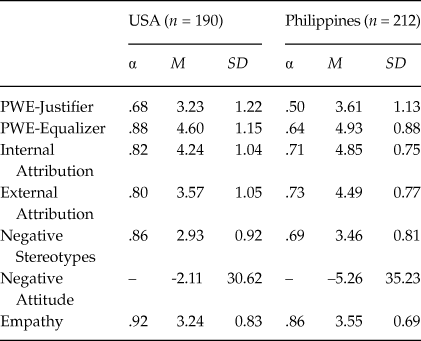
Participants were students at mid-sized universities; 190 from the USA (all European Americans, 123 women; M age = 20.43, SD = 2.97) and 212 from the Philippines (147 women; M age = 19.41, SD = 3.49). They completed a survey in English as part of a request or requirement in their classes; English is the language of instruction in Philippine universities. All participants reported being born in their respective countries and coming from at least middle class families, as assessed by an explicit measure of social class (USA sample), or household questions defined by the Philippine National Statistics Office (Filipino sample).
Measures
Protestant Work Ethic Scales. The PWE measure (Rosenthal, London et al., Reference Rosenthal, London, Levy, Lobel and Herrera-Alcazar2011) comprises two items that assess the PWE-Justifier belief (e.g., “Hard work is all that’s necessary for success, so it is not fair to give preferences to minority or disadvantaged groups”) and two that assess the PWE-Equalizer belief (e.g., “Anyone can succeed and make a good life for themselves, if they work hard.”) The subscales had adequate internal consistency for the USA sample, but not for the Philippine sample (see Table 1), so we conducted confirmatory factor analyses to assess whether the two-factor model fit the data. There was good fit for both the USA sample: χ2(1) = 0.16, p = .687; CFI = .99; TLI = .99; RMSEA = .001, and the Filipino sample: χ2(1) = 0.02, p = .888; CFI = .99; TLI = .99; RMSEA = .001.
Descriptive Statistics for the Two Countries

Note: Negative attitudes is computed using the difference between two attitude ratings, and thus, cannot have internal consistency.
Attributions of Poverty. We used a measure by Cozzarelli et al. (Reference Cozzarelli, Wilkinson and Tagler2001) that had already been used with Filipino samples (Bernardo, Reference Bernardo2013). Participants evaluated seven external attributions (e.g., “Failure of industry to provide enough jobs”) and six internal attributions (e.g., “Being born with low intelligence”) on a scale from 1 (not at all an important cause of poverty) to 6 (a very important cause of poverty).
Negative Stereotypes of Poor Persons. Participants assessed how three traits (e.g., undisciplined) were characteristic of poor persons in the USA or in the Philippines on a scale of 1 (not at all characteristic of poor people) to 5 (extremely characteristic of poor people).
Negative Attitudes. Using an established thermometer measure of attitudes (0, cold/unfavorable to 100, warm/favorable) toward groups (Herek & Capitanio, Reference Herek and Capitanio1999), participants were asked to indicate how they felt toward rich and poor persons. Ratings for poor persons were subtracted from ratings for rich persons. Higher positive difference score indicated more negative attitudes towards poor relative to rich people.
Empathy towards poor persons. The scale used in previous studies (Bernardo, Reference Bernardo2013) included six affective terms (e.g., warmth) towards poor persons that participants evaluated using a scale of 1 (not at all) to 5 (extremely).
Results
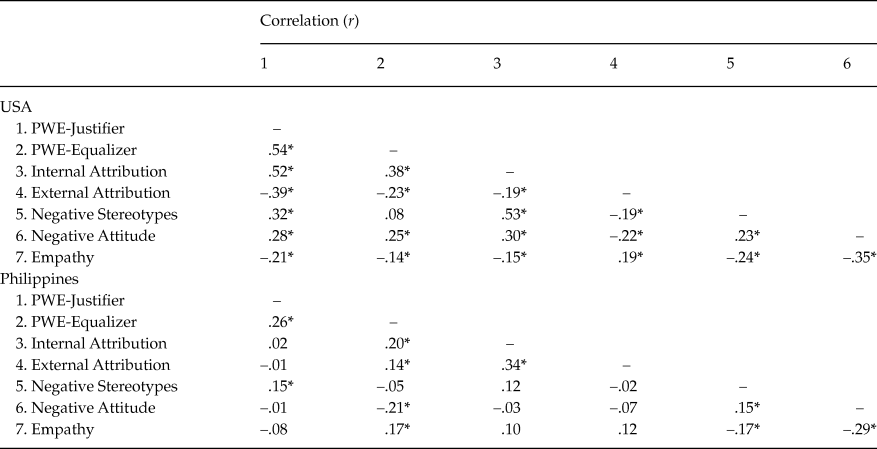
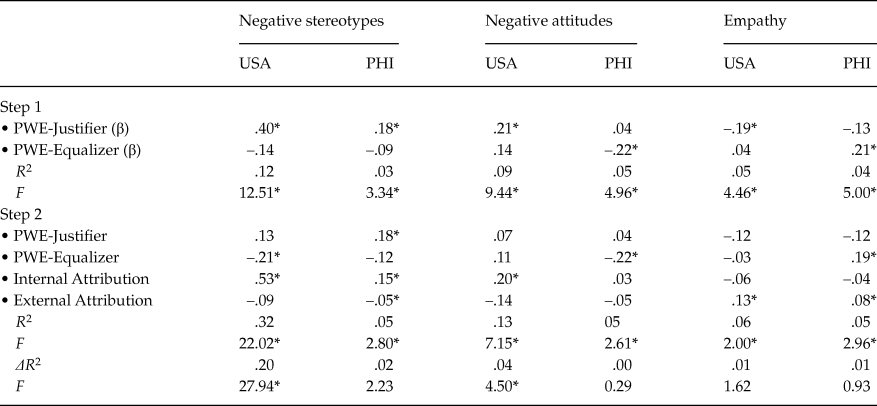
As shown in Table 1, Filipinos seemed to score higher than the European American on most scales, but we do not interpret this difference as we cannot assume scalar equivalence between the two country samples. Moreover, as the relationship between PWE and evaluations of poor persons was examined within country, the between-country differences are not directly related to testing the hypotheses. The various hypotheses were tested using hierarchical regression analysis, with each attitude measure regressed to the two PWE meanings in the first step, and the attributions entered in the second step. Before running the regression analyses, correlations among the key variables were computed, and as shown in Table 2, these show no multicollinearity among the variables. The key results of the regression analyses are summarized in Table 3.
Correlations for the Two Countries

*p < .05.
Hierarchical Regression Analysis

Note: PHI = Philippines.
*p < .05.
Predictors of Negative Stereotypes
In the first step of the regression analysis, PWE-Justifier predicted negative stereotypes but PWE-Equalizer did not in both samples. When attributions were entered in the model for the USA sample, the effect of PWE-Justifier became insignificant, suggesting that internal attribution mediated the relationship between PWE-Justifier and negative stereotypes. This mediating effect in the USA sample was tested in a path analysis with bootstrapping analysis (using AMOS 24.0); the mediation model included both PWE-Justifier and PWE-Equalizer as predictors of negative stereotypes and internal attribution as mediator of the relationship between PWE-Justifier and negative stereotypes. The path analysis confirmed the regression results. As shown Figure 1, the direct path linking PWE-Justifier to negative stereotypes was not significant, but there is a mediated path linking PWE-Equalizer to internal attribution to negative stereotypes. There was also an unexpected significant negative relationship between PWE-Equalizer and negative stereotypes. Most indexes indicated good fit: χ2(1) = 3.11, p = .078; CFI = .99; TLI = .94; except for RMSEA = .11, 90% CI [.01, .25]. Bootstrapping analysis (10,000 bootstrapped samples) indicated that the mediated relationship between PWE-Justified and negative stereotypes was significant; indirect effect: B = .17, SE = .03, p < .0001, 95% CI [.11, .24]. For the Philippine sample, there was no change in the variance explained by PWE-Justifier, suggesting internal attribution did not mediate the relationship; and as such no path analysis was conducted.
Summary of Results of Path Analysis of Negative Stereotypes of Poor Persons in USA Sample.
Path model shows unstandardized coefficients and standard errors. Solid lines and bold coefficients indicate significant pathways at p < .05; dashed lines and regular font coefficients indicate non-significant pathways. Covariances and error terms are not presented for simplicity.

Predictors of Negative Attitudes
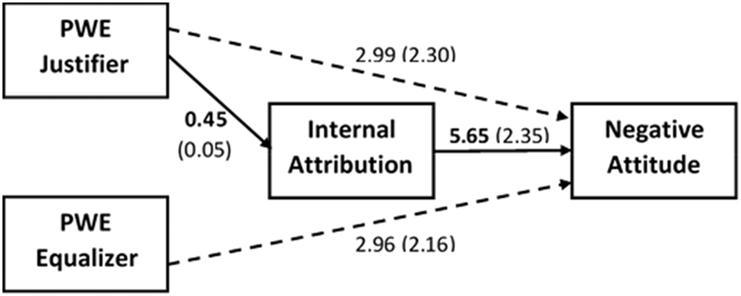
There were clear contrasts between the predictors of negative attitudes for the USA and Philippine samples. For the USA sample, PWE-Justifier predicted negative attitudes, but this relationship is mediated by internal attributions as indicated by the reduced coefficient of PWE-Justifier after attribution was entered into the model. As with negative stereotypes, a path analysis using a similar path model was again conducted for the USA sample (see Figure 2). The results indicated good fit: χ2(1) = 3.11, p = .078; CFI = .99; TLI = .92; RMSEA = .06, 90% CI [01, .15]. Direct paths linking PWE-Justifier and PWE-Equalizer to negative attitudes were both not significant. But the mediated paths linking PWE-Justifier to internal attributions and internal attributions to negative attitudes were significant. Bootstrapping analysis (10,000 bootstrapped samples) confirmed this mediated model; indirect effect: B = 2.52, SE = 1.11, p = .014, 95% CI [0.49, 4.84]. As expected, PWE-Justifier was unrelated to negative attitudes in the Philippine sample. PWE-Equalizer was negatively related to negative attitudes, which is similar to the results of the path analysis involving negative stereotypes; although unexpected, these particular results are not inconsistent with the hypotheses.
Summary of Results of Path Analysis of Negative Attitudes towards Poor Persons relative to Wealthy Persons in USA Sample.
Path model shows unstandardized coefficients and standard errors. Solid lines and bold coefficients indicate significant pathways at p < .05; dashed lines and regular font coefficients indicate non-significant pathways. Covariances and error terms are not presented for simplicity.

Predictors of empathy
As hypothesized PWE-Equalizer predicted empathy in the Philippine sample, but not for the USA sample. The results indicate an unexpected finding that for the USA sample, PWE-Justifier was a significant negative predictor of empathy towards poor persons, and this relationship with PWE-Justifier seems to be mediated by external attributions of poverty, as indicated the reduced coefficient of of PWE-Justifier after attributions were added to the model. However, we should note that adding attributions to the model did not significantly improve the model, unlike in the two other dependent variables. These regression results are not clearly indicative of a mediated relationship, so we conducted another path analysis on the USA sample, but this time including external attributions in the model (see Figure 3). The results indicated good fit: χ2(3) = 3.30, p = .348; CFI = .99; TLI = .99; RMSEA = .02, 90% CI [.01, .13], but do not support the interpretation of a mediation effect. Direct paths linking PWE-Justifier and PWE-Equalizer to empathy were both non-significant. Paths linking PWE-Justifier to internal and external attributions were both significant, but all other paths were not. Bootstrapping analysis (10,000 bootstrapped samples) also suggested no mediation; indirect effect: B = –.05, SE = .04, p = .145, 95% CI [–.14, .02]. Considering the results of the regression analysis and the path analysis, there seems to be no clear set of predictors of empathy in the USA sample. For the Philippine sample, PWE-Equalizer and external attributions both predicted empathy, although as with the USA sample, adding attributions to the model did not improve the regression model.
Summary of Results of Path Analysis of Empathy towards Poor Persons relative to Wealthy Persons in USA Sample.
Path model shows unstandardized coefficients and standard errors. Solid lines and bold coefficients indicate significant pathways at p < .05; dashed lines and regular font coefficients indicate non-significant pathways. Covariances and error terms are not presented for simplicity.

Discussion
This was the first study exploring how PWE-Equalizer and PWE-Justifier beliefs relate to evaluations of poor persons in two cultures. Our main hypothesis was supported, showing that PWE’s negative implications for evaluating poor persons seems to be particular to individualist cultures. By studying two different cultural groups, we were able to expand on prior work on PWE and poverty over the past 40 years, which was mostly limited to studying Western cultures where personal responsibility for disadvantage is emphasized and where PWE presumably has a predominately justifier-of-inequality meaning (Rosenthal, Levy, et al., Reference Rosenthal, Levy and Moyer2011).
Our study demonstrated how PWE-Justifier predicts negative evaluations of poor persons (negative stereotypes and negative attitudes) and was not associated with empathy for poor persons in the USA sample. Taking a step further than prior work, we showed that the negative relationships were mediated by internal attributions of poverty. We noted that internal attributions being a hallmark of individualistic cultures (Choi et al., Reference Choi, Nisbett and Norenzayan1999; Morris & Peng, Reference Morris and Peng1994). Our results support for our theorizing that individualist values emphasizing personal control and responsibility afford more internal attributions of disadvantaged statuses (Ramírez et al., Reference Ramírez, Levy, Velilla and Hughes2010) that are consistent with the use of the PWE-Justifier meaning. In contrast, some other cultures, including many Asian cultures, do not emphasize individualism as much. We note that adding attributions as a predictor did not improve the regression models in the Philippine models, suggesting that evaluations of poor persons may not be strongly related to attributions among Filipinos. In constrast, with the USA sample, the models explaining negative evaluations of poor persons (i.e., stereotypes and attitudes) improved with the addition of internal attributions, consistent with the notion that individualist societies associate PWE-Justifier and personal responsibility with negative evaluations of poor persons. Note that our results showed that PWE-Justifier also predicted negative stereotypes in the Philippine sample, but there was no mediated relationship between PWE-Justifier and negative evaluations of poor persons in the Philippines sample. This suggests that there may be a different social cognitive process relating PWE-Justifier with the negative stereotypes, distinct from the processes that arise from the social cognitive tendencies found in individualist societies. It is a limitation of our present study that we do not actually provide an alternative model that explains evaluations of poor persons in non-individualist societies, a limitation that might also relate to the next discussion point.
Our study also found another cultural contrast, where PWE-Equalizer was associated with empathy and negatively associated with negative attitudes towards poor persons in the Philippine sample, but not in the USA sample. Our results seem consistent with earlier findings (Levy et al., Reference Levy, West and Ramírez2005; Ramírez et al., Reference Ramírez, Levy, Velilla and Hughes2010) that in a sample of African Americans and sample of Mestizos in Colombia, PWE was associated with egalitarianism. Although those studies did not measure PWE-Equalizer directly, the pattern of relationships found is consistent with our observed relationship between PWE-Equalizer and empathy, and is aligned with the view that there is a distinct and more positive meaning of PWE that can be used in intergroup contexts. We assumed that this relationship was due to weak individualism in the Philippines (also perhaps among the aforementioned African American and Colombian samples), but as previously stated, there could be other cultural orientations that may be associated with the PWE-Equalizer meaning in non-individualist societies that our study is presently unable to address.
As these points were beyond the scope of our theorizing, future research could theorize about evaluations of poor persons in societies that do not value individualism and about the social cognitive factors that relate to PWE-equalizer meaning. The obvious candidate might be collectivism, which is the typical cultural syndrome that is considered opposed to individualism (Minkov et al., Reference Minkov, Dutt, Schachner, Morales, Sanchez, Jandosova and Mudd2017; Triandis, Reference Triandis1996). Another possible candidate construct is communitarianism (Metz, Reference Metz2015; Mockabee, Wald, & Leege, Reference Mockabee, Wald, Leege, Aldrich and McGraw2011), which has also been proposed as an alternative worldview to individualism and is said to be common in Catholic communities. Exploring the cultural knowledge that activates the PWE-Equalizer meaning should also be a vital direction of future research, as those can guide efforts to build positive intergroup relations.
But even within the limited scope of our model, our study expands on previous observations that the negative intergroup implications of PWE seems stronger in Western cultures (Rosenthal, Levy et al., Reference Rosenthal, Levy and Moyer2011) by clarifying how one specific meaning of PWE draws from pertinent forms of cultural knowledge that are active in individualist cultures. Cultural knowledge such as values and meanings that are widely shared and endorsed in particular cultures activate specific meanings of lay theories (Hong et al., Reference Hong, Levy and Chiu2001). As regards PWE, we find indications that cultures emphasizing individualism, personal control and responsibility, and dispositional attributions of negative outcomes are likely to activate and bring about the use of the PWE-Justifier meaning in intergroup contexts. Note that although we do not directly provide evidence for the accessibility of and dissemination of the concepts of individualism, personal control and responsibility in our study, we make this theoretical assumption based on established theories regarding the transmission and maintenance of cultural knowledge (Chiu & Hong, Reference Chiu, Hong, Kruglanski and Higgins2007; Kashima, Reference Kashima2014).
We should underscore that other than individualism, there other social differences between the Philippines and the USA that may also be important to consider to have a fuller understanding of the cultural aspects of the meaning of PWE. We focused on individualism in this study as a meta-analysis of studies on PWE indicated a stronger effect of PWE in Western countries that are known to be high on individualism. Other societal differences between the two countries relate to levels of economic and human development, ethnic diversity, educational systems, among many others. It is plausible that other social differences also influence how the PWE dimensions are understood and given meaning in each country. For example, it is possible that because the Philippines has generally lower human development indexes (i.e., access to basic goods and services, health care, education, etc.) and more widespread poverty, Filipinos give more emphasis on the potential to succeed implied in PWE-E. Similarly, the justifier meaning of PWE might be particularly salient in the USA where racial identity politics pervades discussions of access to opportunities fo social mobility. Note that such social factors may not simply be related to endorsement or non-endorsement of individualism. Thus, these other variables that were not controlled for in the two-country comparison could possibly account for the country differences found in the study.
Given that important limitation of the study, it would be important to consider a wider range of cultural samples to work toward a comprehensive understanding of the intergroup implications of the two PWE meanings across cultures, and ideally, other country-level differences could be accounted for in the analysis. Moreover, to more conclusively link individualism to PWE-Justifier, it might be good to directly measure individualism among the participants. Doing so would allow for a more explicit tests of how the cultural syndrome relates to PWE meanings.
We should also point to some methodological limitations associated with the sample and measures. Our study involved a relatively young sample from narrow geographic origins, and who are probably not representative of the two countries. The use of self-report questionnaires also leaves open the possibility that participants from the two countries may be understanding and responding to the items in different ways. Indeed it is possible, that the PWE-Justifier items in our scale evoked different types of intergroup relations (e.g., racial minority groups in the USA compared to indigenous peoples or economically disadvantaged groups in the Philippines) for which other lay beliefs and ideologies might come into play. Future studies should further probe the meanings associated with specific items; although we provide evidence for the two-factor structure of the PWE scales in both samples in our study, knowledge about the precise meanings evoked by the items would strengthen any inference that would be made from the self-report data.
These limitations notwithstanding, the current investigation has a number of strengths and contributions to the literature. As noted, there are few cross-cultural studies of PWE and none that included measures that distinguish PWE-Equalizer and PWE-Justifier and within-cultural studies of two groups is also rare (Ramírez et al., Reference Ramírez, Levy, Velilla and Hughes2010, is an exception). Our study is also unique in the PWE literature by examining mediators (internal attributions) of the relationship between PWE and intergroup attitudes. Our results provide important elaborations on previous studies that link PWE with attitudes towards poor persons and with internal attributions of poverty (e.g., Cozzarelli et al., Reference Cozzarelli, Wilkinson and Tagler2001) – studies that did not distinguish between the dual meanings of PWE and that supported the notion that PWE is more strongly negatively associated with controllable stigmas. Our results suggest that those previous findings actually refer to the PWE-Justifier meaning and the use of internal attributions of poverty to hold poor persons responsible for their plight, and that emphasizing the PWE-Equalizer meaning may lead to different cognitive and affective sets related to poor persons. Finally, our results point to how cultural knowledge (i.e., individualist values) activate the PWE-Justifier meaning and its use in intergroup contexts.
Continuing to study these two meanings of PWE across different cultural contexts and also within cultures appear to be worthwhile endeavors. As noted previously, there are probably other social and cultural factors that work in convergence to shape how PWE is understood in specific societies, but our results provide evidence that individualism is one of the factors associated with PWE-J. Exploring the cultural knowledge that activates the PWE-Equalizer meaning should be an important direction of future research in this area, those can guide efforts to build more positive intergroup cognitions and behaviors. Indeed, we can make greater progress in understanding how to combat intergroup problems if we better understand lay theories like PWE that people use in their everyday life to empathize with or derogate groups in need.