Introduction
It is known that in the in vitro production of embryos, sperm preparation methods, among other factors, have an important role in determining the quality of the blastocysts produced (Samardzija et al., Reference Samardzija, Karadjole, Getz, Makek, Cergolj and Dobranic2006). Single-layer centrifugation (SLC) through a species-specific colloid is a sperm selection technique that has been shown to improve sperm quality in different species (bull: Thys et al., Reference Thys, Vandaele, Morrell, Mestach, Van Soom, Hoogewijs and Rodriguez-Martinez2009; dog, cat, stallion, boar: Morrell & Rodriguez-Martinez, Reference Morrell and Rodriguez-Martinez2011; buck: Jiménez-Rabadán et al., Reference Jiménez-Rabadán, Morrell, Johannisson, Ramón, García-Álvarez, Maroto-Morales, Álvaro-García, Pérez-Guzmán, Fernández-Santos and Garde2012; llama: Trasorras et al., Reference Trasorras, Giuliano, Chaves, Neild, Agüero, Carretero, Pinto, Baca Castex, Alonso, Rodriguez, Morrell and Miragaya2012; wolves: Muñoz-Fuentes et al., Reference Muñoz-Fuentes, Linde Forsberg, Vilà and Morrell2014; red deer: Anel-López et al., Reference Anel-López, Martínez-Rodríguez, Soler, Fernández-Santos, Garde and Morrell2015). Similar techniques e.g. density gradients (a type of colloid centrifugation) have been used to prepare human sperm for fertility treatments (World Health Organization, 2010).
Compared with density gradient centrifugation, which uses several layers of colloid, the SLC technique uses only one layer of colloid, thus saving preparation time. The SLC technique is easier to use than other selection methods such as density gradient centrifugation (DGC) or swim-up (Morrell & Rodriguez-Martinez, Reference Morrell and Rodriguez-Martinez2011; Anel-López et al., Reference Anel-López, Martínez-Rodríguez, Soler, Fernández-Santos, Garde and Morrell2015). Colloids are expensive, therefore the aim of this study was to determine whether good results could be obtained with a smaller volume of colloid. The ‘Small’ version [4 ml of ‘Bovicoll’, (Androcoll-B)] was compared with two variants using a reduced volume (‘Mini’ and ‘Mini-EP’). A further aim was to determine if SLC-selected spermatozoa were capable of fertilization; an in vitro fertilization (IVF) trial was performed.
Materials and methods
Experiment 1: three variants of SLC
Frozen semen from four bulls in commercial semen production was kindly provided by Viking Genetics, Skara, Sweden. Four straws from each bull/batch (n = 16), were thawed at 37°C for 12 s and pooled. An aliquot of 200 μl was used as a control (unselected), and three variants of the SLC treatment were prepared following a protocol described previously (Morrell et al., Reference Morrell, Dalin and Rodriguez-Martinez2009; Anel-López et al., Reference Anel-López, Martínez-Rodríguez, Soler, Fernández-Santos, Garde and Morrell2015), with slight modifications. For each treatment an aliquot of 200 μl was layered on top of a column of Bovicoll (Androcoll-B) as follows: ‘Small’: 4 ml of colloid in a conical centrifuge tube; ‘Mini’: 1 ml of colloid in a conical centrifuge tube and ‘Mini-EP’: 1 ml of colloid in a 1.5 ml Eppendorf® tube. The tubes were centrifuged at 300 g for 20 min and each sperm pellet was transferred to a clean tube containing 20 μl of buffer B (patent applied for) with 5% BSA added to prevent the spermatozoa adhering to surfaces.
A Nucleocounter SP 100 (Chemometec, Allerød, Denmark) was used to evaluate the sperm concentration, according to Hansen et al. (Reference Hansen, Vermeiden, Vermeiden, Simmet, Day and Feitsma2006) with slight modifications (5 μl of the sample, instead of 50 μl and 500 μl of the detergent, instead of 5 ml).
Sperm motility was assessed in an aliquot of 5 μl on a pre-warmed microscope slide, by computer-assisted semen analysis (CASA) using the SpermVision™ (Minitűb, Tiefenbach, Germany) connected to an Olympus BX 51 microscope (Olympus, Japan). The yield of motile spermatozoa after SLC was calculated as follows (Morrell et al., Reference Morrell, Dalin and Rodriguez-Martinez2009):
 $$\begin{eqnarray*}
{\rm{Yield\ }}\left( {\rm{\% }} \right)\; =\;\frac{{{\rm{Total\ number\ of\ motile\ spermatozoa\ after\ SLC}}}}{{{\rm{Total\ number\ of\ motile\ spermatozoa\ before\ SLC}}}}{\rm{\ }} \times {\rm{\ }}100
\end{eqnarray*}$$}}
To obtain the percentage of sperm with functional membranes, the hypo-osmotic swelling test (HOST) was used, following the protocol described by Correa & Zavos (Reference Correa and Zavos1994). Ten microlitres of each sample were incubated in 100 μl of fructose–sodium citrate (100 mOsm) at 37°C for 1 h. After incubation, a 5 μl drop was placed on a slide with a cover glass and a total of 200 spermatozoa was evaluated by phase-contrast microscopy (Olympus BH2, Japan; ×400 magnification).
Chromatin integrity was evaluated using the sperm chromatin structure assay (SCSA). Aliquots of selected and unselected samples were mixed 1:1 with TNE buffer (Evenson & Jost, Reference Evenson and Jost2000), snap-frozen in liquid nitrogen and transferred to a −80°C freezer until analysed. The SCSA has been described in detail by Goodla et al. (Reference Goodla, Morrell, Yusnizar, Stålhammar and Johannisson2014). The DNA fragmentation index (%DFI) was calculated as the proportion of sperm fluorescing red out of the total population (sperm with red and sperm with green fluorescence) (Evenson & Jost, Reference Evenson and Jost2000).
Yield of motile spermatozoa, percentage of sperm with functional membranes (HOST) and %DFI, in the unselected and selected sperm samples were compared using repeated measures analysis of variance (ANOVA) (repeated over bulls) using R v3.2 (R Development Core Team, 2014).
Experiment 2: IVF trial
The aim of this experiment was to determine if SLC-selected spermatozoa were capable of fertilization. Straws of semen of a bull (with proven fertility in IVF) were thawed and treated using two methods: Mini-SLC and swim-up (control). Mini-SLC was chosen as sperm preparation technique based on the results from Experiment 1.
In vitro maturation and fertilization
The methods used have been described previously by Abraham et al. (Reference Abraham, Gustafsson, Ruete and Brandt2012) with slight modifications: 50 μg/ml of gentamycin replaced penicillin and streptomycin in the culture medium, and 0.5 μg/ml FSH and 0.1 μg/ml LH (Stimufol, PARTNAR Animal Health, Port Huron, Canada) was added to the maturation medium instead of 10 μg/ml of each. Bovine ovaries were collected at a slaughterhouse (Linköping) and transported at 33–35°C to the laboratory within 3 h. Cumulus–oocyte complexes (COCs) were aspirated from follicles between 3 to 8 mm in diameter and collected in search medium (HEPES-buffered medium 199 with 0.2% w/v BSA fraction V, 50 IU penicillin and 50 μg/ml streptomycin). Only good quality COCs were selected for maturation (according to Goodhand et al., Reference Goodhand, Staines, Hutchinson and Broadbent2000). Groups of 40 COCs were incubated in maturation media (TCM-199 with l-glutamine, 50 μg/ml of gentamycin, 0.5 μg/ml FSH and 0.1 μg/ml LH (Stimufol, PARTNAR Animal Health, Port Huron, Canada), and 0.4% w/v fraction V BSA for 24 h in a 5% CO2 in air incubator, at 38.5°C. After maturation, COCs were washed with wash medium (modified Tyrode's albumin lactate pyruvate; mTALP, containing 0.3% w/v fraction V BSA) and pipetted, leaving 3–5 layers of cumulus cells around each oocyte; they were then transferred to wells with fertilization media (mTALP containing 0.6% w/v fatty acid-free BSA, 3 μg/ml heparin, 3 μg/ml penicillinamine 3 μg/ml epinephrine and 1.1 μg/ hypotaurine).
Semen from one bull, known to work well in IVF in our laboratory, was used. The spermatozoa were thawed and two different sperm selection techniques were performed: Mini-SLC and swim-up (as control). The Mini-SLC is described in Experiment 1, with the exception that fertilization medium was used instead of buffer B to resuspend the pellet obtained after centrifugation. The swim-up was performed in capacitation media for 45 min at 38.5°C in a 5% CO2 in air incubator, as follows: semen was pipetted into a centrifuge tube and 1 ml of capacitation medium was carefully layered on top. The tube was placed in the incubator at an angle of 45° for 45 min to allow motile spermatozoa to swim-up into the capacitation medium.
After swim-up, the spermatozoa were washed and concentrated by centrifugation (300 g) for 7 min before resuspending the sperm pellet in fertilization medium. Motility was assessed after thawing and after selection and sperm concentration was measured in both groups. Spermatozoa were added to the oocytes at a concentration of 1 × 10⁶ spermatozoa/ml and incubated for 22 h (5% CO2 at 38.5°C). Fertilized oocytes were then denuded from cumulus cells and spermatozoa by pipetting and cultured in synthetic oviduct fluid, (SOF; Takahashi & First, Reference Takahashi and First1992) in a humidified atmosphere of 5% CO2, 5% O2 and 90% N2 at 38.5°C. At 44 h post fertilization, cleavage was checked and the number of embryos beyond the 2-cell stage was noted. The number of blastocysts developed by day 7 and day 8 was recorded. On day 8, all blastocysts were graded (according to Lindner & Wright, Reference Lindner and Wright1983), fixed with 4% paraformaldehyde overnight at 4°C and washed in PBS (with 1% PVA). Afterward, they were stained for 20 min with Hoechst 33342 (2.5 μg/ml), washed and mounted on glass slides with Vectashield. The number of nuclei was recorded for each blastocyst by two observers independently, using an epifluorescence microscopy (SM 510, Carl Zeiss AB, Jena, Germany).
The cleavage rates and blastocyst rates were calculated from the number of fertilized oocytes.
Cleavage rate, blastocyst rate and the total number of nuclei per blastocyst were compared using a paired t-test (R Development Core Team, 2014). Four batches of oocytes were prepared.
Results
Experiment 1
The unselected semen had the following characteristics: concentration (59.1 ± 14.8 × 10⁶/ml), motility (66.8 ± 10.4%), and membrane integrity (41.9 ± 16.7%).
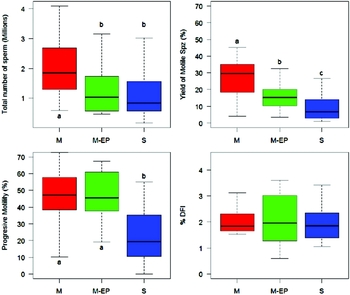
Total number of sperm, yield of motile spermatozoa after SLC, progressive motility and chromatin damage are shown in Fig. 1. Of the three treatments, Mini-SLC produced the highest yield of motile spermatozoa. For progressive motility, there was no significant difference between Mini and Mini-EP SLC; however Small SLC resulted in significantly lower motility than the other two treatments. There was no significant difference between Mini-SLC and Mini-EP for membrane integrity, although Small SLC contained significantly fewer membrane intact spermatozoa than Mini-SLC. Sperm chromatin damage, %DFI, was significantly lower in the selected samples than the unselected control (1.84 and 2.99 respectively, P = 0.036), with no significant differences between the SLC treatments (P > 0.85).
Results of total number of sperm, yield of motile spermatozoa (‘Spz’) after single-layer centrifugation (SLC), progressive motility, and chromatin integrity (%DFI = DNA fragmentation index). Selected samples: ‘M’ = Mini-SLC (1 ml of colloid in a conical centrifuge tube); ‘M-EP’ = Mini-SLC (1 ml of colloid in an Eppendorf® tube) and ‘S’ = Small SLC (4 ml of colloid in a conical centrifuge tube). Labels ‘a’ and ‘b’ indicate significant differences between variables.

Experiment 2
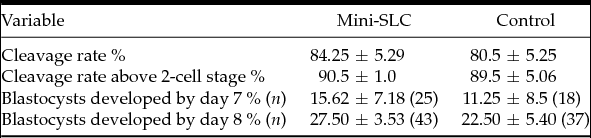
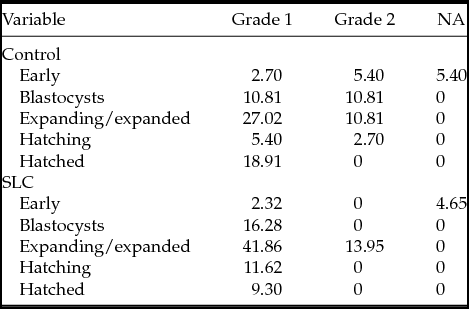
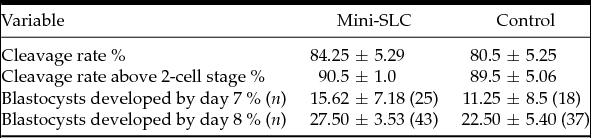
The results of the IVF experiment are presented in Table 1 and Table 2.
Summary of results obtained by IVF of bovine oocyte (n = 320) from abattoir-derived ovaries. Comparison between Mini-SLC and Control (swim-up). Cleavage and blastocyst rates calculated from the number of fertilized oocytes
Proportions of blastocysts developed by day 8, divided by grades and developmental stages (%)
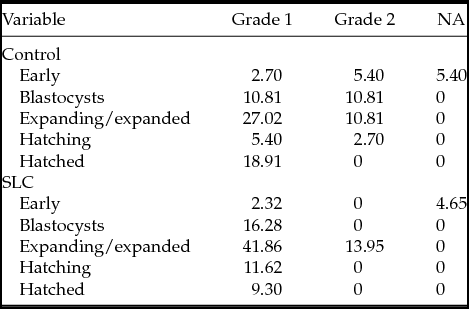
Cleavage rate and blastocyst rate did not differ significantly between groups. There was a trend towards an increased number of cells in blastocysts in the SLC group compared with control 1 (96.05 ± 36.86 and 91.57 ± 39.07, respectively).
Discussion
The results of Experiment 1 are in accordance with previous studies on bull semen samples (Yulnawati et al., Reference Yulnawati, Abraham, Laskowski, Johannisson and Morrell2014) in which SLC was shown to have a positive influence on several kinematic parameters that may be important for fertilization. In the present study, no improvement in motility and membrane integrity was observed after selection, possibly because the post-thawed sperm quality in the control samples was already good.
This study found lower chromatin damage in the selected samples compared with the unselected control, which is consistent with the findings of Goodla et al. (Reference Goodla, Morrell, Yusnizar, Stålhammar and Johannisson2014) for bull spermatozoa and Morrell et al. (Reference Morrell, Moffatt, Sakkas, Manicardi, Bizzaro, Tomlinson, Nilsson and Holmes2004) for human spermatozoa. However, other authors (Jiménez-Rabadán et al., Reference Jiménez-Rabadán, Morrell, Johannisson, Ramón, García-Álvarez, Maroto-Morales, Álvaro-García, Pérez-Guzmán, Fernández-Santos and Garde2012; Anel-López et al., Reference Anel-López, Martínez-Rodríguez, Soler, Fernández-Santos, Garde and Morrell2015) reported no differences in chromatin damage between controls and SLC-selected samples for frozen goat and red deer spermatozoa respectively, perhaps reflecting a species difference. Previous studies showed that colloid centrifugation would be the best technique for preparation of ejaculates with a low concentration of spermatozoa (Trasorras et al., Reference Trasorras, Giuliano, Chaves, Neild, Agüero, Carretero, Pinto, Baca Castex, Alonso, Rodriguez, Morrell and Miragaya2012), which is in agreement with the World Health Organization (2010) for which density gradients are recommended for the preparation of human sperm in cases of oligozoospermia, teratozoospermia or asthenozoospermia, because of the greater total number of motile spermatozoa recovered than from alternative preparation methods.
Mini and Mini-EP SLC produced a higher number of good quality sperm than Small SLC, indicating that it is possible to use 1 ml of colloid instead of 4 ml to prepare frozen–thawed bull sperm samples. Such a modification to the SLC technique would enhance its usefulness and acceptability in a variety of laboratory settings. Moreover, despite the reduction in sperm numbers during SLC, sufficient spermatozoa remained to perform bovine IVF experiments, in agreement with Thys et al. (Reference Thys, Vandaele, Morrell, Mestach, Van Soom, Hoogewijs and Rodriguez-Martinez2009). One of the aims of the present experiment was to determine if SLC-selected spermatozoa were capable of fertilization. Mini-SLC was chosen as the sperm preparation technique based on the results from Experiment 1 and because Small SLC had already been tested in IVF in previous studies (Thys et al., Reference Thys, Vandaele, Morrell, Mestach, Van Soom, Hoogewijs and Rodriguez-Martinez2009). In line with Samardzija et al., (Reference Samardzija, Karadjole, Getz, Makek, Cergolj and Dobranic2006), our cleavage rate was not different between both treatments; however Samardzija et al. (Reference Samardzija, Karadjole, Getz, Makek, Cergolj and Dobranic2006) found a statistically significant difference in the number of blastocyst obtained on day 7 and better quality of embryos from colloid centrifugation when they compared BoviPure with swim-up.
The use of animal models in research has contributed in large part to the knowledge of reproductive physiology in other animals and humans (Kuwayama Reference Kuwayama2005; Chianese et al., Reference Chianese, Chioccarelli, Cacciola, Ciaramella, Fasano, Pierantoni, Meccariello and Cobellis2011), particularly when it is difficult to obtain material or there are ethical reasons why material cannot be used from the target species. Thus a new method can be tested first in a different species, and the technology transferred to human sperm if the results in the model appear to be interesting for the preparation of human sperm. Thus it would be expected that Mini-SLC could be used to advantage for the preparation of human sperm, based on the present results with the bovine model.
In conclusion, good results were seen using a reduced volume of colloid for SLC of frozen–thawed bull semen samples. Sufficient sperm were obtained to be used in IVF, resulting in the production of good quality blastocysts. As there was a trend to an increased number of cells in blastocysts in the SLC group, Mini-SLC method might be better than swim-up to select frozen–thawed bull spermatozoa for IVF.
Acknowledgements
We thank Viking Genetics for supplying the bull semen, Karin Selin-Wretling from KV-lab (Swedish University of Agricultural Sciences) for their help in the laboratory, Alejandro Ruete for valuable discussions and help with statistics, and Ylva Sjunnesson and Maria Sabés Alsina for their help in the IVF laboratory.
Financial support
MCA is funded by a grant awarded to Professor Jane Morrell by the Veterinary Faculty Swedish University of Agricultural Sciences, FORMAS (2010–1241).
Statement of interest
J.M. Morrell is the inventor of Bovicoll (Androcoll-B) and buffer B and one of the patent holders.
Ethical standards
The authors assert that all procedures contributing to this work comply with the ethical standards of the relevant national and institutional guides on the care and use of laboratory animals.