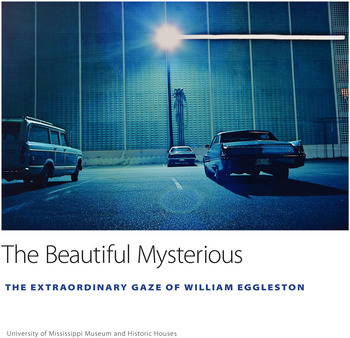
Something about the way the South looks has long fascinated outsiders and southerners alike. It seems to invite the stunning cover of William Eggleston's The Beautiful Mysterious, which is a blue-tinged, illuminated, nearly empty, parking lot. Another example: the “rust aesthetic” associated with the banged-up signs so common in William Christenberry's photographs seems like an authentic southern thing.Footnote 1 In fact, a certain orange-brown, rustlike color permeates many of the photographs in The Beautiful Mysterious. A more shocking visual signifier of southernness has historically been the lynched black body, as, for example, that of Emmett Till in 1955. As it turns out, Eggleston (b. 1939) grew up in Sumner, MS where the murderers of the Chicago teenager were put on trial – and acquitted.
Not surprisingly, if there is a single mood associated with the South, it is “ambivalence.” It is the region that people love to hate and feel guilty for enjoying. Of course, the image of the South is itself subject to the vicissitudes of time, just as the objects in it are. For instance, the South elicits less interest than it once did. Hence the frequently asked question: is the South is still “the South”?
The ongoing fascination with Eggleston's work helps establish the centrality of his photography to the South's own “memory industry.” The fifty-five Eggleston photographs in The Beautiful Mysterious are a gift from his long-time friend, William “Bill” Ferris (b. 1942), to the University of Mississippi Museum. Thirty-six of that number were part of an exhibition there between September 2016 and February 2017. All of them now appear in the volume under review, edited by Ann J. Abadie, a former colleague of Ferris at the University of Mississippi and indispensable one-time associate director of the Center for the Study of Southern Culture between 1979 and 2011. As an added bonus, the beautifully presented book also contains a fifty-six-page symposium devoted to Eggleston's work on 7 October 2016 in Oxford, MS.
Eggleston, The Beautiful Mysterious, cover image.

The symposium is a valuable document in its own right. It explores the pioneering role that William Eggleston's photographs have played in the development of southern and American color photography since the 1970s. In the discussion, Eggleston's friends, colleagues, museum workers, critics and academics create a valuable body of oral (intellectual) history that also illuminates the emergence of visual postmodernism in the last quarter of the twentieth century.
The contribution by historian, folklorist and literary scholar Ferris is particularly invaluable to understanding the context of Eggleston's work and the great importance of southern photography, in particular from the 1960s on. As Ferris sums it up at one point, “Eggleston is to photography what Faulkner is to literature; what B. B. King is to blues … He [Eggleston] is an iconic figure, and he essentially builds on a long, rich tradition of photography in the American South.”Footnote 2 Ferris also calls our attention to the great photographic influences on Eggleston, especially Walker Evans and Eudora Welty, not to mention the French photographer Henri Cartier-Bresson.Footnote 3 Besides these figures, the crucial importance of Alabama's William Christenberry to the development of Eggleston's photography is made clear, as is the indispensable institutional role played by John Szarkowski of the Museum of Modern Art in providing a home for American photography from the 1930s on. There is certainly nothing provincial about this cast of talented artists, historians, critics and curator.
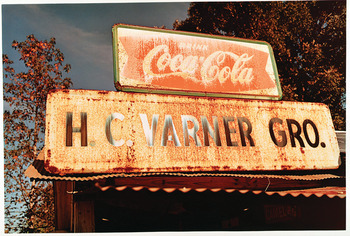
H. C. Varner Grocery, 1971, in Eggleston, The Beautiful Mysterious, 26. © Eggleston Artistic Trust, Courtesy Eggleston Artistic Trust and David Zwirner.
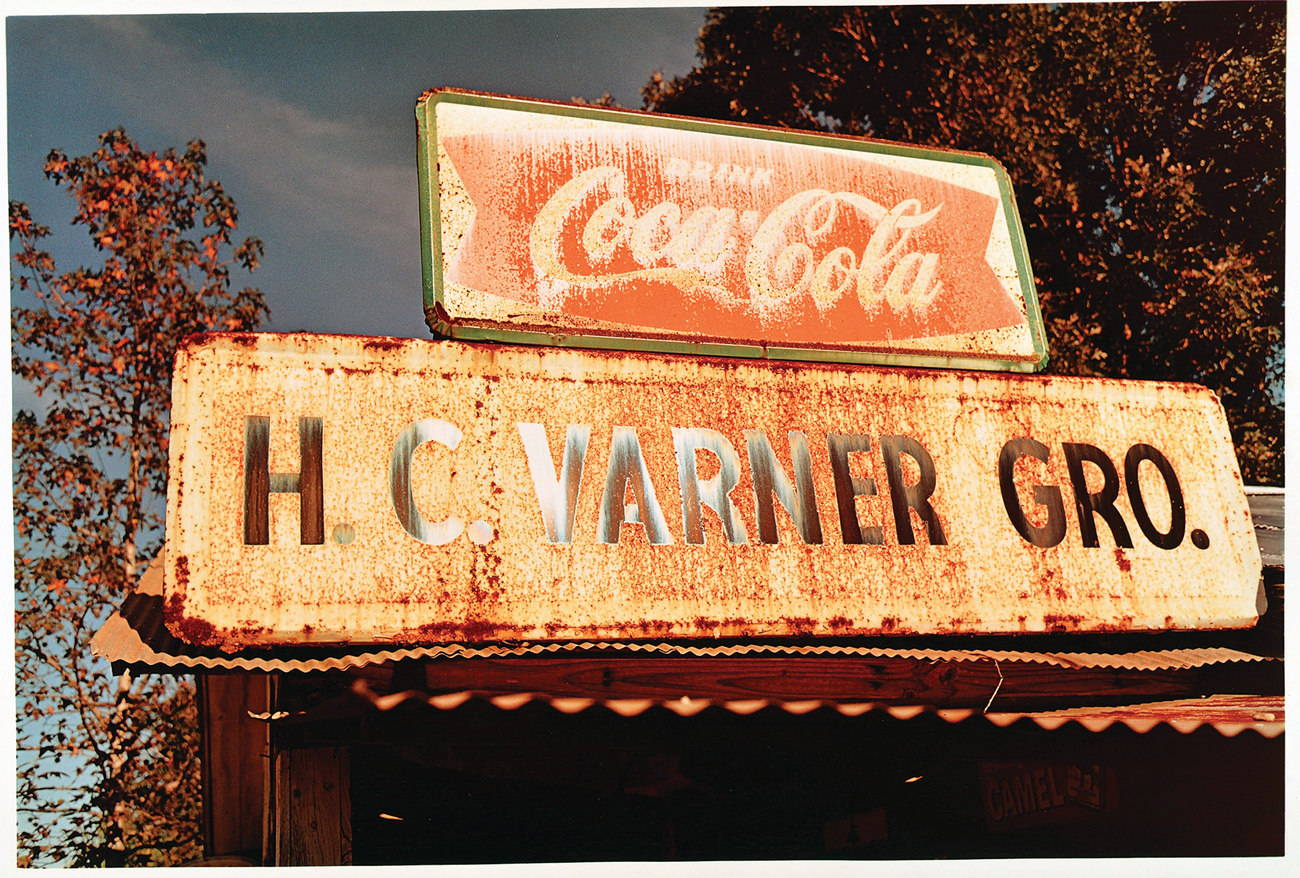
For those who are new to photography as a tradition of art making, it may not be entirely clear what is so important, even unique, about Eggleston as a photographer. First, at a time and place when the documentary and the social-realist tradition ruled supreme, he was never very interested in taking that kind of photograph. Indeed, Walker Evans himself did not strictly distinguish documentary from art photography. In Let Us Now Praise Famous Men (1941/1960), Evans and writer James Agee created a complexly confessional and fragmented narrative concerned not only with the lives of three Alabama sharecropper families in the mid-1930s, but also with the aesthetic and even ontological issues involved in photographic representation in general. Evans went on to have a tremendous influence on Eggleston and Christenberry, first in the 1960s. He made clear that the distinction between documentary and art photography and between signs as advertisements and signs as art objects was hard to maintain with much conviction. Parenthetically, it was no accident, I think, that it was southern artists such as Robert Rauschenberg and Jasper Johns who bridged the gap between abstract expressionist painting and the “capitalist realism” of advertising. The rusting roadside signs already alluded to also turn up among the photographs in The Beautiful Mysterious. Overall, what links the work of Eggleston with that of the others mentioned here is, above all, a commitment to “a democracy of seeing.”
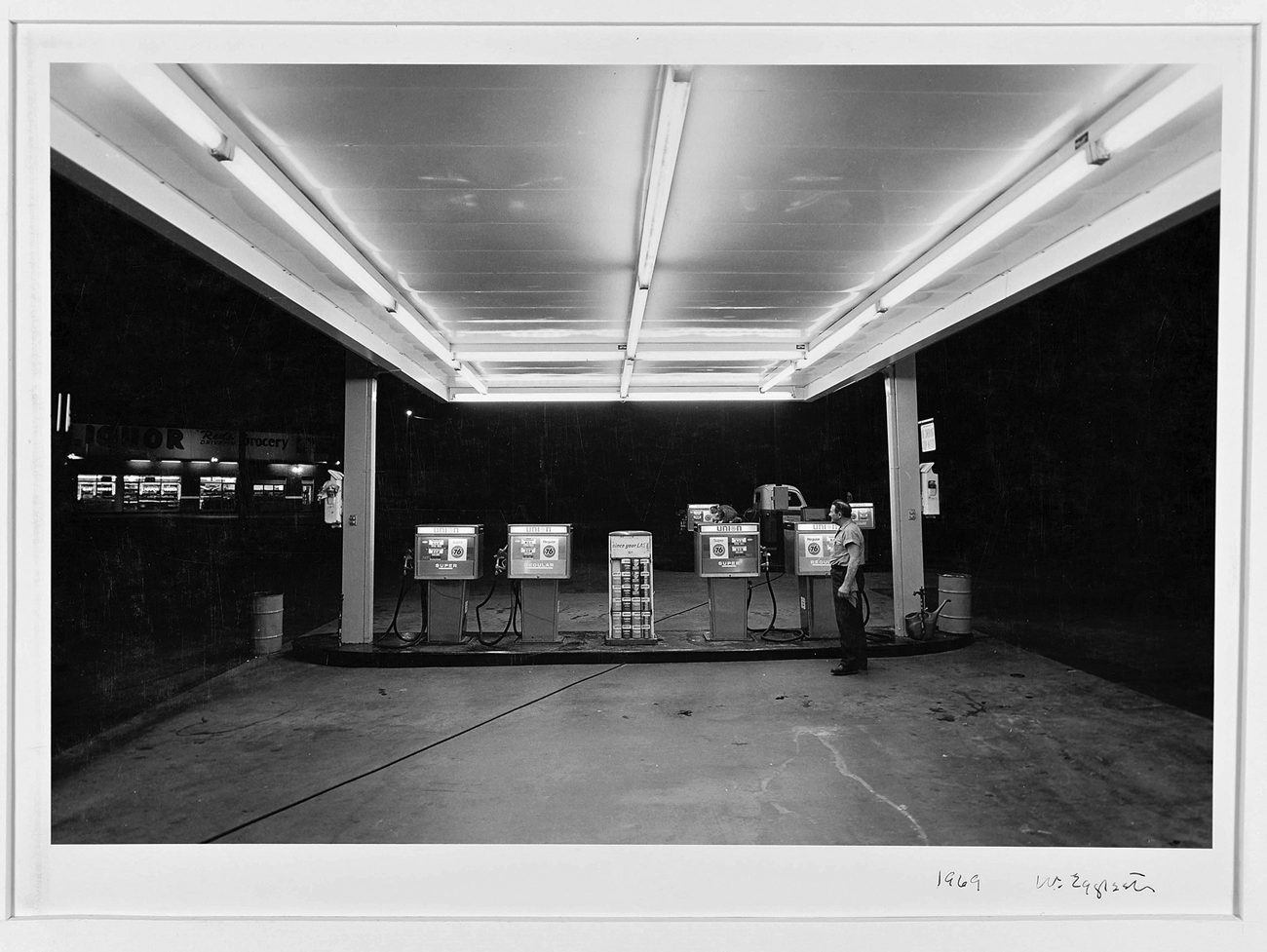
Untitled (Union Avenue, Memphis, Tennessee), 1969, in Eggleston, The Beautiful Mysterious, 21. © Eggleston Artistic Trust, Courtesy Eggleston Artistic Trust and David Zwirner.

However, what made Eggleston's project so different was his turn to color photography in the mid-1970s, a momentous shift in visual aesthetics in general. Eggleston admitted that he was initially just curious about how easy it seemed to be to shift back and forth so easily between color and black-and-white photography. By the early 1970s, Evans was in close contact with Eggleston, who lived in Memphis, and Christenberry, who was from Hale County, Alabama but taught art at Memphis State University. After Christenberry showed Evans the photographic results of his color snapshots taken with a Brownie camera in Hale County, Evans accompanied him there to take more color photographs. But, as mentioned, Eggleston was not interested in emphasizing the documentary function of photography; if anything, his use of color signaled a pivot away from the documentary impulse.
This shift to color was greeted with hostility in the world of art photography. Why is another matter. Perhaps it was that color photographs were identified with the world of capitalism and commerce, family holidays and birthdays, the opposite of everything that modernist photography stood for. Interestingly, about the same time, philosopher Stanley Cavell (himself from Atlanta) contended in his The World Viewed: Reflections on the Ontology of Film (1971) that color films signified a separate ontological realm closely linked with fantasy, while the authentic and the real were linked with black-and-white films. What captured Eggleston's laser-like attention, notes critic Richard McCabe, was “the ugly,” “the obvious,” the “local” and, more generally, the “blandness of mindless consumer culture.”Footnote 4 Thus, in a sense, Eggleston also linked his color aesthetic with the “democratic” aesthetic/ethic; in fact one of his books is entitled The Democratic Forest (1989). In retrospect, it was the aesthetic obsession of his work with deeply saturated color that suggests that the fact of color was as important as what objects are being photographed.
What, then, are Eggleston's photographs “like”? What keeps people coming back to them? One answer is a vaguely philosophical one: they are about the way reality is composed and reproduced. There is a stark “thereness” in many of them. Another striking characteristic of them is the near absence of human beings in a great number of his strongest works. For instance, the first seven photographs in The Beautiful Mysterious are black and white and have an average number of people in them. But the rest of the photographs, the color ones, contain a total of three people. Rather, we might say, most of his photographs testify to the former presence of human beings and their doings. In addition, viewers are invited to concentrate as much on the objects in his photographs – a single lightbulb set against a deeply red ceiling or a stationary tricycle focused on at ground level, or, in a rare nod to southern racial realities, his remarkable 1969–70 photograph of a white man and a black man standing one behind the other near a car and a pond. All this would suggest that reality was made up of arranged objects. Yet Eggleston has also been quoted as saying, “I don't take pictures of things.” How do we square these various positions?
One of the symposium's participants, Megan Abbott, rejects the idea that Eggleston's photographs “seem to tell a story.”Footnote 5 That is, she (rightly, I think) rejects the view that the photographs are primarily psychological documents about Eggleston's state of consciousness. At their best, his photographs insistently compel viewing. They do not ask for a “quick study” but rather insist on our contemplation of the various deep dimensions of supersaturated color. They might be said to exemplify “slow looking.”
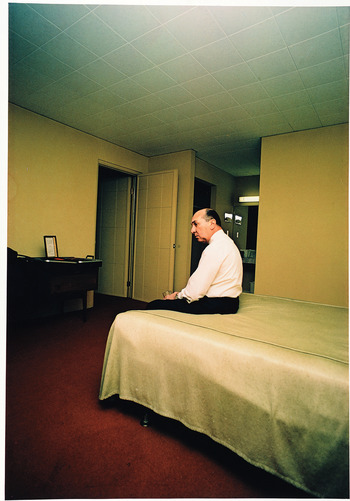
Untitled (Huntsville, Alabama), c.1970, in Eggleston, The Beautiful Mysterious, 23. © Eggleston Artistic Trust, Courtesy Eggleston Artistic Trust and David Zwirner.
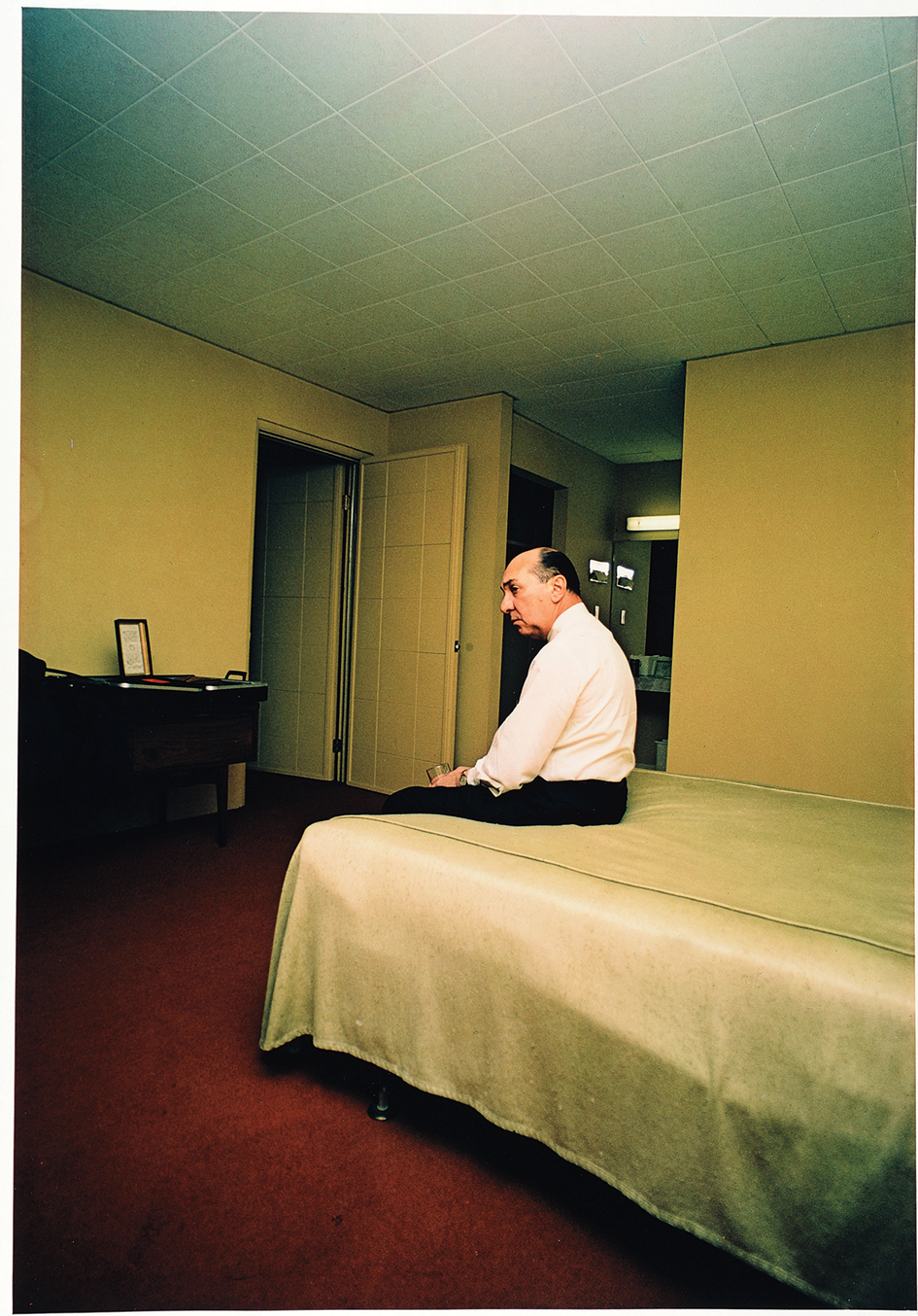
Or perhaps Eggleston's photographs present the fragments of a narrative, which is difficult, even impossible, to reconstitute. They avoid the Evans “square, frontal view” and instead are closer to Cartier-Bresson's “angles.”Footnote 6 An Eggleston photograph almost always presents an off-center scene, its composition made up at odd angles. Indeed, we may arrive at the aftermath of a story or the detritus of objects. Eggleston's camera eye has been aptly characterized by filmmaker Michael Almereyda as something like “an alert alien intelligence hovering within a spirit of bemusement.”Footnote 7 In a strange way, this makes the characteristically Egglestonian angle of vision thoroughly southern in nature – it is an attempt to capture the aftermath of something that was once momentous, but is now no longer.
As with all visual art, the best way to come to an understanding of Eggleston's work is to keep on looking, making connections, changing one's mind, and trying to understand the terms in which it presents itself. Somehow I am not surprised that David Lynch feels a strong affinity with Eggleston's work. Think of the intense colors of the yard and garden in Blue Velvet (1986). I am also reminded of the sudden appearance of the young girl in color in the concentration camp in the film Schindler's List (1993), filmed in black and white. Clearly Stephen Spielberg meant to point us toward another level of reality when he inserted a single colored figure in the dominant black-and-white reality of the concentration camp.
Finally, most commentary on Eggleston's work seems to avoid race, as does the work itself. There is no law that says all southern artists, particularly white ones, must confront and wrestle with the historical, personal and social reality of race. As already mentioned, faces are few in number in Eggleston's photography and they are rarely black. But if Eggleston is going to be seen in terms of the so-called southern experience, as most critics assume, the realities of race would seem to demand attention. The question is, what sort of attention? For example, before most critics realized it, Faulkner's work was almost always about race without always being explicitly so. Eudora Welty, who set out to be a photographer in the 1930s, has written in praise of Eggleston's work but she was also criticized during her lifetime for omitting much explicit treatment of race in her fiction.Footnote 8 William Christenberry's art avoids explicit engagement with race, but then in the last quarter of the twentieth century he began collecting Ku Klux Klan paraphernalia, dolls, icons and decorations which he occasionally exhibited together until various of the items were stolen from his collection and he received death threats. Christenberry never exhibited any or all of the Klan items again after 1979. What can be said, I suppose, is that Eggleston has not felt compelled to figure out how his art, which he has linked to a “democratic” vision, can directly illuminate the South's own history, a history that is incomprehensible aside from a constant meditation on the coexistence of the two races – together and apart.