Local elections in the past four decades have provided valuable data for political scientists to test various hypotheses concerning racial relations in the United States. Past research has shown, for example, that the elections of African American candidates to powerful offices in urban America are closely related to the changing racial demographics of cities (Browning, Marshall, and Tabb Reference Browning, Marshall and Tabb2003). More specifically, racial polarization in a city's mayoral election tends to be at a maximum when whites and blacks each compose about 50% of the city's population. On the other hand, a biracial coalition between whites and blacks led by a charismatic black candidate is more likely to win elections when blacks become a clear majority of the city population (Liu and Vanderleeuw Reference Liu and Vanderleeuw2007). One remaining question that has increasingly drawn attention from scholars is the condition under which a multiracial coalition may be successfully formed.
Many analysts of national elections have assumed that minority voters are monolithic, and that the racial solidarity among blacks, Latinos, and Asians in competitive elections is automatically high. “Except for the Cubans who migrated after the revolution, a majority of Hispanics have voted Democratic,” claim Judis and Teixeira (Reference Judis and Teixeira2002, 57) in their influential book The Emerging Democratic Majority. Moreover, “Asian, Hispanic, black, and other minority voters, swelled by the enormous wave of immigration during the 1990s, now are about 19 percent of the voting electorate, and they gave Gore at least 75 percent support in the 2000 election…. If these voters remain solidly Democratic, they will constitute a formidable advantage for any Democratic candidate” (Reference Judis and Teixeira2002, 61).
However, according to previous empirical studies at the local level, this assumption of minority solidarity is premature, to say the least. The Los Angeles multiracial coalition led by Tom Bradley in the 1970s and 1980s, for example, fell apart in the end. Racial riots occurred in 1992, which gave rise to the tenure of Republican mayor Richard Riordan between 1993 and 2001 (Browning, Marshall, and Tabb Reference Browning, Marshall and Tabb2003; Kaufmann Reference Kaufmann2004). As McClain and Stewart (Reference McClain and Stewart2010) aptly indicate, interracial “coalition” or “conflict” between African Americans and other minorities has always presented a strategic dilemma for minority groups in their pursuit of political empowerment and racial equality. Indeed, minorities do not always “get along” in political and electoral arenas.
OBAMA AND MINORITY SOLIDARITY AT THE LOCAL LEVEL
To study minority solidarity, this article relies on the 2008 presidential election dataset. The 2008 presidential election offered all eligible minority voters the chance to vote for a black candidate who had a realistic chance to win. It is thus possible for researchers to examine the specific “local contexts” in which a multiracial coalition may be successfully built. Overall, Obama's success in winning the highest office in 2008 was due to not only his 43% of the nation's white vote, but also his appeal to the minority voters. According to the exit poll, 95% of African American voters voted for Obama in the general election, while Asians and Latinos cast 67% and 62% of their votes for Obama, respectively.Footnote 1 Obama's black support was critical for his win in the primaries, while Latinos and Asians were more supportive of Hillary Clinton (see Liu Reference Liu2010; Barreto et al. Reference Barreto, Fraga, Manzano, Martinez-Ebers and Segura2008). In the 2008 general election, Latino support proved to be vital to Obama's success in states such as New Mexico and Colorado (Liu Reference Liu2010).
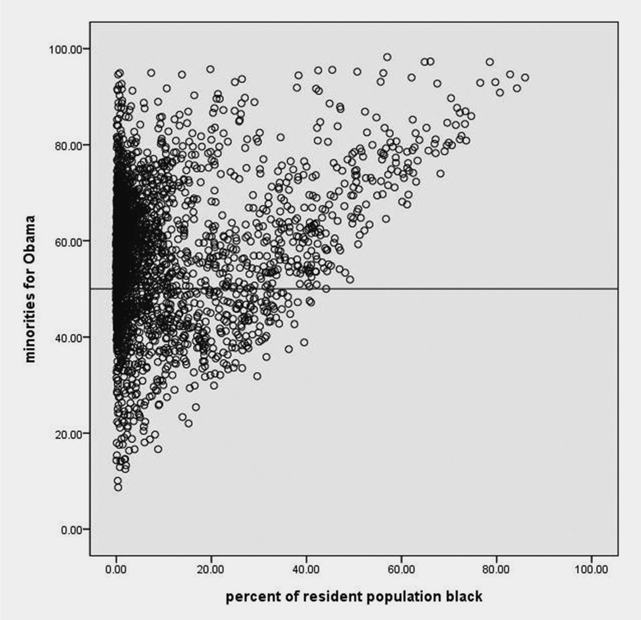
To further examine minority solidarity in 2008, a county-level analysis is invaluable. This layer is significant, because although whites are still the dominant majority in most states (with the exception of Hawaii and California), minorities such as blacks and Latinos may in fact enjoy a “majority status” at the county level because of their numeric advantage. Figure 1 shows the nonwhite support for Obama on the vertical dimension, a measure of minority solidarity in the 2008 general election derived from the Ecological Inference (EI) method.Footnote 2
Black Density and Minority Support for Obama at the County Level

Figure 1 reveals that as black density increases at the county level, so does minority solidarity for Obama. Obviously, this solidarity was mainly a function of black voters' loyalty to Obama in 2008. However, it is also important to note that minorities in 25% of the 3,111 counties cast more votes for McCain than for Obama (see the 781 counties below the 50% horizontal line in figure 3). The triangular distribution of minority solidarity in figure 1 strongly suggests that when blacks were less than 20% of a county's population, other nonblack minorities tended to show a large variation in terms of their support for Obama (i.e., the minority solidarity is low in this context). We turn to figures 2 and 3 to further investigate the voting patterns of minority voters in other Latino- and Asian-related contexts.
Hispanic Density and Minority Support for Obama at the County Level

Asian Density and Minority Support for Obama at the County Level

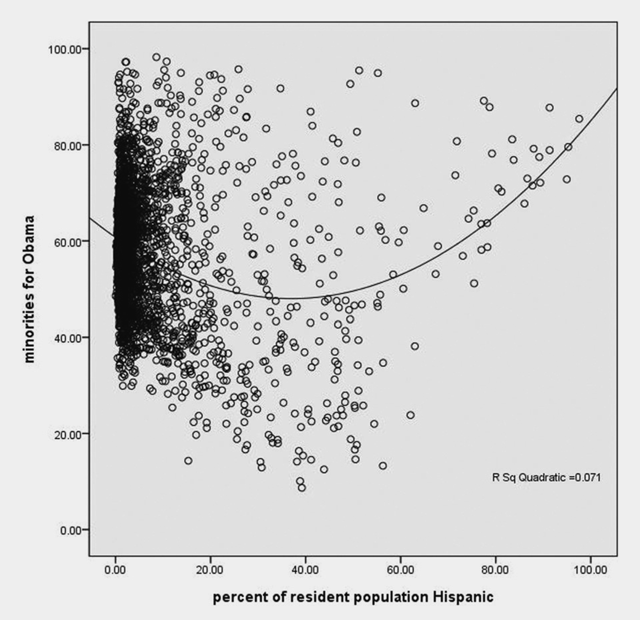
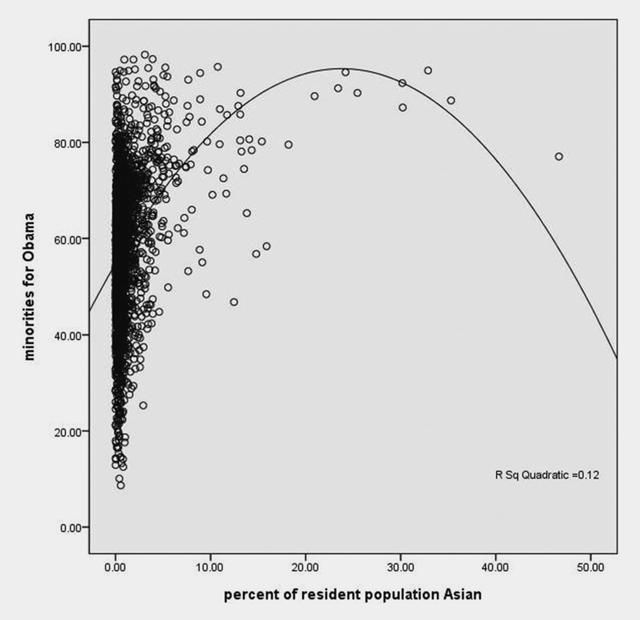
Figure 2 shows the relationship between minority solidarity and Latino population concentration. The quadratic curve indicates that minorities tended to reduce their level of support for Obama as Latinos approached the 40% level of the county population (note the U-shaped relationship). Figure 3 examines the relationship between minority solidarity and Asian population. Minority solidarity reached its highest level when Asians represented 20% to 40% of the county population. This figure also shows that as Asians reached the 40% level of a county's population, the minority solidarity started to decline (see the inverted U-shaped relationship).
CONCLUSIONS: EXPLAINING RACIAL CONFLICT AND MINORITY SOLIDARITY
The county-level analysis of this article shows variations of minority unity for Obama in different minority contexts. Taken as a whole, the notion of minority solidarity was far from the reality in 2008. While blacks were clearly Obama's most loyal voting bloc, the vote choices of Latinos and Asians were much more “context specific.” The most intriguing finding is that minority solidarity for Obama's election was at the lowest point after Latinos and Asians reached roughly 40% of a county's population. This finding suggests that Latinos and Asians may have perceived an element of “black threat” when their own electorate share reached a threshold of about 40%.Footnote 3 In other words, it is in the context of power moving from a minority group status to a more dominant majority group status that Latinos and Asians tend to look at blacks as competitors rather than coalition partners. This finding sheds important light on the future of minority politics in the United States. As Latinos and Asians become more electorally powerful through their population growth in certain local areas, the competition for elected positions among minorities may increase rather than decrease.
This study also finds an important divergence in the multiracial coalition-building process between Latino and Asian local contexts. The U-shaped relationship between minority solidarity and Latino population concentration in figure 2 suggests that minorities in homogenous Latino communities are likely to “come back” to the multiracial coalition to support a viable black candidate such as Obama. As for the Asian American context, as shown by the inverted U in figure 3, a more dominant and racially homogeneous Asian community may lead to less interest in a multiracial coalition led by a black candidate.Footnote 4 This opposite pattern invites future investigation into the intricacy of the multiracial coalition-building process in America.Footnote 5