Nigeria is one of the countries in the West African Coast with a population of about 180 million. It has no dedicated functional children’s heart hospital. Our centre, National Cardiothoracic Center of Excellence, is one of the centres for the management of both adult and paediatric heart diseases.
Foreign humanitarian cardiac surgery teams, namely International Children Heart Foundation at the instance of Kanu Heart Foundation, Cardiostat International (United States of America), Save-A-Heart Nigeria Foundation (United Kingdom), Global Hospital Heart Foundation (India), William Novick Global cardiac Alliance (United States of America and Genoa, Italy), visited our centre in 2003, 2013–2017. The VOOM foundation team led by Dr Vincent Ohaju, a philanthropist, is the main anchor coordinating the activities of the missions, with the exception of the International Children Heart Foundation.
The role of the itinerant missions has focused on both paediatric and adult cardiac interventions, teaching the multidisciplinary local cardiac team members, as well as providing essential supplies that are critical to managing adult CHD among others. However, among the missions, some cardiac teams had the best teaching model required in a developing country, but unfortunately the frequency of their missions is very low. The teams that do come regularly need to improve on the educational programme. Some cardiac teams do send essential supplies ahead of their missions; however, as there are many patients to cater for, they are not always enough. Over-dependence on charity is not sustainable. Involvement of Nigeria National Health Insurance will be very good.
It is true that the missions do some trainings for the development of essential support staff, but is not enough to achieve independence particularly in the situation when visits are not regular. The in-service training where some members of the local team can be arranged to stay in high-volume centres abroad for 3–6 months will additively impart heavily on manpower development for the local personnel(s).Reference Corno 1
It is not a disputable fact that the quality of care for CHD patients has improved since the inception of cardiac missions in our centre; however, as each mission lasts about a week or two and the frequency of visits are not regular, it is generally believed that the overall quality of care will improve when the local team takes over the role of caring for the CHD patients alongside other cardiac pathologies.
In the western world, it is obvious that owing to advances in technology in medicine, diagnostics, and therapeutics, coupled with a high literacy level, patients with CHDs have a long life span and survive into adulthood where risks of complications and co-morbid conditions from the heart diseases complicate their further care. In a developing country like Nigeria, the life span of patients with CHD is short. However, the few who survive to adulthood untreated, or whose symptoms manifest at adult life, constitute a great burden to their parents, both paediatric and adult cardiologists, and to the inexperienced local adult cardiac surgeons. These patients die helplessly from the effects of CHDs, undiagnosed and untreated.
CHD is the most common inborn defect occurring in 0.8% of neonates worlwide.Reference Hoffman and Kaplan 2 Adults with CHD are the beneficiaries of successful paediatric care surgery and paediatric cardiology programme throughout the developed world.Reference Warnes, Liberthson and Dannielson 3 More than 50% of such children would have died before reaching adulthood had it not been for the special intervention in infancy and childhood. This dramatic success story has resulted in a large number of young adults who require lifelong cardiac and non-cardiac services.Reference Hoffman, Kaplan and Libertson 4 , Reference Niva, Perloff and Webb 5
In low-income countries like ours, there are two burden of diseases: CHD and communicable diseases. These are further compounded by ignorance, poverty, social strife, corruption, and nepotism. The result of this is that a majority of patients with CHD are not able to be treated at neonatal, infantal, or childhood stages.Reference Dimopoulos, Diller and KOltsida 6 This greater number dies undiagnosed and untreated. The very few who survive to adulthood and those whose symptoms manifest in adult life pose several unique features while undergoing reparative surgery. They are systemic effects of chronic cyanosis, ventricular hypertrophy, and abnormalities of ventricular function, as well as postoperative arrhythmias.Reference Willamarta, Yaniadi, Rachman and Franklin 7 Cardarelli M et al emphasised that humanitarian paediatric cardiac surgery in LMIC should leave a positive, long-lasting humanitarian footprint by improving local human development indices while remaining cost-effective. Local governments, NGOs, and supranational organisations dedicated to global health should encourage and support sustainable approaches to humanitarian paediatric cardiac surgery.Reference Cardarelli, Varkunth and Molloy 8
Cyanosis in adults with CHDs undergoing heart surgery is an independent predictor of early morbidity and mortality owing to the combined effects of chronic cyanosis on haemostasis, and renal and ventricular function. 9 Other postoperative challenges are hyper-viscosity syndrome due to chronic erythrocytosis and disseminated intravascular coagulopathy.Reference Nwafor, Nwafor, Eze, Ezemba and Ngene 10 The causes of the disseminated intravascular coagulopathy are friable collateral vessels, extensive suture lines, prolonged cardiopulmonary bypass time, and the engendered thrombocytopathy and thrombocytopaenia, as well as hyperfibroginaemia.Reference Nwafor, Nwafor, Eze, Ezemba and Ngene 10
Materials and method
Over a 5.5-year period – June 2003, February, 2013–October, 2017 – five different humanitarian cardiac surgery teams visited National Cardiothoracic Center of Excellence, Enugu, Nigeria, and performed surgical interventions on some adults with CHDs. A retrospective study was performed on them using the data obtained from our hospital information health technology department. The demography of the patients, types of adult CHD, clinical evaluation, and treatment modalities, as well as the outcome, were analysed using Microsoft Excel. The results were presented in arithmetic of percentages using tables.
Results
During the period, a total of 18 patients with CHDs at adult age were treated, averaging 2.4 patients in a year. There were eight men (57.14%) and six women (42.86%), with a male to female ratio of 1.3:1. The youngest among them was 19 years old, whereas the oldest was 47 years old. The most common CHD encountered was atrial septal defect (n=5, 31.71%), followed by sinus of Valsalva aneurysm (n=3, 21.43%). Surgery was the mainstay of treatment in those who had not developed Eisenmenger’s syndrome or other recalcitrant complications such as end-stage heart failure. Mechanisms for heart failure in adults with CHD might involve circulatory overload, ventricular volume and/or pressure overload, inability of a systemic morphologic right ventricle or single ventricle circulation to adequately meet metabolic needs, unequal flow distributions to lung fields, variable pulmonary vascular integrity, and abnormalities of myocardial tissue architecture, electrical conduction, and blood supply.Reference Kantor, Andelfinger, Dancea and Khairy 11
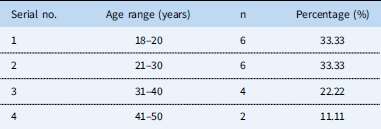
Table 1 shows the age ranges and the number of patients treated. Here, the highest number of patients treated are in the age ranges of 18–20 and 21–30 years, each with n=6 (33.33%). The least age range affected is 41–50 years, with n=2 (11.11%).
Age ranges of adult patients with CHD.

Discussion
Individuals with unrepaired CHDs carried to, or presenting at, adult age comprise a very small population in the developed world. In low-income countries like ours, the reverse is the case. The reasons are as follows: many developing countries have no properly structured population control; there is no local congenital heart expertise to make accurate diagnoses and offer treatment; ignorance and poverty make the parents to present the patients to herbalists at paediatric age group with the aim of getting a cure; there is non-availability of state-of-the-art diagnostic equipment such as trans-oesophageal echocardiography, cardiac MRI, cardiac catheterisation equipment, CT scan, and electrophysiology study equipment in the government hospitals – the few available ones are found in private hospitals and the cost is prohibitive, and in developing countries like Nigeria health insurance does not cover cardiac care; some patients have balanced systemic and pulmonary blood flow despite complex lesions, and this enables the patients to develop to adulthood.12
At adult age, care of these patients is challenging. Prognosis is extremely variable and is dependent on the underlying anatomy, physiology, and the type of envisaged repair whenever possible.Reference Kantor, Andelfinger, Dancea and Khairy 11 After repair, follow-up is very critical because some common challenges may erupt that need expertise attention. For instance, recurrence is common following repair of coarctation of the aorta. Therefore, the patient should be followed up by regular physical examination, MRI, CT scan, or angiography to detect recurrence, which can lead to proximal hypertension and aneurismal formation.Reference Kaemmerer, Theissen and Konig 13
It is known that many children die of CHDs before reaching adult age, undiagnosed and untreated.Reference Geracia and Delogu 14 Some still survive to adult stage, and many more present with symptoms at adult age. The clinical outlook of such patients in our subregion has been very bad until the inception of humanitarian cardiac surgery missions in Nigeria over 5.5 years ago. During the period, 18 patients were managed. There were 10 men (55.56%) and eight women (44.44%) in this study. In a study of 208 patients in patterns with CHD in unoperated adults by Hwaida Hanoush et al, in Beirut Lebanon, a developing country, there was slight predominance of men (52%).Reference Hanoush, Tamin and Younes 15 This is in agreement with our findings.
The oldest patient was 47 years (n=1, 7.14%) and the youngest was 19 years (n=2, 14.29%). The age range mostly affected was 18–20 years (n=5, 35.71%). The other age ranges were each affected equally (n=3, 21.43%); see Table 1. In the same study in Beirut, Lebanon, the age at hospitalisation ranged from 18 to 71 years (32.8±13.3 years).Reference Zahka, Horneffer and Rowe 12 In other studies, 55% of autopsies showed that 25% of tetraology of Fallot are alive after the age of 10 years, with an attrition rate of 5.9%/year, with 11.6%, and 3% dying at 20, 30, and 40 years, respectively.Reference Abraham, Cheria, Rao, Sukumar, Krishnawa and John 16 , Reference Berlranan, Blackstone, Hazelrig, Tuner and Kirklin 17
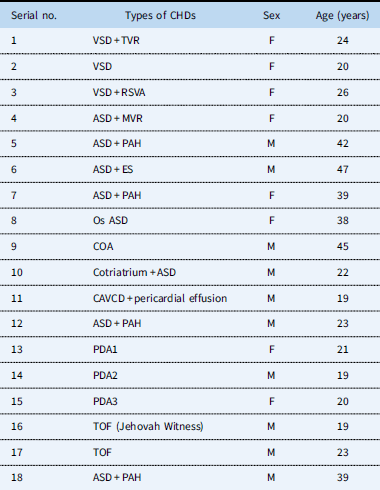
In this study, there were no isolated acyanotic CHD unlike the cyanotic type. Cyanotic CHD recorded was 2 (11.11%), whereas acyanotic CHD, although associated with other CHDs, was 16 (88.89%). The cyanotic type was tetraology of Fallot in a Jehovah Witness patient aged 19 years and another in a 23-year-old. Acyanotic types are as stated in Table 2. Here, atrial septal defect in association with other CHDs predominated (n=8, 44.44%), followed by ventricular septal defect and patent ductus arteriosus, with each n=3 (16.67%). Others were coarctation of the aorta and common atrioventricular defect, with n=1 each (5.56%). The natural survival of atrial septal defects beyond 40–50 years is <50%. Our findings that atrial septal defect is the most common unrepaired CHD in adult is in agreement with other studies.Reference Campbell 18 , Reference Ckobal, Havacek, Kamenik, Vaneck and Popelorg 19
Types of CHDs, sex distribution, and ages of the patients.

ASD=atrial septal defect; CAVCD=common atrioventricular defect; COA=coarctation of the aorta; ES=Eisenmenger’s syndrome; F=female; M=male; MVR=mitral valve repair; Os=Ostium primum; PAH=pulmonary artery pressure; PDA=patent ductus arteriosus; RSVA=rupture of sinus of Valsalva Aneurysm; TOF=tetraology of Fallot; TVR=tricuspid valve regurgitation; VSD=ventricular septal defect.
Of all the 18 patients managed during the study period, 14 (77.79%) were successful. They all had operative repair with uneventful outcome. This outcome agrees with the work of Wu and Child.Reference Wu and Child 20 The remaining patients (n=4, 22.21%) had variable outcome. One patent ductus arteriosus patient (21 years) died intraoperatively owing to rupture of the patent ductus arteriosus during ligation and unsuccessful management of the haemorrhagic shock. One atrial septal defect (47 years) with Eisenmenger’s syndrome is bed-ridden and oxygen-dependent for 2 years owing to inoperability and non-availability of a cardiac transplant in our subregion. Two tetraology of Fallot patients, one of whom is a Jehovah Witness, are awaiting right heart catheterisation before surgery. They have been unable to undergo the investigation because the cost is prohibitive. They have been assessed by two different cardiac missions at different periods, and none agreed to operate without right heart catheterisation. One of the sinus of Valsalva aneurysm repairs done was later found to have aortic incompetence.
Apart from the aortic incompetence encountered in the case of repaired sinus of Valsalva aneurysm, and death on the table in the case of patent ductus arteriosus, there were no other significant surgical complications encountered in the surgically treated patients. This finding is at variation with the work of other authors.Reference Abe, Kamat and Taguchi 21 , Reference Dove, Glancy, Stone, Manashe and Somerville 22
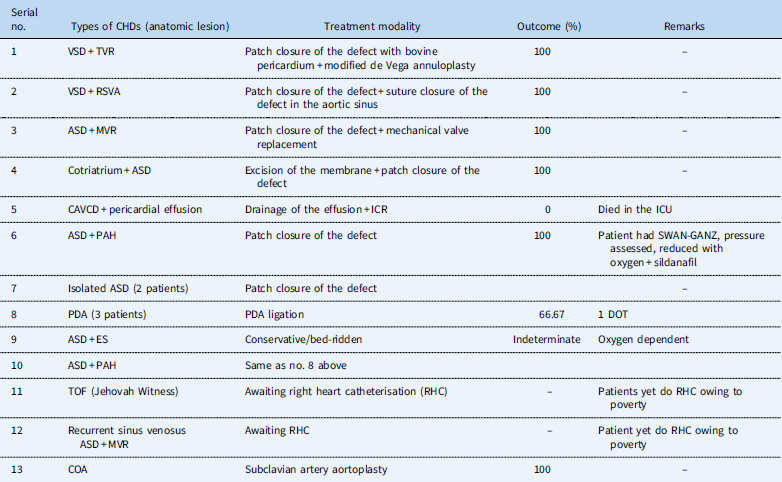
The intracardiac repair was variable and was performed for almost all the CHDs, except for the patent ductus arteriosus and coarctation of the aorta see Table 3. All the atrial septal defect and ventricular septal defect received patch repair with bovine pericardium. This is because there was non-availability of 0.1% paraldehyde-treated autologous pericardium. Mitral valve was replaced with a mechanical valve (St Jude). Tricuspid valve disease occurring with ventricular septal defect was functional and was managed using modified de Vega procedure.Reference Aoyagi, Tanaka and Hara 23 Ruptured sinus of Valsalva aneurysm was repaired via aortotomy approach for the aortic valve. The associated ventricular septal defect was also repaired via the left ventricle. The traditional ventricular septal defect patch repair and infundibulotomy were used for the tetraology of Fallot. The three patent ductus arteriosus were treated by ligation with insignificant residual flow on postoperative echocardiography. However, the one led by a local surgeon had accidental rupture during ligation, with unsuccessful management of the resultant hypotension. Coarctation of the aorta was done using subclavian artery aortoplasty (Table 3).
The types of CHD in the adult, treatment modalities, and outcome.

ASD=atrial septal defect; CAVCD=common atrioventricular defect; COA=coarctation of the aorta; DOT=death on table; ES=eissenmenger’s syndrome; ICR=intracardiac repair; MVR=mitral valve repair; PAH=pulmonary artery pressure; PDA=patent ductus arteriosus; RHC=right heart catheterisation; RSVA=ruptiure of sinus of vasalva aneurysm; TOF=tetraology of Fallot; TVR=tricuspid valve regurgitation; VSD=ventricular septal defect.
Surgical and catheter procedures are on the increase in adults with CHD.Reference Uemura 24 Percutaneous devices are increasingly used to close septal defects, abnormal vascular connections, leaks across conduits and baffles, and pseudoaneurysms; covered stents have enhanced the safety with which aortic coarctation, conduit stenosis, and branch pulmonary stenosis can be treated; and percutaneous valves have broadened the range of therapeutic options in selected patients. Complications after surgery occur in 15–25% of patients and include arrhythmias, low cardiac output, stroke, bleeds, and renal failure. Perioperative mortality risk depends on numerous factors but is generally within the 3–8% range.Reference Giamberi, Chessa and Abella 25 , Reference Holst, Dearani and Burkhart 26
The availability of cardiac catheterisation equipment in our centre is noteworthy, but it was not initially put to use owing to frequent power fluctuation in our subregion and absence of UPS electrical device. In addition, some cardiac teams did not come with personnel with experience in closed heart interventions. This largely accounted for the absence of closed interventions among patients treated. In a similar work carried out in Croatia, Novick et alReference Novick, Aric, Ivancan and Disesa 27 stated that the interventional cardiologist at International Children Heart Foundation was involved in training the local cardiologists during the 10-year International paediatric Cardiac Assistance in Croatia.
The challenges encountered in the management of this group of patients are poverty, in that many cannot afford the cost of diagnostic investigations according to the current protocol of our centreReference Nwafor, Eze, Ezemba, Chinawa and Onyekwulu 28 and the cardiac surgery missions are not regular. Some develop complications that make surgery not feasible at the time of their assessment by the cardiac mission team. It is true that cardiac surgery missions are humanitarian, but there are many patients to take care of in a short time. Many of those whose diseases are clinically and diagnostically confirmed are offered treatment in the shortest time. It is hoped that with proper coordinated cardiac mission trainings of the local staff in our centre and in addition to regular visits, the capacity to take care of greater number patients will definitely improve. Another view emphasises that a cardiac surgeon, interventional cardiologist, and a cardiac anaesthetist including a cardiac intensivist should undergo proper hands-on training in reputable centres abroad with high-volume surgeries in a year. European Association of Cardiothoracic surgeons and its International committee does not believe that the best solution in achieving sustainable cardiac surgery programme in a developing country is by sending a foreign cardiac team there.Reference Roques 29 However, in a similar study by Velebit et al, a team of fully trained specialists carried out a cardiac mission in Tbilis in Georgia for a period of 5 years where the frequency was monthly of 1 week duration with an average of 10 times in a year. After 5 years, the local team was able to become independent and had performed 181 cases within the first 7 months in 2008 out of 204, whereas the remainder was done by a foreign team during irregular support visits in relationship to difficult cases.Reference Velebit 30 Thus, as pointed out by Dearani et al, humanitarian outreach activities should focus on education and sustainability, and surgical tourism should be limited to those countries that will never have the capacity to have free-standing cardiothoracic programmes.Reference Dearani 31
We propose the growth of both structured paediatric and adult programmmes in Nigeria engineered by missions. The paediatric programme will be able to deal with CHD in neonates, infants, and children, whereas the adult programme will take care of the adult congenital diseases including other acquired cardiac pathologies peculiar to the adult population.
Conclusion
Uncontrolled population growth, poverty, ignorance, communicable diseases, nepotism, and corruption affect the prevalence of unrepaired CHDs that are carried to adult age, as well as ACHDs that present de novo at adult age. The conditions of these patients were hopeless until the inception of humanitarian cardiac surgery mission in Nigeria. Many souls that ought to have departed their bodies owing to undiagnosed and untreated CHD have survived to give gratitude to their God.
Acknowledgements
The authors acknowledge the head of National Cardiothoracic Center of Excellence and the entire secretarial staff for their role in the production of this manuscript.
Financial Support
This research work was entirely borne by the authors through utilisation of part of their salaries.
Conflicts of Interest
None.
Ethical Standards
This clinical audit research work is exempted from ethical approval.