Introduction
Generalized anxiety disorder (GAD) is increasingly recognized as a prevalent anxiety disorder with characteristic symptoms, significant morbidity and specific risk factors (WHO, 1993; APA, 2000). Nevertheless, repeated revisions of the GAD diagnostic criteria in recent decades reflect continued uncertainty over the definition and diagnosis of the disorder. Apart from debates over the centrality of pathological worry, the number and type of associated anxiety symptoms, and the level of impairment required for diagnosis (Spitzer & Williams, Reference Spitzer, Williams and Grinspoon1984; Rickels & Rynn, Reference Rickels and Rynn2001; Slade & Andrews, Reference Slade and Andrews2001), a primary focus for nosological revision has been the duration criterion of GAD. Although early classifications of pathological anxiety did not specify a minimum duration for diagnosis (Feighner et al. Reference Feighner, Robins, Guze, Woodruff, Winokur and Munoz1972; WHO, 1978), efforts to improve diagnostic reliability and differentiation from normal anxiety reactions led to the requirement of a minimum GAD duration of 1 month in the Diagnostic and Statistical Manual of Mental Disorders, 3rd edn (DSM-III, APA, 1980) and an increase to 6 months in the revised DSM-III-R (APA, 1987), the DSM-IV (APA, 2000) and the Diagnostic Criteria for Research of the International Classification of Mental and Behavioral Disorders, 10th edn (ICD-10, WHO, Reference Spitzer, Williams and Grinspoon1993).
Among the anxiety disorders, the requirement of such a long and specific duration is almost unique to GAD, and questions about its necessity remain. This suggests that, despite improved reliability of diagnosis (Brown et al. Reference Brown, Di Nardo, Lehman and Campbell2001), questions about the validity of GAD are by no means resolved. Following criticisms of the questionable clinical utility of the current duration criterion in defining GAD (Rickels & Rynn, Reference Rickels and Rynn2001), a number of empirical studies in western countries have recently addressed this question. Taken together, they suggest that GAD lasting 1 month is comparable to GAD lasting ⩾6 months in sociodemographic characteristics, clinical course, pattern of co-morbidity, functional impairment, antecedent childhood adversity, and heritability (Kendler et al. Reference Kendler, Neale, Kessler, Heath and Eaves1992, Reference Kendler, Neale, Kessler, Heath and Eaves1994; Bienvenu et al. Reference Bienvenu, Nestadt and Eaton1998; Maier et al. Reference Maier, Gansicke, Freyberger, Linz, Heun and Lecrubier2000; Carter et al. Reference Carter, Wittchen, Pfister and Kessler2001; Hettema et al. Reference Hettema, Prescott and Kendler2001; Kessler et al. Reference Kessler, Brandenburg, Lane, Roy-Byrne, Stang, Stein and Wittchen2005; Angst et al. Reference Angst, Gamma, Joseph Bienvenu, Eaton, Ajdacic, Eich and Rössler2006).
Such findings have prompted calls for shortening the duration criterion of GAD in DSM-V (Bienvenu et al. Reference Bienvenu, Nestadt and Eaton1998; Rickels & Rynn, Reference Rickels and Rynn2001; Kessler et al. Reference Kessler, Brandenburg, Lane, Roy-Byrne, Stang, Stein and Wittchen2005; Angst et al. Reference Angst, Gamma, Joseph Bienvenu, Eaton, Ajdacic, Eich and Rössler2006; Ruscio et al. Reference Ruscio, Chiu, Roy-Byrne, Stang, Stein, Wittchen and Kessler2007). Before this change can be considered seriously, however, additional data are needed on at least two fronts. First, the GAD duration criterion originally was increased from 1 to 6 months because of concerns that the shorter duration did not adequately distinguish GAD from normative, transient reactions to stress (Breslau & Davis, Reference Breslau and Davis1985). Similar concerns about reduced diagnostic validity and pathologizing of normal stress reactions are likely to be raised for DSM-V. Addressing these concerns will require systematic comparisons of GAD of varying durations on a wide range of relevant validators. Second, although the DSM aspires to be a global diagnostic system, empirical studies of the GAD criteria outside of western countries have been scarce. Recently published data from developing countries such as Nigeria and China have begun to address this gap, but have so far been confined to reporting basic prevalence estimates and sociodemographic correlates of GAD based only on DSM-IV diagnostic criteria (Gureje et al. Reference Gureje, Lasebikan, Kola and Makanjuola2006; Shen et al. Reference Shen, Zhang, Huang, He, Liu, Cheng, Tsang, Lee and Kessler2006) rather than evaluating the impact of modifying these criteria. It is therefore desirable to evaluate how varying the duration of GAD may affect its validity in a range of developed and developing countries, ideally using unselected, general population samples to minimize the impact of sampling biases on results.
The present study examined the validity of GAD defined by different durations in a large dataset including representative samples from 10 developed and seven developing countries. After estimating the prevalence of GAD defined by different minimum duration criteria (1 month, 3 months, 6 months, 12 months), we compared the characteristics of four mutually exclusive groups that met the symptom criteria for DSM-IV GAD but differed in the duration of their longest GAD episode.
Method
Samples
As part of the World Health Organization's World Mental Health (WMH) Survey Initiative (Demyttenaere et al. Reference Demyttenaere, Bruffaerts, Posada-Villa, Gasquet, Kovess, Lepine, Angermeyer, Bernert, de Girolamo, Morosini, Polidori, Kikkawa, Kawakami, Ono, Takeshima, Uda, Karam, Fayyad, Karam, Mneimneh, Medina-Mora, Borges, Lara, de Graaf, Ormel, Gureje, Shen, Huang, Zhang, Alonso, Haro, Vilagut, Bromet, Gluzman, Webb, Kessler, Merikangas, Anthony, Von Korff, Wang, Brugha, Aguilar-Gaxiola, Lee, Heeringa, Pennell, Zaslavsky, Ustun and Chatterji2004), 17 countries in the Americas (Colombia, Mexico, USA), Europe (Belgium, France, Germany, Italy, the Netherlands, Spain), Ukraine, the Middle East (Israel, Lebanon), Africa (Nigeria, South Africa) and Asia-Pacific (Japan, New Zealand, People's Republic of China – Beijing, Shanghai) were surveyed. Developing countries were those with a human development index <0.90, namely China (Beijing, Shanghai), Colombia, Lebanon, Mexico, Nigeria, South Africa and Ukraine. Developed countries were those with a human development index of ⩾0.90, namely Belgium, France, Germany, Israel, Italy, Japan, the Netherlands, New Zealand, Spain and the USA (United Nations Development Programme, 2004).
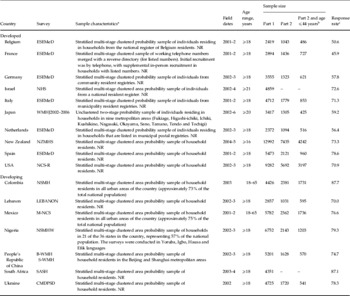
All surveys were based on multi-stage, clustered area probability household samples. Interviews were carried out face to face by trained lay interviewers. The combined total sample size was 85 052 (Table 1). Most of the respondents were aged ⩾18 years, with the exception of respondents from New Zealand (aged ⩾16 years), Japan (aged ⩾20 years) and Israel (aged ⩾21 years). Survey response rates varied, with a weighted average response rate across surveys of 71%. Other than in the Israel survey, where all respondents were administered the full interview, internal subsampling was used to reduce respondent burden by dividing the interview into two parts. Part 1 assessed core mental disorders, including GAD, and was administered to all respondents. Part 2 included additional disorders and correlates relevant to a wide range of survey aims. It was administered to all part 1 respondents who met criteria for any mental disorder as well as a probability sample of other respondents. Part 2 respondents were weighted by the inverse of their probability of selection for part 2 of the interview to adjust for differential sampling. Additional weights were used to adjust for differential probabilities of selection within households and to match the samples to population sociodemographic distributions.
WMH sample characteristics

WMH, World Mental Health; ESEMeD, The European Study of the Epidemiology of Mental Disorders; NR, nationally representative; NHS, Israel National Health Survey; WMHJ2002–2006, World Mental Health Japan Survey; NZMHS, New Zealand Mental Health Survey; NCS-R, The US National Comorbidity Survey Replication; NSMH, The Colombian National Study of Mental Health; LEBANON, Lebanese Evaluation of the Burden of Ailments and Needs of the Nation; M-NCS, The Mexico National Comorbidity Survey; NSMHW, The Nigerian Survey of Mental Health and Wellbeing; B-WMH, The Beijing World Mental Health Survey; S-WMH, The Shanghai World Mental Health Survey; SASH, South Africa Stress and Health Study; CMDPSD, Comorbid Mental Disorders during Periods of Social Disruption.
a Most WMH surveys are based on stratified multi-stage clustered area probability household samples in which samples of areas equivalent to counties or municipalities in the USA were selected in the first stage followed by one or more subsequent stages of geographic sampling (e.g. towns within counties, blocks within towns, households within blocks) to arrive at a sample of households, in each of which a listing of household members was created and one or two people were selected from this listing to be interviewed. No substitution was allowed when the originally sampled household resident could not be interviewed. These household samples were selected from census area data in all countries other than France (where telephone directories were used to select households) and the Netherlands (where postal registries were used to select households). Several WMH surveys (Belgium, Germany and Italy) used municipal resident registries to select respondents without listing households. The Japanese sample is the only totally unclustered sample, with households randomly selected in each of the four sample areas and one random respondent selected in each sample household. Eleven of the seventeen surveys are based on nationally representative household samples, while two others are based on nationally representative household samples in urbanized areas (Colombia, Mexico).
b Israel and South Africa did not have an age-restricted part 2 sample. All other countries, with the exception of Nigeria, People's Republic of China and Ukraine (which were age restricted to ⩽39 years) were age restricted to ⩽44 years.
c The response rate is calculated as the ratio of the number of households in which an interview was completed to the number of households originally sampled, excluding from the denominator households known not to be eligible either because of being vacant at the time of initial contact or because the residents were unable to speak the designated languages of the survey.
Training and field procedures
The central WMH staff trained bilingual supervisors in each country. Consistent interviewer training documents and standardized translation protocols were used across surveys. The institutional review board of the organization that coordinated the survey in each country approved and monitored compliance with procedures for obtaining informed consent and protecting human subjects.
Diagnostic measures
Mental disorders were assessed using version 3.0 of the World Health Organization Composite International Diagnostic Interview (CIDI) (Kessler & Ustun, Reference Kessler and Ustun2004), a fully structured lay-administered interview that generates diagnoses according to both ICD-10 (WHO, 1993) and DSM-IV criteria. DSM-IV anxiety, mood and substance-use disorders were included in analyses, as were several disorders that share a common feature of difficulties with impulse control (intermittent explosive disorder, oppositional-deviant disorder, conduct disorder, attention-deficit hyperactivity disorder). Diagnostic hierarchy rules and organic exclusion rules were used in making diagnoses. As detailed elsewhere (Haro et al. Reference Haro, Arbabzadeh-Bouchez, Brugha, de Girolamo, Guyer, Jin, Lepine, Mazzi, Reneses, Vilagut, Sampson and Kessler2006), blind clinical re-interviews using the Structured Clinical Interview for DSM-IV (SCID, First et al. Reference First, Spitzer, Gibbon and Williams2002) with a probability subsample of respondents from Spain, Italy, France and the USA found generally good concordance between DSM-IV diagnoses based on the CIDI and the SCID for anxiety (including GAD), mood and substance-use disorders (CIDI diagnoses of impulse-control disorders were not validated).
Respondents were assessed for the symptoms of GAD, and then asked about the number and length of episodes of worry or anxiety experienced in their lifetime and in the last 12 months. ‘Episode’ was explicitly defined as ‘a time lasting 1 month or longer when most days you were (worried or anxious/nervous or anxious/anxious or worried) and also had some of the other problems we just reviewed. The episode ends when you no longer have these feelings for a full month.’ Respondents reporting multiple episodes were grouped for analysis based on their longest lifetime episode.
Other measures
Impairment was assessed by the Sheehan Disability Scale (SDS, Leon et al. Reference Leon, Olfson, Portera, Farber and Sheehan1997), which asked respondents to focus on the 1 month in the past year when their GAD was most severe and to rate how much GAD interfered with their home management, work, social life and personal relationships on scales of none (0), mild (1–3), moderate (4–6), severe (7–9) and very severe (10). In addition, role impairment in the past year was assessed by two variables: number of out-of-role days, defined as the number of days out of 365 during which the respondent was ‘totally unable’ to work or carry out daily activities because of GAD; and role impairment in episode, defined as the percentage of all days in the GAD episode that were spent out of role.
Analysis methods
We estimated the 1-month, 12-month and lifetime prevalence of GAD using the minimum duration requirements of 1, 3, 6 and 12 months. Subsequently, mutually exclusive subgroups with durations of 1–2, 3–5, 6–11 and ⩾12 months were compared on age of onset, clinical course, persistence, role impairment and time to recovery using χ2 tests or analysis of variance. Associations with other mental disorders were estimated using a discrete-time survival model with person-year as the unit of analysis, in which variably defined GAD predicted the subsequent first onset of a class of disorders (other anxiety disorders, mood disorders, substance-use disorders, impulse-control disorders). We used the actuarial method (Halli & Vaninadha Rao, Reference Halli and Vaninadha Rao1992) to calculate age-of-onset (AOO) and time to recovery curves for these duration subgroups. Using the Taylor series linearization method (Wolter, Reference Wolter1985) implemented in the sudaan software package (Research Triangle Institute, Research Triangle Park, NC, USA), we adjusted for weighting and clustering when calculating standard errors and performing significance tests. Statistical significance was evaluated at the 0.05 level.
Results
Prevalence
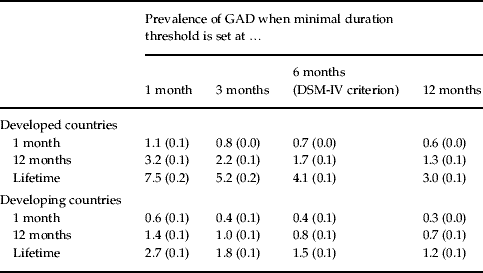
The estimated prevalence of GAD increased as the duration criterion was shortened. (Table 2) For developed countries, lifetime prevalence estimates ranged from a low of 3.0% when the minimum duration was 12 months to a high of 7.5% when the minimum duration was 1 month. The corresponding estimates for developing countries were lower, but in the same direction, ranging from 1.2% for 12-month to 2.7% for 1-month minimum duration. The same pattern was evident for 12-month prevalence estimates for developed (1.3–3.2%) and developing (0.7–1.4%) countries as well as for 1-month estimates in both country groups (developed 0.6–1.1%, developing 0.3–0.6%).
Lifetime, 1-year and 1-month prevalence estimates of DSM-IV generalized anxiety disorder when the duration threshold was set at the minimal requirement of 1, 3, 6 and 12 months, in developing and developed countries
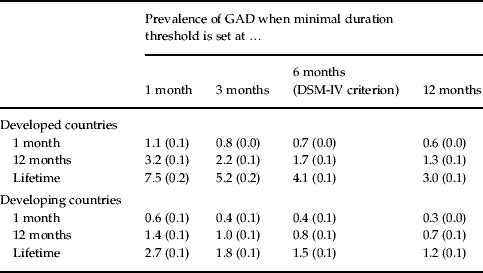
DSM-IV, Diagnostic and Statistical Manual of Mental Disorders, 4th edn; GAD, generalized anxiety disorder.
Values are given as percentage (standard error).
Onset and course
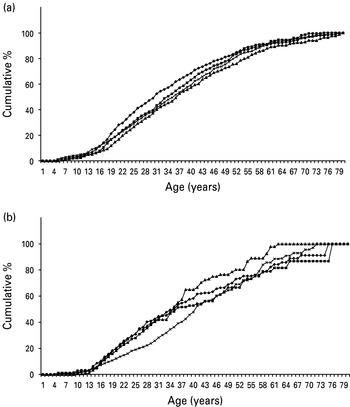
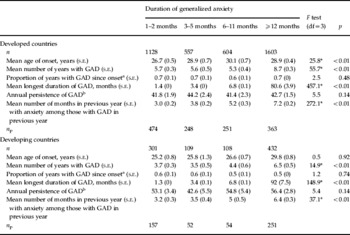
Cumulative AOO distributions were similar in shape for the four mutually exclusive duration subgroups, although the distributions differed significantly [developed χ2(3)=26.0, developing χ2(3)=18.0, p<0.01] (Fig. 1). In both groups of countries, all four subgroups had median AOO in the thirties and rarely had onsets after age 60 years. Mean AOO was also quite similar among the subgroups, falling in the age range of 25–30 years (Table 3). In developed countries, the 1–2 months subgroup had a somewhat later onset than the other three subgroups. In developing countries, there was no significant difference in mean AOO by subgroup.
Age of onset of generalized anxiety disorder in (a) developed countries (χ2=26.0, p<0.01) and (b) developing countries (χ2=18.0, p<0.01). -♦-, 1–2 months; -▪-, 3–5 months; -▴-, 6–11 months; -×-, 12 months.

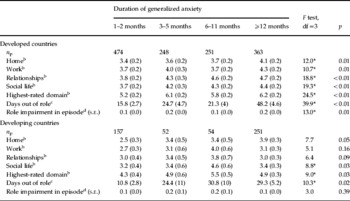
Course of lifetime GAD by specific episode duration (1–2 months, 2–5 months, 6–11 months, ⩾12 months), in developed and developing countries

GAD, Generalized anxiety disorder; df, degrees of freedom; s.e., standard error; n p, number of respondents with GAD in previous 12 months.
a Number of years in episode divided by the total years between onset age of generalized anxiety and current age.
b Percentage of lifetime cases that had generalized anxiety in the past 12 months (ratio of 12-month to lifetime prevalence×100%).
* Significant at p<0.05.
GAD lasting ⩾12 months exhibited greater persistence than the other subgroups. In both developed and developing countries, this subgroup reported more years with GAD (8.7, 6.5) than the other subgroups, which were more similar to one another (5.3–5.7, 3.5–4.4). Increasing duration of GAD was associated not only with an increase in the longest lifetime GAD episode, but also with more months in episode during the past year. By contrast, the four subgroups did not differ in annual persistence of GAD (the proportion of lifetime cases that had GAD in the past 12 months). The subgroups also did not differ in lifetime persistence of GAD, as they all experienced generalized anxiety in roughly half of the years since the onset of their respectively defined GAD.
Severity and impairment
Lifetime GAD severity (mild, moderate, severe) was calculated by submitting 11 nested dichotomous variables representing uncontrollability, distress, and impairment associated with worry and generalized anxiety into an item response theory analysis and trichotomizing the resulting dimension. There was a significant trend in developed [χ2(6)=110.5, p<0.01] as well as developing [χ2(6)=20.7, p<0.01] countries of fewer mild cases and more severe cases with increasing GAD duration (results not shown, but available on request). The highest proportion of severe cases was in the ⩾12 months subgroup in both developed (41.7%) and developing (36.7%) countries. Nevertheless, severity was substantial even in the 1–2 months subgroup, where the majority of cases (55.9% in developed and 60.6% in developing countries) were classified as having moderate or severe GAD.
Impairment was also related to duration of GAD (Table 4). In developed countries, the ⩾12 months subgroup was more severely impaired on all SDS domains (4.1–4.7) than the 1–2 months subgroup (3.4–3.8), with the 3–5 and 6–11 months subgroups being intermediate in impairment. Although they differed significantly, the subgroup means for each domain and for the highest-rated domain were within one point of each other on the 0–10 response scale. There was a larger difference between the ⩾12 months subgroup (48.2) and the other subgroups (15.8–24.7) on number of out-of-role days due to GAD. In developing countries, the overall pattern was also that impairment increased with increasing duration, although the increase was less monotonic than the pattern shown in developed countries. This increasing pattern was statistically significant only for social impairment and for days out of role, where the largest difference was between the 1–2 months subgroup (10.8) and the other subgroups (24.4–30.8).
Past-year impairment in Sheehan Disability Scale domains and days out of role among respondents with lifetime GAD defined by specific episode duration (1–2 months, 2–5 months, 6–11 months, ⩾12 months), in developed and developing countriesFootnote a

GAD, Generalized anxiety disorder; df, degrees of freedom; n p, number of respondents with GAD in previous 12 months; s.e., standard error.
a Estimated among 12-month cases (n p).
b Mean (s.e.) on the Sheehan Disability Scale, which was rated on a scale of 0 (no impairment), 1–3 (mild), 4–6 (moderate), 7–9 (severe), 10 (very severe impairment).
c Mean (s.e.) number of days in the past 12 months during which the respondent was ‘totally unable’ to work or carry out daily activities because of GAD.
d In the past 12 months, proportion of days with GAD that respondents were out of role for the whole day.
* Significant at p<0.05.
Co-morbidity and suicidality
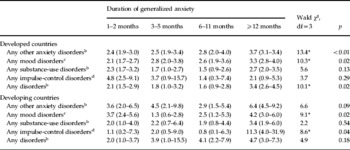
All four GAD subgroups were significantly associated with the subsequent first onset of other mental disorders (Table 5). Where significant differences existed, the highest odds of subsequent disorders were found for the ⩾12 month subgroup. Differences between the other subgroups were generally non-monotonic across disorder classes and inconsistent across developed and developing countries. In predicting the onset of any co-morbid mental disorder, only the ⩾12 months subgroup differed significantly from the 1–2 months subgroup in developed countries by exhibiting higher associations with other anxiety disorders and with any mood disorders. None of the subgroups differed significantly in developing countries. In follow-up analyses examining past-year co-morbidity of GAD with individual mental disorders, the four subgroups had elevated odds ratios (ORs) with every anxiety and mood disorder assessed in the surveys, as well as with intermittent explosive disorder and alcohol abuse (results available on request).
Association between generalized anxiety disorder defined with specific duration and risk of subsequent first onset of other disorders, in developed and developing countriesFootnote a

df, Degrees of freedom.
Values are given as odds ratio (95% confidence interval).
a Based on bivariate analysis using a discrete-time survival model with person-year as the unit of analysis, controlling for person-year, person-year squared, age at interview, sex. No distinctions are made between respondents whose target disorder was active versus remitted at the time that the secondary disorder began. Disorders are diagnosed without diagnostic hierarchies.
b Weighted on part 2 sample (developed n=27 545, developing n=15 579).
c Weighted on part 1 sample (developed n=50 791, developing n=34 057).
d Weighted on part 2 sample in age 44 years or younger (developed n=14 262, developing n=10 121).
* Significant at p<0.05.
In contrast to GAD of shorter durations, the ⩾12 months subgroup had a significantly elevated risk of suicidality (results not shown, but available on request). The ORs in developed and developing countries were significant for subsequent suicidal ideation (2.0, 2.0), plan (1.7, 2.0) and attempt (1.6, 2.1). The ORs for the other GAD subgroups were non-significant and non-monotonic.
Treatment and recovery
Duration of GAD in the prior 12-month period was unrelated to 12-month treatment for the disorder (results not shown, but available on request). In developed countries, the lifetime treatment rate for GAD was significantly lower for the 1–2 months subgroup (46.3%) than for the other subgroups (50.7–53.9%), although the proportions were not very different in substantive terms. Duration was not associated with lifetime treatment in developing countries [Wald χ2 (3)=2.7, p=0.4], probably because of the low prevalence of GAD and rates of treatment there (18.5–31.4%).
In terms of recovery from GAD, defined as two or more continuous years without symptoms among lifetime cases, the duration subgroups differed from one another significantly for both country groups [developed χ2(3)=26.0, developing χ2(3)=15.0, p<0.01]. A lower proportion of the ⩾12 months subgroup recovered than other subgroups in the same period from onset. Regardless of duration, GAD is a chronic disorder, with only half of those affected recovering after about 18–24 years post-onset in developed countries. An even more chronic course was found in developing countries, where the median time to recovery was 24–29 years post-onset. This was most pronounced for the ⩾12 months subgroup where the median time to recovery was as much as 50 years after onset. A special finding in developed countries was that the 1–2 and 3–5 months subgroups had a lower proportion of recovery than the 6–11 months subgroup; i.e. the two subgroups took longer to reach the same proportion of recovery as the 6–11 months subgroup (details of recovery curves not shown, but available on request).
Discussion
Several limitations of the present study are worthy of note. One is the retrospective assessment of the onset, duration and number of anxiety episodes. Although the probing strategy we used has been shown to improve recall of information such as age of onset (Knauper et al. Reference Knauper, Cannell, Schwarz, Bruce and Kessler1999), it was possible that the quality of respondents' recall varied. Recall bias may have been especially likely for respondents with multiple lifetime episodes of varying duration that occurred over a long period of time, or for recollection of more complex diagnostic criteria, such as the number of months when symptoms were present more days than not (Ruscio, Reference Ruscio2002). A related limitation is the current lack of consensus among clinicians and researchers about when a GAD episode should be considered to have ended. The operational definition that we used (1 month of full symptom remission) was somewhat arbitrary and may have overestimated duration by requiring a full month without any symptoms rather than a month when symptoms occurred on fewer than half of the days. Although our use of a fully structured diagnostic instrument and rigorously trained lay interviewers enhanced reliability in the cross-national assessment of mental disorders, the CIDI does not allow symptom clarification and differential diagnosis in the same manner as clinician-administered semi-structured interviews. This might have resulted in inflated associations between GAD and other disorders. While clinical reappraisal studies have suggested reasonably good concordance between CIDI and SCID diagnoses, these studies were performed in only a subset of WMH countries, including China, France, Italy, Spain and the USA (Haro et al. Reference Haro, Arbabzadeh-Bouchez, Brugha, de Girolamo, Guyer, Jin, Lepine, Mazzi, Reneses, Vilagut, Sampson and Kessler2006; Lee et al. Reference Lee, Tsang, Zhang, Huang, He, Liu, Shen and Kessler2007b).
With these limitations in mind, the present study showed that the impact of shifting the GAD duration criterion is quite similar across developing and developed countries, though a few differences between the two country groups are worthy of mention. One is the lower prevalence of both lifetime and 12-month GAD in developing countries. This may reflect a generally lower level of psychiatric morbidity (Demyttenaere et al. Reference Demyttenaere, Bruffaerts, Posada-Villa, Gasquet, Kovess, Lepine, Angermeyer, Bernert, de Girolamo, Morosini, Polidori, Kikkawa, Kawakami, Ono, Takeshima, Uda, Karam, Fayyad, Karam, Mneimneh, Medina-Mora, Borges, Lara, de Graaf, Ormel, Gureje, Shen, Huang, Zhang, Alonso, Haro, Vilagut, Bromet, Gluzman, Webb, Kessler, Merikangas, Anthony, Von Korff, Wang, Brugha, Aguilar-Gaxiola, Lee, Heeringa, Pennell, Zaslavsky, Ustun and Chatterji2004), higher diagnostic thresholds related to respondents having a lower level of mental health literacy, or other methodological factors that lead to a downward bias in the estimation of anxiety disorders in these countries (Shen et al. Reference Shen, Zhang, Huang, He, Liu, Cheng, Tsang, Lee and Kessler2006; Chang et al. Reference Chang, Hahm, Lee, Shin, Jeon, Hong, Lee, Lee and Cho2008). Levels of GAD-related impairment also differed between developed and developing countries. Respondents with GAD in developing countries reported less impairment on the SDS, despite reporting a similar number of out-of-role days as their counterparts in developed countries. Unlike out-of-role days, which are more objectively defined, there may be cross-cultural differences in appraising and responding to questions about how symptoms have interfered with home management, work, social life and personal relationships. The final difference was the lower treatment rate of GAD in developing countries. This is expected, as high levels of unmet needs for mental health treatment are pervasive in low-income countries (Wang et al. Reference Wang, Angermeyer, Borges, Bruffaerts, Tat Chiu, de Girolamo, Fayyad, Gureje, Haro, Huang, Kessler, Kovess, Levinson, Nakane, Oakley Brown, Ormel, Posada-Villa, Aguilar-Gaxiola, Alonso, Lee, Heeringa, Pennell, Chatterji and Ustun2007).
These differences in prevalence, impairment and treatment notwithstanding, GAD prevalence estimates showed similar increases in both groups of countries as the duration criterion was broadened. Moreover, varying the duration of GAD resulted in very similar changes in onset, course, impairment, co-morbidity and recovery rate in developing and developed countries. The findings are consistent with previous western studies (Bienvenu et al. Reference Bienvenu, Nestadt and Eaton1998; Maier et al. Reference Maier, Gansicke, Freyberger, Linz, Heun and Lecrubier2000; Carter et al. Reference Carter, Wittchen, Pfister and Kessler2001; Kessler et al. Reference Kessler, Brandenburg, Lane, Roy-Byrne, Stang, Stein and Wittchen2005) and extend these studies by providing findings from developing countries that conducted surveys using the same methodology.
Compared with respondents who met the DSM-IV duration requirement of 6 months, respondents with GAD duration of 3–5 months had generally similar age of onset, symptom severity, symptom persistence, role impairment, co-morbidity with other mental disorders, suicidality, treatment pattern and course of recovery. In cases where associations were found between duration and outcomes, differences between the 3–5 and 6–11 months' duration subgroups were either non-monotonic or inconsistent. Moreover, respondents with 3–5 months' GAD recovered more slowly than those with 6–11 months' GAD in developed countries. This is a further indication that GAD of <6 months' duration is not necessarily a milder form of the disorder.
Unlike several western studies that examined durations of 1–6 months and did not find duration to relate to the psychopathological profile of GAD (Bienvenu et al. Reference Bienvenu, Nestadt and Eaton1998), we found that the ⩾12 months subgroup was more impaired and slower to recover than the other subgroups. In developing countries, where treatment was greatly limited, the median time to recovery was particularly prolonged. Our findings therefore do not completely support the view that duration is of no utility in defining the severity of GAD (Rickels & Rynn, Reference Rickels and Rynn2001). Because this subgroup represents a chronic form of GAD that is already captured by the DSM-IV 6-month criterion, it is not the focus of the controversy surrounding the duration criterion of GAD. Nevertheless, our findings suggest that episode durations of ⩾1 year may reflect a more severe form of GAD. It is possible that this more chronic form of the disorder may be associated with higher rates of co-morbid axis II pathology or other interpersonal difficulties (Yonkers et al. Reference Yonkers, Dyck, Warshaw and Keller2000).
Questions related to the duration of GAD are affected by how persistence and termination of episodes are defined. The DSM-IV duration criterion for GAD requires that excessive anxiety and worry occur ‘more days than not for at least 6 months’ (APA, 2000). If ‘more days than not’ is interpreted as more than half of the time, the criterion does not specify how the more than 50% of days (i.e. 3 of the 6 months) with anxiety symptoms should be distributed within the 6-month period, nor whether brief periods of complete symptom remission may occur. This is in contrast to the more explicit duration criterion of major depressive episode, in which depressed mood or anhedonia must be present ‘most of the day, nearly every day’ for 2 weeks (APA, 2000). Studies with clinical samples from specialized treatment centers suggest that most patients with DSM-III-R GAD experience anxiety more days than not (Yonkers et al. Reference Yonkers, Warshaw, Massion and Keller1996), but it is unclear whether the same level of persistence would be found in community-based samples. In fact, our data suggest considerable variability in the course as well as duration of GAD symptoms, with the average respondent in the 1–2 months' duration subgroup reporting a pattern of short episodes of anxiety recurring over many years. However, because subjective perceptions of symptom persistence do not always correspond to the objective number of days with anxiety (Ruscio, Reference Ruscio2002), there is a need for prospective research that tracks symptoms on a daily basis for 6 months or more to characterize the course and refine the criteria for GAD.
Our findings have implications for the duration requirement of GAD in DSM-V. If the 6-month duration criterion is maintained, we recommend that DSM-V provide greater description of the longitudinal variability of the course of anxiety. Instead of ‘more days than not for at least 6 months’, more emphasis can be put on the clinical significance, for example, of individuals who suffer from recurrent short episodes of impairing anxiety.
Shortening the duration criterion in DSM-V – to 1 month, for example – will increase the proportion of people who are diagnosed with GAD in both developed and developing countries and facilitate earlier clinical diagnosis. This modification is supported by our findings that individuals whose symptom duration falls short of the DSM-IV criterion typically suffer moderate to severe symptoms and impairment and have a risk of future mental disorders that is no different than that of respondents who meet the current duration criterion. Although an episode duration of <6 months may be considered subthreshold by DSM-IV standards, affected individuals are not necessarily ‘less ill’. Rather, the DSM-IV definition excludes a considerable number of people who suffer from GAD that is <6 months in duration but is nonetheless impairing and recurrent (Kessler et al. Reference Kessler, Brandenburg, Lane, Roy-Byrne, Stang, Stein and Wittchen2005). This problem is less likely to arise using the Clinical Descriptions and Diagnostic Guidelines of the ICD-10, which specify the duration of GAD as ‘variable and usually a few months’ (WHO, 1993).
There are, however, potential downsides to reducing the GAD duration requirement. In primary care settings where general practitioners may not have sufficient skills to evaluate pathological worry and quality psychological intervention is barely available, the adoption of a 1-month duration criterion of GAD may contribute to the pathologizing of normal stress responses and indiscriminant pharmacotherapy (Spitzer & Williams, Reference Spitzer, Williams and Grinspoon1984). The inappropriate treatment of normative anxiety responses to stress is especially likely to happen in developing countries, where the quality of mental health services is greatly limited and the chronic use of benzodiazepine tranquillizers is widespread (Lee et al. Reference Lee, Tsang, Chui, Kwok and Cheung2007a).
If the duration criterion of GAD is shortened to 1 month in DSM-V, we would recommend a more detailed assessment of pathological anxiety that goes beyond subjective recall of having anxiety ‘more days than not’ within the 1-month period, so that clinicians can target treatment to those who need it most. Such assessment can be supplemented by the use of dimensional anxiety and impairment scales (Rickels & Rynn, Reference Rickels and Rynn2001); interviews with collateral informants; and evaluation of concurrent axis II pathology (Yonkers et al. Reference Yonkers, Dyck, Warshaw and Keller2000), early-onset specific phobias, prior anxiety episodes (especially those lasting ⩾12 months), and other predictors of onset and persistence of psychopathology (Kessler et al. Reference Kessler, Andrade, Bijl, Offord, Demler and Stein2002). When thus identified, GAD based on a 1-month duration criterion should not be equated with a diagnosis of adjustment disorder, which is often dismissed by clinicians as having no need for treatment. Instead, it should be considered a clinically significant condition which may be especially suitable for early intervention and prevention of secondary morbidity (Ruscio et al. Reference Ruscio, Chiu, Roy-Byrne, Stang, Stein, Wittchen and Kessler2007). Future trials should examine whether existing therapies would be cost effective in treating 1-month GAD and preventing its recurrence and progression to chronicity (Heuzenroeder et al. Reference Heuzenroeder, Donnelly, Haby, Mihalopoulos, Rossell, Carter, Andrews and Vos2004). Although it is important to recognize the large inter-individual variability in stress responses and to assess the treatment needs of individual patients with care, a shortened GAD duration criterion may not lead to over-treatment. In fact, although major depressive episode has only a 2-week duration criterion, cross-national community epidemiological surveys have shown a large treatment gap for depression across the globe. This gap is especially enormous in developing countries and argues against the inevitability of medicalization in the community (Wang et al. Reference Wang, Angermeyer, Borges, Bruffaerts, Tat Chiu, de Girolamo, Fayyad, Gureje, Haro, Huang, Kessler, Kovess, Levinson, Nakane, Oakley Brown, Ormel, Posada-Villa, Aguilar-Gaxiola, Alonso, Lee, Heeringa, Pennell, Chatterji and Ustun2007).
Finally, it must be emphasized that the present study by no means clarifies all pressing issues related to the diagnostic validity of GAD. Questions about how pathological anxiety should be defined (e.g. its excessiveness, diffuseness, controllability and repetitiveness) and the number and types of associated symptoms that should be required for diagnosis (e.g. somatic symptoms) remain to be examined in future research.
Acknowledgements
The surveys discussed in this article were carried out in conjunction with the World Health Organization WMH Survey Initiative. We thank the WMH staff for assistance with instrumentation, fieldwork and data analysis. These activities were supported by the United States National Institute of Mental Health (R01MH070884), the John D. and Catherine T. MacArthur Foundation, the Pfizer Foundation, the US Public Health Service (R13-MH066849, R01-MH069864 and R01 DA016558), the Fogarty International Center (FIRCA R03-TW006481), the Pan American Health Organization, the Eli Lilly & Company Foundation, Ortho-McNeil Pharmaceutical, Inc., GlaxoSmithKline and Bristol-Myers Squibb. A complete list of WMH publications can be found at http://www.hcp.med.harvard.edu/wmh/
The Chinese World Mental Health Survey Initiative is supported by the Pfizer Foundation. The Colombian National Study of Mental Health (NSMH) is supported by the Ministry of Social Protection. The European Study of the Epidemiology of Mental Disorders (ESEMeD) project is funded by the European Commission (contracts QLG5-1999-01042; SANCO 2004123), the Piedmont Region (Italy), Fondo de Investigación Sanitaria, Instituto de Salud Carlos III, Spain (FIS 00/0028), Ministerio de Ciencia y Tecnología, Spain (SAF 2000-158-CE), Departament de Salut, Generalitat de Catalunya, Spain, Instituto de Salud Carlos III (CIBER CB06/02/0046, RETICS RD06/0011 REM-TAP), and other local agencies and by an unrestricted educational grant from GlaxoSmithKline. The Israel National Health Survey is funded by the Ministry of Health with support from the Israel National Institute for Health Policy and Health Services Research and the National Insurance Institute of Israel. The World Mental Health Japan (WMHJ) Survey is supported by the Grant for Research on Psychiatric and Neurological Diseases and Mental Health (H13-SHOGAI-023, H14-TOKUBETSU-026, H16-KOKORO-013) from the Japan Ministry of Health, Labor and Welfare.
The Lebanese National Mental Health Survey (LEBANON) is supported by the Lebanese Ministry of Public Health, the World Health Organization (Lebanon), Fogarty International, Act for Lebanon, anonymous private donations to the Institute for Development, Research, Advocacy, and Applied Care (IDRAAC), Lebanon, and unrestricted grants from Janssen Cilag, Eli Lilly, GlaxoSmithKline, Roche and Novartis. The Mexican National Co-morbidity Survey (MNCS) is supported by The National Institute of Psychiatry Ramon de la Fuente (INPRFMDIES 4280) and by the National Council on Science and Technology (CONACyT-G30544-H), with supplemental support from the PanAmerican Health Organization (PAHO).
Te Rau Hinengaro: The New Zealand Mental Health Survey (NZMHS) is supported by the New Zealand Ministry of Health, Alcohol Advisory Council and the Health Research Council. The Nigerian Survey of Mental Health and Wellbeing (NSMHW) is supported by the World Health Organization (Geneva), the World Health Organization (Nigeria) and the Federal Ministry of Health, Abuja, Nigeria. The South Africa Stress and Health Study (SASH) is supported by the US National Institute of Mental Health (R01-MH059575) and the National Institute of Drug Abuse with supplemental funding from the South African Department of Health and the University of Michigan. The Ukraine Comorbid Mental Disorders during Periods of Social Disruption (CMDPSD) study is funded by the US National Institute of Mental Health (R01-MH61905).
The US National Comorbidity Survey Replication (NCS-R) is supported by the National Institute of Mental Health (NIMH; U01-MH60220) with supplemental support from the National Institute of Drug Abuse (NIDA), the Substance Abuse and Mental Health Services Administration (SAMHSA), the Robert Wood Johnson Foundation (RWJF; grant 044708) and the John W. Alden Trust.
Declaration of Interest
Dr Kessler has been a consultant for GlaxoSmithKline Inc., Kaiser Permanente, Pfizer Inc., Sanofi-Aventis, Shire Pharmaceuticals, and Wyeth-Ayerst; has served on advisory boards for Eli Lilly & Company and Wyeth-Ayerst; and has had research support for his epidemiological studies from Bristol-Myers Squibb, Eli Lilly & Company, GlaxoSmithKline, Johnson & Johnson Pharmaceuticals, Ortho-McNeil Pharmaceuticals Inc., Pfizer Inc., and Sanofi-Aventis. Dr Stein has received research grants and/or consultancy honoraria from AstraZeneca, Eli-Lilly, GlaxoSmithKline, Jazz Pharmaceuticals, Johnson & Johnson, Lundbeck, Orion, Pfizer, Pharmacia, Roche, Servier, Solvay, Sumitomo, Tikvah, and Wyeth.