




No CrossRef data available.
Article contents
Come down from the clouds: Grounding Bayesian insights in developmental and behavioral processes
Published online by Cambridge University Press: 25 August 2011
Abstract
According to Jones & Love (J&L), Bayesian theories are too often isolated from other theories and behavioral processes. Here, we highlight examples of two types of isolation from the field of word learning. Specifically, Bayesian theories ignore emergence, critical to development theory, and have not probed the behavioral details of several key phenomena, such as the “suspicious coincidence” effect.
Information
- Type
- Open Peer Commentary
- Information
- Copyright
- Copyright © Cambridge University Press 2011
References
Goldstone, R. (1994) An efficient method for obtaining similarity data. Behavior Research Methods, Instruments, and Computers
26:381–86.CrossRefGoogle Scholar
Jenkins, G. J., Smith, J. R., Spencer, J. P. & Samuelson, L. K. (in press) When more evidence makes word learning less suspicious. In: Proceedings of the 33rd Annual Conference of the Cognitive Science Society, ed. Carlson, L., Hölscher, C., & Shipley, T.. Cognitive Science Society.Google Scholar
Kemp, C., Perfors, A. & Tenenbaum, J. B. (2007) Learning overhypotheses with hierarchical Bayesian models. Developmental Science
10:307–21.CrossRefGoogle ScholarPubMed
Perry, L. K., Cook, S. W. & Samuelson, L. K. (in preparation) An exploration of context, task, and stimuli effects on similarity perception.Google Scholar
Samuelson, L. K., Schutte, A. R. & Horst, J. S. (2009) The dynamic nature of knowledge: Insights from a dynamic field model of children's novel noun generalization. Cognition
110:322–45.CrossRefGoogle ScholarPubMed
Smith, L. B. (2000) Learning how to learn words: An associative crane. In: Becoming a word learner: A debate on lexical acquisition, ed. Golinkoff, R. M., Hirsh-Pasek, K., Bloom, L., Smith, L.B., Woodward, A. L., Akhtar, N., Tomasello, M. & Hollich, G., pp. 51–80. Oxford University Press.CrossRefGoogle Scholar
Smith, L. B., Jones, S. S., Landau, B., Gershkoff-Stowe, L. & Samuelson, L. (2002) Object name learning provides on-the-job training for attention. Psychological Science
13:13–19.CrossRefGoogle ScholarPubMed
Smith, L. B. & Thelen, E. (2003) Development as a dynamic system. Trends in Cognitive Science
7(8):343–48.CrossRefGoogle ScholarPubMed
Spencer, J. P. & Perone, S. (2008) Defending qualitative change: The view from dynamical systems theory. Child Development
79:1639–47.CrossRefGoogle ScholarPubMed
Spencer, J. P., Perone, S., Smith, L. B. & Samuelson, L. K. (2011) The process behind the “suspicious coincidence”: Using space and time to learn words. Psychological Science. doi: 10.1177/0956797611413934
CrossRefGoogle ScholarPubMed
Spencer, J. P., Thomas, M. S. & McClelland, J. L. (2009) Toward a unified theory of development: Connectionism and dynamic systems theory re-considered. Oxford University Press.CrossRefGoogle Scholar
Tenenbaum, J. B., Kemp, C., Griffiths, T. L. & Goodman, N. D. (2011) How to grow a mind: Statistics, structure, and abstraction. Science
331(6022):1279–85.CrossRefGoogle Scholar
Xu, F. & Tenenbaum, J. B. (2007a) Sensitivity to sampling in Bayesian word learning. Developmental Science
10(3):288–97.CrossRefGoogle ScholarPubMed
Xu, F. & Tenenbaum, J. B. (2007b) Word learning as Bayesian inference. Psychological Review
114(2):245–72.CrossRefGoogle ScholarPubMed
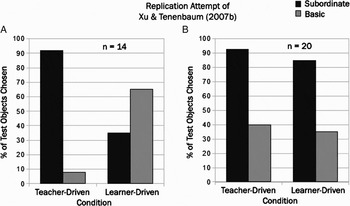
Figure 1. Replication attempt by Xu and Tenenbaum (2007a). A: Xu and Tenenbaum's results. B: Our exact replication attempt.
A central failing of the “Bayesian Fundamentalist” perspective, as described by Jones & Love (J&L), is its isolation from other theoretical accounts and the rich tradition of empirical work in psychology. Bayesian fundamentalists examine phenomena exclusively at the computational level. This limits contact with other theoretical advances, diminishing the relevance and impact of Bayesian models. This also limits Bayesians’ concern with the processes that underlie human performance. We expand upon the consequences of these senses of isolation within the context of word learning research.
One of the most striking shortcomings of Bayesian word learning approaches is a lack of integration with developmental theory. J&L put this quite starkly: In the Bayesian perspective, “Nothing develops” (see sect. 5.4). We agree, but believe that this would be more aptly put as, “Nothing emerges.” Why? Emergence – the coalescing of useful complexity out of simple inputs – is a key element of any developmental theory and a key concept in modern theories of word learning (see Smith Reference Smith, Golinkoff, Hirsh-Pasek, Bloom, Smith, Woodward, Akhtar, Tomasello and Hollich2000). Without emergence, existing knowledge can only be shuffled around or re-weighted; no qualitatively new psychological progress can be made (see Smith & Thelen Reference Smith and Thelen2003; Spencer et al. Reference Spencer, Thomas and McClelland2009).
Critically, Bayesian models leave no room for emergence in their hypothesis space, the priors, or the Bayes’ rule itself. Recent approaches using hierarchical Bayesian models (HBMs) show an impressive ability to discover structure in data (e.g., Tenenbaum et al. Reference Tenenbaum, Kemp, Griffiths and Goodman2011), giving a surface feel of emergence. However, because this ability rests on the modeler building in multiple hypothesis spaces and priors in advance, it is not deeply emergent. These models do not build something new that was not there before (see Spencer & Perone Reference Spencer and Perone2008).
Bayesian disregard for emergence and development is clearly seen in the Kemp et al. (Reference Kemp, Perfors and Tenenbaum2007) model of the shape bias discussed by J&L. This model does not add any quantitative or predictive value over Smith and colleagues’ earlier alternatives (Smith et al. Reference Smith, Jones, Landau, Gershkoff-Stowe and Samuelson2002). Indeed, by modeling children's behavior with static hypotheses about word meanings, they failed to capture the Smith group's crucial arguments about the emergence of this word learning bias. In effect, Kemp et al. presented a model of the phenomenon but without the development. This is not forward theoretical progress.
A second shortcoming of the Bayesian perspective is a failure to probe the inner workings of empirical phenomena in greater than a computational level of detail. Our recent work in the area of word learning does exactly this and reveals severe limitations of Bayesian interpretations.
In one set of experiments, we have demonstrated that a well-known Bayesian phenomenon – the suspicious coincidence (Xu & Tenenbaum Reference Xu and Tenenbaum2007b) – falls apart when several key empirical details are manipulated. The “suspicious coincidence” refers to adults’ and children's more narrow interpretation of a word when taught using multiple, identical exemplars than when taught with a single exemplar. Spencer et al. (Reference Spencer, Perone, Smith and Samuelson2011) showed that when the multiple exemplars are presented sequentially rather than simultaneously – as is the case in many real-world learning situations – adults no longer show a suspicious coincidence effect. This result has no specific contact to the concepts used in the Bayesian model, yet it intuitively maps onto concepts with a rich history in psychology: Simultaneous presentations encourage multiple comparisons over objects, leading to an emphasis on specific featural details, while sequential presentations afford a more global interpretation of similarity (see, e.g., Samuelson et al. Reference Samuelson, Schutte and Horst2009). Clearly, a theoretical account of the suspicious coincidence must address such facts.
In a separate experiment, we replicated the suspicious coincidence effect with 3½- to 5-year-old children when exemplars were labeled three times. When, however, we increased the number of labeling events, children no longer showed a suspicious coincidence effect (Jenkins et al., in press). Once again, this manipulation falls outside the scope of the concepts used in the Bayesian model, but it is a factor that most theories of word learning and categorization would naturally consider. And, critically, children's performance is robustly modulated by such details.
Xu and Tenenbaum (Reference Xu and Tenenbaum2007b) also neglected to probe the details of the knowledge children bring to the word learning task (in Bayesian terms, their hypothesis spaces and priors). Instead of measuring knowledge directly, Xu and Tenenbaum substituted adult data from a separate adult experiment. By contrast, we gathered data from children by using a table-top similarity ratings task (Perry et al., in preparation; see also, Goldstone Reference Goldstone1994). Results showed dramatic, qualitative differences in the structure of children's and adults’ category knowledge. Moreover, children with above-median prior knowledge of the object categories, as measured by parental report, failed to show a suspicious coincidence effect, whereas below-median children showed a strong suspicious coincidence effect. This is the opposite of what Bayesian models predict.
One empirical detail of the suspicious coincidence that Bayesians have probed is its dependence on whether exemplars are chosen by a knowledgeable teacher. Bayesians claim a sample is representative to word learners if it is chosen by a knowledgeable teacher but potentially biased, and therefore less informative, otherwise (Xu & Tenenbaum Reference Xu and Tenenbaum2007a). We attempted – and failed – to replicate the behavioral evidence supporting this dependence. Xu and Tenenbaum found a striking difference between teacher-informed adults (“teacher-driven” in Figure 1A) and adults who partially chose their own exemplars (“learner-driven” in Figure 1A). Our adult subjects showed no such effect (Figure 1B). It is possible that the Xu and Tenenbaum data were influenced by the low number of participants (N=14 in Figure 1A; N=20 in Figure 1B).
Replication attempt by Xu and Tenenbaum (Reference Xu and Tenenbaum2007a). A: Xu and Tenenbaum's results. B: Our exact replication attempt.
The foregoing examples demonstrate a general fragility of one prominent line of Bayesian word learning research. We believe this fragility to be both a characteristic and direct consequence of the Bayesian tendency to isolate theory from the details of mechanism and process.
In summary, we concur with J&L that there are serious limitations in the Bayesian perspective. Greater integration with other theoretical concepts in psychology, particularly in developmental science, and a grounded link to the details of human performance are needed to justify the continued excitement surrounding this approach.