1 Introduction
In a well-documented puzzle of phonological development, some child speakers produce fricatives faithfully in syllable- or word-final contexts, while replacing them with stops or glides in syllable- or word-initial position (Kent & Bauer Reference Kent and Bauer1985, Dinnsen Reference Dinnsen1996, Edwards Reference Edwards1996, Rvachew & Andrews Reference Rvachew and Andrews2002, Marshall & Chiat Reference Marshall and Chiat2003, Dinnsen & Farris-Trimble Reference Dinnsen and Farris-Trimble2008). These patterns of positional fricative stopping or gliding belong to a larger set of child-specific processes of neutralisation in strong position. Surveys of adult phonological typology have documented a bias favouring preservation of contrast in prosodically or perceptually strong positions, with neutralisation occurring preferentially in weak contexts (Beckman Reference Beckman1997, Steriade Reference de Lacy2001). Given this cross-linguistic tendency, it is surprising to find a number of processes in child phonology that feature neutralisation exclusive to initial or prosodically strong contexts (Chiat Reference Chiat1983, Inkelas & Rose Reference Inkelas, Rose, Beachley, Brown and Conlin2003, Reference Inkelas and Rose2007, Dinnsen & Farris-Trimble Reference Dinnsen and Farris-Trimble2008, McAllister Byun, forthcoming). These patterns are difficult to model without violating the assumption of continuity between child and adult grammars (Pinker Reference Pinker1984). If positional constraints that can capture the child-specific bias are added to a universal constraint inventory, the effects of these constraints should surface somewhere in adult phonological typology, yielding fully developed grammars that asymmetrically favour neutralisation in strong contexts. In fact, such grammars are unattested.
Previous analyses of child-specific phonological patterns have drawn on the fact that children and adults differ in their speech-motor control capabilities (Pater Reference Pater1997, Reference Pater2002, Inkelas & Rose Reference Inkelas, Rose, Beachley, Brown and Conlin2003, Reference Inkelas and Rose2007, McAllister Byun, forthcoming). While it is often assumed that phonological constraints are universal and innate (Stampe Reference Stampe1973, Gnanadesikan Reference Gnanadesikan, Kager, Pater and Zonneveld2004), elsewhere it is hypothesised that children construct constraints in response to the pressures they experience as they produce and perceive speech (Hayes Reference Hayes, Darnell, Moravcsik, Newmeyer, Noonan and Wheatley1999, Pater Reference Pater2002). As child-specific articulatory pressures recede over the course of motor maturation, the constructed constraints too will be eliminated, explaining the absence of comparable patterns from adult typology. Here it will be argued that positional fricative neutralisation can be explained as the product of a constraint encoding child-specific limitations on speech-motor control. The present analysis is informed by a new longitudinal corpus of child-speech data, presented in §3. Case-study subject ‘Ben’, a four-year-old boy with phonological delay, realised syllable-final fricatives with faithful manner, but neutralised fricative and glide manner in prevocalic contexts (e.g. shoe, you→[ju]). This pattern was gradually eliminated over the six-month duration of the study. When Ben did acquire fricative manner in prevocalic position, it was initially limited to the context preceding a high vowel. This will be interpreted as evidence that fricative production was influenced by the magnitude of the articulatory transition to the following vowel.
§4 lays out the details of the child-specific articulatory factors proposed to motivate Ben's positional fricative gliding. Studies investigating differences between child and adult articulation have repeatedly found that child speakers have a more limited ability to move the tongue independent of the jaw (MacNeilage & Davis Reference MacNeilage and Davis1990, Kent Reference Kent, Ferguson, Menn and Stoel-Gammon1992). It will be argued that a coarticulated fricative–vowel or vowel–fricative transition requires dissociated control of the tongue and jaw. The child speaker with limited lingual control might then replace a fricative target with a motorically simpler segment, such as a stop or glide. An alternative repair is to produce vowel and fricative gestures in a non-overlapping fashion. Evidence from Ben and other children suggests that stop or glide substitution is favoured for fricative targets in syllable-initial position, while non-overlapping gestural timing is favoured in syllable-final contexts.
§5 offers a formal phonological model to capture children's position-sensitive repairs for sequences of fricatives and vowels. Children's preference for unitary movements of the tongue-jaw complex is proposed to take on phonological status in a violable constraint termed Move.as-Unit (see also McAllister Byun, forthcoming). Using the weighted constraint framework of Harmonic Grammar (Legendre et al. Reference Legendre, Miyata and Smolensky1990, Smolensky & Legendre Reference Smolensky and Legendre2006), violations of this constraint will be expressed as real-valued measures of the magnitude of jaw-independent lingual displacement. Manner substitutions can arise if Move.as-Unit is weighted above conflicting faithfulness constraints. The positional nature of the pattern can be captured in the framework of Articulatory Phonology (Browman & Goldstein Reference Browman and Goldstein1986, Reference Browman and Goldstein1988, Reference Browman, Goldstein, Kingston and Beckman1990, Reference Browman, Goldstein, Bell-Berti and Raphael1995), using two constraints that govern the relative timing of adjacent gestures, CV-Coord and VC-Coord (Gafos Reference Gafos2002). Positional fricative neutralisation will emerge if the weight of a faithfulness constraint such as Ident[cont] (‘Segments have the same value for [±continuant] in input and output’) is greater than the weight of VC-Coord but less than that of CV-Coord. Finally, §6 discusses other areas in which the patterns exhibited by case-study subject Ben are consistent with the predictions of a gestural timing account. In particular, a pattern of glide epenthesis (e.g. sock→[sjak]) that characterised one stage of Ben's phonological development will be reinterpreted as the perceptual consequence of a non-overlapped transition between adjacent gestures (Gafos Reference Gafos2002, Davidson Reference Davidson2003, Gick & Wilson Reference Gick and Wilson2006).
2 Positional asymmetries in fricative production
Several decades of research have documented a preference for postvocalic over prevocalic fricatives in phonological acquisition, beginning in babbling and persisting through toddlerhood or beyond. Analyses of transcribed corpora of babbling reveal that fricative manner is more frequently attested in coda than in onset position (Oller & Eilers Reference Oller and Eilers1982, Redford et al. Reference Redford, MacNeilage and Davis1997, Gildersleeve-Neumann et al. Reference Gildersleeve-Neumann, Davis and MacNeilage2000). Initial stops are more common than initial fricatives, whereas fricatives outnumber stops in coda position (Oller et al. Reference Oller, Wieman, Doyle and Ross1976, Kent & Bauer Reference Kent and Bauer1985).
In older children, a preference for coda fricatives is often revealed through the preferential application in initial position of phonological patterns such as stopping. Edwards (Reference Edwards1996) described a 4;8-year-old child with developmental phonological disorder who produced no word-initial fricatives but consistently preserved fricative manner in word-final position. Marshall & Chiat (Reference Marshall and Chiat2003) reported data from a child who exhibited stopping of fricatives in word-initial but not word-final contexts. Other instances of children acquiring fricatives in coda before onset position have been reported by Farwell (Reference Farwell1976), Ferguson (Reference Ferguson, Honsa and Hardman-de-Bautista1978), Ingram et al. (Reference Ingram, Christensen, Veach, Webster, Yeni-Komshian, Kavanagh and Ferguson1980), Stoel-Gammon & Cooper (Reference Stoel-Gammon and Cooper1984), Stoel-Gammon (Reference Stoel-Gammon1985), Leonard & McGregor (Reference Leonard and McGregor1991), Dinnsen (Reference Dinnsen1996), Velleman (Reference Velleman1996), Stites et al. (Reference Stites, Demuth, Kirk, Brugos, Micciulla and Smith2004) and Dinnsen & Farris-Trimble (Reference Dinnsen and Farris-Trimble2008). It is by no means the case that all children acquire coda fricatives before onset fricatives, and indeed, the reverse preference has also been documented (Rvachew & Andrews Reference Rvachew and Andrews2002, Altvater-Mackensen & Fikkert Reference Altvater-Mackensen and Fikkert2010). Nevertheless, it is conventionally accepted that postvocalic fricatives have a favoured status in phonological development (Edwards Reference Edwards1979, Kent Reference Kent1982, Velleman Reference Velleman2002).
Even though the preference for coda fricatives is not universal across child speakers, the existence of the pattern poses a theoretical challenge, due to the lack of any counterpart in adult phonological typology. Cross-linguistic studies of fully developed grammars have documented a preference to preserve contrast in prosodically strong contexts (initial position and onsets of stressed syllables), while neutralising in weak contexts (Beckman Reference Beckman1997, Smith Reference Smith2000). Examples involving manner contrasts include Korean, which permits fricatives, stops and affricates in onset position while neutralising all three to stop manner in coda position (Ahn Reference Ahn1998), and the Cibaeño dialect of Spanish, which contrasts liquids and glides in initial position, but neutralises both to the glide category in final contexts (Harris Reference Harris1983, Núñez Cedeño Reference Núñez Cedeño1997). However, studies of developmental phonology offer ample evidence of maximisation of contrast in weak position. Besides the fricative pattern described here, neutralisation in strong position has been documented for the stop–affricate contrast (Dinnsen & Farris-Trimble Reference Dinnsen and Farris-Trimble2008), the velar–alveolar place contrast (e.g. Stoel-Gammon Reference Stoel-Gammon1996, Inkelas & Rose Reference Inkelas, Rose, Beachley, Brown and Conlin2003, Reference Inkelas and Rose2007, Dinnsen Reference Dinnsen2008) and the liquid–glide manner contrast (Inkelas & Rose Reference Inkelas and Rose2007). This discrepancy between child and adult patterns of positional neutralisation makes it difficult to model child patterns of neutralisation in strong position without generating incorrect predictions for adult typology. For example, the child preference for final fricatives might be captured by a positional markedness constraint restricting fricative manner to non-initial positions (*#S: ‘Avoid word-initial fricatives’). However, models of positional neutralisation in adult phonology have explicitly stated that positional markedness constraints cannot target individual features in prominent contexts (Smith Reference Smith2000, de Lacy Reference de Lacy2001). Introducing such constraints to the universal inventory would suggest that some adult grammars should neutralise featural contrasts in strong position only, but these grammars are unattested. There is evidence that adult grammars can ban classes of segments, defined in terms of sonority, from prominent positions. However, such constraints will not suffice to model child patterns of fricative neutralisation in strong position, since across children, initial fricatives can be neutralised either with stops (less sonorous) or glides (more sonorous). The existence of children who replace initial fricatives with glides also prevents an account of fricative neutralisation in terms of a preference to maximise the sonority cline in initial position while minimising sonority descent in final position (cf. Ohala Reference Ohala1999).
One account of positional neutralisation in adult phonology holds that most contrasts have greater perceptual salience in prevocalic than postvocalic contexts, and grammars maximise contrast in the context where it is most perceptible (Steriade Reference de Lacy2001). It has been proposed that the child pattern of neutralisation in strong position also has its roots in perception, but the child's perceptual sensitivities differ from those of the adult (Dinnsen & Farris-Trimble Reference Dinnsen and Farris-Trimble2008). However, Altvater-Mackensen & Fikkert (Reference Altvater-Mackensen and Fikkert2010) demonstrated that 14-month-old listeners were sensitive to a switch between a stop and a fricative in initial but not final position in a word-learning task. This indicates that children, like adults, perceive fricative–stop contrasts more readily in initial than final position.
Another possibility is that the child pattern of positional neutralisation can be attributed to articulatory factors. An articulatory account of the fricative asymmetry seen in babbling was proposed by Redford et al. (Reference Redford, MacNeilage and Davis1997), who suggested that articulatory energy diminishes over the course of an utterance, giving rise to consonant gestures of lesser magnitude in final position. With sufficient weakening, the gesture for a stop may fall short of complete closure. This is analogous to accounts of spirantisation of stops in adult phonologies (Kirchner Reference Kirchner2001). However, this account faces two challenges. First, while a continuous decline in energy can explain the appearance of a fricative at the terminus of a string of babbled syllables, it does not account for a coda fricative in an utterance-medial context, which may be followed immediately by complete stop closure in the onset of the adjacent syllable or word (e.g. [asdi] ice cream, produced by a child with positional fricative neutralisation; see §3.2, example (3)). Second, data from spirantisation in adult phonology indicate that while certain fricatives require less articulatory effort than the corresponding stops, sibilant fricatives are in fact more energy-intensive than stops (Kirchner Reference Kirchner2001). Since /s/ and /ʃ/ are commonly attested among the segments produced by children with positional fricative neutralisation, the early preference for word-final fricatives does not lend itself to analysis as the consequence of a general decline in energy.
This paper proposes an alternative articulatory explanation, which hinges on children's documented preference for ballistic movements of the tongue and jaw (MacNeilage & Davis Reference MacNeilage and Davis1990). The motivation for this analysis is supplied in the next section, which presents new longitudinal case-study data from a child with a pattern of positional fricative gliding. After introducing the case-study subject and providing examples to illustrate the pattern of interest, §3 offers quantitative and qualitative data to document the gradual emergence of prevocalic fricatives in the case-study subject's output. It will be demonstrated that fricative manner was facilitated in the context of a high vowel, where the magnitude of the articulatory transition from fricative to vowel is at its smallest. This preference to minimise articulator movement provides the first key insight for the phonetically motivated analysis to follow.
3 Case study of positional fricative neutralisation
3.1 Subject
Data for the present study were drawn from one monolingual learner of American English, Ben, over a period of roughly six months from age 3;9·27 to age 4;4·2. During this interval, Ben's speech was recorded in one-hour sessions on a roughly biweekly basis. These sessions featured a combination of unstructured interactions between Ben and his mother or the author and more structured activities such as naming pictures of words containing a phoneme of interest. Recordings were made with a Sony ICD-SX57 portable mp3 recorder. The recording quality of this device is suitable for phonetic transcription but not always adequate for acoustic analysis.
Although Ben demonstrated age-typical abilities across cognitive, social and receptive-expressive language domains, he showed a substantial degree of delay in speech-sound development. The use of a single subject with atypical phonological development limits the scope of the conclusions that can be drawn from the observations reported here. However, there is considerable precedent for investigating atypical speakers as a means of shedding light on the underlying structure of typical systems (Gierut Reference Gierut2008). It is generally agreed that the phonological patterns exhibited by children with speech sound disorder are qualitatively similar to those seen in younger children developing typically (Beckman et al. Reference Beckman, Munson, Edwards, Cole and Hualde2007). Children with delayed speech development can thus offer valuable insight into patterns that might appear only in a brief stage of typical phonological development, or only in children too young to cooperate with elicitation tasks. For examples of previous research using data from one or two children with delay/disorder to draw inferences about the nature of phonological representations and constraints, see Chiat (Reference Chiat1989), Barlow & Dinnsen (Reference Barlow and Dinnsen1998), Barlow (Reference Barlow2007) and Dinnsen et al. (Reference Dinnsen, Gierut and Farris-Trimble2010).
The present study focuses on Ben's positional pattern neutralising fricative and glide manner in syllable-initial position. However, various other phonological patterns were active in his grammar at the same time, and can be seen in the examples that follow. Along with positional fricative gliding, Ben exhibited a pattern of velar fronting that was specific to prosodically strong contexts: coronal and velar place were neutralised syllable-initially, while remaining distinct in syllable-final position (e.g. duck→[dʌk], cut→[dʌt]). Other patterns included deletion or debuccalisation of coda stops, syllable-initial voicing and syllable-final devoicing of obstruents, liquid gliding and vocalisation, and cluster reduction.
Ben's speech sound errors were suspected to involve a component of difficulty in the domain of motor planning for speech. Formal evaluation had resulted in a provisional diagnosis of Childhood Apraxia of Speech (CAS), a congenital speech-motor deficit affecting the capacity to form and sequence speech sounds. Characteristics of Ben's speech that were suggestive of CAS included atypical prosody, inconsistent errors and errors affecting vowels (Davis et al. Reference Davis, Jakielski and Marquardt1998). However, CAS is a controversial diagnostic category, since the properties proposed to distinguish it can generally be observed in phonological delay or disorder of a non-apraxic type (Forrest & Morrisette Reference Forrest and Morrisette1999). Given this lack of a qualitative distinguishing factor, it will be assumed that Ben's difficulties with speech-motor control made him comparable to a typical child at an earlier stage of speech-motor development. However, this supposition must be validated through comparison with younger children developing typically.
3.2 Positional influences on Ben's realisation of manner contrasts
Among children who have not mastered the fricative manner class, homorganic stops represent the most common substitution (e.g. zoo→[du], fish→[piʃ]). An attested but less common pattern replaces fricative targets with glides (Wauquier Reference Wauquier2010). Ben exhibited a pattern of fricative gliding that was specific to targets in syllable-initial position. Examples of Ben's initial fricative gliding, collected at age 3;10, are provided in (1). Fricatives were typically replaced with the homorganic glide (/s ʃ/→[j], /f/→[w]), but this was not uniformly the case (e.g. soap→[wop], fish→[jʊʃ]).Footnote 1
(1)


The examples in (2), also collected at age 3;10, show that syllable-initial glides at the same point in time were realised with faithful manner. This led to homophony between pairs such as shoe–you and some–yum in Ben's output.
(2)
By contrast, syllable-final fricative targets did not undergo gliding or other manner substitutions, even in the earliest recorded sessions. The examples in (3), also collected at 3;10, show that Ben systematically preserved faithful manner in syllable-final fricative targets. Voicing and place substitutions did occur; the pattern of substitution of coronal for labial place (e.g. five→[was]) will be discussed in §6.4. Many of Ben's fricatives were also characterised by distortion that varied in degree and character (dentalising, palatalising or lateralising). Because the present study concerns only the presence vs. absence of fricative manner, this level of phonetic detail is not represented in the transcriptions to follow.
(3)
The case-study corpus also contains a small number of examples of intervocalic fricative targets following a stressed syllable. Bernhardt & Stemberger (Reference Bernhardt and Stemberger2002) argue that consonants in this context are generally ambisyllabic in child phonology. However, Ben showed a clear preference for affiliating an intervocalic fricative with coda position only: he inserted a glottal stop after an intervocalic fricative target, often with a distinct pause between syllables. Examples of glottal stop epenthesis following an intervocalic fricative are provided in (4).Footnote 2
(4)
Ben's mostly faithful realisation of coda fricatives was particularly striking, in that no other coda consonants were reliably realised with supraglottal place in the first month of the period of study. As illustrated in the examples in (5), also collected at age 3;10, Ben exhibited an active pattern debuccalising voiceless coda stops to [ʔ]. Voiced codas and nasals were deleted. Stops in syllable-initial position were realised with faithful manner, but did show place and voicing substitutions.
(5)
Finally, the behaviour of stop and fricative components of target affricates in initial and final position was in keeping with the patterns described above for simplex stops and fricatives. Affricates in syllable-initial position were reduced to the stop component, as shown in (6).
(6)
In syllable-final position, the fricative portion was realised faithfully, while the stop portion was debuccalised to [ʔ] in voiceless affricates and deleted in voiced affricates, as in (7). Thus, the positional asymmetry favouring stops in syllable-initial contexts and fricatives in syllable-final contexts was also in effect in Ben's realisation of affricate targets.
(7)
3.3 Longitudinal emergence of initial fricatives
The longitudinal data reported here are of particular interest because they capture a dynamic stage in Ben's phonological development: the rate of application of initial fricative gliding diminished steadily throughout the six-month period of study. In the first two recording sessions, Ben produced faithful fricative manner in only 6% of initial targets; by the last two sessions, 81% of initial fricatives were realised with faithful manner. Moreover, the gradual emergence of initial fricatives revealed that faithfulness to fricative manner was conditioned by the height of the following vowel: Ben became consistent in producing fricatives before high vowels well before he mastered fricative manner in a non-high vowel context. This segmental conditioning factor is of interest as a potential source of insight into the forces motivating Ben's positional pattern of fricative gliding.
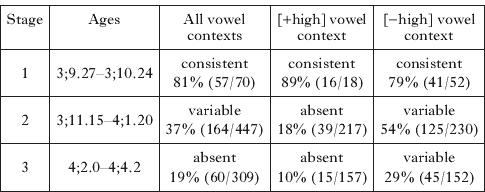
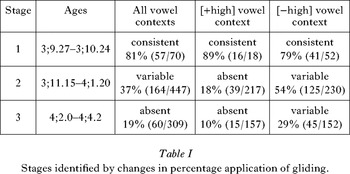
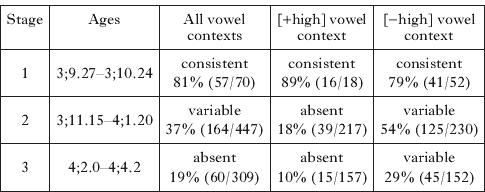
To create a detailed picture of the emergence of prevocalic fricatives in Ben's output, the six-month study interval was divided into three descriptive stages, based on changes in the percentage application of gliding. These stages were imposed for expository purposes only, and are not intended to suggest that Ben's grammar changed abruptly between stages; on the contrary, it will be demonstrated below that his outputs shifted in a gradual, continuous fashion. Following Pater (Reference Pater2002), fricative gliding was characterised as consistent when it affected an estimated 80% of tokens, variable when it affected 20 to 80% of tokens and absent when it applied in less than 20% of tokens. For the calculation of stages, all words in the transcribed record of Ben's output whose adult target form contained an initial singleton fricative from the set /s z ʃ f v/ were flagged for analysis, yielding a total of 826 fricative targets.Footnote 3 Each token was coded for the transcribed height of the following vowel, and the percentage of application of gliding was calculated in both high and non-high vowel contexts. Table I reports the rate of initial fricative gliding across vowel contexts in Ben's three stages of fricative development.
Stages identified by changes in percentage application of gliding.
The next three subsections provide more detailed data regarding Ben's patterns of initial fricative production in each developmental stage. Because fricative manner in final position was realised with ceiling-level accuracy from the earliest recorded session, postvocalic fricatives will not be discussed in connection with the developmental stages of fricative mastery.
3.3.1 Stage 1 (ages 3;9.27–3;10.24)
In Stage 1, gliding was observed in 81% of syllable-initial fricatives (57/70 tokens). The examples in (1) above were drawn from Stage 1. Only 4% of fricatives (3/70) in this stage were realised with fully faithful fricative manner. A pattern of glide epenthesis, to be described in detail in the following section, was observed in 9% of targets (6/70). Other errors, including deletion and stopping, accounted for the remaining 6% of targets (4/70). Fricatives before high and non-high vowels were roughly equivalent in their behaviour in this earliest stage, surfacing with faithful fricative manner in 6% and 4% of tokens respectively.
3.3.2 Stage 2 (ages 3;11.15–4;1.20)
The transition to a second stage of fricative development was identified when the overall rate of gliding of prevocalic fricatives fell below 80%, signalling variable application. Across vowel contexts, gliding was observed in 37% of tokens (164/447). There was distinct divergence in the behaviour of fricatives before high and non-high vowels in this stage. Before a high vowel, the rate of application of gliding was only 18% (39/217), and 59% of fricative targets preceding high vowels were classified as fully faithful in manner (127/217); examples of faithful fricatives before high vowels are provided in (8). Glide epenthesis was transcribed in 16% of targets before high vowels (34/217), and other substitutions were identified in 8% (17/217). When Ben spoke in a careful, monitored fashion, as in a structured task where he and the experimenter took turns naming pictures of fricative-initial words, he was consistent in preserving fricative manner for coronal fricative targets in the context preceding a high vowel. Labial and coronal fricatives began to diverge in their behaviour at this point, with labial fricatives continuing to undergo a high rate of gliding across vowel contexts (see discussion in §6.4).
(8)
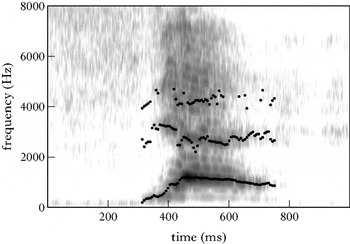
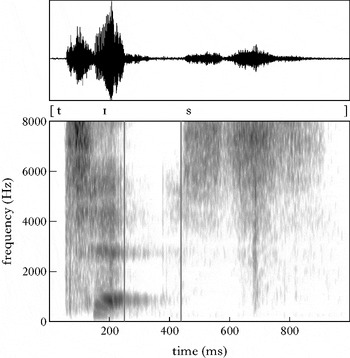
Coronal fricatives preceding non-high vowels underwent gliding at the distinctly higher rate of 54% (125/230). Ben almost never produced fully faithful fricative manner before a non-high vowel (6/230), even in highly monitored speech. Instead, Ben's best efforts in this context yielded outputs that were transcribed with an epenthetic /j/ glide separating the fricative from the following vowel. Examples of this pattern, seen in 31% of fricatives in non-high vowel contexts in Stage 2 (72/230), are provided in (9). Figure 1 shows the spectrogram of an output that was transcribed with glide epenthesis (sun→[sjʌ]). The acoustic correlate of the perceived epenthetic glide is readily visible in the interval of rapidly rising F1 and falling F2 that separates the fricative from the vowel.
Spectrogram of sun, transcribed [sjʌ] (age 3;11.29; Stage 2). Circles represent formants 1–3, calculated using Praat's automatic formant tracking algorithm.

(9)
Glide epenthesis is an unexpected repair pattern, appearing paradoxically to increase the complexity of the target by creating a consonant cluster. Other initial consonant clusters, including obstruent–glide clusters, were absent from Ben's output at this stage, suggesting an active *Complex constraint (‘No consonant clusters’). The analysis to follow will make the case that the transcribed glide was not the product of true phonological epenthesis, but rather the perceptual consequence of non-overlapping consonant and vowel gestures (see e.g. Gick & Wilson Reference Gick and Wilson2006).
3.3.3 Stage 3 (ages 4;2.0–4;4.2)
Ben's third stage of development was identified when the overall rate of gliding fell below the 20% threshold separating variable application from non-application. The rate of gliding across vowel contexts in Stage 3 was 19% (60/309). Persistent differences in the behaviour of fricatives before high and non-high vowels were apparent. In the context preceding a high vowel, 81% of fricative targets surfaced with fully faithful manner (128/157). Gliding was observed in 10% of outputs (15/157), and the remaining 9% showed epenthesis (9/157) or other errors (5/157). In the non-high vowel context, glide epenthesis had ceased to represent a dominant strategy, appearing in only 11% of tokens (17/152). Instead, fricative targets before a non-high vowel surfaced with fully faithful manner in 51% of tokens (78/152). Overall, Stage 3 showed that Ben was in the process of eliminating the fricative error patterns described above. (10) provides examples of faithful initial fricatives produced in Stage 3.
(10)
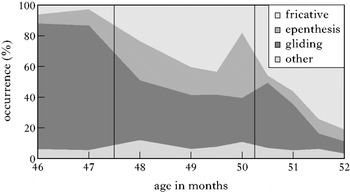
The changes in Ben's realisation of prevocalic fricative targets over time are summarised graphically in Fig. 2. To smooth session-to-session fluctuations that sometimes reflect small numbers of tokens, data were combined across every two adjacent sessions. The superimposed vertical lines represent the boundaries between Stages 1, 2 and 3. Figure 2 shows that although a descriptive criterion was used to divide Ben's development into discrete stages, in actuality his output changed in a mostly incremental fashion.
Longitudinal changes in the occurrence of four output categories.

4 Positional fricative neutralisation as the product of child-specific articulatory factors
4.1 The vowel-context effect and articulatory conditioning
Above it was demonstrated that coronal fricatives preceding a high vowel were realised with faithful manner earlier and at a higher rate than fricatives preceding a non-high vowel. Fisher's Exact Test confirmed that across the full sample, the rate of faithful coronal fricative production in the high vowel context significantly exceeded the rate before non-high vowels (p<0·0001). This conditioning influence of vowel context suggests that Ben's pattern of fricative production was shaped by articulatory factors. Coronal consonants require a high jaw position (Keating et al. Reference Keating, Lindblom, Lubker and Kreiman1994), and the position is even higher for coronal fricatives than stops (Geumann et al. Reference Geumann, Kroos and Tillmann1999, Mooshammer et al. Reference Mooshammer, Hoole and Geumann2006). The transition from a coronal fricative to a low vowel thus features a particularly large movement of the articulators, requiring more biomechanical effort than the smaller transition to a high vowel. It has been established that adult speakers act to conserve biomechanical effort by minimising movements of the articulators, and there is precedent for grammatically encoding this preference to account for patterns in adult phonology (Boersma Reference Boersma1998, Flemming Reference Flemming2001, Kirchner Reference Kirchner2001, Walter Reference Walter2007). However, if the principle of minimisation of articulatory effort is shared across children and adults, it is unlikely to provide the explanation for a pattern that is well attested in child phonology but absent from adult typology. A more promising approach is to consider a phonetic pressure that is specific to the immature articulatory system. §4.2 lays out the evidence for an articulatory-phonetic factor that impacts child but not adult speakers, namely a limited ability to produce functionally independent gestures of the tongue and jaw.
4.2 Advantage for unitary movements of the tongue-jaw complex
In early stages of motor development, children have a limited capacity for discrete control of individual muscles or body parts; motor activation tends to spill over to affect associated structures (Cohen et al. Reference Cohen, Taft, Mahadeviah and Birch1967). When two structures are biomechanically coupled, as in the case of the tongue and the jaw, simultaneous activation is especially likely. It is significant that the tongue and jaw pose differing degrees of difficulty for the developing speech-motor system. Moving the bilaterally hinged mandible represents a manageable motor control task even for the young child. A greater challenge is posed by the tongue, which is a muscular hydrostat: it achieves rigidity through muscular contraction around an incompressible core. The speaker must simultaneously stiffen the tongue to create skeletal support, control its shape and guide its movement (Kent Reference Kent, Ferguson, Menn and Stoel-Gammon1992). Because of this complexity, the tongue tends to take a passive role in young children's speech, borrowing its movement from the active jaw articulator (e.g. MacNeilage & Davis Reference MacNeilage and Davis1990, Nittrouer Reference Nittrouer1993, Green et al. Reference Green, Moore and Reilly2002). Davis, MacNeilage and colleagues have detailed a ‘frame-dominance’ hypothesis that invokes differences in tongue and jaw control to account for regularities of sound patterning in babbling and early speech. They propose that children acquire the frame of the syllable, a regular open–close mandibular oscillation, before they acquire specific content, the jaw-independent lingual adjustments that allow flexible combinations of consonants and vowels (MacNeilage & Davis Reference MacNeilage and Davis1990).Footnote 4
Different sequences of articulatory targets vary in the extent to which they call for dissociated tongue and jaw control. Stops, glides and nasals, which are the earliest emerging categories of speech sounds, are also motorically the simplest (Kent Reference Kent, Ferguson, Menn and Stoel-Gammon1992). Young children's lingual stops are described as the product of ballistic movements of the biomechanically coupled tongue-jaw complex.Footnote 5 Kent places glides in a category of ‘ramps’, which are slower than ballistic gestures but likewise do not call for fine-tuning of lingual force or position. Specific evidence that these motorically simple categories can be produced without differentiated tongue and jaw control comes from their prevalence in the early stages of babbling that are thought to lack cycle-internal adjustments of tongue position (MacNeilage & Davis Reference MacNeilage and Davis1990). MacNeilage & Davis documented a ‘fronted frame’ in babbled strings in which the tongue is set in a relatively anterior position during the open–close cycles of jaw movement, yielding either coronal stops or the /j/ glide with front vowels.
Fricatives belong to the motorically more challenging category of controlled gestures (Kent Reference Kent, Ferguson, Menn and Stoel-Gammon1992). Evidence from adult articulation, collected via X-ray microbeam or electromagnetic midsagittal articulography (EMMA), suggests that a coarticulated transition from a sibilant fricative to a non-high vowel cannot be achieved without some degree of independent tongue and jaw control. In speakers of both German (Mooshammer et al. Reference Mooshammer, Hoole and Geumann2006) and American English (Iskarous et al. Reference Iskarous, Shadle and Proctor2011), the transition from a sibilant to a vowel is characterised by an early jaw-lowering gesture, initiated in the middle of the fricative interval, and a later gesture lowering the tongue tip. Given the tightly constrained nature of tongue position for sibilants, there is reason to believe that this pattern of coordination is universal: because the tongue must remain in a high position to produce frication noise, lowering the jaw is the only possible means of anticipating the more open configuration of a following vowel. However, this pattern is available only to speakers who have the capacity to position the tongue independent of the jaw. In a child who habitually moves the tongue and jaw as a single unit, any lowering of the jaw in anticipation of the vowel will also carry the tongue away from its point of constriction, causing frication to cease. The transition from a vowel to a fricative is less demanding in terms of jaw-independent tongue control: because articulator placement is less constrained for a vowel than a consonant, particularly a sibilant, it is possible for the tongue and jaw to move together toward the target constriction for the final fricative. However, once the tongue reaches the critical distance to generate frication noise, any additional adjustments in jaw position must be made without altering the distance between the tongue and palate. Mooshammer et al. (Reference Mooshammer, Hoole and Geumann2006) found that the tongue tip reached its target earlier than the jaw in German-speaking adults' productions of vowel–sibilant transitions, a pattern that requires dissociated tongue and jaw control. Iskarous et al. (Reference Iskarous, Shadle and Proctor2011) did not measure vowel–sibilant transitions.
It is important to keep in mind that children's avoidance of jaw-independent tongue gestures is a gradient preference rather than a hard physiological restriction. This is evident from the fact that even infants with minimal articulatory control can be observed to produce some jaw-independent adjustments of tongue position (MacNeilage & Davis Reference MacNeilage and Davis1990). Over the course of maturation, independent lingual gestures become increasingly common, but measurements of stop transitions produced by preschool-age speakers reveal an ongoing tendency to use ballistic tongue-jaw gestures (Edwards et al. Reference Edwards, Fourakis, Beckman and Fox1999). A satisfactory model of child articulation should indicate when discrete lingual gestures will be allowed and when they will be supplanted by jaw-dominated gestures. The properties of motor control of a muscular hydrostat suggest that a ballistic tongue-jaw movement is more likely to be necessary in the context of a larger gesture. Recall that lingual control imposes simultaneous stiffening, shaping and movement requirements (Kent Reference Kent, Ferguson, Menn and Stoel-Gammon1992). When the tongue remains in a low position, some of its stiffening and shaping needs are met passively through contact with the bottom teeth. With greater separation from the mandible, these requirements must increasingly be filled by the lingual musculature, increasing the complexity of the motor task. Accordingly, a larger distance to the articulatory target can be expected to increase the child's predisposition to use a ballistic movement of the tongue and jaw. This is in accord with the observation that Ben first mastered prevocalic fricatives in the environment before a [+high] vowel, where the transition is small and the motor control task is correspondingly simpler.
4.3 Positional fricative neutralisation as avoidance of jaw-independent tongue gestures
The preceding discussion suggests two directions of analysis that could account for the asymmetric behaviour of lingual fricatives in onset and coda position in the speech of a child like Ben. (From here until §6.4, all discussion will focus specifically on the coronal fricatives /s/ and /ʃ/. In §6.4 it will be demonstrated that the patterning of labial fricatives, while superficially resembling that of the sibilants, was driven by a separate factor.) One possibility is that the magnitude of the articulatory gesture for a fricative is smaller in coda than onset position. A difference in gestural force or magnitude in initial relative to final position has been invoked in previous accounts of children's patterns of neutralisation in strong position. Stop consonants are known to be produced with larger and more forceful gestures in word-initial relative to word-final position (Browman & Goldstein Reference Browman, Goldstein, Bell-Berti and Raphael1995, Fougeron & Keating Reference Fougeron and Keating1997, Krakow Reference Krakow1999). This asymmetry was exploited by Inkelas & Rose (Reference Inkelas, Rose, Beachley, Brown and Conlin2003, Reference Inkelas and Rose2007) and McAllister Byun (forthcoming) to account for positional velar fronting. Inkelas & Rose (Reference Inkelas and Rose2007) suggested that the same explanation could be applied to positional stopping of fricatives: with less refined speech-motor control, children are liable to overshoot the critical constriction for fricative production, yielding a stop. This tendency for overshoot should be especially strong in initial position, where a more forceful gesture is favoured for prosodic reasons.
However, several facts suggest that fricative neutralisation in strong position cannot be straightforwardly attributed to positional differences in gestural magnitude. First, this hypothesis cannot account for a child like Ben, whose positional fricative gliding is an instance of lenition rather than fortition in a prosodically strong context. Second, while stop consonants exhibit pronounced positional differences in gestural force, sibilants show extremely little variation in constriction degree across prosodic positions (Byrd Reference Byrd1996, Fougeron Reference Fougeron2001; cf. Solé Reference Solé2010). Finally, observations of Ben and other children with positional fricative errors suggest that neutralisation is conditioned by specific properties of the fricative–vowel transition, not simply by prosodic context. Ben provides an example of a pattern of fricative neutralisation that is also conditioned by a segmental factor, the height of the following vowel. Other children produce appropriate fricatives in strong position only when another segment, such as an epenthetic stop, separates the fricative from the following vowel. The examples in (11) were collected by the author from a typically developing boy aged 3;4.
(11)
Gestural magnitude is not the only factor that can influence the difficulty of motor control in a fricative–vowel or vowel–fricative transition. A coarticulated transition calls for jaw-independent tongue control, since the tongue must hold steady at the critical constriction distance while the height of the jaw is adjusted to accommodate the transition into or out of a vowel. However, it should also be possible for the speaker to complete the articulation of the fricative, then initiate movement toward the vowel target with a unitary motion of the tongue-jaw complex; the reverse sequence applies to a vowel–fricative transition. This non-overlapping transition would satisfy the preference to avoid jaw-independent tongue movements without altering the featural identity of the fricative target.
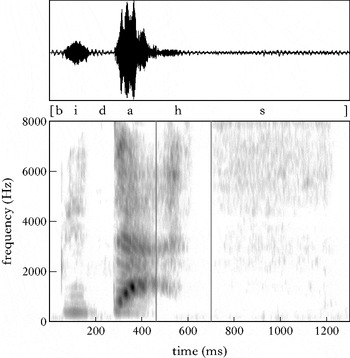
Visual inspection of the acoustic signal of Ben's output suggests that the faithful coda fricatives he produced in Stage 1 were indeed facilitated by a non-overlapping vowel and fricative gestures. In Ben's production of the target word because in Fig. 3, the vocalic interval has a duration of roughly 140 ms. The interval of aspiration noise and silence that separates the offset of periodic vocal fold vibration from the onset of high-energy frication is around 290 ms, more than twice as long. Figure 4 depicts a similar coordination pattern in a coda fricative produced by the three-year-old boy whose coronal stop epenthesis following initial sibilants was reported in (11). In this child's production of the word kiss, the vowel is roughly 98 ms, while the silent interval between the vowel and the coda fricative is 212 ms.
Spectrogram of because, transcribed [bidahs] (age 3;11.29; Stage 2). The aspiration/silent pause in the transition to the final fricative is indicated with vertical lines.

Spectrogram of kiss, transcribed [tis], produced by a typically developing child aged 3;4. The aspiration/silent pause in the transition to the final fricative is indicated with vertical lines.

These examples support the notion that some child speakers do produce non-overlapping vowel and fricative gestures to simplify the motor-control problem posed by lingual fricative articulation. However, the children who produced the above examples were never seen to produce a comparable interval of silence between a prevocalic fricative and the following vowel. Instead, prevocalic fricative targets in the same stage of development underwent gliding or epenthesis errors. This suggests that the gestural timing seen to facilitate coda fricatives was not available in onset position. The following section will support this observation with independent evidence that intergestural timing is more tightly constrained in syllable-initial than in syllable-final contexts.
4.4 Positional asymmetries in gestural coordination
The evidence presented here is drawn from the literature on syllable-position effects, which are position-dependent differences in the magnitude and relative timing of gestures (e.g. Browman & Goldstein Reference Browman, Goldstein, Bell-Berti and Raphael1995, Byrd Reference Byrd1996, Fougeron & Keating Reference Fougeron and Keating1997, Krakow Reference Krakow1999, Gick Reference Gick, Local, Ogden and Temple2003). Having rejected, at least for Ben, the possibility that the positional fricative asymmetry is caused by a positional difference in gestural magnitude, I will consider here only timing aspects.
Tuller & Kelso (Reference Tuller and Kelso1990, Reference Tuller and Kelso1991) described differences in the relative timing of consonant and vowel gestures across onset and coda contexts. They reported that the degree of overlap between a vowel and a coda consonant varies with changes in rate or prosody, whereas onset–vowel transitions maintain stable timing across all conditions. They summarised the contrast in timing between CV and VC transitions with the assertion that ‘syllable-initial consonants appear to be more tightly coordinated with, and strongly coarticulated with, the following vowel, than are syllable-final consonants with the preceding vowel’ (1991: 506). More recently, similar claims have been advanced as part of a research programme that posits a biomechanical basis for these differences in coordination strength and stability (Goldstein et al. Reference Goldstein, Nam, Saltzman, Chitoran, Fant, Fujisaki and Shen2009, Nam et al. Reference Nam, Goldstein, Saltzman, Pellegrino, Marisco, Chitoran and Coupé2009). Goldstein et al. (Reference Goldstein, Byrd, Saltzman and Arbib2006) first proposed the coupling hypothesis of syllable structure, which holds that characteristic patterns of CV and VC coordination are the consequence of in-phase and anti-phase coupling modes. They hypothesised that onset consonants bind to the vowel in an in-phase (synchronous) timing relationship, while a coda consonant is bound to the vowel in an anti-phase relationship, offset in its timing by 180 degrees. In a study of limb oscillation, Turvey (Reference Turvey1990) reported that in-phase and anti-phase couplings are the only two stable patterns of coordination that can be executed without practice. But in-phase and anti-phase relations are not equally stable: when subjects were instructed to oscillate their limbs in an anti-phase pattern with increasing rate, spontaneous transitions to in-phase coordination were observed. The reverse transition did not occur. Drawing on these studies, Nam et al. (Reference Nam, Goldstein, Saltzman, Pellegrino, Marisco, Chitoran and Coupé2009) proposed that the in-phase coupling between an onset consonant and a vowel is stronger than the anti-phase coupling between a vowel and a coda. These authors observed that the proposed difference in the strength of CV and VC couplings can account for a range of phenomena, including the cross-linguistic universality (or near-universality) of CV syllables, the developmentally earlier emergence of CV syllables, the resyllabification of coda consonants as onsets in intervocalic contexts and the difference in timing relations between consonants within clusters in initial vs. final position (the C-centre effect; Browman & Goldstein Reference Browman and Goldstein1988).
The remainder of this paper will demonstrate that Ben's pattern of positional fricative neutralisation can be modelled as the consequence of interaction between these characteristic patterns of gestural coordination and the child-specific preference to avoid jaw-independent tongue gestures. Below it is argued that such trade-offs are best captured in a grammatical model; a formal analysis drawing on the frameworks of Harmonic Grammar and Articulatory Phonology is proposed.
5 Formal model of positional fricative gliding
5.1 Rationale for a phonological analysis
Up to this point, the motivation underlying positional fricative neutralisation has been described strictly in terms of limitations on articulation and motor planning. It might therefore seem natural to explain positional fricative gliding as a motor performance phenomenon rather than a reflection of grammatical competence. The present study cannot provide a definitive demonstration that the pattern in question belongs to the domain of either competence or performance. However, the systematic character of child-speech processes is more in keeping with a phonological account. Most child-speech phenomena, such as cluster reduction or final devoicing, conform to principles of markedness that are well established in adult phonological typology. It is generally uncontroversial to describe these patterns as the product of the child's grammar (cf. Hale & Reiss Reference Hale and Reiss1998). Importantly, the phenomena that do not conform to adult principles, such as neutralisation in strong position, are no less predictable and systematic than the patterns recognised as phonological. Invoking extragrammatical performance factors to account for just those patterns that lack counterparts in adult typology would create a questionable dichotomy between two sets of equally regular patterns in child speech. A more satisfactory solution is available in a ‘constructivist’ model of child phonology (Kiparsky & Menn Reference Kiparsky, Menn and Macnamara1977, Pater Reference Pater1997, Reference Pater2002, Hayes Reference Hayes, Darnell, Moravcsik, Newmeyer, Noonan and Wheatley1999), where child and adult grammars are continuous in their basic form, but the specific substance of constraints is constructed from the speaker's own experience of articulatory, motor planning or perceptual factors. If a particular pressure is experienced by child but not adult speakers, a child-specific phonological constraint may result. As the child speaker's vocal tract and motor control circuits mature, the phonetic pressures he experiences gradually converge with those of the adult. Assuming that speakers periodically re-evaluate the match between their grammar and their physical experience of speech production, the constructivist approach can also account for the disappearance of child-specific constraints in the course of typical maturation.
5.2 Phonologically encoding child-specific speech-motor limitations
The formal analysis to follow utilises weighted constraints in the framework of Harmonic Grammar (Legendre et al. Reference Legendre, Miyata and Smolensky1990, Smolensky & Legendre Reference Smolensky and Legendre2006, Pater Reference Pater2009). Like Optimality Theory (Prince & Smolensky Reference Prince and Smolensky1993), Harmonic Grammar evaluates candidate outputs with a system of constraints that militate against marked forms while favouring faithfulness to the input. But while Optimality Theory constraints are ranked in a strict dominance relationship, Harmonic Grammar constraints carry numerical weights. A constraint assigns each candidate a violation score reflecting the number or magnitude of violations it incurs; negative numbers are used to mark this score as a penalty. Each candidate's weighted violations are summed, and the form with the least negative sum of weighted violations is selected as most harmonic. Transitions from one stage of development to the next can be represented by adjusting the weights assigned to various markedness and faithfulness constraints, akin to the re-ranking of constraints in the OT framework. For previous uses of Harmonic Grammar in developmental phonology, see Farris-Trimble (Reference Farris-Trimble, Chandlee, Franchini, Lord and Rheiner2009), Pater (Reference Pater2009) and Jesney & Tessier (Reference Jesney and Tessier2011). A Harmonic Grammar approach is particularly valuable when we consider how a child's developing grammar interacts with his cognitive and motor development, since Harmonic Grammar is currently being used to link formal phonology with connectionist models of neural activity in speech processing (e.g. Smolensky & Legendre Reference Smolensky and Legendre2006, Goldrick & Daland Reference Goldrick and Daland2009).
The child-specific constraint to be adopted here assigns real-valued penalties reflecting the magnitude of movements of the articulators that violate principles of motor control optimisation. This constraint is related to constraints on articulatory effort in adult speech like Lazy (Kirchner Reference Kirchner2001) and Minimise.ffort (Flemming Reference Flemming2001). There is some controversy around constraints that make reference to continuous-valued parameters, such as the magnitude of articulatory gestures (McCarthy Reference McCarthy2002). A notable objection stems from the fact that in classic OT, banning a particular magnitude of articulatory effort requires exploding a single principle such as ‘minimise articulatory effort’ into a potentially infinite number of sub-constraints, each banning a specific degree of effort. However, implementing effort-based constraints in a Harmonic Grammar framework nullifies this particular concern: in a weighted constraint framework, real-valued phonetic detail can be encoded with a single constraint (Flemming Reference Flemming2001).
§4 reviewed evidence that children have difficulty with the motor task of controlling the tongue independent of the biomechanically coupled jaw. Here it is proposed that this child-specific phonetic pressure is grammatically encoded as a phonetically sensitive constraint Move.as-Unit, which penalises any movement of the tongue that is not supported by a simultaneous jaw gesture in the same direction (see also McAllister Byun, forthcoming). The magnitude of the violation is influenced by the distance the tongue travels relative to the jaw. Above it was noted that that motor control is particularly problematic when there is vertical separation of the tongue and jaw, since passive pressure from the lower teeth can no longer fill some of the tongue's stiffening and shaping requirements. This suggests that vertical tongue movements should be penalised more heavily than horizontal movements. However, data that would permit a detailed coding of the relative contributions of vertical and horizontal tongue movement to motor planning complexity are presently lacking. As a first-pass approximation, here it is proposed that vertical and horizontal tongue movements are penalised by two separate constraints, Move.as-Unitvertical and Move.as-Unithorizontal. The greater difficulty of vertical movement can be captured by stipulating a fixed weighting relationship, such that Move.as-Unitvertical always carries a higher weight than Move.as-Unithorizontal. For present purposes, it will not be necessary to compare candidates that incur different violations of Move.as-Unithorizontal: if the backness of the surrounding vowel context had any impact on Ben's pattern of fricative gliding, it was extremely small in comparison to the robust effect of vowel height. For the remainder of the paper, only Move.as-Unitvertical, defined in (12), will be used in the evaluation of candidates; it will be referred to simply as Move.as-Unit in the tableaux and discussion to follow.
(12)
To assess violations of Move.as-Unit, tongue movements are represented as vectors in a jaw-centred coordinate space. If the jaw moves and the tongue moves with it, no violation of Move.as-Unit is assessed. However, if the tongue moves while the jaw remains fixed, or vice versa, Move.as-Unit is violated in proportion to the length of the vertical component of the vector. Put a different way, Move.as-Unit will assign a penalty in proportion to the magnitude of vertical movement in either of two contexts: a gesture raising the tongue while the jaw remains low, or a gesture that opens the jaw while the tongue remains high.
5.3 Coordination constraints in Articulatory Phonology
Explaining the positional nature of Ben's fricative gliding pattern will require that Move.as-Unit interact with constraints on gestural coordination in onset and coda position. Articulatory imaging studies have revealed that gestures stand in characteristic timing relations with respect to each other, and these timing patterns differ depending on position in the syllable. These intergestural relationships have been modelled in the framework of Articulatory Phonology (Browman & Goldstein Reference Browman and Goldstein1986, Reference Browman, Goldstein, Kingston and Beckman1990, Reference Browman, Goldstein, Bell-Berti and Raphael1995). Gestures, defined in terms of their spatial and temporal properties, constitute the basic units of Articulatory Phonology. Following Gafos (Reference Gafos2002), the present analysis will make reference to a number of temporal landmarks over the course of a gesture, including the gestural onset (initiation of movement toward the target), target (point at which the gesture first attains its goal position), C-centre (midpoint of the period during which the gesture is at its target) and release (beginning of movement away from the target position). These are depicted in (13).
(13)
Browman & Goldstein (Reference Browman, Goldstein, Kingston and Beckman1990) used X-ray microbeam imaging to describe characteristic patterns of gestural overlap in onset and coda contexts. They found that in a CV sequence, the C-centre of the consonant typically coincides with the onset of the vowel, but in a VC sequence, the consonant's target is generally phased with the release of the vowel. Gafos (Reference Gafos2002) proposed that these characteristic patterns of gestural coordination are encoded in the grammar and can be represented with optimality-theoretic alignment constraints termed coordination constraints. In Gafos's model, a CV transition is subject to the constraint CV-Coord (‘Align(C, C-centre, V, Onset)’), which penalises candidates in which the C-centre of the consonant does not coincide with the vowel onset. For the vowel–coda transition, the relevant constraint is VC-Coord (‘Align(V, Release, C, Target)’), penalising forms in which the vowel release does not align with the coda consonant target. The preferred phasings indicated by these constraints are depicted in (14).
(14)
As detailed in §4.3, the present study will follow Tuller & Kelso (Reference Tuller and Kelso1990, Reference Tuller and Kelso1991) and Nam et al. (Reference Nam, Goldstein, Saltzman, Pellegrino, Marisco, Chitoran and Coupé2009) in assuming that the strength of the coupling between an onset consonant and a vowel is stronger than the vowel–coda coupling. In the Harmonic Grammar framework adopted here, the greater strength of the CV coupling will be expressed by assigning a higher weight to CV-Coord than to VC-Coord. It will be assumed that child speakers of English have access to the constraints that govern gestural coordination and syllable-position effects. Since there is evidence that patterns of gestural coordination and syllable-position effects are subject to cross-linguistic differences (Gick & Wilson Reference Gick and Wilson2006, Kochetov Reference Kochetov2006), these patterns must be learned rather than innately specified. The mechanism by which children acquire the gestural coordination constraints of their language is addressed by Nam et al. (Reference Nam, Goldstein, Saltzman, Pellegrino, Marisco, Chitoran and Coupé2009), but will not be explored in the present study.
5.4 Formal model: positional fricative gliding in Stage 1
The following two tableaux show that Ben's pattern of positional fricative gliding can be modelled as the product of interactions among Move.as-Unit and faithfulness and coordination constraints. The constraint weights adopted here were selected to mimic the observed proportions of different outcomes in Ben's speech; see §6.1 for further discussion. However, the precise values are ultimately arbitrary, as any values that satisfy certain weighting conditions, or relationships among constraint weights, will select the correct candidate (Potts et al. Reference Potts, Pater, Jesney, Bhatt and Becker2010). The weighting conditions required to derive the patterns that characterised Ben's Stage 1 will be laid out following the illustrative tableaux in (15) and (16).
(15) depicts the behaviour of an initial fricative in a non-high vowel context (target /sɔ/ saw) in Ben's Stage 1. Candidate (a) depicts normal coarticulation between the fricative and the following vowel. This candidate satisfies CV-Coord, but violates Move.as-Unit. In the absence of actual measurements of tongue and jaw movements in child speech, here the value 1 stands in for the magnitude of violation associated with the transition to a non-high vowel. In candidate (b), the fricative target is replaced with a stop, which can be produced with a ballistic tongue-jaw gesture and thus incurs no violation of Move.as-Unit. Because Ben exhibited a pattern of positional gliding rather than positional stopping, it can be assumed that Ident[cont] carried a higher weight in his grammar than Ident[cons] (‘Segments have the same value for [±consonantal] in input and output’). For this reason, candidate (b) loses to candidate (c), which also satisfies Move.as-Unit but violates Ident[cons] by replacing the fricative target with a glide. In the final candidate, the consonant and vowel gestures have been ‘pulled apart’ in their timing, eliminating the region of gestural overlap. This non-overlapping production satisfies Move.as-Unit, but violates CV-Coord. If the weight of CV-Coord is greater than that of Ident[cons], gliding candidate (c) will be selected as most harmonic.
(15)
Tableau (16) illustrates the contrasting outcome observed for postvocalic fricatives in Stage 1. Candidate (a) satisfies VC-Coord, but violates Move.as-Unit, due to the region of overlap between vowel and fricative gestures. The less constrained nature of articulator placement during a vowel means that the violation incurred in the vowel–fricative transition should be smaller than that associated with the fricative–vowel transition reported above (see the discussion in §4.2). In (16), a violation of magnitude 0·5 is arbitrarily selected for candidate (a). However, note that obtaining the desired outcome, i.e. preservation of fricative manner in final position, does not depend crucially on the violation magnitude assigned to candidate (a). Either candidate (a) or (c) will be selected; the outcomes differ only in whether or not the vowel overlaps the coda fricative. Candidate (b), with gliding of the fricative target, satisfies Move.as-Unit, but violates Ident[cons]. In candidate (c), non-overlapping vowel and consonant gestures violate VC-Coord, but satisfy Move.as-Unit. In (16), the low weight of VC-Coord means that this candidate is selected as most harmonic.
(16)
In this model, the contrasting behaviour of fricatives in initial and final position depends crucially on the weighting of CV-Coord and VC-Coord relative to Ident[cons]. Ben's pattern of positional fricative gliding will result from any set of weights that respect the inequalities in (17).
(17)
6 Additional predictions of the gestural timing model
This section will demonstrate that two other aspects of Ben's fricative production – glide epenthesis in Stage 2 and the presence of aspiration noise rather than a glide-like transition to a postvocalic fricative – can also be interpreted in terms of constraint interactions involving patterns of gestural overlap.
6.1 Formal model: glide epenthesis before non-high vowels in Stage 2
Recall that in careful speech during Ben's Stage 2, a fricative before a non-high vowel was transcribed with an epenthetic glide (e.g. sock→[sjak]). It was noted that epenthesis creating a complex onset constitutes an unlikely repair in the phonology of a child whose output otherwise contained no initial consonant clusters, including obstruent–glide clusters. Here it is argued that what was transcribed as an epenthetic segment is best interpreted as a transitional glide that emerges due to non-overlapping coordination of consonant and vowel gestures.
There is ample literature documenting the possibility that what appear to be epenthetic segments may in fact represent the perceptual consequence of non-overlapping gestural coordination. Gafos (Reference Gafos2002) proposed such an analysis for epenthetic schwa in coda clusters in Moroccan Colloquial Arabic, arguing that when the plateau of one consonant in a cluster is not contiguous with the plateau of the following consonant, the vocal tract is open for a brief interval, creating the percept of a transitional schwa. Davidson (Reference Davidson2003) offered a similar account of perceived epenthetic schwa in English speakers' attempts to produce non-native clusters. A gestural explanation has also been proposed for excrescent schwa in words such as peel and feel in some dialects of English (Gick & Wilson Reference Gick and Wilson2006). Patterns of gestural overlap have also been invoked to account for epenthetic segments other than schwa, such as ‘intrusive’ /r/ in English (Gick Reference Gick1999).
In the tableau in (15) above, the winning candidate for an initial fricative in Stage 1 replaced the fricative target with a glide, which can overlap the vowel and satisfy CV-Coord without incurring the Move.as-Unit violation associated with independent tongue and jaw movement. However, if Ident[cons] were weighted higher than CV-Coord, the optimal candidate would feature a non-overlapped fricative–vowel transition rather than glide substitution. Here it is proposed that the change in Ben's output patterns that was schematised as a transition from Stage 1 to Stage 2 resulted from a reversal of the relative weights of these two constraints. The updated inequalities for Stage 2 are presented in (18).
(18)
In (19), the weight of Ident[cons] has been increased to a value greater than the weight of CV-Coord. Other changes could also satisfy the weighting condition in (18); this one was selected for maximum simplicity. (19) shows that with the change in the relative weights of Ident[cons] and CV-Coord, the winning candidate is (d), which features non-overlapping gestural timing. Note that the transcription of candidate (d) has been altered relative to its appearance in (15): a superscript /j/ glide has been added to indicate that the non-overlapped transition from the fricative to the non-high vowel is perceived as an epenthetic glide. A genuine epenthetic glide would be ruled out by *Complex, which was never violated in this stage of Ben's grammar.
(19)
This analysis might be challenged on the grounds that an excrescent segment in this context is not expected to have the acoustic properties of a glide. In particular, the tongue body is raised for /j/ but not for /s/ in typical adult speech, suggesting that a deliberate gesture might be necessary to position the tongue for the intervening glide. However, there are adult phonologies that insert a palatal glide in the transition between a vowel and an alveolar fricative, e.g. luz ‘light’→[lujs] in certain dialects of Brazilian Portuguese (Albano Reference Albano1999, Operstein Reference Operstein2010). Likewise, Solé (Reference Solé2010) proposed that historical changes in which fricatives are replaced with glides (e.g. Italian noi<Latin nos) may result from perceptual reanalysis in which the vowel transition into or out of a fricative is interpreted as an intervening glide segment. Furthermore, the particular properties of child speech make /j/ even more likely as a transitional state between vowel and fricative targets. Recall that children have difficulty activating one articulator without simultaneously activating another to which it is biomechanically coupled; this difficulty is particularly pronounced when the articulators in question are two regions of a single structure, the tongue. Children who lack functionally independent control of tongue tip and tongue body tend to produce coronal targets, including coronal fricatives, with elevation of what is effectively the entire tongue (Gibbon Reference Gibbon1999). Although this evidence makes it plausible that Ben's tongue position for /s/ did not differ dramatically from its position for /j/, this hypothesis does need to be confirmed by using ultrasound or electropalatography to image tongue-body placement during fricatives and glides in the speech of a child like Ben.
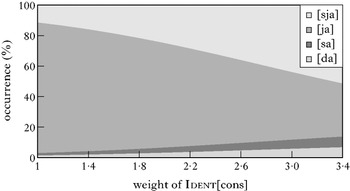
In §3, Ben's phonological development was divided into three rough stages, but it was noted that the identification of stage boundaries was not intended to suggest that change in Ben's grammar was abrupt or categorical; as Fig. 2 revealed, the proportions of different forms in Ben's output changed continuously over time. Here I will briefly show that the formal model set forth above is also compatible with the assumption of gradual change. Recall that in tableaux (15) and (19), the change from Stage 1 to Stage 2 was accomplished by adjusting the weight of a single constraint, Ident[cons]. This maximally simple solution was adopted because constraint weights for this model cannot currently be calculated using an automated learning algorithm such as the gradual learning algorithm for Harmonic Grammar (HG-GLA; Boersma & Pater Reference Boersma and Pater2008). The difficulty lies in the phonetically sensitive constraint Move.as-Unit: while models like HG-GLA determine constraint weights based solely on evidence from the adult input, the weight of Move.as-Unit must also be sensitive to factors such as neuromuscular maturation and motor practice. However, Fig. 5 illustrates that even the simplified model adopted here is compatible with gradual change over time. To create the graph in Fig. 5, the weight of Ident[cons] was increased in even increments from its starting value of 1 until a change in the relative weights of Ident[cons] and CV-Coord was reached, marking the beginning of Stage 2. The percentage of outputs predicted to exhibit glide epenthesis, glide substitution, faithful fricative manner and stopping was then calculated for each increment. Percentages were calculated on the assumption that the probability of a given candidate is proportional to the exponential of its total harmony score H; this assumption was borrowed from the maximum entropy model of grammar (e.g. Hayes & Wilson Reference Hayes and Wilson2008), although the constraint weights themselves were not derived in the maximum entropy framework. The resulting graph can be compared with the actual percentages observed for each category in Ben's outputs across Stage 1, depicted in Fig. 6. Unsurprisingly, the actual data show considerable noise relative to the simulation. (Note that the outlying data point at 203 weeks reflects a session in which only seven prevocalic fricative tokens were observed.) Nevertheless, visual inspection suggests that the formal model proposed here represents a reasonable fit for the data, even with the simplifying assumption that the change from Stage 1 to Stage 2 was achieved entirely through evenly spaced adjustments to the weight of a single constraint, Ident[cons].
Predicted occurrence of candidates based on harmony scores.

Observed occurrence of output categories in Ben's Stage 1.

6.2 Formal model: faithful fricatives before high vowels in Stage 2
In Ben's Stage 2, transitional glides were transcribed almost exclusively in the context before a non-high vowel; before a high vowel, fricatives were realised faithfully and with no percept of epenthesis. Tableau (20) demonstrates that the set of constraints and weights posited here can derive this outcome. Recall from §4.2 that Move.as-Unit is violated in proportion to the magnitude of any vertical movement of the tongue relative to the jaw, meaning that the transition from a fricative to a high vowel incurs a smaller penalty. Having set 1 as the violation magnitude incurred by the transition from a fricative to a low vowel, here the transition to a high vowel will be represented as incurring a violation of magnitude 0·5. Although these values were arbitrarily selected to code the high–non-high distinction, they are not entirely without articulatory motivation: in the measurements of fricative–vowel transitions reported by Iskarous et al. (Reference Iskarous, Shadle and Proctor2011), the average vertical distance travelled by the jaw from its peak height until its minimum at the end of the /s/ interval was roughly twice as great in a non-high vowel context as in a high vowel context. A goal for future work is to use actual measurements of child articulation to arrive at more accurate estimates of the magnitude of Move.as-Unit violations across contexts.
In (20), gestural diagrams have been omitted for brevity, but note that candidate (c) features a non-overlapping fricative–vowel transition and thus violates CV-Coord. The fractional Move.as-Unit violation incurred by candidate (a) makes the fully faithful candidate more harmonic than its competitors. Note that the use of the Harmonic Grammar framework plays a critical role at this juncture: it is essential that Move.as-Unit retain a high weight in this stage, since fricatives before non-high vowels underwent gliding or glide epenthesis, but the data from the high vowel context indicates that small violations of this high-weighted constraint can be tolerated. In classic Optimality Theory, any violation of high-ranked Move.as-Unit would eliminate candidate (a) from consideration, incorrectly predicting glide epenthesis in high as well as non-high vowel contexts.
(20)
Modelling of Ben's Stage 3, when onset fricatives were realised faithfully before non-high as well as high vowels, can be achieved straightforwardly by lowering the weight of Move.as-Unit relative to Ident[cons], CV-Coord and VC-Coord.
6.3 Formal model: preaspirated coda fricatives
§6.1 argued that the epenthetic glide perceived to separate an initial fricative from a non-high vowel in Ben's Stage 2 was the consequence of non-overlapping timing of fricative and vowel gestures. A non-overlapping transition was also present in the winning candidate for a postvocalic fricative target in Stages 1 and 2. However, epenthetic glides or changes in vowel quality were almost never transcribed in postvocalic contexts. Visual inspection of Ben's postvocalic fricative productions, as in Fig. 3 above, provides a ready explanation for the absence of the predicted offglide: voicing for the vowel ceases well in advance of the onset of the fricative. This anticipatory devoicing or preaspiration has the effect of obscuring the formant transitions that could otherwise create the percept of an epenthetic glide. Note that in Ben's case anticipatory devoicing is not restricted to voiceless fricative targets, since final obstruent devoicing was a consistent pattern in his output. Figure 3, featuring the target word because, is itself an illustration of this process. Final devoicing is a common pattern in typically developing children as well as children with phonological disorder (Hodson & Paden Reference Hodson and Paden1981).
The finding that glottal opening occurs in advance of the oral constriction for a fricative coda is entirely consistent with the gestural coordination analysis pursued here. §5.2 referenced the literature documenting syllable-position effects that influence the relative timing of vowel and consonant gestures in onset and coda position. An even more substantial literature has described syllable-position effects pertaining to the relative timing of gestures within a compound segment; for a summary, see Krakow (Reference Krakow1999). Compound segments include nasals (velar opening, oral constriction), liquids (posterior tongue constriction, tongue tip constriction) and voiceless obstruents (glottal opening, oral constriction). With considerable consistency, articulatory studies of within-segment gestural timing have found that both gestures are produced roughly synchronously in onset position, whereas coda consonants tend to feature a lag between the gestures (Byrd et al. Reference Byrd, Tobin, Bresch and Narayanan2009). Most significant for present purposes is the finding that the glottal opening gesture typically precedes the oral constriction in a voiceless obstruent coda (Tuller & Kelso Reference Tuller and Kelso1990).
It has been proposed that coda- and onset-specific patterns of intrasegmental gestural timing can be encoded in phonological constraints that serve as intrasegmental counterparts of CV-Coord and VC-Coord (Delforge Reference Delforge2008). The constraint proposed in (21) is a modification of Delforge's Oral-Glottal Coordcoda. The landmarks designated for alignment in this constraint were selected on the basis of evidence that in a compound segment in coda position, the secondary articulator tends to reach its target at the same time that movement of the primary articulator is initiated (Krakow Reference Krakow1999).
(21)
Tableau (22) depicts the comparison of candidates for a postvocalic fricative target in Ben's Stage 1. On the assumption that candidates featuring overlap between the vowel and the oral gesture for the fricative are ruled out by Move.as-Unit, only candidates with no overlap are included. Candidate (a), with simultaneous onset of glottal and oral gestures, violates Oral-Glottal Coordcoda. The most harmonic candidate is therefore (b), which features an interval of preaspiration and no audible glide transition.Footnote 6
(22)
For a compound segment in syllable-initial position, articulatory evidence shows that component gestures have synchronous or near-synchronous onsets. The relevant coordination constraint, Oral-Glottal Coordonset, should thus favour alignment between the onsets of the oral gesture and the glottal gesture. In accordance with this constraint, no interval of postaspiration should be produced, and the glide-like transition will remain audible.
6.4 A note on labial fricatives
The analysis so far has not addressed the behaviour of labial fricatives. Positional gliding of labial fricatives cannot be modelled with the constraint Move.as-Unit as it is currently formulated: because labial fricatives do not impose any requirements on the position or movements of the tongue, they do not violate a constraint banning jaw-independent lingual gestures. In the present case, two pieces of independent evidence indicate that positional gliding of labial fricatives was driven by a separate constraint *F (‘No labial fricatives’). The existence of a constraint banning labial fricatives has previously been inferred from the observation that children may have phonemic inventories with coronal fricatives but not labial fricatives, or vice versa (Gierut Reference Gierut1998). Evidence for *F in Ben's grammar comes from the behaviour of labial fricative targets in syllable-final position, which surfaced with alveolar place, as seen in (23). Intermittent exceptions occurred in contexts for consonant harmony (e.g. five→[was], [waf]).
(23)
The second piece of evidence that gliding of labial fricatives was not driven by Move.as-Unit comes from the differing behaviour of coronal and labial fricatives in later stages of Ben's development. In Stage 1, coronal and labial fricatives underwent gliding at similarly high rates (79% vs. 83%). In Stage 2, the rate of coronal fricative gliding fell sharply, and faithful fricative manner was observed in 33% of targets. By contrast, gliding was still observed in 78% of labial fricatives, and no labial fricatives were transcribed with faithful manner. This contrast has a straightforward explanation: violations of Move.as-Unit, which drives coronal fricative gliding, are smaller in certain facilitative contexts, such as before a high vowel. Faithful coronal fricatives could thus emerge in this subset of contexts. By contrast, *F is violated by any labial fricative, irrespective of vowel context or the degree of overlap between adjacent gestures.
But if labial fricatives were not subject to the constraint posited to drive positional gliding of coronal fricatives, why did they pattern so similarly? In fact, the observed pattern of positional gliding of labial fricatives is precisely what would be expected from the interaction of high-weighted *F with the faithfulness constraints whose weights were established previously. In the comparison of candidates for an /f/-initial target in (24), fully faithful candidate (a) is ruled out by its violation of *F. The candidate that substitutes a coronal fricative, (b), is ruled out by its violation of Move.as-Unit and Ident[place]. The preference for a glide over a stop as the substitute for /f/ is dictated by the greater weight of Ident[cont] relative to Ident[cons].
(24)
In syllable-final position, a faithful labial fricative is still ruled out by *F, but a coronal fricative is possible if the non-overlapped transition that satisfies Move.as-Unit is used. The coda fricative target will surface with coronal place as long as the weight of Ident[cons] exceeds the combined weights of Ident[place] and VC-Coord. (25) states the weighting conditions that must be added to those identified in (15) above in order to yield Ben's labial fricative gliding pattern. Crucially, this model captures positional gliding of labial fricatives without positing a positional constraint *#F (‘Avoid word-initial labial fricatives’), which would make incorrect predictions for adult phonological typology.
(25)
As the weights of faithfulness constraints increased and the weight of Move.as-Unit decreased in successive stages of Ben's development, /s/ might be expected to emerge as a substitute for /f/ in initial position, particularly in a high vowel context where the Move.as-Unit violation is small. In fact, this substitution was not observed; labial place was nearly always preserved when initial labial fricative targets began to surface with faithful manner in Stage 3. This can be explained as the consequence of cumulative constraint interaction: even as the weight of Move.as-Unit decreased, the candidate with /s/-substitution remained less harmonic than the fully faithful candidate, due to its combined violations of Move.as-Unit and Ident[place]. The additional weighting condition required to block /s/-substitution in Ben's Stage 3 is stated in (26). It was previously specified that a coarticulated transition from a fricative to a high vowel could be schematised as incurring a Move.as-Unit violation of magnitude 0·5; therefore, the condition in (26) is sufficient to prevent /s/-substitution in high as well as non-high vowel contexts.
(26)
The tableau in (27) presents the comparison of candidates for a labial fricative preceding a high vowel in Ben's Stage 3. To represent this stage, when initial fricatives generally surfaced with faithful manner, the weights of *F and Move.as-Unit have been decreased by one. The weights of faithfulness constraints have been increased by one relative to the values set for Stage 2, as seen in tableaux (19) and (20). For Ident[place], the only constraint whose weight in Stage 2 was not previously established, the weight in Stage 3 was set by increasing the weight from Stage 1 by two. Without cumulative constraint interaction, fully faithful candidate (a) would be less harmonic than /s/-substitution candidate (b), which incurs a smaller violation of a high-weighted constraint. In the Harmonic Grammar framework adopted here, however, the violations of Move.as-Unit and Ident[place] combine to make candidate (b) less harmonic than (a).
(27)
7 Conclusions
The primary goal of this investigation has been to account for a child-specific pattern of positional neutralisation affecting fricatives. As an instance of neutralisation in strong position, this pattern is difficult to model without overgenerating the range of possible variation in positional phenomena in adult phonology. The new case-study evidence presented here points to an articulatory basis for one child's pattern of fricative gliding in strong position. In light of the systematic nature of children's speech-sound substitutions, however, the pattern was analysed not as a direct consequence of limitations on motor performance, but rather as the product of a phonological constraint constructed in response to a motor planning pressure. Since children experience the physical act of planning and producing speech differently than adults, the ‘constructivist’ view of developmental phonology can explain why children exhibit patterns that are absent from adult typology, and why these constraints disappear in the normal course of physical maturation. Here it was proposed that some child speakers construct a constraint Move.as-Unit, which penalises movements of the tongue that are not supported by simultaneous movements of the jaw, a motorically less demanding articulator. This constraint is violated by coarticulated fricative–vowel or vowel–fricative transitions, which call for discrete control of the tongue and jaw. To avoid violating Move.as-Unit, the child speaker can replace the fricative with a stop or glide, or he can produce fricative and vowel gestures in a non-overlapping fashion. The positional nature of children's fricative neutralisation then follows from the fact that intergestural timing is more tightly constrained in CV than VC contexts, so that the non-overlapping transition is tolerated in final position only. This gestural coordination account of positional fricative neutralisation is strengthened by its ability to account for associated phenomena in the case-study data, including glide epenthesis in prevocalic position and preaspiration of coda fricatives. The present account makes a new contribution to research in Articulatory Phonology by demonstrating that patterns of intergestural coordination previously described in adult speakers are also influential in developmental phonology. These findings can serve as a point of departure for further investigation of the significance of gestural timing patterns, in combination with child-specific articulatory factors, in accounting for problematic phenomena in child phonology.