Contact investigations for tuberculosis (TB) can be onerous and resource intensive. Most healthcare-associated investigations involve tracking and evaluation of contacts with a source patient diagnosed with active infection.Reference Devadatta, Bhatia and Andrews 1 , Reference Ramakrishnan, Andrews and Devadatta 2 Although less common, transmission of TB after exposure to a healthcare worker (HCW) with unrecognized TB has also been reported.Reference Harris, Sullivan Meissner and Proops 3 – Reference Greenaway, Menzies and Fanning 5 The Centers for Disease Control and Prevention (CDC) recommend periodic testing of HCWs as part of TB control efforts for timely diagnosis and prevention of TB spread in healthcare settings.Reference Jensen, Lambert, Iademarco and Ridzon 6
In 2014, 585 cases of TB were diagnosed in New York City with an incidence rate of 7.2 cases per 100,000 persons. Among them, 24 individuals (4%) were healthcare workers. 7 It is well established that the risk of TB among HCWs is higher than that of the general population.Reference Driver, Stricof and Granville 8 Transmission of Mycobacterium tuberculosis (MTB) between HCWs and from HCW to patients has been described previously, especially in neonatal intensive care units and newborn nurseries. In several of these reports, exposure occurred in high-risk settings; secondary cases were observed after low-intensity exposure or short exposure times.Reference Nivin, Nicholas, Gayer, Frieden and Fujiwara 9 – Reference Sepkowitz 11
Based on studies among contacts with HIV,Reference Yates, Khan and Knight 12 and the higher-than-average risk of TB reactivation with certain cancers,Reference Kim, Hwang and Ro 13 – Reference Kaplan, Armstrong and Rosen 15 persons undergoing oncologic treatment are considered to be at a greater risk for progressing to active disease after exposure to a contagious case of MTB. Furthermore, investigations in these situations can be especially challenging due to the unreliable performance of the tuberculin skin test (TST) or newer-generation assays in detecting recent or past TB infection.Reference Richeldi, Losi and D’Amico 16 , Reference Redelman-Sidi and Sepkowitz 17
In this report, we describe the utilization of electronic medical data resources to conduct a TB contact investigation. The source case was an HCW, and the exposure setting was a high-risk oncology unit at a large tertiary-care cancer center. We summarize the strategy used to generate a contact list, risk stratification, and implementation of a differential testing approach among patients and HCWs.
METHODS
Healthcare Setting
Memorial Sloan Kettering Cancer Center (MSKCC) is a 473-bed cancer hospital in New York City. Screening for latent TB infection (LTBI) with TST or interferon gamma release assay (IGRA) is performed annually for approximately 8,300 healthcare workers, with an overall conversion rate of <0.1% between 2005 and 2015. IGRAs are performed on HCWs with a positive pure protein derivative (PPD) or history of Bacillus Calmette-Guérin (BCG) vaccine. For HCWs with LTBI who decline treatment, active surveillance with a self-completed symptom screening questionnaire is performed annually. On average, 93 new cases of LTBI are diagnosed at MSKCC every year among newly hired employees. Among 111 new LTBI diagnoses in 2014, 86 (77%) occurred in foreign-born workers. Between 2004 and 2014, after counseling, 38.4% of these employees initiated therapy, with an overall completion rate of 76.5%.Reference Arguello-Perez, Schneider and Del Castillo 18
Investigation
Description of index case and exposure setting
A 54-year-old, foreign-born, HIV-negative nurse was diagnosed with cavitary pulmonary TB in January 2015 after experiencing nonresolving cough for 5 weeks. She was known to be PPD positive (30 mm) for more than 20 years, and her baseline chest radiograph showed right-sided apical changes. Treatment for LTBI had been offered but was declined on numerous occasions. The most proximate screening for symptoms of active TB was performed 5 months prior to the onset of the cough. Chest x-ray at time of diagnosis showed a large, right-sided, cavitary lung lesion. Sputum examination was strongly positive for acid-fast bacilli by smear (3+), and culture from sputum grew isoniazid (INH)-resistant MTB after 14 days of incubation.
The index case HCW was assigned to cover a single inpatient unit as part of her daily assignments. She used isolation precautions for every patient following routine care standards. This unit is a 42-bed inpatient ward with 10 private rooms, including a single airborne infection isolation room; the remaining 16 rooms house 32 beds. The air-handling system on the unit allows 8 air changes per hour and incorporates a high-efficiency particulate air filtration system (99.97% retention). Patients admitted to the unit are surgical and medical cases, predominantly with head- and neck-related cancer diagnoses. Only patients who had direct contact with the index case HCW were considered at risk.
Contact tracing
A multidisciplinary response team was assembled including representatives from infection prevention, employee health, nursing, clinical laboratories, health informatics, and administration. The contagious period was calculated based on the onset of cough until the last contact on the unit, as previously described. 19
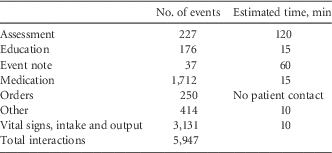
Nursing informatics created a logic-based query to identify all patients for whom any documents had been authored by the index case HCW within the 3-month contact-tracing period from the electronic medical record system (EMR). Any interaction that would require a face-to-face encounter with a patient was built into the query. These encounters covered all aspects of nursing care: nursing admission and daily assessments, patient education, recording event notes, obtaining vital signs, and medication administration. Based on these encounters, patients that received direct care from the index case HCW were initially identified. Next, time spent providing direct patient care was derived to estimate exposure times and cumulative risk (in hours) (Table 1).
Interactions Based on Tracing of Documents Authored by the Index Case From Electronic Medical Records and Estimate Exposure Time for Each Event

A concentric-circle approach was used; significant exposure for those included in the first tier was further refined by the susceptibility of the exposed patient (ie, underlying cancer type, positive HIV status, or transplant recipient). For patients with solid tumors, 2 interactions performed by the index HCW with an estimated cumulative exposure time of ≥2 hours were considered significant. For those with underlying hematologic malignancy, stem-cell transplant recipients, or HIV-positive persons, any direct care was considered substantial exposure and was included in the first tier. 20
For HCWs, first-tier exposure lists were created using the nursing schedule and the EMR to identify coworkers with overlapping shifts. Any HCW sharing any part of a work shift, defined by ≥8 hours of shared time on the same unit with the index case HCW during the contagious period, was considered to have had significant exposure.
RESULTS
Patients
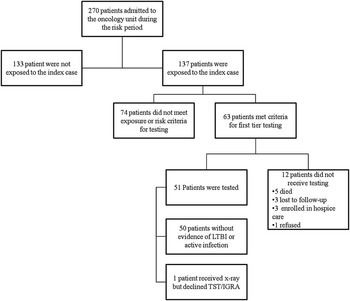
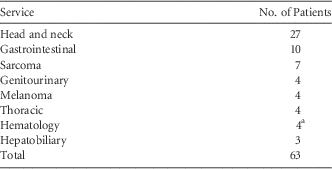
During the high-risk period, 270 patients were admitted to the unit (Figure 1). In total, 137 patients (50.7%) received direct care from the index case HCW, with a total of 5,947 recorded interactions. Of 137 patients, 63 patients (45%) met criteria for testing based on cumulative exposure and patient susceptibility as outlined above. The underlying cancer diagnoses for the 63 patients are shown in Table 2. These 63 patients had a median age of 63 years (range, 18–91 years), and 44 (69.8%) were male. In addition, 4 patients were considered high risk (1 HIV-positive patient and 3 patients with hematologic malignancy, including 2 SCT recipients), and any direct contact with these patients was considered significant enough for first-tier testing.
Patients exposed to the index case HCW, met criteria for testing, and underwent testing.

Exposed Patients by Oncology Service

a Includes 2 bone-marrow transplant recipients.
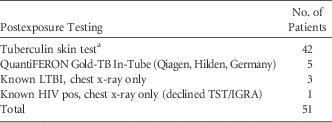
Of 63 exposed patients, 61 (96%) had baseline radiographic evaluation as part of ongoing oncologic care (either chest x-ray or chest computed tomography). Among the 63 exposed patients, 51 underwent testing for TB infection at a median of 69 days (range, 36–117 days) after exposure (Table 3). Overall, 12 patients did not receive postexposure testing due to death (n=5), because they were lost to follow-up (n=3), because they were in hospice care at the time of the event (n=3), or because they refused (n=1). In addition to TST or IGRA, all 51 patients received at least 1 postexposure chest image (x-ray, computed tomography, or positron emission tomography) at a median of 66 days after exposure (range, 14–197 days). No acute changes suspicious for acute TB were identified by chest imaging. Most chest-imaging studies were conducted as part of routine oncologic care and were utilized for postexposure monitoring. All cases were evaluated by an infection prevention practitioner, and comparisons with baseline imaging were performed by radiologists. Treatment for LTBI was offered but was declined by 1 HIV-positive patient who refused TST and IGRA after exposure. At 12 months after the exposure, 42 of 63 exposed patients were alive. No cases of active tuberculosis occurred among the exposed cohort.
Postexposure Testing Method for High-Risk Patients

NOTE. LTBI, latent tuberculosis infection; HIV, human immunodeficiency virus; TST, tuberculin skin test; IGRA, interferon gamma release assay.
a Boosted reaction; yielded 1 positive result (7 mm) following 2-step testing 18 d after initial negative result.
Healthcare workers
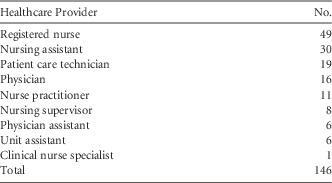
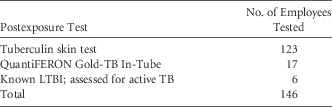
Among exposed coworkers, 146 had significant exposure that met criteria for first-tier testing. Exposed HCWs included individuals from various disciplines. Among all HCWs, registered nurses, nursing assistants, and patient-care technicians assigned to the unit were exposed most often (Table 4). Baseline PPD or IGRA results were available for 142 of 146 employees; 4 employees reported negative PPD in the past. Furthermore, 50 exposed employees were foreign born with incomplete data regarding BCG vaccination status. All 146 employees received postexposure testing between 8 and 12 weeks after exposure (Table 5). Among 140 employees with negative baseline screening, all underwent testing and none were positive. In addition, 6 employees were known to have LTBI and did not report new symptoms in 3 months following exposure. Furthremore, 22 months after the exposure ended, 116 (79%) of the 146 employees had completed their annual evaluations for 2016 with negative annual testing: 99 were tested using PPD, 12 were tested using IGRA, and 5 LTBI cases were screened using a symptoms questionnaire.
Exposed Employees by Occupation

Postexposure Testing Method for High-Risk Employees

NOTE. LTBI, latent tuberculosis infection; TB, tuberculosis.
DISCUSSION
Within healthcare facilities, transmission of MTB from an HCW to a highly susceptible population of immunosuppressed patients undergoing treatment for cancer has seldom been reported. It is reasonable to assume that the risk of developing disease after exposure to MTB is higher among certain individuals undergoing immunosuppressive treatment for cancer.
Our investigation outlines a systematic approach using the EMR to quantify exposure times based on documentation of care provided to patients during daily work hours. Defining the period of contagiousness is a key step in contact tracing and has been based on evidence-based guidelines. During the reported event, the exposed cohort on the oncology unit was composed of a diverse mix of patients. We implemented a tiered risk assessment among exposed patients; an initial stratification was independent of exposure times and was based solely on host susceptibility as determined by underlying cancer and degree of immunosuppression. Next, among other susceptible patients, further breakdown of risk for acquiring TB infection was extrapolated from conservative exposure times. Individuals with a higher risk of developing disease were further tested, and symptoms were carefully scrutinized for active disease.
The limitations of TST and IGRA testing among immunosuppressed patients are well recognized.Reference Redelman-Sidi and Sepkowitz 17 Due to the effects of cancer or its treatment, the results of PPD and IGRA testing may be rendered falsely negative, and symptom assessment is nonspecific (ie, cough, night sweats, and weight loss are common cancer-associated symptoms). Although we achieved a high rate of postexposure testing among exposed patients, with 51of 63 (80%) patients from the first-tier group tested, a comprehensive and targeted follow-up with radiographic assessment was pursued regardless of the results of TST and IGRA. The information gained from the electronic record enabled us to substantially shorten the list of individuals with high-risk exposure and to focus our approach. The strategy used for HCW risk assessment was based on current TB control guidelines. 19 Despite the intensity and duration of the index case HCW exposure to coworkers, no cases of LTBI or active TB occurred among them.
The strengths of our investigation include a high number of HCWs and patients followed up with postexposure testing, mostly due to prompt generation of an exposure list using electronic resources. We describe host-based risk stratification criteria used in an oncologic setting to guide a postexposure work-up. In conclusion, the EMR and employee scheduling system are useful resources for conducting otherwise labor-intensive contact investigations. The widespread implementation of these systems should be routinely utilized. Despite the high-risk features of our index case, a highly vulnerable immunocompromised patient population, and extended proximity with coworkers, we did not find any evidence of TB transmission after this hospital-based exposure.
ACKNOWLEDGMENTS
Financial support: No financial support was provided relevant to this article.
Potential conflicts of interest: All authors report no conflicts of interest relevant to this article.