There has been a recent resurgence of interest in the question of whether spoken dialect differences contribute to the reading difficulties that are experienced by large numbers of poor and racial minority children, many of whom speak nonmainstream American English (NMAE) dialects as opposed to the spoken dialect that adheres most closely to written English orthography, often referred to as “school English” or “standard” or “mainstream” American English (MAE). It is important that decades of linguistic and sociolinguistic research have confirmed that the spoken production of these NMAE forms is characteristic of fluent and masterful use of complex, rule-governed linguistic systems and not indicative of poor or incorrect language use. Moreover, many NMAE dialects share features, although the frequency and contexts for their production may differ (Wolfram & Schilling-Estes, Reference Wolfram and Schilling-Estes2006). Thus, although NMAE dialects are distinct, it is perhaps more useful to consider NMAE use on a continuum, especially when considering the relationship between NMAE use and reading. Because the task of learning to read requires young children to map printed words onto their knowledge of spoken words, the fundamental question is whether beginning readers may be at a disadvantage if their spoken production of NAME features differs from the standard English orthography represented in school texts.
Collectively, the findings from recent empirical investigations indicate significant concurrent and predictive relationships between young children's NMAE use and reading skills (Charity, Scarborough, & Griffin, Reference Charity, Scarborough and Griffin2004; Conlin, Reference Conlin2009; Connor & Craig, Reference Connor and Craig2006; Craig & Washington, Reference Craig and Washington2004b; Craig, Zhang, Hensel, & Quinn, Reference Craig, Zhang, Hensel and Quinn2009; Terry, Reference Terry2012; Terry & Connor, Reference Terry and Connor2010, Reference Terry and Connor2012; Terry, Connor, Petscher, & Conlin, in press; Terry, Connor, Thomas-Tate, & Love, Reference Terry and Connor2010; Terry & Scarborough, Reference Terry, Scarborough, Brady, Braze and Fowler2011). Moreover, although differences in both reading achievement and NMAE usage vary by age, grade, socioeconomic status (SES), gender, discourse, and school context in this population, the relationship between them remains substantial even after taking these factors into account.
Although the empirical evidence is mounting, the basis for the association between dialect differences and early reading acquisition is not yet clear. Two primary hypotheses have been advanced to explain poorer reading achievement by children whose speech includes more NMAE features: linguistic interference between spoken and written language and children's linguistic awareness and flexibility of usage. It is important that these hypotheses may not be mutually exclusive, as both may be able to account for this relationship at different developmental periods of both reading achievement and dialect use. However, each presents different predictions about the relationship between these variables. Thus, the current study examined these predictions by exploring both the lexical representations and the metalinguistic awareness skills of beginning readers who varied in their NMAE use. Although dialects differ in every domain of language, this study focused on the phonological aspects of NMAE use because the phonological component of language is particularly important to the acquisition of word reading skills.
HYPOTHESES ON THE RELATIONSHIP BETWEEN NMAE USE AND READING
Linguistic interference (mismatch) hypothesis
One longstanding view posits that differences between speech and print interfere with the reading process for NMAE speakers and make the task of learning to read more difficult for these children than for those whose spoken dialects align more closely with print (e.g., Labov, Reference Labov, Gadsden and Wagner1995; LeMoine, Reference LeMoine, Harris, Kamhi and Pollock2001). When the writing system of a language is not fully transparent, as is certainly the case for English, all beginning readers will encounter mismatches between written words and their spoken counterpart. For children who speak NMAE dialects, however, such mismatches between print and speech will occur much more often. The greater interference resulting from this reduced transparency is thus hypothesized to make the task of learning to read more difficult for them. With specific regard to phonology, children's NMAE pronunciations of words will often align poorly with the spelling patterns in the words they are trying to read. For example, a child who often reduces final consonant clusters in speech (e.g., who says “fas” for fast) might be confused when seeing two letters rather than one in the rime.
Thus, the child who encounters such mismatches more frequently might find the learning of grapheme–phoneme correspondences to be a more complex and confusing task. Therefore, the difficulty of learning to read is directly related to the degree to which there are mismatches between spoken pronunciations and printed words, which will be greatest for children who produce many NMAE features in speech. The hypothesized interference between spoken and written forms provides a plausible explanation for the inverse correlations that have often been observed between NMAE usage and early reading skills (e.g., Charity et al., Reference Charity, Scarborough and Griffin2004).
Linguistic awareness/flexibility hypothesis
A somewhat different explanation for the relationship has been proposed recently (e.g., Charity et al., Reference Charity, Scarborough and Griffin2004; Terry et al., Reference Terry, Connor, Thomas-Tate and Love2010). According to this view, a child who produces many NMAE features in a formal context that presupposes MAE (such as taking a test or conversing with an unfamiliar adult in a school setting) may be demonstrating weak linguistic and metalinguistic skills, which in turn are perhaps more critical for early reading acquisition than NMAE use itself. Terry and colleagues have discussed some critical components of this hypothesis elsewhere (see Terry et al., Reference Terry, Connor, Petscher and Conlin2010, in press). Specifically for this study, one important component of this hypothesis (which distinguishes it from the linguistic interference hypothesis) is its emphasis on the significant role of metalinguistic awareness in reading acquisition.
By age 4, children who are attuned to language will typically exhibit their emerging metalinguistic skills in a variety of ways, including phonological awareness, which is prospectively and concurrently related to the acquisition of word reading skills (Ehri et al., Reference Ehri, Nunes, Willows, Schuster, Yaghoub-Zadeh and Shanahan2001; National Reading Panel, 2000; Scarborough, Reference Scarborough, Shapiro, Accardo and Capute1998). At about the same age, children also become aware of how to use language in contextually appropriate ways. For example, Connor and Craig (Reference Connor and Craig2006) found that African American preschoolers generally produce fewer African American English (AAE) features in formal rather than informal speech settings, suggesting that some children are bidialectal at this age and aware of different contexts for AAE and MAE use. Linguists refer to this kind of change in dialect use as style shifting or code switching, and some argue that this flexibility in language requires metalinguistic awareness (Wolfram & Schilling-Estes, Reference Wolfram and Schilling-Estes2006). Charity and colleagues (Reference Charity, Scarborough and Griffin2004) suggested that this linguistic flexibility could be indicative of a nascent “dialect awareness” that is likely to be associated with children's developing metalinguistic insight in other domains. Researchers have found significant correlations between children's NMAE use and performance on various measures of metalinguistic awareness (Connor & Craig, Reference Connor and Craig2006; Terry, Reference Terry2006, Reference Terry2012; Terry & Connor, Reference Terry and Connor2012; Terry et al., Reference Terry, Connor, Thomas-Tate and Love2010; Terry & Scarborough, Reference Terry, Scarborough, Brady, Braze and Fowler2011).
According to this hypothesis, therefore, a child who produces many NMAE speech features in a context that calls for MAE presumably does not yet appreciate that a less colloquial register would be more appropriate, and this contextual inflexibility is indicative of a more general insensitivity to variation in language. Because metalinguistic insight is such a helpful tool for discovering how speech maps onto print, the child whose linguistic awareness/flexibility is less well developed will be at a disadvantage in learning to read, and this would account for the observed relationship between NMAE usage and early reading achievement. Note that, according to this view, it is not the usage of nonmainstream dialect features itself that poses a major obstacle to learning to read, but rather the limited linguistic awareness of children who are insensitive to dialect differences and contextual cues to language usage.
PREDICTIONS ABOUT PHONOLOGICAL AWARENESS, NMAE USE, AND READING
As noted above, children's phonological awareness is critical for the acquisition of reading skills. Not only are children's early phonological awareness skills predictive of later reading achievement, but instruction that is designed to improve children's phonological awareness skills facilitates learning to read (Ehri et al., Reference Ehri, Nunes, Willows, Schuster, Yaghoub-Zadeh and Shanahan2001; National Reading Panel, 2000; Scarborough, Reference Scarborough, Shapiro, Accardo and Capute1998). Although the linguistic interference hypothesis emphasizes speech–print differences, the linguistic awareness/flexibility hypothesis emphasizes differences in metalinguistic awareness and how they may be reflected in dialect use.
Thus, according to the linguistic interference/mismatch hypothesis, the relationship of dialect variation to reading is direct. That is, the primary challenge for a NMAE speaker who is learning how to read is mapping his speech patterns onto orthographic patterns that do not align well. Moreover, although other variables, such as phonological awareness, may also contribute to success in early reading, dialect variation would be expected to affect reading skill independently. In contrast, according to the linguistic awareness/flexibility hypothesis, the relationship of dialect variation to reading is indirect. If dialect variation reflects differences in sensitivity to language, then this variation would also be observed in one's performance on other measures of metalinguistic skills, like phonological awareness. Therefore, among beginning readers, NMAE use would be expected to correlate inversely with phonological awareness and reading, but the relationship between NMAE use and reading would be mediated by phonological awareness.
The two hypotheses clearly differ with regard to their conceptions of how metalinguistic awareness, dialect variation, and reading are related in beginning readers. Nonetheless, it is possible that there are both direct and mediated effects of dialect variation on reading. If so, both hypotheses would be supported. To date, only three studies have examined whether the relationship of dialect variation to literacy skill is mediated (fully or partially) by metalinguistic awareness. In a spelling study with children in the first to third grades, Terry (Reference Terry2006) found that the relationship between children's NMAE use and spelling of inflections that vary in spoken production between AAE and MAE was mediated partially by their performance on a measure of morphosyntactic awareness. In a study with preschoolers, Terry (Reference Terry2012) found that children's NMAE use did not contribute independently to their performance on measures of alphabet knowledge, print concepts, and phonological awareness when it was considered simultaneously with related emergent literacy skills. Finally, Terry and Scarborough (Reference Terry, Scarborough, Brady, Braze and Fowler2011) found an inverse relationship between novice readers’ NMAE use and reading skill that was fully mediated by their performance on a measure of phonological awareness. One research question posed, therefore, was whether this mediated effect would also be observed among beginning readers for measures of NMAE use, phonological awareness, and reading skill.
PREDICTIONS ABOUT PHONOLOGICAL REPRESENTATIONS, NMAE USE, AND READING
In addition to phonological awareness, other aspects of phonological processing can contribute to the acquisition of reading skills. Recent research suggests, for instance, that variability in reading skill may be attributed in part to the quality of one's stored lexical representations of words (Perfetti, Reference Perfetti2007). As children acquire a tremendous amount of information about the meanings, pronunciations, and uses of words over time, they store this information in their lexicons and draw upon it when the time comes to learn to read. Accordingly, the more precise and well developed that information is, the more easily it can be mapped onto print to read. The quality of young children's phonological representations has been the focus of several recent studies on the underpinnings of reading disabilities (Elbro, Reference Elbro1996; Elbro, Borstrom, & Petersen, Reference Elbro, Borstrom and Petersen1998; Fowler & Swainson, Reference Fowler and Swainson2004; Swan & Goswami, Reference Swan and Goswami1997a, Reference Swan and Goswami1997b), with emerging evidence that the “precision” of lexical information increases during preschool and the primary grades, such that the child's phonological representations of words become more complete and well specified at the phonemic level (Fowler, Reference Fowler, Brady and Shankweiler1991; Fowler & Swainson, Reference Fowler and Swainson2004; Metsala & Walley, Reference Metsala, Walley, Metsala and Ehri1998). Furthermore, the quality of phonological representations has been related with both early reading and phonological awareness skills (Elbro et al., Reference Elbro, Borstrom and Petersen1998; Swann & Goswami, Reference Swan and Goswami1997a, Reference Swan and Goswami1997b). In a younger preschooler, for example, the second consonant in popsicle might be specified merely as a devoiced stop, and thus the child would consider “popsicle,” “potsicle,” and “poksicle” all to be acceptable ways of pronouncing the word. A beginning reader whose phonological representations are imprecise, therefore, would be trying to align print with lower quality stored information, and thus could be at risk for unsuccessful reading acquisition.
With regard to phonological representations of young NMAE speakers specifically, the linguistic interference/mismatch and linguistic awareness/flexibility hypotheses differ in what is assumed about the child's stored phonological knowledge of spoken words. The interference hypothesis presumes that lexical representations of MAE features are often lacking for NMAE speaking students (LeMoine, Reference LeMoine, Harris, Kamhi and Pollock2001). That is, if a child who says “tol” for told is unaware of the presence of a final /d/ in the MAE pronunciation of the word, then a mismatch would occur when the letter d is encountered while reading. Such frequent mismatches would then cause confusion while learning how to read. In contrast, the awareness/flexibility hypothesis is more compatible with the possibility that a child's lexical representation includes more information than is evident from speech. That is, if a child who says “tol” knows that the word told ends with an unrealized /d/, then the presence of a printed d will not create a mismatch with stored knowledge. If the child's stored knowledge aligns well with print, then mismatches would be infrequent, more easily resolved, and not likely to explain poorer reading achievement among NMAE speakers.
Only one study has examined the phonological representations of NMAE speakers. Terry and Scarborough (Reference Terry, Scarborough, Brady, Braze and Fowler2011) found that novice readers in preschool and kindergarten who produced many NMAE forms in overt speech exhibited knowledge of MAE forms on picture-naming, acceptability-judgment, and pseudoword-repetition tasks. However, the researchers noted that their findings might not generalize, both because race and SES may have been confounded in the sample and because it is unclear whether dialect-related findings extend to social and regional NMAE dialects in other regions of the United States. In addition, the sample included only novice readers, and it would be helpful to understand how NMAE speakers’ phonological representations might be changed for older children who have begun to decode words. Thus, the second goal of the study was to extend upon Terry and Scarborough (Reference Terry, Scarborough, Brady, Braze and Fowler2011) by investigating how MAE and NMAE phonological forms are represented in the mental lexicons of beginning readers who produce NMAE forms in overt speech.
PURPOSES OF THE STUDY
In sum, this study had two central aims for beginning, typically developing readers who varied in their spoken NMAE production: to investigate the nature of their phonological representations of words and to examine the relationships among dialect variation, reading skills, and phonological awareness. Thus, the following research questions were asked:
1. Do young NMAE speakers represent lexically more information about MAE and about its relationship with NMAE than is evident from their overt pronunciations of words?
2. Does phonological awareness mediate the relationship between NMAE use and early reading achievement?
To answer these questions, several experimental measures of children's knowledge of MAE features were adapted from tasks used previously to study stored phonological knowledge and to assess phonological skills (Charity et al., Reference Charity, Scarborough and Griffin2004; Elbro et al., Reference Elbro, Borstrom and Petersen1998; Fowler & Swainson, Reference Fowler and Swainson2004; Oetting, Reference Oetting and Ball2005; Rodekohr & Haynes, Reference Rodekohr and Haynes2001). These tasks were modified to include stimuli that contained phonological features that can be produced differently in NMAE than MAE (dialect sensitive [DS] items) and those that are produced the same (dialect neutral [DN] items). It is important to note that the DS stimuli included NMAE forms that are often observed among AAE speakers, as well as general variation from MAE. Stimuli were informed by these NMAE dialects because the study was expected to include African American children who likely spoke AAE and the results were expected to inform research on the relationship between NMAE use and reading achievement among African American children.
Children's responses on these tasks were expected to reveal what young NMAE speakers know about MAE and its relation to NMAE, and whether there is as much of a mismatch between print and stored knowledge as between print and overt speech. In addition, although significant correlations between children's NMAE use and reading performance were expected, whether this relationship was direct or mediated by phonological awareness was also explored. Thus, by proposing these research questions, the study's findings could inform what appear to be competing predictions drawn from the linguistic interference/mismatch and linguistic awareness/flexibility hypotheses.
METHOD
Participants
Parental consent was obtained for 119 African American children in kindergarten through second grade who were native speakers of American English. Children were recruited from one large public elementary school in a large urban school district in the southeastern United States. The sample included 29 kindergarteners from four classrooms, 53 first graders from six classrooms, and 37 second graders from six classrooms. Fourteen children were removed from the analyses because they were receiving special education services for speech language and/or learning disabilities. The other children had no known speech, language, learning, or developmental disabilities.
The remaining sample included 105 children: 23 kindergarteners, 50 first graders, and 32 second graders. The mean age was 86.67 months (SD = 9.36), with 55.2% being male. Published district records indicated that 95% of the students were African American and 80% of students were eligible for the federal free and reduced lunch programs. Individual student or family SES was not available.
Measures of dialect usage and knowledge
Four experimental tasks were given to assess children's usage of and knowledge about the phonological features of MAE and NAME and the relation between them. The tasks included DS and DN items (a complete list of stimulus items can be found in Charity et al., Reference Charity, Scarborough and Griffin2004, and Terry and Scarborough, Reference Terry, Scarborough, Brady, Braze and Fowler2011). All tasks were presented on a laptop computer using Microsoft PowerPoint illustrations. For two tasks with spoken stimuli, prerecorded audio clips were included in the PowerPoint presentation and were activated by clicking on-screen sound buttons during task administration.
Sentence imitation
A task created by Charity et al. (Reference Charity, Scarborough and Griffin2004) was used to measure the frequency of NMAE and MAE production in speech. On this task, the child was presented with a story spoken in MAE (White female MAE voice) and asked to repeat each sentence verbatim immediately after it was presented. The story included two practice items followed by 15 sentences, with 18 phonological and 19 morphosyntactic DS items embedded. Performance was scored by computing the percentage of DS items on which an NMAE form was produced rather than the MAE target, creating a phonological score and a grammatical score separately. If a child produced neither the MAE nor the NMAE form when imitating an item, that item was not included when scores were computed.
Picture naming: Conventional versus precision instructions
A picture-naming task was used to evaluate whether the children knew more about a word's pronunciation than is indicated by his or her more casual speech. First, the child was presented with a picture of a common object and then asked to name it (conventional instructions). Second, if the child produced the target item, he or she was asked to say the word again “slowly and clearly” (precision instructions). This task included 1 practice item and 27 DS items. Conventional naming production responses were scored for the set of items that the child could identify with the intended target word, regardless of how it was pronounced. Third, for those items named “slowly and clearly” with precision instructions, each response was classified as one of the following: the MAE pronunciation (e.g., “elephant”), a correct NMAE alternative (e.g., “elephan”), or a pronunciation that was correct in neither MAE nor NMAE (e.g., “elfanat”). The percentage of each type of response was computed.
Acceptability judgments
Children's knowledge about word pronunciations was examined by having them make judgments about the acceptability of alternative pronunciations of familiar words. Children were presented with a picture of a common object and four robots who were “learning how to say words.” As each robot tried to name the object in turn, children were asked to listen carefully to its pronunciation and judge whether it was an “okay” way to say the word. This task included 10 pictures, each paired with four variant pronunciations: the MAE version (e.g., breakfast), two correct NMAE alternatives (e.g., breakfas’ and breffis), and a version containing a speech error that was unrelated to dialect (e.g., bweakfast). The pronunciations of all variants of the stimulus words were recorded by four adults: two White MAE speakers (one male, one female) and two African American bidialectal MAE and NMAE speakers (one male, one female). The order of presentation of the four pronunciations was counterbalanced over the 10 trials such that each robot produced some MAE variants, some NMAE variants, and some speech errors. The percentage of trials on which the child judged the pronunciation to be acceptable was scored for each pronunciation variant.
Pseudoword repetition
The ability to encode and reproduce novel phonological sequences, and thereby assess the extent to which the correspondences between MAE features and their permissible NMAE alternatives are known by young dialect speakers, was measured on a pseudoword-repetition task. Children were presented with a robot who wanted to teach them to “say robot words just like he does.” Children listened to the robot and then tried to imitate what it said verbatim. The 10 DS (e.g., “re-noy-tist”) and 10 DN (e.g., “de-bof-tidge”) items were of similar phonological complexity, three to five syllables in length, and produced by an adult White male MAE speaker. Each DS pseudoword contained a target feature that could be pronounced differently in a real word by an NMAE speaker (e.g., the final consonant cluster /-st/), although the corresponding DN pseudoword included a feature that could not be pronounced differently (e.g., the final consonant cluster /-dge/). For each imitation response, the targeted portion was scored as one of the following: a verbatim reproduction, an appropriate substitution of an NMAE alternative for the MAE feature, or an incorrect repetition or omission of the feature. The percentage of each response type was computed separately for the DS and DN items.
Measures of early literacy skills
Children's word-recognition and phonological-awareness skills were assessed with two subtests of the Woodcock Johnson Tests of Achievement, Third Edition (Woodcock, McGrew, & Mather, Reference Woodcock, McGrew and Mather2001). On the letter–word identification subtest, children were presented with letters and words and asked to read them aloud. On the sound-awareness subtest, children were asked to rhyme words and to delete, substitute, or reverse sounds in words. Children's standard scores on the subtests were used in analyses.
Procedure
All testing was conducted at the end of the school year. Each child completed the tasks individually during three brief sessions. Interrater reliability was evaluated for the scoring of all responses on the sentence-imitation, picture-naming, and pseudoword-repetition tasks, with two independent scorers using the participant's audiorecorded responses. Scorers were trained graduate students who were familiar with the phonological and grammatical differences between NMAE and MAE. The percentages of items that were scored the same by both scorers were 92.3% for the sentence-imitation task, 97.4% for the picture-naming task, and 82.9% for the pseudoword-repetition task. When responses were judged differently, the scorers reviewed the recordings together and were able to reach agreement.
RESULTS
In order to answer the research questions, children were assigned to a high or low NMAE use group according to NMAE feature production rates on the sentence-imitation task. The phonological score was used because this study focused primarily on phonology. Children were collapsed into dialect groups across the grade levels because, although NMAE feature production changes during this time, this study was focused less on change in production and more on frequency in production. Then performance on the other measures of NMAE knowledge and use were compared for the two groups. Finally, correlation and regression analyses were used to examine the relationships among reading, phonological awareness, and knowledge and use of MAE and NMAE features.
Dialect group differences in NMAE use and knowledge
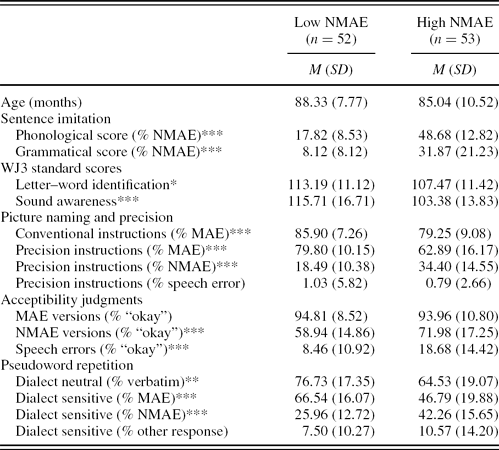
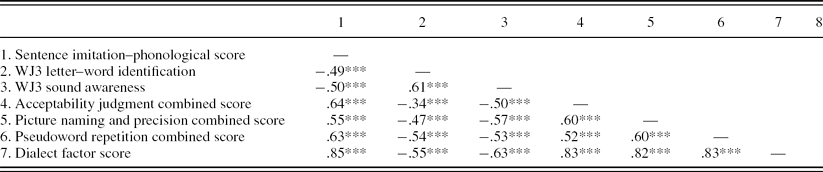
Children's NMAE feature production on the sentence-imitation task varied widely, with phonological scores ranging from 0% to 85.71% (M = 33.40, SD = 18.93) and grammatical scores ranging from 0% to 80% (M = 20.11, SD = 20). Thus, children with phonological scores above the mean were assigned to the high NMAE group (n = 53), whereas the remaining children were assigned to the low NMAE group (n = 52). The high NMAE group included 18 kindergarteners, 22 first graders, and 13 second graders. The low NMAE group included 5 kindergarteners, 28 first graders, and 19 second graders. Analyses of variance (ANOVAs) revealed no significant group differences in age. However, the groups did differ significantly in NMAE use for both the phonological score, F (1, 103) = 210.01, p < .001, η2 = 0.67) and grammatical score F (1, 103) = 56.92, p < .001, η2 = 0.36). Group performance on the picture-naming, acceptability-judgments, and pseudoword-repetition tasks was then analyzed separately in one-way or two-way ANOVAs. Mean group performance on all measures is reported in Table 1. Partial correlations, controlling for age, between the measures are reported in Table 2.
Mean student performance by dialect group

Note: NMAE, nonmainstream American English; MAE, mainstream American English; WJ3, Woodcock Johnson Tests of Achievement, Third Edition.
*p < .05. **p < .01. ***p < .001.
Correlations among child variables, controlling for age
Note: WJ3, Woodcock Johnson Tests of Achievement, Third Edition.
***p < .001.
Picture naming and precision
Responding to the conventional instructions, children in both groups correctly named the targets with NMAE or MAE pronunciations with about 80% accuracy. Although the percentages were very similar, the groups differed significantly in their naming accuracy, F (1, 103) = 17.14, p < .001, η2 = 0.14. It is important that there were very few responses containing speech errors (the mean for the entire sample was less than 1%); thus these responses were not analyzed further.
Responding to the precision instructions, the groups differed in their production of NMAE forms, F (1, 103) = 41.48, p < .001, η2 = 0.29, or MAE forms, F (1, 103) = 41.06, p < .001, η2 = 0.29. When asked to name the items “slowly and clearly,” children in the high NMAE group produced more NMAE forms than children in the low NMAE group. However, children in the high NMAE group also produced many MAE forms. A comparison of the percentages of NMAE versus MAE responses that were produced was evaluated using a 2×2 mixed-model analysis of covariance (ANCOVA) with pronunciation type as the within-subject repeated measure and dialect group as the between-groups factor. Significant pronunciation, F (1, 103) = 322.96, p < .001, η2 = 0.76, and interaction, F (1, 103) = 43.15, p < .001, η2 = 0.30, effects were found, confirming that children in the high NMAE group produced significantly more MAE than NMAE forms in their responses and indicating that they had considerable expressive MAE knowledge.
Acceptability judgments
The dialect groups did not differ in their judgment of MAE pronunciations being “okay.” Means confirmed that all children in the sample accepted nearly all MAE pronunciations of words. The majority of children also accepted NMAE pronunciations; however, significant dialect group differences were found, F (1, 103) = 17.19, p < .001, η2 = 0.14. Children in the high NMAE group were more willing to accept NMAE pronunciations than children in the low NMAE group. Children in the high NMAE group were also more tolerant of pronunciations of words that contained speech errors unrelated to dialect, F (1, 103) = 16.72, p = .001, η2 = 0.14.
To compare the percentages of MAE and NMAE pronunciations that were accepted by children within the groups, a 2×2 mixed-model ANCOVA was carried out with stimulus type (MAE vs. NMAE variants) as the within-subject repeated measure and dialect group as the between-groups factor. Significant effects were found for the stimulus variant, F (1, 103) = 388.21, p < .001, η2 = 0.79, and the interaction, F (1, 103) = 22.37, p < .001, η2 = 0.18. As noted in Table 1, although children in both groups accepted more MAE than NMAE pronunciations, the difference between stimulus types was larger for children in the low NMAE group, indicating that children in the high NMAE group were more tolerant of both pronunciations of words. Overall, these findings suggest that children in the high NMAE group had considerable receptive MAE and NMAE knowledge.
Pseudoword repetition
Group means suggest children in both groups found this task to be challenging (accuracy for the entire sample was 56.57% for the DS items and 70.57% for the DN items); however, children were able to attempt the items. Dialect group differences were found for both DS and DN items, with children in the low NMAE group producing significantly more verbatim repetitions than children in the high NMAE group on both DN items, F (1, 103) = 11.75, p = .01, η2 = 0.10, and DS items, F (1, 103) = 31.25, p = .001, η2 = 0.23. Meanwhile, children in the high NMAE group produced significantly more appropriate NMAE substitutions on the DS items than children in the low NMAE group, F (1, 103) = 34.25, p = .001, η2 = 0.25. Other response types were rare (for all children), suggesting that when attempting to produce a DS target, children in the high NMAE group were likely to produce either the verbatim response or a correct NMAE substitution. Note that such a substitution could not be made correctly without some understanding of the relationship between NMAE and MAE because one would need to know what substitutions are allowable.
Next, analyses were conducted to determine whether the groups differed in how often they substituted an appropriate NMAE feature versus imitated verbatim on the DS items. A 2×2 mixed model ANCOVA with response type (verbatim vs. NMAE substitution) as the within-subject repeated measure yielded significant effects for type of response, F (1, 103) = 58.64, p < .001, η2 < 0.36, and interaction, F (1, 103) = 37.46, p < .001, η2 = 0.27. As noted in Table 1, children in the high NMAE group were equally likely to include an NMAE substitution or a verbatim reproduction of the targeted feature of the DS pseudoword, whereas the children in the low NMAE group were more likely to include a verbatim response.
Summary scores
Summary scores were created for each of the foregoing experimental tasks. For the picture-naming and pseudoword-repetition tasks, the percentage of NMAE pronunciations out of the number of items on which either an NMAE or MAE pronunciation was used was computed. For the acceptability-judgments task, the percentage of NMAE targets accepted out of the summed percentages for NMAE and MAE targets was computed. Thus, higher summary scores reflect greater usage or knowledge of NMAE, as for the sentence imitation scores.
Relationships among NMAE use, phonological awareness, and letter–word recognition
As discussed earlier, there is disagreement between the linguistic interference/mismatch and the linguistic awareness/flexibility hypotheses regarding the contributions of dialect variation and phonological awareness to the acquisition of early reading skills. Baron and Kenny's (Reference Baron and Kenny1986) guidelines for determining whether there is a mediating effect of a variable (in this case, phonological awareness) on the relation between a predictor and an outcome (here, between early reading skill and NMAE knowledge and use) were used to evaluate these competing predictions. Two regression analyses, one that included phonological awareness as a predictor and the other that did not, were carried out so that beta weights for the NMAE use could be compared across analyses. If phonological awareness is a mediator, the beta weight for the NMAE use should be reduced greatly when the phonological awareness score is included in the analysis; if the beta weight changes little, this would instead indicate a direct association of NMAE use with reading.
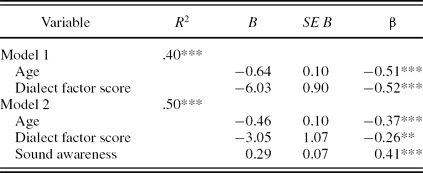
To simplify these analyses, a dialect differences factor score was created first using principal components analysis. The factor score included the picture-naming, acceptability-judgments, and pseudoword-repetition combined scores and the sentence-imitation phonological score. As shown in Table 2, these summary scores were reliably intercorrelated (r = .52–.60). In each regression analyses, the dependent measure of early reading skill was the standard score for Letter Word Identification and the phonological-awareness measure was the standard score for Sound Awareness. These two measures were moderately correlated with each other and, inversely, with the dialect factor score (see Table 2). As shown in Table 3, results of the regression analyses indicate that phonological awareness fully mediated the relationship between NMAE use and reading. In the simple regression of the dialect factor on reading, the beta weight for the predictor was –0.52; however, when phonological awareness was included in the second analysis, the beta weight for the dialect factor score decreased to –0.26.
Summary of regression analyses for variables predicting letter–word recognition
**p < .01. ***p < .001.
DISCUSSION
In this study, two questions that were stimulated by the recent convergence of evidence for a robust relationship between early reading skill and the spoken production of NMAE features were addressed. The findings provide clarification regarding the phonological representations of young NMAE speakers and about the relation of dialect variation to phonological awareness and reading performance. In addition, the results appear to support the linguistic awareness/flexibility hypothesis in explaining the relationship between dialect variation and early literacy achievement.
Phonological knowledge and usage among young NMAE speakers
Children in the high NMAE group produced more NMAE responses on each expressive task. After all, the basis for their grouping into high and low groups was the frequency of NMAE use on the sentence-imitation task. What is most interesting and novel to this study's findings, however, are those observations related to children's lexical knowledge. Results from the acceptability-judgments and pseudoword-repetition tasks, as well as those from the picture-naming task under precision instructions, indicated that the lexical representations of children who use a lot of NMAE in speech nonetheless include a large amount of phonological information about MAE forms. Although they were likely to produce an NMAE form when naming a picture, when asked to do so “slowly and clearly,” children in the high NMAE group produced many more MAE than NMAE pronunciations. Although they were more tolerant of MAE and NMAE word pronunciations, children in the high NMAE group almost always accepted MAE pronunciations of words. Finally, although they were more likely to produce an appropriate NMAE substitution for a dialect-sensitive pseudoword, children in the high NMAE group were equally likely to produce a verbatim MAE response.
Taken together, these findings suggest that, just like their peers who used more MAE in overt speech, children who use more NMAE in overt speech seem to have phonological knowledge of MAE. They also seem to have knowledge of NMAE forms. In other words, they appear to be bidialectical and draw from both linguistic sources to complete phonologically based tasks with familiar words. This notion is consistent with conclusions from prior research (Connor & Craig, Reference Connor and Craig2006) and was perhaps most striking on the psuedoword-repetition task. For children in both groups, if the response was not verbatim, it was almost always an appropriate NMAE substitution. One would require considerable knowledge of both NMAE and MAE rule systems in order to know which forms are permissible under specific linguistic contexts. Further clear evidence can be drawn from the acceptability-judgments task, where children in both groups deemed the majority of NMAE pronunciations to be “okay.”
Labov and Baker (Reference Labov and Baker2010) report similar findings. Although not examining the phonological representations of NMAE speakers specifically, the researchers examined the oral reading errors of African American, Latino, and White children in second, third, and fourth grades who produced NMAE forms in speech. By analyzing the kinds of errors children made and each's relation to their understanding of the meaning unit following the error, the researchers found that errors that could be accounted for by their NMAE speech patterns did not interfere with their understanding of the text. In other words, whereas African American children often omitted the plural marker -s while reading aloud, their use of the NMAE form did not interfere with their understanding of the text that followed that error. This pattern was different from Latino children, whose omission of plural markers was not consistent with their native dialect or language and did appear to be a clear error that interfered with their understanding of the text. The researchers suggest that these differences between groups may be related to differences in the representations of these forms in the mental lexicons of the readers. Thus, African American children who produce many NMAE forms in speech may indeed have underlying representations of MAE forms to draw upon while engaging in literacy tasks.
Children's familiarity with NMAE alternatives is not terribly surprising when one considers the sociolinguistic aspects of dialects and dialect use. First, MAE and NMAE share many features, and the differences between the dialects often rest in the frequency and contexts of feature use, not in the pure absence or presence of specific features. Second, the language environment likely provided exposure to dialect variation because adult speech (even among adults who speak a lot of NMAE) often includes both NMAE and MAE. Keeping in mind that the dialect use can vary by multiple sociocultural factors (e.g., age, gender, race, speech partner), researchers have reported that both adult and child NMAE use can vary by communicative context (Connor & Craig, Reference Connor and Craig2006; Myhill, Reference Myhill1988; Terry & Connor, Reference Terry and Connor2012; Terry et al., Reference Terry, Connor, Thomas-Tate and Love2010, in press; Washington, Craig, & Kushmaul, Reference Washington, Craig and Kushmaul1998). Thus, the children in both groups likely heard both MAE and NMAE dialects frequently in their daily lives because the children and adults in their environment were probably bidialectical as well. Therefore, it is reasonable that children in both the high and the low NMAE groups would find both the MAE and the NMAE pronunciations of words to be “okay” and would appropriately substitute NMAE forms for MAE forms on the picture-naming and pseudoword-repetition tasks.
It is important to emphasize that the sample in this study was African American and was drawn from a high poverty school. Thus, the sociolinguistic conditions for greater NMAE use by all individuals in the environment was inflated, as researchers have reported greater NMAE use (specifically AAE) among children and adults who live in communities with higher percentages of African American people and low income households, and conversely, less NMAE use among African Americans in more racially integrated or higher SES environments (Dillard, Reference Dillard1972; Labov, Reference Labov1972; Myhill, Reference Myhill1988; Ratusnik & Koenigsknecht, Reference Ratusnik and Koenigsknecht1976; Washington & Craig, Reference Washington, Craig and Kushmaul1998). Nevertheless, as Terry & Scarborough (Reference Terry, Scarborough, Brady, Braze and Fowler2011) observed in their racially and socioeconomically diverse sample, the young NMAE speakers in this sample who were from demographically segregated environments also acquired high levels of knowledge about MAE.
The results also revealed some group differences that must be considered. First, although naming accuracy was high for both groups, children in the high NMAE group correctly identified fewer items on the picture-naming task. Second, children in the high NMAE group judged significantly more speech errors to be “okay” on the acceptability-judgments task. Third and finally, children in the high NMAE group repeated verbatim significantly fewer DN pseudowords. The difference between the group means for each of these indicators was between 6 and 12 percentage points, but it was nonetheless significant and worthy of discussion because these items were not sensitive to dialect differences. These results could indicate, for example, that children in the high NMAE group had weaker or perhaps less precise phonological knowledge to draw upon when completing literacy tasks. Children in the high NMAE group had significantly lower standard scores on the sound-awareness and letter–word identification subtests (although group means for both tasks were solidly average).
Keep in mind that adaptations of these tasks were administered because researchers have used them to study the quality of lexical representations in relation to early literacy among children with and without disabilities. Those studies have shown that poor reading in the early school grades is associated with higher rates of mispronunciations of familiar words, greater acceptance of multiple pronunciations of words, and smaller increases in naming accuracy when instructed to speak very distinctly, suggesting that the phonological representations of these children are incompletely or imprecisely specified. Such findings lend support to the hypothesis that the unavailability of precise phonological knowledge may contribute to the development of reading disabilities (Elbro, Reference Elbro1996; Elbro et al., Reference Elbro, Borstrom and Petersen1998; Fowler & Swainson, Reference Fowler and Swainson2004; Swan & Goswami, Reference Swan and Goswami1997a, Reference Swan and Goswami1997b). Thus, the pattern of results found here may indicate that some NMAE options (e.g., reducing a final consonant cluster) could result from erroneous or imprecise phonological encoding or speech production. In this case, one would expect that performance by children in the high NMAE group would be compromised when children attempted to repeat DN pseudowords or judge alternative pronunciations of words.
The variability observed within the high NMAE group on these indicators suggests that some children may have had relatively less precise phonological knowledge in their lexical representations of familiar words. However, because group means indicate that the performance of the dialect groups on these items was similar and because children in both groups were performing well within the average range on literacy tasks that tap phonological knowledge, it seems unlikely that a diminished capacity in phonological processing would account for these differences. In addition, these results might be accounted for by the larger number of kindergarteners in the high NMAE group (n = 18) compared to the low NMAE group (n = 5). The mean age of the high and low NMAE groups was not significantly different. However, given the developmental differences that are expected in this age range, it is certainly plausible that younger children would identify fewer items on the picture-naming task, accept more speech variants on the acceptability-judgments task, and provide fewer verbatim responses on the pseudoword-repetition task.
This study is not without its limitations, as the sample limits the use of additional analyses that might shed light on the findings. For instance, children were nested in 16 classrooms in this study, with some classrooms having as few as 4 children in the sample. Although this dispersion of participants prevented a multilevel analysis in this study, it would be interesting to consider how the results might differ if classroom effects were considered. Previous research has found school context effects not only in NMAE production but also in the relationships between NMAE production and performance on language and literacy measures (Terry et al., Reference Terry, Connor, Thomas-Tate and Love2010).
In addition, emerging evidence suggests that, within this age group, average production of NMAE features decreases significantly between preschool and first grade and stabilizes in second grade (Charity et al., Reference Charity, Scarborough and Griffin2004; Conlin, Reference Conlin2009; Craig & Washington, Reference Craig and Washington2004b; Terry & Connor, Reference Terry and Connor2012; Terry et al., in press). Moreover, children who change their NMAE production during the first grade school year tend to have stronger reading outcomes than children who do not at the end of first and second grade (Conlin, Reference Terry, Connor, Petscher and Conlin2009; Terry et al., in press). Among children in this sample, younger children did produce more NMAE forms, as evidenced by the larger number of kindergartners in the high NMAE group. As noted previously, age may have had some influence on the findings. However, it could also be that children in the high NMAE group were less likely to change their NMAE use, and the results could reflect this lack of linguistic flexibility. Moreover, change in NMAE use would be best captured through a longitudinal design, which was not possible in this study. However, it would also be interesting to examine whether children who decreased their NMAE production over time exhibited different phonological knowledge than children who either increased or did not change their NMAE use.
Finally, the sample included only African American children in order to control for race by SES confounds that inhibited the interpretation of the results in a previous investigation. Although the results here were similar to those in the previous study, a more complete test of the findings would be gained by examining the performance of children across race and SES groups. Recent research findings suggest that the results would be similar for children in different race groups who also produced many NMAE forms in speech (Terry et al., Reference Terry, Connor, Thomas-Tate and Love2010). The same may also be true for other NMAE dialects that are not represented well in the stimuli but are often spoken by children at risk for reading failure (e.g., Appalachian English, Latino English). An analysis akin to that used in Labov and Baker (Reference Labov and Baker2010) might be appropriate in this instance, especially if the research question concerned the production of features that were distinct to a specific NMAE dialect. It may be that the lexical knowledge associated with features that are unique to specific dialects (which are often the most stigmatized forms of a NMAE) are different than those that are shared with other NMAE dialects.
In sum, with respect to the phonological representations of young NMAE speakers, overall the results indicate that, on average, their lexicons contain adequate stored information about MAE to map onto printed words. Phonological imprecision does not appear to explain the reading difficulties that some young NMAE speakers experience in school. Rather, as bidialectal speakers, they have knowledge of phonological options in both NMAE and MAE. Perhaps, this availability of multiple representations could, however, be a source of confusion that contributes to difficulty in learning to read that some NMAE-speaking children experience (Silliman, Bahr, Wilkinson, & Turner, Reference Silliman, Bahr, Wilkinson, Turner, Butler and Silliman2002). Unlike children with reading disabilities, who may have too little available information in their phonological representations, these youngsters may have too much for them to sort out when they approach the task of learning the correspondences between print and the pronunciations of words. Determining which stored forms are most relevant for reading may be more critical to reading achievement than the dialect differences themselves.
Relationship to reading
The second major aim of the study was to investigate the possible bases for the association between dialect variation and early reading skills that has been demonstrated in several recent studies. As reported in those studies, moderate, negative correlations between frequent NMAE use (as measured by both the picture-naming and sentence-imitation tasks) and poorer performance on the sound-awareness and letter–word identification subtests were also found here. However, we wanted to examine the relative contribution of dialect variation to word recognition skills while also considering variables known to predict reading outcomes (specifically phonological awareness), in hopes of determining if this relationship was direct and independent or perhaps more complex. Regression analyses revealed that the unique contribution of dialect variation as a predictor of reading was nullified when phonological awareness was also included as a variable. The results were thus indicative of at least partial mediation of the relationship between reading and NMAE usage, with reduced additive independent contribution by dialect differences to the prediction of reading scores. This mediating effect has been reported previously in the literature with young children (Terry, Reference Terry2006, Reference Terry2012; Terry & Scarborough, Reference Terry, Scarborough, Brady, Braze and Fowler2011). As noted in those investigations, these findings do not suggest that dialect variation has no impact on children's language and literacy outcomes. Rather, they emphasize a more nuanced and complex relationship between these variables that cannot be explained solely by differences between speech and print.
Explaining the relationships: Interference versus awareness hypotheses
Although not a direct test of theories, an underlying purpose of this study was to examine the predictions drawn from the linguistic (mismatch) interference and the linguistic awareness/flexibility hypotheses on the relationship between dialect variation, phonological knowledge, and reading. Overall, the study's findings pose two serious challenges to the linguistic interference (mismatch) hypothesis, which explains reading difficulties of NMAE dialect speakers in terms of interference between spoken and written language. First, the logic of this hypothesis rests upon the assumption that overt speech is a reliable guide to what children know about word pronunciations. The results from this study indicate, however, that despite the lower frequency of MAE forms in their speech, young NMAE speakers know a great deal about these alternative ways of pronouncing familiar words. Hence, the transparency of English spellings is probably not substantially reduced by a lack of information about phonological representations of MAE features, for which good matches can be found with many printed spellings. The sort of direct interference between spoken and written language that is posited by the mismatch hypothesis is thus unlikely to account for the early reading difficulties that some NMAE-speaking children experience. Second, it is difficult to reconcile the interference hypothesis with the finding that little unique variance in early reading skill was accounted for by dialect variation when phonological awareness skill was taken into account in the analyses. In recent research on the relationship between NMAE usage (particularly AAE) and reading differences, the focus has been on the direct association between the two and on the mediating effects of demographic variables. The results of this study indicate, however, that the relationship is more complex and indirect than envisioned by the mismatch hypothesis.
The findings are more consistent with the linguistic awareness/flexibility hypothesis. The data suggest that beginning readers who have been exposed to multiple dialects have become quite knowledgeable about forms used in both dialects, regardless of whether they produce these forms in overt speech. However, it is the children who are able to access these stored representations flexibly that may have stronger language and literacy skills. Specifically with regard to metalinguistic awareness, the relationships observed among phonological awareness, reading, and NMAE use in this sample suggest that children who do not produce predominantly MAE pronunciations in communicative contexts that presuppose MAE (e.g., accessing and using MAE forms to read print or imitate words and sentences with an unfamiliar adult in clinical or research settings) may be exhibiting weaker metalinguistic skills, which are perhaps more critical to the reading process than the actual spoken dialect differences themselves. Irrespective of their spoken dialect use, beginning readers who are not attuned to the ways in which language can be used flexibly and manipulated explicitly will be less able to appreciate how language is represented in the orthographic system and will have a much harder time learning how to read. Thus, it is not surprising that phonological awareness mediated the relationship between dialect variation and word reading.
Dialect variation among beginning readers may be a marker for differences in awareness, rather than a direct contributor to reading acquisition. In other words, speaking an NMAE dialect does not, in itself, place a child at risk for reading difficulty. Rather, NMAE dialect use in a context that presupposes MAE may be an indication that a child has not developed the metalinguistic knowledge and skill necessary for flexible language use, which in turn may limit the child's appreciation of the phonological structure of words. Moreover, a bidialectal child who has well developed metalinguistic insight would be unlikely to experience additional confusion when mapping their speech onto print because he would be able to access stored phonological representations that match print.
Conclusions
In sum, the findings from this study showed that young NMAE speakers’ phonological representations of words are not impaired or imprecise, but rather include a great deal of information about the standard forms that are typically represented in printed English. Moreover, their phonological-awareness skills mediated the relationship between dialect variation and reading skill. These findings confirm and extend those reported by Terry and Scarborough (Reference Terry, Scarborough, Brady, Braze and Fowler2011) to include a sample that was much less racially and socioeconomically diverse, that was from a different geographic region of the United States, and that included both novice and beginning readers. What remains of interest is whether the same results will be observed among children who are not yet reading or receiving formal reading instruction. Evidence that lexical knowledge of MAE and NMAE among novice readers who speak NMAE heavily would clarify whether increasing orthographic knowledge somehow improves the quality of NMAE speakers’ phonological representations toward MAE, or, conversely, whether that information can develop in a language environment in which NMAE is dominant. Future research that includes other dialect-sensitive language domains (e.g., morphosyntax, semantic) and children who are experiencing reading difficulties would also help clarify the relationship between spoken dialect differences and literacy outcomes, and perhaps guide intervention research on the theoretical basis for the reading difficulties that so many NMAE speakers experience in school.
ACKNOWLEDGMENTS
This research was supported in part by a Professional Development Stipend from the Office of Underrepresented Faculty at Georgia State University and research support for student scholars in the Ronald E. McNair Post Baccalaureate Achievement Program. The opinions expressed here are the author's and do not represent these agencies. I am especially grateful to the many undergraduate and graduate research assistants who helped collect and meticulously analyze the data and to Hollis Scarborough who provided thoughtful input on this manuscript. Special thanks to Kim Day, Deborah Knight, Martha Downer, and other support staff at the Rollins Center for Language & Learning at the Atlanta Speech School for supporting this research in their professional development programs. Last, but not least, thank you to the students, families, teachers, and school personnel who so willingly supported this research.