Introduction
Photoperiod (day length) is commonly used by insects as a cue factor regulating seasonal activity (Tauber et al. Reference Tauber, Tauber and Masaki1986; Danks Reference Danks2003). Insects with a facultative winter diapause often show a long-day photoperiodic response: long nights induce diapause, whereas short nights promote active development or reproduction. A number of formal models were proposed to describe the photoperiodic time measurement. The history and main contributions of these studies have been reviewed in a number of comprehensive papers and book chapters (Vaz Nunes and Saunders Reference Vaz Nunes and Saunders1999; Saunders et al. Reference Saunders, Steel, Vafopoulou and Lewis2002; Koštál Reference Koštál2011; Saunders Reference Saunders2011, Reference Saunders2013, Reference Saunders2016; Goto and Numata Reference Goto, Numata and Hoffmann2015). In short, the most well-known models can be divided into two major categories: hourglass models based on a non-repetitive timer measuring night length, and circadian models based on one or more circadian oscillators entrained by the light–dark cycle (the involvement of circadian clocks in the photoperiodic time measurement has been demonstrated in many insects). Among the second category, two most widely accepted groups of models could be distinguished. The external coincidence models are based on the assumption that the induction of diapause in long-day insects occurs if a photoinducible phase of the circadian rhythm entrained by the light–dark cycle coincides with darkness. The internal coincidence models suggest the existence of two independent circadian oscillators. Photoperiod plays a leading role in the entrainment of these rhythms, but the night length measurement and the subsequent diapause induction is determined rather by the interaction of the two oscillators than by the direct influence of light.
Various sophisticated experiments were conducted by numerous authors to verify the consequences of these models. However, one of the important aspects of the problem is not yet sufficiently investigated. It is well known that the diapause-inducing effect of ultra-long (usually 16–18 hours and longer) nights is often weaker than that of natural long (usually 10–14 hours) nights (Tauber et al. Reference Tauber, Tauber and Masaki1986; Saunders et al. Reference Saunders, Steel, Vafopoulou and Lewis2002). The observed decline in the tendency to diapause under ultra-long nights cannot be explained by the abovementioned external coincidence model: in its simple form, this model predicts that both long and ultra-long nights would result in a high incidence of diapause because in both cases the photoinducible phase falls in the dark. However, a weak diapause-inducing effect of ultra-long nights can be better explained in the frames of this model by the addition of the hypothesis that the rhythm damps out in the dark or under ultra-long nights. Based on this modification of the model, it can be expected that (1) the first ultra-long night would have the same diapause-inducing effect as a natural long night because the damping of the oscillator will not manifest itself before the next light–dark cycle, and (2) the diapause-inducing effect would decrease with the number of succeeding ultra-long nights, and the rate of this decrease would be determined by the oscillator damping rate. Although various attempts to find evidence for the external coincidence model with a damped oscillator have been made (Yoshida and Kimura Reference Yoshida and Kimura1995; Hardie and Vaz Nunes Reference Hardie and Vaz Nunes2001; Vaze and Helfrich-Förster Reference Vaze and Helfrich-Förster2016; Beer et al. Reference Beer, Joschinski, Sastre, Krauss and Helfrich-Förster2017), the abovementioned hypotheses were never tested, most probably because of the absence of a suitable insect model. The problem is that the external manifestation of a photoperiodic response (e.g., diapause induction) can be usually detected only after a certain minimum number of experienced photoperiods. In most insects studied so far, the required day number (the number of light–dark cycles needed to produce 50% of a response caused by a permanent influence of the respective photoperiod) is 3–5 days or more (Saunders et al. Reference Saunders, Steel, Vafopoulou and Lewis2002). Therefore, the effect of a single light–dark cycle would require a different model organism.
During the last decades, the maternal photoperiodic effect on progeny diapause has been thoroughly studied in Trichogramma Westwood (Hymenoptera: Trichogrammatidae) species. A facultative prepupal winter diapause in these minute egg parasitoids is mostly induced by a low temperature experienced by embryos and larvae. However, under near-threshold temperatures, the incidence of diapause depends on the photoperiod influencing the pupae and adults of the parental generation: long nights induce diapause in the progeny, but the diapause-inducing effect of ultra-long nights is weaker than that of natural long nights (Zaslavski and Umarova Reference Zaslavski and Umarova1990; Boivin Reference Boivin, Wajnberg and Hassan1994; Reznik Reference Reznik2011). Later, it was shown that even a single long night could cause a significant increase in diapause incidence in the progeny. However, only natural short and long nights were used in these experiments (Reznik et al. Reference Reznik, Vaghina and Voinovich2011a, Reference Reznik, Voinovich and Vaghina2011b).
Empirical data on the damping circadian oscillators are still very scarce (Vaze and Helfrich-Förster Reference Vaze and Helfrich-Förster2016; Beer et al. Reference Beer, Joschinski, Sastre, Krauss and Helfrich-Förster2017). Therefore, it seems desirable to investigate the possible role of a damped circadian oscillator in Trichogramma photoperiodic response. The present study included a set of experiments on the effect of different numbers of short, long, and ultra-long nights on Trichogramma pupae and adult females. First, we aimed to test the hypothesis based on the external coincidence model with a damping circadian oscillator: the diapause-inducing effect of a single ultra-long night should be the same as that of a single natural long night. Our second aim was to estimate the oscillator damping rate by the decrease in diapause-inducing effect with the number of succeeding ultra-long nights. The results of the study can be used to further develop the theory of photoperiodic time measurement and, more generally, of circadian rhythms in insects.
Materials and methods
Insects and general methods
The experiments were conducted on the parthenogenetic strain of Trichogramma telengai Sorokina, originating from Moscow Province of Russia, reared on the eggs of Sitotroga cerealella (Olivier) (Lepidoptera: Gelechiidae) under constant laboratory conditions: temperature 20 °C; light–dark photoperiod of 18:6 hours for more than 200 generations. Voucher specimens of the studied strain were deposited in Zoological Institute, St. Petersburg, Russia.
Effect of single and multiple nights of different lengths on Trichogramma telengai adults
For each replicate of this experiment, a large cardboard with 26 patches of hosts (each included about 500 eggs of S. cerealella) was subjected to two hours of parasitisation by females of the laboratory strain. Then the females were removed and the patches of parasitised host eggs (the maternal generation) were separated, placed in individual test tubes, and distributed among 26 experimental treatments. In all treatments of this and other experiments, the maternal generation developed at a temperature of 20 ± 0.3 °C and air humidity of about 75%; the difference between the treatments was only in photoperiodic regimes. Light (100–150 lux) was provided with daylight fluorescent lamps.
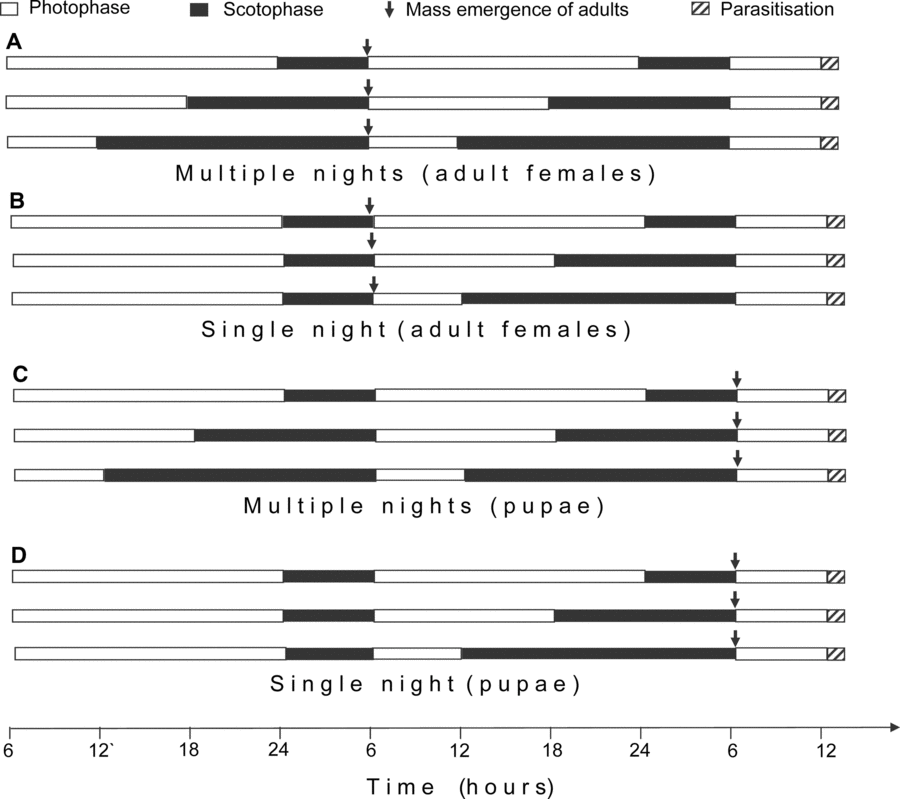
To test the development under multiple nights, in the first set of 13 treatments, the maternal generation developed under a set of 13 constant photoperiods with night length varying from 6 to 18 hours in one-hour steps (Fig. 1A). Trichogramma telengai adults emerge just before or shortly after the beginning of the photophase. One day before the mass emergence, the few adults that emerged were removed. Thus, six hours after the beginning of the next photophase, each tube contained 50–100 females that had emerged during the last six hours. Then the cards with the maternal generation were taken from all tubes, and 50% aqueous honey solution was streaked on the wall of each tube to feed the wasps. After that, adults were kept for one more day under the same photoperiod as during their preimaginal development. Six hours after the next light on, a new card with 300–500 fresh S. cerealella eggs was placed in each tube with females of the maternal generation and subjected to parasitisation for two hours. After parasitisation, these cards (the progeny generation) were incubated under moderate diapause-inducing conditions (14 ± 0.3 °C, light–dark photoperiod of 12:12 hours).
Design of experiments on the effect of single and multiple nights of different lengths on Trichogramma telengai pupae and adults. White and black bars indicate photophases and scotophases, respectively. Arrows indicate the beginning of mass adult emergence, and striped rectangles indicate the period of parasitisation. Only treatments with night length of 6, 12, and 18 hours are shown. For preimaginal development, only one (A and B) or two (C and D) last light–dark cycles are shown.

To test the development after a single induction pulse, in the second set of 13 treatments (single nights), all females of the maternal generation developed under short night conditions (light–dark photoperiod of 18:6 hours). Newly emerged females were handled using the same methods as in the first set of treatments, and then the tubes with the wasps were distributed among the 13 treatments with night lengths from 6–18 hours in one-hour steps (Fig. 1B). Six hours after the last light on, females of the maternal generation were allowed to parasitise; the progeny generation was incubated under the same conditions as in the first 13 treatments.
Sixty days after parasitisation (after the emergence of the non-diapause fraction of the progeny), ≥ 50 randomly selected parasitised eggs were dissected on each card and the number of diapausing (living prepupae) and non-diapausing (adults and sporadic pupae) individuals were recorded. The grain most eggs are rather small (about 0.75 x 0.3 mm). When they are offered in excess, T. telengai females usually lay a single egg per host. Therefore, the number of adults that emerged was estimated by the number of host eggs with emergence holes. This experiment was performed in 12 and 18 replicates with multiple and single nights, correspondingly. The proportions of diapausing progeny were calculated for each replicate of each treatment and were considered as units for statistical analysis. It should be emphasised that different replicates of this and subsequent experiments were started with an interval of several (at least two) days. Treatments of the same replicate, on the contrary, were strictly synchronous and, with the exception of the difference in photoperiods, were always performed under exactly the same conditions.
Effect of single and multiple nights of different lengths on Trichogramma telengai pupae
This experiment was started in the same way, as the first one, but it included only 15 treatments. In the first set of seven treatments (multiple nights) the maternal generation developed under seven constant long and ultra-long night regimes (light–dark photoperiod from 12:12 to 6:18 hours in one-hour steps) (Fig. 1C). In the second set of seven treatments (single nights) all females of the maternal generation developed under short nights (light–dark photoperiod of 18:6 hours), but one day before the mass emergence, the tubes were distributed among the seven treatments with light–dark photoperiods from 12:12 to 6:18 hours in one-hour steps (Fig. 1D). In the last treatment, females developed under a constant short-night regime (light–dark photoperiod of 18:6 hours). In all treatments of this experiment, few adults that emerged one day before mass emergence were removed. Thus, six hours after the beginning of the next photophase, each tube contained 50–100 females that had emerged during the last six hours. Then a new card with 300–500 fresh S. cerealella eggs was placed in each tube with females of the maternal generation and subjected to parasitisation for two hours. After parasitisation these cards were incubated under the same conditions, and the proportion of diapausing progeny was calculated with the same method as in the first experiment. This experiment was performed in 14 replicates.
Effect of the number of long and ultra-long nights on Trichogramma telengai pupae
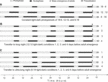
This experiment included 11 treatments. In the first three treatments, the maternal generation developed under three constant light–dark photoperiods: 18:6, 12:12, and 6:18 hours (Fig. 2A). In the next four treatments, the maternal generation started to develop at short night (light–dark photoperiod of 18:6 hours) conditions and was transferred to long night (light–dark photoperiod of 12:12 hours) conditions one, two, three, and four days before the mass emergence of adults (Fig. 2B). In the last four treatments, the tubes with the maternal generation one, two, three, and four days before the mass emergence were transferred to ultra-long night (light–dark photoperiod of 6:18 hours) conditions (Fig. 2C). At the day of mass emergence (18 days after parasitisation), new cards with fresh grain moth eggs were placed in each tube. Then the progeny generation was incubated and the proportion of diapausing progeny was calculated with the same method as in the first and second experiments. This experiment was performed in 15 replicates.
Design of experiment on the effect of the number of long and ultra-long nights on Trichogramma telengai pupae. White and black bars indicate photophases and scotophases, respectively. Arrows indicate the beginning of mass adult emergence, and striped rectangles indicate the period of parasitisation. For all treatments, only last five days of preimaginal development are shown.

Statistical analysis
For each replicate of each treatment of each experiment, the proportion of diapausing progeny was calculated based on not less than 50 individuals. For multiple pairwise comparisons, the proportions of diapausing progeny were transformed (ranked) and then treated with analysis of variance and the Tukey honest significant difference test. For two-sample comparisons, the Kruskal–Wallis test was used. In the text and figures, medians and quartiles of untransformed data (percentages) are given. All the calculations were conducted using SYSTAT 10.2 (http://systat.software.informer.com/10.2).
Results
Effect of single and multiple nights of different lengths on Trichogramma telengai adults
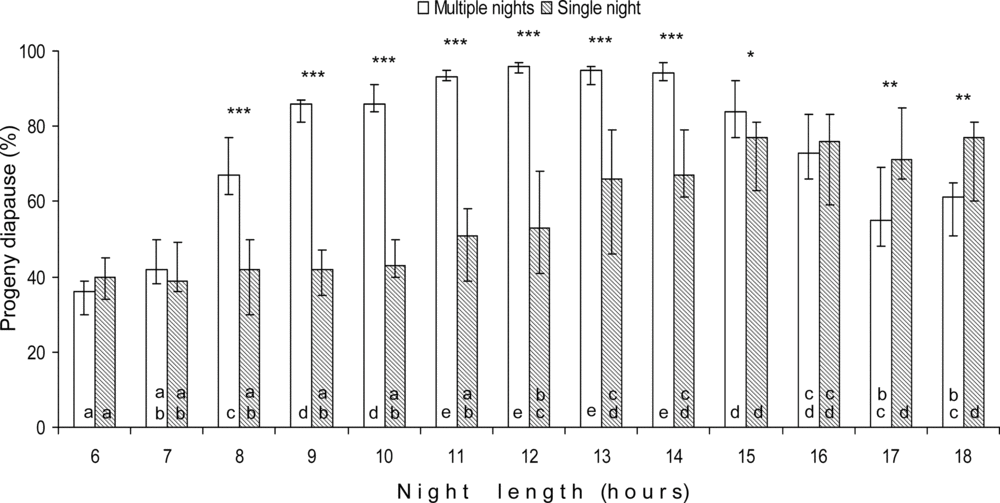
The set of multiple night treatments yielded a typical long-day photoperiodic response (Fig. 3), with a sigmoid increase in diapause incidence up to 14 hours and a decrease under ultra-long nights. In contrast, the single night treatment resulted in a flatter increase, a lower maximum, and no decrease under ultra-long nights. Therefore, a single ultra-long night produced significantly stronger diapause-inducing effect than multiple nights of the same length.
Influence of single and multiple nights of different lengths on the incidence of progeny diapause in the experiment with Trichogramma telengai adult females (see Materials and methods for the design of the experiment). Medians and quartiles are shown. Different letters in bars of the same filling pattern indicate significant (P < 0.05 by the Tukey test of ranked data) difference between values obtained under different night lengths in the same set of treatments (single or multiple nights). Stars above the bars indicate significant difference between the values obtained under the same night length in different sets of treatments (*P < 0.05, **P < 0.01, ***P < 0.001 by the Kruskal–Wallis test).

Effect of single and multiple nights of different lengths on Trichogramma telengai pupae
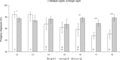
The photoperiodic response of T. telengai pupae was similar to that of adults, although pupae were more sensitive to single long nights. In the progeny of females that developed at a constant short-night light–dark photoperiod of 18:6 hours, the incidence of diapause (median and quartiles) was very low: 9.5% (8.2–18.4%). As shown in Fig. 4, the development under constant long nights induced diapause in > 80% of the progeny, but longer nights had a significantly weaker effect. Therefore, a single 12-hour night had somewhat weaker effect than multiple 12-hour nights, whereas the effect of a single ultra-long (18 hours) night was much stronger than that of multiple nights of the same length.
Influence of single and multiple nights of different lengths on the incidence of progeny diapause in the experiment with Trichogramma telengai pupae (see Materials and methods for the design of the experiment). Medians and quartiles are shown. Different letters in bars of the same filling pattern indicate significant (P < 0.05 by the Tukey test of ranked data) difference between values obtained under different night lengths in the same set of treatments (single or multiple nights). Stars above the bars indicate significant difference between the values obtained under the same night length in different sets of treatments (*P < 0.05, **P < 0.01, ***P < 0.001 by the Kruskal–Wallis test).

Effect of the number of long and ultra-long nights on Trichogramma telengai pupae
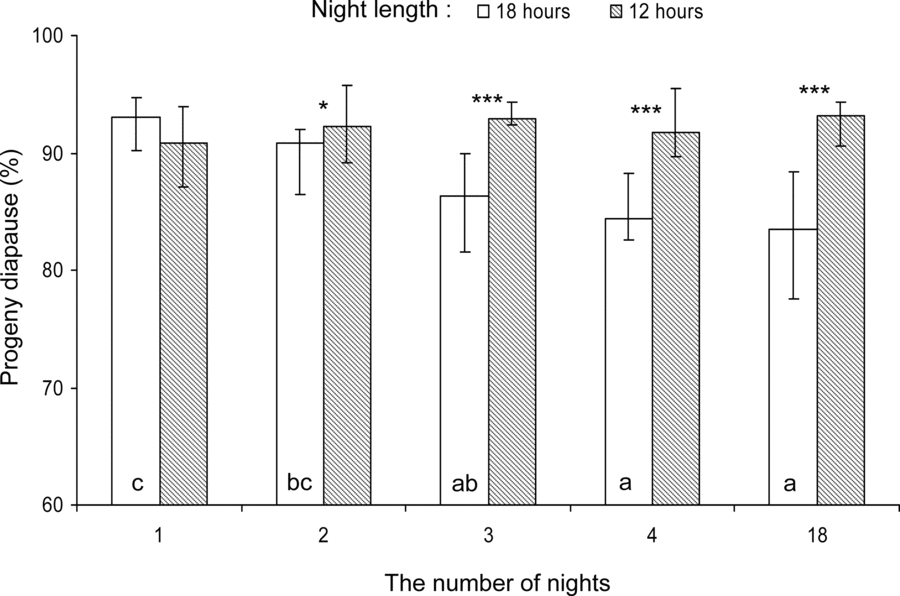
As in the previous experiment, the incidence of diapause in the progeny of females that developed at a constant short-night conditions (light–dark photoperiod of 18:6 hours) was not high: 19.5% (13.7–21.1%). A single 12-hour or 18-hour night preceding the emergence of adults induced diapause in most part of the progeny (Fig. 5). An increase in the number of 18-hour nights caused a decrease in the incidence of diapause, whereas the effect of 12-hour nights was not significantly dependent of their number in this experiment.
Influence of the number of long (12 hours) and ultra-long (18 hours) nights preceding adult emergence on the incidence of Trichogramma telengai progeny diapause (see Materials and methods for the design of the experiment). Medians and quartiles are shown. Different letters indicate significant (P < 0.05 by the Tukey test of ranked data) difference between values obtained for different numbers of nights of the same length. Stars above the bars indicate significant difference between the values obtained for the same number of nights of different lengths (*P < 0.05, ***P < 0.001 by the Kruskal–Wallis test).

Discussion
Photoperiodic responses of T. telengai pupae and adults to multiple short, long, and ultra-long nights are very similar to those observed in other Trichogramma species (Zaslavski and Umarova Reference Zaslavski and Umarova1990; Boivin Reference Boivin, Wajnberg and Hassan1994; Reznik Reference Reznik2011) and in many other long-day insects (Tauber et al. Reference Tauber, Tauber and Masaki1986; Saunders et al. Reference Saunders, Steel, Vafopoulou and Lewis2002; Danks Reference Danks2003): diapause-inducing effect of ultra-long nights is weaker than that of natural long nights. However, when applied only one time, a single ultra-long night (at least with the night lengths up to 18 hours) had the same or even stronger diapause-inducing effect than a single natural long (12–14 hours) night. To our knowledge, this phenomenon has not been reported before for any insect.
Thus, the main working hypothesis of our study was confirmed. Our data suggest that photoperiodic time measurement in T. telengai, as well as in Sarcophaga argyrostoma Robineau-Desvoidy (Diptera: Sarcophagidae) (Saunders Reference Saunders1982; Lewis and Saunders Reference Lewis and Saunders1987), Drosophila melanogaster Meigen (Diptera: Drosophilidae) (Lewis et al. Reference Lewis, Warman and Saunders1997), Tetranychus urticae Koch (Acari: Tetranychidae) (Vaz Nunes et al. Reference Vaz Nunes, Saunders and Lewis1991), and in several other insects and mites (Vaz Nunes and Saunders Reference Vaz Nunes and Saunders1999; Saunders et al. Reference Saunders, Steel, Vafopoulou and Lewis2002; Saunders Reference Saunders2011, Reference Saunders2016) is performed in accordance with the external coincidence model. However, this conclusion does not mean that this model is valid for all insects. On the contrary, the results of the studies conducted on Nasonia vitripennis (Walker) (Hymenoptera: Pteromalidae) and on some other insects agree with the internal coincidence model (Saunders Reference Saunders1974; Koštál et al. Reference Koštál, Noguchi, Shimada and Hayakawa2000; Bertossa et al. Reference Bertossa, Van de Zande, Beukeboom and Beersma2014). Moreover, it is conceivable that various formal models are different manifestations of the same basic mechanism that may be revealed by further ecophysiological and molecular studies (Saunders Reference Saunders2011; Saunders and Bertossa Reference Saunders and Bertossa2011; Bertossa et al. Reference Bertossa, Van de Zande, Beukeboom and Beersma2014; Goto and Numata Reference Goto, Numata and Hoffmann2015).
Our experiment showed that the first ultra-long night has a strong diapause-inducing effect; the effect of two ultra-long nights is somewhat weaker, whereas the results obtained after three and four ultra-long nights are not significantly different from those obtained after constant nights of the same length. This suggests that the circadian oscillator that regulates the photoperiodic response of T. telengai damps out after one or two cycles. According to the damped circadian oscillator model (Lewis and Saunders Reference Lewis and Saunders1987; Saunders and Lewis Reference Saunders and Lewis1987), the degree of damping depends on the synthesis rate model parameter. The rate of damping suggested by our experiments corresponds to a synthesis rate of 0.10–0.11 (Lewis and Saunders Reference Lewis and Saunders1987; Fig. 2). With this value of synthesis rate, under constant ultra-long nights (18 hours) the incidence of diapause should be close to the average of the effects of constant short (six hours) and constant long (12 hours) nights (Saunders and Lewis Reference Saunders and Lewis1987; Fig. 1). Indeed, just this pattern of photoperiodic response was observed in the present study (Fig. 3).
Experiments conducted with other insects have yielded various results (Lewis and Saunders Reference Lewis and Saunders1987; Saunders and Lewis Reference Saunders and Lewis1987; Saunders et al. Reference Saunders, Steel, Vafopoulou and Lewis2002). In particular, similar to the data obtained in the present study, circadian oscillator involved in the photoperiodic time measurement in Chymomyza costata (Zetterstedt) (Diptera: Drosophilidae) damped out after 24 hours (Yoshida and Kimura Reference Yoshida and Kimura1995). The results of some experiments with the black bean aphid, Aphis fabae Scopoli (Hemiptera: Aphididae), also seemed to point to a circadian oscillator that damped out, depending on temperature, after one or two cycles (Hardie and Vaz Nunes Reference Hardie and Vaz Nunes2001).
As noted above, the diapause-inducing effect of a single ultra-long night has not been studied, probably because of the absence of a suitable insect model. However, the extremely rapid photoperiodic response of T. telengai pupae and adults is unusual but not unique. A significant diapause-inducing or diapause-averting effect of a single light–dark cycle has been observed in several insects of different orders (Bowen et al. Reference Bowen, Saunders, Bollenbacher and Gilbert1984; Zaslavski and Kats Reference Zaslavski and Kats1988; Hardie Reference Hardie1990; Smith Reference Smith1991; Hardie and Vaz Nunes Reference Hardie and Vaz Nunes2001; Hua et al. Reference Hua, Xue, Xiao and Zhu2005; Tanaka et al. Reference Tanaka, Tachibana and Numata2008). Thus, it is possible that the design of our experiments (comparison of the effects of single and multiple nights of different lengths) can be applied to some other insect species.
Acknowledgements
We thank T.Y. Umarova for assistance with the experiments. We are deeply grateful to the three anonymous reviewers for valuable comments. The study was performed in the frames of the state research project AAAA-A19-119020690082-8 titled Ecological and Morphological Adaptations of Insects in the Context of General Biodiversity.