The relationship between organizational dissent and the perception of workplace freedom of speech has drawn keen interest of scholars for many years. In these studies, researchers have shown how an individual’s tendency to express disagreement of contradictory opinions (dissent) is positively related to the perception that a workplace fosters a climate of free argumentation (workplace freedom of speech) (Kassing, Reference Kassing2000b, Reference Kassing2006; Garner, Reference Garner2007; Croucher, Parrott, Zeng, & Gomez, 2014). Both organizational behaviors have been studied in conjunction with a variety of other constructs such as employee burnout (Avtgis, Thomas-Maddox, Taylor, & Patterson, Reference Avtgis, Thomas-Maddox, Taylor and Patterson2007), argumentativeness (Kassing & Avtgis, Reference Kassing and Avtgis1999), organizational identification (Croucher, Braziunaite, & Oommen, 2012), and self-esteem (Payne, Reference Payne2007), to name a few.
Researchers studying dissent and workplace freedom of speech have called for further research in non-US settings (Kassing & Avtgis, Reference Kassing and Avtgis1999; Croucher et al., 2012; Croucher et al., 2014); this study is an attempt to answer these calls. Few studies have explored dissent or workplace freedom of speech in non-US settings. The studies that have been conducted outside of the United States have found non-US samples tend to dissent less and perceive less workplace freedom of speech (Gorden, Holmberg, & Heisey, Reference Gorden, Holmberg and Heisey1994; Kassing & Avtgis, Reference Kassing and Avtgis1999; Croucher et al., 2009, 2012). Studies conducted among US samples cannot and should not be generalized to non-US samples. Thus, this study takes place in Singapore, which is one of the most globally diverse nations in the world (Rubdy & McKay, Reference Rubdy and McKay2013).
Organizational dissent and workplace freedom of speech are significantly correlated with employees’ job satisfaction, organizational commitment (Gorden & Infante, Reference Gorden and Infante1991; Garner, Reference Garner2009), and organizational identification (Croucher et al., 2012), and are thus strongly correlated with an employees’ organizational performance. Cultural diversity in organizations alters both cultural minorities and majority members’ attitudes and performance (Rupert, Jehn, Engen, & Reuver, Reference Rupert, Jehn, Engen and Reuver2010). Hornsey, Oppes, and Svensson (Reference Hornsey, Oppes and Svensson2002) found criticism voiced by cultural minorities in workplaces is less tolerated. In other words, criticism from a minority member is more likely regarded as derogatory instead of constructive. This may alter cultural minorities’ organizational dissent behaviors and their perceived workplace freedom of speech level, thus ultimately degrade their organizational outcomes.
The context of this study, Singapore is significant for the following reasons. First, similar investigations have never been conducted in Singapore. Second, Singapore is a diverse nation, consisting of numerous ethnic groups. The diversity in Singapore facilitates a group-level comparison between the dominant cultural group, ethnic Chinese, and the various immigrant groups (Chinese, Malay, Indonesian, and Indian). It has been argued that the social, political, and/or economic situation in a society can affect an individual’s communication behaviors (Croucher et al., 2014). The current study tests this assumption in a nation where ethnic group identity/membership is a heated economic, political, and social issue of debate (Hui & Hashi, Reference Hui and Hashi2007; Weiss, Reference Weiss2011). Third, Singapore represents a nation where many immigrant groups feel rejected by the dominant culture, even though protections are in place to legally protect them (Cheung, Reference Cheung2014). Such negative perceptions could affect an individual’s tendency to dissent or believe they have workplace freedom of speech (Pheng, Yeng, & Shan, Reference Pheng, Ying and Shan2008). Thus, this study explores the relationship between dissent and workplace freedom in Singapore. Moreover, the study examines the differences between members of the dominant cultural group (ethnic Chinese) and immigrant groups on dissent and workplace freedom of speech.
Organizational dissent
Organizational dissent is the expression of disagreement or contradictory opinions about workplace policies and practices (Kassing, Reference Kassing1997, Reference Kassing1998). There are three types of dissent: articulated, latent, and displaced dissent. Articulated dissent involves open and explicit communication of dissent with superiors who have the ability to change and alleviate dissatisfying situations. Employees tend to address articulated dissent to management: when they possess higher levels of satisfaction and commitment toward organizations (Kassing, Reference Kassing1998), and have higher organization-based self-esteem (Payne, Reference Payne2007), when they are more highly recognized and perceive their organization as having more freedom of speech (Kassing, Reference Kassing2000a), and when they are in management positions (Kassing & Avtgis, Reference Kassing and Avtgis1999; Kassing & Armstrong, Reference Kassing and Armstrong2002). In addition, employees who maintain higher-quality relationships with supervisors and those who have greater involvement in decision-making process were reported to have a greater tendency to deliver articulated dissent (Kassing, Reference Kassing2000b; Kassing & McDowell, Reference Kassing and McDowell2008).
Latent dissent is lateral communication of dissent to other employees within an organization (Kassing, Reference Kassing1997, Reference Kassing1998). Expression of latent dissent is negatively related to employee quality relationships with supervisors (Kassing, Reference Kassing2000b), job satisfaction and commitment (Kassing, Reference Kassing1998), and workplace freedom of speech (Kassing, Reference Kassing2000a). In addition, non-management employees (Kassing & Avtgis, Reference Kassing and Avtgis1999; Kassing & Armstrong, Reference Kassing and Armstrong2002) and employees who are provided by the organization better information about decision making (Goodboy, Chory, & Dunleavy, Reference Goodboy, Chory and Dunleavy2008) prefer latent dissent.
Displaced dissent is communicating dissent to audiences outside the organization, including family members and non-work friends (Kassing, Reference Kassing1997, Reference Kassing1998). Kassing (Reference Kassing1998) argued displaced dissent is negatively correlated with employee commitment. Displaced dissent also serves as a safe outlet for younger non-management employees with less work experience (Kassing & DiCioccio, Reference Kassing and DiCioccio2004).
Dissent strategy selection is influenced by employees’ traits, their affiliation with their organizations, work experience, and position within the organization (Kassing, Reference Kassing2008), as well as individuals’ verbal aggressiveness, argumentativeness, and locus of control (Kassing & Avtgis, Reference Kassing and Avtgis1999, Reference Kassing and Avtgis2001). Also, as for the affiliation with their organizations, employees’ commitment, job satisfaction, and organizational identification are all related to their dissent expression (Kassing, Reference Kassing1997, Reference Kassing2000a). Sprague and Ruud (1998) found employees’ senses of powerlessness and preferences for avoiding conflict influence their willingness to dissent. Being more argumentative, less verbally aggressive, being in management position, and having longer tenure in organization appear to contribute to the use of articulated dissent (Kassing & Avtgis, Reference Kassing and Avtgis1999; Kassing & Armstrong, Reference Kassing and Armstrong2002; Kassing & DiCioccio, Reference Kassing and DiCioccio2004; Kassing, Reference Kassing2006), while verbal aggressiveness, being in non-management position contributes to the use of latent dissent. Moreover, Kassing, Piemonte, Goman, and Mitchell (Reference Kassing, Piemonte, Goman and Mitchell2013) found latent dissent correlates negatively with work engagement and positively with intention to leave. In regards to work experience and position within the organization, employees who have less work experience prefer to make displaced dissent (Kassing & DiCioccio, Reference Kassing and DiCioccio2004).
A number of researchers have attempted to identify tactics and messages for expressing dissent. Kassing (2002) found five strategies for upward dissent: direct-factual appeals, repetition, solution presentation, circumvention, and threatening resignation. In the same vein, Garner (Reference Garner2009) developed a dissent messages scale consisting of 11 types of messages: solution presentation, circumvention, direct-factual appeals, repetition, venting, humor, pressure, coalitions, exchange, ingratiation, and inspiration. In addition, Kassing (Reference Kassing2011) reported coping strategies such as disengagement, denial, and venting are significantly associated with employee’s choice of dissent strategies.
Workplace freedom of speech
Gorden and Infante (Reference Gorden and Infante1991) defined freedom of speech as a right for which ‘[c]itizens should not suffer retaliation or disenfranchisement’ (p. 146). However, workplace freedom of speech differs from openness in that the latter ‘implies freedom of speech but has not entailed examination of the retaliatory consequences or the chilling effects of punishment for employees’ exercise of that freedom’ (p. 146). Kassing (Reference Kassing2006) defined workplace freedom of speech as ‘the degree to which an organization creates a climate that is receptive to argumentation and dissent’ (p. 81).
Freedom of speech in the workplace is related to other workplace elements such as profitability, organizational dissent, whistle-blowing, and equality. Increased workplace freedom of speech is positively related to an increase in profitability (Kassing, Reference Kassing2006; Arikpo, Etor, & Usang, Reference Arikpo, Etor and Usang2007). Uys (Reference Uys2008) identified workplace freedom of speech as an essential prerequisite for effective whistle-blowing, and other researchers have argued whistle-blowing improves the organization’s overall condition (Near & Jensen, Reference Near and Jensen1983; Ray, Reference Ray2006; Garner & Garner, Reference Garner and Garner2011). Kassing (Reference Kassing2000a) also stated higher levels of workplace freedom of speech led to more articulated dissent and less latent dissent. More articulated dissent is related to a more democratic discourse and it is economically beneficial to the organization, as the employees perceive the organization more positively (Gorden & Infante, Reference Gorden and Infante1991; Kassing, Reference Kassing2000a, Reference Kassing2009; Choudry & Thomas, Reference Choudry and Thomas2013; Kassing et al., Reference Kassing, Piemonte, Goman and Mitchell2013). Kassing (Reference Kassing2006) also argued more cases of latent dissent reflect lower levels of workplace freedom of speech. Gorden and Infante (Reference Gorden and Infante1991) explained how employees who think they have more freedom of speech in the workplace are more likely to ‘evaluate their organizations as more economically stable, more participative in terms of decision making, and more committed to product quality, the quality of work life, and employee rights’ (p. 147). Thus, based on previous research, dissent should be correlated with workplace freedom of speech (Kassing, Reference Kassing2000a, Reference Kassing2006). Due to the fact that the bulk of research on workplace freedom of speech has largely been conducted in the US context, it is warranted to test these relationships in other cultures. Therefore, we pose the following hypotheses to test these relationships in the context of Singapore:
Hypothesis 1a: There is a significant positive relationship between articulated dissent and workplace freedom of speech in Singapore.
Hypothesis 1b: There is a significant negative relationship between latent dissent and workplace freedom of speech in Singapore.
Comparison of ethnic Chinese and immigrants to Singapore
This research also compares organizational behaviors between members of the dominant and minority cultures in Singapore. Singapore’s economy is largely based on a need for foreign workers (non-ethnic Chinese not born in Singapore), particularly Malay, Indonesian, and Indian. To meet the demand for labor in the 1970s, a series of immigrant policies were liberalized to attract foreign workers, especially Chinese and Malay (Rubdy & McKay, Reference Rubdy and McKay2013). In fact, as of 2013, of the 5.3 million Singaporeans, the total foreign work force was 1.3 million, which includes 300,000 foreign domestic workers (Ministry of Manpower, 2013).
Public concerns about population diversity are growing. Since 1990, the native Singaporean population growth has been 1.1%, while the foreign population has expanded seven times more rapidly (Weiss, Reference Weiss2011). Singapore will confront a severe demographic aging problem in the next few decades; therefore the dependence on foreign labor will continue. The growing foreign population has intensified and will continue to worsen job competition, overcrowding, the overburdened infrastructure, and so on (Hui & Hashi, Reference Hui and Hashi2007). While the Singaporean government has taken steps to attract more skilled ‘foreign talent,’ this policy has been questioned (Ortmann, Reference Ortmann2009). Many Singaporeans are concerned there will be no more ‘true’ Singaporeans in Singapore in the future (Weiss, Reference Weiss2011). Apart from the growing negative opinions native Singaporeans hold against foreigners, there are clear imbalances between groups. The average monthly income of ethnic Malays is 60% less than that of ethnic-Chinese (the dominant culture in Singapore) (Weiss, Reference Weiss2011). In terms of education, the proportion of Malay students receiving admission into higher educational institutions is less than both ethnic Chinese and Indian students (Mutalib, Reference Mutalib2005). Ultimately, ethnic Chinese are the dominant economic, political, and social group in Singapore. Minority groups, such Malays, Indonesians, and Indians are more likely to be disadvantaged (Ortmann, Reference Ortmann2009; Rubdy & McKay, Reference Rubdy and McKay2013). The government, however, has taken steps to promote equality and protect immigrant rights. Legally, Malay welfare, and the welfare of other immigrant groups are protected under Singaporean law (Majlis Ugama Islam Singapura, 2014).
Generally, majority groups, due to their organizational position, are more likely to dissent upward (articulated), while minority groups are more likely to make latent and displaced dissent cases (Croucher et al., 2009). The majority groups have more capability to accomplish this risky behavior that can put employees’ professional career, status, and relations in danger (Kassing, Reference Kassing2011). On the other hand, the employees with higher engagement with the decision-making process and with a closer relationship with the supervisors have been reported to be more likely to express articulated dissent (Kassing, Reference Kassing2000a, Reference Kassing2011; Kassing & McDowell, Reference Kassing and McDowell2008). Previous studies have also shown the majority is more influential in the process of decision making due to its informational influence, where the minority turns to the majority for decision making because the minority thinks the majority has the ‘right’ answers. On the other hand, minority members avoid confrontations and are less confident in providing information, which is a form of normative influence (Nemeth, Reference Nemeth1986). At the same time, the employees who are less confident in the organization and feel less justice in the workplace, and whose organization is less open in the decision making tend to more cases of latent or displaced dissent (Kassing, Reference Kassing1998, Reference Kassing2011). The influence and power coming from the position of majority provide a more stable position and consequently more eligibility to dissent upward while the minority groups due to their less stable organizational position are more likely to make latent or displaced dissent.
Perception of minority (upward) dissent as disruptive (instability) and time-consuming is another factor, which increases the cost of dissent for the minority groups and changes the direction of their dissent to lateral and displaced dissent (Nemeth & Staw, Reference Nemeth and Staw1989). Despite this understanding of minority dissent, previous studies have shown an increase in minority upward dissent can result in higher levels of flexibility and responsiveness toward external changes and environmental awareness, along with more effective decisions, and organizational and problem-solving behaviors. In essence, when minorities are encouraged or when they do dissent more upwards, there are multiple organizational benefits (Schweiger, Sandberg, & Ragan, Reference Schweiger, Sandberg and Ragan1986; De Dreu, De Vries, Anssen, & Altink, Reference DeMaris2000).
However, it is common for most members of minority groups to have less willingness to dissent and to have a lower workplace freedom of speech perception (Croucher et al., 2009). Thus, the following hypothesis is put forth to explore differences between ethnic-Chinese Singaporeans and immigrants to Singapore.
Hypothesis 2: Immigrants to Singapore will report lower levels of dissent (articulated and latent), and lower levels of perception of workplace freedom of speech than ethnic Chinese in Singapore.
Method
Participants and procedures
Data were collected through self-administered online and paper questionnaires in 2013 after appropriate ethical approval. The Principal Investigator contacted participants through previously established social networks and with the assistance of universities/colleges in Singapore. Thus, the Principal Investigator used a snowball sample. Participants did not receive financial incentive for participation. Previous studies showed such a sampling technique is standard, and in many cases necessary in intercultural/cross-cultural communication research (Amir & Sharon, Reference Amir and Sharon1991; Hendrick, Reference Hendrick1991; Frick, Reference Frick1998; Gudykunst, Reference Gudykunst2002; DeMaris, Reference De Dreu, De Vrles, Anssen and Altink2004; Hayes, Reference Hayes2005).
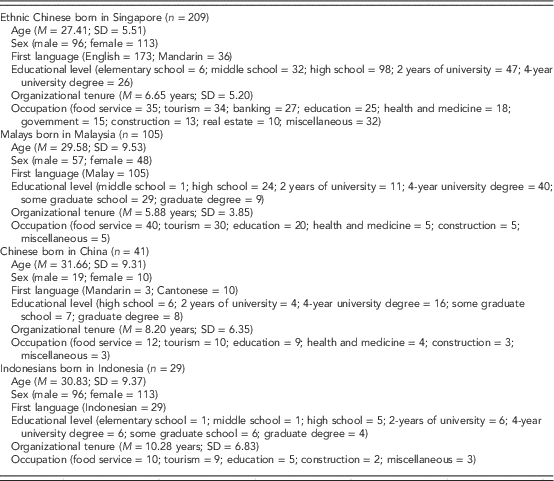
Over a period of four months, 384 individuals in Singapore participated in the study. Participants ranged in age from 18 to 57 (M=28.66, SD=7.53). Men accounted for 51.3% (n=197) of the sample, and women made up 48.7% (n=187) of the sample. The sample was religiously diverse: 39.8% (n=153) Buddhist, 39.1% (n=150) Muslim, 11.5% (n=44) Hindu, 9.4% (n=36) Christian, and 0.3% (n=1) Jewish. The sample’s educational level was diverse: 1.8% (n=7) elementary school, 8.9% (n=34) middle school, 34.6% (n=133) high school, 17.7% (n=68) 2 years of college, 22.9% (n=88) 4-year degree, 8.6% (n=33) some graduate education, and 5.5% (n=21) graduate degree. The first language of the participants was also diverse: 45.1% (n=173) English, 27.3% (n=105) Malay, 17.4% (n=67) Mandarin, 7.6% (n=29) Indonesian, and 2.6% (n=10) Cantonese. Finally, the participants’ organizational tenure varied extensively Organizational tenure ranged from 1 to 30 years with an organization (M=6.88; SD=5.26). See Table 1 for an in-depth demographic breakdown based on an individual’s nation of birth.
Demographic characteristics of participants by nation of birth

Instruments
All surveys were administered in English or Malay, two of the official languages of Singapore. No participants requested to answer the survey in other languagesFootnote 1 . A back-translation method was used to develop the Malay version of the questionnaire. The questionnaire was first created in English and then translated into Malay by a native speaker and then independently translated back into English. The reliability of the English–Malay translation was (κ=0.83).
Organizational Dissent Scale
The Organizational Dissent Scale (Kassing, Reference Kassing1998) is a 24-item scale that measures how employees express their disagreement about workplace/organizational policies and practices to three audiences: coworkers (latent/lateral dissent), supervisors and management (articulated dissent), and non-work friends and family (displaced dissent). The purpose of this study is to examine how a multi-ethnic organizational environment influences employee’s choice of dissent strategies within organizations. As displaced dissent is expressed to non-work friends and family, it is considered as a non-organizational communication behavior (Kassing, Reference Kassing1998), thus is excluded from this study. A number of studies have followed the same logic (Kassing & Armstrong, Reference Kassing and Armstrong2002; Garner & Wargo, Reference Garner and Wargo2009; Croucher et al., 2014). Therefore, initially the scale included 18 of the 24-items. All items are measured on a 5-point Likert scale that ranges from (1) strongly disagree to (5) strongly agree. For articulated dissent, alpha reliabilities have ranged from 0.84 to 0.90 (Croucher et al., 2009; Kassing, Reference Kassing2009)Footnote 2 . The alpha was 0.90 in this study. For latent dissent, alpha reliabilities have ranged from 0.76 to 0.89 (Kassing, Reference Kassing2008; Croucher, Kassing, & Diers-Lawson, 2013). The alpha in this study was 0.91.
Workplace freedom of speech scale
Gorden and Infante’s Workplace Freedom of Speech Scale and two added items from Kassing (Reference Kassing2000a, Reference Kassing2000b) measured the degree to which people perceive their organization permits and/or encourages feedback and input from members. All items are measured on a 5-point Likert scale ranging from (1) strongly disagree to (5) strongly agree. Alpha reliabilities for this scale have ranged from 0.74 to 0.91 (Gorden & Infante, Reference Gorden and Infante1991; Kassing, Reference Kassing2000a, Reference Kassing2000b; Croucher et al., 2014)Footnote 3 . In this study, the alpha was 0.83. See Table 2 for the means, standard deviations, and correlations associated with the study variables.
Correlations associated with the study variables

Note. *p<.05; ** p<.01.
Results
The results were tested in two ways. Hypotheses 1a and 1b were analyzed through the use of one-tailed Pearson’s correlations. To analyze Hypothesis 2, a multiple analysis of covariance (MANCOVA) was used. As shown in Table 2, Hypothesis 1a was supported by the data, while Hypothesis 1b was not. As predicted in Hypothesis 1a, articulated dissent and workplace freedom of speech were positively correlated (r=0.15, p<.05). Unlike what was predicted in Hypothesis 1b, latent dissent and workplace freedom were not negatively correlated, instead they were positively correlated (r=0.11, p<.01).
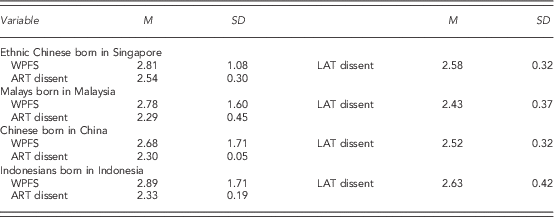
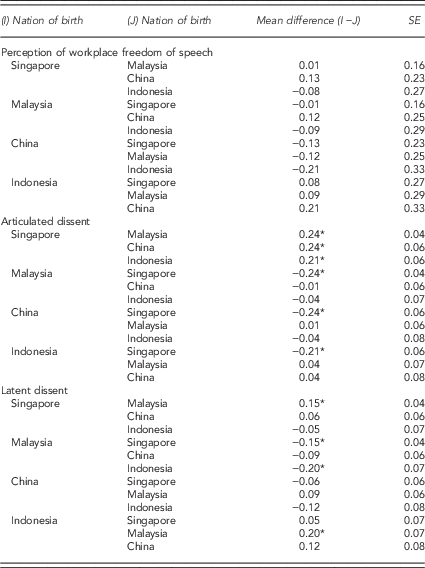
To compare the means of the organizational behaviors, data were analyzed using a MANCOVA. The independent variable was culture (Nation of birth), the dependent variables were perception of workplace freedom of speech, articulated dissent, and latent dissent, and the covariate was categorical (organizational tenure/years with the organization). Organizational tenure was added as a control variable as research shows organizational tenure affects levels of dissent (Kassing & Armstrong, Reference Kassing and Armstrong2002; Kassing, Reference Kassing2006, Reference Kassing2008). Organizational tenure was assessed by asking individuals ‘To the nearest year, how long have you been a part of your present organization?’ Tenure did not have a significant effect on organizational dissent or workplace freedom of speech in this study, LH=0.002, F(3, 377)=0.20, p=.90. Using Hotelling’s Trace, the effect of nation of birth on the three dependent variables was significant, F(9, 1127)=6.79, p<.001. Univariate post-hoc analyses revealed significant differences between individuals based on nation of birth for two of the three independent variables: articulated dissent, F(3, 379)=17.18, p<.001, η2=0.12; and latent dissent, F(3, 379)=5.20, p<.01, η2=0.04. There was not a significant difference among the groups on perception of workplace freedom of speech, F(3, 379)=0.15, p=.93, η2=0.00. Table 3 displays the means, and standard deviations for each dependent variable based on an individual’s nation of birth. See Table 4 for post-hoc results. Based on these results, the following comparisons can be made between native born and immigrants to Singapore regarding dissent and perception of workplace freedom of speech. On articulated dissent, Malays (M=2.29), Chinese (M=2.30), and Indonesian (M=2.33) immigrants all scored lower than ethnic Chinese born in Singapore (M=2.54). On latent dissent, Malay immigrants (M=2.43) scored significantly lower than Chinese born in Singapore (M=2.58).
Means and standard deviations for study variables

Note. ART=articulated; LAT=latent; WPFS=Workplace Freedom of Speech Scale.
Games Howell comparisons of study variables

Note. *p<.05 based on a Games Howell post-hoc comparison.
Discussion
The purpose of this study was to test the relationship between organizational dissent and workplace freedom of speech in Singapore, and to explore differences in these organizational behaviors between members of the dominant and immigrant groups. Correlation analyses revealed: organizational dissent (articulated and latent) was positively correlated with workplace freedom of speech. In addition, MANCOVA analyses revealed nation of birth exerts considerable influence on articulated and latent dissent.
This study discovered a significant positive correlation between articulated dissent and workplace freedom of speech in Singapore. Thus, Hypothesis 1a was supported. This finding is congruent with previous studies conducted in the United States and Europe (Croucher et al., 2014). The emphasis of freedom of speech is placed on the exclusion of retaliation (Gorden & Infante, Reference Gorden and Infante1991). Upward communication in organizations is enacted with great care by employees for its possible detrimental consequences, especially when it involves disagreement and opposing opinions (Kassing, Reference Kassing1997, Reference Kassing1998). Intuitively, being able to voice criticism freely to the management contributes significantly to member’s perception of organizational democracy. Therefore, in combination with previous research conducted in other cultural settings, we argue the positive relationship between upward dissent and workplace freedom of speech is a universal phenomenon that transcends cultural boundaries.
Hypothesis 1b was not supported in this study. On the contrary, the current study showed workplace freedom of speech to be positively correlated with latent dissent (r=0.11, p<.05), which runs counter to previous literature, which has shown a negative correlation (Kassing, Reference Kassing2000a, Reference Kassing2006). This different in the relationship of latent dissent and workplace freedom of speech in Singapore in comparison to other cultures could designate a different perception of workplace freedom of speech among the Singaporean employees. In addition, nation of birth did not have a significant effect on workplace freedom of speech. Singaporeans may have a different perception of workplace freedom of speech for two reasons. First, perceptual differences can result in variations in the finding of studies. Zaharia and Benchea (Reference Zaharia and Benchea2013) believed perceptual differences of concepts such as workplace freedom of speech, religion, and nationality affected their findings of the psychological perception of religion among Romanian employees in the workplace. Second, high power distance in Singaporean organizations may impact employees’ perception of workplace freedom of speech. In a cross-cultural study of workplace bullying on job satisfaction among Australians and Singaporeans, Loh, Restubog, and Zagenczyk (Reference Loh, Restubog and Zagenczyk2010) reported the relationship between bullying and job satisfaction were weaker for Singaporeans than Australians employees and concluded power distance might be the main factor contributing to the difference. In this sense, a top–down structure with a wide power distance may foster an authoritarian atmosphere, which ultimately influences Singaporean employees’ perception of workplace freedom. Moreover, in hierarchical and collectivistic cultures, the communication style is largely determined by the status of interlocutors (Lee, Reference Lee2002; Wang & Chen, Reference Wang and Chen2010). In other words, under the influence of high power distance, people are more constrained communicating with supervisors and readily accept this fact. Thus, the atmosphere of a democratic workplace could be constructed mainly by communication among coworkers instead of supervisor–subordinate communication. Furthermore, discussing critical issues with colleagues could potentially facilitate trust and interpersonal relationships (Wasti, Tan, & Erdil, Reference Wasti, Tan and Erdil2011). That is, expressing latent dissent is not the result of the suppression of upward dissent, but rather is crucial by its very nature in collectivistic and hierarchical cultures. In this case, although the Chinese born Singaporeans show higher levels of articulated dissent and slightly higher levels of freedom of speech in the workplace – they also show higher levels of the latent dissent than the immigrant groups. Overall, it seems the existing perception of workplace freedom of speech is different from previously studied samples, particularly in the United States. Assembly, in the cultures with lower power distance, such as United States, either lateral dissent is taken for granted and does not replicate freedom of speech, or it happens when the employees are not able to dissent upward, thus it manifests as a negative correlation with workplace freedom of speech. However, in the cultures with higher power distance, the act of dissent, regardless of direction, can be assumed as a manifestation of workplace freedom of speech. This perceptual difference further demonstrates how cultural background (in this case nationality) affects perception of dissent. These results show a tendency to use latent dissent not merely as a form of objection, but also as a medium of talking about everyday incidents that happen in the workplace.
Regarding Hypothesis 2, the analysis suggests nation of birth has an influence on organizational dissent; while workplace freedom of speech did not significantly differ based on an individual’s place of birth. Thus, there is partial support for Hypothesis 2. These results are likely due to two key issues: economics and the place of traditional Chinese values in Singaporean society. Significant differences in dissent (articulated and latent) were found between Singaporeans and all immigrant groups. Most non-European expatriates in Singapore hold low-paying jobs and perceive Singapore as a temporary place with higher salaries than in their homeland rather than as a permanent country to live in. These individuals mostly come from collectivistic cultures, often times having to support their families in their home countries (Pheng, Yeng, & Shan, Reference Pheng, Ying and Shan2008). Therefore, the stress and fear for foreign workers to uphold jobs is higher than that for the locals. This may more than likely alter their organizational behaviors. Croucher et al. (2014) found a similar result in an analysis of dissent in continental Europe. Individuals in more precarious economic situations (such as Spain) were more likely to have lower levels of dissent out of fear of losing a job. Economic fears, like losing your job, will affect levels of dissent. In this case, economic fear is a situational factor (Beatty & McCroskey, Reference Beatty and McCroskey1998) that must be explored in future research related to organizational behaviors.
Second, the majority of the Singaporean population is ethnic Chinese, which are greatly influenced by traditional Chinese values (Soo Siew, Hendrik, & Keng-Howe, Reference Soo Siew, Hendrik and Keng-Howe2009; Ji & Skoric, Reference Ji and Skoric2013). The People’s Republic of China’s (PRC) expatriates in Singapore, often sharing the same language and culture, are expected to adapt better than other ethnic groups. However, in reality, the social distance between PRC’s expatriates and local Chinese Singaporeans is evident (Chan Kwok & Seet Chia, Reference Chan Kwok and Seet Chia2003). This is supported in the results, where there were significant differences between immigrant Chinese and local Singaporeans on articulated dissent and latent dissent. Mainland Chinese workers in Singapore are viewed as outsiders regardless of the similarities in physical appearance and culture. Furthermore, many Chinese workers do not regard Singapore as home, nor feel welcomed. In a study of Chinese construction workers in Singapore, Pheng, Yeng, and Shan (Reference Pheng, Ying and Shan2008) found PRC construction workers felt rejected by Singaporean locals and stated they did not like working in Singapore. Members from a high power distance culture are likely to view dirty work more negatively (Ashforth & Kreiner, Reference Ashforth and Kreiner2014). In this sense, PRC expatriates are not different from other immigrant workers in Singapore in that the negative prejudices and stereotypes are projected on all minority groups (Suhaimi & Sudderudin, Reference Suhaimi and Sudderudin2007). Thus, it is likely the status of prejudiced-stereotyped group of this immigrant (minority) group affects their willingness to dissent.
Limitations, implications, and future directions
Although the results of this study contribute to the establishment of a more comprehensive perception of organizational dissent and workplace freedom of speech, the study is also limited. While a convenience sample is not a limitation, (Amir & Sharon, Reference Amir and Sharon1991; Hendrick, Reference Hendrick1991; Frick, Reference Frick1998; DeMaris, Reference De Dreu, De Vrles, Anssen and Altink2004; Hayes, Reference Hayes2005), a convenience sample consisting of predominantly middle to upper income individuals in Singapore may be limited. Generalizations to lower income individuals in Singapore should be made with caution. At the same time, as the effect sizes of the result are small, any conclusions should be interpreted with this in mind.
Four implications emerge from this study. First, this study suggests economic situations should be considered in studies of organizational behavior. Unemployment rates, fear of losing a job, and other economic woes have an effect on an individual’s psychological well-being (Ochsen & Welsch, Reference Ochsen and Welsch2011). Croucher et al. (2014) found significant differences in dissent and workplace freedom of speech levels in nations with vastly different unemployment rates. The nations with higher unemployment rates had lower levels of dissent and workplace freedom of speech than nations with lower unemployment rates. It is essential for future research to continue to consider the potential influence of environmental factors like the economy on organizational behaviors.
Second, the results of this study suggested minority groups feel more constrained to voice criticisms in their organizations than native ethnic-Chinese Singaporeans. Minority groups, often suffer prejudice (Pettigrew & Meertens, Reference Pettigrew and Meertens1995; Stephan & Stephan, Reference Stephan and Stephan1996; Ortmann, Reference Ortmann2009; Rubdy & McKay, Reference Rubdy and McKay2013; Lu, Samaratunge, & Härtel, Reference Lu, Samaratunge and Härtel2016). In such cases, it is common for minorities to have lower levels of dissent and workplace freedom of speech (Croucher et al., 2014). To better understand a minority’s dissent, and/or workplace freedom of speech it is advantageous to understand the perception of prejudice in the dominant culture. Stephan and Stephan’s (Reference Stephan and Stephan1993, Reference Stephan and Stephan1996) integrated threat theory describes different factors that explain prejudicial reactions toward minorities. These threats generate prejudice: real threats, perceived threats, negative stereotypes, and intergroup anxiety. Research should explore how these threats relate to organizational behaviors.
Third, this study encourages organizations in Singapore to increase employee loyalty and retention by facilitating employee voice behaviors. Voluntary employee turnover is a prominent issue faced by many Asian countries, particularly Singapore. According to the Michael Page Singapore Employee Intentions Report (2015), 41 and 26% of respondents are respectively ‘very likely’ and ‘likely’ to change their jobs in the next 12 months. The cost and disruption caused by the job-hopping culture are highly evident and thus high employee turnover has been a national concern in Singapore for decades (Khatri, Chong, & Budhwar, Reference Khatri, Chong and Budhwar2001). According to the Singapore Human Resources Institute (2008), the three top factors of retaining employees are improved employee communication/involvement, increased learning and development opportunities, and increased pay. Therefore, facilitating organizational dissent in a more democratic working environment is a valid way to improve employee communication/involvement and, in turn, to minimize unnecessary employee turnover.
Fourth, the results of this study suggested in Singapore, known to have a higher amount of power distance, employees do more latent dissent when they feel more freedom of speech in the workplace, while previous studies showed more latent dissent among those employees who feel less freedom of speech in the cultures with lower power distance. to further understand the relationships between dissent and workplace freedom of speech, and how these groups differ in their perceptions of these constructs it would be fruitful to conduct qualitative research among these groups. Researchers have suggested in-depth qualitative analyses may reveal greater clarity into how non-US populations conceptualize dissent and workplace freedom of speech (Croucher et al., 2014).
Conclusion
Ultimately, this study tested the relationship between organizational dissent and the perception of workplace freedom of speech in Singapore. The analysis revealed both articulated dissent and latent dissent were positively correlated with workplace freedom of speech. Moreover, nation of birth significantly influences articulated and latent dissent, but not workplace freedom of speech. Work should continue to examine organizational dissent and workplace freedom of speech in non-US settings and among diverse populations to develop a more comprehensive understanding of how contradictory opinions are expressed in organizations.