Introduction
Globalization, an “inexorable supranational force that reshapes, mutilates and overturns the local,”Footnote 1 had a considerable effect on the demand for and production of ships in the second half of the twentieth century.Footnote 2 The shipbuilding industry in northwest Germany is a case in point. Over four decades, originally large and labor-intensive shipyards, constituting a booming sector after World War II, evolved into lean and nimble high-technology companies after periods of crisis, decline, and restructuring.Footnote 3 This transformation, driven by changes in technology and production, was witnessed across countries.Footnote 4 Official documents do not reveal how local workers, especially workers with migrant backgrounds, experienced it. Addressing this gap, we ask: How did globalization shape working environments and working conditions from the perspectives of migrant and nonmigrant workers in the West German shipbuilding industry from 1960 to 2000?
Migration is a lens through which we can examine how corporate responses to global developments led to persistent patterns of social exclusion and inequality in shipyards in northwest Germany over time. We integrate concepts from global ethnography, anthropology, and migration that help explain migratory processes and social transformations in the context of global changes.Footnote 5 Like other sectors, the shipbuilding industry benefited from migration. In the 1950s and 1960s, Germany recruited workers from abroad, “needed to provide cheap labour in building the German miracle as the country’s regeneration was dubbed”Footnote 6 after World War II. The migrant experience enhances understanding of social exclusion and inequality, which—albeit differently—are also perceived by nonmigrant workers and situates them within broader social structures and global economic developments.Footnote 7 Work in the shipbuilding industry has traditionally been precarious.Footnote 8 In other contexts, such as the UK steel industry, workers’ shared experience of precariousness and restructuring led to an occupational community and common conceptions of fairness and justice.Footnote 9 However, as migrant workers’ duration of stay was legally restricted and they were not well integrated in Germany over decades,Footnote 10 segmented conceptions of shipyard work are likely.
We apply oral history, a type of historical inquiry that gathers the voices of participants in past events in recorded interviews.Footnote 11 This method helps business and labor historians understand how staff perceive and make sense of their experiences at work in relation to the actions taken by their employers.Footnote 12 We use official sources and juxtapose a narrative perspective that captures complexities and changes over time.Footnote 13 While archival sources offer a retrospective factual lens on the transformation of the shipbuilding industry, oral history allows for a look at history from below. This approach was applied by British historians in the 1950s and 1960s to give a voice to ordinary people from the working class not covered by official documents.Footnote 14 More recently, the sociologist Michael Burawoy advocated for the study of globalization “from below.”Footnote 15 Oral history supports the study of globalization from below in the context of “migrant incorporation into receiving societies”Footnote 16 and local workforces. The narratives included in oral evidence reveal how migrant and nonmigrant workers make sense of globalization and how their understandings of the same events may differ.Footnote 17 Drawing on twenty-eight oral history interviews with staff from two major German shipyards, we disclose five patterns of social exclusion and inequality between and within groups of workers with and without migrant backgrounds: social divisions, unequal access to vocational training and retraining programs, unequal career opportunities, unfair redundancies, and unequal impact of precarious work.
The contributions of this study are twofold. First, it highlights the interplay between global and local processes and patterns of diversity, working conditions, and social hierarchies in German shipyards over four decades and permits us “to compose the global from below”Footnote 18 from migrant and nonmigrant workers’ perspectives. Second, oral history illustrates the complex interplay between global economic and political developments, corporate responses, and local workers’ individual experiences.Footnote 19 We could not have brought to light patterns of social exclusion and inequality if we had not adopted a narrative perspective.
Factual and Narrative Perspectives
We concentrated on two major shipyards—Blohm + Voss and Howaldtswerke-Deutsche Werft (HDW)—because they were the only leading companies in the German shipbuilding industry that survived until 2000. They had been the employers with the highest number of migrant workers in their industry since the 1960s. Both shipyards originally focused on large vessels and tankers. They restructured and turned to specialized shipbuilding in the 1980s and 1990s. To specify periods in the evolution of the shipbuilding industry and contextualize the shipyards’ strategic actions over time,Footnote 20 we collected the annual reports from Blohm + Voss from 1960 to 2000, available in the Federal State Archive in Hamburg. We used the archive of ThyssenKrupp Marine Systems (TKMS) in Kiel to collect annual reports and corporate documents from HDW. We included articles from local newspaper archives (Axel Springer Archive, Kieler Nachrichten Archive), documents from the trade union IG Metall Küste and the industry association German Shipbuilding and Ocean Industries Association e.V. (VSM), and reports from the archives of the Institut für Arbeit und Wirtschaft (IAW) at the University of Bremen.
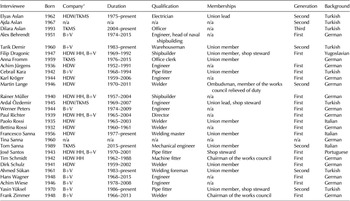
Official documents and archival sources do not report shipyard workers’ perceptions and are silent about migrants’ experiences.Footnote 21 Oral history reveals the subjective meanings that actors ascribe to historical events and their sensemaking processes. Their narratives are not accurate reconstructions but representations of past developments, reflecting diverse actors’ social realities, choices, and actions in their time and on their own terms.Footnote 22 The first author conducted twenty-eight oral history interviews with workers, foremen, engineers, and high-ranking works council and union representatives with and without migrant backgrounds (see Table 1). The interviewees were employed at Blohm + Voss in Hamburg, HDW in Hamburg (acquired by Blohm + Voss in 1980), and HDW in Kiel.Footnote 23 From the 1960s onward, these shipyards had extensively recruited German and international workers. In 1975, Blohm + Voss recorded 2230 migrant workers, the highest number in corporate history and equal to one-third of the entire workforce.Footnote 24 HDW reported 2500 migrant workers in the same year.Footnote 25 From the mid-1970s to 2000, the numbers of both German and international workers considerably decreased from 12,000 to 2500 at HDWFootnote 26 and from about 7800 to 2200 at Blohm + Voss. According to works council representatives, the migrant workforces dropped by 50 percent. The massive layoffs were accompanied by a gradual shift from blue-collar to white-collar staff, as corporate strategies increasingly focused on the construction of specialized ships driven by technological innovation and engineering.Footnote 27 By the end of the century, Blohm + Voss had one thousand employees, of whom only one-third were blue-collar staff.Footnote 28 New technologies and changes in production enabled similar shifts to services across industries and countries.Footnote 29
Oral history interviews

a B+V, Blohm + Voss; HDW, Howaldtswerke-Deutsche Werft; HDW HH, Howaldtswerke-Deutsche Werft Hamburg; TKMS, ThyssenKrupp Marine Systems.
Inspired by diversity studies,Footnote 30 we deliberately chose interviewees who represented different roles and generations of migrant and nonmigrant workers in the shipyards. We recruited them by approaching shipyards, local and national maritime institutions, cultural associations, and social media networks. Our sampling strategy helped us highlight changes in perceptions and social dynamics in the workforce. The subjectivity in the narrations provided clues about the meaning of globalization from below and the relationship between the challenges that German shipyards faced and workers’ individual experiences.Footnote 31 We deliberately included senior union representatives. They also provided views from below, because they had worked in shipbuilding before taking on leadership roles in the union.
The interviews, ranging from one to four hours, were conducted in the interviewees’ homes across six months in 2016 and 2017. In line with a life-history approach,Footnote 32 the interviewees were asked to narrate their entire work lives, including their migration histories, qualifications, and careers. Questions referred to global and local events that had influenced and changed workers’ realities, and experiences of diversity and social differentiation. At the end of each interview, the participant completed an information sheet capturing sociodemographic data. All interviews were digitally recorded and transcribed. The interviewees were accorded pseudonyms considering their sociocultural context to ensure confidentiality. Overall, about fifty interview hours and eight hundred pages of transcripts were gathered.
The application of oral history in conjunction with concepts from global ethnography and diversity strengthened our focus on globalization through the lens of migration.Footnote 33 First, global ethnography reveals how global processes are collectively constructed from below, that is, how globalization is experienced and shaped by those affected in their local sites.Footnote 34 Second, in line with Steven Vertovec’s concept of superdiversity,Footnote 35 we examined the role of workers with and without migrant backgrounds by looking for local productions of differences and interactions of multiple axes of differentiation, such as ethnicity, nationality, class, skills development, qualification, and generational background. Diversity is “an alternative lens for looking at a variety of longstanding social and cultural issues,”Footnote 36 such as evolving structural conditions, power relations, and human interactions in complex social and economic environments. We contextualized the oral history data within the historical backgroundFootnote 37 by using the extant literature on the shipbuilding industry. This factual approach to historiography led to the specification of three periods. We content-analyzed the shipyards’ strategies and social discourses in annual reports and chronicles, policy reports and documents from industrial associations and trade unions, and articles from newspapers. We coded global factors, which were communicated in combination with work and employment.
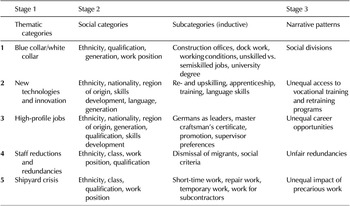
Adopting a narrative approach,Footnote 38 we content-analyzed the oral history interviews in three stages. First, we coded narrated themes on globalization and the interviewees’ experiences in their own local spaces. As we were concerned with period effects and changes over time,Footnote 39 we looked for historical time references in the narratives. Second, within the coded and extracted material, we codified the interplay of social categories, such as ethnicity, nationality, region of origin, class, work position, qualification, skills development, and generational background.Footnote 40 Inductively emerging subcategories alluding to social inequality were included in the coding process. For example, we analyzed the shift from blue-collar to white-collar jobs as a theme in conjunction with social categories, such as ethnicity, qualification, and generation. Issues related to the beneficiaries of this development and the nature of work emerged, leading to inductive codes such as working conditions or unskilled versus semiskilled jobs. Third, we identified narrative strategies and collective interpretative forms, revealing evolving power structures and social hierarchies at the shipyards over time.Footnote 41 Narratives transform an individual story into a socially contextualized memory, which is typical for members of a community.Footnote 42 We compared the previously coded sections across interviews to discover similarities and differences in a synopsis (see Table 2).
Stages of analysis and categories

To mitigate the subjectivity inherent in memories, we included data from discussions with northern German parliamentarians, high-ranking members of the trade union IG Metall Küste, representatives from the industry associations German Society for Maritime Technology (STG) and VSM, and academics. The subjectivity of oral history, previously seen as contentious,Footnote 43 supplemented official documents and representations from prominent actors in the maritime sector.
Corporate Restructuring in the German Shipbuilding Industry
After World War II, shipbuilding clusters developed in Bremen, Bremerhaven, Hamburg, and Kiel. By 1960, West German shipyards evolved into global industry leaders. This development had been nurtured by structural changes in the world shipping industry, which witnessed the increasing importance of oil trade and bulk transports, changes in the shape and size of ships, and technological innovations. Shipbuilding was characterized by high labor intensity and low- or medium-skilled work. Shipyards were important employers in many European countries, such as Sweden, Norway, the United Kingdom, and Germany.Footnote 44 In West Germany, shipyards were among the employers with the highest numbers of migrant workers.Footnote 45
Expansion (1960–1975)
West German shipyards witnessed a period of expansion as a result of a bulk carrier and tanker boom nurtured by an increasing maritime trade and demand for crude and refined oil in the 1960s.Footnote 46 Following the trend observed in many Western European countries, policy makers encouraged mergers and acquisitions, leading to the formation of five major companies specializing in large tanker ships between 1962 and 1968: Howaldtswerke in Hamburg and Kiel, Blohm + Voss in Hamburg, and Bremer Vulkan and Unterweser AG in Bremen.Footnote 47 These shipyards pursued the international standardization of ships to achieve economies of scale and scope. This concentration enabled the high investments necessary to scale up production in northwest Germany.Footnote 48
To satisfy the high global demand for large vessels and tankers, the workforce increased from approximately 54,000 to 113,000 staff.Footnote 49 Because West Germany lacked production workers, between 1955 and 1968, the government signed bilateral contracts with Italy, Spain, Greece, Turkey, Morocco, Tunisia, Portugal, and Yugoslavia. Migrants from these countries, who were denoted as “guest workers,” could work in Germany for a limited time.Footnote 50 Using their increasing bargaining power, trade unions and works councils established long-term employment contracts and layoff protections for German workers. Their actions followed an agenda of “industrial citizenship,” aiming to enhance employment security and working conditions and ensure adequate wages.Footnote 51 However, German authorities and trade unions prioritized German nationals and maintained this position throughout the 1970s. Most migrants settling in West Germany were employed in automotive, mining, and shipbuilding (up to 21 percent until 1971), because these industries heavily relied on craftsmanship and unskilled labor. By 1975, the number of guest workers rose to almost ten thousand in shipbuilding, which has traditionally been a global industry and witnessed more international labor mobility than other industries.Footnote 52 Migrants experienced precariousness beyond the traditionally tough working conditions in shipyards. They were not fully integrated in the workforce, because the German government and the trade unions expected them to leave the country when their contracts expired.Footnote 53
Simultaneously, new entrants from Southeast Asia, most notably Japan and South Korea, challenged West Germany’s and other European shipyards’ leading position in the world market. The technology needed to produce large ships could easily be transferred to these countries. “The main input—in addition to inexpensive labor—was steel, and the shipyards grew in tandem with the domestic supply of steel, ensuring an outlet for the countries’ nascent steel production.”Footnote 54 Benefiting from governmental subsidies and low labor costs, Japan achieved a market share of 50 percent of world shipbuilding completions by 1975.Footnote 55
Shipyard Crisis (1976–1990)
The 1970s witnessed a decrease in demand for bulk shipping and a sharp increase in oil prices, leading to the OPEC oil embargo in 1973 and a severe decline in demand for large bulk carriers and oil tankers.Footnote 56 The time lag between contracting and delivery, which did not allow for a sudden adaptation to the decreasing demand, the expectation that oil consumption and transport would recover soon, and a massive subsidization of shipyards provided by the governments of European shipbuilding nations led to an oversupply of tankers and bulk carriers.Footnote 57 Simultaneously, competitors from Southeast Asia became dominant. In the 1980s, Japan was followed by South Korea, and after 1990, by China. Initially, Japanese shipyards had concentrated on tankers, general cargo ships, and bulk carriers, competing on cost efficiencies.Footnote 58 Over time, Asian shipyards innovated substantially and set new standards in production. For example, Japanese shipbuilders used quality circles and flexible ways of solving production problems. Since the 1950s, they had applied welding block methods, which had originally been introduced in the United States, to commercial vessels. In the 1990s, Korean shipyards developed a design customization strategy, enabling flexible implementation of their customers’ requests in the production process.Footnote 59
German shipyards were hit hard by the crisis. Like their Asian competitors, they reduced their production capacities by 60 percent between 1975 and 1984.Footnote 60 In contrast, when demand for seaborne transport began to recover in the late 1980s, German shipyards could not rebuild their production capacities to precrisis levels. Labor costs were much higher than those in, for example, South Korea. Because productivity did not increase in line with the rising labor costs, West German shipyards could no longer compete on prices and lost their leading position in the global shipbuilding market.Footnote 61 This development reflects the production-diverting effect of globalization. The construction of tankers and vessels declined in Germany and other European countries and was transferred to shipyards in East and Southeast Asia.Footnote 62
Initially, shipyards used short-time work, overtime, and extra shifts to counterbalance the decline in production. They introduced the interchange of staff between companies and temporary employment contracts to enhance flexibility in production. Neither these corporate actions nor governmental subsidies prevented the closure of production sites. Many small- and medium-sized shipyards filed for bankruptcy.Footnote 63 From 1975 to 1988, the workforce declined by almost 50 percent, from 77,000 to 34,000 persons. The largest group affected consisted of low-skilled workers with migrant backgrounds, with a dismissal rate of 50 percent compared with a rate of 30 percent among native Germans. This pattern was typical for German manufacturing industries. In times of decline, unskilled workers, among them many migrants, were often the first to be dismissed. Other groups of staff were more likely to be affected by subsequent waves of layoffs.Footnote 64
Although the West German government had ended its policy of recruitment abroad in 1973 and offered financial incentives encouraging migrants to return to their home countries, many migrant workers refused to do so. Instead, they relocated their family members who had remained in their home countries, constituting a second generation of migrants in Germany. They differed from the first generation, because they had better language skills and were better integrated into German society.Footnote 65 Differences across generations contributed to a “diversification of diversity”Footnote 66 among migrant workers.
Reorientation (1990–2000)
The subsequent period of reorientation coincided with the German reunification and efforts to support East German shipyards in catching up on technological capability and productivity.Footnote 67 After World War II, the political and economic systems in East Germany (German Democratic Republic, GDR) differed considerably from the political and economic systems in West Germany (Federal Republic of Germany, FDR), leading to differences in production regimes and workforces. East German shipyards did not employ migrant workers. They focused on the Soviet market and were hence “able to produce ships in large series and over periods of several years without having to make any significant technical changes or improvements.”Footnote 68 This led to a relatively low level of technical sophistication. In the 1970s, several East German shipyards were merged into a kombinat—a combine—to produce different types of ships and concentrate all steps in production at a single site.
After 1990, the East German shipbuilding industry witnessed substantial reductions in production capacities and a migration of workers to Western shipyards. Since the 1980s, many shipyards in northwest Germany had begun to withdraw from building large vessels and tankers and turned to specialized shipbuilding and engineering services. Technological innovation was vital for their global competitiveness, because the conditions for low-cost production were more advantageous in Japan, South Korea, and China.Footnote 69 German shipyards increasingly focused on vertical relationships within and across organizational and national boundaries to augment their technological competences and cater to international customers’ specific needs. Corporate restructuring became more pronounced in the 1990s, accompanied by an increase in international alliances, mergers, and innovative technologies, such as computer-aided manufacturing (CAM) and computer-aided design (CAD).Footnote 70 These changes and the multi-technological nature of modern ships required a shift in occupational qualification patterns. The number of low-skilled production workers dropped by 65 percent from 62,700 to 25,600.Footnote 71 The proportional growth of high-skilled staff in construction and engineering increased by 50 percent. Shipyards invested in upskilling, reskilling, and vocational training and were keen to recruit young engineers who had just graduated from university.Footnote 72 These developments reflect changes in technology and work that could be observed in all industries in Western Europe.Footnote 73
Strong competition from Asia and the entry of new competitors from Eastern Europe after the fall of the Iron Curtain in 1989 nurtured outsourcing, subcontracting, and temporary employment. As in other manufacturing industries and enabled by the deregulation of the German labor market in the 1990s, technically unsophisticated tasks, such as steelwork, were outsourced to suppliers.Footnote 74 Subcontracting firms hired production workers and “loaned” them to shipyards, reducing labor security and adding to the already precarious nature of work in the shipbuilding industry. This resulted in a smaller core workforce and a growing number of temporary workers from roughly six thousand subcontractor companies.Footnote 75 For example, by the end of the 1990s, Blohm + Voss reported that, among one thousand workers on site, only about a third had permanent contracts.Footnote 76 By 2000, the West German shipbuilding industry that had traditionally been shaped by large shipyards and low-skill labor consisted of medium-sized high-technology companies with globally dispersed production processes and highly qualified staff.Footnote 77
Changing Working Environments
Oral evidence extends the description of the evolving shipbuilding industry based on official documents and archival sources. It does not necessarily confirm the insights emanating from a factual approach to historiography but helps business and labor historians understand how this evolution was individually experienced. Migrant and nonmigrant workers’ memories reconstruct the past. The life-history approach provides background information that explains how and why interviewees reconstruct and interpret their memories differently. It also makes the social and emotional impact of global and local developments on workers more tangible. Their narrations are shaped by but may differ from official accounts and collective recollections of global and local developments, corporate actions, and evolving working conditions from 1960 to 2000.Footnote 78 We identify five patterns of social exclusion and inequality, namely: social divisions, unequal access to vocational training and retraining programs, unequal career opportunities, unfair redundancies, and unequal impact of precarious work.
Social Divisions
A shipyard requires the alignment and coordination of multiple individual operations across departments, craftsmanship, and technological areas, involving close interactions between diverse members of staff. A leading executive described an example:
Simply put, if the worker didn’t care that the painter (…) had completed his work in the place where he was inserting a wall, then he would have to remove the wall afterwards, because the painter had to build there. Or if a painter had completed his work and a welder still had to mount a holder for a pipeline, the painting would have been destroyed. Then, the carpenter wouldn’t have been able to build his wall there. He wouldn’t have to go to the management and say, “I can’t do this.” Instead, he liaised with the painter, “Go and complete the works that are still pending.” (…) This type of interaction could be observed even on the workers’ level because collaboration was so close.Footnote 79
From this managerial perspective, shipbuilding is characterized by self-management and self-organizing practices, close collaborations between craftsmen, and blurred social hierarchies. It supports the concept of industrial citizenship in terms of a sense of belonging to a communityFootnote 80 and reflects a managerial nonmigrant lens shaping the public view of the shipbuilding industry to date. Workers of any social background experienced the production of a ship as a collective effort characterized by inclusive and collaborative relationships. A pipe fitter of Turkish origin (second generation) narrated:
The more the ship grows, the more people work on it. I always say that I almost know the whole shipyard. All know each other. If I must carry some weight, I say, “Hey, babe, can you help me?” “Yes, OK.” And if I must tack weld something at short notice, then I go to the welder and say, “Mate, please give me the cable, just a quick tack.” Then he replies, “Yes, come on, take this and do it that way.”Footnote 81
Although this collective interpretative form prevails, the intersections of social differentiations and factors in the narrations bring exclusions to the fore. Workers with migrant backgrounds were restricted to certain work areas due to their ethnicity. According to the interviewees, in the 1960s, the first generation of migrants were mainly blue-collar workers. A dominant narrative pattern points to job positions and working conditions of migrants in ship production and repair. In line with the overall development of the West German labor market in the 1960s and 1970s, guest workers in the shipbuilding industry were hired to fill structural gaps in low-skilled and unskilled employment.Footnote 82 This recruiting strategy led to internationalized work fields.Footnote 83 High-ranking union and works council members stress that migrants worked in fields where Germans were absent:
There are some operations in repair for which they didn’t find any Germans. For example, when the ship arrives, it must be washed and shaved, (…). That means that shells are removed from the outer skin with a high-pressure cleaner. German colleagues didn’t do this. There were just Turkish colleagues, or wherever they had come from. So this isn’t integration. Or the guys who burnt out and removed ship components, burning out is an operation in repair work (…). Germans didn’t do this, there were foreign colleagues. Therefore, I think that among the operations that had to be carried out in repair work there were some tasks that were deliberately given to foreign colleagues. Or these huge carpets. They had to be cut out of the cruise ships. Blacks and colleagues of any other origin were used for this operation.Footnote 84
Ship cleaning wasn’t popular. This was dirty work. Also, we had sandblasters and color coaters who sandblasted the ships in the docks (…) These were areas where many foreign colleagues were working, most notably Turks and a few Yugoslavs.Footnote 85
The interviews illustrate that social divisions based on ethnicity and country of origin persisted throughout the period under study, challenging the notion of an occupational community.Footnote 86 According to the narrations, social divisions intensified when outsourcing and subcontracting were introduced in the 1980s and 1990s and created a lack of secure work-based identity, mainly among migrants.Footnote 87 The shipyards’ annual reports of that period show that, as corporate strategies increasingly emphasized engineering and high technology to cope with global competition, blue-collar workers were less crucial. For instance:
The structural reorientation of our company towards products based on more sophisticated technology also requires a structural change of our workforce. This is illustrated by the disproportionate increase of the number of (white-collar) employees.Footnote 88
In our markets we will only be successful in the long term if our qualified staff is capable of the highest technical performance. This is in line with the enhancement of engineering that was pursued in the last years.Footnote 89
Industry associations and unions stressed that engineering and construction became gradually more important in the 1980s and 1990s to enhance global competitiveness.Footnote 90 White-collar staff at Blohm + Voss increased from 17 percent in 1960 to almost 47 percent in 1995 and at HDW from 25 percent to 45 percent in the same period.Footnote 91 The interviews with former engineers and workers reveal emerging inequalities with white-collar staff as the winners and blue-collar staff as the losers of globalization:
You can see this based on the number of production workers at B+V. It’s obvious that staff [in production] became less and less numerous. (…) But because I was mainly working in the [construction] offices, I knew that there were job cuts in production. I would say that this issue was discussed, it was regretted. But as staff in the offices steadily increased, this development pushed the decrease in production in[to] the background.Footnote 92
White-collar staff in the construction offices were mostly German. Migrants were rare exceptions. As Ardal Özdemir, an engineer of Turkish origin at HDW from the 1980s onward, put it:
No, at that time I was the only one, (…). HDW is a big company, though in construction where I was working, there were no foreigners.Footnote 93
This pattern persisted across four decades. Even second- and third-generation guest workers were mainly employed in production. They did not benefit from the enhancement of engineering and technological capabilities.
Unequal Access to Vocational Training and Retraining Programs
According to media coverage, in the 1960s and 1970s, migrants at shipyards were more likely to evolve from unskilled to skilled workers than guest workers in other manufacturing industries, because shipbuilding lacked qualified manpower.Footnote 94 Leading members of the shipyards’ works councils pointed out that almost half of the migrant workforce was qualified for semiskilled and skilled craft jobs, such as welders, carpenters, metal workers, lathe operators, and painters:
Most people were not educated, and we trained them, be they welder, shipbuilder, burner, hewer, or whatever. This training at the shipyard was part of their integration. Training as integration and, of course, the shipyard wanted to have manpower, that’s clear.Footnote 95
However, the memories show that migrant workers’ access to short-term training and upskilling was restricted to employment at low hierarchical levels in production and repair. Personnel policies dedicated to supporting migrants’ vocational training and integration did not exist. Corporate executives and works councils’ leaders advocated gangs combining German and migrant workers and work-based learning, as Paul Richter, a German former director explained:
No, no, there were no personnel policy measures. (…) But, intuitively, we, most notably my predecessors, seem to have done the right thing. (…) Nobody had thought about this, and they were just mixed in the gangs, but this was good.Footnote 96
On the one hand, this narration may indicate the belief that migrants were well integrated; on the other hand, it may be an attempt to justify the lack of systematic support for migrants in hindsight and obfuscate the guest workers unfair treatment. The narrative patterns also show that unions were more likely to focus on the German core workforce than on improving the migrants’ situation. If training was offered, the unions’ main goal was not to support migrants in enhancing their skills but to enlist further members. Moreover, due to their subordinate positions in the social hierarchy and restriction to blue-collar work, migrants’ options to engage in training were limited.
An underrepresentation of workers with migrant backgrounds in vocational training and retraining was pertinent during the shipyard crisis in the 1980s and most notably in the 1990s. According to official communications, these programs aimed at building skills and capacity for new technologies.Footnote 97 In 1979, Blohm + Voss reported investments of 67 million German marks for the creation of “high-quality jobs with high technical standards.”Footnote 98 In 1995, HDW highlighted “qualification programs referring to new technologies, most notably in IT, that were attended by thousands of staff members.”Footnote 99 Investments and training were crucial for the transformation of the shipbuilding industry into a high-technology sector. The interviews show that, because of language barriers and a lack of knowledge and access, many migrants were disadvantaged and unable to use complex, technologically advanced machines. First-generation migrants did not participate in retraining programs for CAM and other new technologies. In the first and second generations, jobs requiring technological knowledge, such as mechanical engineers, were rare, as two workers with second- and third-generation migrant backgrounds narrate:
They were no[t] skilled workers; they had some training on the job. And based on these simple tasks they should once use a machine with a display, insert data and use it competently. That wasn’t possible. Well, many migrants could speak at work, with their gang leaders, with staff. But these things were limited to the essentials. But this new challenge that they could use a machine now, (…), that wasn’t possible.Footnote 100
They still had problems with the language, after all these years. Especially the older colleagues. Therefore, they preferred these jobs where they could completely avoid passing any exams. Oral exams, written exams where they must write something. (…) They are happy if they can speak a bit, or I’d say, speak German rather decently. When you talk to them, they tell you that they have been here for 35 years.Footnote 101
Although the situation slightly improved for third-generation migrants, most workers with migrant backgrounds were left behind when the shipbuilding industry embraced new technologies.
Unequal Career Opportunities
Insufficient training and reskilling contributed to a lack of promotion and dead-end jobs among workers with migrant backgrounds. The interviews illustrate that, across generations, they were rarely promoted and barely held leadership positions. As Francesco Sanna, an Italian welder who had qualified as a master craftsman put it, “I was the only one.”Footnote 102 Germans were preferred. Most interviewees with migrant backgrounds worked in the same jobs for decades. They described subjective experiences of discrimination regarding job allocations and promotions:
There were chances [to achieve higher positions], but—as I said—not in the first generation. The second generation, or Ahmed whom I trained and who should have been working here for 15, 17 years, has passed his master craftsman’s certificate. But if there is a vacancy, our master craftsman doesn’t encourage him to apply for this. Recently there was a vacancy in quality management, but our master craftsman suggested another colleague in our department, Christian who had also passed his master craftsman’s certificate, but he didn’t suggest Ahmed, no.Footnote 103
Among the guest workers who were recruited in the 1960s and 1970s, leadership roles were rare. The dominant narrative, happily promoted by union leaders, emphasizes that migrants and their offspring were well integrated in local workforces. Some interviewees mentioned positive developments for second- and third-generation migrant workers in terms of career prospects and qualifications, stressing that from the 1990s onward “the guest workers’ children were fully integrated”Footnote 104 and held high-profile jobs as “masters and gang leaders”Footnote 105 or “technical engineers with a university degree.”Footnote 106 Nonetheless, the narrative patterns included in migrant workers’ recollections point to subjective and structural disadvantages and the crucial role of managerial decisions in maintaining these disadvantages. For example:
That’s the line manager’s decision. (…) I have a colleague of Turkish origin who passed his master craftsman’s certificate ten years ago. I have a colleague, he’s German, who passed his master craftsman’s certificate seven, eight or just six years ago. And now there is a vacancy somewhere. Both apply for this position. But the German colleague is appointed. (…) Even though the Turkish colleague has had his master craftsman’s certificate for three or four more years and you would think that he is more experienced, the Turkish colleague has no chance.Footnote 107
According to the narrations, the German reunification in 1990 created additional challenges. Because of massive layoffs and modernization processes in the shipbuilding industry of the former GDR, thousands of highly qualified shipbuilders migrated from East Germany to shipyards in the northwest.Footnote 108 Rivalries and competition for leadership roles between these workers and qualified migrant staff arose:
When the border was opened, many [colleagues from the former GDR] came to us. They immediately had a permanent contract. And after half a year, many of them were master craftsmen. Many of them held these positions and we asked ourselves, “What’s going on here?”Footnote 109
Though not global in its outreach, the German reunification was perceived as an external force that affected many workers in their local sites. Interviewees with and without migrant backgrounds remembered that almost invariably Germans were promoted to leadership roles. They described unfair personnel policies, racism, and intercultural conflicts that had existed since the 1960s but were reinforced by the sudden influx of workers from East Germany in the 1990s.
Unfair Redundancies
The shipyard crisis in the 1970s and 1980s and the subsequent corporate restructuring were accompanied by massive layoffs.Footnote 110 Corporate communication was dominated by explanations pointing to consensual agreements and social compatibility in terms of voluntary redundancy based on severance schemes.Footnote 111 German works council and union representatives stressed the importance of social criteria for redundancies, such as age, family status, or the number of children:
We said, “Wait, we take care that social compatibility is ensured.” The Turkish colleague Ali was a case in point. He had five children. We discussed what we would do. This would be a socially sensitive issue. We asked the line manager, “Do you have someone else [instead] who has just completed his apprenticeship?”Footnote 112
However, the recollections of workers and union members with migrant backgrounds differ considerably from the official corporate communication and German works council representations. Questioning notions of belonging and occupational community,Footnote 113 they indicate that some workers enjoyed lower levels of job security and representation than others, as they were made redundant because of their ethnicity:
Frankly speaking, I spotted this issue. In repair there were so many hard-working people (…), they were all laid off. For example, I remember a department where 20, 30 Turks had been working. Not even one remained. They were all laid off. But many German colleagues or colleagues of other countries, such as Yugoslavia, remained. (…) Possibly (the foremen) were told to produce lists, possibly, I don’t know. But I had this feeling, to be honest. (…), I spotted differences.Footnote 114
For example, in the pipe mill I observed the following: A colleague, a close colleague who had completed his vocational training with distinction, this foreign colleague was sacked. Was this due to his nationality? Of course, I can’t say anything about this. But it’s a fact.Footnote 115
According to the HR departments and union representatives, personnel statistics are scarce. The shipyards did not collect data on migrant workers such as ethnicity, nationality, age, work position, and qualification during the shipyard crisis and beyond. The lack of personnel statistics became apparent during the waves of redundancies in the 1980s and 1990s when the shipyards faced criticism by the media.Footnote 116 For example, HDW made four thousand workers redundant in 1983. The local media and the works council criticized “a lack of transparency” and missing data in the lists reporting layoffs, such as “name, gender, age, nationality, and occupation.”Footnote 117 This was common practice, because in periods of economic crisis and recession, political and economic policies generally focused on securing the German core workforce due to their inherent greater political agency.Footnote 118 As a worker of Turkish origin put it:
There were always difficult times. Since 1975 there have been many, many periods with ups and downs in shipbuilding. There were always crises. That is, oil crisis, Russia crisis—there was always a crisis. Well, and the shipbuilding industry always suffered tremendously, and always at short notice. When there was a crisis, downsizing followed in due course. Always half a year or a quarter of the year later, the shipyard had fewer staff, because if there are new orders, you can easily re-employ somebody. (…) And then there were the periods of downsizing. When you listen to the old works council members they say, “We haven’t sacked anybody. All layoffs were consensual agreements.” Of course! If you ask someone [a migrant worker] “Listen, I give you 40,000 German marks, then you quit. If you don’t quit, you will be sacked. I must make you redundant because I don’t have enough work for you.” Then he thinks about this over the weekend and feels bad about his job. (…) As I said, in each crisis, people quit quickly and especially our foreign colleagues did so. First, they had tough working conditions, and second, they were often asked to accept termination agreements.Footnote 119
This recollection contradicts the official descriptions in annual reports and the German union members’ claims that redundancies were consensual. It also shows that mainly workers with migrant backgrounds were pushed to choose between voluntary severance schemes or layoffs without compensation.
Unequal Impact of Precarious Work
In the 1960s and 1970s, the working conditions were poor. Production work was completed outside, sometimes in bad weather. It was dangerous and hazardous and characterized by long working hours resulting in health problems and “early retirements, especially among migrant workers.”Footnote 120 Second- and third-generation migrant workers tended to distance themselves from the stereotypical guest workers who, according to them, had no agency in the workplace and allowed their employers to exploit them. From their perspective, many first-generation migrant workers perceived this physically demanding work as a chance to make money that they aimed to use in their home countries after their return:
Where they could work more hours, where they could make money, they went there. (…) My father used to work for 12, 14 hours. Now he has health issues.Footnote 121
According to the interviews, during the first decades in the shipyards, migrants were more likely to accept tough conditions than their German colleagues due to their low status in the hierarchy in the international gangs. They could not decline work, which was forced upon them and delegated by their German colleagues in discriminatory ways. They did not complain about health and safety issues. A German welder explained:
It wasn’t easy to climb into the raised floor and weld above your head, weld steep floors, and this smoke! Nowadays there are smoke evacuators everywhere, but they were not available at that time. Then we said, “Hassan, you go there, no discussion.” Hassan didn’t object and we said, “We don’t go there.” We were told to complete other tasks while he was welding, because we said, “No, without smoke evacuator, we don’t do anything.”Footnote 122
Over time, shipbuilding was moved to halls, slightly reducing the precariousness of work, though migrants tended to continue to work under the worst conditions. The narrations show that the second- and third-generation migrant workers’ situation improved. They gained greater agency due to better language skills and qualification levels. A second-generation migrant worker of Turkish origin narrated:
The first generation worked too hard from my point of view. They worked too much. They did everything. And we [the second generation] also said yes, but we also said no in between. Once said yes, once said no. They [the first generation] all said yes. And I guess now with the third generation it’s slightly different. It’s like it is with the Germans.Footnote 123
As stated in annual reports and official documents, the increasingly fierce global competition and the shipyard crisis in the 1970s and 1980s were accompanied by a lack of orders for new ships, annual furlough schemes, and layoffs. Many shipyards concentrated on repairing ships. According to the workers, this led to a further deterioration of working conditions, most notably for migrants. Almost all interviews with migrant workers were dominated by narrations of precariousness, as illustrated by two first- and second-generation migrant workers’ narratives:
Since Japan and Korea began to build ships, there was less to do. One day HDW dismissed people and shrank substantially, just focusing on repairing. Ross Industry was established. We did only repair work. We worked hard there because we worked in shifts. I was with my wife in Germany during that time. I worked at night. Sometimes I worked on Friday, Saturday, Sunday, and Monday. For example, I worked on Good Friday. I had already worked during the night from Thursday to Friday and then all Friday. I came home and was totally exhausted. I told my wife, “If someone calls, I’ll not be at home.” My master craftsman Schmidt called me when I was in bed. “I don’t have enough staff at the dock. There is a ship, and this and that must be done. Can you come, please?” So I went there again.Footnote 124
There was more or less repair work and we had bad, increasingly worse working conditions. We should break some ships from America, or whatever, which were full of asbestos, just to keep our heads above water.Footnote 125
In the subsequent period of reorientation, the shipyards’ turn to specialized shipbuilding, such as the construction of submarines and tanks, which aimed to compensate for the lack of orders of new ships, included even more physically burdensome work. Leading works council representatives remembered that many workers of Turkish origin completed these tasks:
When we didn’t have enough work in 1990, when there was the shipyard crisis, we built these tanks. They were at our docks. There were many Turks in tank building because this was dreadful work. You had to make deep welds. There was a lot of chrome and nickel. And these flue gases were very poisonous.Footnote 126
The narrations show that outsourcing and subcontracting of labor accompanying the shipyards’ reorientation in the 1980s and 1990sFootnote 127 and aiming to decrease labor costs systematically reduced the opportunities for the employment of semiskilled and low-skilled workers. For instance, in 1983, Blohm + Voss stated:
New computer-aided procedures have replaced the usual operations in the offices and plants. Some supplies that we previously produced ourselves but that can be manufactured in the same quality and at lower costs abroad or by small domestic companies, are no longer considered for in-house production. They must be replaced by goods and services that, because of their high technological standards or complexity, cannot be offered or are not produced at lower costs by others.Footnote 128
Union representatives corroborated that many workers with migrant backgrounds were shifted from direct employment to contract-based work:
There was the plan to have just 2,000 members of staff in 2000. At that time, we were about five, six, seven [migrants] in the department. As I said, the number was steadily decreasing. Many tasks were outsourced, such as the carpentry. Originally this had been a department at HDW. Well, these people left the company, but they were still in Kiel and they continued working for HDW, but for other companies. This was the starting point, many tasks were outsourced, electrical installation, sandblasting—they were all outsourced. (…) There were many Yugoslavs, Spaniards, Italians. Yes, indeed. The specialist departments employed fewer migrants than the other departments. Whenever a task was outsourced, especially cleaning or so, these people were affected. There were so many migrant workers. They went to [a subcontractor] company in Kiel but were still completing cleaning work at HDW. Many migrants are still doing this nowadays. They work at HDW, but they don’t belong to HDW.Footnote 129
This quote illustrates that the shipyards’ transformation into high-technology companies with an emphasis on vertical relationships and a reduced core workforce led to an increase of temporary work and migrant workers with limited rights and agency in the workplace. This contributed to precariousness, as subcontracting firms paid “lower wages”Footnote 130 for the same work.
Conclusion
Overall, this study reveals that the transformation of labor-intensive shipyards into lean and nimble high-technology companies in northwest Germany in the era of economic globalization is also a history of migration, evolving forms of diversity, social exclusion, and inequality that had not been analyzed to date. It makes two contributions related to the benefits of engaging with oral evidence in business history and globalization.Footnote 131
First, the findings show that state, union, and corporate policies supported the manifestation of social exclusion and inequality, although they officially emphasized the inclusiveness of personnel policies. By studying globalization through the lens of migration, we discerned collective interpretative forms of diverse groups in the shipyards. This finding contradicts insights gained from research on workforce responses to the restructuring of heavy industries. The shipyard workers’ experiences in our study differ from, for example, UK steelworkers’ perceptions. Unlike the UK steel companies, where “the experience of restructuring did not discriminate between different types of workers; [because] production workers, engineers and clerical staff were bound by a ‘community of fate,’”Footnote 132 the transformation of the German shipbuilding industry led to different outcomes for diverse groups of staff. From a managerial perspective, workers may have constituted an occupational community, characterized by self-organizing practices and close collaborative relationships across job roles and social hierarchies. However, oral history shows that this perspective does not capture the full picture. Most shipyard workers could not as easily move “between ‘blue’ and ‘white’ collar jobs (…), facilitating the cross-pollination of experiences throughout the occupational community”Footnote 133 as, for instance, UK steelworkers. Their experiences and employment opportunities varied depending on nationality, migrant generation, social hierarchies within and between groups of staff, and the decreasing importance of blue-collar in favor of white-collar jobs. Thus, the notion of an occupational community of common fate does not fully describe the workers’ situation in the German shipbuilding industry after World War II.
Second, the study of globalization through the lens of migration adds another layer of complexity to the notions of industrial citizenship and precariousness. Our findings go beyond the view that industrial workers were pushed into precarity in the era of globalization. Shipbuilding has traditionally been precarious, albeit its precariousness increased as an outcome of economic globalization in the twentieth century.Footnote 134 The oral evidence shows that the outsourcing and subcontracting of labor that accompanied the shipyards’ reorientation in the 1980s and 1990s systematically reduced the opportunities for the employment of semiskilled and low-skilled workers in shipyards. The five patterns of social exclusion and inequality reveal that some workers were hit harder by precariousness than others. Migrants were more likely to be allocated tough production work and to be affected by flexible forms of employment and hence a loss of work-based identity in the reorientation period than their nonmigrant colleagues, who had better access to training and retraining in the preceding decades.
A limitation of our study is its concentration on a single industry. Migrant workers in Germany had been disadvantaged across industries since the 1960s. While migrants initiated wildcat strikes and fought for better working conditions in, for example, the mining and automotive industries,Footnote 135 migrant and nonmigrant workers were united in their strike actions against the large-scale restructuring of the German shipbuilding industry in the 1970s and 1980s. Their solidarity is intriguing, because our findings indicate that they constituted a merely superficial version of an occupational community. More cross-industry comparative research on forms of solidarity among migrant and nonmigrant workers is warranted.
Overall, this study shows that a look at the historical development of a globally operating industry from below and through the lens of migration can lead to insights that differ from what we know based on official sources. Both perspectives should be considered in any meaningful attempt at exploring how globalization affects and is perceived by different actors in their local sites.