Introduction
Mild cognitive impairment (MCI) is associated with an increased risk of dementia of any type and may represent a transitional stage between normal functioning and dementia. The amnestic subtype of MCI (aMCI) represents a specific risk state for Alzheimer's disease (AD), with an annual conversion rate of 10%–15% compared with 1%–2% in the general elderly population (Petersen et al., Reference Petersen, Smith, Waring, Ivnik, Tangalos and Kokmen1999; Bennett et al., Reference Bennett2002; Lopez et al., Reference Lopez2003). People with aMCI have neuropathological changes that are intermediate between normal controls and AD (Petersen et al., Reference Petersen2006), consistent with findings that the neuropathological changes of AD begin many years before the onset of dementia. Numerous structural, functional, and molecular neuroimaging studies support the concept that the clinical syndrome of aMCI is the manifestation of early AD neuropathology for many patients (for reviews, see Frisoni et al., Reference Frisoni, Fox, Jack, Scheltens and Thompson2010; Rinne and Nagren, Reference Rinne and Nagren2010). MCI (and aMCI in particular) has attracted a great deal of interest, partly because the identification of patients at a very early stage of AD may enable the initiation of novel treatment strategies at a disease stage when they are most likely to be effective.
The key paper introducing MCI was published in 1999 (Petersen et al., Reference Petersen, Smith, Waring, Ivnik, Tangalos and Kokmen1999) and listed five criteria: (i) memory complaint, preferably corroborated by an informant; (ii) normal activities of daily living; (iii) normal general cognitive function; (iv) abnormal memory for age; and (v) absence of dementia. The focus of this initial study was on the presence of a memory deficit in the context of otherwise normal cognition and general functioning. These criteria were reiterated in a 2001 Practice Parameter (Petersen et al., Reference Petersen, Stevens, Ganguli, Tangalos, Cummings and Dekosky2001a).
It was soon acknowledged that many patients who would otherwise meet the criteria for MCI might present with impairment in memory and/or other non-memory cognitive domains. This resulted in the description of subtypes of MCI, namely amnestic/non-amnestic with single or multiple cognitive domains affected (Petersen et al., Reference Petersen2001b). Amnestic MCI (single domain) remains the subtype that is most consistently predictive of AD (Petersen et al., Reference Petersen, Smith, Waring, Ivnik, Tangalos and Kokmen1999; Bennett et al., Reference Bennett2002; Lopez et al., Reference Lopez2003). Individuals with other MCI subtypes may be more likely to progress to types of dementia other than AD, although there are fewer epidemiological and outcome studies of these sub-groups.
Criteria for MCI were further developed by subsequent working groups (Winblad et al., Reference Winblad2004; Portet et al., Reference Portet2006). Criteria for the identification of MCI from the Working Group of the European Consortium in AD in Italy in 2005 were (i) cognitive complaints from patients or their families; (ii) report of a relative decline in cognitive function during the past year by the patient or informant; (iii) impairment in memory or other cognitive domain evident on cognitive testing; (iv) absence of major repercussions on daily life; and (v) absence of dementia (Portet et al., Reference Portet2006). This report also highlighted the importance of specification of MCI subtypes.
Given that the criteria for MCI have evolved over time and that observations vary in the literature regarding the value of the concept and how it should be used, we conducted a postal survey to investigate current practice as well as familiarity with and attitudes toward the concept of MCI amongst UK Old Age Psychiatrists. We chose this group because in the United Kingdom, the majority of assessment and diagnosis of dementia and MCI takes place within Old Age Psychiatry services; this aspect of the service is generally delivered and/or led by consultant Old Age Psychiatrists.
Methods
In 2010, we sent a postal survey to all clinicians on the Royal College of Psychiatrists specialist interest group, which includes both pre- and post-membership psychiatrists who have listed Old Age Psychiatry as an area of interest. We chose this group because the assessment and management of MCI and dementia in the United Kingdom is primarily the domain of Old Age Psychiatrists. After exploring other options for contacting a cross-section of Old Age Psychiatrists, this was found to be the most effective method available.
The questionnaire (available as supplementary material attached to the electronic version of this paper at www.journals.cambridge.org/jid_IPG) was designed after a careful review of the literature. To maximize response rate, we developed a brief questionnaire focused on a few key areas. The first section of the questionnaire asked about basic demographics, whether the respondent used the diagnosis in practice, and, where applicable, the reasons for not using the diagnosis. The second section included questions regarding familiarity with and attitudes toward the concept of MCI and used five-point Likert scales. In the third section there were specific questions asking whether or not respondents thought that different clinical features were in keeping with or necessary for the diagnosis of MCI; this section was framed around diagnostic criteria for MCI and each question had “yes,” “no,” and “not sure” options. In the final section, respondents were asked to select cognitive assessment tools that they used in the diagnosis of MCI from a list or to write freehand any cognitive measures used that were not listed. The questionnaire was piloted at several stages on samples of Old Age Psychiatrists across three National Health Service trusts who provided feedback on how relevant each item was to their clinical practice and on clarity and ease of use.
Questionnaires were sent to 1,258 individuals. One hundred and four questionnaires were returned because either the addressee could not be found or the questionnaire was not relevant to their work. Of the remaining 1,154 questionnaires, 453 (39%) were returned completed.
All responses were anonymized and data analysis was performed using SPSS version 18 (IBM, Chicago, IL). Data analyzed were frequencies of responses to each question. No rewards or incentives were offered to respondents and the study was approved by a review panel of the Royal College of Psychiatrists, who provided contact information.
Results
Eighty-three percent of the respondents were consultants, 11% were staff grade or associate specialists, 4% were higher trainees, and 2% were core trainees.
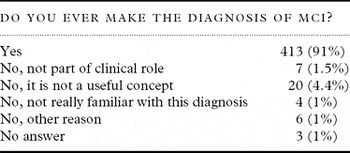
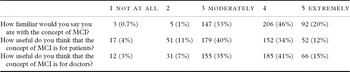
The majority of respondents (91%) said that they made the diagnosis of MCI (Table 1). Table 2 shows the frequency of ratings of familiarity with and usefulness of the concept of MCI. We also looked at these data by classifying individuals based on whether they had rated usefulness of the concept of MCI for doctors as more, the same, or less than for patients. One hundred and ten (24%) thought that the concept was more useful for doctors, 47 (10%) felt it was more useful for patients, and 292 (65%) rated it as the same for both. Some respondents did not consider that MCI was a helpful concept and a few wrote in the free response section that they did not consider it to be a diagnosis. Others commented that they found it useful to be able to give patients a name for their symptoms.
Proportion of respondents reporting that they make the diagnosis of MCI

MCI = mild cognitive impairment.
Familiarity with the concept of MCI and rating of the usefulness of the concept

MCI = mild cognitive impairment.
Seventy-nine percent of the respondents stated that they required a memory complaint from either the patient or an informant to make a diagnosis of MCI. Four percent did not require a memory complaint at all, and 17% did not answer or answered in a way that could not be interpreted. Eighty-two percent reported that they required no or minimal impairment in activities of daily living to be present in order to make the diagnosis of MCI.
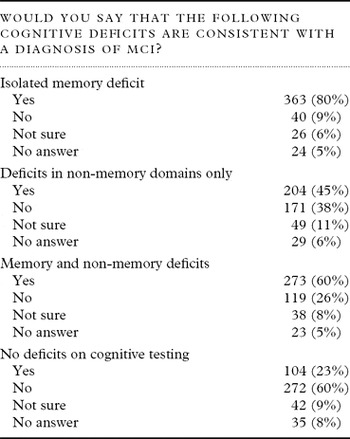
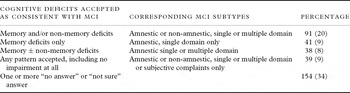
The types of cognitive deficits accepted as consistent with MCI are given in Table 3. The most consistently accepted deficit (80%) was isolated memory impairment. When the responses to all four items by each individual were examined, there was little consistency among respondents in terms of the patterns of cognitive deficits thought by individuals to be in keeping with MCI (Table 4). For example, some respondents would accept only isolated memory impairment as consistent with MCI, whilst others accepted any type of cognitive deficit and others would only accept non-amnestic deficits or required normal objective cognition. Overall, respondents’ answers fell into 12 different patterns, the most common are listed in Table 4. Thirty-two percent of respondents said that they differentiated between subtypes of MCI.
Cognitive deficits reported by respondents to be consistent with a diagnosis of MCI

MCI = mild cognitive impairment.
Patterns of cognitive deficits accepted by respondents and corresponding subtypes of MCI

MCI = mild cognitive impairment.
Twenty-two percent of the respondents thought that patients should score above and/or below a specific cut-off on cognitive testing for a diagnosis of MCI, whereas 62% did not, 13% were not sure, and 4% did not answer. Seventy respondents specified a cut-off value; these values were most frequently based on the Mini-Mental State Examination (MMSE) (n = 46) or the Addenbrooke's Cognitive Examination–Revised (ACE-R) (n = 14) score. There was little agreement in cut-off scores suggested; minimum MMSE scores ranged from 23 to 28.
When asked about cognitive measures used, 93% reported using the MMSE (or test incorporating the MMSE), 59% ACE-R, 19% the Cambridge Cognitive Examination–Revised (CAMCOG-R), and 9% the AD Assessment Scale–Cognitive subscale (ADAS-Cog). Twelve percent used the MMSE alone and 33% used the ACE-R alone. Thirty four percent reported using measures other than those specified in the questionnaire, most commonly referral for neuropsychological assessment (n = 55), DemTect (n = 26) (Kalbe et al., Reference Kalbe2004), and Montreal Cognitive Assessment (MoCA; Nasreddine et al., Reference Nasreddine2005) (n = 19). In the free-response section, several respondents commented that they found it difficult to access neuropsychological assessments for their patients.
Discussion
The results of this questionnaire of 453 UK Old Age Psychiatrists suggest that the concept of MCI has been widely incorporated into UK clinical practice within this speciality, with the vast majority of respondents feeling familiar with the concept, using the term in clinical practice, and rating its usefulness for patients and doctors as at least moderate. It is likely that the weighting of the sample toward consultants (83%) reflects both the nature of the Royal College of Psychiatrists Specialist Register and the mobility of junior doctors in the United Kingdom.
Our findings regarding attitudes toward MCI are in keeping with two related studies. A survey of 420 members of the American Academy of Neurologists (AAN) published in 2010 found that 90% recognized MCI as a clinical diagnosis (Roberts et al., Reference Roberts, Karlawish, Uhlmann, Petersen and Green2010), whereas in a survey of 163 members of the Australian Society for Geriatric Medicine, 69% rated the importance of differentiating MCI from dementia as 4 or 5 on a 5-point Likert scale (1 being not very important and 5 very important) (Mitchell et al., Reference Mitchell, Woodward and Hirose2008). The results of these studies, together with those of this study, suggest that the use of MCI as a diagnostic entity is widely accepted both internationally and across specialties.
In keeping with criteria published for MCI (Portet et al., Reference Portet2006), most respondents in this study felt that a memory complaint from one or both of the patient and an informant was necessary to make the diagnosis of MCI.
Although most respondents reported that an isolated memory deficit was consistent with a diagnosis of MCI (as per the initial Petersen criteria and subsequent criteria for aMCI), there was little agreement among respondents with respect to the patterns of memory and non-memory deficits that they would and would not accept as consistent with MCI and less than a third of the respondents differentiated between subtypes of MCI. This is perhaps not surprising, given that the aspects of MCI criteria that have changed most over time relate to cognitive profiles and subtypes. Interestingly, in the AAN study, 83.4% of respondents reported using amnestic and non-amnestic subtypes of MCI in clinical practice (Roberts et al., Reference Roberts, Karlawish, Uhlmann, Petersen and Green2010). This difference may relate to differences in clinical practice between countries or specialties, although it may be due to differences in the wording of the questions between studies.
The definition of the “objective cognitive deficit,” required for a diagnosis of MCI, also varies within the literature. In the initial Petersen study, no specific cut-off values for memory performance were used, although results showed that the mean performance of MCI subjects was 1.5 standard deviation below that of controls. Several investigators later proposed that objective cognitive deficits should be defined by a cut-off score of 1.5 SD below age-appropriate norms (Geslani et al., Reference Geslani, Tierney, Herrmann and Szalai2005). However, other studies are clear that whereas detailed neuropsychological testing can be helpful in making the diagnosis of MCI, the nature and degree of cognitive deficit should be interpreted in the context of the overall clinical picture (Winblad et al., Reference Winblad2004; Petersen and O'brien, Reference Petersen and O'Brien2006; Portet et al., Reference Portet2006; Albert et al., Reference Albert2011). In the present study, most respondents did not use a specific cut-off score for cognitive performance and there was little agreement among those that did (22% of the sample) as to what this cut-off score should be. This may, in part, reflect the use of short cognitive tests in routine clinical practice, on which people with MCI perform well. Almost a quarter of respondents reported that they considered the absence of any objective deficit on cognitive testing to be consistent with a diagnosis of MCI. This would indicate that some clinicians use the term MCI in a broader sense than it is defined by the present criteria, although again it may reflect a ceiling effect on shorter cognitive tests and possibly lack of access to more detailed neuropsychological assessment.
The finding that 91% of clinicians used the diagnosis of MCI in everyday clinical practice and that cognitive assessment generally involves more detailed assessments than the MMSE alone suggests that clinical practice has evolved toward a more detailed assessment of early cognitive decline and timely diagnosis of dementia, in keeping with the UK National Dementia Strategy (Department of Health, 2009).
The differences in diagnostic practice observed in this study may reflect the differences in the published literature for MCI over time in terms of criteria for cognitive impairment and definition of subtypes. However, these differences in clinical practice may also reflect differences in training or the need to use the concept of MCI in a way that most suits an individual service, for example the resources required for the detailed assessments used in many research studies to establish diagnostically pure samples may not be available or feasible as part of routine clinical practice. The use of more general criteria in clinical practice has the advantage of providing patients that fall between normal function and dementia with a name for their symptoms, but may lead to false reassurance or unnecessary worry. Adherence to a more standardized approach may be achieved via initiatives such as the UK Royal College of Psychiatrists’ Memory Services National Accreditation Programme, which sets standards against which services can be assessed and aims to provide support to identify and address areas for improvement.
Since the data from this study were collected, more key studies related to criteria for MCI have been published (Dubois et al., Reference Dubois2010; Albert et al., Reference Albert2011; Sperling et al., Reference Sperling2011). These studies have focused on the identification of individuals for whom MCI represents the first clinical sign of AD. Most recently, a National Institute on Aging and Alzheimer's Association workgroup published clinical and research criteria for MCI. The clinical criteria developed those previously outlined and expanded on the cognitive characteristics of MCI. The workgroup proposed additional criteria for “MCI due to AD,” incorporating information from general clinical assessment, longitudinal cognitive assessment, genetic factors, and neuroimaging and laboratory investigations to determine whether the etiology of MCI in an individual is consistent with AD etiopathological processes (Albert et al., Reference Albert2011). The research criteria proposed by Albert et al. include the use of cerebrospinal fluid and neuroimaging biomarkers not generally available in clinical practice. The development of these criteria and the associated terminology reflect the recognition that AD represents a disease process that begins and is detectable many years before the onset of dementia.
One limitation of this study is the possibility of response bias, i.e. the clinicians that responded may have been more interested in and/or familiar with MCI than those who did not. Nevertheless, the 453 respondents represent a large proportion of UK Old Age Psychiatrists. With respect to questionnaire design, it is possible that the variability in responses to the questions regarding memory complaints (question 7) and types of cognitive deficit thought to be consistent with MCI (question 8) reflects an issue with wording or format which might have been improved. A more detailed questionnaire would have enabled a more in-depth understanding of current diagnostic practice, although this would likely have been at the expense of response rate.
Conclusions
The results of our survey suggest that the diagnosis of MCI has now become part of everyday clinical practice in the United Kingdom and that clinicians find it a useful term to conceptualize the transitional stage between normal aging and dementia. However, the concept is still evolving and a majority of clinicians do not adhere to strict diagnostic criteria or use further sub-classification to capture the etiology or the specific pattern of cognitive deficit. With the rapid development of biomarkers and refinement of early diagnostic techniques, it is likely that the concept will continue to evolve in terms of its importance in clinical practice.
Conflict of interest
None.
Description of authors’ roles
J. Rodda designed the study, supervised data collection, entered and analyzed data, and wrote the paper. N. Mukadam was involved in study design, assisted with data collection and interpretation, and reviewed the final manuscript. S. Dontham Gandhi collected the data and assisted with analysis and reviewed the final manuscript. Z. Walker was involved in study design, was responsible for the overall supervision of data collection and analysis, assisted with writing of the paper, and approved the final manuscript.