Introduction
Pat Buchanan, in his famous speech at the 1992 Republican National Convention, proclaimed, ‘There is a religious war going on in our country for the soul of America. It is a cultural war, as critical to the kind of nation we will one day be as was the Cold War itself’ (Buchanan Reference Buchanan1992). Characterising this battle as inherently religious, with the stakes no less than the collective ‘soul’ of the country, Buchanan joined a chorus of politicians and journalists of the last three decades claiming that American society was gripped by a potentially disastrous crisis of moral values (Baker Reference Baker2005, p. 2). Much mainstream political rhetoric in the United States continues to frame today's disagreements on social issues such as reproductive rights, gay marriage, stem-cell research, global warming and gun rights as ‘wars’ of cultural, moral and family values. Moreover, many millions of Americans today perceive social problems as stemming from the decline of the so-called ‘traditional family’ and the rise of ‘an amoral popular culture’ (Williams Reference Williams and Williams2003, p. 12). While television, Hollywood films and video games are favourite targets for criticism by culture warriors, popular music has long been seen as an especially potent cause of bad behaviour and cultural decline.
This culture war discourse is usually traced back to the Reagan era, with its lapsarian narrative of an idyllic 1950s America torn asunder by the degenerate 1960s. But decades before Tipper Gore and the Parents' Music Resource Center took on Prince and 2 Live Crew in the late 1980s, many Christian conservatives had been rallying their followers against the inherent dangers of rock music in all its forms.Footnote 1 Beginning in the 1960s, prominent conservative Christian leaders including David A. Noebel, Bob Larson and Frank Garlock preached on the threat of rock music, arguing that not only was the culture of this music morally threatening, but the sounds themselves were inherently dangerous and fundamentally evil, and thus could harm the bodies and minds – and souls – of listeners. These Protestant conservatives essentialised the sonic components of rock music as physically, psychologically and spiritually hazardous for individuals and their salvation but, more importantly, they believed this music threatened the family, the church and the very integrity of the nation itself.
The moral panic over rock 'n' roll beginning in the 1950s has been studied from a range of angles, including analyses of the fears of the music's racial threat and its connection to juvenile delinquency (Tucker Reference Tucker1989; Maddock Reference Maddock1996). But while the role of conservative Christian anti-rock perspectives has been noted in this very journal,Footnote 2 scholarship analysing the specificities of the long-standing conservative Christian campaign against rock music is rare. The few historians or journalists who have paid attention to this movement have largely failed to understand either its particular cultural context or broader political importance, dismissing it as a ‘fringe’ belief, senseless ‘rock bashing’, or as a ‘wacky’ and ‘bizarre’ novelty good only for a ‘laff[s]’ (Martin & Seagrave Reference Martin and Segrave1988, p. vii; Faulkner Reference Faulkner1996, p. 147; Pescovitz Reference Pescovitz2005). For example, Peter Blecha characterises 1950s religious opposition to early rock as ‘a lonely few religious activists … easily dismissed as grumpy throwbacks who were attempting to stop the world’, explicitly likening Christian anti-rock reactionaries to the Ku Klux Klan as extremists with trivially narrow appeal (Blecha Reference Blecha2004, pp. 42, 44–5). The difficulty that scholars have had in understanding this opposition on its own terms can be exemplified by the dismissive title of Eric Nuzum's chapter on 1970s Christian anti-rock rhetoric: ‘Censorshit’ (Nuzum Reference Nuzum2001).Footnote 3 Today's fans of Christian rock, for their part, on the rare occasions that they discuss how their forebears interpreted rock music as an evil threat, usually frame this past as a misguided overreaction to a music that has since become a meaningful expression of personal spirituality. Although studies of rock's perceived racial threat rightly situate much initial religious opposition within larger fears of racial equality and miscegenation, little attention has been paid to the particular mix of religious and political ideology that characterises the specifically conservative Christian opposition to rock, or how this opposition has laid the groundwork for something even more profound in the intervening decades.
In this essay, then, rather than dismissing this long anti-rock campaign as fringe or bizarre (and therefore unimportant), or as simply a facet of a larger moral panic without a logic or significance of its own, I argue that this anti-rock discourse is a crucial part of the postwar rise of contemporary morality politics in the United States that has contributed to the real and significant empowerment of the mainstream conservative political movement. In other words, conservative Christian opposition to rock should not be discounted as the ravings of a few extremists who briefly held the spotlight until most people calmed down; instead, it represents a worldview and rhetorical mode that was once widespread within a small religious subculture but has since developed into one of the central political frames of contemporary American life. In this sense, Christian constructions of rock 'n' roll music as a corrupting force for ‘traditional’ religious, family and national values – sustained by evangelicals long after the initial mainstream panic over rock 'n' roll faded – have become integral to the polarizing of American cultural politics and helped lay the groundwork for today's culture wars.
This project employs methodologies drawn from cultural studies, including Michel Foucault's theory of epistemology that posits that in order to study the dynamic knowledge of a field one must look at its discourses (Foucault Reference Foucault and Sheridan Smith1976). I filter this perspective through a musicological attention to how these early Christian critics critiqued the actual sounds of rock music, not just its lyrics and cultural connotations. In the section that follows, I situate Christian anti-rock discourse within an ongoing ‘moral panic’ around mass culture and American youth which challenges a white, middle-class, Christian, patriarchal social power structure. Then, after introducing the three most important propagators of this discourse, I explore my main theme: the belief that rock's innately harmful musical characteristics could brainwash kids and open them up to spiritual dangers, thus threatening the sanctity and unity of the American nation. Finally, I discuss this anti-rock discourse within a larger history of inflammatory rhetoric and trace the ongoing connections – personal and philosophical – between these anti-rock authors and later culture warriors.
The postwar generation gap and secular ‘moral panic’ over youth and rock
The 1950s reactions against rock 'n' roll were not limited to religious or Christian critics; youth rebellion was widely perceived by the culture at large not just as a religious problem but as a more general social threat. Initial arguments against rock belong to a long history of ‘moral panics’ over social authority under threat from a youthful, feminised, and – especially important in the case of music – racialised popular culture: before Americans worried in the 1950s about the corrupting influence of rock 'n' roll, they worried in the 1920s that jazz endangered the social order (Radano Reference Radano, Radano and Bohlman2000), and in the 1890s that social dancing endangered women's virtue and health (Cook Reference Cook and Washabaugh1998). These struggles over mass culture reflect longstanding anxieties about traditional structures of authority, expressed in recurring moral panics at the intersection of youth, ‘low’ or popular culture, and the market (Springhall Reference Springhall1998, p. 7).
In the postwar era, white middle-class Americans feared the ‘juvenile delinquent’ who read comic books, dressed in jeans and t-shirts, and listened to debased rock 'n' roll. Simon Frith explains that adults feared ‘teenager’ culture as both ‘hedonis[tic]’ and ‘nihilistic’, concerned only with consuming for personal pleasure and vulnerable to sex and violence (Frith Reference Frith1981, p. 183). In both the USA and the UK, these concerns were rooted in class anxiety and a fear of ‘the gradual middle-class adoption of the trappings of working-class teenage life’ (Frith Reference Frith1981, p. 190; Graebner Reference Graebner1986). In the US, the middle-class reaction against rock 'n' roll was especially imbricated with fears of the dangerous body of the racialised Other (Maddock Reference Maddock1996). Thus rock 'n' roll prompted a crisis in white middle-class cultural authority. According to Bruce Tucker, this cultural crisis could be resolved only by changing the American national debate about rock 'n' roll from one centred on race to one centred on youth – resignifying rock's danger as primarily generational rather than racial (Tucker Reference Tucker1989, p. 290).
In part, rock 'n' roll's threat came from the larger spectre of mass culture, in the form of radio, film, television and popular musics, which many in middle-class America saw as a danger to both a national and family home. In 1950 the New York Times published 20 articles that linked mass culture and delinquency; by 1954 this number had more than doubled. Historian James Gilbert described how many in the general public viewed mass culture, including music, as the weapon of a rebellious generation:
It was an outside force guided from media centers in New York and Hollywood. It affected all classes of children. It penetrated the home. And it appeared to promote values contrary to those of many parents. It seemed, in other words, to be the catalyst that provoked generational conflict. (Gilbert Reference Gilbert1986, pp. 77–8)
Furthermore, mass culture was not just an annoyance but a serious danger to the nation overall, a linkage established through the ‘prominent metaphor … of contagion, contamination, and infection’ (Gilbert Reference Gilbert1986, p. 75). Gilbert states that social and political dialogue overlapped in the 1950s such that juvenile delinquency became as dangerous a threat as communism; both were seen as ‘an invasion from the outside, from beyond the family, the community, the group, or the nation [that] threatened treasured institutions’ (Gilbert Reference Gilbert1986). In February 1958, Music Journal, a monthly magazine for music educators, asserted a ‘duty to … comment on the most disgraceful blasphemy ever committed in the name of music. … that popular reversion to savagery known as “Rock ’n' roll” … When [music] is debased to the service of the lowest animal passions, it becomes a definite threat to civilization' (Music Journal 1958, p. 3). Politicians, businessmen and even other musicians utilised the threat of delinquency and its purported link to rock 'n' roll to motivate public sentiment in their favour. Fears of rebellious youth and outrage at rock 'n' roll music even influenced US electoral politics in 1960 as ‘many conservative congressmen [who] were connected with legions of public decency back in their home districts … saw themselves as moral guardians’ and representatives of scores of parents who ‘were quite simply appalled by the loud sexual music’ (Chapple and Garofalo Reference Chapple and Garofalo1977, p. 67). In the realm of social control, rock music was an easy and attractive scapegoat for those trying to control youth and maintain traditional structures of social power; rock became an attractive ‘catch-all’ metaphor for all that was wrong with youth and society, ironically thereby enabling audiences to continue to imbue it with oppositional potential.
The conservative Christian anti-rock movement
While rock music itself gradually lost some of its danger after the 1950s in mainstream America, conservative Christian anti-rock discourse in the 1960s and 1970s continued to regard rock 'n' roll with unabated alarm as a satanic cultural form that led to individual and societal degeneracy. In the early 1960s, church leaders sometimes preached against rock from their pulpits and occasionally attracted wider public attention, but by the late 1960s and 1970s three voices had come to dominate Christian anti-rock discourse: David A. Noebel, Bob Larson and Frank Garlock. Although these three men came from different backgrounds and worked separately on their campaigns against rock, they occasionally cited each other's lectures and publications as supporting evidence for their own. All three published books opposing rock music, and Garlock and Larson each recorded several LP records and audio cassettes, making them especially visible and influential exponents of the evangelical anti-rock position. Far from being on the fringes, these three were popular and well-known figures with prominent voices in conservative Christian debates; furthermore, the majority of conservative Christian anti-rock writings that followed in the 1980s, 1990s and 2000s drew directly upon their ideas and usually cited at least one of them. Larson claimed the authority to speak against rock 'n' roll by highlighting his own prior experience as a rock 'n' roll musician and radio disc jockey, saying: ‘As a minister, I know now what it is like to feel the unction of the Holy Spirit. As a rock musician, I knew what it meant to feel the counterfeit anointing of Satan’ (Larson Reference Larson1971, p. 65).Footnote 4 Noebel, who belonged to the Christian Crusade and whose books were published by the anti-communist John Birch Society, argued that the syncopated beat of rock 'n' roll music hypnotised American youth and brainwashed them into godless communism (Noebel Reference Noebel1965, Reference Noebel1966, Reference Noebel1969, Reference Noebel1974). Garlock, though a less prolific publisher than Larson and less politically oriented than Noebel, had an arguably greater impact on conservative Christian views because of his job in the music department at Bob Jones University and his many preaching tours to colleges, high schools, church camps and church youth meetings (Garlock Reference Garlock1967, Reference Garlock1971).
In their attempts to combat rock music, these writers rely upon a variety of rhetorical strategies including personal anecdotes, dominant legends, received wisdom and popular science. While their writings are self-contradictory and problematically argued, as historians we must be aware of how these sources both reflected and spoke to a Christian subculture that valued populist appeals and decisive calls to action, as well as the authority of personal experience and anecdote. Mark Noll describes this ‘evangelical ethos’ as ‘allow[ing] little space for broader or deeper intellectual effort because it is dominated by the urgencies of the moment’ (Noll Reference Noll1994, p. 12). For these crusading authors, this dangerous music presented an acute threat that needed to be attacked with zealous speed.
Interestingly, Larson and Garlock used very few biblical justifications in their arguments against rock 'n' roll, while Noebel avoided quoting scripture almost completely, suggesting that the theological correctness of their anti-rock stance was already self-evident among their Christian readership and thus the immediate task was to motivate and equip these readers for cultural battle. In contrast, Christian anti-rock writers of the 1980s, 1990s, and 2000s increasingly relied upon theology and biblical hermeneutics to support their arguments (Nekola Reference Nekola2009). This shift towards biblical justification in post-1970s anti-rock discourse reveals not only the growing popularity (and controversy) of Christian popular musics – and thus the need to persuade even Christian readers that rock is dangerous – but also an increasingly separatist mindset, the belief that only scripture offered the moral absolutes and divine truth that could defend conservative Christians from the supposedly steadily encroaching dangers of secular humanism and moral relativism, even within the faith itself.
Killing plants and hypnotizing children with bad music
Conservative Christian critics of rock 'n' roll in the 1960s and 1970s grounded their campaigns, implicitly and often explicitly, on long-standing ideas drawn in part from Greek philosophy, specifically on Classical ideas of music's moral power as fixed, innate and residing in the music itself. Reformers such as Luther and Calvin were influenced through musical treatises and educational curricula shaped by this neo-Platonic idea about the innate power of music, which in time became an accepted part of Christian theology. In the second half of the 20th century, conservative Christian critics of rock 'n' roll including Garlock, Larson and Noebel claimed that the longevity of these ideas demonstrated their truth.
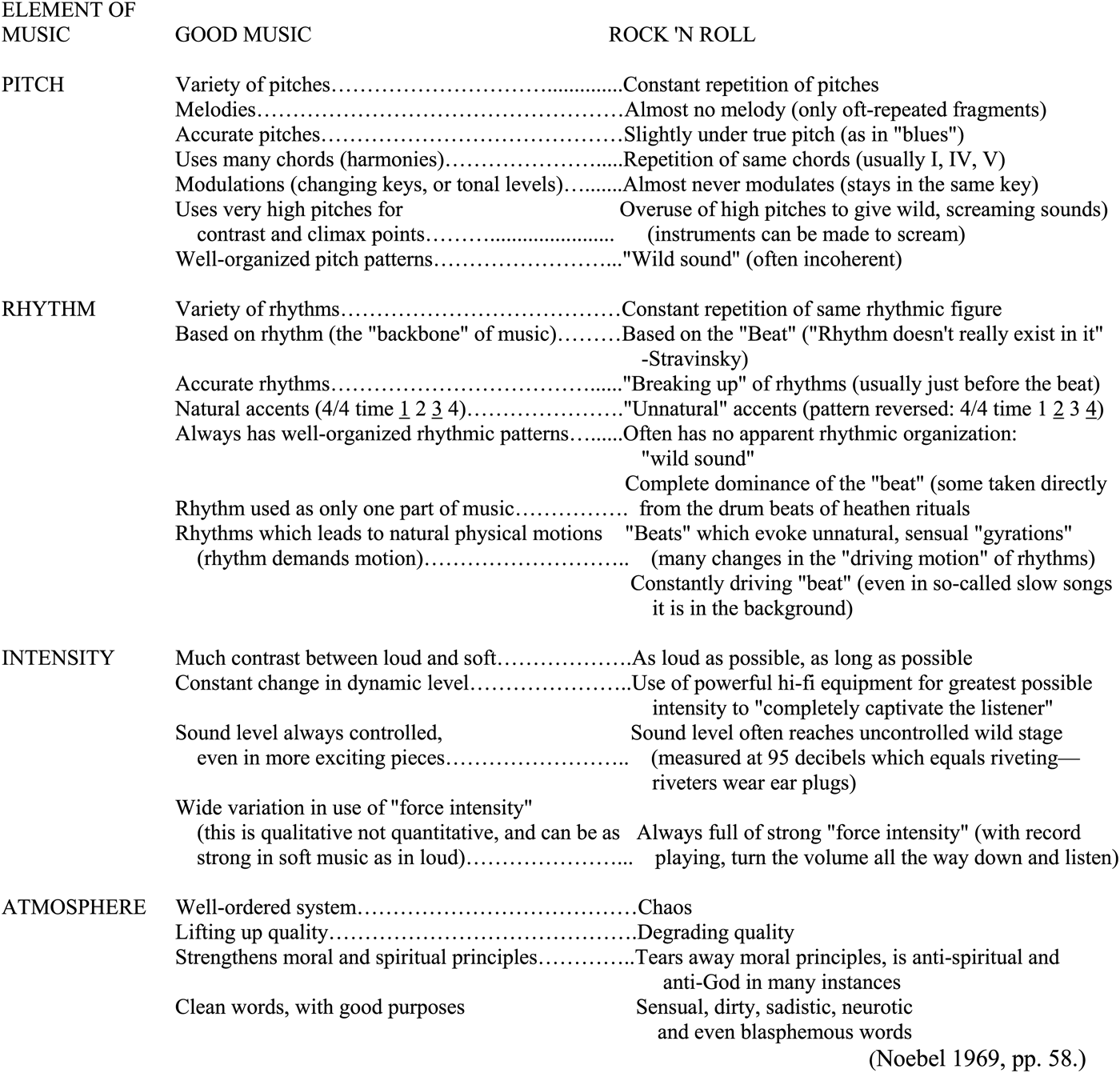
At the core of the problem of rock 'n' roll, they said, was that it was a radically and inherently dangerous music: rock 'n' roll corrupted because the music itself was sonically bad and innately immoral. Good music, they claimed, was harmonic, coherent, organised; it appealed to the intellect and uplifted the spirit. Bad music, by contrast, was primarily rhythmic, unbalanced towards tension and dissonance. Through its appeal to the base and physical elements it could cause long-lasting harm to both the body and the mind. In The Beatles: A Study in Drugs, Sex and Revolution, Noebel (Reference Noebel1969) even provided his readers with a chart that contrasted the characteristics of ‘good music’ with those of ‘rock ’n' roll' (Noebel Reference Noebel1969, p. 57, see Figure 1). Similarly, in The Big Beat: A Rock Blast, Garlock created a list of ‘Characteristics of Good Music in All Ages’, claiming that good music has ‘beauty of design and coherence of form’, and it can only originate from trained, dignified and disciplined composers who ‘show an innate sense of balance between intellectual and emotional elements, and an impeccable sense of the relation between tension and relaxation, contraction and release, dissonance and consonance, motion and response’ (Garlock Reference Garlock1971, pp. 29–30). By contrast, Garlock claimed that:
Any style of music that is all tension or all relaxation is sick music that will make you sick. … I would assert that much of rock music which I have heard is made up of nothing but elements of tension. (Garlock Reference Garlock1971, p. 32)
Garlock attributed rock 'n' roll's harmful physical and mental effects to both its volume and its irregular rhythm, citing as proof of its danger for living beings a series of now (in)famous experiments in which plants that were exposed to rock music died while those shielded from rock flourished.Footnote 5 Arguing that music could harm people as well as plants, Garlock claimed that people are ‘tuned’ to particular musics that correspond to their inner character through a kind of sympathetic vibration, thus suggesting not only that it was possible to see a person's nature through their musical choices, but also that one might ‘re-tune’ oneself and become better or worse through the music listened to (Garlock Reference Garlock1971, p. 9).
Figure 1.

Compared to his concerns about rock music's other potentially dangerous sonic qualities – lack of complex harmonies or melodies, or rock's loud volume – Bob Larson's warnings about the dangerous beat dominate the claims in his many anti-rock books. Larson argued that the speed of the beat was less important than a ‘steady backbeat’, because rock's off-beat accent on beats two and four provoked a ‘sensuous response from the human body’ in contrast to music that engaged the mind and the spirit; ‘elevated forms of music (stirring marches, classical selections)’ are characterised by strong beats on one and three (Larson Reference Larson1970, p. 17). While this sensuous beat was dangerous because it supposedly simulated sexual tension and release, rock 'n' roll's greater threat was to the minds of teenagers, its beat causing them to abandon rational behaviour and self-control (Larson Reference Larson1978, p. 15). Larson claimed that a driving, syncopated rock rhythm induced a ‘hypnosis’ that transformed America's innocent teens into delinquent and rebellious youth:
This subordination of the melody line in rock music to a pulsated rhythm has further psychological consequences. … Any monotonous, lengthy, rhythmic sound induces various stages of trance. It is quite obvious to any qualified, objective observer that teenagers dancing to rock often enter hypnotic trances. When control of the mind is weakened or lost, evil influences can often take possession. Loss of self-control is dangerous and sinful. (Larson Reference Larson1970, pp. 69–70)
The idea that music could bypass the ego of its listeners and directly affect one's fleshly and worldly id was held by many conservative Christian opponents of rock, though they would not have expressed this idea in such Freudian terms. According to Larson's explanation of music's power: ‘There is a definite ethical and moral connotation to music. The spoken word must pass through the master brain to be interpreted, translated, and screened for moral content. Not so with music – especially with rock music’, which can ‘bypass the conscious mind and elicit a physical and/or emotional response’ (Larson Reference Larson1978, p. 110).
Demonic possession and racial contagion
Many conservative Christian critics, including these three authors, offered a specifically religious twist on previous racially tinged moral fears about rock 'n' roll's roots in African and African American culture, claiming that rock's heathen and demonic origins were, by definition, antithetical to Christianity. Importantly, they believed in evil literally incarnate. Just as Billy Graham preached that communism was ‘directed by Satan himself’ (Martin Reference Martin1996, p. 34), they preached that rock music could conjure up demons and the embodied powers of evil on earth. For both Larson and Garlock, rock 'n' roll's ‘heathen’ roots were dangerous for two key reasons: the rhythm was connected to illegitimate religious practices, and the rhythm inspired the body to act without reason and in fulfilment of demonic desire. For example, Larson explained to his readers that the dangerous beat of rock 'n' roll came directly from ‘heathen tribal and voodoo rites’:
The native dances to incessant, pulsating, syncopated rhythms until he enters a state of hypnotic monotony and loses active control over his conscious mind. The throb of the beat from the drums brings his minds to a state when the voodoo, which Christian missionaries know to be a demon, can enter him. This power then takes control of the dancer, usually resulting in sexual atrocities. (Larson Reference Larson1970, p. 130)Footnote 6
Similarly, Garlock claimed that
All one needs to do is make a trip to the places where rock ‘n roll has its roots (Africa, South America, and India) and observe the ceremonies which often go along with this kind of music – voodoo rituals, sex orgies, human sacrifice, and devil worship – to know the direction in which we as a nation are headed. (Garlock Reference Garlock1971, p. 22)
Furthermore, Larson condemned the music of a Hindu ceremony by describing it as ‘jazz-like’ with ‘a steady, pulsating rock’n' roll rhythm' that would lead to a state of trance and subsequent possession by demons (Larson Reference Larson1972, pp. 75–6). Within a religious community that takes seriously demonic seduction and satanic possession as both a mortal threat and a legitimate explanation of the natural and social world, the connection between rock 'n' roll and demons was a truly alarming claim. As Larson repeated throughout his early books, allowing the beat of rock to inspire dance opened oneself up particularly to demonic possession, but even passive listening to the music could summon demons (Larson Reference Larson1972, p. 78).
In addition to their fears of supernatural evil, all three conservative Christian critics' claims about rock's beat were grounded in the concept of a duality between the mind and body drawn, like neo-Platonism, from Classical philosophy. In this conception, white men were most associated with reason, ‘the spirit’ and the mind, while women, children and so-called ‘primitive’ or non-Western peoples existed outside of rationality and were thus associated with the physical, ‘the flesh’ and the body. It is no surprise that these Christian critics aimed their crusade at youth; not only were teens more likely to listen to rock 'n' roll; they were also more susceptible to music's affective powers (and its demons) because they were not fully rational adults. Similarly, conservative Christian critics also argued that non-whites were more vulnerable than whites to rock music's evils and the satanic presence it invited. The notion that race and rhythmic music are linked in dangerous ways can be traced back to longstanding anxieties about the non-rational body – the racialised, feminised and youthful body – as disruptive of the social order. In the 1920s, psychologist Carl Jung claimed that an entire culture could be ‘infected’ by another culture's rhythms (quoted in Golston Reference Golston, Liebermann and Kerr1996). Ronald Radano describes how opposition to the ‘hot rhythm’ of jazz was connected to fears of racial infection, arguing: ‘By the 1910s and 1920s, fears of racial transmission through sound had overtaken other dimensions of social life. For some, hot jazz marked the moral decline of civilization’ (Radano Reference Radano, Radano and Bohlman2000, p. 463).
For conservative Christian anti-rock authors of the 1960s and 1970s, rock music was more than a threat to cultural status and racial purity; Larson and Noebel, like earlier opponents of hot jazz, believed it was a catalyst for the decline of Christianity and American democratic society as a whole (the two being strongly linked in their minds, as will be discussed below). Thus its dangers could not be overstated. Larson claimed that:
[Rock 'n' roll] is now the primary weapon to glorify the perverse and to ridicule religion, patriotism, and morality. It is, indeed, more than just a music. It is a collective noun referring to an unprecedented twentieth century phenomenon that may well be an instrument in the destruction of our Western political, moral, and spiritual foundation. (Larson Reference Larson1970, p. 121; Reference Larson1978, p. 160)
The fervour of this campaign against rock and its destructive beat can be read as a sign of the overwhelming urgency that these Christians felt about the danger Americans were in: rock 'n' roll didn‘t just mark the decline of Christian civilisation and American democratic society, but actually hastened it.
Un-American (musical) activities
The mythos of the United States as a religious nation has permeated American religious and political discourse since John Winthrop declared in 1630 that ‘New England’ ‘shall be as a city upon a hill’ – a Christian community that would stand as a model for the rest of the world (Winthrop Reference Winthrop1630). Dominant American religious and political discourses have often ‘identified America with the cause of Righteousness’, where early settlers came not out of a desire for wealth ‘but out of a hunger for religious freedom’ (Balmer Reference Balmer1999, p. 11). The fight against rock music in the 1960s and 1970s harnessed this long-standing trope in US Christianity: the equation of the American nation with Christian faith and identity, whereby America's enemies were Christ's enemies. Updated for the context of the Cold War, the struggle against communism was a war against a godless threat to both Christianity and the American way of life.
Picking up not far from where Senator Joseph McCarthy left off, groups like the fundamentalist Christian Crusade evangelised not only to save the souls of Americans from damnation but, by winning souls for Christ, sought to combat communism on the home front. The John Birch Society (JBS), named after a Baptist missionary and US Army intelligence officer killed in 1945 by Chinese communists, also sought to galvanise middle-class Americans into conservative politics in order to stop the spread of communism. The JBS found fertile ground in the postwar American Sunbelt, ‘invigorat[ing] a grass-roots movement that had begun to mobilize in local schools and communities to reverse the tide of liberalism’ (McGirr Reference McGirr and Sitkoff2001a, p. 45). And while conservative politicians were careful to distance themselves from JBS leaders who they felt were ‘erratic’, as well as the ‘conspiratorial’ elements of the group's philosophy, they also strove to harness the political power of its member base, calling them ‘some of the solidest conservatives in the country’ (quoted in McGirr Reference McGirr and Sitkoff2001a, p. 48).Footnote 7 These middle-class ‘suburban warriors’, as Lisa McGirr terms them, felt an ‘urgent struggle to safeguard their particular vision of freedom and the “American heritage”’ (McGirr Reference McGirr2001b, p. 4).
For many, America's status as a righteous and moral Christian nation was under threat not just from communism but also from the empowerment of women and people of colour, with ‘civil disobedience’, especially as it was adopted by the Civil Rights movement, posing a particular threat to the nation. William Martin attributes the growth of conservative religious and political organizations in the 1960s to a growing ‘dissatisfaction’ with the social and political changes of the era (Martin Reference Martin1996, p. 80). It is particularly revealing that Billy Graham (a critic of Jim Crow laws and a more moderate ‘neoevangelical’ Christian compared to his anti-rock contemporaries) advised Martin Luther King, Jr. in 1963 to scale back his protests – to ‘put on the brakes a little bit’ and to engage in ‘a period of quietness from which moderation prevails’ (quoted in Martin Reference Martin1996, p. 79).
In addition, conservative Christians' discontent reflected a perceived decline of religious influence in society and rise of a ‘moral relativism’. Christian philosopher and apologist Francis Schaeffer claimed the social problems of the postwar era were rooted in a rampant individualism that displaced a striving after God. According to Schaeffer's reasoning, American society was divided into two groups: those who believed in God, universal truth and a divine moral code, and those who believed that morality had become ‘simply what the consensus of the church or the consensus of society makes up its mind is desirable at that particular moment’ (Schaeffer Reference Schaeffer1968, p. 80). Schaffer claimed that this moral relativism was spread by the media, especially to young people (Schaeffer Reference Schaeffer1968, pp. 44–5). Later, Schaeffer would sound a now-familiar Christian call to arms: in response to this invasion of godless secular humanism, Christians needed to stand up and ‘join the battle’ for ‘freedom’ and ‘truth’ (Schaeffer Reference Schaeffer1981, pp. 53–4).
Drawing on a problematic but appealing theory of cause-and-effect and popular fears of brainwashing through the mass media, conservative Christians were quick to link social changes to the corrupting influence of popular culture. David Noebel was especially vehement in this regard, decrying rock 'n' roll, as well as the politically subversive music of the folk revival, as part of a communist conspiracy to weaken American youth. His Communism, Hypnotism, and the Beatles focused on the specific national consequences of rock music's mind-altering power. According to Noebel, the Soviet Union prohibited rock music at home, which was largely true.Footnote 8 But rather than hailing this as a sign of American freedom, Noebel saw it as evidence that the Soviets better understood rock's danger and used it as a secret weapon to destroy the mental facilities of American youth, thus hastening the US's downfall:
The communists, through their scientists, educators and entertainers, have contrived an elaborate, calculating and scientific technique directed at rendering a generation of American youth useless through nerve-jamming, mental deterioration and retardation. The plan involves conditioned reflexes, hypnotism, and certain kinds of music. The results, designed to destroy our nation, are precise and exacting. … If the following scientific program destined to make our children mentally sick is not exposed, mentally degenerated Americans will indeed raise the communist flag over their own nation. (Noebel Reference Noebel1965, p. 1)
Noebel's passion against rock music was also rooted in his equation of communism with atheism, and thus music that threatened the nation also threatened Christianity. The fear of godless communism in the Cold War era can be linked to Soviet leader Joseph Stalin's attacks on religious power; even the comparatively moderate Billy Graham preached against the unmitigated and ‘Satan[ic]’ evils of communism (Martin Reference Martin1996, p. 34). Noebel, though less well known than Graham to the mainstream US public, capitalised on this conflation of communism and atheism, also fiercely decrying the communist threat long after Graham softened his anti-communist rhetoric in the 1960s. While anti-communist groups began to fall out of political favour after the defeat of Barry Goldwater in 1964, Noebel continued to appeal to mainstream evangelicals and conservative politicians (Martin Reference Martin1996, p. 345).
Working within these ideological currents within the conservative Christian community, Noebel claimed that communists used folk and rock music ‘to prepare [youth] for riot and ultimately revolution in order to destroy our American form of government and the basic Christian principles governing our way of life’ (Noebel Reference Noebel1965, p. 10). Even folk musicians, such as Pete Seeger and Bob Dylan, had the power to hypnotise and ‘nerve-jam’ children and turn them into juvenile delinquents who threatened both the nation and the church. In Rhythm, Riots, and Revolution: An Analysis of the Communist Use of Music, Noebel argued that the US folk revival was a communist front that endangered American children, especially those in public schools, with popular folk music songbooks such as Simon and Schuster's seemingly innocuous Fireside Book of Folk Songs. Although Noebel expounded at length on the dangerous stories and lyrics of folk songs, especially the ‘Communist revolutionary song’ ‘We Shall Overcome’, he repeatedly stressed that the sound of the music itself – as with rock 'n' roll – had the power to hypnotise and ‘mentally destroy’ listeners, rendering them powerless against communist messages (Noebel Reference Noebel1966, pp. 38–48). Even into the 1970s Noebel equated rock music with chaotic noise, arguing that the music fulfilled the communist goal of creating ‘sick’ and weak minds that would weaken American youth and leave them defenceless against a communist takeover by ‘degenerated Americans’ (Noebel Reference Noebel1974, pp. 2–3).
To redeem America and to reclaim its Christianity and morality, they all argued, meant nothing less than waging a ‘war’ on this music, and these sources all reinforce a rhetoric of war in their vocabulary. Larson warned that rock music had created a ‘moral crisis’ in the church where ‘God's people are forced to take a stand against that which is evil’ (Larson Reference Larson1971, p. 9). Said Garlock, rock music was ‘the enemy of Christ and one of the instruments by which the devil gains control over the lives of people and drags them into spiritual wickedness’. For him there was no possibility for compromise: ‘There are two sides in this battle. Which side are you on?’ (Garlock Reference Garlock1971, p. 27). Noebel warned that ‘the undeclared battle to subvert the values of our youth is without parallel, so far as I know, in the history of the world’ (Noebel Reference Noebel1982, p. 14). For these conservative critics of rock music in the 1960s and 1970s, a ‘war’ over culture had already begun.
From communist plots to mainstream culture wars
The conservative Christian anti-rock criticism of the 1960s and 1970s thus brought together a specifically religious understanding of musically inherent rhythmic power with the postwar discourse of the generation gap, both of which situated particular transgressive power in children, youth and the racialised Other. The historical context of the 1960s and 1970s within which this criticism emerged also witnessed the authority of traditional national and religious institutions being challenged, both directly and indirectly, by social and political groups but also by assertions of individual autonomy. The discursive shift from Cold War to culture war – from a communist threat to a crisis in family values – reveals how political and Christian conservatives relocated perceived dangers from originating outside of American borders to being produced on the inside (Balmer Reference Balmer1999, p. 98).
For contemporary readers, secular and religious alike, for whom communism is no longer a serious threat and with whom Christian apocalyptic rhetoric does not resonate, the writings of anti-rock crusaders like Noebel, Garlock and Larson may seem extreme and unusual. Yet we can see, in both their rhetoric and appeal to this conservative Christian community, elements of a style that has continued to shape conservative politics in the United States. Writing in Harper's Magazine in 1964, Richard Hofstadter attempted to understand of this brand of inflammatory rhetoric, terming it ‘the paranoid style in American politics’. This ‘style’ was neither new nor peculiarly American, argued Hofstadter, but it characterised a variety of ethnic and religious conflicts throughout American history (Hofstadter Reference Hofstadter1964, p. 86). It is perhaps unfortunate that Hofstadter chose to use the term ‘paranoid’, a stigmatising term that makes it difficult to encounter such rhetoric non-prejudicially. Nevertheless, his identification of this rhetorical style helps us make sense of certain features of conservative Christian anti-rock writings. For instance, Hofstadter's description of the ‘enemy’ resonates with Noebel's portrayal of the typical communist:
… he is a perfect model of malice, a kind of amoral superman – sinister, ubiquitous, powerful, cruel, sensual, luxury-loving. … Very often the enemy is held to possess some especially effective source of power: he controls the press; he has unlimited funds, he has a new secret for influencing the mind (brainwashing); he has a special technique for seduction. … (Hofstadter Reference Hofstadter1964, p. 85)
Furthermore, the ‘paranoid’ views the enemy's threat as an ‘apocalyptic’ conspiracy against which compromise or anything short of complete elimination leads to defeat, since ‘what is at stake is always a conflict between absolute good and absolute evil’ (Hofstadter Reference Hofstadter1964, p. 82). The power in this paranoid discourse, says Hofstadter, comes from its expression, not by so-called ‘lunatics’ or ‘disturbed minds’, but ‘by more or less normal people’ (Hofstadter Reference Hofstadter1964, p. 77). Without necessarily accepting Hofstadter's pathologising terms, but acknowledging the persuasiveness of his rhetorical analysis, to regard these conservative Christian critics as a ‘lunatic fringe’ is to short-sightedly dismiss the power of their discursive strategies. Instead, these critics should more productively be seen as an example of a group that adopts a long-standing (if provocative) rhetorical tradition that frames political conflict within a dichotomised Biblical understanding of right and wrong, good and evil, truth and corruption. In Hofstadter's terms, these men were ‘renegades’ – saviours of a sort – because ‘in the spiritual wrestling match between good and evil which is the paranoid's archetypal model of the world, the renegade is living proof that all the conversions are not made by the wrong side. [The renegade] brings with him the promise of redemption and victory’ (Hofstadter Reference Hofstadter1964, p. 85). Vanquishing the enemy that is rock music, these Christian anti-rock critics believed, would help restore America's righteousness and social order.
Significant evidence connects conservative Christian anti-rock discourse with mainstream culture wars, strongly suggesting that this discourse has, with minimal revision, become central to conservative political ideology and strategy since the 1980s. Noebel has transformed his fight against rock music and atheistic communism into a Francis Schaeffer-style battle against popular culture and godless secular humanism more generally.Footnote 9 His shift away from denouncing communism as the source of all social evils towards blaming what he sees as America's increasing secularism and abandonment of Christian ‘family values’ mirrors the broader shift in conservative Christian ideology. And although few Americans outside conservative Christianity might know his name, Noebel has been ‘warmly endorsed’ by powerful political leaders such as former Vice President Dan Quayle, Conservative Caucus leader Howard Phillips, and the late leader of Coral Ridge Ministries, D. James Kennedy, whose Christian media empire claims over three million followers (Martin Reference Martin1996, p. 345).
Noebel also has the attention of James Dobson, prominent leader of the Focus on the Family ministries and, according to the New York Times in 2005, ‘the nation's most influential evangelical leader’ (Kirkpatrick Reference Kirkpatrick2005). Just as Dobson argued that it is ‘difficult to overestimate the negative impact’ of rock music, it is perhaps easy to underestimate the impact of Dobson on contemporary American culture. Journalist Dan Gilgoff, in his 2007 The Jesus Machine: How James Dobson, Focus on the Family, and Evangelical America are Winning the Culture War, argues that, as the figurehead of the most powerful Christian Right organization in the 2000s, Dobson's influence on American culture is substantial. Not only did Dobson have intimate ties to the George W. Bush White House, but his personal endorsement appears to have shifted the balance in at least four senate races in 2004 (Gilgoff Reference Gilgoff2007, p. 12). But Dobson's primary power comes from his influence on the worldview of millions of Christian conservatives via his media empire. Said US Senator John Thune of South Dakota, who with Dobson's help defeated incumbent Tom Daschle in 2004: ‘There is literally a generation of Americans who have grown up with Dr Dobson. His voice is golden out there, particularly among Americans who had a conservative value system or conservative worldview. He could speak to them like nobody else could, absent somebody like Billy Graham’ (quoted in Gilgoff Reference Gilgoff2007, p. 6). Importantly, Dobson's huge popularity as a child psychologist came not only from his ability to articulate cultural dangers, but from his problem-solving advice to parents, and many Americans credit Dobson with helping save their marriages and families (Gilgoff Reference Gilgoff2007, p. 7).
Through Dobson, with his seemingly more fatherly ‘Billy Graham’ appeal and powerful political connections, Noebel's conservative beliefs about culture have become hegemonic in conservative Christian circles and highly influential in mainstream conservative politics. In his best-selling 1990 book whose title bespeaks danger and war, Children at Risk: Winning the Battle for the Hearts and Minds of Your Children, Dobson draws on Noebel's ideas, warning against the threat of secular humanism and the dangers of rock: ‘Perpetual and pernicious exposure to rock music’, is responsible for suicide, rape and the general ‘moral undermining of the next generation’; the only ‘bulwarks’ against secular humanism in the US are the Christian church and the institution of the family (Dobson and Bauer Reference Dobson and Bauer1990, pp. 6, 23). Echoing Noebel's warnings of brainwashing, Dobson claims that rock music works like a psychological conditioner, its ‘deafening noises, eerie lights, wild behavior, and godless philosophies’ causing teens to ‘lose [their] grip on reality’ and become ‘slaves’ of their peer group (Dobson and Bauer Reference Dobson and Bauer1990, p. 5). Not only was action required on the part of parents, whom Dobson urged to ‘lock’ the metaphorical ‘doors’ – or shut down the conduits of evil – against such dangers as alcohol, marijuana, pornography, homosexual experimentation and premarital sex (Dobson and Bauer Reference Dobson and Bauer1990, pp. 6–7), but Dobson argued for the need to formally train American children to be wise against the attacks of the inherently amoral secular humanistic culture and its cultural products and by-products, including the ‘pounding’ beat of rock that ‘throbs’ in their ears:
Our children need formal, well-designed instructional programs regarding the issues that affect them … They should be taught the dangers of pornography, the evils of abortion, the risk of AIDS and venereal disease, the importance of premarital virginity, the damage done by heavy metal music, the debate over creation vs. evolution, and the objectives of the gay-rights movement. (Dobson and Bauer Reference Dobson and Bauer1990, p. 268)
Dobson here singles out heavy metal music for criticism, but impugns ‘rock’ in general throughout the book. Dobson actively promoted Noebel's educational centre, Summit Ministries, in Children at Risk as well as on his Focus on the Family radio programme, causing a flood of applications to the programme and an immediate three-fold increase in enrolment.
Since the 1990s, other conservative but not overtly religious culture warriors such as William J. Bennett and Michael Medved have also spoken and written about the dangers of popular media as both the cause and effect of a rebellious, hedonistic and selfish culture. While Dobson still argued for the ‘hypnotic’ danger of the sounds of rock music, other conservative critics like Bennett and Medved no longer locate the danger of the music in its sounds but rather in libertine lyrics and cultural connotations of sex, violence and rebellion. In ‘What Hath the Beatles Wrought? Rock-&-Roll and the Collapse of Authority’, Bennett, who was Ronald Reagan's Secretary of Education and George H.W. Bush's ‘Drug Czar’, alternately sees rock as cause and symptom of a changing culture. While arguing that the intrinsic character of ‘freedom’ in rock music played an important role in the downfall of communism by ‘convinc[ing] the residents of Eastern Europe that they could live more interesting lives without communism’, he also warns that this same liberating music led directly to ‘libertinism’ in the US. The problem, claimed Bennett, was not the music itself, but rather the social collapse of American society into one where individuals, parents and even record companies lacked the ability to stand up for moral discipline and responsibility. While not expressly invoking Schaeffer's diatribes against secular humanism, Bennett indirectly relies upon Schaeffer's warning against moral relativism, arguing that America has become a nihilistic cultural environment that says there are ‘No Limits’ (Bennett Reference Bennett1997, p. 72). Similarly, conservative radio talk show host Michael Medved also adopts a Schaefferist position, arguing that the millennia-old Judeo-Christian worldview is being challenged by an opposition who cares for nothing more than an unrestricted ‘freedom of expression’ (Medved Reference Medved1992, p. 23). Medved sees himself as a populist culture warrior, representing American values against an encroaching moral relativism; he criticises popular music for promoting violence and misogyny, attacking traditional religious values, ‘eras[ing] all gender distinctions’, and promoting ‘cold, bitter, and sadistic [and] … fleeting sex’ (Medved Reference Medved1992, pp. 77–9, 97–8, 102–3, 105–6). He argues that the US is caught in ‘cultural battles’ against ‘standards’ and mourns Americans' supposedly lost ability to pass moral judgment on art and entertainment (Medved Reference Medved1992, p. 21). According to William D. Romanowski, Medved was very successful in telling his audience of conservative Christians exactly ‘what they wanted to hear’ – that the secular media, including popular music, was a powerful evil force that could corrupt children (Romanowski Reference Romanowski1996, p. 56).
The religious aspects of this discourse have, however ironically, become increasingly pervasive as the conservative Christian worldview has sought to become the normative, secular, ‘American’ worldview. In the 1980s, the influential Parents Music Resource Council (PMRC) sought to educate parents as to how rock music, especially heavy metal and punk, could endanger US children with its messages of ‘explicit sex’ and violence that they believed promoted teen pregnancy, rape, murder, suicide and substance abuse. Although the PMRC publicly fought to get the music industry to self-censor – or at least to provide consumers with product warnings about the explicit nature of an album's lyrics or visual imagery – and it sought broad appeal as a public organization not rooted in religion or party politics, it is significant that they called on a rocker-turned-youth pastor from a Northern Virginia church to explain rock's ‘worst excesses’ for its first major audience that included community leaders, politicians and members of the general public (Gore Reference Gore1987, p. 4). The PMRC, along with Bob Larson and Christian anti-feminist Phyllis Schlafly, also endorsed the Fullerton, California ‘Back in Control Training Center’, run by a former Orange County probation officer, whose goal it was to ‘de-punk’ and ‘de-metal’ troubled teens (McLellan Reference McLellan1985; Bivins Reference Bivins2008, pp. 97–8). Tipper Gore, co-founder of the PMRC, acknowledged that destructive listening habits could be a symptom and not simply a cause of a teen's social problems, yet her Raising PG Kids in an X Rated Society relies heavily on anecdotes and sensational news items that strongly imply causal connections. Furthermore, as she issues her ‘call to arms’ for American parents, Gore reifies the metaphor of war, in this case allying parents and children against the influences of a corrupt society (Gore Reference Gore1987, p. xiii).
Particular tropes of early conservative Christian anti-rock discourse have been perpetuated for years by Christian and secular media critics alike: the inherent susceptibility of children and youth, fears of rebellion against parental and institutional authority, and the framing of struggles over culture as nothing less than a ‘war’. Although most of these later critics seem to worry less about rock's dangerous beat, they continue to argue that rock music's corrupting lyrical messages and debased culture endangers kids and, by extension, the nation. In addition, the presidency of George W. Bush, including the terrorist attacks of 11 September 2001, revitalized ‘Christian nationalism’ in the US, bringing fears of moral relativism and battles over biblical good and evil back into mainstream political and social rhetoric (Goldberg Reference Goldberg2006). In 2004, ‘progressive evangelical’ Jim Wallis explained the influence of this ‘theology of war’, saying: ‘The language of “righteous empire” is employed with growing frequency. The roles of God, church, and nation are confused by talk of an American “mission” and “divine appointment” to “rid the world of evil”’ (quoted in Goldberg Reference Goldberg2006, p. 192).
Revitalized by fears of terrorism from without and anti-Americanism within, social conservatives continue to assert that rock music endangers youth and the nation, drawing upon now-familiar themes. For instance, political insiders Myrna Blyth and Chriss Winston revive the trope of cultural ‘infection’, arguing that popular media is a ‘virus’ against which Americans need to ‘inoculate’ their children (Blyth and Winston Reference Blyth and Winston2007, pp. 92–3). They attack a wide variety of media while also specifically discussing the dangers of popular musics. Hip hop, with its ‘vile, angry … lyrics that use extreme and inflammatory language to insult and degrade America’ helps to widen what they call the ‘Patriotism Gap’ in American society by separating children from their parents and by teaching them that rebellion, promiscuity, and violence against others and against the political system are cool (Blyth and Winston Reference Blyth and Winston2007, pp. 6, 10–11).
‘Obscenity-laden lyrics’ and sexually ‘explicit videos’ worry Blyth and Winston more than any driving beat, but these authors echo Noebel et al. in their anxiety over how ‘antiestablishment messages’ in popular music and media endanger the nation, especially compared to the PMRC's primary concern for the health and wellbeing of children (Blyth and Winston Reference Blyth and Winston2007, p. 92). Blyth and Winston cite Bill O'Reilly of Fox News, who warned: ‘Every American should be condemning rappers and rock stars who sell children subversive values’ (quoted in Blyth and Winston Reference Blyth and Winston2007, p. 104). Like Gore, they frame parenting as a ‘battle’ to be won but, more like Noebel, in this war the very nation is at stake:
It is part of our responsibility as Americans and as parents to teach our kids what this nation stands for. … We [must] help them to build the backbone they will need to stand up to those who would harm our country from afar as well as those critics in schools and the media who tell them and teach them over and over again a dark, negative story of America. Our enemies have been using vast resources to misrepresent our way of life and to indoctrinate their children, whenever and wherever they can, to hate America. … (Blyth and Winston Reference Blyth and Winston2007, p. 6)
In response to these dangers, they argue that Americans need to teach their children how to reject bad music like rock and appreciate good music and culture, especially patriotic songs and American classics like Copland's Appalachian Spring (perhaps forgetting that in 1953 Copland was questioned by Senator McCarthy on suspicion of being a communist). As they say, ‘To put it quite simply: America's existence as “the shining city on the Hill” really does depend on it’ (Blyth and Winston Reference Blyth and Winston2007, pp. 6, 106–7). Although Blyth and Winston do not make an explicitly Christian argument against popular culture, they decry the US's increasing ‘moral relativism’ and claim that ‘faith in religion’ is a core American value. Through these meaningful vocabulary choices and by recalling Winthrop's ‘city upon a hill’ metaphor, they encode a Christian message, appealing to a particular insider audience while simultaneously normalizing Christian nationalism for secular readers.
Epilogue: maintaining ecclesiastical control in the rock era
Within contemporary American evangelical discourse, many claim that American patterns and ideals have been disrupted by widespread cultural and social change in the 1960s and 1970s that encompassed everything from Vatican II to the counterculture to the civil rights, gay rights and feminist movements. All of these, they believe, succeeded in undermining traditional American institutions and the social order and have led to a culture war for both the control and the soul of the nation. This cultural clash with the secular world has come to define evangelicals and provide them with a common purpose. The late Wheaton College theologian Robert Webber argued that Christians continue to be in constant conflict with a secular world. Borrowing the Biblical words of Paul from Ephesians 6:12, Webber stated that Christians struggle ‘against the rulers, against the authorities, against the powers of this dark world and against the spiritual forces of evil in the heavenly realms’ (quoted in Webber Reference Webber1986, p. 16). Webber's relatively moderate theology may differ from the more conservative theology of Noebel and Dobson, and they may disagree on the terms of the fight, but he shares their conviction that Christians are still fighting a spiritual battle against evil.
This article reveals how the 1960s and 1970s conservative Christian campaign against rock music differed from mainstream opposition to rock in important ways, and how this campaign has directly influenced contemporary culture warriors who continue to argue that popular culture, especially music, imperils the American nation. Central to the rhetoric of this ‘war’ over rock in both conservative Christian arguments since the 1960s and conservative political arguments since the 1980s is the crucial need to discipline and control American youth in order to maintain structures of authority in the church and the nation.
Yet, while the US's culture wars continue, especially around issues of sexuality and reproduction, the increasing fragmentation of popular culture has made music (as well as television and film) a less effective target for conservative Christians seeking to rally followers against specific cultural forms. Just as never again will a single newscaster be named ‘the most trusted man in America’, as Walter Cronkite was in the 1960s and 1970s, so too will a single music chart of top hits never again reflect a broadly shared public taste. Today Billboard has charts for more than 20 different genres of music, and the proliferation of distribution channels has segmented American audiences along lines of style, politics, age, class and other dimensions. While the ‘mainstream’ was always a problematic, even imaginary, construct, the fact remains that the collapse of even a rhetorical dominant culture presents a problem for Christian culture warriors: it's harder to wage a unified culture war when American culture itself has become radically fragmented and decentralised. For Christian cultural critics, evil may still be everywhere, threatening the nation on multiple fronts, but it may prove difficult to sustain a battle when the relatively coherent dominant cultural targets for their ‘paranoid style’ no longer exist.