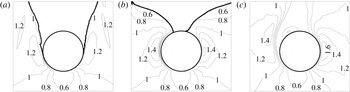
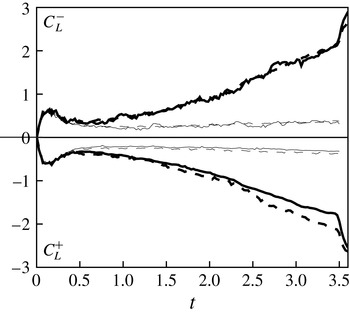
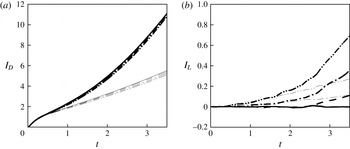
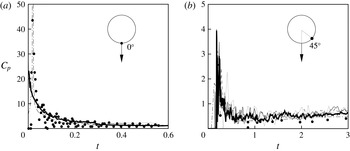
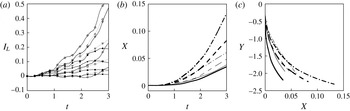
1 Introduction
Water entry is a fundamental problem of scientific interest and engineering importance, e.g. for ship slamming (Faltinsen Reference Faltinsen1990), ballistic impact (Lee, Longoria & Wilson Reference Lee, Longoria and Wilson1997) as well as biological applications such as water-walking animals (Glasheen & McMahon Reference Glasheen and McMahon1996). In this paper we consider the two-dimensional (2-D) problem of the water entry of a horizontal cylinder with radius
 $R^{\ast }$
, density
 $\unicode[STIX]{x1D70C}_{s}^{\ast }$
, spinning with angular velocity
 $\unicode[STIX]{x1D714}^{\ast }$
about its axis. At
 $t^{\ast }=0$
the cylinder impacts a quiescent free surface with vertical entry velocity
 $-V_{0}^{\ast }=-V^{\ast }(t^{\ast }=0)$
. The water is considered incompressible with density
 $\unicode[STIX]{x1D70C}^{\ast }$
and kinematic viscosity
 $\unicode[STIX]{x1D708}^{\ast }$
, under the effect of gravity
 $g^{\ast }$
. We use a Cartesian system
 $\boldsymbol{x}^{\ast }$
with the origin at the initial undisturbed free surface,
 $y$
-axis pointing upwards and
 $\unicode[STIX]{x1D714}^{\ast }$
positive counterclockwise (figure 1).
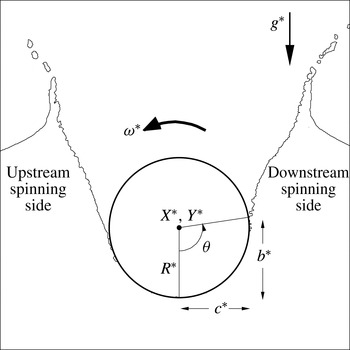
Two-dimensional (2-D) water entry of a cylinder, density
 $\unicode[STIX]{x1D70C}_{s}^{\ast }$
and radius
 $R^{\ast }$
, entering with initial downward vertical velocity
 $V_{0}^{\ast }=V^{\ast }(t^{\ast }=0)$
and spin
 $\unicode[STIX]{x1D714}^{\ast }$
, into quiescent water of density
 $\unicode[STIX]{x1D70C}^{\ast }$
, under the effect of gravity
 $g^{\ast }$
. The cylinder position and velocity are
 $(X^{\ast }(t^{\ast }),Y^{\ast }(t^{\ast }))$
,
 $(U^{\ast }(t^{\ast }),V^{\ast }(t^{\ast }))$
. The contact point is measured equivalently with angle from the negative
 $y$
-axis
 $\unicode[STIX]{x1D703}(t^{\ast })$
, horizontal coordinate
 $c^{\ast }(t^{\ast })$
, or height from the bottom of the cylinder
 $b^{\ast }(t^{\ast })$
.

The broad stages of water entry of a blunt body are generally understood from experiments (e.g. May Reference May1975): (I) initial shock-wave stage, (II) the flow forming and open cavity stages and (III) the collapsing cavity and subsequently fully wetted stage. The initial shock stage (I) is highly transient (typically of order milliseconds) with features associated with the trapped air (Chuang Reference Chuang1966), vapour pressure (Yung et al.
Reference Yung, Sandström, He and Minta2010) as well as air and water compressibility (Hagiwara & Yuhara Reference Hagiwara and Yuhara1976; Hicks et al.
Reference Hicks, Ermanyuk, Gavrilov and Purvis2012). These include the initial pressure distributions, the amplitude of the maximum impact pressures (Moghisi & Squire Reference Moghisi and Squire1981) and associated structural considerations, the generation of a fast horizontal outgoing
 $Re$
-dependent jet (Thoroddsen et al.
Reference Thoroddsen, Etoh, Takehara and Takano2004) and spray (May Reference May1975). However, for the mass ratios of
 $O(1)$
considered in this study, the shock stage is of small importance to the subsequent entry characteristics, and the flow forming and open cavity stage (II) is generally largely unaffected by and independent of the initial stage (May Reference May1975; Battistin & Iafrati Reference Battistin and Iafrati2003). After longer time, stage (III) describes the closing and collapse of the cavity and bubble dispersion and finally the fully submerged vortical flow around the body with little effect from the free surface (Truscott, Epps & Techet Reference Truscott, Epps and Techet2012).
Our interest here is the complex flow forming and open cavity intermediate stage (II), corresponding to non-dimensional time
 $t^{\ast }V_{0}^{\ast }/R^{\ast }\sim O(1)$
. Small capillary number
 $Ca$
(
 $\equiv \unicode[STIX]{x1D70C}^{\ast }\unicode[STIX]{x1D708}^{\ast }V_{0}^{\ast }/\unicode[STIX]{x1D70E}^{\ast }\lesssim O(0.1)$
for hydrophilic surfaces, where
 $\unicode[STIX]{x1D70E}$
is the surface tension coefficient) is known to affect the development of the bulk of the flow and may inhibit the formation of the cavity (May Reference May1951; Vella, Lee & Kim Reference Vella, Lee and Kim2006; Duez et al.
Reference Duez, Ybert, Clanet and Bocquet2007) resulting in increased vorticity (Truscott et al.
Reference Truscott, Epps and Techet2012). Ding et al. (Reference Ding, Chen, Liu, Zhang, Gao and Lu2015) provide a study relating the contact line evolution to the cavity characteristics for surfaces with variable wettability, Weber number
 $We\equiv \unicode[STIX]{x1D70C}{V_{0}^{\ast }}^{2}R^{\ast }/\unicode[STIX]{x1D70E}\sim O(10)$
–
 $O(10^{2})$
and
 $Fr\sim O(10^{4})$
. Our interest is in the case of relatively large
 $V_{0}^{\ast }$
for which surface tension effects on the bulk of the flow can be neglected. The relevant physics is dominated by the free surface measured by the Froude number
 $Fr=V_{0}^{\ast }/(2g^{\ast }R^{\ast })^{1/2}$
, in particular whether it is subcritical
 $Fr\lesssim 1$
(hereafter denoted as
 $Fr^{{<}}$
) or supercritical
 $Fr\gtrsim 1$
(hereafter denoted
 $Fr^{{>}}$
); and also the spin ratio
 $\unicode[STIX]{x1D6FC}=\unicode[STIX]{x1D714}^{\ast }R^{\ast }/V_{0}^{\ast }$
. For this problem, the relevant features of interest are the time evolutions of the free surface, the near-body velocity and pressure and the forces on the body. The velocity and trajectory of the body depend also on the mass ratio
 $m=\unicode[STIX]{x1D70C}_{s}^{\ast }/\unicode[STIX]{x1D70C}^{\ast }$
.
Viscosity, measured by the Reynolds number
 $Re=2V_{0}^{\ast }R^{\ast }/\unicode[STIX]{x1D708}^{\ast }$
, in the absence of spin, is argued to have a small effect on the free-surface development and negligibly so on the forces (and hence trajectory), over a range of moderate
 $Re\sim O(10^{2}{-}10^{5})$
(Moghisi & Squire Reference Moghisi and Squire1981; Zhu, Faltinsen & Hu Reference Zhu, Faltinsen and Hu2007). For non-zero spin,
 $\unicode[STIX]{x1D6FC}\neq 0$
, the presence of viscosity leads to asymmetry of the flow which affects the forces and trajectory. The precise value of moderate
 $Re$
, however, is not qualitatively important and appears to merely decrease/delay the flow asymmetries due to
 $\unicode[STIX]{x1D6FC}$
(Coutanceau & Menard Reference Coutanceau and Menard1985). In this study we account for viscous effects by including a moderate
 $Re$
, typically of
 $O(10^{2})$
.
The detailed kinematics and dynamics of the flow forming and open cavity stage of the bluff-body water entry problem of interest have been reported in many experiments. During the initial flow forming stage, water piles up on the sides of the body. For imposed constant
 $V^{\ast }(t^{\ast })=V_{0}^{\ast }$
for different
 $Fr$
, Miao (Reference Miao1989) measured the time development of the crest of the pileup. For relatively small time
 $t^{\ast }V_{0}^{\ast }/R^{\ast }\lesssim O(0.1)$
, they identify the crest with the spray root location and find its upward vertical velocity independent of
 $Fr$
. As time progresses, the water separates from the body at the contact points, forming a cavity and the splash sheath. The development (upward movement with time along the body) of the contact points (which is unrelated to viscous separation, Sun & Faltinsen Reference Sun and Faltinsen2006), determines the formation or not of trailing air-entraining cavities (e.g. Aristoff & Bush Reference Aristoff and Bush2009). For constant velocity, at the limit
 $t^{\ast }V_{0}^{\ast }/R^{\ast }$
,
 $Fr\rightarrow \infty$
the contact point is shown to stop before the equator at an angle of
 $55.04^{\circ }$
(Birkhoff Reference Birkhoff2012; Gurevich Reference Gurevich2014). For cylinders with
 $m\gtrsim 1$
and/or supercritical
 $Fr=Fr^{{>}}$
, the contact point evolution stops closer to the equator, leading to the subsequent generation of air-entrained cavities (Lin & Shieh Reference Lin and Shieh1997a
). However, for cylinders with
 $m\lesssim 1$
and/or subcritical
 $Fr=Fr^{{<}}$
, the contact points continue to move until the cylinders become fully wet, without entraining air (Miao Reference Miao1989; Colicchio et al.
Reference Colicchio, Greco, Miozzi and Lugni2009). The precise definition/identification of the contact point, and the general dependence of its evolution on finite
 $Fr^{{<}}$
or
 $Fr^{{>}}$
, and
 $m$
are still not fully understood.
For fixed
 $V_{0}^{\ast }$
the initial (
 $t^{\ast }V_{0}^{\ast }/R^{\ast }\sim O(0.1)$
) evolution of the hydrodynamic drag coefficient
 $C_{D}$
is relatively well understood:
 $C_{D}$
increases to some peak value before decreasing, a behaviour shown to be independent of
 $Fr^{{>}}$
(e.g. Campbell & Weynberg Reference Campbell and Weynberg1980). At later times,
 $t^{\ast }V_{0}^{\ast }/R^{\ast }\sim O(1)$
, the evolution of
 $C_{D}$
depends on the value of
 $Fr$
. For
 $Fr^{{>}}$
:
 $C_{D}$
continues to decrease asymptotically with time to
 $C_{D}\sim 1$
, again independent of
 $Fr$
. For
 $Fr^{{<}}$
:
 $C_{D}$
reaches some minimum value at
 $t^{\ast }V_{0}^{\ast }/R^{\ast }\sim 0.5$
and then increases again with time (Miao Reference Miao1989). The rate of the subsequent increase depends on
 $Fr$
, being slower for greater
 $Fr$
. The general dependence of
 $C_{D}$
on
 $Fr^{{<}}$
remains to be fully elucidated.
Truscott & Techet (Reference Truscott and Techet2009a
) show that the forces and trajectories of bluff bodies are closely related to the location and movement of the contact points, as they affect the cavity characteristics. Indeed, for cylinders with prescribed
 $V_{0}^{\ast }$
and larger
 $Fr^{{>}}$
, the contact point and
 $C_{D}$
evolutions are approximately independent of
 $Fr$
. However, for
 $Fr^{{<}}$
Miao (Reference Miao1989) report that the contact point upward movement continues and
 $C_{D}$
increases, with time, with rates that decrease with
 $Fr$
. Miao (Reference Miao1989) attempt to explain the increase in
 $C_{D}$
by accounting for a buoyancy term, but found this insufficient (see Miao Reference Miao1989, figures 5–30). The precise correlation between the development of the contact points and
 $C_{D}$
remains unclear.
When spin is present,
 $\unicode[STIX]{x1D6FC}\neq 0$
, Truscott & Techet (Reference Truscott and Techet2009b
), studying freely falling spheres, observe asymmetries in the free surface development, the forces and the trajectory. The contact points shift and the cavity angle tilts, both towards the downwards, ‘upstream’, spinning side. The dependence of the shift and tilt on
 $\unicode[STIX]{x1D6FC}$
, and whether these behave qualitatively similarly when
 $V^{\ast }(t^{\ast })=V_{0}^{\ast }$
, are not clear. The estimated
 $C_{D}$
is slightly decreased with
 $\unicode[STIX]{x1D6FC}\neq 0$
, and the estimated lift coefficient
 $C_{L}$
(towards the ‘downstream’ spinning side) is found to be reduced than when the free surface is absent. As expected, the trajectory curves towards the downstream spinning side with the lateral displacement increasing with
 $t^{\ast }V_{0}^{\ast }/R^{\ast }$
and
 $\unicode[STIX]{x1D6FC}$
.
Some of the features associated with spin can be related to the problem of a submerged translating spinning bluff body started impulsively. For the latter problem for the cylinder, numerical studies (Badr & Dennis Reference Badr and Dennis1985; Chen, Ou & Pearlstein Reference Chen, Ou and Pearlstein1993; Mittal & Kumar Reference Mittal and Kumar2003; Cheng & Luo Reference Cheng and Luo2007) showed asymmetry in the flow and the pressure distribution on the cylinder. The pressure is lower on the downstream spinning side, and the corresponding lift coefficient
 $C_{L}$
increases with
 $t^{\ast }V_{0}^{\ast }/R^{\ast }$
and
 $\unicode[STIX]{x1D6FC}$
. Cheng & Luo (Reference Cheng and Luo2007) showed that vorticity generation is reduced in the presence of boundaries parallel to the translation motion, and consequently
 $C_{L}$
is decreased. For the present problem with a free surface, the dependence of
 $C_{L}$
on
 $t^{\ast }V_{0}^{\ast }/R^{\ast }$
and
 $\unicode[STIX]{x1D6FC}$
is qualitatively similar, while the presence of the (deformed) free-surface boundary serves a similar role in reducing vorticity generation (Truscott et al.
Reference Truscott, Epps and Techet2012) and hence lift (Truscott & Techet Reference Truscott and Techet2009b
).
Except for limiting cases of small times,
 $Fr\rightarrow \infty$
, and relatively simple geometries, theoretical results (von Kármán Reference von Kármán1929; Wagner Reference Wagner1932) are generally not available, and one must resort to numerical computations for the solution of the water impact problem. Many of these are potential flow solvers, typically generalizing the solution of Wagner (Reference Wagner1932) to finite
 $Fr$
and more general geometries. These obtain very satisfactory comparisons with experiments for both the free surface and forces (e.g. Mei, Liu & Yue Reference Mei, Liu and Yue1999; Battistin & Iafrati Reference Battistin and Iafrati2003; Sun & Faltinsen Reference Sun and Faltinsen2006; Yan et al.
Reference Yan, Liu, Kominiarczuk and Yue2009), generally up to the point where the free surface breaks up. Navier–Stokes free-surface flow solvers, such as level set immersed boundary methods (Zhang et al.
Reference Zhang, Zou, Greaves, Reeve, Hunt-Raby, Graham, James and Lv2010), constrained interpolation profile (CIP) methods (Zhu et al.
Reference Zhu, Faltinsen and Hu2007) and recent developments of Cartesian volume of fluid (VOF) methods (Weymouth & Yue Reference Weymouth and Yue2010, Reference Weymouth and Yue2011), offer powerful solution tools but are still relatively expensive computationally (Sun & Faltinsen Reference Sun and Faltinsen2006). Because of the violent free-surface, Lagrangian meshless methods seem to be particularly attractive and robust since they avoid difficulties associated with tracking of the complex interfaces, common in non-Lagrangian solvers.
In this work, we modify and develop a smoothed particle hydrodynamics (SPH) method for this class of problems. SPH is an explicit meshless Lagrangian method robust for complex geometries that obtains extremely high
 $O(N)$
efficiencies (Liu & Liu Reference Liu and Liu2003; Monaghan Reference Monaghan2012). SPH has been applied to broad ranges of violent free-surface flows (e.g. Monaghan Reference Monaghan1994; Oger et al.
Reference Oger, Doring, Alessandrini and Ferrant2006), including water entry of cylinders (Saghatchi, Ghazanfarian & Gorji-Bandpy Reference Saghatchi, Ghazanfarian and Gorji-Bandpy2014), obtaining generally good predictions of the kinematics such as the free surface (e.g. Colagrossi & Landrini Reference Colagrossi and Landrini2003) but less so for the dynamics such as pressures and forces (e.g. Veen & Gourlay Reference Veen and Gourlay2009; Maruzewski et al.
Reference Maruzewski, Le Touzé, Oger and Avellan2010). The latter is associated with inherent instabilities in the original method resulting in development of spurious oscillations in the dynamics (e.g. Balsara Reference Balsara1995; Swegle, Hicks & Attaway Reference Swegle, Hicks and Attaway1995; Kiara, Hendrickson & Yue Reference Kiara, Hendrickson and Yue2013a
). These can be mitigated by inclusion of numerical damping which typically introduces additional (tuneable) parameters (e.g. Gomez-Gesteira et al.
Reference Gomez-Gesteira, Rogers, Dalrymple and Crespo2010). Kiara et al. (Reference Kiara, Hendrickson and Yue2013a
), Kiara, Hendrickson & Yue (Reference Kiara, Hendrickson and Yue2013b
) propose a modified SPH (mSPH) method which retains the robustness and efficiency of the original SPH but regularizes the inherent instabilities without introducing tuneable parameters. The mSPH method obtains accurate and convergent predictions for both the kinematics and dynamics for a variety of canonical violent free-surface flows.
We apply mSPH here to the study of free-surface impact of a cylinder with or without spin, and for when the cylinder velocity is prescribed and constant (
 $m=\infty$
) or freely falling (
 $m=O(1)$
). We first validate the method for the fully submerged impulsive motion, obtaining good comparisons with existing computations of the kinematics and dynamics for this problem. We then turn to the water impact problem and focussing on a range of Froude numbers
 $Fr\in [0.463,3]$
and spin ratios
 $\unicode[STIX]{x1D6FC}\in [0,2.45]$
, we obtain systematic numerical results generally for
 $t^{\ast }V_{0}^{\ast }/R^{\ast }\leqslant 3$
. We provide a precise definition for the contact point measured by the angle of the contact point
 $\unicode[STIX]{x1D703}$
from the negative vertical axis (§ 2). We quantify the time developments of the: contact point locations
 $\unicode[STIX]{x1D703}(t^{\ast }V_{0}^{\ast }/R^{\ast })$
(§ 4.3.1); drag force
 $C_{D}(t^{\ast }V_{0}^{\ast }/R^{\ast })$
(§ 4.3.2); drag and lift impulse coefficients
 $I_{D}(t^{\ast }V_{0}^{\ast }/R^{\ast })$
,
 $I_{L}(t^{\ast }V_{0}^{\ast }/R^{\ast })$
(§ 4.4.3); and cylinder trajectories (§ 4.5), all as functions of
 $Fr$
,
 $\unicode[STIX]{x1D6FC}$
and
 $m$
.
Our mSPH simulations obtain the detailed evolutions of the free surface and contact point location (figures 8–10); velocity field (figure 8); surface pressures (figures 15 and 24); forces on the cylinder (figure 16); and trajectories (for
 $m=O(1)$
: figure 27); all compared to and in excellent agreement with available experiments. The predictions over a range of
 $Fr^{{<}}$
and
 $Fr^{{>}}\!$
, with and without
 $\unicode[STIX]{x1D6FC}$
, and for infinite and finite
 $m$
, allow us to elucidate and quantify the key mechanisms that determine the evolutions of
 $\unicode[STIX]{x1D703}$
,
 $C_{D}$
and
 $C_{L}$
and their dependence on
 $Fr$
,
 $\unicode[STIX]{x1D6FC}$
and
 $m$
(§ 4).
For
 $\unicode[STIX]{x1D6FC}=0$
(and
 $V^{\ast }(t^{\ast })=V_{0}^{\ast }$
), the evolutions of
 $\unicode[STIX]{x1D703}$
and
 $C_{D}$
are qualitatively different depending on whether
 $V_{0}^{\ast }$
is greater or smaller than that of the inward propagating wavefront generated during the impact. We classify the results in terms of the value of
 $Fr$
. For
 $Fr^{{>}}$
,
 $C_{D}$
increases to a maximum value and then decreases to a constant
 $C_{D}\simeq 1$
; while
 $\unicode[STIX]{x1D703}$
increases monotonically and approaches a constant value, approximately
 $75^{\circ }$
; both within
 $t^{\ast }V_{0}^{\ast }/R^{\ast }\simeq 0.5{-}1$
. These limiting values are independent of
 $Fr^{{>}}$
. For
 $Fr^{{<}}$
, the physics is complicated by the interaction of the body and the inward propagating wave. In this case, the contact points continue their motion above the equator, with an appreciable constant angular velocity, until the cylinder becomes fully wet. At
 $t^{\ast }V_{0}^{\ast }/R^{\ast }\simeq 0.5$
the decreasing
 $C_{D}$
increases with time again to reach a second maximum. The magnitude of
 $C_{D}(t^{\ast })$
during this second increasing stage is synchronized with the increase in
 $\unicode[STIX]{x1D703}(t^{\ast })$
. By subtracting the buoyancy associated with
 $\unicode[STIX]{x1D703}$
,
 $C_{b}(\unicode[STIX]{x1D703})$
, we find that the remaining dynamic component
 $C_{d}=C_{D}$
–
 $C_{b}$
, is similar between
 $Fr^{{<}}$
and
 $Fr^{{>}}$
. These findings explain the seeming contradicting behaviours in
 $C_{D}$
reported between experiments with
 $Fr^{{>}}$
(Campbell & Weynberg Reference Campbell and Weynberg1980) and
 $Fr^{{<}}$
(Miao Reference Miao1989). By varying
 $Re=O(10^{2})$
in the simulations, we confirm that these behaviours are independent of (moderate)
 $Re$
in agreement with Zhu et al. (Reference Zhu, Faltinsen and Hu2007).
When spin is present,
 $\unicode[STIX]{x1D6FC}\neq 0$
, and for prescribed cylinder velocity (
 $V^{\ast }(t^{\ast })=V_{0}^{\ast }$
), asymmetries in the free surface and contact points are small. In this case, the lift
 $C_{L}$
depends on
 $\unicode[STIX]{x1D6FC}$
, as expected, but also on the (almost symmetric) contact point position
 $\unicode[STIX]{x1D703}$
which is a function of
 $Fr$
(and negligibly of
 $\unicode[STIX]{x1D6FC}$
). For the latter dependence, both
 $\unicode[STIX]{x1D703}$
and
 $C_{L}$
increase with decreasing
 $Fr$
.
For the freely falling (
 $m=O(1)$
) case, we express the Froude number, drag and lift in terms of the evolving vertical cylinder velocity
 $V^{\ast }(t^{\ast })$
. We find that the motion of the contact points,
 $\dot{\unicode[STIX]{x1D703}}(t)$
, and
 $C_{d}(t)$
can be obtained from fixed entry results with the same instantaneous velocity. This provides a simple way to compute the trajectory of freely falling cylinders. Lateral motion due to spin is towards the downstream spinning side and results in an additional increase in
 $\unicode[STIX]{x1D703}$
on that side. The key effect of both the lateral motion of the cylinder and the asymmetry in the contact points is a reduction in lift, compared to that for fixed velocity entry with the same
 $\unicode[STIX]{x1D6FC}$
.
2 Problem statement
We consider the problem of a two-dimensional water entry of a cylinder as shown in figure 1. As the cylinder descends into the initially undisturbed water, it creates a flow with velocity
 $\boldsymbol{u}^{\ast }(\boldsymbol{x}^{\ast },t^{\ast })$
and pressure
 $P^{\ast }(\boldsymbol{x}^{\ast },t^{\ast })$
. We define the contact points as the two intersection points separating the wetted (
 $S^{\ast }$
) and dry sections on the cylinder surface. We specify the instantaneous position of the contact point with the angle
 $\unicode[STIX]{x1D703}(t)$
(measured from the negative
 $y$
-axis), or equivalently with its horizontal coordinate
 $c^{\ast }(t^{\ast })$
or the vertical distance from the bottom of the cylinder
 $b^{\ast }(t^{\ast })$
(figure 1). The pressure force on the body is found by integrating the pressure
 $P^{\ast }$
on the wetted surface of the cylinder,
 $\boldsymbol{F}^{\ast }(t^{\ast })=\int _{S^{\ast }}P^{\ast }(t^{\ast })\boldsymbol{n}\,\text{d}S$
.
The key parameters are the Froude number
 $Fr$
, the spin ratio
 $\unicode[STIX]{x1D6FC}$
and the mass ratio
 $m$
. We hereafter use
 $m=\infty$
or
 $O(1)$
to refer to, respectively, the cases with a prescribed constant cylinder velocity
 $V_{0}^{\ast }$
or free-falling cylinder with
 $V^{\ast }(t^{\ast })$
. The Reynolds number is fixed
 $Re=600$
, unless mentioned otherwise. Hereafter all quantities are non-dimensionalized with length, velocity and density scales
 $R^{\ast }$
,
 $V_{0}^{\ast }$
and
 $\unicode[STIX]{x1D70C}^{\ast }$
respectively, denoted by symbols without superscript
 $(\cdot )^{\ast }$
. We define the pressure, lift and drag and (lift, drag) impulse coefficients,
 $C_{p}(t)\equiv P^{\ast }(t)/(\unicode[STIX]{x1D70C}{V_{0}^{\ast }}^{2}/2)$
,
 $C_{L,D}(t)\equiv {F^{\ast }}_{x,y}(t)/(\unicode[STIX]{x1D70C}R^{\ast }{V_{0}^{\ast }}^{2})$
and
 $I_{L,D}(t)\equiv \int ^{t}F_{x,y}^{\ast }(\unicode[STIX]{x1D70F})\,\text{d}\unicode[STIX]{x1D70F}/(\unicode[STIX]{x1D70C}{R^{\ast }}^{2}V_{0}^{\ast })$
. In addition to the evolutions of the free surface and flow field during the cavity forming stage, we are interested in quantifying the time development of
 $\unicode[STIX]{x1D703}(t)$
,
 $C_{p}(t)$
,
 $C_{D}(t)$
,
 $I_{L}(t)$
,
 $I_{D}(t)$
and the cylinder trajectory
 $(X(t),Y(t))$
as functions of
 $Fr$
,
 $\unicode[STIX]{x1D6FC}$
and
 $m$
.
3 The modified SPH (mSPH) scheme for nonlinear wave–body interaction
The mSPH scheme we use is based on the standard Lagrangian meshless SPH method (Monaghan Reference Monaghan1994). The two key modifications in mSPH are the introduction of controlled dissipation through a time-periodic spatial filter and a global error metric that assesses the accuracy of the simulation. The former removes inherent instabilities of the original SPH without introducing tuneable numerical parameters, while the latter validates the accuracy of the predictions. Details of these are in Kiara et al. (Reference Kiara, Hendrickson and Yue2013a ,Reference Kiara, Hendrickson and Yue b ). For completeness, we outline here the key elements of the mSPH method applied to this problem.
3.1 The mSPH scheme
In mSPH, following the original SPH (Monaghan Reference Monaghan1994), we discretize the fluid domain into
 $N$
Lagrangian fluid particles
 $a$
with constant mass
 $\unicode[STIX]{x1D707}_{a}$
, centred at
 $\boldsymbol{x}_{a}$
, velocity
 $\boldsymbol{u}_{a}$
and density
 $\unicode[STIX]{x1D70C}_{a}$
. The pressure
 $P_{a}$
is obtained from an equation of state (EOS) with artificial sound speed
 $C$
:
 $P_{a}=C^{2}(\unicode[STIX]{x1D70C}_{a}-1)$
, typically an order or magnitude greater than the characteristic velocity of the problem. Equations describing the motion of each particle are obtained from momentum and mass conservation. The pressure gradients and velocity divergence are computed via kernel interpolation (KI) over neighbouring particles using a smooth, analytic kernel function
 $W$
(e.g. Morris, Fox & Zhu Reference Morris, Fox and Zhu1997; Dehnen & Aly Reference Dehnen and Aly2012). The bandwidth and compact support of
 $W$
are
 $h=O(\unicode[STIX]{x0394}x)$
, with
 $\unicode[STIX]{x0394}x$
denoting an average initial particle spacing, and
 $\unicode[STIX]{x1D6FC}h$
, with
 $\unicode[STIX]{x1D6FC}=O(1)$
. Incompleteness of the KI near the free surface is generally mitigated via reformulations of the governing equations (e.g. Liu & Liu Reference Liu and Liu2003; Colagrossi, Antuono & Le Touzé Reference Colagrossi, Antuono and Le Touzé2009). The governing equations are:
 $$\begin{eqnarray}\displaystyle & \displaystyle \frac{\text{d}\boldsymbol{x}_{a}}{\text{d}t}=\boldsymbol{u}_{a}, & \displaystyle\end{eqnarray}$$
 $$\begin{eqnarray}\displaystyle & \displaystyle \frac{\text{d}\boldsymbol{u}_{a}}{\text{d}t}=-\mathop{\sum }_{b}\frac{\unicode[STIX]{x1D707}_{b}}{\unicode[STIX]{x1D70C}_{b}}(P_{a}+P_{b})\unicode[STIX]{x1D735}W_{ab}-Fr_{0}^{-2}, & \displaystyle\end{eqnarray}$$
 $$\begin{eqnarray}\displaystyle & \displaystyle \frac{\text{d}\unicode[STIX]{x1D70C}_{a}}{\text{d}t}=\unicode[STIX]{x1D70C}_{a}\mathop{\sum }_{b}\frac{\unicode[STIX]{x1D707}_{b}}{\unicode[STIX]{x1D70C}_{b}}(\boldsymbol{u}_{a}-\boldsymbol{u}_{b})\boldsymbol{\cdot }\unicode[STIX]{x1D735}W_{ab}. & \displaystyle\end{eqnarray}$$
With explicit time integration, the method obtains
 $O(N)$
efficiency. Here, we integrate (3.1)–(3.3) in time using a fourth-order Runge–Kutta scheme with Courant condition
 $\unicode[STIX]{x1D6FE}=O(1)$
and time step
 $\unicode[STIX]{x0394}t=\unicode[STIX]{x1D6FE}h/C$
.
The original SPH has instabilities associated with spatial discretization, weak compressibility and the presence of a free surface (e.g. Stacey Reference Stacey1994; Balsara Reference Balsara1995; Swegle et al.
Reference Swegle, Hicks and Attaway1995; Kiara et al.
Reference Kiara, Hendrickson and Yue2013a
). The instabilities manifest mainly in large spurious oscillations in the dynamics (e.g. Molteni & Colagrossi Reference Molteni and Colagrossi2009; Kiara et al.
Reference Kiara, Hendrickson and Yue2013a
). To quantify these spurious oscillations in the dynamics, without comparison to external data, Kiara et al. (Reference Kiara, Hendrickson and Yue2013b
) introduced the global error metric
 ${\mathcal{Q}}(t)=(HL)^{-1}\sum (\text{d}\boldsymbol{u}/\text{d}t)^{2}\unicode[STIX]{x1D707}/\unicode[STIX]{x1D70C}$
. The authors show that fast Fourier transform (FFT) and moving FFT of
 ${\mathcal{Q}}(t)$
measure the amplitudes and growth rates of the spurious oscillatory components in the dynamics, assessing the validity of the dynamics without comparison to external data.
Instabilities in SPH are typically damped numerically via problem-specific treatments with corresponding numerical parameters (e.g. Gomez-Gesteira et al.
Reference Gomez-Gesteira, Rogers, Dalrymple and Crespo2010), which generally require comparisons with external data. In mSPH, instabilities are dissipated via low order spatial filtering of both
 $u$
and
 $\unicode[STIX]{x1D70C}$
:
 $$\begin{eqnarray}\displaystyle \boldsymbol{u}_{a,smooth}=\unicode[STIX]{x1D70E}^{-1}\mathop{\sum }_{b}\unicode[STIX]{x1D707}_{b}W_{ab}\boldsymbol{u}_{b}/\unicode[STIX]{x1D70C}_{b},\quad \unicode[STIX]{x1D70C}_{a,smooth}=\unicode[STIX]{x1D70E}^{-1}\mathop{\sum }_{b}\unicode[STIX]{x1D707}_{b}W_{ab}, & & \displaystyle\end{eqnarray}$$
where
 $\unicode[STIX]{x1D70E}=\sum _{b}\unicode[STIX]{x1D707}_{b}W_{ab}/\unicode[STIX]{x1D70C}_{b}$
. The filter is applied periodically every
 ${\mathcal{N}}$
time steps. Unlike other SPH implementations, no other treatments or modifications are applied. Kiara et al. (Reference Kiara, Hendrickson and Yue2013b
) showed that this filtering provides a robust, quantifiable dissipation
 $Ch/6{\mathcal{N}}\unicode[STIX]{x1D6FE}(\unicode[STIX]{x1D6FB}^{2}\boldsymbol{u}+O(h))$
. In this study we use
 ${\mathcal{N}}=Re(Ch/12\unicode[STIX]{x1D6FE})$
, which can be shown to be consistent with the addition of a viscous term
 $Re^{-1}\unicode[STIX]{x1D6FB}^{2}\boldsymbol{u}_{a}$
on the right-hand side of (3.2).
The computational domain is an impermeable tank of length
 $L$
and height
 $H=H_{\ell }+H_{u}$
, where
 $H_{\ell }$
,
 $H_{u}$
are respectively the (initial) heights below and above the free surface. From theoretical considerations and confirmed by numerical tests, we find that results are independent of computational domain size with
 $H_{u}\gtrsim O(5)$
,
 $H_{\ell }\gtrsim CT/2$
and
 $L=2H_{\ell }\gtrsim CT$
, where
 $T$
is the duration of the simulation. For this
 $H_{\ell }$
, it can be deduced from Kiara et al. (Reference Kiara, Hendrickson and Yue2013a
) that stability is obtained for
 $C\gtrsim O(Fr^{-2})$
. In this study, unless otherwise noted, we use
 $C=20$
for
 $Fr\lesssim O$
(0.5) and
 $C=10$
for
 $Fr\gtrsim O$
(0.5). The choice of
 $C$
has a small effect for early times only when the flow velocities are greater (see figure 13 for an example of convergence of mSPH with
 $C$
).
For boundary conditions at the wall and cylinder surface we assume no slip, no flux and no normal acceleration relative to the boundary. These boundary conditions are realized via ghost particles with imposed velocity and normal pressure gradient. Values of the latter are obtained by mirroring the velocities and pressures of either fluid particles (for the wall boundaries) or of interpolation points in the fluid domain (for the cylinder, Marrone et al.
Reference Marrone, Colagrossi, Antuono, Colicchio and Graziani2013), all typically within a distance
 $4h$
along the boundary normal. In mSPH, following the original SPH (Monaghan Reference Monaghan1994), we do not explicitly define or track a free surface nor impose any free-surface boundary conditions. However, for illustration purposes (e.g. figure 5) we obtain a free surface from mSPH Lagrangian particles in post-processing. We use a novel scheme that classifies every particle
 $a$
in the simulation as belonging to (fluid domain, vicinity of the free surface, vicinity of small liquid drops/sprays), and assign markers
 $r_{a}=(1,0,-1)$
respectively. The markers are determined comparing estimates of the instantaneous number density
 $d_{a}$
and fluid neighbours
 $n_{a}$
at
 $a$
, against threshold values for
 $d_{u}$
and
 $n_{u}$
. The values of
 $d_{u}$
and
 $n_{u}$
are obtained from the initial (uniform) particle distribution assuming smoothly advected flows from the initial conditions (Kiara et al.
Reference Kiara, Hendrickson and Yue2013a
). Finally, the free surface is obtained as the zero of the interpolated
 $r$
on a regular grid of size
 $h^{\ast }$
(
 ${\gtrsim}O(h)$
). The scheme is simple, efficient and robust (on the choice of
 $d_{u}$
and
 $n_{u}$
) and obtains excellent results (see for example figure 6).
Initially the undisturbed free surface and cylinder bottom are at height
 $H_{\ell }$
above the bottom of the tank. The fluid particles are initially placed below the free surface on a regular lattice with uniform spacing
 $\unicode[STIX]{x0394}x$
, and hydrostatic conditions
 $\boldsymbol{u}^{0}=0$
,
 $\unicode[STIX]{x1D70C}^{0}=1-2\unicode[STIX]{x1D6FF}y$
, where
 $\unicode[STIX]{x1D6FF}=(4Fr^{2}C^{2})^{-1}$
, and
 $\unicode[STIX]{x1D707}=h^{2}\unicode[STIX]{x1D70C}^{0}$
. The remaining domain above the free surface is empty. In SPH the incompleteness of KI near the free surface generates local spurious accelerations at the beginning of the simulation (Kiara et al.
Reference Kiara, Hendrickson and Yue2013a
). These are typically addressed with initial-damping schemes (e.g. Monaghan Reference Monaghan1994). Here, initially, the highest fluid particles are positioned at a distance
 $\unicode[STIX]{x0394}x/2$
below the free surface, which can be shown to eliminate all spurious accelerations at the beginning of the simulation. The flow is advanced in time from (3.1)–(3.3) with a fourth-order Runge–Kutta time integrator. The computational cost is
 $O(N)$
and the code is parallelized with a message passing interface (MPI). Other than the considerations discussed above, the mSPH simulations we report do not contain any tuneable parameters.
The mSPH algorithm is extensively validated with external data for a wide variety of flows, with some examples shown in Kiara et al. (Reference Kiara, Hendrickson and Yue2013b
). Validations cases include flow past infinite plates, with imposed plate velocity or longitudinal pressure gradient; free-surface propagating waves; flow past a free-surface piercing object; collapse of a liquid column; dam break followed by impact; sloshing in swaying tanks; water entry of a wedge; flow past an impulsively started translating fully submerged cylinder, without and with spin. For all our results the time evolutions of
 ${\mathcal{Q}}(t)$
are free of spurious oscillations, verifying the validity of the dynamics. All validations confirm that mSPH captures physical viscous effects and converges as
 $O(h^{2})$
and
 $O(C^{-2})$
. In the next paragraph we show mSPH validation for flow past a fully submerged cylinder started impulsively to translational and rotational motion where we use the exact same algorithm with the free-surface impact problem of interest, varying only the initial position of the cylinder relative to the free surface. The submerged problem bears physical similarities with the free-surface impact problem of interest, but the submerged case has been relatively better studied.
3.2 Submerged translating spinning cylinder started impulsively
Here we show representative results for the initial transient phase,
 $t\leqslant 3$
, of the flow due to impulsive translational and spinning motion of a fully submerged cylinder that, as we show later, contains salient features that elucidate spin effects relevant to the free-surface impact problem. With regards to the numerical algorithm the free-surface impacting and fully submerged simulations differ only in the initial conditions: keeping
 $L$
and
 $H_{u}$
the same, the submerged cylinder is initially immersed in the centre of a deep tank with minimum water depth
 $2H_{\ell }$
. However, the submerged case has been studied relatively more experimentally (e.g. Coutanceau & Menard Reference Coutanceau and Menard1985) and numerically (e.g. Badr & Dennis Reference Badr and Dennis1985; Badr, Dennis & Young Reference Badr, Dennis and Young1989; Chen et al.
Reference Chen, Ou and Pearlstein1993; Mittal & Kumar Reference Mittal and Kumar2003; Martin-Alcantara, Sanmiguel-Rojas & Fernandez-Feria Reference Martin-Alcantara, Sanmiguel-Rojas and Fernandez-Feria2015). Available data for this problem focus primarily on instantaneous streamlines and the time evolutions of the lift and drag coefficients. We note here that, to our best knowledge, pressure distributions are generally unavailable during the initial transient stage of interest. These are available for long-time solutions (e.g. Badr & Dennis Reference Badr and Dennis1985; Mittal & Kumar Reference Mittal and Kumar2003), but the latter are dominated by viscous separation, vortex shedding and related instabilities and the physics differs considerably with the impact problem of interest.
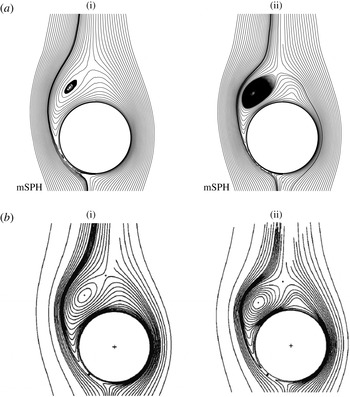
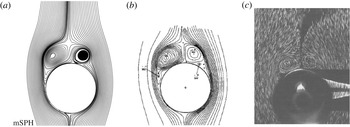
Figures 2–3 show mSPH results for the instantaneous streamlines (obtained by interpolating particle velocities on a regular mesh of size
 $h$
) for different
 $Re=O(10^{2})$
. Our results are in agreement with other numerical and experimental results, including the complex viscous wake region, indicating that mSPH is able to capture the (physical) viscous effects in the problem. The predicted streamlines show asymmetries in the flow, especially prominent in the downstream spinning side, while streamlines in the upstream spinning side remain qualitatively similar to the non-spinning case. The windward stagnation point is also shifted towards the upstream spinning side due to the spin. Comparing figures 2 and 3 it can be seen that for the times considered, the effect of
 $\unicode[STIX]{x1D6FC}$
on the streamlines is much greater than that of (moderate)
 $Re$
.
Instantaneous streamlines for translating and spinning submerged cylinder started impulsively at
 $t=0$
. The flow is from bottom to top, spin
 $\unicode[STIX]{x1D6FC}=1$
counterclockwise and
 $t=3$
. The mSPH predictions for
 $Re=$
(a)(i) 200, (a)(ii) 500. Also included numerical predictions for
 $Re=$
(b)(i) 200, (b)(ii) 500 from Badr & Dennis (Reference Badr and Dennis1985).

Instantaneous streamlines for translating and spinning submerged cylinder started impulsively at
 $t=0$
. The flow is from bottom to top, spin
 $\unicode[STIX]{x1D6FC}=0.5$
counterclockwise,
 $Re=1000$
and
 $t=3$
. (a) The mSPH predictions. Also included are (b) numerical predictions from Badr et al. (Reference Badr, Coutanceau, Menard and Dennis1990), (c) experiment from Coutanceau & Menard (Reference Coutanceau and Menard1985).

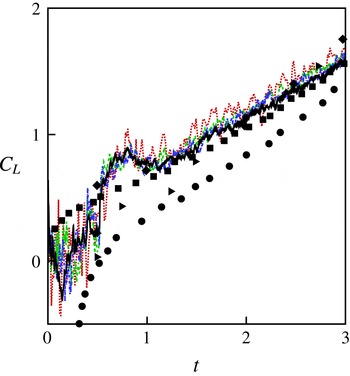
Figure 4 shows mSPH results for the lift coefficient
 $C_{L}(t)$
for
 $\unicode[STIX]{x1D6FC}=1$
and
 $Re=200$
. We compute
 $C_{L}$
following Marrone et al. (Reference Marrone, Colagrossi, Antuono, Colicchio and Graziani2013) where for simplicity we do not include skin friction nor the viscous contribution in the boundary layer, both known to be small for this problem (Badr et al.
Reference Badr, Coutanceau, Menard and Dennis1990; Chen et al.
Reference Chen, Ou and Pearlstein1993; Mittal & Kumar Reference Mittal and Kumar2003). Predictions show a monotonic increase with time and are in good agreement with other numerical results (Badr et al.
Reference Badr, Dennis and Young1989; Chen et al.
Reference Chen, Ou and Pearlstein1993; Mittal & Kumar Reference Mittal and Kumar2003; Martin-Alcantara et al.
Reference Martin-Alcantara, Sanmiguel-Rojas and Fernandez-Feria2015), validating our approach.
Time evolution of
 $C_{L}(t)$
following the translational and spinning motion of a deeply submerged cylinder started impulsively at
 $t=0$
with
 $\unicode[STIX]{x1D6FC}=1$
and
 $Re=200$
. The mSPH predictions for resolution
 $h^{-1}=(\cdots ,\text{red})$
75, (— ⋅ —, green) 125, (– –, blue) 150, (—, black) 300. Relative time-averaged errors with respect to
 $h_{m}^{-1}=300$
are:
 $\unicode[STIX]{x1D716}_{75}=4\,\%$
,
 $\unicode[STIX]{x1D716}_{125}=2.2\,\%$
,
 $\unicode[STIX]{x1D716}_{150}=1.6\,\%$
. Also included are other numerical results: (▪) Badr et al. (Reference Badr, Dennis and Young1989), (●) Chen et al. (Reference Chen, Ou and Pearlstein1993), (♦) Martin-Alcantara et al. (Reference Martin-Alcantara, Sanmiguel-Rojas and Fernandez-Feria2015), (▸) Mittal & Kumar (Reference Mittal and Kumar2003).

Here, for the kernel
 $W$
we use the tensor product of cubic splines in
 $x$
and
 $y$
, with bandwidth
 $h=\unicode[STIX]{x0394}x$
and support
 $\unicode[STIX]{x1D6FC}h=2h$
. Figure 4 also shows convergence of the mSPH predictions for
 $C_{L}(t)$
with
 $h$
. In addition, we compute the time-averaged relative difference in
 $C_{L}(t)$
between predictions with
 $h$
and the finest resolution
 $h_{m}$
,
 $\unicode[STIX]{x1D716}_{h}=\overline{|C_{L}(t;h)-C_{L}(t;h_{m})|}/C_{L}(t=3;h_{m})$
for
 $t>1$
. We find that
 $\unicode[STIX]{x1D716}_{h}$
converges with
 $O(h^{1.3})$
. Similar convergence (not shown) is obtained for all the other flow quantities. Based on these, and similar convergence studies for the free-surface problem, we hereafter use
 $h^{-1}=300$
unless otherwise indicated.
4 Results
We present results for the free-surface impact problem highlighting the time development of the free surface, flow kinematics, forces and cylinder trajectories all as functions of
 $Fr$
. We consider a range of spin values
 $\unicode[STIX]{x1D6FC}$
, and set
 $m=\infty$
(for prescribed velocity) and several values of
 $m=O(1)$
for the freely falling cylinder. For all results presented hereafter, unless mentioned otherwise, we set
 $Re=600$
.
4.1 General characteristics of the water entry of a cylinder without and with spin
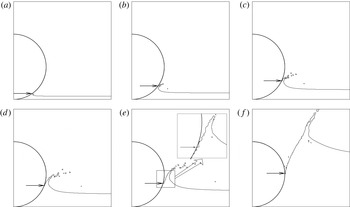
To illustrate the free-surface behaviour near the cylinder and the distinction between the contact point and the splash sheath, we show in figure 5 characteristic instantaneous free-surface profiles during the vertical entry of a cylinder. Early in the flow forming stage, figure 5(a), a jet piles up on the sides of the cylinder. Spray is generated at the crest of the jet (spray root), but the jet itself remains attached on the cylinder surface. At a later time, figure 5(b), the jet detaches from the cylinder forming the splash sheath and resulting in the creation of the cavity. The detachment is due to the ventilation phenomenon described first from theoretical considerations for the infinite
 $Fr$
limit in Birkhoff (Reference Birkhoff2012) and later inferred from numerical results in Battistin & Iafrati (Reference Battistin and Iafrati2003), Sun & Faltinsen (Reference Sun and Faltinsen2006). The experimental observation of the initiation of the detachment is often hindered by the presence of spray generated during the entry, see, for example, figure 10. Our results show that it initializes at
 $t\gtrsim 0.1$
.
Instantaneous free-surface profiles from water entry of a cylinder with
 $m=\infty$
and
 $Fr=0.791$
at
 $t=$
(a) 0.1, (b) 0.2, (c) 0.3, (d) 0.4, (e) 0.5, (f) 1.5. Reference frame is translating with the cylinder. (
 $\rightarrow$
) indicates contact point location.

A key interest is the evolution of the free surface and its effect on the forces on the cylinder. We associate the former with the motion of the contact point on the cylinder, neglecting the details of the spray that is known to be affected by additional parameters such as
 $Re$
and
 $We$
. We define a single and absolute measure for the contact point position
 $\unicode[STIX]{x1D703}(t)$
, obtained from the highest intersection of the bulk of the fluid with the cylinder. Initially, while the jet remains attached/close to the cylinder, i.e.
 $t\lesssim 0.2$
and
 $\unicode[STIX]{x1D703}\lesssim 45^{\circ }$
, obtaining
 $\unicode[STIX]{x1D703}$
is straightforward. At later times, we observe small cavities of
 $O(h)$
near the cylinder. In these cases we define
 $\unicode[STIX]{x1D703}$
to be mid-point between the bottom of the lowest cavity and the highest intersection of the free surface with the cylinder (e.g. inset in figure 5
e). We find this approach to provide an objective and robust estimation of
 $\unicode[STIX]{x1D703}(t)$
, with confidence that scales as
 $O(h)$
with resolution. We note that in some experiments (e.g. Aristoff & Bush Reference Aristoff and Bush2009), a ‘cone angle’ is used which is defined as the angle between the negative
 $y$
axis and the cavity wall at the point where the cavity separates from the body. As can be seen in figure 5(f), the cavity wall slope is not uniform along the wall and the ‘cone angle’ values vary significantly with instantaneous locations of the separation point, therefore it is not a desirable measure.
From figure 5, we see that
 $\unicode[STIX]{x1D703}$
increases monotonically with time throughout the evolution. For
 $t\lesssim 0.5$
, the upward motion of the contact point is significant (a–d), after which the growth rate of
 $\unicode[STIX]{x1D703}(t)$
decreases to a smaller value (d–e). The latter small but steady upward movement of
 $\unicode[STIX]{x1D703}$
can be seen by comparing figure (e) with figure (f) at a much later time. Comparing the same two figures, we see that the splash sheath has developed appreciably. In some experiments, (e.g. Lin & Shieh Reference Lin and Shieh1997a
), it is reported that the contact point ceases to move after
 $t\simeq 0.5$
. This is probably a reflection of the relatively small motion of the contact point compared with the splash after this time.
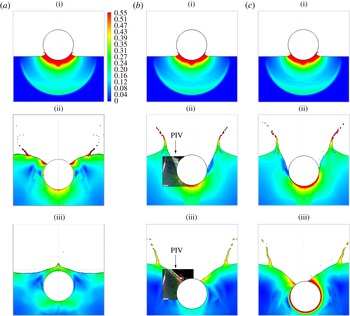
Instantaneous free surface (——) from water entry of a buoyant cylinder with
 $m=0.62$
and
 $[Fr,\unicode[STIX]{x1D6FC}]=$
(a) [0.791, 0]; (b) [1.486, 0]; (c) [1.486, 1]. Time increases from top to bottom with
 $t=$
(i) 0.25, (ii) 2.618, (iii) 5.168. At (b)(ii) and (b)(iii) we have superimposed particle image velocimetry (PIV) results at the same times from the experiments of Colicchio et al. (Reference Colicchio, Greco, Miozzi and Lugni2009) with the same
 $[m,Fr,\unicode[STIX]{x1D6FC}]=[0.62,1.486,0]$
. Colouring with absolute velocity:
 $|\boldsymbol{u}|=0{-}0.549$
for all current results and the PIV image in (b)(ii);
 $|\boldsymbol{u}|=0{-}0.2745$
for the PIV image in (b)(iii).

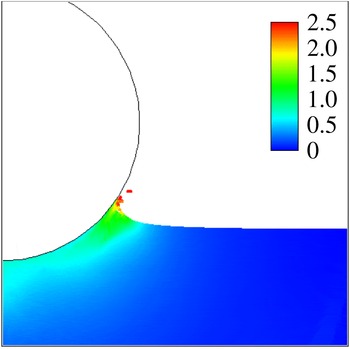
Close up of figure 6(b)(i). Colouring with absolute velocity
 $|\boldsymbol{u}|=0{-}2.5$
.

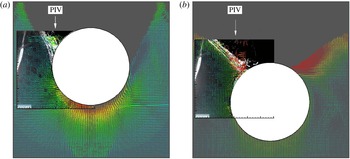
Instantaneous flow field during the vertical water entry of a buoyant cylinder with
 $m=0.62$
,
 $Fr=1.486$
at
 $t=$
(a) 2.618, (b) 5.168 (as in figure 6
b (ii)–(iii)). Colouring with absolute velocity:
 $|\boldsymbol{u}|=$
(a) 0–0.549, (b) 0–0.2745. Also included: PIV images from Colicchio et al. (Reference Colicchio, Greco, Miozzi and Lugni2009) with the same
 $t$
,
 $m$
,
 $Fr$
and colouring.

To illustrate the effects of
 $Fr$
and
 $\unicode[STIX]{x1D6FC}$
on the evolution of key entry characteristics of a buoyant freely falling cylinder
 $(m=0.62)$
, we compare in figure 6 instantaneous free-surface profiles and velocity fields for three different combinations of
 $Fr$
and
 $\unicode[STIX]{x1D6FC}$
: two cases with
 $Fr^{{<}}$
and
 $Fr^{{>}}$
without spin (a–b), and one case with
 $Fr^{{>}}$
and moderate spin (c). For small times, figure 6(a–c)(i), the free surface and flow field are qualitatively independent of
 $Fr$
and
 $\unicode[STIX]{x1D6FC}$
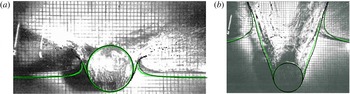
. Figure 7 shows a close up of figure 6(b)(i) with a different colour scale, illustrating the high velocities and sharp velocity gradients taking place about the spray root during these early times.
As time increases, figure 6(a–c)(ii)–(iii), the free surface and the contact point location are shown to vary primarily with
 $Fr$
, and somewhat with
 $\unicode[STIX]{x1D6FC}$
, but the velocity field, particularly in the vicinity of the cylinder, shows a strong dependence on both
 $Fr$
and
 $\unicode[STIX]{x1D6FC}$
.
Figure 6(a) shows results for the non-spinning case with
 $Fr^{{<}}$
. For moderate time,
 $t=2.618$
, 6(a)(ii), the contact points are above the equator,
 $\unicode[STIX]{x1D703}\sim 125^{\circ }$
, well beyond the typically observed range of
 $70^{\circ }$
–
 $90^{\circ }$
(Lin & Shieh Reference Lin and Shieh1997a
,Reference Lin and Shieh
b
). At the same time, the free surface propagates inwards towards the cylinder. This can also be observed from the increased flow velocities near the contact points, resembling a gravity-driven lock-release flow. This indicates that the gravity-driven free-surface flow affects the characteristics of the impact, in agreement with the observations of Greenhow (Reference Greenhow1988). At later time,
 $t=5.168$
, 6(a)(iii), the cylinder becomes fully wet, so that in this case a trailing air-entrained cavity will not be generated.
Figure 6(b) shows the results for the non-spinning case with
 $Fr^{{>}}$
. For moderate time,
 $t=2.618$
, 6(b)(ii), the contact points stay near the equator and the cavity is significantly deeper in comparison to the
 $Fr^{{<}}$
entry in figure 6(a)(ii). At later time,
 $t=5.168$
, 6(b)(iii), the contact points have resumed their upward motion and are located well above the equator. For both non-spinning cases, figure 6(a–b), the inward propagating free-surface flow results in increased contact point height. Therefore, the contact point height provides a measure of the interaction between the inward propagating free-surface flow and the descending cylinder. This interaction is decreased and delayed for the faster descending cylinder with
 $Fr^{{>}}$
, as evident from comparison between the two cases. We note that the contact point evolution behaviours here are very much a consequence of the varying cylinder velocity for finite
 $m$
, see § 4.5.1.
Figure 6(c) shows the results for the spinning case. At moderate time,
 $t=2.618$
, 6(c)(ii), the flow and free surface are asymmetric. These asymmetries are enhanced with increasing time 6(c)(iii). The flow on the upstream spinning side resembles that of the non-spinning case, while that on the downstream spinning side is qualitatively different with overall much greater velocities. The observed flow asymmetries in the presence of spin are similar to those around a spinning cylinder impulsively started in the absence of the free surface (e.g. Labraga et al.
Reference Labraga, Kahissim, Keirsbulck and Beaubert2007), see also § 4.4. As expected, the free surface shows similar asymmetries with the contact point somewhat higher on the downstream side, and the cavity angle steeper on the downstream side. In the presence of
 $\unicode[STIX]{x1D6FC}$
and finite
 $m$
, the cylinder trajectory curves towards the downstream rotating side (by approximately
 ${\sim}$
1 % of the radius in figure (c)(ii) at
 $t=2.618$
, and
 ${\sim}$
10 % in figure (c)(iii) at
 $t=5.168$
). These features are qualitatively very similar to those observed by Techet & Truscott (Reference Techet and Truscott2011) for the spinning sphere.
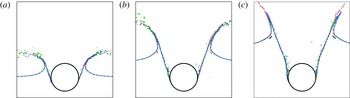
Instantaneous free-surface profiles (—, black) from water entry of a buoyant cylinder with
 $m=1$
and
 $Fr=2.845$
at
 $t=$
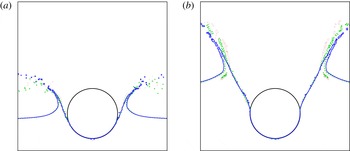
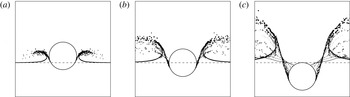
(a) 0.75, (b) 4.78. Photographs from Greenhow & Lin (Reference Greenhow and Lin1983). Also included: (——, green) free-surface profile from boundary element method (BEM) simulations in Sun & Faltinsen (Reference Sun and Faltinsen2006).

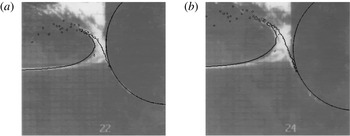
Instantaneous free-surface profiles from water entry of a cylinder with
 $m=1.989$
and
 $Fr=0.707$
at
 $t=$
(a) 0.49, (b) 0.59. Photographs from Lin & Shieh (Reference Lin and Shieh1997a
).

For finite
 $\unicode[STIX]{x1D6FC}$
and
 $m$
, it is in general not clear whether the free-surface, and specifically the contact point, asymmetries are primarily a result of the lateral motion or the spinning flow (see e.g. Techet & Truscott Reference Techet and Truscott2011). We consider this further in § 4.4, where we show that the contact points on the spinning cylinder remain symmetric in the absence of lateral motion.
4.2 Free-surface profiles: comparison with experiments
We perform extensive comparisons of our mSPH free-surface predictions with existing experimental (and computational) data. The overall agreements are excellent for a broad range of
 $Fr^{{<}}$
and
 $Fr^{{>}}$
. For brevity, we show representative comparisons to the measurements of Greenhow & Lin (Reference Greenhow and Lin1983), Lin & Shieh (Reference Lin and Shieh1997a
) and Colicchio et al. (Reference Colicchio, Greco, Miozzi and Lugni2009) for freely falling cylinders. Figures 6(b)(ii)–(iii), and 9–10 show detailed comparisons for different values of
 $m(=O(1))$
,
 $Fr$
, and
 $t$
. The comparisons are consistently very good excluding, as discussed, the details of the spray. In particular, we see that mSPH captures the free surface for the case when the motion of the contact points continues until the cylinder becomes fully wet (figure 6(b)(ii)–(iii)), as well as for the cases when the contact points remain close to the equator (figures 9–10), the key difference between these cases being the different cylinder Froude number with time. For figure 6(b)(ii)–(iii) we note the presence of 3-D optical effects that may confuse the location of the contact point to appear higher than it truly is. The free surface and contact point, identified by the bright boundary of the darker/grey region, are in very good agreement with our results. In figure 9 our predictions are very close to the numerical predictions of Sun & Faltinsen (Reference Sun and Faltinsen2006). Comparisons with the experiment are hindered by position considerations for
 $t\lesssim O(1)$
, also discussed in Zhu et al. (Reference Zhu, Faltinsen and Hu2007). Other predictions, not shown here, for a buoyant cylinder with
 $m=0.5$
at the same
 $Fr$
also yielded excellent comparisons between the numerical results of Sun & Faltinsen (Reference Sun and Faltinsen2006) and close agreement with the experiments of Greenhow & Lin (Reference Greenhow and Lin1983).
We remark that the excellent comparisons for mSPH with
 $Re=O(10^{2})$
–
 $O(10^{3})$
and experiments with
 $Re=O(10^{5})$
indicate that the salient features of the free surface (excluding the spray), and especially the evolution of the contact point, are not strongly affected by
 $Re$
(beyond
 $Re=O(10^{2})$
). This independence of the kinematics on
 $Re$
suggests that the hydrodynamic loads on the cylinder are also independent of
 $Re$
, as observed for spheres by Moghisi & Squire (Reference Moghisi and Squire1981) and confirmed by our dynamic predictions for different
 $Re$
(e.g. figure 24
a). Figure 11 compares mSPH predictions of the free surface for different values of
 $Re=O(10^{2})$
showing that the predicted contact points are largely unaffected, and the main differences are in the details of the spray.
Instantaneous free-surface profiles from water entry of a buoyant cylinder with
 $m=0.62$
and
 $Fr=1.486$
at
 $t=$
(a) 1.02, (b) 3.06 for
 $Re=(\cdots ,\text{red})$
300, (– –, green) 600, (——, blue) 1200.

4.3 Effect of Froude number on the contact point and impact force evolutions
To isolate the effects of
 $Fr$
on the impact dynamics, we consider no spin
 $(\unicode[STIX]{x1D6FC}=0)$
and prescribed velocity
 $(m=\infty )$
. Our main interests are the evolutions of the contact points (§ 4.3.1) and the forces on the cylinder (§ 4.3.2) which we investigate by systematically varying
 $Fr$
.
4.3.1 Contact point evolution
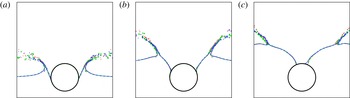
Figure 12 shows superimposed instantaneous free-surface profiles at different times for a range of
 $Fr$
. At earlier times,
 $t=0.5$
, figure 12(a) shows the risen free-surface profile leading to a distinct splash sheath. Significantly, up to this time, the free surface is independent of
 $Fr$
. During this time, the contact point height (relative to the bottom of the cylinder)
 $b(t)>t=z(t)$
, the latter being the submergence depth of the cylinder (for fixed cylinder velocity). So clearly the vertical velocity of the contact point relative to the cylinder bottom
 ${\dot{b}}(t)>1$
. At later time,
 $t=1$
in figure 12(b), the splash continues to develop but the distance between the contact points and the initially undisturbed free surface is reduced. This indicates that
 ${\dot{b}}(t)<1$
during
 $0.5\lesssim t\lesssim 1$
. At
 $t=2$
, figure 12(c), the free-surface profile shows a strong qualitative difference between
 $Fr^{{<}}$
and
 $Fr^{{>}}$
. For
 $Fr^{{>}}$
, the contact points and
 $\unicode[STIX]{x1D703}$
approach the limiting values
 $b\approx 0.75$
and
 $75^{\circ }$
. For
 $Fr^{{<}}$
, as
 $Fr$
decreases,
 $b$
increases and the splash reduces, and the slope of the free surface near the cylinder decreases.
Instantaneous free-surface profiles from water entry of a cylinder with
 $m=\infty$
at
 $t=$
(a) 0.5, (b) 1, (c) 2. For all
 $t$
,
 $Fr=$
(——) 0.486, (– –) 0.577, (— ⋅ —) 0.686, (
 $\cdots \,$
) 0.791, (— ⋅ ⋅ —) 0.925, (— ⋅ —) 1.201, (– –) 1.486, (—) 2. Reference frame fixed at undisturbed free surface (– –).

Evolution of
 $\unicode[STIX]{x1D703}(t)$
during water entry of a cylinder with
 $m=\infty$
. (a)
 $Fr=0.395$
. Convergence of mSPH predictions with
 $C=$
(— ⋅ —) 10, (
 $\cdots \,$
) 20, (– –) 30, (——) 40. Relative time-averaged errors with respect to
 $C_{m}=40$
are:
 $\unicode[STIX]{x1D716}_{10}=18\,\%$
,
 $\unicode[STIX]{x1D716}_{20}=8\,\%$
,
 $\unicode[STIX]{x1D716}_{30}=3\,\%$
. Also included (
 $+$
) are experimental data from Miao (Reference Miao1989). (b)
 $Fr=$
(—) 0.395, (– –) 0.686, (
 $\cdots \,$
) 1.202. Note that here
 $C=10$
for all
 $Fr$
. Also included are experimental data from Miao (Reference Miao1989) for
 $Fr=$
(
 $+$
) 0.395, (▾) 0.686, (○) 1.201. For comparison we also plot
 $\unicode[STIX]{x1D703}$
corresponding to the theoretical results (– –)
 $c=\sqrt{2t-t^{2}}$
(von Kármán Reference von Kármán1929); (— ⋅ —)
 $c=\sqrt{4t}$
(Wagner Reference Wagner1932); and the experimental fit (——)
 $\widetilde{c}=\sqrt{4t-4t^{2}}$
(Miao Reference Miao1989).

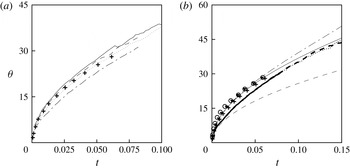
Figure 13 quantifies the evolution of the point position
 $\unicode[STIX]{x1D703}(t)$
for early times
 $t\lesssim 0.1$
for different
 $Fr$
. Included for comparison are the experimental measurements and corresponding data fit of Miao (Reference Miao1989); as well as theoretical predictions based on von Kármán (Reference von Kármán1929) and Wagner (Reference Wagner1932) valid for small
 $t$
. The comparisons of the mSPH predictions with experiments are excellent. During this time,
 $\unicode[STIX]{x1D703}(t)$
increases with time monotonically. Figure 13(a) shows convergence with
 $C$
at early times when velocities are greater. We compute the time-averaged relative difference in
 $\unicode[STIX]{x1D703}(t)$
between predictions with
 $C$
and the highest
 $C_{m}$
,
 $\unicode[STIX]{x1D716}_{C}=\overline{|\unicode[STIX]{x1D703}(t;C)-\unicode[STIX]{x1D703}(t;C_{m})|}/\unicode[STIX]{x1D703}(t;C_{m})$
. We find that the a posteriori convergence rate of
 $\unicode[STIX]{x1D716}_{C}$
scales as
 $O(C^{-1.5})$
. Noting that
 $\unicode[STIX]{x1D716}_{20}$
and
 $\unicode[STIX]{x1D716}_{30}$
are comparable to the confidence in
 $\unicode[STIX]{x1D703}$
, i.e.
 $O(h)$
, we conclude that even at early times, results are independent of
 $C$
for
 $C\gtrsim 20$
. During these early times when
 $C>10$
, agreement with experimental results is very good, with less than
 $4\,\%$
relative error, corresponding to less than
 $1^{\circ }$
. At later times, results are independent of
 $C$
for
 $C\gtrsim 10$
. Figure 13(b) shows that for
 $t\lesssim 0.1$
,
 $\unicode[STIX]{x1D703}(t)$
(for the same
 $C=10$
) is independent of
 $Fr$
, consistent with figure 12(a). Miao (Reference Miao1989) provided a fit for their experimental data for the angle
 $\tilde{\unicode[STIX]{x1D703}}\approx (1.4{-}1.5)\cos ^{-1}(1-t)$
. This is equivalent to
 $\tilde{\unicode[STIX]{x1D703}}\approx \cos ^{-1}(1-2t)$
, or equivalently
 $\tilde{{\dot{b}}}\approx 2$
or
 $\tilde{c}(t)\approx \sqrt{4t-4t^{2}}$
. As seen in figure 13(a), as time increases, the von Kármán (Reference von Kármán1929) prediction substantially underpredicts
 $\unicode[STIX]{x1D703}(t)$
, while that based on Wagner (Reference Wagner1932) is slightly higher.
The dependence of the contact point motion, say
 $\unicode[STIX]{x1D703}(t)$
, on the criticality of
 $Fr$
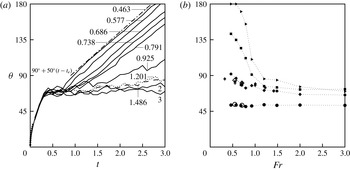
seen in figure 12, is quantified in figure 14(a). For
 $t\lesssim 0.5$
,
 $\unicode[STIX]{x1D703}(t)$
is independent of
 $Fr$
, increasing monotonically from zero to
 $\unicode[STIX]{x1D703}\simeq 75^{\circ }$
. Subsequently,
 $\unicode[STIX]{x1D703}(t)$
remains constant for a period of time that increases with
 $Fr$
, and then
 $\unicode[STIX]{x1D703}$
increases again. The rate of increase differs between
 $Fr^{{<}}$
and
 $Fr^{{>}}$
, with some transition region around
 $Fr=1$
. For
 $Fr^{{>}}$
, the increase in
 $\unicode[STIX]{x1D703}(t)$
is slow, as reported in experiments (e.g. Lin & Shieh Reference Lin and Shieh1997a
). For
 $Fr^{{<}}$
,
 $\unicode[STIX]{x1D703}(t)$
increases steadily until the cylinder becomes fully wet (see, e.g. Miao Reference Miao1989). For
 $Fr^{{<}}$
, figure 14(a) provides a very close linear fit with time (independent of
 $Fr$
),
 $\tilde{\unicode[STIX]{x1D703}}(t)-90^{\circ }\approx 50^{\circ }(t-t_{e})$
, for
 $t>t_{e}$
, where
 $t_{e}$
is the instant when the contact point is on the cylinder equator. The constant angular velocity of the contact point on the cylinder, independent of
 $Fr^{{<}}$
,
 $\dot{\unicode[STIX]{x1D703}}\approx 50^{\circ }$
, after
 $t_{e}$
, is remarkable.
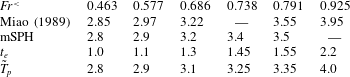
We define
 $T_{p}$
as the time when the cylinder becomes fully wetted, i.e.
 $\unicode[STIX]{x1D703}(T_{p})=180^{\circ }$
. The mSPH predictions of
 $T_{p}$
for different
 $Fr^{{<}}$
are compared to experimental values (Miao Reference Miao1989; Zhu et al.
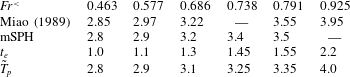
Reference Zhu, Faltinsen and Hu2007) in table 1 showing excellent quantitative agreement. Using the
 $\tilde{\unicode[STIX]{x1D703}}$
fit, we find
 $\tilde{T}_{p}\approx t_{e}+1.8$
. Using
 $t_{e}$
from figure 14(a), we also tabulate
 $\tilde{T}_{p}$
, which shows reasonable agreement. The values of
 $t_{e}(Fr)$
from figure 14(a) are found to increase approximately as
 $(Fr^{{<}})^{2}$
. Thus
 $T_{p}$
also increases approximately as
 $(Fr^{{<}})^{2}$
.
(a) Evolution of
 $\unicode[STIX]{x1D703}(t)$
during water entry of a cylinder with
 $m=\infty$
for 10 different
 $Fr$
, indicated in the plot. Also included: (— ⋅ —) linear fit
 $\tilde{\unicode[STIX]{x1D703}}(t)=90^{\circ }+50^{\circ }(t-t_{e})$
; experimental data from Miao (Reference Miao1989) for
 $Fr=~(+)$
0.395, (▾) 0.686, (○) 1.201. (b) Instantaneous values of
 $\unicode[STIX]{x1D703}$
during water entry of a cylinder with
 $m=\infty$
as function of
 $Fr$
at select
 $t=$
(⋯●⋯) 0.2, (⋯♦⋯) 1, (⋯▪⋯) 2, (⋯▸⋯) 3. Similarly for
 $m=1.989$
at
 $t=$
(○) 0.2, (♢) 1. Also included (
 $+$
) experimental data from Lin & Shieh (Reference Lin and Shieh1997a
) for inferred
 $t\lesssim 1$
.

Time
 $T_{p}$
, when cylinder with
 $m=\infty$
becomes fully wetted,
 $\unicode[STIX]{x1D703}=180^{\circ }$
, for different
 $Fr^{{<}}$
. Also included: experimental results (Miao Reference Miao1989; Zhu et al.
Reference Zhu, Faltinsen and Hu2007);
 $t_{e}$
as obtained from figure 14(a);
 $\tilde{T}_{p}=t_{e}+1.8$
.
The dependence of
 $\unicode[STIX]{x1D703}$
on
 $Fr$
is summarized in figure 14(b), where for select values of
 $t=t_{j}$
, we plot
 $\unicode[STIX]{x1D703}(t_{j})$
as function of
 $Fr$
. For early times,
 $t_{j}\sim 0.5$
,
 $\unicode[STIX]{x1D703}$
is approximately independent of
 $Fr$
. For
 $t_{j}\gtrsim 0.5$
,
 $\unicode[STIX]{x1D703}$
behaves differently depending on whether
 $Fr^{{<}}$
or
 $Fr^{{>}}$
. For
 $Fr^{{>}}$
,
 $\unicode[STIX]{x1D703}=\unicode[STIX]{x1D703}_{j}$
is constant for different
 $Fr^{{>}}$
. The values
 $\unicode[STIX]{x1D703}_{j}$
depend on
 $t_{j}$
(only) and approach
 $75^{\circ }$
for large
 $t_{j}$
. For
 $Fr^{{<}}$
,
 $\unicode[STIX]{x1D703}(t_{j})$
decreases monotonically with increasing
 $Fr^{{<}}$
towards the supercritical values. For a fixed
 $Fr^{{<}}$
,
 $\unicode[STIX]{x1D703}(t_{j})$
increases with
 $t_{j}$
, reaching
 $180^{\circ }$
for sufficiently large
 $t_{j}$
. For the subcritical regime for
 $t_{j}$
in the range of
 $1\lesssim t\lesssim 3$
, figure 14(b) provides a unique mapping between
 $Fr^{{<}}$
and the value of
 $\unicode[STIX]{x1D703}(t_{j})$
, i.e. given the contact point location
 $\unicode[STIX]{x1D703}$
at a specific time,
 $Fr^{{<}}$
is uniquely determined. For fixed entry velocity,
 $t_{j}=z_{j}$
, the submergence depth. Thus a single image of the experiment showing the undisturbed free surface relative to the cylinder, the cylinder, and the contact point position is sufficient to provide
 $Fr^{{<}}$
of the experiment using figure 14(b), provided the submergence depth can be obtained accurately from the relative position of the undisturbed free surface in the photograph.
4.3.2 Impact force evolution
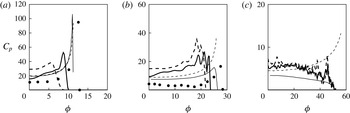
To understand the forces on the cylinder, we first consider the pressure distribution on the cylinder. We obtain
 $C_{p}$
on the cylinder in post-processing, by smoothing the pressure of the Lagrangian fluid particles in the vicinity of the cylinder with accuracy of
 $O(h)$
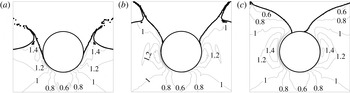
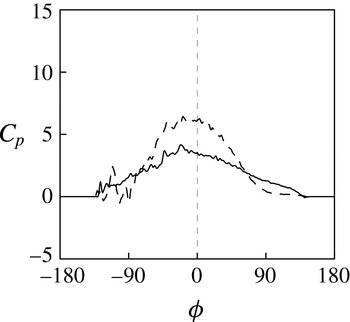
(Kiara Reference Kiara2010). Figure 15 shows instantaneous early time mSPH results for the pressure coefficient
 $C_{p}(\unicode[STIX]{x1D719})$
as a function of angular position
 $\unicode[STIX]{x1D719}$
on the cylinder, for two resolutions. For very early times, where
 $C_{p}$
varies significantly in space and time, resolution requirements for
 $C_{p}$
are higher, but for
 $t\gtrsim O(0.2)$
the results converge. Qualitatively,
 $C_{p}(\unicode[STIX]{x1D719})$
has a (half) ‘M’ (for half of the cylinder) shape which has a peak at the contact point
 $\unicode[STIX]{x1D719}=\unicode[STIX]{x1D703}$
(at the corresponding time) (Miao Reference Miao1989) and appears independent of
 $Fr$
. We compare our predictions against the predictions of Battistin & Iafrati (Reference Battistin and Iafrati2003) for
 $Fr\gg 1$
and small non-zero initial cylinder submergence, and the experiments of Miao (Reference Miao1989). For early times as discussed in § 1,
 $C_{p}$
depends on physics not captured by mSPH. For bluff bodies, early time
 $C_{p}$
is reduced by the presence of air pockets (Hicks et al.
Reference Hicks, Ermanyuk, Gavrilov and Purvis2012), and by water compressibility. Significantly, experimental measurements of
 $C_{p}$
are further reduced with pressure gauge size (Zhao & Faltinsen Reference Zhao and Faltinsen1993). These explain the lower
 $C_{p}$
from the experimental data, but also the discrepancies between the predictions of mSPH and Battistin & Iafrati (Reference Battistin and Iafrati2003): the initial non-zero submergence and incompressible assumption in the latter explain the lower
 $C_{p}$
near
 $\unicode[STIX]{x1D719}=0$
and the higher maxima. Nevertheless, for the early times shown in figure 15, the agreements between simulations and measurements on the shape of the distribution, location of the contact point and wetted area are reasonable and improve for greater times. We note that our numerical predictions and experimental results from Miao (Reference Miao1989) for
 $Fr=1.201$
(not shown) are very similar, indicating that for these small times the dynamics has only small dependence on
 $Fr$
. For
 $t\gtrsim O(0.1)$
, pressure measurements are also available for freely falling cylinders (Colicchio et al.
Reference Colicchio, Greco, Miozzi and Lugni2009). Our mSPH
 $C_{p}$
predictions are in good agreement with measurements, see figure 24. For
 $t\gtrsim O(0.1)$
the instantaneous contact point
 $\unicode[STIX]{x1D703}$
can be identified as the maximum
 $\unicode[STIX]{x1D719}$
after which
 $C_{p}(\unicode[STIX]{x1D719}>\unicode[STIX]{x1D703})$
vanishes, cf. e.g. compare
 $\unicode[STIX]{x1D703}(t=0.5)$
obtained directly from figure 14(a) and via
 $C_{p}$
in figure 15.
Instantaneous pressure distribution
 $C_{p}(\unicode[STIX]{x1D719})$
on cylinder during water entry with
 $m=\infty$
,
 $Fr=0.68$
,
 $t=$
(a) 0.01, (b) 0.05, (c) 0.2. Current results with resolution
 $h^{-1}=$
(– –) 300, (—) 500. Also included: (●) experimental data for
 $Fr=0.68$
from Miao (Reference Miao1989); (——) numerical results and (– –) asymptotic estimates with
 $Fr\gg 1$
from Battistin & Iafrati (Reference Battistin and Iafrati2003).

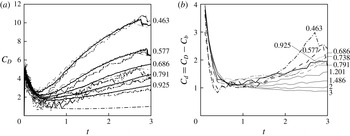
We compute the forces in mSPH following Marrone et al. (Reference Marrone, Colagrossi, Antuono, Colicchio and Graziani2013). Figure 16(a) plots the time development of the impact/drag force coefficient
 $C_{D}(t)$
for a range of
 $Fr^{{<}}$
. For comparison we include the experimental data of Miao (Reference Miao1989) and numerical predictions of Zhu et al. (Reference Zhu, Faltinsen and Hu2007). Our results are in close agreement with the numerical predictions, and in good agreement with the experiments. For
 $t\lesssim 0.2$
, our results are higher than the experimental data compared to the experiments, but the agreement improves with greater time,
 $t\gtrsim 0.2$
, consistent with the earlier discussion for
 $C_{p}$
. This agreement at later times further verifies that the initial impact pressures do not affect later characteristics of the impact for the considered mass ratios (Battistin & Iafrati Reference Battistin and Iafrati2003).
From the figure, we see that drag coefficient evolutions are similar and independent of
 $Fr$
for
 $t\lesssim 0.5$
:
 $C_{D}(t)$
increases to a peak value over very short time (
 $t<O(0.1)$
) then decreases. For
 $Fr^{{<}}$
,
 $C_{D}(t)$
reaches some minimum value at
 $t\gtrsim 0.5$
and then increase again with time thereafter. The rate of increase and the value of
 $C_{D}$
, are greater for smaller
 $Fr^{{<}}$
. For
 $Fr^{{>}}$
,
 $C_{D}(t)$
decreases monotonically from its peak value and reaches asymptotically
 $C_{Dl}\simeq 1$
(Miao Reference Miao1989). For reference, we have also included the experimental fit of Campbell & Weynberg (Reference Campbell and Weynberg1980) for
 $Fr\gg 1$
.
Comparing figures 16(a) and 14(a), we see a strong correspondence between the time evolution of
 $C_{D}(t)$
and
 $\unicode[STIX]{x1D703}(t)$
for both
 $Fr^{{>}}$
and
 $Fr^{{<}}$
. For
 $Fr^{{>}}$
, both
 $\unicode[STIX]{x1D703}$
and
 $C_{D}$
quickly reach almost constant asymptotic values (
 $\unicode[STIX]{x1D703}\simeq 75^{\circ }$
,
 $C_{Dl}\simeq 1$
, somewhat independent of
 $Fr$
) with increasing time. For
 $Fr^{{<}}$
, both
 $\unicode[STIX]{x1D703}$
and
 $C_{D}$
increase monotonically after
 $t\gtrsim 0.5$
.
To further elucidate the behaviours of
 $C_{D}$
, we decompose the total hydrodynamic force coefficient
 $C_{D}$
as
 $C_{D}(t)=C_{b}(t)$
+
 $C_{d}(t)$
, where
 $C_{d}(t)$
is the hydrodynamic component, and
 $C_{b}(t)=0.5Fr^{-2}(\unicode[STIX]{x1D703}(t)-0.5\sin (2\unicode[STIX]{x1D703}))$
is the hydrostatic component. Now
 $\unicode[STIX]{x1D703}$
depends also on
 $Fr$
and generally decreases with increasing
 $Fr$
(figure 14
a). For large
 $Fr$
,
 $C_{b}(t)$
becomes small, and
 $C_{D}(t)\simeq C_{d}(t)$
for
 $Fr^{{>}}$
. For (small)
 $Fr^{{<}}$
,
 $C_{b}(t)$
is significant.
For
 $t\leqslant 0.1$
, buoyancy is small and
 $C_{d}\simeq C_{D}$
. For
 $t\geqslant 0.1$
and finite
 $Fr$
, as buoyancy increases it is
 $C_{d}\neq C_{D}$
. In figure 16(b) we plot
 $C_{d}(t)$
for
 $t\geqslant 0.1$
. This figure is not a comparison, as to our knowledge
 $C_{d}$
is not available elsewhere. With
 $C_{b}$
subtracted,
 $C_{d}^{{<}}$
is similar in magnitude to
 $C_{d}^{{>}}(t)\simeq C_{D}^{{>}}(t)$
, and both sub- and supercritical
 $C_{d}$
are effectively independent of
 $Fr$
. Quantitatively,
 $C_{d}$
is still greater for
 $Fr^{{<}}$
, which can be attributed to the complex inward gravity flow for
 $Fr^{{<}}$
(see figure 6
a). Comparing figure 16(a,b), the respective magnitudes of the buoyancy contribution
 $C_{b}(t)$
for
 $Fr^{{<}}$
and
 $Fr^{{>}}$
are clearly seen.
(a) Evolution of
 $C_{D}(t)$
during the water entry of a cylinder with
 $m=\infty$
, for different
 $Fr$
indicated in the plot. (—) current results; (– –) numerical computations from Zhu et al. (Reference Zhu, Faltinsen and Hu2007); (●) experimental data from Miao (Reference Miao1989); (— ⋅ —) experimental fit for
 $Fr\gg 1$
from Campbell & Weynberg (Reference Campbell and Weynberg1980). (b) Current results for the evolution of
 $C_{d}(t)$
during the water entry of a cylinder with
 $m=\infty$
and
 $t\geqslant 0.1$
, for a range of
 $Fr^{{<}}$
and
 $Fr^{{>}}$
indicated in the plot.

4.4 Effect of spin on kinematics and dynamics
To isolate the effects of
 $\unicode[STIX]{x1D6FC}$
, we again fix cylinder velocity (
 $m=\infty$
) and consider a range of
 $\unicode[STIX]{x1D6FC}$
for respectively a
 $Fr^{{<}}$
and a
 $Fr^{{>}}$
case. Our main interests are the evolutions of the free surface and contact points (§ 4.4.1), the flow field (§ 4.4.2), and the impact loads on the cylinder (§ 4.4.3) which we investigate by systematically varying
 $\unicode[STIX]{x1D6FC}$
.
4.4.1 Free surface and contact point evolution
Figures 17 and 18 compare instantaneous free-surface profiles between non-spinning and spinning cases for two different values of
 $\unicode[STIX]{x1D6FC}$
, for respectively
 $Fr^{{<}}=0.791$
and
 $Fr^{{>}}=1.486$
. For
 $Fr^{{<}}$
, the effect of
 $\unicode[STIX]{x1D6FC}$
is small. For
 $\unicode[STIX]{x1D6FC}=1.05$
, figure 17(c) at
 $t=3$
, the noticeable difference between no spin and spin is the location of the contact point which is slightly higher on the downstream spinning side. The effect of
 $\unicode[STIX]{x1D6FC}$
on the free-surface profile is even smaller for
 $Fr^{{>}}$
. The asymmetry is not seen in the contact point locations but somewhat in the splash sheaths. Qualitatively, the free surface on the upstream spinning side is somewhat more roughened/broken, as has been observed in experiments (Truscott & Techet Reference Truscott and Techet2009b
). This likely reflects the higher shear in the velocity on the upstream spinning side (cf. figure 20(a), see also Labraga et al. (Reference Labraga, Kahissim, Keirsbulck and Beaubert2007)). By considering more
 $Fr$
and longer times, we find (not shown) that these relatively small effects of
 $\unicode[STIX]{x1D6FC}$
generally increase with increasing
 $t$
, decreasing
 $Fr^{{<}}$
or increasing
 $Fr^{{>}}$
, and, as expected with
 $\unicode[STIX]{x1D6FC}$
.
Instantaneous free-surface profiles at
 $t=$
(a) 1, (b) 2, (c) 3 from water entry of a cylinder with
 $m=\infty$
and
 $Fr=0.791$
, for one case without spin (——, red) and two cases with spin
 $\unicode[STIX]{x1D6FC}=$
(– –, green) 0.56, (—, blue) 1.05. Note that the (small) differences between these cases are best identified in the colour version of this figure.

Instantaneous free-surface profiles at
 $t=$
(a) 1, (b) 2, (c) 3 from the water entry of a cylinder with
 $m=\infty$
and
 $Fr=1.486$
, for one case without spin (——, red) and two cases with spin
 $\unicode[STIX]{x1D6FC}=$
(– –, green) 1.05, (—, blue) 1.6. Note that the (small) differences between these cases are best identified in the colour version of this figure.

4.4.2 Flow field evolution
Figure 19 shows instantaneous free-surface profiles and velocity contours at three different
 $t$
for
 $\unicode[STIX]{x1D6FC}=1.05$
and
 $Fr^{{<}}=0.791$
. As expected, the velocity field near the cylinder is faster on the downstream spinning side. This asymmetry decreases with distance from the cylinder, but increases with time, as can be seen comparing figure 19(a–c). The greater fluid velocities near the cylinder explain the higher location of the contact point in the downstream spinning side, with difference between downstream and upstream
 $\unicode[STIX]{x1D703}$
of
 $O(5^{\circ })$
. From figure 19(a), we observe that the velocity field in the splash is also asymmetric. At later times, figure 19(b,c), as the distance between the splash and the cylinder increases, these asymmetries in the splash are reduced.
Instantaneous free surface and absolute velocity field
 $|\boldsymbol{u}|$
at
 $t=$
(a) 1, (b) 2, (c) 3 during the water entry of a spinning cylinder with
 $m=\infty$
,
 $Fr=0.791$
and counterclockwise
 $\unicode[STIX]{x1D6FC}=1.05$
.

Instantaneous free surface and absolute velocity field
 $|\boldsymbol{u}|$
during the vertical entry of a spinning cylinder with
 $Fr=$
(a) 1.486, (b) 0.791. (c) Instantaneous absolute velocity field in the vicinity of a submerged translating and spinning cylinder started impulsively at
 $t=0$
. For all cases
 $m=\infty$
,
 $t=3$
,
 $Re=600$
and counterclockwise
 $\unicode[STIX]{x1D6FC}=1.05$
.

Figure 20(a,b) compare the instantaneous free-surface profiles and velocity contours between
 $Fr^{{>}}=1.486$
and
 $Fr^{{<}}=0.791$
for
 $\unicode[STIX]{x1D6FC}=1.05$
. For both
 $Fr$
, we observe similar velocity fields near the bottom (windward side) of the cylinder, increased shear on the upstream spinning side and increased velocities on the downstream spinning sides. The qualitative differences between the two cases increase with vertical distance from the bottom of the cylinder. The different free-surface profiles and contact point locations, determined primarily by
 $Fr$
, appear to significantly influence the velocity fields.
Some understanding of the effect of
 $Fr$
on the asymmetry of the velocity field near the cylinder due to
 $\unicode[STIX]{x1D6FC}$
can be obtained by contrasting the results above to the well-studied submerged (impulsively started) translating and spinning cylinder. Figure 20(c) shows instantaneous velocity contours, at
 $t=3$
, for the submerged cylinder with
 $\unicode[STIX]{x1D6FC}=1.05$
. These can be compared to the corresponding time in the free-surface impact cases in figure 20(a,b). Below the cylinder the flows are qualitatively and quantitatively similar. In the vicinity of the cylinder, asymmetries due to
 $\unicode[STIX]{x1D6FC}$
increase with increasing wetted area, i.e. increasing
 $\unicode[STIX]{x1D703}$
, towards the fully submerged case. Because
 $\unicode[STIX]{x1D703}$
increases with
 $Fr^{{<}}$
, asymmetries in the flow near the cylinder due to
 $\unicode[STIX]{x1D6FC}$
also increase with
 $Fr^{{<}}$
.
4.4.3 Dynamics
Figure 21 compares instantaneous pressure distributions on the cylinder for four cases: without and with spin
 $\unicode[STIX]{x1D6FC}=1.05$
, for
 $Fr=0.791$
and
 $Fr=1.486$
. At small times, figure 21(a) at
 $t=0.3$
,
 $C_{p}(\unicode[STIX]{x1D719})$
is independent of
 $\unicode[STIX]{x1D6FC}$
(and
 $Fr$
, see § 4.3.2). The effect of
 $\unicode[STIX]{x1D6FC}$
develops over time, figure 21(b) at
 $t=3$
. The dependence of
 $C_{p}(\unicode[STIX]{x1D719})$
on
 $\unicode[STIX]{x1D6FC}$
at this time is relatively small compared to that on
 $Fr$
. Comparing non-spinning and spinning cases at the same
 $Fr$
in figure 21(b), we note the asymmetric effect of spin on
 $C_{p}$
is present but small. The expected decrease of
 $C_{p}$
on the downstream spinning side
 $(\unicode[STIX]{x1D719}>0)$
, is in qualitative agreement with predictions for the submerged spinning cylinder (e.g. Mittal & Kumar Reference Mittal and Kumar2003, figure 10). On the upstream spinning side, the more complex flow field (cf. e.g. figures 18–20) is also reflected in fluctuations in the instantaneous
 $C_{p}$
. Identifying the contact point with the location where
 $C_{p}$
vanishes, we see here the small asymmetry
 $(O(5^{\circ }))$
in
 $\unicode[STIX]{x1D703}$
due to
 $\unicode[STIX]{x1D6FC}$
noted earlier. For figure 21(c) at
 $t=3.6$
, the cylinder is fully wetted for the
 $Fr^{{<}}$
. The asymmetry due to
 $\unicode[STIX]{x1D6FC}$
is enhanced and particularly evident on the upper portion of the cylinder
 $(|\unicode[STIX]{x1D719}|\gtrsim 90^{\circ })$
.
Instantaneous pressure distribution
 $C_{p}(\unicode[STIX]{x1D719})$
on cylinder at
 $t=$
(a) 0.3, (b) 3, (c) 3.6 during the water entry with
 $m=\infty$
, for two cases without spin and
 $Fr=$
(– –) 0.791, (– –) 1.486; and two cases with spin
 $\unicode[STIX]{x1D6FC}=1.05$
and
 $Fr=$
(—) 0.791, (——) 1.486.

Spin during bluff-body entry creates a lateral force towards the downstream spinning side (e.g. Truscott & Techet Reference Truscott and Techet2009b
). It is helpful to see this by considering separately the lift coefficient for the upstream and downstream spinning side,
 $C_{L}=C_{L}^{-}+C_{L}^{+}$
, plotted in figure 22 for the 4 cases considered above. Qualitatively,
 $C_{L}^{-}\sim -C_{L}^{+}$
and resembles
 $C_{D}$
for both
 $Fr^{{<}}$
and
 $Fr^{{>}}$
(cf. figure 16). The effect of
 $\unicode[STIX]{x1D6FC}$
is not evident in
 $C_{L}^{-}$
(which reflects the fluctuations in
 $C_{p}$
on this side) but manifests in the increase of
 $C_{L}^{+}$
with
 $t$
, resulting in positive (downstream) lift
 $C_{L}=C_{L}^{-}+C_{L}^{+}>0$
. The magnitude of
 $C_{L}$
is relatively small (
 $O(10^{-1})$
), and is in fact comparable to the fluctuations in
 $C_{L}^{-}$
. To mitigate the effect of the latter, we consider the force impulse
 $I_{L}(t)\equiv \int ^{t}C_{L}\,\text{d}\unicode[STIX]{x1D70F}$
which we find to be robust. For a freely falling body,
 $I_{L}(t)$
is proportional to the lateral velocity at that time, which is used in experiments to estimate lift Truscott & Techet (Reference Truscott and Techet2009b
).
Time development of the lift coefficients for the upstream and downstream spinning sides,
 $C_{L}^{-}$
and
 $C_{L}^{+}$
, during water entry with
 $m=\infty$
for two cases without spin and
 $Fr=$
(– –) 0.791, (– –) 1.486; and two cases with spin
 $\unicode[STIX]{x1D6FC}=1.05$
and
 $Fr=$
(—) 0.791, (——) 1.486.

Evolution of (a)
 $I_{D}(t)$
and (b)
 $I_{L}(t)$
during the vertical entry of a cylinder with
 $m=\infty$
, for two cases without spin and
 $Fr=$
(—) 0.791, (——) 1.486; two cases with spin
 $\unicode[STIX]{x1D6FC}=0.56$
and
 $Fr=$
(– –) 0.791, (– –) 1.486; two cases with spin
 $\unicode[STIX]{x1D6FC}=1.05$
and
 $Fr=$
(— ⋅ —) 0.791, (— ⋅ —) 1.486; two cases with spin
 $\unicode[STIX]{x1D6FC}=1.6$
and
 $Fr=$
(— ⋅ ⋅ —) 0.791, (— ⋅ ⋅ —) 1.486.

Figure 23 shows
 $I_{D}(t)$
and
 $I_{L}(t)$
for different
 $\unicode[STIX]{x1D6FC}$
for
 $Fr=0.791$
and
 $Fr=1.486$
. Figure 23(a) shows a small decrease in
 $I_{D}(t)$
for
 $\unicode[STIX]{x1D6FC}\neq 0$
, observed, e.g. in Truscott & Techet (Reference Truscott and Techet2009b
) (for spheres). For lift, figure 23(b),
 $I_{L}(t)$
is an order of magnitude smaller than
 $I_{D}(t)$
. For sufficiently large
 $\unicode[STIX]{x1D6FC}$
,
 $I_{L}(t)$
generally increases monotonically with
 $t$
. Without spin and for small
 $\unicode[STIX]{x1D6FC}$
,
 $|I_{L}(t)|\lesssim O(0.01)$
and lift can be negative. This is again in agreement with experiments of Truscott & Techet (Reference Truscott and Techet2009b
). The effects of
 $\unicode[STIX]{x1D6FC}$
and
 $Fr$
on
 $I_{L}(t)$
are evident for
 $t\,({\gtrsim}0.5)$
. For fixed
 $Fr$
,
 $I_{L}(t)$
is greater for greater
 $\unicode[STIX]{x1D6FC}$
, as expected. Comparing sub- and supercritical
 $I_{L}(t)$
for the same
 $\unicode[STIX]{x1D6FC}$
, we see that sub- and supercritical
 $I_{L}(t)$
values are close for
 $t\lesssim 1.5$
. This is the only quantity we have seen for this problem that does not have appreciable difference between
 $Fr^{{<}}$
and
 $Fr^{{>}}$
for
 $0.5\lesssim t\lesssim 1.5$
. This is somewhat surprising considering the disparate magnitudes of the components of
 $C_{L}$
for
 $Fr^{{<}}$
and
 $Fr^{{>}}$
in figure 22.
For
 $t\gtrsim 1.5$
, subcritical
 $I_{L}(t)$
is greater than supercritical
 $I_{L}(t)$
and more so for decreasing
 $Fr^{{<}}$
. This may be partially attributed to the greater wetted area (with asymmetric pressure distribution) for
 $Fr^{{<}}$
(figure 20), which increases as
 $Fr^{{<}}$
decreases. Indeed, we find (not shown here) that after the cylinder becomes fully wet, lift approaches the large values obtained in corresponding cases in the fully submerged problem.
4.5 Freely falling cylinders
We finally consider freely falling cylinders with
 $m=O(1)$
and
 $V=V(t)$
. We consider a range of
 $Fr^{{<}}$
and
 $Fr^{{>}}$
, for
 $\unicode[STIX]{x1D6FC}=0$
and a range of (fixed)
 $\unicode[STIX]{x1D6FC}>0$
. Our main interest is the effect of
 $m$
on the dynamics and trajectory
 $(X(t),Y(t))$
of the cylinder. Our simulations using the same values of (finite)
 $m$
compare well with available experiments, shown earlier for free surface and cylinder position (figures 9 and 10); contact points (figure 14
b) and flow field (figure 8).
4.5.1 Freely falling cylinder without spin
Figure 24 shows the evolution of
 $C_{p}(t)$
at two different locations on a buoyant cylinder with
 $m=0.62$
and
 $Fr_{0}=1.486$
(cf. figures 6
b and 8). Figure 24(b) also includes results from different resolutions. We compute the time-averaged relative difference in
 $C_{p}(t)$
between predictions with
 $h$
and the finest resolution
 $h_{m}$
,
 $\unicode[STIX]{x1D716}_{h}=\overline{|C_{p}(t;h)-C_{p}(t;h_{m})|}/\overline{|C_{p}(t;h_{m})|}$
. We find that
 $\unicode[STIX]{x1D716}_{h}$
decreases with
 $h$
, and is less than 3 % between the finest resolutions, indicating convergence. The mSPH predictions are in good agreement with both the numerical results and experimental data of Colicchio et al. (Reference Colicchio, Greco, Miozzi and Lugni2009). The
 $C_{p}$
evolutions are qualitatively similar with that for
 $m=\infty$
(§ 4.3.2). The main difference is the increase in
 $C_{p}$
here at later times. During these times the instantaneous
 $Fr(t)$
has been reduced to subcritical, see figure 25(b), and found in the experiment of Colicchio et al. (Reference Colicchio, Greco, Miozzi and Lugni2009).
Evolution of
 $C_{p}(t)$
at a fixed location on the cylinder at angle
 $\unicode[STIX]{x1D719}=$
(a)
 $0^{\circ }$
, (b)
 $45^{\circ }$
. For (a)
 $Re=\,(\cdots \,)$
300, (—) 600, (– –) 1200. For (b) convergence with resolution
 $h^{-1}=(\cdots \,)$
150, (– –) 200, (——) 300, (—) 500. The time-averaged errors,
 $0.5<t<3$
, with respect to the finest resolution
 $h_{m}^{-1}=500$
are
 $\unicode[STIX]{x1D716}_{150}=3.6\,\%$
,
 $\unicode[STIX]{x1D716}_{200}=2.9\,\%$
,
 $\unicode[STIX]{x1D716}_{300}=2.8\,\%$
. Also included, in both (a) and (b), corresponding (●) experimental data and (— ⋅ —) numerical predictions from Colicchio et al. (Reference Colicchio, Greco, Miozzi and Lugni2009). For all cases
 $m=0.62$
and
 $Fr_{0}^{{>}}=1.486$
.

Because the cylinder velocity evolves with time, the problem is best understood by considering
 $Fr(t)=-V(t)Fr_{0}$
, where
 $Fr_{0}=Fr(t=0)$
. The cylinder accelerates/decelerates downwards, i.e.
 $Fr(t)$
increases/decreases, for
 $2Fr_{0}^{2}C_{D}/\unicode[STIX]{x03C0}m$
less/greater than 1, as can be seen from the equation of motion of the cylinder:
 $$\begin{eqnarray}\displaystyle -\dot{V}(t)=-\frac{C_{D}(t)}{\unicode[STIX]{x03C0}m}+\frac{1}{2Fr_{0}^{2}}. & & \displaystyle\end{eqnarray}$$
By integrating (4.1) in time, we find the change in the cylinder velocity at
 $t$
to scale as
 $I_{D}(t)/\unicode[STIX]{x03C0}m$
. At small times, even though
 $C_{D}$
is large it is
 $I_{D}\sim t$
(e.g. figure 23
a), and thus the change in the cylinder velocity scales as
 $O(t/\unicode[STIX]{x03C0}m)$
. Therefore, for small times, we can approximate the cylinder velocity as constant,
 $Fr(t)\simeq Fr_{0}$
, provided the weight of the cylinder is such that
 $(\unicode[STIX]{x03C0}m)^{-1}\lesssim O(1)$
.
Evolution of (——)
 $C_{D}(t)$
and (– –)
 $Fr(t)$
for freely falling cylinder with
 $[m,Fr_{0}]=$
(a) [1.989, 0.707], (b) [0.62, 1.486]. We also include the approximations (— ⋅ —)
 $C_{D0\infty }(t)$
and (●)
 $C_{Dt\infty }(t)$
. For comparison we mark
 $Fr=1$
with (
 $\cdots$
).

Figure 25(a) shows the evolution of
 $Fr(t)$
and
 $C_{D}(t)$
for a freely falling cylinder with
 $m=1.989$
and
 $Fr_{0}=0.707$
. As time increases,
 $Fr(t)$
increases, approaching
 $Fr^{{>}}$
at
 $t\approx 1$
. The increase in
 $Fr(t)$
is as expected from (4.1): using the magnitude of
 $C_{D}$
from the figure for early time, the present values of
 $Fr_{0}$
, and
 $m$
, we find that
 $2Fr_{0}^{2}C_{D}/\unicode[STIX]{x03C0}m<$
1, and thus
 $-V(t)$
increases. Figure 25(a) also shows
 $C_{D}(t)$
for
 $m=\infty$
and
 $Fr=Fr_{0}$
, denoted hereafter with subscript
 $(.)_{0\infty }$
. For early times when
 $Fr(t)\approx Fr_{0}$
, it is
 $C_{D}\approx C_{D0\infty }$
, since at small times
 $C_{D}$
is independent of
 $Fr$
. Thus, we can deduce whether an impacting cylinder decelerates or accelerates initially using the value of
 $2Fr_{0}^{2}C_{D0\infty }/\unicode[STIX]{x03C0}m$
. For greater
 $t$
,
 $Fr(t)\neq Fr_{0}$
, and
 $C_{D}(t)$
and
 $C_{D0\infty }(t)$
differ. Figure 25(b) shows corresponding results for a buoyant cylinder
 $m=0.62$
and
 $Fr_{0}=1.486$
. Again
 $C_{D}(t)\approx C_{D0\infty }(t)$
for early
 $t$
. In this case,
 $2Fr_{0}^{2}C_{D}/\unicode[STIX]{x03C0}m\approx 2Fr_{0}^{2}C_{D0\infty }/\unicode[STIX]{x03C0}m>1$
and thus, as expected,
 $Fr(t)$
decreases monotonically with
 $t$
.
Freely falling cylinder with
 $[m,Fr_{0}]=[1.989,0.707]$
. (a) Evolution of (——)
 $\unicode[STIX]{x1D703}(t)$
. We also include the approximations (— ⋅ —)
 $\unicode[STIX]{x1D703}_{0\infty }(t)$
and (●)
 $\unicode[STIX]{x1D703}_{t\infty }(t)$
obtained by numerical integration of
 $\dot{\unicode[STIX]{x1D703}}_{t\infty }(t)$
. (b) Evolution of (——)
 $C_{b}(t)$
. We also include the approximations (— ⋅ —)
 $C_{b0\infty }(t)$
and (●)
 $C_{bt\infty }(t)$
. (c) Evolution of (——)
 $C_{d}(t)$
. We also include the approximations (— ⋅ —)
 $C_{d0\infty }(t)$
and (●)
 $V^{2}(t)C_{dt\infty }(t)$
.

The difference between
 $C_{D}$
and
 $C_{D0\infty }$
at later times is best understood by considering the evolutions of
 $C_{b}(\unicode[STIX]{x1D703}(t))$
and
 $C_{d}(t)$
. Figure 26(a–c) show the mSPH predictions for the time developments of
 $\unicode[STIX]{x1D703}(t)$
,
 $C_{b}(t)$
and
 $C_{d}(t)$
for
 $m=1.989$
and
 $Fr_{0}=0.707$
, corresponding to the case in figure 25(a). Figure 26(a), shows that
 $\unicode[STIX]{x1D703}\approx \unicode[STIX]{x1D703}_{0\infty }$
for
 $t\lesssim 1$
. For
 $t\gtrsim 1$
, when
 $Fr(t)$
becomes
 $Fr^{{>}}$
, the contact point motion resembles that of a fixed velocity entry with
 $Fr^{{>}}$
(figure 14
a). We find that the motion of the contact points
 $\dot{\unicode[STIX]{x1D703}}(t)$
can be approximated by fixed velocity entry results with the same instantaneous velocity, denoted hereafter with the subscript
 $(.)_{t\infty }$
, i.e.
 $\dot{\unicode[STIX]{x1D703}}(t)\approx \dot{\unicode[STIX]{x1D703}}_{t\infty }(t)\equiv \dot{\unicode[STIX]{x1D703}}_{\infty }(t;Fr=Fr(t))$
. We obtain
 $\unicode[STIX]{x1D703}_{t\infty }(t)$
by integrating
 $\dot{\unicode[STIX]{x1D703}}_{t\infty }(t)$
numerically in time, where the instantaneous values of
 $\dot{\unicode[STIX]{x1D703}}_{t\infty }(t)$
are obtained from § 4.3.1 using
 $Fr(t)$
from the mSPH predictions. Figure 26(a) shows that indeed
 $\unicode[STIX]{x1D703}(t)\approx \unicode[STIX]{x1D703}_{t\infty }(t)$
for a range of
 $Fr^{{<}}$
and
 $Fr^{{>}}$
. It follows that
 $C_{b}\approx C_{b0\infty }$
only for
 $t\lesssim 1$
, but
 $C_{b}(t)\approx C_{b}(\unicode[STIX]{x1D703}_{t\infty })$
for a range of
 $Fr^{{<}}$
and
 $Fr^{{>}}$
(figure 26
b).
Figure 26(c) shows that
 $C_{d}\approx C_{d0\infty }$
for shorter
 $t\lesssim 0.1$
, when
 $Fr(t)\approx Fr_{0}$
. We find that in general
 $C_{d}(t)\approx V^{2}C_{dt\infty }(t)$
, with
 $C_{dt\infty }(t)$
obtained from figure 16(b) using
 $Fr(t)$
from the mSPH predictions. This shows that here the effect of the downward acceleration of the cylinder is small compared to the (fixed velocity) impact dynamics. We find that overall the approximation for
 $C_{d}(t)$
is more accurate than for
 $C_{b}(\unicode[STIX]{x1D703}_{t\infty }(t))$
. This is because
 $C_{d\infty }$
is approximately independent of
 $Fr$
, while the dependency of
 $\dot{\unicode[STIX]{x1D703}}$
, and thus
 $C_{b}$
, on
 $Fr^{{<}}$
is more complex.
We approximate
 $C_{D}(t)$
for a range of
 $Fr^{{<}}$
and
 $Fr^{{>}}$
with
 $C_{Dt\infty }(t)=C_{b}(\unicode[STIX]{x1D703}_{t\infty }(t))+V^{2}C_{dt\infty }(t)$
, using fixed entry results. Figure 25 also plots
 $C_{Dt\infty }(t)$
, showing the latter is in good agreement with mSPH results. The agreement is better for the case where
 $Fr(t)$
becomes
 $Fr^{{>}}$
, figure 25(a), where the approximation for
 $\unicode[STIX]{x1D703}_{t\infty }$
is more accurate and
 $C_{dt\infty }$
is greater.
Evolution of
 $Y(t)$
for
 $[m,Fr_{0}]=$
(——◃——, red) [0.5, 2.845]; (——▫——, green) [0.62, 1.486]; (——○——, blue) [1, 2.845]; (——♢——, black) [1.989, 0.548]; (——▹——, magenta) [1.989, 0.707]. (— ⋅ ⋅ —, black) denotes fixed velocity entry
 $Y=t$
. Also included
 $Y_{t\infty }(t)$
from (twice) numerical integration of (4.2) for
 $[m,Fr_{0}]=$
(
 $+$
, green) [0.62, 1.486]; (*, magenta) [1.989, 0.707]. Experimental measurements for
 $[m,Fr_{0}]=$
(◂, red) [0.5, 2.845] from Greenhow & Lin (Reference Greenhow and Lin1983); (▪, green) [0.62, 1.486] from Colicchio et al. (Reference Colicchio, Greco, Miozzi and Lugni2009); (♦, black) [1.989, 0.548] from Lin & Shieh (Reference Lin and Shieh1997b
); (▸, magenta) [1.989, 0.707] from Lin & Shieh (Reference Lin and Shieh1997b
). Other numerical predictions for
 $[m,Fr_{0}]=$
(– –, red) [0.5, 2.845] from Sun & Faltinsen (Reference Sun and Faltinsen2006); (— ⋅ —, blue) [1, 2.845] from Sun & Faltinsen (Reference Sun and Faltinsen2006).

Figure 27 plots the trajectory
 $Y(t)$
for different values of
 $m=O(1)$
and
 $Fr=O(1)$
. For greater
 $m$
, the cylinder descends faster, and for sufficiently heavy cylinders,
 $-{\dot{Y}}(t)>0$
, i.e. the cylinder downward velocity increases with
 $t$
, as expected. For given
 $m$
,
 $-{\dot{Y}}(t)$
is greater for lower
 $Fr$
. For initial times this can be readily seen from (4.1) and the fact that
 $C_{D}\approx C_{D0\infty }$
is approximately independent of
 $Fr$
(e.g. from figures 16(a) and 25), resulting in
 $-\ddot{Y} (t)$
scaling as
 $Fr_{0}^{-2}$
. Our simulations compare well with experiments and other numerical predictions.
We can obtain
 $V(t)\approx V_{t\infty }(t)$
by numerically integrating in time
 $\dot{\unicode[STIX]{x1D703}}_{t\infty }$
and the approximation of (4.1):
 $$\begin{eqnarray}\displaystyle -\dot{V}_{t\infty }(t)=-\frac{1}{\unicode[STIX]{x03C0}m}(C_{b}(\unicode[STIX]{x1D703}_{t\infty }(t))+V_{t\infty }^{2}C_{dt\infty }(t))+\frac{1}{2Fr_{0}^{2}}, & & \displaystyle\end{eqnarray}$$
using fixed entry results from § 4.3.1 and figure 16(b). Figure 27 also plots
 $Y_{t\infty }(t)$
, as obtained by integrating (4.2) twice numerically in time, for two cases with initial sub- and supercritical
 $Fr_{0}$
. The approximation, better for larger
 $Fr(t)$
, shows good agreement with other results.
4.5.2 Freely falling cylinders with prescribed spin
In the presence of sufficiently large
 $\unicode[STIX]{x1D6FC}$
and hence lift, a freely falling cylinder obtains a curved trajectory. From fixed entry results we find that spin has only a small effect on
 $C_{D}$
(which depends primarily on
 $Fr(t)$
) and therefore
 $Y(t)$
. Hereafter we focus primarily on the effects of
 $m$
and
 $\unicode[STIX]{x1D6FC}$
on lift (and
 $X(t)$
).
Instantaneous,
 $t=2.51$
, pressure distribution
 $C_{p}(\unicode[STIX]{x1D719})$
on cylinder for entry with spin
 $\unicode[STIX]{x1D6FC}=1.05$
,
 $Fr_{0}=0.791$
and
 $m=$
(– –)
 $\infty$
, (——) 0.62.

Figure 28 shows instantaneous pressure distributions,
 $C_{p}(\unicode[STIX]{x1D719})$
, on subcritical spinning freely falling cylinder compared to fixed velocity case. As expected, with
 $Fr(t)<Fr$
, the overall magnitude of
 $C_{p}$
is decreased for finite
 $m$
. The notable exception is on the downstream spinning side (near
 $\unicode[STIX]{x1D719}\sim 90^{\circ }$
) where the pressure is increased (due to the sideward motion
 ${\dot{X}}(t)$
) which contributes to a decrease in lift. From figure 28 we also can infer the downstream/upstream contact point locations
 $\unicode[STIX]{x1D703}_{+}/\unicode[STIX]{x1D703}_{-}$
, and the asymmetry
 $\unicode[STIX]{x0394}\unicode[STIX]{x1D703}=\unicode[STIX]{x1D703}_{+}-\unicode[STIX]{x1D703}_{-}$
which is positive for
 $\unicode[STIX]{x1D6FC}>0$
. For fixed velocity entry (with spin),
 $\unicode[STIX]{x0394}\unicode[STIX]{x1D703}_{\infty }$
is small. For freely falling cylinder with
 ${\dot{X}}(t)>0$
,
 $\unicode[STIX]{x0394}\unicode[STIX]{x1D703}$
is appreciable and increases with greater
 $\unicode[STIX]{x1D6FC}$
, again contributing to a decrease in lift.
(a) Evolution of
 $I_{L}(t)$
for: two cases with
 $\unicode[STIX]{x1D6FC}=0.56$
and
 $m=$
(——○——)
 $\infty$
, (——●——) 0.62; two cases with
 $\unicode[STIX]{x1D6FC}=1.05$
and
 $m=$
(——▫——)
 $\infty$
, (——▪——) 0.62; two cases with
 $\unicode[STIX]{x1D6FC}=1.6$
and
 $m=$
(——▿——)
 $\infty$
, (——▾——) 0.62; two cases with
 $\unicode[STIX]{x1D6FC}=2.45$
and
 $m=$
(——♢——)
 $\infty$
, (——♦——) 0.62. Also included
 $I_{sL}(t)=I_{L}/(-V(t))$
for
 $m=0.62$
and
 $\unicode[STIX]{x1D6FC}=$
(
 $\cdots$
○
 $\cdots$
) 0.56, (
 $\cdots$
▫
 $\cdots$
) 1.05, (
 $\cdots$
▿
 $\cdots$
) 1.6, (
 $\cdots$
♢
 $\cdots$
) 2.45. For all cases
 $Fr_{0}=0.791$
. (b) Lateral motion
 $X(t)$
of spinning freely falling cylinder with
 $m=0.62$
for: two cases with
 $\unicode[STIX]{x1D6FC}=1.05$
and
 $Fr_{0}=$
(—) 0.791, (——) 1.486; two cases with
 $\unicode[STIX]{x1D6FC}=1.6$
and
 $Fr_{0}=$
(– –) 0.791, (– –) 1.486; two cases with
 $\unicode[STIX]{x1D6FC}=2.45$
and
 $Fr_{0}=$
(— ⋅ —) 0.791, (— ⋅ —) 1.486. (c) Trajectory
 $Y(X)$
of spinning freely falling cylinder with
 $m=0.62$
for: two cases with
 $\unicode[STIX]{x1D6FC}=1.05$
and
 $Fr_{0}=$
(—) 0.791, (——) 1.486; two cases with
 $\unicode[STIX]{x1D6FC}=1.6$
and
 $Fr_{0}=$
(– –) 0.791, (– –) 1.486; two cases with
 $\unicode[STIX]{x1D6FC}=2.45$
and
 $Fr_{0}=$
(— ⋅ —) 0.791, (— ⋅ —) 1.486.

Figure 29(a) plots
 $I_{L}(t)$
for several
 $\unicode[STIX]{x1D6FC}$
comparing between fixed entry and freely falling with
 $m=0.62$
. It is seen that
 $I_{L}\approx I_{L0\infty }$
only initially, but not for later times. To account for the effect of non-constant
 $V(t)$
, we define an instantaneous lift impulse
 $I_{sL}(t)\equiv I_{L}(t)/(-V(t))$
, also plotted in 29(a). We find that
 $I_{sL}(t)$
and
 $I_{L0\infty }(t)$
compare somewhat better, but with
 $I_{sL}(t)$
generally less than
 $I_{L0\infty }(t)$
, as discussed from the
 $C_{p}$
.
In figure 29(b) we plot the lateral displacement
 $X(t)$
for the case of
 $m=0.62$
for different values of
 $\unicode[STIX]{x1D6FC}$
,
 $Fr^{{<}}$
and
 $Fr^{{>}}$
. Comparing between cases with the same
 $Fr$
, we see that
 $X$
increases with
 $t$
and is greater for greater
 $\unicode[STIX]{x1D6FC}$
. Comparing between cases with the same (sufficiently large)
 $\unicode[STIX]{x1D6FC}$
we see that
 $X$
is greater for
 $Fr^{{<}}$
.
Finally, in figure 29(c) we plot the trajectories
 $X(Y)$
for the case of
 $m=0.62$
for different values of
 $\unicode[STIX]{x1D6FC}$
,
 $Fr^{{<}}$
and
 $Fr^{{>}}$
. Comparing between cases with the same
 $Fr$
, we see that
 $X$
is generally greater for greater
 $\unicode[STIX]{x1D6FC}$
, with increasing slope
 $-\text{d}X/\text{d}Y$
as time increases. The difference between
 $Fr^{{<}}$
and
 $Fr^{{>}}$
for a given
 $\unicode[STIX]{x1D6FC}$
is less obvious. Comparing figure 29(b,c) we can make the general remark that one cannot deduce the dependence on
 $Fr$
and
 $\unicode[STIX]{x1D6FC}$
only from the trajectory
 $Y(X)$
. This is because both
 $U(t)$
and
 $-V(t)$
are greater/smaller for
 $Fr^{{<}}/Fr^{{>}}$
, but with different dependencies. Note that available experimental data on spinning impact are limited and focus mainly on spheres (Truscott & Techet Reference Truscott and Techet2009a
,Reference Truscott and Techet
b
; Techet & Truscott Reference Techet and Truscott2011). Our results have favourable qualitative comparison with these of Truscott & Techet (Reference Truscott and Techet2009b
) for: the sign and amplitude of the lateral displacements and their increase with
 $\unicode[STIX]{x1D6FC}$
(for fixed
 $Fr$
), as well as the reduction of
 $C_{D}$
with
 $\unicode[STIX]{x1D6FC}$
.
5 Conclusions
We consider the vertical water impact of a two-dimensional horizontal cylinder, with fixed velocity or freely falling, and without or with spin about the horizontal axis. Our interest is in the flow and cavity forming stages of the impact, and we focus on the effects of Froude number
 $Fr$
, and spin
 $\unicode[STIX]{x1D6FC}$
and mass
 $m$
ratios, on the development of the kinematics and dynamics. We simulate this problem using a meshless Lagrangian modified smoothed particle hydrodynamics (mSPH) numerical scheme that is well suited for violent fluid structure interaction problems (Kiara et al.
Reference Kiara, Hendrickson and Yue2013b
). We consider a broad range of
 $Fr$
,
 $\unicode[STIX]{x1D6FC}$
and
 $m$
, obtaining detailed predictions of the free surface, contact points, flow field, impact loads and cylinder trajectories, all in quantitative agreement with experimental data where available.
The contact point position
 $\unicode[STIX]{x1D703}$
and drag are determined by
 $Fr$
. For supercritical
 $Fr^{{>}}$
,
 $\unicode[STIX]{x1D703}$
stops near the equator, but for subcritical
 $Fr^{{<}}$
,
 $\unicode[STIX]{x1D703}$
continues until the cylinder becomes fully wet, inhibiting the generation of air-entrained trailing cavities. By subtracting the buoyancy associated with
 $\unicode[STIX]{x1D703}$
from the total drag, which increases appreciably with decreasing
 $Fr^{{<}}$
, we show that the remaining dynamic components are similar for all
 $Fr$
. The key effect of spin
 $\unicode[STIX]{x1D6FC}\neq 0$
is lift towards the downstream spinning side, due to asymmetry in the pressure distribution, that increases with
 $\unicode[STIX]{x1D6FC}$
and for
 $Fr^{{<}}$
. The increase of lift with
 $Fr^{{<}}$
is associated with the increase of
 $\unicode[STIX]{x1D703}$
for
 $Fr^{{<}}$
. For freely falling cylinders we show that drag can be obtained from fixed entry results with the same instantaneous velocity, providing a simple approach to predict the cylinder trajectory. Lateral motion due to spin results in appreciable asymmetry in
 $\unicode[STIX]{x1D703}$
and reduction in lift.
In this work we have studied a 2-D problem. Extensions of
 $O(N)$
mSPH to three dimensions are straightforward and can be used to study more general applications such as water entry of spheres or other general shapes (Truscott & Techet Reference Truscott and Techet2009b
; Truscott, Epps & Belden Reference Truscott, Epps and Belden2014).
Acknowledgement
This research is supported financially by grants from the Office of Naval Research.