




No CrossRef data available.
Infant and maternal behavior moderate reactivity to novelty to predict anxious behavior at 2.5 years
Published online by Cambridge University Press: 10 February 2006
Abstract
The degree to which infant regulatory behaviors, together with infant reactivity to novelty, predicted anxious behavior at 2.5 years, and the moderating effect of maternal behavior were tested. Sixty-four low-risk mothers and infants participated. Mothers rated infant negative reactivity and anxious behavior; infant and maternal behaviors were observed at 6 months postpartum. Based on results of hierarchical, multiple regressions, infant regulatory behaviors (i.e., attention control, withdrawal) moderated associations between reactivity to novelty and later anxious behavior, but predictions depended also on maternal behavior. High reactivity to novelty, in conjunction with withdrawal and with poor attention control, predicted anxious behavior only when mothers were less engaged or less sensitive, suggesting that maternal behavior alters developmental trajectories associated with infant temperament.
We are grateful to participating families; the Visiting Nurse Association, Beginnings, and Primetime for help recruiting; David Howell and Roger Bakeman for help with data analysis; James Long for his technical assistance; Emma Burrous for help developing and applying coding schemes. We are also grateful to these undergraduates and volunteers: Kerry Modry, David Centerbar, Julie Mulhern, Amanda Werner, Regina Miller, Jeannine Pablo, Maya Carlet, Samantha Thomas, Kerstin Grieshaber, Erica Hendalion, Amanda Heldt, Allyson Stern, Lisa Badanes, Lynne Babchuck, Emily Vilardo, Heather Kline, Michelle Clancy, Gina Berrera, and Shamila Lekka.
Information
- Type
- Research Article
- Information
- Copyright
- © 2006 Cambridge University Press
Infant temperament includes both reactive and regulatory components (Rothbart & Derryberry, 1981; Thompson, 1994), and it follows that early reactivity, together with infants' evolving regulatory capacities, likely contribute to distinct patterns of behavioral development and adjustment (Calkins & Fox, 1994; Rothbart & Bates, 1998). Nevertheless, there have been few attempts to test the joint prediction of infant reactivity and regulatory behaviors to later behavior, or the moderating effect of maternal behavior over time. This is a significant gap in knowledge because this information is relevant both to questions concerning the processes that explain continuity and discontinuity in development, and to preventing the development of problem behaviors and disorders through early intervention (Cole, Martin, & Dennis, 2004). We address these issues in this study, focusing on the development of anxious behavior.
Temperament and the Development of Behavioral Inhibition and Anxiety
Anxiety disorders are one of the most prevalent mental health problems, affecting around 10% of the population in both adolescents and adults (Verhulst, van der Ende, Ferdinand, & Kasius, 1997). For this reason, and because such disorders interfere with life in numerous ways, their origins have become of increasing interest to clinical researchers who identify parental behaviors and children's temperament as potential contributors to the development of anxious behaviors and disorders (Ollendick & Hirshfeld-Becker, 2002; Rapee & Szollos, 2002). In addition, developmental research linking negative reactivity during the first year with later behavioral inhibition and anxiety demonstrates the usefulness of community samples for identifying temperamental antecedents of subsequent anxious behavior.
Briefly, infants identified as highly distressed (more crying) and highly aroused (more limb movement) in response to novel stimuli at 4 months were most likely to be behaviorally inhibited (i.e., react to unfamiliar events with either distress or subdued affect and avoidance) at 14 and 21 months of age (Kagan & Snidman, 1991). Calkins, Fox, and Marshall (1996) and Fox, Henderson, Rubin, Calkins, and Schmidt (2001) reported comparable findings. Infants high in reactivity to novelty at 4 months were significantly more likely to display behavioral inhibition over the first 2 years, and 88% of the extremely inhibited infants at 14 months were classified as high activity/high cry at 4 months. Kagan and colleagues found also that children who were inhibited and withdrawn at 21 months were at greater risk than uninhibited children for anxiety symptoms and disorders from 7 and 13 years (Kagan, Snidman, Arcus, & Reznick, 1994; Rosenbaum et al., 1993; Schwartz, Snidman, & Kagan, 1999). Most relevant to the current study, Kagan, Snidman, Zentner, and Peterson (1999) reported that a reactive temperament at 4 months increased the risk for anxious symptoms at 7.5 years; 45% of high reactives, 15% of low reactives, and 21% of the remaining children were classified as having anxious symptoms.
Although the convergence of the summarized findings identifies early reactivity to novelty as a risk factor for the development of anxiety in children, several issues remain. First, predictions are modest, and change over time has been documented, prompting researchers to consider moderating effects of maternal regulation behaviors (Wachs & Kohnstamm, 2001). The possibility that infant regulation behaviors have comparable moderating effects has received little attention to date. Second, the presumption that distress to novelty, specifically, predicts later inhibition and anxiety remains untested. Rothbart and Derryberry (1981) identified two types of early reactivity, distress to novelty and distress to limits, that typically neither correlate significantly with each other, nor similarly with child behaviors (Karrass & Braungart-Rieker, 2004; Mangelsdorf, McHale, Diener, Goldstein, & Lehn, 2000). These temperamental traits have been linked to specific negative emotions (i.e., fear and anger), in turn associated with different sides of the brain and the synchrony between them (Buss et al., 2003; Davidson & Rickman, 1999), providing a clear basis for expecting such validity. Nevertheless, a strong empirical case for identifying distress to novelty specifically as the dimension of infant negative reactivity linked to later anxiety requires evidence that distress to limits does not show a comparable effect. Third, to date, associations between early temperament and later anxiety have been based entirely on observational measures of infant reactivity; it is uncertain whether results are comparable using maternal reports of infant distress to novelty. In this study, we investigate each of these issues: the moderating effects of specific infant and maternal regulatory behaviors on links between infant reactivity to novelty and anxiety, the discriminant validity of reactivity to novelty in relation to later anxiety, and the predictive validity of a maternal report measure of infant distress to novelty (Rothbart, 1981). Although there is evidence of bias in maternal reports of infant temperament (Rothbart & Bates, 1998), this can be reduced, and potentially eliminated, by controlling correlated, mother-reported characteristics, such as depression (Mebert, 1991; Leerkes & Crockenberg, 2003). Doing so removes source variance, eliminating it as a possible confound in associations between other mother-report measures included in the same analysis.
Infant Regulatory Behaviors
Infant behaviors that begin to develop during the first year, and are thought to regulate infant negative emotions (Rothbart, Ziaie, & O'Boyle, 1992), may help to explain why some infants develop in ways that are consistent with their early reactivity and others do not. Central among them is the development of orienting toward visual locations (the posterior attention system; Posner & Peterson, 1990) that demonstrates important changes between 3 and 6 months postpartum. These include the increasing ability to disengage gaze from an external stimulus and the ability to anticipate the location of upcoming visual events (Johnson, Posner, & Rothbart, 1991), both relevant for the early self-regulation of emotion. Evidence that 4-month-old infants who disengaged more easily from a stimulus were less susceptible to negative affect indicates that regulation of attention and expression of negative emotions are linked by 4 months of age. Recent studies confirm that by 4–6 months, infants who regulate attention better (i.e., look away from a mildly distressing stimulus, or from nonstressful visual stimuli) show less negative affect (Axia, Bonichini, & Benini, 1999; Whitehead & Frick, 2004). These data are suggestive, but do not establish the regulatory effect of infant attention in novel contexts.
More compelling evidence that infants modulate negative emotion by regulating attention comes from studies using contingency analyses to determine if putative infant regulation behaviors serve a regulatory function. Buss and Goldsmith (1998) reported that decreases in fear distress were more frequent than expected only after infant withdrawal, and proposed that behaviors that regulate reactivity to novelty develop after 6 months of age. In contrast, Crockenberg and Leerkes (2004) found that decreases in negative affect were significantly more likely when 6-month-old infants looked away from a novel toy and when they self-soothed, as well as when they withdrew, identifying all three as potential moderators of early negative reactivity. Nevertheless, there is reason to expect them to operate differently as moderators of reactivity to novelty in relation to later anxiety. Looking away reduces arousal while the infant remains engaged (i.e., by looking at the mother or something else), behavior incongruent with the pattern of avoidance that characterizes anxious behavior. In contrast, withdrawal reduces arousal by restricting the infant's engagement with the environment, not just with the novel toy. Not only is withdrawal a defining feature of anxious behavior, but also an infant who learns early to withdraw from novelty may miss out on opportunities to develop more adaptive responses, contributing further to continuity in the tendency to withdraw. Thus, withdrawal should increase the likelihood of later anxiety, whereas looking away should reduce its likelihood for infants high in reactivity to novelty. In addition, although self-soothing allows the infant to stay engaged with the environment, unlike attention regulation, which increases, self-soothing decreases with age (Moore, Cohn, & Campbell, 2001; Rothbart et al., 1992), possibly limiting its effectiveness as a regulator of distress to novelty after the first year. The potential moderating effect of infant activity on distress to novelty documented previously in relation to later anxious behavior is also of interest (Kagan et al., 1999). At issue is whether activity is an inherent dimension of reactivity to novelty as Kagan et al. (1994) contend, or an “upregulator,” which acts to increase distress concurrently, and hence the likelihood of less adaptive outcomes, as Rothbart, Ziaie, and O'Boyle (1992) propose. If the former were the case, we would define reactivity to novelty operationally as the interaction of distress to novelty and activity, whereas if the latter were the case, we would define reactivity to novelty operationally as distress to novelty. Moderating effects of infant and maternal regulatory behaviors would be tested in relation to one or the other of these definitions. Lack of clarity about which conceptualization better explains the extant findings1
Although the absence of increases in negative affect contingent on infant activity undermines this explanation (Crockenberg & Leerkes, 2004), activity may operate differently for easily distressed infants than for those who are less easily distressed by novelty.
Linking Maternal Behaviors With Specific Infant Regulation Behaviors
Global measures of maternal sensitivity are associated with better emotion regulation in children of many ages (Kochanska, Murray, & Harlan, 2000; Thompson, 1994), and with child behaviors that reflect good emotion regulation (e.g., Nachmias, Gunnar, Mangelsdorf, Parritz, & Buss, 1996). In addition, maternal sensitivity/responsiveness has been shown to modulate infant negative affect concurrently (Haley & Stansbury, 2003), as do specific maternal behaviors (Crockenberg & Leerkes, 2004; Jahromi, Putnam, & Stifter, 2004.) Thus, it is reasonable to expect mothers to alter associations between early negative reactivity and later anxiety by fostering emotion regulation, although direct evidence that they do so is scant.
As reported by van den Boom (1995), mothers of irritable infants who participated in an intervention were more sensitive when their infants cried, and at age 4 their children exhibited fewer internalizing and externalizing behaviors. However, the process by which initially irritable babies develop more adaptive behaviors remains uncertain because the moderating effect of maternal sensitivity was not tested. Feldman, Greenbaum, and Yirmiya (1999) provided more direct support for a maternal moderating effect with their finding that mutual synchrony between mothers and infants at 9 months predicted self-control at age 2 among children with “difficult temperaments” as infants. Arcus (2001) reported a similar moderating effect, although contrary to other findings, reactive infants were more behaviorally inhibited at 14 months if mothers were highly responsive to infant crying and low in limit setting.
Taken together, these studies are congruent with the view that the way mothers engage with reactive infants affects how their infants develop over time. Less clear is the extent to which maternal responsiveness/sensitivity is beneficial to this process, and which specific maternal behaviors foster adaptive development in reactive infants. Testing the moderating effects of maternal sensitivity allows comparison of our results with those of others. Identifying specific maternal behaviors is necessary because some of the ways mothers are sensitive may be more relevant to the development of adaptive emotion regulation than others. As recommended by Wachs and Kohnstamm (2001), we specify a priori the maternal behavior expected to moderate2
Moderation occurs when the association between two variables depends on a third (e.g., the association between temperament and anxiety depends on maternal behavior).
Conceptualizing maternal moderating effects
From prior research (e.g., Johnson et al., 1991), we know that infants shift attention away from a central attractor stimulus when there is a competing event of sufficient intensity and complexity to draw their attention elsewhere. For young infants, whose mobility is limited and whose ability to shift attention is just developing, parents are instrumental in producing diverting events of this sort. They use animated facial and vocal cues to engage their infants, to introduce visual stimuli (i.e., toys) that interest but do not frighten them, and to maintain infant attention through these behaviors. We reasoned that parents who engage more frequently in such behaviors when their reactive infants are exposed to novelty foster the redirection of infant attention in the service of emotion regulation. Through distraction, parents give infants opportunities to engage with something else, and to experience decreases in negative affect that accompany shifts in attention. Based on extant learning principles, we expect infants to experience reduced negative affect as pleasurable, and to repeat behaviors associated with such reductions. Infants who learn to shift attention to reduce negative arousal should be less prone to withdraw from novelty because they have other ways to regulate distress, and hence over time, are less anxious in response to novelty. Individual differences in attention control exist also, and caregivers likely build on these in fostering emotion regulation.
Crockenberg and Leerkes (2004) report data consistent with this model. At 6 months, mothers' engagement with their infants (away from the novel toy) was linked contingently with decreases in infant negative affect at greater than chance levels, identifying it as a potential moderator of infant reactivity to novelty. Calming was more likely also when mothers supported their infants (i.e., soothed while sharing the infant's focus on the novel toy), suggesting that support could have a comparable moderating effect. If it does, we would need to demonstrate an independent moderating effect of maternal engagement to support its centrality to the lawful discontinuity between early temperament and later anxious behavior.
Hypotheses
1. Infant negative reactivity to novelty and activity in response to novelty interact to predict later anxious behavior. Children simultaneously high in both negative reactivity and activity as infants are expected to be more anxious, confirming previous studies.
2. Infant attention control and withdrawal moderate the association between reactivity to novelty and anxious behavior. Children, who were high in negative reactivity as infants, and either low in attention control or high in withdrawal, are more anxious, whereas those high in negative reactivity, and high in attention control or low in withdrawal, are less anxious.
We formulated no hypotheses about the moderating effect of self-soothing on infant reactivity to novelty, based on evidence that self-soothing decreases as infants get older, limiting its potential impact on the trajectory from infant reactivity to novelty to later anxious behavior.
We expect infant regulation behaviors observed when mothers are not involved, that represent the capacity to self-regulate (Cole et al., 2004), to moderate developmental trajectories linked with early reactivity to novelty. We test the validity of this assumption by comparing moderating effects of infant behaviors in this context with those observed with mothers involved.
3. Maternal engagement (away from novelty) and sensitivity moderate between infant reactivity to novelty and later anxious behavior. When mothers are less sensitive or less engaged, high reactivity to novelty in conjunction with high withdrawal or low attention control predict more anxious behavior; when mother are more sensitive or engaged, no such prediction occurs.
Method
Participants
Sixty-four primiparous mothers and children, of 92 on whom complete 6-month data were available, participated at 2.5 years. Mothers averaged 31 years (range = 21–41), had 16 years of education (range = 11–20), and had been married/living with a partner for 5 years; 95% were Caucasian, 3% Asian, 2% Hispanic. Mean family income was $61,460 (range = $15,000–140,000). Thirty-eight toddlers were male. All had been healthy at birth and full term.
All mothers who remained in the area and who were willing to participate were included. Those who did not participate indicated that they were too busy for a variety of reasons, including the imminent or recent birth of another child. With one exception, participants did not differ from nonparticipants on demographic, maternal, or infant variables (p > .20, two tailed); mothers who participated at 2.5 were more educated than those who did not, t (90) = −2.12, p < .05, Ms = 15.6 and 14.8 years, respectively.
Procedures
Two months prior to delivery, mothers were recruited from birthing classes; they completed a demographic questionnaire by phone and a depressive symptoms questionnaire by mail. At 5 months postpartum, mothers rated infant temperament by phone; at 6 months, infants and mothers were videotaped during a laboratory assessment of infant regulation. When children were 2.5, mothers rated their behavior on questionnaires that were mailed to them. Mothers received $10 and were entered into a $100 lottery for Wave 1 data collection and received $20 for participating in the follow-up.
Measures
Infant Behavior Questionnaire (IBQ)
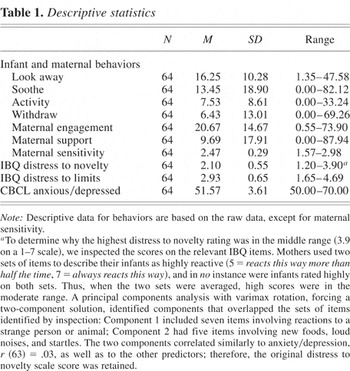
Two IBQ subscales (Rothbart, 1981) were administered to assess mothers' perceptions of their infant's temperament, distress, and latency to approach sudden or novel stimuli and distress to limitations. Mothers indicate on a 7-point scale how frequently their infants responded to specific events by fussing or crying during the previous week (e.g., when exposed to a loud noise or when introduced to a stranger). At 6 months, subscales have good internal reliability (.75–.81), interrater reliability (.54–.66), concurrent validity with home observations of infant temperament (mean r = .40) and with the negative emotionality and approach–sociability subscales of the Revised Infant Temperament Questionnaire and the Infant Characteristics Questionnaire (rs = .61–.73; Goldsmith, Rieser-Danner, & Briggs, 1991; Rothbart, 1981; Rothbart & Goldsmith, 1985). In this study, mean ratings from the 17-item distress to novelty scale (Cronbach α = .68) and the 20-item distress to limits scale (α = .78) served as emotion-specific measures of infant temperament; the latter was used to test the discriminant validity of the distress to novelty scale as a predictor of later anxious behavior. Descriptive data are reported in Table 1.
Descriptive statistics

Center for Epidemiological Studies Depression Scale (CES-D)
Depressive symptoms were assessed using this 20-item checklist of moods, feelings, and cognitions associated with depression (e.g., I felt depressed, I felt that people dislike me) designed for use with community samples (Radloff, 1977). Respondents indicate on a 4-point scale how often they felt a particular way during the previous week. The CES-D has convergent validity with the Research Diagnostic Criteria, a standardized psychiatric interview, and with the Beck Depression Inventory (Spitzer, Endicott, & Robins, 1978). Items were averaged to derive a prenatal measure of depressive symptoms (Cronbach's α = .88), included as a covariate when regressing anxious/depressed behavior on its predictors.
6-Month behavioral observation
Following a 5-min warm up, mothers placed their infants in a car seat, then sat 3 feet away, situated so that by turning infants could see them. Two novel toys (a bumble ball and fire truck) were introduced, in counterbalanced order to control for toy effects. During the first novelty task (mother uninvolved), mothers remained neutral so that we could observe infants' responses to the toy, both reactive and regulatory, without maternal intervention. During the second task (mother involved), mothers interacted with their infants any way they liked, but were asked not to intervene directly (e.g., touch the novel toy), or remove their child from the seat, unless they wished to end the activity.3
Mothers followed these directions without difficulty, remaining uninvolved when requested to do so. They often mentioned later that this had been hard for them.
Measures of infant behavior were obtained from both conditions, but infant behaviors observed when mothers were not involved were included as predictors in all hypothesis testing analyses. Infant behaviors observed when mothers were involved, and hence confounded by maternal behavior, were included only in a final set of analyses to test whether they predicted later behavior as well as those obtained when mothers were not involved. Measures of maternal behaviors were derived from the mother involved condition.
Infant and mother behavior coding
Infant and maternal behaviors were coded continuously from videotapes, using a computerized, eventbased coding system. Trained students coded in pairs to maintain accuracy while viewing tapes, operating the VCR, and entering codes. Different pairs coded infant and maternal behaviors to reduce bias, and were blind to all other data. Pairings varied to prevent pair-linked coder drift. The authors coded 25 videotapes independently, at the beginning and midway through the process, to assess reliability and to prevent coder drift for each type of coding.
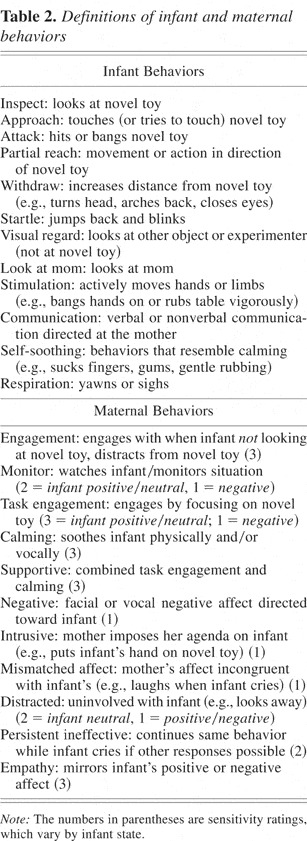
Twelve mutually exclusive behavioral codes, adapted from Rothbart et al. (1992), were used to code infant behavior. Brief descriptions are provided in Table 2; complete definitions and coding instructions are available from the first author. Thirteen additional codes were created during coder training to identify instances in which infants engaged in two or more behaviors simultaneously (e.g., self-soothe and look at mom). Intercoder reliability for all codes within a 1-s interval ranged from .65 to .87 (mean κ = .75).
Definitions of infant and maternal behaviors

To maintain an adequate subject to variable ratio, infant behaviors were combined based on both conceptual considerations and their simple correlations. To control for time differences, each variable was defined as the percent time the infant engaged in the behavior. Three were identified a priori as regulation behaviors (look away, self-soothe, and withdraw); activity was identified as a potential “upregulation” behavior. Look away included visual regard of another object and look at mom, combined because they involved looking away from the novel toy and toward something else, and correlated significantly, r (87) = .31, p < .01. Soothe included self-soothe, self-soothe with look at mom, and self-soothe and inspect novel toy, combined because each involved self-soothing, and correlated significantly, rs (87) = .22–.62, p < .05. Activity included stimulate, partial reach, and stimulate/inspect because all involved movement and correlated significantly, rs (87) = .30–.47, p < .01. Withdraw was defined by closed eyes, and/or movement away from the novel toy; it correlated positively with no other regulation behavior. These were skewed, and thus transformed; descriptive data are presented for the nontransformed variables in Table 1.
Twelve maternal behavior codes were created based on existing schemes (Farran, Kasari, Comfort, & Jay, 1986; van den Boom, 1995.) Intercoder reliability (kappas) within a 1-s interval ranged from .65 to .85 for the 12 codes (mean κ = .75), using procedures described above. Brief descriptions are provided in Table 2; detailed descriptions are available from the second author. Variables representing the percent of time mothers engaged in each of the 12 behaviors were created, tested for skew, and transformed if necessary. Of these, two maternal behaviors were included as potential moderators of infant reactivity in subsequent analyses: engagement (away from novel toy), included as a moderator for the conceptual reasons outlined above, and support (i.e., toy-focused engagement with soothing), included to assess the uniqueness and independence of maternal engagement as a moderator of infant reactivity.4
Maternal support was the only behavior other than maternal engagement linked contingently with changes from negative to neutral or positive infant affect, and therefore the behavior of choice for testing the independence of the maternal engagement moderating effect.
Maternal sensitivity refers to behaviors mothers engage in that are contingent on and appropriate to the infant's current context and state. Thus, maternal sensitivity scores were created by assigning each maternal behavior a sensitivity rating a priori (1 = low sensitive, 2 = moderately sensitive; 3 = sensitive) depending on the infant's state, using the computerized Video Coding System (Long, 1999), multiplying the duration of time a mother engaged in each behavior by its sensitivity rating, summing the weighted values, and dividing by the total observation time. For example, maternal monitoring was rated as moderately sensitive (2) if the infant was in a positive or neutral state, but low sensitive (1) if the infant was distressed. Sensitivity ratings for each maternal code by infant state are included in Table 2. By assigning sensitivity ratings using the computerized Video Coding System (Long, 1999), they are as reliable as the discrete maternal behaviors to which they are linked. Correlations between this measure of maternal sensitivity and a global sensitivity rating used in previous reports from this data set, r (60) = .66, p < .001, and with independent measures of mothers' emotional competencies (Leerkes, Burrous, & Crockenberg, 2004), support its validity.
Because of technical difficulties with the video time codes, maternal data were missing on three mothers and mean scores were substituted in those cases. Missing sensitivity scores were generated by substituting values derived from a regression equation in which sensitivity was regressed on the global sensitivity ratings.
Child Behavior Checklist (CBCL)/2–3
This 100-item checklist (Achenbach, 1992) was administered to mothers to assess children's behavioral and emotional symptoms. Mothers indicate whether specific behaviors are not true, somewhat/sometimes true, or very/often true for their child within the last 2 months. The T score for the 11-item anxious depressed subscale (e.g., nervous, high strung or tense; too shy or timid; unhappy, sad, or depressed) was the operational measure of anxious behavior used in this study. Negatively skewed scores were corrected using log transformations; an outlier was adjusted using guidelines from Tabachnick and Fidell (1996). The scale has excellent test–retest reliability for maternal ratings of nonreferred 2- and 3-year-olds 1 week apart, r (60) = .77, p < .001, stability over a 1-year interval, r (74) = .69, p < .001, and good interparent agreement for 2-year-olds, r (63) = .61, p < .001 (Achenbach, 1992); it also distinguishes clinically referred and nonreferred children (p < .001), controlling demographic differences. Descriptive data are included in Table 1. Only one child had a score in the clinical range of the anxious/depressed subscale.
Results
Data analyses proceeded in several steps. First, we correlated mother-rated infant reactivity to novelty, observed infant and mother regulation behaviors, maternal depressive symptoms, and mother-rated anxious behavior to assess collinearity and identify main effects. We used independent samples t tests to test for gender differences. Second, we regressed anxious behavior at 2.5 on the interactions between reactivity to novelty and the regulation behaviors to test the combined effect of infant reactivity and regulation on later behavior. Third, we regressed anxious child behavior on the interactions of maternal engagement or sensitivity, reactivity to novelty, and infant regulation behavior to test the moderating effects of maternal behavior on the link between infant reactivity and regulation and later behavior. Variables were centered and significant interactions plotted using Aiken and West's (1991) procedures. Fourth, we carried out regression analyses designed to test the discriminant validity of the predictors.
Zero-order correlations and t-test differences
Results of independent samples t tests by child gender on infant and maternal variables revealed no significant differences. Thus, gender was considered no further.
Correlations among and between infant, maternal, and 2.5-year behaviors
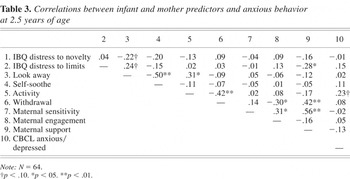
As presented in Table 3, infants who looked away more from the novel toy engaged in less self-soothing, suggesting that different infants tend to prefer different regulation behaviors at 6 months. Infants who looked away more were also more active, whereas infants who withdrew more were less active. In addition, infant withdrawal observed when mothers were not involved correlated negatively with maternal engagement. The more mothers engaged with their infants away from the novel toy, the less infants withdrew from the novel toy. More sensitive mothers were more engaged with their infants and more supportive. However, the small to moderate size of the correlations between sensitivity and the specific maternal behaviors suggests that the degree of overlap in the measures is modest, especially in relation to maternal engagement.
Correlations between infant and mother predictors and anxious behavior at 2.5 years of age

There were no significant correlations between reported reactivity to novelty, maternal behaviors, or anxious/depressed behavior (Table 3). Of the infant behaviors, only activity correlated with anxious/depressed behavior as a positive trend. As expected from prior research, distress to novelty correlated negatively with observed look away behavior, but only as a trend. In addition, prenatal maternal depressive symptoms did not correlate with anxious/depressed behavior, r (63) = .12, p > .10, although it did correlate with reported distress to novelty as a one-tailed trend, r (63) = .17, p < .10, and hence was included as a covariate in the regression analyses.
Interactive effects of infant reactivity and regulation: Hypotheses 1 and 2
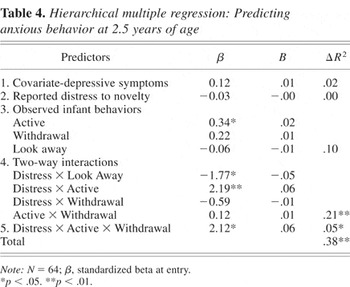
Anxious/depressed behavior at 2.5 years was regressed on its predictors to test the hypothesized moderating effects (Table 4). Maternal prenatal depression was entered first as a covariate, followed by mother-reported distress to novelty. The infant regulation behaviors (activity, look away, withdraw) were entered next, followed by the hypothesized two-way interactions (Distress to Novelty × Look Away, Distress × Activity, Distress × Withdraw), the Activity × Withdraw interaction needed to test the three-way interaction, and then the three-way interaction (Distress to Novelty × Activity × Withdraw). According to Harris (1985), an adequate sample size in multiple regression is 50 plus the number of predictors, which in this case is 9, and therefore appropriate with an n of 64.
Hierarchical multiple regression: Predicting anxious behavior at 2.5 years of age

Infant activity predicted anxious/depressed behavior at entry, although other variables moderated this association. As hypothesized, distress to novelty interacted with infant activity, and separately with look away behavior, to predict anxious depressed behavior at 2.5 years, after all main effects and two-way interactions entered the equation. The distress to novelty by look away interaction remained significant, β (53) = −2.16, p < .05, after entry of the three-way interaction (Distress to Novelty × Activity × Withdrawal), which was also significant, indicating that they explained nonoverlapping variance in anxious/depressed behavior.
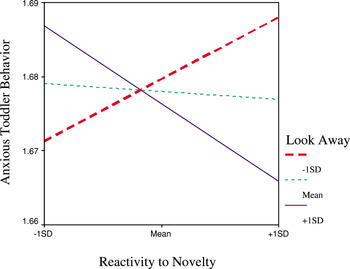
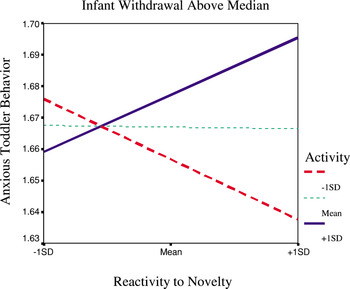
As illustrated in Figure 1, when infant look away behavior was low, distress to novelty was positively associated with anxious behavior, whereas when look away was high, it was negatively associated with anxious behavior. To interpret the three-way interaction, we created two groups, one in which infants did not withdraw (n = 31), the other in which they did (n = 33), and tested the two-way distress to novelty by activity interaction in each group. As expected, infant activity moderated the association between distress to novelty and anxious behavior in the withdrawal, β (32) = .82, p < .01, but not in the no withdrawal group, β (30) = .26, p > .20. As shown in Figure 2, among infants who withdrew during exposure to the novel toy, distress to novelty was positively associated with anxious behavior at 2.5 if they were also highly active.

The moderating effects of infant look away on the association between infant reactivity to novelty and toddler anxious behavior.

The moderating effects of infant activity on the association between infant distress to novelty and toddler anxious behavior when infant withdrawal is high.
When the regression was repeated, substituting self-soothe and its interaction for look away and its interaction, there was no significant main effect or interaction (all betas nonsignificant, p > .10), and the main effect of activity and its interactions remained significant.
Maternal behaviors as moderators of the reactivity by regulation prediction: Hypothesis 3
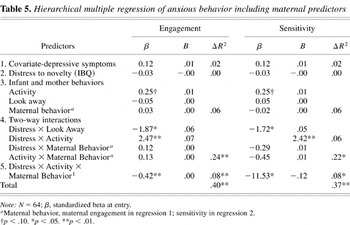
In the next set of hierarchical regressions, anxious/depressed behavior was regressed on its predictors to test the moderating effects of maternal sensitivity and of specific maternal behaviors (Table 5). To avoid overloading the models, the three-way interactions (Distress to Novelty × Activity × Maternal Variable and Distress to Novelty × Look Away × Maternal Variable) were tested in separate analyses. Variables were entered as above, with infant withdrawal excluded as a predictor, and the following additions. In the first set of analyses, maternal sensitivity was included as a main effect, interactively with distress to novelty, infant activity, and infant look away, and in three-way interactions with distress to novelty and either infant activity or infant look away. In the second, maternal engagement was included as a behaviorally specific moderator using the same format. In a third, maternal support was substituted for maternal engagement in a post hoc analysis, as a main effect and in all interactions, to determine if it had a comparable moderating effect. In the final analysis, maternal engagement and support were both included as predictors to test their independence as moderators of infant reactivity to novelty.
Hierarchical multiple regression of anxious behavior including maternal predictors

As shown in Table 5 and as expected, the three-way interactions of distress to novelty, activity, and both sensitivity and maternal engagement significantly predicted anxious behavior at 2.5. Contrary to prediction, no comparable maternal moderating effects were observed in relation to the distress to novelty by infant look away interaction, β (63) = 2.98, and β (63) = 0.00, both p > .20, for sensitivity and engagement respectively, although analyses within high and low maternal behavior groups reported below contradict these results.
In a separate regression, the three-way interaction of distress to novelty, activity, and maternal support was significant also, β (63) = −2.61, p < .05. However, when both three-way interactions (i.e., with engagement and with support) were entered simultaneously, maternal engagement remained a significant predictor of anxious behavior, β (63) = −.32, p = .015, indicating its independent effect, whereas the three-way interaction with maternal support was a trend, β (63) = −1.21, p = .067.
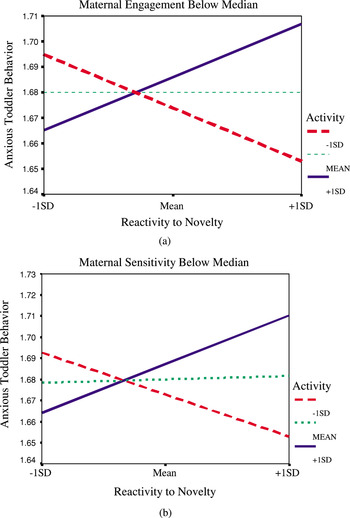
To interpret the interactions, we split the distributions of each maternal variable at their medians to create high and low groups, and tested the two-way interactions in each group. When mothers were below the median on engagement, sensitivity, or support, the distress to novelty by activity interaction was significant, β (31) = 1.06, p < .01, β (31) = .95, p < .01, β (33) = .55, p < .01, respectively; distress to novelty is positively associated with anxious behavior if infants are high active, but not if they are low active, as shown in Figure 3a and b for engagement and sensitivity. Moreover, when either maternal engagement or sensitivity were below the median,5
The interactive effect of distress to novelty by look away was not tested in high and low maternal support groups because support was included post hoc in the analyses to determine whether maternal engagement explained unique variance in anxious behavior.

The moderating effects of infant activity on the association between infant distress to novelty and toddler anxious behavior under (a) low maternal engagement and (b) low maternal sensitivity.
Discriminant validity
To establish the uniqueness of the infant predictors, and to test the methodological assumptions on which the study design was based, two hierarchical regression analyses were carried out. In each, the model variable was replaced by another of the same type, with the expectation that results would not match those reported above. Distress to limits, a measure of infant frustration or anger proneness, replaced distress to novelty as the measure of infant negative reactivity; and infant regulatory behaviors obtained when mothers were involved with their infants replaced infant behaviors obtained when mothers were not involved. There were no main or interactive effects when distress to limitations was substituted for distress to novelty (all p > .10), and no main or interactive effects of infant regulatory behaviors (i.e., look away, self-soothe, or withdrawal) observed when mothers were involved (all p > .10).
Discussion
Taken together these data support the conceptualization of temperament as having both reactive and regulation components, and demonstrate that by 6 months of age differences in infant attention regulation and withdrawal, in conjunction with high reactivity to novelty, uniquely predict later anxious behavior. At the same time, moderating effects of maternal behavior suggest that interactions that develop between infants and caregivers alter temperament-linked developmental trajectories.
Although the view that temperament has reactive and regulatory components is widely accepted, evidence that prediction to later behavioral tendencies increases when both are considered jointly provides additional support for the conceptual model. If we consider only simple effects, there is no association between mother-reported reactivity to novelty and mother-rated anxious behavior 2 years later. Similarly, there is only one significant association between an observed infant behavior (activity) and later anxious behavior, and it is qualified by interactions with other variables. In contrast, interactions of mother-reported distress to novelty and observed infant behaviors explain significant variance in subsequent anxious behavior. Of particular note are the specific infant behaviors that moderate between early reactivity to novelty and later anxiety. As expected, infants high in distress to novelty with good attention control (i.e., above the median in look away behavior) were reported to engage in less anxious behavior, whereas infants high in distress to novelty and activity who also withdrew from the novel toy were reported to engage in more anxious behavior at 2.5 than comparable infants who did not withdraw. Thus, although looking away from a novel toy (and toward something else) and withdrawal both serve a regulating function (Crockenberg & Leerkes, 2004), they are differentially adaptive in relation to later anxious behavior.
Although high activity in conjunction with high distress to novelty predicted later anxious behavior, replicating previous findings using different measures of both constructs, it is noteworthy that infant attention control (look away behavior) had a comparable and independent moderating effect on distress to novelty in relation to anxious behavior. We infer from this set of findings that infant activity is not a necessary feature of the reactivity to novelty construct. Nevertheless, it is a sufficiently powerful moderator (of distress to novelty) that the distress to novelty/look away interaction explains significant variance in anxious behavior only when variance explained by the distress to novelty/activity interaction is removed by the simultaneous entry of the two interactions into the regression equation. In future studies, researchers will need to take this suppression into account in testing moderating effects of infant behaviors other than activity on early distress to novelty in relation to subsequent behavioral development.
It is noteworthy also that longitudinal predictions are based on individual differences in infants' reactivity to novelty and regulation during the first half year of life. This is before most infants have developed a recognizable “fear of strangers,” often considered evidence that fear, and therefore fear regulation, develop after 6 months of age (Buss & Goldsmith, 1998). We infer from these data that an infant's ability at 6 months to redirect attention from the novel toy, to either the mother or some other visual stimulus, is adaptive, not just in the moment, as demonstrated previously (Crockenberg & Leerkes, 2004), but over time as a moderator of early reactivity to novelty. In contrast, self-soothing, which was also effective in reducing negative affect at 6 months, showed no moderating effect on reactivity to novelty in relation to anxious behavior, possibly because infants self-sooth less as they get older (Rothbart et al., 1992), and thus this type of regulation may be less available to them in unfamiliar situations.
From the data it appears that development in the posterior attention system (i.e., orienting of attention toward visual locations; Posner & Peterson, 1990) between 3 and 6 months postpartum anticipates later behavioral patterns, despite the growing sophistication of this system and development of the anterior attention system later in the first year. Why should this be so? Possibly, babies whose ability to redirect attention develops early are less likely to withdraw from novel, unpredictable stimuli they encounter because they have alternative ways of regulating distress. Infants who develop this competency later may experience high negative arousal to novelty in the interim to which withdrawal may be the automatic (i.e., not cortically mediated) response. In addition, parents may inadvertently encourage infant withdrawal from novelty if they do not foster emotion regulation through attention control. That infants of mothers who engage with them (away from the novel toy) withdraw less is consistent with this thesis, although other data provide stronger evidence of caregiver effects, as discussed below.
Maternal behavior moderates the early temperament to later behavior link
Within the range of differences assessed in this study, among first-born infants, carried to term, with no medical risk conditions, there was no necessary link between early reactivity and regulation and anxious behavior during the third year. The presence or absence of prediction from infant temperament to child behavior depended on mothers' behaviors observed during their infants' exposure to the novel toy. Consistent with the expected moderating effect, when mothers were highly sensitive, or highly engaged (away from the novel toy), high distress to novelty, in conjunction with infant activity or look away, did not predict anxious behavior, whereas in the absence of such maternal behavior, it did. Moreover, the moderating effect of maternal engagement (away from the novel toy) remained significant when it was entered simultaneously with the three-way interaction including maternal support, indicating that it explains unique variance in anxious behavior. However, the moderating effect of maternal support, although only partly independent, suggests that more than one type of maternal behavior is implicated in the lack of continuity between early temperament and later anxious behavior.
Each of the maternal moderating effects discussed above provides meaningful information about the conditions under which we can expect lawful discontinuity between early temperament and later anxious behavior. That maternal sensitivity moderates between early reactivity and later anxiety is congruent with other studies in which maternal sensitivity has been linked to a range of adaptive developmental outcomes, as noted above. That encouraging the infant to shift attention away from the novel toy serves a similar moderating function is consistent with our conceptualization of the way mothers foster attention-related emotion regulation, and is clinically useful, as we discuss below. Taken together, these findings are congruent with a contextual approach to temperament that emphasizes the fit between infant characteristics and the social environment in predicting developmental outcomes (Lerner, Nitz, Talwar, & Lerner, 1989; Thomas & Chess, 1977; Wachs & Kohnstamm, 2001).
Methodological issues and limitations
That predictive associations between early temperament and later anxious behavior were unique to distress to novelty supports an emotion-specific model of infant temperament. Distress to limits, although similarly reported by mothers, was not associated with mother-reported anxious behavior later on. Similarly, that only infant regulation behaviors observed when mothers were not involved predicted (with infant reactivity to novelty) later behavior suggests that behavior in that context reflects an infant's regulatory competence better than behavior observed when mothers are involved (i.e., able to engage with their infants as they wish.) These findings increase the credibility of the results, as does evidence that associations between early temperament and later child behavior remain after source variance shared by mother-report measures is removed by covarying maternal depressive symptoms. For these reasons, and also because some current findings replicate prior results based on different measures, we infer that mother-reported distress to novelty is a valid measure of infant reactivity in this context.
Nevertheless, the results are limited by the sample size, and by the single measure of anxious behavior obtained at 2.5 years. Evidence that predictions from infant reactivity to novelty and regulation are apparent also in the laboratory-based assessment of behavioral inhibition used in previous studies would strengthen the results. So also would evidence that temperament effects remain when prenatal maternal anxiety, which was not available, is covaried. In addition, in a clinical sample with more extreme maternal behavior (e.g., little effort to draw or maintain the infant's attention away from the novel stimulus or insistence that the infant attend to the novel stimuli even if distressed), main effects of maternal behavior may be apparent, as reported in studies with older children (Rapee & Szollos, 2002).
Conclusions and Implications
In this study, we confirm the moderating effects of 6-month infant and maternal regulation behaviors on early infant negative reactivity in relation to later anxious behavior. We demonstrate that an infant's ability to turn attention away from a novel stimulus and toward something else is adaptive over time, and that a mother's specific behaviors with her infant alter the trajectory between the infant's early reactivity to novelty and anxious behavior 2 years later, possibly through its impact on infant emotion regulation. Identification of maternal engagement and, to a lesser extent maternal support, as specific targets of intervention is potentially useful to those concerned with fostering emotion regulation in infants, who need to focus their efforts. When infants look away from a novel toy, or show mild signs of increasing arousal, encouraging that behavior by responding positively or inviting the infant to look away appears to be effective. Whereas when infants focus intently on a novel event, and are either unable or disinclined to look away, sharing that focus, while soothing, may be more appropriate. A next step in this research is to determine whether fostering infants' attention control increases their use of this competency and reduces their tendency to withdraw from novelty, diminishing the likelihood of behavioral inhibition and anxious behavior over time. If it does, we may have identified a strategy for preventing some temperament-based anxiety behaviors and disorders by working with infants and their parents.
References
REFERENCES
Achenbach, T. M.
(1992).
Manual for the Child Behavior Checklist/2–3 and 1992
profile.
Burlington, VT:
University of Vermont, Department of Psychiatry.
Aiken, L., &
West, S.
(1991).
Multiple regression: Testing and interpreting interactions.
Newbury Park, CA:
Sage.
Arcus, D.
(2001).
Inhibited and uninhibited children: Biology in the social
context. In
T. Wachs &
G. A. Kohnstamm (Eds.),
Temperament in context (pp.
43–60).
Hillsdale, NJ:
Erlbaum.
Axia, G.,
Bonichini, S., &
Benini, F.
(1999).
Attention and reaction to distress in infancy: A longitudinal
study.
Developmental Psychology,
35,
500–504.CrossRefGoogle Scholar
Buss, K. A., &
Goldsmith, H. H.
(1998).
Fear and anger regulation in infancy: Effects on the temporal
dynamics of affective expression.
Child Development,
69,
359–374.CrossRefGoogle Scholar
Buss, K. A.,
Schumacher, J. R.,
Dolski, I.,
Kalin, N. H.,
Goldsmith, H. H., &
Davidson, R. J.
(2003).
Right frontal brain activity, cortisol, and withdrawal behavior in
6-month-old infants.
Behavioral Neuroscience,
117,
11–20.CrossRefGoogle Scholar
Calkins, S. D., &
Fox, N. A.
(1994).
Individual differences in the biological aspects of
temperament. In
J. Bates &
T. Wachs (Eds.),
Temperament: Individual differences at the interface of biology and
behavior.
Washington, DC:
American Psychological Association.
Calkins, S. D.,
Fox, N. A., &
Marshall, T. R.
(1996).
Behavioral and physiological antecedents of inhibited and
uninhibited behavior.
Child Development,
67,
523–540.CrossRefGoogle Scholar
Cole, P. M.,
Martin, S. E., &
Dennis, T. A.
(2004).
Emotion regulation as a scientific construct: Methodological
challenges and directions for child development research.
Child Development,
75,
317–333.CrossRefGoogle Scholar
Crockenberg, S. C., &
Leerkes, E. M.
(2004).
Infant and maternal behaviors regulate infant reactivity to novelty
at six months.
Developmental Psychology,
40,
1123–1132.CrossRefGoogle Scholar
Davidson, R. J., &
Rickman, M.
(1999).
Behavioral inhibition and the emotional circuitry of the brain:
Stability and plasticity during the early childhood years. In
L. A. Schmidt &
J. Schulkin (Eds.),
Extreme fear, shyness, and social phobia: Origins, biological
mechanisms, and clinical outcomes. Series in affective science (pp.
67–87).
New York:
Oxford University Press.
Farran, D.,
Kasari, C.,
Comfort, M., &
Jay, S.
(1986).
The Parent/Caregiver Involvement Scale training manual.
Chapel Hill, NC:
Frank Porter Graham Child Development Center.
Feldman, R.,
Greenbaum, C., &
Yirmiya, N.
(1999).
Mother–infant affect synchrony as an antecedent of the
emergence of self-control.
Developmental Psychology,
35,
223–231.CrossRefGoogle Scholar
Fox, N. A.,
Henderson, K. H.,
Rubin, K. H.,
Calkins, S. D., &
Schmidt, L. A.
(2001).
Continuity and discontinuity of behavioral inhibition and
exuberance: Psychophysiological and behavioral influences across the first
years of life.
Child Development,
72,
1–21.Google Scholar
Goldsmith, H. H.,
Rieser-Danner, L. A., &
Briggs, S.
(1991).
Evaluating convergent and discriminant validity of temperament
questionnaires for preschoolers, toddlers, and infants.
Developmental Psychology,
27,
566–579.CrossRefGoogle Scholar
Haley, D., &
Stansbury, K.
(2003).
Infant stress and parent responsiveness: Regulation of physiology
and behavior during still-face and reunion.
Child Development,
74,
1534–1546.CrossRefGoogle Scholar
Harris, R. J.
(1985).
A primer of multivariate statistics
(2nd ed.).
New York:
Academic Press.
Jahromi, L. B.,
Putnam, S. P., &
Stifter, C. A.
(2004).
Maternal regulation of infant reactivity from 2 to 6 months.
Developmental Psychology,
40,
477–487.CrossRefGoogle Scholar
Johnson, M. H.,
Posner, M. I., &
Rothbart, M. K.
(1991).
Components of visual orienting in early infancy: Contingency
learning, anticipatory looking, and disengaging.
Journal of Cognitive Neuroscience,
4,
335–344.CrossRefGoogle Scholar
Kagan, J., &
Snidman, N.
(1991).
Infant predictors of inhibited and uninhibited behavior
profiles.
Psychological Sciences,
2,
40–44.CrossRefGoogle Scholar
Kagan, J.,
Snidman, N.,
Arcus, D., &
Reznick, J. S.
(1994).
Galen's prophecy: Temperament in human nature.
New York:
Basic Books.
Kagan, J.,
Snidman, N.,
Zentner, M., &
Peterson, E.
(1999).
Infant temperament and anxious symptoms in school age
children.
Development and Psychopathology,
11,
209–224.CrossRefGoogle Scholar
Karrass, J., &
Braungart-Rieker, J. M.
(2004).
Infant negative emotionality and attachment: Implications for
preschool intelligence.
International Journal of Behavioral Development,
28,
221–229.CrossRefGoogle Scholar
Kochanska, G.,
Murray, K. T., &
Harlan, E. T.
(2000).
Effortful control in early childhood: Continuity and change,
antecedents, and implications for social development.
Developmental Psychology,
36,
220–232.CrossRefGoogle Scholar
Leerkes, E. M., &
Crockenberg, S. C.
(2003).
The impact of maternal characteristics and sensitivity on the
concordance between maternal reports and laboratory observations of infant
negative emotionality.
Infancy,
4,
517–539.CrossRefGoogle Scholar
Leerkes, E.,
Burrous, E., &
Crockenberg, S.
(2004).
Identifying components of maternal sensitivity to infant distress:
The role of maternal emotional competencies. Parenting:
Science and Practice,
4,
1–23.CrossRefGoogle Scholar
Lerner, J. V.,
Nitz, K.,
Talwar, R., &
Lerner, R. M.
(1989).
On the functional significance of temperamental individuality: A
developmental contextual view of the concept of goodness of fit.
In
G. A Kohnstamm,
J. E. Bates, &
M. K. Rothbart (Eds.)
Temperament in childhood.
West Sussex:
Wiley.
Long, J.
(1999).
Video coding system: Reference guide.
Caroga Lake, NY:
James Long Company.
Mangelsdorf, S.,
McHale, J.,
Diener, M.,
Goldstein, L., &
Lehn, L.
(2000).
Infant attachment: Contributions of infant temperament and maternal
characteristics.
Infant Behavior and Development,
23,
175–196.CrossRefGoogle Scholar
Mebert, C. J.
(1991).
Dimensions of subjectivity in parents' ratings of infant
temperament.
Child Development,
61,
352–361.CrossRefGoogle Scholar
Moore, G. A.,
Cohn, J. F., &
Campbell, S. B.
(2001).
Infant affective responses to mother's still face at 6 months
differentially predict externalizing and internalizing behaviors at 18
months.
Developmental Psychology,
37,
706–714.CrossRefGoogle Scholar
Nachmias, M.,
Gunnar, M.,
Mangelsdorf, S.,
Parritz, R. H., &
Buss, K.
(1996).
Behavioral inhibition and stress reactivity: The moderating role of
attachment security.
Child Development,
67,
508–522.CrossRefGoogle Scholar
Ollendick, T., &
Hirshfeld-Becker, D.
(2002).
The developmental and psychopathology of social anxiety
disorder.
Biological Psychiatry,
51,
44–58.CrossRefGoogle Scholar
Posner, M. I., &
Peterson, S. E.
(1990).
The attention system of the human brain.
Annual Review of Neuroscience,
13,
25–42.CrossRefGoogle Scholar
Radloff, J. S.
(1977).
The CES-D Scale: A self-report depression scale for research in the
general population.
Applied Psychological Measurement,
1,
385–401.CrossRefGoogle Scholar
Rapee, R. M., &
Szollos, A. A.
(2002).
Developmental antecedents of clinical anxiety in childhood.
Behaviour Change,
19,
146–157.CrossRefGoogle Scholar
Rosenbaum, J. F.,
Biederman, J.,
Bolduc-Murphy, B. A.,
Faraone, S.,
Chaloff, J.,
Hirshfeld, D. R.,
et al.
(1993).
Behavioral inhibition in childhood: A risk factor for anxiety
disorders.
Harvard Review of Psychiatry,
1,
2–16.CrossRefGoogle Scholar
Rothbart, M.
(1981).
Measurement of temperament in infancy.
Child Development,
52,
569–578.CrossRefGoogle Scholar
Rothbart, M. K., &
Bates, J. E.
(1998).
Temperament. In
W. Damon (Ser. Ed.) &
N. Eisenberg (Vol. Ed.),
Handbook of child psychology: Vol. 3. Social, emotional and
personality development
(5th ed.).
New York:
Wiley.
Rothbart, M. K., &
Derryberry, D.
(1981).
Development of individual differences in temperament. In
M. E. Lamb &
A. L. Brown (Eds.),
Advances in developmental psychology
(Vol. 1).
Hillsdale, NJ:
Erlbaum.
Rothbart, M. K., &
Goldsmith, H. H.
(1985).
Three approaches to the study of infant temperament.
Developmental Review,
5,
237–260.CrossRefGoogle Scholar
Rothbart, M. K.,
Ziaie, H., &
O'Boyle, C. G.
(1992).
Self regulation and emotion in infancy.
New Directions for Child Development,
55,
7–23.CrossRefGoogle Scholar
Schwartz, C. E.,
Snidman, N., &
Kagan, J.
(1999).
Adolescent social anxiety as an outcome of inhibited temperament in
childhood.
Journal of the American Academy of Child and Adolescent
Psychiatry,
38,
1008–1015.CrossRefGoogle Scholar
Spitzer, R. L.,
Endicott, J., &
Robins, E.
(1978).
Research diagnostic criteria: Rationale and reliability.
Archives of General Psychiatry,
36,
773–782.CrossRefGoogle Scholar
Thompson, R. W.
(1994).
Emotion regulation: A theme in search of definition.
Monographs of the Society for Research in Child Development,
59(No. 240),
25–52.CrossRefGoogle Scholar
Tabachnick, B., &
Fidell, L.
(1996).
Using multivariate statistics.
New York:
HarperCollins.
Thomas, A., &
Chess, S.
(1977).
Temperament and development.
New York:
Brunner/Mazel.
van den Boom, D. C.
(1995).
Do first-year intervention effects endure? Follow-up during
toddlerhood of a sample of Dutch irritable infants.
Child Development,
66,
1798–1816.CrossRefGoogle Scholar
Verhulst, F. C.,
van der Ende, J.,
Ferdinand, R. F., &
Kasius, M.C.
(1997).
The prevalence of DSM-III-R diagnoses in a national sample
of Dutch adolescents.
Archives of General Psychiatry,
54,
329–336.CrossRefGoogle Scholar
Wachs, T. D., &
Kohnstamm, G. A.
(2001).
The bidirectional nature of temperament–context links.
In
T. Wachs &
G. Kohnstamm (Eds.),
Temperament in context (pp.
201–222).
Mahwah, NJ:
Erlbaum.
Whitehead, M., &
Frick, J.
(2004).
Individual and developmental differences in attention regulation
during the Still-Face procedure.
Poster presented at the International Conference on Infant
Studies, Chicago.
Descriptive statistics
Definitions of infant and maternal behaviors
Correlations between infant and mother predictors and anxious behavior at 2.5 years of age
Hierarchical multiple regression: Predicting anxious behavior at 2.5 years of age
The moderating effects of infant look away on the association between infant reactivity to novelty and toddler anxious behavior.
The moderating effects of infant activity on the association between infant distress to novelty and toddler anxious behavior when infant withdrawal is high.
Hierarchical multiple regression of anxious behavior including maternal predictors
The moderating effects of infant activity on the association between infant distress to novelty and toddler anxious behavior under (a) low maternal engagement and (b) low maternal sensitivity.
 You have
Access
- 95
- Cited by