Slanted beats, enchanted communities: Pavement's early phrase rhythm as indie narrative
When describing the musical style of indie pop and rock, many recent books and articles list immediately noticeable features, such as instrumentation, guitar timbres, production values and lyrical content.Footnote 1 Deeper-level structural elements – that is, hypermetric, melodic and harmonic patterns that define the beginning, middle and endings of a section or song – remain unexplored. However, these structural elements also play crucial roles in defining the indie genre. Early songs by the band Pavement – especially from their first album, Slanted and Enchanted – provide a compelling example:Footnote 2 songs that are putatively musically conservative often deviate from regular metric and phrase structures. When combined with lyrical and musical cues, these deviations suggest narratives of differentiation or they allow the band to maintain critical distance from a perceived mainstream.Footnote 3
The concept of differentiation is key to the genre: indie pop and rock allowed those who were disaffected with their socioeconomic situation, or the identities marketed to them by large corporations, to claim an alternative identity that was centred on musical taste (Azerrad Reference Azerrad2001; Bannister Reference Bannister2006b, xxi; Hesmondhalgh and Meier Reference Hesmondhalgh, Meier, Bennett and Strange2015).Footnote 4 A full outline of its history and ideology can be found in Azerrad (Reference Azerrad2001), Bannister (Reference Bannister2006a, Reference Bannisterb), Fenster (Reference Fenster1991), Fonarow (Reference Fonarow2006), Hesmondhalgh (Reference Hesmondhalgh1997, Reference Hesmondhalgh1999), Hesmondhalgh and Meier (Reference Hesmondhalgh, Meier, Bennett and Strange2015), Hibbett (Reference Hibbett2005), Kruse (Reference Kruse1993) and others. Indie scenes’ liberation from mass culture, achieved in part through dissemination via small, non-vertically integrated labels (Hesmondhalgh Reference Hesmondhalgh1999; Fenster Reference Fenster1991), might appear to allow them free musical expression and stylistic choice.Footnote 5 Yet their musical practices in fact occurred within the bounds of stylistic constraints that were both practical and philosophical. As indie entered into closer relations with major labels, in fact, some industry insiders argued that the genre ought to be defined in musical terms (Hesmondhalgh Reference Hesmondhalgh1999, p. 51).
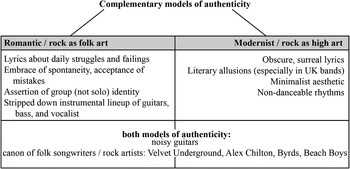
Bannister (Reference Bannister2006a, pp. 6–7) and Bennett (Reference Bennett, Bennett and Dawe2001) argue that indie's musical values were created in part by establishing taboos: indie bands avoided the polished grandiosity, ostentatious virtuosity and technological frippery associated with rock and pop bands produced and marketed by major labels. In their place, indie bands asserted two complementary aesthetic ideals, shown in Figure 1. The first derives from the view of rock as a ‘folk’ practice, part of rock discourse since the 1960s (Frith Reference Frith1981). The second viewed rock as high art, following the legacy of the Velvet Underground and punk music criticism.Footnote 6 Figure 1 lists stylistic features pertaining to each ideal that have been identified in previous studies, such as Bannister (Reference Bannister2006b, pp. 65–86), Brackett (Reference Brackett2013), Fonarow (Reference Fonarow2006, pp. 39–50), Hibbett (Reference Hibbett2005, pp. 60–64) and Kruse (Reference Kruse1993). Some features are overdetermined and can be traced to both ideals, such as the use of noisy guitars, which reflects both the embrace of an imperfect, live sound as well as the legacy of this sound from the Velvet Underground. In addition, indie artists were highly conscious of rock history, and the genre coalesced around a relatively stable canon of influential artists who represented either a talented folk songwriter or a rock conceptual artist (Bannister Reference Bannister2006a, pp. 80–82; Kruse Reference Kruse1993, pp. 35–6).Footnote 7
Models of authenticity in indie rock.

Pavement's first album, Slanted and Enchanted (recorded 1990/1991; released 1992), realises the ideals shown in Figure 1 in several ways. Almost all the songs on the album use heavily distorted guitars that emphasise high-frequency buzz and hiss. Save for one track, the guitar and drums use no reverb. Lead singer and primary songwriter Stephen Malkmus is quoted in Rolling Stone as saying that this production resulted from his ignorance about the recording process (Rolling Stone Staff Reference Staff2011), suggesting authenticity through a folk-like naiveté (Hesmondhalgh Reference Hesmondhalgh1999, p. 63). However, an interview by Greg Milner with producer and drummer Gary Young (Milner Reference Milner2009, pp. 181–2) belies this assertion: the band was aware of the sound they wanted. The lack of reverb eschews the illusion of a large space that many arena-rock bands used, and instead suggests a direct communication from band to listener.Footnote 8 The high hiss of the guitars suggests a gritty, raw sound and requires effort from the listener to hear the singer, minimizing the singer's role as a star and instead conveying a group identity. The album was recorded on a shoestring budget over the space of two weeks, following indie's DIY ethos from the previous decade. Malkmus often sings with a flat tone and approximate pitch, recalling Lou Reed of the Velvet Underground. According to Bannister (Reference Bannister2006b, pp. 37–8, 40–44), the detached engagement projected by Malkmus has been a marker for art rock since the 1960s, when intellectual discourses surrounding high (visual) art and popular music began to intertwine at UK art schools, and when Warhol's detached, voyeuristic persona influenced rock artists. Finally, the rhythms, while engaging, avoid the pulsing, bass-heavy sounds associated with dance styles, similarly eliciting an intellectual, non-bodily, engagement.Footnote 9
Yet Pavement's differentiation from a perceived mainstream goes beyond the details of production, budget and singing style mentioned above. Their narrative of differentiation can be found in multiple aspects of their songwriting, especially in their metric and phrase structures. Indeed, the critical acclaim accorded to the band may well stem from their ability to work creatively in these domains within the constraints of the indie genre.Footnote 10 In order to discuss Pavement's deviations, it is first necessary to briefly define regular phrase and metric patterns. They are characterised by:
-
• Hypermeter that generally groups into powers of two – that is, into larger patterns of strong/weak alternation forming patterns of length 2, 4 or 8 (Biamonte Reference Biamonte2014, [1.2]–[1.5]).Footnote 11
-
• Phrases of equal length defined by parallel structure and regular end-rhyme. These regular phrases reinforce the hypermetric patterns, helping to make the song easily danceable. In addition, double or quadruple repetition of a phrase is a means of projecting closure, even absent other harmonic cues (Nobile Reference Nobile2014, pp. 82–3; Summach Reference Summach2011, [9]).
-
• A form that contains alternations between verse and chorus, in which the catchiest musical material appears less than halfway through the song.
A sampling of rock and hip-hop albums that appeared at or near the top of the Billboard top 200 chart during 1990, the year Pavement began recording their first album, attests that this music largely adheres to the norms of regularity listed above. Exceptions occur in a minority of songs; where they do occur, they typically take the form of a brief hypermetric irregularity that serves a transitional or closing formal function. In Pavement's songs, in contrast, hypermetric and phrase irregularity is common and pervasive and serves an expressive role, allowing the band to continually thwart expectation and support lyrics that are often concerned with differentiation from a perceived mainstream.Footnote 12
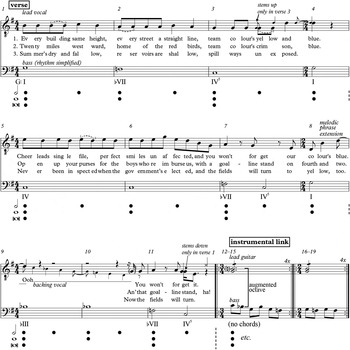
An example of pervasive metric irregularity supporting lyrics that create an ironic distance from a perceived mainstream can be found in ‘Lions (Linden)’ from Watery, Domestic (1992), an EP Pavement released shortly after Slanted and Enchanted. Example 1 shows the music used in the entire song except the coda.Footnote 13 The first two verses describe a football (i.e. American football) game between two schools in a pristine suburban environment. The Lions are, in fact, the mascot for a high school team in Linden, California, which is near Stockton, the childhood home of Pavement co-founders Malkmus and Scott Kannberg (Jovanovic Reference Jovanovic2004, pp. 29–33). The third and final verse, in contrast, describes a summer drought that threatens the area's water supply. The final line, ‘the fields will turn to yellow too’, makes an explicit connection to the first two verses, since its final word, too, rhymes with the ‘blue’ and ‘fourth and two’ that end verses 1 and 2, and the reference to yellow recalls the first verse's reference to the same colour. However, in the final verse, the yellow colours grass, connoting decay and weakness, rather than uniforms of the athletes, which connote vitality and strength. The degradation of the environment in verse 3 is combined with a suggestion of political corruption or incompetence: the reservoir has not been ‘inspected/when the government's elected’. The song thus exposes weaknesses in the natural and social environment that props up a suburban community much like the one in which the band members grew up. The final verse adds an ironic twist to the first two verses and creates a position of critical disengagement from an activity that unites the town and its school, a position analogous to the band's relation to mass culture as a whole.Footnote 14
‘Lions (Linden)’ from Watery, Domestic (1992).

The phrasing and hypermeter reinforce the irony found in the lyrics. The verse has several metric elisions, giving it a jerky, unpredictable quality that belies the description of perfect order and balance within the community. At the end of the song, the tonic, a sonority that is putatively associated with stability, is placed into a dissonant and metrically irregular context. If one accepts the metaphor ‘tonic as home’, a specific interpretation is possible: the home becomes destabilised and dirtied, reflecting the gulf between pride in one's home team and the surrounding environmental degradation.
A metric analysis is shown underneath the score in Example 1. Following the notation system in Lerdhal and Jackendoff's A Generative Theory of Tonal Music (1983, pp. 68–104), lower-level beats are shown on the top row, with successively higher levels in lower rows. A beat at one level is metrically accented if it is also a beat at a larger level in the same column (that is, if the column has a dot). Over mm. 1–12, the metric regularity and the coordination of the G-major tonic arrival with a hypermetric downbeat is consistently thwarted. In m. 4, the bass line completes double-plagal pattern ♭VII–IV–I (Biamonte Reference Biamonte2010, pp. 98–9). However, the arrival on the tonic coincides with a metric elision: a weak beat at the half-note level is deleted from the meter, causing the following beat to be reinterpreted as a strong beat.Footnote 15 The deletion is marked with a vertical dashed line in the hypermetric analysis. Biamonte (Reference Biamonte2014, [7.6]) notes that small-scale metric elisions (e.g. a 2/4 measure in an otherwise 4/4 song) in rock often serve a closing formal function, providing a ‘sectional marker and connecting turnaround’ to the following section. In contrast, ‘Lions (Linden)’ uses this type of elision repeatedly, repeatedly thwarting a sense of regular rhythm. Moreover, Biamonte's characteristic examples show the tonic aligned with the following hypermetric downbeat, while in ‘Lions (Linden)’, the elision occurs after the tonic arrival, where a weak beat would have occurred. In bar 8, the tonic arrival again occurs simultaneously with a metric elision; in addition, closure is further thwarted by an extension of the melodic phrase, which comes to rest on bar 9, accompanied by ♭III. The lead vocal immediately backtracks after its extension: bar 11 repeats nearly the same music and lyrics from bar 7, as if the extension thwarted closure and necessitated a new beginning.Footnote 16
Full harmonic closure occurs at bar 12 with a return to the tonic harmony. Bars 11–12 heighten the previous metric elisions by removing a beat at the whole-note level, transforming what would be a weak-beat tonic arrival at bar 12 into a hypermetric downbeat. Unlike the previous elisions, this type of metric reinterpretation, coinciding with the tonic, is a common device in the rock style (Stephenson Reference Stephenson2002, pp. 17–18), suggesting that normativity is restored by the end of the song. Moreover, hypermetric regularity is, in one respect, restored over bars 12–19: the two repeated instrumental passages fall into 4-bar groups without any hypermetric elisions. However, in another respect, metric dissonance is created by successively shorter time signatures – 3/4 over bars 12–15 and 2/4 over bars 16–19 – contradicting the expectation for local-level metric continuation. Reinforcing the metric dissonance is a clashing relationship between guitar and bass. Over bars 12–15, the lead guitar holds G and B, the root and third of the tonic triad, while the bass part draws from the G pentatonic minor scale, prolonging the minor tonic harmony with added neighboring notes. The B♭ in the bass line creates an augmented octave with the B in the lead guitar, making the passage the most dissonant in the song. Much like Sonic Youth's explorations of divergent textures, the song establishes an ironic contradiction between tonal stability and intervallic dissonance (Heetderks Reference Heetderks2014). ‘Lions (Linden)’ represents a tour-de-force of hypermetric reinterpretations. The constant metric surprises create discomfort that matches the tension between the situation described in the lyrics and the lyrical persona's critical distance from it.
‘Summer babe (winter version)’, the first track from Slanted and Enchanted, lacks the clear narrative found in ‘Lions (Linden)’; instead, its lyrics are full of wordplay and ambiguities. Also unlike ‘Lions (Linden)’, its hypermeter is strictly regular.Footnote 17 However, it articulates a rejection of mass culture and creation of a new group identity in other ways: through its opening line, which references and then distorts a contemporaneous hit; through melodic phrases that eschew rhyme and gradually become less balanced and regular; and through an end-accented form that saves the catchiest material for the final few seconds.Footnote 18
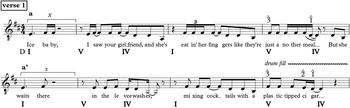
Verse 1, shown in Example 2,Footnote 19 begins with a reference to mainstream pop with the words ‘Ice baby’, referencing the repeated hook in Vanilla Ice's 1989 song ‘Ice, ice baby’, which on 2 November 1990 became the first hip-hop single to top the Billboard Hot 100 chart.Footnote 20 The next measure transforms the meaning of the hook's first two morphemes: the first vowel-consonant pair of the line, ‘ice’, becomes the first sound in the next line, ‘I saw your girlfriend’. Thus, the band appropriates the word and transforms its meaning into a different narrative: the singer apparently pines for a friend's girlfriend who ‘eats her fingers’ – a line that could be read as sexually suggestive or as indicating the act of chewing one's fingernails, a sign of anxiety. Similar connotations occur in the next line: the first syllable of ‘cocktails’ is suggestive of a phallus, while the image of a woman waiting while drinking and smoking suggests anxiety. Another turn away from ‘Ice ice baby’ and other top-charting singles occurs through the lack of end rhymes.
‘Summer babe (winter version)’ from Slanted and Enchanted (1992), verse 1.

Verse 1 establishes duple regularity at several time-spans. It uses a 2-bar chordal loop that repeats throughout the song.Footnote 21 The vocal part consists of two roughly identical four-measure vocal phrases (bars 1–4 and 5–8), marked as a and a′ on the score. Each phrase begins with a prominent motive, marked x, which establishes parallelism between the two, and ends with a brief rest on ^1 on the third beat of the bar. The symmetrical balance between the phrases and the 8-bar length gives a sense of completion to the verse, even in the absence of other cues for closure.Footnote 22 In the final bar of the verse, Young plays a drum fill, reinforcing that a large-scale formal beginning follows,Footnote 23 and each 8-bar verse is followed by an 8- or 16-bar guitar solo, creating regularity at a larger time-span.
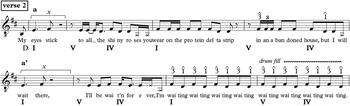
Successive verses gradually dismantle the regularity found in verse 1. Verse 2, shown in Example 3, begins with the same motive x that characterises verse 1. However, the predominantly iambic patterns that appeared in verse 1 are replaced with a more irregular succession of accents, and rather than ending with a stepwise descent to the tonic, the a′ phrase ends with an alternation between scale degrees ^3 and ^1 that fills up the entire final 2 bars, as if the vocal track were stuck in a loop, an apt musical analogue to the ‘waiting forever’ in the lyrics. The lack of a brief rest at the end of the section prevents it from displaying the symmetry found in verse 1.
‘Summer babe’, verse 2.

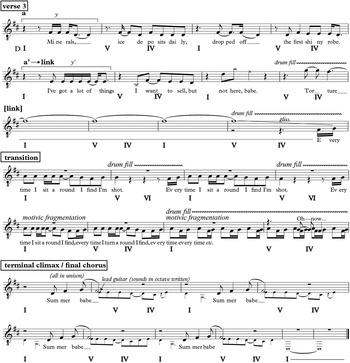
Verse 3 is even more irregular and transforms into a transition section that leads to a final chorus or terminal climax. Example 4 shows verse 3, the transition, and the final section. Verse 3 begins with a new motive, y, which breaks the pattern of the first two verses by beginning with two beats’ rest. The fifth bar further departs from the previous model by not exactly repeating motive y. In the final 2 bars of the verse (beginning with the text ‘not here, babe’), Malkmus changes to his highest register and concludes with a long-held note that extends into the next 4-bar unit, which provides a link to the following transition.
‘Summer babe’, verse 3, transition, and terminal climax/final chorus.

The 8-bar transition section uses new grouping devices to create further instability. It begins after only four instrumental bars, breaking the uniform 8-bar groups that pervaded the song up to that point. During this transition, the backing vocals’ ‘every time I sit around I find I'm shot’ undergoes successive fragmentation: smaller and smaller portions are isolated and repeated to create systematic acceleration to the next hypermetric downbeat: the line lasts for 2 bars (13–16), for 1 bar (17–18) and for one beat thereafter.
The transition section represents the final step in a process of successively dismantling predictability and regularity. In contrast, the section that follows is highly regular and memorable. It could be heard as a return to mainstream features, except for its formal location: the first time the song's most memorable material occurs is not near the song's beginning, where artists typically aim to capture listeners’ attention, but at its ending. Depending on a listeners’ judgment of its relative autonomy, the final section could be heard as a terminal climax (Osborn Reference Osborn2013, p. 24) or final chorus. It is filled with the title phrase ‘summer babe’, and in comparison with the previous sections, it has a ‘singalong’ quality that invites co-performance by listeners. As is true of many climactic sections, the line is short, repeated and therefore easily remembered (Nobile Reference Nobile2014, pp. 169–70; Osborn Reference Osborn2013, pp. 27–8). Its syncopated rhythms are reinforced through what Salley (Reference Salley2011, pp. 418–20) calls place-preserving near alliteration: the two off-beat syllables (’-mmer’ and ‘babe’) both begin with bilabial consonants, and the near alliteration creates a regular pattern of mouth movements that makes the line memorable and further eases listener participation. Finally, the line is sung by all of the band members, suggesting a group performance. While the band sings the title refrain, the lead guitar injects a countermelody every other bar, saturating the texture with both vocals and lead guitar. Before this point, the vocals and lead guitar performed in separate sections.
Osborn (Reference Osborn2013, p. 43) suggests that placing a single climactic statement at the close of a rock track represents a rejection of the notion that the song is a commercial product, demanding instead that it be heard as an aesthetic whole. This formal strategy is in keeping with ‘Summer babe's’ process of rejection and recreation. The song gradually distorts markers associated with mainstream pop – the line ‘Ice baby’ and regularity in phrasing. It then reconstitutes these features at its conclusion, standing in opposition to mainstream rock through formal placement, and inviting fans to join through musical and textual features. The song's first and last word-pairs reflect what is left behind and what is embraced. The opening Billboard-alluding words, ‘Ice baby’, with their bright vowels (the long i and e sounds), quick rhythms and denotation of coldness, are rejected in favour of the darker vowels (the short u), longer rhythms and denotation of warmth in the phrase ‘summer babe’ that appears at the song's close.Footnote 24
‘Here’, also from Slanted and Enchanted, performs a similar rejection of a perceived mainstream and creation of an alternate community. However, the rejection in this song is far less triumphant. The community created in the lyrics is counterpointed with a sense of defeat, or with the recognition of the futility of striving. In the first part of the verse, allusions to defeat or failure occur with the lines ‘success it never comes’, ‘your jokes are bad, but not as bad as this’ and, finally, ‘everything's ending here’. Like the repeated line ‘HURRY UP PLEASE IT'S TIME’ from T.S. Eliot's ‘The Waste Land’ (1922), the ‘everything’ that is named in the verse is left ambiguous – whether it represents a night of festivities, a friendship or even the entire rock and roll era coming to an end is left unclear. The second part of the verse also suggests futility.Footnote 25 The first line describes an empty gesture – ‘sterile striking’ – and an aimless activity – defending a dock that contains nothing to defend.
Counterpointing these references to futility are those that suggest the creation of a group identity. The verse begins with two personae: an ‘I’, who laughs at the bad jokes of a ‘you’. The final lines establish a larger collective: ‘come join us in a prayer,/we'll be waiting’ (emphasis added). Similar relationships occur in the chorus. Pavement disliked the term ‘slacker rock’ that was sometimes applied to their music, but something like a slacker ethos is present in this song – if this ethos is defined as a studied rejection of goal-oriented culture and a retreat into an alternate community, whether this community is imagined or real.Footnote 26
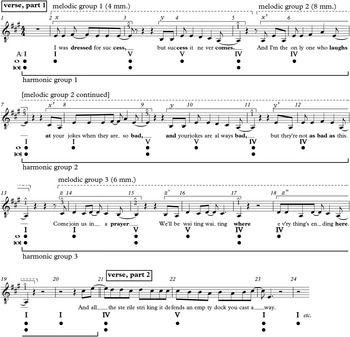
In ‘Summer babe’, gradual dissolution of predictable phrase structure within a regular hypermeter indicates departure from the mainstream. In ‘Here’, in contrast, conflicting cues for grouping boundaries reinforce the theme of aimlessness found in the lyrics. Figure 2 shows the harmonic progression used in the verse, along with grouping boundaries these harmonies project. The first part of the verse cycles through I–V–IV three times, and parallelism causes the three chords to be grouped together. The section ends with a single tonic chord. Based on the previous criteria, this chord initially sounds like the beginning of a new I–V–IV cycle, as shown by the dashed brackets below the chords. However, a new section, labelled ‘verse part 2’, begins afterward, because of pronounced changes in register, phrasing and harmonic rhythm. The final tonic chord in the ‘verse part 1’ section is retrospectively heard as the end of the previous harmonic group, creating an 8-bar harmonic progression shown by the solid bracket underneath the dashed brackets. This 8-bar progression foreshadows the regular, 4-bar grouping of the ‘verse, part 2’ that follows.
‘Here’, from Slanted and Enchanted, harmonic progression in verse.

The vocal part presents its own grouping cues that contradict those created by harmony. The vocal part for the first part of the verse, along with hypermetric and grouping analysis, is shown in Example 5. The grouping suggested by the harmonies is shown by brackets underneath the staff in Example 5, and melodic motives and their suggested groupings are shown above the staff. The vocal melody in bars 1–12 uses two motives: x, which places ^5 on the downbeat, ^6 on the fourth eighth, and concludes on ^5; and y, which places ^5 on the downbeat and concludes by descending to ^1. (Some motivic instances add a brief anacrusis or vary the contour, but the essentials remain invariant.) The motives group into two large phrases, shown by dotted brackets above the staff. Phrase 1 is 4 bars long and consists of x + y, while phrase 2 is 8 bars and consists of x′ + x′ + y + y′. Each vocal group contains a complete grammatical sentence, enforcing the same boundary. Moreover, they are united by internal assonance and alliteration, as shown by the bold words on the figure: the first group contains internal repetitions of the ‘c’ and ‘s’ consonants – dressed, success and comes; and the second group is united by the ending assonance of laughs and bad, as well as several small linking words that use the short a vowel – at, and and as.Footnote 27
‘Here’, from Slanted and Enchanted, first part of verse 1.

The 4 + 8 proportion of the vocal groups contradicts the 6 + 6 proportion of the harmonies. The song, much like a Necker cube, allows listeners to perceive either grouping based on whether they attend to text or to backing instruments.Footnote 28 In addition, the layout causes the y-motive, the only one that descends to scale degree ^1, to fail to coincide with the tonic harmony until the end of the passage, forestalling strong closure. A final melodic group, less ambiguous because of its consistent repeated motive z and end-rhymes, reaches closure after only 6 bars, a length that is disproportionate to the previous 12-bar group.
The vocal phrases’ relation to meter and grouping further reinforces the sense of aimlessness and ambiguity found in the lyrics. The odd-measured downbeats receive stronger emphasis than the even-measured ones both because they are the location of the chord changes and because the drums accent each odd bar, beginning at bar 3, with a kick-drum quaver anacrusis and a cymbal crash on the downbeat. The voice uses what Stephenson (Reference Stephenson2002, pp. 14–17) calls the ‘continuous downbeat’ phrase-model, which consists of a string of short phrases that each end on the hypermetric downbeat. Unlike many continuous-downbeat phrases, ‘Here’ does not begin with vocal activity. Instead, it begins with vocal rest, drawing attention to the song's empty spaces and putting the voice in a reactive, rather than active, role.Footnote 29 Griffiths (Reference Griffiths and Moore2003, p. 48) suggests that short phrases starting from the hypermetric downbeat might suggest the ‘bored, slacker’ attitude in grunge. ‘Here’ suggests, in contrast, that it is empty space at the hypermetric downbeat that defines this attitude, as if the voice is too apathetic to begin. The ambiguity of grouping boundary, forestalling of closure, and incommensurate phrase-lengths, when combined with the relaxed, low-register vocals, reinforce the aimless, melancholy affect given in the lyrics.
A counterexample to ‘Here’ is ‘Zürich is stained’, also from Slanted and Enchanted. Unlike in ‘Here’, the vocals take an active, rather than reactive, role: it is the vocal melody that imposes the primary grouping and hypermetric boundaries, contradicting those suggested by the harmonic changes. Both songs use a relaxed tempo and sparse accompaniment, and the lyrics of the first verse of ‘Zürich is stained’ have similar themes: they bring up failure or futility (‘that kind of strength I … don't have’) and rejection or refusal, in this case, of responsibility (‘it's not my fault’/‘hold me back or let me run’). Unlike ‘Here’, the relationship with the you in the verse is oppositional: the persona in the song asserts their independence by refusing the responsibility imputed to them by the antagonist (‘You think it's easy, but you're wrong … hold me back or let me run’).
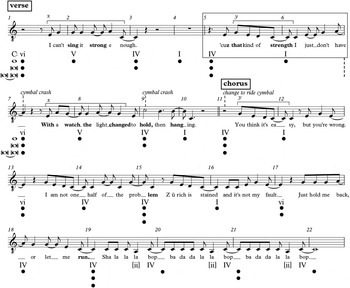
A transcription of the song is shown in Example 6. The verse begins with 2 bars of vocal activity (1–2) followed by 2 bars of vocal rest (3–4), suggesting a 2 + 2 organization of the vocal phrase, common in rock (Stephenson Reference Stephenson2002, pp. 7–9; Moore Reference Moore2012, pp. 83–4). Bars 5–6, enclosed in a box in Example 6, are the primary source of grouping ambiguity. When the voice enters again at bar 5, it initially sounds like the beginning of a new vocal phrase. But several musical factors dispel this notion. In bar 7, the voice repeats a varied form of motive x, which began the verse, suggesting the beginning of a new phrase. In addition, the harmonies in bars 7–10 are vi–V–IV–I, a repetition of the harmonies from bars 1–4, and a cymbal crash on the downbeat of bar 7 suggests the onset of a new hypermeasure.Footnote 30 As indicated by the bold words in Example 6, alliteration and near alliteration group bars 5–6 with bars 1–2. Each 2-bar span has a pair of words that alliterate or near-alliterate the s or z consonants (the two are closely related, since they are vocalised and unvocalised versions of the same mouth positions): bar 2 contains ‘sing’ and ‘strong’; bar 5 contains ’-z that’ and ‘strength’.Footnote 31 Several alliterative pairs, shown in bold on the figure, bind together the words in the second phrase. The consonants involved are w, ch and h. Similar relationships appear in the second verse.
‘Zürich is stained’ from Slanted and Enchanted, verse 1 and chorus.

The harmonies and vocal motives from bars 5–6 reappear in bars 11–12, but unlike before, they are reinterpreted as the onset of a new section and hypermeasure. This formal division contradicts the grouping implied by the harmonic and motivic repetition, but it is enforced by the lyrics, which begin a new idea, and the drums, which change from a hi hat to a ride cymbal at bar 11. The chorus is more regular in comparison with the uneven and ambiguous phrases from the verse, following the ‘loose-verse–tight-chorus’ model common in rock (Biamonte Reference Biamonte2014, [7.7]; Temperley Reference Temperley2007). It falls into 4-bar phrases and uses regular end-rhymes: ’-blem’ in bar 15 forms a near rhyme with ‘run’ in bar 19. However, this regularity is disrupted in bar 19, and as in the onset of the chorus, the vocals maintain a prominent role in the disruption: they add 4 bars of scat syllables to the end of the chorus, accompanied by an extended IV.Footnote 32
The forms of phrase and metric irregularity identified in this article – thwarted closure at the end of a phrase (‘Lions (Linden)’ and ‘Summer babe’), conflicting cues for grouping boundaries (‘Here’ and ‘Zürich is stained’), and irregular hypermetric lengths (‘Lions (Linden)’, ‘Here’, and ‘Zürich is stained’) – appear with fluctuating degrees of frequency throughout Pavement's career, and they continue to provide opportunities for expression and differentiation. For example, in their second album, Crooked Rain, Crooked Rain (1994), the band alluded to multiple 1970s ‘classic-rock’ bands in order to reinvent their sound and differentiate themselves from the grunge and alternative styles that had broken out into the mainstream.Footnote 33 Yet hypermetric distortions persisted as a means of distorting these allusions and allowing the band to assert its independence.
The extra-musical interpretations of the hypermetric devices listed above are speculative, but they are informed both by lyrics and the sociological and ideological position of indie bands in the late 1980s and early 1990s. They show that, because of the wide range of contexts in which it appears, hypermetric dissonance has multiple expressive affordances: it can suggest sarcasm, triumphant rejection or defeat, among other states. Performing, recording and consuming Pavement's music forms what Born (Reference Born1993, p. 236) calls an independent artistic practice, one that creates an ‘imagined community’ based on alterity, in which listeners take pleasure by identifying with this community through enjoying ‘the sense of constituting difference, of defining the collective self against others, the exotic or complex as opposed to the banal’. In short, part of the pleasure in listening to Pavement comes from identifying moments of structural deviance or quirkiness, and using these deviations to construct a narrative of communal differentiation.
Other studies of indie music have shown how it articulates differentiation from the mainstream through timbre (Blake Reference Blake2012) or modal mixture (McDonald Reference McDonald2000).Footnote 34 In the case of Pavement, hypermeter and vocal phrasing are similarly instrumental in articulating differentiation. Further discussion of indie should include similar study of how songwriters worked creatively within the genre's constraints in order to express its primary values.